



Abstract
Sustainable practices through green innovation have become key while the organization aims to achieve COP26 (Conference of the Parties, 26th Summit) targets. This study examined the relationship between management environmental concern, green process innovation, green product innovation and green performance in China’s hotel industry. It further examines the mediating role of green products and process innovation between management environmental concerns and green performance. Researchers utilized Structural Equation Modelling using Partial Least Squares version 4 to test theory and path analysis. Findings suggest that management environmental concern significantly influences the green process and product innovation. For indirect effects, green product and process innovation mediate the relationship between management environmental concerns and green performance. This study contributes to the growing body of work on green innovation in several important ways addressing the gap in the literature and examining the causes of green innovation from the point of view of green performance in the hotel industry’s perspective.
Plain Language Summary
This study examined the relationship between management environmental concern, green process innovation, green product innovation and green performance in China’s hotel industry. It further examines the mediating role of green products and process innovation between management environmental concerns and green performance. Researchers utilized Structural Equation Modelling using Partial Least Squares version 4 to test theory and path analysis.
Keywords
Introduction
Concern over the state of the environment has kept hotel businesses interested in green innovation (Xie et al., 2019a, 2019b). In fact, it is crucial that hotels, particularly those in the hotel sectors, take on the obligation to safeguard the natural world. Companies should think about consumer requirements to the environmental benefits of making changes to their processes (Barauskaite & Streimikiene, 2021; Khattak et al. 2023). Green innovation’s role in addressing environmental issues for hotel industry has been greatly lauded (Asadi et al., 2020). Environmental sustainability is not only necessary, but also presents an opportunity to increase competitiveness through a win-win argument, with innovative businesses that focus on green technology and practices having a better chance of gaining and maintaining an edge in the hospitality market (Shanti & Joshi, 2022; Yu et al., 2022). It is predicted that investments in green innovation would pay dividends in two areas: reduced environmental impact and enhanced economic competitiveness through technological progress (Q. Wang et al., 2019). Numerous hotels have recently adopted eco-friendly practices both in their processes and their final products (Nazneen et al. 2023). It is therefore generally agreed that innovations in environmental protection are a crucial part of the solution to the problem of sustainability (Silvestre & Ţîrcă, 2019). For this reason, the topic of business’s responsibility to address environmental concerns has been on the rise during the past decade.
Green innovation, the practice of making things without using harmful or poisonous materials, is gaining prominence as a means for businesses to demonstrate their commitment to environmental protection (Kavaliauskiene et al., 2021) and it will be increasingly important for hotel businesses to achieve sustainable development and society (Abbas & Sağsan, 2019; S. Sun et al. 2023). When looking at the literature on innovation, the following categories can be used to categorize the studies done on green or environmental innovation. Research in the first category focuses on the methodological foundations of eco-innovative product design or green product design (Bierwisch et al. 2021). The second category includes research that examines how environmental innovations relate to scientific progress or official policymaking. Despite the fact that sustainable development innovation processes have attracted more and more research over the past two decades, empirical methodologies to studying these processes remain underdeveloped (Donbesuur et al. 2021; Fernando et al. 2019; Sánchez et al. 2021). The environmental impact of a product is often overlooked in favor of its novelty and commercial potential (Foster, 2020). In addition, the academic community has just recently begun to address the topic of how environmental care affects a company’s capacity to compete. Due to analytical and empirical limitations, identifying the green innovation concept is a difficult task. In contrast, information on the implementation of green innovations in developing nations and emerging economies like China is scarce. This research looked at how green innovation (the capacity to create environmentally friendly products), management environmental concern and green performance for hotel industry in China, despite the fact that China’s economy has grown rapidly over the past few decades, with negative consequences for the natural environment.
Evaluation of a company’s environmental impact is known as its “green performance” (Rehman et al., 2021). Previous studies have demonstrated that green performance can alter established ways of thinking within an organization and that people within that organization play a crucial role as change agents (Judi et al., 2022). Most often, the term “green innovation” will refer to either “green process innovation” or “green product innovation” (Yeşiltaş et al., 2022). As has been shown in previous research on the impacts of green innovation, both green process and green product innovation are strong indicators of green performance (Awan et al., 2021). By contrast, businesses that adopt “Green process innovation” work to enhance the product process environment, lessen the number of dangerous compounds used in production, to stop soil, water, noise and air pollution, and reuse and recycle as much material as possible (Liu & Giovanni, 2019). During hotel operation process, green product innovations use nontoxic substances or biodegradable materials to lessen the environmental (Awan et al., 2021).
The management literature has seen a rise in interest in green innovation and associated topics over the past two decades. Green innovation includes both new products and new methods, including those that help to save resources, lessen emissions, cut down on waste and lessen the overall negative impact of the business (Xie et al., 2019a, 2019b). Although there has been an increase in empirical discourse in recent decades examining the connection between sustainable development and green performance, the results have been mixed (Cassetta et al., 2023). A lack of a theoretical framework and a lack of easy access to data are highlighted as impediments to a deeper investigation of the connection between environmental concerns and green performance (Rameezdeen et al., 2019). Thus, this study aims to examine to the relationship between management environmental concern, green process innovation, green product innovation and green performance in hotel industry of China. It further looks into the mediating role of green product innovation and green process innovation between management environmental concern and green performance.
Literature Review
Theoretical Underpinnings
Stakeholder Theory
Using stakeholder theory and the notion of organizational learning, we created a conceptual model to explore the connections between stakeholder demands and green innovation. To meet environmental protection criteria, organizations can turn to green innovation to boost their environmental performance. Improvements in energy efficiency, waste reprocessing, eco-friendly product, and environment protection are all examples of how technology has contributed to these areas (Lisi et al., 2020). Existing studies suggest that businesses on the cutting edge of green innovation can gain an edge in the marketplace by differentiating their products (by fostering a positive “green image”) and keeping hotel operation costs low (by maximizing resource efficiency and decreasing pollution prevention costs) (Barforoush et al., 2021; Dong et al., 2022). Companies have to make changes to their production lines and systems to make their products safer for the environment. This includes things like reusing or recycling materials, installing new recycling systems and cutting back on energy and raw material use. Scholars maintain that this sort of innovation can improve a company’s efficiency and resource productivity, hence lowering the company’s operating expenses and giving it a competitive advantage at lower prices (Skordoulis et al., 2020; F. Zhang & Zhu, 2019). For this reason, proponents of the stakeholder theory argue that stakeholder demands can be a significant impetus for businesses to invest in environmentally friendly R&D (Song et al., 2020). To follow the reasoning of stakeholder theory (Freeman & Phillips, 2002), businesses should act in a way that benefits their most important stakeholder groups. Additionally, businesses have difficulties while attempting to implement green innovation due to the need to modify existing operational systems and capacities as well as develop brand new ones (Fernando et al., 2019).
Resource-Based View (RBV)
The Resource-Based View (RBV) theory is a useful framework for understanding how firms can gain a competitive advantage through their unique resources and capabilities. In the context of this study, RBV can be applied to explore how Management Environmental Concern (as a resource or capability) influences a hotel’s ability to develop and implement green product and process innovations. This theory helps to analyze how certain resources, such as leadership’s commitment to environmental concerns, can lead to sustainable competitive advantages in the form of improved green performance. The alterations to business processes may impact product designs, indicating that these two forms of green innovation have mutually beneficial implications toward businesses. Green product innovation may represent the economic worth of green process innovation (Bhatia, 2021). There is a lot of proof that green innovations are beneficial, but that doesn't mean companies would immediately pursue them. Since green innovations tend to make the world a better place for everyone, including businesses, they cannot claim all the benefits to themselves. Investing heavily in green innovation is risky because the benefits are often not seen for many years (F. Zhang & Zhu, 2019).
Management Environmental Concern and Green Innovation
Eco-friendly hotel practices have received a lot of attention in the past (S. Sun et al. 2023). From the dawn of the 21st century, attention has been focused on the strategic and operational implementations of green and sustainable practices for creating eco-friendly hotel chains (Patwary et al. 2022). According to Kang et al., (2012), hotel guests care about the local environment and are willing to pay more for a greener stay at a hotel. Eco-friendly and new experiences should be prioritized to attract more visitors. Implementing green practices within the established hospitality and services industry and thereby creating sustainable hotels required a methodical and strategic approach (Y. Zhang et al., 2022). Green practice implementation would necessitate training for staff and management (Kim & Choi, 2013). Two major issues that have emerged as concerns for the hospitality sector are water consumption and climate/environmental disruptins. When formulating regulations, policymakers take into account the impact that weather has on the hospitality industry’s expansion. Research demonstrates the importance of water as a growth and preservation factor in the food industry (Fleming et al., 2015). Prior to this, Hossain et al. (2022) emphasized the significance of sustainability reporting methods by highlighting major concerns in hotel management. Green innovation and management environmental concern: there is evidence for both sides of the argument. Managerial decision making on sustainability issues can be better understood from a cognitive framing viewpoint (Dewulf et al. 2020). Innovative green businesses may be able to maintain their market dominance. Less money is spent on buying new materials and disposing of old ones according to a green process innovation strategy (C. H. Wang & Juo, 2021).The need for businesses to take on environmental responsibility can be met by developing environmentally responsible products, or “green innovations.” Green innovation helps businesses offset their environmental expenses, which in turn creates strengthens for the companies (Zameer et al., 2020). Managers' cognitive frameworks serve as filters, allowing them to assign significance to nebulous cues and ultimately leading them to favor certain strategic choices. Not to be overlooked is management’s part in how well green process innovation is implemented inside an organization (Xue et al., 2019). When making decisions, managers are motivated by how important a given issue is in comparison to other, potentially conflicting inputs and goals (Colombo & Mella, 2022). Since management is likely to have a catalytic role, we look into whether or not they are concerned about the environment. Managers who care more about environmental issues are more likely to invest time, effort, and resources into such endeavors, which may increase the possibility that green innovation will have a beneficial impact to firm performance (Elmagrhi et al., 2019).
Based on the prior literature and relevant data, the following hypothesis and framework were presented in this study (See Figure 1).
H1: Management environmental concern is positively related to green product innovation.
H2: Management environmental concern is positively related to green process innovation.
Green Innovation and Green Performance
Both new green products and new green processes are considered green innovations (Lisi, et al., 2020). By incorporating eco-friendly components and processes into product development and distribution, green innovators decrease the environmental effect of their products across their entire lifespan (F. Zhang & Zhu, 2019).Performance in the area of green product innovation is defined as the “Performance of green product related with environmental protection innovation, which involves pollution prevention, energy saving, no toxicity, waste recycling, or green product designs” (Aftab et al., 2022). The term “Green process innovation” is used to describe “The performance in process innovation that is related to energy saving, pollution prevention, waste recycling or no toxicity” (Soewarno et al., 2019). In the mean time, Green product innovation allows businesses to create sustainable goods without compromising on quality or safety. In turn, this sets their environmentally friendly products apart from the competition, allowing them to charge higher costs to customers. Green innovation strategy, environmental scanning and company’s environmental commitment are just a few of the aspects that have been the focus of previous studies on how to boost green product innovation performance (Song et al., 2020; Yang & Lin, 2020). In contrast, there has been no research into the correlation between EIP and the success of green product innovation. EIP has the potential to dramatically impact the efficiency with which green product innovations are developed. To begin, environmental innovation is a powerful tool for lowering environmental impacts and assisting businesses in accomplishing their environmental objectives (Patwary et al. 2022). Green product innovation benefits the firm as a whole, hence EIP creates a “win-win” situation through green product creation. Second, environmental innovation is a crucial tool for companies to use to increase their productivity and the quality of their products when they are faced with intense market competition (Skordoulis et al., 2020). Companies who choose to pursue this tactic will develop goods that minimize resource and energy use (Acerbi et al., 2021). Green product innovation performance is improved as a result of the firms' efforts and organizational resources being directed toward the commercialization of innovative green products and the attainment of firm sustainability (Ibrahim et al. 2023; Y. Zhang et al. 2022). Last but not least, a growing customer demand for environmentally friendly products acts as a powerful incentive for businesses to adopt environmentally friendly methods that may evolve through the changing external environment (Y. Sun et al., 2021). These strategies are crucial for improving the green product innovation performance of businesses by helping them better meet the needs of their customers. Also, a company can improve the efficiency of its green processes by exploring new ways of conducting business that don't reduce profitability.One potential outcome of green innovation is the creation of new items that can be sold to generate income for businesses (Javeed et al., 2022). This means that successful green process innovation aids businesses in being more productive and bolstering their core competencies, which can subsequently lead to better economic performance (Bhatia, 2021). When a company adopts a green process, it can make its own unique contributions to environmental betterment, independent of the use of conventional resources (Qiu et al., 2020). The more efficient use of resources and energy made possible by new green processes is one way in which businesses can improve their green performance and thereby lessen their negative effects on the environment (Wong et al., 2020). An organization’s capacity for developing green products and processes can be bolstered by the implementation of green process innovation, which is an innovative capacity for environmental management. In turn, this enhances a firm’s green product and consequently its green performance. As a result, green innovation is prized as a key factor in leading to better green performance for businesses (Cheng, 2020).
Based on the prior literature and relevant data, the following hypothesis and framework were presented in this study (See Figure 1).
H3: Green product innovation is positively related to green performance
H4: Green process innovation is positively related to green performance
Mediating Role of Green Process and Product Innovation
To create products and deliver services that have no or minimal negative effects on the green process innovation involves enhancing traditional operation methods and employing environmentally friendly technologies (Awan et al., 2021).Therefore, it is directly connected with environmental concern of any hotel management. Green product innovation is introducing new or improved environmentally friendly goods, for instance, improved technical materials or components (Qiu et al., 2020). It’s an approach to product development that seeks to lessen a product’s environmental footprint over its lifespan and meet unmet consumer demands (Ashraf et al., 2021). That is also directly connected with the environmental concern of management.. Unless otherwise mentioned, “Green performance” is usually refers to monetary and related metrics, such as a company’s revenue, market share, stock performance, return on investment and related intangibles which is also directly connected with the green innovation. Thus, green innovation mediates between management environmental concern and green performances. Typically, green process innovation is more expensive and requires more internal resources, but it has been shown to be more effective than other green measures (Wong et al., 2020). Scrubbers for smokestacks are one example of an ancillary green process innovation. Other examples include the replacement of inputs, optimization of production, and reclamation of outputs (Chen et al., 2020). The competitive advantage and long-term viability of businesses have both been shown to benefit from green process innovation (Xie et al., 2019a, 2019b). Therefore, businesses would be wise to put money into green process innovation (Wicki & Hansen, 2019). As a result, we argue that an organization’s green process innovation methods are helpful in boosting the organization’s bottom line. Green process innovation enhances current production processes or introduces new processes to reduce unfavorable environmental impacts, which in turn increases a company’s environmental compliance and brings differentiating advantages (Zameer et al. 2020). Clean technologies and final solutions, both of which are important to green process innovation, were also found to have a favorable correlation with financial performance (Xie et al. 2022). Recently, there has been a change in focus toward green product production as a route to sustainable development and economic growth (Shahzad et al., 2020). Besides, Investing in green product innovation may shield firms from environmental protests and regulatory fines to help them to establish new market possibilities and reach new levels of green product success (Awan et al. 2021). Green process innovation addressed to enhance a company’s green performance and enabling green product innovation. Ayllón and Radicic (2019) argued that this tactic is most effective when it is paired with a commitment to constant improvement in both the quality of the product and the efficiency with which it is produced. Green process innovation requires substantial green investment since it is the only method to improve every step of the operational and management process systematically (Song et al., 2020). Additionally, this form of the invention takes time and may have consequences that are not immediately obvious.
Based on the prior literature and relevant data, the following hypothesis and framework were presented in this study (See Figure 1).
H5: Green product innovation mediates the relationship between management environmental concern and green performance.
H6: Green process innovation mediates the relationship between management environmental concern and green performance.
Research Hypothesis and Framework

Research framework.
Research Method
Sample
The unit of analysis in the present study is employees working in hotels in China. The selection of the sample is considered as a more significant outcome because of the reduction in fatigue and in potential errors from the collection of data, mainly when a huge number of elements are involved (Sekaran & Bougie, 2016). In further to determine the sample size, researcher performed the power analysis by using G*Power software v. 3.1 (Faul et al., 2009). This include: effect size (f2 = 0.15); significance level (.05); desired statistical power (1 − β = .95); and total number of nine predictors. However, the result (total sample size of 166) appears inadequate for the population of the study (see Figure 2). As suggested by Sekaran & Bougie (2016) to guard against the weak response rate, avoidance of error and better response rate, the researcher preferred the large than smaller sample size. Also, large sample size is always helpful for the better generalization of results (Fidell & Tabachnick, 2003). As followed the rule of thumb, the sample size should be greater than 30 and less than 500 considered as the adequate and appropriate sample size (Roscoe et al., 1975). While Hair et al. (2011) suggested that the sample between 100 and 400 is satisfactory to apply Structural Equation Model (SEM).

G*Power sample size estimation with respective power level.
The researchers decided to distribute 800 questionnaires among hotel employees and expected to receive back at least 384 for further analysis. Following the above suggestions, our sample size is sufficient as the exact number of hotel employees in China is unknown and varies annually.
Data Collection
We have done a preliminary study (pilot test) with 50 respondents before actual fieldwork. Data were collected from June to December 2022. According to the recommendation of previous research, over 50% response rate is adequate for a pen-paper survey. To get at least 384 responses, 800 questionnaires were distributed through a purposive sampling method. To cover the large area, the researchers, and their representatives (e.g., students, friends, colleagues, etc.) were involved in distributing the questionnaire in the most well-known tourist spots and where most of the hotels are located in China.
Only hotel employees were approached for the research with a sealed envelope containing a pencil and the questionnaire. First, many hotel managers were uncomfortable allowing us to do an official survey because of the government restriction during the pandemic. We distributed the questionnaires to the Lower and mid-level hotel employees who assisted us willingly. The employees recruited for this study were food and beverage assistants, room attendants, supervisors and assistant managers. Out of 412 (51.50%) returned questionnaire responses, 394 responses with complete data.
Measurement
Management environmental concern, green product innovation, green process innovation, and green performance were measured on a seven-point Likert scale. Management environmental concern was measured using four items from Tang et al. (2017). Four items construct was used to measure green product innovation was adopted from Chen et al. (2016). These questions further validated and tested by Lisi et al. (2020). Four items to measure green process innovation adopted from Tang et al. (2017). Green performance was using four items adopted from Daily et al. (2012). These questions further validated and tested by C. H. Wang and Juo (2021).
Data Analysis
The PLS-SEM method was used because it is the most suitable method for hypothesis testing and causal-chain research (Rasoolimanesh et al., 2021). Concurrently explaining the latent and observed relationships, SEM measures and adjusts for observed variables to represent any ambiguity in a latent variable construct (Cheah et al., 2018). Moreover, PLS-SEM with many latent variables can help correct some of the measurement errors that frequently crop up in tourism research (Dijkstra & Henseler, 2015).
Results
Outliers, Multicollinearity, and Normality
First, as suggested by Lynch (2013), multivariate outliers with a p value of .001 or above were found and removed. According to Podsakoff et al., 2012, We used procedural and statistical techniques to exclude the possibility of common method variance because there was just one source of data. Green product innovation, green process innovation and green performance are only a few of the characteristics whose associated assessment points were selected at random in this study’s management environmental concern. We also removed the possibility of construct overlap by employing a simplified version of the green performance assessment (e.g., Rabiul & Yean, 2021). The Mahalanobis distance test was used to look for outliers, with a significance threshold of 0.001. Four observations with a p-value of more than .001 were eliminated. The skewness scores for data normality ranged from .1355 to .012, while the Kurtosis values ranged from 1.262 to 0.106, indicating data normality was not a concern as suggested by Hair et al. (2014). It was also determined using Harman’s single-factor test that a single factor explained just 16.54% of the overall variation (63.23%). The fact that it was lower than 50% indicates that the data did not share a common method variance (Podsakoff & Organ, 1986). Statistics for collinearity are presented in Table 1 below.
Collinearity.

Results of the Assessment of the Measurement Model
The convergent and divergent validity of the variables was assessed using a consistent approach, as described by Dijkstra and Henseler (2015). Convergent validity requires that every item load at least 0.60, have a composite reliability (CR) of more than 0.70, and have an average variance extracted (AVE) of more than 0.50 (Hair et al., 2020; Henseler et al., 2015). As can be seen in Table 2, all elements in the constructions had loadings between 0.642 and 0.824, which is considered to be within the acceptable range (Dijkstra & Henseler, 2015).
Construct Validity and Reliability.

Cronbach’s alpha, rho A, composite reliability, and average variance extracted are all shown in Table 2. All constructs in the study were considered reliable since they had adequate reliability. The actual AVE values were more than the recommended .50. Green performance had a CR of 0.926, green process innovation scored 0.955, green product innovation scored 0.921, and management environmental concern scored 0.912. All constructs were thus found to be convergently valid (Dijkstra & Henseler, 2015; Hair et al., 2019).
Heterotrait-Monotrait (HTMT) ratios between 0.85 and 0.90 are required to demonstrate discriminant validity (Hair et al., 2019; Henseler et al., 2015). When compared to the ideal ratio of 0.85, the HTMT values were significantly lower (see Table 3). Additionally, all indication constructs (primary) were superior to all other constructs. Therefore, all the constructs had adequate discriminant validation for further study, as recommended by Henseler et al. (2015).
HTMT (Heterotrait & Monotrait) Ratio Criterion for Discriminant Validity.

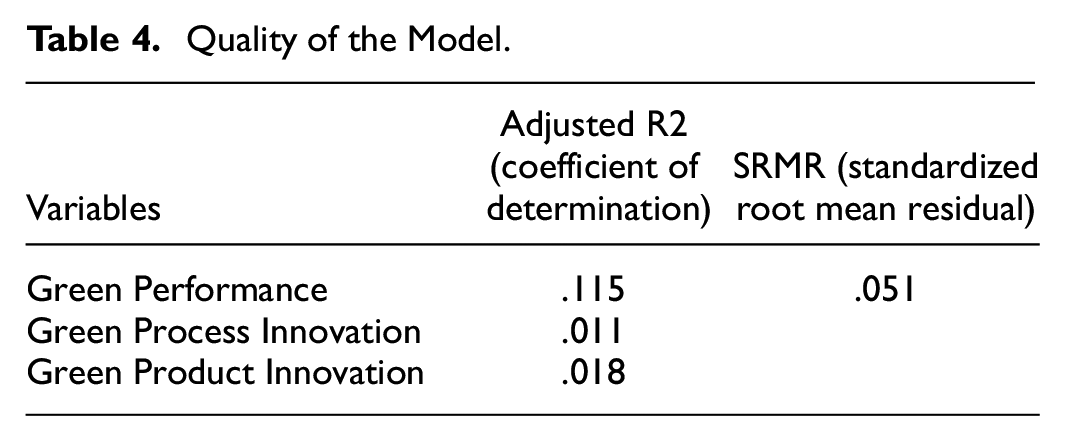
We estimated standardized root mean residual (SRMR) and R2 to assess the model’s accuracy (Cheah et al. 2018). Meanwhile, it was recommended that the R2 estimate of .10 be the least acceptable state (Hair et. 2020). The model is good, with moderate effects and moderate predictive relevance, as shown by the precise values and evaluation of SRMR and R2 presented in Table 4.
Quality of the Model.
Results of the Assessment of Structural Model and Hypothesis Testing
Direct and indirect effects were tested using statistical approaches as recommended by Zhao et al. (2010) (see Table 5). Table 5 and Figure 3 demonstrate a positive correlation between green process innovation and green product innovation and green performance. As a result, both H1 (T value = 3.770, p value = .000) and H2 (T value = 5.543, p value = .000) are true. There is a positive correlation between management environmental concern and both green process innovation (T = 2.772, p = .006) and green product innovation (T = 3.708, p = .000). Therefore, hypotheses 1, 2, 3, and 4 are all valid.
Hypothesis Testing Results.

Note. β = path coefficient; ns = not significant.
p < .001 or t > 3.29; **p < .01 or t > 2.58; ***p < .05 or t > 1.96;

Structural model (p-values and path coefficients).
The mediating effects between management environmental concern and green performance are demonstrated in Table 5 and Figure 3. Green product innovation is shown to play a significant mediating impact (T value = 3.008, p-value = .003). Moreover, there is a statistically positive relationship between Management Concern for the Environment and Green Performance (T = 1.971, p = .049), with Green Process Innovation serving as a mediator. Since this is the case, both H5 and H6 are supported.
Discussion and Conclusion
Discussion
All of the interesting hypotheses investigated in this study have been shown to be statistically significant. The significance of hotel management’s environmental concern in fostering sustainability and innovation was highlighted by our result. When management gives environmental concerns top priority, it may promote both product and process innovations that boost the hotel industry’s environmental performance and competitiveness. Study (Tang et al., 2017) also found that, when managerial concern for the environment is taken into account, green process innovation significantly (and favorably) predicts business performance. Our findings imply that Management Environmental Concern (MEC) develops a sincere commitment to lessening hotel operations' negative environmental impacts. It suggests that novel procedures with low environmental effect can be developed as a result of environmentally conscious management. The study also emphasized the need for a comprehensive strategy for sustainability in the hotel sector and the crucial role that leadership commitment plays in establishing sustainable practices and operational effectiveness. Another study also suggested that green product and green process innovation significantly affect green performance among hotel employees in China. Nuryakin and Maryati (2020), demonstrating the significance of green product innovation in environmental sustainability and attaining company growth and enhanced quality of life through the use of business environmental components. We found that Green product and process innovation is positively related to green performance. It suggests that hotels that make investments in the creation of ecologically friendly goods and services will probably see an improvement in their environmental performance . Study also found that green innovation, including green product innovation and green process innovation, is significantly influenced by dynamic capability, coordination capability and social reciprocity and has a beneficial impact on organizational performance as well as environmental performance (J.-W. Huang & Li, 2015). Moreover,another study (Ar, 2012) suggested that green product innovation has a substantial positive impact on company performance as well as competitive competence.Though they also suggested that green product innovation and company growth are only somewhat correlated with managerial environmental concern.
Besides, it is observed that products that are more environmentally friendly tend to be more well received by consumers. This result agrees with the findings of other research showing market demand for green products is an important determinant in the commercial success of new green product innovations. In either product or process innovation, our study discovered a mediating effect between management’s environmental concerns and the hotel’s green performance. They place a strong emphasis on the all-encompassing strategy needed for sustainability in the hotel sector, where management’s values and innovation-driven practices play a key role in reaching environmental performance targets. Evans et al. (2017) also stated that the green product innovation process must be established with business networks to produce products with added value in the domain of customers. This research also confirms that management environmental concern significantly influences on green product innovation and green process innovation among hotel employees in China. Even Hwang & Lyu, (2019) suggested in a study that green image is a very important predictor of consumer attitudes—Yousaf’s (2021) research on green corporate identity which impacts green innovation success. Innovative green processes bolster the competitiveness of green products. Nuryakin and Maryati (2020), who found that to succeed in the marketplace and generate revenue from their products, businesses must implement innovative greening processes. Another study illustrates the significance of product introduction in establishing a competitive edge for SMEs (Dewi, et al., 2020).
Conclusion
There are at least three significant takeaways from this study. First, we offered an idea for maximizing an organization’s internal resources in order to increase its creative potential. The second thing we brought to the table was supporting an academic theory with data: the idea that boosting the viability and competitiveness of green goods might help narrow the gap between green process innovation and green product innovation performance. Finally, the study demonstrates how the link between green process and green product innovation in green innovation performance.
Theoretical Implications
This study contributes to the growing body of work on green innovation in several important ways. To begin, this study addresses a gap in the literature by examining the causes of green innovation from the point of view of green performance in hotel industry’s perspective. Previous studies have often generally investigated the causes or effects of green innovation on productivity (Q. Wang et al., 2019; Kavaliauskiene et al., 2021). The impact of green performance has been largely disregarded, even though stakeholders' demands, regulatory changes, corporate assets, technological capacities, anticipated social and economic benefits, and managers' protection of the environment have all been measured as key factors of green innovation. Green innovation, like technology advancement, requires supply chain literacy (K. G. L. Huang & Li, 2017). This study takes a holistic approach, going beyond product innovation to incorporate process innovation as well. By considering both factors as mediators between management’s environmental concern and green performance, it offers a more nuanced view of the complex linkages at play in the pursuit of sustainability inside hotels. By highlighting the variety of sustainable practices employed in the hotel industry, this extensive analysis contributes to the theoretical discussion. Stakeholder theory highlights the importance of addressing various stakeholders' demands and interests. In this study, it is evident that green performance is influenced by factors such as regulatory changes, demands from stakeholders, and managerial commitment to environmental protection. This aligns with stakeholder theory, which emphasizes the significance of satisfying the interests of diverse stakeholders. In the context of this research, stakeholders encompass not only customers but also regulatory authorities and society at large. By incorporating these stakeholder perspectives, the study recognizes the role of stakeholders in influencing the hotel industry’s green performance.
Considering China’s unique organizational culture and the severity of its environmental pollution, an empirical investigation of the effect of green innovation on green performance in China is crucial (Lisi, et al., 2020). Exactly how Chinese businesses employ green innovation to motivate in an unknown topic. This research offers a helpful and in-depth look at the question of whether or not knowledge from sustainable performance may help to foster innovation activities in the Chinese environment, and if so, under what circumstances this might happen. This study recognizes the unique resource of “Management Environmental Concern” within the hotel industry. This aligns with the RBV theory’s emphasis on identifying and leveraging distinctive resources and capabilities that can lead to a competitive advantage. In this case, management’s commitment to environmental sustainability is a valuable resource that can potentially drive green innovation and, consequently, improve green performance in hotels.
Third, this study uses a survey of Chinese hotels to confirm the theoretical model. This research contributes to China’s knowledge of green innovation and performance. An urgent need exists for an empirical study on the impact of green innovation in China due to the country’s distinctive corporate culture and severe environmental pollution (Lisi et al., 2020). Though not a lot, several studies have been conducted on China’s green learning and its effects on green innovation (Miao et al., 2017; Yin & Yu, 2022). This study gives a helpful and in-depth insight into the question of whether or not learning from green performance may assist green innovation in the Chinese environment, and under what conditions this can occur.
Managerial Implications
This analysis sheds light on the role that employees’ green concern plays in fostering green process and product innovation. Green innovation seeks to reduce a business’s environmental impact through more careful management of a product’s whole lifespan from operation to disposal (You et al., 2019). As a result, in order to innovate in a sustainable way, managers should look to their suppliers and consumers for answers to environmental concerns and a chance to split the rewards. Green customer and supplier education help businesses ensure their entire product lifecycle is in line with sustainable development laws. In this instance, businesses should look for opportunities to enhance their green supply chain’s educational skills in order to encourage green innovation. As an illustration, it has been proposed that supply chain integration can improve supply chain learning (Jajja et al., 2018).
This research leads us to the conclusion that the disruptive impacts of green technology reduce the positive benefits of learning about green procurement on green process innovation. Therefore, managers need to think about how the many kinds of information in the green supply chain interact with the inherent uncertainty of green technologies. It is important for organizations to know what kind of green innovation outcome they want and what kind of environmental factors they are up against before choosing a learning partner.
Limitations and Future Research Directions
This research lays a vital theoretical foundation for the administration of green innovations in economies in transition. Firstly, the dynamic relationship between green technological innovation and enterprises' financial performance warrants further investigation, therefore researchers should seek more credible metrics and collect panel data to quantify these variables in the future. Second, we only look at green process innovation and green product innovation’s consequences because of the scarcity of relevant data. Also, it’s important to examine green management innovation, a subset of green technology.
Footnotes
Authors Contributions
Declaration of Conflicting Interests
The author(s) declared no potential conflicts of interest with respect to the research, authorship, and/or publication of this article.
Funding
The author(s) disclosed receipt of the following financial support for the research, authorship, and/or publication of this article: This research was funded by China Scholarship Council and Center for National and Regional Studies, North Minzu University (the code of the researcher: 202108645004).
Ethical Approval
Not applicable.
Consent for Publication
We do not have any individual person’s data in any form.

Data Availability Statement
The data that support the findings of this study are openly available on request.