



Abstract
Urbanization is a long-term structural transformation occurring worldwide. Promoting coordinated urban-rural development and sustainable rural growth has become a central concern for the international community. Countries universally face challenges, such as the declining economic role of agriculture, inadequate rural infrastructure, and population outflow in the process of promoting rural transformation. In this context, government audits (GA) serve as an independent external oversight mechanism. They play a critical role in ensuring the effective implementation of rural revitalization policies and the proper use of related funds. This study evaluates the impact of GA on the performance of China’s rural revitalization initiative, focusing on the 2019 audit of rural revitalization. Using a double machine learning (DML) framework and panel data from 31 Chinese provinces (2016–2022), the study examines how GA affects rural revitalization outcomes. The findings show that: (1) GA significantly enhances the effectiveness of rural revitalization policies. After the audit implementation, rural revitalization indicators improved by an average of 0.4074 index points. This result is statistically significant at the 1% level. (2) GA improves the implementation process by reducing relative poverty, correcting inflated employment figures, and promoting the development of green finance. (3) The impact of GA varies across provinces, reflecting differences in financial supervision and marketization levels. The study also suggests measures to address the challenges identified in rural revitalization policy implementation. Future research should focus on improving the computational efficiency and scalability of machine learning algorithms for more refined policy simulations and evaluations. Additionally, an audit governance framework suitable for cross-country comparisons could be developed. This would help assess the adaptability of these mechanisms across different institutional contexts, particularly in developing countries with weak audit systems and significant rural governance challenges.
Plain Language Summary
Rural development is a global priority, and countries are using different strategies based on their needs. National audits play an important role in overseeing how well rural revitalization policies and funds are implemented. This study looks at how national audits can help improve rural revitalization efforts, focusing on China’s 2019 audit of rural policies and funds. Using a double machine learning model and data from 31 provinces between 2016 and 2022, the study finds that: (1) National audits do help improve rural revitalization. (2) They help reduce poverty, fix incorrect employment reports, and promote green financial development. (3) The impact of national audits varies across different regions, depending on the level of financial supervision and market development.
Keywords
Introduction
Urbanization is a long-term, widespread structural process occurring globally (Y. Liu & Li, 2017; Li et al., 2018). In this context, achieving coordinated urban-rural development and promoting sustainable rural growth has become a critical issue internationally (Bock, 2016). Although rural transformation pathways differ across countries, they commonly face challenges such as the declining economic role of agriculture, inadequate rural infrastructure, population outflow, environmental degradation, and resource scarcity (Çakmakçı et al., 2023; Jin et al., 2021; J. Liu et al., 2023; Prishchepov et al., 2013; Salemink et al., 2017; Zhao et al., 2022). In response, countries have advanced sustainable rural development through tailored institutional arrangements and governance measures.
International rural governance practices demonstrate that robust oversight and accountability mechanisms are essential. These mechanisms address multiple objectives, complex funding structures, and diverse governance actors. Whether through the results-oriented mechanisms of the EU’s Common Agricultural Policy, the performance evaluation systems of the U.S. Farm Bill, or audit oversight and digital governance tools used by countries like Brazil and India, all aim to improve transparency and policy effectiveness(Avis et al., 2018; Benson, 2022; Muralidharan et al., 2023; OECD, 2016). These shared experiences highlight that the structural challenges of rural governance are universal. China faces similar issues, despite its unique institutional context. These challenges include large-scale governance, coordinating multidimensional objectives, overseeing agricultural funding, and implementing policies at the grassroots level. These issues closely align with global experiences. Therefore, research on the role of GA in rural revitalization has significant domestic policy value. It also contributes to global discourse.
In 2017, China officially launched its Rural Revitalization Strategy, establishing a five-dimensional policy framework centered on “thriving industries, ecological livability, rural cultural civilization, effective governance, and prosperous livelihoods” (S. Fan et al., 2023; Y. Liu et al., 2020; Xinhua, 2018). This marks a new phase in China’s rural development, transitioning from poverty alleviation to structural optimization and modern governance (Deng et al., 2024). The uniqueness of this strategy is reflected in four key aspects. First, regional disparities and the complexity of cross-level coordination stemming from megacity governance (Y. Liu et al., 2020). Second, the systemic integration and resource coordination necessary for advancing multiple policy objectives simultaneously (Deng et al., 2024). Third, the large scale of agricultural funding and its extended chain, which pose challenges for regulatory oversight and performance improvement (Y. Liu et al., 2020). Fourth, the risk of information asymmetry and policy deviation within multi-level governance structures (L.-A. Zhou, 2016). These structural characteristics highlight that precise policy implementation is central to rural revitalization, positioning China’s approach as a significant case for governance research with global comparative value.
Against this backdrop, the GA functions as an independent and authoritative external oversight mechanism. It plays a critical role in ensuring the proper implementation of policies and the responsible use of funds (Avis et al., 2018; Lin et al., 2022; OECD, 2016). According to international standards, GA is an independent evaluation process focused on economy, efficiency, and effectiveness. It emphasizes a closed-loop process of “information disclosure, rectification, accountability, and learning,” supported by a chain of evidence (INTOSAI, 2019a, 2019b). The OECD further highlights that external audits enhance public governance by improving transparency and reducing policy fragmentation (OECD, 2016). In Brazil, random audits by federal oversight bodies have significantly reduced local corruption and improved health, procurement, and social subsidy programs (Zamboni & Litschig, 2018).
In China, rural revitalization audits primarily focus on agricultural policies, fiscal funds, and grassroots implementation. These audits form a supervisory loop of “information disclosure, rectification and accountability, and performance improvement.” This approach addresses implementation deviations and enhances both the efficiency and transparency of fund utilization (Ling et al., 2024). In recent years, China’s top-level policies have consistently emphasized strengthening performance management and full-process oversight of agricultural funding projects (Kuang, 2022). This has established a clear foundation and strict requirements for conducting such audits. In 2019, the National Audit Office of the PRC conducted its first audit of rural revitalization policies and funds across 13 provinces, prompting a systematic investigation and rectification of violations (National Audit Office of the PRC, 2019). This underscores the governance challenges in rural revitalization and the need for enhanced oversight and accountability through GA.
Although GA play a significant role in rural governance, existing literature exhibits three key shortcomings. First, there is insufficient evidence to establish causality. Much of the research on GA remains theoretical or based on case studies and correlation analysis, lacking rigorous causal identification of whether audits enhance policy performance (Cordery & Hay, 2020; Grossi et al., 2023; Hay & Cordery, 2021; Rana et al., 2022). Additionally, while rural revitalization has garnered widespread global attention (Y. Wang et al., 2023; J. Yang et al., 2022), few studies have focused on external oversight and accountability as primary research topics. Current research broadly centers on four main areas. First, factors and spatial governance, which emphasizes improving rural resource allocation efficiency through land consolidation and optimization of the homestead land system (Y. Wang et al., 2023; Y. Zhou et al., 2020). Second, industry and market drivers, focusing on the role of rural tourism, distinctive industries, and the digital economy in boosting employment and income (Dai et al., 2023; Xiong, 2022; W. Yang et al., 2025). Third, human settlements and public services, which focus on developing ecological and livable environments, improving basic public services, and enhancing quality of life (Cui et al., 2025; Y. Wang & Masron, 2025). Fourth, innovation and institutional supply focus on enhancing endogenous momentum through rural innovation systems and institutional arrangements (S. Fan et al., 2023; X. Yin et al., 2022; R. Zhou & Chen, 2025).
Second, methodological limitations are significant. Current policy evaluation methods in rural revitalization predominantly rely on traditional causal inference techniques, such as Difference-in-Differences and Propensity Score Matching-Difference-in-Differences (D. Zhang et al., 2022; G. Zhang et al., 2025). These methods are based on low-dimensional linear assumptions, making them unsuitable for handling high-dimensional covariates and complex nonlinear relationships in rural revitalization, especially the multilevel effects of cross-mechanism interactions (Cordery & Hay, 2020; Grossi et al., 2023). Traditional models fail to adequately account for the simultaneous impacts of policy implementation across multiple dimensions, including the rural economy, society, and environment. This limits the precision of causal effect estimates and contradicts the goal of constructing a comprehensive evaluation system for rural revitalization (Ishii et al., 2014; Shi & Yang, 2022; Tao & Wu, 2024). Therefore, traditional approaches are inadequate for addressing the challenges posed by high-dimensional and complex policy environments (Hay & Cordery, 2021). To overcome these limitations, machine learning methods have been proposed and increasingly applied in policy evaluation. Specifically, the DML framework has significantly improved causal inference under high-dimensional data conditions (Athey et al., 2019; Chernozhukov et al., 2018). This enables researchers to more effectively identify complex policy effects and mechanisms. However, research applications in this area remain limited.
Finally, research on the mechanism remains unsystematic. While the role of GA in rural revitalization has gained increasing attention, studies on the mechanisms behind the effectiveness of audits are still underdeveloped (Avis et al., 2018; Benson, 2022; Muralidharan et al., 2023; OECD, 2016). Most existing studies primarily focus on the direct effects of GA, such as whether GA can improve the quality of basic public services, fiscal transparency, and fund utilization (Z. Chen & Hu, 2025; D. Zhang et al., 2022). However, there is a lack of in-depth analysis of the mechanisms through which auditing operates, particularly how specific auditing activities contribute to the implementation of rural revitalization policies. Furthermore, the impact of auditing goes beyond oversight of fund utilization. It also includes its influence on rural revitalization through improved government governance, enhanced transparency in public resource allocation, and strengthened accountability mechanisms for policy implementation (Avis et al., 2018; Zamboni & Litschig, 2018). To date, there has been no systematic investigation into how audit mechanisms affect the actual effectiveness of rural revitalization policies.
Based on the theoretical and practical context outlined above, this paper addresses the following core questions: Can GA significantly enhance the performance of rural revitalization? If so, what is the mechanism of action? Does the audit effect vary across different institutional and market environments? Additionally, this paper makes three key contributions. First, it provides evidence of the causal effects of auditing within the Chinese context. Using the 2019 special audit on rural revitalization as an institutional shock, this study systematically quantifies the impact of GA on rural revitalization performance for the first time. It also examines the international significance of this approach in the broader context of global rural governance experiences. Second, the paper contributes methodologically by introducing DML for policy evaluation. To address the research gap, it employs a DML model to identify the causal effects of rural revitalization audits. DML effectively mitigates biases from high-dimensional control variables through Neyman orthogonalization and cross-fitting, enabling robust inference in complex nonlinear settings (Athey & Imbens, 2019; Chernozhukov et al., 2018). Additionally, DML’s applicability to panel, stratified, and dynamic policy evaluations demonstrates its suitability for complex, multidimensional policy scenarios (Bodory et al., 2022; Chiang et al., 2022). The successful application of machine learning in remote sensing and agricultural monitoring, such as crop classification from hyperspectral imagery and multi-source data-driven yield prediction (Mahmoodi et al., 2024; Vafaeinejad et al., 2025), provides cross-domain evidence. These examples show that machine learning is well-suited to handle high-dimensional, nonlinear structures, aligning with the demands of rural revitalization policy evaluation. Third, this paper explores the mechanisms through which auditing promotes rural revitalization across three dimensions: relative poverty alleviation, improved employment data quality, and green finance development. It also examines the heterogeneity of audit effects based on financial regulation and marketization levels.
Hypotheses
GA, Rural Revitalization
Auditing for rural revitalization is a unique external oversight system with Chinese characteristics, falling under the scope of GA. GA is characterized by its independence, mandatory enforcement, authority, and comprehensiveness (Qian & Huang, 2025). These features allow it to play a vital role in improving internal rural governance and optimizing the external governance environment during the full implementation of the rural revitalization strategy (F. Yang et al., 2023). The New Public Management theory highlights that cross-departmental collaboration, independent oversight, and information transparency are key mechanisms for addressing administrative gaps and improving governance effectiveness (Behn, 2001; Krogh & Triantafillou, 2024). In the context of rural revitalization, the independence and authority of GA make it an essential tool for promoting policy implementation and optimizing resource allocation. Performance Accountability theory underscores that a closed-loop mechanism of responsibility, accountability, and incentives forms the institutional foundation for enhancing administrative efficiency (Y. Fan, 2025; Virani & van der Wal, 2023). Within this framework, GA can improve the implementation of rural revitalization policies by institutionalizing oversight, ensuring efficient resource distribution, and providing institutional safeguards for the strategy’s smooth execution (Q. Xu & Jiang, 2024).
Additionally, rural revitalization audits serve three main functions. First, they provide early warning capabilities. Through continuous monitoring, rural revitalization audits track policy implementation and fund utilization, helping to identify potential risks and issue proactive warnings (Hutchinson et al., 2024). For example, audits in Tongjiang City (Heilongjiang Province), Gushi County (Henan Province), and Yunyang County (Chongqing Municipality) identified operational mismanagement issues that could have led to suboptimal project outcomes. Timely risk disclosure enhanced targeted oversight, aligning with the core principles of risk-oriented auditing theory.
Second, accountability and responsibility functions. GA authorities hold violators accountable for issues in rural revitalization efforts, such as misappropriation or fraudulent claims of special funds. They trace these issues to their source and enforce responsibility, thus improving the standardization and transparency of rural governance (Mir et al., 2017). This function underscores the role of auditing in promoting accountability and strengthening internal controls, aligning with the outcome-oriented principles and enhanced responsibility emphasized in New Public Management theory (Hood, 1995). For example, audits in Funan County (Anhui Province) and Hui County (Gansu Province) revealed practices such as recording unverified accounts receivable and misappropriating collective funds. Authorities then required relevant units to address these issues, further reinforcing financial oversight in rural areas.
Third, the corrective function. Rural revitalization audits not only identify issues but also promote institutional improvements and governance optimization. By offering constructive recommendations, they eliminate adverse factors and ensure the smooth implementation of the strategy (F. Yang et al., 2023). This function aligns with the modern auditing concept of “audit for development,” which emphasizes the positive role of auditing in policy optimization and systemic improvement (Gray and Jenkins, 1993). Following the audit’s identification of issues, relevant regions have recovered or reactivated 44.8662 million yuan in agricultural funds, further demonstrating the practical effectiveness of audits in correcting deviations and improving efficiency. Based on these findings, the following hypothesis is proposed.
GA, Error Correction Effect, Rural Revitalization
The “error-correction effect” refers to the governance outcome in which GA, as an external oversight mechanism, drives audited entities to implement corrective actions after identifying issues.
In practice, some regions still face challenges such as delays in distributing subsidies to registered impoverished households, failure to implement employment placement for the poor as required, and some disadvantaged students not receiving educational subsidies. These implementation failures have led to certain impoverished groups not fully benefiting from policy support and fiscal resources. The theory of fiscal poverty alleviation suggests that if economic growth and social development do not equitably benefit impoverished groups, it may worsen poverty disparities, creating a “Matthew effect” (Luo et al., 2021), which hampers the progress of rural revitalization. Moreover, from a behavioral economics perspective, poverty is not only an issue of low income but also involves limited cognitive resources and distorted decision-making behaviors. For instance, a “scarcity mindset” can impair households’ ability to make sound judgments in resource allocation and risk management (de Bruijn & Antonides, 2022), further reducing overall social welfare.
To address the aforementioned issues, immediate corrective measures and continuous oversight through GA are essential. According to New Public Management theory, audits enhance government accountability and transparency, improving public resource allocation and ensuring that poverty alleviation resources reach their intended beneficiaries (Behn, 2001). Performance Accountability Theory further stresses that the accountability function of auditing strengthens the responsibility mechanism within government departments, ensuring the efficient use of public resources (Hood, 1995). Audits of rural revitalization initiatives drive corrective actions, promoting the proper use of special funds and strengthening oversight of policy implementation. This ensures more effective resource allocation to rural development and agriculture-related projects, improving rural economic standards, alleviating relative poverty, and advancing rural revitalization (Q. Xu et al., 2024). Based on these insights, we propose the following hypothesis:
Addressing employment issues is central to the rural revitalization strategy. China has introduced measures such as employment training subsidies and support for job-seeking and entrepreneurship to promote stable rural employment (Bojnec & Fertő, 2022). However, some regions have erroneously included ineligible individuals, such as the elderly, those unable to work, and college students, in their stable employment figures. This not only inflates the reported number of stable jobs but also misdirects employment subsidies to unrelated sectors. Moreover, poverty involves not only low income but also structural issues, such as limited labor opportunities and poor-quality employment. Research indicates that if employment support mechanisms fail to address real employment needs or correct data inaccuracies, poverty may become entrenched or even worsen (Bourdieu, 1985; Donovan et al., 2023; Sehnbruch et al., 2024).
According to New Public Management theory, improving administrative efficiency relies on oversight mechanisms that ensure transparency, accountability, and focus on outcomes (Hood, 1995). In this framework, GA, as an independent external oversight mechanism, can address issues such as inflated employment figures and ensure efficient resource allocation. Performance Accountability theory further highlights that establishing responsibility and accountability mechanisms enhances policy implementation effectiveness (Virani & van der Wal, 2023). By correcting inflated employment data, national audits strengthen accountability, improve transparency, and ensure fair policy implementation. This helps ensure that employment subsidy funds reach those in need, thereby advancing the rural revitalization strategy. Based on these theoretical insights, the following hypothesis is proposed:
GA, Green Finance, Rural Revitalization
According to financial structure theory, economic development is not only dependent on the scale of finance but also closely tied to its structure (Yi et al., 2023). To foster the green transition of its economy, China is actively developing a green financial system to direct capital toward sustainable sectors. In the context of rural revitalization, green finance is guided by the principle of “harmonious coexistence between humans and nature.” It aligns with policy goals by prioritizing the financing needs of agriculture, rural areas, and farmers, offering diverse financial products such as green loans, bonds, insurance, and funds (Li et al., 2025). The Cobb-Douglas production function suggests that capital is a key driver of economic growth (Y. Liu et al., 2018). Green finance aids the green transformation of rural economies and supports rural revitalization by channeling capital into sectors like green industries, circular agriculture, and pollution prevention (S. Fan et al., 2023; Lee & Lee, 2022; Nenavath & Mishra, 2023).
On the other hand, New Public Management theory highlights that improving administrative efficiency requires oversight mechanisms characterized by transparency, accountability, and a focus on outcomes (Hood, 1995). In this context, rural revitalization audits play a crucial role as an external oversight mechanism. They effectively identify and address deviations in the implementation of financial poverty alleviation efforts. Audits conducted in Qinggang County, Heilongjiang; Wanzhou District, Chongqing; Danjiangkou City, Hubei; Dongping County, Shandong; and Wuzhishan City, Hainan, have revealed issues such as loan misappropriation, delayed insurance claims, and inadequate fiscal interest subsidy implementation. By exposing and rectifying these irregularities, GA helps improve the rural financial environment, enhancing both financial institutions’ confidence in lending and rural entities’ trust in financial services. This ultimately directs more resources toward green agriculture and rural environmental protection projects, structurally optimizing the rural financial ecosystem and supporting rural revitalization. Based on this, the following hypothesis is proposed:
The logic of these hypotheses is shown in Figure 1.

Logic of hypotheses.
Empirical Model and Methodology
Modeling
Current policy evaluation research predominantly relies on traditional causal inference methods, which exhibit significant limitations in practical application (D. Wang et al., 2024). For example, the Difference-in-Differences model depends on the strict parallel trends assumption and requires high-quality sample data. While synthetic control methods can create virtual control groups that satisfy the parallel trends assumption, they require the treatment group to lack extreme values and are typically limited to “single treatment group versus multiple control groups” scenarios. Additionally, propensity score matching involves considerable subjectivity in selecting matching variables. To address these limitations, increasing numbers of scholars have incorporated machine learning approaches into causal inference (Athey & Imbens, 2019; Chernozhukov et al., 2018; Knittel & Stolper, 2021). Among these, DML has emerged as a promising method for causal inference in complex economic data. DML-based models offer two main advantages over traditional causal inference models. First, this study will use a composite indicator to measure the degree of rural revitalization, which is influenced by numerous economic and social variables. Accurate policy evaluation requires controlling for these variables, but traditional methods struggle with issues such as the “curse of dimensionality” and multicollinearity, which can undermine causal inference. In contrast, DML automatically selects the most relevant control variables through machine learning algorithms and regularization techniques, resolving these issues and enhancing the predictive power of the model. Second, rural revitalization often involves nonlinear relationships among various variables. Traditional models tend to suffer from specification bias, leading to unstable estimators. DML, however, effectively avoids these problems. In summary, this paper employs DML for causal inference, with the model specification outlined as follows:


Where i is the city and t is the year. RRit denotes rural revitalization index, and NAit denotes the policy variable of rural revitalization audit, which is set to be 1 after the audit, and 0 otherwise.


Where m(Controlsit) serves as the regression function of the dispositional variables on the high-dimensional control variables, and a machine learning algorithm is also used to estimate its specific form
Machine Learning Algorithm Selection
This study chose Random Forest as the primary base learner for DML based on the following methodological considerations. First, economic variables often exhibit complex nonlinear relationships and interactive effects. Random Forests can automatically identify and model these complex patterns by combining multiple decision trees, without the need for predefined functional forms (Breiman, 2001). This flexibility allows the method to avoid the misidentification of functional forms that can occur with traditional parametric techniques, aligning with the growing trend of using machine learning in economics (Athey & Imbens, 2019). Second, Random Forests are highly robust to outliers, variable scale differences, and multicollinearity. The ensemble method, which uses bootstrap sampling and random feature selection, helps prevent overfitting while maintaining strong predictive performance (Breiman, 2001). This characteristic is particularly important for our analysis of provincial-level economic and audit data, as these datasets often include multiple covariates with significant correlations between variables. Finally, Random Forests exhibit strong compatibility with the DML framework. Previous research has shown that under appropriate regularization, combining Neyman orthogonization with sample splitting allows machine learning methods like Random Forests to yield consistent and asymptotically normal causal parameter estimates (Chernozhukov et al., 2018). Thus, integrating Random Forests with DML is both theoretically sound and practically feasible.
Additionally, to validate the robustness of the findings regarding algorithm selection, this study also incorporates gradient boosting and neural networks as alternative algorithms, alongside Random Forests. The gradient boosting algorithm builds weak learners sequentially, correcting residuals from previous rounds to improve prediction accuracy (Friedman, 2001). This ensemble learning method differs from Random Forests and performs well in capturing nonlinear relationships. Neural networks, through multiple layers of nonlinear transformations, learn hierarchical data representations, allowing them to approximate complex nonlinear mappings (Goodfellow et al., 2016). These networks excel in modeling high-dimensional data. The three algorithms differ significantly in their theoretical foundations, optimization strategies, and functional representations. If the results from all three methods lead to consistent conclusions, this would serve as triangulation, strengthening the credibility of the research findings.
It is worth noting that, to prevent model overfitting, this study uses a K-fold cross-validation framework in the first stage of the DML approach, ensuring model evaluation is based on out-of-sample predictions. During the training phase, machine learning algorithms with automatic hyperparameter optimization capabilities (such as Random Forests, gradient-boosted trees, and neural networks) are selected to maximize prediction accuracy and minimize overfitting risks. Additionally, the cross-fitting procedure in the DML method ensures that the training samples for the first-stage machine learning model are entirely separate from those used for second-stage causal effect estimation, thus enhancing the robustness of the estimates (Chernozhukov et al., 2018). Finally, robust standard errors are used during the estimation phase to address potential heteroskedasticity issues, ensuring the reliability of the results.
Research Timeline
It is important to note that the time window for this study spans from 2016 to 2022. This period was chosen to align with standard causal inference practices (Angrist & Pischke, 2009), specifically by constructing a symmetric observation window around the 2019 policy implementation. This design ensures a balanced panel with data from the 3 years prior to and following the policy, providing a clear baseline before the policy and capturing its initial effects. Regarding the estimation strategy, this study adopts this classical research design and applies it using the latest DML approach. Through orthogonalization and cross-fitting, DML effectively controls for high-dimensional confounding variables, enhancing the robustness and reliability of the causal effect estimates (Chernozhukov et al., 2018).
Variable Setting and Selection
Dependent Variable
Building on relevant studies (Q. Yin et al., 2022; Zhu et al., 2022) and the Strategic Plan for Rural Revitalization (2018–2022), this paper constructs and applies a rural revitalization index system (as shown in Table 1) based on the five key dimensions of the rural revitalization strategy (Figure 2). The index is measured using the entropy method to derive the rural revitalization index (RR). Notably, the entropy method is employed to determine the weights of indicators at each level of the system, providing an objective weighting approach. Unlike subjective methods, such as expert scoring, the entropy method automatically assigns weights based on the inherent data dispersion, thus reducing biases from human judgment (Mukhametzyanov, 2021). Specifically, indicators with greater variation across samples convey richer information and are assigned higher weights in the composite index (Karagiannis & Karagiannis, 2020). This “data-driven” mechanism enhances the accuracy of identifying disparities and dynamic changes across provinces in China’s rural revitalization process, making the method highly applicable and reliable for constructing multidimensional composite indices.
Rural Revitalization Indicator Construction System.


Connotation of the five requirements.
Independent Variable
The treatment group in this study is defined based on the implementation of exogenous policies. Specifically, it includes the 13 provinces that were subject to the National Audit Office’s special audit on rural revitalization in 2019. These provinces are: Inner Mongolia Autonomous Region, Liaoning, Jilin, Heilongjiang, Jiangsu, Zhejiang, Anhui, Fujian, Jiangxi, Shandong, Hubei, Guangdong, and Hainan (National Audit Office of the PRC, 2019). Accordingly, 13 provinces were designated as the treatment group, while the remaining 18 provinces formed the control group. A time-based dummy variable (GA) for the “national audit” was created, based on the audit year, 2019.
Control Variables, Mechanism Variables
With reference to the relevant literature (Feng & Wang, 2024; Huang et al., 2022; Pan & Fan, 2023; Ye & Xu, 2023), and considering the research content of this paper as well as data availability, the variables in Table 2 were selected for this study. The control variables include: the urbanization rate (UR), foreign trade dependency (FT), per capita GDP (lnGDP), science and technology expenditure (ST), disaster impact (lnDI), industrial structure (IS), rural finance development (lnRF), and enterprise development (lnED). The mechanism variables include: green finance (DF), rural employment (lnCEF), and relative poverty (lnRRG).
Descriptive Statistics for Each Variable of the Article.

Data Sources
The data for this study are derived from several sources, including the following publications: the China Population and Employment Statistical Yearbook, the China Urban and Rural Construction Statistical Yearbook, the China Education Statistical Yearbook, the China Urban and Rural Statistical Yearbook, the China Social Statistical Yearbook, the China Civil Affairs Statistical Yearbook, the China Tertiary Industry Statistical Yearbook, the China Agricultural Product Processing Industry Yearbook, the China Rural Financial Services Report, the China Energy Statistical Yearbook, as well as provincial statistical yearbooks, the Wind database, and the China Socioeconomic Big Data Research Platform. For missing data in specific years, we assumed constant growth rates for these indicators and estimated the missing values based on the previous year’s growth rate. The dataset includes provincial (municipal) level data from China’s 31 provinces (municipalities) covering the period from 2016 to 2022, excluding Taiwan, Hong Kong, and Macao. Descriptive statistics for each variable are presented in Table 2.
Results and Analysis
Benchmark Regression Results
Based on the preceding theoretical analysis and research design, this paper applies a DML model to empirically assess the impact of GA on rural revitalization. We adopt a 1:4 sample split ratio, and use Random Forest as the base learner in both the main and auxiliary regressions. The regression results are reported in Table 3. Column (1) shows that, after controlling for year fixed effects, province fixed effects, and other covariates, GA has a positive effect on rural revitalization. In economic terms, the implementation of GA increases the rural revitalization index by about 0.4074 points on average, and this effect is statistically significant at the 1% level. After including quadratic terms for the control variables in Column (2), the estimated coefficient remains stable, confirming the robustness of the result. Therefore, Hypothesis 1 is supported.
National Audit’s Benchmark Regression Results for Rural Revitalization.
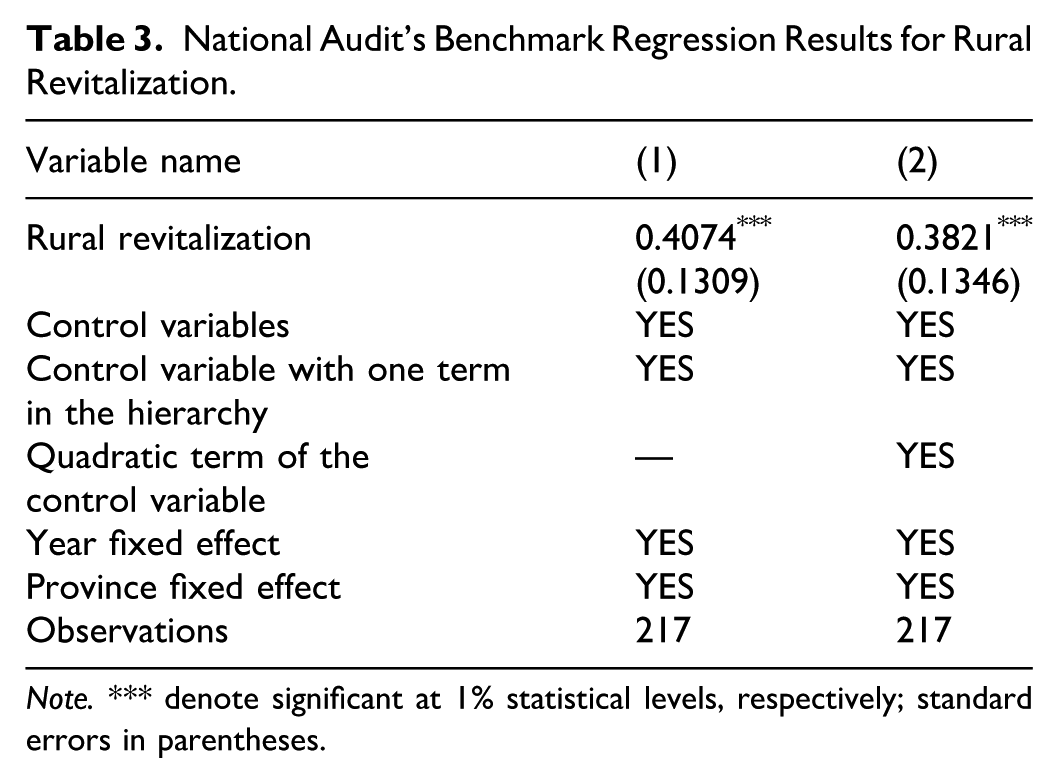
Note. *** denote significant at 1% statistical levels, respectively; standard errors in parentheses.
Endogeneity and Robustness Tests
Robustness Test
To assess the reliability of the baseline DML estimates, we conduct seven robustness checks: tail trimming, sample adjustment, alternative sample splits, alternative machine learning models, outcome replacement, additional interaction controls, and a DID validation.
First, to reduce the influence of extreme values, we winsorize the dependent variable at the 1% and 5% levels and re-estimate the model. Second, because Beijing, Tianjin, and Shanghai differ markedly from other regions in terms of economic development and structural conditions, we re-run the benchmark regression after excluding these three provinces to improve the generalizability of the results (B. Zhou et al., 2023). Third, we perform a sensitivity analysis by varying the number of cross-validation folds, thereby directly examining how different sample-splitting ratios affect the estimates. The results show that, despite changes in training-set size, the sign and significance of the core effect remain stable, which supports the robustness of our conclusions. Fourth, to guard against algorithm-specific artifacts, we replace the Random Forest base learner with gradient boosting and neural network models and re-estimate the effects. Fifth, to test the robustness of the findings to alternative outcome measures, we follow (X. Xu & Wang, 2022) and substitute the rural revitalization index with alternative constructions, then repeat the baseline regression. Sixth, to address potential confounding from unobservable shocks that vary jointly across provinces and years, we add province–year interaction terms on top of province and year fixed effects. Seventh, as a complementary check, we estimate a conventional difference-in-differences model to further verify the policy effect.
The results, reported in Table 4 and its continuation, show that GA consistently exerts a positive and statistically significant effect on rural revitalization across all seven tests, with significance levels between 1% and 5%. This pattern indicates that the baseline regression results are highly stable.
Robustness Testing Results.

Note. ** and *** denote significant at the 5% and 1% statistical levels, respectively; standard errors in parentheses.

Note. ** and *** denote significant at the 5% and 1% statistical levels, respectively; standard errors in parentheses.
Endogeneity Test
To mitigate endogeneity arising from omitted variables or reverse causality, this paper follows Cai and Duan (2022) and uses the staffing levels of provincial audit agencies as an instrumental variable. On the one hand, audit staffing directly reflects audit execution capacity and supervisory coverage, and is therefore strongly correlated with the intensity of GA implementation. On the other hand, staffing levels are largely shaped by historical institutional arrangements and administrative planning, and are not directly related to current rural revitalization outcomes, which supports their exogeneity.
In addition, drawing on Chernozhukov et al. (2018), we construct a partial linear instrumental variable model within the DML framework. Specifically, the model is given by:


In this specification, IVit is the instrumental variable, and the remaining variables are defined as before. Column (4) of Table 4 (continued) reports the results. The coefficient on GAit remains positive and statistically significant at the 5% level, further confirming the robustness of the baseline findings.
Mechanism Analysis
First, some scholars have defined being below the usual standard of living or the average income level as relative poverty concerning the typical groups in society (Wei et al., 2023). The Minimum Subsistence Guarantee System for Rural Residents is a livelihood guarantee system introduced by the Chinese Government for rural residents whose annual per capita net household income is below the local minimum subsistence guarantee standard. Therefore, this population group belongs to the relatively poor. Concerning relevant studies and the availability of data (Luo et al., 2021), this paper uses the number of rural residents covered by the minimum subsistence guarantee as an indicator of relative poverty. As can be seen from column 5(1) of Table 5, national audits contribute to rural revitalization by reducing the number of rural residents with minimum subsistence guarantee, that is, by reducing the number of relatively poor people and alleviating relative poverty. This mechanism was significant at the 10% level, thus supporting hypothesis H2.
Mechanism Analysis Results.

Note. *, and **denote significant at the 10% and 5% statistical levels, respectively; standard errors in parentheses.
Second, based on the characteristics of the study content and data availability, this paper uses the number of rural employment as a measure of the national audit’s mechanism for correcting inflated employment numbers. From column (2) of Table 5, the national audit contributes to rural revitalization by correcting the inflated rural employment numbers. The mechanism is significant at the 5% level, thus supporting hypothesis H3.
Finally, referring to related research (Huang et al., 2022), this paper uses the green finance index as an indicator to measure green financial development. As can be seen from column (3) of Table 5, national audit promotes rural revitalization through increased green economic growth. The mechanism is significant at the 5% level, thus supporting hypothesis H4. The national audit can promote rural revitalization in a way that promotes green financial development and also through corrective functions.
Heterogeneity Analysis
First, this study measures the intensity of financial supervision using the ratio of local financial regulatory expenditure to the value added of the financial sector. Following Tang et al. (2020), the provincial median level of financial supervision in 2022 is used as the cutoff to distinguish high- and low-supervision regions. Columns (1) and (2) in Table 6 show that the enabling effect of GA on rural revitalization is stronger in regions with lower levels of financial regulation. This heterogeneity may reflect a substitution effect and diminishing marginal returns between GA and local financial regulation. In regions with stronger financial supervision, mature routine oversight mechanisms in rural financial institutions have already promoted the optimization of fund management, deepening of reforms, and effective implementation of agricultural support funds (L. Xie et al., 2023). Many potential governance problems are contained at an early stage. Under these conditions, GA, as an ex post oversight mechanism, has relatively limited room to generate additional improvements and thus faces a “ceiling effect.” This logic is consistent with evidence on the impact of financial regulation on real economic activity, which suggests that the marginal benefits of regulation may decline once intensity surpasses a certain threshold (B. Wang, 2021). By contrast, in regions with weaker financial oversight, the lack of routine supervision can lead to the accumulation of problems and the emergence of regulatory blind spots. In such contexts, the intervention of GA plays an important complementary role. Through systematic review and accountability, GA fills oversight gaps and delivers larger marginal gains in governance performance. Related studies also find that in regions with weaker local governance capacity or underdeveloped audit systems, the regulatory effect of audits tends to be more prominent (H. Chen et al., 2025).
Heterogeneity Test Results.

Note. ** and *** denote significant at the 5% and 1% statistical levels, respectively; standard errors in parentheses.
Second, this study uses a marketization index to capture regional market development. Following X. Xie and Zhu (2021), we take the provincial median value of the 2022 marketization index as the cutoff to distinguish high- and low-marketization regions. Columns (3) and (4) of Table 6 show that GA has a stronger enabling effect on rural revitalization in regions with lower levels of marketization than in those with higher levels. In highly marketized regions, markets help optimize the allocation of social resources, and government functions gradually shift from direct control to service provision. Market actors can supervise public authority through multiple channels, which reduces the relative marginal role of GA. By contrast, in regions with low marketization, local officials have greater fiscal discretion. This creates more room for rent-seeking through administered prices and government concessions and makes administrative corruption more likely. In such settings, GA intervention becomes more critical, and its governance effect is correspondingly amplified (L. Xie et al., 2023).
Conclusions and Policy Implications
Conclusion
This study takes the 2019 rural revitalization audit as a quasi-natural experiment and, using data for 31 provinces from 2016 to 2022 within a DML framework, examines how GA enables rural revitalization. It focuses on three core scientific questions, which also define the research objectives: whether GA significantly improves rural revitalization performance, through which mechanisms GA operates, and whether the effects of GA differ across institutional and market environments. The main findings are as follows.
(1) The enabling effect of GA is significant. The results show that GA increases the rural revitalization index by about 0.4074 points, and this effect is statistically significant at the 1% level. This finding is consistent with Pei and Yao (2025).
(2) GA alleviates relative poverty through precise identification and correction. The estimates indicate that the implementation of GA reduces the number of rural residents receiving minimum living allowance benefits by about 0.4664 units (coefficient = −0.4664, p < 0.1). This provides direct evidence for a “targeted assistance” mechanism, in which audit oversight helps eliminate inflated poverty figures and ensures that social security resources are accurately directed to the intended groups, thereby addressing relative poverty at its source.
(3) GA corrects inflated employment figures by strengthening accountability. The results show that GA reduces overreported employment by 0.1952 units (coefficient = −0.1952, p < 0.05). This suggests that audit-induced accountability pressure significantly curbs the practice of including ineligible individuals in employment statistics and ensures that employment subsidies are genuinely used to support rural revitalization. These conclusions are in line with J. Liu and Lin (2012), who find that GA effectively corrects errors and reduces corruption.
(4) GA promotes the development of green finance by improving financial discipline. The estimates indicate that GA raises the regional green finance index by about 0.0260 units (coefficient = 0.0260, p < 0.05). This implies that GA helps clean up the rural financial environment by uncovering and rectifying problems such as loan misappropriation and inadequate interest subsidies, thereby strengthening market confidence and channeling more capital to green and sustainable sectors. This result is consistent with Z. Chen and Hu (2025), who show that GA enhances fiscal transparency in China, particularly through disclosure and oversight.
(5) There is a “functional substitution” effect with financial regulation. The enabling effect of GA on rural revitalization is more pronounced in regions with weaker financial regulation, showing clear patterns of functional substitution and diminishing marginal returns. This logic is consistent with the literature on financial regulation and real economic growth, which suggests that once regulatory intensity exceeds a certain level, marginal benefits tend to decline (B. Wang, 2021).
(6) There is an “institutional complementarity” effect with marketization. GA has a stronger impact in regions with lower levels of marketization, reflecting institutional complementarity between auditing and market mechanisms. In highly marketized regions, diverse market actors and mature institutions already form an effective oversight system over government power, which reduces the marginal demand for GA. In contrast, in less marketized regions, administrative power leaves more room for rent-seeking. In such contexts, GA, as an independent and authoritative external oversight mechanism, plays a particularly important role in correcting deviations and exerting deterrence, thereby compensating for weaknesses in market-based supervision (L. Xie et al., 2023).
The findings of this study generate three main marginal contributions. First, the study provides evidence on the causal effects of auditing in the Chinese context. Using the 2019 special audit on rural revitalization as an institutional shock, it is the first to systematically quantify the impact of GA on rural revitalization performance and to place these results within the broader landscape of global rural governance. Second, it offers a methodological contribution by introducing DML for policy evaluation and using this framework to identify the causal effects of rural revitalization audits. Third, it advances mechanism-based understanding by showing how auditing promotes rural revitalization through three channels: alleviation of relative poverty, improvement in the quality of employment data, and promotion of green finance development. It also documents the heterogeneity of GA effects across different levels of financial regulation and marketization.
Policy Implications
Beyond the three core marginal contributions discussed above, this paper also offers five policy recommendations, highlighting their practical relevance for management practice and international application.
First, the role of GA in rural revitalization should be further strengthened. In the course of implementing the rural revitalization strategy, GA is indispensable. Increasing the intensity of GA helps ensure that relevant policies and funds are properly implemented, thereby enhancing the effectiveness of rural revitalization policies. This is consistent with the experience of the EU’s Common Agricultural Policy, where audit mechanisms have improved transparency in policy implementation through results-oriented resource allocation (OECD, 2016). These experiences suggest that other developing countries can adapt the practices of the EU and China within their own audit frameworks to reinforce oversight and transparency, secure a more rational allocation of funds, and improve the effectiveness of their rural revitalization efforts.
Second, a robust audit and verification mechanism should be established. In routine rural revitalization work, governments at all levels need to strengthen checks on policy implementation outcomes to ensure that funds flow to the intended sectors and to prevent resource misallocation. In practice, this requires a tiered, multi-level audit and verification system that tracks the entire process of fund use, verifies whether policy funds are used for their designated purposes, and reduces misreporting or diversion of funds away from rural revitalization. This recommendation is also relevant for other developing countries, especially those with complex governance structures and uneven resource distribution, where a layered audit mechanism can help ensure the efficient and accountable use of public funds.
Third, greater emphasis should be placed on relatively impoverished groups and subsidy management. These populations are at the core of rural revitalization. Governments should continue to increase support for them and establish effective feedback channels to ensure policy transparency and responsiveness. At the same time, GA should strengthen oversight of fund allocation and subsidy distribution so as to improve the efficiency and fairness of policy implementation and accelerate progress toward rural revitalization goals. For other developing countries, especially those with high poverty levels, auditing is equally critical for safeguarding the equity of poverty alleviation policies and the integrity of resource allocation. Reinforcing audit oversight of disadvantaged groups can substantially enhance policy effectiveness while reducing resource waste and corruption.
Fourth, local financial oversight should be strengthened and audit resources allocated more efficiently. Effective local financial regulation can reduce the burden on GA, lower audit costs, and improve the efficiency with which rural revitalization funds are used. Governments should enhance day-to-day financial supervision and encourage local authorities to work closely with financial institutions to promote green finance and develop clear green credit standards. Such collaboration not only eases the audit workload but also increases the effectiveness of policy implementation. In other developing countries, especially those with relatively weak financial regulatory systems, stronger financial oversight can provide more solid support for GA and help ensure that public funds are directed toward sustainable projects, including green finance initiatives. This approach can both improve audit effectiveness and foster more sustainable economic development.
Fifth, green finance should be actively promoted to enhance the sustainability of rural revitalization. Mechanism analysis indicates that GA plays a pivotal role in advancing green finance. In regions with weak financial oversight, GA strengthens the implementation of green finance policies, thereby supporting rural revitalization. This not only improves the transparency of green investment, but also effectively supports the expansion of the green economy. Governments should therefore accelerate the development of green financial systems and foster closer linkages between local financial institutions and green investment projects to ensure the long-term sustainability of rural revitalization. For other developing countries, especially those facing resource constraints and environmental degradation, green finance should become an integral component of rural revitalization strategies. By refining green credit standards and project audit frameworks, these countries can secure stable financial support for green investments and promote environmentally sustainable economic growth.
Additionally, the findings of this study, particularly those on the relationship between GA and rural revitalization, have clear international relevance. Although audit frameworks and governance environments differ across countries, the role of GA in improving policy transparency, promoting the efficient allocation of public funds, and enhancing policy effectiveness is broadly generalizable. In particular, other developing countries facing similar challenges in financial regulation, poverty alleviation, and environmental protection can draw useful lessons from China’s experience. For example, they may adapt China’s tiered audit arrangements and its mechanisms for promoting green finance to strengthen governance capacity and improve the implementation of rural development policies.
Limitations and Future Research Directions
This study provides empirical evidence on the role of GA in rural revitalization by developing a theoretical framework and applying a DML approach. Nonetheless, several limitations remain, which also suggest directions for future research.
This study has three main limitations. First, due to data availability, the seven-year observation window only permits an assessment of the short- to medium-term effects of GA, while its long-term dynamic impacts require continued tracking. Second, although DML is effective in handling high-dimensional confounders, the estimates may still be affected by omitted variables. Third, the analysis is conducted within the Chinese context. While the findings offer useful insights for other developing countries, cross-country differences in audit frameworks, fiscal oversight systems, and rural development stages mean that the results cannot be transferred mechanically.
Future work can be extended in two directions. Methodologically, the computational efficiency and scalability of machine learning algorithms can be further improved to support policy simulation and evaluation using higher-frequency and more fine-grained data. Substantively, it would be valuable to develop an audit governance framework suitable for cross-country comparison, and to test the mechanisms identified in this study under diverse institutional settings. Particular attention should be paid to the applicability and adaptation of these mechanisms in developing countries where audit systems are weak and rural governance challenges are especially acute.
Footnotes

Ethical Considerations
This article does not contain any studies with human participants performed by any of the authors.
Consent to Participate
This article does not contain any studies with human participants performed by any of the authors.
Author Contributions
YY: Writing original draft, Formal analysis, Data curation; LC: Writing review & editing; AX: Methodology, Writing review & editing, Visualization; YW: Writing review & editing, Methodology, Investigation.
Funding
The authors disclosed receipt of the following financial support for the research, authorship, and/or publication of this article: This research was supported by the following projects: the National Social Science Fund Project “Research on the Pricing Mechanism and Realization Pathway for Sea Area Use Right Transfers in the New Development Stage” (Grant No. 22CGL003); the Key Project of Fujian Social Science Foundation “Research on the Mechanisms and Pathways of Digital New Quality Productive Forces Leading the High-Quality Development of Fujian’s Marine Economy” (Grant No. FJ2025A032); the Fujian Higher Education Institution’s Science and Technology Innovation Team “Fujian Marine Economy Green Development Innovation Team” (Document No. Min Jiao Ke [2023] No. 15) and its Open Project “Research on the High-Quality Development of Fujian’s Marine Economy” (Grant No. KF04); the Special Research Project of the Fujian Social Science Research Base “Research Center for the Pathway to Rural Revitalization with Eastern Fujian Characteristics” (Document Nos. Min She Ke Gui [2020] No. 1 and Min Cai Jiao Zhi [2021] No. 103); the Scientific Research Development Fund Projects of Ningde Normal University (Grant Nos. FZ202305, FZ202314, and 2024FZ006).
Declaration of Conflicting Interests
The authors declared no potential conflicts of interest with respect to the research, authorship, and/or publication of this article.
Data Availability Statement
All data used in this study were obtained from publicly available sources. The datasets generated and/or analyzed during the current study are available from the corresponding author on reasonable request.