




Abstract
Demonstration Policy on rural revitalization aims at driving the economic development of the entire region through the demonstration effect. Using the panel data of 15 rural revitalization demonstration areas in Henan province of China from 2013 to 2020, this study explores the promotion effect of rural revitalization demonstration policies on rural economy through the Differences-in-Differences (DID) method. The results show that the construction of rural revitalization demonstration areas has significantly promoted the growth of local economy. The demonstration effect is the best in the middle of the economic development, followed by the better economic development of the demonstration, and finally the economic backwardness of the demonstration. More specifically, the order of effect from large to small is as follows: counties (second-level administrative regions), poverty-stricken counties (third-level administrative regions), county-level cities (first-level administrative regions).
Keywords
Introduction
Rural revitalization is related to rural decline. The history in both developed and developing countries has proved that rural hollowing and rural decline are the inevitable results of promoting industrialization and urbanization (R. Chen et al., 2014; Y. Liu et al., 2014; Markey et al., 2008; McDonald et al., 2013). However, stark developmental differences between urban and rural areas are not conducive to the sound cycle and healthy development of a country’s economy and society. Therefore, developed countries and some developing countries prioritize the integration of urban and rural social and economic development as industrialization and urbanization accelerate to a certain extent, and vigorously promote the rural revitalization strategy. China’s rural revitalization strategy is to solve the imbalance between urban and rural development, prevent the decline of rural regions and foreground them. The strategy advocates prioritizing agricultural and rural development, establishing and perfecting the urban-rural integration development mechanism, and accelerating the modernization of agricultural and rural areas (Guo & Liu, 2021). The demonstration policy of rural revitalization refers to the selection of some representative counties as demonstration areas as part of the rural revitalization strategy. Through gap comparison and experience reference, the policy can promote improvement in other non-demonstration areas, improving the living environment of farmers and rural economy. As a vast agricultural province in China, Henan’s rural development features are universal and typical. The research on the promotion of the rural revitalization demonstration policy in Henan province and its economic development has reference significance to other provinces in China and rural areas of other countries. However, while implementing the rural revitalization demonstration policy, does the rural revitalization demonstration area of Henan province have a significant leading effect? If so, do all the demonstration areas have the same impact on local economic development? These two problems are important to prove in the follow-up construction of rural demonstration areas.
At present, the research on rural revitalization is mainly divided into two parts. One is based on the rural revitalization strategy to study the impact of digital technology, rural migrant workers’ entrepreneurship, and e-commerce on local economic development (Lv & Sun, 2022; H. Wang, 2022; Z. Wang & Zhang, 2023). The other is a direct study of specific issues such as farmers’ subjectivity, rural poverty alleviation, rural governance, and the cultural inheritance of rural elites in rural revitalization (X. Liu, 2019; B. Liu & Wang, 2019; S. Wang & Feng, 2019; G. Wang & Wang, 2021). The study on the rural revitalization demonstration area focuses on the specific initiatives there. For example, D. Chen (2021), described the main practices and achievements of Licheng District in establishing demonstration areas for full mechanization of major crop production, and presented development proposals. Most current studies use the single difference method to compare the economic level before and after the establishment of the demonstration areas. However, this simple comparison fails to identify the net effect of rural revitalization policies on economic growth excluding other factors. Additionally, the establishment of rural revitalization demonstration areas based on the region’s promotion in different endowment conditions differ. The existing literature fails to further identify the regional differences in the promotion of economic development by the rural revitalization demonstration policies. Based on this, we use the panel data in Henan province of China and DID method to study the role of rural revitalization demonstration policies in promoting economic growth.
This study uses the data from 101 counties in Henan province from 2013 to 2020 to verify the direct effect of the rural demonstration policy on regional economic growth. By using the DID method, our study overcomes the estimation bias of some previous studies, identifies the net effect of rural revitalization policy on economic growth, and tests the robustness of the results. Additionally, we analyze the regional differences in rural revitalization demonstration policies in promoting economic growth in detail. After considering the initial economic development of different regions, this study finds that there are also differences in the promotion effect of rural revitalization demonstration on regional economic development. Thus, rational distribution of rural revitalization demonstration areas can promote the rapid development of the region and reduce the gap between the rich and the poor.
Literature Review and Hypothesis
The rural revitalization strategy is a development strategy put forward by China in order to address unique development difficulties faced by its own rural areas, which is specific and targeted. However, there are multiple international precedents for this development strategy. Since the 1960s, rural areas in developed countries have declined under the impetus of early industrialization. These countries have launched the rural revival movement, such as the United States’ small town constructions, rural reform in France, Germany’s rural revival movement, and South Korea’s new village movement (Shi & Yang, 2022). These are tailored for their national context and are aimed at revitalizing the country by improving rural infrastructure and public services and promoting sustainable economic development. Contemporary China is gradually realizing prosperity for all its citizens. While promoting common prosperity, the countryside is often excluded. Optimization of space and development potential are present in rural areas too. President Xi Jinping made several speeches suggesting that rural revitalization is an important task for the realization of the Chinese Dream. The Communist Party of China should promote rural revitalization with the help of the party and society, follow the path of socialist rural revitalization with Chinese characteristics, and promote common prosperity. In 2017, the Party’s 19th National Congress, for the first time, presented the general requirements of the rural revitalization strategy including industrial prosperity, ecological livability, civilized rural style, effective governance, and a rich life. As a requirement for rural revitalization, the provincial governments have actively established rural revitalization demonstration areas and given various preferential policy supports. Specifically, the construction of the demonstration area mainly includes the modernization of the agricultural sector, construction of rural infrastructure and public service system, and beautiful rural demonstrations, along with improved rural governance ability (Su, 2021). Through these strategies, the demonstration effect of rural revitalization demonstration areas can be realized, which can promote the development of local economy.
Demonstration Construction of the Modernization of the Agricultural Sector
The demonstration area of rural revitalization should play a leading role in the modernization of the agricultural sector. Modernizing the agricultural sector means promoting the leap from traditional to modern agriculture by optimizing the dynamic structure, industrial structure, and factor structure of agricultural development. We should construct a complete modern agricultural industrial system that fits the industrial chain of market-oriented consumption. Schultz (1999), an American agricultural economist, noted that if developing countries could transform traditional agriculture into modern agriculture, then it could effectively promote their economic growth. Fischer and Qaim (2014) suggested that farmers should engage in collective agricultural production and marketing activities that can enable smallholder farmers to remain competitive in rapidly changing markets and thus contribute to agricultural modernization in developing countries. Murakami (2011) stated that the government should encourage farmers to return to their villages to start businesses, accumulate elements for rural productive activities and promote the modernization of agricultural villages through economies of scale. The modernization of the agricultural sector in China is guided by the thought of socialist agricultural development with Chinese characteristics, striving to improve agricultural productivity, giving importance to the multiple functions of modern agriculture, developing people-centered modern agriculture, promoting common prosperity, and harmonizing agricultural and rural modernization as well as the relationship between man and nature (Yang, 2021). The agricultural modernization demonstration construction in the rural demonstration areas aims for common prosperity. It insists on innovative and green development, utilizing the digital economy to raise the income of farmers and promote the development of the rural economy.
Constructing Basic Supporting Facilities and Public Services in Rural Areas
Poverty reduction policies widely adopted in developing countries include increasing expenditure on public services and strengthening infrastructure construction. These policies can significantly promote economic development (Suriansyah et al., 2014). Lu and Jacobs (2016), from the perspective of the government, noted that the success of rural construction requires strong support from the government. Government can improve rural infrastructure and provide welfare subsidies. Through the implementation of transportation and power construction projects in the demonstration area, China’s rural revitalization strategy will continue to strengthen basic and supporting facilities in rural areas. Through the balanced allocation of high-quality education resources, supporting the improvement of sports fitness equipment, and building a sound medical service system, rural public service facilities will be improved. These basic facilities and public services for rural residents provide a strong background for local economic development, ensuring a beneficial guarantee.
Demonstration Construction of Beautiful Countryside
Beautiful countryside construction is a green development model. It can promote energy saving, emission reduction, and the optimization and upgrading of rural industrial structure, and achieve the coordinated as well as sustainable development of the economy and environment. This development model is based on the compound ecological theory proposed by Professor Ma Shijun, a famous ecologist in China, in 1981. The theory holds that society, economy, and nature, on which human beings rely for survival, complete a complex system (R. Wang & Yang, 2012). The demonstration construction of the beautiful countryside requires the countryside to be planned and designed reasonably according to the external environment, the stage of social development, and the actual situation of the countryside, whereby the local social economy should be developed without affecting the ecological environment (Zheng & Chen, 2015). The construction of beautiful countryside has been practiced in Japan, Korea, Germany and other countries. These countries adopted rural ecological environment construction, adhering to the harmonious coexistence of man and nature through rural green development (Zhu, 2018). In China, President Xi declared that green water and mountains are mountains of gold and silver. The green water and mountains in the countryside are high-quality ecological environment resources. The gold and silver mountains refer to rural economic growth or output. The rural construction movement represented by the beautiful countryside has become an important measure to promote the development of rural areas in China. The demonstration area of rural revitalization can promote the adjustment of rural industrial structure and the sustainable development of the economy by protecting the ecological environment and building a beautiful countryside.
Rural Governance
Rural governance is an important link in rural revitalization. In 1998, Chinese scholar Xu, Y. first proposed the concept of rural governance (Xu, 1998). The research of rural governance has been extended by a group of outstanding scholars, examining the operating mechanism of China’s rural paternalism, the function mechanism of moral restriction and legal regulation, the motive of social change, the generation logic of rural community self-management, and the administrative reform of grass-roots autonomous organizations, etc. (Dong, 2013; He, 2020; Liang, 2019; Qing, 2016; D. Zhou & Huang, 2019). Kim (2006), through his research on rural construction in South Korea, proposes that rural construction should focus on improving the system governance and the planning fund subsidy mechanisms, and enhancing the villagers’ autonomy and innovation awareness. J. Wang (2008) studied rural construction in Germany, and noted that for agricultural development, the government should make laws to guarantee rural construction, and simultaneously focus on rural planning and construction. The direction of Chinese rural governance is autonomy, rule of law, and virtue. The key to autonomy lies in the promotion of administrative efficiency of grass-roots organizations and the guarantee of the People’s sovereign rights. The focus of rule of law is to accelerate the improvement of various laws and regulations, and to protect people’s rights and interests in education, medical care, and employment to the greatest extent. The rule of virtue is closely related to the creation of a civilized countryside. The realization of rural revitalization refers to the high-quality development of rural economy, highly improved material life, such as food, clothing, housing, and transportation, and the enrichment of farmers’ spiritual world, abandoning the stereotypes and bad habits, and maintaining excellent traditional culture (P. Chen et al., 2022). Through rural governance, the rural revitalization demonstration area provides a good environment and system guarantee for the development of local economy, ensuring stable development of the rural economy.
Hypotheses
Hence, the rural revitalization demonstration policy will promote the development of rural industries and increase the income of farmers through the modernization of agricultural industries in the demonstration areas. Through the construction of rural infrastructure and public services, the policy provides favorable conditions for the rural economy, makes the development of industry more sustainable through the construction of beautiful countryside, and provides a good environment and system guarantee for economic development through rural governance. At the macro level, the policy dividend enjoyed by the rural revitalization Demonstration Zone has strongly promoted the society to attach importance to the agricultural and rural areas in the region, and can greatly attract social capital to invest in agriculture and social talents to gather in the rural areas, improving local economic growth points. In terms of implementation, the agricultural and rural authorities at all levels in the demonstration counties and districts will be pressurized to implement the good policies designed at the top level, explore the industries in the demonstration areas as much as possible, and develop the characteristic economy, to increase farmers’ income. From the above discussion, this study puts forward the following hypothesis 1:
Hypothesis 1: The demonstration policy of rural revitalization can promote the development of local economy.
According to Heckscher-Ohlin’s resource endowment theory, different regions have different production factor endowments (Ohlin, 1993). The uneven development in the early stage of rural areas, the great difference in development between different types of areas, and the different initial resource endowments in different places lead to different effects of the same policy. Additionally, the economic level, poverty level, and the causes of poverty in each model area are different, and the promotion effect of the policy on the local economy will be different. According to the basic economic principle of diminishing marginal effects, regions with better economic development are superior to relatively underdeveloped regions in terms of infrastructure, public services, talent reserves, and preferential policies. Demonstration effects also exist. The same preferential policies and financial support become additional advantages in regions with better economic development, and their marginal effect is small (R. Liu & Zhao, 2015). The infrastructure of the demonstration areas with backward economic levels is relatively inadequate and the policy barriers are relatively cumbersome. Therefore, the policies of the demonstration areas in the relatively underdeveloped areas are more of timely help. The driving effect and radiation effect of the economy are even greater. However, some relatively remote or national-level poverty-stricken areas may suffer from inconvenient transportation or the solidification of the original social culture. When social organizations participate, they often cannot integrate into the cultural traditions of the local society, causing failure in achieving the goal (F. Sun et al., 2016). Some backward areas are unable to develop their economies precisely because they have no available resources and no viable industries. In these special places, the demonstration policy effect may be affected. Therefore, we speculate that the effect of the demonstration policy on the economic development of the medium-sized demonstration area is the best, followed by the economic development of the better demonstration area, and finally the economically backward demonstration area.
Taking Henan province as an example, in 2018, the Agricultural Office of the Henan Provincial Committee thoroughly communicated and consulted with all provincial-level municipalities, and finally identified 18 demonstration counties 1 for the rural revitalization strategy in the entire province, to lead and drive the implementation of rural revitalization strategy.
The initial factor endowments of these 18 counties are also quite different, and these differences are often highly related to the administrative hierarchy in the Chinese political system. Even within the same municipality, the level of economic development, industrial resources, and public services of different counties vary greatly due to the different administrative division levels. According to different levels of economic development, Henan Province divides administrative regions into three levels: first-level administrative regions, second-level administrative regions, and third-level administrative regions. Among them, the first-level administrative regions are mostly urban or county-level cities, where the development level is relatively good. The second-level administrative regions are counties with a medium level of development or cities with relatively backward development. The third-level administrative regions are mostly counties with backward development and poverty. Additionally, counties can be divided into county-level cities, counties, and poverty-stricken counties according to the national administrative division and their inclusion among impoverished counties. Since the rural revitalization demonstration areas in Henan Province are selected from each provincial municipality, these 18 counties are distributed in the three levels using the two classification methods. Therefore, aligning with the previous discussion, this study can propose a second hypothesis to be tested.
Hypothesis 2: The effect of demonstration policy is the best in the medium-sized demonstration area of economic development, followed by the better demonstration area of economic development, and finally the backward demonstration area of economic development. To be specific, the order of magnitude of the impact is counties (second-level administrative regions), poverty-stricken counties (second-level administrative regions), and county-level cities (first-level administrative regions).
Study Design
Measurement Model Setting
In the evaluation of policy implementation effect, Difference-in-Difference (DID) is a very practical and important research method. It can eliminate the interference of other factors other than processing variables. Additionally, when using the DID model, it needs relatively few conditions to construct, which is an important reason for the extensive use of the double difference method. In cases where randomization is not possible, we can better identify the actual effects of policies by identifying policy treatment groups and control groups, followed by observing policy changes with randomization characteristics.
According to DID, the subjects are divided into control and experimental groups by comparing the implementation of policy. The effects of policies can be assessed by comparing the differences between the groups affected and unaffected by policies. As the implementation of the rural revitalization demonstration policy in Henan province began in 2018, this study takes 2018 as the cut-off point for policy implementation, and takes the areas that implement the rural revitalization demonstration policy as the experimental group, other areas in the province are regarded as the control group. The samples were grouped by two virtual variables. The variable
Based on this, the following DID foundation model is established:

Through the above analysis, the samples can be divided into four categories, namely, the experimental group before the demonstration policy construction (
Variable Settings
Dependent variable: The main dependent variable in the study is rural economic growth which is taken using the logarithm of per capita GDP and the per capita income of farmers, namely lnPgdp and Pincome respectively (M. Li & Du, 2014; Lin & Liu, 2003). Therefore, this study uses lnPgdp and Pincome as the dependent variables to measure the level of rural economic development. Considering the comparability and reliability of the data, this study calculates the real GDP in 1994 as the base year. The GDP per capita is calculated by dividing the real GDP by the total population registered at the end of the year. All the original data are from China County Statistical Yearbook and Henan Province Statistical Yearbook (2013–2020).
The key explanatory variable is rural revitalization demonstration area virtual variable (treat). Since the data period is 2013 to 2020, according to the list of demonstration areas approved by Henan Province until 2020, which are published in the “China County Statistical Yearbook” and “Henan Province Statistical Yearbook,” each area is assigned the value. If a area is set up as the rural revitalization demonstration area in 2018, then it is assigned the value of 1; otherwise is 0. Additionally, to test hypothesis 2, this study collected the list of county-level city, county, and poverty-stricken administrative territorial entity, and the list of level 1, level 2, and level 3 administrative regions published by the Henan Provincial Government. The samples are assigned values according to the list. If the county is one of the above six categories from 2013 to 2020, it is assigned the values of 1; otherwise, it is assigned the values of 0.
Control variables: To control the influence of other factors on the effect of policy, this study introduces public service, education level, and population density as control variables: (1) Public Service: public service can affect economic growth and development directly or indirectly through different factors, such as investment, consumption, resource utilization rate, reduction of public risk and division of labor cost. To some extent, the level of public services reflects the level of local economic development, thereby improving the former can promote the latter (Gao & Fu, 2013; C. Liu et al., 2019). Public services mainly include compulsory education, public health and basic medical care, basic social security, and public employment services (Tan & Liu, 2016). Hence, this study choose medical level, financial development level (loan ratio), and welfare level (benefit level) to control the impact of public services on economic development. (2) Education level: The level of education reflects the quality of residents considerably. The educational level of the peasant household is determined by their average educational years (X. Li, 2015; X. Liu & Zhang, 2007). While studying the promoting effect of human capital on urban economic development, scholars usually choose the number of students in local colleges and universities as the variable (Cai & Du, 2000; Fleisher et al., 2010; G. Li & Fan, 2003). Considering that the level of economic development in rural areas generally lags behind the cities, the level of education of farmers is low, and there is no university in the countryside, scholars generally use the proportion of middle school students as a variable index when studying the promotion effect of farmer education level on rural economy (T. Chen, 2018). (3) Population density: Population is an important part of the market. Research by Xie et al. (2012) shows that population concentration affects the level of local economic development. Many scholars have studied the relationship between population concentration and economic growth, using population density as an agent variable to study economic development (Futagami & Ohkusa, 2003; Peng et al., 2006; C. Sun et al., 2019). The explanation and calculation method of related variables are shown in Table 1.
The Explanation and Calculation Method of Relevant Variables.

After adding control variables based on the benchmark model (1), it is extended into the following empirical model:

Data Sources and Variable Descriptive Statistics
This study select the original relevant data of 107 counties and cities in Henan province from the China County Statistical Yearbook and Henan Province Statistical Yearbook (2013–2020). These data mainly include more than 20 original data sets, such as the county’s GDP, the number of hospital beds, the number of students in middle school, the total amount of loans at the end of the year, the number of beds in welfare institutions, the household registration population, the total population at the end of the year, the resident population and so on. To ensure the integrity and reliability of the data of selected counties and cities, the data of six counties and cities are deleted because these regions (Jian’an District, Suiping County, Jiyuan City, Jia County, Gongyi City, and Anyang County) are poor in terms of integrity, county-level reform and expansion, and new urban areas. So in this study, 15 demonstration countries 2 are selected as treatment group, and the other 86 counties are selected as the control group. The original data of 101 counties from 2013 to 2020 are adjusted to balance panel data using Excel to evaluate the impact of rural revitalization model policies on rural economic development.
There are two reasons for defining the sample interval as 2013 to 2020: it is restricted by the data of the “China County Statistical Yearbook” and “Henan Province Statistical Yearbook” and after 2013, there are emerged new regions, expanded regions, and merged regions, which lead to great differences in many important data indicators around 2013. However, 2013 is an important juncture for Henan province to step up rural construction. At the rural work conference of the Henan Provincial Committee, the Henan Provincial Committee and the provincial government have identified the solution to the Three Rural Issues as important and taken a series of strong farmer policy measures, which have a positive impact on this study.
The data were analyzed by Stata16, including the observed value, minimum value, maximum value, mean value, and standard deviation of the dependent variable, explanatory variable and control variable. The descriptive statistical results of the indicators are shown in Table 2.
Statistical Description of Relevant Variables.

Empirical Analysis
Benchmark Regression Results
To evaluate the impact of the rural revitalization demonstration policy on rural economic development, that is to verify Hypothesis 1, and to eliminate the impact of time effects, two-way fixed effects are used based on the benchmark model. And the results of multicollinearity shows that the variance inflation factor (VIF) is 1.29, less than 2 and much less than 5, so there is no multicollinearity between the variables.
Since the rural revitalization demonstration areas selected by Henan Province are distributed in each municipality and have differentiated characteristics. So it provides us with a quasi-natural experiment. This study uses the DID method to evaluate net effect of rural revitalization demonstration policies on regional economic growth. The regression results are shown in Table 3.
Regression Results of the Benchmark Model.
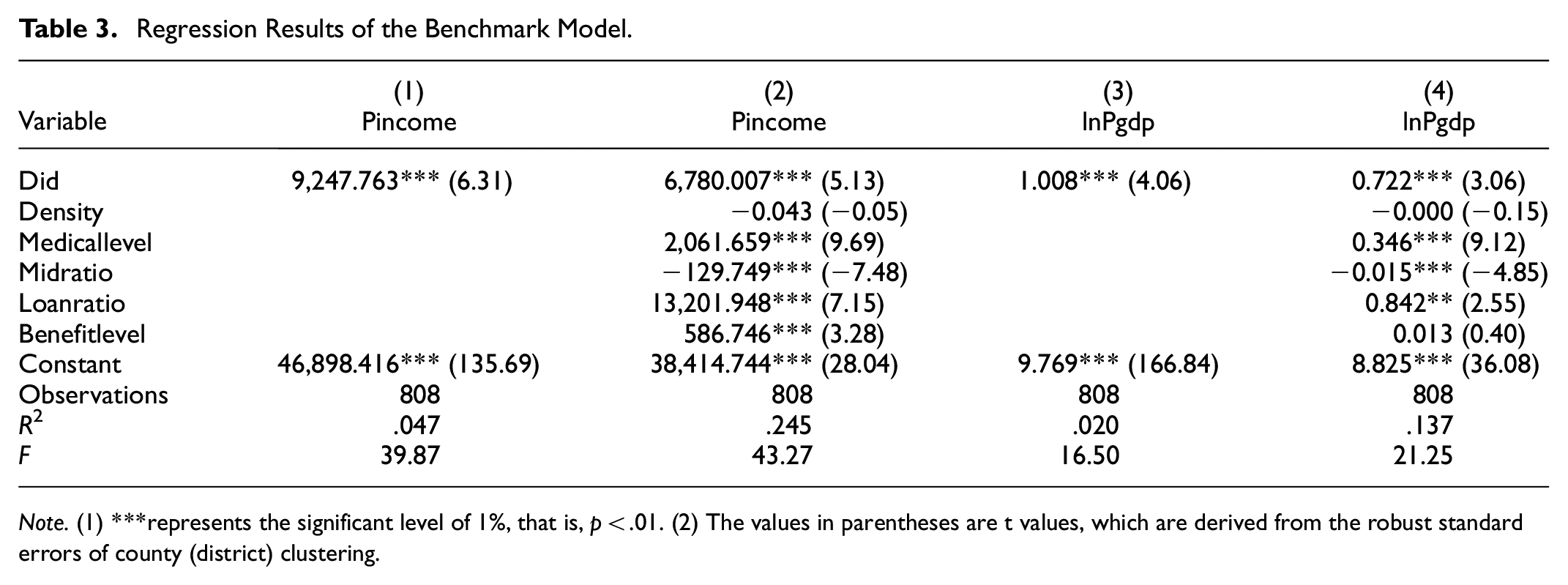
Note. (1) ***represents the significant level of 1%, that is, p < .01. (2) The values in parentheses are t values, which are derived from the robust standard errors of county (district) clustering.
Columns (1) and (3) of Table 3 are regressions that only control the fixed effects of region and time, and do not include control variables. Thus, the coefficient of the core explanatory variable did is positive and significant at the 1% level, indicating that the rural revitalization demonstration policy significantly promotes the development of rural economy. After adding the relevant control variables to columns (2) and (4), and then performing regression, the result coefficients have been reduced, but they are still significantly positive at the 1% level. This result indicates that the rural revitalization demonstration policy still promote the growth of the rural economy after adding the control variables. So hypothesis 1 is basically verified.
Applicability Test of the DID Model
The first premise of using the DID model is that the parallel trend hypothesis is true. Hence, the treatment group and the control group have the same trend of change before the implementation of the policy. If the parallel trend hypothesis is not satisfied, the estimated policy effect will be biased. The parallel trend hypothesis in this study is that the economic development of the treatment group and the control group has the same trend before the pilot of the rural revitalization demonstration policy. If the parallel-trend hypothesis is satisfied, it is shown that the intervention of the demonstration policy on the development of the rural economy occurs only after the pilot. And before the pilot, there was no significant difference in the trend of economic development between the treatment group and the control group.
This study evaluates the dynamic effect of the rural revitalization demonstration policy by using the standard event study method to test the parallel trend (Jacobson et al., 1993). By replacing


Among them, D0 is the dummy variable that the rural revitalization demonstration policy starts to carry out. D-S is the dummy variable of the s-year before the implementation of the rural revitalization demonstration policy. DS is the dummy variable of the s-year after the implementation of the model rural revitalization policy. S values 1 to 5, taking the year before policy implementation as the current year (2017).
By running the regression equation, we get Figures 1 and 2 respectively. From the size of the estimated parameter {

Dynamic effect graph of InPgdp.

Dynamic effect graph of Pincome.
The second premise of using DID method is that the selection of the demonstration area is random and not controlled artificially. The rural revitalization demonstration areas in Henan province were not selected randomly, but by carefully selecting typical and representative counties. This may cause the dependent variables (InPgdp and Pincome) of the study to be systematically correlated with the choices. Hence, its do not satisfy the stochastic premise of the DID model. Merely comparing the differences between areas with and without the demonstration policy can not reflect the real effect of the demonstration policy. To solve this problem, this study must examine whether there are systemic differences between different areas.
This study tests whether there is a significant difference between the growth trend of per capita GDP and per capita income in the demonstration area and the non-demonstration area before the implementation of the policy, to explain whether the government in the choice of model counties and urban areas can be regarded as a random selection (L. Zhou & Chen, 2005). If there is no obvious difference between the per capita GDP, per capita income, and the non-demonstration sites before the rural revitalization demonstration policy, it shows that the government chooses the demonstration areas randomly, for the exogenous nature of the policy to provide some support.
In 2013, the rural revitalization demonstration policy was not implemented in all the areas of Henan province. This study introduces the variable demonstration area (value 1 if the county becomes a demonstration area in the future, otherwise value 0) to study the characteristics of the growth trend of the dependent variables (lnPgdp and Pincome) in these areas in 2013. The regression is performed by taking the new explanatory variable demonstration area into the model (2) and replacing the
The Growth Difference Between the Two Types of Regions.

Note. (1) ***represents the significant level of 1%, that is, p < .01. (2) The values in parentheses are t values, which are derived from the robust standard errors of county (district) clustering.
Table 4 shows there was a negative correlation between the sample selection tendency of the experimental group and the explained variables before the implementation of the demonstration policy. Hence, before the implementation of the policy, the change of the dependent variable has nothing to do with whether a certain place will become a demonstration county in the future, which shows that the selection of the demonstration area by the Henan provincial government can be approximated to a random event, validating the applicability of the double difference.
Robustness Test
To further illustrate the robustness of these results, the following robustness tests are performed.
Adding Lag Variables
A lagged variable test is added to exclude possible endogenous problem problems with other control variables. During the research process, C. Sun et al. (2019) put other control variables involved in the model after one or two periods of lag and then substituted them into the model for testing, and verified the effect of policy implementation by comparing the regression results.
In this study, five control variables of population density, medical level, proportion of middle school students, financial development level, and welfare level are artificially delayed by one period, and the new variables are substituted into the model for regression testing. Table 5 shows the results. It shows that the coefficient of the core explanatory variable did is still positive and significant at the 1% level, which effectively supports Hypothesis 1.
Lagged Variable Test.

Note. (1) ***represents the significant level of 1%, that is, p < .01. (2) The values in parentheses are t values, which are derived from the robust standard errors of county (district) clustering.
Placebo Test
To further test whether the results were influenced by unobservable factors, the placebo test was performed by randomly selecting the year and region in which the demonstration policy was implemented. Specifically, we randomly selected 15 counties from 101 counties in the whole sample as the virtual experimental group, assuming that they have implemented the demonstration policies, and considering other areas as the control group. Thus, a new sample was used for regression according to Model (2), from which a placebo test could be completed. By repeating the above process 500 times, the estimated coefficients of 500 DID can be estimated and the kernel distribution of the estimated coefficients can be plotted. Thus, we could verify whether the local economic development is significantly affected by factors other than those of the model rural revitalization policy. If the distribution of DID estimation coefficient under random treatment is near 0, the model setting does not leave out important influence factors; hence, the influence factors in the benchmark analysis are indeed the influence brought by the implementation of rural revitalization demonstration policy in Henan province. As Figure 3 demonstrates, the estimated coefficients of the false DID terms are concentrated around the zero point and are in accord with the normal distribution, which indicates that the estimated results in this paper are unlikely to be influenced by the unobservable factors, the regression results were robust. Hence, it passed the placebo test.

The results of the placebo test.
Thus, this study’s conclusion that the rural revitalization demonstration policy can promote the growth of the rural economy is relatively stable. Hence, H1 has been verified.
Test for Hypothesis 2
According to hypothesis 2, the differences in the level of initial resource elements and the degree of economic development in regions will have different effects of rural revitalization demonstration policies on regional economic development. The effect of demonstration policy is the best in the medium-sized demonstration area of economic development, followed by the better demonstration area of economic development, and finally the backward demonstration area of economic development. To be specific, the order of magnitude of the impact is county (second-level administrative regions), poverty-stricken county (second-level administrative regions), and county-level city (first-level administrative regions).
To verify the theory, this study selects three types of regional indicators, namely county-level cities, counties, and poverty-stricken counties, and constructs the following model (5) based on model (1) to test the validity of hypothesis 2.

Among them, the
Further Test Data.

Note. (1) ***, **, and * represent the significant levels of 1%, 5%, and 10%, respectively, that is, ***p < .01, **p < .05, and *p < .1. (2) The values in parentheses are t values, which are derived from the robust standard errors of county (district) clustering.
Referring to Table 6, this study found that the rural revitalization demonstration policy had the most obvious promotion effect on counties, followed by poverty-stricken counties, and county-level cities. The promotion effect of counties and poverty-stricken counties is greater than that of county-level cities, which conforms to the law of diminishing marginal effects. However, considering that the foundation of poverty-stricken counties is relatively backward and the initial resource level is too low, its economic promotion effect is not as good as that of counties with relatively better economic conditions. Thus, this conclusion supports H2.
Henan Province divides its administrative divisions into three grades according to the living standards and per capita income of each region. The 15 rural revitalization demonstration areas we selected are distributed in all three levels. 4 To further verify the reliability of H2, the sample size are divided into three categories according to the regional classification of the Henan provincial government and established the model (6) again for analysis.

Among them,
Model (6) Analysis Results.

Note. (1) ***, **, and * represent the significant levels of 1%, 5%, and 10%, respectively, that is, ***p < .01, **p < .05, and *p < .1. (2) The values in parentheses are t values, which are derived from the robust standard errors of county (district) clustering.
Through the results, we found that the rural revitalization demonstration areas in the second-level administrative regions and those in the third-level administrative regions have the most significant role and the second largest role in promoting rural economic development respectively, whereas the rural revitalization demonstration areas in the first-level administrative regions have no significant role in the same. This result is basically consistent with that of model (5). Therefore, we can conclude that the results of hypothesis 2 are reliable.
Conclusion and Discussion
In theory, rural revitalization demonstration areas can achieve rural economic development through demonstration effects. However, there is still a relatively lack of empirical research on rural revitalization demonstration policies. Then, has the rural demonstration policy implemented in China promoted economic development? The answer to this question has important practical significance. Based on the relevant data of 15 demonstration areas in Henan Province approved since 2018, this study uses DID method to prove the impact of rural revitalization demonstration policies on economic development in Henan province. Two conclusions have been drawn.
First, the demonstration policy of rural revitalization plays a significant role in promoting economic development. The demonstration policy of rural revitalization in Henan province has achieved its demonstration effect. Through the rural revitalization demonstration policy, the demonstration area infrastructure, public service level, ecological environment quality has been significantly improved, which is very conducive to rural economic development. And the demonstration policy of rural revitalization is based on the realization of industrial transformation, which promotes the development of relevant industries through the development of modern agriculture, thus improving and upgrading the industrial structure of relevant industries. It accelerates the pace of the integration development of the primary, secondary and tertiary industries in rural areas, and is also conducive to promoting industrial agglomeration and obtaining scale benefits. In the rural revitalization demonstration areas, the demonstration policies have also increased the employment opportunities of farmers by providing them with skills training. The local government should expand and excavate the project of farmers’ employment and entrepreneurship by using new ideas, which provides a broad platform for the realization of farmers’ employment and entrepreneurship. In addition, the state also attaches great importance to the demonstration rural revitalization policy and has invested a large number of human and material resources. And these policy dividends are also conducive to the realization of local employment and entrepreneurship of farmers, and drive farmers to increase income and become rich, and promote economic development.
Second, the demonstration policy of rural revitalization to promote the effect of rural economic growth has a regional imbalance. This study found that the demonstration policy of rural revitalization of the economic promotion in the medium level of economic development of the county (second-level administrative regions) is the most significant. There is more room for improvement in the economic development of these areas, because the starting point is slightly lower. The demonstration effect of rural revitalization can get the biggest benefit. The rank second is the poverty-stricken counties (third-level administrative regions). Due to the low economic starting point, late start and poor infrastructure in the region, even if given human, material and financial support, it is necessary to carry out infrastructure construction in the early stage, change the way of thinking of local farmers, demonstration effect can be shown. These will affect the effectiveness of the demonstration policy and effective time. At the bottom of the list are the county-level cities (first-level administrative country subdivision). As the base of these administrative regions is better, the driving effect of the demonstration rural revitalization policy is not obvious.
The result indicates that provincial governments at all levels should take into account the initial level of resources and the level of economic development when setting up demonstration areas. If the demonstration areas can be set up properly, the demonstration rural revitalization policy will not only promote the local economic development, but also reduce the gap between the rich and the poor faster, and will play a good role in promoting the realization of common prosperity.
Footnotes
Author Note
This research was conducted while [Yikang Guo] was at [Xinyang Normal University]. He is now at [Xinjiang University of Finance and Economics] and may be contacted at [No. 449, Beijing Middle Road, New Downtown, Urumqi, Xinjiang Uygur Autonomous Region, China. Email:
Declaration of Conflicting Interests
The author(s) declared no potential conflicts of interest with respect to the research, authorship, and/or publication of this article.
Funding
The author(s) disclosed receipt of the following financial support for the research, authorship, and/or publication of this article: This work was supported by the National Social Science Foundation of China[No. 20CGJ021], and Postgraduate Education Reform and Quality Improvement Project of Henan Province [No. YJS2022JD30].
Ethical Approval
This study was conducted with the approval of the ethics committees of Xinyang Normal University.

Data Availability Statement
The data used in this study are available from the corresponding author upon reasonable request.