



Abstract
The selection of entrepreneurial endeavors by return migrant workers represents a form of reverse urban-to-rural labor migration that has the potential to promote rural development and contribute to rural revitalization. However, there is a paucity of academic research examining the influence of entrepreneurial role models on their decision to pursue entrepreneurship. In light of this gap, this paper employs data from the China Household Finance Survey (CHFS) to analyze the impact of entrepreneurial role models in 2017 on return migrant worker entrepreneurship in 2019. This analysis is based on social learning theory and employs the OLS and 2SLS methods. The results demonstrate that the entrepreneurial role models in 2017 exerted a significant influence on the probability of return migrant workers initiating businesses in 2019, increasing it by .80%. These results remain robust after using an instrumental variable approach and an enhanced method to mitigate self-selection bias to address the endogeneity problem. The mechanism analysis indicates that entrepreneurial role models can enhance the strength of social networks by increasing the frequency of interactions with return migrant workers, thereby influencing their decisions to pursue entrepreneurial careers. The impact of entrepreneurial role models on return migrant workers’ entrepreneurial activities varies significantly. Specifically, the findings indicate that older individuals, those with less education, and those with higher income levels before returning to their hometowns are more likely to engage in entrepreneurial activities. This study aims to provide insights that can inform the formulation of appropriate policies for rural sustainable development in developing countries.
Keywords
Introduction
The issue of sustainable development has emerged as a primary concern for developing countries in the contemporary era (Gao et al., 2024a; Gao et al., 2024b; Gao et al., 2024c; Tan et al., 2024). This concern is especially pronounced in the economic sector. China, the world’s largest developing country, has identified the sustainable development of rural economies as a critical priority. A key strategy employed is the encouragement of migrant workers to return to their hometowns and contribute to the local economy. This approach is seen as a pivotal method for promoting rural economic sustainability and revitalization (Y. Zhou et al., 2019). In China, individuals with agricultural household registration (hukou) who have been employed in the non-agricultural sector in urban areas for a minimum of 6 months are typically designated as migrant workers (Wu et al., 2023). The term “return migrant worker” refers to the subsequent return of these individuals to their places of origin, whether villages, communes or counties (Démurger & Xu, 2011; Wu et al., 2023; Y. Zhao, 2002). The employment and living conditions of migrant workers have consistently been a consistent area of social concern, with a particular attention given to the entrepreneurial activities of this group after their return (J. Yin et al., 2021). It is widely acknowledged that migrant workers enhance their human capital, as well as their accumulated material and social capital, while working and residing in more developed or urban areas (Lin et al., 2021; Xi et al., 2025; Yu et al., 2017). The ongoing enhancement of infrastructure, institutions, and market conditions in their hometowns (Wang et al., 2022; J. Yin et al., 2021) has led to a return of these workers to their hometowns to engage in entrepreneurial endeavors (C. Y. Liu et al., 2019).
According to China’s National Bureau of Statistics, the number of individuals returning to rural areas to establish their businesses exceeded 8.5 million in 2019. Of this figure, 70% were return migrant workers launching their businesses (Xue et al., 2023). It is projected that by 2025, the number of such individuals will exceed 15 million on a national scale. The return of migrant workers to their hometowns has resulted in a “reverse-centralized” flow of factors and resources, which has, to a certain extent, addressed the issue of a lack of development resources in rural areas and facilitated economic growth in these regions. Return migrant entrepreneurs serve as catalysts for rural economic growth, introducing their entrepreneurial spirit and accumulated human, financial, social, and technological capital back to their hometowns, thereby facilitating the urban-rural socio-economic transformation in their hometowns (Bao et al., 2022; Zhu et al., 2021). Furthermore, the return of migrant workers facilitates the formation of economic agglomerations in rural areas, generates employment opportunities, and alters the structure of rural industries through entrepreneurial activities (Bao et al., 2022). This helps reduce income disparities between urban and rural areas, as well as within rural areas (P. Huang et al., 2024; Y. Zhang et al., 2023). From a non-economic perspective, the entrepreneurial activities of return migrant workers facilitate the integration of these individuals into rural communities, enabling them to maintain proximity to their families and address their familial responsibilities concurrently. This contributes to an enhanced sense of well-being among rural residents in China (Wang et al., 2022).
A substantial corpus of literature exists on the motivating factors behind return migrant entrepreneurial behaviors, which can be classified into two categories: macro and micro factors. From a micro perspective, scholars have primarily examined the personal and familial attributes of entrepreneurs, including material, human, social, and financial capital (Fan et al., 2023; Lin et al., 2021; Wang et al., 2022; Xi et al., 2025; Xue et al., 2023). In terms of macro-level factors, the existing literature has predominantly focused on the social and economic environment, encompassing the availability of infrastructure, institutional quality, and market conditions (S. Chai et al., 2023; P. Huang et al., 2024; Wang et al., 2022; J. Yin et al., 2021). These factors have been identified as influencing the likelihood of return migrant entrepreneurship in their hometowns. However, a comprehensive investigation into the influence of entrepreneurial role models on return migrant worker entrepreneurs engaging in entrepreneurial activities remains conspicuously absent. In light of this gap, this study investigates the mechanisms through which entrepreneurial role models influence return migrant worker entrepreneurship, drawing on social learning theory and utilizing the China Household Finance Survey (CHFS) database from 2017 and 2019. The study’s findings reveal that entrepreneurial role models in 2017 significantly augmented the probability of return migrant worker entrepreneurship in 2019. The impact of entrepreneurial role models on return migrant worker entrepreneurship can be primarily attributed to the social network effect and the occupational selection effect. The study also reveals significant heterogeneity in the impact of entrepreneurial role models on the entrepreneurial activities of return migrant workers.
The potential marginal contributions are reflected in the following aspects: (1) This paper, drawing on social learning theory, examines the impact of entrepreneurial role models on return migrant worker entrepreneurship. It aims to expand the theory by integrating it with the interaction of entrepreneurial role models with return migrant potential entrepreneurs in developing countries. (2) This study addresses a gap in existing research by systematically exploring the influence mechanisms of entrepreneurial role models on return migrant worker entrepreneurship. This study makes a significant contribution to advancing the theory in this domain, offering invaluable insights that will inform future research in this field. (3) This paper contributes to the body of research on the factors that influence return migrant worker entrepreneurship. This study contributes to the existing literature on the role of entrepreneurial role models in motivating return migrant workers to start businesses. It underscores the significance of these models as representations of rural “strong ties” social networks in this context. (4) Leveraging the most recent data from the China Household Financial Survey (CHFS), which is nationally representative, this study employs a distinctive approach to examine the heterogeneous impact of entrepreneurial role models on return migrant worker entrepreneurship. This analysis offers key insights and provides a foundation for governments in developing countries to formulate targeted policies to foster a sustainable rural economy.
The remainder of this paper is organized as follows. The second section presents the literature review and theoretical hypothesis. The third section introduces the data and variables used. The fourth section outlines the empirical strategy and interprets the relevant results. The fifth section explores the mechanism analysis. The final section presents the conclusions and discussion.
Literature Review and Research Hypothesis
Literature Review
Motivations of Migrant Workers Returning to Their Hometowns
Lee (1966) proposes a “push-pull” qualitative analysis model of population migration flows from a sociological perspective, providing a robust theoretical framework for the study of migrant workers’ mobility. In a similar vein, Todaro (1969) develops a quantitative analysis model of rural-to-urban labor migration from an economic perspective. By incorporating the variable of expected income, he concludes that the motivation of agricultural laborers to relocate to urban areas is contingent upon the discrepancy in expected income between rural and urban regions. The Todaro model has been employed by numerous scholars to examine the characteristics of labor mobility in China and to elucidate the phenomenon of migrant workers returning to their hometowns (Y. Zhao, 2002). Mohabir et al. (2017) and Y. Zhao (2002) posit that factors such as gender, age, education, and sense of belonging significantly influence the intentions and decisions of migrant workers regarding their return to their home areas. Lin et al. (2021) contend that the household registration (hukou) system constitutes a substantial obstacle for migrant workers seeking to establish permanent residence in the cities where they are employed. However, they also posit that this system functions as a conduit for migrant workers to maintain close ties with their hometowns, villages, and communities. Furthermore, organizational factors in rural societies, such as organizational culture and organizational policies, can also be effective in enhancing the material, relational, and personal adaptations of return migrant workers, and contribute to their identification with the local society (Shen et al., 2023). Consequently, out-migration is regarded as a transient labor migration process, whereby the labor force relocates from rural areas to pursue employment opportunities in economically advanced urban centers, subsequently returning to their rural origins to engage in alternative forms of labor (Van der Ploeg & Ye, 2016).
Willingness and Behavior of Return Migrant Workers to Start Businesses
Upon returning to their place of origin, migrant workers will be confronted with a number of significant decisions regarding their future. These include whether to return to farming, integrate into the local labor market, or embark on entrepreneurial endeavors. It is noteworthy that some migrants make decisions in conjunction with other choices prior to their departure from their place of origin. These include decisions regarding the choice of whether to migrate for work, the duration of their migration, whether to return, and the type of occupation they will pursue after their return (Bao et al., 2022; Lin et al., 2021). Some scholars have expanded the scope of their research to encompass the entrepreneurial activities of migrant workers upon their return to home regions. They internalize the phenomenon of migrant workers returning to their rural home regions and engaging in entrepreneurial activities, drawing upon the framework developed by Dustmann and Kirchkamp (2002) to inform their theoretical research. Migrant workers amass a range of resources, including entrepreneurial, human, technological, and social capital, in their urban workplaces (Bao et al., 2022; C. Y. Liu et al., 2019; Xu et al., 2017). This accumulation of resources subsequently motivates them to return to their hometowns and launch their own businesses. Concurrently, China’s rural entrepreneurial environment has undergone a notable transformation in recent years, with substantial advancements in infrastructure, road transportation, and informatization (Wang et al., 2022; J. Yin et al., 2021). To a certain extent, this alleviates the resource constraints faced by entrepreneurship and provides a positive environment for entrepreneurial activities of migrant workers after they return to their hometowns (C. Y. Liu et al., 2019; Mei et al., 2020).
Characteristics of Entrepreneurship Among Return Migrant Workers
The entrepreneurial behavior of return migrant workers in China is characterized by three key aspects. Firstly, there is the movement of populations from developed to less developed regions (Démurger & Xu, 2011). Globally, the majority of population flows are unidirectional, with individuals migrating from less developed to more developed areas. However, China’s migrant workers, who return to their hometowns to establish their own businesses, exemplify bidirectional population flows between urban and rural regions (Y. Hu, 2023). This phenomenon represents a reversal of the “urban-to-rural” flow, occurring concurrently with the predominance of the “rural-to-urban” flow (Y. Hu, 2023). Secondly, it underscores the significance of returning to one’s place of origin (Y. Hu, 2023). The decision of where to establish a business for migrant workers returning to their hometowns is not based on the assessment of the region’s entrepreneurial advantages. Rather, it is driven by a desire to return to their hometowns. This decision is influenced not only by the social network in the place of origin but also by the sentiment of contributing to the development of their hometown. Thirdly, the selection of entrepreneurial industries is contingent upon the local resource endowments (Y. Hu, 2023; S. Zhang et al., 2021). While international returnee entrepreneurs often focus on high-tech industries, leveraging advanced technologies acquired abroad, return migrant worker entrepreneurs in China tend to focus on industries based on rural resource endowments, which are typically not high-end. Upon returning to their place of origin, most return migrant workers deploy the resources accumulated from working in developed regions to engage in self-managed non-agricultural industries (Démurger & Xu, 2011; Y. Hu, 2023; S. Zhang et al., 2021).
Research Hypothesis
Demonstration Effect of Former Successful Entrepreneurs
The impact of entrepreneurial role models on individual entrepreneurship can be explained through the lens of social learning theory (Bandura, 1977). In line with this theory, Gibson (2004) defines a role model as “an individual who seeks out social roles that are analogous to their own and aspires to enhance the similarity by emulating the attributes of the role model.” The study of role models in social learning theory provides a comprehensive understanding of the processes involved in observational learning, cognitive development, and identity formation in relation to role models. When individuals observe role models adeptly executing tasks, surmounting obstacles, or accomplishing objectives, they are inclined to emulate these behaviors, perceiving them as exemplary. This imitation process represents a core aspect of role model learning (Brown & Treviño, 2014). Through imitation, individuals gradually internalize the behavioral patterns and values of their role models, which in turn shapes their perceptions of effective behaviors and situations.
In rural areas of China, where most return migrant workers reside and operate, a “strong ties” social network is frequently observed, characterized by close kinship, blood ties, and geographic proximity (J. Liu et al., 2024). Within this framework, rural residents may exhibit distinctive behavioral and decision-making patterns, particularly when faced with uncertainty. To reduce the costs of seeking information, individuals often rely on reference and imitation, given their close relationships and familiarity with one another. Success stories are readily accessible and can inspire others to emulate the experiences of entrepreneurial role models (Koellinger, 2008). Social networks provide potential entrepreneurs with opportunities to observe and interact with entrepreneurial role models, which can significantly influence their entrepreneurial decisions (Greve & Salaff, 2003). Successful entrepreneurs, as exemplars within social networks, shape the occupational preferences of potential entrepreneurs (Witt, 1991), stimulate entrepreneurial willingness (Scherer et al., 1989), and motivate action toward entrepreneurship.
Gibson (2004) categorizes entrepreneurial role models as either “close” or “distant” types, based on their level of interaction with potential entrepreneurs. “Close” entrepreneurial role models, who engage in direct and frequent interactions with potential entrepreneurs, are often individuals with whom the potential entrepreneur is personally familiar. As proposed by Gibson (2004), entrepreneurial role models in rural areas should be classified as belonging to the “close” type. In rural communities, entrepreneurial role models frequently include family members, friends, or acquaintances whose successes inspire others and accelerate local entrepreneurship (Andersson & Larsson, 2016). Furthermore, rural residents are situated in close spatial and social proximity to entrepreneurial role models (H. Zhao et al., 2023), providing them with opportunities to observe or experience the attitudes, values, and behavioral patterns of these role models, which they can then emulate. In alignment with social learning theory (Bandura, 1977), engaging with entrepreneurial role models enables rural residents to recognize shared or analogous entrepreneurial aptitudes and resources by comparing themselves with the aforementioned role models. This, in turn, enhances their perception of the viability of entrepreneurship as a viable career path.
Based on the previous discussion, we develop the following main Hypothesis:
H1: Entrepreneurship role models can increase the probability of return migrant workers starting their businesses.
Mechanisms of Entrepreneurial Role Models Influencing Return Migrant Worker Entrepreneurship
Entrepreneurial role models may disseminate knowledge for the community with special mentoring and support for potential entrepreneurs, or increase the willingness of potential entrepreneurs to undertake entrepreneurial projects by creating an environment that triggers entrepreneurial behaviors (H. Zhao et al., 2023). The effects are more pronounced when the two groups reside in the same geographic area (Wyrwich et al., 2019). In social networks with strong ties, formed through kinship, blood, and geography, rural residents share symmetrical information and close relationships with one another. This results in frequent interaction between entrepreneurial role models and potential entrepreneurs, which significantly increases the density of social networks (J. Liu et al., 2024). Since social capital—resulting from interactions within social networks (J. Liu et al., 2024)—is a key factor in rural residents’ entrepreneurship (H. Zhao et al., 2022), the extensive interaction of potential entrepreneurs with entrepreneurial role models serves to promote their accumulation of social capital, which in turn facilitates their entrepreneurial activities (J. Zhao & Li, 2021). According to Social Learning Theory (Bandura, 1977), proximate entrepreneurial role models provide nascent entrepreneurs with the chance to observe, learn, and “teach by example” (Dohse & Walter, 2012), thereby granting them access to entrepreneurial information and resources. Consequently, constructive engagement with entrepreneurial role models (N. Chen et al., 2016; H. Hu & Wang, 2019) allows prospective entrepreneurs to accumulate knowledge and hone skills relevant to entrepreneurship (S. J. Chai, 2017), reduce fears of failure (Wyrwich et al., 2016, 2019), strengthen entrepreneurial confidence (Hopp & Sonderegger, 2015), and increase the likelihood of starting a business.
Consequently, this leads to the following Hypothesis:
H2a: Entrepreneurship role models facilitate the entrepreneurial activities of return migrant workers by strengthening the connections to the social networks of return migrant workers.
In alignment with the tenets of the career choice model, the decision of return migrant workers to pursue entrepreneurial endeavors in their hometowns can be viewed as a rational choice of personal occupation. This is based on a comparison between the expected utility of entrepreneurship and the expected utility of engaging in farming or conventional employment (Bao et al., 2022; Fonseca et al., 2001; Haile, 2008). In this framework, if a return migrant worker’s expected utility of entrepreneurship is high, they will opt to establish their own business; conversely, they will elect to engage in farming or be employed. Given the multitude of factors that contribute to an individual’s perception of the utility of a given occupation, we adopt the model of Haile (2008) and Bao et al. (2022) to posit that the expected utility of entrepreneurship for return rural migrant workers is contingent upon a number of variables, including entrepreneurial aptitude a, risk attitude r, access to capital K (including human, physical, and social capital, etc.), and a vector X of personal characteristics related to occupational choice (e.g., age, education, gender, social factors, etc.). The expected utility of engaging in farming for return migrant workers is contingent upon three key factors: the area of arable land owned by the return migrant worker l, the level of agricultural production p, and personal characteristics X. The expected utility of being employed for return migrant workers depends on two key factors: job productivity, as reflected in the wage rate w, and personal characteristics X.
It can be posited that the expected utility functions of entrepreneurship, engaging in farming and being employed for return migrant workers can be written as follows:
In the process of learning from and communicating with entrepreneurial role models, return migrant workers enhance their human and social capital. These individuals are convinced that the expected utility of personal entrepreneurship surpasses that of engaging in farming or conventional employment. Consequently, they diminish the potential for future uncertainty and the associated fear of failure (Wyrwich et al., 2016). Additionally, they perceive entrepreneurship as a compelling career choice and are inclined to prioritize their entrepreneurial endeavors promptly (Bao et al., 2022).
Therefore, this paper proposes the following Hypothesis:
H2b: Entrepreneurship role models promote the entrepreneurial activities of return migrant workers by influencing their occupational selections.
Based on the above analysis, the research model constructed in this paper is shown in Figure 1.

Research model.
Data and Variables
Data Selection
This paper draws upon data from the China Household Financial Survey (CHFS), conducted by the China Household Financial Survey and Research Center of Southwestern University of Finance and Economics in China (excluding Taiwan Province, Hong Kong Special Administrative Region, and Macao Special Administrative Region) in 2017 and 2019. The 2019 CHFS survey sample encompassed 343 districts and counties in 29 provinces (including autonomous regions and municipalities directly under the Central Government), and ultimately collected information from 34,643 households and 107,008 family members. This broad and nationally representative sample provides a solid basis for this study.
The selection of relevant data is informed by existing literature on return migrant workers (H. Chen & Wang, 2019). Specifically, the data from the CHFS in 2019 are employed, with a particular focus on individuals who possess an agricultural hukou and have been employed outside of their prefecture-level city of registration for a period exceeding half a year, subsequently returning (Wu et al., 2023). Regarding the processing of the data, the sample excluded individuals under the age of 16 or over the age of 65. The sample was further restricted to exclude individuals who had initiated a business in both 2017 and 2019, as well as those who had expressed a desire to return to their hometown but had not yet done so. Additional exclusions included those under 15 at the time of their first out-migration, those who out-migrated for the first time before China’s reform and opening-up policy in 1978 (Yu et al., 2017), missing samples of entrepreneurship, and individual samples with household consumption below zero in 2019. In sum, the final dataset comprises 3,617 samples of return migrant workers, distributed across 221 cities and 268 county-level regions in 29 provinces (and municipalities directly under the Central Government) within mainland China.
Variable Construction
Dependent Variable
In this paper, we focus on non-farm entrepreneurship. The dependent variable is the decision of return migrant workers to embark on entrepreneurial activities in 2019 (hereinafter referred to as return migrant worker entrepreneurship). To operationalize this variable, we refer to the existing literature and specifically rely on the responses to a key question within the 2019 CHFS questionnaire. This question pertains to the respondent’s employment status during the previous year. In instances where a respondent’s employment status was identified as “employer,”“self-employed,” or “freelancer,” the dependent variable is assigned a value of 1 (G. Zhou & Li, 2016), indicating engagement in entrepreneurial activities. In contrast, any other responses to the employment status question are assigned a value of 0, denoting that the individual had not initiated their own business venture.
Core Independent Variable
The entrepreneurial role models in 2017 (hereafter referred to as “entrepreneurial role models”) represent the core independent variable in this study. In the absence of a universally accepted definition of entrepreneurial role models, scholars have employed various approaches to conceptualizing this phenomenon. For example, Bosma et al. (2012) posit that individuals who have inspired others to launch their own businesses can be considered as entrepreneurial role models. Meanwhile, N. Chen et al. (2016) propose that parents, other family members, and close friends who own businesses may be considered potential role models. Recent scholarship has sought to further refine this measure. Some researchers focus on successful micro-entrepreneurs as entrepreneurial role models (Lafortune et al., 2018), while others include those who have devised a viable business concept and managed a company of an industry-specific minimum efficient size (Wyrwich et al., 2016). In light of these considerations, we direct our attention to the measures proposed by Lafortune et al. (2018) and Wyrwich et al. (2016) regarding entrepreneurial role models. We then examine the entrepreneurship sample of individuals with agricultural hukou, and conclude that those whose companies were operating at a profit or at a break-even point may be regarded as entrepreneurial role models. Following the methodology proposed by Démurger and Xu (2011), the number of successful entrepreneurs at the county level was calculated, resulting in a total of 2,686 successful entrepreneurs in 2017.
Control Variables
We classify the control variables that may affect return migrant worker entrepreneurship into five categories: (1) variables reflecting individual characteristics (S. Chai et al., 2023; P. Huang et al., 2024), for example, gender, marital status, health, age, age-squared, education, and risk attitude. (2) Variables that reflect the working conditions of migrant workers (Lin et al., 2021; J. Yin et al., 2021), such as the nature of out-migration work, annual income from working in cities, and the duration of migration. (3) Variables reflecting family characteristics (P. Huang et al., 2024; Lin et al., 2021), such as family size and household assets. (4) Entrepreneurial climate (Démurger & Xu, 2011; Z. Yin et al., 2019), which controls for the impact of government policies supporting entrepreneurship (Nunn & Wantchekon, 2011). (5) A regional fixed effect reflecting individual location characteristics: city fixed effect.
Variable Definitions and Descriptive Statistics
Table 1 provides the definitions of the main variables, while Table 2 describes the statistical characteristics. The mean value of return migrant workers who choose to establish their businesses is 0.110, indicating that the likelihood of initiating a business venture among this cohort is 11%. The mean education level is 9.402, suggesting that most respondents had completed education beyond the junior high school level but below a high school diploma. The respondents were predominantly young, with an average age of 41 years. The mean values for respondents’ gender, marital status, and health are 0.685, 0.803, and 3.553, respectively. The results indicate that the sample of return migrant workers is predominantly male, mostly married, and in relatively good physical health. The mean risk attitude score is 2.461, suggesting that most return migrant workers have a generally neutral risk attitude. The mean duration of return migrant workers is 3.5 years, with an average annual income of 27,700 RMB. The mean family size per return migrant worker is four, with an average household asset value of 627,000 RMB. The mean score for the entrepreneurial climate is 0.022. The mean number of entrepreneurial role models per county is 11, with a maximum of 37 in any single county.
Definitions of Main Variables.

Note. The logarithm is ln (1 + the original data).
Descriptive Statistics.

Empirical Strategies and Results
Model Specification
As demonstrated in the preceding analysis, the linear probability model (LPM; Angrist & Krueger, 2001) is employed to examine the influence of entrepreneurial role models in 2017 on return migrant worker entrepreneurship in 2019.

The subscripts i, j, and q represent individual, county, and city respectively;
Baseline Results
We carry out the estimation in Equation (1), and present the baseline results in Table 3. Column (1) presents the regression results obtained by controlling for city fixed effects exclusively. Column (2) to (5) illustrate the regression results obtained by gradually incorporating control variables, including personal characteristics, migrant workers’ working conditions, family characteristics, and the entrepreneurial climate. The results of the OLS estimation indicate that the probability of entrepreneurial role models influencing return migrant workers to engage in entrepreneurship is .080%, which is statistically significant at the 1% level. Concurrently, the standardized beta coefficient indicates that an increase of one standard deviation in the number of entrepreneurial role models is associated with a 0.162 standard deviation increase in the probability of return migrant workers establishing businesses. Our findings suggest that entrepreneurial role models have a significant impact on the propensity of return migrant workers to pursue entrepreneurial endeavors. Thus, Hypothesis H1 is supported.
Baseline Results.

Note. Robust standard errors clustered to county level in parentheses.
p < .01. **p < .05. *p < .10.
In terms of other control variables, male return migrant workers may be more inclined to pursue entrepreneurship (P. Huang et al., 2025; Xi et al., 2025). The impact of age on the propensity of return migrant workers to establish a business exhibits a nonlinear pattern, displaying an inverted U-shaped trajectory (S. Chai et al., 2023; P. Huang et al., 2024). Although the test of significance was not passed, the results do indicate a correlation between higher levels of education and better health status, as well as a higher likelihood of return migrant workers securing entrepreneurship (P. Huang et al., 2024). The estimated coefficient for marital status is positive and statistically significant at the 1% level, indicating that married return migrant workers are more likely to establish their businesses (P. Huang et al., 2024; Xi et al., 2025). A higher risk tolerance, a longer duration of out-migrant work, and a greater level of household assets are identified as positive predictors of entrepreneurial activities among return migrant workers (S. Chai et al., 2023; P. Huang et al., 2024). The estimated coefficient of annual income from working in cities is positive but not statistically significant. This may indicate that as income increases, the probability of migrant workers returning to their hometowns to establish their businesses also increases, to some extent (Fan et al., 2023). The probability of entrepreneurship among return migrant workers is inversely correlated with the size of the family unit (Bao et al., 2022; P. Huang et al., 2024). Furthermore, the coefficient of the entrepreneurial climate is positive but is not statistically significant. This suggests that a more favorable entrepreneurial climate is associated with a higher probability of return migrant workers becoming entrepreneurs.
Exploration of Endogeneity
This paper examines the influence of entrepreneurial role models in 2017 on the entrepreneurship of return migrant workers in 2019. Given the temporal distinction between these two events, it is reasonable to conclude that there is minimal likelihood of mutual causality between the core independent variable and the dependent variable in the model. Nevertheless, the baseline regression indicates that entrepreneurial role models have a positive influence on the phenomenon of return migrant worker entrepreneurship. However, it is also possible that this favorable impact is partly attributable to omitted variables and self-selection. In this paper, we acknowledge two main concerns that warrant further investigation. Firstly, unobserved factors may be influencing the entrepreneurship of return migrant workers, which could lead to a biased estimate of the core independent variable’s coefficient. Secondly, it is possible that self-selection behavior among migrant workers may be a factor. Specifically, the inclusion of individuals with a naturally higher propensity for entrepreneurship could result in an overestimation of the core independent variable’s effect. To address these issues, we aim to mitigate the omitted variable problem through the use of an instrumental variable method and to address the self-selection problem via proactive/passive entrepreneurial grouping regression.
Strategies to Mitigate Omitted Variables
Instrumental Variable Regression
To address the endogeneity issue stemming from omitted variables, we employ the instrumental variable approach. In line with the methodology proposed by Démurger and Xu (2011) and Xu et al. (2017), we utilize the climate of participation in business as an instrumental variable in our regression analysis. This is quantified by the number of family members involved in business management in agricultural hukou individual entrepreneurship projects as a proportion of the county’s population in 2017. Firstly, it is proposed that there is a correlation between the climate of participation in business and the success of entrepreneurial projects undertaken by entrepreneurial role models in the current year. Concurrently, the climate of participating in business is a relatively more macro variable, to a minimal extent influenced by entrepreneurial role models. A two-stage least squares regression is conducted through the instrumental variable, as detailed in Table 4. Column (1) presents the results of the first-stage regression, wherein the estimated coefficient of the instrumental variable is statistically significant at the 1% level, indicating a strong correlation between the instrumental variable and entrepreneurial role models. Furthermore, the F-value of the first-stage joint test is 19.58, exceeding 10, which dismisses the possibility of a weak instrumental variable.
Instrumental Variable Regression and Falsification Test of Instrumental Variable.

Note. Controls include personal characteristic variables, working conditions of migrant workers variables, family characteristic variables, and entrepreneurial climate variables, the same applies below.
Robust standard errors clustered to county level in parentheses.
p < .01. *p < .10.
Secondly, the instrumental variable is also subject to the exclusion restriction. The climate of participation in business may impact the entrepreneurial activities of non-agricultural hukou individuals, and these entrepreneurial activities may influence the entrepreneurial behaviors of return migrant workers, potentially leading to a herding effect on their entrepreneurial choices. However, the entrepreneurial climate variable (the proportion of the non-agricultural hukou individual entrepreneurs in the county population) has been included as a key control variable in the model, maintaining the entrepreneurial climate for non-agricultural hukou individuals unchanged and thus preventing this potential path of influence. The results are presented in column (1) of Table 4, where the estimated coefficient of the instrumental variable is found to be positively significant at the 1% level. Column (2) of Table 4 reports the results of the second-stage regression of the 2SLS: The coefficient of entrepreneurial role models is 0.078, which is statistically significant at the 10% level and shows a slight reduction in magnitude compared to the baseline regression result. The 2SLS results further support the conclusion that entrepreneurial role models contribute to return migrant worker entrepreneurship.
Falsification Test of the Instrumental Variable
Based on the results presented in columns (1) and (2) of Table 4, we deduce that the instrumental variable exerts a positive influence on the return migrant worker entrepreneurship. We hypothesize that the influence of entrepreneurial role models represents the sole channel affecting return migrant workers’ decisions to start their own businesses, and that the instrumental variable can only impact their entrepreneurship through these role models. If this assumption is valid, then entrepreneurial behavior among urban residents, if it exists, should not be influenced by the entrepreneurial role models. In the absence of entrepreneurial role models on the entrepreneurship of urban residents, it is unlikely that the instrumental variable would affect their entrepreneurship. To assess the reliability of the instrumental variable regression, we follow the methodology of Nunn and Wantchekon (2011) and conduct a falsification test. This involves examining 11,340 observations from the 266 counties initially selected, with a particular focus on whether urban residents are establishing businesses. We employ a regression analysis to examine the influence of entrepreneurial role models and the instrumental variable on the entrepreneurship among urban residents. As illustrated in Table 4, the regression results indicate that both the coefficients of the entrepreneurial role models in column (3) and the instrumental variable in column (4) are not statistically significant. This suggests that neither variable has a notable impact on the entrepreneurship of urban residents. Consequently, we conclude that this instrumental variable affects the return migrant workers’ decision to start their own businesses solely through the influence of the entrepreneurial role models, thus satisfying the conditions of exogeneity and affirming its efficacy as an effective instrumental variable.
Strategy to Mitigate Self-Selection
The phenomenon of self-selection may exert an influence on the entrepreneurial activities of return migrant workers (Démurger & Xu, 2011). Some migrant workers, having accumulated the requisite entrepreneurial capital and relevant skills while working outside their hometowns, may return to their place of origin with the intention of establishing a business. Additionally, there are migrant workers who decide on out-migrating for work, the duration of migration, returning home, and starting a business after their return, all before even leaving their hometowns (Lin et al., 2021). If such return migrant workers exist, endogeneity problems could arise, potentially leading to an overestimation of the core independent variable’s true marginal effect.
In order to mitigate the potential adverse impact of self-selection, we evaluate whether the return migrant workers are proactive or passive in initiating their own businesses, based on their responses to the question, “Reasons for Family Members to Return to Hometown.” A list of nine options was presented to the respondents, which included the following: (1) job opportunities, (2) returning to hometown to start a business, (3) high cost of living at the work site, (4) high housing prices, (5) difficulty settling down at the work site, (6) parental care, (7) children’s schooling/care, (8) health reasons, and (9) other reasons. In the event that respondents select the option “returning to hometown to start a business,” it is deemed an active decision to embark upon entrepreneurial endeavors. Responses that do not indicate a desire to “return to hometown to start a business” are classified as instances of passive entrepreneurship. Based on these considerations, we incorporate the control variable pertaining to the rationale for returning to hometowns and conduct a group regression analysis on the return migrant workers who initiate business ventures passively and actively. The results are presented in Table 5.
Proactive/Passive Entrepreneurship Regression.

Note. Robust standard errors clustered to county level in parentheses.
p < .01. **p < .05.
Column (1) depicts the regression outcomes after incorporating the control variable pertaining to the rationale for returning to one’s hometown. The estimated coefficient of entrepreneurial role models remains largely consistent with the baseline results and is statistically significant at the 1% level. Column (2) presents the regression results for the proactive entrepreneurship group, wherein the estimated coefficient for entrepreneurial role models is not statistically significant, indicating that entrepreneurial role models do not exert a notable influence on the decision of return migrant workers to establish businesses. Column (3) presents the regression results for the passive entrepreneurship group. The estimated coefficient of the entrepreneurial role model is 0.072, which is significant at the 5% level and smaller than that of the baseline results. This finding suggests the presence of a self-selected cohort of return migrant workers who are more inclined to pursue entrepreneurial activities. Nonetheless, the results from the passive entrepreneurship group still support the conclusion that entrepreneurial role models play a significant role in promoting the return migrant worker entrepreneurship.
Robustness Checks
Estimation Using the Probit Model
We use the Probit model with binary dependent variables for estimation and column (1) of Table 6 shows the estimated result of the Probit model. The estimated coefficient of entrepreneurial role models is 0.061, which is significant at the 1% level, and it is also a positive stimulus to return migrant worker entrepreneurship.
Robustness Checks.

Note. Column (1) reports the average marginal effect of the core explanatory variable.
Robust standard errors clustered to county level in parentheses.
p < .01.
Adding Control Variables
In accordance with the data provided by the CHFS in 2019, cities are classified into three distinct categories. There are notable discrepancies between cities of varying tiers with respect to economic development and urbanization rates. It can be reasonably deduced that county-level areas situated within cities of varying tiers are likely to exert a significant influence on the entrepreneurial intentions and activities of return migrant workers. The control variable of city level is incorporated into model (1) and the regression is re-run. As illustrated in column (2) of Table 6, the estimated coefficient for entrepreneurial role models is 0.080, which is statistically significant at the 1% level.
Excluding the Samples of Beijing, Tianjin and Shanghai
Due to the low proportion of agricultural hukou residents in the three major municipalities directly under the Central Government, Beijing, Tianjin, and Shanghai, return migrant workers with agricultural hukou constitute only about 0.88% of the sample size in this study. As a result, according to Yu et al. (2017), we exclude the samples of Beijing, Shanghai, and Tianjin and add a city-level control variable to conduct regression analysis again. The revised regression results, presented in column (3) of Table 6, show that the estimated coefficient of entrepreneurial role models is 0.081, significant at the 1% level. This coefficient indicates a positive effect on the entrepreneurial activity of return migrant workers.
Substitution of the Core Independent Variable
As the selection of the dependent variable in the benchmark model is based on the screening and counting of individual data, to avoid any potential bias in the selection of the variable, we utilize the household entrepreneurship data from the CHFS2019 to replace the dependent variable and re-run the regression analysis. As demonstrated in Column (4) of Table 6, the estimated coefficients of the core independent variable also show a positive influence on return migrant worker entrepreneurship.
Analysis of Heterogeneity
By Age
It is widely acknowledged that the working experiences of migrant workers is shaped by their age (P. Huang et al., 2024; J. Yin et al., 2021). Younger workers often migrate to urban areas in search of improved skills, knowledge, and experience, driven by the prospect of higher income opportunities. However, over time, many of these individuals experience job burnout. In particular, older migrant workers, despite having established their professional abilities, face greater obstacles in pursuing advancement opportunities. Moreover, it can be challenging for them to secure salary and benefit increases. Some skilled migrant workers, having accumulated substantial network resources and household wealth, may consider returning home to establish a business and provide care for their families.
In this analysis, we determine that the median age of return migrant workers in the sample is 41 years old. For the purposes of this analysis, individuals aged 41 are classified as part of the youth group, while those aged 41 and above are categorized as belonging to the middle-aged group. Separate regression analyses are then conducted for the two groups. The regression results are presented in columns (1) and (2) of Table 7. In the youth group, the estimated coefficient of entrepreneurial role models is 0.046, which is not statistically significant, indicating that entrepreneurial role models have no significant promoting effect on young return migrant workers to start their own businesses. In the middle-aged group, the estimated coefficient of entrepreneurial role models is 0.113, which is statistically significant at the 1% level and 41.25% higher than the estimated result in the baseline regression. These findings are also consistent with those of our previous analyses.
Heterogeneity Analysis.

Note. Robust standard errors clustered to county level in parentheses.
p < .01. **p < .05.
By Education
The educational background of return migrant workers influences their knowledge level and learning ability, thereby shaping their distinctive perceptions and diverse needs with respect to entrepreneurship (P. Huang et al., 2024). Recognizing this relationship, we divide the sample based on the median years of education, which is 9 years, corresponding to junior high school education. The samples of return migrant workers with a level of education below that of junior high school are classified as the low education group, and the samples of return migrant workers above junior high school are considered the high education group. The results of the group regression are presented in columns (3) and (4) of Table 7.
The regression results indicate that, within the low education group, entrepreneurial role models appear to exert a significant promoting effect on the return migrant worker entrepreneurship. The estimated coefficient of entrepreneurial role models is 0.095, which is significant at the 5% level and 0.015 higher than that of the baseline regression results presented in Table 2. In contrast, the estimated coefficient of entrepreneurial role models is not statistically significant for the highly educated group, indicating that it does not significantly impact the highly educated return migrant entrepreneurs. This finding suggests that return migrant workers with low education are more likely to imitate entrepreneurial role models to circumvent the costs associated with trial and error, given their limited knowledge base. Consequently, they are significantly influenced by entrepreneurial role models. In contrast, highly educated return migrant workers, with a more extensive knowledge base, tend to evaluate the costs, benefits, and risks of starting a business in a more objective manner. They are less likely to follow a herd mentality or emulate successful entrepreneurs, making them less vulnerable to the influence of entrepreneurial role models.
By Income Before Returning Hometown
Migrant workers have the potential to earn higher incomes and accumulate sufficient entrepreneurial capital, which can facilitate the rapid initiation of entrepreneurial activities. It is postulated that migrant workers with varying income levels prior to returning to their hometowns may demonstrate different responses to the influence of entrepreneurial role models (P. Huang et al., 2024). Therefore, we divide the sample into low-income and high-income groups according to the median income level of migrant workers before returning home and conduct group regression.
The results are presented in columns (5) and (6) of Table 7. The regression results indicate that the estimated coefficient of entrepreneurial role models for the low-income group is 0.046, which is not statistically significant, suggesting that entrepreneurial role models do not have a statistically significant effect on this group’s propensity to start their own businesses. In contrast, the estimated coefficient of entrepreneurial role models is 0.131 for the high-income group, which is statistically significant at the 1% level and 63.75% higher than the result in the baseline regression. This analysis underscores that the income earned by migrant workers prior to returning home plays in shaping their entrepreneurial decisions. Those with higher incomes are more likely to be influenced by entrepreneurial role models and to take prompt action to establish their own businesses. Conversely, those with low incomes may be constrained by financial limitations, which can impede their immediate entry into entrepreneurship due to a lack of adequate capital.
Mechanism Analysis
Social Network Effect
In the rural areas of China, social networks are largely structured around the exchange of favors based on kinship, blood ties, and geographic proximity (Bian, 1997). The role of social network relationships in the entrepreneurial decisions of potential entrepreneurs is pivotal (X. Huang et al., 2021; P. Huang et al., 2024). These networks help potential entrepreneurs to acquire the necessary physical capital, technology, experience, and critical information they require (W. Hu et al., 2022), thereby enhancing the viability of entrepreneurial ventures (P. Huang et al., 2024). Furthermore, social networks in rural areas frequently originate from familial connections, blurring the distinction between familial and broader social relationships. Migrant workers who maintain close ties with their hometowns during their time in urban areas are more likely to return and initiate businesses, as their extensive familial and local social networks facilitate the launch of entrepreneurial projects (C. Liu, 2020). In this context, entrepreneurial role models may exert a more significant influence on the decision of return migrant workers to establish their businesses within the confines of specific rural social networks. It seems reasonable to suggest that the influence of entrepreneurial role models on the entrepreneurship of return migrant workers may be mediated by an increase in the interaction frequency between the two groups (J. Yin et al., 2021).
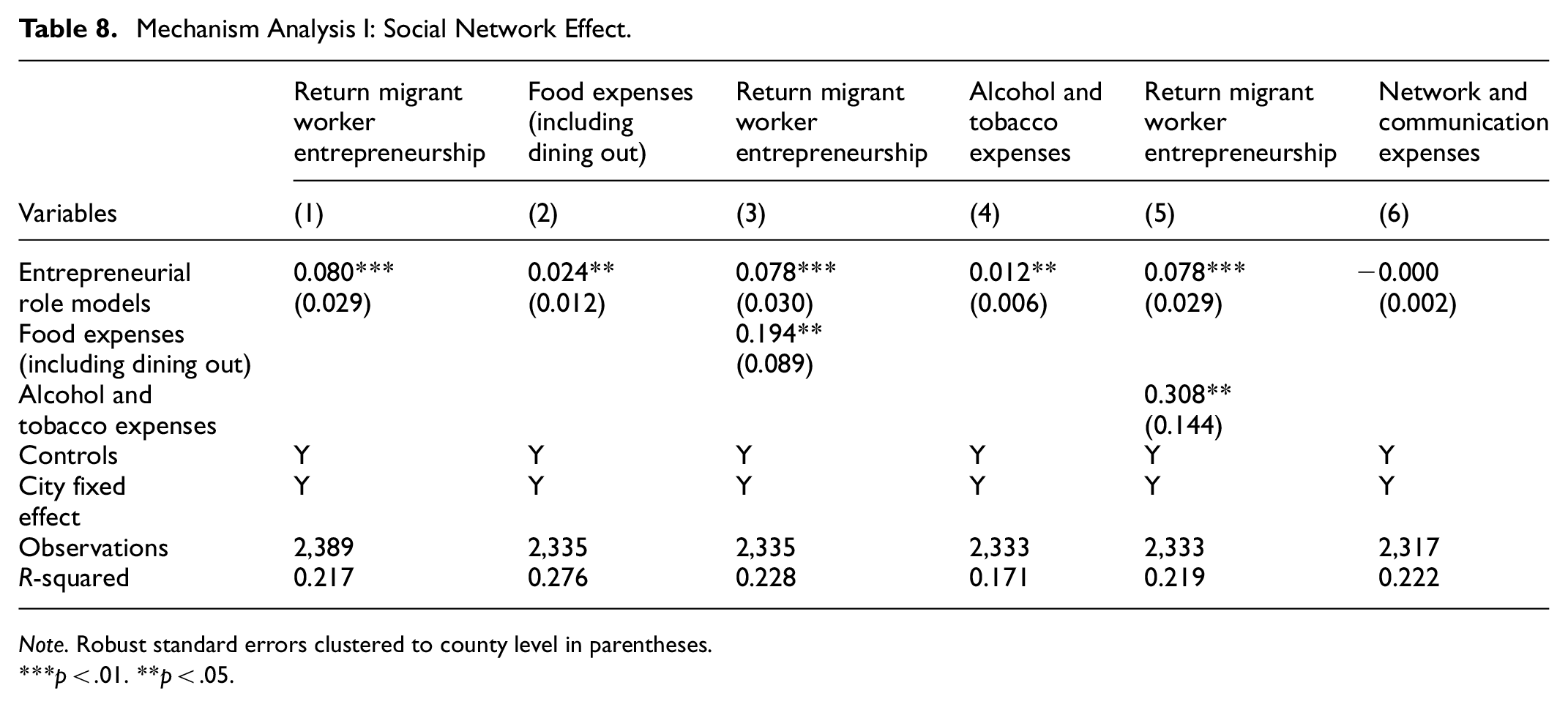
In accordance with the hypothesis proposed by Afandi et al. (2017), social capital, or social networks, can be defined as the frequency of interactions with relatives and friends of potential entrepreneurs. It can be reasonably deduced that increased meetings and communication between potential entrepreneurs and entrepreneurial role models may result in higher recurrent consumption expenditure of the families of potential entrepreneurs. Prior research has indicated that recurrent consumption expenditures (P. Huang et al., 2024; Xue et al., 2023; J. Zhao & Li, 2021), particularly those related to dining out, tobacco and alcohol expenditures, and network communication expenditures (P. Huang et al., 2024; Xue et al., 2023; J. Zhao & Li, 2021), serve as crucial avenues for maintaining social networks in rural China. Dining out serves as a primary conduit for emotional communication and information exchange among friends and relatives. There is a positive correlation exists between the amount of money spent on dining out and the breadth of one’s social networks. Accordingly, the average monthly expenditure on food by the family in the previous year (including dining out) is selected as the proxy variable for social networks. Furthermore, the consumption of alcohol and tobacco at dinner, as well as the consumption expenditure on tobacco and alcohol as gifts, can also serve as indicators of social networks. Therefore, we select the average monthly expenditure on alcohol and tobacco of the family in the previous year as the proxy variable for social networks. The widespread use of telephones and the Internet has facilitated enhanced communication between friends and relatives. Furthermore, expenditures related to family telephones, Internet access, and other communication channels can also be employed as a proxy for social networks. Therefore, we select the average monthly expenditure on network and communication for the family in the previous year as a measure of social networks. To facilitate analysis and reduce the impact of heteroscedasticity, three proxy variables for the social networks are logarithmically transformed. To verify this mechanism, we use the three proxy variables of the social networks as mediating variables and apply the mediating effect model, which will be set with the reference to the existing literature (Baron & Kenny, 1986) as follows:


Where
The results are presented in Table 8. Column (1) presents the regression result of model (1), which serves as the baseline regression model and is identical to that result observed in column (5) of Table 3. The regression results in column (2) indicate that the estimated coefficient of entrepreneurial role models is 0.024, which is statistically significant at the 5% level. Similarly, the results in column (4) demonstrate that the estimated coefficient of entrepreneurial role models is 0.012, which is also statistically significant at the 5% level. These findings suggest that the presence of entrepreneurial role models is associated with an increase in both monthly household expenditure on food (including dining out) and alcohol and tobacco. Columns (3) and (5) present the joint effect results of entrepreneurial role models and food expenses (including dining out) on return migrant worker entrepreneurship, as well as the joint effect results of the entrepreneurial role models and alcohol and tobacco expenses on return migrant worker entrepreneurship, respectively. The regression coefficients for entrepreneurial role models, food expenses (including dining out), and alcohol and tobacco expenses are significantly positive at the 1% or 5% levels, respectively. Additionally, the regression coefficients for entrepreneurial role models in model (3) are slightly lower than that in model (1) without mediating variables. However, the regression results in column (6) indicate that the estimated coefficient of entrepreneurial role models is not statistically significant, indicating that entrepreneurial role models have no significant impact on the average monthly household network and communication expenditure. One possible explanation is that household network and communication expenses are largely based on fixed package fees, which have been trending downward due to advancements in communication technology and increasing competition among telecommunication operators.
Mechanism Analysis I: Social Network Effect.
Note. Robust standard errors clustered to county level in parentheses.
p < .01. **p < .05.
Our findings indicate that, to a certain degree, potential entrepreneurs and entrepreneurial role models engage in increased spending on meals, tobacco, and alcohol as a means of communication and relationship maintenance. This reveals that the demonstration effect of entrepreneurial role models has amplified the frequency of interaction between entrepreneurial role models and potential entrepreneurs (J. Yin et al., 2021), strengthening the social network closeness between the two parties, boosting confidence in entrepreneurial pursuits (P. Huang et al., 2024). Therefore, Social networks play a mediating role in the effect. This finding corroborates those of previous studies by P. Huang et al. (2024), and Xue et al. (2023). Consequently, Hypothesis H2a is supported.
Occupational Selection Effect
It can be reasonably concluded that entrepreneurial role models play a significant role in fostering return migrant worker entrepreneurship. Nevertheless, further examination is required to assess the transformation’s impact on return migrant workers’ occupational selections, particularly in relation with the shift from employment or farming to the establishment of their businesses.
In accordance with the methodology proposed by G. Zhou and Li (2016), the sample is delineated into two discrete categories: entrepreneurs are classified as either “employer” or “self-employed” (which includes “self-employed workers” and “freelancers”). Subsequently, the two categories of entrepreneurs are compared to individuals who are employed and those engaged in farming, respectively. In the context of the CHFS questionnaire, the term “employer” refers to a legal entity that assumes responsibility for gains or losses (sometimes in conjunction with partners), exercises authority over business management and decision-making processes, and hires personnel. The “employer” status is broader in scope and requires a relatively high threshold for initiation. The term “self-employed” encompasses both “self-employed workers” and “freelancers.” Those who are self-employed operate without hiring individuals outside their immediate family, and the initial capital threshold for this category is lower. The term “freelancer” describes an individual engaged in work activities who is not affiliated with any specific unit, representing a new employment form that has emerged in recent years, largely driven by the platform economy. Based on these considerations, we put forth the methodology proposed by G. Zhou and Li (2016), retain only the samples of those employed by others or units (i.e., those who have signed formal labor contracts), those engaged in temporary work (i.e., those who have work units but did not sign a formal labor contract), farmers, employers, and those in self-employment. In order to verify this occupational selection effect, the model is set as follows:

Where
The results are presented in Table 9. In columns (1) and (2), the “self-employed” sample is excluded, and the determinants of “employer” versus “being employed,”, and “employer” versus “farming” are compared. In columns (3) and (4), the “employer” sample is excluded, and the determinants of “self-employment” versus “being employed,” and “self-employment” versus “farming” are compared. From the perspective of the “employer” entrepreneurship, the influence of entrepreneurial role models on the occupational selection of return migrant workers transitioning from farming to employer, or from being employed to employer, is positive but not statistically significant. However, from the perspective of “self-employed” entrepreneurship, entrepreneurial role models exert a significant positive influence on the occupational transition of return migrant workers who are transitioning from farming to self-employment or from being employed to self-employment. This indicates that return migrant workers are more likely to pursue self-employment as a preliminary step. Although the role of an employer or a boss is undoubtedly a crucial aspect of entrepreneurial behavior, self-employment, as the original form of entrepreneurship, is also a vital mode of entrepreneurship (Bao et al., 2022; Li & Wu, 2014). It facilitates the generation of supplementary income for their families and fosters the advancement of the entrepreneurial capabilities of return migrant workers. Additionally, it has been demonstrated to have a beneficial effect on the growth of the rural economy (Bao et al., 2022). In general, the positive impact of entrepreneurial role models on the decision of return migrant workers to establish businesses is significant (Bao et al., 2022). Thus, Hypothesis H2b is supported.
Mechanism Analysis II: Occupational Selection Effect.

Note. Robust standard errors clustered to county level in parentheses.
p < .01. **p < .05.
Conclusions and Discussion
Conclusions
Based on the social learning theory, we utilize data from the Chinese Household Finance Survey (CHFS) to investigate the influence of entrepreneurial role models in 2017 on the entrepreneurial activities of return migrant workers in 2019. The primary conclusions can be summarized as follows: Firstly, entrepreneurship role models in 2017 significantly increased the probability of return migrant worker entrepreneurship in 2019. Secondly, the conclusions remain robust after addressing the endogeneity problem through the use of instrumental variable and enhanced mitigating self-selection methods. Thirdly, there are notable differences between groups in the mechanisms through which entrepreneurial role models exert their influence. Individuals who are older, have less education, and have a higher income before returning home are more significantly influenced by entrepreneurial role models. Finally, mechanism analysis indicates that entrepreneurial role models can enhance the closeness of social networks by increasing the frequency of interactions with return migrant workers. This provides potential entrepreneurs with access to entrepreneurial information and resources, which in turn affects their decisions to pursue entrepreneurship. These findings offer valuable insights for developing countries seeking to implement effective policies for sustainable rural economic development.
Theoretical Implications
The influence of entrepreneurial role models on return migrant worker entrepreneurship represents a crucial avenue for addressing urban-rural inequality and fostering rural economic growth. This paper makes the following theoretical contributions:
First, the extant literature provides a comprehensive examination of the macro- and micro-level factors underpinning return migrant entrepreneurial behaviors (S. Chai et al., 2023; Fan et al., 2023; P. Huang et al., 2024; Wang et al., 2022; Xi et al., 2025; Xue et al., 2023; J. Yin et al., 2021). However, there has been a lack of systematic study on the influence of entrepreneurial role models on return migrant workers engaging in entrepreneurial activities. In response to this gap, this paper, drawing on social learning theory, examines the impact of entrepreneurial role models on return migrant worker entrepreneurship and advances the development of the theory in developing countries.
Secondly, this paper elucidates the mediating role of social networks between entrepreneurial role models and return migrant worker entrepreneurship, as well as the occupational choice effect of entrepreneurial role models on their entrepreneurship. Entrepreneurial role models can enhance the strength of social networks by increasing the frequency of interactions with return migrant workers. This provides potential entrepreneurs with access to entrepreneurial information and resources, which in turn affects the occupational selection of return migrant workers, thereby enhancing their willingness to start businesses.
Finally, this paper contributes to the existing body of research on the factors that influence return migrant worker entrepreneurship. This analysis underscores the significance of these models as exemplars of rural “strong ties” social networks in this context. By integrating the distinctive contextual elements of rural China, this paper offers insights into how the human environment influences the cognitive processes of potential entrepreneurs and sheds light on the specific issues of entrepreneurship research among return migrant workers in China. This analysis illuminates the subject matter and offers governments in developing countries a basis for formulating targeted policies to foster a sustainable rural economy.
Practical Implications
The policy implications of these findings are as follows:
Firstly, it is recommended that local government departments and industry associations disseminate information about entrepreneurial thinking, entrepreneurial projects, and entrepreneurial performance among entrepreneurial role models. This should include the sharing of entrepreneurial stories and the activation of the power of role models. The objective is to attract return migrant workers who have accumulated capital, technology, and management experience. The establishment of an entrepreneurial platform for mutual assistance, and resource sharing is recommended as a means of stimulating and enhancing their entrepreneurial enthusiasm and initiative.
Secondly, given the varying impact of entrepreneurial role models on return migrant worker groups—particularly among older, less educated, and higher-income individuals before returning home—it is crucial to ensure the precise application of policy. For these groups, local governments should provide guidance and support, encouraging them to rely on local resource endowments to carry out entrepreneurial activities within the existing industrial chain. The multiple comparative advantages of return migrant workers are most effectively integrated into their hometowns, where they can engage in entrepreneurial activities within the existing industrial chain and facilitate the advancement of rural industrial integration. This will enhance the likelihood of success for their entrepreneurial pursuits.
Thirdly, it is recommended that the construction of the Return Migrant Entrepreneurship Parks be promoted, attracting a greater number of return migrant workers to establish their businesses within the parks. This will facilitate the sharing of positive externalities associated with the agglomeration economy, thereby reducing the cost of entrepreneurship. It is equally important to reinforce the public services for return migrant worker entrepreneurship within the parks. This necessitates the optimization of the curriculum for entrepreneurship training, the enhancement of the efficacy of such training, and the provision of intellectual and talent support for the seamless advancement of entrepreneurship projects.
Limitations and Future Research
It should be noted that this study is not without limitations. Firstly, the survey data used in this study covers a vast geographical area in China but lacks temporal continuity. Future research could utilize longitudinal tracking and panel data methods to conduct dynamic studies with multiple time points, thereby further testing the reliability of the conclusions.
Secondly, return migrant worker entrepreneurship has non-economic impacts, such as the assumption of family responsibilities, the pursuit of a freer lifestyle, and the contribution back to their hometowns (Y. Hu, 2023). It is clear that the entrepreneurial activities of return migrant workers lead to changes in rural areas that extend beyond the economic sphere. These changes may include an improvement in the well-being, social cohesion, and sense of belonging of rural residents. The next stage of research should focus on discerning the exploring the influence of return migrant worker entrepreneurship on the non-economic dimensions of development in rural regions.
Footnotes

Author Contributions
All authors contributed to conceptualization, formal analysis, investigation, methodology, and writing and editing of the original draft. All authors have read and agreed to the published version of the manuscript.
Funding
The author(s) disclosed receipt of the following financial support for the research, authorship, and/or publication of this article: This work was supported by National Social Science Fund of China (22AJY014), MOE (Ministry of Education in China) Liberal arts and Social Sciences Foundation (22YJAZH117); Key Research Platforms and Programs for General Universities (2023ZDZX4066) and Guangzhou College of Commerce (2023XTYB03).
Declaration of Conflicting Interests
The author(s) declared no potential conflicts of interest with respect to the research, authorship, and/or publication of this article.