



Abstract
This study investigates spatial heterogeneity in China’s rural revitalization through a configurational lens that integrates Bourdieu’s capital theory with Foucault’s governmentality. Using data for 31 provinces, fuzzy-set Qualitative Comparative Analysis (fsQCA) and Necessary Condition Analysis (NCA) reveal multiple equifinal development pathways. A prominent configuration associated with high attainment combines ecological and human capital within adaptive governance, while six additional patterns are linked to partial capital deficits and more rigid policy rationalities. By mapping provincial governance regimes and capital strategies, the analysis characterizes how differing institutional logics correspond to observed variations in land use, rural development priorities, and resource allocation. The paper advances a dual-structure framework connecting capital accumulation and governance control, and outlines theoretical and policy implications for context-sensitive revitalization strategies in China and comparable settings.
Plain Language Summary
This study looks at why rural development in China varies so much from one province to another. It shows that the success of rural revitalization depends not just on how much money or resources a region has, but also on how local governments manage and guide development. Using data from 31 provinces, the research identifies several different paths that regions take toward development. Some provinces succeed by combining strong environmental protection and skilled workers with flexible and supportive local governance. Others struggle due to gaps in key resources—like education, infrastructure, or community engagement—and because their policies are too rigid or disconnected from local needs. The study offers a new way to understand rural development by showing how resources and governance must work together. These insights can help design more effective and tailored strategies for improving life in rural areas—not just in China, but in other countries as well.
Introduction
The evolving dynamics of rural governance and spatial inequality have placed rural revitalization at the center of China’s modernization agenda. Framed as a strategic extension of poverty alleviation, rural revitalization seeks to advance integrated urban–rural development by upgrading infrastructure, restoring ecological systems, and improving rural livelihoods (Han, 2020; Islam, 2024). Despite clear national priorities, the institutional diversity and spatial fragmentation of rural China have produced substantial variation in implementation and experience. Addressing these differences calls for an analytical lens that moves beyond input–output indicators to capture the relational and governance-driven dynamics of rural development.
Over the past decade, a substantial literature has assessed rural revitalization through multi-dimensional indicators, including ecological quality, human mobility, digital infrastructure, and cultural renewal (Iddrisu & Bhattacharyya, 2015; Wu, 2025). Many studies employ statistical techniques—such as entropy-TOPSIS, principal component analysis, and GIS—to construct composite indices and compare performance across provinces. While these approaches provide important empirical baselines, they tend to privilege rankings over explanatory depth. In response, scholars increasingly draw on sociological frameworks—most notably Bourdieu’s theory of capital and Foucault’s governmentality—to conceptualize rural change not only as economic upgrading but also as the reconfiguration of social fields and governing rationalities. Capital-oriented work extends beyond Bourdieu’s classical triad (economic, cultural, social) to incorporate ecological and human capital, emphasizing interplay and conversion among resource forms (Sun et al., 2024; Xiang et al., 2024). In parallel, governmentality-focused research examines how audit systems, performance metrics, and participatory schemes render rural subjects and spaces visible, governable, and comparable within a national regime of policy legitimation (Haugaard, 2022; McKeown et al., 2022).
However, three gaps remain. First, much empirical work relies on additive or linear specifications that treat capital domains as isolated and independent, overlooking how multiple conditions may interact configurationally to shape observed outcomes (Mafimisebi et al., 2025). Such designs are limited in capturing the complexity of equifinal pathways, especially where similar resource endowments correspond to divergent developmental trajectories. Second, although capital and governance perspectives are increasingly invoked, they are seldom operationalized in tandem; consequently, we know little about how capital configurations are contingent on, and aligned with, state-led governing rationalities (Karini, 2025). Third, many assessments assume symmetry and under-attend to threshold patterns, necessary conditions, or conjunctural sufficiency (Xiong et al., 2024; Zhou & Han, 2025). As a result, they under-represent the asymmetric, equifinal associations characteristic of China’s regionally diverse revitalization process.
To address these limitations, this study advances an integrated analytical framework that conceptualizes rural revitalization as a dual process of capital configuration and discursive governance. Drawing on Bourdieu, the analysis models five forms of capital—economic, human, social, cultural, and ecological—as interacting, accumulating, and converting within rural development fields. Building on Foucault’s notion of governmentality, it further examines how these capital structures are rendered governable through technologies of visibility, including income metrics, audit mechanisms, and spatial indicators. Methodologically, entropy-based weighting is used to construct capital indicators from provincial yearbooks; fuzzy-set Qualitative Comparative Analysis (fsQCA) is applied to identify multiple configurations sufficient for high attainment; and Necessary Condition Analysis (NCA) is employed to diagnose bottleneck capitals whose absence constrains outcomes regardless of other conditions.
Applied to data from 31 Chinese provinces, the study offers three contributions. First, it operationalizes a capital–governance dialogue by linking sociological theory to measurable indicators. Second, it documents equifinal, configurational associations in which distinct bundles of capital correspond with high revitalization attainment under different governance regimes, rather than any single dominant factor. Third, it foregrounds methodological clarity and replicability by detailing indicator construction, calibration anchors, consistency and coverage statistics, robustness checks, and NCA bottleneck diagnostics, thereby providing a transferable template for comparative analyses of rural transformation.
The study seeks to answer the following questions:
How can rural revitalization be theorized through a multidimensional capital framework grounded in sociological perspectives?
What configurations of capital conditions are sufficient for achieving high levels of rural development across Chinese provinces?
In what ways do governance discourses and capital asymmetries shape regional variation in rural development trajectories?
Research Framework
The Connotation of Rural Revitalization
Rural revitalization has emerged as a central policy concern across post-development and transitional contexts, particularly following poverty-reduction campaigns and urban–rural restructuring. In China, the national agenda articulates five domains—industry, ecology, talent, organization, and culture—reflecting a sectoral logic that resonates with rural policy frameworks elsewhere (Guo & Li, 2024; He & Zhang, 2022). Empirical research commonly employs quantitative techniques such as regression, spatial clustering, and composite index construction to assess progress within these domains (Liu et al., 2022; Xiong et al., 2024). While informative, such approaches often adopt a functionalist lens that treats development dimensions as independent covariates, with limited attention to their mutual configuration, interaction patterns, or the governing rationalities that render them legible and actionable in policy terms.
In response to the limits of linear and sectoral approaches, scholars increasingly adopt relational models that foreground the interplay among resources, institutions, and symbolic power in rural development. A prominent line of inquiry builds on Pierre Bourdieu’s theory of capital and field, using the foundational triad of economic, cultural, and social capital as a heuristic to account for developmental divergence across rural regions (Milbourne & Coulson, 2021; Zhang et al., 2022). Rural studies have subsequently extended this triad to include human capital, which relates to demographic vitality, educational attainment, and adaptive capacity, and ecological capital, which concerns environmental assets and sustainability conditions (Demchenko et al., 2023; Popa et al., 2024). Although these extensions move beyond Bourdieu’s original formulation, they preserve its relational logic: capital is treated not as an isolated resource but as a socially constructed, field-specific asset whose value depends on institutional legibility and conversion potential.
Despite its increasing conceptual utility, the expanded five-capital framework remains under-applied in empirical rural development research, where analytical emphasis often privileges sectoral metrics and policy-led benchmarks. More critically, capital-based accounts, while useful for identifying resource asymmetries, provide limited traction for explaining why similar endowments are associated with divergent outcomes across cases and contexts. To address this limitation, recent scholarship in rural governance engages Michel Foucault’s concept of governmentality, which reframes development not merely as material uplift but as a regime of discursive normalization, behavioral alignment, and subject formation (Ezeudu & Ezekwelu, 2024; Hartley & Kuecker, 2022). This perspective directs attention to the institutional logics that define what counts as development, determine who is rendered governable, and specify the techniques through which governance operates. Despite their complementary insights, capital theory and governmentality have seldom been integrated systematically within comparative rural studies, particularly in non-Western settings. The present study contributes to closing this gap by treating capital as both structurally accumulated and discursively filtered, subject to normative authorization and performative legibility within broader governance regimes.
This study contributes to closing the theoretical gap by integrating the five-capital framework within Bourdieu’s field-theoretic model and overlaying it with Foucault’s concept of governmentality. In this formulation, rural revitalization is conceptualized both as a structural configuration of interrelated capitals and as a discursive process through which development is rendered legible, legitimate, and governable. This dual lens allows examination of which combinations of capital are associated with rural transformation, and how particular configurations are differentially recognized, prioritized, or constrained under specific governance regimes. While the framework is analytically generalizable and aligns with recent calls for comparative inquiry into the politics of development (Bhuwania et al., 2024), it is empirically grounded in the Chinese context, which provides a fertile case for analyzing the interplay between symbolic capital configurations and strong state-led governance.
Theoretical Foundations: Capital and Governmentality
Across multiple Global South contexts, researchers increasingly employ capital-theoretical and governmentality-oriented frameworks to account for heterogeneous trajectories of rural development (Oztig, 2018). These perspectives underscore how structural distributions of resources and governing rationalities interact to produce uneven regional outcomes. Table 1 synthesizes representative studies and illustrates how distinct configurations of capital and governance correspond to observed patterns of rural transformation across different national settings.
Country-Level Capital–Governance Dynamics in Rural Contexts.

Building on these insights, this study proposes an integrated framework that connects material distributions and conversion of capitals with the modalities of rule through which development is made governable. It draws on Bourdieu’s theory of capital and field (Bourdieu, 1986) and Foucault’s concept of governmentality (Foucault, 1991): the former theorizes accumulation and conversion within stratified fields, while the latter analyzes the techniques, metrics, and discourses that format subjects and spaces. Together, they explain how capital structures and governance rationalities co-configure heterogeneous revitalization pathways.
From a Bourdieusian perspective, rural revitalization unfolds within a multi-capital field in which agents—including local governments, village cadres, and rural entrepreneurs—contend for symbolic recognition and material advantage. These contests revolve around the accumulation and conversion of five forms of capital: economic, ecological, human, social, and cultural. This five-capital configuration extends Bourdieu’s original triad of economic, social, and cultural capital by incorporating ecological capital (Brandon et al., 2021) and human capital (Bourdieu, 2018; Pasban & Nojedeh, 2016), both of which have acquired increasing salience in contemporary rural policy agendas.
However, capital conversion is neither automatic nor universal; it is field-specific and contingent on locally legitimized rules. The value of any given form of capital (for example, cultural capital) depends on its capacity to be transformed into other forms (for example, economic or institutional capital) within the symbolic logic of a particular field. When conversion does not occur—owing to structural asymmetries, institutional bottlenecks, or deficits of recognition—it yields what Bourdieu terms illusio without capital, namely a misalignment between belief and actual leverage. Accordingly, this study does not treat the five-capital framework as axiomatic or additive but as a contested terrain in which capital operates relationally. Conversion processes are institutionally mediated, symbolically regulated, and unevenly distributed, which renders simplistic additive models theoretically insufficient.
In contrast, Foucault’s governmentality perspective shifts attention from field struggles to the productive mechanisms through which rural populations are rendered governable (Ettlinger, 2011; Rose, 1999). These mechanisms include technologies of surveillance such as digital governance, performance-based audit systems rooted in target management, campaigns of discursive moralization associated with “civilized countryside” initiatives, and subjectivation processes that promote self-responsibilization. Rather than relying on overt coercion, these techniques operate through affective infrastructures that shape conduct from within (Raffnsøe et al., 2019; Spierenburg, 2004). In this sense, governmentality does not stand in opposition to capital logic, but often functions as the enabling infrastructure through which specific forms of capital are mobilized, regulated, or obstructed. These two frameworks—relational capital accumulation and discursive governance—are not merely coexistent, but mutually constitutive in shaping development outcomes.
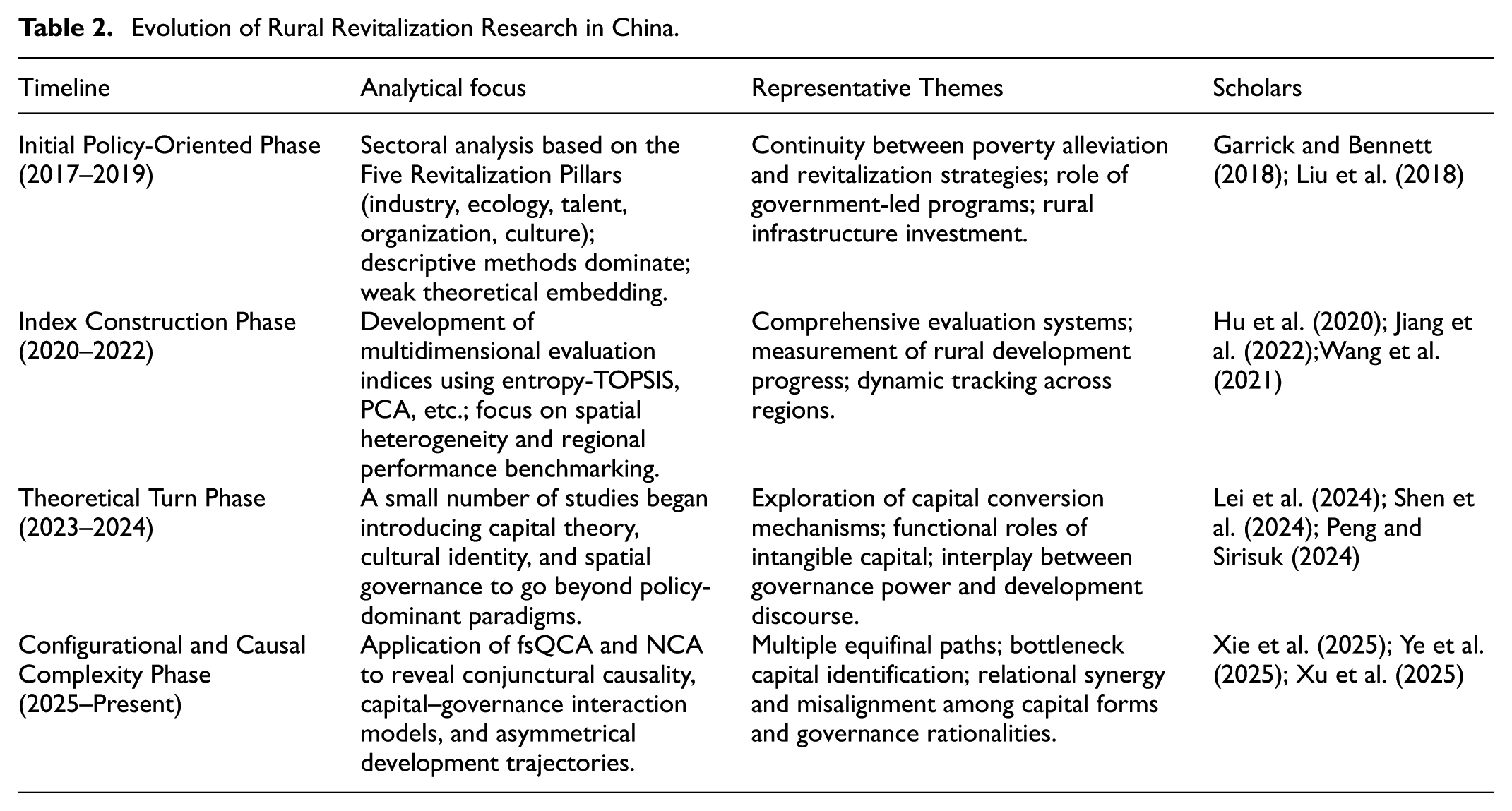
This theoretical synergy is particularly salient in the Chinese context, where the evolution of rural revitalization research offers fertile ground for examining a capital–governmentality model. As summarized in Table 2, Chinese scholarship has moved from descriptive, pillar-based analyses toward more integrative approaches that foreground configurational complexity and relational reasoning. The growing use of frameworks such as fsQCA and NCA indicates deeper engagement with how capital conversion logics (Bourdieu) are selectively enabled or constrained by performance audits, moral campaigns, and data-driven governance (Foucault). Rather than importing Western theory wholesale, the Chinese case provides a dynamic empirical base through which to refine and elaborate this dual-theoretical lens.
Evolution of Rural Revitalization Research in China.
The Chinese case not only substantiates the explanatory utility of a capital–governmentality framework but also extends it by showing how local institutions, policy designs, and discursive environments condition the interaction between material capitals and governing rationalities. This context-sensitive validation underscores the need for an integrated lens capable of capturing both structural and symbolic dimensions of rural development. On this basis, a broader contribution is to theorize how these perspectives intersect beyond China, specifying the conditions under which their interaction yields distinct configurational patterns in other settings.
The integration of these two frameworks enables a fuller account of rural transformation as both structurally configured and discursively governed. Prior research has often prioritized one lens—for example, Bourdieusian analyses of rural class formation (Tomay & Berger, 2024) or Foucauldian critiques of authoritarian environmentalism (Rydin, 2021)—with relatively few attempts at systematic bridging. The present study contributes by illustrating how capital configurations (Bourdieu) are selectively amplified or constrained by governance technologies (Foucault), yielding equifinal as well as fractured revitalization pathways. This contested, conversion-centered reading of capital provides the theoretical basis for the configurational, rather than additive, strategy adopted in the analysis. In doing so, the study responds to recent calls for theoretical triangulation in rural governance (Sridharan, 2021) and demonstrates the analytical value of conceptual hybridity in non-Western empirical contexts such as China.
Analytical Framework: Capital Configuration and Governance Filtering
Prior work often disaggregates revitalization into sectoral inputs and estimates separate effects, implicitly treating capitals as commensurable, additive stocks. This obscures conversion constraints—who authorizes conversion, how worth is audited and recognized, and with which other capitals a resource must co-occur—and cannot explain divergent outcomes under similar endowments. We therefore reconceptualize rural revitalization as a field-based process of capital configuration and discursive realization: Bourdieu’s theory explains how economic, ecological, human, social, and cultural capitals structure the field through accumulation and conversion; Foucault’s governmentality clarifies how outcomes become governable through legibility, normalization, and promotability. We term the resulting outcome Governable Development Attainment.
Figure 1 situates the empirical strategy within this framework. fsQCA tests conjunctural sufficiency and asymmetric set relations, identifying multiple capital bundles sufficient for high Governable Development Attainment and distinguishing mismatched bundles associated with non-high Governable Development Attainment. In parallel, NCA probes necessity thresholds—whether any single capital must exceed a minimum level regardless of configuration. Together, the two methods map field structure (bundles) and governability filters (discursive realization). On this basis, we select and calibrate indicators to capture both structural capital dynamics and discursive development effects.
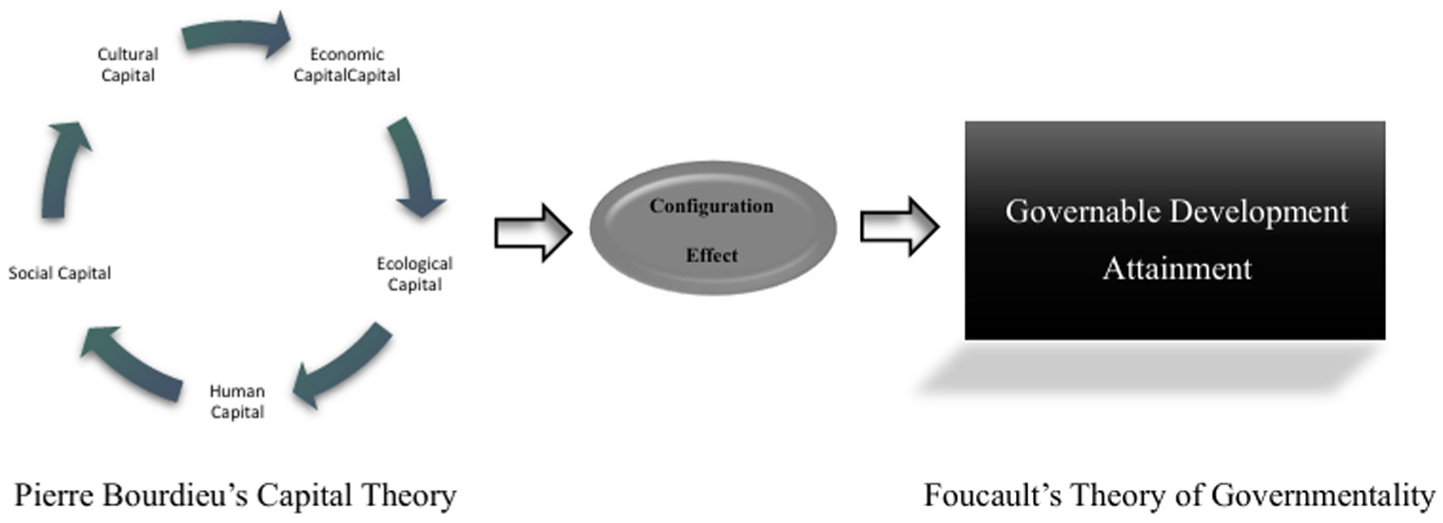
Research framework.
Accordingly, empirical indicators are selected and calibrated to reflect both structural capital dynamics and discursive development effects. Specific indicators are selected as follows:
Economic Capital
In Bourdieusian terms, economic capital denotes material assets that are directly convertible into wealth and embedded within rural production systems. In the Chinese context, it is reflected in agricultural output, infrastructure endowments, and investment capacity, thereby forming the material base on which other capitals operate (Liu et al., 2025). Its distribution is uneven, often mirroring historical policy preferences, heterogeneity in land productivity, and differential access to digital technologies (Jia, 2023).
Rather than a static stock, economic capital is treated here as a convertible resource that may be rearticulated as human capital (through education), social capital (through networks), or symbolic capital (through publicly visible prosperity). The feasibility and scope of such conversions are contingent on local institutions and development regimes. Following Deng et al. (2024), the study operationalizes economic capital using indicators such as grain output, labor productivity, and the level of mechanization to characterize a region’s capacity for material accumulation and potential transformation. Developmental relevance, in turn, is read through its legibility to policy instruments—such as earmarked funds and audit-based incentives—which can facilitate recognition of economic performance within governance processes and, by extension, its conversion into human, social, or symbolic gains.
Ecological Capital
From a Bourdieusian standpoint, ecological capital is not a purely natural endowment but a socially conditioned asset whose value depends on institutional embeddedness and prospects for conversion (Gkartzios et al., 2022). Within rural revitalization, it can operate as both constraint and enabler: high environmental quality may be present, yet limited governance capacity can restrict its developmental salience.
Ecological capital mediates the relationship between rural habitus and material reproduction, delimiting which forms of accumulation are locally feasible. Its significance emerges when mobilized through legitimate governance mechanisms and aligned with other capitals (Chen et al., 2025). Absent such alignment, ecological assets remain largely inert, contributing little to recognized performance or legitimacy.
Following Liu et al. (2025), this study operationalizes ecological capital using indicators such as village green coverage, waste treatment, and environmental infrastructure, each capturing how environmental assets are structured within the wider field of rural development. Accordingly, ecological assets are treated as capital insofar as they are institutionally embedded and convertible through authorized devices (e.g., designations, standards, branding), rather than as a free-standing additive stock.
Human Capital
Within a Bourdieusian frame, human capital denotes embodied and institutionalized competencies that condition agents’ capacity to act, aspire, and adapt within a structured field. In rural China, its generative potential is constrained by demographic ageing, selective out-migration, and persistent disparities in educational access (Seeberg, 2024). Beyond formal credentials, human capital also reflects habitus, the internalized dispositions through which individuals perceive opportunities and align with prevailing development logics (Scurry et al., 2025).
In the context of rural revitalization, human capital enables the translation of policy, technology, and institutional change into localized agency. Its strength shapes not only labour capacity but also the scope for converting other capitals into sustainable developmental attainments. Following Liu et al. (2022), this study operationalizes human capital using indicators for educational attainment, vocational training coverage, and institutional investment in rural human resources. Effective conversion is contingent on habitus–policy alignment: skills and dispositions need to correspond to governance scripts—such as training regimes and extension services—to be recognized as developmental returns.
Social Capital
In Bourdieusian terms, social capital refers to durable networks of association that confer access to resources, recognition, and influence. Within rural fields, it functions as a mechanism of symbolic and practical coordination, embedding agents in structures of mutual obligation and normative regulation (Zhou & Gu, 2025). The volume and effectiveness of social capital depend not only on network density but also on institutional legitimation and convertibility across capital forms (Chtouris & Miller, 2024).
In the context of rural revitalization, social capital supports trust-based governance, collective action, and the local mediation of state initiatives. Where social ties lack legitimacy or are fragmented, governance programs may find limited support and produce less durable attainments. Following Chu et al. (2023) and Sánchez-Arrieta et al. (2021), this study operationalizes social capital through indicators capturing institutionalized participation, organizational presence, and relational cohesion across rural communities. A distinction is drawn between institutionally interfaced networks—such as cooperatives, associations, and participatory councils—and purely informal density, whose conversion into recognized gains is more constrained.
Cultural Capital
In Bourdieusian terms, cultural capital comprises symbolic resources through which hierarchies are legitimized, identities are formed, and distinctions are reproduced. In rural revitalization, it provides the discursive and aesthetic frame within which modernity is perceived, internalized, and contested in local communities (Lu & Qian, 2023). Cultural capital is not neutral; it encodes normative visions of rural life that selectively valorize some practices while marginalizing others (Lynch, 2021).
Its structuring force lies in specifying what counts as culturally legitimate and developmentally desirable. Through institutionalized forms and embodied dispositions, it mediates the reproduction of social order under evolving policy discourses. Following Cheer (2024) and Hale et al. (2023), this study operationalizes cultural capital via three dimensions: symbolic infrastructure, normative recognition, and participatory access to cultural production—each capturing how culture functions as a mechanism of rural differentiation within revitalization processes. Cultural investments acquire developmental salience when symbolically recognized and coupled with complementary human and social capacities that sustain implementation.
Governable Development Attainment
This outcome is conceptualized as the observable result of capital conversion under governance filters rather than as a neutral aggregation of inputs. Recognizing that rural development entails administrative visibility and normative regulation in addition to material growth, the study adopts Foucault’s governmentality as the conceptual basis for constructing the outcome variable (Sun et al., 2024). This perspective supports an examination of how “success” is defined, legitimated, and rendered governable within state-led revitalization discourses.
Instead of reading income, consumption, or welfare solely as by-products of capital accumulation, the analysis treats them as instruments of power-mediated normalization. Developmental attainment is therefore interpreted in relation to the alignment between localized capital configurations and broader institutional expectations. In this sense, the rural field is not only stratified by uneven capital distributions, as in Bourdieu’s account, but also governed through discursive norms that specify what counts as “modernity,”“prosperity,” or “progress” (Bode, 2024).
Within this framework, three indicators represent the key dimensions of Governable Development Attainment: (a) per capita disposable income of rural residents, (b) the Engel coefficient of rural households, and (c) the urban–rural income ratio. These indicators align conceptually with governability and permit empirical observation. They are used not as additive proxies of prosperity, but as governance-sensitive traces of successful conversion under state rationalities.
Per capita disposable income reflects the degree to which rural livelihoods are monetized and institutionally embedded. Greater legibility and programmability of income are typically associated with the state’s capacity to shape behavioral patterns through instruments such as pricing, taxation, and transfer payments. The Engel coefficient, capturing the share of food in total consumption, serves as an indicator of consumption structure and discretionary capacity; a lower coefficient is generally consistent with a wider scope of choice and a stronger responsiveness to policy interventions, enabling governance to embed normative expectations through subsidies, co-payments, or soft regulation (London, 2018). The urban–rural income ratio indexes the spatial dimension of equity and coordination; a narrowing gap may facilitate the application of unified regulatory standards, improve cross-regional policy coherence, and reduce enforcement frictions.
This operationalization captures both material and symbolic dimensions of rural development, offering a Foucauldian lens on how governance is exercised not only through infrastructure and investment, but also through metrics, rankings, and institutional discourse.
Data Construction
Data Collection
To balance timeliness, official credibility, and national comparability, the analysis relies on the 2023 editions of China’s official statistical yearbooks, which constitute the most recently verified, uniformly available cross-provincial data at the time of study. Although the underlying figures pertain to 2022, they reflect the latest release cycle and ensure consistency across regions and indicators.
The dataset covers 31 Chinese provinces and draws primarily on the China Statistical Yearbook (National Bureau of Statistics of China, 2023a), the Rural Statistical Yearbook (National Bureau of Statistics of China, 2023b), and the Population and Employment Statistical Yearbook (National Bureau of Statistics of China, 2023c), supplemented where appropriate by provincial statistical releases to enhance regional specificity. Sixteen conditional variables are constructed to represent five capital domains—economic, ecological, human, social, and cultural—in alignment with the analytical framework. The outcome, regional development attainment, is operationalized using three indicators: per capita rural disposable income, the Engel coefficient of rural households, and the urban–rural income ratio.
Variable Construction and Operationalization
Building on Bourdieu’s framework, we conceptualize rural revitalization as shaped by the volume, structure, and conversion potential of five interrelated capitals, and translate this multidimensional structure into an analyzable model by rendering each capital observable through indicators that capture both its material presence and its functional embeddedness within the rural field. Accordingly, we specify conditional variables as empirical proxies for each capital domain; indicator selection follows two criteria—theoretical relevance and data availability—to align with the conceptual model while maintaining robustness for fsQCA calibration (Bley et al., 2024). Operational definitions and measurement schemes for all conditional variables are reported in Table 3.
Selection and Measurement of Conditional Variables.
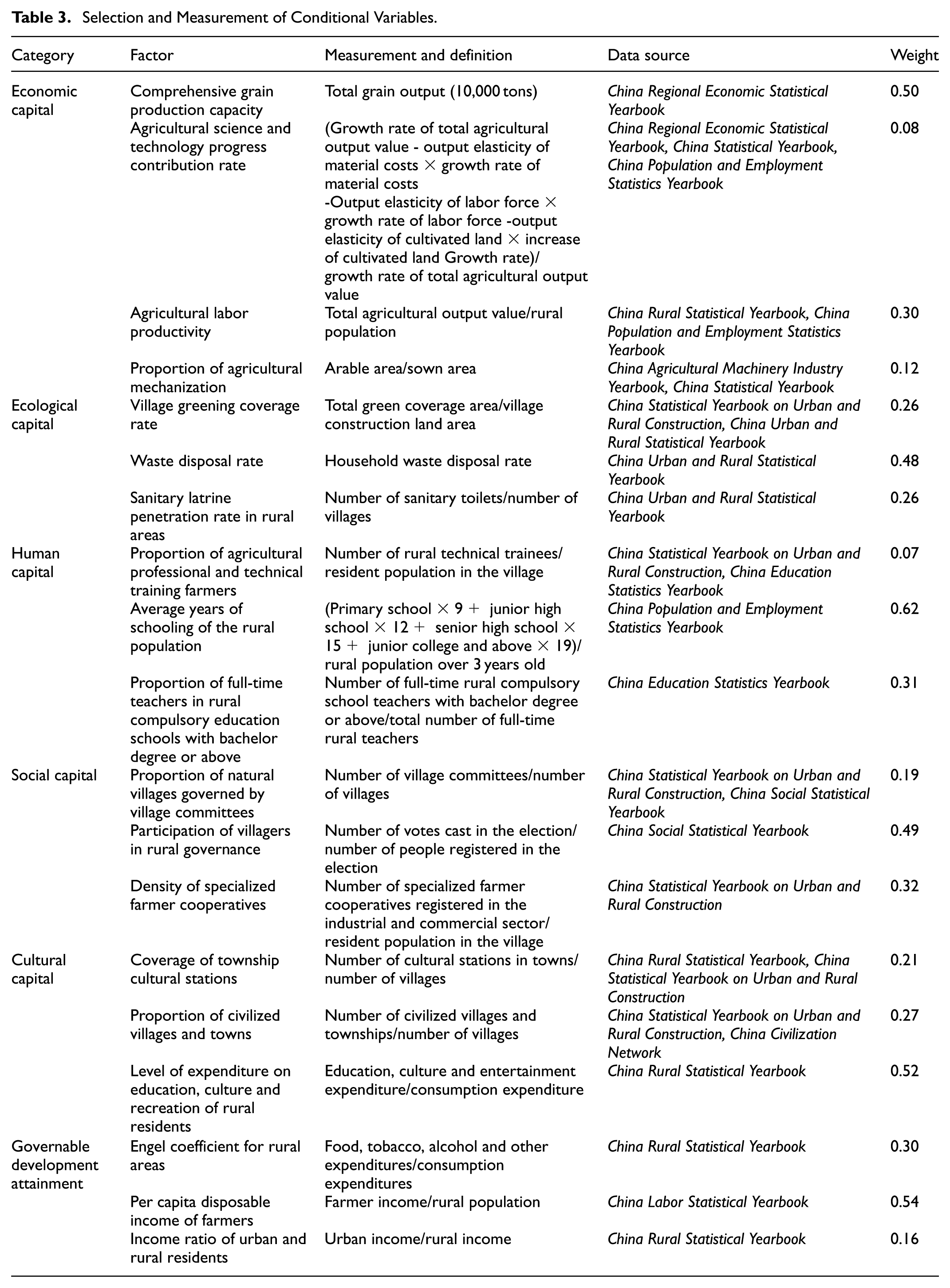
To limit subjective bias and enhance cross-provincial comparability, the study applies the entropy-weighting method, a widely used technique in social-science evaluation (Liu & Li, 2015; Zhu et al., 2020). Raw indicators are first normalized via the min–max procedure to ensure consistency of units and scales. Entropy values are then computed to gauge informational dispersion across provinces, such that indicators with greater variability receive higher weights (Appendix A). These inverse-entropy weights reflect the relative discriminative power of each variable and serve to construct composite capital indices for the configurational analysis.
Measurement and Calibration
All conditions and the outcome are calibrated as fuzzy sets for set-theoretic analysis using fuzzy-set Qualitative Comparative Analysis (fsQCA) (Ragin, 2009; Schneider & Wagemann, 2012). Each case receives a membership score in [0,1], which represents its degree of set membership in the target concept (Ott et al., 2018).
Calibration follows the direct method with three qualitative anchors: 0.95 (full membership), 0.50 (crossover), and 0.05 (full non-membership), consistent with guidance in the QCA literature (Legewie, 2018; Skaaning, 2011). Thresholds are informed by theoretical expectations and by the empirical distribution so as to preserve conceptual and substantive coherence. Detailed calibration criteria for all variables, including economic, ecological, human, social, and cultural capital, are reported in Table 4.
Calibration of Conditions and Results.

Data Analysis and Empirical Results
Necessity Analysis
To test whether any single condition is a prerequisite for high rural revitalization, we apply Necessary Condition Analysis (Dul, 2016), which detects conditions that are necessary but not sufficient. NCA suits social systems where specific resources can act as bottlenecks regardless of broader configurations (Dul et al., 2020). We use two estimators—Ceiling Regression (CR) and Ceiling Envelopment (CE). The effect size d gauges necessity strength (<0.10 weak; 0.10−0.30 moderate; >0.30 strong), and permutation tests assess statistical relevance; p < .05 is treated as evidence consistent with necessity.
Table 5 shows that Comprehensive Grain Production Capacity and Agricultural Labor Productivity (economic capital) and the Proportion of Natural Villages Governed by Village Committees and Villager Participation in Governance (social capital) have high coverage (>90%) but very small effects (d < 0.10), which is inconsistent with necessity. Likewise, the Rural Sanitary Latrine Penetration Rate (ecological capital) aligns closely with the outcome, but non-significant permutation tests preclude a necessity classification. Taken together, none of the 16 conditions independently meets the criteria for necessity, underscoring the primacy of configurational interplay rather than single-variable dominance.
Analysis of Necessary Conditions.
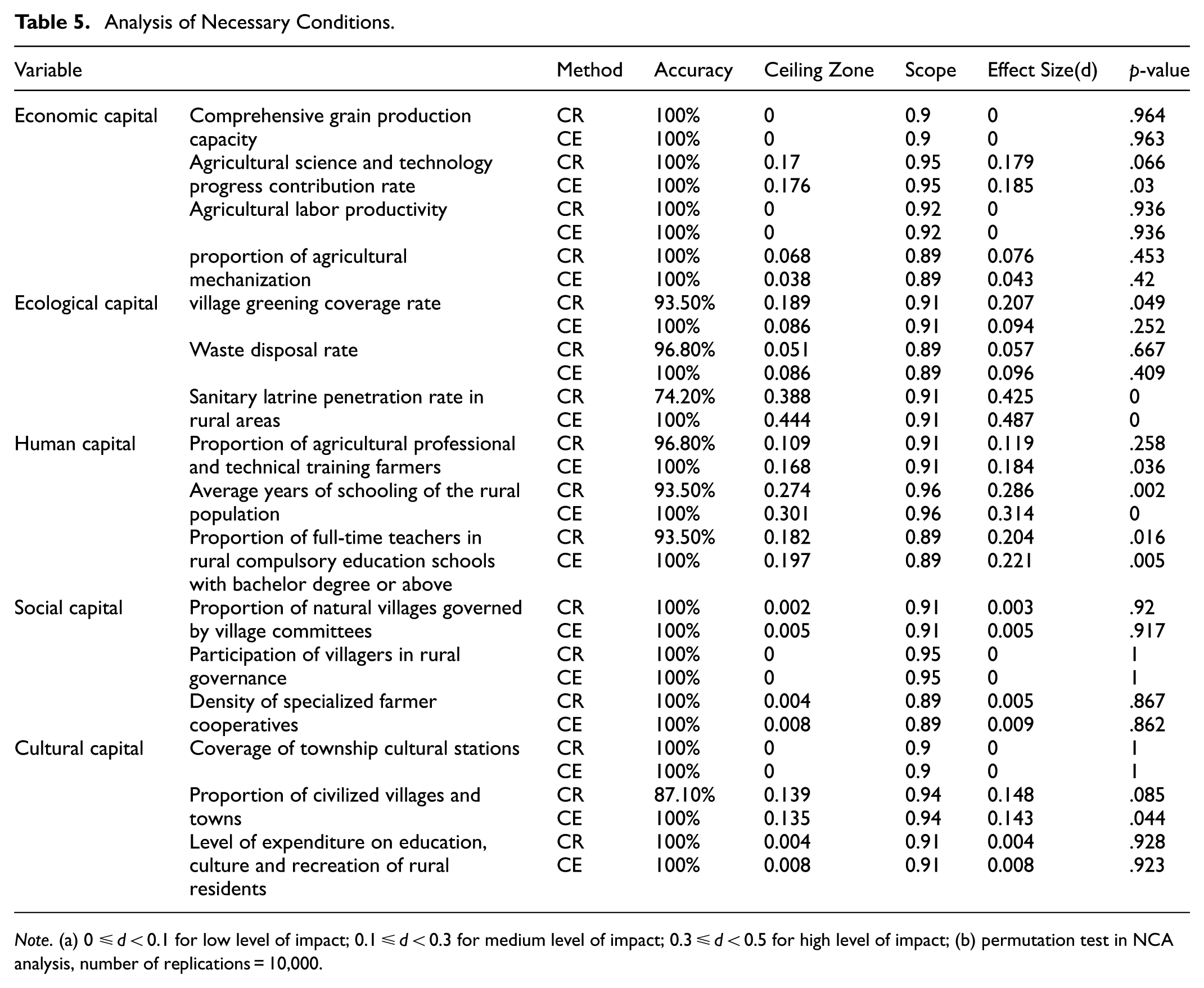
Note. (a) 0 ≤ d < 0.1 for low level of impact; 0.1 ≤ d < 0.3 for medium level of impact; 0.3 ≤ d < 0.5 for high level of impact; (b) permutation test in NCA analysis, number of replications = 10,000.
To further examine the role of each capital domain, a bottleneck analysis was conducted within the NCA framework using Ceiling Regression (CR). Based on the distribution of revitalization scores, provinces were stratified into three tiers: low level (0%–50%), medium level (50%–80%), and high level (80%–100%). These cut points align with the sample median and the upper quintile of the provincial distribution, consistent with prior applications in the literature.
The results (Table 6) indicate that low-level revitalization does not display clear bottlenecks across the measured dimensions. By contrast, medium-level revitalization exhibits bottleneck requirements in at least four capital domains (excluding economic capital), suggesting that movement beyond the basic threshold is associated with more diversified support. At the high level, all five capital forms register as bottlenecks in the NCA sense, with cultural capital showing a stronger constraining effect than ecological capital. This pattern highlights the symbolic and normative components of advanced rural development.
Analysis of Bottleneck Level (%) in the Development of Capital Conversion.
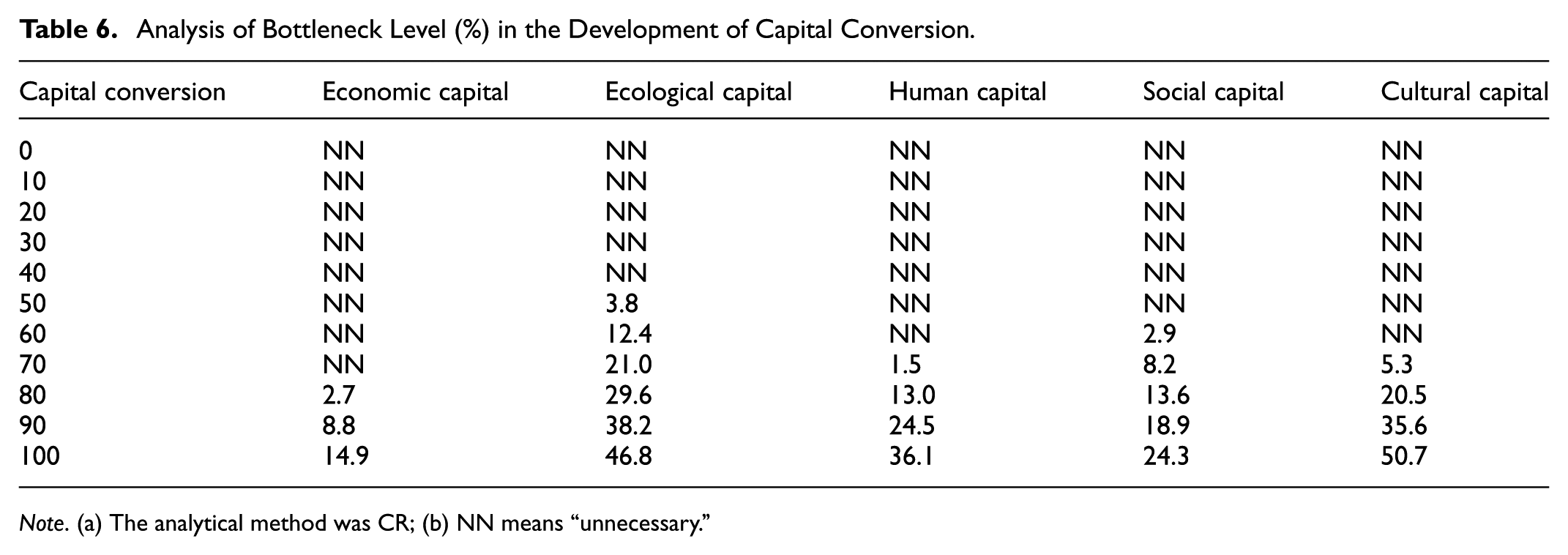
Note. (a) The analytical method was CR; (b) NN means “unnecessary.”
Notably, although the effect-size and bottleneck analyses yield partially divergent emphases, their joint reading indicates that no single capital domain attains the necessity-consistency threshold of 0.90, suggesting the absence of strictly necessary conditions. Villagers’ participation in rural governance, however, approaches necessity for the complement set, emerging as a near-necessary factor for non-high attainment (consistency = 0.89). This pattern underscores the salience of social-capital activation and subjective involvement in medium-to-low development contexts and is consistent with a governmentality perspective on rural revitalization.
Adequacy Analysis of Conditional Configuration
Moving from necessity to sufficiency, we use fsQCA to examine how bundles of conditions relate to Governable Development Attainment. Sixteen indicators across five capital domains enter the model (consistency ≥ 0.80; PRI ≥ 0.75; min cases = 1). The intermediate solution yields one configuration sufficient for high Governable Development Attainment and six alternatives for non-high Governable Development Attainment (Table 7). Results are asymmetric: the high Governable Development Attainment path reflects coordinated accumulation and conversion of multiple capitals under enabling governance, whereas the non-high paths show domain-specific deficits or misalignments. This clarifies why similar endowments can lead to divergent outcomes.
Configurations for High and Low Levels of Rural Revitalization.

Note. 1 or 1+ means that the condition exists, 0 or 0+ means that the condition does not exist; 1+ or 0+ means core conditions, 1 or 0 means marginal conditions. A blank space means that the condition may or may not exist.
Configuration of high-level Governable Development Attainment
The fsQCA identifies a single dominant configuration associated with high Governable Development Attainment, with consistency = 0.973 and raw coverage = 0.547, indicating that approximately 54.7% of high-performing provinces are represented by this path.
Substantively, the configuration features strong ecological and human capital as core conditions, with economic, social, and cultural capital not entering as core. This pattern is consistent with an “ecology–human–governance” type in which environmental sustainability and demographic capacity provide a synergistic foundation under generally enabling, relatively non-intrusive governance arrangements.
Theoretically, two implications follow. First, in Bourdieusian terms, non-material capitals—particularly ecological and human—can, when sufficiently mobilized and institutionally stabilized, function as primary supports relative to economic capital within the field. Second, from a Foucauldian perspective, the pattern aligns with a mode of governability that privileges self-regulation and eco-responsibility rather than direct economic steering.
Empirically, analogous configurations are most frequently observed in coastal provinces characterized by advanced environmental infrastructure and inflows of skilled populations. These locations occupy favorable positions in the national field, facilitating the mobilization of developmental resources and enabling governance alignment through capital synergies and institutional stability.
Configuration of low-level Governable Development Attainment
To capture the multiplicity of suboptimal patterns, the analysis identifies six configurations associated with low Governable Development Attainment, labeled L1 to L6. These configurations represent constellations of capital deficits in which the absence or weakness of one or more domains, namely economic, ecological, human, social, and cultural capital, constrains conversion processes consistent with high-governance outcomes.
L1: Structural Deficit in Ecological, Human, and Social Capital
This configuration denotes a structurally under-capitalized constellation marked by the concurrent absence of ecological, human, and social capital. With consistency = 0.984 and raw coverage = 0.483, it accounts for nearly half of the non-high outcomes. Ecologically fragile provinces such as Guizhou, Yunnan, Qinghai, and Tibet (Figure 2) are illustrative cases, characterized by environmental degradation, out-migration of labour, and limited institutional capacity. In such settings, compounded deficits are associated with constrained agricultural resilience, weak endogenous revitalization initiatives, and fragmented organizational cohesion. The pattern aligns with low responsiveness to policy signals and limited scope for subject formation under the rural revitalization regime, reflecting a systemic shortfall in capital infrastructure rather than isolated weaknesses.
L2: Cultural Symbolism Without Human–Social Grounding

Case chart of low-level rural revitalization interpretation.
Configuration L2 features salient cultural capital alongside weak or absent human and social capital. Cultural revitalization initiatives, such as heritage promotion, tourism festivals, or place branding, are often highly visible yet primarily top down and only loosely connected to grassroots participation. Where professional talent pipelines and autonomous local organizations are limited, culture tends to function as a representational repertoire of governance rather than a condition aligned with collective empowerment. With consistency = 0.938 and raw coverage = 0.539, this configuration is exemplified by cases such as Chongqing, Guangxi, and Jiangxi, where substantial investment in cultural narratives coexists with comparatively thin administrative and associational infrastructures. The pattern points to restricted conversion of symbolic assets into durable governance capacity in the absence of human and social grounding.
L3: Cultural Disembedding with Ecological and Human Deficits
In L3, cultural capital is present, whereas ecological and human capital are markedly weak, yielding a developmental impasse. Although some environmental assets and modest gains in education or labour-force vitality are observable, limited embedding within local cultural logics is associated with alienation. In the absence of cultural recognition and legitimacy, what Bourdieu terms misrecognized capital, governance initiatives tend to be perceived as technocratic and externally imposed. Provinces such as Xinjiang, Gansu, and Henan (Figure 2) exemplify this pattern. Restricted mobilization of rural identity and symbolic cohesion appears to hinder the consolidation of governable subjects despite material improvements. A consistency of 0.983 indicates that deficits in ecological and human foundations are strongly aligned with field instability under this configuration.
L4:Cultural Reliance with Economic and Human Capital Deficits
Configuration L4 highlights a disconnect between visible cultural initiatives and the underlying material and human resources required for rural revitalization. Although heritage preservation, local festivals, and rural tourism are active, limited economic foundations and weak human capital render these cultural investments institutionally fragile and socially fragmented. In the absence of robust industrial development and skilled labour, cultural programming tends to remain normatively detached, with limited internalization of governance norms or alignment of habitus with developmental objectives. A raw coverage of 0.489 indicates a common yet incomplete trajectory, illustrated by cases such as Guizhou and Qinghai.
L5: Economic–Cultural Dominance Without Ecological and Social Cohesion
Configuration L5 combines economic and cultural capital, indicating material and symbolic advances. However, limited ecological sustainability and weak organizational cohesion leave these advances thinly institutionalized and environmentally vulnerable. Cases such as Hebei and Yunnan (Figure 2) illustrate settings where investment in industrial expansion and cultural promotion is not accompanied by resilient governance arrangements or ecological stability. The pattern aligns with a mode described as “governance without government,” in which policy instruments are present while the ecological and social infrastructures necessary for sustained subject formation and durable development remain underdeveloped. With unique coverage of 1.1 percent, the configuration is relatively uncommon but analytically instructive in delineating governance vulnerabilities.
L6: Social–Cultural Coupling with Economic and Ecological Deficits
Configuration L6 is theoretically salient yet infrequent. Social (organizational) and cultural capital reinforce each other, whereas economic and ecological capital remain insufficient. In provinces such as Shaanxi and Gansu (Figure 2), local institutions, village governance mechanisms, and cultural initiatives are comparatively robust. However, persistent economic underdevelopment and ecological degradation, including soil erosion and desertification, limit substantive transformation. In Foucauldian terms, effective subject formation requires both technologies of governance, namely organizational and symbolic frameworks, and infrastructures of life, namely economic and ecological bases. Where the latter are weak, governance initiatives tend to remain aspirational rather than substantively transformative.
Across configurations L2 to L6, cultural capital appears frequently but functions in a compensatory or hollowed-out manner, with limited capacity to catalyze durable conversion in the absence of ecological, human, or social alignment. This pattern supports a dual-theoretical reading. From a Bourdieusian perspective, symbolic capital requires field-specific conversion mechanisms to operate effectively. From a Foucauldian perspective, cultural revival without capacity constitutes a disciplinary façade, producing governing visibility without material transformation. Accordingly, low-level governable development reflects not simple scarcity but the maldistribution and misalignment of capital forms in relation to state-led governance rationalities.
Robustness test
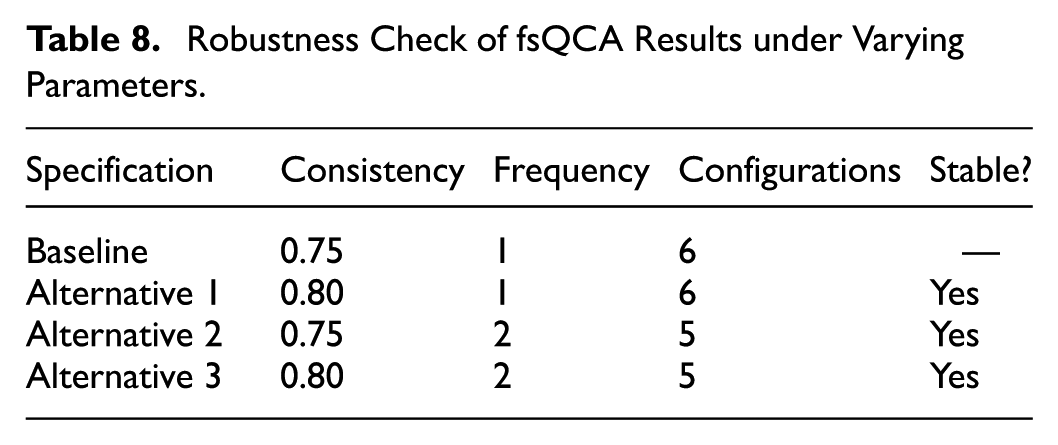
Robustness checks were conducted for the configurations associated with low Governable Development Attainment. First, increasing the case-frequency threshold from 1 to 2 yielded only minor changes in the counts of parsimonious and intermediate solutions, and the composition of the intermediate solution remained largely stable (Lucas & Szatrowski, 2014). Second, raising the PRI-consistency threshold from 0.75 to 0.80 produced similar outcomes (Mattke et al., 2022). Taken together, these sensitivity tests indicate that the core configurational findings are stable with respect to reasonable variations in model parameters (Table 8).
Robustness Check of fsQCA Results under Varying Parameters.
Discussion
Path Diversity and Capital Configuration
The configurational results indicate that China’s rural revitalization does not follow a single linear trajectory; rather, it unfolds through multiple, region-specific pathways shaped by historically sedimented capital structures and differentiated governance logics. Instead of treating development as a function of input magnitude, the analysis suggests that the structure, synergy, and symbolic legitimacy of economic, ecological, human, social, and cultural capital are associated with whether revitalization efforts prove sustainable and transformative.
From a Bourdieusian standpoint, rural space is not merely a policy domain but a contested field in which actors such as local governments, village cadres, farmers, and enterprises seek to accumulate and convert capital under field-specific rules. Within this relational framework, the attainment of rural revitalization is associated with the alignment between possessed capital (volume) and convertible capital (trajectory). For example, the Zhejiang case (H1) illustrates the cumulative effects of ecological and human capital operating in synergy, where landscape governance and talent return reinforce one another under stable institutional arrangements, even in the relative absence of strong social and cultural capital. This alignment coincides with material improvement and appears to be accompanied by adjustments in habitus, as local populations become more attuned to policy norms, productivity expectations, and participatory governance.
In contrast, the L1 to L6 configurations reflect fractured capital arrangements. L1 is characterized by comprehensive deficits across ecological, human, and social capital (Table 9). In Guizhou, for example, the Relocation for Poverty Alleviation program has emphasized population reallocation over the cultivation of local capital stocks, functioning as a spatial response rather than a developmental strategy.
Regional Pathways Under Capital and Governance Regimes.

L2 and L4 indicate a predominance of cultural capital without sufficient human or organizational grounding, such that cultural initiatives remain largely representational rather than organically embedded in rural life. In Guangxi, for instance, the Rural Cultural Industry Development Plan emphasizes heritage commodification but operates with limited institutional support. In Qinghai, the Mineral Resource Development Plan prioritizes industrial expansion relative to cultural integration, weakening local alignment between cultural programming and the capacities needed for implementation. L3 highlights deficits in ecological and human capital despite the presence of cultural initiatives, a combination that undermines field stability. In Xinjiang, for example, the Ethnic Minority Tourism Development Policy remains predominantly top down and externally scripted, with limited linkages to local ecological or educational infrastructures.
In L5 and L6, organizational or symbolic strength is present without commensurate productive economic capital, approximating what Bourdieu terms illusio without capital, namely a condition in which political or organizational capacity is decoupled from substantive developmental leverage. In Yunnan, the Ethnic Cultural Tourism Promotion Program foregrounds symbolic performance in the absence of commensurate structural investment. In Shaanxi, the Moral Evaluation Council and Village Self-Governance System mobilize moral authority while material foundations remain limited. Across these cases, weak capital congruence and underdeveloped conversion mechanisms render revitalization largely rhetorical or performative rather than substantively transformative.
Overlaying these structural dynamics, Foucault’s concept of governmentality reorients attention from discrete state actions to the formation of governable rural subjects. Under the H1 model, rural revitalization proceeds through both capital investments and governance technologies, including digital monitoring, performance appraisal, narrative production, and moral auditing. Zhejiang’s Beautiful Countryside initiative and Digital Village strategy exemplify this alignment, coupling ecological and human capital accumulation with institutional performance mechanisms. These instruments cultivate subjectivities that internalize development objectives, rendering governance productive rather than overtly coercive. By contrast, configurations such as L2 and L4 delineate the limits of symbolic governance, where official scripts do not resonate with local habitus and participation remains largely non-performative or merely symbolic.
In sum, the results indicate that capital is institutionally mediated rather than autonomous, and that conversion entails both material processes and discursive authorization. The heterogeneity of rural revitalization pathways reflects not only economic differentiation but also variation in institutional rationalities, discursive regimes, and field-specific rules of valuation. High-level Governable Development Attainment is evident where capitals are present and relationally configured, mediated by enabling governance technologies, and accorded recognition within the dominant field of power.
To render these differentiated configurations and their associated governance regimes transparent, Table 9 synthesizes eight representative pathways derived from the configurational analysis. The cases illustrate how dominant capital forms interface with local policy logics and governance techniques, yielding distinct developmental trajectories across regions.
Governance Regimes and Foucauldian Control
While capital configurations elucidate the material conditions associated with distinct revitalization pathways, they do not by themselves account for the governance technologies through which these capitals are mobilized, constrained, or redirected. Drawing on Michel Foucault’s notion of governmentality, this section examines rural revitalization as proceeding not only via material investment but also through strategic regimes of control that activate power through discourse, performance metrics, institutional design, and processes of subjectivation rather than overt coercion.
Across the configurations identified in this study, regional variation reflects not only capital asymmetries but also differentiated logics of control. In Zhejiang (H1), high-quality revitalization is associated not merely with ecological and talent capital but with a rationalized policy architecture organized around Beautiful Countryside initiatives and digital governance tools. In this setting, revitalization operates as a performance regime: local cadres internalize responsibility through KPI-based evaluations, and villagers are encouraged to participate via narrative alignment with the state’s vision of “modern rural citizenship.” In Foucauldian terms, subject formation proceeds through optimization rather than overt coercion, with discourse, metrics, and institutional design shaping conduct from within.
By contrast, configurations such as L2, exemplified by Guangxi, display a prevalence of symbolic cultural investment—museums, festivals, and branding—without commensurate institutional empowerment. Rural residents are positioned as custodians of tradition but afforded limited economic agency or planning voice, producing a disjunction between cultural revitalization and durable transformation. Governance operates here through aesthetics and representation, disciplining conduct via display rather than capability, and generates limited endogenous momentum in the absence of complementary organizational and economic capacities.
In the more fragile configurations (L1 and L3), governance is marked by a monologic rationality. Policy narratives invoke “stability,”“poverty alleviation,” or “industrialization” in abstract terms, yet provide limited feedback channels or participatory infrastructures. The absence of institutional pluralism yields a predominantly top-down disciplinary arrangement in which rural revitalization is rendered a technocratic assignment rather than a negotiated process of transformation.
These patterns indicate that rural revitalization in China involves not only competition over capital resources but also contestation over the construction of governable subjects. Farmers are addressed not as passive recipients of development but as actors expected to self-discipline, self-modernize, and align aspirations with the state’s strategic vision. Governance operates through spatial zoning, incentive programs, and cultural scripts—technologies of conduct in Foucauldian terms. Such infrastructures condition the conversion of capital into durable attainments and help account for why regions with comparable capital inputs exhibit divergent outcomes.
Thus, while Bourdieu clarifies the composition and conversion of capitals, Foucault illuminates how governance frameworks mediate these processes through the regulation of meaning, expectations, and behavioral norms. Capital does not convert autonomously; it is authorized, enabled, and made productive through techniques of governmentality.
Theoretical Implications: Capital & Governance
Situated within the dual lens of capital and governmentality, the findings suggest two interrelated implications for theory. The diversity of capital configurations indicates that no single capital form suffices for rural revitalization; developmental leverage arises from the synergistic alignment and relational dynamics among economic, ecological, human, social, and cultural capitals. At the same time, regional governance regimes show that ostensibly similar capital bases can be associated with divergent attainments, depending on how resources are managed, filtered, and mobilized through Foucauldian mechanisms of control.
Building on these insights, this section advances a Capital–Governance Interaction Model to account for the emergence of distinct rural revitalization pathways in China. The model integrates Bourdieu’s concept of the capital field with Foucault’s notion of governmentality, providing a relational account of why some regions register high Governable Development Attainment whereas others plateau despite broadly comparable investments or resource endowments.
Capital Configurations as Strategic Potentials
In Bourdieusian terms, the five capitals (economic, ecological, human, social, and cultural) constitute the latent structural base for rural transformation. Capital does not operate autonomously; it requires relational positioning and mutual reinforcement within the field. High-attainment cases tend to display relational coherence across multiple capitals rather than the dominance of any single domain, a pattern associated with cumulative dynamics of accumulation and retention. By contrast, the low-attainment pathways (L1 to L6) exhibit fragmented structures or limited conversion capacity, indicating misalignment among capitals within their institutional settings.
Governance Regimes as Conversion Filters
Through a Foucauldian lens, governance is not neutral administration but a technology for conducting conduct, in which incentive systems, moral discourses, bureaucratic audits, and cultural standards shape behavioral repertoires and delimit what outcomes are recognized as legitimate. In the context of rural revitalization, local cadres, village elites, and external actors operate within regimes of visibility and discipline that specify which forms of capital are encouraged, monitored, or marginalized. Under performance-oriented logics, for example, symbolic cultural investment may be prioritized as a measurable display, substituting for structural reform and yielding shallow revitalization despite heightened cultural visibility.
Toward an Integrated Framework: The Capital–Governance Interaction Model
Integrating the logics of capital configuration and governance rationality, this study advances a four-quadrant framework that interprets rural revitalization as the co-production of structural capital conditions and governing modalities (Figure 3). The quadrants are defined by the intersection of capital coherence (high versus low relational alignment across economic, ecological, human, social, and cultural domains) and governance orientation (enabling versus constraining regimes of legibility, normalization, and promotability). This scheme situates observed pathways as configurations in which capital structures and control technologies jointly condition Governable Development Attainment.

Capital - Governance Interaction Model.
This conceptual model extends the insights developed in Section V.i and Section V.ii shifting from identifying emergent configurations to examining why similar policy inputs are associated with divergent outcomes. In this formulation, capital denotes latent structural capacity embedded in rural systems, whereas governance constitutes the operational mechanism through which that capacity is activated, disciplined, and redirected. The effectiveness of rural revitalization is thus conditioned by the alignment, or misalignment, between capital structures and the rationalities that govern their conversion into publicly legible attainments. Governance does not simply implement development; it interprets and reorganizes capital toward particular ends, thereby generating variegated trajectories of rural change.
Possibility Exploration: Extending from Chinese Cases
This section refines the synthesis of Bourdieu’s theory of capital and field with Foucault’s concept of governmentality, which underpins the capital–governance interaction model advanced in this study. Although both frameworks address power and structure, they proceed from distinct ontological premises: Bourdieu theorizes social differentiation through the accumulation, distribution, and conversion of capitals within relational fields, whereas Foucault analyzes governance as operating through regimes of visibility, normalization, and control that render subjects and spaces governable.
In the Chinese context, these perspectives intersect in analytically productive ways. A Bourdieusian lens maps how actors such as local governments, village elites, and rural entrepreneurs pursue and accumulate economic, cultural, human, social, and ecological capital within stratified development fields. Yet capital stocks alone are insufficient to account for observed attainments. A Foucauldian lens illuminates how these capitals are mobilized, filtered, or left dormant through policy rationalities, performance metrics, institutional screening, and disciplinary audits that structure conduct across rural territories.
Empirically, the synthesis is visible in China’s revitalization apparatus, where development indicators, model-village designations, and project audits structure both the criteria of success and the actors able to convert symbolic or cultural capital into policy advantage. In some regions, cultural capital is translated into material investment through recognition in state-led campaigns; in others, it remains largely ornamental when misaligned with governance priorities.
Positioned as a possibility exploration, the capital–governance model conceptualizes rural transformation as a dual process of structural configuration and discursive filtering and considers the conditions under which this formulation may travel beyond China. Three scope conditions are especially salient: (a) the presence of comparable capital taxonomies that can be rendered legible by state or para-state metrics; (b) governance regimes that employ audit and narrative instruments capable of authorizing capital conversion; and (c) institutional interfaces linking local organizations to policy incentives. Where these conditions are only partially met, the model is expected to hold in attenuated form, yielding variant configurational patterns.
Accordingly, the Chinese evidence serves as a theory-building base for cautious extension to other Global South settings. The next section outlines how the framework may be adapted across contexts, specifies boundary conditions for transferability, and proposes comparative propositions for empirical scrutiny.
Model Extension: From Chinese Cases to Global Applicability
Although the capital–governance interaction model is empirically anchored in China’s provincial patterns of rural revitalization, it possesses broader theoretical relevance. Its core proposition is that differentiated configurations of economic, ecological, human, social, and cultural capital operate in conjunction with multi-level governance rationalities to generate heterogeneous rural development attainments. This proposition is consistent with dynamics observed in other contexts characterized by uneven territorial development and state-led modernization agendas. The framework therefore provides a transferable lens for comparative analysis, provided that capital taxonomies, governance instruments, and institutional interfaces are calibrated to local conditions.
In Brazil, disparities between the southern and northern regions reflect differences not only in capital endowments but also in governance modalities. Southern states display comparatively high coordination of human and ecological capital within adaptive governance arrangements, a pattern analogous to the high-attainment configuration identified in this study. By contrast, parts of the Amazon basin exhibit fragmented capital structures alongside governance rationalities oriented toward territorial control rather than participatory development, a combination that corresponds to the low-attainment configurations (L1 to L6) observed in several western Chinese provinces.
In India, a comparable analytical structure applies. States such as Kerala exhibit strong synergies among human, social, and cultural capital embedded within the Panchayati Raj system, whereas less developed regions display persistent capital deficits under fragmented governance logics. This contrast illustrates how decentralized governance frameworks can mediate capital conversion in ways analogous to China’s village committee arrangements, while remaining conditioned by India’s distinct political–institutional trajectories.
In Indonesia, post-decentralization reforms have produced a governance landscape in which regions such as Java combine high densities of economic and human capital with relatively strong institutional coordination, whereas peripheral areas face ecological vulnerabilities alongside governance incoherence. This pattern reflects layered interactions between capital structures and governing rationalities that are similar in form—though distinct in content—to those identified in the Chinese context.
These comparative parallels indicate that the capital–governance interaction model can serve as a cross-national analytical framework for interpreting rural development heterogeneity under state-led governance (Table 10). Rather than a China-specific device, the model specifies core sociological mechanisms—capital stratification, governing rationalities, and institutional layering—that structure rural transformation across national fields. Future research should assess its applicability through systematic cross-case designs, enabling a more integrated theoretical account of rural governance and development across Global contexts.
Capital–Governance Dynamics Across Countries.

Conclusion
Theoretical and Methodological Contributions
This study develops an integrated account of rural revitalization by linking Bourdieu’s field-and-capital perspective to Foucault’s governmentality. Rural attainment is treated as a configurational phenomenon shaped by the relational alignment of economic, ecological, human, social, and cultural capitals and by governing rationalities that render resources legible, authorized, and promotable.
Methodologically, a transparent set-theoretic strategy is implemented. Entropy weighting constructs composite indicators; direct calibration with theoretically informed anchors enables fuzzy-set measurement; fsQCA recovers equifinal configurations associated with high and non-high Governable Development Attainment; NCA assesses necessity and identifies bottleneck elements; and sensitivity checks on case frequency and PRI consistency indicate stable solutions. This workflow is replicable and adaptable across contexts subject to calibration of capital taxonomies, governance instruments, and institutional interfaces.
Theoretically, the contribution is a two-dimensional Capital - Governance model that explains uneven provincial trajectories by specifying capital coherence, governance filtering, and field-specific rules of valuation. The model reframes revitalization from an input-accumulation view toward one centered on how governance interprets and channels capital, offering a transferable lens for comparative research.
Policy and Governance Implications
The findings have implications for national policy design and the strategic orientation of rural governance. The H1 configuration, exemplified by provinces such as Zhejiang, indicates the enabling role of coordinated ecological and human capital under adaptive, multi-level governance. In these settings, performance-based planning instruments and digital governance platforms align developmental capacities with institutional flexibility and participatory legitimacy, thereby facilitating capital conversion consistent with higher Governable Development Attainment.
From a strategic perspective, the results support differentiated policy regimes attuned to local field conditions. In structurally disadvantaged regions, priorities include building grassroots institutional capacity, strengthening cultural legitimacy, and facilitating cross-regional circulation of capital resources. In transitional zones, calibrated policy experimentation that advances ecological and social capital alongside economic development is likely to produce more sustainable trajectories. At the national level, performance assessment systems should evolve to incorporate indicators of governance quality, participatory embeddedness, and long-term symbolic legitimacy as integral components of revitalization effectiveness.
Given the model’s broader applicability, these implications extend beyond China. In countries characterized by uneven territorial development and layered governance, including Brazil, India, and Indonesia, the capital–governance interaction framework provides a useful lens for interpreting the relationship between resource conditions and institutional design. Recognizing revitalization as a process of governed capital conversion opens avenues for context-sensitive, equity-oriented, and theoretically grounded rural development strategies across diverse settings.
Limitations and Future Directions
This study relies on a cross-sectional design using data from the 2023 editions of national statistical yearbooks. While this affords a comprehensive snapshot of capital configurations and their governable attainments within a given policy context, it constrains observation of temporal dynamics and limits inference regarding directional relations. Future work could extend the analysis with panel designs or comparative time-series QCA to trace the evolution of capital structures and governance effects over time. Additional avenues include mixed-method designs that pair configurational results with fieldwork, as well as multi-country studies to assess the model’s transferability under varying institutional conditions.
Footnotes
Appendix A. Weighting and Calibration Documentation
Acknowledgements
The authors would like to thank all individuals who provided valuable support and feedback during the preparation of this manuscript. We also appreciate the constructive comments from anonymous reviewers that helped improve the quality of this paper.
Author Note
The manuscript was written and submitted independently by the authors. No third-party submission services were used. Language refinement was performed using ChatGPT under the authors’ supervision to improve clarity and fluency.

Ethical Considerations
This study did not involve human participants, intervention, or the collection or use of identifiable personal data. All analyses relied exclusively on publicly available, aggregate secondary data from national statistical yearbooks and related public sources. In accordance with institutional and national regulations, this work does not constitute human-subjects research; therefore, formal ethics review was not required.
Consent to Participate
Because the study used only anonymized, aggregate secondary data in the public domain and did not involve any direct contact with individuals, informed consent was not applicable and was therefore not required. This determination is consistent with Sage’s guidance for ethics and informed-consent statements and with the APA Ethics Code (Section 8.05) regarding archival research that poses no reasonable risk to individuals.
Consent for Publication
Not applicable.
Author Contributions
Conceptualization, Z.C.; data curation, R.L.; formal analysis, Z.C.; writing—original draft preparation, Z.C.; writing—review and editing, Z.C.; supervision, L.W. All authors contributed to the study conception and design. All authors have read and agreed to the published version of the manuscript.
Funding
The authors received no financial support for the research, authorship, and/or publication of this article.
Declaration of Conflicting Interests
The authors declared no potential conflicts of interest with respect to the research, authorship, and/or publication of this article.
Data Availability Statement
All data used in this study are derived from publicly available national statistical yearbooks and related public sources cited in the article. The compiled dataset and analysis scripts are available from the corresponding author on reasonable request.