




Abstract
This study examines the logical connection and articulation mechanism between rural human capital and rural revitalization from the perspective of farmers’ professionalization. Utilizing panel data spanning 2011 to 2020, collected from 31 provinces in China, a comprehensive index framework for rural revitalization was constructed, and a fixed-effect model was used for empirical analysis. It is found that: firstly, rural human capital strongly drives rural revitalization, and the professionalization of farmers has a converging influence on rural revitalization as well as a favorable moderating influence on the convergence of rural human capital on rural revitalization. Secondly, the harmonized progress of urban and rural regions is a significant interface mechanism between rural human capital and rural revitalization. Therefore, to facilitate rural revitalization, the government should provide educational opportunities, make investments in rural human capital through policies, and emphasize the value of talents and industrial resources in integrating the urban and rural.
Keywords
Introduction
During rapid industrialization and urbanization, cities around the world have achieved faster development, but the problem of rural decline also tends to be serious. The decline of rural areas is a widespread global issue (Y. Liu & Li, 2017). Statistical data reveals that the global rural population has experienced a notable decline, from 66% in 1960 to 44% in 2021. The massive decrease in rural population has led to labor shortage, low agricultural efficiency, and shrinking rural economy, which seriously restrict the progress in rural areas. Hence, it is crucial to prioritize the revival of rural areas (Y. Li et al., 2019). Developed countries were the first to realize the seriousness of these problems and pioneered a number of rural revitalization movements aimed at achieving rural revitalization in the 1970s. Among them, the “One Village, One Product” campaign in Oita Prefecture, Japan (J. Zhang, 2019), the “Destination Support Strategy” in Ore Village, Sweden (Nordin & Westlund, 2009), and the land consolidation and rural renewal in Bavaria, Germany (Chen, 2012) are the most typical rural revitalization campaigns. All countries in the world have developed their own unique rural revitalization models while seeking appropriate approaches for rural development. And China is also actively exploring suitable paths to adapt to the rural plight it currently faces.
The suggestion of the rural revitalization is an important measure made by China to explore the issue of rural development. The 19th National Congress report in China made an excellent strategic plan to implement rural revitalization. It represents both a comprehensive approach to addressing the “three rural issues” in current and a substantial solution for tackling the disparities in urban-rural development and rural inadequacies (L. Li et al., 2021). The realization of rural revitalization requires the synergy of multiple forces. Among them, the role of human capital is quite important. Numerous studies have shown that human capital is the endogenous driving force that pulls rural economic development and is fundamental to the revitalization of rural areas (Cabrer-Borrás & Serrano-Domingo, 2007; Moreno, 2005; J. Zhang et al., 2019). In the seventh national census, China’s rural population experienced a reduction of 164.36 million, indicating a decline compared to the figures of the sixth national census. The data show that China’s urbanization yielded historic achievements, yet resulted in significant rural brain drain due to labor migration (Y. Li et al., 2019). The Rural Revitalization Plan (2018–2022) emphasizes “strengthening rural professionals,” aligning with the Central Government’s 2021 directive to integrate rural talent revitalization into overall talent planning. This indicates a growing national focus on the progressive recognition of human capital accumulation in rural areas. In the content framework of rural revitalization, revitalizing industry, ecology, and organization is easier, but revitalizing talent and culture is deeper and more challenging (H. Li & Jiao, 2021). Hence, addressing rural talent predicament crucial for China’s rural economy’s high-quality development, and exploring human capital-driven rural revitalization path holds practical significance.
Human capital is the knowledge, skills and ability of laborers to use them effectively. The key to human capital development is education, and the output efficiency of investment in education is the most durable and effective. (Schultz, 1961). Rural talent revitalization should take investment in education as the most important way to enhance human capital. The 2012 No. 1 document emphasized cultivating new types of professional farmers to address the question of “who should cultivate the land.” This approach gained recognition and offers new ideas for rural talent revitalization (Lv, 2020).
In addition, urban and countryside are an organism, and urban and countryside can only achieve their respective sustainable development if they support each other (G. Fan & Wang, 2023). Nowadays, China’s urban construction is facing problems such as insufficient industrial development, poor circulation of factors and imperfect infrastructure (X. Kong & Xie, 2022). Given that the countryside serves as a vital pillar for economic and social progress, the rural revitalization strategy should focus on integrating with urban areas and foster rural transformation through the establishment of institutional mechanisms for urban-rural integration (Y. Liu, 2018).
In recent years, the research on rural revitalization at home and abroad has become more mature. However, now that China’s rural revitalization has gained access to the critical period of consolidating the achievements of poverty eradication. How can rural human capital be optimized to maximize its contribution to rural revitalization? Does vocational education and training for farmers contribute to enhancing rural human capital? What is the way to connect human capital and rural revitalization? Is it possible for the integrated development of urban and rural areas to synergistically foster rural revitalization? Effectively tackling these questions is vital for the successful implementation of rural revitalization in both the present and future. Therefore, this study examines the influence of human capital enhancement and the development of professional farmers on rural revitalization, drawing from human capital theory and rural-urban relations theory. Additionally, it explores the potential of urban-rural integration in fostering rural revitalization, aiming to uncover novel approaches for achieving rural revitalization.
The following sections of this paper are organized as follows. Firstly, the literature on rural revitalization and human capital, farmer professionalization, and urban-rural integration is reviewed. Secondly, the theoretical frameworks of human capital theory and urban-rural relationship theory are reviewed to formulate hypotheses to be examined in the subsequent phase of the research. Thirdly, we describe the criteria for the selection of variables and the research methodology used in this paper. Finally, we discuss the empirical results, draw conclusions and limitations, and suggest future research directions.
Literature Review
Rural Revitalization
Academics have started spirited discussions and produced excellent research findings on rural revitalization since its introduction in the 2017 report of the 19th National Congress, mostly focusing on two issues. The research on the rural revitalization process comes first. The precise routes to accomplish rural revitalization have primarily been studied from the perspectives of financial development (Lu & Du, 2023; Meng et al., 2023; M. Wang et al., 2023), rural e-commerce (P. He & Tan, 2023; Sun, 2022) and digital economy (Y. Fan & Liu, 2023; Ren & Wang, 2023). The quantitative study of rural revival is the second. Building a complete index system of rural revitalization, a quantitative analysis of the rural revitalization development level in China is done starting from the five characteristics of industrial prosperity, environmental sustainability and livability, cultured rural ambiance, effective governance, and prosperous living conditions (L. He et al., 2022; T. Zhang et al., 2018; Y. Zhang et al., 2023). The realization of rural revitalization demands the joint efforts of various parties. Rural revitalization has rich contents and is an all-around strategic deployment for rural development.
Rural Human Capital and Rural Revitalization
Talent revitalization is the primary focus of implementing the rural revitalization strategy, and the comprehensive revitalization of the countryside is driven by talent revitalization (Lan et al., 2021). Currently, the investigation into the correlation between rural human capital and rural revitalization primarily centers on three key areas: first, the effect of human capital heterogeneity on rural revitalization. For example, Yao et al. (2022) examined the spatial impact of rural human capital on revitalization, considering heterogeneity and regional differences by using the SDM model. Leveraging heterogeneous human capital, W. Ma and Liu (2019) explored its impact on rural non-farm income and farm-related income for poverty reduction. D. Wang and Ran (2022) emphasized regional heterogeneity in rural human capital’s role in driving rural digitalization and its impact on integrating rural industries. Second, the role of human capital investment on rural revitalization. Luo et al. (2022) suggested optimizing educational resource allocation across age groups to enhance labor force education and human capital investment efficiency in rural areas. Jiang and Jiang (2019) proposed six realization paths for cultivating new types of professional farmers in China at present to achieve rural human capital revitalization. Heckman (2005) argued that the urban area should be given priority over the rural area in China’s human capital investment policy, and it is this policy bias that has hindered the progress of China’s rural economy. Third, the impact of human capital accumulation on rural revitalization. Gan et al. (2019) emphasized the significance of rural migrants returning to their hometowns for driving rural revitalization. Lucas (1988) argued that human capital accumulation is a core element in promoting economic growth, and it mainly drives economic growth through endogenous, spillover and aggregation effects. Stephen (2014) highlights rural human capital’s impact on agricultural enterprises and rural economic development in Russia, based on analysis.
Professionalization of Farmers
Professional farmers can help rural areas with their lack of human capital by acting as a crucial support force for agricultural modernization and rural revitalization. Scholars’ research on farmers’ professionalization is mainly reflected in two aspects: willingness and cultivation of farmers’ professionalism. In terms of farmers’ willingness to professionalize, factors such as external environmental support and career perceptions (M. Zhang et al., 2021; J. Zhou, 2020), policy perceptions (Guo et al., 2019), and social networks (Weng et al., 2020) all positively influence farmers’ willingness to professionalize. In terms of farmers’ professionalization cultivation, government policies and financial support, reforming vocational qualifications and skills recognition are conducive to optimizing farmers’ professionalization cultivation paths (C. Liu et al., 2020; Suo & Chen, 2022). New professional farmers are the backbone of high-quality agricultural development, and the government should prioritize and consistently explore approaches to foster a new generation of skilled farmers (J. Liu & Wang, 2022). The cultivation of professional farmers should also focus on the cultivation of “leaders” of agricultural producers such as family farms, agricultural cooperatives, leading enterprises and social service organizations, and give play to their demonstration and leading roles in rural economic development, in order to enhance the “spillover effect” of rural human capital (Wu, 2018). In addition, many studies have highlighted that the main strategy to deal with the phenomenon of aging farmers and agricultural production is to create professional farmers to ensure modern agricultural production functions by improving the professional capacity of farmers with regards to labor, capital and technology (Mottaleb, 2018; Muyombano & Espling, 2020).
Urban-Rural Integration Development and Rural Revitalization
The interconnection between urban and rural regions in China has changed as the goal of creating a wealthy society has been achieved, but there are still disparities in terms of population, land, capital, public services, systems, and institutions that impede urban-rural integration (B. Ma & Song, 2022) and limit the implementation of rural revitalization. Considering the standpoint of integrating urban and rural areas, the essence of rural revitalization is to move toward common prosperity through integrated urban-rural development. And the crucial factor is to facilitate unrestricted two-way flows of population, technology, capital, information, and other essential elements between urban and rural regions (Xiong, 2022). Allawi and Al-Jazaeri (2023) explored an innovative approach to stimulate rural development through the incorporation of urban development initiatives approaches to achieve rural areas with the aim of achieving spatial sustainability in rural areas. L. Wang and Zhao (2022) advocate for integrated urban-rural development, promoting free movement of elements, enhancing division of labor, property rights reform, and collective economy for rural revitalization. Y. Wang et al. (2023) confirm that both the digital economy and rural human capital can greatly contribute to the development of urban-rural integration. Integrated urban-rural development intersects new urbanization and rural revitalization strategies, promoting balanced development and meeting necessary requirements for rural revitalization and new urbanization (W. Zhou, 2022).
To sum up, there are still some shortcomings in the domestic and international studies on rural revitalization: firstly, most of the literature only analyzes the correlation between rural human capital and rural revitalization in terms of policy interpretation and theoretical research, but lacks quantitative empirical analysis, which to a certain extent leads to the subjectivity of research conclusions. Moreover, the few empirical studies only take rural human capital as a boundary condition to study its influence path on rural revitalization, and the direct influence mechanism of rural human capital on rural revitalization still needs to be further explored. Secondly, as a viable approach to enhance the level of rural human capital, few papers have focused on the quantitative study of farmers’ vocational education. Finally, although scholars have conducted extensive research on the relationship between rural-urban integration and rural revitalization, few studies have focused on the mediating function of rural-urban integration in the convergence effect of rural human capital on rural revitalization.
Compared with previous literature, this paper offers potential contributions in the following aspects: firstly, this paper uses statistical data and measures the rural revitalization index using the entropy value method to empirically explore the path of rural human capital driving rural revitalization in China and to improve the existing qualitative literature. Secondly, it measures farmers’ professionalization from different perspectives and discusses whether the improvement of farmers’ professionalization level is a moderating path for rural human capital to promote rural revitalization. Thirdly, we establish a comprehensive index system for urban-rural integration development to examine whether urban-rural integration development is an articulation mechanism in the relationship between rural human capital and rural revitalization. Fourth, it is a novel attempt to incorporate urban-rural integration development, rural human capital and farmers’ professionalization into one analytical framework to study the influence effect on rural revitalization. Through investigating the impact of rural human capital on rural revitalization, this study presents novel insights for the achievement of China’s rural revitalization strategy, balanced urban-rural development, and the revitalization of rural talent in the future.
Theoretical Mechanism and Research Hypotheses
Theoretical Framework
Human Capital Theory
A measure of the prosperity of a country or region is whether its economy can function well. Similarly, the issue of rural revitalization is simply the issue of rural economic growth. Then, what is the source of economic growth? Neoclassical economic theory considers physical capital as a source of short-term economic growth and technological progress as a source of long-term economic growth. However, this theory fails to further explain the causes of long-term economic growth and has certain limitations. In the 1980s, the endogenous economic growth theory, represented by American economists Romer (1985) and Lucas (1988), argued that technological progress resulting from investment in and development of human capital is the source of long-term economic growth, revealing the mechanism of action between human capital and economic growth, thus forming the core of the endogenous economic growth theory—human capital theory. Human capital theory asserts that human capital is vital for driving economic growth, alongside tangible factors like land and capital. It suggests measuring human capital through workers’ education level, emphasizing its significance (Schultz, 1961).
As the core of endogenous economic growth theory, human capital theory has important implications for rural revitalization in China. From one perspective, one of the aims of enacting rural revitalization in China is to promote rural economic construction, and human capital theory reveals that human capital is an essential component of economic expansion. So, the success of rural revitalization in China hinges on the level of human capital development in rural areas. From another perspective, another important purpose of China’s rural revitalization is to promote the modernization of agriculture and rural areas. Modernized agriculture requires modern scientific knowledge, network technology, and advanced agricultural production techniques, relying more on intellectual capital than physical capital. In summary, based on human capital theory, this paper introduces the variable of farmer professionalization to examine the role of farmer professionalization in the relationship between rural human capital and rural revitalization.
Theory of Urban-Rural Relations
Urban and rural development are closely linked. Therefore, rural revitalization cannot focus only on the countryside, but should find a breakthrough in the development from the relationship between the city and the countryside. Marx and Engels developed the thesis of the urban-rural interaction after critically analyzing earlier research. They dialectically examined the underlying causes of the opposition and separation among urban and rural areas as well as the movement process of the two, and he came to the conclusion that, as the productive forces advance, the development trend of urban-rural relations will undoubtedly move from the state of opposition and separation to the ultimate integration (G. Fan & Wang, 2023). The theory of urban-rural relationship profoundly reveals the essence of urban-rural social development and its inherent laws of movement, which holds significant importance for gaining a deeper understanding of the urban-rural relationship in China, grasp the development trend of urban-rural integration, and realize rural revitalization. To realize the harmonious development of urban and rural areas and rural revitalization in China, we must always adhere to Marx and Engels’ theory of urban-rural relations as our guide (H. Zhang, 2018). Consequently, this paper introduces the variable of urban-rural integration development derived from the urban-rural relationship theory and examines the mechanism by which urban-rural integration contributes to rural revitalization through rural human capital.
Research Hypotheses
Direct Impact of Human Capital on Rural Revitalization
The key to the realization of rural revitalization strategy is how to maximize the contribution of talents (Wu, 2018). The efficiency of input and output of social physical capital and human capital can effectively manage the related transaction costs (Giacomarra et al., 2021), help managers achieve high efficiency (Tsiouni et al., 2022) and gain competitive advantages in the market (Crescimanno et al., 2023), which shows that physical capital and human capital can greatly promote economic and social development. Rural revitalization also requires both physical capital and human capital, and the role of human capital is more important than that of physical capital. Physical capital such as capital and technology provide the basic support for rural revitalization, while the deployment of resources such as capital and technology requires the promotion of “people” (Du & Yang, 2018). Whether the long-term objective of “making agriculture a promising industry, farmers an attractive employment, and the countryside a beautiful habitat for living and working in peace and happiness” can be achieved depends on the state of rural human capital.
Firstly, improving the level of human capital can help “make agriculture a promising industry.” Industrial revitalization is the key to achieve agricultural modernization. Whether or not the industry is successful determines whether or not agriculture is robust. China’s rural industries are now growing successfully, but there are still issues including an unbalanced human resource structure and a lack of funding for technical R&D. In order to increase agricultural production efficiency, correct problems with rural industrial development, support the revitalization of rural industries, and make agriculture a prosperous industry, there is an urgent need for a large number of highly qualified and high-level agricultural professionals to oversee and take part in agricultural production.
Secondly, improving the level of human capital helps “make farmers an attractive occupation.” Expanding laborer employment opportunities, increasing their chances of finding non-farm employment, and dramatically raising farm households’ income can all be achieved by raising the level of rural human capital (Gao & Hao, 2018; Lai & Chen, 2018). China’s agricultural and rural development has now reached a new stage. In order to encourage the modernization and scale development of agriculture and rural areas under the new circumstances, it is necessary to provide farmers with cultural and vocational education and training to enhance their professional skills, to cultivate farmers to become pioneers of new agricultural industries, new business models, and practitioners of new agricultural business subjects, and to make sure that farmers are aware of the importance of new agricultural business subjects.
Finally, improving the level of human capital can help “make the countryside a home for living and working in peace and happiness.” Among the “five elements” of rural revitalization, “ecological livability” is crucial. The improvement of rural production and lifestyle is necessary for the achievement of the objective of “ecological livability” in rural regions, and both organizational and technological developments call for people with greater skill levels to match them (Lai & Chen, 2018). Therefore, the function of human capital in fostering village transformation and improving the rural area’s spatial layout can help radically alter the rural way of life and transform rural areas into livable and prosperous communities (Lan et al., 2021).
Based on the above analyses, we propose the following null hypotheses and alternative hypotheses for the first primary effect:
H1 0: There is no positive correlation between rural human capital and rural revitalization.
H1 a: There is a positive correlation between rural human capital and rural revitalization.
The Moderating Effect of Professionalization of Farmers
The term “professionalization of farmers” refers to the process of converting “traditional farmers” or those who have left their hometowns into “professional farmers.” The new professional farmers are a result of this process, and the two are related in terms of the relationship between the goal and the means (Lv, 2020). In the “Thirteenth Five-Year Plan,” the concept of new professional farmers is clearly stated: A new professional farmer is a modern agricultural practitioner that views agriculture as their primary vocation, is knowledgeable about agricultural production techniques, and relies heavily on the money from agricultural production and management to support their family. New professional farmers are different from traditional farmers, and are the inheritance and development of traditional farmers. By inheritance, we mean that new professional farmers have traits that are modern and current and that both are inseparable from the development of agriculture and rural areas (Huang & Wen, 2022).
Schultz believes that the capacity of farmers plays a very important role in modernizing agriculture. The more education and training farmers receive, the more their output will grow. Vocational training for farmers is helpful for addressing the rural talent gap, transforming the plentiful human resources in rural areas into human capital, and maximizing rural advantages (Y. Li, 2020). On the one hand, through vocational training and education, the government assists farmers in gaining information about agriculture, understanding government policy support and market norms, and boosting their confidence to engage in agricultural activities in order to strengthen their human capital. On the other hand, farmers’ vocational training can inspire their friends and family to start new businesses as professional farmers, which enhances the likelihood that farmers will continue to live in rural areas (Weng et al., 2020). By cultivating professional farmers, we can not only assist existing farmers in completing their identity transformations and enhancing the identities of new professional farmers, but we can also raise the bar for farmers’ management of agriculture and rural areas, empowering them to take the lead in agricultural production and management. Train farmers gradually to become new professionals who are “excellent at management, technology, and business” in order to revitalize rural talent and supply reserve talent for rural growth (Guan & Cai, 2015). The process of professionalization of farmers is in fact a process of specialization of the labor force, which encourages human resources with specialized skills and qualities to work to their best advantage in order to generate greater economic benefits from human capital. The professional development of farmers requires that they should have the necessary professional agronomic knowledge and expertise, which will not only provide reliable human resources support for modern agriculture, as well as cultivate a high-quality agricultural workforce for adapting to and advancing the modernization of agriculture, but also contribute positively to the development of the agricultural economy of the country as a whole, thus adding vitality to the agricultural sector, the countryside and the peasantry.
Based on the above analyses, the following null hypothesis and alternative hypothesis was put forward:
H2 0: The degree of farmers’ professionalization doesn’t have a positive moderating role in the positive correlation between rural human capital and rural revitalization.
H2 a: The degree of farmers’ professionalization has a positive moderating effect on the positive correlation between rural human capital and rural revitalization.
Intermediary Effect of Integrated Urban-Rural Development
The process of continuously closing the gap between urban and rural areas in terms of factor allocation, industrial growth, spatial layout, and ecological environment is known as urban-rural integration development (Tan & Zheng, 2021). For the countryside, urban-rural integration not only refers to the inflow of urban resources into the countryside, but also emphasizes the self-deployment of resources within the countryside in order to achieve mutual promotion and common development of the city and the countryside. The issue of urban-rural relationship is a key issue concerning economic and social development (H. Zhang, 2018). The core cause of current issues like “excessive urban-rural gap,”“hollowing out of the countryside,” and “rural illness” is China’s long-standing dual urban-rural structure, which favors the urban growth plan (Y. Liu et al., 2016). Therefore, urban and rural development requires integration for vitality and modernization, avoiding isolated growth.
The Central Government’s 2021 primary policy document proposed to “promote a new type of urbanization with people at the core,” emphasizing the important role of “people” in the integrated development of urban and rural areas. On the one hand, rational development and effective allocation of human resources are conducive to solving the problem of excessive urban-rural gap caused by uneven distribution of resources between urban and rural areas (Shuang & Latanqimuge, 2021), and workers with higher levels of human capital will use the theoretical knowledge or experience they possess to collaboratively drive the group to improve the production efficiency and socioeconomic benefits of the whole society and narrow the urban-rural gap (J. Zhang et al., 2019). On the other hand, integrated urban-rural development is conducive to providing channels for rural laborers to work in cities and urban talents to develop in rural areas, fully developing human resources at both urban and rural ends, improving the stock of rural human capital, and empowering rural revitalization.
Based on the above analyses, the following three null hypotheses and alternative hypotheses are proposed:
H3 0: There is no positive correlation between the level of human capital in rural areas and the level of urban-rural integration.
H3 a: There is a positive correlation between the level of human capital in rural areas and the level of urban-rural integration.
H4 0: There is no positive correlation between integrated urban-rural development and rural revitalization.
H4 a: There is a positive correlation between integrated urban-rural development and rural revitalization.
H5 0: There is no mediating role of integrated urban-rural development in the impact of rural human capital on rural revitalization.
H5 a: There is a mediating role of integrated urban-rural development in the impact of rural human capital on rural revitalization.
Based on the above mechanism analysis, the research model constructed in this paper is shown in Figure 1.
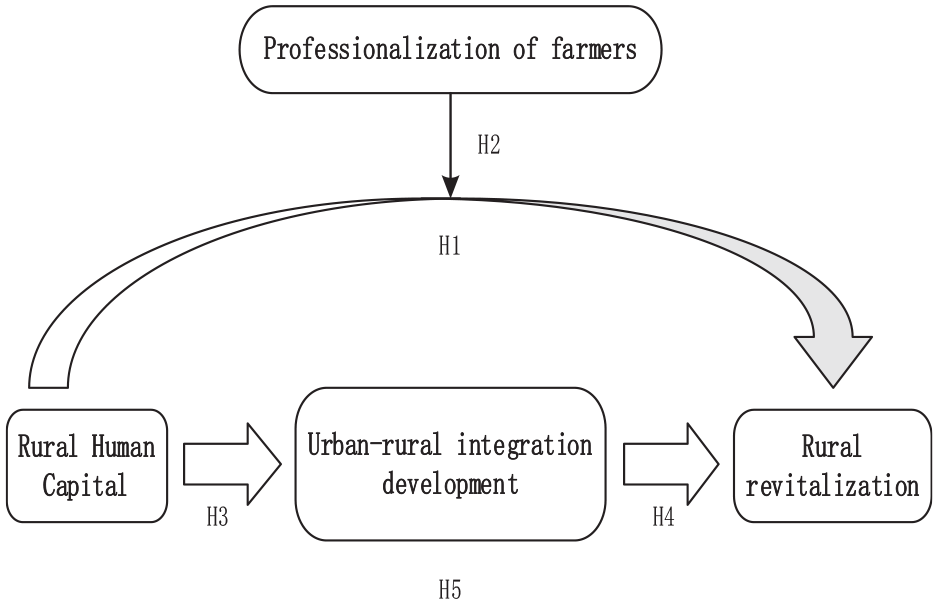
The hypothesized model.
Research Design
Indicator Construction and Variable Description
Core Independent Variable: Rural Human Capital
The most commonly used method to measure rural human capital is the education indicator method, and the main indicators are total years of education, average years of education, illiteracy rate, return to education, etc. In this paper, we refer to Yao et al. (2022) to measure the level of rural human capital by using the average years of education of rural residents. The formula for calculating the average education level of rural residents is as follows:
Average number of years of education of rural residents = (number of illiterate people × 0 + number of elementary school education × 6 + number of middle school education × 9 + number of high school education × 12 + number of college and above education × 16) / total number of people over 6 years old.
Dependent Variable: Rural Revitalization
As an important strategic project to realize Chinese-style modernization, rural revitalization is a realistic need to accelerate the realization of common prosperity in China; it is an inevitable choice to make up for the shortcomings of China’s agricultural and rural modernization; it is a national strategy to narrow the urban-rural gap and realize urban-rural integration in China at present; and it is also a rural development strategy with Chinese characteristics. The “five-in-one” objectives and tasks of “prosperous industry, ecological livability, civilized countryside, effective governance and affluent living” contained in the rural revitalization strategy scientifically answer the issue of achieving agricultural and rural farmer development. The rural revitalization index is a comprehensive evaluation question that includes several indicators. Hence, assessing the status of rural revitalization’s five dimensions is essential. At present, the evaluation system of rural revitalization indicators has been heavily researched and gradually matured. According to the theoretical meaning of rural revitalization and drawing on the research results of Jia et al. (2018) and L. He et al. (2022), this paper selects 15 secondary indicators to build a holistic evaluation index system for the rural revitalization strategy. The detailed evaluation index system is presented in Table 1.
Comprehensive Evaluation Index System of Rural Revitalization Strategy.

Adjustment Variables: Professionalization of Farmers
Professional farmers, whose primary career is farming, must not only have a specific degree of education but also understand how to function on a market and scale. As a result, a thorough evaluation index is also used to measure how professional farmers are in a variety of areas. Drawing on the research results of C. Liu et al. (2020), this paper constructs an evaluation index system of farmers’ professionalization in four aspects: full-time farming degree, agricultural business level, technology application level, and degree of informatization, which are shown in Table 2.
Farmer Professionalism Evaluation Index System.

Intermediate Variables: Urban-Rural Integration Development3
The scholars’ definitions of integrated urban-rural development varied slightly. When constructing this system, some academics choose the fundamental components of urban and rural areas, such as economy, culture, environment, and space, as the first-level indicators; another group of academics sets pertinent indicators based on the idea of urban-rural coordination. This paper comprehensively draws on the studies of Shi (2021), R. Liu et al. (2020) to construct the urban-rural integrated development index system. The system includes 4 primary indicators of economic, social, ecological environment and spatial elements, and 12 secondary indicators. The specific index system is shown in Table 3.
Urban-Rural Integration Development Index System.

Control Variables
The control variables selected based on previous literature are as follows.
Level of Economic Development (lngdp)
GDP represents the level of economic development of a region. The higher the GDP, the higher the level of economic development of the region, which strongly supports the development of the countryside (D. Kong & Chen, 2019).
Rural Population Structure (ps)
An increase in the dependency ratio of the elderly population will accelerate the aging of the rural labor force and weaken rural productive development (L. He et al., 2022).
Degree of Openness to the Outside World (open)
Foreign direct investment is conducive to promoting the circulation of factors and industrial development between urban and rural areas, narrowing the gap between urban and rural areas, improving the economic level of rural areas, thus giving full play to the potential of rural markets and promoting rural revitalization (Yang et al., 2022).
Rural Retail Market Vitality (lncons)
The retail industry is the pioneer and basic industry of a country’s economy, and its development status can reflect the economic growth of rural areas. Total retail sales of consumer goods can reflect the scale and market vitality of the retail market in the region. The higher the total retail sales, the better the retail scale and market vitality of the region, and the more conducive to rural revitalization (Lan et al., 2021).
Research Methods
Entropy Method
Existing studies focus on the application of multilevel analysis process (AHP) method, entropy method and coordinated development index method to examine the comprehensive level of rural revitalization (R. Wang & Wang, 2022). Since there is some variability between the measurement results of each method, choosing a suitable method is the key to correctly evaluate the comprehensive level of rural revitalization and farmers’ professionalization. The entropy method measures index dispersion, calculates weights based on variations, enabling comprehensive evaluation of multiple indicators. However, the AHP method and the coordinated development index method usually demand a substantial cumulative contribution rate, and insufficient sample size can compromise the accuracy of these methods. Compared with the above two methods, the entropy method can eliminate as much as possible the human interference factors arising from the determination of weights, and ensure that the measurement results are more reasonable, scientific and objective, in order to accurately reflect the overall level of the research object. For this reason, this paper calculates the weights of each indicator with the help of entropy value method to obtain the comprehensive level of rural revitalization and farmers’ professionalization in each province from 2011 to 2020.
Principal Component Analysis Method
The main idea of the principal component analysis method is to reduce the dimensionality and linearly combine the indicators with correlation, so that they are transformed into a small number of uncorrelated composite indicators. Its advantage is that it speaks completely with data, which ensures the accuracy and reliability of the analysis results. The specific steps of the principal component analysis method are as follows: first, the initial data standardization; second, calculate the correlation matrix of each index; third, calculate the eigenvalue and contribution rate; fourth, determine the number of principal components according to the variance contribution rate; fifth, calculate the initial factor load matrix; sixth, calculate the principal component load value and conduct analysis and evaluation. To enrich the research, this paper uses stata16.0 software to conduct principal component analysis on the comprehensive level of urban-rural integration of Chinese provinces from 2011 to 2020, from which four principal components are extracted and then measure the comprehensive evaluation index of urban-rural integration according to the cumulative contribution rate 85% criterion.
Setting Up the Measurement Model
Baseline Measurement Model
This paper incorporates the modeling concepts of D. Wang and Ran (2022) and establishes the fundamental model as follows to examine the impact of rural human capital on rural revitalization.

In equation (1): the subscript i represents the region, t represents the year;
Moderating Effect Model
The degree of farmers’ professionalization is a key indicator to measure the efficiency of rural education investment. In this paper, we add the interaction term (

Intermediary Effect Model
Further, the urban-rural integration development index (



In the above equation, equations (3) to (5) are stepwise method mediation test procedures. Among them, equation (3) represents the effect of rural human capital on rural revitalization, equation (4) represents the effect of rural human capital on the level of urban-rural integration development, and equation (5) represents the effect of rural human capital and the level of urban-rural integration development on rural revitalization. The test steps are as follows. First, test whether the regression coefficient
Data Source
The research data in this paper come from the panel data of 31 provinces except Hong Kong, Macao and Taiwan from 2011 to 2020, and the relevant raw data are mainly from the China Statistical Yearbook, China Rural Statistical Yearbook, China Population and Employment Statistical Yearbook, China Environmental Statistical Yearbook, China Social Statistical Yearbook, and the statistical yearbooks of each province in the corresponding years. In this paper, stata16.0 software was used to process and analyze the data, and the linear interpolation method was used to deal with some missing values. Table 4 presents the descriptive statistical analysis for each variable.
Results of Descriptive Statistics of Variables.

Empirical Results and Analysis
Baseline Regression Results
Before conducting the empirical regression of model (1), the appropriate econometric model should be selected first. The results of the baseline tests for fixed effects, random effects, and mixed effects regressions for model (1) are shown in Table 5, where columns 1, 2, and 3 indicate the regression results for mixed effects OLS, fixed effects FE, and random effects RE, respectively. According to the regression results, the regression results of the core explanatory variable rural human capital in all three forms are significant at the 1% statistical level, which indicates that the model test results of this paper are robust for the core explanatory variable rural human capital. Further, the regression coefficients of the core explanatory variables in the fixed-effects model in Table 5 are better than those of the mixed-effects and random-effects models, and the F-value under the fixed-effects model is 45.03, which passes the significance test at the 1% level, so the fixed-effects model is chosen. In conclusion, the fixed-effects model is the one chosen in this study to empirically investigate the relationship between rural human capital and rural rejuvenation. The fixed-effects model’s estimation results show that model (1) has a high goodness-of-fit (R2) value of 0.624, indicating an excellent overall fit.
Baseline Test Results.

, **, and *** are significant at the statistical levels of 10%, 5%, and 1%, respectively.
The estimation outcomes of the stepwise regression are shown in Table 6. Among them, column 1 examines the effect of rural human capital on rural revitalization alone without taking into account control variables. The findings reveal that the regression coefficient of rural human capital is significant at the 1% level of confidence, demonstrating that rural human capital can significantly contribute to rural revitalization and confirming hypothesis 1. Columns (2) to (5) indicate the process of including the control variables in the regression one by one. The stepwise regression results are still significant as seen in Table 6. However, the rural human capital regression coefficient is gradually declining, from 0.923 in model 1 to 0.365 in model 5, which suggests that if the impact of rural human capital on rural revitalization is analyzed separately without taking the control variables into account, it will overstate the magnitude of the effect. So, control variables are extremely significant. And the inclusion of control variables will more accurately estimate the driving effect of rural human capital.
Results of the Impact of Rural Human Capital on Rural Revitalization.

, **, and *** are significant at the statistical levels of 10%, 5%, and 1%, respectively.
Test for Moderating Effects
To verify the moderating role of farmer professionalization in the effect of human capital on rural revitalization, model (2) is regressed and the results are shown in Table 7. In Table 7, Column 1 shows the overall impact of farmer professionalization and rural human capital on rural revitalization, while Column 2 shows the moderating effect on rural revitalization after taking into account their interaction. Columns 1 and 2 are used as comparison points, and Column 2 dominates the analysis of the moderating effect. The results from column 2 show that the coefficient of the moderating variable is significantly positive at the 1% level, indicating that farmer professionalization itself can promote rural revitalization. Additionally, the coefficient of the interaction term between the moderating variable farmer professionalization and rural human capital is 0.111 and significantly positive at the 10% level. It indicates that farmer professionalization has a reinforcing effect on the driving effects of rural human capital on rural revitalization. And the stock of rural human capital is high in areas with high levels of farmer professionalization, which will in turn promote rural revitalization.
The Moderating Role of Farmer Professionalism.
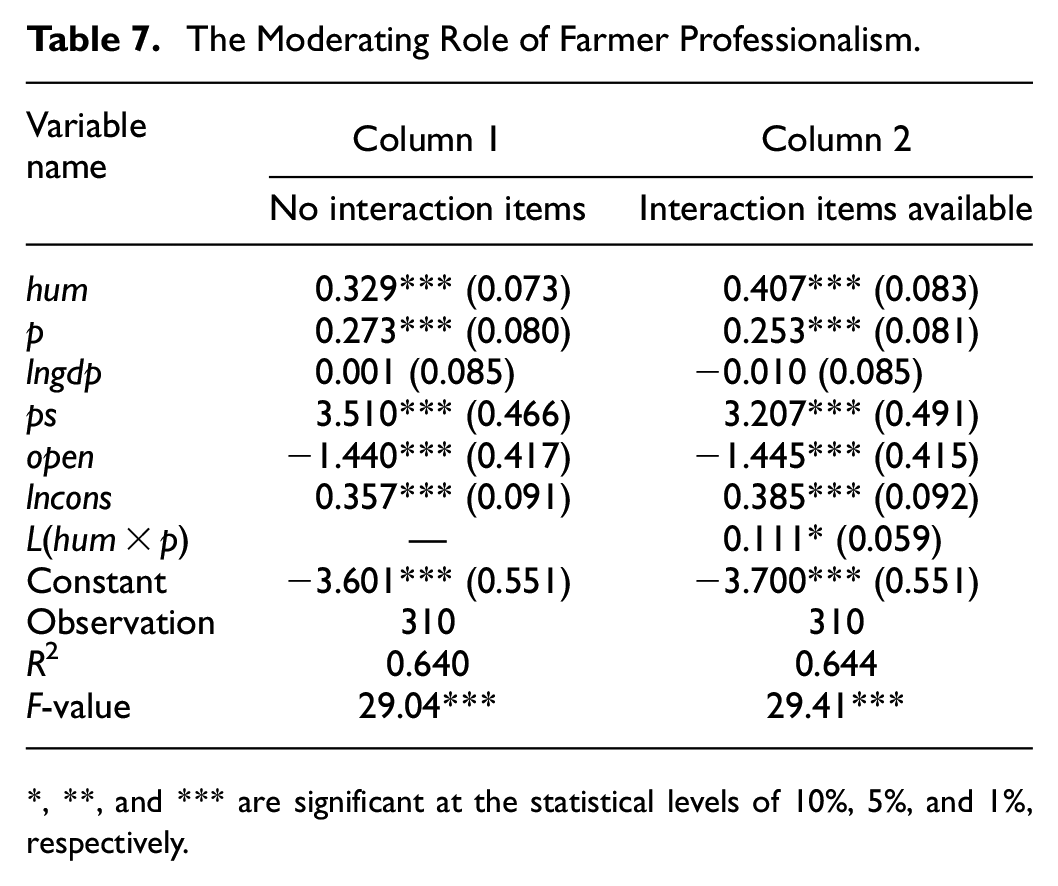
, **, and *** are significant at the statistical levels of 10%, 5%, and 1%, respectively.
Intermediation Effect Test
The estimated outcomes of the mediating impact of model (3), model (4), and model (5) are provided in Table 8 to evaluate whether there is a mediating effect of the degree of rural-urban integration development in the driving path of rural human capital on rural revitalization. Column 1 in Table 8 reports the total effect of rural human capital on rural revitalization, and the coefficient is significantly positive at the 1% level, indicating that the development of rural human capital is conducive to promoting rural revitalization. Column 2 in Table 8 reports the estimated results of rural human capital on the mediating variable urban-rural integration development. The estimated coefficient is positive and significant at the 5% level, indicating that the development of rural human capital can influence urban-rural integration development and test hypothesis 3. Column 3 in Table 8 reports the estimated results after including the mediating variable urban-rural integration development. It can be seen that the coefficient of the effect of rural human capital on rural revitalization is still at the 1% level significantly positive, and the mediating effect of urban-rural integration development is also significantly positive at the 5% level, and hypothesis 4 is verified. Additionally, the coefficient of the effect of rural human capital on rural revitalization is 0.343 and significant at the 1% level as shown by the results of the mediating effect in column (3), which also indicates that urban-rural integration development has a partial mediating effect in the effect of rural human capital on rural revitalization. In other words, the promotion effect of rural human capital on rural revitalization is partially realized through urban-rural integration development, and hypothesis 5 is partially valid.
The Intermediary Effect of Urban-Rural Integration Development.

, **, and *** are significant at the statistical levels of 10%, 5%, and 1%, respectively.
Robustness Tests
Replacement Variable Method
To re-measure the rural revitalization index, the entropy method is used to measure the explanatory variable rural revitalization index in the baseline regression. In order to test the robustness of the model, the measurement method of the rural revitalization index was changed and the rural revitalization index was re-measured using principal component analysis. The new rural revitalization index is used to participate in the regression of panel data, and the results are shown in column 1 of Table 9. The findings in column 1 demonstrate the robustness of the empirical findings of the benchmark test by demonstrating the regression coefficients of rural human capital after modifying the measuring method are still significant.
Robustness Tests.

, **, and *** are significant at the statistical levels of 10%, 5%, and 1%, respectively.
Shortened Time Window
The data from 2017 to 2020 were chosen to participate in the regression because the original data comprised a total of 10 years of panel data from 2011 to 2020. This was done to examine whether time and other policies had an impact on the model and to decrease the sample period. 2017 was the year when the 19th Party Congress proposed the rural revitalization strategy. And keeping the sample after 2017 made it easier to situate the study of this paper in the context of the rural revitalization strategy and exclude the interference of other policies. The regression results are shown in column 2 of Table 9.
Endogeneity Test
This paper incorporates the lagged period of rural revitalization into the benchmark model and reruns the regression using the systematic GMM estimation method in order to address the endogeneity issue brought on by the potential inertia and persistence of the development of rural revitalization. The regression results are displayed in column 3 of Table 9. The results in column 3 show that the key explanatory variable for rural human capital has a regression coefficient with positive significance at the 10% level, which shows that the results of the baseline regression are reliable. In addition, the p-values of the Sargan test and the autoregressive (AR) test are presented in column 3 in order to examine the validity of the instrumental variables included in the model and the existence of serial correlation problems. The results show that the p-values of both the Sargan test and the autoregressive (AR) test are greater than 0.05, which indicates that the instrumental variables employed in the model are valid and there is no serial correlation, further validating that the test results of this paper are robust.
Discussion and Implication
This study is developed based on the conceptual framework of human capital theory and rural-urban relations theory to examine the human capital pathways driving rural revitalization in China. In general, the study findings reveal the usefulness of the proposed conceptual framework in promoting rural revitalization in China. It is shown that cultivating farmers into professional farmers through more investment in education can help raise the level of rural human capital from within the countryside. And it reveals that integrated urban-rural development is the only realistic path to achieve rural revitalization.
Our empirical results point to a more significant direct effect of rural human capital on rural revitalization without the interference of other factors, a finding that has certainly been emphasized in many studies (Borojo & Yushi 2015). However, by reading the literature, we found that most of the literature studied the role of human capital on rural revitalization as a mediating variable or moderating variable. Lan et al. (2021) point out that rural human capital is the articulation pathway between precise poverty alleviation and rural revitalization, and precise poverty alleviation provides intellectual support for rural revitalization through enhancing the accumulation of human capital. L. He et al. (2022) believe that strengthening human capital accumulation holds immense importance for the digital economy empowering rural revitalization. However, this paper asserts that human capital serves as the primary driver of rural economic growth, emphasizing the significance of investigating the direct impact of human capital on rural revitalization for the advancement of rural development in China. The government should continue to adopt targeted policies to vigorously cultivate high-quality rural talents and continuously enhance the overall caliber of rural human capital and optimize its internal structure. In addition, some control variables are added to verify which factors interfere in the process of the impact of rural human capital on rural revitalization. The empirical findings indicate that the coefficients of economic development level (lngdp), rural population structure (ps) and rural retail market vitality (lncons) are all positive, indicating that the convergence effects of promoting economic growth, improving rural population structure and stimulating rural retail market vitality on rural revitalization are more obvious. However, the coefficient of the degree of foreign openness (open) is negative, and this finding aligns with the study of Yang et al. (2022). One possible explanation for this is that foreign direct investment tends to be more biased toward urban industrial areas, and although in favor of activating urban and rural factor resources and facilitating the integration of urban and rural areas, its effect on rural revitalization is minimal.
In the empirical test of the moderating effect, we find that farmer professionalization not only has a convergent effect on rural revitalization by itself, but also the coefficient on rural revitalization remains significantly positive after interacting it with rural human capital, indicating that farmer professionalization has a reinforcing effect in the influence effect of rural human capital on rural revitalization. Our findings are consistent with the results of Yin (2022) who concluded that cultivating new professional farmers and “professionalizing” farmers is a realistic path to develop green agriculture and promote rural revitalization. Moreover, our findings suggest that farmer professionalization is a moderating mechanism in human capital and rural revitalization. As X. Wang (2020) pointed out in his recent research work, increasing the investment in farmers’ vocational education can effectively drive rural human capital output and provide human support for rural development. The comprehensive quality of farmers is linked to the process and effectiveness of rural revitalization development, and it is crucial to enhance the development of new categories of professional farmers and realize the “professionalization” of farmers.
The integration of people and their own conceptions and values is fundamental during the course of urban-rural integration and development. Exploring the realization mechanism of human resources mobility among urban and rural regions requires reflecting on the function of integrating urban and rural areas (H. Li & Jiao, 2021). The results of our study point out that urban-rural integration and rural revitalization are positively linked, with human capital enhancing the quality of urban-rural development for common progress. Our study reinforces the study of Y. Liu et al. (2016) scholars’ view that urban-rural integration and rural revitalization strategy complement each other, and that an integrated system of rural regional development should be built according to the requirements of industrial prosperity, environmental sustainability and livability, cultured rural ambiance, effective governance and prosperous living conditions to promote urban-rural integration and advance the realization of a new type of village and township with people as the core. In addition, as Shuang and Latanqimuge (2021) said, talent resources are a significant catalyst to promote rural development, and only with talent in rural areas can there be scientific and reasonable rural development planning and plans to promote integrated urban-rural development.
The findings of our study have many theoretical and practical implications. From a theoretical standpoint, on the one hand, the findings demonstrate the usefulness of rural human capital, especially rural human capital invested through the development of farmers’ vocational education, in rural economic development. The findings further confirm the core view of human capital theory, namely the importance of educational investment in human capital. In addition, although the function of rural human capital in contributing to rural revitalization has been more widely applied, previous research has overlooked the significance of vocational education for farmers. Therefore, the findings of this paper enrich the human capital theory. On the other hand, through theoretical analysis and empirical research, we discovered the influential process of rural human capital on rural revitalization is partly facilitated by the degree of urban-rural integration, and rural human capital can influence rural revitalization through the path of urban-rural integration and development. This not only broadens the mediating mechanism of rural-urban integration, but also enhances the theoretical contribution to rural human capital and rural revitalization.
Apart from theoretical significance, the research conclusion of this paper also has quite rich practical significance, here are the following two enlightenments:
On the one hand, the research findings reveal that managers should increase education and policy support for rural human capital to build a reserve talent pool for rural development. By optimizing the allocation and reasonable flow of talent resources, they can achieve matching the right individuals with the right positions and ensuring the right positions for the right individuals, and improve the structure of rural talents. Specifically, first, strengthen the education and training for the main body of farmers who stay in villages to improve their identity as new professional farmers. Farmers significantly contribute to the development and governance of villages, and vocational education and training for farmers can enhance farmers’ confidence in agricultural production and management and their sense of identity as new professional farmers. Therefore, the government should increase the education and training of villages and the training of farmers’ agricultural-related professional skills to improve the level of farmers’ human capital and better serve the development of villages. The government should pay attention to the basic agriculture-related education and vocational skills education for young adults who stay in villages in each region, because young adults are an important force for the prosperous development of rural revitalization, and they are the most likely group of people to become the “who will plant the land.” Secondly, the government’s policy is to attract migrant laborers to go back to their native villages. The rapid development of urbanization in China has made the main labor force in rural areas “settle” in cities, which hinders the sustainable development of rural areas. Therefore, to ensure the return of migrant workers to their hometowns, it is crucial to fully leverage the government’s role in policy support and financial backing. The government should not only improve the incentive and support policies including talents, land and subsidies, but also offer policy assurances and financial assistance to support the development of people returning to their hometowns. It should also provide preferential policies for enterprises to invest in their hometowns, strengthen financial and credit support, open up green channels for credit, and provide employment opportunities for people returning to their hometowns.
On the other hand, the research findings also enlighten managers to focus on the role played by industrial and talent resources in urban-rural integration and promote urban-rural integrated development to help rural revitalization. Urban-rural integration development is the only realistic path to realize rural revitalization, and the realization of urban-rural integration development should concentrate on the optimal allocation of industrial and talent resources between urban and rural areas. Specifically, firstly, the synergy between urban and rural areas should be led by industrial integration. It is essential to fully leverage the resource advantages of the countryside, build the countryside characteristic base, cultivate the countryside pillar industries, facilitate the industrialization of agriculture, and promote the development of agricultural industrialization to provide the impetus for promoting the integrated development of urban and rural areas. We should also pay attention to the status of digital construction in the integrated development of urban and rural industries, accelerate the improvement of rural digital network system, build digital villages, maximize the role of the digital economy in the development of rural industries, and create favorable conditions for the integrated progress of urban and rural industries in China, so as to better realize the rural revitalization strategy. Secondly, the integrated progress of urban and rural areas should focus on the integration of talents. It is not only necessary to create a public platform for urban-rural employment and entrepreneurship, but also to encourage the agricultural population to be employed near the county cities, so as to reduce the employment cost and make both work and farming work go on. We should also actively guide urban talents to return to their hometowns, encourage all kinds of talents who love rural industries and public services to return to their hometowns, provide them with housing and living security, and nurture talent advantages to facilitate the development of rural industries and public services.
Conclusion
China has currently completed the construction of a well-off society and made significant advancements in the strategy of rural rejuvenation. In order to achieve the long-term and stable development of rural areas, the government must now prioritize the execution of a rural revitalization strategy in order to consolidate the successes of poverty eradication and prevent the emergence of poverty eradication and return to poverty. In this context, the panel dataset covering 31 Chinese provinces from 2011 to 2020 were picked as the research samples in this paper. Drawing upon the conceptual framework of human capital theory and urban-rural relationship theory, the entropy value method is utilized to measure the rural revitalization index as well as the PCA method to calculate the index for urban-rural integration development. Then, a panel data fixed-effects model was utilized to empirically test the impact of rural human capital on rural revitalization and the mediating mechanism of urban-rural integration development. A series of robustness analyses were also conducted. From the study, the concludes with the following findings. Firstly, rural human capital significantly contributes to rural revitalization, and enhancing the degree of rural human capital helps to enhance the sustainable development competence and competitiveness of rural areas, and this finding remains valid following robustness tests such as the systematic GMM estimation method are used. Secondly, vocational education and training for farmers is the key to rural human capital accumulation, and raising the level of farmers’ professionalization contributes to the level of rural human capital. Finally, through theoretical discussion and empirical test, it is found that urban-rural convergence development can develop synergistically with rural revitalization, and is a better way to narrow the divide between rural human capital and rural revitalization. Rural human capital reshapes urban-rural dynamics, accelerating and enhancing integration for rural revitalization.
Limitations and Future Research
Despite the innovation of this study, there are still some limitations and room for expansion. The first is that the research sample of this paper only involves panel data from 2011 to 2020, which is a small sample size, which will lead to biased empirical results to some extent. Future scholars can expand the time range to increase the sample size to ensure the precision of the research findings. Furthermore, due to the availability of data, there is room for further improvement of the content of the indicator system of rural revitalization. In the future, scholars can enrich the content of the indicator framework of rural revitalization from the perspectives of agricultural modernization and farmers’ satisfaction. Secondly, the evaluation object of this study on rural revitalization is at the provincial level, which has a wide scope and varies greatly from province to province. Future studies can adopt more data at the county and village levels to narrow the scope of the study. Finally, the heterogeneity of rural human capital has obvious spatial effects, and future studies can further explore whether it has spatial spillover effects on rural revitalization.
Footnotes
Acknowledgements
The authors would like to thank Dr. Miao Bin for his help in preparing the original draft of this paper.
Declaration of Conflicting Interests
The author(s) declared no potential conflicts of interest with respect to the research, authorship, and/or publication of this article.
Funding
The author(s) disclosed receipt of the following financial support for the research, authorship, and/or publication of this article: This work was supported by the Henan Provincial Science and Technology Public Relations Project in 2021, “Research on the transformation path of social industry medical institutions based on the virtual pension of the Internet of things” (202102310212).
Ethical Approval for Animal and Human Studies
Not applicable.
Research Interests
Human Resource Management, Enterprise Risk Assessment
Human Resource Management, Rural Human Capital

Data Availability Statement
The data supporting the findings of this study are available upon request from the corresponding author.