



Abstract
In the context of ongoing digitalization, smart tourism (ST) is playing an increasingly prominent role in promoting the sustainable development of tourism enterprises. While prior research has largely emphasized macro-level strategies or technological deployment, there remains a lack of micro-level empirical analysis. Drawing upon panel data of Chinese A-share listed tourism firms from 2014 to 2023, this study constructs a firm-specific ST index using a novel text-mining approach that identifies the frequency of ST-related terms in corporate annual reports. Sustainable growth rate (SGR) serves as a metric for assessing long-term growth capability from a financial viewpoint, and is used to explore the linkage between ST and corporate growth performance. The empirical results show that ST is positively associated with SGR (β = .032, p < .01), and that the interaction terms ST × media attention (MA) and ST × financial slack (Slack) are also significantly positive (β = .012 and .023, respectively). These findings indicate that greater ST engagement leads to improved sustainable growth, particularly under conditions of high MA or abundant Slack. The analysis is based on a relatively small sample of A-share listed tourism firms, which constrains the generalisability of the results but allows for a focused examination of this sector. This paper deepens the micro-level perspective on ST, refines the understanding of contextual moderating effects, and offers theoretical and applied value for enterprises undergoing smart transformation in pursuit of sustainable advancement.
Plain Language Summary
This study looks at how using smart technologies helps travel and tourism companies grow in a stable and sustainable way. “Smart tourism” here means using tools such as big data, artificial intelligence, cloud platforms, and digital service systems to improve daily operations and customer experience. We focus on 13 tourism companies listed on the Chinese A-share stock market between 2014 and 2023. Instead of using surveys, we read the companies’ annual reports and counted how often smart technology–related terms appeared. This gives us a simple picture of how actively each company talks about and applies smart tourism in its business. We then compare this information with a financial measure of long-term growth capacity. This measure captures whether a company can keep growing using mainly its own profits, without relying too much on extra borrowing. Our results show three key points. Companies that pay more attention to smart tourism tend to have stronger and more stable long-term growth. When these companies receive more coverage from news and financial media, the positive impact of smart tourism on growth becomes stronger. Companies with more spare financial resources can invest in smart tools more steadily, and therefore benefit more from smart tourism. Overall, the study suggests that digital and smart technologies are not just “nice to have” for tourism firms. When combined with public visibility and healthy finances, they can become an important driver of long-term, sustainable growth.
Introduction
With the continuous evolution of digital technologies, the tourism industry is accelerating its transition toward smart transformation (Q. Liu et al., 2024). ST represents the integration of emerging digital technologies within tourism enterprises and is reshaping service models and operational logic. It has become a crucial pathway for enhancing organizational efficiency, optimizing resource allocation, and strengthening sustainable capabilities. Especially in the context of post-pandemic uncertainty in the industry’s recovery, tourism enterprises urgently need to leverage smart approaches to enhance their resilience to external risks and achieve long-term stable growth (Huang et al., 2025). This reality has brought the question—Can ST facilitate corporate sustainable development?—to the forefront of both academic and industry discussions.
Current literature primarily focuses on the macro level, such as the relationship between ST and urban governance, public services, or government-led strategies, while paying limited attention to firm-level ST practices and their specific impact on financial performance or sustainable development (Ivars-Baidal et al., 2023; Lee et al., 2020). Moreover, existing studies often rely on questionnaire surveys or case analyses, which face limitations in sample representativeness and subjective measurement standards. As a result, the internal relationship between firms’ ST adoption and financial performance has not yet been systematically and rigorously tested (Grossi et al., 2020; Tavitiyaman et al., 2021).
To summarize, existing research suffers from three main limitations. First, most studies remain at the destination or regional level and rarely adopt firm-level designs to link ST practices with financial outcomes such as sustainable growth. Second, there is no widely accepted, replicable indicator to capture the intensity of ST adoption at the enterprise level, which weakens the empirical foundation for micro-level analysis. Third, the contextual conditions under which ST contributes to long-term growth—especially the roles of the external information environment and internal resource slack—have not been systematically modeled.
To fill these research gaps, this study selects tourism-related companies listed on the Chinese A-share market between 2014 and 2023 as the research sample. It innovatively constructs a firm-level ST indicator by extracting keyword frequencies related to ST from annual report texts. The SGR is employed as the core measure of long-term development capacity. Furthermore, two moderating variables—MA and Slack—are introduced to build a dual-path moderating framework from the perspectives of external information environment and internal resource flexibility, aiming to systematically examine how and under what conditions ST affects firms’ sustainable growth capabilities.
This study contributes to the literature in three ways. First, it shifts the focus of ST research from destinations and policy programs to the firm level by examining how ST engagement relates to the SGR of listed tourism enterprises. In doing so, it links the ST literature with core debates on long-term financial sustainability. Second, it develops a firm-level ST index based on annual report text mining, extending recent work that uses narrative disclosures to measure digital transformation and sustainability strategies. This provides a scalable measurement approach that can be adapted to other industries and contexts. Third, it proposes and tests a dual-moderator framework in which MA and Slack jointly condition the ST–SGR relationship, thus integrating insights from information economics and resource-based theory into the study of ST. We focus on A-share listed tourism firms in China for two main reasons. First, they represent the most visible and resource-intensive segment of the tourism industry, where ST initiatives are often piloted and disclosed in detail to capital market participants. Second, the high level of mandatory disclosure in this market provides rich textual and financial information that allows us to construct firm-level measures of ST engagement and sustainable growth in a consistent way.
The remainder of this paper is organized as follows. The Literature Review and Research Hypotheses section reviews the relevant literature and develops the research hypotheses. The Research Design section describes the data, variable construction, and empirical models. The Empirical Analysis Results section presents the main regression and robustness results. The Conclusion and Recommendations section discusses the findings, offers managerial implications, and outlines limitations and directions for future research.
Literature Review and Research Hypotheses
Review of Literature on ST
With the rapid advancement of digital technologies, ST has increasingly become a vital tool for improving the management efficiency and service quality of tourism enterprises. Early research mainly focused on the technological components and platform construction of ST, such as the application efficiency of the Internet of Things, cloud computing, and artificial intelligence in scenic spot operations (Rosário & Dias, 2024; W. Wang et al., 2020). Some scholars emphasized that ST can optimize tourist experiences and service processes, thereby improving the allocation efficiency of tourism resources (Chuang, 2023; Mehraliyev et al., 2019). Overall, the research on ST has gradually extended from a macro policy perspective to more micro-level domains, including urban development, scenic area governance, and user behavior (Cavalheiro et al., 2019).
In recent years, a growing body of international research has further linked ST to sustainability outcomes and destination competitiveness, highlighting how data-driven platforms, sensor networks, and AI-based services can support more resilient and inclusive tourism development. Recent studies have examined ST in relation to sustainable urban tourism, smart destinations, and digital business ecosystems in tourism (Aliyah et al., 2023; Ionescu & Sârbu, 2024).
At the firm level, existing studies have suggested that ST facilitates enterprises in upgrading information systems, reconstructing service processes, and building digital capabilities, thereby strengthening their competitive advantage (Pencarelli, 2019). However, most of the literature remains focused on case descriptions or conceptual models, lacking quantitative analysis of the impact of ST on corporate financial performance or long-term development capacity (Pai et al., 2025). In particular, there is no unified standard for constructing measurement systems to assess the extent of ST practices at the firm level, resulting in a weak empirical foundation for micro-level research.
In addition, as a hybrid practice integrating technology and management, ST is influenced by both internal resource endowments and external environmental factors. Current research on its underlying mechanisms is fragmented, lacking systematic modeling frameworks and empirical tests of moderating effects. Therefore, it is urgently necessary to construct quantifiable indicators of ST based on firm-level data and to explore its impact mechanisms on corporate sustainable development.
Review of Literature on Sustainable Growth
Sustainable Growth refers to a firm’s ability to achieve stable and continuous development without relying on additional external financing (Brychko et al., 2022). This indicator integrates both profitability and resource retention capacity and has been widely used to assess the long-term development potential of firms. In recent years, as the concept of sustainable development has gained increasing attention, the SGR has emerged as an important financial metric for evaluating a firm’s sustainability, attracting interdisciplinary interest from finance, accounting, and strategic management scholars (Vuković et al., 2022).
Existing studies mainly explain the mechanisms influencing corporate sustainable growth from two perspectives: internal management factors and external environmental factors. Internally, financial soundness, R&D investment, governance structure, and digital capability have been shown to significantly affect a firm’s growth boundary and resource allocation efficiency (Li & Li, 2025; Z. Wang et al., 2023). Externally, market competition intensity, policy support, and media oversight also serve as important constraints on sustainable growth (Álvarez Jaramillo et al., 2018; Jie & Jiahui, 2023).
Although prior research has provided a relatively comprehensive theoretical foundation for understanding sustainable growth, there remains a gap in exploring its relationship with ST. This is particularly relevant in the tourism industry, where firms heavily rely on scenario-based services and customer experience, making technology-driven transformation critical for long-term growth. Therefore, integrating ST with corporate sustainable growth analysis holds promise for offering new theoretical insights and practical approaches to advancing digitalization and green transformation in the tourism sector.
The Moderating Role of MA and Slack
In the process through which ST promotes corporate development, both external environments and internal resource conditions can significantly influence its effectiveness. MA, as a key component of the external informational environment, plays a critical moderating role in shaping strategic outcomes. From the perspective of signaling theory, ST-related disclosures in annual reports can be viewed as signals through which firms communicate their technological commitment and future-oriented strategies to outside stakeholders. Media coverage affects how these signals are transmitted and interpreted: extensive and mainly positive reporting can amplify the visibility and credibility of ST investment, shape investor perceptions, and influence corporate reputation (Kim et al., 2021). In the tourism industry, where public image is especially vital, high MA increases the likelihood that ST initiatives will be recognized and rewarded by the market, thereby translating technological efforts into performance gains and sustainable development advantages.
At the same time, a firm’s internal resource deployment capability is another determinant of how effectively ST initiatives are implemented. Slack refers to the set of discretionary resources that an organization can utilize without impairing its standard operations (J. Liang et al., 2023). Drawing upon the Resource-Based View (RBV), such slack constitutes a strategic asset that enables firms to absorb shocks, experiment with new technologies, and sustain long-term projects that may not generate immediate payoffs (Shibin et al., 2017). In the ST context, firms often require substantial inputs in infrastructure, skilled personnel, and data systems. Insufficient financial buffers may expose firms to risks of strategic disruption or delayed implementation. Thus, maintaining adequate Slack can alleviate resource limitations during digital transition and enhance the contribution of ST to sustainable growth.
In conclusion, MA and Slack jointly shape the strategic effectiveness of ST from two complementary dimensions: MA captures external information signals around ST investment, whereas Slack reflects internal resource reserves that support its execution. Considering these variables together allows us to build a dual moderating framework that explains under what external and internal conditions ST can successfully facilitate sustainable corporate development.
Literature Review and Research Hypotheses
With the acceleration of digital transformation, ST has gradually become a critical strategic tool for tourism enterprises to respond to market competition and drive transformation and upgrading. Existing literature has mainly focused on the technological paths, governance mechanisms, and user perceptions of ST, with most studies conducted from macro-level policy or regional performance perspectives. However, there is a lack of empirical research at the firm level that quantitatively examines the relationship between ST practices and business performance (M. Wang & Wang, 2023). In particular, the role of ST in achieving the core financial goal of sustainable growth remains underexplored, and the conditional mechanisms underlying this relationship have not been systematically analyzed. Building on the above theoretical arguments, we develop a set of hypotheses linking ST to sustainable growth (H1) and specifying how MA and Slack moderate this relationship (H2 and H3).
In terms of variable construction, mainstream research tends to rely on questionnaire surveys or regional-level input indicators, lacking replicable and quantifiable micro-level data. This study innovatively constructs a firm-level ST index by extracting the frequency of ST–related keywords from corporate annual reports, thereby enhancing the objectivity and operability of the analysis. Regarding moderating mechanisms, few existing studies have simultaneously considered both external informational environments and internal resource slack. This study incorporates MA and Slack as two moderating variables, representing external information accessibility and internal resource allocation capabilities, respectively. These variables help fill the gap in the literature regarding conditional pathways in the impact of ST on firm performance.
Based on the above analysis, this study proposes the following hypotheses:
This study develops an analytical framework in which ST serves as the core explanatory variable, SGR as the dependent variable, and MA and Slack as moderating variables. The aim is to deepen the theoretical understanding of the financial implications of ST and to provide data-driven support and managerial insights for tourism enterprises in optimizing their digital strategies. Figure 1 illustrates the conceptual model of this study. Building on these hypotheses, the next section describes the data, variable construction, and empirical models used to test the proposed relationships. Within this conceptual framework, we empirically test the proposed relationships using Chinese A-share listed tourism firms as a representative context.

Research model.
Research Design
Sample and Data Sources
This study selects tourism-related enterprises listed on the main board of the A-share market in China from 2014 to 2023 as the research sample. Based on the 2021 revised industry classification standard by Shenwan Hongyuan Securities, the sample includes various sub-sectors such as scenic spot operations, tourism accommodations, travel agencies, tourism retail and duty-free businesses, and integrated cultural tourism groups. This selection comprehensively reflects the core composition of China’s tourism industry.
China provides a suitable empirical setting because its tourism industry has undergone rapid digitalization and has been a key target of ST-related policy support over the past decade. The sample period 2014 to 2023 is determined by data availability: 2014 marks the first year in which annual reports for all sampled firms are consistently available in digital format for text analysis, while 2023 is the most recent year for which complete financial and media data are accessible at the time of data collection. We do not include 2024 because several firms’ 2024 annual reports and corresponding media coverage had not yet been fully disclosed when the dataset was constructed. Importantly, this window spans both the outbreak and recovery phases of the COVID-19 pandemic. The year fixed effects in our models absorb common shocks associated with the pandemic, so the estimates reflect how ST engagement relates to SGR across pre-, during-, and post-pandemic periods rather than in a single crisis year.
For variable construction, the ST index is derived through text mining of corporate annual reports using Python programming. Specifically, it counts the frequency of keywords related to smart technologies—such as “artificial intelligence,”“big data,”“blockchain,” and “cloud computing”—to quantify the level of ST technology adoption at the firm level. Data on MA are obtained from the China Research Data Services (CNRDS) platform, which records the annual number of mentions of each firm in mainstream media (including print and online platforms). The natural logarithm of this count is used to reduce the impact of skewed distribution. All other financial and corporate governance variables are sourced from the CSMAR (China Stock Market and Accounting Research) database.
To enhance the validity of the sample and the robustness of the results, the following data preprocessing steps are conducted: (a) firms under special treatment are excluded to control for financial anomalies that may bias estimates; (b) observations with missing values in key variables are removed; (c) continuous variables are winsorized at the 1st and 99th percentiles to mitigate the influence of outliers on regression results; and (d) skewed variables are log-transformed to improve distributional properties and address heteroscedasticity issues.
After filtering and cleaning, the final sample consists of 130 firm-year observations, reflecting both the limited number of tourism-related firms listed on the Chinese A-share market and the exclusion of some firms due to missing or abnormal data.
Variable Definitions and Descriptions
To systematically examine the impact of ST on the SGR of tourism enterprises, and to explore how this relationship varies under different organizational resources and external environmental conditions, this study constructs a multidimensional variable system consisting of dependent, independent, moderating, and control variables. The definitions and measurement methods for each key variable are as follows:
Dependent Variable: SGR
To evaluate a firm’s long-term growth potential, this study uses the SGR as the dependent variable (Wu et al., 2022). SGR reflects a firm’s ability to expand based on internal profitability and retained earnings without changing its capital structure. It is widely used in assessing corporate growth and financial health. The calculation formula is:

where ROE denotes the return on equity and b represents the earnings retention ratio. This financial indicator has high comparability and accurately captures a firm’s endogenous growth capacity.
Compared with short-term profitability ratios such as ROA or ROE, SGR places explicit emphasis on internally financed growth under a stable capital structure, which makes it particularly suitable for capturing long-term sustainable development in a capital-intensive industry such as tourism.
Independent Variable: ST
To capture firms’ engagement with ST in a scalable and objective manner, this study constructs an ST index based on text mining of annual reports. Specifically, Python programming is used to analyze annual reports and extract the frequency of keywords highly related to ST, such as “artificial intelligence,”“big data,”“blockchain,” and “cloud computing.” To account for the distribution’s dispersion, the total frequency count is log-transformed:

This text-based indicator captures how prominently ST-related technologies and practices are embedded in firms’ strategic communication. Similar keyword-frequency measures have been widely used to proxy firms’ digital transformation or sustainability orientation in recent empirical studies based on annual report text mining (Alduais, 2022; Y. Liu et al., 2024). This indicator provides a dynamic measure of a firm’s strategic attention and technological engagement in ST, without relying on survey-based methods. To validate the accuracy of the text-mining procedure, we also manually reviewed a subset of annual reports and confirmed that firms with higher ST scores typically provide richer descriptions of digital infrastructure, online service platforms, and data-driven tourism products, which supports the face validity of the text-based index.
Moderating Variables
MA: This variable reflects the extent of a firm’s exposure in the external information environment. It is measured by the total number of mentions in major financial newspapers and online media during a given year, and then log-transformed:

MA can shape market perceptions and investor behavior, potentially enhancing the visibility and effectiveness of a firm’s strategic actions.
Slack: This variable captures the firm’s available resource flexibility, representing its strategic adaptability and risk resilience. It is measured by the ratio of the difference between current assets and current liabilities to total assets:

Higher Slack indicates greater resource availability, which may enhance the effectiveness of ST initiatives.
Control Variables
To control for potential confounding factors affecting the dependent variable, the following control variables are introduced (Zhu & Jin, 2023): Firm Size (SIZE), Leverage (LEV), Growth (GRO), Firm Age (AGE), Ownership Concentration (TOP1), State Ownership (SOE).
A summary of the variables and their measurement methods is presented in Table 1.
Variable Definitions.

Model Specification
To systematically examine the impact of ST on the sustainable growth capacity of tourism enterprises, and to investigate whether this relationship is moderated by different organizational resources and external environmental conditions, this study establishes the following regression framework. All models are estimated using Ordinary Least Squares (OLS), incorporating year fixed effects to control for systematic disturbances caused by macro-environmental changes across years.
Baseline Regression Model
First, to identify the direct impact of ST on firms’ SGR, the following baseline model is constructed:

In this model, SGR
it
represents the SGR of firm i in year t, ST
it
denotes the level of ST,
Moderation Effect Model
To further explore the moderating roles of external information environment (MA) and internal resource base (Slack) in the above relationship, the study introduces interaction terms to construct the moderation effect model:
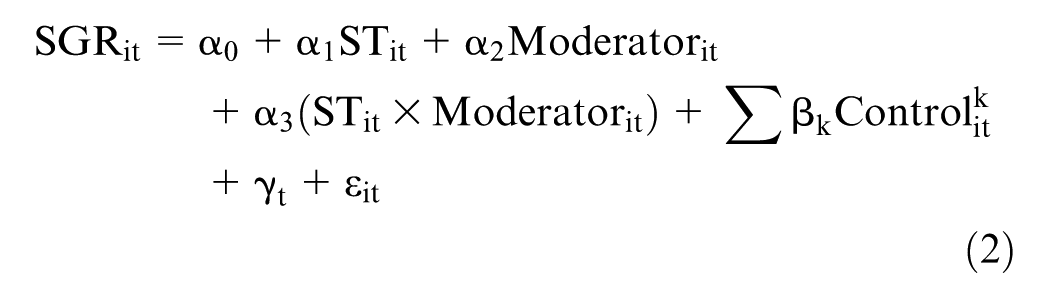
In this model, Moderator it again refers to MA and Slack; the interaction term ST it × Moderator it captures the direction and strength of the moderating effect. The parameter α3 remains the key to testing the significance of the moderation effect; if significant and directionally appropriate, it confirms that the moderating variables influence the relationship between ST and sustainable growth.
To ensure the reliability of the estimation results, all continuous variables are standardized, including winsorization at the 1% level to reduce outlier effects, and logarithmic transformation of some variables to reduce heteroskedasticity. In the robustness check, the study also incorporates firm fixed effects as a complementary estimation approach to further validate the robustness of the core findings.
Empirical Analysis Results
Descriptive Statistical Analysis
To comprehensively understand the basic characteristics of the sample variables, this study conducts descriptive statistical analysis on the main research variables. The results are presented in Table 2.
Descriptive Statistics of Variables.

Regarding the dependent variable, the average value of the SGR is 0.0403, with a standard deviation of 0.0789, a minimum of −0.222, and a maximum of 0.288. This indicates considerable variation among the sample firms in terms of internal accumulation capacity and growth potential, and suggests that some firms may face the risk of insufficient sustainable growth.
The independent variable, ST level, has a mean of 1.466, with a maximum value close to 3 and a minimum of 0. This suggests that while some firms frequently mention ST-related technologies in their annual reports and demonstrate a strong tendency toward digital transformation, others are still in the early exploratory stage of smart development, with limited technological integration.
In terms of moderating variables, MA has an average of 5.570 and a standard deviation of 1.208, indicating substantial variation in public exposure across firms. Slack has an average of 0.192, a maximum of 1.805, and a minimum of −4.626, suggesting a wide distribution. This reflects the presence of firms with strong financial buffers as well as others experiencing tight resources and liquidity constraints.
For the control variables, the average value of firm size (SIZE), measured as the natural logarithm of total assets at year-end, is 22.17, indicating that most sample firms possess a relatively large asset scale. The average debt ratio (LEV) is 35.4%, reflecting a relatively stable financial condition. The growth rate of operating revenue (GRO) shows significant fluctuation, highlighting pronounced differences in growth performance across firms. The average firm age (AGE), in logarithmic form, is approximately 3, corresponding to an actual average establishment time of around 20 years. The average ownership concentration (TOP1) is 35.57%, suggesting a generally concentrated ownership structure, with some firms having a majority shareholder owning more than 50% of the shares. In addition, the proportion of state-owned enterprises (SOE) is 77.7%, which aligns with the characteristic prominence of state ownership in the tourism industry.
Overall, the sample data are reasonably distributed, and the variables exhibit significant differences and representativeness, providing a solid foundation for the subsequent regression analysis and mechanism testing.
Correlation and Multicollinearity Test
To preliminarily examine the linear relationships between variables, this study conducts a Pearson correlation analysis. The results are presented in Table 3.
Pearson Correlation Matrix of Variables.

Note.“*”, “**”, and “***” denote significance levels at 10%, 5%, and 1%, respectively.
The results show that ST level is significantly and positively correlated with SGR(r = .250, p < .01), indicating that tourism firms with higher levels of smart development tend to have stronger endogenous growth capabilities. Both moderating variables are also positively correlated with SGR. Among them, Slack exhibits the highest correlation coefficient (r = .519, p < .01), suggesting that firms with greater resource slack are more likely to achieve stable growth. MA is also significantly and positively correlated with SGR (r = .190, p < .05), implying that the information environment may have a positive effect on the implementation of corporate strategies.
Some control variables also show meaningful correlations with SGR. Firm age (AGE) is significantly and negatively correlated with SGR (r = −.478, p < .01), indicating that younger firms may possess greater growth flexibility. Firm size (SIZE) and ownership concentration (TOP1) show weak positive correlations with SGR.
To further validate the suitability of the model, this study applies the variance inflation factor (VIF) test to assess the presence of multicollinearity among variables. The results show that all VIF values are well below the commonly used threshold of 10, with an average VIF of 1.71, suggesting that there are no severe multicollinearity issues and that the regression model demonstrates good stability and explanatory power.
Regression Analysis Results
To examine the effect of ST level on the sustainable development capacity of tourism enterprises and its moderating mechanisms, this study employs stepwise regression analysis with year fixed effects. The regression results are presented in Table 4.
Regression Results.

Note. t-Statistics in parentheses.
p < .05. ***p < .01.
Column (1) reports the baseline regression model, which tests the direct effect of ST level on the SGR. The coefficient of ST is 0.032 and is significant at the 1% level (t = 4.57), indicating that the improvement of ST technology contributes to enhancing a firm’s sustainable growth capacity, thus supporting Hypothesis H1. In economic terms, the estimated coefficient suggests that, holding other factors constant, a one-unit increase in the ST index is associated with a 0.032-point increase in SGR. Given that the mean SGR in our sample is 0.0403, this effect is non-trivial for tourism firms operating in a highly competitive and volatile environment.
Column (2) incorporates MA and its interaction with ST based on Column (1). The interaction term ST × MA has a coefficient of 0.012, which is significant at the 5% level (t = 2.55), while the main effect of MA is not significant. This suggests that under conditions of high MA, the positive effect of ST becomes more pronounced, thereby validating Hypothesis H2. The positive coefficient on ST × MA implies that the marginal contribution of ST to SGR is stronger when firms attract more media coverage, consistent with the idea that information signals magnify the benefits of technological investment.
Column (3) further introduces Slack and its interaction with ST. The coefficient of the interaction term ST × Slack is 0.023 and is also significant at the 5% level (t = 2.10), while the main effect of Slack is not significant. This indicates that when firms possess greater Slack, the positive effect of ST on sustainable growth becomes stronger, supporting Hypothesis H3. Similarly, the significant ST × Slack term indicates that firms with greater financial buffers are better able to convert ST projects into sustainable growth, highlighting the importance of internal resource support.
As for the control variables, firm size (SIZE) consistently shows a significant positive impact across all models, suggesting that larger firms have greater potential for sustainable growth. Firm age (AGE) is significantly negative, indicating that younger firms tend to exhibit better growth performance. Firm ownership type (SOE) shows a significantly negative effect in some models, reflecting potential institutional constraints faced by state-owned enterprises in achieving sustainable development. Other control variables such as leverage (LEV), growth (GRO), and ownership concentration (TOP1) show inconsistent significance across different models.
Overall, with the inclusion of moderating variables, the explanatory power of the model gradually improves, with the R2 increasing from .575 to .649, indicating an enhanced model fit and strong robustness of the results. Some control variables, such as firm size, age, and ownership type, show mixed levels of significance across different specifications. This pattern likely reflects the relatively concentrated structure of the tourism sample and the coexistence of both state-owned and privately controlled firms within a narrow industry segment. As a result, traditional governance-related indicators may exhibit limited variation, which weakens their explanatory power once ST and the moderators are included.
Robustness Check: Regression Model With Firm and Year Fixed Effects
To further verify the robustness of the main regression results, this study incorporates firm fixed effects and year fixed effects into the original model to control for unobservable individual heterogeneity and macroeconomic time trends. The relevant regression results are shown in Table 5.
Robustness Regression Results With Firm and Year Fixed Effects.

Note. t-Statistics in parentheses.
p < .1.
Column (1) presents the baseline regression model with dual fixed effects. The coefficient of ST level is 0.018 and is significant at the 10% level (t = 1.66), indicating that even after controlling for firm- and year-level heterogeneity, ST still exerts a positive influence on sustainable growth, thus supporting the robustness of Hypothesis H1.
Column (2) adds MA and its interaction term ST × MA based on Column (1). The coefficient of the interaction term is 0.009, significant at the 10% level (t = 1.71), suggesting that higher MA strengthens the positive effect of ST on sustainable growth, thereby confirming the stability of Hypothesis H2.
Column (3) further introduces Slack and its interaction term ST × Slack. The regression results show that the coefficient of the interaction term is 0.027, significant at the 10% level (t = 1.93), which further confirms that internal resource slack can enhance the effectiveness of ST strategies, thus supporting Hypothesis H3.
Although some control variables are not significant in the robustness check, the signs and significance levels of the core independent variable and interaction terms remain consistent, indicating strong robustness and reliability of the empirical findings under different model specifications. The overall explanatory power of the model has also improved, with the R2 increasing from .365 to .415, further enhancing the credibility of the results.
As an additional robustness check, future research could re-estimate the models using an alternative ST measure based on the number of ST-related sentences in annual reports.
Conclusion and Recommendations
Discussion
Consistent with H1, the empirical analysis shows that higher ST engagement is associated with a significantly higher SGR among tourism enterprises. This firm-level evidence complements prior destination-focused and policy-oriented studies by demonstrating that ST is not only a branding or experiential tool, but also a driver of long-term financial sustainability. In line with H2 and H3, the moderating analyses reveal that both MA and Slack strengthen the positive ST–SGR relationship, underscoring the importance of external information environments and internal resource buffers in realizing the benefits of ST (Mandić & Garbin Praničević, 2019).
Compared with previous literature, this study contributes in three key aspects. First, in terms of the dependent variable, the SGR is employed to measure long-term corporate development. This moves beyond the traditional overreliance on short-term profitability indicators (such as ROA and ROE), better aligning with the contemporary discourse on sustainable business transformation. Second, for the independent variable, this study utilizes natural language processing to extract the frequency of keywords such as “artificial intelligence,”“blockchain,” and “big data” from annual reports, thereby quantifying the level of ST construction. This method is more objective and comparable than binary indicators such as “whether disclosed” or “whether a platform is built,” often used in prior studies. Third, by introducing MA and Slack as moderators, this study enriches the understanding of how ST influences firm performance through external environmental and internal resource conditions, offering an insightful perspective for future research.
Empirical results show that the level of ST has a significantly positive effect on the SGR of firms, which aligns with the theoretical expectation that technological advancement enhances resource allocation efficiency, operational transparency, and customer responsiveness (Zheng et al., 2025). At the same time, prior research has also cautioned that digital and smart initiatives can create new costs, organizational complexity, and implementation risks, so positive performance effects are not guaranteed in all contexts. Our findings may partly reflect the fact that the sampled firms are relatively large, listed tourism enterprises that are better positioned to absorb the costs of smart technologies and convert them into long-term gains. Future studies could therefore investigate whether smaller or less resource-rich tourism firms experience more mixed or even negative effects from ST adoption. The moderating effect analysis further reveals that MA amplifies the marginal effect of ST. This suggests that in an external environment with more active information dissemination, smart strategies are more likely to gain public recognition and market returns. It is worth noting that the main effect of MA is relatively weak once the interaction term is included, which is common in moderation models because the moderator primarily operates by conditioning the focal relationship rather than exerting an independent influence on the outcome. Slack, on the other hand, reflects the amplifying role of internal resources in the effectiveness of smart strategy implementation. Especially in the context of the tourism industry’s sensitivity to macroeconomic fluctuations, firms with greater resource buffers are better positioned to unlock the value potential of ST. Likewise, the insignificant main effect of Slack suggests that surplus resources alone do not guarantee better growth; instead, their value is realized when they are channeled into strategically meaningful initiatives such as ST.
Additionally, the study notes that some control variables, such as firm ownership type and equity concentration, exhibit unstable significance across different models. This may be due to the relatively concentrated nature of the tourism sample, where structural differences in corporate governance are not pronounced. Future research could further explore corporate heterogeneity, for example, by incorporating ownership structure or governance complexity to refine sample classification.
Finally, the findings should be interpreted in light of the sample context. Our analysis focuses exclusively on Chinese A-share listed tourism firms, which are relatively few in number and subject to specific regulatory and institutional conditions. The mechanisms identified here may not fully generalize to smaller, privately held tourism businesses or to firms operating in other countries, and future work should validate these patterns in broader settings.
In summary, this study achieves methodological improvements in indicator construction and model specification, and also addresses several research gaps in the field of ST. The findings hold both strong theoretical value and practical implications.
Research Conclusions
Based on data from A-share listed tourism companies in China from 2014 to 2023, this study empirically examines the impact of ST development on corporate sustainable growth, and further investigates the moderating roles of MA and Slack. The main conclusions are as follows:
First, ST significantly enhances the sustainable growth capacity of tourism enterprises. This indicates that smart technologies, as a vital component of digital transformation, can promote financial stability and long-term profitability by optimizing information integration, improving operational efficiency, and enhancing customer experience (Ionescu & Sârbu, 2024). This finding supports the positive role of technological advancement in fostering strategic resilience and sustainable growth of enterprises (L. Liang & Li, 2024).
Second, MA positively moderates the relationship between ST and sustainable growth. When firms receive greater exposure from mainstream media, the technological changes brought about by ST are more likely to gain market recognition, thereby strengthening brand image, attracting investor interest, and enhancing customer trust, which in turn amplifies the marginal effects of ST on financial performance (Torabi et al., 2023).
Third, Slack, as an internal buffer mechanism, reinforces the effectiveness of ST. Abundant financial resources provide a strong foundation for enterprises to invest in intelligent technologies, enabling them to better cope with uncertainties and maintain stable technological input, thereby supporting the realization of sustainable growth objectives.
Taken together, the evidence from our dual-moderator model suggests that ST can be an important driver of sustainable growth for tourism firms, but its effectiveness is not unconditional. In our sample of Chinese A-share listed tourism enterprises, ST contributes more to long-term performance when it is accompanied by favorable external information environments and sufficient internal financial buffers. These results provide a nuanced view of how digital transformation interacts with institutional and organizational conditions to shape corporate sustainability outcomes.
Managerial Implications
Based on the empirical findings, this study offers several implications for both corporate managers and policy makers seeking to enhance the sustainable growth of tourism enterprises in the context of ST.
As a labor-intensive industry, tourism will continue to rely heavily on frontline staff in accommodation, food and beverage, and travel services. ST should therefore be viewed not as a substitute for human service, but as a complementary set of tools that support employees and enhance service quality. In accommodation businesses, ST applications such as self-service check-in kiosks, digital concierge systems, and smart energy-management platforms can help frontline staff cope with peak demand while improving guest comfort and environmental performance. In food and beverage operations, digital menus, mobile ordering systems, and data-driven demand forecasting can reduce waiting times and food waste, allowing staff to devote more attention to personalized interaction. For travel agencies and transport providers, real-time information platforms, dynamic pricing tools, and route optimization algorithms can enable employees to respond more quickly to disruptions and tailor itineraries to diverse customer needs.
Strengthen Investment in ST to Solidify the Digital Foundation of Enterprises
ST is not only a tool to improve service quality and management efficiency, but also a crucial pathway for strategic transformation and differentiated competition. Tourism enterprises should align smart technology deployment—such as artificial intelligence, blockchain, and big data—with their development stage and industry positioning, aiming to build a data-driven and user-centered digital ecosystem that enhances operational resilience and market adaptability (Gössling, 2020). Our empirical results on H1 underline that firms with stronger ST engagement tend to achieve higher SGR, reinforcing the need for sustained digital investment rather than one-off projects.
Proactively Build Positive Media Relations to Enhance External Environmental Support
This study finds that MA plays a positive moderating role in the relationship between ST and corporate growth. Therefore, while advancing smart transformation, enterprises should also focus on brand communication and media engagement. By ensuring information transparency, fulfilling social responsibilities, and leveraging positive event marketing, firms can strengthen their favorable influence in public opinion, thereby facilitating the conversion of technological investment into market response and investor recognition (Basri, 2020). This recommendation directly reflects the positive moderating role of MA identified in our analysis.
Enhance Slack to Strengthen Resource Assurance Capabilities
ST initiatives often involve substantial upfront investment and technical uncertainty. Enterprises should optimize their capital structure, improve liquidity, and build risk-buffering capacity to ensure stable financial support for long-term strategic implementation (Amoa-Gyarteng & Dhliwayo, 2023). Especially in the tourism sector, which is vulnerable to external shocks, maintaining adequate Slack can help enterprises pursue smart transformation steadily and avoid the risks of interrupted technological upgrades. The significant ST × Slack interaction found in our regressions indicates that such financial buffers help tourism firms maintain ST investment even under adverse market conditions.
Improve Government Policy Support Systems to Promote Collaborative Innovation in the Industry
Government authorities should further refine ST development policies by providing targeted support in areas such as tax incentives, public platform construction, and pilot demonstrations of new technologies. Meanwhile, leading enterprises in the sector should be encouraged to play a driving role in promoting industrial chain collaboration and balanced regional development of ST capabilities, thus fostering a favorable external environment for enterprise digital transformation.
Research Limitations and Future Directions
First, the study is based on a relatively small sample of A-share listed tourism firms. Although this design allows for a focused analysis of a key industry segment, it inevitably limits the external validity of the findings. Future research could expand the dataset by incorporating tourism firms listed on other exchanges, such as Hong Kong or overseas markets, or by combining listed and large non-listed companies.
Second, our ST index is constructed from the frequency of technology-related keywords in annual reports. While text-mining offers a transparent and replicable way to capture firms’ strategic emphasis, it may not fully reflect the scale or effectiveness of actual technology deployment. Subsequent studies could triangulate this indicator with tangible measures such as IT expenditure, the number of digital professionals, or the presence of dedicated ST platforms to strengthen construct validity.
Third, the paper focuses on direct and moderating relationships and does not explicitly test intermediate mechanisms. A promising avenue for future work is to build a moderated mediation framework in which ST enhances operational efficiency or service quality, which in turn promotes sustainable growth, while MA and Slack shape the strength of these mediating pathways.
Although the sample period covers the COVID-19 shock and subsequent recovery, we do not explicitly distinguish between pre-pandemic, pandemic, and post-pandemic phases. Future research could incorporate more refined pandemic-related indicators or sub-period analyses to examine how crises reshape the relationship between ST and sustainable growth.
Footnotes
Acknowledgements
The authors gratefully acknowledge the support provided by Anyang Institute of Technology.

Ethical Considerations
This study relies exclusively on secondary, publicly available firm-level data and does not involve human participants, interventions, or sensitive personal information. Therefore, ethics approval and informed consent are not applicable to this research.
Consent for Publication
We confirm that neither this manuscript nor any part of it is currently under consideration for publication in, or has been published in, any other journal. All authors have approved the manuscript and agree with its submission to Sage Open.
Author Contributions
Ayuan Zhang: Conceptualization, research design, literature review, and writing—original draft preparation. Yongjie Zhu: Data collection, data cleaning, variable construction, and empirical analysis, as well as critical review of the methodology and results. Jinzhe Yan: Supervision, theoretical refinement, and writing—review and editing; provided substantive comments on argument development and presentation, and is responsible for correspondence with the journal. All authors contributed to the interpretation of the results, revised the manuscript critically for important intellectual content, and approved the final version for submission to Sage Open.
Funding
The authors disclosed receipt of the following financial support for the research, authorship, and/or publication of this article: This research was supported by the Doctoral Research Start-up Fund of Anyang Institute of Technology (Grant No. BSJ2024011).
Declaration of Conflicting Interests
The authors declared no potential conflicts of interest with respect to the research, authorship, and/or publication of this article.
Data Availability Statement
The study is based on secondary financial and textual data for listed firms. The processed dataset underlying the findings is available from the corresponding author upon reasonable request.