




Abstract
Enjoying local food could be one of the motives for tourism, and local food and restaurant recommendation information would be important for tourists to decide their destination. Recommendation agents are the sorting and searching function to find the best local food and restaurant among the complexity of information, and they could also be helpful for the tourist to decide their destination. Online tourism websites (e.g., Ctrip.com) started to provide restaurant recommendations containing food-related information and recommendation agents to attract tourists. However, few studies have investigated their impact on the destination visit intention of potential Chinese tourists. This study aims to empirically validate how restaurant recommendation information, including food-related information and recommendation agents, could impact online tourists’ reactions, such as satisfaction, continuous website usage, and destination visits. We developed our hypothesis based on the information system (IS) success model. We gathered 202 data points from potential tourists using quasi-experimental methods, and these data were analyzed by the PLS algorithm. The results indicate that restaurant recommendation information and recommendation agents significantly increase the perceived information quality and perceived system quality. Increased perceived information quality and system quality could significantly increase potential tourists’ satisfaction, website continuous usage intention, and destination visit intention. The results of this study could contribute to making tourism websites more attractive by using local food and restaurant information and recommendation agents.
Keywords
Introduction
The international tourism industry is developing rapidly. The number of international tourists is expected to grow 3% annually to reach 1.8 billion by 2030 (UN World Tourism Organization [UNWTO], 2019). People pay attention to sustainability as well as the growth potential of the international tourism industry. International tourism is noted as a sustainable growth industry, especially because developing countries are not affected by negative consequences such as corruption, conflict, and environmental pollution and have positive ripple effects on economic growth, value-added creation, and employment expansion (UNWTO, 2019). One international tourist could generate an additional 11 jobs and 29% of service exports (UNWTO, 2014). Many developing countries, including the Philippines, Vietnam, and Thailand, generate wealth through the tourism industry and reinvesting profits into national economic development. For this reason, governments and tourism promotion agencies are working on ways to expand the size of the travel industry and attract tourists. In particular, they are trying to attract Chinese tourists who greatly influence the number of travelers and purchasing power in the international and domestic travel markets.
One of the countries leading the recent development of the international tourism industry is China. Potential Chinese tourists greatly impact the international tourism market based on their large purchasing power (Kim et al., 2013). With economic growth, people’s desire for tourism has increased, and the Chinese tourism market has grown significantly both in the domestic tourism market and in the international tourism market. The Chinese tourism market grew 15.9% and reached 4,566 billion CHY in 2017 (China Tourism Academy [CTA], 2017). The number of domestic trips in China exceeded 50 billion, the Chinese domestic tourism market reached 705 billion USD, and contributed approximately 5% to Chinese GDP (CTA, 2017).
Enjoying the local food could be one of the motives of tourism (Kim et al., 2013; Mitchell & Hall, 2004). Chinese tourists’ affection for eating has been noted in various studies, and enjoying local food, which is distinctive in each region, is one of their objectives in choosing a destination (Tourism Australia [TA], 2017). For example, the “Restaurant Australia” project (https://www.youtube.com/watch?v=0l9Agm9qRPs), which is driven by the Australian Tourism Agency, emphasized fresh and natural local food attract tourists. For this reason, 46% of Chinese visitors in Australia in 2017 answered that “food, wine, and local cuisine” were the most important motive for choosing their destination (TA, 2017). In particular, when tourists visit destinations for noncommercial purposes, they are eager to spend their money enjoying local food for relaxation and enjoyment. Prior studies also found that enjoying local food could play an important role in determining the tourist’s experience in the destination and that it could be the critical motive for deciding that destination (Cohen & Avieli, 2004; Crouch & Ritchie, 1999; Kim et al., 2013; Mitchell & Hall, 2004). They argued that local food could provide interesting experiences (Nam & Lee, 2011) and competitive value to tourists (Crouch & Ritchie, 1999), that the uniqueness of the destination could be reflected in the local food (Nam & Lee, 2011), and that local food could stand for cultural differences to maintain the sustainability of tourism (Dixit, 2019; Handszuh, 2000). Travel agencies use local food as a tool to boost travel fun, make customers satisfied, and maintain the competitiveness of a destination (Crouch & Ritchie, 1999).
Information technology has enabled it to provide richer tourism information for tourists (Choi et al., 2007). In the pretravel stages, tourists can find cuisine information and satisfactory restaurants in the destination (Choi et al., 2007). Tourism websites provide tourists with various information through the Internet, including traffic, accommodations, restaurants, attractions, and even reviews by tourists (Lu et al., 2002; Wang, 2008). It has been reported that 72% of tourists look up information about tourist attractions in advance on tourism websites, SNSs and blogs to determine destinations, and 16% of them even read reviews carefully (China Go Abroad [CGA], 2017). However, most travel websites (e.g., expedia.com) do not provide information about local food or distinctive local restaurants. They only provide reservation information for hotels and transportation at the destination. Tourism websites could provide more information to attract tourists, including information on local food and restaurants that tourists may be interested in (Huang, 2003; Law et al., 2010; Rodríguez-Molina et al., 2015). For example, only Ctrip.com has recently started to provide information about local food and restaurants famous for food (e.g., restaurant recommendation information), and people can easily find it by using condition search or sorting functions (e.g., recommendation agents).
Although local food and restaurant recommendations are provided through tourism websites and used for potential travelers, there are few prior studies on what cognitive and emotional responses they elicit from potential travelers (Bettman, 1979; Engel et al., 1982; Gursoy & McCleary, 2004; Howard & Sheth, 1969; Mathieson & Wall, 1982; Schmoll, 1977) even in China (Quan & Wang, 2004). Several studies have found that food plays an important role in choosing a destination and have revealed what restaurant features lead to satisfaction in tourism but have not demonstrated successfully attracting potential travelers if the information on local food and restaurant features of restaurants recommended in destinations is provided on tourism websites (Dixit, 2019).
Therefore, we challenged empirically to verify the impact of local food and restaurant recommendations provided through the tourism website on potential tourists’ reactions and destination visit intentions. In detail, we aimed to (1) extract from prior tourism studies what elements of local food and restaurant recommendation information should be provided, (2) identify the impacts of restaurant recommendation information and agents on the information and system quality, which is referred to from DeLone and McLean’s IS success model (Pitt et al., 1995), and (3) demonstrate the effect of these changes on the satisfaction, tourism website usage, and destination visit intention of potential tourists. Various restaurant recommendation information elements compiled in the study may give practical advice on designing more effective tourism websites. The results of this study are believed to enhance the competitiveness of tourism websites and contribute to the development of the tourism industry by providing empirical evidence on how the provision of more abundant tourism information, such as local food and restaurant recommendation information, increases tourism website usage intention and induces customers to travel by drawing their destination visit intention.
Theoretical Background
Restaurant Recommendation Information
Local food and restaurants are one of the tourist destination attractions (Dixit, 2019; Gyimóthy et al., 2000), and tourists search for information on tourism websites to find these (Rodríguez-Molina et al., 2015). Tourists often evaluate their experiences in restaurants by their detailed attributes and features, and they could form a general attitude toward their travel in the destination (Gupta et al., 2007; Jang et al., 2012; Mittal et al., 1998). Since experience in restaurants can affect tourists’ satisfaction and willingness to visit destinations, we could improve the competitiveness of tourism websites if we could identify what specific features of restaurant recommendation information should be provided on the tourism website.
Various aspects of food values, such as healthiness, novelty, memorability, surprise (Dixit, 2019), and cultural differences (Kim et al., 2020), are discussed to attract potential tourists. Previous studies suggest that restaurants are mainly evaluated with eight restaurant features (Andaleeb & Conway, 2006; Arora & Singer, 2006; Chen & Hu, 2010; Clark & Wood, 1999; Cullen, 2005; Gupta et al., 2007; Hyun, 2009; Jang et al., 2011, 2012; Johns & Howard, 1998; Koo et al., 1999; Law et al., 2008; Namkung & Jang, 2008). These are food quality (including taste), service quality, price, ambiance, atmosphere, beverage, location, and environment. However, some studies have identified the following concepts: ambiance and environment are included in the atmosphere (Chen & Hu, 2010; Jang et al., 2011, 2012) and beverage in food quality (Clark & Wood, 1999; Qu, 1997; Sulek & Hensley, 2004). Another study argued that restaurant features comprised six elements: food quality, service quality, atmosphere, price, value, and convenience (Kim et al., 2009). Table 1 shows the summary results of the restaurant features cited in previous studies. We found that the most frequently mentioned features were food quality, service quality, price, atmosphere, and environment. Food quality and service quality could be regarded as the most influential features to determine consumers’ evaluation of restaurants (Cronin & Taylor, 1994; Kim et al., 2009; Ryu & Han, 2010).
Restaurant Features.

Note. FQ = food quality; SQ = service quality; P = price; A = ambience; AM = atmosphere; B = beverage; L = location; E = environment.
Previous studies show how restaurant features affect consumer responses as follows. Food quality is a characteristic most frequently used by customers as an evaluation factor for restaurants (Cronin & Taylor, 1994; Kim et al., 2009). Food quality is a multidimensional concept (Brady & Cronin, 2001). Some classify food quality into food quality, menu diversity, and consistency (Qu, 1997), others into taste (Namkung & Jang, 2007), temperature, variety, and decorative effects of food (Leinonen et al., 1999), while another study adds freshness and healthiness of ingredients to it. This study identified food quality as a general concept that reflected all of these factors. Studies argue that food quality is the most important feature for enhancing customers’ experiences in restaurants (Dubé & Renaghan, 1994; Pettijohn et al., 1997), could play a critical role in increasing satisfaction (Kim et al., 2020; Sulek & Hensley, 2004), and could make restaurants successful (Sulek & Hensley, 2004). Food taste could be a cue for evaluating food quality. Food taste, temperature, and cleanliness could be motives to visit restaurants (Back, 2012; Park, 2004). Like food quality, quality of service is also a multidimensional concept. Service quality has been defined as customers’ judgment of the overall excellence or superiority of the service (Zeithaml, 1988; Zeithaml et al., 1988). Service quality is often measured by five dimensions: empathy, tangibles, reliability, assurance, and responsiveness (Cronin & Taylor, 1994; Lee & Hing, 1995; Zeithaml et al., 1988). Service quality could affect customer satisfaction (Andaleeb & Conway, 2006; Ladhari, 2008). Price could be the third feature to determine consumers’ evaluation. Food prices generally lead to expectations of the value gained from food, which affects satisfaction, the concept of whether such expectations are met or not. If food price is less than the value obtained through food, people are more satisfied and loyal to the restaurant (Mattila & O’Neill, 2003). Such formed satisfaction and loyalty affect the restaurant’s brand value and intention to visit (Ladhari, 2008). The fourth restaurant feature is the atmosphere. The atmosphere is influenced by restaurant lighting or interior design, which stimulates consumers’ emotional aspects and makes the experience of dining richer. Consumers who are stimulated by cognitive and emotional aspects are more likely to be satisfied (Kim et al., 2006). The last fifth feature of a restaurant is its location. In fact, the most frequently mentioned features of restaurants are the above four features. However, considering that the situation in the study is not a typical consumer but a tourist, although mentioned in a small number, the location was also included in the restaurant feature. Tourists generally have limited time and mobility in their destinations. Therefore, whether the restaurant is reachable indicates the ability of travelers to enjoy local food and restaurants. Its location and waiting time not only improve the restaurant’s brand image (Ryu et al., 2008) but also help tourists have a pleasant experience in their destinations. Following the literature on restaurant features, the abovementioned features could be most important when tourists decide on that restaurant. Meanwhile, all five features could be easily located by tourists on restaurant pages on tourism websites (e.g., Ctrip.com). In summary, we decided to examine how these five restaurant features affect tourists’ reactions in this study.
Recommendation Agent
Recommendation agents (RA) are defined as software agents that elicit, either explicitly or implicitly, the interests or preferences of individual consumers for products and accordingly make recommendations (Xiao & Benbasat, 2014). RA helps consumers easily find the information they want. Consumers can also sort out information using different criteria. You can get RA’s help when you find or sort the product you want on Amazon.com, or when you look for the information you want out of the mass of information about the product. RA helps you make purchasing decisions more easily and quickly. On the tourism website (i.e., Ctrip.com), you can use RAs to quickly and easily find information about local food or restaurants you want. You can search for restaurants famous for their best special local food by condition search and arrange them in order by tourist’s ratings. Conversely, restaurant information allows you to look at the best-selling menu in the restaurant or arrange reviews of the restaurant with various criteria, such as helpfulness.
The effects of this RA have been reported in consumer behavior studies using information systems. RA could reduce consumer effort and time (Russell & Yoon, 2008), increase efficiency (Russo, 2002), and increase consumer satisfaction in the e-commerce context (Yoon et al., 2013). As a decision support system, RA reduces the time and effort required to make decisions and increases the quality of decision making (Häubl & Trifts, 2000; Walsh et al., 2005; Yoon et al., 2005). One function of RA is navigation support. Navigation support refers to the navigational technologies used for finding users’ paths in hyperspace by adopting the knowledge and characteristics of users (Brusilovsky & Pesin, 1994). Proper navigation support increases work productivity and reduces financial risk (Harridge-March, 2006), making it easier for customers to find the products they want (El-Keblawy & Al-Ansari, 2000; Otim & Grover, 2006). Navigation support on tourism websites helps tourists find updated information about destinations and book travel packages (Lu et al., 2002). Therefore, we decided to investigate the impact of such navigation support as the condition search and sorting function on the potential tourists’ evaluation on the tourism website.
DeLone and McLean’s IS Success Model
Because local food and restaurant information and recommended agents are provided through tourism websites, the theory explaining how appropriate information and effective knowledge provision affect people’s cognitive and affective responses should be applied. DeLone and McLean’s information system (IS) success model is the theory that provides a concise demonstration of the impact of IS users’ assessment of information and systems on satisfaction and behavioral intention with information systems. It has been applied to various situations, including knowledge management systems and e-business systems. This study adopts DeLone and McLean’s information system success model as an overarching theory to explain the impact of local food and restaurant information and recommended agents.
DeLone and McLean (2003) reviewed papers on IS success in the 1980s and compiled the taxonomy of IS success. They referred Mason’s modification of the Shannon and Weaver model of communications (DeLone & McLean, 2003; Shannon & Weaver, 1949). Shannon and Weaver’s model of communications identified three levels of communications: the technical level (accuracy and efficiency of the communication system that produces the information), the semantic level (the success of the information in conveying the intended meaning), and the effectiveness level (its impact on the receiver) (DeLone & McLean, 2003; Shannon & Weaver, 1949). Mason (1978) adopted these three factors into the IS field and modified them in information processing: receipt of information, influence on the recipient, and influence on the system. The receipt of information represents the capability of the system to deliver the information, the influence on the recipient shows the IS user’s recognition of the information, and the influence on the system means the IS user’s reaction to the system and information. DeLone and McLean capture a total of six IS success taxonomies in each of these three levels of information processing: system quality, information quality, use (usage intention), user satisfaction, individual impact, and organizational impact (DeLone & McLean, 2003; Petter & McLean, 2009). System quality corresponds to the technical aspect, and information quality corresponds to the semantic aspect. The other variables are associated with the effectiveness level of communications (DeLone & McLean, 2003). Usage intention reflects the receipt of information. User satisfaction and individual impact are related to the influence on the recipient, and the organizational impact is associated with the influence on the system (Petter & McLean, 2009). Each variable is defined as follows (Petter & McLean, 2009). System quality refers to the IS performance in terms of reliability, convenience, ease of use, functionality, and other system metrics. Information quality is defined as the characteristics of the output offered by the IS, such as accuracy, timeliness, and completeness. User satisfaction refers to the approval or likeability of an IS and its output. Usage intention refers to the expected future consumption of an IS or its output, and use is the real consumption of an IS or its output.
This model also reveals the causal relationship between each variable (DeLone & McLean, 2003; Petter & McLean, 2009). IS users feel high system quality if information systems help them perform tasks accurately and effectively by using IS. When the information produced by the system is accurate, timely, reliable, and relevant, IS users consider information quality highly. Higher system quality and information quality make it easier and more effective for IS users to perform the tasks and more satisfied with this experience. When people are satisfied with the use of information systems, positive behavioral changes emerge, such as continuously using more information systems (DeLone & McLean, 2003). These models have been validated (McGill et al., 2003; Rai et al., 2002; Seddon, 1997) and adopted in various contexts (Petter & McLean, 2009). Over 150 empirical studies have been performed, and over 1,000 papers referred to this model (Petter & McLean, 2009).
Consumer Reactions
DeLone and McLean’s IS success model has successfully captured the consequences of system quality and information quality. When IS users face exogenous stimuli, they start to access the stimuli in both cognitive and affective aspects, and they form a general attitude toward the stimuli. One typical example of attitude is satisfaction. In consumer studies, satisfaction is an evaluation rendered that the consumption experience was at least as good as it was supposed to be (Hunt, 1977), which is affected by the previous purchase experience (Anderson & Srinivasan, 2003). Satisfaction is a comprehensive assessment of all aspects that make up a customer relationship with a service provider (Severt, 2002), in both economic and psychological aspects (Bhattacherjee, 2001; Geyskens et al., 1999). In the IS success model, satisfaction is defined as the approval or likeability of an IS and information as to its output.
Satisfaction could induce various virtuous behavioral intentions (Bhattacherjee, 2001; Choi & Chu, 2001; Oliver, 1980; Tarn, 1999). One example of these virtuous behavioral intentions is IS continuous usage intention (Bhattacherjee, 2001). When IS users are satisfied with the services provided by the website, they want to continue to benefit and sustain positive experiences and continue to use the website (Bhattacherjee, 2001). Satisfaction could be a strong predictor of consumer preference for the product, purchase intention, visit intention at e-commerce sites, online portals, and online communities (Chiu et al., 2009; Kim et al., 2009; Liu et al., 2010). Causality between satisfaction and continuous usage intention has been empirically validated in online auctions, online banking, and even online learning (Akyol & Garrison, 2011; Chiu & Wang, 2008; Lim & Morris, 2009; Vatanasombut et al., 2008; Wang & Chiang, 2009).
Considering that the research context of this study is tourism websites, we decided to adopt destination visit intention as the other virtuous consequence of satisfaction. Destination visit intention is a representative variable most often cited as a result of satisfaction in tourism research (Chen & Kerstetter, 1999; Hoa et al., 2015; Kim et al., 2007; Woodside & Lysonski, 1989). When tourists are satisfied with the information and systems provided by the website, they choose a tourist destination based on what the website presents (Hoa et al., 2015; Kim et al., 2007). Effective provision of information about the destination on tourism websites makes it easier for tourists to form an image of destination (Hoa et al., 2015), expect more positive experiences at the destination (Chen & Kerstetter, 1999), and make tourists eager to visit the destination (Woodside & Lysonski, 1989).
Hypothesis Development and Research Model
Tourism websites offer various local food and restaurant recommendation information, including food quality, service quality, price, atmosphere, and location. Deep information provided from various perspectives is essential for potential tourists to understand local food and restaurants. The more diverse and abundant information a tourism website provides, the more effectively the potential tourists can compare, choose between food and restaurants after reading this information (Cullen, 2005; Dubé & Renaghan, 1994; Xiao & Benbasat, 2014), and plan special experiences in the destination. In some cases, potential tourists can even look at online reviews to obtain a very detailed look at food and restaurants from the five perspectives (Rodríguez-Molina et al., 2015; Sen & Lerman, 2007). Online reviews are generally considered reliable because they are not advertisements for food or restaurants written by fellow tourists (Sen & Lerman, 2007). Information quality means that the information produced by the IS is accurate, complete, timely, reliable, and relevant (DeLone & McLean, 2003; Mustafa & Turner, 2011). The tourism website is an example of IS, and local food and restaurant recommendation information can be provided. Therefore, local food and restaurant recommendation information increases the perceived information quality.
At the same time, these also represent the website’s technical performance (Gable & Poore, 2008). Tourism websites can deliver details about local food and restaurants more vividly (Islam, 2012). Being able to read information about local food and restaurants by potential travelers means that the system on the tourism website is working effectively and properly. System quality indicates that the system operates functionally and conveniently (Brusilovsky & Pesin, 1994; Hamilton & Chervany, 1981; Kraut et al., 1989). Restaurant recommendation information generated by tourism websites offers the opportunity for consumers to make decisions. In this case, if the information provided by tourism websites meets customer needs, they may feel that the system is helpful. Therefore, local food and restaurant recommendation information increases perceived system quality. Therefore, hypotheses 1 and 2 are set as follows.
While it is important to provide diverse and in-depth information, it is also important to provide this information in more convenient and easier ways to find. Recommended agents use condition search and sorting to help people find information more easily and quickly. Because recommended agents reduce people’s effort (Häubl & Trifts, 2000) and time (Hostler et al., 2005) to find information, using recommended agents allows tourists to find the qualified information they want. Therefore, recommendation agents increase the perceived information quality.
System quality includes functional superiority, convenience, and ease of use (DeLone & McLean, 2003). Consumers do not want to waste time and effort searching for the mass of information (Todd & Benbasat, 1992). Making local food and restaurant information sorted, conditioned search results and functions readily available by the recommendation agent on the tourism website means achieving the purpose of the tourist attraction. Recommended agents also have a positive effect on the overall system quality of tourist websites. Therefore, hypotheses 3 and 4 are set as follows.
When the information quality provided by the information system is high and when the information system is effectively and easily available (Xu et al., 2013), IS users’ work performance and satisfaction increase (DeLone & McLean, 1992, 2003). Then, they could form an overall positive attitude toward information system usage. One example of attitude is satisfaction (Shi et al., 2010). High-quality information is positively related to customer satisfaction (Hostler et al., 2005). If potential tourists find local food and restaurant information easily and quickly and have positive experience using the tourism website, they would be satisfied with the experience. Therefore, hypotheses 5 and 6 are as follows.
Satisfaction formed through the use of information systems affects various behavioral intentions (Tarn, 1999). Numerous studies have demonstrated the positive relationship between customer satisfaction and behavioral intention. IS users who are satisfied with IS usage continue to use it because they want to sustain that satisfaction (Bhattacherjee, 2001). Satisfaction increases repurchase intention (Getty & Thompson, 1994) and increases revisits (Chi & Qu, 2008; Petrick et al., 2001) and recommendation intention (Han & Ryu, 2007). In the tourism research field, destination image and user satisfaction are proven to be two important factors that determine tourists’ revisit intention. When potential tourists were satisfied with the tourism website, they would like to continue using the website and visit potential destinations as advised by the website. Therefore, hypotheses 7 and 8 are set as follows.
Because this is a behavioral study, various demographic variables (Riley, 1987) and prior experience (Mazursky, 1989; Susan & David, 2010) can influence the study results. The study tried to control these possible factors while reflecting the characteristics of the population. Figure 1 shows the research model refined through these considerations.

Research model.
Methodology
Operationalization of Constructs
To guarantee the validity of the constructs, each of the constructs was adopted from the existing literature. Restaurant recommendation information and recommendation agents, independent variables of our study, were measured by multi-item instruments asking how often respondents used this information and functions on tourism websites (Ma & Agarwal, 2007). However, these variables should not be treated as unidimensional variables because the use of one function by IS users does not mean the use of another. For example, a potential tourist referred to food quality information does not necessarily mean that the tourist referred to location information. It could not be certain that he used a condition search function that should use the sorting function. Therefore, two independent variables in this study should be treated as formative indicators, not as unidimensional variables of reflective indicators (Ma & Agarwal, 2007). Unlike the reflective indicators, the formative indicators should make utmost efforts to include all possible items in the measurement items of a construct through interviews and literature review. Following the advice of Ma and Agarwal (2007), this study conducted in-depth interviews with four experts in marketing and IS and conducted an extensive literature review of restaurant recommendation information and recommendation agents (i.e., navigation support). The literature review results are summarized in the theoretical background section. Interviewees responded that five restaurant recommendation information elements and two recommended agent functions could cover the entire concept of the latent variables. To prove the validity of the formative indicators of restaurant recommendation information and recommended agents selected by us, we introduced the effectiveness of the recommendation system (Pavlou & Gefen, 2004) and the perceived usefulness of the recommended agent (Hassanein & Head, 2005) as reflective indicators. In the case of high correlation between formative and reflective indicators, we can be sure that even formative indicators could reflect the phenomenon well (Ma & Agarwal, 2007). Correlations are shown in the analysis results section.
Measurement items of all constructs were adopted from the prior study. They were not only applied to the situation of the tourism website but also translated into Chinese, and the validation of measurement items should be required. Two stages of validation processes were conducted (Churchill, 1979). First, we recruited four professional respondents (e.g., two professors and two experts in the marketing and IS field) to check the meaning of the measurement items. Based on their advice, several changes in words considering nuance were performed. Second, we recruited 20 students who confirmed the readability, understandability, and responsibility of the survey material. Twenty pilot test participants answered that they could easily read and respond to the material. The measurement items finally confirmed after such validation are shown in Table 2.
Measurement Items for Constructs.

These indicators are used for validation of formative indicators.
Data Collection
In this study, we want to verify the hypothesis by the survey method because the study should be able to provide practical help to the design of tourist websites and because the survey method can vividly reflect the actual phenomenon (Campbell & Stanley, 1963). We gathered data from potential Chinese tourists using the tourism website Ctrip.com (Campbell & Stanley, 1963). Ctrip.com is the representative tourism website in China; its revenue reached 4.5 billion USD, and its market share reached 59.3% of the online tourism market in China. Additionally, Ctrip.com recently started to provide restaurant recommendation information and recommendation agents for supporting potential tourists. We asked Ctrip.com to allow us to recruit surveyors, but Ctrip.com rejected our request. They responded that to protect privacy, customers’ personal information cannot be disclosed to the public and that they cannot be allowed to attach links to Ctrip.com because it is also an advertisement. Therefore, we created a virtual experimental tourism website by imitating the actual features of Ctrip.com under their permission and conducted a quasi-experiment by creating four types of virtual pages similar to the actual pages. One virtual page provides general information about tourism, but no local food and restaurant recommendation information or recommendation agent is allowed (Group A). We portray the main page of Ctrip.com without the food and restaurant recommendation section (e.g., local food and restaurant recommendation, Meishilin). In the second group (Group B), information on local food and restaurant recommendations is provided, but no condition search or sorting functions are provided. We referred to the tourism information page for Chengdu Province (https://you.ctrip.com/restaurantlist/chengdu104.html) of China in Ctrip.com, and the icons and hyperlinks of the condition search and sorting function were deleted. In the third group (Group C), several brief pieces of information, including photos and names of the dishes, are displayed, but no specific information about the food and restaurants is displayed. Condition search or sorting functions can be utilized, but detailed search functions have been blocked. In the fourth group (Group D), local food and restaurant recommendations were provided and recommended agents were also allowed. First, the participants were invited to join in the experiment by clicking the links to the survey website. Once on the experimental site, the participants were assigned to each group. A brief introduction was shown to the participants before they started answering the questions. The population of this study is potential tourists in China, and the sample frame is potential young tourists who are most interested and active in tourism. We recruited a total of 240 participants for quasi-experiments through in-college advertising from a university located in Shandong, China. Sixty people were randomly allocated to Groups A through D. Thirty-eight of them did not attend the quasi-experiment on the day and were found to have answered insincerely because all responses were 1 or 7. We gathered 202 valid observations. The gender ratio of men and women and the majors of social science and engineering were made up of approximately half each. They have experience using various websites and traveling abroad. Table 3 presents the demographic data of the respondents.
Demographic Data.
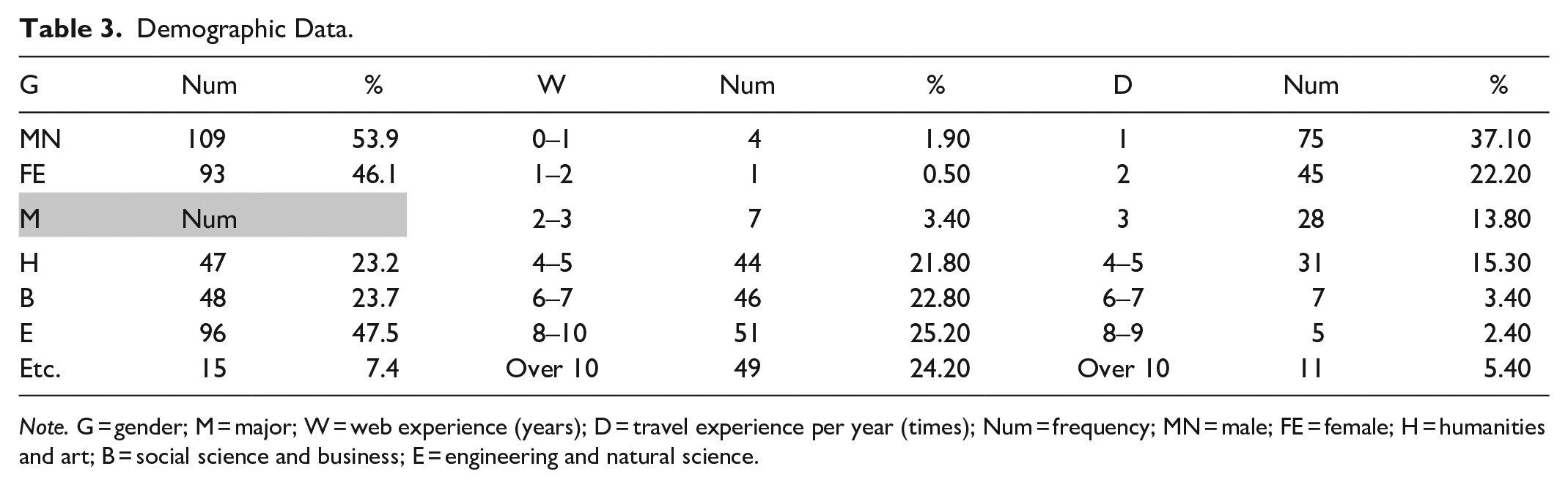
Note. G = gender; M = major; W = web experience (years); D = travel experience per year (times); Num = frequency; MN = male; FE = female; H = humanities and art; B = social science and business; E = engineering and natural science.
Analysis and Results
A manipulation check is required to verify that the experimental design has been treated well. If the experimental treatment is adaptably handled, we can observe the difference in variance distribution between the control groups and experimental groups, and ANOVA results show it. ANOVA was used to assess the difference in the mean between groups (Wetzels et al., 2012). Table 4 is the result of ANOVA. ANOVA results showed significant differences in perceived information quality and perceived service quality among groups. According to the results of the mean difference comparison between groups, Group A (only tourism information) reports the lowest mean, Group D (restaurant recommendation information with recommendation agent) reports the highest mean, and Group B and Group C are located in the middle of both. Based on the ANOVA results, we could have confirmed that experimental treatment is done normally, resulting in differences between groups and that independent variables in our study can positively affect perceived information quality and perceived system quality.
ANOVA Results.

Note. df = degree of freedom; Sig = significance.
Because this study uses formative indicators, it is necessary to ensure that they sufficiently express the concept of the construct. It could be confirmed to check the correlation between the formative and reflective indicators. By assessing Pearson’s correlation analyses, a significant correlation between restaurant recommendation information and the effectiveness of recommendation information (Biocca et al., 2003) (.375, p = .000) and a significant correlation between recommendation agents and the perceived usefulness of recommendation agents (.610, p = .023) were found. Therefore, we could confirm the validity of the formative indicators of each construct to adopt it in this study.
Causality between variables was tested using PLS analysis. This method could assess the validity and reliability of the measurement model (Gefen et al., 2000), could have a small number of observations for performing analysis, and could be used to measure the formative constructs (Chin, 1998). The PLS method could be performed by two stages: validation of the measurement model and confirmation of the causality of the structural model.
Measurement Model
The first step in PLS analysis is to verify the reliability and validity of the measurement model. We checked each variable’s average variable extended (AVE), composite reliability, and Cronbach’s alpha to check the convergent validity and reliability. When AVE is greater than 0.5 and composite reliability, Cronbach’s alpha is greater than .7, which means that most of the variances of the variables are explained by this measurement model and that the measurement model is sufficiently reliable. According to Table 5, the values of AVE, composite reliability, and Cronbach’s alpha of all variables exceed the proposed guidelines in the prior study (Fornell & Larcker, 1981) to confirm the facial and convergent validity and reliability of the measurement model of this study. Discriminant validity means that the observation measured the concept of a variable it was intended to measure and did not measure the concept of the other variables. The discriminant validity is verified in two ways. The first way to check the discriminant validity is to assess the square root of the AVE value for each variable. The square root of the AVE value for each variable must be greater than the correlations with other variables. The diagonal cells of Table 5 are the square root values of the AVE value for each variable and are greater than the correlations with the other variables. The second way to check the discriminant validity is to assess the factor loadings. The factor loadings within one variable must be greater than the factor loadings with the other variables. Table 6 shows the factor loadings, and we can see that the factor loadings within a variable are greater than the factor loadings between variables. Through these considerations, we have confirmed that our measurement model has reliability and validity and proceeded with structural equation model analysis using the PLS algorithm.
Latent Variables Correlations.

Note. Diagonal cells are square root of AVE of each construct, Off-diagonal cells are the correlations. AVE = average variance extracted, CR = composite reliability, α = Cronbach’s alpha.
Factors Loading.

PLS Analysis Results
We tried to validate our hypothesis through the analysis of the structural equation model through the PLS algorithm. The results of the PLS analysis provide path coefficients and a p-value between each variable, and the causal relationship between the variables can be identified. Figure 2 shows the brief of the PLS analysis results.

PLS analysis results.
Path coefficients between restaurant recommendation information and perceived information quality (H1, β = .215), between recommendation agent and perceived information quality (H3, β = .289), between recommendation agent and perceived system quality (H4, β = .734), between perceived information quality and satisfaction (H5, β = .46), between perceived system quality and satisfaction (H6, β = .346), between satisfaction and continuous usage intention (H7, β = .708), and between satisfaction and destination visit intention (H8, β = .629) are significant and positive. The path coefficient between restaurant recommendation information and perceived system quality (H2) is not significant. We confirmed that all hypotheses of this study were approved except H2.
These results mean the following. First, suppose the tourism website provides potential tourists with a variety of restaurant recommendation information, including food quality, service quality, price, atmosphere, and location, and helps potential tourists find this information easier and faster using condition search or sorting functions. In that case, they evaluate that the overall information quality of the tourism website is high. The more effective the recommended agents are offered, the higher the system quality of tourism websites. Second, simply providing restaurant recommendation information does not necessarily increase the evaluation of the system quality of tourism websites. This is because providing various restaurant recommendation information and whether potential tourists can use them effectively to make decisions for choosing the destination are different issues. We conducted an additional interview with several quasi-experimental participants to interpret the results of the study. They responded in common that there was too much information about restaurants and that in many cases, it was rather difficult, time-consuming, and unsure decision-making about food and restaurants without any technical support. This result means that simply providing information does not increase the assessment of the tourism website system or help tourists make tourism decisions. The results emphasize the role of recommended agents, and it is proven that the recommended agent’s path coefficient (0.289, 0.734) is greater than that of restaurant recommendation information (0.215). Third, the increased perceived information quality and perceived system quality increase the satisfaction of potential tourists with the tourism website. The increased satisfaction significantly increases the continuous usage intention of the tourism website and the destination visit intention to the destination proposed by the tourism website. In particular, the better the system quality of the tourism website, the more people are satisfied with its use, with the R2 value of the perceived system quality exceeding .5. In conclusion, providing restaurant recommendation information and recommendation agents has been shown to increase the perceived information quality and perceived system quality of tourism websites, increase satisfaction, and increase the continuous use and visiting destination intention.
Discussion
According to the old saying, three things that people need to live are clothes, houses, and food. We enjoy many things on a trip, but enjoying local food is also an important motive. Various topics have been reviewed in tourism studies, but few studies have been conducted on how potential tourists react when the tourism website provides information on food and restaurants with general tourism information. They focused on studies of restaurants themselves or on the reservation system of online tourism sites, but only a few studies focused on the various recommendation systems of online tourism websites. Therefore, the study challenged to empirically verify changes in potential tourists’ cognitive and affective responses when local food and restaurant recommendation information were provided with recommended agents. The results of this study successfully proved that local food and restaurant recommendation information increases perceived information quality, and the recommended agent increases both perceived information quality and perceived system quality. It failed to increase perceived system quality if only restaurant recommendation information was provided. Increased perceived information quality and system quality increase satisfaction with the usage experience of tourism websites and significantly increase the intention of continuing to use tourism websites and visiting the destination. This result provides several discussion topics.
The first topic is that IT can lead to the development of the tourism industry. Using IT, potential tourists are looking for more information online, not just relying on offline tourism agencies. Several online tourism agencies (e.g., Expedia.com, Agoda.com, Ctrip.com) help tourists find information about transportation, hotels, and even restaurants that are the subject of our study and book them by themselves. As tourists can see various information about destinations, tourists want to have a richer and more diverse experience there, and their level of demand and requirements is increasing. They expect more abundant services, not just transportation and hotels but enjoying local food and sharing such experiences with others on SNSs. By using IT, the power in the tourism industry is shifting from tourism agencies to tourists. This means that competition among tourism agencies intensifies, and tourism companies only survive if they provide enhanced services. Therefore, IT is leading the transformation of the tourism industry.
The second topic is that restaurant recommendation information significantly increases potential tourists’ destination choice. This is consistent with the findings of a previous study (Wetzels et al., 2012). The findings of this study provide empirical evidence on how tourism websites could combine tourism information and food information. Compared to other websites that provide tourism information only, one with food information could be more attractive to potential tourists.
The third topic is that providing only information yields limited promotion of performance. Following the findings of our study, it has been shown that providing only local food and restaurant recommendation information increases perceived information quality but does not significantly increase perceived system quality, which is a more important factor. Providing ordinary information is helpful to perform tasks, but providing too much information causes the information overload problem. In an additional interview result, participants responded that too much information creates difficulty in choosing food, restaurants, and destinations. Therefore, we emphasize the importance of recommended agents. Providing information without a recommendation agent may rather reduce performance.
The fourth topic is that the importance of the recommendation system has increased. Consumers read reviews left by other consumers and make purchasing decisions. Even when choosing local food and restaurants, tourists refer to the results evaluated by various standards (i.e., food quality) and perform their tasks by carefully reading reviews from other tourists. Unlike other information and advertisements provided by tourism websites, the review-based recommendation system is more effective because the review was written by a neutral third party. It could be interpreted that this is why the recommended agents of the study have shown great influence on the dependent variables.
The fifth topic is that tourism websites can aim to improve practical performance, including customer satisfaction, continuous usage intentions, and destination visit intention, by providing local food and restaurant information, which is one of the key motives for travel. Previous studies have suggested that satisfaction with the website has a positive relationship with continuous usage intention and revisit intention (Bhattacherjee, 2001; Chi & Qu, 2008; Petrick et al., 2001). We already demonstrated a causal relationship in which local food provision, restaurant recommendation information, and recommendation agents increased customer satisfaction, continuous usage intention, and destination visit intention.
The sixth topic is that providing only information or simply changing the website design is not enough. Local food or restaurant recommendation information and recommendation agents are newly developed systems. Cyr (2008) has identified three elements of website design: navigation support, design support, and information support. DeLone and McLean’s (2003) updated models have added information quality and system quality and service quality. This means that various methods can be used to improve online services, and constant innovation is needed. To increase the competitiveness of online tourism agencies, ideas for improving customer service must be developed, implemented and improved constantly.
The seventh topic is that online and offline tourism agencies should collaborate with each other. Previous studies predict that these O2O service markets grow further. Collaboration between online tourism agencies and offline service providers is essential for attracting customers. People book their travel plans more easily and quickly through online tourism websites, receive actual services at offline restaurants, record, and upload their experience online. With these cycles repeating, the provision of information online and the system support to manage them and improve services offline are now inseparable.
In summary, information technology is leading the transformation of the tourism industry, and through information system development, such as a recommendation system, tourism websites can achieve substantial results, such as increasing customer satisfaction and attracting customers. Maintaining this effect requires applying new ideas, constant innovation, and collaboration between online tourism agencies and offline service providers.
Conclusions
Of the many experiences at the destination, enjoying local food is an important motivation. Online tourism websites can provide general travel information as well as local food, restaurant recommendation information, and recommendation agents. We introduced DeLone and McLean’s (2003) IS access model to verify the effectiveness of local food, restaurant recommendation information, and recommendation agents. Research results indicate that local food, restaurant recommendation information, and recommendation agents significantly increase the perceived information quality, perceived system quality, satisfaction, continuous usage intention, and destination visit intention. These findings contribute to the following academic and practical implications.
There are four academic contributions. First, the study succeeded in expanding the scope of the study by validating the effectiveness of new ideas that provide local food and restaurant recommendation information with recommended agents. At the same time, this study carried out interdisciplinary research by combining tourism research with information system research. Second, this study could draw more convincing conclusions by applying a solid theoretical background of the IS success model to explain the phenomenon. The IS success model has already been applied in various situations but has also been found to be applicable to tourism. Third, this study provided the foundation for a future study using artificial intelligence and big data analytics by finding information overload phenomena and emphasizing information screening system quality. The findings of this study indicate that information provision alone does not significantly improve performance and that performance can be maximized only when information can be effectively extracted, organized, and analyzed to create meaningful knowledge by using IS. It can be reflected in the design of intelligent information systems in various fields. Fourth, the study focused on the effectiveness of the recommendation system. The recommendation system can provide consumers with improved services that are easier, faster, and more convenient to use. The technology that consumers use to search for the information they need is essential to a future information society. Fifth, the study’s findings offer knowledge of restaurant recommendation information on potential tourists’ destination choices on tourism websites. To our knowledge, this is the first study to empirically investigate the impact of restaurant recommendation information on potential tourists’ destination choices in the Chinese domestic tourism market.
There are three practical contributions. First, this study is timely as a study responding to the development of the tourism industry, which is considered the source of sustainable economic growth. Tourism does not produce side effects such as pollution, conflict, starvation, or war. Instead, it creates jobs and revenue. Therefore, the importance of tourism industries has grown recently. This study successfully offers the idea of a new business model: providing local food and restaurant recommendation information with the recommendation agent, when competition among tourism companies grows harder, and when they are looking for new ways to improve their services. In particular, the findings of this study could be more helpful to tourism companies because the purchasing power and influence of Chinese tourists are increasing in the tourism industry. Second, independent variables in this study could help design real tourism websites. We recognized five restaurant recommendation information and two recommended agent functions. These can be introduced immediately on actual tourism websites. Third, we insist on increasing investment in the system by emphasizing the influence of the system quality. The information must be provided with a system that can organize it, and investment must be made to develop a sophisticated system.
Despite these academic and practical contributions, the study has the following limitations. First, because this study introduced formative indicators, its validity is limited compared to when unidimensional indicators as reflective indicators were introduced. We have created a formative indicator through as many literature reviews as possible and expert interviews, but it may include many other things besides those we have adopted in this study. Rather, this is an opportunity to introduce more diverse factors and indicators in a later study to verify their hypothesis. Second, this study was conducted using the quasi-experiment method. Laboratory experiments are advantageous in maintaining internal validity by controlling exogenous variables, and the survey method is advantageous in describing the phenomenon of reality, increasing the applicability of the study results. We tried to control the exogenous variables and reflect the phenomenon. Various methods can be introduced in later studies. Third, we have a relatively small sample of 202 observations. Samples are all students as potential Chinese tourists. Observations have been made only at the virtual sites of Ctrip.com. This is because Ctrip.com refused to recruit participants. There is a limit to the external validity of this study. The demographic limitations of the sample in this study should be amended by a later study of more diverse demographic groups.
Finally, the study could be expected to contribute to the development of the travel industry, improve the performance of travel websites, and increase the rich travel experiences of potential travelers.
Footnotes
Declaration of Conflicting Interests
The author(s) declared no potential conflicts of interest with respect to the research, authorship, and/or publication of this article.
Funding
The author(s) received no financial support for the research, authorship, and/or publication of this article.
