



Abstract
Prior research has underscored the growing significance of new technologies in shaping tourists’ experiences; however, numerous areas remain unexplored. This research led to some exciting new findings for critical investigations into how the role of technology in the museum visitor experience can trigger intricate psychological processes, influence behavior, evoke memories. This study formulates an integrated model to examine the psychological processes of tourists influenced by smart technology and the mechanisms governing their responses. Employing a quantitative approach, we conducted an empirical survey of 506 visitors to China’s leading smart tourism destination, the China Grand Canal Museum. The structural and measurement models were tested in a two-step examination using SmartPLS. The findings revealed three factors, namely, immersive experience, presence, and engagement, which positively influence user satisfaction with smart technology during museum visits. Our research contributes to the literature on museums and smart tourism by introducing and empirically validating an integrated model. This comprehensive investigation offers a multifaceted perspective, shedding light on how the confluence of immersive experiences, presence, and engagement shapes an elevated and enriched perception of museum experience and tourist satisfaction within the context of the contemporary technological landscape. This study additionally serves as a roadmap for museums searching for to include innovation, appeal to new audiences, and thrive withinside the evolving cultural landscape.
Plain language summary
While earlier studies have highlighted the increasing significance of new technology in influencing the tourist experience, unexplored areas persist. This study develops an integrative model to examine visitors’ psychological processes as they are influenced by smart technologies and their response mechanisms, which contributes to a critical examination of how the role of technology in the museum visitor experience triggers complex psychological processes, influences behavior, and evokes memories. The study’s findings demonstrate that three elements—immersion experience, sense of presence, and engagement—positively impact users’ satisfaction with smart technology when they visit museums. The study also found that in modern technological surroundings, immersive experience, presence, and interaction influenced improved and enriched perceptions of the museum experience and visitor satisfaction. Finally, this study provides a road map for museums looking to innovate, draw in new patrons, and prosper in a changing cultural environment.
Keywords
Introduction
Incorporating new technology into museums has the ability to add value and attraction to new tourist demographics (Trunfio et al., 2020). Through new technology, museums ought to increase conventional cultural gaining knowledge of studies with precise elements, along with people who facilitate enjoyment and social interaction (Dağ et al., 2023). In this context, smart tourism technology has won traction in cultural heritage tourism and gives promising advantages (Jung et al., 2018).
Smart technology has numerous packages in museums and gives numerous functionalities, Augmented Reality (AR) and Virtual Reality (VR; He et al., 2018) technologies provide immersive experiences by reconstructing historic scenes or showcasing artworks; they promote engagement via interactive storytelling and simulations. Interactive Displays and Experiences (Sung et al., 2021) functionality encompasses the use of touchscreens, interactive screens, or gesture-based systems that promote visitors’ participation in exhibits. Specifically, visitors may also access detailed information, explore historic narratives, and enhance their cultural knowledge. Smart Guiding Systems (Jiménez-Barreto et al., 2022) technologies involve the use of mobile applications or special gadgets to guide tourist traffic; they enhance traffic’ revel by permitting automatic excursion planning, facilitating the enhancement of audio publications and show off descriptions, and presenting interactive queries. Digitization system and use of databases (Yang & Zhang, 2022) facilitate the conversion of museum collections into virtual formats, creation of online files or databases, and granting of far flung get entry to famous; therefore, these improvements play an essential role in preserving cultural history and education. Big Data Analytics for Personalized Experiences (Chang et al., 2021) enriches the understanding of tourists’ conduct and can, therefore, assist museums in presenting customized recommendations for famous or routes to decorate tourist revel in. Internet of Things and Sensor Technology (Buhalis, 2020) are being increasingly used to monitor traveler flow, exhibit conditions, and environmental factors. These technologies also allow the optimization of exhibit layouts and implementation of measures for preserving museum artifacts. Finally, live streaming, remote visits and virtual exhibitions (Koo et al., 2023), through live streaming or digital exhibition spaces, tourists are capable of remotely interact with museum exhibits and events.
The tourism sector is dynamic, volatile, and time sensitive, and thus requires tourism destinations to leverage market intelligence and enhance their adaptability so as to increase their value and hold a competitive edge (Stylos et al., 2021). Tourism destinations should keep a close eye on their competition and undertake the best era to boom traveler attendance; the same applies to museums (Lu et al., 2023). By maintaining their competitive edge and using the most suitable technology, museums can boost visitor engagement and appeal to new audience segments, ultimately overcoming the many challenges they face in the 21st century (He et al., 2018). Such transformations are crucial for museums to attract new customer segments, including Generation Z (Buhalis et al., 2023). It is worth exploring how the psychological genesis of users under the use of new technologies in order to better serve them, this study formulates three research questions (RQ):
RQ1. In cultural tourism, how do smart tourism technologies trigger the mental processes of tourists?
RQ2. In cultural tourism, how do tourists’ mental processes influence their behaviors and reactions?
RQ3. Do smart tourism technology interventions within museums influence tourist satisfaction, and if so, to what extent?
Although the importance and necessity of implementing new technologies in tourism destinations has been widely discussed, specific empirical research on this topic remains insufficient. Jiang et al. (2023) indicated that the current literature mainly emphasizes utilizing AR for tourism marketing and thus leaves a notable gap in empirical studies and conceptual development regarding tourists’ experiences with AR. Although technology has begun to be employed in diverse tourism scenarios such as resorts, hotels, cultural heritage sites, museums and galleries, events, and cruises, empirical studies on these destinations have lagged behind (Wei, 2019). Fan et al. (2022) pointed out that prior studies on AR/VR tourism have not clarified whether and how certain parallel structural constructs within operational mechanisms affect tourists’ responses. Lu et al. (2023) highlighted the insufficient recognition of museum experiences and the scarcity of relevant research and pointed out that existing research subjects are concentrated on European museums, and there is a lack of research on Asia, especially China. This research could lead to some exciting new findings for critical investigations into how the role of technology in the museum visitor experience can trigger intricate psychological processes, influence behavior, evoke memories.
The remainder of this paper is organized as follows. The next section outlines the conceptual framework and formulates the hypotheses. Thereafter, the respective sections present the methodology and analysis of the results. The final section discusses the implications and limitations of the study.
Literature Review and Hypothesis Development
Embodiment of Smart Tourism Technologies
The integration of technology into the tourism sector is commonly referred to as smart tourism technology (Buhalis, 2020; C. D. Huang et al., 2017; Jeong & Shin, 2020; Yang & Zhang, 2022). Currently, electronic guides (S. Huang et al., 2015), service robots (Ivanov & Webster, 2020), and new realities, such as VR, AR, and mixed reality (MR; Fan et al., 2022; Jiang et al., 2023; Yung et al., 2021) are widely employed during the in-tour stage in tourism destinations.
Although collectively referred to as new realities, VR, AR, and MR have different application scenarios and perform different functions in the tourism industry. Initial efforts in the realm of VR involved creating panoramic paintings intended to expand an individual’s field of vision and thereby create the illusion that the observer is physically immersed in the depicted scene. Panoramic paintings use foreshortening techniques to evoke a sense of presence amongst viewers (Rauschnabel et al., 2022). VR is predominantly recognized through head-mounted displays (HMDs) that were initially developed for gaming and entertainment purposes. Nevertheless, the application of VR has expanded considerably across various industries and consumer contexts, including prototyping, job training, marketing, and tourism (Shahab et al., 2021). VR enhances user experience by offering vibrant and enjoyable 3D renditions of destinations through devices such as HMDs, handheld devices, or personal computers. This technology transports users to virtual destinations and provides a preview of actual destinations. It delivers additional information, provides vivid and enjoyable interactive experiences, and creates mental images of destinations for visitors (Fan et al., 2022).
AR involves processing and displaying real-time 3D data in a physical environment. Utilizing a computer-mediated approach, AR technology positions virtual content in specific real locations on mobile device screens such as smartphones and tablets through various applications. It is a technology that seamlessly integrates virtual objects into the real world, fostering interactions between real and virtual elements. AR primarily fosters interactions between users and destinations, thus offering supplementary information to enhance travel experiences (Caboni et al., 2024; Dağ et al., 2023; Song et al., 2024).
In the current research, we investigate VR, AR, and MR collectively as an embodiment of smart tourism technologies instead of examining and discussing them independently. We employ this approach because AR is a special form of VR (Fan et al., 2022; Wei, 2019) and MR is a combination of VR and AR (Trunfio et al., 2020).
Immersive Museum Experience
An immersive museum experience is a combination of tourists’ virtual and in-tour experiences as they use smart technologies. Immersion refers to both mental attitude and a particular type of personal experience. It is typified by the sensation of existing in, being confined by, and engaging with a constantly stimulating and experiential environment (Sung et al., 2022). It relates to the concept of “mental immersion,” as defined by Sherman and Craig (2003), that is, a state of deep immersion in an experience and a suspension of disbelief.
The sensation of physically entering a virtual environment (VE) as a response to technological stimuli refers to physiological immersion, which may have important implications for psychological immersion (Flavián et al., 2019; Ngan & Lei, 2024). Smart tourism technologies offer comprehensive and in-depth information that allows users to explore and manipulate the media environment (Daassi & Debbabi, 2021). These environmental factors induce a sense of psychological immersion (Fan et al., 2022). Advanced technology with a high level of immersion may allow users to feel physically present in the virtual world (Tussyadiah et al., 2018).
In conjunction with the findings of related studies (Daassi & Debbabi, 2021; Flavián et al., 2019; Sung et al., 2022), current smart tourism technologies can improve virtual experiences by providing physical surroundings for consumers through visual and auditory enhancements, which collectively ensure a more immersive consumer experience. Thus, we propose the following hypothesis:
H1: The embodiment of smart tourism technologies significantly and positively influences immersive museum experience.
Presence
Presence refers to a state of consciousness, specifically the psychological sense of being present in a VE (Fan et al., 2022; Yu et al., 2024). This concept is fundamental to AR/VR experiences as it emphasizes the essential feeling of “being there” within the virtual space rather than the physical location in which the user is situated (He et al., 2018; Wedel et al., 2020).
The distinction between presence in VR and AR experiences lies in their nature. VR immerses users in a virtual world and thus provides a realistic illusion; by contrast, AR integrates virtual objects into users’ physical environment (Ch’ng et al., 2023), thereby creating the sensation that these objects exist in the real world (Fan et al., 2022). Specifically, AR can substantially enhance sensory inputs and thereby transport users to to a VE by augmenting actual scenarios; for example, it can present a 3D image of a meadow along with the scent of grass (He et al., 2018). In sum, VR provides users with both mental and physical presence within a complete VE (Marasco et al., 2018), while AR complements user perception of one or more senses (e.g., vision, hearing, and touch; Kang, 2020). Research comparing AR and VR has suggested that which consumers often feel more present in AR conditions (Ch’ng et al., 2023).
According to Fan et al. (2022), tourists’ immersive experiences transition into a state of presence, which subsequently elevates their engagement level. Additionally, Yung et al. (2021) emphasized that immersion serves as per a prerequisite for presence while Daassi and Debbabi (2021) provided evidence supporting the positive correlation between the sense of immersion and presence. Based on these findings, we propose the following hypothesis:
H2: Immersive museum experience significantly and positively influences presence.
Engagement
User engagement refers to users’ intense cognitive, temporal, emotional, and behavioral engagement during interactions in a digital environment (Flavián et al., 2019). According to So et al. (2014), consumer/tourist engagement can be categorized into five dimensions: enthusiasm, attention, absorption, interaction, and identity. The enthusiasm dimension denotes the passionate and fervent feelings that tourists harbor toward a destination. The attention dimension gauges a tourist’s level of conscious or subconscious focus on a destination, with sustained attention correlating with increased engagement. The absorption dimension surpasses the attention dimension, as reflected in tourists who are deeply focused and delighted during their visit, potentially losing track of time. The interaction dimension is a key aspect of tourist engagement and involves effective behavioral activities within the destination. The identity dimension draws from social identity theory, in which tourists associate themselves with specific destinations that align with their self-image (Rasoolimanesh et al., 2019; So et al., 2014).
Facilitating detachment from physical surroundings, immersion serves as a pivotal factor in fostering users’ engagement (Dağ et al., 2023; Flavián et al., 2019). This concept is particularly notable in technologically advanced settings, where users are transported into virtual realms generated by computers, predominantly stimulating the senses of sight and hearing (Sung et al., 2021). Accordingly, we propose Hypothesis 3:
H3: Immersive museum experience significantly and positively influences tourist engagement.
Tourist Satisfaction
Tourist satisfaction is the psychological concept encompassing the sense of well-being and pleasure resulting from the interaction between tourists’ experience at a destination and their expectations of that destination (Yuksel & Yuksel, 2008). According to the theory of planned behavior and theory of uses and gratification, the fulfilment of specific visitor needs, such as entertainment or cognitive requirements, through AR/VR technology is expected to induce a favorable psychological state. Such positive state enhances satisfaction and subjective well-being, as demonstrated by Kim et al. (2020). Moreover, immersive experience amplifies the worth of the experience, contributing to heightened pleasure and satisfaction amongst tourists (Guo et al., 2021). According to the meta-analysis of Fan et al. (2022), utilizing AR/VR within the tourism sector provides tourists with additional information and fosters harmony, exploration, escapism, and interaction with the surroundings to yield substantial immersive experiential value. This condition, in turn, contributes to heightened tourist satisfaction and subsequently influences customer behavioral responses. Thus, we propose the following hypothesis:
H4: Immersive museum experience significantly and positively influences tourist satisfaction.
Meanwhile, several scholars have highlighted the significance of presence in cultural tourism, affirming that the sense of presence in the smart tourism technology experience significantly contributes to a positive impact on satisfaction (Dağ et al., 2023; Fan et al., 2022). User engagement prompts involvement in user–content interaction. This amalgamation involves ongoing interactions between the mind, body, and computer-mediated environment, thereby enhancing the gratification of immersive experiences and increasing overall satisfaction (Georgiou & Kyza, 2017). Satisfaction reflects favorable tourist sentiments toward a brand or destination. From a psychological standpoint, tourist engagement positively influences satisfaction (Rasoolimanesh et al., 2019).
Accordingly, we propose the following hypotheses:
H5: Presence significantly and positively influences tourist satisfaction.
H6: Tourist engagement significantly and positively influences tourist satisfaction.
Figure 1 depicts a conceptual model based on the foregoing discussion and hypotheses.

Conceptual model.
Research Methodology
Measurement Scales and Questionnaire Design
The measurement scales used in this study were adapted from those used in previous research. The questionnaire design encompassed the Smart Tourism Technology Embodiment (STTE; Cheng & Huang, 2022; Flavián et al., 2019), Immersive Museum Experience (IME; Daassi & Debbabi, 2021; Sung et al., 2022), Presence (PCE; Daassi & Debbabi, 2021; He et al., 2018), Engagement (EGG; Rasoolimanesh et al., 2019; So et al., 2014), and Tourist Satisfaction (TSA; Fu et al., 2019; S. Huang et al., 2015) scales. Consistent with the literature, we utilized a 7-point Likert type scale, with ranging from “strongly disagree” to “strongly agree” (1–7). The details regarding the sources of the constructs and corresponding questions can be found in the Appendix 1. The questionnaire was translated English into Chinese by an English professor and a tourism management scholar. Two Chinese professors were consulted to ensure the cross-cultural validity of the questionnaire. Furthermore, a pilot test was conducted to confirm the clarity of the questions, involving a focus group discussion led by two computer scholars, two tourism scholars, and one marketing expert. Subsequently, 100 questionnaires were distributed to visitors of the China Grand Canal Museum to ensure the reliability and validity of the questions.
This anonymous survey study complied with Section 8.05 of the APA Ethical Principles. No personally identifiable information was collected, and risks to participants were minimized through non-sensitive content design, voluntary participation, and secure data handling. Full ethical compliance details are provided in Appendix 2.
Research Site and Data Collection
The China Grand Canal Museum was selected as the research site. The China Grand Canal Museum is China’s leading museum that extensively uses smart technologies. The museum employs various advanced technologies such as VR, AR, full-area projection rendering, 360° ring-screen IMAX projection, 5G live broadcast, and autostereoscopy to recreate the historical ambiance of ancient towns along the canal. Visitors engage in a virtual journey, riding on a physical boat model synchronized with a digital multimedia presentation, traversing 17 cities across eight provinces, and gaining a unique time travel experience along ancient grand canal (refer to Plate 1). The museum’s substantial tourist footfall further motivated our selection of the research site.

Smart tourism technologies application in China Grand Canal Museum.
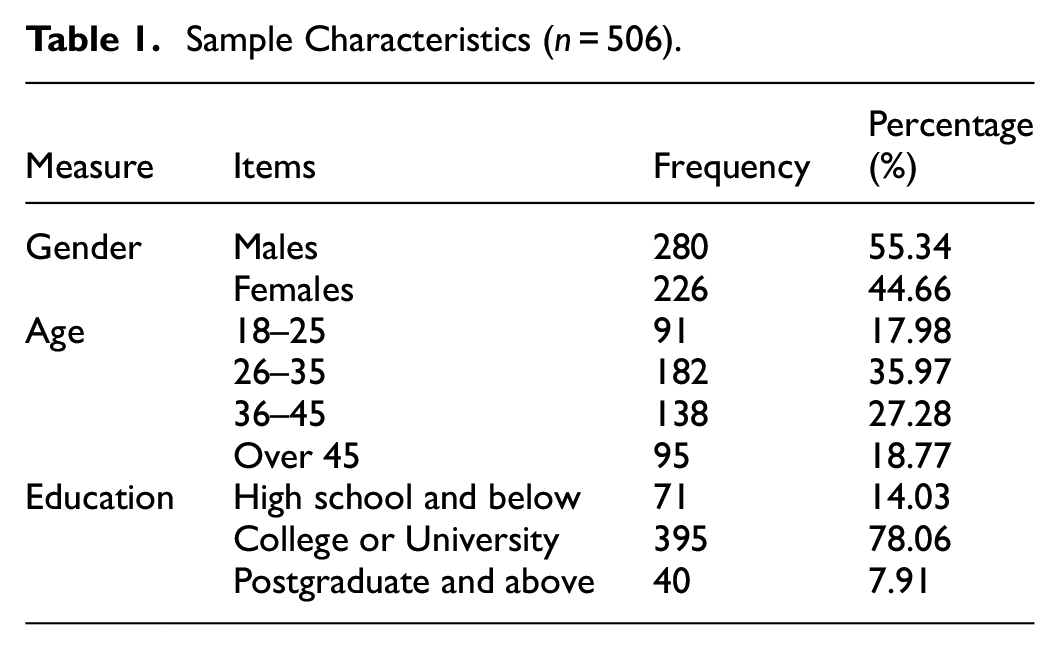
Data were collected through an on-site survey conducted from 1 June 2023 to 1 September 2023. During this 3-month period, three trained student investigators went on six distinct trips to Yangzhou, Jiangsu Province, where they administered questionnaires at the China Grand Canal Museum. Tourists were approached and asked to participate in in the survey after their museum visit. During the survey period, 623 questionnaires were distributed. After excluding 117 invalid responses, 506 valid responses were finally obtained. Table 1 presents the sample profiles of the respondents.
Sample Characteristics (n = 506).
Statistical Analyses
Partial least squares structural equation modeling (PLS-SEM) was employed in the study to evaluate the theoretical model. A widely utilized data analysis method in tourist and consumer research, PLS-SEM minimizes the residuals of endogenous constructs and is thus suitable for theoretical model testing (Ali et al., 2018; Filieri et al., 2021).
The structural and measurement models were tested in a two-step examination using SmartPLS (version 4.0.9.8; Ringle et al., 2015). Moreover, the models were evaluated through path modeling and bootstrapping, the indices of which facilitate the evaluation of the appropriateness of a model and its ability to explain the observed data.
Results
Measurement Model
An appropriate method to measure the model is necessary, to analyze the SEM, we used multiple tools like Cronbach’ s alpha, rho_A, and average variance extracted to assess the measurement model’s quality following Hair et al. (2014) guidelines.
Reliability and Validity
The validity and reliability of the measurement model was assessed using confirmatory factor analysis. The outcomes are tabulated in Table 2. The PLS factor loadings of the model exceeded the value of 0.70 recommended by Hair et al. (2014), and the p-values were below 0.001. Meanwhile, the composite reliability values exceeded 0.70, the Cronbach’s alpha and rho_A values both surpassed .70, and the average variance extracted (AVE) for every construct exceeded the minimum criterion of .50. The results indicate satisfactory reliability and convergent validity. Consequently, the measurement model was deemed to be satisfactory and of high quality.
Validity and Reliability Test Results.

Note. CR = composite reliability; AVE = average variance extracted.
p < .05. **p < .01. ***p < .001.
Convergent and Discriminant Validity
We evaluated convergent and discriminant validity using the heterotrait–monotrait (HTMT) ratio in accordance with comparable studies (Islam et al., 2023; Yang et al., 2024). As shown in Table 3, each correlation’s HTMT ratio was below .9, thus meeting the criteria suggested by Henseler et al. (2015). Hence, the convergent and discriminant validity of the measurement model were deemed satisfactory.
Discriminant Validity Test—The Heterotrait-Monotrait Ratio of Correlations (HTMT).

Structural Model Evaluation
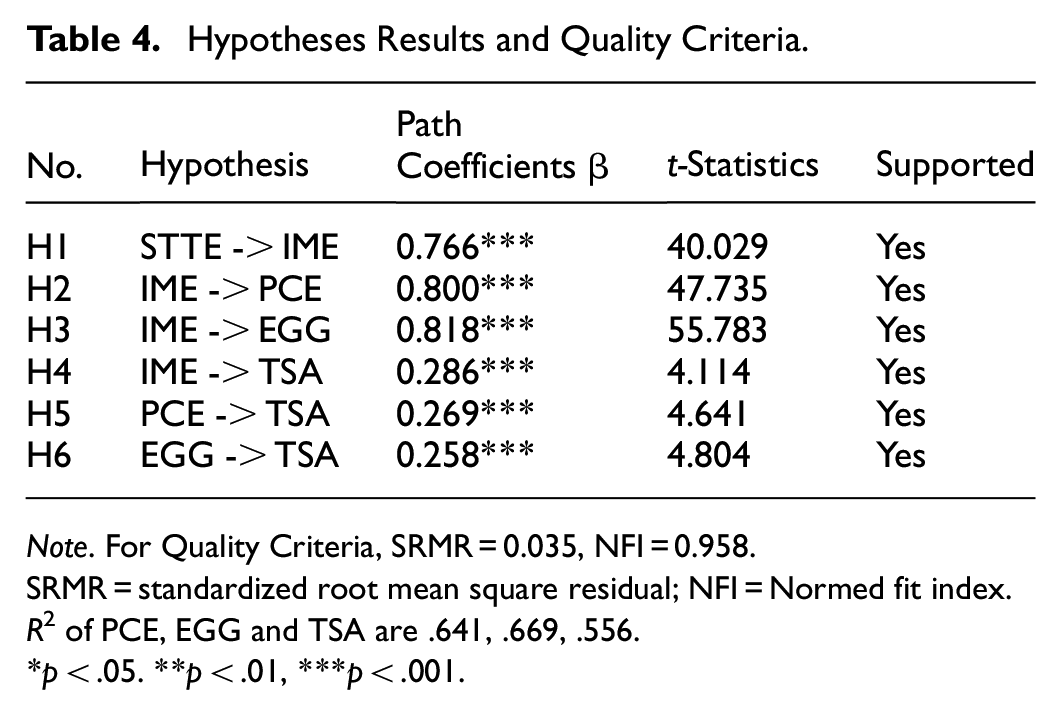
We used a bootstrapping method comprising 5,000 iterations to evaluate the statistical significance of the path coefficients. The results of the structural model evaluation are presented in Table 4 and Figure 2.
Hypotheses Results and Quality Criteria.
Note. For Quality Criteria, SRMR = 0.035, NFI = 0.958.
SRMR = standardized root mean square residual; NFI = Normed fit index.
R2 of PCE, EGG and TSA are .641, .669, .556.
p < .05. **p < .01, ***p < .001.

Structural model (Model Fit: SRMR = 0.035, NFI = 0.958).
Coefficients of Determination (R2)
In the examination of the endogenous latent variables, the coefficients of determination (R2) for presence, engagement, and tourist satisfaction were .641, .669, and .556, respectively. Notably, all the R2 values surpassed the thresholds suggested by Chin (1998) for substantial (>.67), moderate (>.33), and weak (>.19) relationships. Consequently, the endogenous variables in our model can be classified as moderate to strong.
Model Fit
In assessing model appropriateness, a good fit is defined by a standardized root mean square residual (SRMR) below 0.08 and a normative fit index (NFI) above 0.90 (Dash & Paul, 2021). The structural model achieved a satisfactory fit with an SRMR of 0.035 and an NFI of 0.958.
Hypotheses’ Testing
The standardized path coefficient, with a value of 0.766 (p = .000), signified a highly significant and positive influence of smart tourism technology embodiment (STTE) on immersive museum experience (IME) at a confidence level of 0.001, providing support for hypothesis H1. Applying a consistent rationale, all formulated and examined hypotheses were supported.
Table 4 shows the results for these hypotheses. Immersive museum experience had a significant and positive impact on presence (H2), engagement (H3), and tourist satisfaction (H4). Moreover, presence had a significant and positive impact on tourist satisfaction (H5), and engagement had a significant and positive impact on tourist satisfaction (H6).
Discussion
Based on a thorough literature review, this study posited that immersive experience serves as an external manifestation of smart tourism technologies. It also argued that presence and engagement trigger mental processes that elicit enhanced perceptual responses to technology. These arguments are in line with RQ1.
We also simulated the impact mechanisms and pathways from technological embodiment to behavior and reactions. We found that users’ responses to smart tourism technologies can be categorized into internal processing mechanisms and resultant behavioral reactions. Internal processing mechanisms encompass presence and engagement, whereas the resultant behavioral reactions refer to satisfaction. We also examined the mediating effects, revealing the mediating roles of presence and engagement in the relationship between immersive experience and satisfaction. Analysis of survey data from 506 participants yielded supportive results for the proposed hypotheses. As technology embodiment improves, museum experience becomes more immersive, leading to higher levels of presence and engagement and consequently resulting in increased satisfaction. Notably, presence and engagement play pivotal roles in the impact mechanism, with higher levels of both correlating with increased satisfaction. These results address RQ2 and RQ3.
This comprehensive investigation offers a multifaceted perspective, shedding light on how the confluence of immersive experiences, presence, and engagement shapes an elevated and enriched perception of museum experience and tourist satisfaction within the context of the contemporary technological landscape.
Theoretical Implications
This study has numerous theoretical implications. Firstly, it enriches the museum and smart tourism literature by formulating and empirically validating an integrated model. Numerous scholars have highlighted the noticeable and underexplored gap in the empirical research on smart technology and visitor experience (Jiang et al., 2023). Accordingly, we performed our empirical study in the context of museums that serve as important cultural tourism destinations. The selection of research focus aligns with the calls for comprehensive research made by Litvak and Kuflik (2020), Yung and Khoo-Lattimore (2019), and Wei (2019). Secondly, this study bolsters the empirical research on the combination of smart technology applications and heritage tourism studies. The findings underscore the potential of this technology to enhance the memorability of tourism experiences by allowing immersion, interaction, and interpretation. Thirdly, our study was conducted in the Asian context, addressing the observation by Lu et al. (2023) that most existing research in this area has been performed in Europe and studies in different geographical contexts are, therefore, lacking. Our choice of study site contributes a valuable perspective to existing research and enriches the understanding of the implications of smart technologies for heritage tourism experiences. Finally, our research model reflects the complex relationship between the antecedents and consequences of tourist behaviors and reactions to the use of smart technologies in museums. On the basis of the existing literature, three dimensions for measuring users’ cognitive processes were developed and subsequently tested in the study. Moreover, the effect of immersive experience, presence, and engagement on tourist satisfaction was illustrated through a mediating mechanism. This aspect of our study is aligned with the proposition by Fan et al. (2022) and Lu et al. (2023), who urged scholars to explore how the role of technology in museum visitors’ experience can contribute to complex mental strategies, affecting behavior and eliciting memories.
Practical Implications
From the perspective of “antique museology,” museums are establishments that collect, preserve, and protect ancient artifacts and, therefore, favor social elites’ curatorial approach (McCall & Gray, 2014). Owing to demographic and societal changes, this standpoint has developed into the brand new museology theory (Vergo, 1989). Responding to the growing viewpoint of museum operations, new museology emphasizes the need to enhance tourist experience to further attract community interest in the preservation of historically significant artifacts. Additionally, museums face economic challenges springing up from a decline in tourist numbers (He et al., 2018). Hence, they must shift from their conventional position of serving specific social groups, including cultural elites, to an extra inclusive position of catering to various audiences (Zhang et al., 2023). In this context, enhancing visitor experience is essential and may benefit from the exponential growth of emerging technologies.
The contemporary studies provide actionable guidance for museum operators as they navigate this transformative landscape. Grounded in empirical evidence, this study aims to highlight the value of smart technology in boosting tourist engagement and revitalizing the museum experience. By adopting those technologies, museums can meet current expectations and cope with the challenges posed by economic constraints and changing demographics. For example, museums can intelligently control the flow of visitors and realize real-time diversion of people through an online reservation system. In addition, using big data analysis technology, it carries out audience portrait and intelligent distribution service, and pushes personalized exhibition information for the audience. Finally, by utilizing digital technologies to exhibit the collection’s high-definition details and associated academic accomplishments, the audience is elevated from a mere observer to an explorer and participant, gaining a deeper comprehension of the cultural significance the collection carries in various dimensions, including vision, hearing, touch, and interactive thinking. Ultimately, this study serves as an important reference for museums aiming to embrace innovation, attract new audiences, and thrive in the evolving cultural landscape.
Limitations and Future Research
This study emphasizes the transformative capacity of smart technologies withinside the museum sector. It additionally has numerous theoretical contributions and affords precious guidance for museum operators. Nevertheless, it is not without limitations.
Firstly, various demographics, consisting of age groups, cultural backgrounds, and ranges of technological familiarity, affect the effectiveness of smart technology in engaging tourists. Given this diversity, our research might not have drastically explored the effect of those elements at the popularity and use of such technology. Future research could focus on the potential influence of various demographic factors on the acceptance and use of smart technologies in museums. For example, whether people in different countries have different acceptance of smart technologies, and whether older people are lower acceptance, as is generally believed.
Secondly, this study may not have comprehensively taken into consideration the ethical issues involved in using smart technology in museums, including concerns about data privacy, surveillance, and the possible exclusion of certain groups. Future research should investigate these ethical implications in detail.
Finally, this study might not have comprehensively explored the potential long-term impacts of smart technology on museum experiences and cultural preservation. The evolution of these technologies and their sustainable contributions to museums require additional exploration.
Conclusion
While earlier studies have highlighted the increasing significance of new technology in influencing the tourist experience, there are still a lot of unexplored areas. This study develops an integrative model to examine visitors’ psychological processes as they are influenced by smart technologies and their response mechanisms, which contributes to a critical examination of how the role of technology in the museum visitor experience triggers complex psychological processes, influences behavior, and evokes memories. The study’s findings demonstrate that three elements—immersion experience, sense of presence, and engagement—have a beneficial impact on users’ satisfaction with smart technology when they visit museums. The study also found that in modern technological surroundings, immersive experience, presence, and interaction influenced improved and enriched perceptions of the museum experience and visitor satisfaction. A road map for museums looking to innovate, draw in new patrons, and prosper in a changing cultural environment is also supplied by the study.
