




Abstract
This research explores the relationship between human resource (HR) practices, knowledge acquisition, and innovation performance in Village-Owned Enterprises (VOEs) in South Buton, Southeast Sulawesi, Indonesia. Using data from 60 active VOE managers, the study highlights the crucial role of HR strategies in shaping an organisation’s ability to absorb knowledge both internally and externally. The findings show that effective HR practices improve VOEs’ product, process, and administrative innovations by enhancing knowledge acquisition. This is evidenced by the coefficient value of .336, indicating significance. This emphasises the mediating role in strengthening the effect of knowledge acquisition on innovation performance. A key challenge identified is the inefficiency of HR in managing acquired knowledge, which hampers the growth and innovation of village-owned businesses. This limitation underscores the need for targeted interventions to improve HR capabilities within VOEs, enabling them to make better use of acquired knowledge. By establishing a strong management model, the government can turn VOEs into catalysts for rural economic growth and unlock the potential of local villages. The study offers valuable insights for policymakers and VOE leaders, stressing the importance of a comprehensive strategy that fosters innovation and sustainable rural economic development by utilising local resources.
Keywords
Introduction
The relationship between resource management procedures, organisational innovation performance, and resource practices is described in this study using the resource-based view (RBV). According to this theory, an organisation’s ability to compete successfully and achieve success depends on the resources it owns and uses in its operations. These resources are the unique skills and capabilities the organisation possesses, which it can utilise to outperform its rivals in effectiveness and efficiency (Barney et al., 2001).
RBV theory adopts an internally driven approach, relying on internal resources as the primary driver of an organisation’s sustainable competitive advantage, according to Kull et al. (2016). However, the business environment and dynamism are vital factors in today’s resource utilisation. As a result, it suggests that organisations must adapt their capabilities to external conditions to gain a competitive advantage from a resource-based perspective (Droge et al., 2008). Moreover, Kull et al. (2016) explained that many assets and capabilities can activate and facilitate the development of core competencies to achieve organisational success. However, knowledge and innovation are essential for success in modern and new-era organisations. Varis and Littunen (2010) explain that an organisation’s capacity to innovate and continuously improve and update its knowledge base is closely related to its ability to adapt to the external environment and achieve sustainable competitiveness. Accumulating empirical evidence from businesses suggests that improving human resource practices can boost innovation (Karlsson, 2013; Saba Colakoglu et al., 2019). Human resource (HR) practice refers to training, personnel placement, and the development of compensation and performance evaluation methods (Al Hallami et al., 2013; Karlsson, 2013).
Considering the importance of HR practices and the rising demand for them, an increasing number of empirical studies examine how HR influence organisational innovation performance (Mahroum, 2016; Zehir et al., 2016). As a result, HR practices can integrate training, employee development, and compensation to boost organisational success. Village-owned enterprises are vital economic entities within villages, functioning as social and commercial institutions. Through their contributions to social services, these enterprises serve the community’s best interests as social institutions. As commercial entities, they aim to generate profit by offering local resources (goods and services) for sale on the market. Therefore, to achieve both objectives, it is essential to implement optimal HR practices via development and training programmes that improve skills and knowledge.
South Buton District is one of the districts in Indonesia, situated in Southeast Sulawesi province, and was officially established in 2014. It comprises 60 villages across 10 sub-districts. These villages are distributed among seven sub-districts: Batauga has five villages; Sampolawa contains thirteen; Lapandewa has seven; Batu Atas has seven; Siompu Barat includes eight; Siompu has ten; and Kadatua has ten. Currently, all villages have a Village-Owned Enterprise, but most are not managed optimally. A key reason for this is the limited capacity of HR. The low HR skills in managing village-owned enterprises in Indonesia also affect their ability to handle organisational knowledge. This limitation hampers their capacity to innovate in products, processes, or administrative functions.
Empirical facts show that, to date, many Village-Owned Enterprise institutions in Indonesia have not developed, and some have even ceased to exist. However, in terms of managed potential, they are ideal and quite diverse, especially regarding natural resources. The main issue behind this phenomenon is the lack of knowledge and ability among HR to manage these institutions, preventing organisations from innovating. Research conducted by Bakti, et al., (2022) explains that HR capabilities positively and significantly affect knowledge management. HR and knowledge management both positively and significantly influence organisational innovation.
Knowledge is a vital strategic asset for organisations to sustain a competitive advantage. This is because knowledge is created and shared across the organisation, potentially improving performance by enhancing its capacity to respond to various new situations. Choi et al. (2008) stated that organisations that continually invest in knowledge management and develop knowledge management systems are better positioned to acquire and utilise resources.
Furthermore, empirical studies on the influence of HR practices on innovation continue to show varied results. Research findings (Zehir et al., 2016) indicate that HR practices positively impact innovation performance. The Resource-Based View (RBV) theory suggests that HR are the most vital among all organisational resources, as Farooq et al., (2016) stated. Therefore, skills and expertise will support organisations’ HR in achieving desired objectives.
Weisberg (2006) proposed that HR practices boost innovative activities, as these practices support them in achieving organisational goals. Managing knowledge effectively is a method to balance organisational expertise and individual thought (Tan & Nasurdin, 2010; Alegre, & Chiva, 2008; Singh, & Jain, 2014). Therefore, organisations need quality HR and sound planning to meet these expectations. HR Practices are the main tools through which organisations can influence and shape individual skills, attitudes, and behaviours to perform their tasks and attain organisational objectives (Collins & Clark, 2003).
This study aims to enhance the capabilities of Village-Owned Enterprise managers, promote rural economic development in Indonesia, and empower communities. Specifically, it highlights the relationship between HR management practices, knowledge acquisition, and innovation performance. This research will offer managerial implications beneficial for practitioners, government officials, and managers, impacting the enhancement of knowledge and innovation performance of Village-Owned Enterprises in Indonesia. However, in this article, the researcher only focuses on the study of knowledge management for the dimension of knowledge acquisition. Meanwhile, the dimensions of knowledge storage, knowledge sharing and application of knowledge contributions have not been explained, and this has the potential to be reviewed.
Literature Review and Hypothesis
Human Resource Practices
Human resource (HR) practices can be described as ‘all activities associated with managing people in a company’ (Boxall & Purcell, 2015). It relates to the deliberate patterns and activities that attract, engage, evaluate, motivate, train and develop individuals with the appropriate attitudes, perceptions and behaviours to meet present and future demands within an organisational context (Becker & Huselid, 1998). This definition suggests that HR practices are strategies employed by organisations to shape employees’ understanding, thinking, and behaviour to support organisational goals (Kehoe & Wright, 2013).
HR practices involve organisational activities to attract, develop, motivate, and retain employees (Horwitz et al., 2003). They ensure that organisations make effective use of HR to meet organisational goals (Collins & Clark, 2003; Wright & Boswell, 2002). Therefore, HR practices are crucial in managing knowledge within organisations (Theriou & Chatzoglou, 2014) and can improve organisational management processes by enhancing employee skills and abilities, shaping their behaviours and attitudes, and boosting their motivation and learning capacity (Jackson et al., 2014).
Research by Jerez-Gómez et al. (2004) found that HR practices such as selection, compensation, training, and development act as drivers to shape employee behaviour and motivation, influencing their learning attitudes to assist organisations in achieving peak performance. Additionally, Pillai (2016) found that HR practices like training and development, rewards and recognition, performance evaluation, and teamwork contribute to knowledge sharing within organisations. Mansouri (2016) and Chia et al. (2016) suggest that commitment-based HR practices, which direct HR towards ‘doing’ for the organisation rather than “controlling” them, yield better long-term performance. According to Kehoe and Wright (2013), HR practices are approaches used by organisations to reshape employees’ understanding, thinking, and behaviour in ways that align with organisational objectives (Ramesh & Gelfand, 2010; Tanova & Holtom, 2008). Werner (2014) proposed that the main contributors to HR management development include numerous psychological and psychiatric training and development theories, organisational development, and career development. Burma (2014) stated that the perceived level of adequacy of HR practices contributes to the perceived job fit of individuals and organisations.
Research by Gope et al. (2018) indicates that HR management practices aim to enhance individual learning, employee motivation, and retention for knowledge acquisition and knowledge sharing from a strategic perspective to improve organisational performance. The resource-based view emphasises the impact of HR management practices on company performance (Becker et al., 1997), particularly regarding innovation (Almeida & Kogut, 1999; Chen & Huang, 2007; Cooke & Saini, 2010; Vinding, 2006). Laursen and Foss (2003) found that HR management practices promote organisational learning, which enhances innovation. Using incentives, teamwork, participatory programmes, delegation, and decentralisation helps acquire, diffuse, and exploit complex knowledge, which is central to generating new ideas.
Bakti et al., (2022) conducted a study titled The Influence of Human Resource Practices on Organisational Innovation Mediated by Knowledge Management. The results show that HR practices have a positive and significant effect on knowledge management. Both HR practices and knowledge management positively and significantly influence organisational innovation. Similarly, the impact of HR practice on organisational innovation, mediated by knowledge management, is also positive and significant. Therefore, the Regional Government should set requirements for the community when recruiting village-owned enterprise administrators, such as education level, work experience, and technical education and training for managers, to foster the development and application of knowledge to enhance organisational innovation.
Increasing empirical evidence indicates that HR management practices enhance innovation through training, staff placement, and the development of compensation methods and performance evaluations (Al Hallami et al., 2013; Bakti et al., 2022; Karlsson, 2013). As the need for these practices grows, numerous empirical studies focus on the effects of HR management on organisational innovation performance (Mahroum, 2016). Therefore, HR practices integrate training, compensation, and employee development to support organisational success (Hanif et al., 2016). Generally, HR management practices have a positive impact on organisational innovation (Bakti et al., 2022; Farooq et al., 2016; Zehir et al., 2016). Tan and Nasurdin (2010) also suggest that effective and reliable HR practices foster specific work attitudes among employees towards organisational innovation. However, research by Morrow and McElroy (2003) demonstrates a weak relationship between HR practices and company activities that significantly influence organisational objectives.
Knowledge Management and Knowledge Acquisition
North and Kumta (2014) explain that knowledge management consists of processes designed to create, collect, maintain, and disseminate knowledge. An empirical study by Xue (2017) indicates that knowledge management is essential for organisations to remain competitive. Furthermore, knowledge management encourages innovation and unique ideas from others. The innovation process heavily depends on knowledge, mainly because knowledge represents a domain much deeper than data, information, and conventional logic. Therefore, the strength of knowledge lies in its subjectivity, underpinning values, and assumptions foundational to the learning process (Nonaka & Takeuchi, 1995). Innovation relates to knowledge that can be utilised to create new products, processes, or services to strengthen competitive advantage and meet customers’ ever-changing needs.
Hayaeian, et al., (2022) analysed the relationship between strategic knowledge management and company innovation strategies, revealing that both knowledge management strategies influence innovation. Nicolás and Cerdán (2011) also examined the relationship between knowledge management, innovation, and performance, stating that knowledge management affects organisational performance both directly and indirectly through innovation. Research by Yesil et al. (2013), focusing on knowledge sharing’s impact on innovation capability and performance, found that knowledge sharing does not influence innovation capability and performance. Rofiaty et al. (2015) found that knowledge management affects innovation but does not influence performance. Further research results (Al-Hakim & Saeed, 2016; Chen & Huang, 2009) indicate a significant positive impact of knowledge management on innovation, suggesting that better knowledge management leads to improved innovation. This aligns with Malhotra’s view (2005) that one reason for implementing knowledge management in organisations is to enhance innovation.
However, Wati et al. (2022) found that improving knowledge management does not enhance organisational performance through innovation. This research indicates that knowledge management has no positive and significant effect on organisational performance via innovation. Based on the results of statistical testing, it is stated that knowledge management has no positive and significant effect on organisational performance with full mediation by innovation, meaning that changes in the value of innovation cannot mediate the relationship between knowledge management and organisational performance.
Cui et al. (2005) also noted that knowledge management capability comprises three interconnected processes: knowledge acquisition, knowledge conversion, and knowledge application (Gold et al., 2001). Knowledge serves as a vital resource for organisations and a fundamental source of competitive advantage (Gold et al., 2001; Grant, 1996; Jaworski & Kohli 1993). Hence, knowledge management capability refers to the processes within organisations that develop and make use of internal knowledge (Gold et al., 2001). An effective and efficient knowledge management process substantially contributes to improving organisational performance, as highlighted by Liao (2009). Knowledge management is essential for organisational performance or innovation (Darroch, 2005). It is crucial to verify these findings thoroughly.
Knowledge Acquisition
Knowledge acquisition involves gathering new knowledge and information, which can come from an organisation’s internal or external sources. Regardless of its origin, a key factor in this process is employees’ motivation to discover and create new knowledge (Jiménez-Jiménez & Sanz-Valle, 2012). Organisations can acquire new knowledge through various methods, such as inherent learning passed down from founders based on experience and vicarious learning, which involves acquiring knowledge from other individuals and businesses (Jashapara & Tai, 2011). Parker (2012) notes that forming relationships and alliances with different partners can positively influence an organisation’s capacity to acquire knowledge.
Kraaijenbrink et al. (2009) describe knowledge acquisition as the transfer of knowledge from a source to a company through sub-processes such as written forms, physical objects, individuals, collaboration between the source and recipient, courses, and outsourcing. Nevo and Chan (2007) define knowledge acquisition as the process of capturing, expressing, and storing knowledge, while Saisuthanawit et al. (2013) define it as the ability of most people within an organisation to learn.
The knowledge management process is expected to influence organisational performance in both administrative and technological innovation (Chen et al., 2010). Knowledge acquisition is linked to using existing knowledge or capturing new knowledge to improve an organisation’s ability to achieve its goals efficiently and enhance organisational learning (Lin & Lee, 2005). Chen and Huang (2009) explain that knowledge acquisition is a method to obtain knowledge both internally and externally. The newly acquired knowledge will increase the organisation’s knowledge stock, reduce uncertainties, and open new opportunities to apply and exploit knowledge, thereby promoting innovative outcomes (Gold et al., 2001; Li et al., 2009; Nonaka & Takeuchi, 1995). Innovative performance in organisations requires collective effort and experience to recognise and capture new knowledge (Fabrizio, 2009). Innovation will naturally increase through knowledge acquisition within organisations (Darroch & McNaughton, 2003). Therefore, knowledge acquisition has a positive relationship with organisational innovation performance.
Efficiency and effectiveness in knowledge acquisition, as well as individual knowledge absorption capacity, significantly support organisational innovation (Gold et al., 2001; Zahra & George, 2002). This is because organisations skilled in acquiring external knowledge from various sources are believed to develop a richer and higher-quality knowledge base (Andreeva & Kianto, 2011; Cohen & Levinthal, 1990; Fabrizio, 2009).
Nevertheless, while the role of knowledge acquisition in supporting innovation activities is essential and crucial, it is not considered sufficient for knowledge creation and organisational learning (Argote & Ingram, 2000). Acquired knowledge must be assimilated and integrated with existing organisational knowledge and capabilities to achieve tangible benefits (Kotabe et al., 2011; Zahra & George, 2002). Externally acquired knowledge might not improve new product market performance if it is not integrated and transformed into a practical and valuable form. Research by Liao et al. (2010) indicates a relationship between direct and indirect knowledge acquisition and innovation capability. Furthermore, Jantunen (2005) discovered that an organisation’s knowledge absorption capacity fully mediates the relationship between knowledge acquisition efforts in product development, enhancing the organisation’s innovative endeavours.
Organizational Innovation Performance
Innovation can be seen as adopting new ideas or behaviours within an organisation. These new ideas often combine existing concepts, challenge the current system, or are perceived as novel approaches by those involved (Van de Ven, 1986), and they may be developed internally (Pennings & Harianto, 1992). The scope of innovation includes product, process, and administrative innovations. However, broadly speaking, innovations are classified into administrative and technological types (Tan & Nasurdin, 2010).
Several studies have explored the link between HR management practices and innovation. Bataineh and Alfalah (2015) identified a connection between HR management practices, innovation, and knowledge management in shaping employees’ commitment to the company brand. Beugelsdijk (2008) demonstrated that HR management practices impact a company’s organisational innovation, making these practices valuable resources for companies seeking to innovate. HR management practices should foster innovation through practices that serve the best interests of all parties, supported by an organisational culture that motivates and energises, gathers feedback, and promotes knowledge sharing (Ortega-Parra & Sastre-Castillo, 2013). This can be achieved by helping employees reach their peak performance, motivating them to attain organisational goals by aligning with their career expectations and development, and creating a work environment that stimulates energy and creativity (Burma, 2014). Schumpeter’s model classifies innovation into product and process innovations. Product innovation involves changes to the product itself (Flikkema et al., 2007)
Omotayo (2015) agrees that increasing asset competition will challenge organisations that do not implement knowledge management strategies. Key aspects of process innovation include robotics and monitoring systems (Yuzbasıoglu & Topsakal, 2014). Essentially, organisations must establish the necessary conditions for innovation. Knowledge sharing is considered an intermediary between HR management practices and innovation.
The resource-based view emphasises the influence of HR management practices on organisational performance (Becker et al., 1997), particularly concerning innovation (Almeida & Kogut, 1999; Chen & Huang, 2009; Cooke & Saini, 2010). Laursen and Foss (2003) contend that HR management practices foster organisational learning and bolster innovation. Consequently, organisations should utilise HR management practices and promote knowledge sharing to maximise innovation performance. Singh and Kassa (2016) also examine the link between HR management practices, including innovation levels, and identify a positive relationship with innovation. Therefore, it is hypothesised that a key mechanism connecting human resource practices and innovation performance is knowledge sharing.
Cohen and Levinthal (1990) explain that the effectiveness of a knowledge environment in fostering innovation largely depends on a company’s ability to acquire and manage both existing and new knowledge. Intra-company innovation efforts, such as research and development, facilitate the utilisation of locally generated knowledge. Company employees typically retain this internal knowledge (Grant, 1996), while the human capital of company owners and managers contributes to coordinating and exploiting this knowledge (Colombo & Grili, 2005). This results in mutual learning between the organisation and its members (March, 1991). Literature provides empirical evidence on the positive effects of HR on innovation (Forsman, 2011; Muscio, 2007; Østergaard et al., 2011).
Method
All active officials of the Village-Owned Enterprises in South Buton Regency, Southeast Sulawesi Province, Indonesia, including directors, secretaries, and treasurers, totalling 157 individuals, will be included in this research. Since the population is only 157 individuals, the chosen sampling method is a census, meaning the entire population will be used as the sample. Therefore, the sample size for this study consists of 157 individuals. Data for this study will be collected through questionnaires and measured using a five-point Likert rating scale.
The exogenous variable in this study is HR practices, measured by dimensions such as performance appraisal, career management, training, and reward systems. These items are based on the research by Farooq et al., (2016), and Al Kaabi et al. (2018). Meanwhile, the intervening variable used is knowledge acquisition, with measurement dimensions of internal and external knowledge acquisition. This is based on research conducted by Waribugo et al. (2016), Masa’deh et al. (2016), and Bharadwaj et al. (2015). The endogenous variable in this study is organisational innovation, measured by product, process, and administrative innovation. Product innovation is based on research by Farooq et al., (2016), and Waribugo et al. (2016). Process innovation is derived from the research of Cooper (1998), and Farooq et al., (2016), while administrative innovation is based on studies by Yazhou and Jian (2013), Farooq et al. (2016), Al-Hakim and Hassan (2011) and Al Kaabi et al. (2018).
This study was ethically approved by Universitas Halu Oleo in Kendari, Indonesia, with clearance under reference numbers 2912/UN29.7/EC/2023. Prior to data collection, all participants received information about the study’s purpose, procedures, and possible risks. Informed consent was obtained, and participants agreed to the anonymous publication of the results in accordance with institutional and ethical standards.
Results
The study’s measurement model is evaluated using composite reliability, AVE, and Cronbach’s α, as well as the model’s goodness-of-fit results. This research combines three underlying variables, each comprising nine dimensions. As shown in Table 1, all constructs – human resource (HR) practices, knowledge acquisition, and innovation performance – meet the fit criteria, indicating an effective measurement model.
Evaluation of Human Resource (HR) Practice Variable Model.

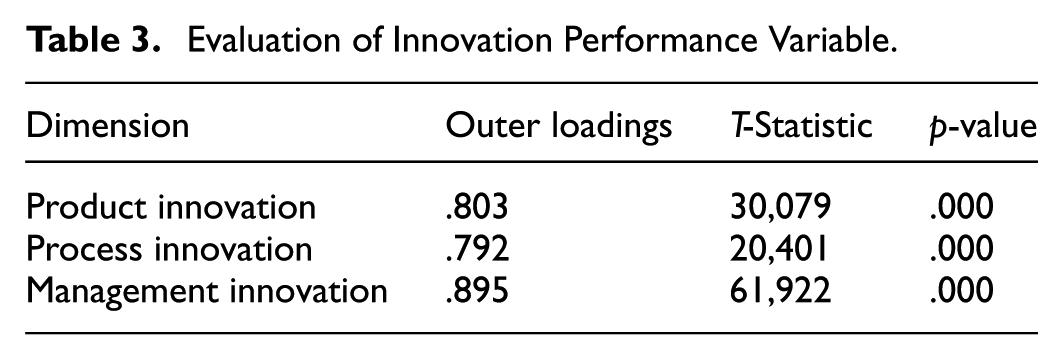
Assessing the measurement model of these latent variables depends largely on their substantive content, which is identified by comparing relative loadings and evaluating their significance. Table 2 shows that the two metrics associated with HR practices related to knowledge acquisition have p-values below .05, showing their statistical significance. The importance of these metrics in shaping their linked variables can be determined from their relative loadings, t-statistics, and p-values. Furthermore, Table 3 demonstrates that three metrics connected to innovation performance are statistically significant, with p-values under .05. Based on the relative loadings, t-statistics, and p-values, it is evident that among the four metrics, two play a key role in defining the HR practices variable, two strongly influence the knowledge acquisition variable, and three are vital in shaping the innovation performance variable.
Evaluation of Knowledge Acquisition Variable.

Evaluation of Innovation Performance Variable.
Further analysis reveals that HR practices’ impact on knowledge acquisition has an R2 of .494. The combined effect of HR practices and knowledge acquisition on innovation performance results in an R2 of .709. The mediating role of knowledge acquisition between HR practices and innovation performance is reflected by a Q2 value of .8528, indicating that 85.28% of the variability in the innovation performance construct is explained by these two primary variables, with 14.72% attributed to external factors.
Delving deeper, Table 4 shows that HR practices significantly influence knowledge acquisition with a path coefficient of .703, indicating a positive effect. The effect of HR practices on innovation performance, with a path coefficient of .433, and the impact of knowledge acquisition on innovation performance, with a coefficient of .479, are both positively significant.
Path Coefficient Analysis for Human Resource (HR) Practices, Knowledge Acquisition, and Innovation Performance.

Table 5 illustrates the mediating role of knowledge acquisition between HR practices and innovation performance, with a coefficient of .336, indicating significance once again. Essentially, the direct and indirect effects of HR practices on knowledge acquisition and innovation performance, including the influence of knowledge acquisition on innovation, are confirmed to be significant at the .01 level. This emphasises the crucial mediating role of knowledge acquisition in strengthening its impact on innovation performance.
The Indirect Effect of Human Resource (HR) Practices, Knowledge Acquisition, and Innovation Performance.

Discussions
The findings of this research reveals that HR practices in managing BUMDes in Indonesia are perceived as weak. This also affects the BUMDes’ ability to acquire knowledge both internally and externally, resulting in low innovation. Empirical evidence of the feeble HR practices in BUMDes organizations in the South Buton district is evident from indicators like the reward system. Up to now, BUMDes has not been able to implement a fixed salary system for its managers. Consequently, the compensation received by BUMDes managers for their work is still meagre and considered inadequate, leading many to seek employment elsewhere and relegating BUMDes activities to a side job.
Empirical phenomena based on this research also show that, to date, BUMDes in the South Buton district have not allocated funds for HR development activities, whether through education or training. Consequently, many BUMDes managers have never participated in educational or training programmes. This has resulted in many BUMDes managers lacking sufficient knowledge in BUMDes management, particularly in business development and financial administration. This deficiency also hampers the ability of BUMDes to innovate, whether in products, processes, or administration.
Alshekaili and Boerhannoeddin (2011) stated that knowledge is one of the most important strengths for an organisation’s success. The main benefit of knowledge is that it influences management in encouraging knowledge-sharing activities through various means, such as employee training, rewards, and a flexible environment via knowledge management programmes. This is crucial as most knowledge management failures arise from a lack of interest by the organisation’s management (Wang & Noe, 2010).
Collins and Clark (2003), and Wright and Boswell (2002) emphasise that effective HR management helps organisations achieve their goals more efficiently. Therefore, HR practices are essential for managing knowledge within organisations (Chatzoglou & Diamantidis, 2014). This idea aligns with research by Strack et al. (2012), which found that organisations that effectively manage their HR experience higher growth than those that do not. Empirical research by Patricia Ordóñez de Pablos (2006) explains that an organisation’s competitive advantage lies in its human resources’ ability to acquire and transfer knowledge. This study also corresponds with Harter et al.’s (2002) findings, which suggest that HR practices lead to increased knowledge, motivation, synergy, and organisational worker commitment, resulting in a sustainable competitive advantage for organisations.
HR management practices and knowledge acquisition are interconnected and mutually reliant constructs within the knowledge-based theory of organisations, with direct and indirect links to intangible assets regarded as the organisation’s vital strategic resources (Geiger, D., & Schreyögg, G., 2012). HR management practices involve effectively utilising people in organisations to encourage organisational members to interact, share knowledge, and accomplish organisational objectives (Al-Tit, 2016; Fong et al., 2011; Hunitie, 2017). At the same time, knowledge management pertains to an organisation’s capacity to capture, develop, organise, share, apply, and leverage knowledge assets to retain a competitive advantage, with HR playing a central role (Inkinen, 2016; Omotayo, 2015).
This research aligns with the empirical study conducted by Burden and Proctor (2000) on training and competitive advantage. They found that training is essential for organisations to achieve and sustain a competitive edge. Furthermore, research by Jerez-Góme et al. (2004) and Pillai (2016) revealed that HR management and HR practices, such as selection, remuneration, and training and development, act as drivers of employee behaviour and motivation, thereby shaping their learning attitudes and helping organisations attain peak performance. This study also supports Al Kaabi et al.’s (2018) findings, which suggest that remuneration positively and significantly impacts organisational innovation. From field assessments, it was observed that the limited capability of HR in the Village-Owned Enterprises to manage knowledge and forge partnerships – whether with other villages or with third-party entities such as private companies, universities, or financial institutions – is a primary factor contributing to the currently low levels of business innovation by Village-Owned Enterprises in South Buton district, Indonesia.
The findings of this study also align with the research by Ibrahim (2019), which determined that one of the barriers to the growth of Village-Owned Enterprises is the limited availability of HR. Moreover, the study supports the findings of Farooq et al., (2016), who concluded that HR management practices positively influence organisational innovation. Specifically, the dimension of training positively impacts organisational innovation, covering product, process, and administrative innovation. Furthermore, this research aligns with the findings of Collins and Clark (2003), who indicated that HR management practices can guide employees towards achieving organisational goals and encourage innovation (Camelo-Ordaz et al., 2011). Research by Schaffer and Paul-Chowdhury (2002) suggested that when employees perceive that their organisation’s HR management practices are seen as an investment by their superiors, they tend to reciprocate with positive work attitudes and behaviours, likely fostering innovation.
This study shows that most Village-Owned Enterprises in the South Buton district, Indonesia have poor knowledge management, particularly regarding knowledge acquisition. This has caused many of these enterprises to be unable to innovate to their full potential. The issue can also be linked to insufficient contributions from local facilitators, community empowerment cadres, and experts in transferring knowledge to the community and managers of Village-Owned Enterprises. As a result, they are limited and challenged in acquiring both external and internal knowledge and in applying the knowledge they already have. Additionally, research findings by Cheng and Shiu (2015) and Lichtenthaler (2015) explain that open innovation mechanisms involve acquiring external knowledge or technology through community participation, while other mechanisms focus on transferring internal knowledge or technology to external parties for economic or strategic reasons.
The findings show that HR practices significantly influence innovation performance through knowledge acquisition, with a path coefficient of .245 indicating a positive relationship. According to the research, it is clear that HR practices in managing Village-Owned Enterprises (BUMDes) in South Buton district and Indonesia overall remain relatively weak. This is mainly due to limited HR in rural areas. Such a situation impacts the selection process for BUMDes management, which cannot always meet the formal requirements outlined in regulations, especially those concerning skills and business experience. Although the recruitment and appointment of BUMDes management are conducted through village deliberations, some requirements are often overlooked because of HR limitations.
This phenomenon contradicts the Ministry of Villages, Development of Disadvantaged Regions, and Transmigration Regulation No. 3 of 2021, Article 14, which states that operational implementers of BUMDes should possess an entrepreneurial spirit, reside in the village for at least 2 years, have a good personality, be honest, competent, and focus on the village’s economic ventures, with at least a high school education. This aligns with the government’s goal of establishing independent villages through village entrepreneurship. Therefore, BUMDes managers must understand entrepreneurial principles to ensure that BUMDes can continuously innovate. Although there is no universally accepted consensus on best practices, literature reviews on HR management practices have identified five standard practices linked to meaningful business outcomes: performance assessment, career management, training, reward systems, and recruitment. Effective HR management practices motivate employees to experiment with new ideas, develop shared understanding, and implement changes in organisational activities, all of which are likely to contribute to organisational innovation. This research is consistent with the resource-based view (Becker & Huselid, 1998), emphasising the impact of HR management practices on organisational performance, particularly concerning innovation. Laursen and Foss (2003) found that HR practices promote organisational learning and enhance innovation.
Furthermore, this research aligns with Mahroum’s (2016) findings, demonstrating a positive relationship between knowledge management, HR practices, and innovation. Therefore, HR practices, including training, compensation, and employee development, can promote organisational success (Hanif et al., 2016). Additionally, the findings in this study Al-Tit et al. (2016), showing that HR smanagement practices can significantly predict organisational performance either directly or indirectly through knowledge management. This study also opens up opportunities for further research on other dimensions of knowledge management, such as knowledge retention, knowledge sharing, and knowledge application. Future researchers can expand this study by exploring these aspects as well as conducting studies in other companies or organissations to test the consistency of these findings. Therefore, the findings of this study offer a theoretical foundation for designing knowledge-based rural development policies. Rather than policies focused solely on physical infrastructure, the theoretical implications emphasise the necessity for policies that systematically build a knowledge ecosystem. Such policies should integrate HR practices, such as training and development, as strategic instruments to facilitate the retention and sharing of local knowledge. This approach transforms individual knowledge into collective social capital, thereby strengthening the adaptive capabilities of rural communities and creating a more sustainable and organic development model. Ultimately, this will accelerate economic development in rural regions
Conclusions
This study examined how HR practices influence organisational innovation performance, with knowledge acquisition acting as a mediator. The results show that HR practices and knowledge acquisition both directly and significantly impact organisations’ innovation performance. Likewise, the effect of HR practices on innovation performance – mediated by knowledge acquisition – also proves to be significantly positive. However, the direct effect of HR practices is stronger than the mediated effect. The findings highlight that poor quality of HR is a key factor in limiting the capability of BUMDes (Village-Owned Enterprises) to acquire knowledge internally and externally, which affects their ability to improve innovation performance, whether in products, processes, or administration.
The poor quality of HR can also be linked to the fact that BUMDes has yet to allocate funds for HR development, whether for education or training, from the village’s contribution managed by BUMDes. This has resulted in many BUMDes managers in South Buton never attending educational or training activities. Furthermore, the lack of a fixed salary system demotivates BUMDes managers from innovating. Many BUMDes managers even regard BUMDes as a side job, engaging more in other activities to increase their family’s income.
Therefore, as the government aims to establish BUMDes as the economic driving force in rural areas, leveraging local potential to empower micro-businesses and create employment opportunities for village residents, it is urgent to assess HR practices. Furthermore, BUMDes and village governments must develop an incentive system and salary structure for managers to boost their motivation and performance.
Limitations of this study include its focus on intervening variables, specifically the variable of knowledge acquisition. In knowledge management theory, knowledge acquisition is only one aspect; other elements such as knowledge storage, sharing, and application were not examined in this study. Therefore, future researchers might consider exploring these additional dimensions of knowledge management. Additionally, subsequent studies could reassess the variables in this research by sampling different companies.
Footnotes

Funding
The authors received no financial support for the research, authorship, and/or publication of this article.
Declaration of Conflicting Interests
The authors declared no potential conflicts of interest with respect to the research, authorship, and/or publication of this article.
Data Availability Statement
Data sharing not applicable to this article as no datasets were generated or analyzed during the current study.