




Abstract
The purpose of this study is to explore when leaders of manufacturing companies in China adopt high-performance work system (HPWS) and authoritarian leadership to pressure employees to maintain their intention toward organizational innovation improvement. These two approaches can trigger employee resistance and further affect innovation and financial performance. We collected data through the responses of 224 manufacturing companies in China. Regarding the methodology, Spearman’s rank correlation coefficient and partial least squares (PLS) regression are the primary methods used. Our findings indicate that employees’ resistance as a moderator certainly affects the relationship between improving organizational innovation and achieving innovative performance, which also affects financial performance. In addition, authoritarian leadership will lead to employees’ resistance. However, if leaders adopt HPWS to promote employees’ intention toward innovation improvement, although there is a lack of direction between HPWS and employees’ resistance, employee resistance can still be triggered if leaders lack commitment. In this contribution, the research results not only remind the leaders of manufacturing companies in China to reconsider whether to adopt a new approach or to combine their current approach with a commitment to redesigning HPWS to promote employees’ intention toward organizational innovation but also remind leaders of manufacturing companies from other countries to change their approach to addressing employees’ intention toward innovation improvement when the environment, culture, or personality traits change.
Keywords
Introduction
Innovation is an important index for measuring the survival ability of a business in a highly competitive environment (Colino et al., 2014). Thus, to achieve powerful survival ability and improve the development of sustainability, it is critical to increase innovation capability (Anderson et al., 2014).
In the field of innovation research, the Organisation for Economic Co-operation and Development (2005, Oslo Manual) indicated that there are four types of innovation: product innovation, process innovation, marketing innovation, and organizational innovation. Although S. Lee et al. (2010) indicated that these four innovations are equally important for businesses, Camisón and Villar-López (2014) indicated that without substantial organizational innovation, it is difficult to improve the other three types of innovation. Thus, organizational innovation is deemed to have critical importance.
In a manufacturing company, organizational innovation plays a critical role. Actually, the production and improvement of products, production processes, and marketing innovation usually depend on a substantial organizational structure (Visnjic et al., 2016). In various external competitive environments in particular, a quality manufacturing organization should possess an innovative capability to change its organizational structure based on competitive environment demands. Only then will it be possible to possess great technical capabilities to improve innovative products, production processes, and marketing policies to address environmental demands. For that reason, R. Lee et al. (2019) and Bujidos-Casado et al. (2017) indicated that organizational innovation in manufacturing companies is more important than the other three innovation capabilities and that improved organizational innovation has a positive effect on improving products, production processes, and marketing innovation, ensuring that these three types of innovation will be achieved, fostering highly innovative performance and further improving financial performance (Artz et al., 2010; Evanschitzky et al., 2012).
China’s manufacturing companies are familiar with this principle. Especially, as today’s manufacturing companies in China play a critical role in the whole world’s supply chain, they certainly need to raise their organizational innovation ability to improve innovative products, production processes, and marketing policies, and manufacturing companies in Southeast Asia can act as a substitute for China’s critical role in the whole world’s supply chain at any time.
To improve organizational innovation, Jaiswal and Dhar (2015) and D. Liu et al. (2017) indicated that employees’ intention toward innovation improvement is critical. Because innovation should depend on new ideas or knowledge, Park et al. (2014) indicated that new ideas or knowledge are created by employees. When employees maintain a high intention toward organizational innovation, the speed and ability of organizational innovation will be enhanced. Thus, leaders of manufacturing companies should encourage such employee intention. In China, due to the culture of feudalism, unlike manufacturing companies from Western countries, managers of Chinese manufacturing companies prefer pressuring employees.
To promote employees’ intention toward innovation improvement, today’s manufacturing companies in China prefer to create pressure to maintain and raise employees’ intention. Why do they decide to pressure employees? When the Chinese government decided on its economic reform and opening up in 1978, more people were living through extreme poverty periods. These people established a home under the period and bred the next generation; due to worrying that their children will experience poverty again, parents worked hard for their money. However, a weird phenomenon occurs in China. Perhaps due to the fear of poverty, these parents always show a utility view toward their children. In addition, although these parents work hard, their income is always used to spoil their children. Finally, their children have two personality traits. First, they are obviously utilitarian; second, due to being spoiled, their work attitude appears lazy and desultorily.
Therefore, when these children leave school and enter the real world, unfortunately, they become the main employees of today’s manufacturing companies. To address their personality traits, manufacturing companies usually adopt two approaches to create pressure, including a high-performance work system (HPWS) and authoritarian leadership style. Regarding the practice of an HPWS, leaders usually set high work performance indices and require that every employee commit to do their best to achieve these indices (Datta et al., 2005). In China, leaders prefer to set multiple-stage performance targets with multiple-stage high-performance rewards. When these employees use new ideas to raise organizational innovation and help companies achieve the staged targets, they will be paid accordingly. However, if they cannot keep achieving higher performance, then they may be fired or reduce remuneration. Authoritarian leadership is associated with a leader who adopts coercion to manage and pressure employees (Miller, 2016). Regarding the practice of authoritarian leadership in China, the company management system usually is combined with the Chinese communist party system, which is a form of centralized management in which leaders usually have greater authority. When leaders give orders, employees need to complete them, regardless of their difficulty. Therefore, in recent decades, more leaders of manufacturing companies have become accustomed to using authoritarian leadership to pressure employees for the purpose of organizational innovation. Surprisingly, employees always try their best to do everything and never resist because they worry that they will be punished if they resist.
However, recently, an increasing number of leaders have begun to doubt the effect of an HPWS and authoritarian leadership. First, an increasing number of employees may make great efforts at work to increase organizational innovation in the beginning; however, after some time, they resist performing at higher levels. Second, although employees never resist the authoritarian leadership of leaders, they abide to actively improve organizational innovation. However, increasing organizational innovation ability is becoming increasingly difficult. It seems to be a form of passive resistance.
Although the above situation has appeared gradually, the investigation results of some recent empirical studies suggest that these two approaches still have a positive effect on manufacturing companies in China. For example, Tang et al. (2017) and Miao et al. (2020) indicated that pressure from an HPWS is positive, and employees’ creativity will be sparked by pressure from an HPWS and further increase organizational innovation ability. Hou et al. (2019) indicated that although authoritarian leadership seems negative, it still has an effect on pressuring employees’ intention toward increasing organizational innovation, and thus, they never resist it.
There seems to be a conflict between recent phenomena and investigation results. Based on the above factors, the purpose of this study will be to explore the following question: When leaders of manufacturing companies in China adopt an HPWS and authoritarian leadership to pressure employees to maintain intention toward organizational innovation improvement, can these two approaches trigger employees’ resistance and further affect innovation and financial performance?
The research question is very important for leaders of manufacturing companies in China or any business organization leaders who plan to build a production base in China. If the effects of an HPWS and authoritarian leadership certainly decrease, then the internal environment of the business organization will change. Employees’ personality traits may change, and leaders need to reidentify a fit management approach to maintain employees’ intention toward innovation improvement. However, if the effect of an HPWS is still significant and the effect of authoritarian leadership reduces triggered resistance, which may mean that employees have become obviously utilitarian, leaders may need to rethink how to design a better HPWS. If the effect of authoritarian leadership is significant, then it is worth thinking deeply about the phenomenon because it is unusual. Irrespective of the result, it will help leaders of manufacturing companies in China rethink how to promote employees’ intention toward organizational innovation improvement.
Literature Review and Hypothesis Development
Literature Review
Innovation is defined in one of two ways: “(1) the introduction of something new or (2) a new idea, method, or device” (Kahn, 2018). From the manager perspective, the primary purpose of innovation is to introduce change into the organization to create new opportunities or exploit existing opportunities (Damanpour & Wischnevsky, 2006). Therefore, innovation has become an important activity in today’s business organizations.
Organizational innovation is one way to innovate. It is defined as a new organizational method in a firm’s business practices, workplace organization or external relations that is new to the firm and intended to improve firm performance (Caning & Edralin, 2019; Nikpour, 2018). The development of the new organizational method is based on new ideas (Waheed et al., 2019) or new knowledge (Allouzi et al., 2018). These new ideas and knowledge can be produced through internal individual employees. In practice, more manufacturing companies certainly encourage their employees to provide new ideas and knowledge to solve or create new production and business process technology for related problems about business practices and production processes.
However, why do manufacturing companies need to improve organizational innovation? According to Evangelista and Vezzani (2010) and Khanagha et al. (2013), the purpose of organizational innovation is to improve innovation performance and thereby achieve great financial performance. Camisón and Villar-López (2014) found that improved organizational innovation has a positive effect on technical innovation capability and that technical innovation capability can improve product and process innovation to address market demands. In addition, Laforet (2013) indicated that high-quality organizational innovation increases innovation capabilities for internal and external operations, including production, marketing, and human resource management. Therefore, we find that improved organizational innovation increases innovation capabilities. When these innovation capabilities achieve a high level of innovation performance, financial performance can also be improved. Based on the above factors, relationships among the improvement of organizational innovation, innovation performance, and financial performance are possible.
The improvement and increasing of organizational innovation are not going smoothly. As Jaiswal and Dhar (2015), D. Liu et al. (2017), and Hussain et al. (2018) noted, the improvement of organizational innovation usually depends on employees’ intention. Because innovation should depend on new ideas or knowledge, Park et al. (2014) indicated that new ideas or knowledge are created by employees. Therefore, existing studies focus on how to maintain or increase employees’ intention. These methods include the development of team innovation climate and environment (Ullah et al., 2016), motivation mechanism of an HPWS (Alatailat et al., 2019; Kundu & Gahlawat, 2016), or leadership behavior including transformational (Al-Husseini et al., 2019; Elrehail et al., 2018) and authoritarian leadership (Lacap, 2019; Wu & Lin, 2018).
However, the existing study also found that some factors may cause employee resistance and reduce their intention toward new knowledge sharing. Employees have their own emotions (Ittipanuvat et al., 2014). If employees’ emotions are negative and resistant, then the improvement of organizational innovation will be affected and may even be halted. For this reason, studies have recently begun to note the effects of employees’ intention and attempt to explore which factors lead to employees’ negative emotion, leading to further resistance to the intention toward organizational innovation improvement. However, we can find that more studies usually start their discussion of the question from the perspective of change. For example, Montes et al. (2004) indicated that innovation will cause a redistribution of income. If their contribution to new knowledge is lower than that of other employees, then it might cause personal value loss and income to be affected. Therefore, employees will resist organizational innovation. Masih et al. (2018) indicated that employees believed that knowledge is their using value. If they easily share, their use value will decrease, and the organization will lose competitiveness. To solve this problem, related studies have also been conducted. For example, psychological empowerment and organizational citizenship behaviors are used.
Previously, research on organizational innovation has usually focused on “organizational-level variables.” However, since related research began to explore the relationship between employees’ resistance and organizational innovation and further explore which factor will lead to employee resistance, today’s research on organizational innovation has begun to also include individual variables. Individual emotion, behavior, and thinking can affect the improvement of organizational innovation. In practice, this is also a common phenomenon.
Existing research has indicated that organizational innovation brings about change, and employees may resist innovation because the change will lead to restlessness. Therefore, to avoid resistance, existing research focuses on this point. However, a weird phenomenon appears. Today’s leaders of business organizations try to maintain employees’ intention toward organizational innovation through the development innovation environment, motivation mechanism, or fit leadership behavior. It may work in the beginning; however, with long-term practice, employees may appear to engage in irritated or antipathetic behavior and even resist innovation, but the problem is not their resistance to change. Similar to our research background, based on the culture of feudalism, leaders of manufacturing companies in China usually adopt an HPWS and authoritarian leadership to pressure employees to ensure that they maintain intention toward organizational innovation. In recent decades, these two approaches have worked well. However, an increasing number of leaders have found that employees begin to resist cooperation with organizational innovation. Considering different cultures and personality traits, business organizations from different economies usually adopt different approaches to maintaining employees’ intention. However, when the original approach loses its effect gradually and even causes employees to resist, it may be a hint that employees’ thinking, behavior, or cultural cognition has changed. During this time, leaders may measure which type of approach is still working and further identify the change in direction of employees’ thinking, behavior, or cultural cognition to redesign a new approach for maintaining employees’ intention. However, existing research still lacks exploration based on the above concept. Therefore, this study is based on manufacturing companies in China to address the above question. The research results certainly expand the gap of the existing research and further provide valuable practical implications for practitioners.
Hypothesis Development
Based on the research purpose and literature review, this study will develop a theoretical framework and further test to explore our research question. The theoretical framework is shown in Figure 1. To verify the theoretical framework, this study will develop related hypotheses.

Theoretical framework.
The relationships among the improvement of organizational innovation, innovative performance, and financial performance
In fact, good innovative performance usually means that a business has high product innovative capability, process innovation capability, and marketing innovation capability (Ballot et al., 2015). That said, how can a business improve these innovative capabilities? According to Soto-Acosta et al. (2016), organizational innovation is critical. A high level of organizational innovation capability can increase internal technical ability and resources to support product, process, and marketing innovation. Thus, related studies, such as those by Camisón and Villar-López (2014) and Lopez-Valeiras et al. (2016), have indicated that organizational innovation will have a positive effect on increased innovative performance. However, whether organizational innovation can truly enhance innovation performance is still in doubt. According to McKinsey report, Satell (2017) indicated that while 84% of corporate executives think innovation is key to achieving growth objectives, only 6% are satisfied with the innovation performance of their firms. Because the idea is new, although it can help firms develop new organizational methods to improve business and production processes, these new organizational methods need to be verified over a long time. Therefore, it is difficult to show the results in a short time. Thus, innovation performance is not significant. Based on the above factors, the following hypothesis is established and tested in this study:
According to Camisón and Villar-López (2014), good innovative performance will help the business expand its market share, thereby increasing its profit. Based on increased profit, Sadikoglu and Zehir (2010) further indicated that there is a relationship between innovative performance and financial performance. In fact, studies such as those by Černe et al. (2015), Sok and O’Cass (2015) and Baker et al. (2016) have found that innovative performance will improve financial performance. Based on the above factors, the following hypothesis is established and tested in this study:
The relationship among an HPWS, authoritarian leadership, and employee resistance
According to Ashraf and Javed (2014), employees usually possess the characteristics of lazy attitudes and negative behavior. This may seem to be an extreme statement, but the situation certainly has happened in our generation. However, it cannot be called a “lazy attitude.” Arnett (2015) believed that the majority of employees are often not fully committed to their job. He indicated that if managers distribute related missions, such as innovation ideas, then 89% will do as well as possible. However, 40% of this 89% also admitted that they may try to get by doing as little work as possible. If this situation is called lazy, then it may not be appropriate. However, in the eye of managers, it is lazy and also a negative behavior. Therefore, when improving organizational innovation, it is necessary to avoid employee characteristics that affect the improvement of organizational innovation. Ishak et al. (2016) believed that it is necessary to pressure employees. In the real world, it is common practice for leaders to pressure employees by implementing a HPWS and adopting an authoritarian attitude. However, these common practices may lead to employee resistance.
According to related research such as Jensen et al. (2013) and Y. Zhang et al. (2015), the requirements of an HPWS will impose heavy pressure on employees. That pressure will cause employees to believe that it is difficult to achieve the required work performance, thus decreasing their passion for work. Because they know that their job security will be affected when they cannot achieve the required work performance, employees may appear to resist. They might adopt a negative or extreme attitude and refuse to cooperate with management policy (Mariappanadar, 2013). Mariappanadar (2014) indicated that employees can even create conflict and intentionally damage property. Existing studies have indicated that an HPWS has a positive effect on the promotion of employees’ intention and attitude. However, Fernandez (2016) found that this is not completely true. He cited investigation reports from Regus Group and McKinsey Quarterly to explain that when employees are controlled under the HPWS, they may enhance their intention in the beginning for motivational reward. However, it is impossible for organizations to reduce their performance level. If employees can achieve a certain level of performance, then the organization will set a higher performance goal, which leads to a greater higher challenge. When there is a long time needed to pursue the achievement of high performance, it will lead to anxiety and burnout and further cause pressure. During this time, employees’ intention will decrease, and they will resist organizational innovation, even stopping the improvement of organizational innovation, which can lead to poor innovative performance.
In addition, although authoritarian leadership will compel employees to cooperate with organizational innovation improvement (Farh & Cheng, 2000), this approach leads to psychological stress and insecurity at work. This psychological stress and insecurity will lead to employee resistance and extreme emotion (A. Y. Zhang et al., 2011). In addition, authoritarian leadership will debase the contributions of employees (Erben & Güneşer, 2008). This situation can easily increase employee dissatisfaction. Finally, it leads to employee conflict and extreme emotion (Fritz & Sonnentag, 2009). For this reason, authoritarian leadership may lead to employee resistance. Based on the above factors, the following hypotheses are established and tested in this study:
Employee resistance, as a moderator, affects the relationship between the improvement of organizational innovation and innovation performance
When employees’ attitudes become negative or even resistant, they may either be passive or resist the improvement of organizational innovation (Yang et al., 2016). Goepel et al. (2012) further indicated that when employees appear to have a resistant attitude, they show extreme emotions. They refuse to cooperate with the improvement of organizational innovation, leading to poor innovation performance. Bergendahl and Magnusson (2015) and Choi et al. (2016) noted that individual employees are an important base for improving organizational innovation. If these employees show a passive attitude and appear to engage in resistant behavior, then they will probably affect the improvement of organizational innovation, thus further decreasing innovation performance. Based on the above factors, the following hypothesis is established and tested in this study:
Method
Questionnaire Constructs, Data Collection, and Sample Profile
For verification hypotheses, this study utilizes an empirical test. In the empirical test, six variables are involved in this study according to the research model and hypotheses, including the improvement of organizational innovation, innovation performance, financial performance, an HPWS, authoritarian leadership, and employee resistance. Therefore, we collect empirical data in practical situations that involve these six variables. Based on these six variables, we further design scale items through the use of related literature. Finally, these scale items are used to design a questionnaire, as shown in Table 1, and empirical data are collected. Regarding the questionnaire, its survey will adopt a 5-point Likert-type scale to investigate.
Questionnaire Constructs.

Note. HPWS = high-performance work system; ROS = return on sales; ROI = return on investment.
During data collection, this study surveyed a large manufacturing company in Zhejiang Province in China. Overall, 100 manufacturing companies in Zhejiang Province were active in improving organizational innovation. Considering the research purpose, this study investigates the president, vice president, and project manager of organizational innovation. There are 300 of these leaders from 100 manufacturing companies. Regarding the data collection method, we designed an online questionnaire on a web platform and sent a questionnaire linked by e-mail. Then, we received 224 responses, for a 74.67% response rate; thus, the sample size satisfied the minimal requirement. In the sample profile, 17.86% of leaders improved organizational innovation in less than 1 year, 33.04% did so in less than 3 years, 29.46% did so in less than 5 years, and 19.64% did so in more than 5 years.
Normality
According to prior analysis, data normality should be ensured. We calculated the mean, standard deviation, skewness, and kurtosis to measure data normality. All calculation results are provided in Table 2. According to the results indicated in Table 2, all the data of the variables meet the requirement of normality.
Results of Normality.

Method
In this study, Spearman’s rank correlation coefficient and partial least squares (PLS) regression are the primary methods used to evaluate the research model and hypotheses. Spearman’s rank correlation coefficient is a technique that can be used to summarize the strength and direction of a relationship between variables. PLS regression is an excellent method for analyzing path relationships and moderation through estimates of standardized regression coefficients for paths, which can then be used to measure the research hypotheses. Thus, we adopt the PLS method to verify the research hypotheses. In this study, we used SmartPLS 3.0 as an analytical tool.
However, why do we use Spearman’s rank correlation coefficient? Actually, it was used for studying the significance of the one-way variance test and for investigating differences, and multivariable regression was used for exploring the simultaneous effect of independent variables on dependent variables and for path analysis confirmation (Jafarabadi & Kaffashi, 2017). Vol. 17(2) of Organizational Research Methods, used to discuss the correlation test of PLS, found that the test process had weaknesses and suggested that researchers should adopt mixed methods to enhance the correlation test, or it will affect the results of path analysis. Based on the above, this study combines Spearman’s rank correlation coefficient to enhance the PLS analysis results.
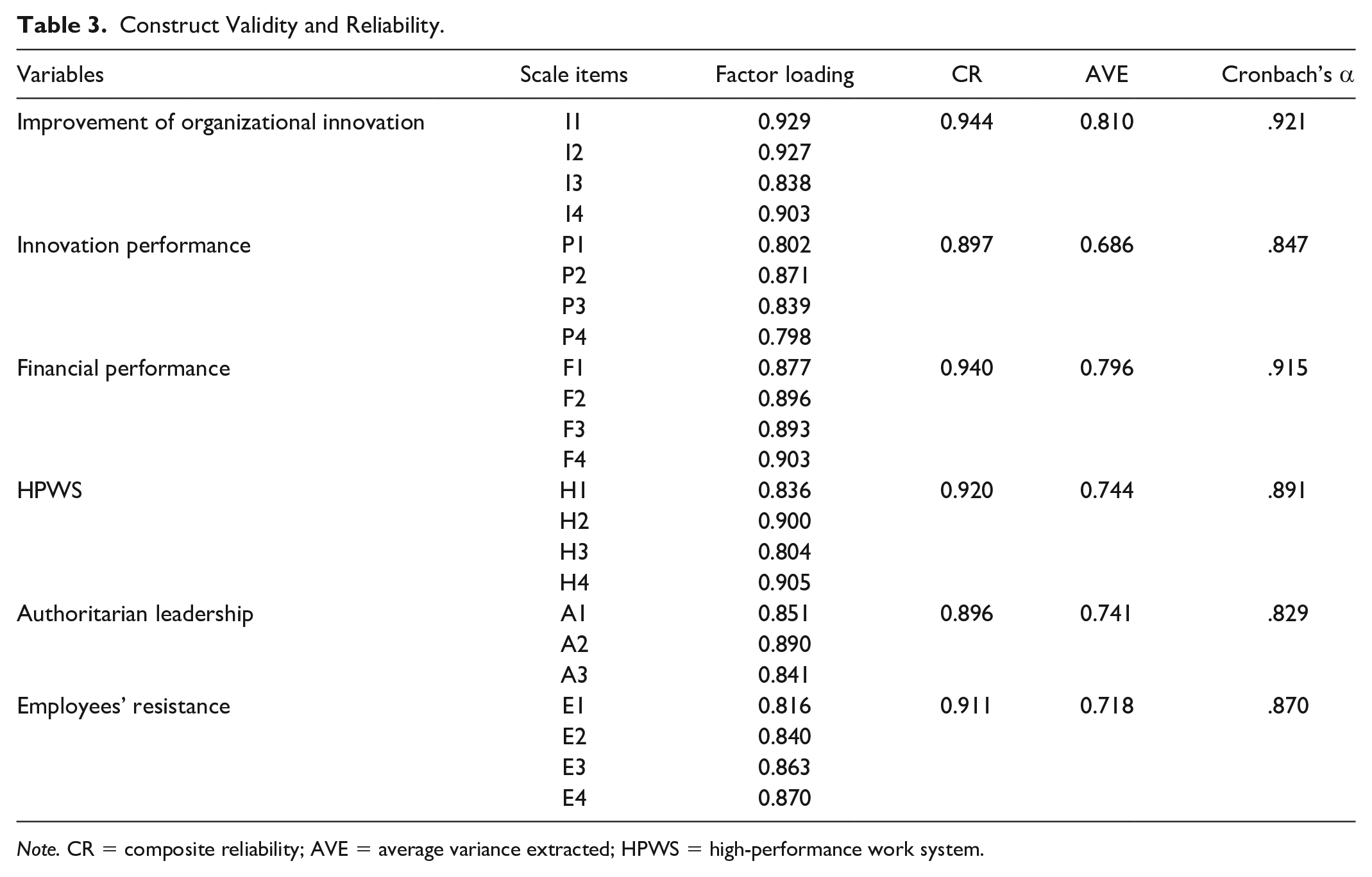
To test the previous research hypotheses, the validity and reliability of the constructs should be tested. In construct validity, composite reliability (CR), average variance extracted (AVE), and factor loadings are the primary indices. For reliability, Cronbach’s alpha is the primary index. To satisfy the requirements of CR, AVE, and factor loading, Fornell and Larcker (1981) and Bagozzi and Yi (1988) recommended that the CR and AVE values should exceed 0.7 and 0.5 or above, respectively, and the factor loadings should exceed 0.5. For reliability, according to Nunnally (1978), the value of Cronbach’s alpha should exceed 0.7. In addition to validity and reliability, model fit should satisfy the requirement related to the recommendation value. In this study, the standardized root mean square residual (SRMR) is the main index of model fit and should be lower than 0.05.
Results and Discussion
Test Results
When analyzing prior hypotheses, we need to test for validity and reliability, and all the test results are provided in Table 3. According to Table 3, factor loadings from every variable significantly exceeded 0.5. In regard to the AVE and CR values, all AVE values exceed 0.5 and CR values exceed 0.7; thus, convergent validity is acceptable. For reliability, Cronbach’s alpha value of six variables exceeds 0.7, thus satisfying the requirement.
Construct Validity and Reliability.
Note. CR = composite reliability; AVE = average variance extracted; HPWS = high-performance work system.
Next, we test the correlation through Spearman’s rank correlation coefficient, and the test results are shown in Table 4. Table 4 also shows the mean and standard deviation, which also involves the correlation coefficient. According to the test, the correlation between variables is significant. According to Table 4, we can infer that all hypotheses are supported.
Spearman’s Rank Correlation Coefficient.

Note. HPWS = high-performance work system.
p < .01.
Finally, we use PLS regression to test hypotheses. Following the suggestions of Hair et al. (2011), we performed a bootstrapping procedure with 5,000 subsamples to test the significance of each path coefficient using t tests. In addition, the test process of bootstrapping also involves testing the moderation effect. All test results are shown in Table 4. As shown, the path coefficient between the improvement of organizational innovation and innovative performance is 0.800, and the p value is .000, which is lower than .01; therefore, the result has significance. The path coefficient between innovative performance and financial performance is 0.790, and the p value is .000, which is lower than .01; therefore, the result is significant. Based on the above, Hypotheses 1 and 2 are supported.
In addition, Table 4 shows the results among HPWS, authoritarian leadership, and employee resistance. As shown, the coefficient between HPWS and employee resistance is −.038, and the p value is .564, which is higher than .05; therefore, the result has no significance. The coefficient between authoritarian leadership and employee resistance is .361, and the p value is .000, which is also lower than .01; therefore, the result has significance. Based on the above, Hypothesis 3 is not supported, and Hypothesis 4 is supported.
Finally, we test for the moderation effect of employee resistance. The coefficient is .091, and the p value is .020, which is lower than .05; therefore, the results have significance. This means that employee resistance, as a moderator, affects the relationship between the improvement of organizational innovation and innovation performance. Based on the above factors, Hypothesis 5 seems to be supported. Regarding the model fit, SRMR is 0.056 and lower than 0.08; thus, the model fit is also accepted (Table 5).
Test Results of PLS.

Note. SRMR = 0.056. PLS = partial least squares; HPWS = high-performance work system; SRMR = standardized root mean square residual.
p < .05. **p < .01.
Discussion
Based on the analysis results, this section will provide a conclusion for the research hypothesis and question and further discussion. First, the Spearman rank correlation coefficient test results show that the correlation between variables is significant. When comparing research hypotheses, it seems that all hypotheses are supported. Regarding the test results of PLS regression, the test results showed that Hypotheses 1, 2, 4, and 5 are supported, and Hypothesis 3 is not supported. That means that the HPWS does not trigger employee resistance.
As expected, an improvement of improved organizational innovation certainly results in innovative performance and increased financial performance. In addition, we found that employee resistance certainly moderates the relationship between the improvement of organizational innovation and innovative performance. This means that when employees appear to adopt a resistant attitude, they can disrupt the improvement of organizational innovation, leading to poor innovative performance and affecting financial performance.
Regarding the factors triggering employee resistance, as an introduction, according to the personality traits of employees in China, the leaders of manufacturing companies believe that they can pressure employees through an HPWS and authoritarian leadership to maintain their intention toward organizational innovation. However, according to the test results of the Spearman rank correlation coefficient and PLS regression, authoritarian leadership certainly has lost its effect and easily triggered employee resistance. Why did authoritarian leadership lose its effect? We can explain this through China’s recent network phenomenon and rule of law phenomenon. In the network phenomenon, an increasing number of people began to share about the workplace situation on the network platform with one another, such as the Sina Weibo blog. More people may bear pressure from leaders, but it does not mean that they are willing to cooperate with such pressure. In particular, authoritarian leadership usually involves negative words (Alqudah, 2011; Sorenson, 2000), and it is easy to trigger employees’ negative emotions. Therefore, an increasing number of people make a complaint on the web blog and interact with people who have the same experience. However, as a special phenomenon, some people like to share how they resist the leader’s authority. Although we cannot identify this information about whether resistance authority is true or fake, this information usually has a potential effect in advocating peoples’ resistance. In today’s China, internet writers have driving power, which causes an increasing number of people to resist authoritarian leadership. In addition, the rule of China law in labor rights has improved considerably. Therefore, an increasing number of people apply labor dispute arbitration when they feel or meet unreasonable pressure from authoritarian leadership. Let us not wonder how these labor dispute arbitration results, but people do not fear authoritarian leadership and actively fight for rights, which has become a normal phenomenon in China. Based on the above, we can say that networks and rules of law have changed the personality traits of employees, which is why authoritarian leadership has lost its effect and triggered employee resistance.
Regarding an HPWS, although the test results of the Spearman rank correlation coefficient show that the correlation between an HPWS and employee resistance is significant, the test results of PLS regression indicate that an HPWS does not lead to employee resistance. Although the test result between the Spearman rank correlation coefficient and PLS regression is conflicting, it can be explained. Actually, today’s China has a serious problem, that is, utilitarianism prevailing. If we review the wanted advertisement of China, we can find that the majority of advertisements usually flaunt “high performance and high reward.” However, when new employees take office, they will bear pressure from high performance. When they achieve basic-level performance, companies will require employees to achieve higher performance, or their wages will reduce or even affect their working ability. However, these employees are still willing to bear pressure. Because of a weird social phenomenon, these individuals like to flaunt their wealth! In today’s China, people’s behavior and conversation always are geared toward the pursuit of a great deal of wealth. Many individuals are always jealous of others because their income is higher than their own, and the situation promotes people to pursue a great deal of wealth. Therefore, if achieving high performance can help people obtain large rewards, then the majority of people will be willing to bear pressure from achieving high performance and never resist. Even though, when achieving performance, if leaders cannot pay accordingly or the reward cannot satisfy employees’ desired results, then it will trigger resistance. Actually, the problem concerns the leader’s commitment. As Pahi et al. (2015) and Garg and Ramjee (2013) states, commitment will influence employees’ trust. Actually, more leaders of manufacturing companies in China certainly lack commitment to their employees. Therefore, it is a risk to trigger employees’ resistance. Based on utilitarianism, although employees are willing to bear pressure from an HPWS, if they lack commitment, then it is still possible to trigger resistance. Compared with the phenomenon in the introduction, some employees resist challenging higher performance, mainly because of commitment. Therefore, leaders of manufacturing companies in China should consider how to revise their HPWS and combine it with commitment.
Conclusion
The purpose of this study is to explore when leaders of manufacturing companies in China adopt an HPWS and authoritarian leadership to pressure employees to maintain intention toward organizational innovation improvement. These two approaches can trigger employee resistance and further affect innovation and financial performance. Based on our test results and discussion, our research conclusion indicated that employee resistance, as a moderator, certainly affects the relationship between the improvement of organizational innovation and achieving innovative performance, further affecting financial performance. In addition, when leaders adopt authoritarian leadership to produce pressure and push employees’ intention toward improve organizational innovation, the result is employee resistance, which further disrupts the relationship between the improvement of organizational innovation and innovative performance. However, if leaders adopt an HPWS to push employees’ intention, then they can avoid the appearance of employee resistance. However, according to our discussion, if there is a lack of commitment, then the HPWS will still trigger employee resistance.
Regarding academic implications, considering different cultures and personality traits, business organizations from different economics usually adopt different approaches to maintain and raise employees’ intention toward organizational innovation. However, when the original approach loses its effect gradually and even causes employees to resist, it usually means that employees’ thinking, behavior, or cultural cognition change. Similar to our research results, although an HPWS and authoritarian leadership were deemed effective approaches for manufacturing companies in China, the research results found that authoritarian leadership has gradually lost its effect, even causing employee resistance. However, an HPWS still maintains its effect. This means that employees were sick about the control of authoritarian leadership and preferred the reward from an HPWS. If leaders of manufacturing companies in China hope to maintain employees’ attending intention, then they should consider how to design a better motivation mechanism based on an HPWS, even when combined with leadership commitment. Our research tries to explore the relationship between organizational innovation and employee resistance from different directions and viewpoints, and the existing research still lacks an exploration of the causes of employee resistance based on the above research direction. For this reason, our research expands the field of organizational innovation research and provides different directions to exploit the relationship between organizational innovation and employee resistance. Therefore, it has great academic implications.
As a practical implication, we found that an HPWS still has an effect and never causes employee resistance. These results seem to mean that China’s employees have changed their sense of worth, and they are willing to bear pressure for the reward from an HPWS. This means that if leaders of manufacturing companies in China hope to enhance employees’ attending intention in organizational innovation, they must design a better motivation mechanism based on an HPWS and no longer use authoritarian leadership. In addition, although our research focuses on manufacturing companies in China, the same concept can be considered in other contexts. This means that business organizations from different economies should recheck their approach in maintaining and raising employees’ intention to measure its effect and further confirm the thinking and behavior of their employees when they change and should implement or revise the approach to avoid employee resistance.
For research limitations, first, this study only explores manufacturing companies in China. Our research direction and viewpoint can provide new thinking and further be applied to manufacturing companies or business organizations from different economies to explore how to effectively improve organizational innovation and avoid employee resistance. However, this study still lacks an exploration of different economics in this study. Second, the research results indicated that an HPWS is still working to improve organizational innovation for manufacturing companies in China and never causes employee resistance. In the discussion, we even suggested that leaders of manufacturing companies in China should combine an HPWS with commitment and design a better motivation mechanism to positive pressure employees’ and further maintain or raise attending intention in organizational innovation. However, our study never discusses how to combine with commitment to design the motivation mechanism based on an HPWS. Based on the above factors, future research can focus on the above limitations. Researchers can explore manufacturing companies or business organizations from different economies to explore the effect of the adopted approach on maintaining and increasing employees’ intention and whether change can cause employee resistance. In addition, we further measure and select a better approach to maintain and increase employees’ intention. Finally, if researchers are interested in the exploration of manufacturing companies in China, then they can further explore how to combine commitment and further design a better motivation mechanism based on an HPWS to maintain and increase employees’ intention toward organizational innovation.
Footnotes
Declaration of Conflicting Interests
The author(s) declared no potential conflicts of interest with respect to the research, authorship, and/or publication of this article.
Funding
The author(s) disclosed receipt of the following financial support for the research, authorship, and/or publication of this article: This research was funded by The National Social Science Fund of China, Grant 19BGL271.
