




Abstract
It has become a common way for enterprises to use external knowledge to reduce the development bottleneck caused by internal resource constraints. How does external knowledge develop inside enterprises and then promote the innovation performance? Drawing upon resource-based view and dynamic capability theory, this study proposes a chain mediation model of how firms’ opportunity identification and R&D, as two distinctive microfoundations of dynamic capabilities, mediate the relationship between external knowledge acquisition and firms’ innovation performance. Through the questionnaire survey of Chinese high-tech enterprises, the results show that both external market knowledge acquisition and external technological knowledge acquisition influence the level of opportunity identification and internal R&D activities, so that the internal knowledge base of the enterprise can be updated or reconstructed, and the innovation performance can be improved. This further confirms that enterprises transform external knowledge with the role of dynamic capabilities, which enriches the research on open innovation from the perspective of dynamic capabilities.
Plain Language Summary
The single-use of resource-based view makes it difficult to explain how external knowledge acquisition enhances innovation performance. Drawing upon resource-based view and dynamic capability theory, this study proposes a chain mediation model of how firms’ opportunity identification and internal R&D, as two distinctive microfoundations of dynamic capabilities, mediate the relationship between external knowledge acquisition and firms’ innovation performance. Through the questionnaire survey of Chinese high-tech enterprises, the hierarchical regression results show that both external market knowledge acquisition and external technological knowledge acquisition influence the level of opportunity identification and internal R&D activities, so that the internal knowledge base of the enterprise can be updated or reconstructed, and the innovation performance can be improved. This further confirms that enterprises transform external knowledge with the role of dynamic capabilities, which enriches the research on open innovation from the perspective of dynamic capabilities.
Keywords
Introduction
The hi-tech enterprises are facing the pressure brought by the accelerating frequency of technological change and the shortening of product life cycle. How to break through the internal resource constraint of the enterprise and develop new products ahead of the competitors in a limited time are major problems faced by enterprises in their business practice. With the improvement of technological complexity, even if enterprises have a high technological level and scientific research strength, it is difficult for them to master all the knowledge used for product or service innovation. The usage of external knowledge is particularly relevant when the technological environment is undergoing fast changes, as in the case of Industry 4.0 (Müller et al., 2021). Only by broadening the effective knowledge acquisition network and relying on the external resources of enterprises extensively can they have the opportunity to create value efficiently. According to the open innovation theory, enterprises’ open search for new knowledge can not only get access to external resources, but also help to overcome blind spots, avoid risks, and reduce the negative impact brought by the uncertainty of market and technological change (Clausen et al., 2013). Although the positive relationship between external knowledge acquisition and enterprise innovation performance has been confirmed in many studies (Gao & Rai, 2023; Lanzolla & Frankort, 2016; Chen & Chen, 2009), it is still not clear how enterprises transform these external knowledge into elements that promote innovation performance.
According to the resource-based view, resources that are valuable, rare, imperfectly imitable, and non-substitutable can bring competitive advantages to enterprises (Barney et al., 2001). However, it is difficult for enterprises to acquire knowledge from the outside to have all the above characteristics. Researchers of dynamic capabilities suggest that a weakness of the resource-based view is its lack of attention to how a firm’s key resources can be renewed when circumstances require it (Eisenhardt & Martin, 2000; Singh et al., 2021; Teece, 2018; Teece et al., 1997). When the resource-based view is used to test the relationship between start-up resources and performance for an enterprise in the dynamic environment, it may lead to misleading conclusions (Wu, 2007). Resources are passive, but organizations are not. According to the dynamic capability theory, enterprises with dynamic capabilities have initiative in the face of environmental changes and can quickly integrate, establish and reconstruct internal and external resources (Teece, 2018; Wu, 2007). The internal resources development path in enterprise can be explained effectively by resource-based view and dynamic capability theory, but researches on the path that how resources that are valuable (for some purposes) but not necessarily rare, inimitable, and non-substitutable for the knowledge-seeking firm introduced by enterprise influence the innovation performance is still scarce. At the same time, in today’s highly dynamic and uncertainty market, competitors may follow up in a short period of time even if the enterprise owns heterogeneous resources. Combing resource-based view and dynamic capability theory, following Li-Ying et al. (2016), this study focuses on explaining the mechanism of enterprise external knowledge acquisition on innovation performance with dynamic capability theory. Enterprise transforms the external market knowledge and technological knowledge into the reconstructing and updating resources with the help of dynamic capabilities to boost innovation performance.
Dynamic capabilities can be broken down into elements (microfoundations), which constitute the lower capability hierarchy (Teece, 2007, 2018). These microfoundations are lower-level dynamic capabilities such as processes for forming external partnerships or for developing new products. Due to the high complexity of dynamic capabilities as a group of “processes,” it is difficult to measure. Now several measurable lower-level dynamic capabilities, namely microfoundations, have been identified, such as alliance management capabilities, product development capabilities, integration capabilities and technological diversification (Li-Ying et al., 2016; Schilke, 2014). Opportunity identification and internal R&D activities, two important variables in innovation research, have also been considered as lower-level dynamic capabilities in some researches (Karna et al., 2016; Li-Ying et al., 2016; Luo & Liu, 2009; Teece, 2007, 2018). In this study, opportunity identification and internal R&D activities are introduced into the theoretical model of external knowledge acquisition affecting innovation performance. The former emphasizes capturing the value of external acquired knowledge, while the latter emphasizes the integration and utilization of external acquired knowledge. This paper argues that under the circumstances of China’s in-depth economic transformation period and uncertain technological environment, the hi-tech enterprises face highly dynamic business environment. Enterprises should break through the limitation of their own resources and reduce the uncertain risk by acquiring external knowledge. Based on the framework of resources—dynamic capabilities—performance, the moderating effect of opportunity recognition and internal R&D activities is specified to connect external knowledge acquisition and innovation performance. In addition, according to the difference of knowledge content, external knowledge acquisition is divided into two dimensions, external market knowledge acquisition and external technological knowledge acquisition. Opportunity identification and internal R&D activities, as dynamic microfoundations, play the role of updating and reconstructing the internal resource base of enterprises. The acquisition of external market knowledge and technological knowledge will improve the level of enterprise opportunity identification, which is conducive to increasing the intensity of enterprise internal R&D activities. Under the action of the two dynamic microfoundations, external knowledge and internal resources will be integrated, forming an updating or restructuring resource base, and thus affecting the innovation performance of enterprises. At the same time, it is noted that opportunity identification promotes internal R&D activities, and a chain structure formed by the two microfoundations also mediates the relationship between external knowledge acquisition and innovation performance.
Theory Background
Open Innovation
Traditional innovation view emphasizes the driving effect of internal R&D activities on innovation, which suggests that development of new technology and new products are related to internal research infrastructures, research funds and research personnel. Enterprises promote R&D activities through internal resources and capabilities, and then achieve innovation output. This self-dependent innovation path is broken by fluid researchers and active venture capital, and the theoretical circle begins to pay attention to the open innovation theory (Chesbrough, 2003). Especially in a dynamic business environment, open innovation policies and practices help enterprises to update outdated organizational knowledge for staying relevant and competitive in the markets (Singh et al., 2021). Open innovation is characterized by the ambiguity of enterprise boundaries and utilization of internal and external innovative ideas and resources. “Introduction—digestion and absorption—re-innovation” is one of the three main independent innovation modes in China. This model has the characteristics of high efficiency, gradualness, reverse learning and multi-agent coordination. Through “standing on the shoulders of giants,” enterprises improve innovation ability at a lower cost in shorter time, which provides an efficient path for the technological junior countries promoting the development of independent innovation (Wuhan University Open Innovation Research Group, 2019). Building upon open innovation, the current research on antecedents of enterprise innovation performance mainly includes two aspects, R&D openness and interaction with external agents. In terms of openness, for example, Yufen and Jin (2008) studied the impact of R&D openness on innovation performance of Chinese enterprises. Yaowu (2020) studied the impact of platform openness on innovation performance, which showed the depth of openness has an inverted U-shaped impact on innovation performance, while the breadth of openness has a positive impact on innovation performance. Nevertheless, the contributions of depth and breadth in external knowledge search have been found to substantially impact innovation performance (Ardito & Messeni Petruzzelli, 2017; Dong & Netten, 2017; Grimpe & Sofka, 2009; Katila & Ahuja, 2002; Laursen & Salter, 2006; Wang et al., 2020). Studies on the interaction with external agents are more diversified. Corporate social capital, knowledge acquisition strategy and inter-firm network are all important antecedent variables that affect firm innovation performance. The research of Xiaoxuan and Hong (2019) shows that the business capital and academic capital of top management team are positively influencing the technological innovation of enterprises. Zeng et al. (2010) studied the influence of cooperation network on innovation performance of small and medium-sized enterprises, and found that cooperation with other companies, agencies and scientific research institutions can significantly promote corporate performance, especially inter-company cooperation, while cooperation with government departments has no significant impact on innovation performance. More specifically, some studies focus on the interaction between enterprises and external specific stakeholders. For example, Estrada et al. (2016) found that when a complete knowledge sharing and protection mechanism are formed inside the company, cooperation between enterprises and competitors has a positive impact on innovation performance. In the interaction between firms and external entities, the inward knowledge flow formed empowers firms’ innovation, and the mechanism by which external acquired knowledge influences innovation performance cannot be fully and reasonably explained through the resource-based view.
Resource-Based View and Dynamic Capability Theory
Extant research on the antecedents of firm innovation largely builds upon resource-based theory, among which the internal influencing factors include organizational culture, organizational structure and leader traits, while the external influencing factors include the external network and external search strategy, etc. The resource-based view explains performance differences among firms in terms of the heterogeneity of resources and capabilities at their disposal (Barney et al., 2001). With the deepening of research and the prominence of market dynamics, the static perspective of resource-based theory has been questioned. For example, Ray et al. (2004) chose the insurance industry as the sample source in the empirical stage of their research on the resource-based view. Wu (2010) argues that industry selection in Ray et al. (2004) lacks environmental dynamics compared with high-tech industry, so the research results might be affected by the limitation of the sample selection. When an enterprise faces an uncertain and changing market environment, the heterogeneous resource combination is difficult to fully explain the source of the competitive advantage of the enterprise (Eisenhardt and Martin, 2000; Müller et al., 2021; Teece et al., 1997), and may even draw misleading conclusions (Wu, 2007). In addition, the knowledge firms acquire from external sources do not have all the qualities of heterogeneous resources described by the resource-based view, that is, valuable, rare, imperfectly imitable, and non-substitutable (Barney et al., 2001; Li-Ying et al., 2016). So, the single-use of resource-based view makes it difficult to explain how external knowledge acquisition enhances innovation performance. The combination of the resource-based view and dynamic capability theory is more convincing to explain the performance differences among enterprises in dynamic environment, and helps to avoid the flawed conclusions caused by a single model. Even if an enterprise gains a competitive advantage through initial resources, in a dynamic environment, the original endowment will rapidly consume and eventually loses its original competitive advantage (Wu, 2007). Some scholars began to apply the dynamic capability theory to explain this problem. For example, Baobao et al. (2011) constructed a framework of “resource integration process—dynamic capability—competitive advantage” and verified it through empirical research. Fahy et al. (2006) demonstrate that enterprises accomplish marketing innovation through the allocation of existing marketing resources, and the role of dynamic capability is the important factor for enterprises to achieve performance. To explain how external resources influencing enterprise performance, Li-Ying et al. (2016) suggest the dynamic capabilities of enterprises plays an important role. Riviere et al. (2021) put forward two mechanisms, assimilation and aggregation, which enable this to occur. They theorize that the headquarters’ and subsidiaries’ brokering capabilities are critical for reconciling routine reconfiguration at the two levels so that dynamic capability development can occur, and the MNE can adapt to environmental changes. Therefore, dynamic capabilities are an important mediating variable between resources and enterprise performance. This paper is carried out along the framework of “external resources—dynamic capabilities—performance.”
How does enterprises digest and integrate external knowledge to complete the transformation process of innovation performance? We introduce two intermediary variables, opportunity identification and internal R&D activities. Scholars recognize that enterprise capabilities to sustain success depends largely on the discovery, access, and development of opportunities (Lessard et al., 2013; Teece, 2007, 2010, 2018). Opportunity identification is the cognitive that recognize the possibility of creatively combining resources to meet market demand, create value and gain revenue. At the same time, opportunity identification is also considered as a dynamic microfoundation. Teece (2007), as the founder of the theory of dynamic ability, regards perceiving and capturing opportunities as a dynamic ability, and Luo and Liu (2009) also regard it as a micro dynamic ability in subsequent studies. Different from external knowledge acquisition, internal R&D are the activities of developing and optimizing new products or services within an enterprise, including both basic scientific research and applied scientific research activities. At the same time, the view that internal R&D activities are belong to dynamic microfoundation of enterprises has been affirmed in some studies, such as Li-Ying et al. (2016) and Karna et al. (2016).
Hypothesis Development
External Knowledge Acquisition and Innovation Performance
The core ideas of resource-based view are that heterogeneous resources can enable enterprises to maintain competitive advantages (Barney et al., 2001). Knowledge, as a productive resource, is an important source of enterprise’s heterogeneous resources and plays an important role in enterprise’s value creation process. The source of knowledge is divided into two ways, internal development and external acquisition, at the same time external knowledge acquisition has a unique advantage in promoting innovation performance. Research stresses the role of preexisting knowledge bases for firms’ innovativeness (Appio et al., 2017; Ardito & Messeni Petruzzelli, 2017) and suggests that firms with more openness to exploring novel knowledge sources will generate more innovation (Ardito et al., 2020; Ardito & Messeni Petruzzelli, 2017; Wang et al., 2020). Lanzolla and Frankort (2016) demonstrates s that the number of new products can be increased through the knowledge acquisition from R&D alliance. Additionally acquiring and absorbing knowledge at different geographic levels contributes to technological, and innovation processes in firms (Gao & Rai, 2023).
Firstly, a firm’s knowledge base is the key influencing factor of innovation performance, and external knowledge acquisition affects innovation performance by increasing firm knowledge base. The theory of technological evolution points out that increased knowledge base can result in the creativity of enterprises (Henderson & Cockburn, 1996). At the same time, due to the limitation of internal knowledge, enterprises with weak knowledge base are prone to fall into core rigidity, resulting in the lack of competence to expand new business. The growth of enterprise knowledge base comes from the long-term investment of corporate knowledge enhancement and external knowledge acquisition (Cohen & Levinthal, 1989). Besides, organizational knowledge quickly becomes outdated in a dynamic business environment, external knowledge acquisition can update firm’s knowledge base to help firms stay relevant and competitive in the markets (Singh et al., 2021). Therefore, external knowledge acquisition can improve the creativity of enterprises by increasing the knowledge base, help enterprises avoid falling into the core rigidity, and promote the innovation performance. Secondly, learning between multiple agencies is more likely to lead to innovation. Innovation involves a process of continuous mutual learning activities between one company and multiple institutions (Lundvall, 1992). External knowledge acquisition is the process of interaction and communication among enterprises, competitors, customers, suppliers, distributors, and scientific research institutions.
Acquisition of external market knowledge provides enterprises with the information on market demands, competitive business trends and other information, and inspires new ideas for enterprises to develop new products or services. Enterprises grasping of richer market knowledge, can predict the market situation and position of new products more accurately. With the practice of searching external market knowledge, firms are more responsive to the needs of their customers and to be quick enough to incorporate customer’s demands in the offerings to outperform the competitors in their markets (Singh et al., 2021). At the same time, in terms of emerging markets, the acquisition of external market knowledge enables enterprises to get rid of the constraints of familiar market divisions, break through traditional thinking and generate inspiration for breakthrough innovation (Laursen & Salter, 2006).
Acquisition of external technological knowledge fills the technological gap of enterprises and provides feasibility support for new product development. In the process of developing new products or services, the technological difficulties encountered by enterprises can be quickly solved by acquiring external technological knowledge. In the process of technological knowledge exchange with external organizations, it provides ideas for the new application of the original technological knowledge of enterprises. Narin et al. (1987) pointed out that the number of enterprise patents has a positive relationship with scientific discoveries introduced from outside and the degree of connection with basic science. For practicing exploratory innovation strategy, incumbent industrial firms require new ways of thinking and technology from their environment or from outside their industries to generate new and yet unknown logics of value creation (Müller et al., 2021). Therefore, companies that acquire more technological knowledge from outside have better performance in innovation activities (Teece et al., 1997)
In short, the acquisition of external market knowledge provides innovative ideas for enterprises in the face of market demand, while the acquisition of external technological knowledge provides new product solutions for enterprises in the face of cutting-edge technology. Therefore, this paper proposes the following hypotheses:
Mediating Role of Opportunity Identification
As for the origin of opportunities, there are mainly three views. Scholars, such as Hayek (1945) and Kirzner (1997), demonstrate that opportunities have existed before entrepreneurs discover them. Entrepreneurs discover opportunities through their keen insight. Other scholars, such as Ardichvili et al. (2003) believe that opportunities are created and are the result of entrepreneurs’ subjective efforts. Some scholars believe that opportunities can be both created and discovered.
From the perspective of opportunity discovery, opportunities are easily generated in the interaction between external knowledge and the unique capabilities of enterprises, and a high-density knowledge environment is conducive to the discovery of business opportunities by enterprises (Audretsch & Keilbach, 2008). Resources through relational networks, including available and potential resources can help enterprises make more accurate inferences about market trends, thereby promoting the identification of entrepreneurial opportunities (Huang et al., 2022). A high level of external knowledge acquisition enables enterprises to be in a high-density knowledge environment, making it easier for enterprises to find opportunities. Referring to local competitive characteristics and the potential to increase local business prospects, knowledge acquisition through internationalization depth fosters opportunity identification for the subsidiary (Riviere et al., 2021). Openness to various knowledge sources by connecting external channels improves the monitoring of developing opportunities and technologically progressing trends in the market (Wang et al., 2020). Secondly, the disequilibrium distribution of social knowledge leads to opportunities, which can be discovered by the few people who have relevant knowledge and experience. Modern enterprises are a collection of employees with different skills. The increase in the intensity of external knowledge acquisition makes executives and employees more likely to get in touch with unique information, which is conducive to the discovery of opportunities.
Based on the perspective of opportunity creation, entrepreneurs’ imagination plays an important role in opportunity construction (Tocher et al., 2015), and the increasement of knowledge base is conducive to stimulating the creativity of enterprises (Henderson & Cockburn, 1996). Therefore, external knowledge can increase enterprise creativity and provide resources and inspiration for opportunity construction through providing materials for combinatorial thinking, breaking the deadlock of enterprise closed-loop thinking. Specifically, the acquisition of external market knowledge enables enterprises to have a deep insight into the changes in supply and demand, and to timely capture the existing but undiscovered demand. At the same time, entrepreneurs creatively use the external market knowledge to form the cognitive for the future potential demand and lay out the future potential business plan. Therefore, the acquisition of external market knowledge is beneficial for enterprises to improve the level of opportunity identification. The acquisition of external technological knowledge can complement the original technology of the enterprise, or increase the level of technological diversification of the enterprise, so that the enterprise can more easily find the market imbalance caused by technological change and find business opportunities. In addition, the optimization and diversification of technological base brought by the acquisition of external technological knowledge can raise the creativity of enterprises, improve the technological ability and confidence in realizing potential demands, and thus be conducive to the identification of opportunities.
The premise of developing new business is the perception of business opportunity, and some breakthrough innovations are closely related to opportunity identification, which can link creative technological ideas to market needs. After acquiring external knowledge, enterprises will experience the process of fusion and collision with internal knowledge. Abundant external knowledge has broadened the knowledge and information flow of enterprises, making it more likely for entrepreneurs to make correct and feasible decisions based on actual conditions, cope with the challenges of the innovation process and gradually realize innovation performance (Huang et al., 2022). As opportunity identification guides the future business direction, it plays a guiding role in the process of internal and external knowledge fusion and the reconstruction of enterprise knowledge base, catalyzes the integration of internal and external resources to form internal heterogeneous resources, which is conducive to innovation performance. The acquisition of external market knowledge can enhance the level of enterprise opportunity identification in terms of market demand, market trends, so as to improve the innovation performance; The acquisition of external technological knowledge improves the level of enterprise opportunity identification in terms of technological level, thus improving the innovation performance. This paper proposes the following hypotheses:
Mediating Role of Internal R&D Activities
The level of internal R&D activities is positively affected by the intensity of external knowledge acquisition. Some studies have confirmed that internal R&D activities of enterprises with specialized R&D departments are positively affected by cooperative R&D, and the external resource acquisition strategy of enterprises with high absorptive capacity can also improve the internal R&D level. Patrik and Andreas (2003) show that technology spillover is an important information channel for enterprises, which can reduce the uncertainty of R&D projects and has a positive impact on enterprises’ R&D investment. The research of Cohen and Levinthal (1989) also pointed out that external knowledge flow has a promoting effect on enterprise R&D investment.
The path of Chinese car companies to independent R&D is also a typical case of external knowledge acquisition to promote internal R&D activities. Specifically, external market knowledge acquisition makes enterprises aware of market trends. In the circumstance of comparing with industry leaders, enterprises are more likely to find short board, research direction and goal, reduce the uncertainty, configurate internal R&D resources more efficiently, make the enterprise more inclined to increase internal R&D strength referring to market demand. The acquisition of external technological knowledge complements or enriches the original technological system of enterprises to a certain extent, and fills up the technological shortcomings of enterprises quickly, shortening the product development cycle, improving the efficiency of internal R&D activities, and effectively promoting the intensity of internal R&D activities of enterprises. At the same time, internal R&D activities enable external technology and internal technology to interact and integrate for their own use.
After acquiring external knowledge, enterprises need to further integrate it with former knowledge base via internal R&D activities for stimulating innovation output. Knowledge as the most significant resource of a company, it’s essential for R&D departments to generate external knowledge about markets and technologies into internal knowledge (Cassiman & Veugelers, 2006). This point of view indicates that relying solely on external introduced knowledge cannot fully support the innovation performance of enterprises. Internal R&D activities play a key role in linking internal and external knowledge, especially in the process of integrating, updating or reconstructing the internal knowledge base of an enterprise. External knowledge acquisition may illuminate the cognitive distance (Dahlander & Gann, 2010) between the existing knowledge and new knowledge, which could be bridged by internal R&D activities. Firms incorporate external knowledge effectively with the help of internal R&D, which is often regarded as a source of absorptive capacity to identify external knowledge and a path-dependent process in knowledge accumulation (Cohen & Levinthal, 1989; Jiang et al., 2021). Fleming (2001) believes that the development of new knowledge could be completed by the reorganization of knowledge resulting from R&D activities. Nerkar and Paruchuri (2005)also argues that both knowledge reorganization and enterprise capability expansion are related to R&D activities. Therefore, after acquiring external knowledge, enterprises can internalize it with the help of internal R&D activities, thus promoting enterprise innovation performance.
In short, the acquisition of external market knowledge provides enterprises with insights into how to commercialize their technological knowledge (Teece, 2010), and the knowledge base reconstruction promoted by internal R&D activities is carried out to a more reasonable direction, thus improving innovation performance. External technological knowledge acquisition reduces the risk of R&D projects and shortens the R&D cycle. Internal R&D activities enable the rapid integration of internal and external technologies. In this process, a new technology system is cultivated and established to promote the innovation output of enterprises. Therefore, this paper proposes the following hypotheses:
Chain Mediating Role of Opportunity Identification and Internal R&D Activities
Classical resource-based theory believes that heterogeneous resources can bring competitive advantages to enterprises, while knowledge is highly shared, especially knowledge acquired from outside the enterprise, which is extremely difficult to possess all the characteristics of heterogeneous resources. Then how can enterprises transform external knowledge into elements driving innovation? Combining dynamic capability theory can help explain the impact of external knowledge acquisition on innovation performance. Firms must acquire knowledge about environmental shifts via learning or unlearning to appropriately reconfigure capabilities and routines (Tsang & Zahra, 2008). The benefits of new and novel external knowledge are indeed valuable, as they offer focal firms an opportunity to integrate with internal existing knowledge to generate innovative activity (Capaldo & Petruzzelli, 2014). Such external knowledge sourcing has gained increasing popularity mainly because of the growing awareness of its complementary values, such as leveraging the existing knowledge base for innovation (Wang et al., 2020). Thus, dynamic capabilities develop through a process of knowledge acquisition and knowledge acquisition serves as the initial input in dynamic capability development in the MNE (Riviere et al., 2021). Opportunity identification and internal R&D activities, as two kinds of dynamic microfoundations, form a chain structure that mediates the positive relationship between external knowledge acquisition and innovation performance. Enterprises with openly engaging their communities of inquiry tend to gather diverse information, generate multiple alternatives, and test conjectures about their potential opportunities through disconfirmation (Shepherd et al., 2022). Opportunities generated from multiple alternatives and disconfirmation can be developed more precisely. After identifying the business opportunity, enterprises develop the opportunity through R&D activities to realize its business value. Fei (1995) argues that developed countries would develop opportunities by carrying out many innovation activities while developing countries wouldn’t for the limitation of technological conditions. Opportunities had no significant impact on R&D activities in developing countries though opportunities have economic and technological attributes. On one hand, this conclusion affirms the positive effect of opportunity identification on R&D activities and points out the limitations of technological capabilities. However, China’s technological level has made great progress compared with 25 years ago. Therefore, it can be inferred that even in the developing Chinese enterprises, R&D activities can be positively affected by opportunity identification now. Patrik and Andreas (2003) found a positive correlation between technological opportunities and enterprise R&D intensity. Dencker and Gruber (2015) argue that enterprises need to carry out certain activities to turn opportunities into performance. Internal R&D activities are the further development of opportunities, increasing the likelihood that they will be transformed into marketable products or services.
Under the action of opportunity identification and internal R&D activities, acquisition of external market knowledge promotes enterprises to develop market demand-driven business plans and initially complete marketable products or services with the efforts of researchers. Acquisition of external technological knowledge helps enterprises form technological opportunities stimulated by new technologies and be conducive to innovation performance through internal R&D activities. From the perspective of dynamic capabilities, opportunity identification and internal R&D activities process the market knowledge and technological knowledge that do not have the whole heterogeneous characteristics, so as to update or reconstruct the internal knowledge base of enterprises and achieve the objective of improving the innovation performance. Therefore, this paper proposes the following hypotheses:
Based on the above discussion, opportunity identification and internal R&D activities are used as two mediating variables to explain the impact of external knowledge acquisition on innovation performance. The conceptual framework is shown in Figure 1.
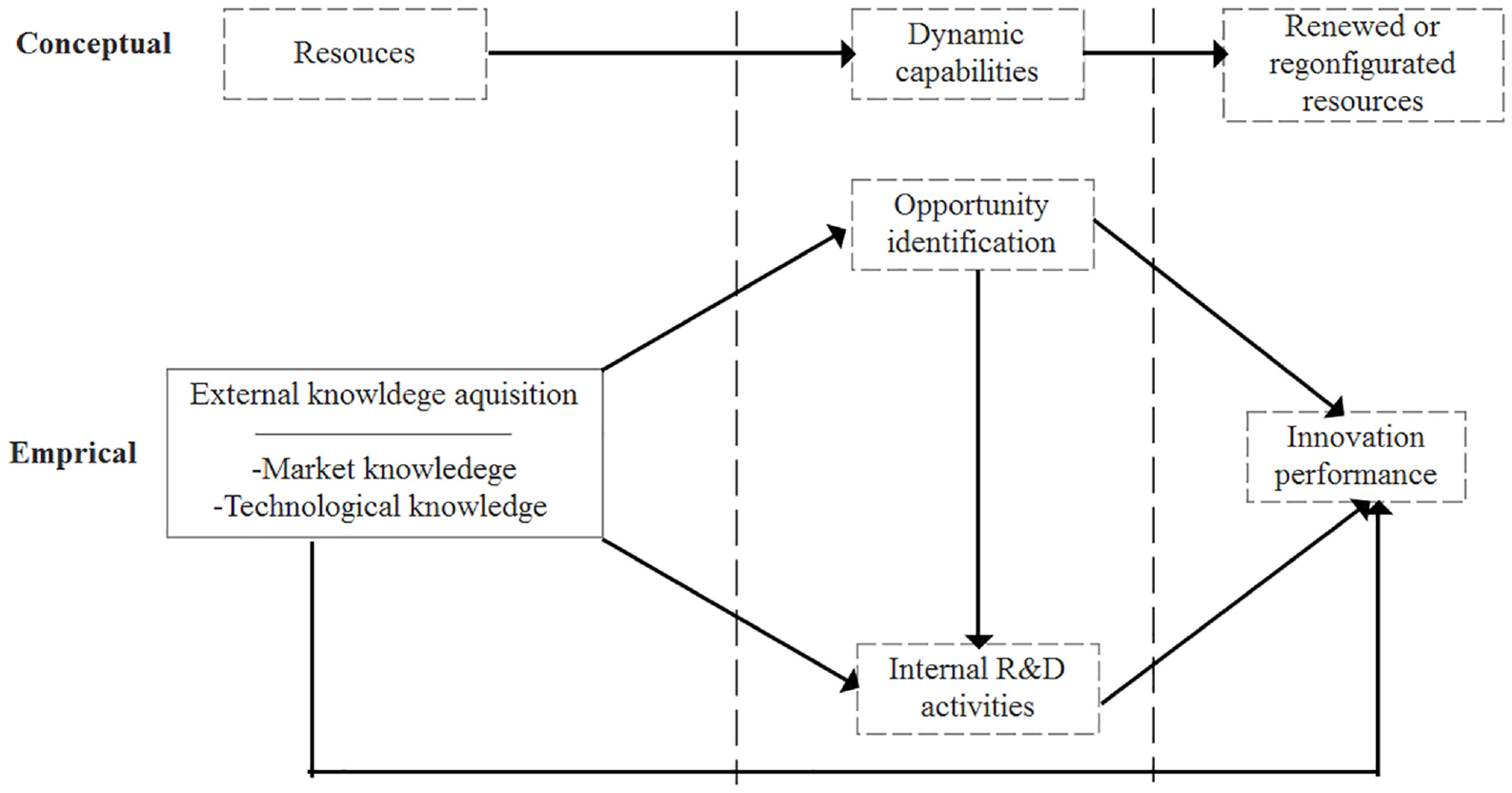
Relationship model between external knowledge acquisition and enterprise innovation performance.
Methods
Sample and Data Sources
Data collection in this study was conducted nationwide through site visiting, telephone interview and email question-and-answer, covering 20 provinces and 4 autonomous regions in China. The formal questionnaire consists of two parts. The first part is composed of basic information of focal firms, external knowledge acquisition and opportunity identification; The second questionnaire is composed of internal R&D and innovation performance. These two parts of the questionnaire were answered by two senior managers of focal firms. Questions were designed using a 5-point Likert scale. Industry is an important factor affecting enterprise innovation, and industry structure and industry characteristics will have impacts on the operation and development of enterprises. Therefore, combined with the content of this study and the availability of data, the industry we select is required to have characteristic activities such as innovation and R&D activities, so the selection of industries should be inclined to knowledge-intensive or technology-oriented enterprises. This research mainly focuses on hi-tech enterprises, so manufacturing industry and information technology industry are selected as the research industry. In the site visiting part, questionnaires were distributed in EMBA classes of universities and some industry conferences, and other on-site interviews, telephone and email interviews were conducted based on the introduction of acquaintances. In this paper, the researchers sent out 972 questionnaires to these enterprises, and received 226 valid questionnaires (response rate = 23.3%).
The average age of the respondents was rather young, and most of the respondents are between 30 and 50 years old, so that 85.9% of the participants were lesser than 50. Nearly 80% of the respondents have worked in the current company for more than 3 years, which can be inferred that they have a full understanding of the company’s operating conditions. Furthermore, 43.8% deputy general manager and above level manager, 56.19% department manager are included in the respondents. According to employee counts, small enterprises accounted for 27.43%, medium-sized enterprises accounted for 52.65%, and large enterprises accounted for 19.91%. The distribution of firm size was relatively balanced, and medium-sized enterprises accounted for the largest proportion, and the samples of large enterprises and small enterprises were about one quarter each (see Table 1). As the newly established enterprises may be immature in terms of organizational structure and operation, enterprises with less than3 years of establishment have been excluded during the questionnaire screening. The classification standard of new enterprises is <8 years, this paper actually includes new enterprises, but excludes enterprises that have been established <3 years (see Table 1). Table 1 also shows the ownership of the firms.
Basic Information for the Subjects.

Note. Scale: Manufacturing industry, small (21–300 employees), medium (301–1,000 employees), large (1,001 and more employees); IT industry, small (21–100 employees), medium (101–300 employees), large (301 and more employees).
Cross-table analysis was conducted based on the differences in variables including firm size, firm age, industry, province, and performance, showing no significant differences. Special attention is also paid to the homologous variance problem. Harman single factor test was used to do factor analysis by putting all the items together. The explanatory variance of the first principal component was 32.48%, indicating that the homologous variance problem was not very significant.
Measures
When measuring external market knowledge acquisition, this paper refers to McKelvie et al. (2009) and adopts four indicators to measure. For external technological knowledge acquisition, according to the research of Zhou and Li (2012), four items are adopted to measure. For opportunity recognition, three items were adopted referring to Ozgen and Baron (2007). For internal R&D activities, Horowitz’s (1962) proposal was used to measure the workload of the R&D department, the number of R&D personnel and the investment in R&D. For the dependent variable, innovation performance, the research of Xihong et al. (2010) was adopted.
Control variables
According to industry classification and the number of employees, the scale of firms can be divided into three categories: large, medium and small. The nature of ownership of enterprises can be divided into three types: state-owned enterprises, private enterprises, and foreign-funded enterprises. For industry, there are only two industries investigated in this paper, namely manufacturing industry and software information industry. The firm age is measured using a continuous variable of LOG10 (firm age).
Reliability and Validity Test
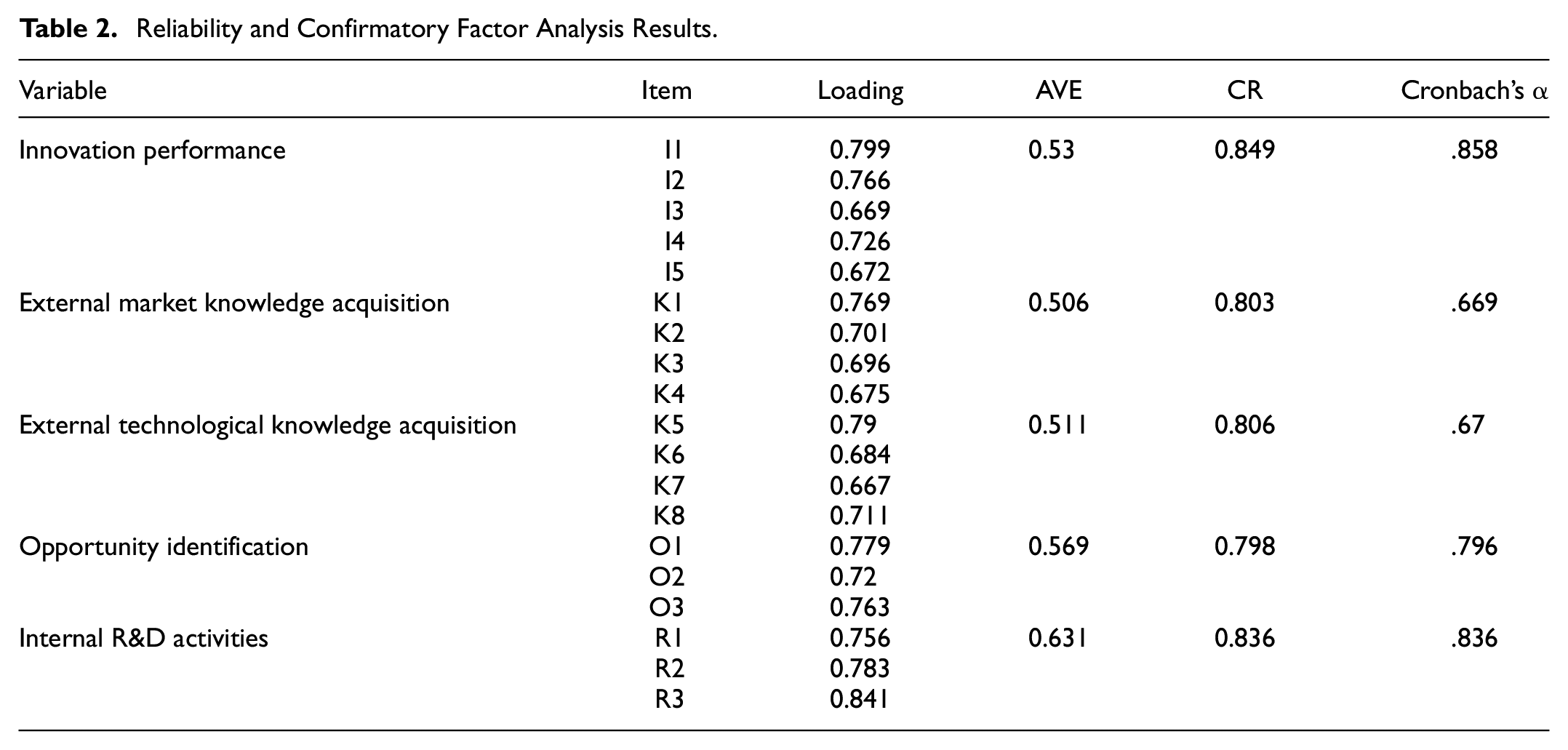
Firstly, exploratory factor analysis and confirmatory factor analysis were conducted for each construct. The results showed that the Cronbach’s α coefficient of all variables reached to .65, and the composite reliability was above 0.7, indicating that the questionnaire had good reliability. According to the results of CFA validity test, the convergent validity and the discriminant validity were tested. The load of each CFA factor is greater than 0.65, and most of them are greater than 0.7, indicating that the questionnaire items have a high convergence validity. According to the logic of the Fornell-Larcker method, a construct shares more variance with its associated indicators than with any other construct. The AVE values of each construct are all greater than the threshold of 0.5, and the square root of AVE is greater than the coefficient of the corresponding index in the correlation matrix, indicating that this measurement has high convergent validity and discriminant validity. The results are shown in Tables 2 and 3.
Reliability and Confirmatory Factor Analysis Results.
Descriptive Statistics and Correlations.

p < .01. *p < .05 (two-tailed).
Modeling Procedures
Descriptive Statistics
In Table 3, the correlation coefficients between market /technological knowledge acquisition, opportunity identification, internal R&D activities and innovation performance are all significant. However, the correlation coefficient between other variables is <.5, which indicates that multicollinearity will not occur if all variables are put into the same model.
Hypothesis Testing
Firstly, hierarchical regression analyses were conducted to analyze the relationship between external market/ technological knowledge acquisition, opportunity identification and innovation performance, whereby firm age, industry, state ownership status and firm size were included as control variables. The results are shown in Table 4 below. The results show that the acquisition of external market knowledge and external technological knowledge separately have a significant impact on opportunity identification (M1, M2) and innovation performance (M3, M6), and opportunity identification has a significant impact on innovation performance (M4). If opportunity identification is added into M1 and M2 respectively, the coefficients of external market/technological knowledge acquisition and opportunity identification are significantly (external market knowledge acquisition coefficient = 0.189**, opportunity identification coefficient = 0.596***; The acquisition coefficient of external technological knowledge = 0.281***; opportunity identification coefficient = 0.525***), that is, opportunity identification partially mediates the relationship between the acquisition of external market/technological knowledge and innovation performance. This result supports Hypothesis 1, Hypothesis 2, Hypothesis 3, and Hypothesis 4.
Regression Analysis Results (External Market/Technological Knowledge Acquisition, Opportunity Identification, and Innovation Performance).

p < .001. **p < .01. *p < .05.
Secondly, hierarchical regression analyses were conducted to analyze the relationship between external market/ technological knowledge acquisition, internal R&D activities and innovation performance. The results are shown in Table 5 below. The results show that external market knowledge acquisition, external technological knowledge acquisition and opportunity identification have a significant impact on internal R&D activities (M1, M3, M2), and internal R&D activities have a significant impact on innovation performance (M4). If both internal R&D activities and external market/technological knowledge acquisition are added into the regression equation, the coefficient of external market/technological knowledge acquisition and internal R&D activities is significantly (external market knowledge acquisition coefficient = 0.424***, internal R&D activity coefficient = 0.313***; External technological knowledge acquisition coefficient = 0.509***, internal R&D activity coefficient = 0.272***). Combining with the model in Table 4, it can be believed that internal R&D activities partially mediate the relationship between external market/technological knowledge acquisition and innovation performance. This result supports Hypothesis 5 and Hypothesis 6.
Regression Analysis Results (External Market/Technological Knowledge Acquisition, Internal R&D Activities, and Innovation Performance).

p < .001. **p < .01. *p < .05.
Finally, a bootstrapping procedure with 5,000 samples was used to analyze mediating effect of the chain structure constituted by opportunity identification and internal R&D activities. Table 6 presents the Bootstrap method analysis results of the relationship between external market knowledge acquisition, opportunity identification, R&D activities and innovation performance. The results of path 2 IND2 market knowledge > opportunity identification > R&D activities > innovation performance show that the chained mediating effect is positive and significant (the influence coefficient of external market knowledge acquisition through opportunity identification and internal R&D activities on innovation performance is 0.041, Bootllci = 0.014, Bootulci = 0.086). The coefficients of IND1 and IND3 are both positive and significant, that is, the three mediation paths under the chained mediation model are all significant, and the total indirect effect is 0.485. After controlling the three paths, the direct effect of external market knowledge acquisition on innovation performance is still significant, with a direct effect of 0.177. Therefore, opportunity identification and internal R&D activities have a partial mediating role in the process of external market knowledge acquisition affecting innovation performance. This result supports Hypothesis 7.
Bootstrap Analysis Results (External Market Knowledge Acquisition, Opportunity Identification, R&D Activities and Innovation Performance).

Note. Confidence interval 95%; Sampling times 5,000; Control variables added; The coefficients in the table are non-normalized coefficients, the same as below.
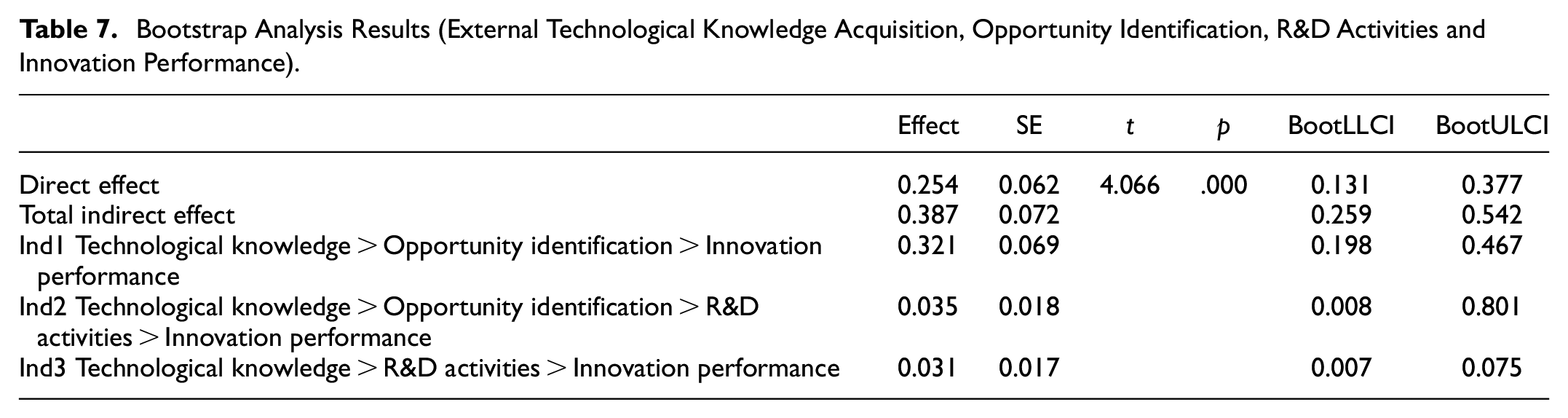
Table 7 presents the Bootstrap analysis results of the relationship between external technological knowledge acquisition, opportunity identification, R&D activities and innovation performance. First, focus on Ind2 external technological knowledge acquisition > opportunity identification > R&D activities > innovation performance. The chained mediating effect is positive and significant (the influence coefficient of external technological knowledge acquisition through opportunity identification and internal R&D activities on innovation performance is 0.035, Bootllci = 0.008, Bootulci = 0.801). The coefficients of IND1 and IND3 were both positive and significant, that is, under the chained double-mediation model, the three mediating paths were all significant, and the total indirect effect was 0.387. After controlling the three paths, the direct effect of external technological knowledge acquisition on innovation performance is still significant, and the direct effect is 0.254. Therefore, opportunity identification and internal R&D activities have a partial mediating role in the process of external technological knowledge acquisition affecting innovation performance, which supports Hypothesis 8.
Bootstrap Analysis Results (External Technological Knowledge Acquisition, Opportunity Identification, R&D Activities and Innovation Performance).
Results and Discussion
Conclusion and Practical Implications
More and more scholars pay close attention to the enterprise innovation performance with the perspective of open innovation, and knowledge in innovation activities is a key antecedent of innovation performance. Constantly breaking through enterprise boundaries to seek external knowledge, has become a main option for most enterprise management practice. However, there is no clear answer about how external resources without all the heterogeneity resources characteristics affect innovation performance of enterprise. Based on the dual perspectives of resource-based view and dynamic capability theory, this paper combs the mechanism of external knowledge acquisition impacting on innovation performance, and further clarifies how different types of external knowledge improve enterprise innovation performance with the effect of dynamic capability. This study enriches the theory of open innovation and deeply interprets the important role of enterprise opportunity identification and internal R&D activities in updating and reconstructing the enterprise knowledge base.
In line with expectations based on prior theoretical work on the role of external knowledge in innovations (Chen & Chen, 2009; Clausen et al., 2013; Gao & Rai, 2023; Lanzolla & Frankort, 2016; Müller et al., 2021) and on qualitative studies in resource-based view, dynamic capability theory (Barney et al., 2001; Eisenhardt & Martin, 2000; Teece, 2018), our study quantitatively shows that external knowledge acquisition is transformed into heterogeneity resources with the help of dynamic capacities for innovation. Specifically, opportunity identification and internal R&D activities, as measurable lower-level dynamic capabilities, function as mediations for mediating the relationship between external knowledge acquisition and innovation performance respectively. More importantly, our empirical results provide evidence for the chain mediating role of opportunity identification and internal R&D activities. We find that opportunity identification directly affects internal R&D activities and “external knowledge acquisition—opportunity identification—internal R&D—innovation performance” constitute the complete path of this study.
Firstly, Hypothesis 1 and Hypothesis 2 respectively analyze the positive effects of external market/ technological knowledge acquisition on firm innovation performance. In fact, the promoting effect of external knowledge acquisition on enterprise innovation performance has been widely recognized (Chesbrough, 2003; Clausen et al., 2013; Gao & Rai, 2023; Lanzolla & Frankort, 2016; Müller et al., 2021). However, most empirical studies are rooted in western developed countries, and the empirical results have positive promotion (Gao & Rai, 2023; Zhou & Li, 2012) and inverted “U” shape (Berchicci, 2013; Laursen & Salter, 2006). In this study, external knowledge acquisition is divided into two dimensions: market knowledge acquisition and technological knowledge acquisition. This study takes Chinese knowledge-intensive enterprises as samples, discusses and empirically tests the relationship between external knowledge acquisition and innovation performance in order to maintain the integrity of the study. Furthermore, our regression results did not find an inverse “U” shaped relationship. The first possible reason is that some Chinese enterprises lack access to external knowledge (Li-Ying et al., 2014) and have not reached the knowledge saturation level. On the other hand, enterprises may have rational strategies on external knowledge acquisition and arrange external knowledge properly.
Secondly, this study illustrates external knowledge transformation mechanism in the perspective of dynamic capabilities. Previous studies on firms acquiring external knowledge and improving innovation output pay more attention to the direct effect between the two (Chesbrough, 2003; Gao & Rai, 2023; Zhou & Li, 2012), researchers regard firms that acquire knowledge as black boxes and use a static resource-based perspective to view performance as the direct output after acquiring external resources. But externally acquired knowledge actually does not fully meet the description of heterogeneous resources (valuable, rare, imperfectly imitable, and non-substitutable) in terms of resource based-view (Barney et al., 2001). Knowledge as an important productive resource for enterprises, few empirical literatures illustrate the interaction between external knowledge and internal knowledge base for affecting enterprise innovation (Moran, 2005). Few studies have combined the resource-based view and dynamic capability theory to explore how resources with incomplete heterogeneous characteristics are transformed into a set of resource with heterogeneous characteristics, how this process occurs and develops, and which specific firm capabilities play an important role in this process (Li-Ying et al., 2016). Based on Li-Ying et al. (2016), who construct an intermediary model between external technical resources, dynamic capability and updated/reconstructed internal resources, this study enriches and expands the research by introducing two lower-level dynamic capabilities. As the microfoundations of dynamic capability, the chain mediation, composed of opportunity identification and internal R&D activities, helps to form an updated or reconstructed resource base by integrating external and internal resources after acquiring external knowledge, which makes the originally incomplete heterogeneous resources become VRIN resources, thus affecting the innovation performance of enterprises.
In management practice, it provides a theoretical basis for enterprises to implement external search strategy and clarifies the path of external resources to influence innovation performance through dynamic capabilities, which makes enterprises pay more attention to opportunity identification, internal R&D activities and other micro-capabilities related to the development of dynamic capabilities. On the one hand enterprises can take positive external knowledge acquisition strategy to improve the enterprise innovation performance, at the same time they are suggested to focus on the interaction between external knowledge and enterprise original knowledge by consciously cultivate their dynamic capabilities. First, top managers should focus on the knowledge acquisition strategies across enterprise boundaries, as Chesbrough (2003) points out in the discussion of the open innovation model that the closed innovation model used by enterprises has been challenged by the active venture capital and the mobility of skilled workers, and open innovation has become an important choice for enterprises to make profits. In terms of internal knowledge in rapid updating technological and market environment, it is difficult for individual enterprise to have sufficient time to provide all the internal knowledge for self-development, and it is difficult to keep up with the market trend considering long-cycle technological R&D and innovation activities. The direct introduction of external mature technology, matching with internal knowledge and application in new products help enterprises accelerate R&D cycle, save human and material resources, and bring competitive advantage. In order to provide accurate ideas for the development direction of enterprises’ products or services, enterprises should strive to expand multi-channel access to consumer demand information, strengthen dealer feedback management, analyze the market situation of upstream production factors provided by suppliers and track the dynamics of competitors, grasp the most cutting-edge market changes and trends. It may be wise for top to stay open minded, maintain close contact with external organizations that can provide knowledge resources for enterprise development, broaden knowledge acquisition channels, and improve the efficiency and quality of external knowledge acquisition. Secondly, we argue the influence mechanism of external knowledge acquisition on enterprise innovation, which provides a reference basis for enterprises to efficiently allocate external knowledge to improve innovation performance. The degree of enterprise managers’ understanding in external market knowledge and technological knowledge determines the discovery of future business possibilities to a certain extent. When the intensity of external knowledge acquisition increases, enterprises can strengthen their internal R&D activities and implement the discussion or practice about identifying opportunities in a planned way deliberately. Managers can appropriately organize the relevant staff from the marketing department and the technology department to study and discuss the external knowledge acquired by the enterprise on a regular basis, and strive to maximize the business opportunities that may be hidden in the knowledge, and to open up the ideas through brainstorming and other activities to create creative opportunities. Independent R&D capabilities can be cultivated gradually through the process of opportunity development and internal R&D activities. Enterprise managers should take measures to strengthen the interpretation of external knowledge, and pay attention to the opportunity identification and R&D activities deliberately, so as to strengthen the role of external knowledge in the promotion of enterprise innovation.
It is important to note that although this study did not find an inverted U-shaped relationship between external knowledge acquisition on innovation performance, it also does not imply that firms can adopt a high-intensity external knowledge acquisition strategy. From the main insights of this study, it is clear that opportunity identification and R&D activities play a key mediating role after external knowledge acquisition, which means firms’ capabilities can be enhanced and are in a state of flux, but there is still a ceiling on capabilities in a short period of time. In fact, the growth of enterprise dynamic capability cannot follow up high intensity of external knowledge acquisition, because enterprise dynamic ability has a certain threshold and external resource cannot be converted to updated or reconstructed knowledge base. That is to say, in a short period of time, if the intensity of the firm’s external knowledge acquisition is too great, and the firm’s level of opportunity identification or internal R&D activities have reached the peak of the firm’s actual capabilities at that stage and cannot be increased rapidly, then additional external knowledge acquisition at that moment cannot continue to improve the firm’s innovation output. Besides external knowledge acquisition will bring additional financial and human burden, which is the problem should be avoided by enterprises in the management practice. Therefore, when implying the external knowledge acquisition strategy, the enterprise should take its own actual situation into consideration, assess the innovation output and reasonably debug the intensity of external acquisition. In the early stage of China’s reform and opening up, some Chinese enterprises in automobile industry experienced the tortuous development process of “technology introduction, technology lagging, technology re-introduction.” The reason for this phenomenon is that Chinese automobile enterprises did not have enough capacity to handle the acquired technological knowledge, and internal R&D activities could not continue to increase, as they had reached to the peak at that time. With the passage of time and the continuous accumulation of technology, Chinese automobile enterprises improved their R&D capabilities and broke through the peak of original internal R & D intensity, so that the additional increase in external knowledge can cause the enhancement of internal R & D activities, which broke the cycle “technology introduction, technology lagging, technology re-introduction.” This phenomenon is actually caused by absorptive capacity and the knowledge base of the firm, the moderating variable mentioned in the studies of Escribano et al. (2009) and Zhou and Li (2012), which provides a deeper understanding of the mediating role (rather than the moderating role) of opportunity identification and internal R&D activities although the moderating role is not within the scope of this paper. Enterprises must evaluate the situation and avoid the loss caused by excessive acquisition when implying external knowledge acquisition strategy
Limitations and Future Research
This paper still has some limitations. The first is the endogeneity problem of each variable brought by questionnaire survey, although we have taken some measures in each stage of the investigation. In addition, in terms of the causal relationship between opportunity identification and external knowledge acquisition, there is a certain overlap and interaction in actual management practice. However, in empirical research, it is difficult to distinguish the time sequence of the occurrence of opportunity identification and external knowledge acquisition, which is an obvious defect of this study. Future research can enrich the microfoundations and identify more mediating variables that play a role in this path.
Footnotes
Declaration of Conflicting Interests
The author(s) declared no potential conflicts of interest with respect to the research, authorship, and/or publication of this article.
Funding
The author(s) disclosed receipt of the following financial support for the research, authorship, and/or publication of this article: This research was supported by the Tianjin Art and Science Planning Project (A22023) and Jilin Province Social Science Foundation of China: Research on Environmental Sustainability Orientation Driving Mechanism and Its Impact on Triple Performance of Agricultural Enterprises in Jilin Province under the “Double Carbon” Goal (grant 2022C58).

Data Availability Statement
Research data is readily available through the corresponding author.