




Abstract
Innovation, as represented by information technology (IT), is considered essential to the survival of a business. Companies use IT innovation to improve their financial performance and the effectiveness of their operations. While technological innovation in the past focused on the introduction of machines to replace physical labor, modern IT innovation, represented by artificial intelligence, has shown that it can also replace human creativity and intellectual labor, increasing job insecurity for human resources at all levels. Therefore, the interests of companies and workers in IT innovation based on the assurance of job security conflict, and workers are motivated to reject IT innovation just like their predecessors who rejected machines. Moreover, vulnerable groups of workers will experience greater job insecurity. During the economic crisis, companies try to reduce labor costs to survive, which also poses a threat to workers’ job security. This study examines the impact of IT innovation intensity on workers’ innovation resistance by dividing it into system and process aspects and identifying the moderating effects of workers’ vulnerability and firms’ financial performance. Using data from the Korean Labor & Income Panel Study in South Korea, this study reveals that workplaces with a high proportion of female workers are more likely to engage in innovation resistance in response to IT innovation; this tendency is stronger the worse the financial performance of the firm. Furthermore, this study presents the implications and limitations and directions for future research.
Plain language summary
This study was conducted in the following context. First, organization-driven innovation is essential for their survival, but for the employees who are the subjects and targets of the innovation, it is a threat to their job security. This creates a conflict of interest between the organization and its employees regarding the adoption of the innovation. Second, IT innovations, such as kiosks, focus on the substitutability of human resources more than other types of innovations. Therefore, this study focuses on IT innovations to understand innovation rejection activities. Third, when an organization’s financial performance deteriorates, such as during an economic crisis, the conflict of interest between the organization and its members on innovation could be maximized. In this study, the financial performance of the organization is a key contextual factor. The Core Strengths of this study are as follows. First, this study proposed the implications of the study by focusing on vulnerable labor groups with low job security. Paradoxically, they are the ones who can benefit the most from technological innovation, but they are also the ones whose job security is most threatened by innovation. Second, the worse the financial performance of an organization, the more the need for innovation increases, but at the same time, the more job insecurity they perceive. This study examines the three-way interaction effect of organizational financial performance and labor vulnerability on innovation rejection activities according to innovation intensity.
Introduction
Information technology (IT) innovation is no longer an option for organizations but a necessity due to the fourth industrial revolution, big data, machine learning, artificial intelligence, and smart factories (Alves et al., 2018; Appio et al., 2021; Pietronudo et al., 2022). Successful adoption of technological innovations improves the effectiveness of human resources, increasing the performance and viability of companies. The development of new products and services through technological innovation expands a firm’s market power and sales (Blundell et al., 1999). Adopting innovative institutions enables firms to adapt to societal changes. According to several studies, there is a positive relationship between technological innovation and firm performance (Rosenbusch et al., 2011; Wamba, 2022). However, in terms of human resources, more recent technological innovations are different from earlier technological innovations. While previous technological innovations aimed to maximize efficiency in terms of so-called exploitation (March, 1991), such as manual labor or simple repetitive tasks, and replace human resources with machines in this regard (Benner & Tushman, 2003), IT innovations demonstrate that human creative activities (exploration) can also be replaced by machine learning through neural network artificial intelligence. All human resources now face job insecurity, unlike in the past when only low-wage, unskilled labor could be replaced.
In addition, the economic crisis caused by external factors, such as the coronavirus disease 2019 (COVID-19), worsens the sustainability of companies (Zhang & Zheng, 2022). Changes in the business environment resulted in changes in internal work routines, which in turn led to the use of technological innovation as a solution to overcome the crisis. During a financial crisis, employees’ sense of job security may worsen, making them less likely to accept technological innovations that could replace them (Lian et al., 2022).
This study aims at the following: First, the reasons for the failure of innovation in companies can be understood by looking at the attitudes of employees. Since workers are the ones who implement innovations, worker resistance is a major obstacle to innovation success (Klein & Sorra, 1996). By identifying the conditions for innovation resistance, this study contributes to the success of innovation in firms. Second, during economic crises, such as the 1997 Asian financial crisis, the 2008 financial crisis, and the recent deterioration of firm performance triggered by COVID-19, several firms are trying to improve management efficiency through IT innovation. This study demonstrates that deteriorating financial performance may have a negative impact on job security, leading to workers’ resistance to innovation activities. Therefore, this study suggests policy needs that can provide job security while promoting innovation. Last, this study describes the paradoxical situation where vulnerable workers, who should be the beneficiaries of technological innovation, become the main victims. This study concludes that retraining and human resource development, in addition to improving firm efficiency through technological innovation, are essential to achieving social justice for vulnerable workers.
Therefore, first, this study aims to confirm that modern technological innovation increases the substitutability of human resources at all levels, which in turn increases their resistance to innovation. Second, this study demonstrates that the perceived job insecurity of vulnerable groups, such as older workers, non-regular workers, foreigners, disabled people, and women, influences firm innovation resistance. Third, this study identifies firms’ financial performance as a contextual factor for innovation resistance. Last, this study aims to identify the negative aspects of IT innovation from the perspective of human resources, provide policy suggestions for vulnerable labor groups, and suggest implications for the success of IT innovation adoption in corporate financial crises (Figure 1).
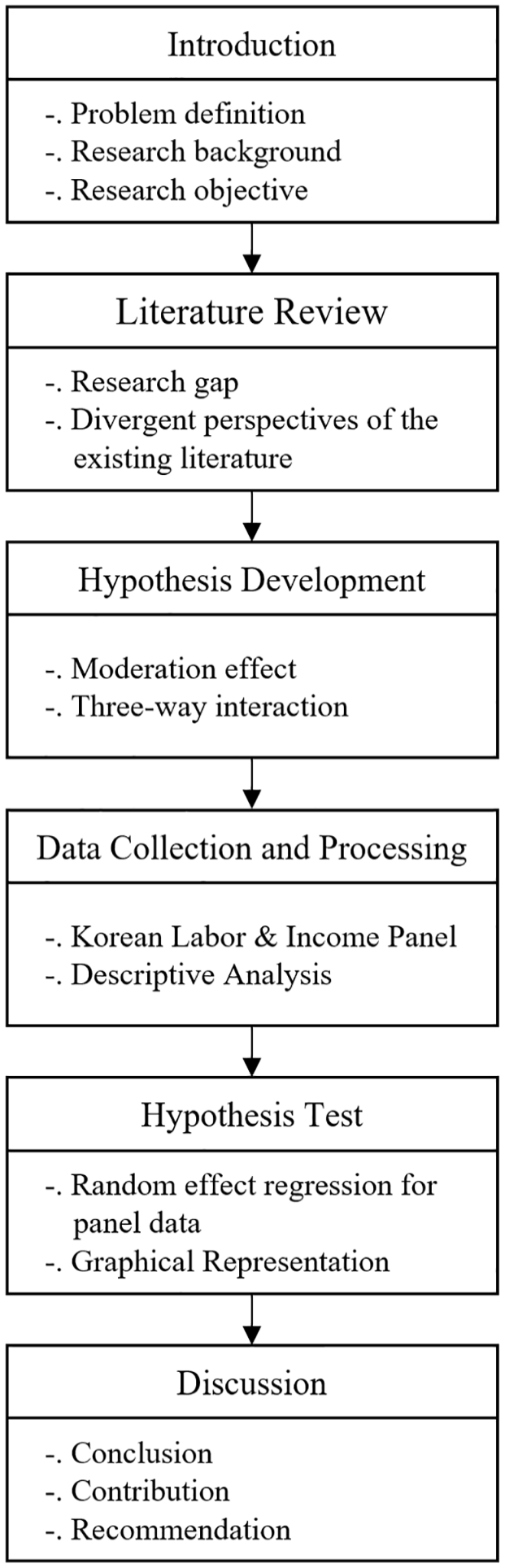
Research method diagram.
In order to achieve the objectives of this study, this paper is organized as follows. First, the research gaps and divergent and conflicting perspectives of the existing literature are analyzed. Second, the relationship between IT innovation and innovation resistance is explained based on the psychological state of organizational members. Third, vulnerable workers are defined and their innovation resistance tendency is hypothesized. The moderating effect of organizational performance is also hypothesized. Fourth, the hypotheses are tested using panel analysis and illustrated graphically. Finally, the results and implications of the study are discussed, and suggestions for future research are provided.
Theory and Hypothesis
Literature Review
According to several studies, employees’ participation in innovation activities is determined by a variety of factors, including their characteristics, the organizational environment, and management decisions (Hammond et al., 2011). However, they do not report consistent findings. First, regarding internal factors, there are both positive (Al-Jinini et al., 2019; Necoechea-Mondragon et al., 2017; Ou et al., 2014) and negative (Harel et al., 2019; Herrmann & Nadkarni, 2014; Sonenshein & Dholakia, 2012) effects of workers’ competencies and work experience on participation in innovation activities. There are also contradictory findings regarding factors external to the workforce. While some studies have found that a firm’s innovative culture positively influences employee engagement in the innovation process (Birkinshaw et al., 2008), others have found that a mechanistic culture leads to employee disengagement (Afrahi et al., 2022; Bruns & Stalker, 1961). Using big data doesn’t always mean it’s good for business (Ghasemaghaei & Calic, 2020).
Moreover, according to several studies, the alignment of internal and external organizational resources determines the direction of the impact of antecedents such as competencies, work experience, organizational culture, managerial commitment to innovation, and organizational absorptive capacity (Cohen & Levinthal, 1990; Dzhengiz & Niesten, 2020; Ho & Amin, 2023) on employee involvement in innovation (Menon et al., 2002; Pérez-Nordtvedt et al., 2008). These studies are mainly guided by Klein and Sorra’s (1996) framework on the effectiveness of innovation participation. They identified employee involvement in innovation activities as a key determinant of innovation effectiveness and innovation-value fit as a determinant of employee involvement in innovation activities. Innovation–value fit is determined by whether the effectiveness of innovation matches the values of the workers who are the subject of the innovation (Klein & Sorra, 1996).
Table 1 summarizes the antecedents that influence innovation performance and participation. Although the introduction of organizational innovations can increase organizational interests, employees will not participate in such innovations if they do not agree with the innovation, if it is not communicated accurately, or if it threatens their job security. In other words, employees will participate in innovation only if the benefits of the innovation are returned to their interests. Therefore, this study identifies organizational and individual conflicts of interest as a major obstacle to innovation implementation. To confirm this phenomenon, this paper focuses on employees with low bargaining power in the labor market. They will be more likely to perceive conflicts of interest. This research is particularly important at a time when the adoption of innovation in organizations at all levels is essential. A comprehensive understanding of the conflicts of interest of individuals who are the main agents of innovation implementation and the analysis of contextual factors can provide practical implications for increasing corporate sustainability through innovation implementation, and academic implications to the divergent and conflicting perspectives in the existing literature.
Research Gaps and Divergent and Conflicting Perspectives in the Literature on the Antecedents of Innovation.

IT Innovation and Innovation Resistance
In 19th-century England, textile workers refused to become victims of technological innovation by destroying the machines that threatened their jobs, known as the Luddite movement. Modern technological innovation reduces job security for all workers by replacing all types of labor, both physical and intellectual. Like their predecessors, who destroyed textile machines, they refuse to adopt IT innovations that could replace them. This is often referred to as the neo-Luddite movement (Jones, 2006). External innovations that threaten employees’ job security and lessen the effectiveness of their exploitation are typically viewed negatively by employees. This is often referred to as the “not-invented-here” (NIH) syndrome (Ismail et al., 2023; Katz & Allen, 1982). This phenomenon can be analyzed in several ways based on social identity theory (Antons & Piller, 2015; Tajfel & Turner, 1979). First, in the ego-defense mechanism, employees often identify themselves with their jobs and use them to establish a social identity. Innovation from outside is sometimes rejected because it is perceived as a challenge to influence within the organization. Second, in the social-adaptive aspect, employees in a company are defined by their job responsibilities. For them, any reduction or substitution of tasks is a threat to their social identity. Third, in the knowledge affinity aspect, employees process familiar information more easily and require additional learning for unfamiliar innovations. This process consumes cognitive resources, and employees become defensive about resource consumption (Conservation of Resource Theory, Hobfoll, 1989). Modern technological innovations are often difficult to understand unless you are an expert in the field. Employees refuse to adopt innovations that they do not understand. Lastly, in the utilitarian view of technology adoption, employees tend to adopt external innovations only when they advance their interests (Eagly & Chaiken, 1993). They engage in innovation diffusion only when it can be protected by patents (Im et al., 2013) or when there is a reward system (Koch & Leitner, 2008). Organizational adoption of technology is not always good for employees. If they feel that innovation threatens their psychological and social job security, they may assess it and reject it. The level of commitment to the innovation decreases as the fit between innovation and value increases.
Vulnerable Workers and Innovation Resistance
The increase in job instability due to machines and innovation varies across industries and job types (Bhargava et al., 2021; Carnoy, 1997; Hötte et al., 2023; Van Roy et al., 2018). According to Acemoglu and Restrepo (2017), the increased use of robotics in industry reduces the employment-to-population ratio, and Fossen and Sorgner (2019) found that people in jobs that are highly substitutable by innovation are more likely to change jobs. If the technological change increases the substitutability of human resources at all levels, there will be a significant difference in threat between those who have the bargaining power to ensure job security and those who do not. Vulnerable workers are those who work in conditions where their employment rights are likely to be denied or those who lack the means to protect themselves from such issues (Department of Trade and Industry, 2006; McIlroy, 2008). Vulnerable groups of workers can be broadly divided into two categories: working conditions and demographics. The first included irregular and low-skilled workers. Workers with low levels of education or low socioeconomic status are more likely to be in low-skilled jobs, and companies require them to be irregular, which increases job insecurity. Second, demographic factors include women, the elderly, the young, and the foreign-born. They are employed in relatively low-wage jobs and have shorter tenure (Bureau of Labor Statistics, 2017). The introduction of technological innovations has a direct and immediate impact on these vulnerable groups of workers. In the United States, the introduction of kiosks is expected to displace around 80,000 jobs by 2024 (Bureau of Labor Statistics, 2017). The threat of technological disruption is greater for the underprivileged than for those in higher-paying, full-time jobs, and they are more likely to resist it. Thus, the following hypothesis is presented:
Hypothesis 1. Firms with a higher proportion of vulnerable labor groups are more likely to have stronger worker resistance to IT innovation.
Financial Performance and Innovation Resistance
The deterioration in corporate performance has a direct negative impact on the job security of the labor force. According to a World Bank report on the economic crisis in East Asia (Kang et al., 2001), 90% of the unemployed in South Korea were low-wage, unskilled workers in manufacturing and construction, whose employment decreased from 21.1 million in 1997 to 19.8 million in 1998 and 19.0 million in 1999. Women and workers with less than a high school education accounted for the majority of those experiencing unemployment. Unemployment in the United States also increased by 2.6 million during the 2008 financial crisis. These were also concentrated among the most vulnerable groups of workers (Haltiwanger et al., 2011). The deteriorating financial performance caused by an economic crisis creates a divergence between the goals of the firm and those of the workforce (Figure 2). Employing job flexibility for vulnerable workers will help companies improve their short-term financial performance, but in the long run, they will seek to automate their workforce in order to survive. In particular, pandemics, such as COVID-19, significantly increase the demand for IT innovation in contactless technologies (Javaid et al., 2020). In times of economic crisis, vulnerable groups of workers may perceive the adoption of innovative technologies by firms as a substitute for their labor, and as their continuous commitment (Meyer & Allen, 1991) is maximized in such situations, their NIH syndrome and their resistance to innovation will increase. Thus, the following hypothesis is presented:
Hypothesis 2. Firms with a higher proportion of vulnerable labor groups and poorer financial performance are more likely to have stronger worker resistance to IT innovation.

Research model.
Methods
Sample and Procedure
To test the hypotheses, this study uses data from the 2015 and 2017 Korean Labor & Income Panel Study conducted by the Korea Labor Institute. The survey is a biennial longitudinal survey in South Korea that provides information on the general business environment. The survey sampled firms with 30 or more employees across all industries, including agriculture, fishing, and mining. The number of enterprises used in each analysis is shown in the results table.
Measure
IT Innovation Intensity
The independent variable, the level and pace of IT innovation, was measured using questions on IT-related investment, software, and equipment/facility purchases at the workplace. In particular, “My workplace has significantly increased investment in IT,”“My workplace has increased the use of IT-related software and development,” and “My workplace has increased the purchase of IT-related equipment/facilities” were measured out of 5 and averaged for analysis.
Innovation Resistance
Innovation resistance, a dependent variable, was analyzed separately in terms of system and process. It is a reverse-coded measure of participation in innovation activities. In particular, “During the past year, to what extent have workers at your establishment been involved in decisions to introduce new machinery, facilities, equipment, and systems through formal channels (i.e., trade unions or works councils) and other informal channels?” and “During the past year, to what extent have workers in your establishment been involved in decisions to reorganize processes through formal channels (such as trade unions or works councils) and other informal channels?” were converted into reverse-coded measures on a 6-point scale and used in the analysis as innovation system resistance and innovation process resistance.
Vulnerable Worker Proportion
For the moderating variable, the proportion of vulnerable workers is used to calculate the number of workers in vulnerable groups relative to the total number of workers in the establishment. The percentage of older workers aged 55 and above, the percentage of disabled workers, the percentage of foreign workers, the percentage of non-regular workers, and the percentage of female workers were each calculated and used in the analysis.
Financial Performance
For the moderating variable, financial performance, the revenue per worker to control for the size of the business was calculated.
Control Variables
This study controls the internal conditions of each company by creating dummy variables such as unionization and professional managers and whether companies belong to conglomerates or listed companies.
Statistical Analysis Strategy
To test the hypotheses, this study used a panel analysis. For panel data that are repeatedly measured in the same company, estimation with a simple generalized linear model can lead to the problem of first-order autocorrelation, particularly for data with missing values. Before the panel analysis, a Hausman test was performed on each of the analytical models to ensure that the random effects model was adopted. STATA version 16 was used.
Results
Descriptive Statistics and Correlation
For each research variable, the mean, standard deviation, and correlation between variables were analyzed and presented in Table 1. The correlations between IT innovation intensity and innovation system and innovation process resistance were negatively and significantly correlated at −18 and −17, respectively. The correlation between the two innovation resistances was high at.85.
Results of the Hypothesis Test
The moderating effect of the vulnerable worker proportion on the effect of IT innovation intensity on innovation system resistance is analyzed and shown in Table 2.
Descriptive Statistics of Variables and Correlation.

+p < .10. *p < .05. **p < .01.
Among the vulnerable groups, the elderly, disabled, foreigners, and non-regular workers did not have a significant interaction term for the effect of IT innovation intensity on innovation system resistance. Only women groups had a significant positive interaction term (Model 5, b = 0.23, p < .05) on innovation system resistance. Figure 3 shows the graphical representation of this.
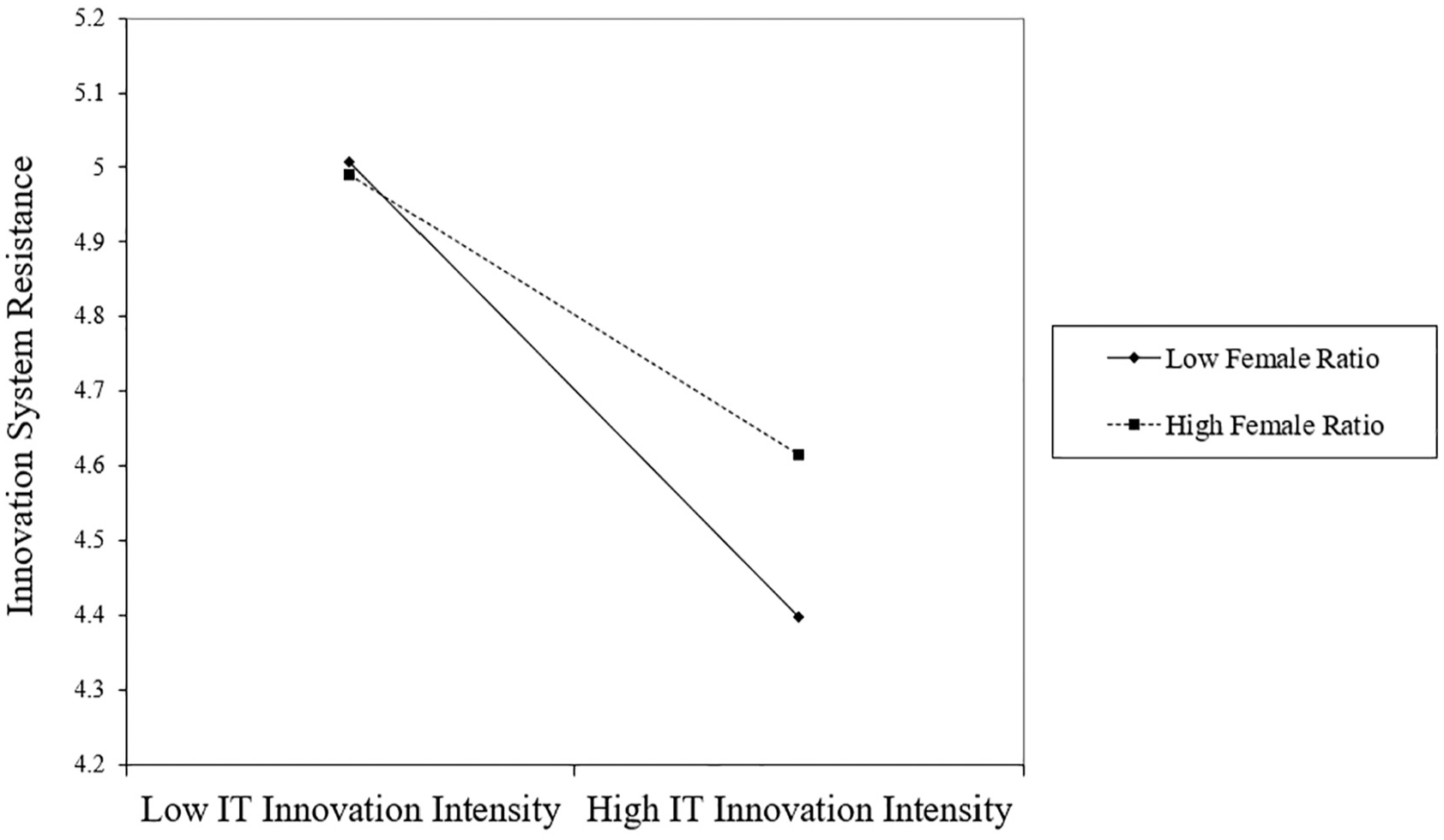
Moderating effect of female group ratio on the relationship between IT innovation intensity and innovation system resistance.
As the IT innovation intensity increases, the degree of innovation system resistance decreases, but the slope is smaller for organizations with more female workers, that is, the tendency to reject the innovation system is stronger. The moderating effect of vulnerable worker proportion on the effect of IT innovation intensity on innovation process resistance is analyzed and shown in Table 3.
Panel Analysis Results of the Relationship Between IT Innovation Intensity, Vulnerable Working Group, and Innovation System Resistance.

p < .10. *p < .05. **p < .0.
Similar to the innovation system resistance, the interaction term for the effect of IT innovation intensity on innovation process resistance was not significant for the elderly, disabled, foreigners, and non-regular workers among the vulnerable labor groups. Only the women group had a significant positive interaction term on innovation process resistance (Model 10, b = 0.27, p < .05). Figure 4 shows the graphical representation of this. As the intensity of IT innovation increases, the degree of innovation process resistance becomes weaker, but the slope is smaller for organizations with more female workers, that is, the tendency to reject the innovation process is stronger. Therefore, Hypothesis 1 is supported in companies with a high proportion of female workers.
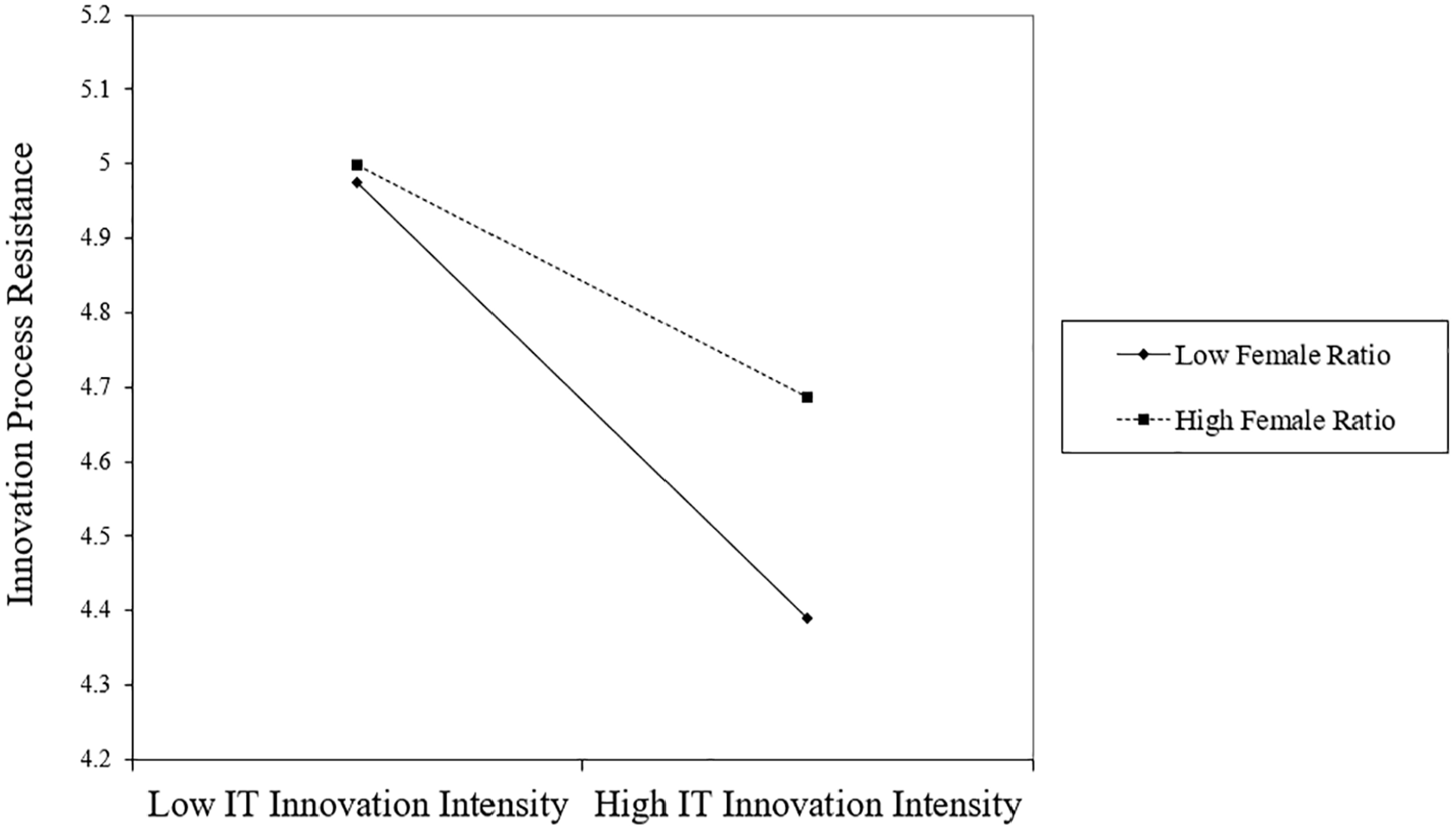
Moderating effect of female group ratio on the relationship between IT innovation intensity and innovation process resistance.
To test hypothesis 2, a three-way interaction term between IT innovation intensity, the proportion of female employees, and financial performance was used. Table 4 shows the results. The results show that the three-way interaction does not have a significant coefficient for innovation system resistance, but it is significant for innovation process resistance with a coefficient of −21.96 (Model 12, p < .05). Hypothesis 2 is partially supported (Table 5). To clearly interpret the results of the analysis, a graph of female employee ratio and financial performance as contextual factors were plotted, as shown in Figure 5.
Panel Analysis Results of the Relationship Between IT Innovation Intensity, Vulnerable Working Group, and Innovation Process Resistance.
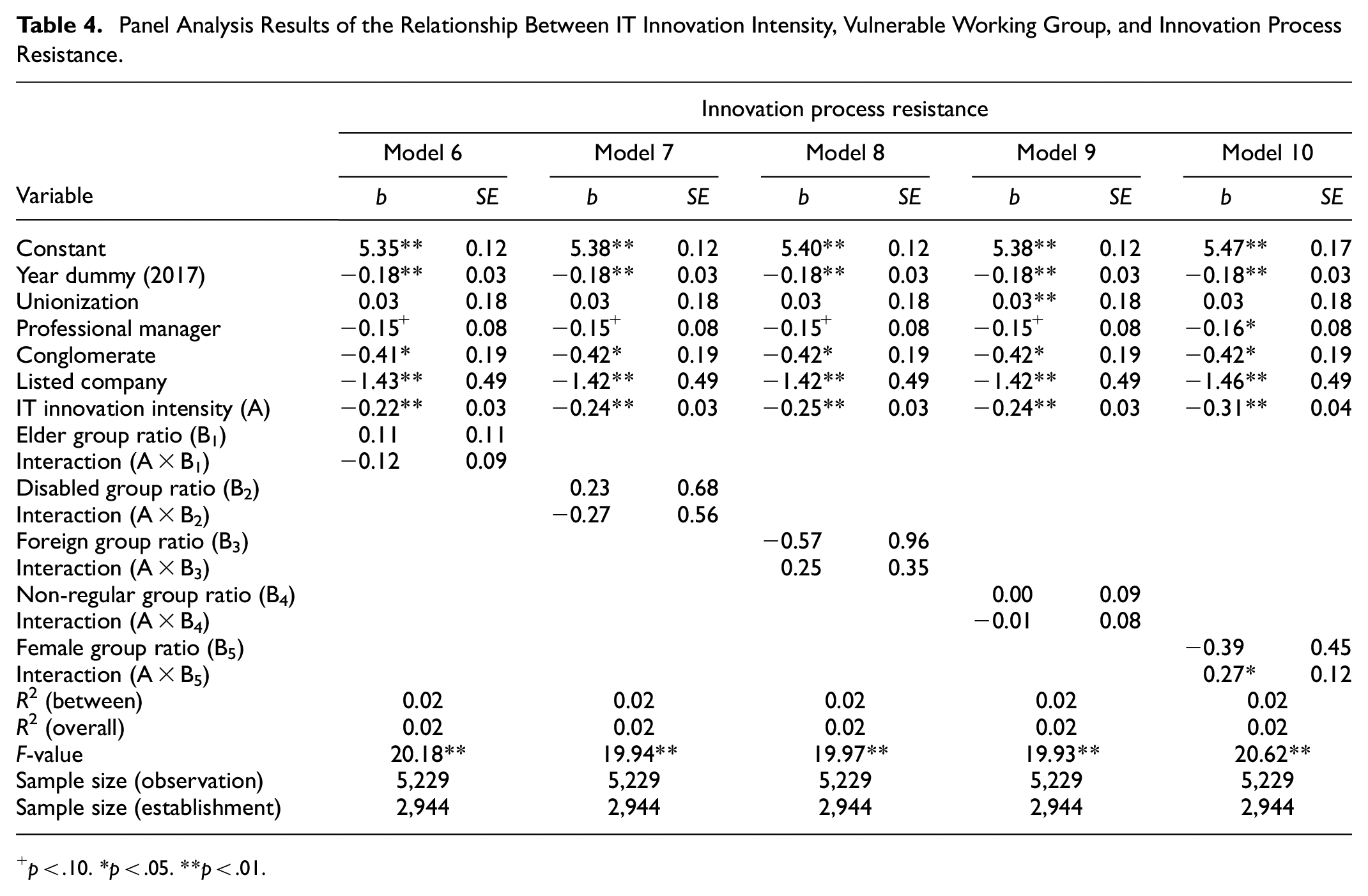
p < .10. *p < .05. **p < .01.
Panel Analysis Results of the Relationship Between IT Innovation Intensity, Female Working Group, Financial Performance, and Innovation Resistance.

p < .10. *p < .05. **p < .01.

Three-way interaction effect of IT innovation intensity, female group ratio, and financial performance predicting innovation process resistance.
The results indicate that the degree of resistance to innovation processes weakens as the intensity of IT innovation increases in other groups, but resistance increases in firms with a high proportion of female employees and low financial performance.
Discussion
Summary of Findings and Implications
Innovation has been shown to have a positive impact on a firm’s financial performance and long-term viability (García-Fernández et al., 2022; Shanker et al., 2017). However, the interests of organizations and workers are not always aligned when it comes to firms’ innovation investments. On the one hand, workers want to ensure the survival of the organization and achieve its goals, but on the other hand, they also want to ensure their job security and survival. This study analyzes the phenomenon that the conflicting interests of these organizations and their employees in innovation can lead to their resistance to innovation. In other words, if a group cannot share in the organizational benefits of an innovation, it cannot resolve the conflict of interest and will resist the innovation. If the company is unable to generate sufficient financial benefits, this tendency will be reinforced. According to the results of this study, this tendency is stronger among vulnerable workers with less job security, and the deteriorating financial situation of firms is likely to reinforce this tendency. IT innovation intensity was found to weaken innovation resistance. Both innovation systems and innovation process resistance are lower in firms with high IT innovation intensity. A possible explanation for this is the tendency towards isomorphism to secure legitimacy (Deephouse, 1996). Non-vulnerable organizational members do not feel as much job insecurity as vulnerable workers as a result of the introduction of IT. They can justify their status in an organization by accepting organizational norms and carrying out organizational instructions. The greater the intensity of IT innovation in the workplace, the easier it is for employees to perceive management’s commitment to innovation (signal effect, Feldman & March, 1981; Guest et al., 2021). General employees, who are relatively unconcerned about job insecurity, can promote their survival in the organization by assimilating to a desirable image of management.
According to the results of the analysis of the moderating effect of five vulnerable groups of workers, including the elderly, the disabled, foreigners, non-regular workers, and women, workplaces with a high proportion of female workers are more likely to resist innovation. In particular, workplaces with a high proportion of female workers and poor financial performance are more likely to resist the innovation process as the intensity of IT innovation increases, unlike other workplaces that are found to be receptive to IT innovation.
This study has several theoretical implications. First, the literature on organizational innovation has focused on the positive aspects of innovation, such as its effectiveness and necessity. This study theorizes, hypothesizes, and empirically tests the point of divergence between the interests of the firm and the interests of the workers, and shows that if the firm’s innovation is aimed at displacing workers, it may lead to resistance from the workers it displaces. This study contributes to the existing literature, which emphasizes the importance of innovation research but provides inconsistent results on the antecedents of innovation implementation.
Second, as a key framework for analyzing innovation implementation, Klein and Sorra’s (1996) study needs to be empirically tested in many contexts. This study contributes to the development of innovation research by confirming this framework with real-world data. They found that in order to increase the effectiveness of innovation implementation, it is necessary to increase the innovation-value fit of organizational members. The study found that even in East Asian companies with strong collectivist cultures, innovation resistance is stronger among vulnerable groups when the company is performing poorly. The study showed that this can be done by reducing conflicts of interest with their organizations.
Third, this study identifies the conditions under which innovation resistance is strongest by analyzing the financial performance of vulnerable groups and firms as contextual variables. The results indicate that the higher the proportion of female workers and the worse the financial performance, the higher the job insecurity of workers, which leads to innovation resistance activities. The study categorizes vulnerable workers into five groups and empirically examines them along with their financial conditions to elaborate the contextual factors at play in the framework. In doing so, this study contributes to the advancement of the literature on innovation implementation.
This study has several practical and policy implications. First, this study provides managers with information about the boundary conditions of IT innovation resistance. This study shows that employees can be motivated to resist innovation when they are both the innovators and the targets of innovation. They may be reluctant to adopt or reject new IT technologies, systems, equipment, and processes. Furthermore, according to the results of this study, the presence of professional managers, being part of a chaebol group, and being a publicly listed company significantly reduced innovation resistance in all analysis conditions. Organizations that want to introduce IT innovations can assess their conditions to determine the degree of innovation resistance among their employees. If there are conflicts of interest, it’s important to communicate with employees in advance and establish HR policies that reassure them that innovation will benefit them as well (Sonenshein & Dholakia, 2012).
Second, this study suggests that among various vulnerable worker groups, women are most susceptible to innovation resistance based on the intensity of IT innovation. This is particularly true for firms with poor financial performance. This finding is consistent with the decline in female employment in South Korea during the economic crisis (Kang et al., 2001). The same trend can be expected in the current situation of deteriorating financial performance of firms triggered by COVID-19. In formulating employment stability policies in the context of IT innovation, policy measures should be taken to address the employment instability of female workers, and human resource development and employment safety nets for them should be expanded.
Third, generative AI innovations such as Chat-GPT and Bard are becoming a game changer for many organizations today (Filippo et al., 2024; Kanbach et al., 2023). Unlike traditional IT innovations, these innovations threaten the perceived job security of a broader range of workers, not just the traditionally vulnerable. The results of this study emphasize that the successful implementation of innovation is not determined by the amount of benefits generated by the innovation, but by the reconciliation of the conflicting interests of organizational members and the organization. Therefore, organizations should encourage employee participation in policy making and profit sharing to prevent the NIH syndrome or neo-Luddite movement (Jones, 2006; Katz & Allen, 1982).
Limitations and Future Research
Despite its implications, this study has several limitations. First, although the vulnerable worker group was divided into five groups, namely the elderly, the disabled, foreigners, non-regular workers, and women, and statistical analysis was conducted, no significant results were found for the remaining groups except for the female group. In particular, given that the interaction effect between the female group and financial performance was significant, future studies should consider contextual factors to identify the effects of other vulnerable worker groups. Second, this study examines firms that participated in the Korean Working Panel Survey. Cross-validation in different countries and cultures is needed to increase the generalizability of the study. Different countries have different types of social policies and coverage for unemployment; therefore, the vulnerable labor groups emphasized in different countries may differ. Future studies should examine different countries, including the United States and Europe. Finally, future research should analyze more recent data. Because perceptions of innovation are constantly changing, the analysis should be able to track changes over time. Autoregressive cross-lagged model analysis could be one such method.
Footnotes
Declaration of Conflicting Interests
The author declared no potential conflicts of interest with respect to the research, authorship, and/or publication of this article.
Funding
The author received no financial support for the research, authorship, and/or publication of this article.
Ethical Approval

Data Availability Statement
The data that support the findings of this study are available from the corresponding author upon reasonable request.