



Abstract
The objective of this study is to compare the employment impacts of administrative control-type environmental policies versus market regulation-type environmental policies. This paper employs a production cost function to analyze the theoretical mechanisms through which these two types of environmental regulations affect employment. Using data from Shanghai and Shenzhen A-share listed companies from 2006 to 2022, the nonparametric event study method and the parametric event study method are applied to validate the findings of the theoretical mechanism analysis. Both theoretical mechanisms and empirical findings indicate that administrative control-type environmental policies reduce employment levels by decreasing output, whereas market regulation-type environmental policies enhance employment levels by increasing the input of clean production factors. Therefore, when implementing environmental regulatory policies, it is essential not only to consider the urgency of carbon emission reduction but also to fully account for employment concerns, selecting policy combinations that minimize unemployment risks to the greatest extent possible.
Plain Language Summary
This study aims to compare the differing employment impacts of two types of environmental policies: command-and-control measures to reduce carbon emissions versus market-based carbon trading. Under the objective of minimizing production costs, this paper analyzes the theoretical mechanisms through which these two categories of environmental regulations affect employment. Using data from Shanghai and Shenzhen A-share listed companies from 2006 to 2022, the study tests the findings of this theoretical mechanism analysis. The results consistently indicate that command-and-control approaches to reducing carbon emissions lower output levels, leading to a decline in employment. In contrast, market-based carbon trading increases investment in human, financial, and material resources related to environmental technologies, thereby boosting employment levels. Therefore, when implementing environmental regulatory policies, it is essential not only to consider the urgency of carbon emission reductions but also to fully account for employment impacts, selecting policy combinations that minimize unemployment risks to the greatest extent possible.
Keywords
Introduction
As the world’s largest carbon emitter, China has taken the initiative to assume responsibility for carbon emissions reduction, setting targets for carbon peaking and carbon neutrality (Gao et al., 2025a), and promoting the green and low-carbon transformation of production and lifestyles through environmental policy tools. This transition is not only an important innovation in the field of ecology and environment, but also a profound change in the economic and social system. It will not only have a profound impact on many areas such as product production, logistics and transportation, and consumer behavior, but will also cause changes in production input factors. These impacts and changes will inevitably lead to the disappearance of some traditional jobs and the emergence of new ones in related industries, and structural unemployment issues will become increasingly prominent.
The environmental policy tools that may lead to structural unemployment are roughly divided into two categories : administrative control-type environmental policy and market regulation-type environmental policy, such as low-carbon city pilot policy and carbon emission trading pilot policy (Sterner & Robinson, 2018).China’s first batch of low-carbon city pilot policy was established in 2010, covering five provinces and eight cities; the second batch of low-carbon city pilot regions was established in December 2012, encompassing 29 pilot cities; and the third batch of low-carbon city pilot regions was established in January 2017, involving 45 pilot cities. China’s carbon emissions trading pilot policy was launched in October 2011, covering seven provinces and municipalities. From 2013 to 2014, carbon emissions trading markets successively commenced operations in these seven regions, with Fujian Province also joining the pilot program in December 2016. Five years later, the national carbon emissions trading market was established in Shanghai. In order to regulate the operation of the carbon emission trading market, in 2024, the State Council of China implemented the “Interim Regulations on the Administration of Carbon Emission Trading” as the “fundamental law” of the Chinese carbon market, and provided the superior law basis for the expansion of the carbon emission trading market to the three industries of steel, cement and aluminum smelting in 2025.These two types of environmental policies have altered the emission reduction models of enterprises, thereby changing their factor inputs and product outputs and forcing changes in employment. However, the results of such changes are uncertain (Ferris et al., 2014). They may lead to job losses or the creation of new jobs (Zhong et al., 2021), that is, structural unemployment issues may arise (Gao, Cai, & Wu, 2025).
Therefore, it is necessary to conduct an in-depth analysis of the theoretical mechanisms underlying this uncertainty in order to identify its root causes, thereby helping different cities formulate appropriate environmental policies that both reduce carbon emissions and mitigate the increase in structural unemployment.
Literature Review
Statistical analysis revealed that a 10% reduction in sulfur dioxide emissions was associated with a 3.1% decrease in low-skilled employment in high-polluting industries (Zheng et al., 2022). However, the U.S. government’s use of the Inflation Reduction Act (IRA) to promote clean energy manufacturing and deployment could create over 3.8 million jobs in six states, including Arizona and California. However, the impact of the Netherlands’ National Environmental Plan in 1989 on employment remains uncertain (Van Der Straaten & Ugelow, 1993). In addition to the above three scenarios, environmental policies may have little to no impact on employment levels. In 2008, British Columbia, Canada, implemented a carbon tax policy (Gao et al., 2022). This policy only affected the structure of employment, with no significant changes in employment levels (Yamazaki, 2017). The above cases show that there are four different views on the impact of environmental policies on employment.
Firstly, environmental regulation reduces employment. The administrative control-type environmental regulation reduces carbon dioxide emissions by forcing a reduction in production or a shutdown of production. The lack of production capacity leads to a decrease in corporate profit margins, leading to a decrease in factor inputs, including labor (Zhong et al., 2021). There are many cases where environmental policies have suppressed employment, not only the Clean Air Act (Greenstone, 2002) and the Clean Water Act (Raff & Earnhart, 2019) in the United States led to a decline in employment, but also the carbon tax in the United Kingdom had the same policy effect (Yip, 2018). Employment declines are particularly pronounced in industries that rely heavily on high energy consumption (L. Li et al., 2021).
Second, environmental regulations may increase employment. In the long term, firms have the ability to manage carbon dioxide by adopting green production models (He et al., 2021), such as increasing investment in green innovation technologies and environmentally friendly equipment (X. Li et al., 2022). As these technological and equipment investments increase, the total carbon emissions of businesses decrease. This encourages businesses to increase production, thereby increasing the demand for labor, known as the “green jobs” phenomenon (Bezdek et al., 2008). Moreover, environmental regulation by forcing enterprises to green technological innovation activities, improve the productivity of enterprises, but also increase the demand for factor inputs, including labor (Ren et al., 2020). The implementation of many environmental policies proves this point. For example, the carbon tax policy in British Columbia promoted employment (Curtis, 2018).
Finally, there is a “U” shape between environmental regulation and employment. An analysis of provincial dynamic panel data from 2004 to 2018 found that the intensity of environmental regulation has a “U” shaped relationship with employment in the industry (Zhong et al., 2021). Similar findings are found in firm-level data (X. Wang et al., 2020). It is further found that both administrative control-type and market regulation-type environmental regulation and employment in China have a U-shaped relationship and are currently on the left side of the U-shaped curve (Jing et al., 2023). This U-shaped relationship is realized through technological innovation, and the relationship is heterogeneous across firms and is related to firms’ ownership structure, pollution level, and technology intensity (D. Li & Zhu, 2019).
Although studies have been conducted to analyze the impact of environmental regulation on employment in a relatively comprehensive manner, the following three aspects still need to be explored in greater depth. Firstly, the difference between administrative control-type and market regulation-type environmental regulation on the influence of employment needs to be further analyzed. This difference has been neglected by existing studies, resulting in the inability to identify an effective program for improving employment under different environmental regulations. Secondly, the mechanisms by which administrative control-type and market regulation-type environmental regulations affect employment are not clear. As a result, the impact of different types of environmental regulation on employment cannot be predicted, making it impossible to either predict changes in employment rates or formulate an effective prevention program for possible unemployment. Thirdly, the views on the impact of environmental regulation on employment in the existing studies vary, which may be due to the variability of the intrinsic mechanisms of the impact of different types of environmental regulation on employment. If this issue is ignored, then the conclusions obtained are one-sided. In view of this, this paper compares the mechanisms of the impact of administrative control-type and market regulation-type environmental regulation on employment. Specifically, under the condition of profit maximization, the cost function is used to analyze the mechanism of these two types of environmental policy tools affecting employment separately, and to dig out the economic principles leading to changes in employment. And, on the basis of theoretical analysis, relevant data are used to verify the scientific validity of this mechanism.
Theoretical Mechanisms
Theoretical Mechanisms Underlying the Relationship Between Environmental Policy Instruments and Employment
Assuming that enterprises follow the goal of minimizing production costs, they invest in M types of production elements and N types of clean elements, and their variable costs can be expressed as in Equation 1; Berman & Bui, 2001).

In Equation 1, C denotes the variable cost of the firm, Y denotes output, DM is the price of the Mth factor of production, and UN is the input of the Nth clean factor of production. According to Sheppard’s Lemma, Equation 1 can be expressed as Equation 2. In Equation 2, P represents environmental policy tools,

Both sides of the equal sign of Equation 2 take full derivatives with respect to the environmental policy P as shown in Equation 3

From Equation 3, it can be seen that environmental policies affect employment in two ways: output Y and clean production input factor U. Next, this paper analyzes the impact of output Y and clean production factors U on employment under the low-carbon city pilot policy and the carbon emission trading pilot policy, respectively.
Theoretical Mechanisms By Which Low-Carbon City Pilot Policy Affect Employment
In the implementation of low-carbon city pilot policy, reducing output has become the optimal path for enterprises to reduce carbon emissions. This policy directly controls carbon emissions by regulating production activities, rather than relying on price mechanisms or property rights measures (Sterner & Robinson, 2018). The primary reason businesses adopt this carbon reduction measure is that the key to success in local officials’ promotion competition has shifted from economic growth indicators to environmental indicators (Li-an, 2022). However, the tenure of Chinese officials is relatively short, lasting only 5 years. To achieve significant improvements in environmental quality within 5 years, local government officials tend to adopt short-term measures, such as reducing output to quickly decrease carbon emissions, in order to meet their promotion targets. Compared to reducing production, the pace of carbon reduction through clean production is slower. This is because clean production technology innovation and process replacement require a longer timeframe, which does not align with local government officials’ short-term demands. Therefore, this emissions reduction method is not the optimal choice in low-carbon city pilot policy.
Based on the above results, Equation 3 can be used to analyze the impact of low-carbon city pilot policy on employment. The first term on the right-hand side of Equation 3 indicates that the implementation of low-carbon city pilot policy (P) leads to a decrease in output (Y), while the second term indicates that low-carbon city pilot policy has no impact on the input of clean production factors. Therefore, the implementation of low-carbon city pilot policy (P) on the left-hand side of Equation 3 leads to a decrease in labor demand (L).
Theoretical Mechanisms of the Impact of Carbon Emissions Trading Pilot Policy on Employment
This paper adopts the Tradable Performance Standard (TPS) as its carbon emissions trading mechanism (J. Zhang et al., 2017). Under the carbon emissions trading policy, enterprises with carbon emissions higher than the standard set out in the policy have three options. The first is to reduce carbon emissions by cutting production; the second is to purchase carbon emission rights from “carbon surplus” enterprises; and the third is to purchase cleaner production technologies. If the first option is to reduce production in order to comply with carbon emission standards, there may be diseconomies of scale and the enterprise will not be able to maximize profits. If it is the second option, then on the surface, through the deployment of carbon dioxide emission rights among different carbon emission enterprises, it can meet the demand of high carbon emission enterprises to continue production to a certain extent, but in the long run, the high carbon enterprises have not maximized profits. If the third option is chosen, enterprises adopt clean production technologies, their carbon emission intensity will decrease, and their carbon emissions may fall below the emission cap. So, the second term on the right-hand side of Equation 3 is greater than 0. Furthermore, since the company’s carbon emissions are below the emission cap, the company does not need to reduce production to decrease carbon emissions, so the first term on the right-hand side of Equation 3 is 0. Therefore, the value on the left-hand side of Equation 3 depends on the second term on the right-hand side. Thus, the implementation of carbon emissions trading policies increases labor demand.
If the factor market is imperfectly competitive, then
Model Construction, Sample Selection and Data Sources
Model Construction
To avoid endogeneity issues, this paper employs both the nonparametric event study method and the parametric event study method. The specific analytical model for the former is shown in Equation 4; the specific analytical models for the latter are shown in Equations 5 and 6, representing the parametric event study methods for the employment impacts of low-carbon city pilot policy and carbon emissions trading pilot policy, respectively.


In Equation 4, i and t denote city and year, respectively.
Firstly, this paper determines the base period for the policy. The base year for the low-carbon city pilot policy and the carbon emissions trading pilot policy is set as the year preceding their implementation, namely 2009 and 2013, respectively.
Secondly, determine the event window for this paper. On the one hand, the implementation time of the first batch of low-carbon city pilot policy preceded that of the carbon emissions trading pilot policy, and all cities under the carbon emissions trading pilot policy were also part of the first batch of low-carbon city pilot policy. On the other hand, when comparing the impact of the two types of policies on employment, it is necessary to distinguish their respective effects to obtain their net effects. Given this, this paper selects the first batch of low-carbon pilot cities as the sample. This is because the cities included in the first batch of low-carbon pilot city policies encompass all the cities included in the carbon emissions trading pilot policy, a feature that facilitates the establishment of experimental and control groups, making it easier to obtain the net effect of the two types of policies. To obtain this net effect, this study is divided into three phases: the first phase is prior to the implementation of the low-carbon city pilot policy, that is, before 2010; the second phase is from the launch of the low-carbon city pilot policy to the launch of the carbon emissions trading pilot policy, that is, 2010 to 2013; the third phase is after the widespread implementation of the carbon emissions trading pilot policy in all pilot cities, that is, after 2013. From 2010 to 2013, only the low-carbon city pilot policy was implemented. This stage can be compared with the low-carbon city pilot policy before 2010 and also with the carbon emissions trading pilot policy after 2013. Therefore, the period from 2010 to 2013 serves as both the post-policy event window stage for the low-carbon city pilot policy and the pre-policy event window stage for the carbon emissions trading pilot policy. In view of this, the window period before and after the implementation of the two policies in this paper is set at 4 years, and
Thirdly, the choice between non-parametric event analysis and parametric event analysis. In practice, if the data exhibits a pre-event trend, this means that the patterns of data changes before and after the event are significantly different, leading to significant bias in the non-parametric event method and greater accuracy in the parametric event method. This is because the non-parametric event method relies on the patterns of data changes to obtain the final results. If these patterns undergo significant changes, the method cannot derive a single result from two different patterns. In such cases, the parametric event method is more appropriate. The parametric event method sets a separate parameter for each different pattern of data change rather than applying a single parameter to all data, resulting in more accurate estimation results.
Sample Selection and Data Sources
The sample selection method of this paper is as follows. In analyzing the impact of low-carbon city pilot policy on employment, this paper selects the first batch of low-carbon pilot cities, including 5 provinces and 8 cities, a total of 72 cities as the treatment group, and the 40 non-low-carbon city pilots nor carbon emissions trading pilot cities as the control group. These 40 cities were selected by the equiproportionate sampling method of the stratified sampling method, in which each province or region draws a sample of cities according to the proportion of its number of cities to the number of cities in China (Dobkin et al., 2018). When analyzing the impact of the carbon emissions trading pilot policy on employment, a total of 35 cities in 5 provinces and municipalities, Guangdong, Hubei, Tianjin, Chongqing, and Shenzhen, which belong to both the first batch of low-carbon pilot cities and carbon emissions trading pilot cities, are selected as the treatment group. The remaining 8 provinces and municipalities of the first batch of low-carbon pilot cities after removing the above 35 cities, totaling 37 cities, and the 40 cities that are neither low-carbon pilot cities nor carbon emissions trading pilot cities, totaling 77 cities, constitute the control group. Specifically, this paper analyzes the impact of environmental regulations on employment from the enterprise level. The A-share market listed companies in Shanghai and Shenzhen from 2006 to 2022 are selected as the research object, and the following treatments are made to minimize the appearance of extreme values. Firstly, “ST” and “*ST” listed enterprises, suspended or terminated enterprises are excluded; secondly, enterprises with more data shortages, enterprises in banking and insurance industries, enterprises with asset responsibility ratio greater than 1, enterprises with listing time less than 1 year and enterprises with observation value of only 1 year are excluded; and enterprises with listing time less than 1 year and enterprises with observation value of only 1 year are excluded; and lastly, individual shortfalls are made up by interpolation. This results in an unbalanced panel of 1,395 listed firms with a total of 9,756 observations. All data in this article are from China Research Data Service Platform (CNRDS).
After taking the logarithm of each index, the descriptive statistics are shown in Table 1.
Descriptive Statistics.
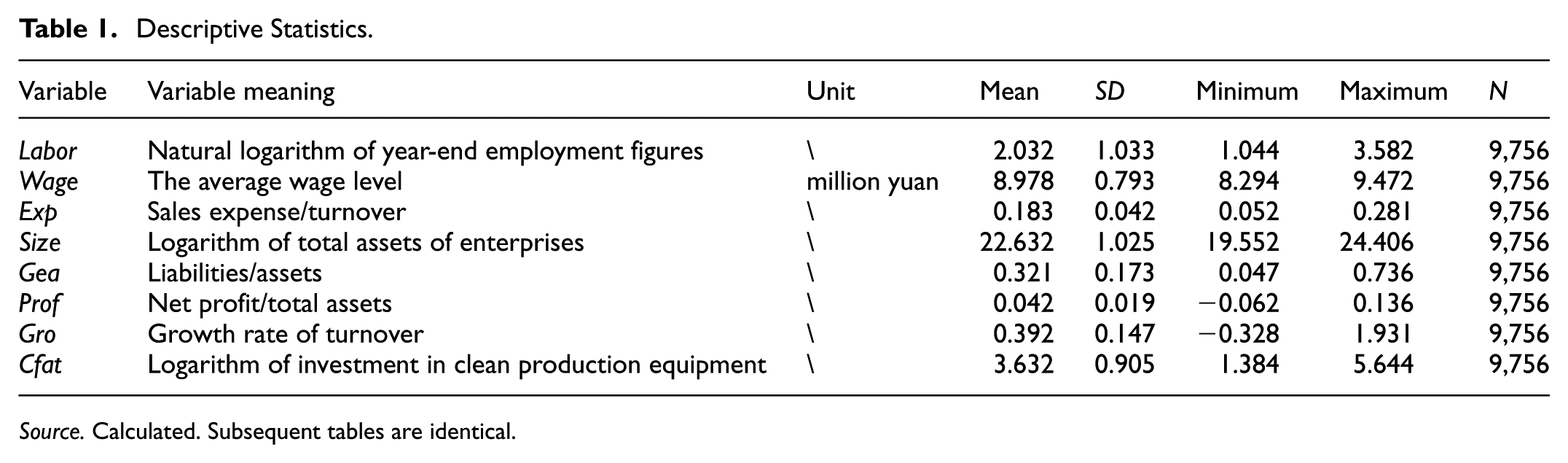
Source. Calculated. Subsequent tables are identical.
Empirical Results
The Analysis Results of Non-parametric Event Analysis and Parametric Event Analysis
The results of the nonparametric event analysis model based on Equation (4) are shown in Table 2. Columns (1) and (3) in Table 2 show the results without controlling for another policy, and columns (2) and (4) show the results with another policy controlled. The results in columns (2) and (4) both show some reduction compared to the results in (1) and (3). This suggests that if the effect of the other policy is ignored, then it may affect the consistency of the estimates and lead to omitted variables.
Nonparametric Event Analysis Results.

Note. Pre_4 denotes the four periods prior to policy implementation, Afe_1 denotes the effect of the policy 1 year after its implementation., and other designations follow the same pattern; Current denotes effects in the year of policy implementation. LC denotes low carbon city pilot policy city; CET denotes carbon emissions trading pilot policy city. The following tables are identical. EFE = enterprise fixed effect; TFE = time-fixed effect; CV = control variable; APP = another pilot policy. The following tables are identical.
***, ** and * indicate 1%, 5%, and 10% significance levels, respectively; standard errors are in parentheses. Subsequent tables are identical.
In addition, the results in columns (3; 4) show that the results before the implementation of the carbon emissions trading pilot policy are all significant, which suggests that there is a clear pre-policy trend in the estimation results of this policy, which does not satisfy the prerequisite assumptions of the non-parametric event study method. Therefore, the results in Table 2 are biased and need to be corrected by applying parametric event analysis, the results of which are shown in Table 3.
Comparison of Regression Results Between Nonparametric Event Study and Parametric Event Study Methods.

Note. NE = nonparametric estimation; PE = parameter estimation. The following tables are identical.
Note.***, ** and * indicate 1%, 5%, and 10% significance levels, respectively; standard errors are in parentheses.
The results in the Pre-policy trends row of Table 3 indicate that the low-carbon city pilot policy has no pre-policy trend on employment, while the carbon emissions trading policy has the opposite effect on employment. Therefore, the impact of the low-carbon city pilot policy and the carbon emissions trading pilot policy on employment should be analyzed using non-parametric event models and parametric event models, respectively, with the results shown in the first and fourth columns of Table 3. After accounting for pre-existing trends, the results in Table 3 confirm that the low-carbon city pilot policy reduced employment, while the carbon emissions trading pilot policy increased employment.
To display the pre-policy trends of the low-carbon city pilot policy and the carbon emissions trading pilot policy more intuitively on employment, this paper presents Figure 1. The results in Figure 1 are consistent with those in Table 3.

Results of event study method.
This paper only reports results for 4 years before and after the two policies and does not show the full results for the survey period. This is because on the one hand, the symmetry of the pre-policy and ex post time windows of the policies is taken into account. The window of time before the 2 policies were implemented was 4 years, so a 4-year window was also set for comparison after the policies were implemented; Therefore, although the survey period of this paper is 2006 to 2022, only the results from 2006 to 2017 are reported. And, the results after 2017 are similar to the results of the four periods after the window.7
Robustness Test
Firstly, eliminate interference from other policies on the model. This paper reviews relevant policies introduced during the study period and finds that some policies resemble the low-carbon city pilot policy and the carbon emissions trading pilot policy. Among these, the more significant policies include the energy conservation and carbon reduction policies in the 5-year Plans, Comprehensive demonstration city of energy saving and emission reduction fiscal policy, the innovative city pilot policy, and the smart city pilot policy. The first two pilot programs set assessment targets for regional carbon emissions, while the latter two aimed to incentivize regional innovation levels. The implementation of these policies has, to some extent, impacted employment levels among enterprises. For example, the 11th 5-Year Plan in 2006 required a reduction of approximately 20% in energy consumption per unit of GDP. Subsequent 12th and 13th 5-year Plans set targets of 16% and 15% reductions, respectively. China’s central government requires local governments to strictly implement the 5-year Plans, which serve as a key criterion for evaluating local officials’ promotions. To control for the potential influence of these policies on the research findings, this study conducted the following exclusionary tests. On one hand, based on the energy conservation target achievement reports for the 11th and 12th 5-year Plans released by the National Development and Reform Commission, as well as the Comprehensive Work Plan for Energy Conservation and Emission Reduction during the 13th 5-year Plan period issued by the State Council in 2016, this study compiled the energy intensity reduction targets for each sample city during the survey period and incorporated them as control variables in the regression model. On the other hand, dummy variables representing the energy conservation and carbon reduction policies, the innovative city pilot policy, the smart city pilot policy, and the energy conservation and emission reduction fiscal policy comprehensive demonstration city pilot policy were sequentially incorporated into the model. The regression results, presented in columns (1)–(4) of Tables 4 and 5, align with those in Table 3.
Robustness Test of the Impact of Low-Carbon City Pilot Policy on Employment.
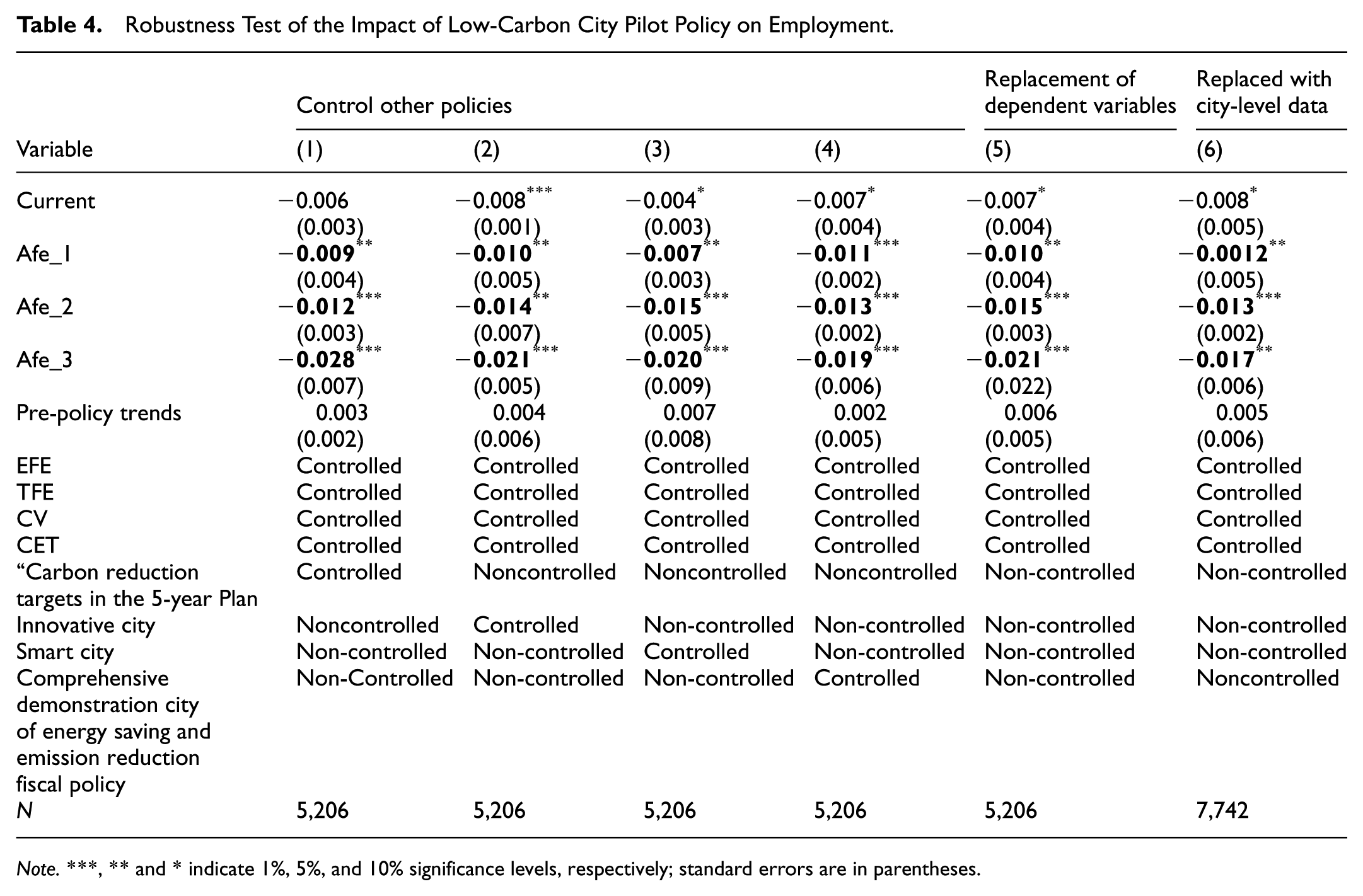
Note.***, ** and * indicate 1%, 5%, and 10% significance levels, respectively; standard errors are in parentheses.
Robustness Test of the Impact of Carbon Emissions Trading Pilot Policy on Employment.

Note.***, ** and * indicate 1%, 5%, and 10% significance levels, respectively; standard errors are in parentheses.
Secondly, the dependent variable is replaced. The dependent variable was changed from the number of employees at the end of the year to the average number of employees during the year. The regression results after the replacement are shown in column (5) of Tables 4 and 5, respectively. The finding that the low-carbon city pilot policy reduces the employment rate, compared to the carbon emissions trading pilot policy that raises the employment level, is consistent with the findings in Table 3.
Thirdly, employment indicators were selected at the city level. The employment indicator has been replaced from “number of employees at the end of the year” to “number of urban employed persons,” and other indicators remain unchanged. After replacing the indicator, the regression results are shown in column (6) of Tables 4 and 5, respectively. The results in these two columns are still the same as those in Table 3, the low carbon city pilot policy reduces the employment rate, and the pilot carbon emissions trading policy increases the employment rate.
Fourthly, the time placebo test. This paper employs the time placebo test to verify that the difference in employment levels between the experimental and control groups does not stem from temporal trends. Three dummy policy variables were constructed by shifting the effective dates of the low-carbon city pilot policy and the carbon emissions trading pilot policy forward by 1, 2, and 3 years, respectively. Specifically, the dummy variables for the low-carbon city policies were designated as L1, L2, and L3, while those for the carbon emissions trading policy were labeled T1, T2, and T3. These policy dummy variables were then incorporated into the regression model, with the detailed results presented in Table 6. The findings indicate that under the counterfactual time test, the implementation of these policies did not significantly impact corporate employment levels, confirming the absence of systematic time trend differences between the experimental and control groups. Thus, it can be concluded that the identified effects—where low-carbon city pilot policy reduces employment levels and carbon emissions trading pilot policy increases employment levels—are genuinely present and not influenced by temporal variations.
Time Placebo Test.

Note.***, ** and * indicate 1%, 5%, and 10% significance levels, respectively; standard errors are in parentheses.
Theoretical Mechanism Test
The theoretical mechanism test mainly analyzes the impact of low-carbon city pilot policy and carbon emissions trading policy on enterprise output and clean production factor input. The clean production factor input indicator selects investment in clean production equipment. The value of this indicator depends on the quantity and unit price of clean production equipment invested. To avoid inflation’s impact on this indicator, the annual investment in clean production equipment from 2006 to 2022 has been converted to 2006 price levels. The calculation method for this indicator is: multiply the stock of a company’s waste gas and wastewater treatment equipment by the national average price of pollution control equipment for that year, then divide by the fixed asset investment price index. This index is a fixed-base index with 2006 as the base year, and its value in 2006 is one. The stock of a company’s wastewater and waste gas treatment equipment is sourced from the “Construction in Progress” section of the company’s annual report. Pollution control equipment prices are sourced from the 1688 platform at: https://www.1688.com/jiage/-BBB7B1A3BBFAD0B5C9E8B1B8.html?from=ye&bizId=musicheng.ok.1688.com&no_cache=false. The fixed-asset investment price index is derived from the “China Statistical Yearbook.” The final calculated result is expressed logarithmically.
Firstly, this paper employs event study to examine whether the two policies exhibit pre-policy trends in their effects on output and clean production factor inputs, as shown in Figure 2. Only the carbon emissions trading pilot policy has a pre-policy trend for clean production factors. Secondly, this study employs stepwise regression to verify the mediating roles of enterprise output and clean production factor inputs in the relationship between the two pilot policies and enterprise employment. Thirdly, considering that both internal and external resources such as financing constraints and government subsidies may interfere with the model results to some extent, To mitigate these influences, this study further controls for variables related to financing constraints and government subsidies within the model. Specifically, following Brown et al. (2012), the study constructs a financing constraint SA index using firm size and age, calculating its absolute value to measure the level of financing constraints. Drawing on Han et al. (2024), the study selects the ratio of government subsidies received by firms to their total operating revenue to characterize the level of government subsidies. Both clean production factor inputs and firm output are log-transformed. The results of the mechanism tests are presented in Tables 7 and 8. To further validate the findings in Figure 2, the mechanism verification in Tables 7 and 8 employs both nonparametric event analysis and parametric event analysis.

Event study results of enterprise production and carbon emission intensity.
The Results of Mechanism Analysis on Enterprise Output.
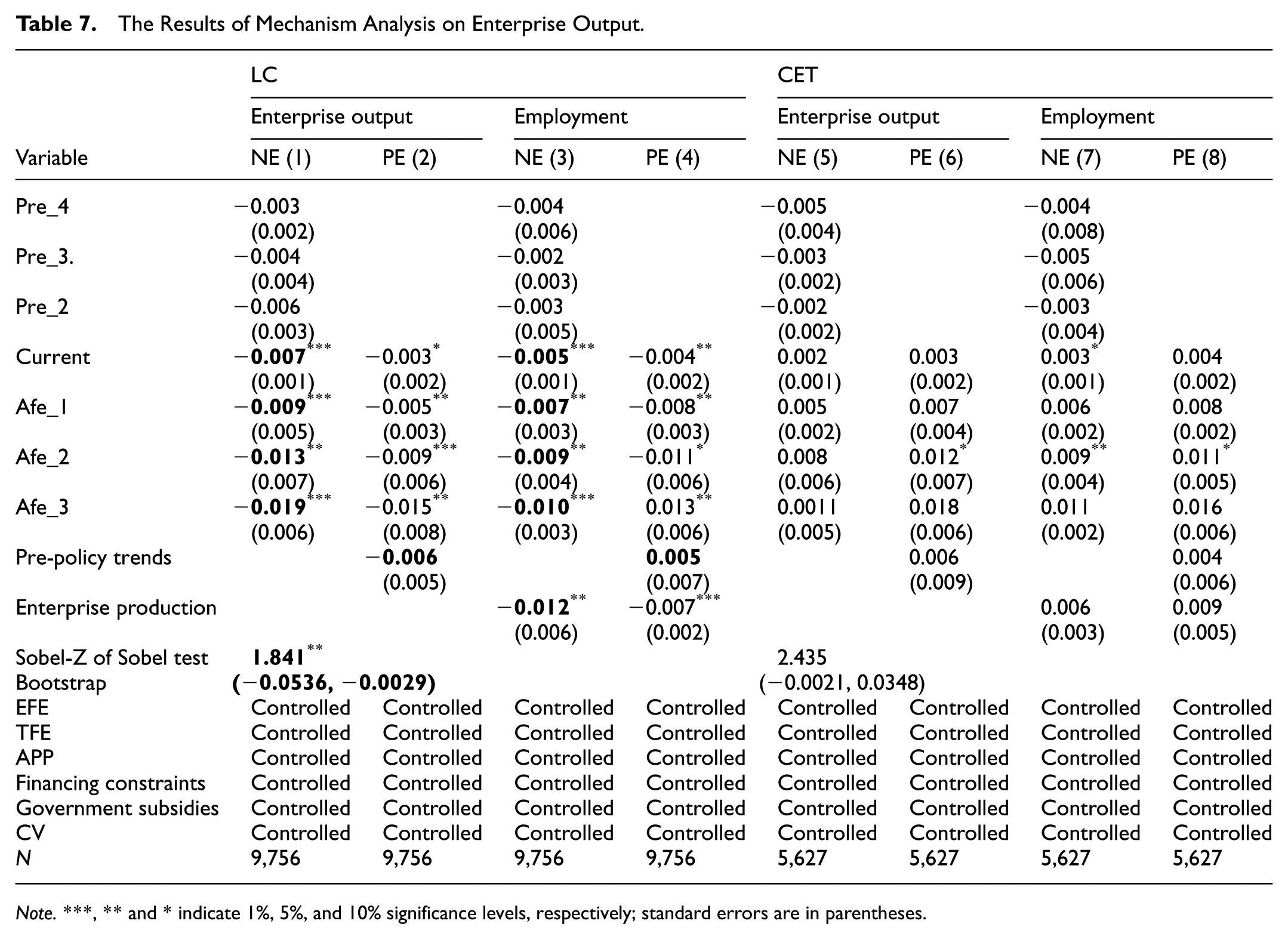
Note.***, ** and * indicate 1%, 5%, and 10% significance levels, respectively; standard errors are in parentheses.
The Results of Mechanism Analysis on the Input of Clean Production Factors.

Note.***, ** and * indicate 1%, 5%, and 10% significance levels, respectively; standard errors are in parentheses.
Columns (1) and (3) in Table 7 indicate that the low-carbon city pilot policy reduces employment rates by lowering output, consistent with theoretical findings. This result contradicts the findings of Hou and Xing (2025), C. Wang et al. (2023), Gao et al. (2025b), Fu et al. (2024), and C. Wei et al. (2024). There are two main reasons for this discrepancy. Firstly, the sample in this study consists of listed companies, while the samples in other literature primarily consist of cities. Cities include both listed and non-listed companies; however, listed companies are required to disclose more information about their environmental impact, making them more attentive to environmental protection. In contrast, non-listed companies may have weaker environmental awareness and may not reduce carbon emissions by cutting production, thereby avoiding job losses. Therefore, the difference in samples may be one reason for the contradiction between the results of this study and those of existing literature. Secondly, the actual survey period for this study on the impact of low-carbon city pilot policy on employment was from 2006 to 2013, while the survey periods in existing literature are longer. Since low-carbon city pilot policy are mandatory and require companies to reduce carbon emissions in the short term, the best way for listed companies to achieve rapid carbon reduction is to reduce production, which will lead to a decrease in labor demand. However, if companies have sufficient time to complete technological innovations, they may reduce carbon emissions through technological innovations rather than production cuts, as production cuts would harm corporate profits. Therefore, this study focuses on changes in labor demand in the short-term following policy implementation.
Table 8 indicates that the input of clean production factors serves as a mediator variable in the impact of the carbon emissions trading pilot policy on employment. Given the pre-policy trends in the policy’s influence on clean production factors, parametric event study was employed for the impact analysis, with results presented in columns (6) and (8) of Table 8. The results in Column (6) of Table 8 indicate that the carbon emissions trading pilot policy effectively increases the input of clean production factors. Furthermore, the results in Column (8) of Table 8 show that the carbon emissions trading pilot policy increases employment by boosting the input of clean production factors. L. Zhang et al. (2025) and Yang et al. (2024) also support this finding.
Further Sobel and Bootstrap methods were employed to re-examine the mediator effect, as shown in the Tables 7 and 8. In the Table 7, enterprise output serves as the mediator variable for the impact of low-carbon city pilot policy on employment. Since all Z-values from the Sobel test passed the 5% significance level test and all Bootstrap estimates fell on the same side of zero, this confirms the existence of a mediator effect. Similarly, in Table 8, the input of clean production factors serves as the mediator variable for the impact of carbon emissions trading pilot policy on employment. Since the Z-values from the Sobel tests all passed the 1% significance level test and the Bootstrap estimates all fell on the same side of zero, this confirms the existence of a mediator effect.
In summary, this section validates the theoretical mechanism of how low-carbon city pilot policy and carbon emission trading pilot policy affect employment. The former pilot policy reduces carbon emissions by reducing output, thereby leading to a decrease in employment, while the latter pilot policy reduces carbon emissions by increasing the input of clean production factors, thereby leading to an increase in employment.
Heterogeneity Analysis
Firstly, we compare the impact of low-carbon city pilot policy on employment under different carbon emission levels. This study uses the median carbon emissions of sample enterprises as a cutoff point, classifying enterprises with emissions above the median as high-carbon emitters and those below the median as low-carbon emitters. As shown in the results of columns (1) and (2) in Table 9, overall, the low-carbon city pilot policy had a negative impact on employment rates for both high-carbon emitters and low-carbon emitters. Additionally, the decline in employment rates was more pronounced for high-carbon emitting enterprises compared to low-carbon emitting enterprises. This is because high-carbon emitting enterprises need to reduce more input factors to meet carbon emission reduction standards, leading to a greater decline in employment rates.
Results of the Heterogeneity Test for Low-Carbon City Pilot Policy: Corporate Carbon Emissions, Nature of Corporate Ownership, and Different Regions.

Note.***, ** and * indicate 1%, 5%, and 10% significance levels, respectively; standard errors are in parentheses.
Secondly, we compare the impact of low-carbon city pilot policy on employment in enterprises with different ownership structures. Based on the division of ownership and control, the sample enterprises can be categorized into state-owned enterprises (where ownership is held by the state) and non-state-owned enterprises (where ownership is held by individuals or other organizations; F. Wei & Zhou, 2024). Based on this, this paper conducts regression analyses on the sample data of state-owned and non-state-owned enterprises separately, with the specific results shown in columns (3) to (4) of Table 9. Clearly, compared to non-state-owned enterprises, the low-carbon city pilot policy resulted in a smaller decline in employment for state-owned enterprises. The reason for this outcome may be that state-owned enterprises are more likely to obtain financial support for low-carbon transformation, such as environmental subsidies, compared to non-state-owned enterprises, thereby exerting less restraint on their output. In contrast, non-state-owned enterprises face stricter carbon emission reduction policies, such as suspension of operations for rectification, leading to a significant decline in their output levels in the short term and subsequent reductions in employment levels.
Thirdly, we examine the impact of low-carbon city pilot policy on employment across different regions. This study adopts the regional classification method proposed by Lee et al. (2023), dividing the sample enterprises into eastern, central, and western regions. Based on this classification, the impact of low-carbon city pilot policy on employment in different regions is shown in columns (5)–(7) of Table 9. The results from these three columns indicate that low-carbon city pilot policy significantly reduced employment levels in enterprises in central and western China, with the largest decline observed in western regions, while having no significant impact on employment levels in eastern China. This is because, compared to eastern regions, central and western regions have a higher proportion of high-energy-consuming and high-emission enterprises, as well as a higher proportion of low-skilled labor. Under the influence of the low-carbon city pilot policy, enterprises in the central and western regions need to reduce more input factors to lower carbon emissions, resulting in a greater decline in employment levels in these regions.
Fourthly, the impact of low-carbon city pilot policy on employment levels in high-carbon and low-carbon emitting industries. To further examine the differential effects of these policies on employment across industries with varying carbon intensity, this study employs heterogeneity analysis by selecting the power industry and service industry as representative high-carbon and low-carbon emitting sectors, respectively (Christodoulou et al., 2024). Specifically, this study grouped enterprises from the power industry and service industry within the research sample for separate regression analyses. The results of the heterogeneity analysis are presented in columns (1) and (2) of Table 10. The results indicate that the low-carbon city pilot policy exerts a greater negative impact on employment levels in the power industry enterprises, while having no significant effect on employment levels in the service industry enterprises. This may be because the policy imposes stricter emission reduction requirements on power industry enterprises, which exhibit high-carbon emission characteristics, compared to service industry enterprises with low-carbon emission profiles.
Results of the Heterogeneity Test for Low-Carbon City Pilot Policy: Industry Attributes and Enterprise Types.

Note.***, ** and * indicate 1%, 5%, and 10% significance levels, respectively; standard errors are in parentheses.
Fifthly, the impact of low-carbon city pilot policy on employment levels in export-oriented and non-export-oriented enterprises. Following Luo et al. (2023), enterprises engaged in exports prior to the 2007 renewal loan criteria change are classified as export-oriented enterprises, while the remaining sample enterprises are categorized as non-export-oriented enterprises. Based on this classification, this study conducted a grouped regression analysis, with specific results presented in columns (3) and (4) of Table 10. The results indicate that the low-carbon city pilot policy significantly reduced employment levels in non-export-oriented enterprises, while having no significant impact on employment levels in export-oriented enterprises. This may be because, compared to export-oriented enterprises, non-export-oriented enterprises are typically smaller in scale, have lower productivity, limited financing channels, and are more susceptible to domestic policy influences. When confronted with emission reduction pressures from the low-carbon city pilot policy, non-export-oriented enterprises struggle to secure funding for low-carbon technology upgrades. They often opt to cut high-energy-consumption and high-emission production processes to meet policy requirements, consequently leading to reduced employment levels.
Sixthly, the impact of low-carbon city pilot policy on employment for high-skilled and low-skilled labor. Fusillo et al. (2022) define “Abstract Task” as high-skilled occupations and “Manual Task” as low-skilled occupations. Accordingly, this study categorizes the labor force within the two policy pilot regions into high-skilled and low-skilled labor. The effects of low-carbon city pilot policy on employment for workers with different skill levels are shown in columns (1) and (3) of the Table 13. The results indicate that the implementation of low-carbon city pilot policy reduces demand for both low-skilled and high-skilled labor. This may occur because the policy impacts employment by reducing output: when output declines, inputs of all production factors decrease, leading to reduced demand for both low-skilled and high-skilled labor.
Following the heterogeneous analysis of the impact of low-carbon city pilot policy on employment, this paper further focuses on the heterogeneous analysis of the impact of carbon emission trading pilot policy on employment. The analysis results are shown in the Tables 11 to 13.
Results of the Heterogeneity Test for Carbon Emissions Trading Pilot Policy: Corporate Carbon Emissions, Nature of Corporate Ownership, and Different Regions.

Note.***, ** and * indicate 1%, 5%, and 10% significance levels, respectively; standard errors are in parentheses.
Results of the Heterogeneity Test for Carbon Emissions Trading Pilot Policy: Industry Attributes and Enterprise Types.
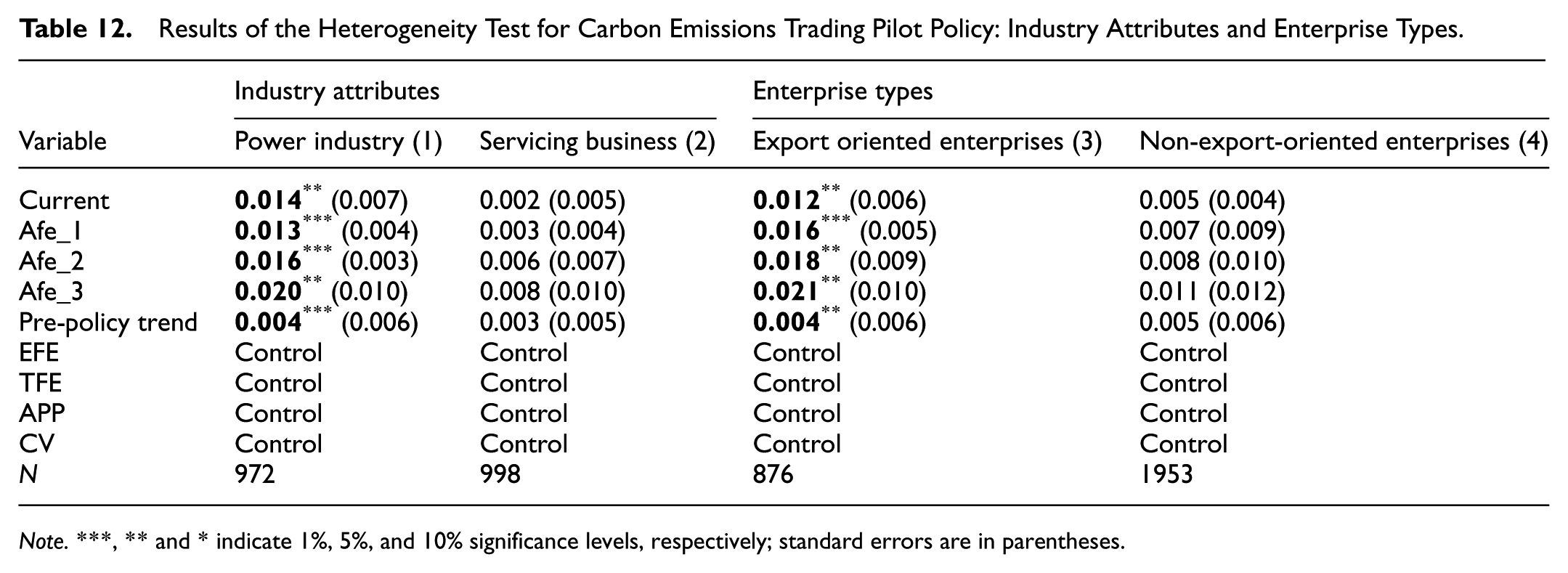
Note.***, ** and * indicate 1%, 5%, and 10% significance levels, respectively; standard errors are in parentheses.
Results of the Heterogeneity Test for Labor Force With Different Skill Levels.

Note.***, ** and * indicate 1%, 5%, and 10% significance levels, respectively; standard errors are in parentheses.
Firstly, the impact of the carbon emissions trading pilot policy on employment levels at companies with different carbon emission levels is shown in the first and second columns of Table 11. The results indicate that employment decreases in high-carbon-emitting enterprises, while the opposite occurs in low-carbon-emitting enterprises. This is because high-carbon-emitting enterprises must purchase emission rights to continue production, leading to increased production costs and potentially reduced output.
Secondly, the impact of the carbon emissions trading pilot policy on employment in enterprises of different ownership types. Columns 3 and 4 of Table 11 indicate that the carbon emissions trading policy has a significant positive effect on employment levels in state-owned enterprises, but no significant effect on employment levels in non-state-owned enterprises. This may be because state-owned enterprises typically assume and fulfill more social responsibilities than non-state-owned enterprises.
Thirdly, the impact of the carbon emissions trading pilot policy on employment in enterprises across different regions, as shown in columns 5 to 7 of Table 11. The results indicate that the carbon emissions trading policy has a positive effect on employment in enterprises in eastern and central regions, but no significant impact on employment in western regions. This may be because, compared to eastern and central regions, western regions are dominated by high-energy-consuming and high-emission enterprises, facing dual constraints of high-carbon industrial structure lock-in and insufficient funds for transformation. Under the influence of the carbon emissions trading policy, enterprises in western regions may meet policy requirements through measures such as reducing production capacity or purchasing carbon quotas, rather than achieving emission reduction targets through clean production factor inputs. Therefore, the carbon emissions trading pilot policy has no significant impact on employment levels in western enterprises.
Fourthly, the differential impact of carbon emissions trading pilot policy on employment levels across industries with varying carbon intensity. The sample selection and empirical testing process mirrored the heterogeneity analysis of low-carbon city pilot policy. The results are presented in columns (1) and (2) of Table 12. The results indicate that the carbon emissions trading pilot policy significantly increases employment levels in enterprises within the power industry, while having no significant impact on employment levels in the service industry. This may be because most service enterprises do not participate in the carbon emissions trading market and do not directly engage in quota trading. Consequently, carbon price signals cannot be directly transmitted into their production cost functions. This leads to service enterprises having no incentive to establish dedicated positions responsible for carbon reduction. In contrast, the power industry, as one of the key emission-controlled industries under the carbon emissions trading policy, often increases investments in clean production factors like renewable energy to mitigate cost pressures from the carbon exchange and meet market demand for green solutions (Gao, Zhang, & Liu, 2025). This strategy creates more job opportunities for enterprises within the power industry.
Fifthly, the impact of carbon emissions trading pilot policy on employment levels in export-oriented and non-export-oriented enterprises. The sample selection and empirical testing process mirrored the heterogeneity analysis of low-carbon city pilot policy. The results are presented in columns (3) and (4) of Table 12. Findings indicate that carbon emissions trading pilot policy significantly boosted employment levels in export-oriented enterprises, while having no significant effect on non-export-oriented enterprises. This may stem from export-oriented firms having the opportunity to pass on part or all of the additional carbon costs incurred by the policy to overseas buyers. In contrast, non-export-oriented firms primarily sell their products in the domestic market, making them more vulnerable to the policy’s impact. They face limited scope for passing on carbon costs, bearing the bulk of the burden themselves. To counter rising costs, non-export-oriented firms may opt to reduce production output, thereby negatively affecting employment.
Sixthly, the carbon emissions trading pilot policy significantly increased demand for high-skilled labor while also generating a moderate increase in demand for low-skilled labor, as shown in columns (6) and (8) of Table 13. Although demand for low-skilled labor rose during the first 2 years of the pilot policy implementation, this result failed to pass the significance test. However, the growth in demand for low-skilled labor during the second and third years after policy implementation passed the significance test. This may be attributed to the following: Following the implementation of the carbon emissions trading policy, high-skilled labor facilitates enterprises’ low-carbon technological innovation and enhances their profitability in the carbon trading market, thereby increasing corporate demand for such workers. However, enterprises lack intrinsic motivation to increase demand for low-skilled labor. The growth in demand for low-skilled labor is actually achieved indirectly through “skill complementarity.” Furthermore, the realization of skill complementarity requires a certain scale of high-skilled labor as a prerequisite. This also explains why the increase in demand for low-skilled labor only passed the significance test in the second and third years after the implementation of the carbon emissions trading pilot policy.
The Moderating Effect of the Economic Environment
Differences in economic conditions may influence the implementation of environmental policies and employment. Given this, the policy dummy variables LowC and TPS in Equations 4–6 are both multiplied by the GDP of the city where the firm is located, that is, GDP is used as a moderating variable to reanalyze the impact of environmental policies on employment. The regression results are shown in Table 14. As can be seen from these results, the implementation of low-carbon city pilot policy still reduces employment under the GDP moderating effect. This indicates that the Chinese government is committed to reducing carbon emissions. Despite the significant decline in GDP for low-carbon pilot cities in both 2012 and 2013, this did not stimulate the high-carbon industries capable of driving rapid economic growth. Similarly, under the GDP moderating effect, the carbon emissions trading pilot policy still has a positive impact on employment. This suggests that before the implementation of carbon emissions trading, enterprises had already developed a strong environmental protection consciousness and may have gradually replaced high-carbon production methods with clean production methods. Therefore, after the implementation of the carbon emissions trading policy, these enterprises benefited not only from reduced carbon emissions but also from increased income through the sale of carbon emissions rights. Furthermore, the reduced carbon control costs and increased income from selling carbon emissions rights further prompted enterprises to expand their production scale and increase their demand for labor.
The Regression Results of Economic Environment as a Moderating Variable.

Note.***, ** and * indicate 1%, 5%, and 10% significance levels, respectively; standard errors are in parentheses.
Conclusion
The conclusion of this paper is that low-carbon city pilot policy reduces employment by decreasing output, while carbon emissions trading pilot policy increases employment by boosting the input of clean production factors. Furthermore, this paper offers the following two recommendations.
Firstly, a portion of the revenue from carbon quota auctions is allocated to establish a Green Employment Training Fund to cultivate green-skilled talent and support green startups. Approximately 30% of annual carbon quota auction proceeds are earmarked for this special fund, primarily directed toward green vocational skills training, green industry internships and employment subsidies, green vocational education and industry-education integration, green entrepreneurship, and regional green transition. The fund’s governance structure and functions are as follows: National level: Formulates strategy, approves annual plans, and oversees evaluation; Fiscal custodian department: Manages fund custody, budget administration, and auditing; Executive agency: Issues project guidelines, establishes training standards, and builds information systems; Local authorities: Handle project applications, organize training, manage employment, and report performance. Project applicants primarily include: Vocational colleges, Industry associations, Green enterprises, Local governments. Primary project applicants include: higher vocational colleges, industry associations, green enterprises, and local governments. They submit applications according to relevant guidelines, with the foundation organizing expert reviews and publicly announcing results. Qualified trainees are incorporated into the national skilled talent database. The Green Employment Training Fund undergoes third-party auditing and performance evaluation, with assessment outcomes regularly disclosed. Regions or institutions with employment conversion rates below 50% for three consecutive years will have their project applications suspended.
Secondly, a dual-objective assessment mechanism for carbon reduction and employment should be established, accompanied by local pilot programs. The mechanism aims to ensure overall employment stability and steady improvement in job quality while rigorously implementing carbon reduction targets. The assessment indicator system primarily consists of two sets of metrics: carbon reduction and employment. The former includes: total carbon emissions, carbon emission intensity, and the share of non-fossil energy sources. The latter encompasses: net growth in green jobs, reemployment rates in high-carbon industries undergoing transformation, and coverage rates for green skills training. Assessment Entities: Central and local institutions. Central institutions—including the National Development and Reform Commission, Ministry of Ecology and Environment, and Ministry of Human Resources and Social Security—develop national assessment methods and indicator systems, conducting annual oversight and final evaluations of local governments. Local agencies form assessment teams comprising relevant provincial departments. These teams conduct annual evaluations of all levels of government and key enterprises within their jurisdictions, reporting results to the central assessment team. The assessment methodology encompasses three primary aspects. ①Central agencies evaluate the coordinated achievement of carbon reduction and employment targets. ②Central agencies implement a tiered assessment approach: employment placement and green transformation in traditional industrial bases are key assessment focuses; new employment generated by green technology R&D in innovative cities is a key assessment focus. ③The central agency establishes a dynamic monitoring system. This system conducts monthly dynamic monitoring to issue early warnings for regions showing “significant carbon reduction but rising unemployment,” requiring such regions to submit employment security plans. To explore the scientific validity of this assessment mechanism, pilot programs are necessary. Representative industrial cities, resource-based cities, and comprehensive cities should be selected as pilot sites, ensuring the universality and relevance of the experience gained. Pilot regions must establish a “Green Employment Training Fund” using revenues from carbon quota auctions. Additionally, incentive mechanisms must be developed. For pilot regions demonstrating outstanding performance, the central government will provide policy preferences in transfer payments, green bond issuance, and major project allocation. Concurrently, central authorities should allow pilot regions some margin for error in their implementation.
This study did not incorporate public participation environment regulation into its analytical framework. Future research could delve deeper into the employment effects of participation environment regulation and its underlying mechanisms, conducting detailed tests that account for firm heterogeneity. Such work would provide a more comprehensive theoretical foundation and policy reference for achieving synergies between environmental governance and employment stability.
Footnotes
Acknowledgements
This research was supported by a grant from Nanjing Institute of Technology, and I am grateful for their financial support. And I would like to thank the China Research Data Service Platform (CNRDS) for providing the data used in this study.”

Ethical Considerations
It is not applicable.
Funding
The authors disclosed receipt of the following financial support for the research, authorship, and/or publication of this article: This research is supported by the National Social Science Fund of China (Grant ID:24BJY086), Major projects of Jiangsu Provincial Department of Education (Grant ID:2024SJZD029), University Research Fund of Nanjing Institute of Technology (Grant ID: YKJ202228).
Declaration of Conflicting Interests
The authors declared no potential conflicts of interest with respect to the research, authorship, and/or publication of this article.
Data Availability Statement
The data supporting the research in this paper were obtained from the China Research Data Service Platform (CNRDS), but there are limitations to the accessibility of these data, which are licensed for use in the current study and therefore not publicly available. However, the authors can provide these data upon reasonable request and with permission from CNRDS.