




Abstract
This article presents a research investigation focusing on the effects of ChatGPT utilization on sustainable education and development. The study employed five machine learning (XGBoost, RF, SVM, GBDT, and ANN) models for predicting the impacts of ChatGPT usage in education, aiming at identifying the potential benefits of ChatGPT usage on learners, tutors, and possible future implications using the data collected via social networking sites. A total of 2,936 datasets concerning the impacts of ChatGPT utilization on sustainable education were analyzed. Four of the research AI-predictive models predicted the impacts of ChatGPT usage on sustainable education and development with greater accuracy with
Introduction
In the present day, Artificial Intelligence (AI) has experienced remarkable growth, ushering in new forms and transformations in various aspects of human endeavors such as; nations’ economy, health sector, m-payment systems, and contemporary education (Ali et al., 2023; Cavus et al., 2021). Among these innovations, is Open AI, specifically “Chat Generative Pre-trained Transformer” (ChatGPT) which stands out as a recent development with a significant impact on the teaching and learning processes. Its emergence can be traced back to an extensive history of AI research, which has been leveraged by technology-based learning over several decades. Early studies on the integration of technology into the teaching and learning process primarily concentrated on aspects such as learning strategies, enthusiasm, attitudes, and collaboration (Loderer et al., 2020).
In recent times, ChatGPT has gained considerable attention for its exceptional performance across various narrative tasks. Early enthusiasts, especially in the educational sector, have shown a strong affinity for ChatGPT (Tubishat et al., 2023). It is imperative to grasp the perspectives of these early enthusiasts, as they can provide insight into the technology’s prospective outcomes, strengths, weaknesses, and potential for success or setbacks. Social media serves as an effective communication tool, allowing individuals to freely express themselves by writing, commenting, and sharing their perspectives on various subjects while engaging with others. Consequently, discussions on social media, and early research trends regarding ChatGPT’s utilization in education serve as a valuable resource for gaining insights into public apprehensions concerning ChatGPT (Dong et al., 2023). Furthermore, Kasneci et al. (2023) argued that the global influence of ChatGPT on education is evident through its adoption by both students and educators, many of whom use social media platforms to share their thoughts about the technology.
Though some research endeavors have explored the potential advantages of ChatGPT across various domains using traditional methodologies. There remains a notable dearth of studies investigating the effects and forthcoming obstacles associated with ChatGPT adoption among educators and learners utilizing Machine Learning (ML) based techniques. Consequently, there exists a compelling necessity for additional research in this area. ML algorithms are essential for processing information and sentiment data, as well as for assessing individuals’ viewpoints regarding AI-based technologies such as ChatGPT, to gain insights into their perspectives. These methods are often referred to as ML techniques. Research has consistently shown that ML techniques usually outperform traditional approaches in studies that focus on exploring human emotions, attitudes, and behavior toward emerging technology due to their robustness and predictive capabilities (Mohammed & Bulama, 2023). ML techniques are applied to classify or predict the influence of input parameters on output variables. Thus, the purpose of this study is to examine the impacts of students and educators’ utilization of ChatGPT in teaching and learning activities using five ML algorithms; “Gradient-boosted decision tree (GBDT),”“Artificial neural network (ANN),”“Support vector machine (SVM),”“Random forest (RF),” and “eXtreme gradient boosting (XGBoost)” to obtain precise results regarding the impacts of ChatGPT on contemporary education.
The study would offer educational institutions valuable insights into the impact of ChatGPT on teaching and learning processes. Additionally, the study’s results underscore the superior predictive capabilities of ML techniques in comparison to other conventional methods. The ML models employed in this study provide more precise predictions of ChatGPT’s effects on both students and educators, potentially serving as a valuable tool for those in decision-making roles, particularly within the education domain.
The remaining part of the paper is organized as follows: Section “Introduction” provides an overview of prior research related to ChatGPT. Section “Material and Methods” outlines the materials and methods employed in this paper. Section “Results and Discussions” presents the findings and discussions of the paper. Finally, Section “Conclusion” encapsulates the conclusions drawn from this research and outlines potential avenues for future work.
Material and Methods
AI predictive models have become the cornerstone of modern research transformation. These models use both machine learning (ML) and deep learning (DL) techniques to analyze extensive datasets, uncover hidden relationships, and generate predictions that provide unmatched precision in guiding scholars. They have made traditional research methods obsolete and are now indispensable tools for businesses, educators, and students seeking to stay ahead in a rapidly evolving world (Li et al., 2020). In this section, we provide an overview of sentiments expressed in previous studies concerning the emergence, potential advantages, challenges, and possible future implications of ChatGPT usage across various domains, with a particular emphasis on its effects within the education sector.
Appearance of ChatGPT
Studies have shown that ChatGPT was launched in the year 2022, precisely on November 30 by an OpenAI firm. The technology is considered by many as a versatile conversational chatbot with the potential to significantly impact all aspects of our society (Castonguay et al., 2023). However, the potential educational implications of this natural language processing technology remain uncertain. For instance, Adeshola and Adepoju (2023), argued that ChatGPT’s potential influence could extend to educational learning objectives, assessment processes, learning activities, and evaluation procedures. Prior to the rapid rise of ChatGPT, Jain and Jain (2019) examined the usage of AI in higher education teaching and learning. The authors highlighted how AI has rapidly expanded access to higher education services beyond the confines of traditional classrooms. Their study discussed the potential for AI to become a significant component of colleges and its immediate as well as long-term effects on various sectors within higher education.
Another study conducted by Kovačević (2023) stressed that the recent emergence of ChatGPT has triggered extensive discussions about the ethical considerations and practical use of AI. Specifically, it is imperative to address the potential misuse of AI in education and to make educational curricula adaptable for the forthcoming era of AI-assisted assignments.
State of the Art: ChatGPT Utilizations
Potential Benefits of ChatGPT Usage
In general, there are scarcity of publications that delve into the role of ChatGPT in education and other fields. For instance, regarding the potential benefits of ChatGPT on contemporary education, Lo (2023) argued that teachers could simplify the creation of learning assessment materials using ChatGPT, resulting in time and effort savings, while potentially enhancing the quality of questions through adherence to a standardized framework. With the capabilities offered by ChatGPT, educators can generate open-ended question prompts that align with the learning objectives and success criteria of their instructional lessons. Considering that a significant portion of teachers invest substantial time in crafting quizzes, monthly tests, and examinations, it becomes evident that there is an opportunity for educators to reduce the assessment workload by seeking assistance from ChatGPT.
In contrast to traditional tutoring methods, ChatGPT emerges as a promising tool with the potential to function as an ideal personal tutor for students. Mhlanga (2023) and Qadir (2023) argued that students can receive personalized feedback and individualized answers by engaging with ChatGPT, which can provide virtual intellectual tutoring services. This convenience allows students to seek assistance from ChatGPT whenever they require help with their homework, assignments, projects, or even mathematical exercises. This approach has the potential to empower students to become independent and self-directed learners. Additionally, Baidoo-Anu and Ansah (2023) claimed that in addition to addressing students’ inquiries, ChatGPT also has the ability to engage in discussions on a wide range of topics. Also, in the context of essay writing, Choi et al. (2023) stressed that ChatGPT’s performance exhibited notable disparities compared to traditional methods. The authors claimed that on some occasions, it aligned with or even outperformed the average performance of real students. Conversely, when ChatGPT’s essay prompts contained errors, these errors were notably egregious, often resulting in the lowest grades in the class. This trend was particularly evident when the essay questions required students to evaluate or reference specific cases, theories, or doctrines covered in the course.
Another research undertaken by Surameery and Shakor (2023) found that ChatGPT possesses the ability to locate and rectify errors in computer code. The authors argued that ChatGPT possesses advanced Natural Language Processing (NLP) skills, including its ability to comprehend and generate text resembling human language. This capability proves valuable in the analysis of code, as it enables the model to grasp the code’s intended meaning and detect potential errors based on the language used. Similar to its impact on educational institutions, ChatGPT also holds significant potential benefits in global healthcare education. For instance, in healthcare education, Sallam (2023) conducted a systematic review to explore the potential utilizations of ChatGPT in both research and practical contexts. The analysis assessed 280 archives and revealed that ChatGPT provides numerous potential advantages and uses, this includes proficiently scrutinizing substantial datasets, generating code, and conducting rapid and concise literature reviews, as well as its usefulness in cost minimization in drug discovery and development, improved documentation, personalized medicine, and other elevated health literacy.
İpek et al. (2023) and Karakose et al. (2023) in their studies argued that “ChatGPT has the ability to enhance education skills across various domains, including but not limited to literature search, content creation, translation, generating in-depth and intricate responses, understanding and addressing students’ requirements, providing personalized learning experiences. Also, the authors stressed that ChatGPT, especially ChatGPT-4 can present information in a more organized and integrated manner, showcasing enhanced critical reasoning abilities.” Also, Athanassopoulos et al. (2023) in their work argued that “ChatGPT has the potential to serve as a language learning aid and assist in the teaching process, particularly for students with a refugee or migrant background.” Nevertheless, the authors stressed that additional research is required to explore its application and efficacy in various educational settings.
Possible Future Obstacles of ChatGPT Utilization in Education
Though, relevant studies on the potential benefits of ChatGPT usage in education were examined to position the current research within the context of previous findings. However, considering the valuable insights presented by Deng and Lin (2022), it becomes imperative for this research to examine the potential drawbacks of ChatGPT and other generative AI utilization in the realm of education. For instance, Baidoo-Anu and Ansah (2023) in their research put forth the argument that the use of ChatGPT in education could potentially have adverse consequences on the teaching and learning processes in the future. The authors have pointed out several possible limitations associated with ChatGPT usage. These limitations encompass the absence of human interaction and constrained comprehension, biases in training data, restricted creativity, reliance on data, and a deficiency in contextual understanding. Additionally, Mhlanga (2023) and Cavus et al. (2023) in their studies stressed that there are a lot of concerns regarding the ability of ChatGPT to tailor instruction to individual students’ unique requirements, along with apprehensions about privacy and data security when ChatGPT is used in educational settings. Furthermore, İpek et al. (2023) and Karakose et al. (2023) stressed that ChatGPT has some drawbacks such as cheating, generating incorrect answers, and ethical and legal issues which negatively affect academic integrity, thus the need for college administrators to do more to ensure adherence to AI ethical practices.
In another research conducted by Tubishat et al. (2023) using “sentiment analysis to analyze the effects of using ChatGPT in education.” The authors explore the arrival of ChatGPT, a cutting-edge language model designed for text generation that closely resembles human writing. They also discussed the challenges and opportunities ChatGPT presents in education and its potential impact on educational stakeholders. One challenge associated with using ChatGPT in education is the potential threat it poses to traditional essay-based assessments, with concerns that students may use it to outsource their written assignments. Furthermore, educators also expressed their worries about ChatGPT’s limited ability to comprehend and evaluate the relevance or accuracy of the information it generates, as it primarily operates as a text-generation machine (Ali et al., 2023). Also, Shoufan (2023), and Sallam (2023) in their studies highlight several legitimate concerns and potential risks associated with the utilization of ChatGPT, especially in healthcare education. The potential risks and other concerns highlighted by the researchers are; ethical dilemmas, the threat of bias, plagiarism concerns, copyright challenges, issues related to transparency, legal implications, absence of originality, erroneous responses, restricted knowledge, and imprecise citations.
Though, Biswas (2023) and Khan et al. (2023) in their works underscore multiple potential benefits of ChatGPT. Nonetheless, the articles acknowledged certain drawbacks of ChatGPT in education and medical domains, such as its limited human-like comprehension and the absence of data updates beyond the past and present, potentially causing text generation errors. The authors suggest that while ChatGPT can serve as a valuable aid, it should not be regarded as a substitute for human expertise and capacity in the education sector. Furthermore, according to Shidiq (2023), ChatGPT is not a substitute for human beings when it comes to direct or verbal interactions due to certain limitations. The authors claimed that; (a) learning typically involves direct interactions, including emotional connections usually established by the teachers who use modeling and examples to enhance academic excellence, while ChatGPT lacks this capability, (b) learning relies on creativity to generate fresh ideas and innovations, which are presented to students for feedback and further development, while ChatGPT lacks the creativity inherent in humans, (c) ChatGPT cannot grasp the nuances and varied learning styles of individual students. Also, the researchers stressed that reliance on ChatGPT in social situations can lead individuals to feel inadequate because they may struggle to effectively navigate social interactions.
Methodology
Dataset
To achieve our research objective, we devised a strategy to investigate educators’ and students’ opinions regarding the potential benefits and obstacles of ChatGPT utilization in contemporary education, primarily by gathering data via an online tool (i.e., Google Form). The research was carried out within 3 months, that is, from 10th August 2023 to 10th November 2023. Thus, the study dataset consists of 3 months datasets obtained via online tools only.
Data Collection Process
Participants for the research were drawn from various institutions of learning. The survey link was sent to the respondents via institutional official social media platforms, for example, Instagram, Twitter, WhatsApp, and Facebook. Interestingly, the online survey link was designed to ensure the confidentiality of participants, as it did not capture personal information such as respondent Identities (IDs), emails, and IP addresses. Additionally, educators and students have the right to opt out of the study since participation is voluntary. Furthermore, the authors also communicated the study’s purpose to the institution administrators through separate emails, highlighting the importance of gathering information regarding the potential benefits and challenges associated with ChatGPT usage in modern education.
The data collection tool used in the study was adapted from Ali et al. (2023), and Sok and Heng (2023). It comprises two sections: the first section determines the participant’s categories, that is, as either educators or students, while the second section contains 10 statements (i.e., Interest in learning, independent learning, self-confidence, ambition to get a job, interaction with other people, fun and enjoyment while learning, creation of learning assessment, enhancing pedagogical practice, outlines creations, and generating innovative concepts) aimed at assessing the perspectives of both educators and students regarding the possible benefits of using ChatGPT in education. During the selection of our data source, we accorded priority to data coming from educators’ and students’ platforms due to the study objectives. A total of 11,865 responses were collected, and 11,466 (97%) were found to be valid, indicating an impressive response rate (Cavus et al., 2022).
Data Cleaning and Preparation
The study collected data were subjected to different machine learning (ML) data pre-processing techniques such as data cleaning, data normalization, and feature selections. After cleaning our datasets by removing duplicate and incomplete entries. The research ML data preparation methods produced a total of 2,936 valid datasets regarding the impact of ChatGPT utilization on contemporary education.
Machine Learning Techniques
Studies have shown that “machine learning” (ML) techniques exhibit superior performance in handling complex research domains, such as perceptions, attitudes, and emotions due to their robustness, flexibility, and predictive capabilities (Cavus et al., 2021; Mohammed & Bulama, 2023). Additionally, in many situations, machine learning (ML) methods can achieve higher accuracy and lower complexity compared to conventional models. For example, Liu et al. (2020) employed an “artificial neural network” (ANN) to estimate fiber nonlinear noise with greater accuracy and efficiency compared to the original analytical model used in the study. Therefore, this study employed five ML techniques; GBDT, ANN, SVM, RF, and XGBoost in order to obtain accurate and reliable results regarding the impacts of ChatGPT on contemporary education.
GBDT Algorithm
GBDT is a machine learning ensemble algorithm that employs multiple decision trees (DTs) as its base learners. Each decision tree (DT) is not independent because a newly added DT gives more weight to the misclassified samples identified by previous DTs. Though, the normal Gradient Boosting (GB) approach offers more precision in terms of predicting linear relationships. However, GBDT has the ability to capture both linear and non-linear relationships in dataset, making it more suitable for studies with large and complex datasets like ours (Liang et al., 2020). It’s evident that the residual values from previous DTs serve as inputs for the next DT. Subsequently, the newly added DT is used to reduce these residuals, thereby decreasing the loss along the negative gradient direction in each iteration. Ultimately, the prediction outcome is determined by summing the results obtained from all DTs. To obtain the (model optimum mapping function (F)), the model loss and optimal functions were calculated using Equation 1 as per (Dong et al., 2023).

Where, F(X) denotes the linear regression problem, while L represents the loss function of the regression problem, and y is the target. The algorithm of the study proposed GBDT is presented in Figure 1.

Framework of the study XGBoost algorithm.
ANN Algorithm
Artificial neural networks (ANN) is one of the most widely employed machine learning techniques, drawing inspiration from the intricate neural networks found in the human brain (Saritas & Yasar, 2019). Among the various types of ANNs, feedforward neural networks are particularly common. They transmit the processed weight values of each artificial neuron as output to the subsequent layer, relying on inputs from neurons in the preceding layer. Within the category of feedforward neural networks, the Multilayer Perceptron (MLP) holds a significant position (Saffari et al., 2022). For training MLP, the backpropagation algorithm stands out as the most frequently employed technique. It operates by adjusting the weights between neurons to minimize errors. Although, the ANN model excels in learning patterns and demonstrates adaptability to new data values. However, it is worth noting that this system may exhibit slow convergence and the potential for reaching local optima compared to EANN (Cavus et al., 2022). The research proposed “Feed-forward neural networks” (FFNN) algorithm consists of 10 inputs, a hidden layer, and 1 output layer as shown in Figure 2.
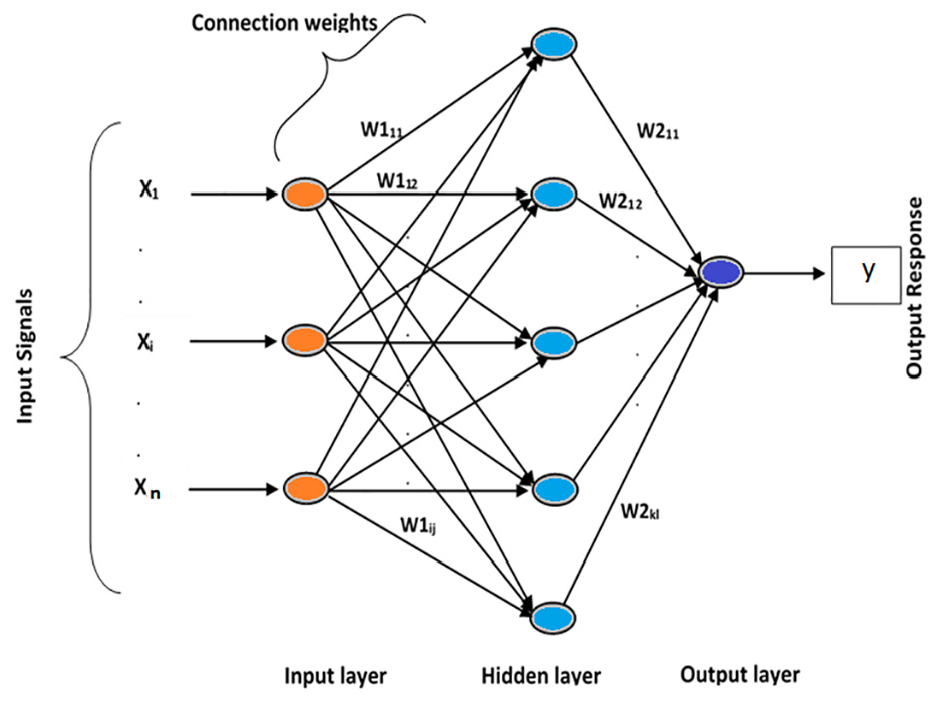
Structure of the study ANN algorithm.
SVM Algorithm
Support vector machine (SVM) is one of the most dominant ML algorithms due to its robustness in handling data uncertainty (Ghosh et al., 2019). The approach is usually employed to establish the optimal decision boundary (hyperplane) that separates different sets of data. SVM seeks to identify the ideal hyperplane by maximizing the distance (known as the margin) between these data clusters. Additionally, SVM usually exhibits strong performance in high-dimensional spaces, making it suitable for scenarios where the number of features (dimensions) is equal to or exceeds the number of samples. However, the technique is sensitive to noise and outliers in the data (Nanglia et al., 2021). In SVM, the margin signifies the separation between the nearest data points, also referred to as support vectors, and the hyperplane itself. Consequently, the primary objective in SVM is to locate the hyperplane that offers the greatest margin value, as this effectively reduces classification errors. The proposed SVM algorithm of the study was implemented using Equation 2.

Where w is the weight vector of the orthogonal hyperplane, x represents the input in the dataset, b is the bisector, and ∅ denotes the null set in the dataset. The study’s proposed SVM algorithm is presented in Figure 3.

Flow diagram of the study SVM algorithm.
Random Forest Algorithm
Random Forest (RF) is an ensemble learning approach which involves the creation of several decision trees. Each tree is created individually, resulting in a collection of trees that form a forest. The ultimate output is decided by a majority vote from the trees in the forest. In the training phase of Random Forest (RF), each tree in the forest is trained on a random subset of the training data with replacement, and utilizing bootstrapping. Additionally, feature selection occurs during the training process. A notable advantage of employing RF is its ability to address the overfitting issue commonly associated with other decision tree classifiers. The study’s RF model was implemented using Equation 4.

Structure of the study’s proposed RF algorithm is presented in Figure 4.

Structure of the research RF algorithm.
XGBoost Algorithm
The “eXtreme Gradient Boosting” (XGBoost) algorithm, is a scalable tree-boosting system which was introduced by Chen and Guestrin (2016) and has gained widespread recognition, particularly for its remarkable efficiency and high prediction accuracy. It gained significant attention, especially after excelling in Kaggle’s Higgs sub-signal recognition competition. Basically, XGBoost is an enhanced version of the GBDT algorithm (Deng et al., 2022). It comprises several decision trees and finds applications in both classification and regression tasks. For instance, Song et al. (2020) in their study claimed that XGBoost has several advantages compared to GBDT. The authors argued that (a) GBDT relies solely on first-order Taylor expansion, while XGBoost incorporates a second-order Taylor expansion into the loss function, and (b) Unlike XGBoost, the GBDT algorithm employs normalization in its objective function to counter overfitting and reduces model complexity. Algorithm of the study XGBoost technique was implemented using Equation 4.

Structure of the study proposed XGBoost approach is illustrated in Figure 5.

The study XGBoost algorithm (Song et al., 2020).
The research proposed ML approach is depicted in Figure 6, consisting of five critical phases.

Algorithm of the research proposed ML methodology.
Validations of Different Models
The rationale behind the adoption of ML models in research lies in their ability to yield dependable and precise outcomes, a feat that conventional methods often struggle to achieve without a profound understanding and prior knowledge of the subject matter. However, due to the issue of overfitting that plagues many AI models, the performance of these models during testing may not consistently mirror their performance during training. This inconsistency poses a challenge, as it can hinder researchers from obtaining accurate results for undisclosed datasets. To address this and other concerns, model validation becomes imperative. Various validation techniques are available, such as holdout validation, leave-one-out validation, and k-fold cross-validation, among others. Consequently, this study opted for k-fold cross-validation as suggested by Wong and Yeh (2019), utilizing four assessment metrics; coefficient of Determination (




Results and Discussions
In this section, we provided and discussed the study feature selection result, performance comparisons result of the research employed ML models, and overall models’ predictions results concerning the effects of ChatGPT usage in education.
Features Selection Results
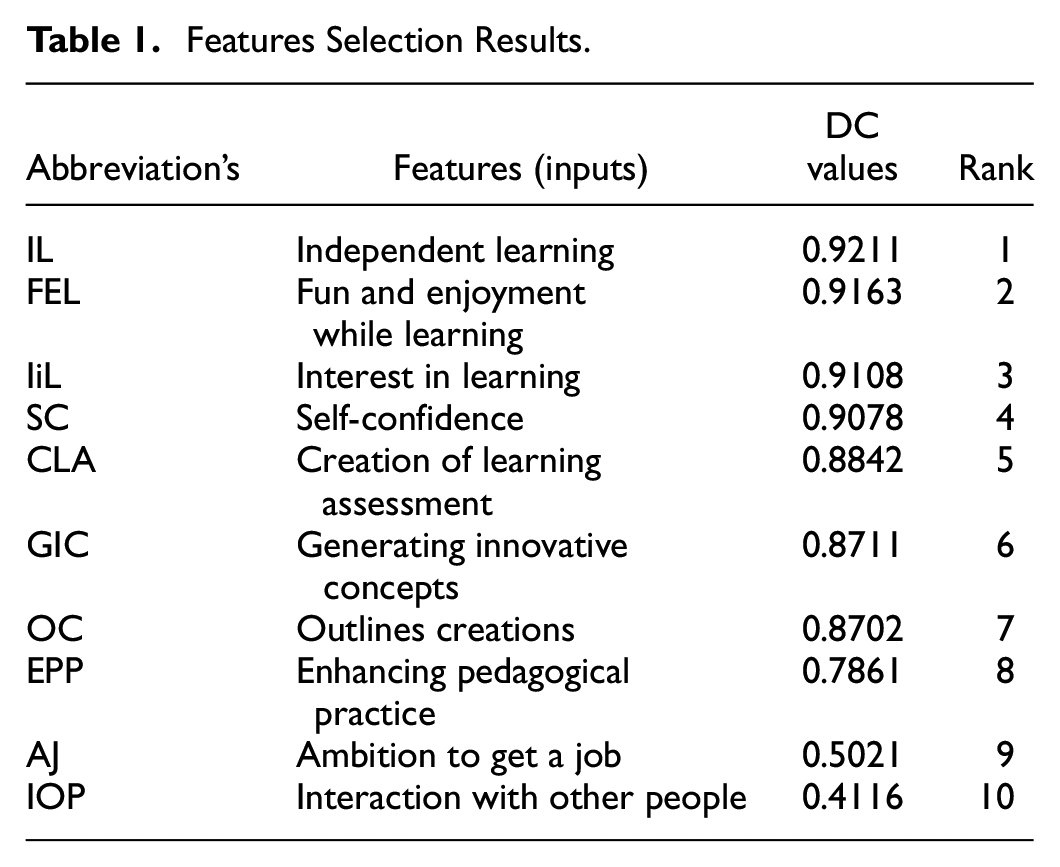
Selection of relevant features plays a crucial role in machine learning tasks because irrelevant features included in the training process of various prediction systems can result in increased costs, longer execution times, and reduced overall performance of the models (Cavus et al., 2022; Salcedo-Sanz et al., 2018). Features-relevant examination serves as a valuable tool for eliminating irrelevant features in ML models. In this study, the technique was employed to identify the most significant features among all potential inputs used in the experiment. The closer the feature value is to 1, the stronger the correlation with the dependent variable, and vice versa. The results of the study’s relevant features (inputs) are offered in Table 1, using the coefficient of determination (DC) metric. The DC assessment metric is explained using Equation 9.

Features Selection Results.
In these equations,
Based on the research features (inputs) selection results as shown in Table 1, students and educators’ passion for independent learning (IL), fun and enjoyment while learning (FEL), interest in learning (IiL), and self-confidence (SC) were the most relevant features that determined the impacts of ChatGPT utilization on contemporary education across the globe with DC values of >0.9211, >0.9163, >0.9108, and >0.9078, respectively. The result is reinforced by the findings of (Baidoo-Anu & Ansah, 2023). The authors stressed that “self-confidence, fund and enjoyment, and independent learning may be the main reasons for the rise of ChatGPT usage in teaching and process.” Following closely were the creation of learning assessment (CLA), generating innovative concepts (GIC), and outline creation (OC) with >0.8842, >0.8711, and >0.8702 values, respectively. This outcome is also supported by the results of Ali et al. (2023) who argued that “educators’ utilization of ChatGPT may not be unconnected with the tool’s ability to generate innovative ideas, and outline creations” compared to the usual conventional approach of concepts and outline creations that require much time and effort. Though enhancing pedagogical practice has lower DC values >0.7861 and ranked 8, the feature was included in the research datasets for calibration and verification. However, ambition to get a job and interaction with other people features were identified as the least significant features with DC values of >0.502 and >0.4116 respectively. Consequently, the features were excluded from the experimental datasets to prevent a reduction in the models’ accuracy as argued by (Salcedo-Sanz et al., 2018). Having chosen our relevant features (i.e., inputs), the research proposed ML models were trained and verified using the four-valuation metrics mentioned above. Performance of the research employed models was offered in the next subsection.
Models Performance Comparison Results
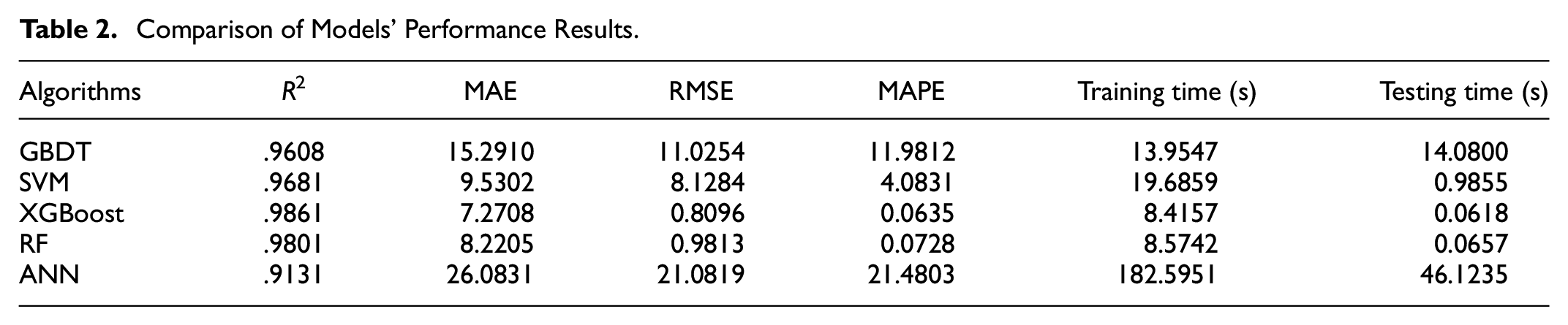
In our experiments, we implemented GBDT, ANN, SVM, RF, and XGBoost using various Python libraries such as; sklearn, TensorFlow, and XGBoost libraries. The platforms used for the calibration and verification include but are not limited to HP-laptop equipped with a Core i7, 16GB RAM, and 1TB SSD. Table 2 displays the prediction accuracy, training time, and testing time for the five ML models used in the study concerning the impacts of ChatGPT utilization in education. It is evident that four of the models achieved high predictive accuracy, with R2 values >.96. Among these models, XGBoost, and RF outperformed the others, with R2 values >.98, and training and testing time of; XGBoost training time = 8.4157 s, testing time = 0.0618 s, and RF training time = 8.5742 s, testing time = 0.0471 s respectively. Followed by SVM and GBDT with R2 values of >.96 and lesser training and testing times compared to the ANN model which came last. The models’ (XGBoost, and RF) performance results are supported by the findings of (Song et al., 2020). The authors claimed that XGBoost and Random Forest predictive models have higher precision skills, and usually outperformed other ML models in terms of classification and prediction abilities. On the contrary, the accuracy of the ANN model was relatively low compared to the other four models. The model R2 values of <.92 clearly show that the model has moderate forecasting skills concerning predicting the effects of ChatGPT utilization on educators and students. The performance comparison results and predictive ability of the research employed algorithms are offered in Table 2, and Figure 7.
Comparison of Models’ Performance Results.

Predictive skills of the study employed ML algorithms.
Models Prediction Results
Results of the research employed ML models were obtained and compared. As depicted in Figure 8, four of the research employed models (XGBoost, RF, SVM, and GBDT) predicted the impacts of ChatGPT in education with higher accuracy. However, the XGBoost and RF models demonstrated the highest precision skills compared to SVM and GBDT. The two models (XGBoost and RF) outperformed the other models in forecasting the impacts of the research chosen features, that is, independent learning (IL), fun and enjoyment while learning (FEL), interest in learning (IiL), self-confidence (SC), creation of learning assessment (CLA), generating innovative concepts (GIC), outlines creations (OC), and enhancing pedagogical practice (EPP) on contemporary education with prediction results of >0.98. Also, the SVM and GBDT algorithms performed well as models achieved >0.96 estimation results. In contrast, the performance of the research proposed ANN algorithm was relatively low compared to the other four ML models. Prediction results of the research utilized ML models are presented in Figure 8.
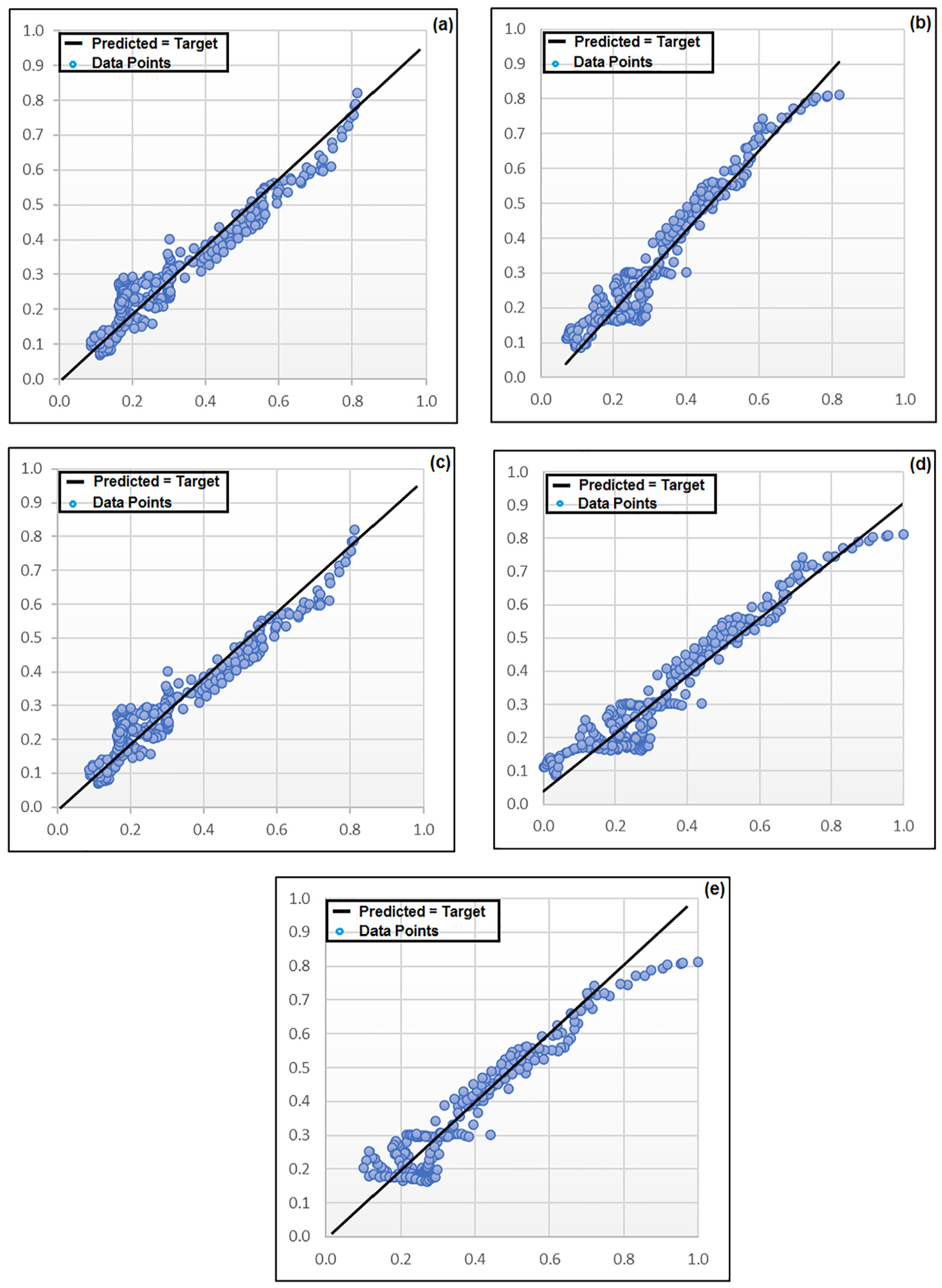
Forecasted versus actual impacts of ChatGPT in education by (a) XGBoost, (b) RF, (c) SVM, (d) GBDT, and (e) ANN.
Based on the predictive outcomes of the study ML models, it becomes evident that the utilization of ChatGPT is important in education. The four of the research employed ML models predicted with higher precision that utilization of ChatGPT in education increases students’ learning ability. The results clearly indicate that ChatGPT usage motivates students to; (a) develop interest in the learning process (IiL), (b) learn independently without necessarily interacting with the human teacher (IL), (c) have self-assuredness (SC), and derive satisfaction and funs while learning (FEL). These findings are supported by the conclusions of Tubishat et al. (2023) who contended that ChatGPT stands as a potential catalyst for reshaping the delivery and accessibility of education, making it more engaging and inclusive for a wider range of learners. Furthermore, the research predictive results indicate that ChatGPT usage saves educators time and effort, and improves their teaching approach compared to other conventional methods of teaching. The result indicates that utilization of ChatGPT among educators may possibly; (a) enhance pedagogical practice (EPP), (b) generation of innovative concepts (GIC), (c) easy creation learning assessment (CLA), and (d) outline creations (OC). These results contradict the findings of Kasneci et al. (2023) who argued that “natural language processing models like that of ChatGPT can only be used as a complementary supplement for instruction generation” but not for other teaching activities.
Though, 10 features (inputs) were initially selected to have an outlook on the possible impacts of ChatGPT usage on educators and students. However, based on the research features selection results, it was found that only eight (i.e., IL, FEL, IiL, SC, CLA, GIC, OC, and EPP) of the 10 features were discovered to be relevant, thus included in the research, while the remaining two, that is, Ambition to a job (AJ), and interaction with other people (IOP) were found to be irrelevant, thus excluded. This outcome is in disagreement with the results of Ali et al. (2023) who contended that “students and educators’ desire to interact with other people, and ambition to get a job” were among potential benefits of ChatGPT usage in education. Possibly the result may not be unrelated to our choice of participants who are spread across the globe compared to the prior works.
The research results also highlight some of the possible future implications of ChatGPT usage in education. These implications comprise; a lack of human interaction, a limited grasp of concepts, biases in training data, creativity restrictions, dependence on data, and a lack of contextual understanding to mention but a few. This result is reinforced by the findings of Kasneci et al. (2023) who stressed that the easily generated ChatGPT content may have an adverse effect on their ability to think critically and solve problems. This is because the model simplifies the process of obtaining answers or information, potentially promoting laziness and undermining the learners’ motivation to conduct independent investigations and arrive at their conclusions or solutions.
Practical Implications
This study aims to investigate the potential benefits and obstacles of ChatGPT utilization in contemporary education. However, the research also provides at least three key implications for educational institutions; One, the research findings highlight some of the potential benefits of ChatGPT utilization in education such as independent learning, fun and enjoyment while learning, easy course content development, and interest in learning. Secondly, the study identified some potential drawbacks of ChatGPT and other generative AI utilization in the realm of education. These drawbacks include but are not limited to the absence of human interaction and constrained comprehension, biases in training data, restricted creativity, privacy, and data security concerns when ChatGPT is used in educational settings. Though the integration of different chatbots like that of ChatGPT into educational activities continues to threaten academic integrity, yet it offers some benefits to both educators and students. Thirdly, the study results can assist institutional administrators in understanding the potential benefits of ChatGPT usage, and how it can be successfully implemented in their institutions by ensuring that all assignments, quizzes, and practical’s are given during class period so that students can adhere to the various AI ethical practices such as; (a) informed consent and privacy, (b) fairness and avoidance of bias, (c) collaboration and inclusivity, and (d) responsible use of various AI tools.
Conclusion
In conclusion, five different ML techniques; XGBoost, RF, SVM, GBDT, and ANN were employed to investigate and model the impact of ChatGPT usage on contemporary education. Four of the ML models (i.e., XGBoost, RF, SVM, and GBDT) utilized in the study performed exceptionally by accurately predicting the impacts of ChatGPT usage on educators and students. The models achieved a high level of accuracy, as indicated by their “coefficient of determination” (
Although four of the models (XGBoost, RF, SVM, and GBDT) exhibited strong performance, the XGBoost model outperformed the other three. This superior performance may be attributed to the XGBoost model’s ability to handle undefined experimental datasets, regularization techniques, and features relevant ranking compared to other ML algorithms. From students’ points of view, the findings of the study revealed that ChatGPT has the potential to increase students learning interest (IL), self-assuredness (SC), independent learning ability (IL), and increase students’ amusement while learning. While from educators’ perspective, the research outcomes exposed that utilization of ChatGPT can enhance the process of; outline creations (OC), generating innovative concepts (GIC), and creation of learning assessment (CLA) all of which save educators time and effort. However, findings of the research found interaction with other people (IOP), and ambition to get a job (AJ) to be irrelevant regarding the impacts of ChatGPT on contemporary education. Interestingly, there are at least three novelties of this research that distinguish it from other prior ChatGPT studies; (a) the research employed five different AI predictive algorithms (XGBoost, RF, SVM, GBDT, and ANN) compared to prior studies’ choice of other methods, (b) unlike prior studies, findings of this research not only highlights the potential impacts of ChatGPT usage among educators and students, but also highlights other possible futures implications that ChatGPT usage may have in education from global perspectives, and (c) the research uses 10 features instead of 5-to-6 inputs usually used in prior ChatGPT studies. However, like all other studies, this research too has its own set of limitations; the research is limited to the datasets used, that is, data collected via social media platforms, and methods employed by the authors, that is, machine learning techniques. Hence, forthcoming research should explore other sources of data, for example, academic repositories, filed data, sensor data, and data from IoT Devices. Also, future research should employ two distinct strategies. For instance, a fusion of AI and traditional methods with increased input factors and data volume in order to gain more insights into the study’s highlighted possible future implications of ChatGPT usage in education.
Footnotes
Declaration of Conflicting Interests
The author(s) declared no potential conflicts of interest with respect to the research, authorship, and/or publication of this article.
Funding
The author(s) received no financial support for the research, authorship, and/or publication of this article.

Data Availability Statement
Data for the study is available on request via the corresponding author or any of the co-authors.