




Abstract
Confronted with the challenge of diminishing tax revenue from Macao’s gambling sector, the synergistic growth of diverse industries has emerged as a crucial avenue for the region’s development. Given the intricacy of evaluating the symbiosis among multiple industries in Macao, this study adopts the biological ecological niche model and introduces a novel framework for assessing industrial symbiosis. This framework incorporates the time-varying weights of symbiosis and competition among various industries in Macao from 2012 to 2024. By calculating the ecological niche width, overlap, and suitability of each industry, it more precisely captures the multi-industry symbiosis dynamics in Macao. The empirical findings highlight the industrial symbiosis between Macao’s burgeoning key industries, the gambling sector, and major non-gambling industries. Macao’s multi-industry symbiosis presents extensive development potential, and the efficacy of policies promoting moderately diversified economic growth is gradually becoming apparent. Notably, the banking sector has taken the lead in showcasing industrial agglomeration capabilities. A horizontal comparison with Hong Kong’s industrial symbiosis reveals that Macao’s policy guidance has positively influenced the development of industrial agglomeration capabilities in emerging sectors. This study offers valuable insights for Macao to devise moderately diversified economic development policies, mitigate irrational resource competition between industries, and foster a symbiotic industrial environment. It also holds significant theoretical importance and practical application value for the interdisciplinary application of ecological theory to enhance the measurement methodologies for industrial symbiosis development.
Plain Language Summary
The industrial structure of Macao is single, and the gambling industry accounted for over 75% of the city’s tax revenue before 2020. Under the constant impact of Chinese anti-corruption campaign in 2016 and the dynamic zero-COVID policy in 2020, Macao’s gambling industry revenue plummeted, tax pressures forced other industries in Macao to develop in a diversified way. This study aims to answer two key questions by studying the spatiotemporal evolution trend of multi-industry symbiosis in Macao: (1) Has Macao’s gambling industry completely squeezed out the development space of other industries? (2) Can emerging industries in Macao, such as banking and traditional Chinese medicine, create an industrial ecological environment for the second industrial agglomeration in Macao?
Keywords
Introduction
Amidst the intricate economic landscape and the ever-evolving international economic and political scenarios, the sustainable growth of Macao’s overall economy and its resilience in the face of crises are increasingly under duress. Over the past two decades, the Macao gambling industry has consistently been a cornerstone, contributing significantly to the local GDP and tax revenues. In the 5 years preceding the epidemic, this industry accounted for more than 60% of Macao’s GDP and over 90% of its tax revenue. However, during the epidemic, customer traffic plummeted by 85%, causing the gambling industry’s contribution to tax revenue to swiftly decline to 29.32%. This drastic reduction directly resulted in a year-on-year economic contraction of 24.5% in the first half of 2022, with Macao experiencing three consecutive quarters of negative growth, thereby plunging the economy into a recession (Sheng et al., 2023). Many scholars have reflected on the significant setback experienced by Macao from 2020 to 2022, contending that its economy is excessively reliant on the gambling sector and that its singular industrial structure results in a lack of economic resilience. External shocks merely act as triggers, and this phenomenon is also observed in the development trajectory of other resource-based cities (Sheng et al., 2023).
Indeed, as early as 2012, Macao explicitly stated in its government program that it would actively develop a moderately diversified industrial structure and intensify policy efforts to promote the growth of four key industries: modern banking, culture, exhibitions, and traditional Chinese medicine. This initiative aims to create a more varied industrial landscape and a broader tax base. Although these emerging industries are still in their infancy, they may not be entirely immune to the effects of the COVID-19 pandemic, they can still moderately enhance Macao’s economic resilience (McCartney et al., 2021). Consequently, Macao has been one of the quickest small and micro economies to recover from the pandemic’s impact (Zhang et al., 2022). Simultaneously, we must acknowledge that Macao’s long-standing industrial structure, which has depended heavily on a single industry, aligns with the preferred choice for economies of small and medium-sized cities. This is because the land and population size of many countries and regions worldwide cannot match those of China, the United States, and Russia. Thus, within this industrial framework, which is dominated by a single industry yet coexists with moderately diversified industries, is there additional room for the symbiotic growth of emerging industries? Is it challenging to establish a harmonious relationship of multi-industry symbiosis due to the competitive pressures on industrial survival spaces? These questions form the crux of our discussion.
In historical research, empirical studies on measuring the symbiotic relationship between multiple industries can be mainly divided into two categories. The first type is to explore which factors are the key determinants of resource allocation in multi-industry symbiotic relationships within a region (Lybæk et al., 2021). These factors include industrial policy guidance, urban functions and infrastructure, cooperation and innovation atmosphere, and enterprise technology and innovation capabilities (Shahzad et al., 2021; Xiao et al., 2024). Through enterprise-level micro data, the key factors of industrial symbiosis can be more accurately revealed. However, due to the difficulty of obtaining data from Macao enterprises, this method faces challenges in practical operation. The second type is to construct a network model for multi-industry collaboration (Teng & Lin, 2024), which captures the temporal characteristics of resource allocation in multiple industries and structural changes in industrial development trends. This method can use macro data to reflect the symbiotic relationships among multiple industries under multiple factors. Based on data availability and research objectives, I chooses the second method, which is to construct a multi-industry collaborative network model and conduct in-depth analysis of the core viewpoints.
The contribution of this study to existing literature primarily lies in two aspects: firstly, it deeply analyzes the basic structure of the symbiotic development of multiple industries in Macao, constructs reliable measurement indicators, and symbiotic evolution network models, further enriching the research content of industrial ecology. Secondly, it has added significant content to the empirical research on the symbiotic relationship between multiple industries in Macao under the moderate diversified economic development industrial policy since 2012. The research results indicate that under the guidance of industrial policies, Macao has an ecological space for multi-industry symbiosis, and with the continuous improvement of the agglomeration ability of emerging industries, it gradually presents a trend of multi-industry symbiosis that does not rely on the gambling industry, thereby effectively enhancing the resilience of Macao’s economy.
The remainder of this study is structured as follows: Chapter 2 reviews the pertinent literature. Chapter 3 conducts theoretical analysis and proposes hypotheses, Chapter 4 describe the methods and Chapter 5 analyzes and discusses the findings, while Chapter 6 presents the main conclusion, policy recommendations and research limitations.
Literature Review
The references for this study will be conducted from two aspects: the symbiotic relationship between multiple industries in Macao and the multi industry symbiosis methodology.
Research on Industrial Symbiosis in Macao
The symbiotic development of multiple industries has garnered widespread attention. Due to limited resources, the industrial structure within the region is aligned with the scale of regional development (Yang et al., 2024), making the symbiotic relationship between industries endogenous (Neves et al., 2020). Moreover, the technological synergy resulting from multi-industry competition and cooperation is also the cornerstone of sustainable economic development in the region (Yang et al.,2022). Historically, literature has long been concerned with Macao’s relatively single industry structure, which is dominated by gambling.
Upon searching multi-academic journals in applied economics for the past 5 years using keywords such as “Macao” and “industrial structure,” it was discovered that scholars have consistently shown interest in Macao’s gambling-based industrial structure. Some scholars adopt a pessimistic stance, contending that resource constraints, path dependence, and the Dutch disease effect have made it challenging for emerging industries to secure a foothold in Macao’s industrial landscape. Conversely, another group of scholars maintains a more optimistic perspective, asserting that Macao’s strategic economic diversification post-2012 has effectively signaled a symbiosis across multiple industries and triggered a resource realignment, markedly improving the capacity for coordinated development across various sectors. Table 1 encapsulates these differing viewpoints.
Literature Review on the Symbiotic Development of Multiple Industries in Macao.

There is currently no consensus on whether there is a symbiotic space and possibility among multiple industries in Macao. Empirical studies by some scholars have shown that there has not yet been a synergistic effect between multiple industries in Macao at the technological level (Ma et al., 2023). This may be both an opportunity for emerging industries under policy guidance (Chen et al., 2022) and a challenge (Lawal & Alwi, 2021; Wadström et al., 2021). Further in-depth exploration is needed to measure and evolve the symbiotic relationship between industries in response to this viewpoint. The above historical viewpoints have laid the basic theoretical foundation for this study.
Research on the Measurement of Multi industry Symbiosis
Ecological history research has demonstrated that the relationships among populations in the biological realm can foster unique symbiotic relationships within a region (Venturino, 1994). These ecological niche measurements and symbiotic relationships between organisms show a high degree of similarity to social systems. Bischi & Tramontana (2010) posit that other economic systems, which adhere to logical rules, may also follow the Lotka-Volterra principle, as seen in industrial structures (Cui et al., 2018; Yang et al., 2024).
Utilizing the keywords “measurement of industrial symbiosis relationship” and “evaluation of industrial symbiosis relationship,” a search was conducted in the multi-academic journal database of applied economics for the decade years. It was discovered that the measurement and evaluation of industrial symbiosis relationships have primarily been conducted at the national level (Susur et al., 2019). The predominant method involves using linear regression models to analyze key factors that contribute to the formation of these relationships, such as regional technological development level (Cui et al., 2018), industrial cluster level (Gu et al., 2022), policy guidance (Aiginger & Rodrik, 2020), degree of resource competition, and rent-seeking costs (Santos & Magrini, 2018). However, this method cannot capture the time-varying characteristics of industrial symbiosis. Additionally, some scholars have begun to explore interdisciplinary models. For instance, Li et al. (2023) drew upon geographical research to construct a gravity model for analyzing multi-industry symbiosis in the Greater Bay Area and measuring the stage differences in the industrial development space of the region. Wei et al. (2024) referenced quasi-natural experiment research to analyze the level of industrial agglomeration among multiple industries.
The commonly employed technique involves conducting panel fixed effects regression on companies and industries across various cities to ensure the accuracy of the conclusions. Considering that Macao’s economic scale is comparable to that of mainland Chinese cities, it is no longer feasible to perform internal geographic segmentation. Additionally, Macao faces challenges in obtaining company-level data, rendering mainstream methods inapplicable. Nonetheless, these empirical methods and conclusions hold reference value for the present study.
Theoretical Analysis and Hypotheses
Historical research indicates that the trend of inter-industry symbiosis in Macao was relatively stable from 1998 to 2012 (Sheng et al., 2023). From 2012 to 2016, a series of diversified industry planning initiatives, based on the diversified development of tourism in Las Vegas, also yielded minimal results (Wu & Su, 2024). Throughout this period, the four industries of banking, exhibitions, culture, and traditional Chinese medicine, which developed spontaneously, gradually matured and contributed to Macao’s economic growth. In particular, the international asset scale of the banking industry in Macao has significantly increased over the past 3 years, with year-on-year growth rates of 8.7%, −3.6%, and 4.9%, respectively. During the same period, the economic added value also saw a significant increase, reaching 15.3%, 8.8%, and −6.3%, respectively. This indicates that when Macao’s overall economic output declined, the market selected the banking industry as a leading sector and included it in the screening of industrial clusters through the “voting with feet” method. Baker et al. (2022) argue that when an industry receives sufficient resources, its generalization ability increases, leading to competition once it reaches a threshold. Prior to this, the symbiotic space of multiple industries is spontaneously formed. Some scholars believe that despite Macao having an industry chain led by the gambling industry, there is a lack of technological root effects between the industry chains, which has hindered the formation of industry chain synergy (Vom Lehn & Winberry, 2022). This also provides development space for the ecological niche width growth of other emerging industries. Assuming that:
Historical research indicates that the industrial synergy relationship within a multi-industry symbiosis typically exhibits a U-shaped curve. In the initial phase, the symbiotic relationship among multiple industries may be mutually reinforcing (Baker et al., 2022). Moreover, due to the symbiotic relationships between various industries and the government’s well-crafted economic growth objectives and industrial policies, the guiding impact of Macao’s moderately diversified economic development policy becomes more readily apparent. Specifically, during the process of multi-industry development, resource competition is an inevitable aspect. Susur et al. (2019) noted that when the actual extent of resource utilization between industries is low and the degree of ecological niche overlap is minimal, resources tend to be allocated more reasonably. Gu et al. (2022) contend that when resource allocation among industries is unreasonable, industrial policies can be used to realign the disproportionate aspects of resource distribution, thereby optimizing the industrial structure, reducing areas with high ecological niche overlap, and thus decreasing inter-industry competition. This increases the likelihood of cooperation and long-term coexistence, making the ecological niche suitability more rational. Based on these observations, the following hypothesis is proposed:
Historical literature indicates that appropriate symbiotic relationships between emerging industries can more effectively enhance knowledge spillovers, promote input-output synergy between upstream and downstream industries, and thus form new industrial agglomeration models (Zhang & Abdusuli, 2024). Typically, industries with agglomeration capabilities maintain a moderate distance from related industries within the symbiotic network. Specifically, the phenomenon of agglomeration within an industry is more likely to occur in companies with strong technological innovation capabilities, which enhance production efficiency through technological collaboration. Moreover, the agglomeration effect within industries can extend to inter-industries, where enterprises from different sectors cluster in the same location, generating externalities and promoting regional economic development. However, the wider the industrial niche, the more significant the production scale effect, the stronger the market demand, the more frequent the communication among employees, the faster the dissemination of knowledge and technology, and the larger the scale of enjoying agglomeration externalities. This suggests that the width of the industrial niche is closely related to the agglomeration power of the industry. Nevertheless, when the width of the industrial ecological niche becomes excessively large, competition for resources between industries intensifies, encroaching on each other’s space, which may lead to dominant industries hindering the development of others, thereby disrupting the environment of industrial agglomeration and symbiosis. Consequently, the formation of industrial agglomeration relies on appropriate industrial symbiotic relationships, necessitating the maintenance of a suitable distance between each industry within the symbiotic network over the long term. Research has found that emerging industries in Macao have greater industrial agglomeration capabilities compared to other non-gaming industries. To verify the scientific validity of this finding, the following hypotheses are proposed:
Methods
Data Source
The sample data primarily originates from the Event Sequence Database of the Macao Special Administrative Region Government’s Department of Statistics and Census (DSEC, https://www.dsec.gov.mo/ts/#!/step1/zh-MO), which provides annual macroeconomic statistics by industry. The research spans the period from 2012 to 2024. The subjects of the study are the 12 key industries in Macao, as statistically analyzed by DSEC (refer to Table 3). Given the need for balanced data and the initial proposal and implementation timeline of Macao’s moderately diversified economic development policy, some annual data collected prior to 2012 have been omitted. Additionally, since certain industries in 2012 and 2013 were not further disaggregated, historical methods have been employed to augment the aforementioned data using linear, exponential, and nearest neighbor mean approaches. Moreover, should there be any annual data missing for 2024, the first quarter data will serve as a substitute.
Construction of Indicator
Indicators for Measuring Ecological Niche
To accurately measure the ecological niche width, overlap, and suitability of multi industry symbiosis in Macao, this study draws on the production function of economic growth theory to characterize the ecological niche of industrial occupation scale from the dimensions of human and capital. Specifically, indicators such as industrial labor force size, enterprise density, local resident labor force size, and average labor salary are used to characterize the industrial human ecological niche and evaluate the competitive potential of the industry accordingly (Chen et al., 2022). Given the differences in employment rules between local and migrated employees in Macao, when measuring the scale of industrial human resources compensation, it is necessary to distinguish between local and migrated employees to reduce measurement bias. At the same time, selecting the scale of local resident labor force to characterize the symbiotic relationship between various industries and the improvement of local human capital supply in Macao. In addition, the average salaries of local and migrated employees were calculated separately, and their manpower scales were weighted to represent the increase in demand for human capital in Macao due to the symbiotic relationship between various industries.
Due to the high dependence of various industries in Macao on overseas direct investment rather than land (Wei et al., 2024), in order to reflect this unique capital accumulation characteristic, this study uses indicators such as total fixed investment, foreign direct investment, investment returns and investment flow to characterize the capital niche, in order to reflect the sustainable development capacity and long-term benefits of the industry. Specifically, the total amount of fixed capital formation and foreign direct investment are used to measure the capital scale in the symbiotic relationship between industries. To comprehensively evaluate the dynamic changes in the capital niche, the Investment returns indicator is introduced to measure the efficiency of capital utilization and the profitability of industries. High investment returns not only indicate that the industry has good capital operation capabilities, but also indicate its sustainable investment attractiveness in the future. In addition, the capital flow between industries was also considered, and the capital interaction relationship between different industries was captured by adding capital flow. This helps to reveal the optimized allocation and dynamic balance of capital in industrial symbiosis. To reduce the differences in dimensional skewness, increasing enterprise density (A12) in human resources (A1) and increasing investment returns (A24) in capital (A2) are used to characterize the cross effects of technology, organization, and service dimensions on human resources and capital. The allocation of resources in the dimensions of human resources and capital jointly promotes the changes in the breadth of industrial ecological niches, and the changes in the breadth of ecological niches of various industries also affect the symbiotic state and resource allocation environment of multiple industries in Macao. The specific indicator system is shown in Table 2.
Ecological Niche Measurement Index System.

Utilizing the Lotka-Volterra model (Bischi & Tramontana, 2010), this study investigates the ecological niche width, overlap, and suitability of various industries within Macao’s symbiotic system. The model construction process is outlined as follows: initially, multiple indicators specific to Macao are employed to construct a resource space that mirrors the current human and capital levels across different industries in Macao, facilitating an analysis of the resource space for each industry (refer to Table 2 for detailed measurements). Subsequently, the Lotka-Volterra model is applied to gauge the ecological niche width of these industries in Macao. Secondly, the degree of industrial niche overlap is calculated using Equation 1:

Among them,

In Equation 2,
Influence of Policy Guidance
Looking back at the policy guidance history of encouraging the symbiotic development of multiple industries in Macao, it can be found that the possible drawbacks of a single industry structure have been widely discussed within Macao since 2012. In 2014, at the celebration of the 15th anniversary of Macao’s return to the motherland, General Secretary Xi’s speech on actively promoting Macao’s moderate and sustainable economic development laid the foundation for the direction of moderate and diversified economic development in Macao. In 2019, Macao endeavored to identify the primary direction and related major projects for moderate and diversified economic development, basing its choices on scientific evidence. This led to the gradual establishment of a “4+1” industrial policy framework aimed at the symbiotic development of multiple industries. The “4” in the “4+1” framework represents Macao’s emerging key industries: modern banking (D101), exhibitions (D102), culture (D103), and traditional Chinese medicine (D104). The “+1” signifies the gambling industry, which contributes the highest tax revenue (D1). Building upon a historical review of Macao’s moderate economic diversification, this study employs keywords such as “Macao,”“moderate diversification,” and “policies” (including related terms like “guidelines,”“programs,”“regulations,”“methods,”“systems,”“planning,” etc.) from the website of the Macao Special Administrative Region Government (https://www.gov.mo/en/). It conducts annual searches, downloads articles containing these keywords each year, and applies the Naive Bayes method in machine learning to calculate the proportion of noun frequency represented by these keywords. By calculating the annual sum of word frequency, the study constructs an indicator for Macao’s moderate diversified economic development policy guidance (Diversity) and analyzes the impact of this policy guidance on the symbiotic development of multiple industries.
Control Variables
To ensure the robustness of the results, the first-order difference (PerGDP) of Macao’s per capita gross domestic product (GDP) calculated using the expenditure method based on current year prices was used in the regression analysis to control for the impact of Macao’s overall economic development on the regression results. In addition, historical research was referenced to analyze Macao’s labor performance, cumulative capital level, degree of openness to the outside world (EX), education development level (Edu), and consumer price level (CPI). The specific indicator construction method is shown in Table 3.
Explanation of Indicator Construction.

Empirical Results With Discussion
Benchmark Analysis
Ecological Niche Width
From the measurement of ecological niche width in Table 4, there is a significant difference in the average ecological niche width of various industries in Macao, with the smallest being construction (D2, 1.16) and the largest being manufacturing (D7, 9.34). The most dominant industry in Macao, gambling (D1, 6.55), only ranks 7th in terms of ecological niche width, indicating that gambling has not occupied all resource space. This conclusion partially supports H1. In addition, the analysis of the ecological niche measurement of the four emerging industries shows that the ecological niche widths of banks (D101), exhibitions (D102), culture (D103), and traditional Chinese medicine (D104) are all below 5.5, and there is no problem of squeezing the competitiveness of other industries. This conclusion supports the H1, indicating that there is room for multi industry development in Macao’s ecological niche.
Width of Macao’s Industrial Ecological Niche.

Ecological Niche Overlap and Symbiotic Network
Calculate the ecological niche overlap among various industries in Macao to obtain the competition coefficient ccAB for each pair of industries, thereby constructing a symbiotic network between them. The findings depicted in Figure 1 reveal two characteristics of ecological niche overlap among Macao’s industries: Firstly, banks (D101) exhibit stronger industrial agglomeration capabilities and possess a higher ecological niche suitability compared to the other three emerging industries. Secondly, they maintain a symbiotic relationship with the gambling industry that is more suitable (with a coefficient higher than 0.66). The potential reason for this is that the modern services, exemplified by Macao Bank, which have embraced updated digital technologies, can extend the digital space for multi-industry symbiosis in Macao through the spillover effects of industrial services. This helps to mitigate the spatial competition risk among industries, given the limited land resources. Secondly, the symbiotic relationship between the gambling industry and other traditional industries remains stable, with gambling continuing to hold a dominant position. This suggests that the development of emerging industries in Macao does not disrupt the symbiotic relationships of other traditional industries and may lead to the formation of a new industrial agglomeration that is independent of the gambling sector. This conclusion partially corroborates the H2.

The network symbiotic relationship among various industries in Macao.
Industrial Symbiosis Relationship and Policy Guidance
The evolution of Macao’s industrial network’s symbiotic relationship is paralleled by the policy evolution of moderate, diversified economic development in Macao. Throughout this period, Macao has also been affected by external events, including the Chinese Anti-Corruption campaign in 2016 and the dynamic zero-COVID policy in 2020. In this section, a regression model is employed to investigate the impact of the current industrial symbiosis environment in Macao. Should the regression coefficient between Symbiosis and Diversity during the sample period lack statistical significance, it suggests that external events and shifts in market demand have compelled changes in Macao’s industrial supply, leading to the spontaneous emergence of a development space for multi-industry symbiosis. Conversely, if the regression coefficient exhibits significant positive statistical significance, it implies that policy guidance for moderate, diversified economic development in Macao has a positive impact on the multi-industry symbiosis relationship within the region.
Table 5 indicates that the results from columns (1) and (2) reveal that under the least squares (OLS) regression model, the coefficients for policy guidance (Diversity) are significantly positive. This suggests that policy guidance for moderate diversified economic development in Macao has a positive impact on the symbiosis of Macao’s industrial network, aiding in the optimization of Macao’s diversified industrial structure. For robustness, columns (3) to (5) of Table 5 were regressed using autocorrelation and heteroscedasticity (HAR) as well as Newey-west robust estimation regression, which controlled for regression residuals simultaneously. The coefficients for policy guidance (Diversity) remained significantly positive, indicating that the policy guidance effect plays a significant role in the formation of multi-industry symbiosis in Macao. Thus, H2 is supported.
The Impact of Macao’s Policy Guidance on the Symbiotic Relationship between Industries.

Note.The standard errors in parentheses, *p < 0.1, **p < 0.05, ***p < 0.01.
Robustness Analysis
Robustness Analysis of Ecological Niche Measurement
Further test whether the research results are robust to the following factors: ecological niche measurement indicators, the symbiotic environment during the sample period, and the autocorrelation of industrial development.
Firstly, ecological niche measurement indicators play a pivotal role in the proposed multi-industry symbiosis model. In order to evaluate the impact of indicators on the results, one of the secondary indicators of human resources and capital was removed from the ecological niche measurement indicators in Table 1, and the calculation of ecological niche width was recalculated. Table 6 shows the root mean square error (RMSE) and mean absolute percentage error (MAPE) of the recalculated niche widths in the sub samples compared to the baseline model. The results show that there is no significant difference in RMSE and MAPE between the sub samples and the baseline model at a 90% confidence level, indicating that there is no bias in the baseline results due to evaluation indicators. Upon comparing the RMSE and MAPE values for various variables, we observed that excluding the average labor salary (A14) results in a relatively smaller root mean square error (RMSE) for niche width, yet a relatively higher mean absolute percentage error (MAPE). This suggests that while the average labor salary has a minor impact on the ecological niche width index for individual industries, it significantly influences the annual aggregate error of ecological niche width across various industries in Macao. Conversely, the scale of the local resident labor force (A13) is crucial for predicting the accuracy of niche width for individual industries (with an RMSE of 23.79, indicating a relatively high value), but it has a lesser impact on the annual aggregate error of niche width across different industries (with a MAPE of 19.24). This implies that although removing sub-indicators of ecological niche measurement does not alter the overall statistical significance of the benchmark results, each sub-indicator does exert a certain influence on individual industries or the overall symbiotic system.
The Importance of Sub-indicators of Ecological Niche Measurement.

Note. *, **, *** is the P-value of the coefficient difference test of RMSE and MAPE between benchmark model and the new models.
Secondly, the selection of the sample period can significantly influence the outcomes of the prediction model. Notably, certain years have witnessed substantial external impacts on the development of Macao’s industry. For instance, the structural adjustment of gambling tourists resulting from Chinese Anti-Corruption campaign in 2016 and the marked decline in inbound tourists due to the dynamic zero-COVID policy in 2020 are critical factors. Consequently, these two years will be excluded from the entire sample period for model testing. Columns (1), (2), and (3) in Table 7 present the prediction errors for three sub-samples. The results indicate that there is no statistically significant difference in RMSE and MAPE compared to the baseline model at a 90% confidence level, suggesting the robustness of the baseline results. Additionally, it is evident that in 2016 and 2020, despite the overall model’s error results not being significantly affected by exclusion, there were notable MAPE values in the prediction of the total ecological niche width for these two years. This suggests that these years have a substantial impact on the symbiotic structure of multiple industries in Macao.
The Error of Adjusted Sample Period and Optimal Window Rolling of Indicators.

Note. *, **, *** is the P-value of the coefficient difference test of RMSE and MAPE between benchmark model and the new models.
Thirdly, owing to the temporal autocorrelation inherent in industrial symbiosis, industries exhibit autocorrelation during the resource allocation process. This autocorrelation in industrial resource allocation can influence industrial symbiosis, potentially resulting in biased outcomes regarding the width, overlap, and suitability of industrial ecological niches. To address these concerns, this study employs the ARIMA model to ascertain the optimal window size for the secondary indicators within each ecological niche width indicator system. It then applies the optimal window rolling calculation to each indicator, recalculating the ecological niche width for each industry after weight adjustment within the optimal rolling window. The findings presented in column (4) of Table 7 reveal that the recalculated ecological niche widths of each industry, used as the test set, exhibit no significant differences in RMSE and MAPE when compared to the benchmark model at a 90% and 95% confidence level. This underscores the robustness of the benchmark results.
Stability Analysis of Industrial Symbiosis Relationship and Policy Guidance
Furthermore, this study employed the computational approach outlined in the “Statistical Indicator System Analysis Report on Moderate Diversified Development of Macao’s Economy,” released by the Macao Statistics and Census Service in 2016. It utilized the Entropy Index of Economic Diversity, which assesses the extent of industrial development diversification through production methods, to gauge the diversification level of Macao’s industrial structure. Given the direct statistical method employed in constructing this index, it does not overlap with the grassroots indicators used in this study to evaluate the symbiotic relationships among various industries. Therefore, it can serve as a proxy for the Symbiosis variable. The outcomes presented in columns (1) to (3) of Table 8 indicate that policy guidance (Diversity) exerts a significant positive effect on the economic diversification alternative variable (EIED), which measures the extent of industrial development diversification. Additionally, column (4) differentiates between the periods before and after policy guidance and introduces a binary variable (Div) for regression analysis. The findings suggest that the Macao government’s policy guidance post-2016 has notably enhanced the symbiosis of Macao’s industries (Symbiosis), affirming the robustness of the baseline results.
The Impact of Macao Policy Guidance on the Diversification of Macao’s Industrial Structure.

Note. The standard errors in parentheses, *p < .1, **p < .05, ***p < .01, columns (1) and (2) show the adjusted R2, and columns (4) show the Pseudo R2 used to measure the goodness of fit of classification models (such as logistic regression).
Further analysis
Agglomeration effect under the symbiosis of industries in Macao
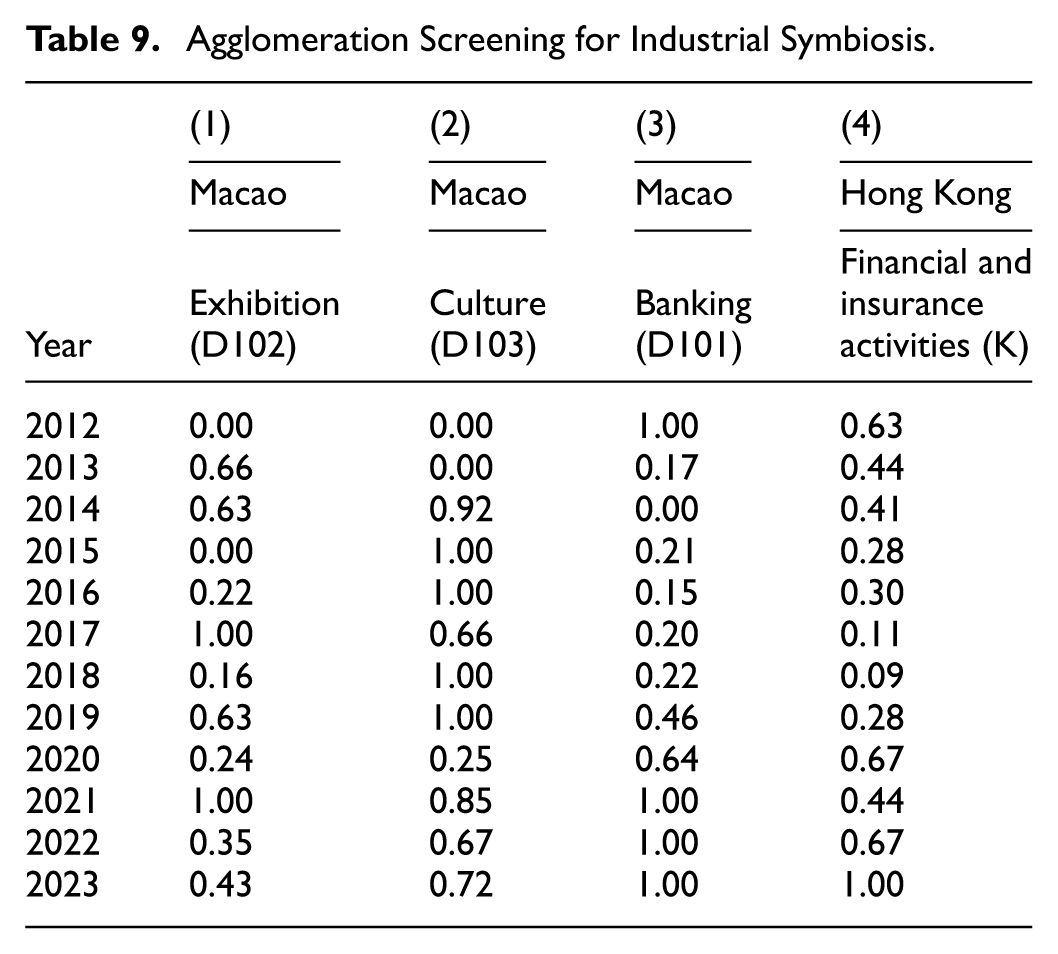
Due to the ongoing evolution of ecological niche width, overlap, and suitability, populations can be screened through symbiotic relationships, leading to clustering phenomena among them. This section will assess the likelihood of Macao’s industries being screened in a clustered state annually, based on the ecological niche width and overlap of its various industries, and analyze the future trends of symbiosis among Macao’s multiple industry agglomeration. The results presented in Table 9 indicate that the industries exhibiting clustering and agglomeration effects, as selected by the symbiotic system, include exhibitions, culture, and banking. The screening coefficient for the banking agglomeration is notably higher than that for the exhibition and cultural industries, and the model fitting has consistently remained at 1 since 2021, suggesting a significantly stable industrial agglomeration. The banking industry is thus well-suited to serve as a agglomeration industry, leveraging the synergistic effects of industrial symbiosis. Assuming H3 is supported, compared to the primary non-gambling industries, Macao’s emerging key industries demonstrate greater industrial agglomeration capabilities. The symbiosis of multiple industries, coupled with industrial policies, has effectively promoted economic growth.
Agglomeration Screening for Industrial Symbiosis.
Comparison With Hong Kong
Statistical analysis of Macao’s economic data reveals that by the conclusion of the first quarter of 2024, the cumulative assets of Macao’s financial sector had soared to MOP 2.6 trillion. A notable feature is the substantial share of international assets, which have been escalating at a brisk pace. Specifically, by the close of 2023, these global holdings constituted more than 85% of the total assets. Moreover, over the past three years, there has been a marked upsurge in the international asset base of Macao’s banks. The year-on-year growth rates were 8.7%, −3.6%, and 4.9%, respectively. Concurrently, the economic value added by these financial institutions witnessed significant fluctuations, with annual growth rates of 15.3%, 8.8%, and −6.3%, respectively. This data underscores a strategic shift wherein the banking sector has emerged as a pivotal industry amidst Macao’s economic slowdown. The market’s preference for this sector, as evidenced by the “foot voting” phenomenon, underscores its role as a primary driver of economic momentum. Did the industrial policy of moderate diversified economic development play a positive guiding role during this period? This section will analyze the relationship between cluster selection in industry symbiosis and government policy guidance by comparing the evolution of industry symbiosis with Hong Kong’s banking industry (K1).
Historical research indicates that during the same period, Hong Kong’s financial industry had a more complete industrial structure and a higher contribution to the industry. This encompassed a variety of financial instruments and trading markets, including banking, insurance, and other forms of currency management and investment (Wei et al., 2024). Utilizing the same measurement method for ecological niche width and overlap, it was determined that from 2012 to 2024, financial and insurance activities (K) in Hong Kong had a niche width of 9.4 out of its main 4+4 industries, placing it first in terms of proportion. This finding aligns with historical research, underscoring the significant role of Hong Kong’s financial services in its economic development. By further breaking down the banking industry (K1) from financial and insurance activities (K) and assessing its symbiotic relationship, it was revealed that the banking industry in Hong Kong also exhibits a high coefficient of competition with other industries. This has propelled the banking sector into a potential cluster industry, as illustrated in column (4) of Table 9.
Upon horizontally comparing columns (3) and (4) of Table 9 year by year, it becomes evident that firstly, during the sample period characterized by the rapid development of the digital economy, the banking industry exhibited endogenous industrial synergy and spatial expansion capabilities. These capabilities have concurrently enhanced the industrial agglomeration of both Macao and Hong Kong, despite the constraints of limited land and labor resources. Secondly, the agglomeration capacity of Hong Kong’s banking industry exhibits a U-shaped structure, which was relatively low from 2014 to 2019, but significantly higher from 2012 to 2014 and after 2019. This trend markedly contrasts with the gradually increasing agglomeration effect of Macao’s banking industry post-2016, suggesting that Macao’s policy guidance has fostered the industry agglomeration capacity of the banking sector within the symbiotic relationship between industries. This conclusion further corroborates H3.
Conclusion
Main Conclusion
The single-industry structure has resulted in insufficient economic resilience in Macao, and the central issue in policy guidance is whether a moderately diversified industrial policy can foster the development of an industrial symbiosis environment. Unlike most studies that concentrate solely on the coordinated development of industries, this study delves into the dynamic evolution of industrial symbiosis in Macao from an industrial ecology perspective. It can directly address the question of whether there is a multi-industry symbiotic space in Macao by innovatively constructing a measurement model for industrial symbiotic relationships.
Benchmark research findings indicate that the ecological niche width of various industries in Macao exhibits a significant gradient distribution, with the ecological niche width of emerging key industries showing an upward trend. This suggests that Macao has the potential for multi-industry symbiosis, aligning with other research conclusions (Henriques et al., 2021). Notably, this study also precisely measured the aforementioned symbiotic space, offering quantitative support for the implementation effect of Macao’s moderately diversified economic development policy. Furthermore, this study examined the ecological niche overlap and suitability within the symbiotic space of multiple industries and found that, under the impetus of moderately diversified economic development policies, the development effectiveness of emerging key industries is gradually becoming apparent. Contrary to the findings of numerous historical studies (Aiginger & Rodrik, 2020; Sheng et al., 2023), this study not only revealed the direct effects of policy guidance through regression analysis but also obtained supplementary evidence on the role of policy guidance through detailed measurements of Macao’s industrial symbiosis structure and industrial agglomeration capacity. This effectively fills the gap of data sparsity in Macao’s macro data analysis, thus more comprehensively demonstrating the actual effectiveness of Macao’s moderately diversified economic development policy in actively guiding it. Meanwhile, multiple robustness tests were conducted in this study, and the main conclusions remain valid.
Further analysis indicates that, under the guidance of Macao’s industrial policies, the banking sector has gradually developed industrial agglomeration capabilities. This development offers the potential to facilitate Macao’s transition away from a singular economic structure that is heavily reliant on the gambling industry. The research findings of Vom Lehn and Winberry (2022) suggest that modern service industries can provide additional network space, thereby enabling the rational allocation of resources across industries through the promotion of industrial synergy. The perspective of this study aligns with historical research and delves into the “black box” of how the modern service industry fosters industrial synergy. Furthermore, this study highlights the pivotal role of policy guidance in fostering industrial agglomeration and establishing industrial symbiosis networks. Through horizontal comparative analysis with the banking industry in Hong Kong, it offers valuable insights for policymakers.
Policy Recommendations
Based on the above analysis, this article proposes the following policy recommendations:
Firstly, establish a more comprehensive evaluation system for the ecological niches of multiple industries in Macao to dynamically monitor the integration status of various industrial resources. For industries facing the challenge of resource scarcity, based on the strategy and goal of moderately diversified economic development, more policy support should be provided to broaden their basic ecological niches for symbiosis with other industries. For industries with high resource overlap, based on feedback from dynamic monitoring of ecological niches, they should be encouraged to adopt ecological niche separation strategies and reduce resource competition in a market-oriented manner.
Secondly, fully leverage the predictive outcomes of the multi-industry ecological niche assessment system to guide industrial policies and promptly identify industries with inherent agglomeration potential, such as banking. Furthermore, promote the convergence of resources between traditional industries and emerging key sectors. While sustaining a symbiotic relationship with the gambling industry, traditional industries should also intensify their efforts to integrate resources with fields like traditional Chinese medicine and culture, thereby enhancing the ecological alignment and competitiveness of industrial development. For instance, the real estate sector should actively pursue resource integration with domains such as exhibitions and traditional Chinese medicine, whereas the hotel industry should vigorously foster resource integration with the cultural sector, to establish a more advantageous industrial chain ecological structure and forge new symbiotic relationships for the industry.
Limitations and Future Work
Considering the assumed interactions within closed systems in the ecological model, there is a significant difference compared to Macao’s open, service-oriented, and highly dependent economic model, which relies heavily on external tourism and capital flows. This constitutes a limitation of the current study. Further research is necessary to explore the scalability of industrial symbiosis models within closed systems and to develop specific measurement methods that can effectively capture the impact of exogenous variables on these systems. Additionally, given the central role of digital technology in the modern economy, it is essential to construct an industrial niche measurement index system that incorporates digital technology elements. This would enable a more accurate evaluation of the technological development level of various industries in Macao and their contribution to economic growth.
Footnotes

Author Contributions
Man Jin: Conceptualization, Formal analysis,Writing- original draft,Writing-review & editing, Validation.
Funding
The author disclosed receipt of the following financial support for the research, authorship, and/or publication of this article: This work was supported by the Macao Foundation, grant number [G00861-2408-749]; Chaohu University, grant number [XWZ202405]; West Anhui University, grant number [WXSK202523].
Declaration of Conflicting Interests
The author declared no potential conflicts of interest with respect to the research, authorship, and/or publication of this article.
Data Availability Statement
Data are available to provide on request.