




Abstract
Local government debt serves as a crucial source of funding for local governments to provide public services and steer regional economic development. Exploring the impact of local government debt on regional innovation and entrepreneurship holds significant practical importance. This paper uses the data of 295 cities in China from 2015 to 2020 and uses the fixed effect model for empirical analysis. Our findings reveal a positive association between local government debt and regional innovation and entrepreneurship. This positive effect is attributed to the amplification of both the venture capital agglomeration effect and the technology agglomeration effect. Moreover, this relationship is particularly pronounced in cities characterized by high fiscal transparency, officials’ promotion pressure, and poor business environment. Ultimately, this paper enriches the existing literature by enhancing our comprehension of the economic implications of local government debt and the factors influencing regional innovation and entrepreneurship. Furthermore, it furnishes empirical evidence regarding the effectiveness of local government debt management in China.
Introduction
Promoting mass entrepreneurship and innovation plays a crucial role in assisting countries worldwide to achieve full employment and promote economic growth (Ahlstrom et al., 2018; Farinha et al., 2018; K. Zhao, Wu, et al., 2023). Therefore, it is of utmost importance to clarify the factors that influence regional innovation and entrepreneurship, as this will aid in promoting overall economic improvement in the post-epidemic era and support global economic recovery. The existing literature discusses the influencing factors of innovation and entrepreneurship from both macro and micro perspectives. At the macro level, social and economic factors (Silva et al., 2022), government regulations (Baumol, 1990), the combination of entrepreneurship policies (Huang et al., 2022), digital technologies (Dana et al., 2022; Salamzadeh et al., 2022; C. Zhao, Liu, et al., 2023), and fintech (Yang & Wang, 2022) influence innovation and entrepreneurship. At the micro level, innovation and entrepreneurship are associated with innovation cognition (Saeedikiya et al., 2024), the empowerment of employees (Sánchez Tróchez et al., 2021), entrepreneurial orientation (Santos-Vijande et al., 2022), moral disengagement (Muldoon, 2022), psychological capital configurations (Yao & Li, 2023), and entrepreneurial team knowledge conflict (X. Liu et al., 2023).
In fact, as the specific executor of the regional innovation and entrepreneurship-driven development strategy, local governments have played an important role in the development of regional innovation and entrepreneurship (Autio & Rannikko, 2016; Buffart et al., 2020; Darnihamedani et al., 2018; Nyström, 2008). This is because innovation and entrepreneurship require a lot of capital investment. Local governments can promote innovation and entrepreneurship directly by increasing investment in science and technology, increasing human capital and knowledge accumulation, or indirectly by releasing development signals to attract capital inflows to promote innovation and entrepreneurship. Therefore, it is necessary to continue to pay attention to government behavior, especially the impact of government funding sources on regional innovation and entrepreneurship.
Local government debt plays a crucial role as a significant source of funding for local governments to provide public services and drive regional economic development. China’s fiscal decentralization system and political promotion incentives have imposed excessive financial pressure on local governments, compelling them to rely on debt financing for regional development (Xiong & Shen, 2019). As of 2021, the balance of local government debt reached an astonishing 30.47 trillion yuan, accounting for 26.64% of GDP. As the scale of local government debt continues to expand, scholars are increasingly concerned about its potential impacts. At the macro level, researchers have mainly focused on the relationship between local government debt and regional economic growth, leading to three distinct conclusions. Some believe that local government debt promotes regional economic growth (DeLong et al., 2012; Turnovsky & Fisher, 1995), while others argue that it inhibits such growth (Baum et al., 2013; Reinhart et al., 2012; Woo & Kumar, 2015). Additionally, some propose a U-shaped relationship between the two (Checherita-Westphal & Rother, 2012; Eberhardt & Presbitero, 2015; Égert, 2015). In contrast, at the micro level, scholars contend that local government debt impacts enterprise financing, investment, and innovation (Cong et al., 2019; Huang et al., 2020; Liang et al., 2017).
The existing literature at the macro level primarily focuses on the relationship between local government debt and the quantity and speed of economic growth, while largely overlooking its impact on the quality of economic growth. As China’s economy transitions into a phase of high-quality development, emphasizing the quality of economic growth becomes an essential requirement. It is widely acknowledged that innovation and entrepreneurship serve as critical drivers of economic growth and reflect the sustainability and quality of such growth. Consequently, it is imperative to explore the effects of local government debt on the quality of growth from the perspective of innovation and entrepreneurship. Regrettably, while existing literature has recognized the impact of local government debt on enterprise-level innovation, it predominantly addresses individual enterprises, overlooking its impact on regional innovation and entrepreneurship. Furthermore, previous research on local government debt in China has primarily focused on data predating local debt governance. However, in 2015, China implemented comprehensive governance of local government debt. Thus, an essential question arises: what impact did this governance have on regional innovation and entrepreneurship, and how did it affect these aspects? This is the main research question of this paper.
Based on the above analysis, we gathered data from 295 Chinese cities spanning the period from 2015 to 2020 and employed a fixed effect model to investigate the influence of local government debt on the quality of regional innovation and entrepreneurship. The results demonstrate that an increase in the size of local government debt corresponds to a higher level of quality in regional innovation and entrepreneurship. This relationship can be attributed to the augmented effects of venture capital agglomeration and technology agglomeration. Furthermore, the study unveils the significant impact of local government debt on both regional innovation and entrepreneurship, with a more pronounced effect observed in cities characterized by high fiscal transparency, increased officials’ promotion pressure, and poor business environment. The robustness tests conducted confirm the validity of the results.
This paper makes three main contributions. Firstly, it expands on the existing research regarding the economic consequences of local government debt. Previous studies have primarily focused on the influence of local government debt on regional economic growth at a macro level (Mo, 2018; Qu et al., 2023; R. Zhao et al., 2019), with some scholars also examining its impact on corporate investment and innovation at a micro level (Croce et al., 2019; Demirci et al., 2019; Huang et al., 2020). In contrast, this paper further enriches the literature by exploring the effect of local government debt on regional innovation and entrepreneurship as a whole, providing a macro-level perspective. Secondly, it expands the existing literature on the factors that influence regional innovation and entrepreneurship. Previous studies have highlighted the significant role of government in the innovation and entrepreneurship process (Michael & Pearce, 2009; Yoon et al., 2018). Factors such as government size, policies, regulations, and actions have been identified as crucial in affecting the quality of regional innovation and entrepreneurship (Autio & Rannikko, 2016; Buffart et al., 2020; Darnihamedani et al., 2018; Nyström, 2008). However, this paper takes a unique approach by exploring the impact of local government debt on regional innovation and entrepreneurship, providing valuable insights from the perspective of local government debt. Lastly, this paper offers practical policy implications. It utilizes a sample of the Chinese government after local debt management to provide direct evidence for assessing the effects of local government debt management. Additionally, it offers theoretical support for promoting regional innovation and entrepreneurship.
Institutional Background and Literature Review
Institutional Background
In response to the international financial crisis in 2008, the Chinese central government initiated the “Four Trillion” investment program. Within this program, local authorities contributed 2.82 trillion-yuan, accounting for 70.5% of the total plan, to alleviate the financial burden and ensure matching funds. Due to the strained finances of the local governments, they heavily relied on borrowing from commercial banks through local financing platforms, such as the China Investment Corporations (CICs), during this investment phase. Consequently, local government debt grew comprehensively and rapidly. As anticipated, China’s economy experienced a rapid rebound following the implementation of the stimulus program (Liang et al., 2017). However, scholars have noted that this surge in debt has adverse effects on the credit resources available to enterprises, hindering the development of the real economy and impeding both enterprise investment and innovation (Croce et al., 2019; Demirci et al., 2019; Huang et al., 2020).
To address the distorting impact of local government debt on regional resource allocation, the Chinese government has taken steps to enhance its governance. The implementation of the new Budget Law in 2015 required local authorities to solely borrow debt through the issuance of local government bonds. It also mandated the evaluation of the balance of outstanding debt held by local governments before December 31, 2014, including bank loans, trust financing, and municipal investment bonds. These were subsequently replaced by local government bonds, effectively reducing both local government debt and local financing platform debt. Consequently, the central government has intensified supervision over local financing platforms. Circulars issued by the China Banking Regulatory Commission (CBRC) and the Securities and Futures Commission (SFC) strictly prohibit trusts, private equity funds, and asset management plans from investing in local financing platforms that violate the law. Furthermore, the Ministry of Finance and other relevant departments have issued a document forbidding the government from providing any form of guarantees to platform companies. Moreover, state-owned financial enterprises are explicitly prohibited from raising funds from local governments through financing platforms or from state-owned enterprises and public institutions. As a result of these governance measures, local government bonds have become the primary instrument for local government debt, altering the previous logic where financing platforms squeezed regional credit, and it may have a new and different impact on local development.
Economic Consequences of Local Government Debt
The impact of local government debt on the macroeconomy is a subject of controversy in academia. One perspective asserts that local government debt has a positive effect on the macroeconomy. According to the Keynesian view, expansionary fiscal policies can stimulate the economy and help overcome recessions. Public debt plays a crucial role in financing public investments, and over the long term, its increase can foster investment and drive economic growth (DeLong et al., 2012; Turnovsky & Fisher, 1995). Spilioti and Vamvoukas (2015) share this viewpoint, suggesting that government debt is beneficial in situations where effective demand is insufficient. They argue that such debt can increase residents’ income, leading to higher aggregate social demand and promoting economic growth. On the other hand, an alternative standpoint argues that local government debt has a negative impact. The expansion of debt burdens can displace capital, decreasing the efficiency of utilizing government funds and undermining economic growth (Baum et al., 2013; Reinhart et al., 2012; Woo & Kumar, 2015). Other scholars propose that the relationship between local government debt and the macroeconomy is nonlinear. The majority of the literature supports a U-shaped relationship, implying the existence of an optimal debt size. Beyond this size, economic growth becomes suppressed (Checherita-Westphal & Rother, 2012; Eberhardt & Presbitero, 2015; Égert, 2015). However, R. Zhao et al. (2019) argue that the relationship between the two exhibits a wavering pattern, suggesting that the role of local government debt in promoting China’s regional economic growth may involve multiple thresholds.
Furthermore, some scholars discuss the economic consequences of local government debt at the micro level. Unlike the diversified characteristics of local government debt financing channels in Western countries (Mian et al., 2021), the rapid growth of local government debt in China is mainly driven by borrowing from the banking system through local government financing platforms (Rao et al., 2022). Due to the local segmentation characteristics of China’s credit, local government debt has squeezed out corporate credit resources, resulting in corporate financing difficulties (Jinxiang et al., 2020; Liang et al., 2017; C. Liu, Cao, et al., 2020). This has affected corporate innovation (H. Liu, Zhou, et al., 2020), reduced corporate labor employment (Yu & Wang, 2022), and increased corporate leverage manipulation (Rao et al., 2022). Since bank credit is disproportionately distributed to state-owned enterprises (Cong et al., 2019), this crowding-out effect is more pronounced in non-state-owned enterprises (Yarba & Güner, 2020), thereby crowding out investment in these entities (Huang et al., 2020).
Influencing Factors of Innovation and Entrepreneurship
Innovation and entrepreneurship are crucial to coping with the crisis and promoting development (Ahlstrom et al., 2018; Farinha et al., 2018; Salamzadeh et al., 2023). Existing literature focuses on the impact of individual-level factors on innovation and entrepreneurship. These include the empowerment of employees (Sánchez Tróchez et al., 2021), entrepreneurial orientation (Santos-Vijande et al., 2022), moral disengagement (Muldoon, 2022), psychological capital configurations (Yao and Li, 2023), innovation cognition (Saeedikiya et al., 2024), and entrepreneurial team knowledge conflict (X. Liu et al., 2023). While valuable at the individual or enterprise level, this perspective may not suffice when considering regional. It is essential to consider the diverse socio-economic and institutional backgrounds within each region (Silva et al., 2022; Xie et al., 2021), such as Internet infrastructure (Audretsch et al., 2015), government size (Aidis et al., 2012), government regulations (Baumol, 1990), and a combination of entrepreneurship policies (Huang et al., 2022) have significant effects on innovation and entrepreneurship at the regional level.
As the principal implementers of regional innovation and entrepreneurship-driven development strategies, governments play a crucial role (Bozhikin et al., 2019; Michael & Pearce, 2009; Stephan et al., 2015; Yoon et al., 2018). Various factors, including government size, policies, regulations, and actions, influence innovation and entrepreneurship (Autio & Rannikko, 2016; Buffart et al., 2020; Darnihamedani et al., 2018; Nyström, 2008). Notably, Nyström (2008) found that smaller government sectors cultivate a more conducive environment for entrepreneurship. Baumol (1990) emphasized the significance of policies on the entrepreneurial activity at the institutional level, arguing that institutional and policy changes influence the allocation of entrepreneurs’ resources between productive activities, such as innovation, and unproductive activities like rent-seeking. Government support can provide substantial resources and opportunities to social entrepreneurs and social enterprises, helping them gain institutional legitimacy and fostering regional social entrepreneurial activity (Stephan et al., 2015). Additionally, Blind (2012) examines the impact of competition policies, price regulation, market entry regulations, and the regulation of natural monopolies and public utilities on innovation. Woolley and Rottner (2008) find that government commitment to optimizing the entrepreneurial environment, in terms of both science and finance, enhances regional innovation. Clausen (2009), using Norwegian data, discovers that government subsidies for “research” promote the quantity and quality of firms’ innovations, while subsidies for “design” substitute for firms’ investment in innovation. The impact of tax cuts on innovation is debated, with some scholars arguing that tax cuts promote innovation (Bloom et al., 2002; Bozio et al., 2014), while others find that they have little effect on corporate innovation and may even result in a degree of “crowding out” (Lach, 2002; Lan, 2020).
Local Government Debt and Innovation and Entrepreneurship
Most of the literature concerning the impact of local government debt on innovation and entrepreneurship has focused on the enterprise level, with no unified conclusion reached. One perspective within the literature argues that local government debt significantly hampers corporate innovation (H. Liu, Zhou, et al., 2020). This is attributed to the depletion of regional financial resources, intensified government taxation efforts, and the exhaustion of regional credit resources (Xu et al., 2021). This viewpoint finds support from other scholars who contend that local government debt strengthens corporate financing constraints, resulting in negative effects (J. Fan et al., 2022; Li & Qi, 2023). Furthermore, certain scholars have identified a U-shaped relationship between local government debt and firm innovation. For instance,D’Andrea (2023), in a regression analysis of a sample comprising 15 industrialized countries, and Zhang and Jin (2022), utilizing data on non-financial firms in China, find that an increase above a certain threshold in local government debt adversely affects the rate of innovation, while a decrease below the threshold has a positive impact.
In summary, existing research on the impact of local government debt on regional development has mainly focused on the quantity and speed of regional economic growth (Checherita-Westphal & Rother, 2012; DeLong et al., 2012; Eberhardt & Presbitero, 2015; Égert, 2015; Turnovsky & Fisher, 1995). However, our focus is on the impact of local government debt on the quality of regional development. While the existing literature only examines the impact of local debt on individual corporate innovation (D’Andrea, 2023; H. Liu, Zhou, et al., 2020; Zhang & Jin, 2022), we aim to extend this analysis to the broader context of regional innovation and entrepreneurship. Importantly, the existing literature on China’s local government debt mostly uses data before local debt governance (Rao et al., 2022). In reality, following the implementation of the new budget law in 2015, local government bonds have become the primary form of local government debt. As a result, the logic of local government debt squeezing out regional credit through financing platforms has changed. Hence, it is crucial to understand the implications of local government debt on regional innovation and entrepreneurship after governance, as well as the underlying mechanisms.
Theoretical Analysis and Research Hypothesis
Local government debt has the potential to hinder regional innovation and entrepreneurship. The theoretical logic behind this claim is as follows: Firstly, from the perspective of financing constraints, local government debt can crowd out corporate financing. Researchers like Blinder and Solow (1973) argue that money, government bonds, and real capital are relatively interchangeable in public portfolios. Local government bonds tend to be favored by investors due to their guaranteed payments and government backing. Consequently, when investors increase their investment in government bonds, they often reduce their investments in other areas (Becker & Ivashina, 2018; Krishnamurthy & Vissing-Jorgensen, 2015). Financing constraints play a significant role in driving firm innovation and entrepreneurship (H. Liu, Zhou, et al., 2020). This can result in insufficient investment in regional innovation and entrepreneurship, ultimately restricting their innovation and entrepreneurship capabilities and diminishing innovation and entrepreneurship activity in these areas. Secondly, in terms of risk-taking, the maturity of local government debt exceeds the leadership term, which objectively leads to the separation of power and responsibility of local government debt. If the growth of local government debt exceeds the scope of social interests, non-socially rational debt expansion will generate debt risk problems (Miao & Fu, 2015). Additionally, Tao’s (2015) research shows that regional financial risks caused by local government debt can be transmitted to the real sector, thus affecting the overall economic environment (Baum et al., 2013; Reinhart et al., 2012). Innovation and entrepreneurship projects have a high risk of failure, which requires management, shareholders, and other relevant personnel to have a strong risk-taking ability. The risk of irrational expansion of local government debt has brought great uncertainty to the investment and innovation environment, thus reducing the risk-taking ability of enterprises and making it more challenging to embrace innovation or entrepreneurship.
However, local government debt has the potential to promote regional innovation and entrepreneurship through the agglomeration effects of venture capital and technology. Firstly, local government debt helps alleviate financing constraints and enhances innovation and entrepreneurship through the agglomeration effect of venture capital. Due to information asymmetry and high market risks, new ventures often struggle to secure sufficient venture capital through traditional financing channels, making seeking venture capital an important financing method. According to signal theory (Spence, 1973), the scale of local government debt serves as an indicator of the local government’s willingness to expand. The release of positive policy news associated with local government debt conveys valuable information that fosters a conducive environment for innovation and entrepreneurship, thereby increasing venture capital and providing financial support to new ventures. This, in turn, promotes regional entrepreneurial activities. Secondly, local government debt enriches the opportunities for innovation and entrepreneurship through the technology agglomeration effect. By alleviating local financial pressure, the expansion of local government debt enables local governments to effectively allocate financial resources, ensuring the availability of innovative elements. This proactive approach benefits the generation of technological innovation outcomes. Entrepreneurs in the region can leverage these outcomes and the corresponding entrepreneurial opportunities to meet market demands and advance the commercial application of innovation results (Shane & Venkataraman, 2003). In other words, the concentration of technological innovation offers new prospects and favorable conditions for urban entrepreneurship, thus positively impacting the enhancement of urban entrepreneurial activities.
Therefore, this paper proposes the following competitive hypothesis:
H1a: The larger the local government debt, the lower the quality of regional innovation and entrepreneurship.
H1b: The larger the local government debt, the higher the quality of regional innovation and entrepreneurship.
Research Design
Sample Selection and Data Sources
This paper uses data from 295 cities in China from 2015 to 2020 as the research sample to study the relationship between local government debt size and regional innovation and entrepreneurship. Our study included 99% of cities in China, which conforms to the sampling logic (Rahman et al., 2022). The choice of 2015 as the research period’s starting point is due to the Chinese central government’s efforts to strengthen local government debt management and mitigate systemic financial risks. Since 2015, the government has implemented nationwide reforms to regulate the management of local government debt. These reforms explicitly outline provisions about government debt entities, borrowing methods, local government guarantees, repayment sources, local budget management, risk assessment and early warning mechanisms, emergency disposal mechanisms, and accountability systems. Following the reform, local government bonds became the sole legally permitted means of borrowing, and local governments commenced public disclosure of their annual debt issuance on government websites. Consequently, this offers us an opportunity to collect official local government debt data. Information on local debt in the paper is manually collected from the Annual Government Accounts Report, the Description of Debt Raising, and the government information disclosure channels of each city. Data on local innovation and entrepreneurship are obtained from the China Regional Innovation and Entrepreneurship Index developed by the Enterprise Big Data Research Center of Peking University, and other data are obtained from the China City Statistical Yearbook and various statistical bulletins. After excluding samples with missing key data, the final dataset consists of 1,530 city-year observations. To eliminate the effects of extreme values, all continuous variables are winsorized at the 1% and 99% levels.
Model Setting and Variable Definition
Referring to Huang et al. (2020), Liang et al. (2017), and Qi et al., (2022), the following fixed effects model is constructed to test the relationship between local government debt size and regional innovation and entrepreneurship:

where the subscripts i and t denote the city and year, respectively. η i represents city-fixed effects to control for the inherent differences between cities, and φ t represents annual fixed effects to control for the effects of unobservable factors that change over time. The dependent variables is regional innovation and entrepreneurship (INNOVA & ENTRE), which is measured using the China Regional Innovation and Entrepreneurship Index constructed by the Center for Enterprise Big Data Indicators Research at Peking University. The index consists of five primary indicators and seven secondary indicators. It is primarily compiled based on over 50 million records from databases such as the industrial and commercial registration database, patent database, and trademark database. It utilizes the “complete enterprise data” of all scales and industries in mainland China, including data from small and micro enterprises as well as startup companies, thus achieving a wider coverage of enterprises and higher data quality (Table 1).
China’s Regional Innovation and Entrepreneurship Indicator System.

The independent variable in this study is the size of local government debt (LGD). Since no public source offered time series for either city- or province-level government debt before 2015 (Huang et al., 2020), previous studies primarily relied on data from urban local financing platforms or self-measurements to measure the local government debt (W. Chen et al., 2022; Liang et al., 2017; Huang et al., 2020). While the research interval of this paper is 2015 to 2020, after 2015 local governments issued bonds to become their only legal way to raise debt, and local government websites will publicize the annual debt data, the authenticity of the data is guaranteed, so to maintain the consistency of the data source and the reliability of the data, this paper measures the local government debt by local government debt balance/regional GDP and adopts the per capita local government debt size for robustness testing.
Referring to studies by Huang et al., (2020), Liang et al., (2017), and Qi et al., (2022), this paper controls for the effects of local fiscal factors, economic development level, industrial structure, financial support, urbanization level, and Internet penetration rate. Specifically, it includes fiscal revenue (PFR), economic growth rate (GDPG), per capita gross regional product (GDPP), the share of secondary industry (SECONDI), the share of tertiary sector share (THIRDI), regional financial institution loans (FIN), urbanization rate (CITIZEN), and Internet penetration rate (AINTERNET). In addition, the paper controls for year and city-fixed effects. The specific definitions of the variables are shown in Table 2.
Variable Definitions.

Empirical Results and Analysis
Descriptive Statistics
Table 3 presents the descriptive statistics of the variables in this paper. The minimum and maximum values of INNOA & ENTRE are 38.162 and 100, respectively, indicating significant differences between cities in the quality of regional innovation and entrepreneurship. The mean value is 85.033, indicating that overall, the quality of innovation and entrepreneurship in China’s cities was high during 2015 to 2020. The minimum and maximum values of LGD are 0.034 and 1.123, indicating significant differences in the size of local government debt, and the mean value of 0.264 indicates that the mean ratio of local government debt balance to local GDP is 26.4%. The descriptive statistical analysis of the other control variables revealed no significant abnormalities.
Descriptive Statistical Analysis of the Main Variables.

Basic Regression Results
Table 4 reports the results of regression of the local debt size and regional innovation and entrepreneurship in the main test. Columns (1) and (2) are the regression results without and with control variables, respectively. In columns (1) and (2), the coefficients of LGD are 2.676 and 6.131, respectively, which are significant and positive at the 1% level. These results indicate that the larger the local government debt, the higher the quality of regional innovation and entrepreneurship, supporting H1b.
Local Government Debt and Regional Innovation and Entrepreneurship.

Note. ***, ***, and ** denote significant at the 1%, 5%, and 10% levels, respectively, with t-values in parentheses.
Robustness Tests
Alternative Measures of Key Variables and Samples
In this paper, the per capita urban innovation and entrepreneurship index (urban innovation and entrepreneurship index/urban resident population) and the per capita local government debt size (local government debt/urban resident population) are used as proxies to examine the impact of local government debt on regional innovation and entrepreneurship, respectively. The regression results are shown in columns (1) (2) of Table 5. Column (1) shows the regression results with the replacement of dependent variables, and the LGD coefficients is significantly positive at the 1% level, indicating that the conclusions of this paper are robust. Column (2) shows the regression results with the replacement of the independent variable, and the LGD1 coefficient is still significantly positive at the 1% level, indicating that the positive relationship between local government debt and regional innovation and entrepreneurship remains robust.
Robustness Tests: Alternative Measures of Key Variables and Samples.

Note. ***, ***, and ** denote significant at the 1%, 5%, and 10% levels, respectively, with t-values in parentheses.
Considering that the sample of this paper includes both prefecture-level cities and municipalities, to avoid the possible impact of the differences in the administrative structure of the cities on the results, this paper excludes the samples of municipalities and sub-provincial cities from the regression. Considering the impact of the new Crown pneumonia outbreak in late 2019 on the scale of local government debt and the regional innovation and entrepreneurship environment, the 2020 data is excluded. The regression results are shown in columns (3) (4) of Table 5, and the LGD coefficients are all significantly positive at the 1% level, indicating that the conclusions of this paper remain robust after considering the impact of the above factors.
Independent Variable Lagged One Period
To avoid the effect of reverse causation, the independent variables are lagged by one period in this paper, and the regression results are shown in column (1) of Table 6, with the conclusions remaining unchanged.
The Other Robustness Tests.

Note. ***, ***, and ** denote significant at the 1%, 5%, and 10% levels, respectively, with t-values in parentheses.
Propensity Score Matching Method
To alleviate the endogeneity problem caused by sample selection, this paper uses the sample after propensity score matching (PSM) to regress again. Firstly, based on the median local debt size, the sample cities are divided into two groups, the treatment group, and the control group, secondly, the control variables in the model (1) are selected as covariates for 1:1 nearest-neighbor matching, and lastly, the samples obtained after matching are regressed again. The regression results are shown in column (2) of Table 6, and the LGD coefficient is significantly positive at the 5% level, and the conclusion of this paper still holds.
Controlling for Provincial × Year Fixed Effects
To further control for the effects from unobservables at the provincial level, the paper introduces both province and time-fixed effects interaction terms. The results, as shown in column (3) of Table 6, show that the coefficient of local government debt on urban innovation and entrepreneurship remains significantly positive, again validating the paper’s conclusions.
Excluding the Impact of Innovative Entrepreneurship Policies
Since 2008, China has successively implemented the pilot policy of national innovative cities and announced the list of national-level cities created with entrepreneurship, whose core objective is to build innovative and entrepreneurial cities, enhance the city’s independent innovation and entrepreneurship capacity, promote entrepreneurship-driven employment, and boost local economic development. Therefore, to exclude the influence of the above policies, this paper excludes the innovative and entrepreneurial pilot cities before 2020 and re-regresses them. The regression results are shown in column 6 (4), and the LGD coefficient is significantly positive at the 5% level, indicating that the conclusion of this paper still holds after considering the impact of regional innovation and entrepreneurship policies.
Instrumental Variables Approach
To alleviate the endogeneity problem caused by reverse causality, drawing on the idea of Demirci et al. (2019), the scale of urban education expenditure (Edu_Expend) is selected as an instrumental variable to be tested. Education expenditure as an important part of fiscal expenditure is related to the scale of local government debt, while the regional education expenditure in the current year does not directly affect innovation and entrepreneurship, and there is a certain lag. Table 7 presents the test results, column (1) shows that education expenditure is significantly and positively correlated with the size of local debt, for example, the more education expenditure a city has, the larger the size of local debt. Column (2) shows that the LGD coefficient is significantly positive, consistent with the benchmark regression, indicating that the conclusions of this paper remain robust after accounting for possible endogeneity issues.
Instrumental Variables Approach.
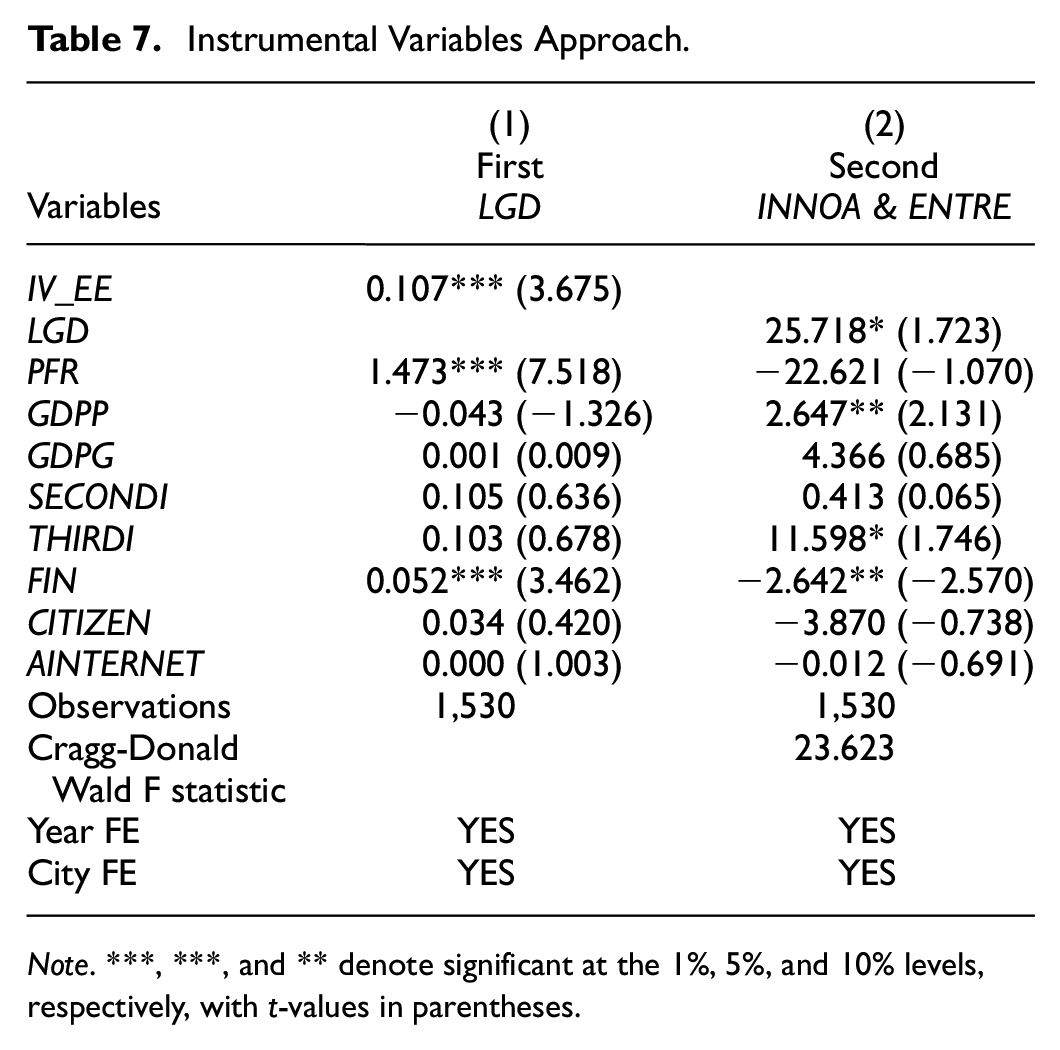
Note. ***, ***, and ** denote significant at the 1%, 5%, and 10% levels, respectively, with t-values in parentheses.
Further Analysis
Possible Mechanisms
Venture Capital Agglomeration Effects
Venture capital is an important indicator of the availability of capital for start-ups in a region. In this paper, we adopt the Venture Capital Index in China Regional Innovation and Entrepreneurship Index to characterize the venture capital agglomeration effect of cities. The regression results are shown in column (1) in Table 6, and the coefficient of LGD is significantly positive, indicating that the issuance of local debt significantly increases the level of venture capital in cities. The expansion of local government debt scale releases the government’s willingness to expand to investors, which enhances investors’ willingness to invest in enterprises or urban entrepreneurs’ venture capital, while venture capital agglomeration will broaden the source of funds for enterprises and entrepreneurs, alleviate their financing constraints, and contribute to the smooth development of urban innovation and entrepreneurship activities. Accordingly, the influence mechanism of the venture capital agglomeration effect can be verified.
Technology Clustering Effects
The expansion of the local government debt scale has alleviated the local financial pressure to a certain extent (Z. Chen et al., 2020), and local governments have more abundant funds to invest in science and technology, which leads to local technology agglomeration effect. Therefore, this paper adopts (government investment in science and technology/regional GDP) to construct the technology agglomeration index. The regression results are shown in column (2) of Table 6, and the regression coefficient of LGD is significantly positive, indicating that the scale of local government debt effectively improves urban science and technology investment, which contributes to urban technology agglomeration, and the urban technology agglomeration effect will provide technological support for innovation and entrepreneurship, which further leads to the enhancement of urban innovation and entrepreneurship activity. The mechanism of the technology agglomeration effect is verified (Table 8).
Mechanism Analysis.

Note. ***, ***, and ** denote significant at the 1%, 5%, and 10% levels, respectively, with t-values in parentheses.
Heterogeneity Analysis
Impact on Innovation or Entrepreneurship
The above analysis shows that local government debt enhances the quality of regional innovation and entrepreneurship, but it remains to be further tested what impact local government debt has on regional innovation and entrepreneurship quality respectively. For this reason, this paper uses the number of newly registered enterprises in cities, a secondary indicator in China’s Regional Innovation and Entrepreneurship Indicator System, to measure local entrepreneurship, and the number of invention patents authorized in cities during the same period to measure local innovation, and examines the impact of local government debt on regional innovation and entrepreneurship, respectively. The regression results are shown in columns (1) (2) of Table 7, and the results indicate that local government debt has a significant promotion effect on both regional innovation and entrepreneurship.
Impact of Fiscal Transparency on Local Governments
The continuous improvement of the fiscal system environment will promote the government budget to be more open and transparent, improve the information asymmetry in the public expenditure principal-agent relationship, and further rectify the adverse selection and moral hazard caused by information asymmetry (Arbatli & Escolano, 2015). In a highly transparent fiscal system environment, on the one hand, local governments will enhance the disclosure of the scale of local government debt, and it will be easier to send the signal of “development” to investors, thus strengthening the effect of risk investment agglomeration. On the other hand, the government’s budget for science and technology expenditures will be more open, which will enhance the effect of science and technology capital expenditures and increase the effect of science and technology agglomeration. It is reasonable to expect that the impact of local government debt on regional innovation and entrepreneurship is more significant in regions with high fiscal transparency. Therefore, this paper utilizes the score data of municipalities in the Research Report on Fiscal Transparency of Chinese Municipal Governments published by Tsinghua University to measure the fiscal transparency status of municipalities, and divides the sample municipalities into high and low fiscal transparency groups based on the median fiscal transparency score, and conducts regression analyses. The regression results are shown in columns (3) and (4) of Table 7, with the LGD coefficient in column (3) being significantly positive at the 1% level, and the LGD coefficient in column (4) being insignificant, which suggests that the impact of local government debt on regional innovation and entrepreneurship is more pronounced in the regions with high fiscal transparency.
Impact of Officials’ Promotion Pressure
In the Chinese institutional context, due to the fiscal decentralization and promotion tournament system, local governments have a stronger willingness to intervene in regional development with fiscal policies based on competitive patterns and political promotion incentives (Qu et al., 2023). When there is promotion pressure on local officials, borrowing becomes the main means for local governments to break through the fiscal budget, and they are more willing to guide investors and enterprises to invest in innovative and entrepreneurial activities, thus promoting local economic development. Therefore, we expect that the impact of local government debt on innovation and entrepreneurship will be more pronounced in regions with promotion pressure. Drawing on Qian et al. (2011), this paper constructs a promotion pressure index based on three dimensions: GDP growth rate, fiscal surplus, and unemployment rate, where fiscal surplus = (local fiscal revenue − local fiscal expenditure)/local fiscal revenue, and unemployment rate = number of registered unemployed people in urban areas/(number of registered unemployed people in urban areas + number of registered employed people in urban areas). Considering that the promotion of government officials in China is mainly assessed by relative performance evaluation methods, and thus cities of the same rank are the most directly comparable objects, we divide our cities into three categories: municipalities directly under the central government, sub-provincial cities, and ordinary cities according to the rank of administrative divisions. For ordinary cities, we compare the above three variables with the weighted average of the cities in the province where they are located; sub-provincial cities with the weighted average of 15 sub-provincial cities; and municipalities with the weighted average of 4 municipalities directly under the central government. In the calculation method, for GDP growth rate and fiscal surplus, the weighted average of the year is less than the current year is assigned as 1, otherwise, it is 0; for the unemployment rate, the average of the year is greater than the current year is assigned as 1, otherwise, it is 0; and then the scores are summed up to get the index of promotion pressure on the local officials, PS. We divided the samples into the group of the existence of promotion pressure (PS > 0) and the group of the non-existence of promotion pressure (PS = 0) and carried out regression, and the results are shown in Table 7, column (5), column (5), column (5). The results are shown in columns (5) and (6) of Table 7. The LGD coefficient in column (5) is significantly positive at the 1% level, while the LGD coefficient in column (6) is not significant, which suggests that the impact of local government debt on regional innovation and entrepreneurship is more pronounced in the regions where there is promotion pressure.
Impact of Local Business Environment
Innovative entrepreneurial activities are influenced by the regional business environment. First, the resource support provided by the ecology of the business environment enhances the number of organizations that the environment can support and facilitates the creation of new firms (Aldrich & Ruef, 2006). Second, differences in the business environment affect entrepreneurs’ perceptions of resources, capabilities, and opportunity viability, which in turn affects the behavior that initiates entrepreneurship (Lim et al., 2016). If a city’s government is service-minded, efficient, and supportive of the market, it will reduce transaction costs and enhance entrepreneurial intentions (Thornton & Ocasio, 2008). It can be reasonably expected that in areas with a better business environment, the talent, technology, and financial resources needed for innovation are more complete, which will diminish the venture capital agglomeration effect and technology agglomeration effect brought by local debt. In this paper, according to the marketization index developed by G. Fan and Wang (2011) and Wang et al. (2018), based on the size of the annual median of the index, the sample is divided into two groups of high business environment and low business environment, and regression is carried out separately, and the regression results are shown in columns (7) (8) of Table 7, the LGD coefficients of column (7) are not significant, and the LGD coefficients of column (8) are significant and positive at 1% level, which suggests that in the region with low business environment local government debt is more effective in promoting regional innovation and entrepreneurship (Table 9).
Heterogeneity Analysis.

Note. ***, ***, and ** denote significant at the 1%, 5%, and 10% levels, respectively, with t-values in parentheses.
Conclusions
Enhancing regional innovation and entrepreneurship is a critical driver of high-quality economic development, and understanding the factors that influence it holds both theoretical value and practical significance. This study examines the impact of local government debt on the quality of regional innovation and entrepreneurship using a fixed-effect model based on panel data from 295 cities in China spanning from 2015 to 2020. The empirical findings demonstrate that local government debt significantly enhances the quality of regional innovation and entrepreneurship, and this conclusion is further supported by a series of robustness tests. Mechanism testing reveals that local government debt positively influences regional innovation and entrepreneurship through the agglomeration effects of venture capital and technology. Specifically, local government debt acts as a signal to attract more venture capital investment and facilitates increased government investment in science and technology. This, in turn, leads to the accumulation of technological achievements and provides the region with greater financial and technical support for innovation and entrepreneurship. Further research also indicates that local government debt has a significant promoting effect on both innovation and entrepreneurship, particularly in areas characterized by high fiscal transparency, pressure on officials for promotion, and poor business environment.
This paper has the following three research insights: first, this paper verifies the relationship between local government debt and regional innovation and entrepreneurship based on the data after the implementation of China’s new budget law in 2015, and finds a positive effect after the governance of local government debt so that the government should further improve the operation mode of local government debt and prevent the potential risks of local debt, to create a favorable regional innovation and entrepreneurship atmosphere. Secondly, the risk investment agglomeration effect and technology agglomeration effect are important channels through which local government debt affects regional innovation and entrepreneurship. Local governments should strengthen the policy design in favor of risk investment, to better play the risk investment agglomeration function of innovation-driven policies, in addition to increasing the investment in scientific and technological technology and enhancing the ability of technological transformation, to better play the role of technology agglomeration. Finally, this paper finds that the impact of local government debt on regional innovation and entrepreneurship varies in different regions, therefore, local governments should formulate and implement local government debt management measures according to local conditions, and then promote the coordinated development of urban innovation and entrepreneurship.
This paper has some limitations. With the implementation of the reform in China’s local government debt management system, the guarantee function of local governments for implicit debt borrowers, such as financing platforms, has been limited. As a result, the scale of local government implicit debt has been constrained. However, the existence and potential impact of local government implicit debt on regional innovation and entrepreneurship still warrant future exploration.
Footnotes
Author Contributions
Li Dai and Zongze Li wrote the main manuscript text;
Yuqi Yang and Li Dai analyzed data;
Yifan Bao collected data;
All authors reviewed the manuscript.
Declaration of Conflicting Interests
The author(s) declared no potential conflicts of interest with respect to the research, authorship, and/or publication of this article.
Funding
The author(s) disclosed receipt of the following financial support for the research, authorship, and/or publication of this article: This paper was supported by New Agricultural Science Research and Reform Practice Projects of the Ministry of Education and Henan Province (Project No. 2020JGLX111), New Liberal Arts Research and Reform Practice Project of Ministry of Education and Henan Province (Project No. 2021JGLX033), the Key Project of Higher Education Teaching Reform Research and Practice in Henan Province (Project No. 2021SJGLX093).

Data Availability Statements
The data that support the findings of this study are available from the corresponding author upon reasonable request.