




Abstract
The development of HSR (HSR) promotes the flow of economy and population, which can, to some extent, impact the innovation level of cities connected by it. This paper, based on city data from 276 prefecture-level cities and above from 2003 to 2016, employs the DID method and a mediation effect model to empirically analyze the relationship between the opening of HSR, economic agglomeration, and the level of urban innovation. The study finds that the introduction of HSR not only elevates the innovation level of connected cities but also manifests a mediation effect of economic agglomeration. Further research reveals that this mediation effect varies regionally and by city hierarchy. Specifically, in eastern regions, the mediation effect of HSR promoting urban innovation through economic agglomeration is less pronounced than in western regions. For central cities, the mediation effect is represented through economic density, while for non-central cities, it manifests through economic density, population density, and industrial density. Robustness checks further validate these findings, reaffirming the conclusions of this paper. Thus, the study’s findings offer policy insights, suggesting that local governments can leverage the economic agglomeration advantages brought by HSR and adopt differentiated and rational policy measures to promote high-quality urban development.
Plain language summary
High-speed rail (HSR) lines are more than just fast trains; they connect cities in ways that can significantly boost local economies and spark new innovations. This research dives into how the introduction of HSR affects the innovation levels of cities by bringing them closer together, economically and socially. By looking at data from 276 cities across China from 2003 to 2016, we used sophisticated statistical methods to understand the relationship between HSR openings, economic growth in clusters (or “agglomeration”), and innovation within cities. Our findings reveal that HSR doesn’t just make cities more innovative by itself; it also encourages the growth of tightly-knit economic areas that further drive innovation. However, this effect isn’t uniform across all areas or types of cities. Cities in the western parts of the country see a stronger benefit from economic clusters in boosting innovation through HSR than those in the eastern regions. Additionally, the way HSR helps central cities innovate differs from its impact on smaller, non-central cities. By conducting thorough checks to ensure our results were consistent and reliable, we’ve shown clear evidence of HSR’s benefits. This information is incredibly valuable for policymakers. It suggests that by focusing on the economic clustering effect of HSR, local governments can implement targeted strategies to foster high-quality development in their cities. This study underlines the importance of tailoring policy measures to the unique characteristics of each city and region to make the most of what HSR can offer.
Introduction
With the inclusion of High-Speed Rail (HSR) in the national plan, the sixth major speed-up of China’s railways, and the opening of the Beijing-Tianjin Intercity HSR, China rapidly entered the “HSR era,” and the construction of HSR in China also experienced rapid development. By the end of 2022, the operational mileage of China’s HSR had reached 42,000 km, with a HSR passenger volume of about 1.673 billion trips. The HSR network has covered 94.9% of cities with a population of more than 500,000. Apart from China, HSR has been extensively introduced in many other countries around the world. Japan, as a pioneering nation in this domain, inaugurated its Shinkansen between Tokyo and Osaka in 1964, marking the birth of the first commercially operated HSR in the world. By June 2021, Japan’s high-speed network expanded to cover 2,893 km, bridging the main islands of Honshu and Kyushu. Europe, too, embraced this technology ardently. By 2021, France’s HSR (Train à Grande Vitesse, TGV) will have an operating mileage of 2,719 km, Germany’s HSR mileage (Intercity Express, ICE) will be 1,330 km, and Spain’s HSR (AVE) will have an operating mileage of 3,100 km. Other nations such as Italy, South Korea, Taiwan, the UK, and Turkey have also embarked on this journey, each adapting HSR to their unique geographies and economic contexts, further solidifying the importance and influence of this innovation in global transportation (Omio, 2023).
With the rapid development of HSR and the further improvement of the HSR network, HSR has had a significant impact on the economic agglomeration and spatial distribution of cities along its route (Li et al., 2016), not only greatly affecting people’s choice of travel mode but also changing the traditional transportation pattern. Meanwhile, the flow of talent and capital, and the exchange of information brought about by HSR, will impact the economic vitality and innovation activities of the cities it serves through the scale and specialization generated by economic agglomeration (Du & Peng, 2017). Studies have shown that economic agglomeration can improve urban innovation levels by driving the scale agglomeration of innovative resources, and the sharing of knowledge, information, and technology (Huang & Li, 2018). On one hand, economic agglomeration can enhance the specialization and scale efficiency within cities, improve urban economic vitality and innovation levels through increased R&D investment, internal cooperation, and specialized production; on the other hand, during the process of economic agglomeration, the city’s innovation level can be improved through technology spillover and management system innovation caused by regional cooperation (L. N. Gao & Zhang, 2015). Therefore, the inauguration of HSR not only directly affects the innovation level of the cities it reaches but can also impact their innovation level through economic agglomeration.
While existing literature on HSR largely focuses on macroeconomic level studies, such as the significant impact of HSR on city-to-city accessibility, population mobility, information transfer, and technology spillover, thereby further influencing regional spatial economic distribution characteristics (Ahlfeldt & Feddersen, 2010; Qin, 2017), research on the microeconomic behavior of individuals mainly concentrates on the effects of HSR inauguration on residents’ travel and consumption behavior, corporate location choices, and industrial layouts (Oosterhaven & Romp, 2003; Willigers & van Wee, 2011; S. Zheng & Kahn, 2013). In addition, HSR (HSR) stands out for its eco-friendly benefits, including efficient commuting, low environmental impact, and reduced pollution compared to traditional transport modes (Spielmann & Scholz, 2005; S. Yao et al., 2019). It significantly lowers emissions from buses, planes, and trains, thus notably cutting down haze pollution in China (F. Zhang et al., 2021). These advantages make HSR a pivotal factor in enhancing public transportation’s environmental efficiency and residents’ quality of life in served regions. Although a substantial body of research focuses on the impact of HSR on the macro economy, such as its diffusion and agglomeration effects on regional economies (Givoni, 2006; Hall, 2009) and HSR’s environmental benefits, pollution reduction, and quality of life improvement (e.g., Spielmann & Scholz, 2005), there is still a significant gap in studies regarding the link between HSR and urban innovation, especially on how HSR affects the innovation levels of cities, whether the inauguration of HSR influences the innovation level of the cities it serves, and whether it can impact the innovation level of these cities through the economic agglomeration it induces.
Due to the different timing of HSR inaugurations across cities, this paper attempts to use this variability as a form of “quasi-natural experiment,” utilizing data from prefecture-level cities and their districts from 2001 to 2015, along with Difference-in-Differences (DID) method and the mediating effect model, to study the relationship between HSR inaugurations, economic agglomeration, and urban innovation. The study finds: First, the inauguration of HSR can not only improve the innovation level of the cities where it is introduced but also has a mediating effect of economic agglomeration, meaning that HSR can enhance the innovation level of cities by promoting economic agglomeration. Second, the mediating effect of economic agglomeration between HSR inaugurations and urban innovation exhibits regional heterogeneity; for the eastern region, HSR improves the innovation level of cities through economic density, population density, and industrial density, while in the central and western regions, the mediating effect is manifested through economic density and industrial density agglomeration. Third, the mediating effect of economic agglomeration on urban innovation levels through HSR exhibits heterogeneity across hierarchical cities. Specifically, the mediating effect of HSR inaugurations on enhancing urban innovation levels manifests as economic and population density agglomeration in central cities, and as economic and industrial density agglomeration in non-central cities. Therefore, the structure of this paper is as follows: the second section for literature review and theoretical hypotheses; the third section for research design, including model construction, measurement of economic agglomeration, and data sources and selection; the fourth section for regression results and empirical analysis; the fifth section for main conclusions and policy recommendations.
Literature Review and Hypothesis Formulation
Literature Review
The theory of new economic geography suggests that transportation infrastructure can reshape regional economic structures by influencing shifts in production costs and the reconfiguration of production factors (Cantos et al., 2005; Krugman, 1980). Research related to the interplay between HSR and economic development primarily delves into the distributive economic effects brought about by HSR. Sasaki et al. (1997), utilizing a rudimentary spatial econometric model, examined the impact of Japan’s Shinkansen HSR network on economic activities and population mobility. They found that a well-developed HSR network somewhat disperses the economy from affluent regions to their surroundings. However, an overly dense HSR network might not necessarily benefit this economic diffusion from prosperous regions. Givoni (2006), in studying HSR developments across different countries, observed that the introduction and maturation of HSR networks enhance accessibility between connected regions. This leads to the migration of production factors from non-central urban areas to central urban locales, thereby fostering economic growth in the central urban zones while impeding that in non-central ones.
Employing a geographic economic framework, Ahlfeldt and Feddersen (2010) explored the German HSR system. They discerned that such a system not only directly broadens the market reach of products within connected regions but also indirectly bolsters regional economic growth through the spillover effects of technology, information, and managerial philosophies. Jiao et al. (2017), using empirical data from 2003 to 2014 for municipalities and prefecture-level cities, probed the impact of China’s HSR network on urban network structures. They identified that the HSR network bolsters the overall connectivity of urban networks across regions and the centrality of urban nodes. Gradually, it alters the urban hierarchy in various regions, primarily evidenced by the spatial development of the HSR network leading high-value cities to shift from their original geographic centers toward areas with denser populations and more robust economic development. As for the impact of HSR on China’s socio-economic landscape, the majority of scholars have concentrated on macro-economic aspects (Ahlfeldt & Feddersen, 2010; Qin, 2017), such as the diffusion and agglomeration effects of HSR on regional economies (Givoni, 2006; Hall, 2009).
Does the inauguration of HSR influence economic agglomeration in the areas it serves? Numerous scholars have delved into this question, exploring the impact of HSR on economic concentration from various perspectives. Hall (2009), after studying HSR in major European countries, discerned that HSR influences regional economic agglomeration. Specifically, HSR fosters the agglomeration of capital, labor, and other production factors from non-central cities to central ones, with the effect being particularly pronounced in the service sector. Vickerman (1997), in his study on European HSR, noted that the commencement of HSR affects corporate behaviors. This is because the heightened accessibility provided by HSR endows central cities with locational advantages and increased appeal to businesses, leading to a concentration of enterprises and manufacturers in central and larger cities (Willigers & van Wee, 2011). This, in turn, promotes economic agglomeration and growth in these central urban hubs. S. Zheng and Kahn (2013), through empirical research on mega-cities in China and their neighboring areas, found that on one hand, due to the surge in housing prices and consequent increase in production costs, the opening of HSR routes leads manufacturing plants in mega-cities to concentrate in surrounding areas served by HSR. On the other hand, owing to transportation and environmental issues, as well as the rising cost of living in these mega-cities, the HSR also results in residents relocating from these mega-cities to surrounding areas with better environmental and educational conditions. Qin (2017) examined how China’s sixth major railway speed-up impacted the economic agglomeration of central cities toward counties along the route. He found that HSR has led economic activities and fixed asset investments in counties to concentrate toward central cities, resulting in negative spillover effects on the economies of these counties. Shao et al. (2017), in their study on the Yangtze River Delta urban agglomeration, discovered that HSR promotes service industry agglomeration in the regions it serves. Moreover, the stronger the HSR service intensity, the greater its impact on service industry agglomeration. Further analysis indicated that the HSR’s influence on service industry agglomeration is primarily evident in the productive service sector.
Several researchers have also examined the influence of HSR inaugurations on regional innovation. Y. Gao and Zheng (2020) observed that HSR connections significantly foster product and process innovations, with the effects being especially pronounced in the Yangtze River Delta region. K. Zheng et al. (2022) probed into the impact of HSR on corporate innovation. Their findings suggest that HSR facilitates knowledge spillovers between cities, thus enhancing firms’ innovative capacities. To further stimulate knowledge flow and collaborative research, they advocate for refining transportation infrastructure and establishing “HSR city circles” centered on HSR network nodes. Fan et al. (2022) unearthed several insights: (1) China’s intercity technology transfer network has crystallized into a national “diamond structure”; (2) HSR has imparted a marked positive effect on intercity technology transfers; (3) Beyond its direct impacts, HSR has also indirectly influenced technology transfers through geographical, industrial, innovative, and technological complementarities. These revelations further broaden our comprehension of the relationship between transport infrastructure and innovation networks.
Hanley et al. (2022) established that once a city integrates into the HSR network, there’s a significant surge in the volume of its innovative collaborations both at the city and city-pair levels, accompanied by a substantial enhancement in patent quality. HSR, in particular, bolsters innovative collaborations between developed and underdeveloped regions, contributing to balanced development across Chinese regions. L. Yao and Li (2022) investigated the effects of HSR on intercity innovative collaborations, concluding that HSR connections noticeably strengthen both the quantity and quality of innovative collaborations between connected cities, with collaborations between cities within the same province reaping particularly notable benefits. Lastly, Wu et al. (2022) delved into the influence of HSR construction on the innovation capabilities of publicly listed companies. They discerned that HSR construction distinctly amplifies a firm’s level of innovation, exerting its effects through human capital, marketization levels, and sales revenue. They also noted heterogeneity in the impacts of HSR construction across different types of publicly listed firms.
Hypothesis Formulation
The advent of HSR’s expansive network has significantly reduced the temporal distance between cities it serves, enhancing accessibility and convenience between them. This has profound implications on regional collaborative innovation capabilities and urban innovation levels. Specifically, the impact of HSR on urban innovation can be categorized as follows: Firstly, the introduction of HSR diminishes the time cost between cities, reducing transaction and communication costs for businesses (Pauline et al., 2018). This amplifies the opportunities for interactions and collaborations between businesses in different cities. Such interactions can enhance collaborative innovation capabilities (Dong et al., 2019) and overall innovation levels in these cities. Secondly, while HSR expands the market reach for businesses in its connected regions, it also invites external businesses to the local market. The ensuing intensified market competition propels businesses to recognize the importance of product innovation and to prioritize innovative activities. To foster this, incentive systems and rewards are introduced to spur research and development, talent acquisition, and encourage collaborations between researchers from different cities, thus enhancing the innovation capabilities of businesses and the city at large. Thirdly, the opening of HSR facilitates knowledge, information, and technology spillovers (Tsekouras et al., 2016). Business leaders, while interacting with their counterparts from other cities, can learn and integrate advanced techniques, fostering innovation at both the business and city levels. Fourthly, HSR allows business managers to glean insights from developed regions and advanced enterprises regarding management systems and philosophies (Bian et al., 2019). This can reduce myopic decision-making behaviors, enhancing the efficiency and scientific basis of decisions, laying the foundation for an innovative management system and elevating the city’s innovation levels (Tan et al., 2022). Fifthly, the introduction of HSR enhances a city’s locational advantages. To attract investments and facilitate the transfer of industries from higher-tier cities, local governments in connected regions might simplify administrative processes (Agrawal et al., 2017), enhance administrative efficiency, and offer tax incentives to encourage business innovation. This fosters an innovation-friendly social atmosphere, further elevating the city’s innovation levels. Given the above analysis, the paper posits Hypothesis 1:
Furthermore, HSR, by influencing economic agglomeration, can also enhance urban innovation levels. The introduction of HSR stimulates the flow of resources like capital and labor, resulting in a redistribution of population, funds, and information, and subsequently altering or transferring regional economic activities (Li et al., 2016). The rail system not only affects inter-city accessibility and connectivity in the short term but also inevitably influences the migration, agglomeration, and dispersion of economic activities (Chen & Hall, 2012; Ureña et al., 2009). HSR enhances the regional advantages of the connected cities and their attractiveness for business locations (Willigers & van Wee, 2011), leading to a migration of businesses to these cities. This results in the agglomeration of industry-related or similar businesses, fostering specialized production, business competition and collaboration, and creating an environment conducive to business innovation.
Specifically, on one hand, the introduction of HSR leads to economic agglomeration of inter-related businesses, enhancing diversity and enabling cross-industry knowledge sharing and spill-overs. On the other hand, similar businesses aggregate in the same HSR-connected city, leading to specialized production and scale economies. This drives knowledge and technology spill-overs within industries (Baptista & Swann, 1998), pushing specialized production toward deeper levels and enhancing technical innovation capabilities (Tao & Peng, 2017). The economic agglomeration also forms an open, shared economic environment, realizing technological innovation in specialization and high-end production (F. A. Wen, 2018). Overall, HSR fosters economic agglomeration in connected cities, which in turn elevates their innovation levels. Based on the above analysis, the paper further posits Hypothesis 2:
Additionally, under the spatial-temporal compression effects of HSR, the ways people travel and the flow of economic activities are altered, thus influencing the economic relationships between different connected cities. Moreover, influenced by geographical positioning and market competition mechanisms, cities with pronounced locational advantages and developed economies are more likely to experience agglomeration of labor and investment due to HSR. This agglomeration of labor and capital, coupled with the intense market competition in economically developed areas, promotes urban economic vitality and innovative vigor, consequently enhancing the innovation levels of connected cities. For less economically developed areas, the economic effects brought by the opening of HSR are even more pronounced. They attract more talents and labor from surrounding areas and receive industry transfers (primarily manufacturing enterprises) from more developed cities. This facilitates the introduction of advanced technologies and management concepts, further elevating the innovation levels of the connected cities. Moreover, while HSR influences the agglomeration and dispersion of economic activities, studies have shown that due to significant disparities in economic development levels, urban function positioning, and agglomeration of capital and talent among different regions, HSR leads to a reconfiguration of economic activities between central and non-central cities (Jiao et al., 2017). For example, Ureña et al. (2009) found that HSR results in the agglomeration of high-end specialized economic activities in central cities, while industries requiring vast land and labor resources lean toward peripheral non-central cities. Regarding labor mobility, central cities, with their superior infrastructure and healthcare facilities, have a distinct advantage in attracting and retaining talent, especially high-quality talent. Therefore, the opening of HSR in central cities is more conducive to labor agglomeration. Consequently, HSR leads to the agglomeration of the population (especially high-quality individuals) and high-quality capital in central cities (C. L. Chen, 2012), which boosts their innovation levels. For non-central cities, HSR enhances their accessibility and connectivity with central cities, thus improving their geographical advantages and facilitating the influx of industries and related economic activities from nearby central cities. This results in the agglomeration of labor-intensive industries and populations, which, to some extent, boosts the innovation levels of the connected cities. Given the above analysis, the paper posits the following research hypotheses:
Research Design Concept and Methodological Framework
New Economic Geography provides a macro-framework for understanding the impact of HSR (HSR) on urban economies, emphasizing how improvements in transportation infrastructure can reduce geographical friction, promote the agglomeration of economic activities, and thereby influence the level of urban innovation (Fu et al., 2023). From the theoretical perspective of New Economic Geography, this study delves into how HSR, by altering production costs and reconfiguring the allocation of production factors, affects regional innovation levels. Consequently, treating the inauguration of HSR as a quasi-natural experiment, the study adopts a DID approach for empirical analysis of the impact of HSR openings on urban innovation levels. It further employs a mediation effect model to examine whether HSR affects the innovation levels of cities through economic agglomeration (e.g., Sun & Li, 2021), capturing both the direct and indirect economic impacts of HSR openings comprehensively.
The DID method, as a quasi-experimental design tool, effectively mitigates the impact of time-invariant factors and common temporal changes experienced across cities by comparing the differences in urban innovation levels before and after the opening of HSR (e.g., Fan & Xu, 2023). The applicability of this method lies in the fact that the inauguration of HSR can be considered an exogenous policy intervention, providing a unique quasi-natural experimental setting (Shen et al., 2023). The DID method is capable of controlling for potential confounding variables, thus enhancing the credibility of causal inference (Liu et al., 2022). By establishing treatment groups (cities with HSR openings) and control groups (cities without HSR openings) and comparing the changes before and after HSR openings, it accurately identifies the net effect of HSR openings on urban innovation levels (K. L. Wang et al., 2023). This allows researchers to more precisely determine the impact of HSR openings on urban innovation levels, thereby offering empirical evidence for policy-making.
Further incorporation of the mediation effect model aims to explore whether economic agglomeration plays a significant role between HSR openings and urban innovation levels. This model allows for an in-depth examination of how HSR openings indirectly influence urban innovation by fostering economic agglomeration (e.g., Pan & Jin, 2017; Z. L. Wen & Ye, 2014; Yang & Ma, 2023). This analytical framework assists in comprehensively understanding the multifaceted mechanisms through which HSR openings impact urban innovation, addressing gaps in existing literature. After establishing the overall impact of HSR openings, the mediation effect model enables a more precise measurement of the mechanisms through which economic agglomeration affects innovation levels in cities with HSR. The adoption of this method not only adds complexity to the research but also enhances the possibility of a deeper understanding of the economic impacts of HSR (Ma et al., 2023).
By combining the DID method with the mediation effect model, it is possible to scientifically and accurately assess the impact of HSR openings on urban innovation levels and reveal the role of economic agglomeration as a crucial mediating variable (K. L. Wang et al., 2023). The choice of this methodological approach is advantageous for exploring the effects of HSR on urban innovation levels in-depth, offering new theoretical and empirical perspectives on how HSR openings promote urban innovation. This is valuable for policymakers and urban planners, providing insights that aid in optimizing transportation infrastructure and developing the urban innovation ecosystem.
Additionally, the Propensity Score Matching—Difference-in-Differences (PSM-DID) method was adopted for robustness checks. This methodology, by initially conducting propensity score matching (PSM) to pair treatment and control group members before the intervention, and then applying the DID method to compare the differences post-matching, aims to enhance the accuracy of the research and the reliability of causal inferences (e.g., Beck et al., 2010; Ke et al., 2017).
The PSM-DID method is particularly suited to this study as it effectively reduces potential selection bias associated with the opening of HSR, ensuring similarity between comparison groups before the intervention. This step is crucial for enhancing the robustness of the study’s findings, especially in assessing the complexity and multidimensionality of HSR’s impact on urban innovation levels (e.g., Beck et al., 2010; Ke et al., 2017). Through the application of the PSM-DID method, we are able to more accurately identify the net effect of HSR openings, providing empirical evidence for policy formulation based on more precise causal inferences.
Research Methods and Data Description
This study focuses on 276 or more prefecture-level cities from 2003 to 2016, employing the DID method. This method was chosen due to its efficacy in revealing causal relationships and controlling for confounding variables, drawing on the practices of pioneering researchers in the field (e.g., Beck et al., 2010; Ke et al., 2017). Additionally, we have utilized a mediation effect model, consistent with the approaches of other researchers (e.g., Pan & Jin, 2017; Z. L. Wen & Ye, 2014), to empirically analyze the relationship between the opening of HSR, economic agglomeration, and urban innovation levels. This model was selected for its effectiveness in capturing indirect effects or mediating processes.
Model Specification
Based on the theoretical analysis and research hypotheses presented earlier, this study aims to further examine the impact of HSR opening on urban innovation levels. Additionally, we seek to determine whether the opening of HSR can influence urban innovation levels through economic agglomeration. Drawing inspiration from the research methods used in Z. L. Wen and Ye (2014), as well as Pan and Jin (2017), this paper constructs a mediating effect model represented by Equations 1–3. Through empirical regression, we aim to probe the mechanisms by which HSR opening affects urban innovation levels.


In the model:
Within this research framework: Equation 1 assesses the effect of the introduction of HSR on a city’s innovation level, the research hypothesis 1 can be tested through this equation. Equation 2 gauges the impact of the HSR introduction on the city’s economic agglomeration level. Equation 3 examines the combined influences of both the introduction of HSR and the city’s economic agglomeration on its innovation level. Together, Equations 1–3 constitute the mediation model to ascertain whether HSR influences a city’s innovation level through its effect on economic agglomeration, the research hypotheses 2, 3, and 4 can be tested through these three equations. Furthermore: If the coefficient
Measuring the Level of Economic Agglomeration
Given the mediation model constructed in this research involves the level of economic agglomeration in cities, there’s a need to measure this particular level. While there are numerous studies and metrics to evaluate economic agglomeration, such as the HHI index, Location Entropy index, and Spatial Gini coefficient, these metrics often don’t account for variations in city size and are largely industry-specific. Therefore, to offer a comprehensive measure of a city’s economic agglomeration level, this study adopts the measurement methods proposed by Wan et al. (2020). This research primarily evaluates a city’s economic agglomeration level from three perspectives: the degree of economic development, labor intensity, and the level of industrial development.
Economic density serves as a measure of the intensity of economic activities in a city and its level of economic agglomeration. It represents the economic value generated per unit area of a region. In this study, economic density is defined as the Gross Domestic Product (GDP) per unit land area of the city. The specific calculation formula is:

Where:
Population density can measure the economic agglomeration degree of labor in an area based on the labor intensity. In this study, the population density of a city is represented by the total number of employed individuals per square kilometer in the city’s jurisdictional area. It reflects the concentration of workers involved in economic activities within a city. The specific calculation formula is:

Where:
The industrial density can, to some extent, represent the economic agglomeration level of industrial development in a region. In this study, we use the total industrial output value per square kilometer within a city’s jurisdiction to measure its industrial concentration. This reflects the city’s average level of industrialization and the degree of industrial agglomeration. The specific calculation formula is:

Wherein,
Data Sources and Main Descriptive Statistics
The data related to the opening dates of HSR in this study primarily derives from the information disclosed by the China Railway Corporation. Notably, the definitions and categorizations of HSR opening dates follow the conventions of K. Z. Zhang and Tao (2016). Specifically, if a HSR line was launched in the first half of the year, it’s recorded as having been opened in that year. If it was inaugurated in the second half, its opening is recognized as the subsequent year. Furthermore, according to the latest regulations from the China Railway Corporation, “China HSR” refers to railways designed for speeds of 250 km/h (including reserved speeds) and above, initially operating at no less than 200 km/h. This includes high-speed electric multiple units (EMUs; 250–350 km/h) and intercity high-speed (above 250 km/h) but excludes standard EMUs (200 km/h). Hence, our definition of HSR opening dates does not encompass EMU trains.
Given the limitations in data availability at the prefecture-level city scale for measuring innovation levels, many researchers rely on limited city patent data or patent data from listed companies and R&D expenditure. However, these metrics do not comprehensively represent a city’s innovation level. Kou and Liu (2017), utilizing patent data from the National Intellectual Property Administration and micro-enterprise data from the State Administration for Industry and Commerce, have generated a city innovation index which aptly gauges a city’s innovative capacity. Thus, this study employs the natural logarithm of the city innovation index from the “China City and Industry Innovation Power Report 2017” as an indicator of urban innovation levels.
The years spanning 2003 to 2016 are undeniably pivotal in the evolution of China’s HSR system. During this period, China transitioned from virtually no HSR to boasting the world’s most extensive HSR network. This era not only captures the inception and rapid expansion of the HSR but also its period of stabilization and the profound influence it began to exert on economic paradigms.
Our primary focus is to investigate the implications of HSR openings on economic agglomeration and urban innovation. The timeline from 2003 to 2016 represents a crucial phase in China’s HSR journey: from preliminary planning to its comprehensive rollout. This specific timeframe was chosen to ensure continuity and completeness in our research. These 14 years offer a holistic before-and-after comparison, allowing us to observe the genuine impact of HSR on economic agglomeration and urban innovation. This delineation also helps sidestep potential disturbances from external factors in subsequent years, especially considering the myriad policy changes, economic events, and global challenges (such as the ramifications of the COVID-19 pandemic) that could significantly skew data interpretations. Additionally, it’s noteworthy that the urban innovation data we reference is based on publicly available sources, with the latest statistical cut-off being precisely 2016, setting a natural boundary for our research period.
All pertinent economic data for prefecture-level cities and municipalities from 2003 to 2016 in this study have been sourced from the “China City Statistical Yearbook” (2004–2017) and the CSMAR database. For instances of partial data omissions in macroeconomic figures, our initial approach was to supplement the gaps with statistics from the prefecture-level and municipality statistical bulletins. Subsequently, we employed linear interpolation to address any remaining data deficiencies.
In a bid to enhance the accuracy of our study’s estimations, we have made certain exclusions. Cities with entirely missing variables, significant administrative boundary changes, or those that have been demoted from the prefecture-level status have been omitted. Additionally, Hainan Province and Tibet Autonomous Region, both of which exhibit minimal connectivity to China’s HSR network, have been excluded from the dataset. Consequently, the final sample set encapsulates data from 276 cities, comprising 269 prefecture-level cities and 4 municipalities. A descriptive statistical breakdown of the primary variables is showcased in Table 1.
Main Descriptive Statistics.

Empirical Results
Baseline Regression Results of HSR Opening and Urban Innovation
To begin, we conduct a regression on Equation 1 to empirically analyze the impact of HSR openings on urban innovation levels. Model (1) from Table 2 reveals a significantly positive coefficient, HRS, suggesting that the introduction of HSR enhances the innovation level of cities within its connected region. To ensure the robustness and reliability of our findings, while controlling for time-fixed and individual-fixed effects, we progressively incorporate control variables and conduct baseline regressions. The outcomes, as depicted from Model (2) through Model (7) in Table 2, indicate that the regression coefficient HRS remains positively significant at the 1% level. This means the inauguration of HSR significantly boosts the innovative capabilities of the cities in its network, thereby empirically validating Hypothesis 1 of our study.
Baseline Regression Results of HSR Opening and Urban Innovation.

Note. (1) Values in parentheses are robust standard errors; (2) *, **, and *** denote significance at the 10%, 5%, and 1% levels, respectively.
In addition to the control variables in our study and after adjusting for individual and time fixed effects, the models (2) through (6) indicate that the coefficient for regional economic development potential (growth_gdp) is positive at the 5% significance level. This suggests that higher regional economic development leads to improved infrastructure, which in turn attracts talent. Due to heightened market competition in these regions, governments and businesses prioritize innovation and R&D investments, thereby enhancing urban innovation. However, the impact of external openness (lnfdi) and human capital (human) on urban innovation isn’t significant. The non-significant effect of foreign direct investment (lnfdi) on urban innovation might be attributed to its competition and spillover effects. Moreover, improved medical conditions in a region enhance urban innovation, indicating the pivotal role of healthcare in talent mobility and urban innovation promotion.
HSR Opening, Economic Agglomeration, and Urban Innovation
The preliminary empirical results indicate that the introduction of HSR elevates urban innovation in the regions it connects. To further investigate whether the HSR influences urban innovation through economic agglomeration, this study employs economic density, population density, and industrial density as proxies for economic agglomeration. The empirical regression results are shown in Table 3.
Regression Results of HSR Opening, Economic Agglomeration, and Urban Innovation.

Note. (1) Values in parentheses represent robust standard errors; (2) *, **, and *** denote significance at the 10%, 5%, and 1% levels, respectively.
Firstly, the estimated coefficients of HSR opening from models (1), (3), and (5) in Table 3 are 0.130, 0.002, and 0.200, respectively, and are significantly positive at the 1% level. This suggests that the introduction of HSR enhances economic, population, and industrial densities in connected regions, thereby fostering economic agglomeration. Furthermore, the coefficient for economic density in model (2) is 0.491 and is highly significant at the 1% level. The Sobel test yields a significant value of 7.274 at the 1% level, affirming the mediating effect of population density. This implies that the HSR indirectly affects urban innovation through economic density. Moreover, as seen from models (3) through (6), coefficients associated with the HSR’s impact on urban innovation, population density, and industrial density are significantly positive. This confirms that the HSR influences urban innovation via mediating effects of population and industrial densities, supporting our Hypothesis 2.
Heterogeneity of the Mediating Effect of Economic Agglomeration
Due to the vast disparities in economic development and cultural resources across different regions, the mediating effect of how HSR openings influence urban innovation via economic agglomeration varies regionally. Furthermore, given the significant distinctions in function, urban role, and economic development levels among cities of different tiers, this effect also exhibits heterogeneity based on city classification. To test the heterogeneity of the mediating effect, this study utilizes subsample regressions focusing on different regions and city tiers.
Initially, adopting common literature classifications, we partition China into the Eastern and Central-Western regions based on variations in economic development and geographic location. Using models (1) through (3), we then run mediating effect regressions on these subsamples. The heterogeneity empirical results are displayed in Tables 4 and 5. Observing models (2), (4), and (6) in Table 4, it’s evident that the introduction of HSR significantly boosts economic, population, and industrial agglomerations in the Eastern region. Models (3), (5), and (7) in Table 4 reveal significant coefficients for HSR openings at the 10% level, and the coefficients for economic, population, and industrial densities are all positive. The Sobel test is significant at the 10% level, indicating a mediating effect in the Eastern region where HSR enhances urban innovation through economic agglomeration.
Regional Heterogeneity of the Mediating Effect (Eastern Region).
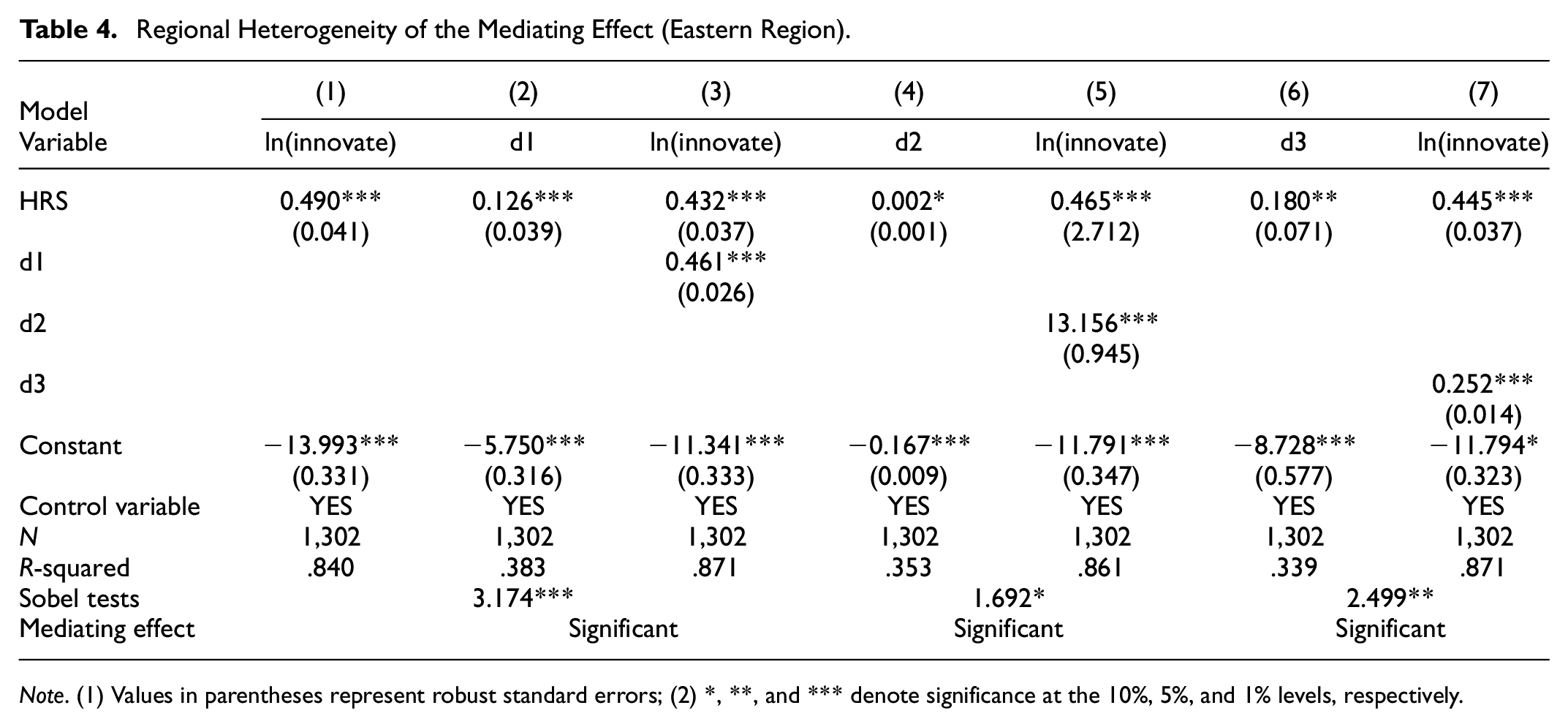
Note. (1) Values in parentheses represent robust standard errors; (2) *, **, and *** denote significance at the 10%, 5%, and 1% levels, respectively.
Mediating Effect of Regional Heterogeneity (Central and Western Regions).
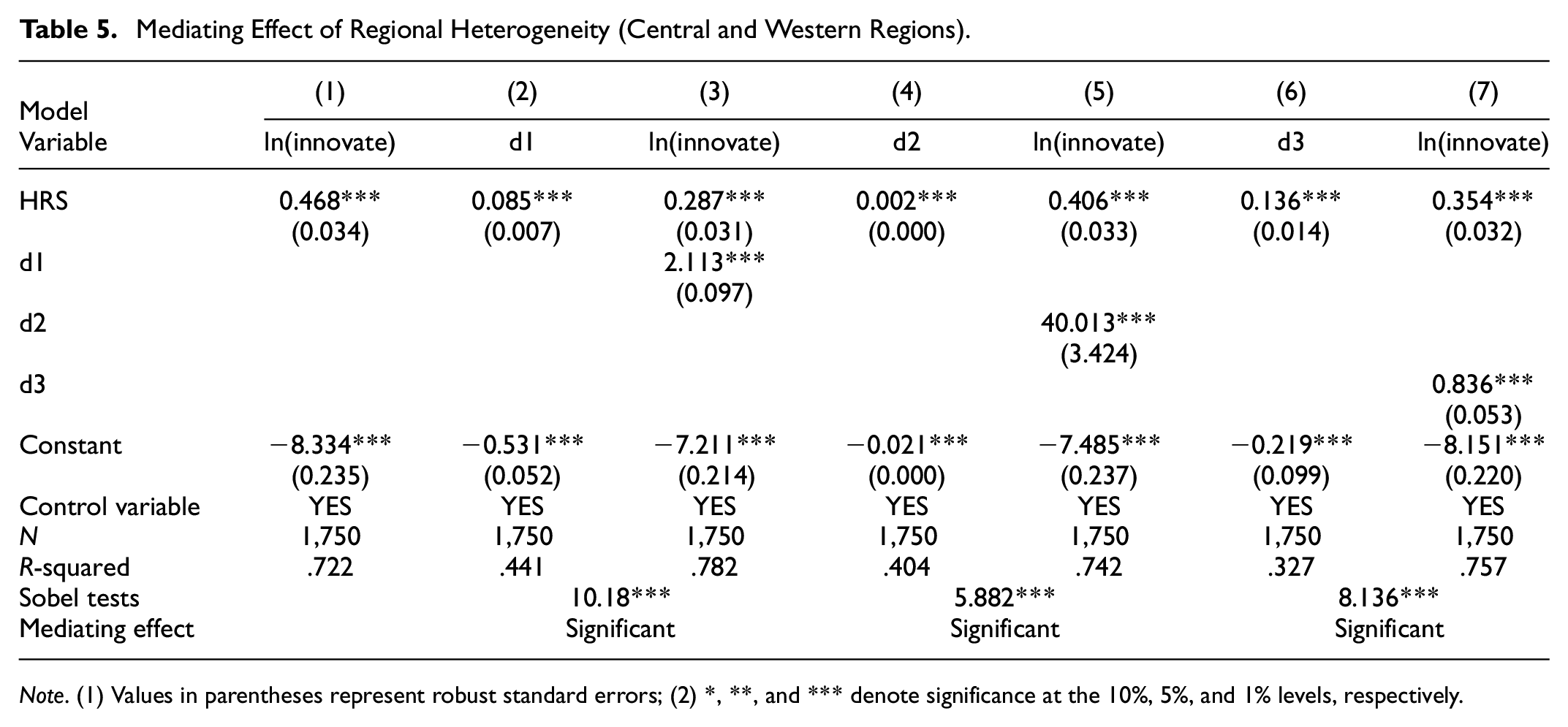
Note. (1) Values in parentheses represent robust standard errors; (2) *, **, and *** denote significance at the 10%, 5%, and 1% levels, respectively.
Similarly, from Table 5, models (2), (4), and (6) suggest that HSR openings also amplify economic, population, and industrial agglomerations in the Central-Western cities. The Sobel test, significant at the 10% level, suggests a partial mediating effect in these areas. Comparing the coefficients for economic, population, and industrial densities between models (3), (5), (7) in Table 4 and models (2), (4), (6) in Table 5, it appears the coefficients are smaller for the Eastern region than the Central-Western region. This implies that the mediating effect of HSR promoting urban innovation through economic agglomeration is more pronounced in the Central-Western region than in the Eastern region. Consequently, our findings affirm the regional heterogeneity in how HSR influences urban innovation via economic agglomeration, corroborating Hypothesis 3.
Additionally, consistent with the categorization approach in most literature, we define central cities as provincial capitals and sub-provincial cities. All other cities are categorized as non-central cities. Using models (2) through (4), we then conducted mediating effect regressions to further examine the heterogeneity of the mediating effect across different city tiers. The empirical results are presented in Tables 6 and 7.
Heterogeneity of Mediating Effect Based on City Tier (Central Cities).

Note. (1) Values in parentheses represent robust standard errors; (2) *, **, and *** denote significance at the 10%, 5%, and 1% levels, respectively.
Heterogeneity of Urban Levels in Mediation Effects (Non-Central Cities).
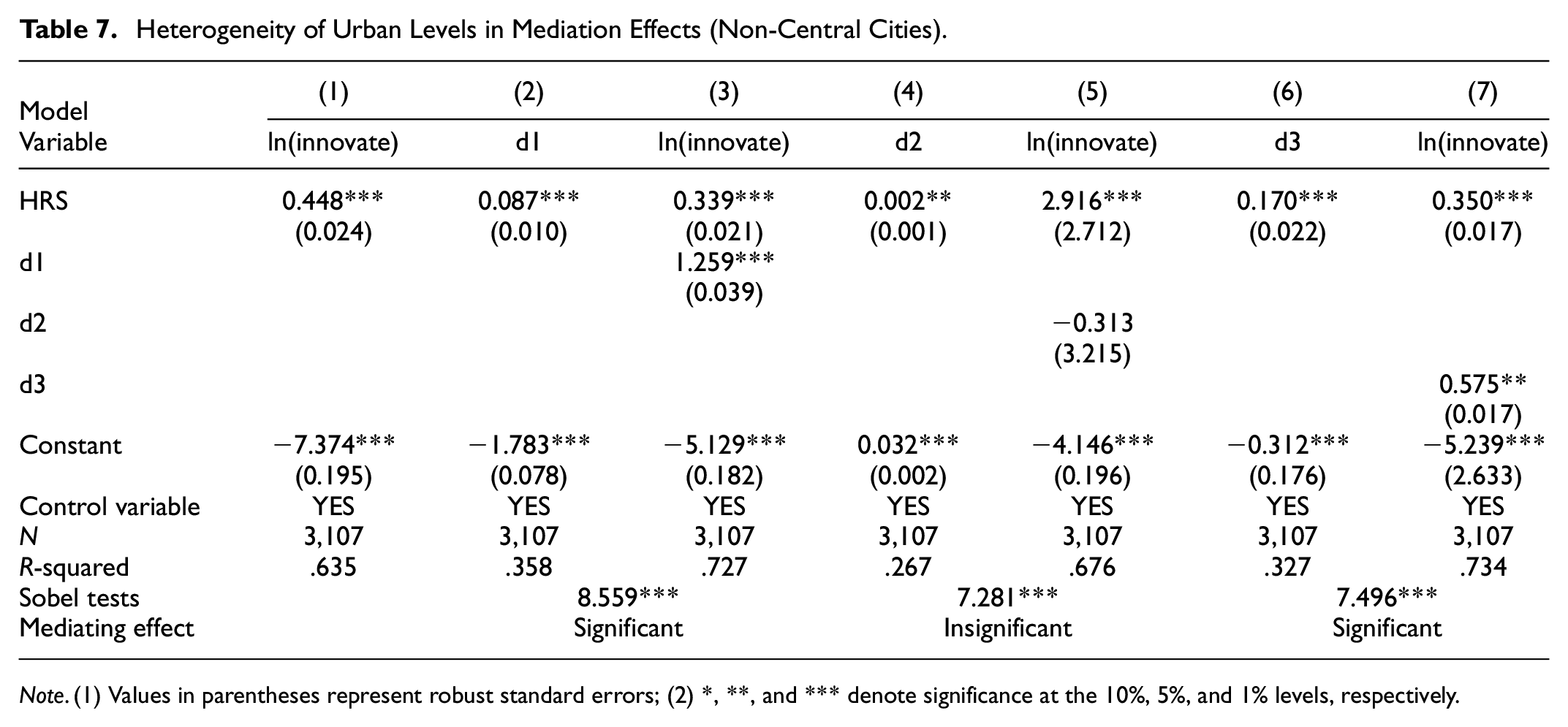
Note. (1) Values in parentheses represent robust standard errors; (2) *, **, and *** denote significance at the 10%, 5%, and 1% levels, respectively.
From Table 6, looking at models (2), (4), and (6), it’s evident that at a 1% significance level, the introduction of HSR increases the economic density of central cities. However, its impact on population density and industrial density isn’t significant. Delving further into Table 7, models (2), (4), and (6) reveal that HSR openings enhance economic, population, and industrial densities in non-central cities.
From models (3), (5), and (7) in Table 6, we observe that HSR significantly promotes urban innovation levels in central cities through economic density, with the Sobel test being notably significant at the 10% level. However, the mediating effects through population and industrial densities aren’t pronounced. Meanwhile, from Table 7, models (3), (5), and (7) indicate that the coefficients for HSR’s impact on economic, population, and industrial densities are all significant at the 1% level, with the Sobel test also revealing a marked significance at the same level. This suggests the presence of a mediating effect where HSR promotes urban innovation in non-central cities by enhancing economic, population, and industrial densities.
Consequently, the mediating effect of HSR influencing urban innovation through economic agglomeration exhibits heterogeneity based on city tiers. Specifically, HSR can promote innovation levels in central cities through an increase in economic density, but not through enhancements in population or industrial density. For non-central cities, however, HSR elevates their innovation levels through improvements in all three densities—economic, population, and industrial. This further substantiates Hypothesis 4 of our study.
Robustness Checks
Parallel Trend Assumption
In empirical estimations employing the DID method, it’s imperative to ensure that the treated and control groups exhibit parallel trends prior to the introduction of HSR. To further substantiate the overarching impact of HSR on urban innovation levels and thereby bolster the robustness of our empirical findings, this study initially undertakes a parallel trend assumption test for robustness checks.
To verify if the treated and control groups maintained similar trajectories before the launch of the HSR, we augment our baseline regression by introducing interaction terms between the year-of-introduction dummy variables and the treatment dummies. If the coefficients of the interaction terms from years preceding the HSR’s introduction are statistically insignificant, it indicates the satisfaction of the parallel trends assumption; that is, both the treated and control groups followed congruent trends before the HSR’s initiation.
As depicted in Figure 1, prior to the rail’s introduction, the estimated coefficients for the dummy variables across the five periods preceding the rail’s launch consistently hover around zero, with none being statistically significant at the 10% level. This underscores that the treated and control groups indeed maintained parallel trends before the HSR’s commencement, lending credence to the objectivity of our study’s conclusions.

Parallel trend assumption and dynamic effects.
PSM-DID Approach
From our prior theoretical analysis, it was evident that there are substantial differences in economic characteristics and cultural practices among various regions and cities of different hierarchies. When employing the DID model for empirical analysis, this heterogeneity can lead to sample selection biases, potentially compromising the accuracy of our estimates. To address this concern, we further employed the PSM-DID approach to ensure robustness in our empirical results. The empirical results are shown in Table 8.
Mediating Effects of HSR Introduction, Economic Agglomeration, and Urban Innovation (PSM-DID).

Note. (1) Values in parentheses represent robust standard errors; (2) *, **, and *** denote significance at the 10%, 5%, and 1% levels, respectively.
Table 8, starting with Model 1, indicates that the introduction of HSR has indeed fostered enhancements in urban innovation levels, further substantiating our first research hypothesis. From Models 1 to 3, we observe that the advent of HSR not only elevates the economic density of cities where it’s introduced but also amplifies their innovation levels by fostering economic density. Delving deeper with Models 4 to 7, our study discerns that HSR also escalates the population and industrial densities of cities it serves. Furthermore, by elevating both population and industrial densities, HSR invariably bolsters urban innovation levels. This reinforces our second hypothesis, positing that HSR enhances urban innovation levels through economic agglomeration, and further underscores the robustness and reliability of our research conclusions.
Alternative HSR Indicator: HSR Network
In past research, many researchers have argued that using the mere presence or absence of HSR to gauge its impact on economic development doesn’t fully account for various factors. This includes the duration of HSR operations, differences in HSR station locations, and variations in frequency due to those locations. All these can lead to inaccuracies in research conclusions. To further verify the influence of HSR on urban innovation and its mediating effect, this study, drawing inspiration from the methodology of Jiao et al. (2017), utilizes HSR station data. We employed network analysis to calculate the centrality of the HSR network, specifically its “Weighted Degree Centrality,” to represent the significance of prefecture-level city HSR stations within the entire HSR network. This was then used as a substitute for the binary variable indicating the presence of HSR to test the robustness of our research conclusions on its impact on urban innovation. The empirical results are presented in Table 9.
HSR Network, Economic Agglomeration, and Urban Innovation.
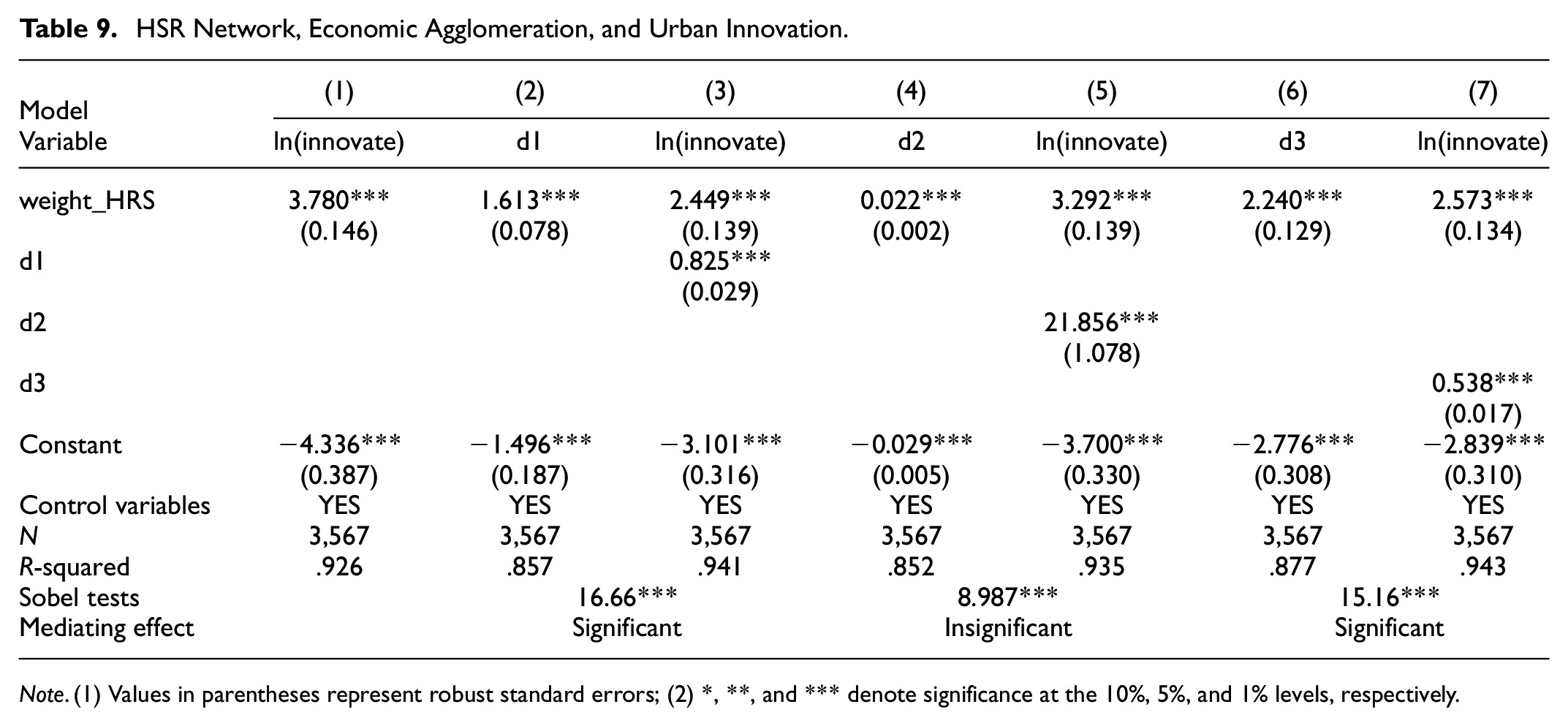
Note. (1) Values in parentheses represent robust standard errors; (2) *, **, and *** denote significance at the 10%, 5%, and 1% levels, respectively.
Starting with Model 1 in Table 9, we discern that cities with a higher “Weighted Degree Centrality” in the HSR network (denoted as weight_HRS) tend to exhibit higher levels of innovation, further corroborating our primary research hypothesis. From Models 2, 4, and 6, we find that an elevated centrality in the HSR network increases the economic, population, and industrial densities of the cities connected by the HSR. Furthermore, the empirical results from Models 3, 5, and 7, combined with the Sobel test outcomes, reveal that the centrality level of the HSR network enhances urban innovation in cities connected by HSR by increasing their economic, population, and industrial densities. This confirms our second hypothesis, suggesting that HSR promotes urban innovation through economic agglomeration. The overall findings further underscore the robustness of our research conclusions.
Alternative Economic Agglomeration Indicators
To further validate the robustness of the mediating effects, this study draws upon the methodologies proposed by Wang et al. (2022). We employ geographic concentration to measure a city’s economic agglomeration and population concentration to depict economic agglomeration in terms of population. The entropy method is used to gauge industrial agglomeration, representing the economic agglomeration within industries. The subsequent mediation regression results are presented in Table 10.
HSR Introduction, Economic Agglomeration, and Urban Innovation (Using Alternative Economic Agglomeration Indicators).

Note. (1) Values in parentheses represent robust standard errors; (2) *, **, and *** denote significance at the 10%, 5%, and 1% levels, respectively.
From Models 1 and 2 in Table 10, and with the Sobel test results (significant at the 1% level) confirming, it’s evident that the introduction of HSR not only promotes economic agglomeration in the cities it connects but also enhances urban innovation through this elevated economic concentration. As per Models 3 and 4, along with the accompanying Sobel test results (again significant at the 1% level), HSR facilitates population concentration in connected cities, subsequently elevating urban innovation through this increased population agglomeration. Furthermore, from Models 5 and 6, complemented by the Sobel test results (significant at the 5% level), we discern that HSR not only fosters industrial agglomeration in the cities it reaches but also bolsters urban innovation through this intensified industrial concentration.
Consequently, HSR augments urban innovation through enhancing economic, population, and industrial agglomerations. In essence, the introduction of HSR boosts urban innovation via economic concentration. These findings provide further credence to Hypothesis 2 of this study, reiterating the robustness of our research conclusions.
Conclusions and Implications
Theoretical Contributions
This research not only establishes a connection between HSR and urban innovation but also elucidates the mediating role of economic agglomeration. This not only expands the traditional theories of infrastructure investment and economic development but also offers a fresh perspective on how infrastructure can influence economic growth through indirect pathways.
By empirically demonstrating the associations among HSR, economic density, population density, and industrial density, this study provides a deeper explanation for the link between spatial dimensions in agglomeration economics and theories of knowledge innovation and technological diffusion.
Beyond identifying the overall effects of HSR, this research reveals its differential impacts across various regions and urban hierarchies. This emphasizes the significance of considering geographical and administrative heterogeneity in studies of economic growth and development.
By integrating the PSM-DID method, this study offers a more precise tool for identifying treatment effects. This not only provides a novel research design for economic studies but also offers a more robust methodological approach for policy evaluation.
Breaking away from the conventional viewpoint that solely considers the presence or absence of HSR, this study introduces the weighted centrality of the HSR network to examine its effects on economic development, offering a new and more intricate framework for analyzing HSR networks in the fields of transportation economics and regional science.
Practical Implications
Given the role of HSR in promoting innovation in cities, businesses should actively seek advanced technologies and management concepts during external collaborations, enhancing both collaborative and self-reliant innovation capabilities. Local governments in cities connected by HSR should foster a favorable innovation and institutional environment, optimizing the business environment, enhancing administrative efficiency, and offering fiscal and tax support for innovative industries and businesses.
Due to regional heterogeneity in the mediating effects, businesses and governments in eastern cities should equally prioritize the influences of economic, population, and industrial densities on innovation. They should adopt measures to attract capital, talent, and industry agglomeration. Cities in central and western regions should emphasize the positive effects of economic, population, and industrial densities on urban innovation, attracting economic activities through fiscal and tax incentives and accommodating industrial transfers from the east.
Considering the city-tier heterogeneity in mediating effects, central cities should focus more on economic density to enhance their innovation levels. In contrast, non-central cities should prioritize economic, population, and industrial densities, accommodating industrial transfers from neighboring central cities. This would facilitate industry collaboration between core and peripheral cities, promoting synergistic innovation capabilities.
Conclusions
As China’s economy gradually shifts toward a “new normal,” the 20th National Congress of the Communist Party highlighted innovation as the core and vital driver of economic growth. It underscored the necessity for China to transition from high-speed economic growth to high-quality economic growth. Given this context, understanding the relationship and heterogeneity between HSR opening, economic agglomeration, and urban innovation becomes crucial for guiding China toward high-quality economic development. Using data from 276 cities at the prefectural level and above, this study empirically analyzed the relationship between HSR opening, economic agglomeration, and urban innovation using DID and mediation effect models. It was found that HSR not only directly influences the innovation level of the cities it connects but also indirectly promotes city innovation levels through economic agglomeration. On the whole, HSR enhances city innovation levels through economic density, population density, and industrial density. Further exploration revealed regional and city-tier heterogeneity in the mediating effect of HSR on urban innovation. For different regions, the economic agglomeration mediating effect of HSR in promoting city innovation is less pronounced in eastern cities compared to central and western cities. For cities of different tiers, HSR boosts innovation in central cities mainly through economic density, while for non-central cities, it does so through economic, population, and industrial densities. Through various robustness tests, including the common trend assumption test, counterfactual tests adjusting the initiation time, and the PSM-DID method, the empirical results consistently support the study’s conclusions.
Limitations and Future Research Directions
This study has the following limitations: First, the time span of the data used in this research concludes in 2016. This decision was based on the consideration that 2003 to 2016 is viewed as the pivotal development phase of China’s HSR, as well as the availability of relevant data. Although this period witnessed the rapid rise and maturation of China’s HSR network from its inception, the relationships between HSR and urban innovation post-2016 remain unaddressed. Second, while this study offers insights into the relationship between HSR and urban innovation, it does not extend the results to a cost-benefit analysis level. Such an analysis, approached from both short- and long-term perspectives, would provide governments with a more comprehensive basis for policy decision-making.
For future research, there’s potential to extend the temporal scope, incorporating data from post-2016 to reflect the continued development of HSR and provide more comprehensive insights. Additionally, future research could delve into conducting a comprehensive cost-benefit analysis of the impact of HSR on urban innovation, from both short- and long-term economic perspectives. This would not only provide a deeper understanding of the economic ramifications of HSR development but also aid policymakers in making more informed decisions based on a holistic economic evaluation.
Footnotes
Declaration of Conflicting Interests
The author(s) declared no potential conflicts of interest with respect to the research, authorship, and/or publication of this article.
Funding
The author(s) disclosed receipt of the following financial support for the research, authorship, and/or publication of this article: This work was supported by the National Natural Science Foundation of China [Grant Numbers 72004083, 72363016, and 72063013], The Science and Technology Research Project of the Jiangxi Provincial Department of Education [Grant Number GJJ2400407]. This work was also supported by the Jiangxi Provincial Social Science Planning Fund [Grant Number 20190419]; and the 74th Batch of General Program of the China Postdoctoral Science Foundation [Grant Number 2023M741481].

Data Availability
The datasets generated during and/or analyzed during the current study are available from the corresponding author upon reasonable request.