




Abstract
This study examines how perceived teacher autonomy support relates to students’ English learning engagement in Chinese primary and middle schools, focusing on the mediating effect of positive academic emotions and the moderating effect of school level. A total of 454 students from 11 schools completed validated Chinese versions of the Learning Climate Questionnaire, the School Emotion Questionnaire, and the Learning Engagement Questionnaire. Two-level multilevel models estimated in R revealed a significant indirect pathway, whereby perceived autonomy support predicted higher positive academic emotions, which in turn fostered greater English learning engagement. Monte Carlo simulations further confirmed significant indirect effects at both school levels and highlighted a stronger mediating role of positive academic emotions among primary school students than among middle school students. The findings reveal a developmentally differentiated emotional pathway linking perceived teacher autonomy support with students’ English learning engagement. They highlight the importance of developmentally attuned instructional practices and outline directions for future longitudinal research on age-specific mechanisms of engagement.
Plain Language Summary
This study explored how students’ perceptions of teacher autonomy support influence their engagement in English learning and why this effect may differ between primary and middle school students. A total of 454 students from 11 schools in northwest China completed questionnaires about their classroom experiences and feelings during English lessons. The findings showed that when teachers encouraged student choice, respected opinions, and created a supportive atmosphere, students felt more positive emotions such as enjoyment and confidence, which in turn led them to participate more actively in learning. Importantly, this emotional pathway was stronger for primary school students, suggesting that younger learners are more emotionally sensitive to teachers’ support and care. These results highlight the crucial role of positive emotions in promoting classroom engagement and suggest that teachers should adapt their instructional approaches to students’ developmental stages, especially by providing emotionally supportive and autonomy-enhancing learning environments for younger learners.
Keywords
Introduction
In an increasingly globalized and digitalized world, English proficiency has become a central educational goal, viewed as essential for developing students’ global awareness, intercultural competence, and long-term academic opportunities (Wang et al., 2023). However, English language educators continue to face persistent challenges with student engagement. Many learners remain disengaged during English classes, displaying low motivation and passive participation (Liu & Du, 2024; Xuan Mai et al., 2024). This lack of active involvement is problematic because learning engagement, students’ active, goal-directed participation in academic activities has been widely recognized as a key predictor of educational success (Okunuki & Kashimura, 2024; Reeve et al., 2025). Fredricks et al. (2004) conceptualize engagement as a multi-dimensional construct encompassing behavioral (e.g., attention, effort, participation), emotional (interest, enthusiasm, sense of value), and cognitive (strategic thinking, self-regulation) components. Higher levels of engagement have been empirically linked to better academic outcomes and enhanced psychological well-being. For instance, among Chinese EdD students, learning engagement robustly predicted academic achievement and even mediated the effects of research self-efficacy on performance (H. Miao et al., 2025). Similarly, a study of Indian undergraduates found that engagement served as a mediator between institutional support and students’ psychological health, suggesting that engagement plays a protective, motivational role (Chaudhry et al., 2024). Given the importance of engagement for learning and development, it is critical to understand what classroom factors foster or hinder students’ engagement in English language learning.
One classroom factor consistently linked to greater student engagement is perceived teacher autonomy support (PTAS), defined as students’ subjective experience of their teachers promoting independent thinking and ownership in learning (Chong & Reinders, 2025; Reeve, 2009). This perception-based construct emphasizes how students interpret teacher behaviors, which include acknowledging students’ opinions, offering meaningful choices, and minimizing controlling language, all of which students interpret as supportive of their psychological needs. When students perceive teachers as autonomy-supportive, they are more likely to feel that their needs for autonomy, competence, and relatedness are being met. According to Self-Determination Theory (Deci & Ryan, 2000; Reeve, 2009), these needs form the foundation of intrinsic motivation and sustained learning engagement. In the classroom, PTAS is often reflected in students’ experience of being invited to share their views, being treated fairly, and receiving feedback that emphasizes growth rather than punishment (Reeve et al., 2019). These experiences can strengthen students’ sense of control and confidence, making them more willing to participate and persist in academic tasks. Research in language learning settings supports this idea. For example, D. Yang et al. (2022) reviewed studies with Chinese secondary students and found that when students perceived higher levels of teacher autonomy support, they reported higher levels of emotional and behavioral engagement. Similarly, L. Yang (2024) showed that PTAS predicted stronger engagement among Chinese university English learners, partly through students’ academic emotions such as interest and confidence. In sum, when teachers create a supportive, choice-rich learning climate, students are more likely to engage actively in English learning.
Although PTAS is positively associated with student engagement, recent studies suggest that this relationship is often not direct. Instead, it tends to operate through students’ internal psychological experiences (Wang et al., 2024). Among these internal processes, positive academic emotions (PAE) have received increasing attention as a potential mediating factor. PAE refer to learning-related emotional states such as enjoyment, interest, pride, and satisfaction. These emotions play an important role in influencing students’ motivation, attentional focus, and persistence in learning (Pekrun, 2024; Pekrun & Linnenbrink-Garcia, 2012). In the context of English language learning, students who feel interested, excited, or experience a sense of accomplishment are more likely to sustain motivation and concentrate on learning tasks. According to Control-Value Theory (Pekrun, 2006), these emotions tend to emerge when students perceive a high level of control over academic activities and recognize the value of what they are learning. Once such emotions are triggered, they contribute to greater engagement by enhancing effort, concentration, and strategic learning behaviors. Teachers play a crucial role in shaping these emotional experiences. When they adopt autonomy-supportive instructional practices such as providing meaningful choices, encouraging student input, and making lessons relevant to students’ interests, students are more likely to feel emotionally supported and personally invested in learning. This emotional pathway has been supported by empirical research. For example, Wang et al. (2024) found that among Chinese university students, PTAS predicted classroom engagement indirectly through its effect on students’ positive emotional responses to English learning. Similarly, a study by Sadoughi and Hejazi (2021) with Iranian EFL learners showed that teacher support was associated with increased enjoyment and interest in class, which were in turn linked to stronger behavioral and cognitive engagement. Taken together, these findings suggest that emotional experiences do not simply accompany learning outcomes. Rather, they serve as a mechanism that links teacher support to student engagement.
While autonomy-supportive teaching and positive emotions benefit learners across age groups, the strength of these effects may vary with developmental stage. This study considers school level (upper elementary vs. middle school) as a potential moderator of the relationship between PTAS, PAE, and learning engagement. Developmental research suggests that late childhood and early adolescence differ in students’ emotional dependence on teachers and their ability to self-regulate. Younger students tend to be more responsive to teacher approval and relational cues, whereas older students increasingly prioritize autonomy and peer relationships (Furrer & Skinner, 2003). In elementary classrooms, children are still forming their self-concept and rely more on external feedback to stay motivated (Skinner & Belmont, 1993). At this stage, teacher behaviors such as warmth, acknowledgment of student perspectives, and the provision of meaningful choices may have a particularly strong emotional impact. For instance, Reeve and Jang (2006) found that such support enhanced intrinsic motivation and elicited more pronounced emotional engagement among younger students. These findings suggest that the emotional benefits of teacher support may be more immediate and salient in primary school settings (Meyer & Turner, 2007; Roeser et al., 2000). In contrast, middle school students while still influenced by teacher behaviors tend to be less emotionally reactive as they develop independent goals and stronger peer orientation (Hospel & Galand, 2016). Although some scholars argue that autonomy support becomes increasingly relevant during adolescence, this shift mainly reflects a cognitive appreciation of independence rather than emotional reliance on teachers. Younger students, who seek affirmation and emotional safety from adults, may thus be more deeply affected when teachers demonstrate respect, care, and support.
Although extensive research has linked PTAS with student engagement in language learning (e.g., D. Yang et al., 2022; Wang et al., 2024), several gaps remain. First, most studies have relied on single-level samples, often university students, without considering the hierarchical structure of school settings where students are nested within classrooms. Second, although the mediating role of emotional experiences, particularly PAE, has been proposed in theory, it has rarely been tested empirically among younger learners. Third, little is known about developmental differences across school levels, even though prior evidence suggests that the effects of autonomy support and emotional responsiveness may change as students grow older and as their social relationships evolve within different cultural contexts.
To establish a coherent conceptual foundation, the present study is grounded in an integrated theoretical framework that combines Self-Determination Theory (Deci & Ryan, 2000) and Control-Value Theory (Pekrun, 2006). Integrating these two perspectives, students’ perceptions of autonomy-supportive teacher behaviors, are expected to enhance their perceived control and task value. These experiences elicit PAE, including enjoyment, interest, and pride, which foster concentration, persistence, and effort in English learning. In this framework, PAE serve as an affective mechanism linking PTAS to learning engagement. Because younger students are generally more emotionally responsive to teacher behaviors and more dependent on adult feedback, the strength of this emotional pathway may vary across school levels.
Building on the above theoretical framework, this study investigates how Chinese primary and middle school students’ PTAS is associated with their engagement in English learning and whether PAE mediate this relationship. It further examines whether the strength of this mediational pathway varies by school level. Specifically, we propose three hypotheses: H1: PTAS is positively associated with students’ English learning engagement. H2: PAE mediate the association between PTAS and English learning engagement. H3: The indirect effect of PTAS on engagement through PAE is stronger for primary school students than for middle school students. Testing these hypotheses will clarify the psychological mechanisms through which PTAS promotes language learning engagement and offer insights into how these processes differ across developmental stages.
Materials and Methods
Participants
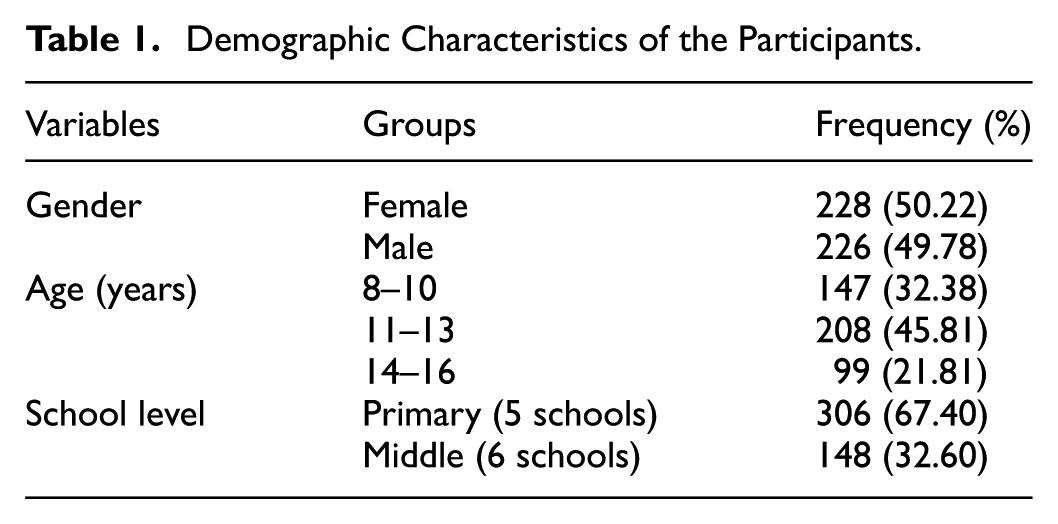
A total of 454 students participated in the study. They were recruited from 11 schools in a northwest city in China, including 5 primary schools and 6 middle schools. The sample was nearly gender-balanced, with 228 girls (50.22%) and 226 boys (49.78%). Participants ranged in age from 8 to 16 years. Most students were between 11 and 13 years old (45.81%), followed by those aged 14 to 16 (21.81%). In terms of school level, 306 students (67.40%) were enrolled in primary school (grades 4–6), while 148 students (32.60%) attended middle school. Detailed demographic information is summarized in Table 1.
Demographic Characteristics of the Participants.
Research Procedure
The study was carried out in several public schools located in northwest China. Prior to data collection, the research team met with school administrators and teachers to introduce the study’s objectives and obtain institutional approval. Both students and their parents (or legal guardians) were informed about the purpose of the study, the procedures involved, and the voluntary nature of participation. Written informed consent was obtained from all participants and their guardians in accordance with institutional ethical guidelines. Data were collected during regular class hours in quiet classroom settings, with assistance from trained research staff who were not teachers at the participating schools. Students completed the questionnaires independently and were given sufficient time to respond at their own pace.
Measures
Perceived Teacher Autonomy Support
PTAS was measured using the Learning Climate Questionnaire (LCQ; Williams & Deci, 1996), a six-item scale that assesses students’ perceptions of autonomy-supportive behaviors from their English teachers. An example item is: “My English teacher encourages me to express my opinions in class.” Responses were rated on a 5-point Likert scale ranging from 1 (strongly disagree) to 5 (strongly agree), with higher scores indicating greater levels of PTAS. In the current sample, the internal consistency of the scale was satisfactory (Cronbach’s α = .86).
Learning Engagement
Learning engagement was measured using the Student Self-Report Engagement Questionnaire (Jang et al., 2010), a four-item scale designed to assess students’ behavioral, emotional, and cognitive engagement during classroom activities. Students responded on a 5-point Likert scale ranging from 1 (strongly disagree) to 5 (strongly agree), with higher scores indicating higher levels of engagement. The scale demonstrated good internal consistency in the present study (Cronbach’s α = .82).
Positive Academic Emotions
PAE were measured using the School Emotion Questionnaire (Wolters et al., 1996), a five-item scale assessing students’ emotional responses to learning. A sample item is, “I feel excited about learning English.” Students responded on a 5-point Likert scale ranging from 1 (strongly disagree) to 5 (strongly agree), with higher scores indicating more positive emotional experiences. The scale demonstrated strong internal consistency in the present study (Cronbach’s α = .88).
Centering and Multicollinearity Diagnostics
All Level-1 predictors, including PTAS, PAE, gender, and age, were group-mean centered to capture within-group variability and reduce the influence of between-group differences. The mediator (PAE) was retained in its raw form because preliminary diagnostics revealed no multicollinearity (all VIFs <1.4).
Results
Preliminary Analyses
Intraclass correlation coefficients (ICCs) from the unconditional models revealed that 8% of the variance in PTAS (ICC = .08), 13% in PAE (ICC = .13), and 9% in English learning engagement (ICC = .09) were attributable to between-school differences. These proportions indicate that a meaningful amount of variability in the key constructs was due to school-level factors. All ICCs exceeded the conventional .05 threshold, suggesting non-trivial between-school variance that warranted multilevel analysis, thereby justifying the application of multilevel modeling in subsequent analyses.
Accordingly, multilevel modeling was conducted. All level 1 predictors, including PTAS, PAE, gender, and age, were group-mean centered to isolate within-school variability, while the level 2 variable, school level (0 = primary, 1 = middle), was retained in its raw form to facilitate cross-level moderation. This centering approach ensures that level 1 effects reflect within-school relationships, independent of between-school variance.
All models were estimated using the lme4 package in R (version 4.3.2) (R Core Team, Vienna, Austria). Indirect effects were computed through Monte Carlo simulation (10,000 iterations) to construct confidence intervals for multilevel mediation effects. Model diagnostics showed satisfactory convergence and parameter stability, suggesting the sample was adequate for reliable multilevel estimation.
Descriptive Statistics and Correlations
Descriptive statistics and correlations among the key study variables are presented in Table 2. PTAS was positively associated with both PAE (r = .63, p < .001) and English learning engagement (r = .47, p < .001). The strongest correlation was found between PAE and English learning engagement (r = .68, p < .001).
Descriptive Statistics and Correlations Among Key Variables.

p < .001.
Multilevel Mediation and Cross-Level Moderation
As part of the preliminary model evaluation, random-slope models were estimated to examine whether the associations between PTAS and PAE, as well as between PAE and learning engagement, varied significantly across schools. The variance components for both slopes were non-significant (see Table 3), indicating that these associations did not differ meaningfully by school. Therefore, fixed slopes were retained in the final model for the sake of parsimony and interpretability.
Random-Slope Diagnostics.

Note. Variance estimates (τ11) were obtained from random intercept and random slope models using REML estimation in R (version 4.3.2) (R Core Team, Vienna, Austria) with the lme4 package. REML = restricted maximum likelihood.
Table 4 presents the fixed-effect estimates from the two-level model. Consistent with H1, higher PTAS predicted greater English learning engagement. Supporting H2, PAE significantly mediated this association, as PTAS positively predicted PAE (path a), and PAE in turn predicted higher engagement (path b). Furthermore, H3 was supported, as a significant cross-level interaction (PTAS × school level) indicated that the indirect pathway differed between primary and middle schools. Specifically, the effect of PTAS on PAE (path a) was stronger for primary school students than for middle school students, suggesting that PTAS exerts stronger emotional influence in younger learners. Taken together, these findings provided full support for H1, H2, and H3.
Multilevel Mediation and Cross-Level Moderation.

Monte Carlo confidence intervals indicated significant indirect effects for both primary and middle school groups: 0.29, 95% CI [0.23, 0.35] and 0.22 [0.14, 0.30], respectively. The difference between the two indirect effects (Δ = .07 [0.01, 0.13]) did not include zero, further confirming the hypothesized moderated mediation effect.
Figure 1 illustrates the simple slopes of PTAS predicting PAE across school levels. The slope for primary school students was steeper (β = .62, SE = 0.04, p < .001) than for middle school students (β = .47, SE = 0.05, p < .001), indicating that PTAS was associated with a larger increase in PAE among younger learners.
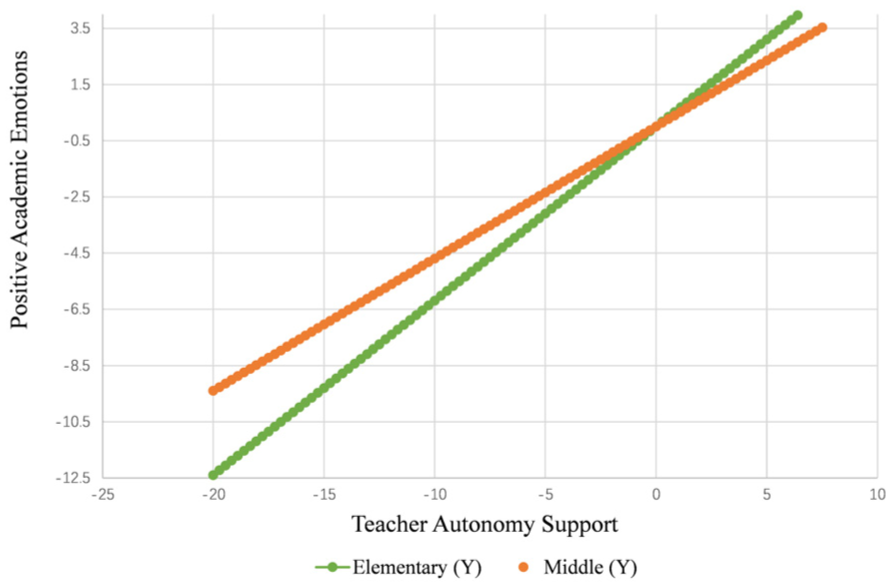
Simple slopes of PTAS predicting PAE across school levels.
Figure 2 presents the conceptual structure of the multilevel moderated mediation model tested in this study. At the within-school level (level 1), PTAS was modeled to predict PAE, which in turn was modeled to predict English learning engagement. At the between-school level (level 2), school level (primary vs. middle) was specified as a moderator of the PTAS → PAE path, allowing the strength of this association to vary across developmental stages.

Multilevel moderated mediation model with school level moderating the PTAS → PAE path. Unstandardized coefficients are reported; standard errors in parentheses.
Discussion
This study examined the psychological pathways through which PTAS influences students’ English learning engagement, focusing on the mediating effect of PAE and the moderating effect of school level. The results supported a mediational process, PTAS was associated with more PAE, which in turn related to higher learning engagement. Moreover, this indirect pathway varied by school level, with a stronger effect in primary schools than in middle schools. Overall, the results suggest that emotional processes and developmental stage jointly shape the motivational impact of PTAS on English learning engagement.
As expected, PTAS was positively associated with students’ English learning engagement. This result aligns with prior evidence that autonomy-supportive teaching fosters students’ active participation in learning (e.g., Chong & Reinders, 2025). In Self-Determination Theory terms (Deci & Ryan, 2000), when teachers support students’ autonomy and competence needs, learners are more likely to internalize motivation and put forth sustained effort. Especially in a subject like English that often involves external assessments, offering students choices and acknowledging their perspectives can increase their sense of ownership over the learning process, leading to more persistent and volitional engagement. Our findings reinforce this idea and also address calls to connect motivational support with concrete indicators of classroom engagement (Reeve et al., 2019).
Consistent with H2, PAE significantly mediated the relationship between PTAS and learning engagement. This finding accords with Pekrun’s (2006) Control-Value Theory, which posits that students experience greater interest and enjoyment when they feel in control of their learning and value the material. In our study, autonomy-supportive instruction likely nurtured these conditions by giving students a sense of control (e.g., providing choices) and enhancing the perceived relevance of English lessons, thereby boosting students’ positive emotions toward learning. In turn, students who felt more interested and excited about English tended to invest more attention and effort, resulting in higher engagement (Pekrun & Linnenbrink-Garcia, 2012). This emotional pathway mirrors findings from other EFL contexts, where supportive teaching increased students’ enjoyment and involvement in learning (Sadoughi & Hejazi, 2023; Wang et al., 2024). These results not only confirm the motivational role of emotion in language learning but also demonstrate how autonomy-supportive teaching fosters this affective pathway in the underexplored context of Chinese primary and middle school classrooms.
In support of H3, we found that the association between PTAS and PAE was significantly stronger for primary school students than for middle school students. This developmental difference aligns with motivational development models suggesting that younger students are more emotionally sensitive to teacher input (Connell & Wellborn, 1991; Furrer & Skinner, 2003). In late childhood, children’s motivation and emotions are heavily influenced by teachers; thus, autonomy-supportive practices may have an especially large impact on their interest and enjoyment. By early adolescence, students gain more cognitive independence and peer orientation, which can diminish the emotional effect of teacher support. Prior studies similarly show that autonomy-supportive strategies yield greater interest and engagement benefits for younger students than for older ones (Jang et al., 2010; Skinner & Belmont, 1993). Our findings extend this pattern to English learning, suggesting that late childhood is a window when autonomy-supportive teaching most strongly boosts students’ positive emotions and engagement.
Our finding of a stronger emotional pathway for younger students can also be understood in light of the Chinese cultural context. In Confucian-heritage classrooms, teachers are regarded not only as instructors but also as moral guides and emotional caretakers responsible for students’ academic and personal development. Autonomy-supportive behaviors such as listening to students’ opinions, offering meaningful choices, and showing empathy carry a different significance in this context than they might in Western classrooms, where autonomy often signals individualism and self-direction. In contrast, such behaviors in Chinese classrooms are interpreted through a relational lens. They embody benevolent care (ren) and convey respect, trust, and emotional commitment from teacher to student. This relational interpretation enhances the emotional salience of PTAS. When students perceive their teacher’s behavior as caring and respectful, they experience not only a greater sense of control over learning but also positive emotions such as pride, gratitude, and enjoyment, emotions rooted in feeling valued by an authoritative figure. These emotional reactions, in turn, motivate students to engage more fully, not merely as a form of self-expression but also as a way of honoring the teacher’s support and sustaining relational harmony.
Building on this cultural interpretation, the developmental difference observed in our study can be further understood through age-specific patterns of socialization. In the Chinese cultural context, students at different developmental stages undergo distinct forms of socialization, which help explain the variation in the strength of the emotional pathway. For younger children, teachers serve not only as sources of instruction but also as central figures in emotional support and motivational development. Primary school students rely heavily on teacher recognition and approval to regulate their emotions and sustain motivation. Consequently, when teachers display autonomy-supportive behaviors, these are perceived as expressions of personal care and elicit stronger emotional engagement. As students mature, however, their emotional and motivational regulation increasingly shifts toward peer relationships and self-set goals, reducing their emotional responsiveness to teacher behavior. Thus, the stronger emotional mediation among younger students reflects both their developmental dependence on teachers and the enduring cultural norm that positions teachers as moral and emotional authorities.
This study offers several theoretical contributions to the literature on motivation and second language learning. First, it provides empirical support for the mediating role of PAE in the relationship between PTAS and student engagement. By integrating Self-Determination Theory, which emphasizes the fulfillment of autonomy and competence needs, with Control-Value Theory, which highlights the role of perceived control and value in shaping emotions, this study demonstrates how the two frameworks complement each other in explaining students’ learning behavior in English language classrooms. Second, the identification of school level as a moderating factor highlights the developmental dimension of student motivation. The results suggest that instructional strategies may not operate uniformly across age groups; instead, they interact with students’ developmental stage, particularly their emotional sensitivity to teacher behavior. This underscores the importance of tailoring autonomy-supportive practices to learners’ evolving psychological needs. Third, by drawing on a sample of Chinese primary and middle school students, the study extends the applicability of established motivational models to an East Asian context. The findings reveal that autonomy support, within Confucian-heritage classrooms, is often interpreted not as a vehicle for individual freedom but as an expression of relational care. This culturally specific interpretation suggests that teacher behaviors promoting student choice and perspective-taking may function primarily as signals of personal regard and emotional investment. In this way, the study not only broadens the cross-cultural scope of motivational theory but also offers a more context-sensitive understanding of how autonomy can be communicated and received in collectivist educational environments.
From a practical perspective, our results underscore the value of autonomy-supportive teaching practices for fostering students’ engagement in English classes. Teachers should be encouraged to solicit student input, provide clear and constructive feedback, and offer meaningful choices that strengthen students’ sense of agency in learning. At the same time, educators and school leaders should consider developmental differences in students’ responsiveness to these practices. Teacher training programs might include guidance on how to adapt autonomy-supportive strategies for different age groups, ensuring that both younger and older learners’ psychological needs are appropriately met.
Despite its contributions, this study has several limitations. First, the sample size and number of school clusters were relatively modest, which may limit the generalizability of the findings. Nonetheless, prior simulation research suggests that a sample of this magnitude is sufficient for reliable estimation in two-level models (Maas & Hox, 2005; McNeish & Stapleton, 2016). Future studies with larger and more diverse samples would allow for stronger tests of the model’s stability and improve the generalizability of the results. Second, the cross-sectional design and reliance on self-report questionnaires limit causal interpretations and may introduce response biases (e.g., social desirability). Students’ self-reported perceptions might have been influenced by transient moods or a tendency to give socially expected answers, which could inflate the observed associations. Future research should therefore combine self-reports with other data sources (e.g., teacher ratings, peer reports, or observational measures) and utilize longitudinal or experimental designs to verify the direction and durability of these effects. Third, because our data reflected only students’ perceptions, we could not capture the full complexity of classroom interactions. Incorporating teacher perspectives or independent classroom observations in future work would provide a more balanced view of student–teacher dynamics. Finally, the data were collected from a single city in northwestern China, and the school contexts shared a similar cultural background. This homogeneity may limit the cultural and contextual generalizability of the results. Replicating the study in other regions and educational settings (including outside Confucian-heritage cultures) is recommended to test the robustness and broader relevance of the proposed model.
Conclusions
This study examined how PTAS influences students’ English learning engagement through PAE and compared differences between primary and middle school students. The results showed that younger students exhibited stronger emotional responses to PTAS, reflecting a developmentally differentiated emotional mediation pathway. These findings highlight the pivotal role of PAE in classroom engagement and indicate that the impact of PTAS varies across developmental stages. Theoretically, this study enriches the understanding of emotional mechanisms in classroom learning, showing that autonomy-supportive teaching promotes engagement not only behaviorally but also through students’ emotional experiences. Practically, the results suggest that teachers should flexibly adapt instructional approaches to students’ developmental characteristics, creating emotionally supportive and participatory learning environments for learners at different school levels.
Footnotes
Acknowledgements
This research was supported by the Social Science Foundation of Shaanxi Province (Project No. 2024P037, “The Intrinsic Mechanism and Pathways for Integrating Core Socialist Values into College Students’ Daily Lives”). We thank the participating school administrators, teachers, and students for their collaboration throughout the study. We are also grateful to the parents and guardians for their consent, and to the research assistants for their careful work during data collection. Finally, we appreciate the constructive feedback provided by anonymous reviewers, which greatly enhanced the clarity and rigor of this manuscript.
Author Note
This manuscript has not been published or presented elsewhere in part or in entirety, and is not under consideration by another journal.

Ethical Considerations
All study participants provided informed consent, and the study design was approved by the appropriate ethics review boards. All the authors have approved the manuscript and agree with submission to your esteemed journal.
Funding
The authors disclosed receipt of the following financial support for the research, authorship, and/or publication of this article: The research project “The Intrinsic Mechanism and Pathways for Integrating Core Socialist Values into College Students’ Daily Lives” funded by the Social Science Foundation of Shaanxi Province (Proiect No.:2024P037).
Declaration of Conflicting Interests
The authors declared no potential conflicts of interest with respect to the research, authorship, and/or publication of this article.
Data Availability Statement
The dataset generated and analyzed during the current study contains identifiable student information and is therefore not publicly available. The data will be made available upon reasonable request after the peer-review process.