




Abstract
Although academic engagement has received increasing attention in educational research, few have examined how teacher emotional support relates to students’ cognitive and emotional processes, particularly in college English learning settings. To fill this gap, the present study proposed a moderated chain mediation model, with teacher emotional support as the independent variable, academic engagement as the dependent variable, academic self-efficacy and positive academic emotions as mediators, and gender as the moderator. This study employed well-established measurement instruments, including the Teacher Emotional Support Scale, the Academic Self-Efficacy Scale, the Achievement Emotions Questionnaire, and the Student Academic Engagement Scale, to collect data from 794 students. The hypothesized model was developed and examined through Partial Least Squares Structural Equation Modeling. The results showed that teacher emotional support had a significant positive effect on academic engagement. Academic self-efficacy and positive academic emotions each served as mediators between teacher emotional support and academic engagement, both separately and in a sequential pathway. In addition, gender did not significantly moderate the paths in the model. This study integrates Self-Determination Theory, Control-Value Theory, and Social Role Theory to provide a refined theoretical foundation and empirical evidence for English instruction, thereby offering stronger support for students’ engagement in English learning.
Plain Language Summary
University students often struggle to stay engaged in their English studies, especially with challenging content. This study investigated how teacher emotional support influences students’ academic engagement, focusing on how students’ confidence in their academic abilities (academic self-efficacy) and their positive emotions during learning may help explain this relationship. We also examined whether gender has an effect on these connections. We collected data from 794 students using well-established surveys that measured teacher emotional support, academic self-efficacy, positive academic emotions, and academic engagement. The results showed that teacher emotional support was positively related to higher academic engagement. Students who felt more supported by their teachers were also more likely to have higher self-confidence and experience more positive emotions in their learning. These positive emotions and self-confidence then contributed to their engagement in English learning. Interestingly, gender did not significantly change these relationships. The findings suggest that teacher emotional support can help boost students’ self-confidence and create positive emotions, which in turn can lead to greater engagement in their studies, particularly in English learning.
Keywords
Introduction
With the deepening of globalization, English has become a vital tool for Chinese university students to access academic resources and participate in international communication, making China one of the countries with the largest population of English learners worldwide (M. L. Wu & Cai, 2025). However, due to regional disparities and unequal distribution of educational resources, English instruction in universities shows considerable variation, and exam-oriented approaches remain prevalent (Lu et al., 2022). In such contexts, students tend to rely heavily on textbooks and test-taking strategies while having limited opportunities for authentic language use and communication (Pan & Block, 2011). Given that university teaching practices may shape how students learn and perform in English, researchers have increasingly focus on improving students’ learning experiences and engagement to help them develop stronger language skills. As a core variable determining English learning outcomes, academic engagement (AE) is widely viewed as a key link connecting the learning environment, students’ internal psychological processes, and their academic outcomes (An et al., 2024; Namaziandost et al., 2024). It reflects students’ enthusiasm and level of participation in the learning process, characterized by vigor, dedication, and absorption—emphasizing energetic involvement, identification with tasks, and immersion in the academic experience (Y. J. Ma et al., 2023; Zhuang et al., 2023).
A substantial body of research links higher AE levels to better academic achievement, stronger learning motivation, and improved overall performance (Atmoko et al., 2022; Shao & Kang, 2022; Sun et al., 2023). Existing studies on AE have mainly focused on three types of factors. First, contextual factors. Teacher emotional support (TES) refers to instructors’ attention and responsiveness to students’ emotional needs, often expressed through care, encouragement, and understanding (He et al., 2024; A. M. Ryan & Patrick, 2001). TES helps students cope with learning challenges, enhances resilience, and fosters a supportive classroom climate that stimulates motivation and engagement (Barbosa-Camacho et al., 2022; Guedes et al., 2022; Mutiso et al., 2024; Ran et al., 2022; Zou et al., 2023). Second, cognitive factors. Academic self-efficacy (ASE) represents the application of self-efficacy in learning contexts. It describes students’ confidence in their ability to complete learning tasks successfully and to regulate their learning behaviors (Bandura, 1986; Jiang et al., 2025). Such beliefs influence learners’ confidence, persistence, and engagement levels (Butera et al., 2024; Fatimah et al., 2024; L. M. Liu et al., 2023; Sato et al., 2024). Third, emotional factors. Positive academic emotions (PAE) refer to favorable emotional experiences during learning, such as interest, enjoyment, hope, and confidence (Xie & Guo, 2023). Studies indicate suggests that positive emotions broaden learners’ participation and engagement, whereas negative states such as academic stress or low self-esteem may hinder (Alkharj et al., 2024; Carmona-Halty et al., 2024; Ho et al., 2023; Tran et al., 2022; Yu et al., 2023). In summary, TES as external support, ASE as a cognitive belief, and PAE as an emotional experience are interrelated yet distinct factors that collectively shape students’ AE.
Despite their recognized importance, two issues remain underexplored. First, most studies emphasize direct effects but rarely test the sequential pathway in which TES enhances ASE, which then promotes PAE and engagement. Second, research has not sufficiently addressed contextual and individual differences, particularly in university English learning and across gender. To address these gaps, this study develops an integrated model grounded in Self-Determination Theory (SDT), Control-Value Theory (CVT), and Social Role Theory (SRT). Specifically, we examine whether TES predicts engagement through ASE and PAE as sequential mediators, and whether gender moderates the TES–engagement relationship. This framework clarifies how external support, cognitive beliefs, and emotional experiences jointly shape engagement, providing targeted insights for English instruction and learner support.
Theoretical Foundation and Research Hypotheses
Theoretical Framework
SDT proposed by R. M. Ryan and Deci (2000), is one of the core frameworks for explaining learning motivation and behavior. SDT emphasizes that behavior is shaped not only by external rewards and constraints but also by the satisfaction of three basic psychological needs: autonomy, competence, and relatedness. When these needs are fulfilled, individuals are more likely to experience stronger self-efficacy and intrinsic motivation, which foster AE and positive emotions (Derakhshan & Noughabi, 2024; Shen et al., 2024). Conversely, when these needs are frustrated, motivation tends to decline and negative emotions emerge. Prior research has shown that in educational settings, TES helps satisfy students’ needs for competence and relatedness, thereby strengthening their ASE and persistence (Guo et al., 2025). In the context of university English learning, SDT explains how TES enhances students’ ASE, which in turn promotes their engagement. Specifically, when students perceive understanding, encouragement, and care from teachers, they develop stronger ability beliefs and self-efficacy, which sustain higher levels of persistence and engagement in English learning.
CVT proposed by Pekrun (2006), provides a complementary framework for explaining academic emotions. CVT argues that learners’ emotional experiences in academic contexts depend on two types of cognitive appraisal: perceived control over learning tasks and the perceived value or significance of those tasks and outcomes. When students believe they can manage the learning process and view tasks as meaningful, they are more likely to experience PAE such as interest, hope, and enjoyment (Goetz et al., 2020; Xu et al., 2023). In university English learning, ASE strengthens students’ perceptions of control, while TES enhances the value of learning tasks by offering emotional feedback and creating a supportive classroom climate, both of which facilitate the development of positive emotions (Rubach et al., 2023). Prior studies also suggest that PAE further encourage learning motivation and AE (Shen et al., 2024). Thus, CVT provides a strong theoretical basis for examining the mediating role of ASE and PAE in the link between TES and AE.
In sum, SDT emphasizes how teacher support strengthens self-efficacy, while CVT highlights how self-efficacy and support shape appraisals that foster positive emotions. Building on these perspectives, this study explores how TES relates to AE through the sequential mediation of ASE and PAE. Moreover, drawing on SRT, we also explore whether gender serves as a moderator in the relationship between TES and AE.
Teacher Emotional Support and Academic Engagement
TES refers to the behaviors through which teachers provide care, encouragement, and emotional interaction, helping students overcome academic challenges and fostering interest and motivation in learning (Yan et al., 2024). For university students learning English, TES not only promotes their ASE and PAE but also influences their AE, thereby enhancing their academic performance (Mutiso et al., 2024; Shen et al., 2024; Yan et al., 2024). Yan et al. (2024)found that TES can create a supportive educational setting where learners feel acknowledged and encouraged, which strengthens their academic confidence and engagement. Research indicates that students who feel more TES likely to exhibit higher AE compared to those who perceive less support (E. Y. Liu et al., 2022; Shen et al., 2024). TES enhances students’ PAE, thereby increasing their AE (He et al., 2024; Mutiso et al., 2024; M. Zhou et al., 2025). He et al. (2024) examined the impact of TES on students’ negative emotions in online learning and found that perceived TES mitigates or eliminates negative academic emotions, reduces academic burnout, and promotes PAE, ultimately fostering AE. On the other hand, TES stimulates students’ interest in learning, improves their focus, and promotes deeper engagement in academic activities (E. Y. Liu et al., 2022; Vargas-Madriz et al., 2024; Y. P. Wang & Wu, 2022). E. Y. Liu et al. (2022) found that when students perceive high teacher expectations, they are motivated to set higher learning goals and maintain greater enthusiasm for learning. These findings collectively highlight the beneficial influence of TES on the AE of university students in English learning.
The Mediating Role of Academic Self-Efficacy
ASE reflects how self-efficacy operates within the specific context of learning. It refers to students’ judgments about their ability to successfully complete academic tasks, that is, their belief in their capacity to regulate their own learning behaviors and competencies (Bandura, 1986; Jiang et al., 2025). It affects both cognitive and behavioral aspects, enabling students to develop a clear self-perception and predict achievable goals (Sula Atas & Kumcagiz, 2020). TES is essential in enhancing ASE. When students experience understanding and encouragement from teachers, their confidence in their academic abilities grows, helping them overcome learning challenges (Huang & Wang, 2023; Maurya et al., 2023; Özcan & Kültür, 2021). Özcan and Kültür (2021) found that teacher support in coursework, combined with effective teaching strategies, enhances students’ learning experiences and increases their ASE. Furthermore, when teachers offer emotional support, students are more likely to develop confidence in managing academic challenges and trust in their own capabilities. This supportive environment fosters resilience, encouraging learners to persevere in the face of challenges they encounter in their studies, which translates into higher AE (L. M. Liu et al., 2023). Research has also underscored the significant link between ASE and AE (Luo et al., 2023). Students possessing strong ASE are likely to engage actively in learning tasks, utilize resources effectively, and adopt positive coping strategies when facing challenges (Kang et al., 2024; D. F. Wang et al., 2022; Zhong et al., 2023). Zhong et al. (2023) found that students with higher ASE employ more effective learning strategies, possess a stronger sense of self-worth, and demonstrate higher AE. TES boosts students’ confidence and motivation, thereby fostering deeper engagement (P. Y. Chen et al., 2021). Consequently, ASE is regarded as a key mediator connecting TES with AE (Feng et al., 2023). When teachers acknowledge and support students, their ASE grows, improving their task management skills, encouraging curiosity in learning new content, and boosting their AE (Xie & Guo, 2023). Through this mechanism, TES indirectly increases AE and performance by strengthening students’ ASE.
The Mediating Role of Positive Academic Emotions
Academic emotions refer to emotions directly associated with academic activities or outcomes (Pekrun, 2006). They are usually grouped into positive and negative categories. PAE include favorable emotional states experienced during learning and academic activities, such as interest, enjoyment, hope, and confidence (Xie & Guo, 2023). Such emotions positively impact students’ learning experiences and cognitive processes, increasing their interest in academic content, encouraging deeper exploration of new knowledge, and enhancing their AE (Gu et al., 2024). For university students learning English, positive emotions form an essential foundation for maintaining AE (T.-J. Wu & Tai, 2016; Yang et al., 2019). By evoking and sustaining positive emotions, TES enables students to maintain optimism when encountering academic challenges (J. Ma et al., 2022). Research indicates that TES significantly impacts students’ PAE, helping them cope with stress and anxiety and fostering a positive mindset (X. Chen et al., 2022; Li et al., 2023; S. Y. Wang et al., 2022; Xie & Guo, 2023). X. Chen et al. (2022) discovered that greater teacher support leads to higher PAE in students, with teaching enthusiasm further intensifying these emotions. PAE enhances students’ intrinsic motivation and improves their learning behaviors, fostering AE and academic achievement (Zhu et al., 2022). When students feel positive emotions like interest and satisfaction, they tend to sustain their engagement in learning, demonstrate higher concentration, and maintain strong motivation (Lee et al., 2020). This emotional state not only increases the time students spend in class and extracurricular activities but also improves the quality of learning, allowing students to effectively absorb and integrate new knowledge, thereby significantly enhancing AE (Y. T. Hu et al., 2024; Saleem et al., 2022; Zhang et al., 2024). Saleem et al. (2022) found that PAE enhance students’ learning capacity, accumulate psychological resources, and provide motivation, effectively fostering stronger learning intentions and higher AE. Therefore, when university students feel positive emotions while learning English, they are more likely to remain engaged. These emotions act as a mediator linking TES and AE (An et al., 2023; Cho & Lee, 2025; Shen et al., 2024). Shen et al. (2024) studied the relationship among TES, PAE and AE, found that perceived emotional support positively influenced their AE. This finding confirms the role of PAE between TES and AE. Through the activation of PAE, TES is transformed into students’ intrinsic motivation, alleviating academic burnout and promoting AE.
The Chain Mediating Role of Academic Self-Efficacy and Positive Academic Emotions
According to existing literature, TES not only has a direct positive link with AE but also relates to higher AE indirectly by enhancing students’ ASE or by fostering PAE. (Guo et al., 2025; Shen et al., 2024). Meanwhile, ASE shows a significant positive relationship with PAE (X. Chen et al., 2022; Zhao et al., 2024). This suggests that TES, by providing students with psychological safety and positive feedback, can strengthen their self-identity, thereby improve their emotional states and ultimately foster greater AE. Therefore, ASE and PAE act as separate mediators between TES and AE, while their possible sequential mediating role also deserves attention. This study seeks to examine how TES relates to college students’ AE in English learning through the chain mediation of ASE and PAE. Understanding these modifiable factors may offer practical strategies for improving students’ English learning engagement and refining instructional practices.
The Moderating Role of Gender
Gender is an important factor shaping students’ academic experiences and may moderate the relationship between TES and AE. According to SRT, males and females develop different traits and behavioral patterns through socialization (Rudman et al., 2021). Women often place greater emphasis on emotional communication and interpersonal relationships, making them more sensitive to teachers’ care and support; consequently, they are more likely to feel stronger positive emotions and show higher engagement when they receive this type of support. By contrast, men are generally expected to show stronger independence and task orientation, and may rely less on external emotional support to sustain motivation and engagement (X. X. Wu et al., 2024). For instance, Lerang et al. (2025) surveyed 1,306 students and 79 teachers in Norway to examine the link between teaching support and student engagement. Their findings revealed that female students were more strongly influenced by teacher support and, in turn, demonstrated higher levels of engagement. These insights suggest that the effect of TES on engagement may differ by gender. Therefore, this study further tests gender as a moderator in the proposed model to explore whether this pathway operates differently across male and female students, thereby deepening our understanding of individual differences in the mechanisms of AE.
The Current Study
In summary, drawing on SDT, CVT, and SRT, this study develops a moderated chain mediation model to examine how TES is associated with AE and its underlying mechanisms. Specifically, we first test the sequential mediating roles of ASE and PAE in the relationship between TES and AE, and then investigate the moderating effect of gender on the direct link between TES and AE. The hypothesized model is presented in Figure 1, and the corresponding hypotheses are as follows: (a) TES significantly and positively associated with AE; (b) ASE mediates the relationship between TES and AE; (c) PAE mediates the relationship between TES and AE; (d) ASE and PAE function as sequential mediators linking TES with AE; (e) Gender significantly moderates the relationship between TES and AE.

Research model.
Methods
Participants and Procedures
The study was conducted between September and December 2024 to explore the factors influencing AE during university English learning. Questionnaires were distributed and collected from first- to fourth-year college students in China using random sampling. The research team first communicated with class teachers, after which the teachers introduced the survey during class, emphasizing the importance of voluntary participation. Teachers randomly selected students and shared the survey process through class group chats, stressing the voluntary nature of participation. All responses were explicitly required to be made with reference to students’ experiences in their university English courses and their English teachers, rather than generalized impressions of other teachers or past learning. Participants were explicitly notified of their right to discontinue participation whenever they wished, with the assurance that all provided information would remain strictly confidential. All individuals involved consented to participate after being thoroughly briefed on and comprehending the study’s purposes and goals.
To maintain sample representativeness, this study set the minimum required sample size at 600 participants, based on the formula proposed by R. B. Kline (2018): (number of items × 10) + (number of items × 10 × 20%). After data cleaning, a total of 794 valid questionnaires were retained. The criteria for data cleaning were as follows: (a) questionnaires with over 20% missing data, and (b) questionnaires where more than 80% of the items were marked with extreme options (“completely agree” or “completely disagree”). These response patterns may cause strong bias, known as floor or ceiling effects, and reduce the accuracy of data analysis.
Table 1 presents the demographic characteristics of the sample. In terms of gender, 367 participants were male (46.2%) and 427 were female (53.8%), indicating a relatively balanced distribution. Regarding age, most participants were between 18 and 20 years old (71.4%) or 21 and 22 years old (25.4%). For academic year, sophomores accounted for 51.1% and juniors for 36.3%. As for major, 39 students majored in English (4.9%), while 755 majored in non-English disciplines (95.1%), reflecting a notable imbalance that may affect the external validity of the findings. The researchers confirms that all research was performed in accordance with relevant guidelines/regulations applicable when human participants are involved (e.g., Declaration of Helsinki or similar). This study was approved by the Ethics Committee. The participants received oral and written information and provided written informed consent before participating in the study.
Sample Demographics.

Measurement Instruments
The first section described the participants’ demographic characteristics, and the second section included the study constructs. Except for demographic factors, all constructs were rated on a 5-point Likert scale. The Teacher Emotional Support Scale by Yan et al. (2024) was used to measure university students’ perceived TES (e.g., “Our teacher treats every student in class equally”), retaining 11 items with a Cronbach’s α of .952 after removing those with outer loadings under 0.708. Students’ ASE was evaluated using the Academic Self-Efficacy Scale by Meng and Zhang (2023; e.g., “I believe I am capable of handling projects or completing group work”). Resulting in 9 items with a Cronbach’s α of .932 after similar item exclusion. The Achievement Emotions Questionnaire by Bieleke et al. (2021) was used to measure students’ PAE (e.g., “I often feel smart while studying”), with 5 items remaining after refinement and a Cronbach’s α of .896. All the above scales are unidimensional. The Utrecht Work Engagement Scale for Students, revised by Meng and Zhang (2023), was used to assess students’ AE (e.g., “I feel happy when I focus on studying”), and 8 items were retained after removing those with low item–construct correlations (outer loadings < 0.708). The Cronbach’s α is .918. All scales showing excellent reliability.
Data Analysis
We conducted data analysis using Smart PLS 4.0. This software was selected because of its unique advantages in addressing several analytical challenges, particularly its robustness in handling non-normal data distributions, suitability for moderate sample sizes, and strong performance in maximizing the explanatory power of endogenous latent variables in complex models (Hair et al., 2021). The present study examined the associations among TES, ASE, PAE, and students’ English learning engagement, with gender included as a moderator. The research model involved four constructs and 33 measurement items, based on data from 589 participants. Given the complexity of the model, Smart PLS provided an appropriate and effective analytic approach to ensure the robustness and explanatory strength of the results (Shang & Ma, 2024).
The data analysis proceeded in three stages. First, we assessed the measurement model, including reliability and validity. Reliability was examined through item reliability, composite reliability, and Cronbach’s α. Validity was tested through convergent validity and discriminant validity, with the latter evaluated using both the Fornell–Larcker criterion and the Heterotrait-monotrait ratio (HTMT). Second, we assessed the structural model, which included collinearity diagnostics, significance testing of model relationships, explanatory power (R2), and predictive relevance (Q2). Finally, we tested mediation and moderation effects within the overall model to explore how TES predicts AE through the sequential mediation of ASE and PAE, and examined whether gender moderates the direct link between TES and AE.
Results
Measurement Model
First, to verify that the data met the assumptions for multivariate analysis and to ensure reliable statistical results, this study assessed the skewness (Sk) and kurtosis (Kur) of each variable to test for normality. The Kaiser-Meyer-Olkin (KMO) test and Bartlett’s test of sphericity were then used to assess the adequacy of the measurement tools. As presented in Table 2, all variables had Sk values below 3 and Kur values below 10, consistent with standard statistical guidelines (Qian, 2025). These results suggest that the variables followed a normal distribution and contained no outliers (R. Kline, 2005). All KMO values were greater than 0.5, and Bartlett’s test yielded p-values under .05, suggesting that the dataset met the requirements for conducting factor analysis.
Descriptive Statistics of All Variables.

Note. TES = teacher emotional support; ASE = academic self-efficacy; PAE = positive academic emotions; AE = academic engagement.
SEM Analysis
PLS-SEM was used to assess both the measurement model and the structural model. This method has multiple benefits: first, it serves as a tool for predictive data analysis; second, it demonstrates robustness when working with smaller sample sizes and non-normally distributed data; and third, it is particularly effective for analyzing intricate models (Premkumar & Bhattacherjee, 2008). This study aims to analyze the relationships among TES, ASE, PAE, and AE, and the complexity of the model with 51 items across 4 constructs, PLS-SEM was considered appropriate.
Measurement Model
The measurement model was assessed by evaluating the reliability and validity of the data and the survey instrument. Reliability was assessed by examining the factor loadings of each construct, with values greater than 0.70 indicating strong reliability. Table 3 shows that all items exceeded the factor loading threshold, confirming their reliability. Composite reliability and Cronbach’s alpha also verified internal consistency. In this research, Cronbach’s alpha all values surpassing the minimum acceptable level of .7 (Brown, 2002). All items showed composite reliability values confirming acceptable internal consistency (Hair et al., 2021). Average variance extracted (AVE) was used to assess convergent validity, each exceeding the 0.5 benchmark. These values fall within the acceptable range, as suggested by Henseler et al. (2015), indicating that the constructs exhibit satisfactory convergent validity.
Reliability and Validity.

Note. TES = teacher emotional support; ASE = academic self-efficacy; PAE = positive academic emotions; AE = academic engagement.
Discriminant validity reflects the extent to which a construct differs from other constructs (Zaiţ & Bertea, 2011). According to the Fornell-Larcker criterion, discriminant validity is established when the square root of a construct’s AVE is greater than its correlations with all other constructs (Henseler et al., 2015). According to Table 4, each construct’s AVE square root was greater than its maximum correlation with other constructs, indicating adequate discriminant validity for the model.
Discriminant Validity (Fornell-Larcker Criterion).
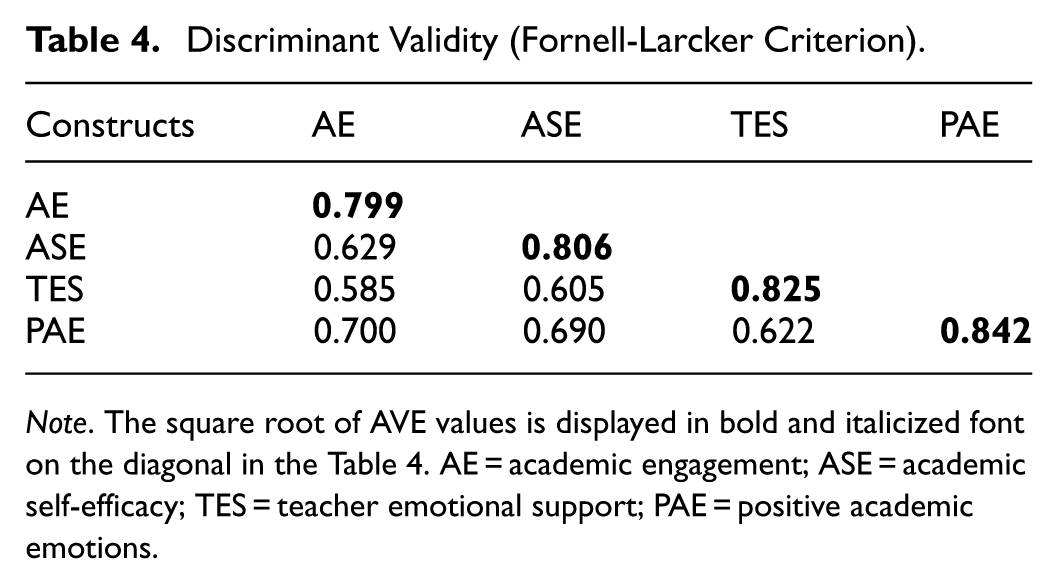
Note. The square root of AVE values is displayed in bold and italicized font on the diagonal in the Table 4. AE = academic engagement; ASE = academic self-efficacy; TES = teacher emotional support; PAE = positive academic emotions.
The HTMT introduced by Henseler et al. (2015), provides an additional measure to assess discriminant validity. According to Gefen et al. (2011), HTMT values between any two constructs should ideally remain below 0.90. As indicated in Table 5, all HTMT values meet this criterion, supporting the evidence of discriminant validity.
Discriminant Validity (HTMT Criterion).

Note. AE = academic engagement; ASE = academic self-efficacy; TES = teacher emotional support; PAE = positive academic emotions.
Confirmatory Factor Analysis
The confirmatory factor analysis results showed that, after model adjustment, the model achieved a satisfactory fit: χ2/df = 1.905 (less than 2), RMSEA = 0.034 (below 0.08), GFI = 0.933, NFI = 0.956, CFI = 0.978, IFI = 0.978, and TLI = 0.976 (all > 0.9). These values meet the recommended thresholds proposed by L. T. Hu and Bentler (1998).
Structural Model
To assess the structural model reliability and explanatory strength, various indicators, such as path coefficients, R2 and collinearity diagnostics, were employed. Specifically, collinearity diagnostics were conducted to identify potential multicollinearity concerns. VIF values should be below 3.3 to rule out problematic multicollinearity. Table 6 shows that all values fell between 1.000 and 2.183, confirming multicollinearity was not an issue.
Collinearity Test.

Note. AE = academic engagement; ASE = academic self-efficacy; TES = teacher emotional support; PAE = positive academic emotions.
Path coefficient significance and magnitude were tested using bootstrapping with 5,000 subsamples. Table 7 presents the summarized results of the path analysis. The significance testing evaluates how exogenous variables affect endogenous variables. The findings indicate that TES (β = .182, t = 5.341, p = .000), ASE (β = .218, t = 4.170, p = .000), and PAE (β = .436, t = 9.010, p = .000) all positively associated with AE. These results suggest that TES, ASE, and PAE play a substantial role in enhancing AE in the context of university English learning.
Path Hypothesis Testing.

Note. AE = academic engagement; ASE = academic self-efficacy; TES = teacher emotional support; PAE = positive academic emotions.
p < .001.
Finally, the explanatory power (R2), adjusted R2, and predictive relevance (Stone-Geisser’s Q2) of the model were examined. According to Table 8, the R2 values for AE, ASE, and PAE were .549, .366, and .542, respectively, and the adjusted R2 values were .547, .365, and .541, respectively. This indicates that the predictors accounted for 54.7%, 36.5%, and 54.1% of the total variance in AE, ASE, and PAE, respectively. In addition, the Q2 value for AE, ASE, and PAE was 0.270, which exceeded 0, suggesting that the model showed good predictive relevance (Hair et al., 2021).
Model’s Explanatory Capacity and Predictive Validity.

Note. AE = academic engagement; ASE = academic self-efficacy; TES = teacher emotional support; PAE = positive academic emotions.
Mediation Analysis
To explore the mediating roles of ASE and PAE between TES and AE, the bootstrapping method was applied (Teo et al., 2015), a total of 5,000 subsamples were used to estimate indirect effects, direct effects, and confidence intervals. The significance and form of mediation were judged based on the confidence intervals. When zero was absent from the confidence interval, the indirect path was considered statistically meaningful. The detailed outcomes are displayed in Table 9, ASE and PAE acted as separate mediators between TES and AE and also formed a sequential chain mediation pathway.
Mediation Analysis.

Note. AE = academic engagement; ASE = academic self-efficacy; TES = teacher emotional support; PAE = positive academic emotions.
p < .001.
Supplementary Multigroup Analysis by Gender
To further validate the model’s robustness, a supplementary multigroup analysis based on gender was conducted using PLS-MGA. This analysis aimed to test whether the path coefficients differ significantly between male and female groups.
In this study, the same path model and data processing procedures were applied to both gender groups, which is a necessary condition for establishing structural invariance (Henseler et al., 2016). Furthermore, as the models for both groups were estimated using identical algorithm settings, structural invariance was confirmed (Henseler et al., 2016). Compositional invariance is confirmed when the correlation between composite scores is greater than the fifth percentile of the empirical distribution (Henseler et al., 2016). As shown in Table 10, the observed correlations exceeded the 5% quantile, providing strong evidence for compositional invariance (Hair et al., 2021). Overall, measurement invariance between the two groups was confirmed.
MICOM Compositional Invariance Between Male and Female Groups.

Note. AE = academic engagement; ASE = academic self-efficacy; TES = teacher emotional support; PAE = positive academic emotions.
After establishing measurement invariance, the multi-group analysis compared the corresponding path coefficients among the different groups (Z. Zhou et al., 2014). The results of the path coefficient comparisons between gender subgroups are presented in Table 11. The findings indicated that none of the path differences between males and females were statistically significant (p > .05).
Path Coefficient Comparison (Males and Females).

Note. AE = academic engagement; TES = teacher emotional support.
Discussion
This study demonstrates that TES is positively associated with AE. Rather than functioning merely as an instructional aid, TES serves as an essential psychological resource that helps students cope with the anxiety and monotony of exam-oriented classrooms in Chinese universities (Lu et al., 2022). By fostering a safe and supportive environment, TES reduces stress, enhances students’ enthusiasm, and sustains their persistence in learning tasks. These results further support the core assumption of SDT, which highlights the role of external support in cultivating competence beliefs and intrinsic motivation (R. M. Ryan & Deci, 2000). The findings extend previous work by showing that in language learning contexts (Yan et al., 2024; M. Zhou et al., 2025), TES acts not only as an instructional strategy but also as a psychological support mechanism that enhances AE on both cognitive and emotional levels. Similar patterns have also been observed in other EFL contexts, such as Thai and Turkey, where supportive teacher–student relationships have been associated with greater learning engagement and language confidence (Chaiyasat et al., 2025; Dincer et al., 2019). For educators in China, this implies that addressing students’ affective needs through feedback, encouragement, and recognition is as crucial as delivering academic content for sustaining engagement.
ASE mediates the relationship between TES and AE. Consistent with prior research (Özcan & Kültür, 2021), our results indicate that TES indirectly fosters engagement by enhancing students’ competence beliefs. In Chinese culture, teachers are viewed as authority figures, and their care and recognition are often interpreted as affirmation of students’ abilities, thereby strengthening students’ confidence in facing challenges in English learning. From the perspective of SDT, TES fulfills the basic need for competence, thereby enhancing ASE. Students with higher ASE tend to set more challenging goals, persist through difficulties, and remain optimistic under pressure, which promotes greater involvement in class activities and sustained engagement. Notably, research in non-Chinese EFL environments such as Saudi Arabia and Iran also highlights ASE as a key motivational belief influencing persistence and classroom participation (Alrashidi & Alshammari, 2025; Namaziandost et al., 2023), suggesting that this cognitive mechanism may be widely applicable across cultural settings. This finding aligns with evidence from other domains, such as physical education, where teacher and peer support increase ASE and consequently engagement (Zhang et al., 2024). Thus, ASE serves as a cognitive pathway linking TES to AE. Nevertheless, it may not be the sole mechanism; future studies could explore other mediators, such as goal orientation or self-regulated learning strategies, to further clarify how TES promotes engagement.
PAE also mediated the relationship between TES and AE, consistent with Shen et al. (2024). Given the strong emphasis on exam performance in China’s English learning environment, students are prone to anxiety and stress (Pan & Block, 2011). Within this context, TES helps counteract these pressures by creating a safe and supportive classroom climate that fosters interest, enjoyment, and confidence. According to CVT, TES enhances students’ sense of control and task value, which subsequently promotes positive emotions. These emotions encourage constructive strategies such as help-seeking, collaboration, and persistence, thereby reinforcing behavioral engagement. Students who perceive recognition and appreciation from their teachers tend to sustain higher levels of curiosity and enthusiasm for learning, forming a cycle in which positive emotions sustain motivation and participation (Dong et al., 2022). Comparable findings have been reported in Middle Eastern EFL contexts, where positive emotional classroom climates support willingness to communicate and participation (Sadoughi & Hejazi, 2021), indicating that emotional mechanisms may operate similarly across settings. In this way, PAE provides an emotional pathway linking TES to AE, complementing the cognitive pathway of ASE. However, this study did not examine other emotional variables such as anxiety or boredom, which may also influence AE. Future research could incorporate these to provide a more comprehensive understanding of emotional mechanisms in this context.
This study found that ASE and PAE played a sequential mediating role in the relationship between TES and AE in university English learning, accounting for 22.244% of the total effect. This result reveals a continuous “belief–emotion–behavior” mechanism through which TES promotes engagement. Theoretically, this finding is consistent with SDT and CVT: when students perceive emotional support from teachers, they are more likely to experience a sense of autonomy and task value, which enhances ASE, stimulates PAE, and ultimately leads to higher levels of AE. In the Chinese English learning context, this pathway is particularly significant. Exam-oriented classrooms often induce anxiety and frustration due to challenges such as vocabulary memorization and oral expression. When teachers understand these difficulties and provide positive feedback, they not only alleviate students’ psychological pressure but also help build confidence and strengthen self-efficacy (Huang & Wang, 2023; Y. J. Ma et al., 2023). Students with higher self-efficacy are more likely to persist in their efforts and set challenging goals, generating a sense of accomplishment and satisfaction that fosters positive emotions (Zhao et al., 2024). These emotions, in turn, enhance motivation and concentration, encouraging sustained effort and deeper engagement in English learning (X. Chen et al., 2022; Saleem et al., 2022; Zhu et al., 2022). This virtuous cycle further explains how TES indirectly promotes AE under exam-oriented conditions. Of course, this study has limitations. For instance, potential mediators such as task value or types of learning motivation were not included. Future research could incorporate these variables to reveal multidimensional pathways through which TES influences AE. In addition, the use of cross-sectional data means that causal relationships require verification through longitudinal or experimental designs.
Through multi-group structural equation modeling, this study found that gender did not exert a significant moderating effect on the pathways among TES, ASE, PAE, and AE. Based on SRT, this can be interpreted as evidence that traditional gender role expectations in education are becoming less pronounced. Although women have often been considered more relational and emotionally responsive and men more independent and task-focused, the university English learning context appears to provide an equitable environment where TES benefits both genders similarly. Rather than a limitation, this underscores the stability and generalizability of the proposed model across male and female students. It suggests that when students perceive care and positive feedback from teachers, they show greater motivation and engagement regardless of gender, indicating the broad applicability of TES benefits. This finding also aligns with trends in higher education that emphasize equitable teacher–student interactions and personalized learning, where gender-based differences in learning processes are diminishing. Future research could extend this work by examining other demographic moderators, such as socioeconomic background, academic discipline, or cultural context, using larger and more diverse samples to further test the boundary conditions of this model.
Impact
Impact
This study advances theory in several ways. First, drawing on SDT, CVT, and SRT, we developed and validated a moderated chain mediation model. The model revealed both the independent and sequential mediating roles of ASE and PAE in the link between TES and AE, while also testing gender as a moderator. By jointly examining cognitive (ASE), emotional (PAE), and individual difference (gender) factors, the study moves beyond prior research that typically focused on single mechanisms, thus offering a more comprehensive and theoretically innovative account of the TES–AE relationship. Second, our findings support the central propositions of SDT, highlighting how external support enhances students’ competence beliefs, which in turn foster greater engagement. They also resonate with CVT by underscoring the role of perceived control and task value in generating PAE. Together, these results illustrate a complete “support–cognition–emotion–engagement” pathway. Finally, in the context of university English learning, this study provides a localized and structured theoretical framework for understanding motivational and emotional processes in foreign language learning, thereby enriching research on TES mechanisms. The nonsignificant moderating effect of gender indicates that the proposed model applies equally well to both male and female students, enhancing the generalizability of the findings.
The findings of this study have important practical implications for foreign language teaching. First, the direct positive link between TES and AE indicates that teachers should consciously foster a supportive and caring, inclusive, and encouraging classroom atmosphere. This can be achieved through personalized communication, emotional feedback, and positive teacher-student interactions to enhance students’ learning experiences. Second, the role of ASE highlights the importance of setting clear goals, providing constructive feedback on success, and reinforcing positive evaluations to strengthen students’ academic confidence. These approaches play an important role in strengthening students’ motivation for self-directed learning and their persistence in academic activities. At the same time, the mediating role of PAE underscores the value of emotional activation in teaching. Teachers may consider designing interactive activities, such as situational simulations, group cooperation tasks, and role-playing, to enhance students’ enjoyment and emotional engagement in class, thereby stimulating their intrinsic motivation. In sum, this study proposes strategies that promote English teaching through both cognitive and emotional pathways and provides empirical evidence for improving college-level English instruction and student achievement.
Limitations and Future Directions
Although this study theoretically and empirically explored the mechanism through which TES linking TES to AE via ASE and PAE, several limitations should be acknowledged. First, the study adopted a cross-sectional design, which limits the ability to infer causal relationships among variables. Future research could employ longitudinal or experimental methods to dynamically track changes in variables and further verify the causal stability of the proposed model. Second, the participants were primarily university-level English learners in China, which may limit the generalizability of the findings to other educational systems and cultural contexts. Future studies could include learners from different countries, institutional settings, and cultural backgrounds to test the model’s robustness across diverse contexts. Third, although this study incorporated two key mediating variables, ASE and PAE, other potentially influential factors—such as family support, learning strategies, and language anxiety—were not included in the model. In addition, potential moderating factors, such as socioeconomic status, academic year, or class size, were not examined. Future studies may incorporate a wider range of mediators and moderators to build a more comprehensive theoretical framework, thereby enhancing the model’s explanatory power and practical value. Finally, all measures in this study were based on self-reported questionnaires, which may increase the risk of common method bias. Although we attempted to reduce this risk through measures such as anonymity and randomized item order, future research should consider incorporating multi-source data (e.g., teacher ratings, peer evaluations, or behavioral indicators) to enhance the robustness of the findings.
Conclusion
This study explored the relationships between TES and AE within the context of English learning, with ASE and PAE as key mediating variables. The findings showed that higher levels of TES were related to stronger ASE and PAE, which were in turn linked to greater AE. The proposed model accounted for 54.7% of the variance in AE, indicating its strong explanatory power. Theoretically, this study contributes to the understanding of how teacher support, self-efficacy, and academic emotions are interconnected in the EFL context, extending the application of SDT, CVT and SRT. Practically, the results suggest that teachers who provide encouragement, recognition, and emotional care are associated with students’ higher confidence, more positive emotions, and sustained engagement in English learning. Future research may include additional mediators such as learning strategies or goal orientations, and examine different cultural and institutional settings to further evaluate the generalizability of the model.
Footnotes

Ethical Considerations
The researchers confirms that all research was performed in accordance with relevant guidelines/regulations applicable when human participants are involved (e.g., Declaration of Helsinki or similar). This study was approved by the Ethics Committee of Xuchang University (Approved no. XC-IRB-2024-0013).
Consent to Participate
The participants received oral and written information and provided written informed consent before participating in the study.
Author Contributions
Conceptualization: Lingling Ma, Guoqing Li; Methodology: Lingling Ma; Formal analysis and investigation: Lingling Ma; Writing—original draft preparation: Lingling Ma, Guoqing Li; Writing—review and editing: Lingling Ma; Supervision: Lingling Ma, Guoqing Li. All the authors have read and agreed to the published version of the manuscript.
Funding
The authors disclosed receipt of the following financial support for the research, authorship, and/or publication of this article: This work was supported by 2024 Humanities and Social Sciences Project of Henan Provincial Department of Education: Research on the Connotative Development of Foreign Languages in Colleges and Universities under the Background of “Integration of Industry and Education, Collaborative Education” (No. 2024-ZZJH-376) and “Research on the Methods and Paths to Enhance the Smart Teaching Ability of Foreign Language Teachers in Universities in the Digital Humanities Era” (No. XCU2023-ZHJX-05), Smart Teaching Special Research Project of Xuchang University.
Declaration of Conflicting Interests
The authors declared no potential conflicts of interest with respect to the research, authorship, and/or publication of this article.
Data Availability Statement
The data that support the findings of this study are available on request from the corresponding author.*