




Abstract
Previous research has indicated that students’ academic engagement is related to their emotional support from teachers. However, there is scarce evidence on how teacher emotional support relates to students’ academic engagement. Given the potential role of positive academic emotions in learning, this study investigated the mediating role of students’ positive academic emotions in the relationship between teacher emotional support and academic engagement among Chinese college students. Additionally, this study examined how mastery-approach goals moderated positive academic emotions. A survey instrument containing teacher emotional support, positive academic emotions, mastery-approach goals, and academic engagement was administered to 464 Chinese college students. The results demonstrated that students’ emotional support from their teachers positively influenced their academic engagement. Positive academic emotions mediated the relationship between teacher emotional support and students’ academic engagement. Furthermore, the mastery-approach goals moderated the mediating role of positive academic emotions. Finally, the implications for teachers in teaching for practice and the application prospects are discussed.
Keywords
Introduction
As an essential prerequisite in the process of learning (Oga-Baldwin, 2019), academic engagement is a vital factor influencing college student’s academic success (Johnson & Stage, 2018; Nortvig et al., 2018; Sakurai & Pyhältö, 2018; Wu, 2019) and future work perceptions (Lee & Lee, 2018). Furthermore, it even affects higher education success (Murray, 2018). However, many college students are not engaged in their learning, resulting in low levels of motivation (Korpershoek et al., 2020), academic outcomes (e.g., Alhadabi & Karpinski, 2020; Kim et al., 2019), and even high dropout (e.g., Bäulke, et al., 2018; Kehm et al., 2019). Although many studies have proposed factors affecting college students’ academic engagement (e.g., Fredricks et al., 2019; Valadez et al., 2021), it must be noted that academic engagement is a complex and multifaceted concept, the nature of which is debatable (e.g., Payne, 2019; Suri, 2020). Thus, more studies should be conducted to explore the nature and mechanism of academic engagement. This study aims to address this issue by focusing on three of its essential predictors: teacher emotional support, positive academic emotions, and mastery-approach goals.
Literature Review
Academic engagement is the extent to which students engage in learning-related activities (Fredricks & McColskey, 2012). According to the academic engagement model proposed by Fredricks, the meta-construct of academic engagement includes three dimensions: behavioral, cognitive, and emotional (Fredricks et al., 2004). Cognitive engagement refers to the intellectual effort students devote to learning processes. It involves students’ efforts to combine new knowledge with what they have mastered and use cognitive and metacognitive strategies to understand knowledge. Behavioral engagement refers to students’ active or physical involvement in learning activities. It also refers to students’ positive actions, the effort to learn and participate in class, and the learning processes. Additionally, emotional involvement focuses on students’ positive and negative attitudes and evaluations toward teachers, peers, studies, and schools. Further, it involves students’ interests, sense of belonging, and identity concerning their schools or majors.
SDT theory (Self-determination Theory) provides a framework for understanding the influence of students themselves and the learning environment on their academic engagement. SDT theory assumes that all students, regardless of age, gender, socio-economic status, nationality, or cultural background, all have the intrinsic growth trend (intrinsic motivation, curiosity, psychological needs) for their high-quality academic engagement (Ryan & Deci, 2020). However, students are not isolated. In the classroom, their environment supports or threatens their needs, goals, interests, and values, and each student’s academic engagement is a product of his motivation and classroom support or threat. Therefore, the teaching task of activating students’ intrinsic motivational resources is a crucial step in promoting high-quality learning engagement (Reeve & Halusic, 2009).
SDTS provides educators and researchers with relevant advice on cultivating and utilizing students’ inner resources in the teaching process to promote high-quality academic engagement (Niemiec & Ryan, 2009). According to this theory, students have three basic psychological needs: the need to satisfy intimacy, autonomy, and efficacy, which provides a basis for predicting which aspects of the classroom environment are conducive to students’ academic engagement (Deci et al., 1999). Therefore, a classroom environment satisfying the three psychological needs can help improve students’ academic engagement. Secondly, the role of teachers is not to create or manipulate the motivation and engagement of students but to support and enhance the motivation and participation of students through various measures that can meet their different needs. In addition, students have intrinsic motivation resources that enable them to devote themselves entirely to learning. The learning environment either supports students’ internal motivation resources or hinders them. Students learning motivation and learning environment influence each other. Therefore, the teaching environment that meets the psychological needs of students can be affected by internal resources such as students’ pursuit of academic goals.
As teachers are essential organizers of the learning process, their support can facilitate student engagement (Patrick et al., 2007). Many studies have found that students who perceive higher levels of teacher support have higher levels of engagement than those with less support (Chong et al., 2018; Sadoughi & Hejazi, 2021; Zhao et al., 2019). Teacher support is the feeling that students are considered essential and supported by their teachers (Klem & Connell, 2004). If the teacher meets the psychological needs of students, the students will be more satisfied with the learning environment, which leads to greater engagement in the learning process (Martin & Bolliger, 2018). Teacher support includes academic and emotional support (Patrick et al., 2007). Academic support is students’ perception that teachers care about what and how much they have learned. In contrast, emotional support is students’ belief that teachers care about their feelings as distinct individuals (Johnson et al., 1985). Researchers have raised the possibility that, compared to other types of support, the emotional support teachers provide to students by forming positive emotional connections with them may be an essential element of effective learning (Hernández-Sellés et al., 2019).
Additionally, self-determination theory indicates the importance of emotional support in the process of learning (Skinner & Belmont, 1993), according to which students are motivated to learn and become more engaged when teachers support their emotional needs, showing positive trajectories in the academic field (Hamre & Pianta, 2001). Furthermore, teacher-emotional support also helps build positive teacher-student relationships, essential for students to develop social interaction skills and academic competence in the classroom environment (Mahona & Demetria, 2020; Salo et al., 2022). Students will then be motivated to participate in classroom activities (Ryan & Deci, 2017) and focus more on academic tasks, enhancing their academic engagement. Furthermore, previous studies have shown that positive emotions in an academic field are correlated with academic engagement (Carmona-Halty et al., 2021; Rodríguez-Muñoz et al., 2021). Specifically, students who experience positive academic emotions are more likely to be engaged in their learning.
Although teacher emotional support can promote students’ academic engagement, earlier studies imply that, as an external factor, emotional support from teachers often requires the addition of individual internal factors to enable its facilitating effect (Helgeson & Lopez, 2010). Researchers have pointed out that positive academic emotions are a possible essential internal factor affecting the relationship between teacher emotional support and academic engagement (e.g., Liu et al., 2018; Sadoughi & Hejazi, 2021). Positive academic emotions are students’ positive emotions in learning, guidance, and achievement in an academic environment (Pekrun, 2006). Suppose the teacher is sensitive to students’ emotional needs. In that case, students will feel respected and supported and have an emotional connection with the teacher and a sense of belonging in the classroom, which can promote positive academic emotions such as enjoyment, pride, and hope (e.g., Pekrun et al., 2002; Skinner & Belmont, 1993). Earlier studies have also reported a significant correlation between teacher support and positive academic emotions (Liu et al., 2018; Sadoughi & Hejazi, 2021). Furthermore, positive emotions can expand students’ scope of attention, broaden their behavioral repertoires (Fredrickson & Branigan, 2005), increase their learning motivation, improve their learning flexibility (Pekrun et al., 2002), and direct their attention to learning tasks, thereby strengthening their academic engagement (Arnold, 2009; Zhang et al., 2021).
Although the previous studies indicated that positive academic emotions meditate the relationships between teacher emotional support and academic engagement, there are still some gaps that previous studies still need to address. Firstly, previous studies have been conducted in Western cultures, and the results cannot be directly generalized to other cultures. Secondly, there is scarce evidence to examine how positive academic emotions are related to academic engagement. Thirdly, few studies have examined whether other factors influence the relationship. So, are other factors influencing the relationships between positive academic emotions, teacher emotional support, and academic engagement? The relationship between teacher emotional support, positive academic emotions, and academic engagement may be moderated by mastery-approach goals. Mastery-approach goals are defined as goals that focus on the sustained mastery of various academic tasks (Pekrun et al., 2014). According to the control-value theory of achievement emotion, an individual’s belief in the value of a task would trigger positive or negative emotions (Pekrun, 2006). The more value beliefs individuals have about the task, the more positive their emotions will be, and vice versa (Pekrun, 2006, 2018). Additionally, according to the broaden-and-build theory of positive emotions (Fredickson, 2001), positive emotions expand the mindset of performance resources, leading to higher mastery-approach goals. Previous studies also showed that students experience higher levels of positive academic achievement with higher mastery-approach goals (Datu et al., 2022; Mouratidis et al., 2018; Schweder, 2020). Furthermore, as an essential condition for effective learning performance (Elliot & Murayama, 2008), mastery-approach goals are positively associated with academic engagement (Babenko et al., 2018; Datu & Park, 2019; Miller et al., 2021). Specifically, students with higher mastery-approach goals reported more significant investment in their effort in learning (Hulleman et al., 2016), thus showing more engagement in achieving the goal (Jiang & Zhang, 2021; Putwain et al., 2018; Shih, 2018).
Based on the above literature, the present study aimed to investigate the effect of teacher emotional support on academic engagement and the mediating role of positive academic emotions among college students. Furthermore, the moderating role of mastery-approach goals was explored. More specifically, we propose the following hypotheses (as shown in Figure 1):
Hypothesis 1: Teacher emotional support and positive academic emotions positively predict students’ academic engagement.
Hypothesis 2: Positive academic emotions mediate the relationships between the teacher’s emotional support and students’ academic engagement.
Hypothesis 3: The mediating role of positive academic emotions is moderated by mastery-approach goals.

The hypothesis model.
Materials and Methods
Participants
This study was conducted in two comprehensive universities in northwest China. Compared with the southeast coastal areas, the economy and education level of the northwest region is weaker. We used purposive sampling to select participants for the study, and any freshmen who had not participated in a similar study could participate in this study. After incomplete or invalid questionnaires were excluded (80), the data of 464 participants were used in this study. All participants were first asked to provide informed consent before conducting the survey. Then they were asked to complete questionnaires on their demographic information and their teacher’s emotional support, positive academic emotions, mastery-approach goals, and academic engagement. At the end of the survey, each participant was given a notebook as compensation.
Of the participants, 245 were male, and 219 were female. All the participants were majoring in education: 152 were majoring in psychology, 148 were in educational technology, and 164 were in education. The demographic information is presented in Table 1.
Socio-Demographic Characteristics of the Participants.

Measures
All questionnaire items except those for academic engagement (for which a pre-existing Chinese version was used) were first translated into Chinese by three teachers of psychology, six doctoral students majoring in psychology, and then checked by five foreign language teachers who worked with the authors in the same college. After that, we distributed all items to 200 first-year students who volunteered to participate in the trial testing major in education and psychology. All participants had yet to participate in a similar study. After they finished the questionnaire, they were told the study was over, and each was given a pen as compensation. Ultimately, we modified the scale according to the test results to ensure validity.
After the questionnaire survey, we selected 50 students who had higher scores of teachers’ emotional support and 50 students who had lower scores. We asked them, “What do you think are the main sources of teachers’ emotional support for you? What kind of emotional support do you expect?” to provide preliminary evidence on how teachers provide emotional support.
Teacher Emotional Support
Emotional support was assessed using the Emotional Support Scale adapted from Wong et al. (2018), which consists of four items: for example, “My teacher respects my opinion.” The items were rated on a 5-point Likert-type scale, with one indicating do not agree and five indicating strongly agree. The total score is calculated by summing the scores for all items, with a higher score indicating a higher level of emotional support from the teacher. After factor analysis, one factor was extracted, and the contribution rate was 90.45%, the KMO coefficient was 0.871, and the Bartlett test score was less than 0.001. Furthermore, Cronbach’s alpha reliability coefficient was .96, indicating that the questionnaire has good validity and reliability.
Positive Academic Emotions
The positive academic emotions questionnaire was assessed by the sub-scales of the Achievement Emotions Questionnaire adapted from Pekrun et al. (2011), which consists of two sub-scales: class positive academic emotions and learning positive academic emotions. After factor analysis, two factors were extracted, and the contribution rate was 88.15%, the KMO coefficient was 0.97, and the Bartlett test score was less than 0.001. Furthermore, the values of Cronbach’s alpha reliability coefficients for each aspect were .98, .97, and .97, respectively, indicating that the questionnaire has good validity and reliability.
Academic Engagement
This study adopted the Academic Engagement Scale Awang-Hashim and Sani (2008) developed. This questionnaire has been translated into Chinese and has good reliability and validity (Sha et al., 2022). The items of this scale are scored on a 5-point Likert-type scale and fall into three sub-scales: behavioral (8 items; e.g., “How often do you come to class without pencil or paper?”); cognitive engagement (10 items; e.g., “I ask myself questions to make sure I understand the material I have been studying in this class”), and emotional behavior (11 items, e.g., “I wish I were in a different school”). Cronbach’s alpha reliability coefficients in this study were .96, .90, and .70, respectively.
Mastery-Approach Goals
This study adopted the subscale of Achievement Goal Questionnaire–Revised (Elliot & Murayama, 2008) to assess the mastery-approach goals of students, which consists of three items such as: “I aim to master the material presented in this class completely” and rated on a 5-point Likert-type scale, with one indicating do not agree and five indicating strongly agree. After factor analysis, one factor was extracted, and the contribution rate was 83.31%, the KMO coefficient was .75, and the Bartlett test score was less than 0.001. Moreover, Cronbach’s alpha reliability coefficient was .95, indicating that the questionnaire has good validity and reliability.
Procedure
First, volunteers willing to participate in this study were recruited through university posters. Before students participated in this study, they completed informed consent forms provided by the investigators and assistants. After participants’ consent was obtained, the questionnaires were distributed in a uniform classroom. All the participants were asked to complete the questionnaire according to their situation.
Ethics
The present study followed the Declaration of Helsinki and its later amendments. Before participating in the present study, all participants provided written informed consent to participate.
Data Analyses
SPSS software (version 26.0) was used to analyze the data. Additionally, the SPSS macro process was used to test the mediation effect of positive academic emotions on the relationship between teacher emotional support and academic engagement (Model 4) and to test the moderating role of mastery-approach goals on positive academic emotions (Model 14).
The Harman single-factor method was used to test for common method bias. First, SPSS factor analysis was used to test this. The results showed that the variance explanation percentage of the first common factor was 39%. To further test for common method bias, MPLUS (version 8.3) was used for verification, yielding χ2(1703) = 10013.36, p < .001, RMSEA = 0.000, CFI = 0.77, TLI = 0.77, indicating that there was no serious common method bias in the data of this study.
Results
The Relationship Between Teacher Emotional Support, Positive Academic Emotions, and Students’ Academic Engagemen
A correlation analysis of emotional support, positive academic emotions, mastery-approach goals, and academic engagement was conducted.
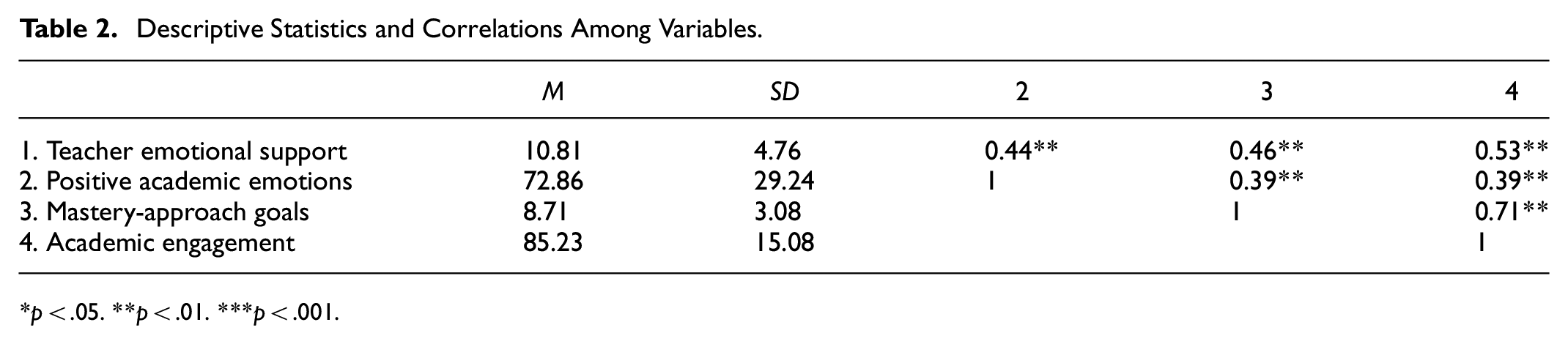
Descriptive statistics and pair correlation results for all variables are shown in Table 2. Significant positive correlations existed between teacher emotional support, positive academic emotions, mastery-approach goals, and academic engagement.
Descriptive Statistics and Correlations Among Variables.
p < .05. **p < .01. ***p < .001.
Mediation Analysis of Positive Academic Emotions
We used SPSS (Model 4) to conduct the mediation analysis to explore the hypotheses regarding the paths from teacher emotional support to academic engagement through positive academic emotions.
The mediation results for positive academic emotions are shown in Tables 3 to 5. Tables 3 and 4 show that 28% of academic engagement variance was due to teacher emotional support. Teacher emotional support significantly affected academic engagement (β = 0.69, p = .0000). Additionally, 20% of the variance changes in positive academic emotions were because of teacher emotional support. There was a significant effect of teacher emotional support on positive academic emotions (β = 2.73, p = .0000). Furthermore, 31% of the variance changes in academic engagement were because of teacher emotional support and positive academic emotions. There was a significant effect of teacher emotional support on positive academic emotions (β = 1.42, p = .0000). The effect of positive academic emotions on academic engagement was also substantial (β = 0.10, p = .0000).
Model Summary.

Coefficients.

Bootstrap Analysis of the Significance Test of Mediation Effect.
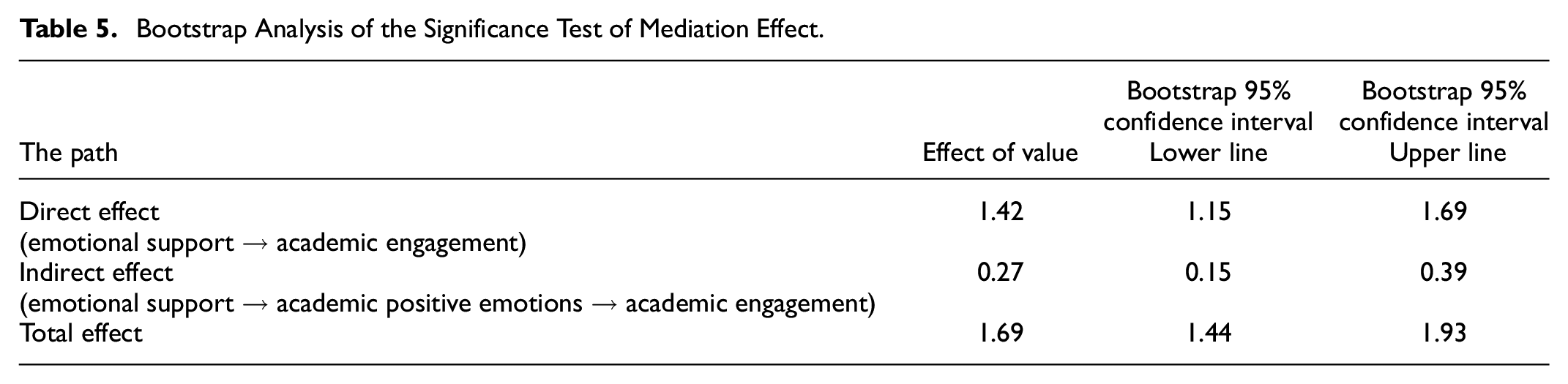
Bias correction non-parametric percentage bootstrapping was used to test the mediating effect. As shown in Table 5, positive academic emotions partially mediate the influence of teacher emotional support on academic engagement.
The Moderating Role of Mastery-Approach Goals
In a more detailed model, we used the PROCESS macro (Model 14) to explore the impact of teacher emotional support on academic engagement through positive academic emotions moderated by mastery-approach goals. Further, bias-corrected 95% bootstrap confidence intervals for indirect effects were generated using 5,000 bootstrap samples.
As shown in Table 6, the interaction term of positive academic emotions and mastery-approach goals is significantly associated with academic engagement, meaning that mastery-approach goals mediate the relationship between positive academic emotions and academic engagement. The index of moderated mediation was significant (β = 0.06, 95% CI [0.02, 0.09]). Specifically, for students with higher mastery-approach goals, teacher emotional support significantly affected academic engagement through positive academic emotions (β = 0.10, 95% CI [0.05, 0.16]). For students with lower mastery-approach goals, emotional support did not significantly affect academic engagement through positive academic emotions (β = −0.01, 95% CI [−0.06, 0.03]).
Moderated Mediation Analysis.

Discussion
This study explored the underlying mechanism of how to promote academic engagement of college students through teacher-emotional support, positive academic emotions, and mastery-approach goals. The findings indicated that teacher emotional support could directly influence college students’ engagement, consistent with our H1 and previous studies based on SDT theory (e.g., Ahmed et al., 2018; Crawford, 2018; Quin et al., 2018; Xerri et al., 2018; Xu et al., 2020). Academic engagement is teacher-friendly and malleable (Mercer & Dörnyei, 2020); teachers can take adequate measures to promote learners’ academic engagement. As an efficacy kind of support, teacher-emotional support is beneficial to create a supportive atmosphere of constructive teacher-student interaction and cultivating students’ sense of belonging and affinity to the classroom (Roeser et al., 1996). When students receive teachers’ emotional support that can meet their psychological needs in the learning process, they will have the internal motivation to continue to complete the given learning task (Ryan & Deci, 2020). This internal motivation is like fuel, promoting student behavior and emotional engagement (e.g., Skinner et al., 2008; Sökmen, 2021; Zhang et al., 2021). Furthermore, the results can be explained by the teaching through an interactions framework (Hamre & Pianta, 2007). If teachers know students’ emotional needs and respond by choosing appropriate activities, they are more likely to engage in learning (Patrick et al., 2007).
In addition, this study preliminarily attempted to investigate how teachers provide students with emotional support so that they might attain success. We collated the results of interviews with students with high teacher emotional support and students with low teacher emotional support. The results found that for students who perceived high levels of emotional support from the teacher, 75% reported that the teacher made eye contact and smiled at them in class. Teachers ask, offer advice, and always smile when they meet difficulties. Most students with lower teachers’ emotional support are reluctant to make eye contact with teachers because of their poor academic performance and fear of teachers’ questions. They expect the teacher to provide them with academic help individually after class. Future research will investigate emotional support issues in-depth, such as what motivates and inspires students.
Additionally, the results indicated that positive academic emotions mediate the relationships between teacher emotional support and academic engagement, which supported H2 and indicated that teacher emotional support exerted effects on academic engagement via positive academic emotions, which is consistent with previous studies showing the mediating role of positive emotions in an academic field between teacher support and academic engagement (Liu et al., 2018). To be specific, to be specific, teachers’ emotional support can not only cultivate students’ positive emotions by giving them emotional attention (Aldridge et al., 2013) but also build a good teacher-student relationship to promote the generation of positive emotions further (Skinner et al., 2008). When the teacher makes modest efforts to express emotional support to students, students may be encouraged to build positive interactions with the teacher. Such a positive learning environment motivates students to explore and gain knowledge, resulting in them experiencing more positive academic emotions (Silver et al., 2005). The positive emotions gained during learning subsequently boost students’ academic engagement. More specifically, positive academic emotions such as enjoyment can promote students’ creative thinking; minimize information irrelevant to the task, thereby promoting student focus on the current learning task (Pekrun, 1992); and improving academic engagement. Additionally, some researchers have proposed that positive emotions can expand the individual’s scope of attention, broaden behavioral repertoires (Fredrickson & Branigan, 2005), enhance instinct, and lead to more engagement in learning (Arnold, 2009). Furthermore, according to the control-value theory (Pekrun, 2006), teachers can take measures to enhance students’ valuation of the activity or the result, promoting students’ engagement in the learning task.
Moreover, the results showed that mastery-approach goals moderated the mediating role of positive academic emotions, which supports H3 and is consistent with previous studies examining how mastery-approach goals promote academic engagement (Upadyaya & Salmela-Aro, 2013). For students with higher mastery-approach goals, teacher emotional support significantly affected academic engagement via positive academic emotions. Contrariwise, teacher emotional support did not significantly affect academic engagement via positive academic emotions for students with lower mastery-approach goals. These results are consistent with previous models (Linnenbrink & Pintrich, 2002; Pekrun et al., 2006). Specifically, the model proposed by Linnenbrink and Pintrich (2002) postulates that achievement goals influence attention by focusing on success or avoidance of failure, which affects the emotions that individuals experience. Mastery-approach goals enhance people’s perception of success, which promotes emotions such as pride, thus influencing academic engagement through cognitive processes (Clore & Huntsinger, 2009). Additionally, the model constructed by Pekrun et al. (2006) posits that achievement goals promote individuals’ attention to focus on success and failure, which leads to different emotions. Mastery-approach goals promote individuals’ positive perceptions of academic processes, thus activating positive emotions. Furthermore, positive emotions influence academic engagement by conserving cognitive resources in academic tasks (Pekrun et al., 2002).
Nonetheless, this study makes unique contributions to the existing literature. The social-cognitive perspective (Bandura, 1999) proposed that social factors have a stimulatory effect by motivating beliefs, but how this works needs to be clarified. The results of this study not only suggested that support from the outside world can influence an individual’s emotional state of learning directly but also indicated that an individual’s psychology and behavior, such as social factors influence academic engagement through internal factors such as mastery-approach goals, which provided empirical support for this theory.
This study has several practical implications. Teachers are encouraged to establish emotional links with students in teaching and to provide emotional support to students in generalizing the benefits of academic positive emotion-increasing interventions in academic engagement. This study demonstrated the association of emotional support with positive academic emotions and engagement. Teachers may not know how to establish a positive emotional connection with students. As our preliminary interview results show, students with different academic achievement differences expect different ways of providing emotional support. Thus, schools can promote the emotional connection between teachers and students through training to improve teachers’ emotional intelligence to improve teachers ability to recognize emotional cues in students and provide emotional support according to students’ needs. In addition, given the moderating role of mastery-approach goals on positive academic emotions, it is suggested that schools strengthen the training of teachers to include a focus on methods to stimulate students’ internal mastery-approach goals. For example, teachers need to be good at finding students’ progress, giving feedback to them on time, and guiding them to set reasonable learning goals.
This study has several limitations. This study used a correlational design to investigate the longitudinal association between teacher emotional support, positive academic emotions, mastery-approach goals, and academic engagement. Thus, care should be taken not to draw causal relationships between teacher emotional support and academic engagement. Further research could address this limitation using longitudinal studies or experimental designs. In addition, this study was conducted in Northwest China, and the results of this study cannot be fully applicable to subjects in other regions. First of all, compared with the southeast coastal areas, the economy in the northwest is relatively backward, and the educational resources are weak, so the level of students’ academic investment may also be low. Teachers may pay more attention to students’ achievement and pay less attention to emotional support. Future studies should conduct in more areas to improve the ecological validity of research results. Additionally, other potential factors may influence the mediating variables of positive academic emotions, which should be further investigated in future research.
Conclusion
As a product of interaction between internal resources and the teaching environment, the factors and mechanisms of academic engagement have always been the focus of researchers’ research. This study focuses on an essential link in the teaching environment (teachers) and explores how students’ emotional support from teachers affects students’ academic engagement through their internal resources. At the same time, it examines how this relationship is affected by students’ internal resources. This study provides practical support for SDT theory and practical guidance for teachers who want to improve students’ motivation and engagement. Future research should focus on how teachers can provide emotional support, a safe atmosphere and other environmental support for students to stimulate and maintain their intrinsic motivation and achieve academic achievement.
Footnotes
Declaration of Conflicting Interests
The author(s) declared no potential conflicts of interest with respect to the research, authorship, and/or publication of this article.
Funding
The author(s) disclosed receipt of the following financial support for the research, authorship, and/or publication of this article: This work was supported by the 2023 Gansu Province Philosophy and Social Science Planning Project,‘Research on School Education for Strengthening the Consciousness of the Chinese National Community’ (Project No. 2023YB068), as part of its periodic research outcomes.

Data Availability Statement
The raw data supporting the conclusions of this article will be made available by the authors, without undue reservation.