




Abstract
The role of emotions in L2 instruction has been well-recognized. With the rise of positive psychology in SLA, the investigations of L2 learners’ emotions have shifted from concern with negative emotions to inclusion of positive ones. However, few studies from the recent literature on positive and negative emotions have distinguished their emotions across different language skills (listening, speaking, reading, and writing), although emotions are universally recognized as domain-specific. Moreover, of these few studies, even fewer have reported specifically on emotional experiences of L2 learners in the process of listening learning, which is understandable given the general under-exploration of listening as compared with other language skills. This case study attempts to address this gap by exploring academic emotions of Chinese undergraduate English majors in the process of acquiring English listening skills from the perspective of Positive Psychology. Based on data collected from various sources over two semesters, a refined categorization of listening learners’ academic emotions is proposed and the characteristics of their emotions are revealed in terms of diversity, intensity, and frequency. The categorization and characteristics imply that L2 listening instructors might need to pay special attention to the emotional dimension of their instruction and learn to be an emotional therapist, though this is not their traditionally expected role.
Introduction
Emotions are intimately involved in every aspect of the learning process (Schutz & Lanehart, 2002) and therefore they can exert a huge impact on learning achievement. They are especially relevant to L2 (second language) learning due to the unique nature of the classes not necessarily having a set content (Coyle et al., 2010; Stryker & Leaver, 1997) and the aspects of culture and personal identity involved (Dewaele, 2016; Dornyei, 2005; Gardner & Lambert, 1959). As far as emotions of L2 learners are concerned, researchers in SLA (second language acquisition) used to be predominately preoccupied with anxiety. Recent years have seen their focus shift from anxiety to a more comprehensive view of emotions since the inception of positive psychology (hereafter referred to as PP).
Committed to articulating “a vision of the good life that is empirically sound while being understandable and attractive” (Seligman & Csikszentmihalyi, 2000, p. 5), PP is defined as “the scientific study of what goes right in life” (Peterson, 2006, p. 265). In contrast with psychology focused on repairing damage within a disease model of human functioning, PP is concerned with positive features and positive qualities which make life thrive and worth living. Specifically, it is supported by three building pillars: (1) positive subjective experiences; (2) positive individual traits; (3) positive civic virtues and institutions (Seligman & Csikszentmihalyi, 2000). In this light, PP is naturally relevant to learning, especially for SLA as “languages are both taught and learned by people—human beings with hopes and fears, strengths and limitations, goals and frustrations” (MacIntyre et al., 2019, p. 1). In addition, the new topics introduced by PP into psychology such as happiness, optimism, hope, well-being, meaning, empathy, resilience, and grit (Lopez & Snyder, 2009) “play a central role in learning and teaching, especially with respect to language learning, which is a long-term, gradual acquisition process necessitating perseverance, optimism, and resilience, among other qualities” (MacIntyre et al., 2019, p. 1). Despite its claimed focus on “positive,” PP never suggests ignoring problems or neglecting their existence with phoney affirmations or illusionary thinking (MacIntyre et al., 2019). As a matter of fact, positive and negative emotions are inseparable (Lazarus, 2003) and either can have a positive or negative impact (MacIntyre, 2016), implying the need to integrate positive experiences and negative experiences in PP research to better inform language learning and instruction. To stress this need, the term, “second wave positive psychology” (or PP 2.0), has arisen recently in literature. It is defined by Lomas and Ivtzan (2016) as
“an altogether more nuanced approach to the concepts of positive and negative, and by a subtle appreciation of the ambivalent nature of the good life (. . .) epitomised by an appreciation of the fundamentally dialectical nature of well being.” (p.7)
In line with the spirit of PP 2.0, studies of L2 learners’ emotions have started to explore a wide range of both positive emotions (excitement, pleasure, pride, contentment, satisfaction, occasional confidence, joy, love, etc.) and negative emotions (disappointment, sadness, powerlessness, anxiety, anger, shame, etc.) (Dewaele & Dewaele, 2017; Dewaele & MacIntyre, 2014; MacIntyre & Vincze, 2017; Ross & Stracke, 2016). However, in spite of the proven domain-specificity of academic emotions (Goetz et al., 2008), such a move does not seem to filter down to the sub-domain of L2 listening, which is thought to be the Cinderella of the four language skills (Flowerdew & Miller, 2005) and has received less attention from both researchers and practitioners than other language skills (Field, 2008; Vandergrift & Goh, 2012). Yet, the relatively scarce literature on listening research and instruction reveals that listening is an essential skill for language learning with its own distinctive characteristics.
Firstly, the significance of listening for language learning and acquisition has been well-documented with the success in listening learning argued to have a huge impact on success in learning other skills and life-long language learning (Field, 2008). Secondly, listening is a complex process involving a series of procedures in decoding and meaning-building such as discriminating unfamiliar sounds and words, interpreting stress and intonations and drawing on information from the immediate and sociocultural environment (Field, 2008; Vandergrift, 1999) and is thus regarded as the most difficult skill to learn (Vandergrift, 2004). Thirdly, as casually recorded in relevant literature, the complex process of listening seems to give rise to both negative and positive emotions, such as anger, anxiety, depression, oppression, shock, horror, discomfort, hope, happiness, etc., which affect learners’ incentive for listening learning (Cauldwell, 2018; Field, 2008; Rost & Wilson, 2013; Vandergrift & Goh, 2012).
Given the characteristics of listening learning and the role of emotions in language learning, rigorous inquiries into academic emotions arising from the process of listening learning would probably produce useful and systematic knowledge with inspiring pedagogical implications. Regretfully, to date only a small number of empirical studies have been found in which academic emotions of listening learners have been explored systematically (e.g., Piniel & Albert, 2018; Pishghadam et al., 2016). Pishghadam et al. (2016) investigated the achievement emotions of Iranian learners across four different language skills by means of an emotion scale (including nine discrete emotions: anger, anxiety, shame, relief, enjoyment, hope, pride, boredom, and hopelessness) designed based on the AEQ questionnaire proposed by Pekrun et al. (2005). This research indicated that each of the skills is associated with specific emotions and of all the four English language skills, listening is the only one linked to all of the examined negative emotions, which can possibly be ascribed to the complex and heavy cognition process of listening (Vandergrift, 1999, 2004). Piniel and Albert (2018), using participants’ written description, explored a wider range of emotions experienced by English majors in a Hungarian university across four skills under the guidance of Pekrun (2014) framework of academic emotions (achievement emotions, epistemic emotions, topic emotions, and social emotions). It revealed that: (1) language learners experience a wide range of positive emotions (pride, contentment, comfort, relaxation, curiosity, excitement, etc.) and negative emotions (frustration, confusion, tiredness, boredom, depression, anger, disappointment, impatience, anxiety, and remorse), which can be divided into four categories proposed by Pekrun (2014) in addition to two discrete emotions, feeling nothing special and feeling privileged about having access to a great university, which cannot be classified into the system of Pekrun (2014); (2) the four categories of academic emotions are experienced by language learners in different frequencies across four language skills and positive achievement emotions are experienced more frequently in learning listening than in learning other skills, which contradicts the findings from Pishghadam et al. (2016).
As discussed above, these few studies have further confirmed the domain-specificity of academic emotions with regard to language learning and expanded our knowledge of academic emotions of listening learners. Given the fact that academic emotions influence greatly the language learning process and product and different language skills are usually taught in different courses, they imply the significance of exploring specific emotions associated with each of the four language skills especially for pedagogical improvement.
However, as far as listening-related academic emotions are concerned, the existing few studies appear to be suffering from three obvious limits. Firstly, the limited research contexts covered. In the few studies where emotional experiences of listening learners are explored, very few contexts are represented. Since the emotional experiences might vary greatly from context to context as suggested by the two aforementioned studies, more contexts need to be included in this line of inquiry to form a more comprehensive picture of emotional experiences of listening learners. Secondly, research design characterized by single instrument collecting cross-sectional data. The single data collection instrument used once for each of these two studies (an emotion scale and a written paragraph respectively) might shed doubt upon the capability of the studies to capture the range, nuances, complexity and distinctions of the emotions that listening learners might experience, and thus undermine the trustworthiness of research findings. Thirdly, the absence of a focused inquiry into academic emotions in listening learning. The few studies have conducted a systematic empirical investigation into both positive emotions and negative ones in listening learning, but as part of comparison of learners’ emotions across different language skills rather than with the focus put on listening. This lack of focus may undermine the depth and breadth of empirical probe into academic emotions in listening learning.
Because of these limits, it seems that we are far from drawing a consistent and complete picture of listening learners’ emotional experiences. For example, there is already an inconsistency between the two existing studies in terms of their findings about achievement emotions of listening learners, and it can reasonably be doubted that the discrete emotions in the scale used and the categorization proposed can fully represent the emotional experiences of listening learners across contexts and even in a particular context. To remedy the situation and contribute to a more complete picture of academic emotions of listening learners, this study explored the emotional experiences of 22 Chinese English majors in the process of listening learning from the perspective of positive psychology based on a variety of data sources collected over two semesters. Specifically, it attempted to find out:
RQ1: What are the categories of the emotions experienced by listening learners in their learning process?
RQ2: What are the characteristics of the emotions experienced by listening learners in their learning process?
Methodology
Participants
Twenty-two English majors in the first year of university took part in this study. The pre-course survey showed that these students had quite diverse English listening learning experiences prior to their admission into university. In some provinces of China, English listening is not taught at all in schools as it is not part of National Matriculation English Test (NMET) while in foreign language schools, listening is a daily routine of English instruction. This led to a huge discrepancy among the participants in terms of listening proficiency as revealed in the pre-course listening test.
Setting
The study was conducted during the first year of an undergraduate program of English majors. Listening was a compulsory course of the program for the first two semesters. In this course, the students were required to listen to a variety of listening materials including Ted talks, News of Finance and Economics, TEM 4 (Test for English Majors, Band 4) dictations as well as the listening section of IELTS (International English Language Testing System) in the classroom and whatever interested them outside the classroom.
Researcher Positioning
The researcher of this study was the listening teacher of the course. Meanwhile, he was also a listening learner in the sense that he had worked on listening just like the participants, and he kept learning to be a better listener as he taught listening. His own listening learning experiences enabled him to be more sympathetic with the academic emotions of the participants. In addition, being the designer and instructor of the course, he was familiar with its aim, objective and content as well as the participants, which helped him to maintain a partial insider (emic) perspective and function as the researcher-as-befriender (Sarangi & Candlin, 2003). As both the teacher and friend, the researcher was able to encourage the participants to be both honest and thoughtful in digging and sharing their personal emotional experiences.
Data Collection
To obtain in-depth data for analyzing the emotions and ensuring the trustworthiness of research results, multiple instruments of data collection were employed: Journal of Emotional Experiences in Listening Learning (JEE), Survey of Emotional Experiences in Listening Learning (SEE), Field Notes (FN), and Stimulated Recall Interview (SRI) as shown in Table 1 below.
Data Collection Instrument.

Journal of emotional experiences in listening learning
The 22 participants were asked to write a journal describing briefly their daily experiences of listening learning immediately after they took place, including: what they listened to; how they listened to it; how they were feeling while listening and learning to listen. This timely recording could contribute to the authenticity and accuracy of the data.
Survey of emotional experiences in listening learning
The participants might not have the language and awareness to describe what they feel in listening learning and consequently might miss some emotions they might have experienced. To make up for this deficiency of journal writing, a survey of emotional experiences was conducted at the end of the course in which a series of possible positive and negative emotions were listed as informed by relevant literature of emotions. Participants were asked to recall whether they have experienced the emotions listed and illustrate them with examples. The list was not exhaustive and to prevent the absence of the emotions felt by participants but unlisted in the survey, participants were also asked to write down any other emotions that they felt but didn’t appear in the list. Furthermore, participants were also asked to answer questions regarding the characteristics of their emotions such as range, intensity, and frequency.
Field notes
While teaching, the teacher kept a close eye on what was happening in the classroom in relation to students’ emotional responses and noted them down in the form of field notes immediately after class was over, for further analysis or investigation.
Stimulated recall interviews
To dig and clarify the emotional responses confessed or observed in the process of listening learning, stimulated recall interviews were conducted, using learners’ journal and survey and teacher researcher’s field notes as the stimuli.
Data Analysis
The data in this study was analyzed both deductively and inductively in a cyclical process. As inspired by the deductive qualitative content analysis approach (Elo et al., 2014), the data was analyzed deductively with reference to both the emotion framework of PP 2.0 (positive emotion and negative emotion) and Pekrun’s (2014) theoretical framework of academic emotions (achievement emotions, epistemic emotions, topic emotions, social emotions), which suggests “the directions along which to look” (Flick, 2009, p. 473) in the beginning of data analysis. In addition to deductive analysis, all the data collected was examined inductively following Strauss and Corbin’s (1990) approach to qualitative data analysis with three phases of analysis: open coding, axial coding and selective coding for the purpose of developing categories emerging from the data. This inductive way ensured that the participants’ points of view were included in the analysis and the system of categories developed in this study were grounded in the data (Freeman, 1996; Glaser & Strauss, 1967) with the view to enriching the content and/or expanding the scope of the framework used. For example, the inductive analysis revealed that in listening learning, physical quality of classroom affected learners’ emotions greatly and a category of “environment emotions” was extracted from the data and the framework of academic emotions proposed by Pekrun (2014) was modified accordingly. Either deductively or inductively, the data analysis followed an iterative approach, with a cyclical return to the data.
Findings and Discussion
Few efforts have been found to explore exclusively L2 learner’s emotions in listening learning, resulting in an partial and limited knowledge of learners’ emotional experiences in this process. This study, by focusing on L2 listening learners’ emotions, reveals a distinctive categorization and characteristics of learner’s emotions in the process of listening learning.
The Findings and Discussion Regarding Categorization of Emotional Experiences
Based on data collected and guided by Pekrun’s (2014) framework of academic emotions, a framework of academic emotions experienced in the process of listening is proposed as below in Table 2.
Framework of Academic Emotions of L2 Listening Learners.

As it can be seen from Table 2, listening learners in this study experienced four broad categories of emotions on abstraction level 3 which stand in contrast with the academic emotions of learners in general and language learners. As mentioned before, Pekrun (2014), based on the dimension of arousal and activation, developed a framework of academic emotions consisting of four big categories: achievement emotions, epistemic emotions, topic emotions, and social emotions. Piniel and Albert (2018), using this framework as a guide, explored a more specific domain, the academic emotions of language learners and found that most of language learners’ emotions can be put into these four categories though some special feelings related to language can’t be represented such as feeling nothing special and feeling privileged about having access to a great university. This study found that in addition to achievement emotions, epistemic emotions, L2 listening learners also experienced input emotions instead of topic emotions and environment emotions instead of social emotions, which seem to be salient in the process of L2 listening learning. What is more, these four categories on the highest abstraction 3 are based on the eight sub-categories on the abstraction level 2 which are extracted from the16 sub-categories on the primitive abstraction level 1. In terms of emotional valence, all the (sub) categories can be positive or negative except for social environment emotions and easy task-related emotions which are positive only. Each of these categories will be presented and discussed in details as below.
Achievement emotions
Achievement emotions refer to feelings connected to success and failure in school, including enjoyment of learning, hope and pride related to success, and anxiety and shame related to failure (Pekrun, 2014). The data in this study revealed that achievement is a major source of listening learners’ emotions. As shown in Table 3, the achievement emotions can be divided into two sub-categories: Task-related emotions and learner-referenced emotions. The former is triggered by pure task performance while the latter by comparing their current performance with their past performance or their peers’ performance.
Task-Related Emotions Versus Learner-Referenced Emotions.
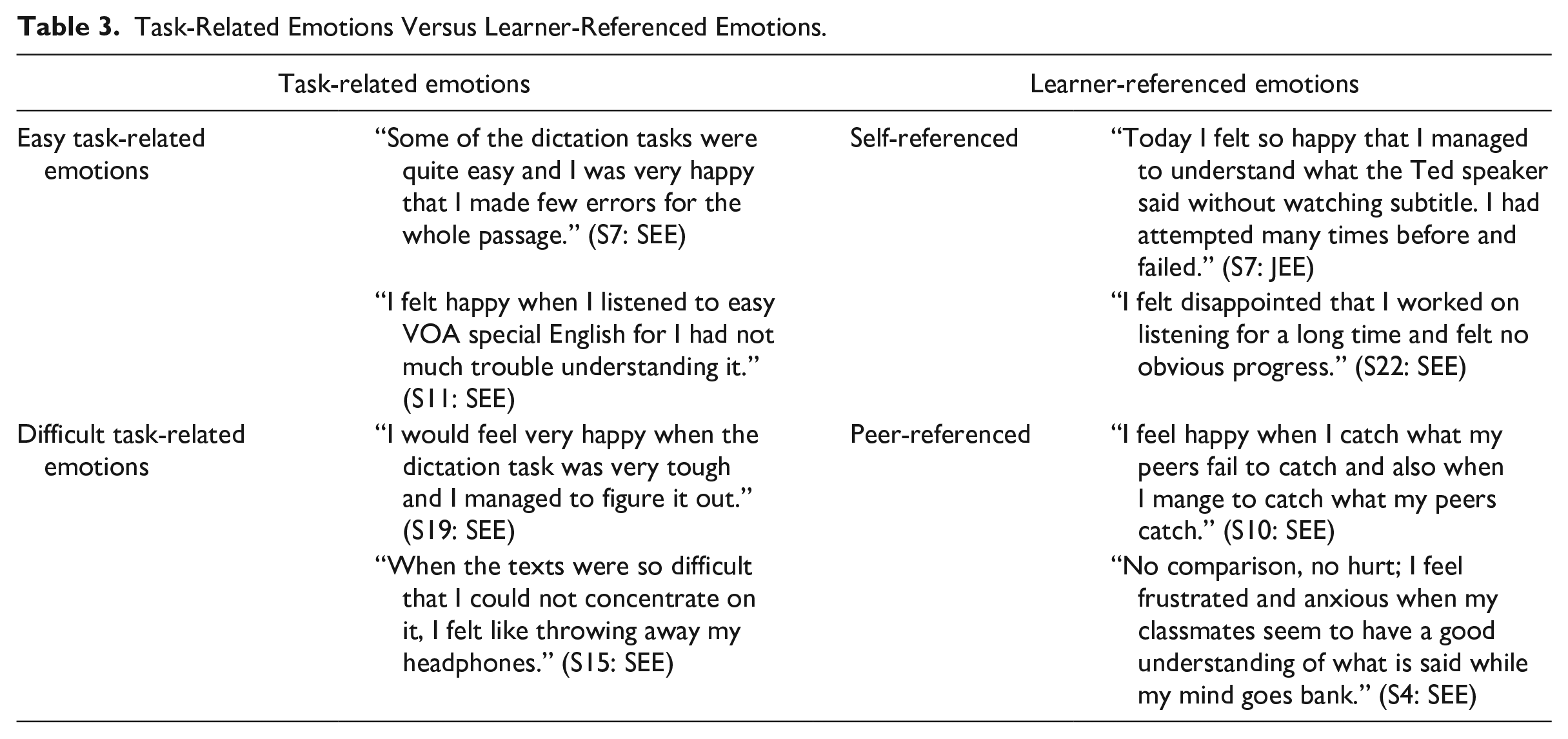
Regarding task-related emotions, it was found that all participants experienced positive emotions from understanding spoken texts and negative emotions from failing to understand them regardless of the degree of task challenge. As revealed in the excerpts from Table 3, while VOA special English is perceived as an easier task, the ease of task doesn’t prevent learners from deriving pleasure from successful comprehension, though comprehension success on difficult tasks seems to bring about more intense positive emotions. In other words, it seems that learners who manage to understand any particular spoken text can experience some enjoyment to different extents according to the efforts made for comprehension. On the other hand, failure in comprehension triggers negative emotions. What is worth noting is that learners often experienced positive and negative emotions by evaluating their performance in relation to that of their previous selves and their peers. Their superior performance, either self-referenced or peer referenced, seldom failed to inspire positive emotions and 20 of 22 participants reported that negative emotional experiences resulted from their performance no better than that of their past selves or inferior to that of their peers.
Epistemic emotions
Epistemic emotions, according to Pekrun (2014), relate to cognitive problems encountered while learning, including surprise, curiosity, confusion, frustration, etc. As illustrated in Table 4, epistemic emotions identified in this study can be divided into decoding-based emotions and meaning-building-based emotions with the former inspired by either sound perception or sound variation and the latter by skill application and knowledge application.
Decoding-Based Emotions Versus Meaning Building-Based Emotions.

As it can be seen from the excerpts in Table 4, the epistemic emotions arise in the process of learners making efforts to solve the challenges of decoding and meaning-building. Such a process of exertion can be both positive and negative, depending on the balance between task difficulty and learner’s ability and the final results of the efforts. In this sense, epistemic emotions in listening learning are closely related to achievement emotions and input emotions.
Input emotions
Input emotions as a category were developed from Pekrun’s (2014) topic emotions to fit the emotional realities of L2 listening learning. Topic refers to what a text is about while input involves two aspects: content and form. Language has two basic elements: content and form and naturally language learners might differ from general learners in that their emotions might be affected by both the content and the form of the text. This assumption is confirmed by the data in this study which showed that listening learners have a wider range of emotional triggers that can be better represented under the category of input. The input emotions consist of content-based ones and form-based ones. The former can be further divided into topic-related and idea-related emotions while the latter into delivery-related and language-related emotions as illustrated in Table 5 below.
Content-Based Emotions Versus Form-Based Emotions.

The data showed that what instigates learners’ emotions are not only the topic that the text is about but also the ideas carried in the text. Topic here refers to what the speech is about and the idea to the speaker’s insight into or observation of the topic. However, the idea part is sort of absent in the categorization by Pekrun (2014) and Piniel and Albert (2018). Similar to idea-related emotions, the form-based emotions fail to be made salient too even in studies of language learners. Delivery-related emotions, which are excited by how a speech is delivered, might be unique to listening learners while the language-related emotions, which are inspired by how a text is written, can probably and reasonably be felt by language learners in general. What is also worth noting is that while learners’ emotions can be influenced by both content and form of the input, the impact of content looks much more salient. All 22 participants pointed out that content of the listening materials was a substantial trigger of their emotions. One of the participants confessed: “For me, happy experiences in listening learning is predominantly related to the content of the listening material.” (S7: JEE). On the other hand, only 10 participants articulated the impact of input form on their emotions, with most of them reporting positive and negative emotions caused by the pronunciation and accents of speakers and several pointing out language quality as a source of emotions.
Environment emotions
Environment emotions as a category were expanded from Pekrun’s (2014) social emotions to match the emotional landscape of L2 listening learning. The environment consists of both physical environment and social environment as each of them can affect emotions of listening learners. Emotions of social environment is equal to Pekrun’s (2014) social emotions that relate to teachers and peers in the classroom and include such emotions as love, sympathy, compassion, admiration, contempt, envy, anger, or social anxiety. As far as language learning is concerned, the effect of surrounding social environment on the inner mental world has been well recognized (Dörnyei, 2009). It was found in this study that social environment emotions in listening learning can be put into emotions triggered by cognitive support and those by emotional support.
As it can be seen from excerpts in Table 6, classmates can offer both cognitive and emotional support for learners. Cognitively, different learners might have a different understanding of the same input and their discussion might contribute to their better comprehension of it and sometimes to the emergence of epiphany. Emotionally, learners can create a sense of community in which they share the same experiences and goals, leading to mutual sympathy and encouragement. Similarly, the teacher can offer cognitive and emotional support too. Cognitively, the teacher’s professional knowledge about listening itself might inspire the academic interest and satisfaction of learners. Emotionally, patience, care, comfort, and encouragement that the teacher shows to learners especially when they fail to perform as expected can, give learners a sense of love. What is worth noting is that there was no negative valence reported in relation to social environment in this case study. This might be a true reflection of learners’ contentment with the classroom climate, though the effect of research methodology could not be completely ruled out: participants might hesitate to report their negative emotions related to their peers and teachers for the researcher was the teacher. To reduce the effect of such research methodology, the researcher had encouraged participants to be as honest and candid as possible.
Social Environment Emotions Versus Physical Environment Emotions.
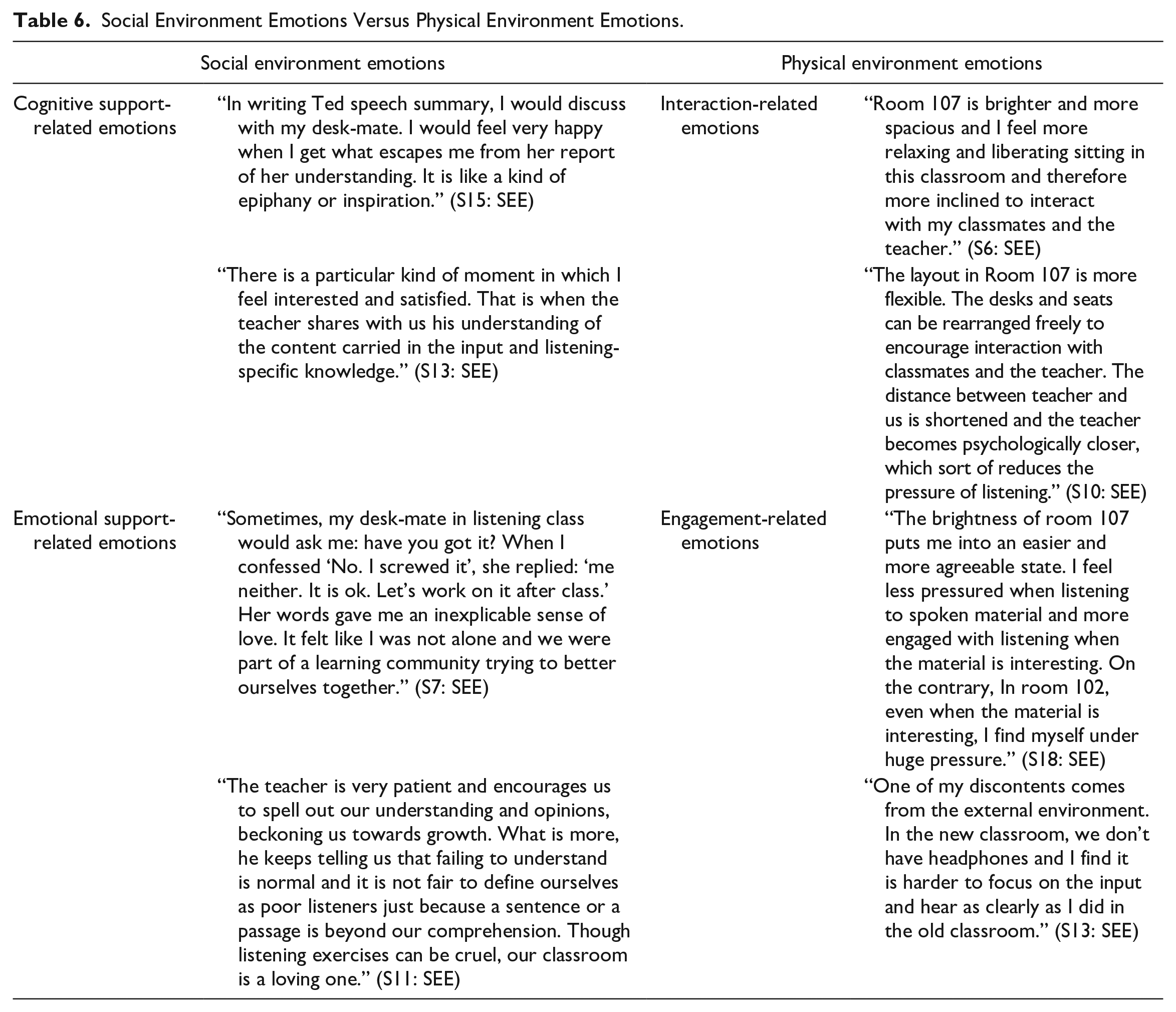
Besides the emotions inspired by the social environment, it was found in this study that the physical environment can play a role in listening learners’ emotions. It looks a little bit strange that while it is common knowledge that human beings are prone to the influence of their physical surroundings, the physical environment of a classroom is seldom brought up in relation to language learners’ academic emotions in contrast with the widely-discussed social environment. The physical environment emotions proposed in this study refer to the emotions triggered by the physicality of the classroom (the space, desk arrangement, lighting, learning facilities and equipment, etc.). The participants happened to be put into two different classrooms over the 1 year of listening learning. They were different in size, brightness, layout, multi-media facilities, seats and desks, etc. As marked in the FN (20181105), the participants looked excited and happy when they stepped into the bigger, brighter and better-equipped one, indicating that in addition to the mental climate of classroom, physical environment is another trigger of learners’ emotions. A rough analysis of JEE and SEE showed that all 22 participants reported opposing emotions when learning in different classrooms with mostly positive emotions like ease, relaxation and liberty and even optimism aroused in one while mostly negative emotions such as nervousness, pressure and restraint (lack of liberty) in the other. A further analysis of the data divided the emotions experienced into two types: interaction-related emotions and engagement-related emotions. As it can be seen from excerpts in Table 6, listening learners’ interaction with peers and the teacher is promoted by the bright and spacious classroom as well as the layout of chairs and desks. As a matter of fact, 19 of the 22 participants reported the layout of chairs and desks shortens the psychological distances among learners and between learners and the teacher, thus encouraging interaction and reducing pressure. Learners’ engagement with tasks can also be enhanced as the agreeableness of classroom’s physicality reduces the pressures while the disagreeableness does the opposite and thus discourages engagement. Yet, there was one participant complaining about the absence of individual headphones negatively affecting her engagement with the input and listening experiences, which also suggests the importance of physical affordance. In short, the above-mentioned emotions of physical environment, absent in Pekrun’s (2014) framework, look salient for listening learners. This is probably because listening learners are more sensitive to the physical environment of learning than learners of other subjects and skills. However, given the fact that learners’ emotions can’t possibly be completely free of the impact of their physical environment of learning, emotions of physical environment might justifiably be hypothesized as a main sub-category of academic emotions supplementing the other emotions proposed by Pekrun (2014) for learners in general.
Categorization is an important way of knowledge production by human beings and there are two approaches to emotion categorization. The first one, focused on creation of lists of primary emotions such as the one provided by Izard (2010), has been attempted by a number of researchers (Reeve, 2009). The second approach, focused on reducing distinct emotions to affective dimensions, views them as varying on two dimensions: arousal/activation and valence/pleasantness (Larsen & Fredrickson, 1999). These categorizations are domain/context free and therefore might not fit human emotional experiences in particular domains and be helpful for enhancement of domain-specific emotion. Thus, recent years have witnessed a shift of focus to contextualized categorization of emotional experiences in particular domains. This study is part of this contextualized line of inquiry. It examines a narrower and more specific domain: academic emotions of L2 listening learners and based on arousal and valence, develops a more expanded and refined framework of academic emotions for L2 listening Learning (see Table 2) which contrasts both general academic emotions and emotions of language learners in general.
The Findings and Discussion Regarding the Characteristics of Emotions Experienced
In addition to the categorization of emotions, this study proceeds with exploring the characteristics of academic emotions in L2 listening learning to arrive at a more nuanced representation. It was found in this study that emotions experienced in L2 listening learning are distinctive from those arising in learning other skills in terms of diversity, frequency and intensity.
Diversity of emotions experienced
Diversity is one of the most salient features about the emotions experienced by L2 listening learners in this study. Besides the diversity in terms of arousal as illustrated in 3.1, the emotional experiences are also diverse in the number of discrete emotions reported in JEE and SEE (Table 7).
Types of Discrete Emotions.

As shown in Table 7, learners experienced 11 discrete positive emotions and 16 discrete negative emotions. These emotions cover the majority of primary emotions proposed in emotion studies (e.g., Izard, 2010; Reeve, 2009) and the positive emotions reported covered a wide range of valued subjective experiences proposed in the field of positive psychology: well-being, contentment, and satisfaction (in the past); hope and optimism (for the future); and flow and happiness (in the present) (Seligman & Csikszentmihalyi, 2000). In comparison with language learners in previous studies, listening learners in this study seemed to have experienced more discrete emotions. In addition to those academic emotions reported in Pishghadam et al. (2016) and Piniel and Albert (2018) reports, learners in this study experienced such emotions as tranquility, flow, love, interest, apathy, etc. Such diversity was confirmed by SRI data as participants confessed that they experienced a wider range of emotions in listening learning than in learning of other language skills. When asked in SRI whether they experienced so many different emotions in learning other language skills (writing, learning and speaking), all of 22 participants answered “no” and agreed that the emotions experienced in learning other skills were significantly fewer than in learning listening. Given the varied proficiencies of the participants, this finding suggests the diversity of emotions is a distinctive characteristic of L2 listening learners regardless of listening proficiency.
Intensity of emotions experienced
While intensity is an important quality of emotions, it is somehow ignored in studies about academic emotions of language learners. As far as listening learning is concerned, there are some casual recordings in literature about listening instruction of learners’ strong negative emotions such as horror, discomfort, depression, feeling overwhelmed and even oppressed (Cauldwell, 2018; Rost & Wilson, 2013). This study has built a clearer picture of the intensity attribute of L2 listening learners’ emotions. The data showed that the participants experienced not only stronger negative emotions but also stronger positive emotions in listening learning than in learning other skills and generally speaking, negative emotions felt stronger than positive ones.
When asked to rate the intensity of their emotions (from 0 to 10) in learning four different language skills, listening learning was reported to be the process of the most intensive emotions (Table 8).
Ratings of Emotional Intensity Across Four Language skills.

As shown in the table above, listening scores the highest in emotional intensity as compared with speaking, reading and writing. Specifically, 11 of the 22 participants rated listening as the most intense while 5 of them listed both listening and speaking as the most intense. Such intensity of emotions felt were also illustrated in learners’ JEE. In describing their emotional experiences in their journals, such adverbs of degree as “very,” “much” “superb” were frequently used as modifiers of their emotions. Additionally, the emotions were also vividly described in their self-confessions which demonstrate the intensity, for example:
“Being able to understand a spoken passage or a clip of video without consulting the transcript or subtitles gives me the sense of relief, liberty and boosts my appetite for food” (S9: SEE)
“I often find that I lose my mind in the process of listening and lose clue of what is spoken and I do feel the impulse of throwing my headphones away.” (S15: SEE)
As shown in the two excerpts above, both positive and negative emotions can be of high intensity. Such intensity of emotion is also echoed by teachers’ classroom observation recorded in the FN. Learners were often found with facial expressions of joy, excitement and rapture. As for which emotions were more intensively felt: positive or negative, 14 participants reported that negative emotions were more intensely felt while 7 reported that positive emotion more intensely felt with one participant finding it hard to tell the intensity difference between positive emotions and negative ones. Generally speaking, it seemed that learners of lower listening proficiency felt more intense negative emotions than those of higher listening proficiency.
Frequency of emotions experienced
The third salient feature of emotional experiences in L2 listening learning is frequency. In contrast to intensity, frequency seems to be a major concern in studies of academic emotions. Piniel and Albert (2018) found that their participants experienced positive emotions more frequently than negative emotions in listening while the results of Pishghadam et al. (2016), showed that listening was primarily linked to negative emotions. More specifically, according to Piniel and Albert (2018), topic emotions were mentioned most frequently for reading (N = 42) followed by listening (N = 25), speaking (N = 12), and writing (N = 15) while achievement emotions mentioned most frequently for listening (N = 33) followed by reading (N = 20), speaking (N = 19), and writing (N = 21). Such findings were partly supported by the data of this study, which showed that emotions arose up more frequently in listening learning than in learning of other skills and the most frequent positive emotions (optimism, contentment, and interest) and negative emotions (frustration, sadness, and anxiety) were both related to achievement and input.
When asked to rate the frequency (from 0 to 10) at which their emotions were excited in learning four different language skills, the learners reported listening learning to be the process in which emotions arose the most frequently (Table 9).
Ratings of Emotional Frequency Across 4 Language skills.

As shown in the table above, listening scores the highest in emotion frequency as compared with speaking, reading and writing. Specifically, 10 of the 22 participants rated listening at the highest frequency while 5 of them listed both listening and speaking at the highest frequency. In SRI, one of the learners put it this way: “The process of learning other skills are more emotionally smooth with the emotional experiences mentioned above taking place much less frequently” (S2: SRI)
As for which emotions were more frequently felt: positive or negative, 11 reported negative ones and 8 positive ones with 3 finding it hard to tell the frequency difference between positive emotions and negative ones. As for the frequency at which each of the emotions was experienced, optimism (6.54), contentment (5.45), and interest (5.27) were the three most frequently felt emotions while frustration (5.90), sadness (4.95), and anxiety (4.90) the three most frequently felt negative ones. There was an obvious individual difference with less proficient L2 listening learners experiencing more frequently negative emotions than more proficient learners.
As to what factors might contribute to these three characteristics, few accounts have been found. Piniel and Albert (2018) think the difference in frequency can be explained by different samples, educational contexts and research methodologies involved in two studies. This study found that the characteristics in intensity and frequency were closely related to individual differences in listening proficiency. What is more, the distinctive nature of listening could be another contributing factor as most participants pointed out that these more diverse, intensive and frequent emotional experiences were more related to listening than speaking, writing, and reading.
Implications and Conclusion
While the domain-specificity of academic emotions has been confirmed by empirical studies and the inquiries into L2 language learners’ emotions have been on the rise, few studies have been made to explore the emotional experiences of language learners in learning listening, the most difficult language skill to teach (Walker, 2014). This study proposes a more expanded and refined categorization and three distinctive characteristics of academic emotions of undergraduate English majors in L2 listening learning, based on various sources of qualitative data collected over two semesters. Such categorization and characteristics not only add to the knowledge base of L2 listening learners’ academic emotions, but also carry specific implications for listening instruction. They highlight to listening instructors the importance of paying attention to learners’ emotions in listening learning and encourage them to better their emotional experiences by (1) optimizing the emotional triggers revealed and (2) serving as an emotion mentor.
Firstly, listening instructors are expected to try their best to optimize the four above-mentioned emotional triggers. To optimize learners’ achievement emotions, epistemic emotions and input emotions, instructors are expected to develop listening materials with quality content and form as well as being appropriately challenging. This could be a greater challenge because, as revealed in this study, quality content of input refers not only to interesting topic but also inspiring ideas while quality form of input to not only what is textual but also what is acoustic. Yet, the efforts would be worthy as they are frequently mentioned by learners in this study. To optimize social environment emotions, instructors are also expected to create conditions where learners are more likely to get both cognitive and emotional support from their teacher and peers. To optimize physical environmental emotions, instructors are expected to, when possible and proper, seek access for a classroom which is bright, spacious, and equipped with quality facilities for listening instruction.
Secondly, listening instructors are not emotion mentors or therapists. However, the emotional experiences illuminated suggest that they perhaps should be in order to help their learners make a better use of their emotions rather than being at the mercy of them. In spite of the efforts mentioned above to optimize the emotional triggers, it would be impossible to have all the materials, the social environment and the physical environment perfect for all the learners given availability constraints of relevant resources and individual differences of learners in listening proficiency, learning style, and even personal interests, etc. It would possibly be inevitable and therefore normal to feel greater emotional fluctuations in L2 listening learning because of the nature of L2 listening. Listening learners deserve to be made aware of these impossibilities and possibilities in order to have a reasonable anticipation of their emotional experiences in the process of L2 listening. Moreover, learners are supposed to know that both positive and negative emotions can be regulated to promote learning. As a matter of fact, to better learners’ emotional experiences and well-being, many strategies and techniques have been proposed in both PP in general (Gross, 1998; Seligman et al., 2005) and PP for SLA (Fresacher, 2016; Gregersen et al., 2016; Gregerson et al., 2014; Helgesen, 2016, 2018). Such interventions may be contextualized and personalized (Fresacher, 2016; Gregersen et al., 2016; Reschly et al., 2008) for listening instruction by teachers in order to help improve the process and product of L2 listening learning. In this sense, listening instructors are expected to play the role of emotion mentor.
Along with the knowledge contribution and pedagogical implications of this study are its limitations which shall be addressed in future studies. Firstly, while the data in this study are collected over two semesters, the possible changes in listening learners’ academic emotions over time are not traced systematically. Secondly, although a wide range of academic emotions and their characteristics are revealed, the effect of these distinctive emotions on listening learning is not examined. Thirdly, this study does not look into how listening learners regulate their emotions naturally before introduction of teacher’s interference scheme. As the change of listening learners’ emotions over time, the effect of their emotions on learning and their self-regulation strategies will contribute to a richer picture of their emotional landscape in the process of listening learning and offer more insights for listening instruction, they deserve to be explored systematically in the future by researchers interested in positive psychology and concerned about listening pedagogy.
Footnotes
Acknowledgements
I’d like thank to all the learners who agreed to be part of this study for their sincere cooperation.
Declaration of Conflicting Interests
The author declared no potential conflicts of interest with respect to the research, authorship, and/or publication of this article.
Funding
The author disclosed receipt of the following financial support for the research, authorship, and/or publication of this article: This work was supported by CUFE Teacher Development Center Fund [grant number JFY20180007].
