



Abstract
This study explores the factors that influence the intention to engage in green purchase behavior among Vietnamese consumers. The study integrates the Theory of Planned Behavior (TPB) and Social Cognitive Theory (SCT), incorporating the impacts of environmental consciousness, subject norms, perceived marketplace influence, and health consciousness. The study examines these factors as antecedents that influence attitudes and perceived behavioral control and ultimately lead to green purchase intention. Employing a quantitative research method, gathering data from a structured survey of 526 Vietnamese consumers. PLS-SEM was employed to examine the proposed correlations. The results indicate that both attitude and perceived behavior control directly affect green purchase intention. Additionally, environmental consciousness, subject norm, perceived marketplace influence, and health consciousness are demonstrated to influence customers’ attitudes and perceived behavior control. The research further reveals two moderating effects. Perceived environmental responsibility positively moderates the relationship between attitude/perceived behavior control and green purchase intention, suggesting that individuals with heightened pro-environmental attitudes and enhanced control are more inclined to engage in green purchasing behaviors. Conversely, price sensitivity negatively influences the relationship between attitude and green purchase intention, indicating that price-sensitive customers may choose cost-effective green items. These findings provide insightful suggestions for politicians and marketers aiming to encourage green consumption in Vietnam.
Keywords
Introduction
Climate change poses significant threats to developing nations, including Vietnam, which is highly vulnerable to its impacts. In 2020, these impacts cost Vietnam an estimated $10 billion, or 3.2% of its GDP. Projections suggest this damage will be 12% to 14.5% of GDP by 2050 if no adaptive measures are taken (World Bank, 2022). In response, the Vietnamese government has implemented various policies to encourage green consumption, such as the Law on Environmental Protection and the Green Growth Strategy for 2021 to 2030. These initiatives have led to a 15% growth in the green product market share between 2021 and 2023, with a target of increasing the green economy’s contribution to GDP from $6.7 billion in 2020 to $300 billion by 2050 (GOV, 2023). This aligns with consumer sentiment, as over 72% of Vietnamese consumers will be willing to pay extra for green products (MOIT, 2024). This rising consumer awareness of environmental issues is expected to drive green consumption trends (Lavuri et al., 2023), encouraging businesses to adopt green marketing strategies, integrate sustainability into their operations, and support environmentally friendly products.
The research stream on green consumption employs various theoretical frameworks, but the theory of planned behavior (TPB), the most widely applied model (K. Sharma et al., 2023), identifies three key determinants of behavior: “attitude (ATT), subject norm (SN), and perceived behavior control (PBC)” (Ajzen, 1991). However, TPB has faced criticism for its limited scope, as it often excludes elements like emotions, morals, ethics, and habits, thereby restricting its comprehensive applicability (Alam et al., 2024; Rozenkowska, 2023). Furthermore, TPB may lack predictive power, especially for individuals who do not act on their intentions, and it struggles to explain long-term behavioral patterns (Rozenkowska, 2023) or the influence of past behavior and experience (Zerbini et al., 2017). Researchers have therefore called for extensions to TPB through the inclusion of additional variables or by combining it with other models. The Social Cognitive Theory (SCT) offers a comprehensive perspective that focuses on personal, behavioral, and environmental factors (Schunk & DiBenedetto, 2021), which can complement the limitations of TPB. While SCT has been extensively applied in fields such as healthcare (Godin et al., 2008), education (Torre & Durning, 2015), technology (T. C. Lin & Huang, 2008), and human resource management (Zhao & Zhou, 2021), its application in green consumption research remains limited (Table 1). (H. Y. Lin & Hsu, 2015; Michel et al., 2023; Phipps et al., 2013; Preko, 2017; Sawitri et al., 2015), particularly in developing countries like Vietnam.
Studies on Green and Sustainable Consumption Using SCT Theory.

Source. Author’s work.
Green purchasing behaviors can be affected by several psychological, cultural, and social factors (K. Sharma et al., 2023). Key factors include subject norm (SN), perceived marketplace influence (PMI), and health and environmental consciousness (HCS and ECS), all of which can enhance green purchase intention (GPI). Despite widespread environmental and health consciousness, genuine usage of environmentally friendly products remains limited (Yadav & Pathak, 2017). In Vietnam, where collectivism is highly valued and individuals are closely linked to their families or communities, subject norms often significantly influence purchasing decisions, and individuals tend to adjust their behavior to fit in with the collective (Van Phuong et al., 2025). On the other hand, individuals often see themselves as part of a group where their actions can affect the collective, which may also impact perceived marketplace influence (PMI). However, PMI is mainly unexplored in environmental consumption research (Joshi et al., 2021; Leary et al., 2017; Michel et al., 2023), representing a significant research gap. Previous studies have explored the disparity between ATT and GPI (Sultan et al., 2020), often called the “green gap” (ElHaffar et al., 2020). However, the gap between PBC and GPI has not been thoroughly examined (Sultan et al., 2020). Moderating elements can partially address such research gaps (ElHaffar et al., 2020).
Recently, Perceived Environmental Responsibility (PER) has garnered attention from researchers and is considered an antecedent (Duong et al., 2022), determinant (Suki & Suki, 2019), and mediator (Shahrin et al., 2020). Hoang and Tung (2024) examined the moderating effect of PER on the interaction between attitudes and behaviors in Generation Z consumers. Nevertheless, this study has not examined the particular influence of PER on the interaction between PBC and GPI. Although consumers exhibit increasing environmental consciousness, the trend does not consistently manifest in their green purchase behavior, which is frequently hindered by obstacles such as cost. Price fulfils two roles: (1) it serves as a metric of trade-off value, indicating the financial expenditure associated with a product, and (2) it performs as an informational signal, providing insights into product quality (Hsu et al., 2017). Price-sensitive consumers may possess fewer positive opinions and have less participation with environmentally friendly products (Zepeda & Deal, 2009). Karuppiah and Ramayah (2023) discovered that PS adversely attenuated the association between ATT/PBC and the propensity to acquire electric vehicles. In contrast, heightened environmental consciousness and robust personal values have demonstrated an increase in consumers’ readiness to pay a premium for eco-friendly items (Rahma et al., 2025). Hsu et al. (2017) indicated the favorable moderating influence of PS on the relationship between ATT/PBC and the inclination to purchase green skincare products. This study seeks to further the comprehension of PER’s moderating role by examining its impact on the link between PBC and intention. Simultaneously, it aims to reassess the moderating influence of PS in the realm of green product acquisition.
This study has three objectives:
(1) To examine the influence of antecedent factors (ECS, SN, PMI, and HCS) on GPI as mediated by ATT and PBC.
(2) To investigate the moderating roles of PER and PS in the relationships between ATT, PBC, and GPI.
(3) To propose effective governance policies that can promote green purchasing intentions in Vietnam?
This research contributes numerous theoretical contributions to the field of green consumer behavior. Initially, it suggests an integrated SCT with a TPB model to analyze green purchasing intention and its principal antecedents (ECS, SN, PMI, and HCS). These characteristics serve as external drivers of consumer decision-making under the expanded TPB model, corresponding with essential components (environmental-personal-behavior) in SCT. Furthermore, this study emphasizes the moderating roles of PER and PS in connecting attitude, perceived behavioral control, and green buying intention. Ultimately, it examines green purchasing intents and expands the notion of sustainable consumerism within a dynamic global framework. The present research provides valuable recommendations for governments and companies to promote sustainable consumption in the contemporary day.
Theoretical Framework
This study conceptually combines TPB and SCT to enhance the understanding of green consumption behaviors. TPB elements include “attitude, subject norm, and perceived behavior control” (Ajzen, 1991). SCT, on the other hand, fosters triadic reciprocity, which helps explain the ongoing, interacting, and reciprocal influence of personal, behavioral, and environmental factors (Schunk & DiBenedetto, 2021). Rather than passively responding to environmental signals, SCT proposes that individuals actively alter their environments using cognitive and behavioral mechanisms (Bandura, 2001; Phipps et al., 2013). This integrated framework directly aligns the components of the SCT and TPB factors.
Environmental factors: SCT’s environmental elements encompass social impacts as well as outside stimuli. ECS is an individual’s concern about environmental problems affecting their pro-environmental activity (Chang & Chen, 2012), where individuals see themselves as part of the natural environment and feel responsible for the common good (Zelezny & Schultz, 2000). The social environment’s external pressures and expectations are represented by SN (Preko, 2017). PER is derived from the external reality of environmental challenges and social expectations, which represent a person’s felt commitment to promote ecological well-being (Shahrin et al., 2020).
Personal factors include internal cognitive processes, beliefs, and self-efficacy (Bandura, 2001). Ajzen (1991) defined ATT as “an individual’s internal evaluation of their actions.” PBC also refers to “an individual’s perception of their ability to perform a specific behavior” (Ajzen, 1991). PMI reflects an individual’s efficacy-based beliefs in their ability to influence others or organizations in the market (Leary et al., 2014). HCS represents an individual’s internal awareness and motivation regarding their well-being (Hong & Chung, 2022; Uikey et al., 2024). PS, an individual trait, dictates the degree of attention paid to low prices during purchase decisions (Zepeda & Deal, 2009).
Behavior Factors: GPI, a behavioral factor in SCT, directly corresponds to TPB’s central factors of behavioral intention, representing a person’s motivation to engage in specific green purchasing behaviors (Ajzen, 1991).
This dynamic interplay demonstrates how personal convictions, social and environmental contexts, and behaviors continuously shape and reinforce each other toward green consumption.
Hypothesis and Model Development
Environmental Consciousness (ECS)
ECS is defined as “an individual’s awareness and concern for environmental issues, reflecting their commitment to environmental protection and sustainability” (Chang & Chen, 2012). ECS represents the broader social context and pressure and is considered an environmental stimulus (Laheri et al., 2024). Individuals with high environmental consciousness often recognize the necessity of environmental protection and the influence human conduct has on ecosystems (Kautish et al., 2019). This awareness represents a self-value that encourages a positive ATT and PBC toward green products (Alam et al., 2024; Khan, 2024).
Subject Norms (SN)
SN refers to “the social pressures individuals perceive, which influence their decisions to engage in or abstain from specific activities” (Ajzen, 1991). In Vietnam, cultural characteristics are influenced by the collective, making SN play an even stronger role: green behavior is not only a personal choice but also a way to maintain social cohesion (Van Phuong et al., 2025). The TPB identifies SN as a key predictor of intention, which in turn influences both ATT and PBC. Essentially, when individuals experience social pressure to adopt certain behaviors, this pressure affects their overall assessment of the behavior and belief in their capability to achieve it (Ishaq et al., 2021; Varah et al., 2021; Tarkiainen & Sundqvist, 2005).
Perceived Marketplace Influence (PMI)
The concept of PMI primarily revolves around individuals’ perceptions of how their actions impact others, thereby fostering sustainable development (Leary et al., 2014). PMI serves two main functions depending on the research context: its influence on other consumers and its impact on businesses (Leary et al., 2017). Prior research indicates that PMI motivates individuals to cultivate positive attitudes toward pro-environmental purchasing behaviors (Michel et al., 2023). Drawing from SCT, the PMI serves as an efficacy-based belief that an individual’s actions can impact other marketplace participants, which aligns with SCT’s focus on how personal beliefs and environmental factors shape behavior (Kautish et al., 2024). This belief directly fosters an increased sense of personal autonomy and command over market outcomes (Leary et al., 2014); as a result, an individual’s apparent power over their actions is reinforced, as is their ability to effect larger change.
Health Consciousness (HCS)
HCS is an important predictor of consumer behavior, especially in green purchasing (Uikey et al., 2024). Prior research has shown that people with greater levels of HCS produce more positive ATT, recognizing their intrinsic benefits for personal well-being (Gam et al., 2020; Yadav & Pathak, 2016). Furthermore, these customers are more inclined to have greater PBC when it comes to purchasing green goods. This is because increased awareness of health concerns helps boost confidence in one’s capacity to act effectively and wisely concerning consumption decisions (Gam et al., 2020; Ishaq et al., 2021). Therefore, those who sincerely care about their health are prone to overcome obstacles to environmentally responsible purchasing, expecting that they can directly affect their health advantages through consumption patterns.
The Mediating Role of Attitude (ATT), Perceived Behavioral Control (PBC)
ATT denotes “a consumer’s positive or negative appraisal of green purchasing behavior” (Joshi et al., 2021). Consumers that have a favorable view toward green products are more inclined to purchase them. PBC is “an individual’s assessment of the ease or difficulty of engaging in green purchasing behavior” (Duong et al., 2022). It is strongly connected to self-confidence and resource availability, both of which are important factors in decision-making (Joshi et al., 2021). Empirical research repeatedly shows a favorable relationship between ATT, PBC, and GPI.
The Moderating Role of Perceived Environmental Responsibility (PER) and Price Sensitivity (PS)
PER reflects an individual’s commitment to minimizing environmental harm and fulfilling ethical obligations, fostering pro-environmental actions like choosing eco-friendly products (Hosta & Zabkar, 2021; Shahrin et al., 2020). In green consumption, PER mitigates the negative impacts of conventional consumption, encouraging environmentally conscious choices (Hamzah & Tanwir, 2021). Consumers with higher PER are more likely to adopt green behaviors, develop positive attitudes, and enhance perceived behavioral control, leading to stronger purchase intentions (Hamzah & Tanwir, 2021; Michel et al., 2023; Suki & Suki, 2019). This aligns with SCT, which highlights the interaction between personal and environmental elements in shaping behavior (Michel et al., 2023). Although PER has been investigated as a determinant or mediator, its function as a moderator within the TPB framework has not been thoroughly explored (Hoang & Tung, 2024). This study examines PER as a moderator, thereby bridging the gap between ATT, PBC, and GPI.
A key barrier to the adoption of green products is that consumers prioritize pricing over other factors (Hsu et al., 2017). Despite recognizing the environmental benefits, consumers often opt for cheaper alternatives (Bhutto et al., 2022). PS moderates the interaction between ATT, PBC, and GPI, with studies showing mixed effects (Bhutto et al., 2022; Hsu et al., 2017). In Taiwan, Hsu et al. (2017) discovered that this factor positively moderates ATT and PBC in green skin care product purchasing intentions. However, Bhutto et al. (2022) in Pakistan reported a negative moderating impact on hybrid automobile purchase intentions. In Malaysia, Karuppiah and Ramayah (2023) noticed that PS affects green buying intention. Highly price-sensitive consumers may have less positive attitudes and be less likely to continue making green purchases (Van Hoang & Le Thanh, 2024). Despite having a positive viewpoint about green products, price-sensitive customers are less likely to engage in green activities due to high expenses (Bhutto et al., 2022).
The conceptual model for this study (Figure 1).

The conceptual model.
Methodology
Measures
This study used a quantitative research design; a structured questionnaire is a data-collecting tool that is the best tool for gathering practical responses and has been used in many past studies (Cheung & To, 2019; Joshi et al., 2021; Lavuri et al., 2023; Varah et al., 2021; Yadav & Pathak, 2016). Three sections made up the questionnaire: the first screened those fit for the research orientation, those 18 years of age and above; the second gathered consumer demographic data; and the third included items relevant to the research concepts. Every component of the structure was assessed on a 5-point Likert scale. Cheung and To (2019) note that ECS was evaluated on a 3-item scale. The studies of Joshi et al. (2021), Leary et al. (2014), and Tarkiainen and Sundqvist (2005) used the 3-item scale to assess SN, PMI, and HCS. Varah et al. (2021) utilized the 4-item scale to evaluate ATT; from Lavuri et al. (2023), the 3-item scale to evaluate PBC and GPI was employed by Yadav and Pathak (2016). Designed from Hamzah and Tanwir (2021) and Karuppiah and Ramayah (2023), the 4-item scale evaluates PER and PS.
Data Collection and Sampling
The study focused on consumers’ intentions to purchase green products. Participants were randomly approached and had to be at least 18 years old to ensure they were adult consumers with the capacity to make purchasing decisions. A non-probability convenience sampling method was used for three main reasons. First, a complete list of consumers intending to buy green products was not available for probability sampling. Second, potential participants were geographically dispersed, making random sampling impractical. Third, convenience sampling is frequently utilized in behavioral research due to its cost-effectiveness and efficiency in data collection within constrained budgets and time limits (Chanda et al., 2023; N. Sharma et al., 2022). This methodology has been employed in prior research about green purchase intentions (Chanda et al., 2023; Joshi et al., 2021; N. Sharma et al., 2022).
Before conducting the official survey, a pilot test was carried out with 150 respondents aged 18 and above to assess the reliability of the measurement scales using SPSS 20. The results of this pilot helped refine and improve the final questionnaire. The main data collection took place between September 2024 and March 2025. Following Hair et al. (2019), the minimum required sample size was ten times the number of observed items. The minimum required sample size for 30 measurement items is 300. A total of 724 questionnaires were gathered, comprising 250 in-person surveys from the southern region and 474 online responses through Google Forms nationwide. Participation was entirely voluntary, and informed consent was obtained from all respondents. Upon removing incomplete or ineligible replies, including those from individuals under 18 years of age, 526 valid questionnaires were retained for study.
Data were analyzed via PLS-SEM by SmartPLS 4 software. The analysis occurred in two phases: initially, evaluating the reliability and validity of the constructs; subsequently, examining the proposed links among them (Hair et al., 2019). Bootstrapping with 5,000 samples was conducted to assess the significance of direct effects in the proposed model.
Results and Discussions
Descriptive Statistics
Among 526 survey participants (Table 2), 57.98% were women and 42.02% were men. The majority (56.46%) were single, while 43.54% were married. The largest age group was 18–28 (48.29%), followed by 29 to 44 (40.11%). About 9.89% of participants were 45 to 60, while 1.71% were over 60. Most participants (60.46%) held college degrees, while 16.35% had intermediate degrees. Only 9.13% were high school graduates; 14.07% were postgrads. Office workers (36.31%) outnumbered students (24.33%). Managers accounted for 8.17%, and trade/housekeeping also accounted for 11.60%. Other workers made up 13.12%, while direct production workers made up 6.46%. Most participants (40.49%) earned less than 10 million VND each month, while 30.23% earned 10–20 million. Only 11.98% made over 30 million VND; 17.30% earned 20–30 million. The majority of participants (73.95%) came from the South, as paper surveys were collected directly from consumers in this region, while the North and Central regions were mainly collected through online surveys, of which the North was 13.88% and the Central region was 12.17%.
Demographic Statistics.

Source. Primary data.
Common Method Bias (CMB)
To address potential CMB problems, two post-hoc statistical analyses were carried out. Initially, we applied Harman’s single-factor test. The result shows that the first unrotated component accounted for 25.309% < 50% (Podsakoff et al., 2003), indicating that the CMB is not a major worry. We then performed a thorough collinearity test using the methods proposed by Kock and Lynn (2012). The VIF values across all latent variables varied between 1.450 and 2.176. These values are significantly lower than the crucial threshold of 3.3 (Hair et al., 2019). The results of both experiments provide persuasive evidence that CMB does not pose a significant threat.
Measurement Model
The study employs PLS-SEM to evaluate the proposed framework. PLS-SEM was chosen instead of CB-SEM because it can handle complicated models, work with smaller groups of data, deal with data that doesn’t follow a normal pattern, and help in developing theories (Hair et al., 2019). It excels in predicting outcomes and is suitable for complex theoretical models with limited pre-existing information (Henseler et al., 2016). This approach facilitates the concurrent estimation of route coefficients, correlations, shared variance, and significance levels while considering all covariances in the dataset (Bollen, 1989). Its capability to simultaneously estimate all pathway coefficients independently ensures robust results, making it a widely adopted approach in social sciences and marketing (Hair et al., 2019).
The study assessed construct validity and reliability by evaluating Cronbach’s α, CR, AVE, and discriminant validity. Cronbach’s α is in the range [0.758-0.878] > 0.708 (Hair et al., 2019). Table 3 indicates that all constructions demonstrate CR values between 0.858 and 0.916, exceeding the 0.70 criterion suggested (Hair et al., 2019), so affirming internal consistency. The AVE values above 0.50 fulfill the criterion set by Hair et al. (2019), signifying adequate convergent validity. Discriminant validity was confirmed by the HTMT criterion. The HTMT values presented in Table 4 varied from 0.003 to 0.541, below the suggested threshold of 0.90 (Henseler et al., 2016).
The Reliability and Validity Assessment.

Source. Results from Smart PLS 4.
The HTMT Value.

Source. Results from Smart PLS 4.
Structural Model Evaluation
Path coefficient (β) analysis, R2 values, collinearity diagnostics (VIF), and bootstrapping 5,000 resamples helped assess the structural model. Well below the 3.3 criterion, the VIF ranged from 1.450 to 2.176, therefore proving the lack of multicollinearity problems (Hair et al., 2019). The coefficient of determination (R2) values indicate that the model has a modest ability to predict outcomes, explaining 26.5% of the changes in PBC, 31.2% in ATT, and 32.9% in GPI, which is 26% higher than the suggested level (Cohen, 2013). The model’s suitability is assessed through the SRMR; SRMR = 0.66 < 0.08. Additionally, Q2 values (PBC = 0.192; ATT = 0.026; GPI = 0.245) > 0, validating the predictive significance of the model (Hair et al., 2019)
The Result of PLS-SEM
The Result of PLS-SEM.
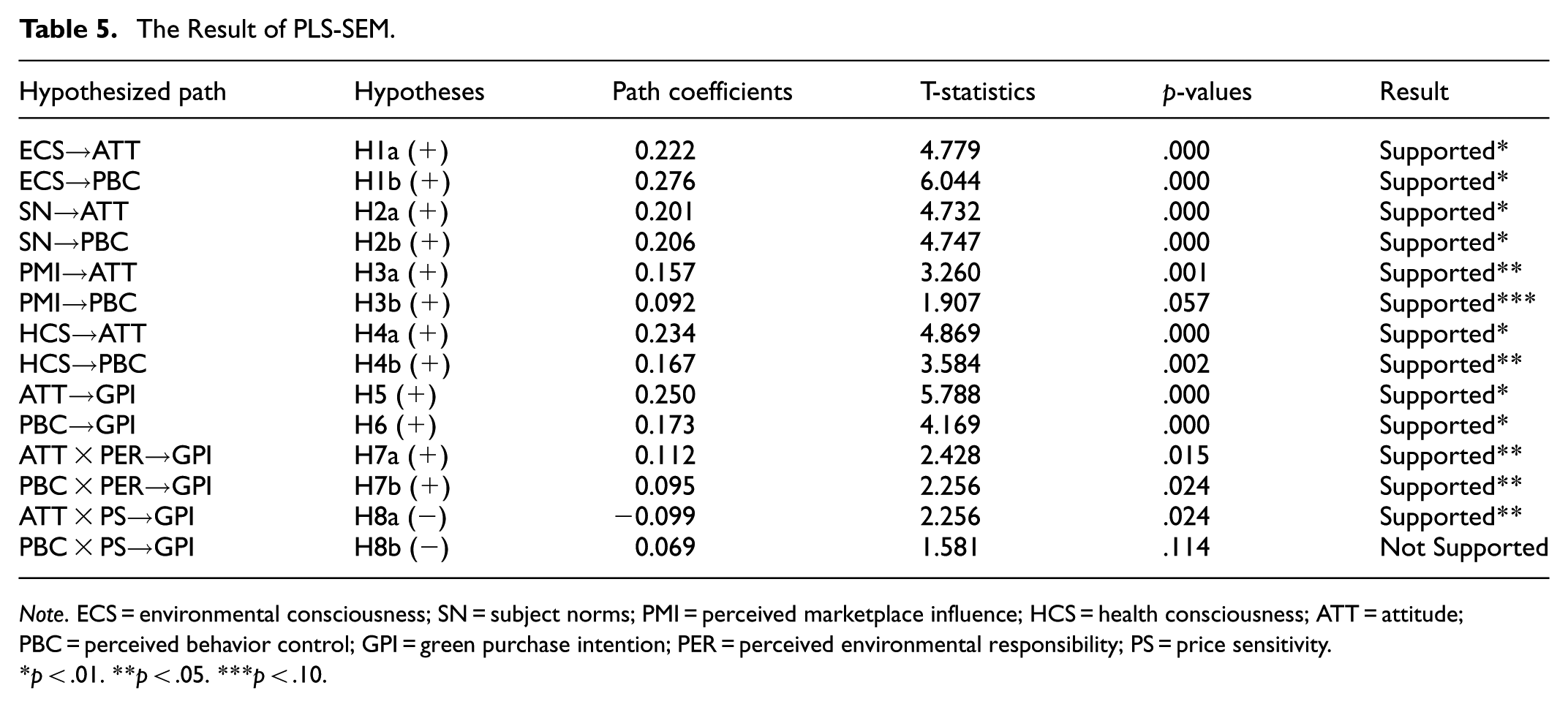
Note. ECS = environmental consciousness; SN = subject norms; PMI = perceived marketplace influence; HCS = health consciousness; ATT = attitude; PBC = perceived behavior control; GPI = green purchase intention; PER = perceived environmental responsibility; PS = price sensitivity.
p < .01. **p < .05. ***p < .10.
Discussion
Table 5 and Figure 2 confirm all hypotheses at the 10% significance level, except hypothesis H8b, and the findings align with previous studies. Hypothesis H1a (ECS → ATT; β = 0.222, p < .01) and H1b (ECS → PBC; β = 0.276, p < .01) are consistent with the studies by Alam et al. (2024), which show that individuals who are highly ECS have a better attitude toward environmental behavior and believe they can better control their environmental impacts and take action to address ecological challenges (Alam et al., 2024; Khan, 2024). Hypothesis H2a (SN → ATT; β = 0.201, p < .01) and H2b (SN → PBC; β = 0.206, p < .01) align with the results from Duong et al. (2022) and Ishaq et al. (2021), showing that social approval and collective expectations significantly shape consumer perceptions and confidence in adopting green behaviors (Ghouse et al., 2024). In Vietnam’s collectivist society, adherence to social ideals and community approval increases individuals’ incentive to participate in environmentally sustainable shopping (Van Phuong et al., 2025). Hypotheses H3a (PMI → ATT; β = 0.157, p < .05) and H3b (PMI → PBC; β = 0.092, p < 0.1) are supported by the study of Joshi et al. (2021) and Hoang and Tung (2024). When customers perceive that their choices are not only for personal benefit but also have the potential to encourage others to participate, they tend to view green purchasing behavior as worth pursuing and show more favorable attitudes (Joshi et al., 2021). This belief drives higher behavioral capability, encouraging individuals to overcome barriers and allocate resources (money, time, and effort) toward green consumption. Consumers who possess confidence in their capacity to effect change via their decisions typically exhibit enhanced behavioral control (Karuppiah & Ramayah, 2023). H4a (HCS → ATT; β = 0.234, p < .01) and H4b (HCS → PBC; β = 0.167, p < .01), similar to the result of Gam et al. (2020) and Ishaq et al. (2021), HCS consumers tend to purchase products that promote well-being and enhance their lifestyle choices. They actively seek health-safe and green items (Gam et al., 2020; Ishaq et al., 2021). H5 (ATT → GPI; β = 0.250, p < .01) and H6 (PBC → GPI; β = 0.173, p < .01) confirm the TPB core assertion that favorable ATT and PBC influence intentions to purchase environmentally friendly products (Duong et al., 2022; Yadav & Pathak, 2016).

Measurement model analysis results.
This study confirms hypothesis H7a (ATT × PER → GPI, β = 0.112, p < .05), and H7b (PBC × PER → GPI, β = 0.095, p < .05) is confirmed, showing that PER moderates the relationship between ATT/PBC and GPI. This indicates that moral responsibility serves as a psychological conduit between belief and action, motivating individuals to overcome barriers and align consumption with environmental principles (Duong et al., 2022; Hosta & Zabkar, 2021). Figure 3 and Figure 4 show interaction effects, in which steeper slopes imply that higher PER levels strengthen the positive association between ATT and GPI. PER is both a driving factor and an enhancer of the relationship between attitude/pbc and behavior through an individual’s sense of environmental responsibility in the context of increasing awareness of environmental protection in Vietnam (Michel et al., 2023; Shahrin et al., 2020; Suki & Suki, 2019). For consumers, environmental responsibility is a more ubiquitous phenomenon that has been present in their lives for a longer amount of time than social responsibility; over time, customers believe that carrying out environmental duty is an ethical obligation (Hosta & Zabkar, 2021). Furthermore, PER strengthens the ATT/PBC and GPI relationship, particularly among those with higher environmental responsibility, highlighting the environmental factor’s dynamic interaction with personal factors and behavior factors in SCT (Hoang & Tung, 2024).

The role of PER moderating the impact of ATT on GPI.

The role of PER moderating the impact of PBC on GPI.
This study confirms hypothesis H8a (ATT × PS → GPI, β = −0.099, p < .05) is confirmed, showing that PS moderates the relationship between ATT and GPI. PS has a negative moderating effect on the ATT-GPI (β = −0.099), indicating that price-sensitive consumers prefer affordable costs over environmental benefits (Bhutto et al., 2022). Despite favorable sentiments regarding green products, PS may prevent the intention to acquire green products (Karuppiah & Ramayah, 2023). Figure 5 shows interaction effects, in which steeper slopes imply that higher PS levels intensify the favorable relationship between ATT and GPI. Since green products often carry premium costs due to high-quality production expenses, price-sensitive consumers may perceive them as financially inaccessible (Bhutto et al., 2022). For numerous Vietnamese consumers, cost continues to be a significant barrier in converting favorable perceptions into purchasing behavior. This highlights that while social and moral motivations encourage green intention, economic feasibility remains an important condition for sustainable consumer behavior in Vietnam’s emerging market. Interestingly, PS showed a positive moderating impact (β > 0) in the PBC-GPI. Price-sensitive consumers with high PBC actively search for reasonably priced green substitutes instead of weakening this relationship, hence increasing their buy intent. However, when consumers perceive good value or believe they can find reasonably priced green alternatives, their willingness to buy increases (Van Hoang & Le Thanh, 2024).

The role of PS moderating the impact of ATT on GPI.
Conclusion
The integration of TPB and SCT in this study offers a comprehensive and contextually relevant explanation of how Vietnamese consumers form their GPI through the interaction of environmental, personal, and behavioral factors. The model integrates the cognitive, social, and moral dimensions of green consumption and demonstrates that consumer sustainable behavior is not only influenced by rational decisions but also by social influence and internalized moral principles. Among the external factors, SN shows the collectivist nature of Vietnamese society to create distinctive dynamics in which consumer choice is greatly affected by social pressure and a public sense of environmental responsibility (Van Phuong et al., 2025). ECS also emerged as a solid driver, indicating that individuals who are aware of environmental concerns tend to create stronger beliefs regarding their ability to act responsibly toward the environment (Cheung & To, 2019).
At the personal factors, PMI and HCS reinforce green purchasing tendencies. Consumers’ perception that green goods are healthy and beneficial to the environment will motivate them to choose these products (Ishaq et al., 2021), while those responsible for the environment in the marketplace always wish they could inspire others through green choices (Joshi et al., 2021), demonstrating the SCT reciprocal determinism, where personal beliefs and social feedback mutually reinforce each other. ATT and PBC remain the central motivation mechanisms by which these elements are translated into intention, supporting TPB’s structural consistency within the integrated framework.
The moderating roles of PER and PS also help narrow the “ATT/PBC-GPI” gap PER integrates the connection among attitude, perceived control, and intention by instilling a sense of moral obligation (Duong et al., 2022); elevated price sensitivity indicates that cost acts as an impediment to purchase intention (Hsu et al., 2017), yet if price functions as an indicator of product quality, it may augment perceived control when the product is reasonably priced (Karuppiah & Ramayah, 2023). The study demonstrates that sustainable consumption in Vietnam is the result of moral engagement, collective influence, and self-belief converging to shape eco-conscious behavioral intentions.
Implications
Theoretical Implications
Green consumption is a multifaceted phenomenon influenced by numerous variables. While previous studies on green or sustainable consumption have predominantly relied on TPB, the potential of SCT to explain the social, economic, and environmental factors influencing consumer behavior has been limited in this field (H. Y. Lin & Hsu, 2015; Michel et al., 2023; Phipps et al., 2013; Preko, 2017; Sawitri et al., 2015). The study addresses this gap by integrating SCT with external environmental factors (ECS, SN, and PER), personal factors (PMI, HCS, ATT, PBC, and PS), and behavioral factors (GPI). It also broadens TPB by incorporating additional antecedents, such as ECS, SN, PMI, and HCS, to enhance the comprehension of the predictors of green consumer behavior.
Furthermore, moderating factors such as PER and PS are considered simultaneously to narrow the gap between ATT/PBC and GPI. Ethical consumption, which is linked with ecological obligation, can alleviate the negative effects of conventional consumption and promote green shopping (Duong, 2024). PS also influences green purchasing patterns, as green items may be priced higher than non-green products (Prakash et al., 2019). Some research shows that emphasizing economic considerations has a detrimental influence (β < 0), while others believe that higher costs signal greater quality, allowing environmentally concerned customers to accept premium pricing (Hsu et al., 2017; Karuppiah & Ramayah, 2023). This study addresses the research gap between ATT/PBC and purchase intentions in existing theories.
Ultimately, this research provides critical managerial insights into environmentally responsible consumption, particularly in collectivist cultures like Vietnam. By combining SCT and TPB, the study provides an enhanced comprehension of the intricacies of green consuming behaviors and suggests solutions to further sustainable practices in the future.
Managerial Implications
First it is essential for managers to understand that environmentally conscious consumers choose eco-friendly firms and goods (Prakash et al., 2019). This understanding typically prompts environmental action. Companies ought to advocate the environmental advantages of their products, including pollution mitigation, sustainable resource utilization, and conservation efforts (Duong, 2024). By accentuating the social advantages of green consumption, such as enhancing their image and thereby fostering a more sustainable community, managers could personally benefit from this recognition and help create a more sustainable society. To encourage sales, managers might support the obvious environmental effect of products and green marketing. Moreover, supporting sustainable conduct is consumer environmental and health consciousness (Van Hoang & Le Thanh, 2024).
Second, customers who believe they can significantly affect the market and companies are more inclined to participate in green activities and promote sustainable consumption (Leary et al., 2014). In Vietnam’s collectivist culture, managers must leverage subject norms by promoting green behavior as a social norm. Utilizing influencers and peer networks cultivates a green self-identity and boosts purchasing intentions (Becerra et al., 2023). Highlighting Environmental Corporate Social Responsibility (ECSR) efforts and gaining social approval for eco-friendly choices increases the perceived impact in the market, which fits with cultural values (Duong, 2024).
Finally, PER influences purchasing decisions by reflecting an individual’s personal commitment to enhancing environmental well-being (Duong et al., 2022). Adhering to ethical and eco-friendly standards can significantly attract consumers to a company’s offerings (Uikey et al., 2024). Furthermore, promoting a company’s environmental commitment can heighten consumer interest in environmentally friendly products (Hoang & Tung, 2024). Clear and reliable eco-certifications can reinforce customers’ favorable views and raise their propensity to acquire green items (Guo et al., 2020). While green products may appeal to customers, price sensitivity can stifle sales, especially in emerging nations like Vietnam. Managers can address this barrier by providing more affordable non-green products or by emphasizing the long-term cost benefits associated with these products. Additionally, the government plans to increase green credit to 10% of total loans by 2025 and up to 25% by 2030 (SBV, 2025), allowing businesses to take advantage of preferential loans through state-owned banks to reduce the prices of green products, thereby making environmentally friendly options, like organic food, more competitive and accessible for consumers.
Limitation and Future Directions
This study on green consumption in Vietnam has illuminated intentions for green purchases; still, some of the limits need to be resolved in the next research. First, the dependence on self-reported primary data may induce social prejudices or subjective biases. Furthermore, the use of convenience sampling techniques, cross-sectional data, the focus on green products, and the large number of survey samples in southern Vietnam may limit the generalizability of the findings. Future studies might focus on specific green goods and increase their generalizability by spreading the research area to additional places. Secondly, this study investigated how moderator variables such as PER and PS influence the relationships between ATT/PBC and GPI. Future studies should examine how other moderating elements, such as culture or collectivism, influence green purchase habits, potentially utilizing frameworks like Hofstede’s cultural dimensions. Furthermore, exploring consumer distrust in greenwashing through diverse research methodologies would be beneficial. The incorporation of various theoretical frameworks should be a consideration for future research in order to provide a more thorough understanding. Finally, a comparison analysis between Vietnam and other regional nations might provide significant insights, aiding firms and governments in formulating more effective green consumption strategies specific to the Vietnamese environment.
Footnotes

Funding
The authors received no financial support for the research, authorship, and/or publication of this article.
Declaration of Conflicting Interests
The authors declared no potential conflicts of interest with respect to the research, authorship, and/or publication of this article.
Data Availability Statement
Data sharing not applicable to this article as no datasets were generated or analyzed during the current study.