




Abstract
The gap between what consumers say and do threatens the effectiveness of sustainability initiatives. An explanatory-sequential mixed-methods design modeled survey data from 410 Generation Y consumers. We unpacked the statistics through 12 in-depth interviews to probe the psychological levers that could close this gap. A conceptual framework—melding the Value–Belief–Norm theory, the Norm Activation Model, and the Theory of Planned Behavior—posited that Environmental Concern (EC) and the socio-moral emotions of Consumer Guilt (CG) and Ascription of Responsibility (AR) shape Sustainable-Consumption Behavior (SCB) via Perceived Consumer Effectiveness (PCE), with Awareness of Consequences (AC) as a theorized catalyst. PLS-SEM confirmed the framework: EC was associated with SCB (β = .75); CG (β = .32); and AR (β = .42) boosted PCE; PCE, in turn, mediated the EC → SCB pathway (indirect β = .15). AC moderated the EC → PCE link (β = .22), indicating that concrete knowledge intensifies the sense of personal impact. Thematic analysis corroborated and enriched these findings, surfacing five themes—Concern–Action Gap, Empowered by Impact, Guilt as Moral Driver, Owning the Problem, and Awareness as Catalyst—that mapped neatly onto the SEM paths. Drawn from educated, urban Turkish Gen-Y consumers, this convenience sample allows analytical transfer to similar emerging-economy groups but not statistical generalization. The innovation of this study lies in its integration of three psychological theories into a unified model that is theoretically grounded and practically predictive, bridging emotional, cognitive, and behavioral drivers of sustainable consumption. Pairing vivid consequences with personal-impact feedback most effectively turns EC into lasting pro-environmental behavior.
Plain Language Summary
This study examines why people who care about the environment do not always act eco-friendly. We surveyed over 400 young adults in Turkey to understand how emotions like guilt, feelings of personal responsibility, and beliefs about making a difference influence their actions. We also interviewed 12 people in-depth to learn how they think about sustainable living. Our results show that people are more likely to behave sustainably if they believe their actions matter. Feelings of guilt and responsibility also help push people toward eco-friendly behavior, but only when they feel they can make a real difference. On the other hand, many people still struggle to act on their environmental values due to cost, convenience, or feeling powerless. This is called the “concern–action gap.” We also found that when people are more aware of the environmental impact of their actions, such as learning how plastic harms sea life or how meat consumption affects the climate, they are more likely to change their behavior. The study shows that simply caring about the environment is not enough. People need to feel empowered and well-informed to take meaningful action. These findings can help governments, educators, and companies design better policies and campaigns encouraging sustainable living.
Keywords
Introduction
In recent decades, environmental disruption, ecological degradation, and resource depletion have intensified, placing sustainability at the forefront of global concern (IPCC, 2023). These crises threaten ecological balance and pose serious risks to economic development and public health. The United Nations’ Sustainable Development Goals highlight the urgency of coordinated action (United Nations, 2015). While institutions and corporations are key agents, research increasingly underscores the crucial role of individual behavior (Brick et al., 2023; Paul et al., 2016). Systemic policies and technological innovation are vital, but their success depends on individuals translating awareness into daily routines.
Within this context, sustainable consumption has become central in environmental psychology and consumer research. Defined as making environmentally responsible choices—such as reducing waste or selecting sustainable products—it shows how daily decisions contribute to ecological change (Peattie & Peattie, 2009; Prothero et al., 2010). Yet, a persistent attitude–behavior gap remains: pro-environmental intentions often fail to translate into action (Kollmuss & Agyeman, 2002). Structural barriers play a role, but psychological factors—particularly guilt, responsibility, and perceived efficacy—are equally pivotal in converting intentions into consistent behavior.
While prior studies have examined isolated drivers of sustainable consumption—such as guilt (Antonetti & Maklan, 2014), perceived consumer effectiveness (Ellen et al., 1991), or moral norms (J. I. De Groot & Steg, 2009)—few have combined these factors within a single model. Most integrative studies are Western-centric and single-method, leaving the interplay of CG, AR, PCE, and AC understudied in non-Western contexts. Mixed-methods designs triangulating quantitative and qualitative insights remain rare (Chen et al., 2022; Onwezen et al., 2013).
Several recent papers have combined elements of Value-Belief-Norm theory (VBN; Stern, 1999), Norm Activation Model (NAM; Schwartz, 1977), and Theory of Planned Behavior (TPB; Ajzen, 1991); for example, Laheri et al. (2024) fuse biospheric values with moral norms to predict organic-food purchase, and Sun et al. (2024) nest AC in a VBN–TPB hybrid to explain low-carbon travel intentions. Our study advances this stream by (i) integrating all three frameworks, (ii) being the first to test AC as a statistical moderator amplifying the EC → PCE pathway, and (iii) focusing on Generation Y consumers in a fast-growing, non-Western economy, a context largely absent from prior research. These extensions enable a more nuanced analysis of how moral emotions, efficacy beliefs, and consequence awareness jointly drive sustainable consumption in emerging markets.
This study examines how EC, CG, AR, and PCE predict SCB, with AC as moderator. Drawing on VBN, EC links biospheric values to norms, while CG and AR activate these norms (Stern, 2000). NAM posits that AC and AR together trigger moral obligation (Han & Hyun, 2017; Schwartz, 1977), with AR translating AC into action. In TPB, perceived behavioral control—here, PCE—directly influences behavior (Ajzen, 1991). Integrating these models, we trace the pathway from values to moral activation (VBN, NAM) and ultimately to sustainable behavior via PCE (TPB).
Turkey’s Generation Y (1981–1996) is a highly educated, digitally connected cohort with increasing environmental awareness (Arslan & Karakuş, 2024). However, infrastructural constraints—such as irregular recycling, limited public transport, and high prices on eco-labeled products—complicate sustainable choices (Saricam & Okur, 2018). Collectivist norms intensify peer scrutiny, heightening guilt and responsibility when intentions remain unrealized (Teksoz et al., 2014). This mix of concern, social pressure, and contextual barriers makes Turkish Gen Y well-suited for probing the psychological mechanisms behind the attitude–behavior gap.
By integrating CG, AR, PCE, and AC in one framework and employing an explanatory-sequential mixed-methods design, this study addresses both conceptual and methodological gaps. PLS-SEM examines hypothesized pathways, while 12 semi-structured interviews provide thematic depth and triangulation.
This research addresses three key questions: (1) How do EC, CG, AR, and PCE influence SCB? (2) Does AC moderate the concern–action link? (3) How do individuals make sense of these dynamics in daily life? The study advances theory by fully integrating all three frameworks in a Generation Y context and adds methodological depth by situating these constructs in lived experience, enhancing both theoretical clarity and practical relevance for sustainable consumption.
Literature Review and Theoretical Frameworks
Environmental psychology explains sustainable consumption through three foundational models (Gkargkavouzi & Halkos, 2025). VBN (Stern, 2000) locates biospheric values at the core of pro-environmental motivation, asserting that deeply held values generate beliefs and personal norms that drive sustainable action (Pavlíček et al., 2021). NAM (Schwartz, 1977) clarifies how these abstract values are transformed into moral obligations: when individuals become aware of the consequences (AC) of their actions and assume responsibility (AR), moral norms are activated, compelling ethical behavior (C. N. L. Tan et al., 2025; Waris & Mohd Suki, 2025). TPB (Ajzen, 1991) frames behavior as the product of attitudes, subjective norms, and perceived behavioral control—operationalized here as PCE—which reflects an individual’s confidence in their ability to effect change through personal choices.
While all three models address the antecedents of sustainable consumption, each operates at a distinct psychological level: VBN grounds EC in deep-seated values; NAM bridges these values to moral norms via AC and AR; TPB, meanwhile, captures how attitudes, social expectations, and efficacy beliefs shape behavioral intentions. The overlap between VBN’s personal norms and NAM’s moral obligation, as well as the alignment of PCE with TPB’s perceived control, underscores the need for theoretical integration.
By tracing the pathway from foundational values (VBN), through moral activation (NAM), to intention and action (TPB), our integrated model delineates a clear psychological trajectory toward SCB. This synthesis clarifies where the models converge and diverge, and highlights how emotional, moral, and cognitive levers interact to drive environmentally responsible behavior. Notably, personal norms in VBN conceptually overlap with the moral-obligation component of NAM, while PCE in our model operationalizes the perceived behavioral control element of TPB; acknowledging these overlaps clarifies why an integrated lens is necessary and avoids construct redundancy.
A review of prior research reveals four main gaps: (i) most studies consider VBN, NAM, or TPB separately, without reconciling overlapping constructs; (ii) AC is often treated as a static antecedent, with its moderating potential overlooked; (iii) PCE is rarely modeled as a mediator linking emotions like guilt and responsibility to behavior; and (iv) the evidence base is Western-centric and methodologically narrow, with few mixed-methods studies in fast-developing collectivist contexts.
This study addresses these issues by integrating VBN, NAM, and TPB in a single model, positioning AC as a dynamic moderator, and empirically demonstrating PCE’s mediating role in a Turkish Gen Y sample. The explanatory-sequential mixed-methods approach (PLS-SEM, PLSpredict, thematic analysis) offers methodological innovation and a theory-driven, predictive framework for SCB.
Environmental Concern and Sustainable Consumption Behavior
EC is a core psychological driver of SCB, gaining urgency with global crises such as climate change and resource scarcity. These challenges heighten responsibility at both individual and organizational levels, shaping sustainable intentions through attitudes, norms, and perceived control (Ajzen, 1991, 2011). Social media and public awareness amplify these influences, while policy interventions further support eco-friendly choices (Maduku, 2024). Heightened EC also motivates firms to adopt sustainable production, aligning with consumer values and building competitive advantage (D’Souza et al., 2022).
This dynamic is supported by VBN theory, which frames EC as a normative trigger for moral responsibility (Cao & Liu, 2023; Choi et al., 2015; Liang et al., 2023; Stern, 2000). Social media increases accountability and rewards brands that meet ecological standards (S. Wang et al., 2023). Thus, EC emerges as a key motivator, reinforced by the interplay of ethics, policy, and environmental pressures.
SCB is shaped by egoistic, altruistic, and biospheric values: egoistic motives (e.g., health, savings) may undermine broader goals (Liu et al., 2018; Stolz et al., 2013), while altruistic and biospheric values foster sustained eco-friendly behavior (Swami et al., 2010; Yang et al., 2021). Blending self-interest with social responsibility strengthens engagement (Caniëls et al., 2021), and strategies highlighting both ethics and rewards are effective (Song & Kim, 2019).
Empirical evidence consistently affirms EC’s importance: greater EC boosts green purchasing, especially alongside altruism (Gunawan et al., 2024; Qi et al., 2020), predicts zero-waste product intentions (Huda et al., 2023), and, when tied to knowledge and responsibility, directly drives green consumption (Shen & Wang, 2022). External factors—like self-image, digital influencers, and the COVID-19 pandemic—further amplify EC’s effect (Chen et al., 2022; Iacovacci et al., 2023; Nguyen, 2023; Pereira et al., 2023; Surianshah, 2021). As environmental threats intensify, EC’s role as a central driver of sustainable consumption is strengthened by moral awareness, supportive policy, and social influence.
Environmental Concerns and Perceived Consumer Effectiveness
PCE—the belief that individual actions can contribute to environmental sustainability—is a key psychological driver of sustainable consumption. This belief is powerfully shaped by EC, which increases awareness of ecological threats and fosters a sense of moral responsibility (Ellen et al., 1991; Thøgersen, 2009). When individuals internalize the urgency of environmental problems, they are more likely to see their choices as impactful, thereby enhancing their agency. Empirical studies confirm that those with higher EC typically exhibit greater confidence in the efficacy of their actions (Karmokar et al., 2021; Stojanova et al., 2023; Y. Wang, 2017). This conviction catalyzes more sustainable behaviors. However, belief in personal impact—not just moral awareness—is crucial; for example, Yoo et al. (2021) found that recognizing the ethical value of upcycled fashion did not always translate into purchase intent unless individuals also believed in the effectiveness of their actions. Cognitive and social factors further reinforce EC’s influence on PCE. Information, emotional resonance, and participation in environmentally conscious communities amplify belief in personal efficacy (Higueras-Castillo et al., 2019; Mishal et al., 2017; Nelissen et al., 2007). Thus, EC acts as a moral trigger and a cognitive enabler of sustainable consumption.
Consumer Guilt and Perceived Consumer Effectiveness
CG arises when individuals perceive a mismatch between their consumption choices and personal ethical standards (Soorani & Ahmadvand, 2019). It is often triggered by awareness of the hidden costs of consumption, social expectations, or recognition of personal impact on the environment (Martins et al., 2024; Rowe et al., 2019). This emotional dissonance can prompt individuals to reevaluate their behavior, with guilt serving as a catalyst for more responsible actions (Antonetti & Maklan, 2014). Research shows that CG, especially when coupled with strong personal efficacy, motivates sustainable behavior (Kabadayı et al., 2015; Mahasuweerachai et al., 2023; Peloza et al., 2013). CG enhances PCE, increasing belief in one’s ability to contribute to sustainability (Antonetti & Maklan, 2014; Burhanudin et al., 2021). By heightening awareness of the consequences of unsustainable habits, guilt motivates behavioral change and reinforces confidence in one’s capacity to make a difference (Tao et al., 2024). Although Antonetti and Maklan (2014) found that consumer guilt can directly drive PEB, subsequent studies have reported inconsistent direct effects when individuals’ efficacy beliefs are low. Burhanudin et al. (2021) demonstrate that guilt operates by enhancing self-regulatory capacity and perceived consumer effectiveness. To reconcile these findings, we posit that PCE mediates the impact of guilt on behavior, yielding:
Ascription of Responsibility and Perceived Consumer Effectiveness
According to NAM, realizing environmental threats and their consequences activates personal responsibility (Laheri et al., 2024; Schwartz, 1977; Zhong et al., 2024). AR captures how much individuals internalize accountability for environmental harm; recognizing one’s role fosters PCE and the belief that everyday decisions can support sustainability.
Empirical evidence supports this link: J. Wang et al. (2022) show that accepting responsibility for food waste aligns behavior with ethical convictions. Oh and Ki (2023) find that greater AR strengthens commitment to responsible organizations. AR remains influential even under uncertainty (Scarpi et al., 2023), and, together with AC, increases willingness to pay premiums for green products (Al Mamun et al., 2023). Internalized responsibility enhances agency and strengthens alignment between consumption and ecological values (Borusiak et al., 2020; Yan et al., 2024; Zheng et al., 2023). Ultimately, recognizing one’s complicity in environmental challenges turns responsibility into a guiding principle for action.
Consumer Perceived Effectiveness and Sustainable Consumption Behavior
PCE heightens sensitivity to environmental issues and strengthens motivation for action. Individuals with high PCE are more likely to overcome barriers such as cost, lack of information, or accessibility, as they believe their choices can make a tangible difference. This leads to greater adoption and maintenance of sustainable habits, while low PCE can impede the shift to sustainable behaviors.
Empirical evidence affirms that perceived capability to effect change increases engagement in PEB (Mansoor et al., 2021). PCE is recognized as a pivotal motivator for sustainable practices, consistent with findings that belief in one’s impact drives environmentally responsible choices. Higher PCE correlates with increased SCB (Karmokar et al., 2021) and is linked to green food selection and enhanced well-being (J. Wang et al., 2020). Among young consumers, PCE, EC, and attitudes significantly predict organic food purchasing (Nam & Nga, 2020). Similarly, perceived behavioral control—closely related to PCE—shapes sustainable consumption intentions (Ayar & Gürbüz, 2021). Hanss et al. (2016) also report that confidence in one’s impact supports sustainable purchasing. Collectively, these studies underscore the central role of PCE in driving SCB.
The Moderating Role of Awareness of Consequences
Turkey’s rapid urbanization and the rise of a digitally engaged, youth-driven consumer base provide a unique context for pro-environmental attitudes and behaviors. Urban expansion has heightened public awareness of issues like pollution and waste, increasing both AR and guilt as individuals recognize their role in environmental degradation (Oglu et al., 2024). Millennials and Gen Z, shaped by social media, experience intensified moral emotions—particularly guilt—when personal consumption clashes with sustainability ideals (Demirbaş & Deniz, 2024). Additionally, widespread Islamic ethical principles emphasizing stewardship and balance reinforce AR and strengthen the motivational impact of guilt.
Within this socio-cultural landscape, EC remains a key driver of eco-friendly attitudes and behaviors, with research showing that heightened EC promotes sustainable choices (Liobikienė & Juknys, 2016). However, converting concern into belief in personal impact—PCE—depends on awareness of consequences. AC not only clarifies how daily actions affect environmental outcomes (Chen et al., 2022; Naatu et al., 2024), but also activates moral norms and intensifies obligation. In Turkey, where environmental pressures and ethical norms are both strong, AC likely plays a powerful moderating role, strengthening the EC → PCE link, and promoting sustainable behavior.
AC transforms EC from abstract concern to action-oriented awareness by clarifying how personal choices impact the environment (Sajid et al., 2022). In NAM (Schwartz, 1977), AC activates moral norms and strengthens PCE by linking awareness of consequences to a sense of obligation (Farooq et al., 2023). As a cognitive bridge, AC turns concern into actionable knowledge, and studies show it amplifies the influence of biospheric values on efficacy and personal norms (Hansla et al., 2008).
Individuals with high AC recognize their role in shaping outcomes, which enhances PCE (Higueras-Castillo et al., 2019; Patwary et al., 2022; Zhang et al., 2014). The effect of AC on behavior is multidimensional; emotional and normative factors also contribute (J. Wang et al., 2022). While high awareness alone may not always prompt action, AC strengthens PCE by clarifying the ecological impact of personal choices. Thus, the positive effect of EC on PCE is amplified at higher levels of awareness, as environmentally aware individuals become more convinced their actions matter.
The Mediating Role of Perceived Consumer Effectiveness
Having EC alone does not guarantee adoption of SCBs. Whether EC leads to sustainable action depends on a psychological process where individuals believe their behaviors can create meaningful environmental impact (Ellen et al., 1991). This belief—PCE—serves as the mechanism through which EC transforms into concrete PEB. Individuals with high PCE are more likely to align concerns with sustainable habits. For instance, Helm and Subramaniam (2019) emphasize that environmental awareness shapes PCE, fostering greater engagement in sustainable practices. Their findings suggest that those highly sensitive to environmental issues are likelier to believe their actions matter, motivating them toward sustainability. Similarly, Y. Wang (2017) found that higher EC leads to stronger PCE, which positively influences SCBs. In Bangladesh, Karmokar et al. (2021) identified EC as the main driver of SCB, with PCE playing a crucial mediating role. C. S. L. Tan and Ota (2024) argues EC indirectly shapes perceptions of convenience or cost savings, enabling sustainable behaviors even when facing obstacles. This illustrates how EC enhances PCE, fostering sustainable actions. People are likelier to commit to SCBs only when they believe their actions will have impact.
Following the theoretical context presented earlier, the analytical model developed in this study visually represents the assumed pathways among the primary constructs. Figure 1 encapsulates the design of the research model by charting the interconnections posited through the hypotheses.
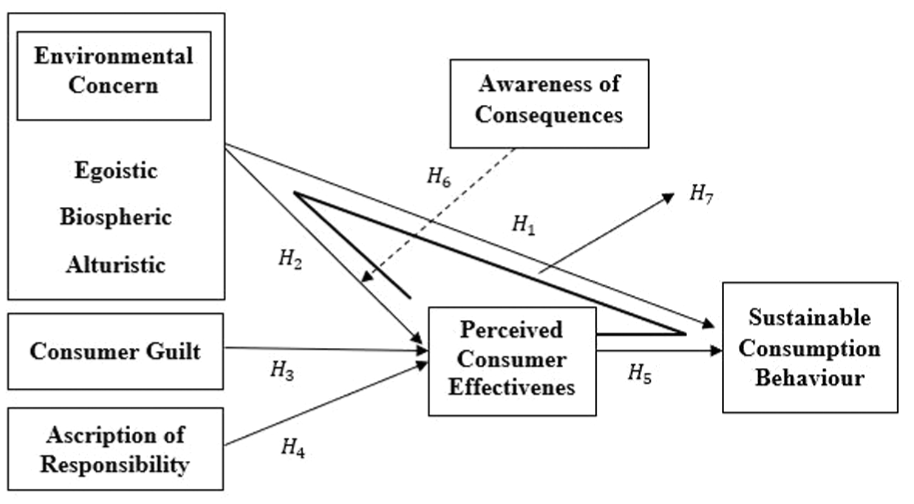
Research model.
Methodology
We begin with the quantitative strand—survey data modeled via PLS-SEM—before turning to the qualitative strand, a series of in-depth interviews subjected to thematic analysis. These complementary phases combine statistical rigor with interpretive depth, testing hypothesized paths while revealing the psychological processes that drive SCB.
Ethical approval for this study was obtained prior to data collection. Before accessing the questionnaire, participants were presented with an online information-and-consent page outlining the study’s objectives, data handling procedures, anonymity protections, and their right to withdraw at any point. Only those who explicitly selected “I agree” were allowed to proceed; the survey’s logic prevented participation without consent, and no personally identifiable information was collected at any stage.
Quantitative Research Methodology
The quantitative phase employed a self-administered questionnaire to collect data suitable for PLS-SEM. It details the sampling logic, instrument development, measurement validation, and structural-model testing that establish the robustness of the study’s hypothesized pathways.
Data Collection Procedures
This study focused on Turkish Generation Y consumers (ages 29–44), a cohort characterized by increasing purchasing power, environmental sensitivity, and significant influence over household decisions (Chaney et al., 2017; Naderi & Van Steenburg, 2018). Due to the lack of an official sampling frame, a non-probability convenience sampling approach was adopted. After removing 12 incomplete or inconsistent responses, the final sample comprised 410 valid cases.
All core constructs—SCB, AR, AC, CG, EC, and PCE—were measured using established multi-item scales. EC was assessed at individual, social, and biospheric levels, drawing from Schultz (2001) and Maduku (2024), while SCB was operationalized following P. Wang et al. (2014), capturing behaviors such as energy conservation, recycling, and eco-label purchasing. AR items were adapted from J. I. M. De Groot et al. (2007) and Onwezen et al. (2013), AC from Han (2014) and Bamberg and Möser (2007), CG from Theotokis and Manganari (2015), and PCE from Roberts (1996).
All items utilized a 7-point Likert scale. Survey content and clarity were reviewed by three experts in sustainability and consumer behavior, with minor revisions made as advised. A pilot test with 42 participants confirmed high reliability (Cronbach’s alpha > .70 for all constructs). The finalized instrument was then used for main data collection. Scale items are presented in Supplemental File Table A, while participant demographics are shown in Table 1.
Characteristics of Participants.

 : Turkish lira.
To verify that the latent constructs are interpreted equivalently across demographic strata, we conducted the three-step MICOM procedure (Henseler et al., 2016) in SmartPLS 4. Configural invariance was secured by specifying identical models for all groups. Permutation tests (1000 runs, α = .05) confirmed compositional invariance for every construct (all p > .05). Mean- and variance-equality tests showed no significant differences (|d| < 0.20; variance ratios > 0.90). Hence, partial measurement invariance is established across both the age split (≤34 years, n = 238; ≥35 years, n = 172) and the income split (<85,000 , n = 205; ≥85,000 , n = 205), legitimizing subsequent multigroup structural comparisons (Hair et al., 2022).
Measurement Model and Structural Evaluation
The structural model was estimated using PLS-SEM in SmartPLS 4. PLS-SEM was chosen for three key reasons: (i) it effectively handles model complexity—including six latent constructs, 46 indicators, an interaction term, and mediation—unlike CB-SEM; (ii) it is robust to substantial non-normality in the data (Mardia’s kurtosis = 17.34, p < .001); and (iii) it prioritizes predictive relevance, which matches the study’s focus on out-of-sample prediction. Attempts to estimate the model with CB-SEM (AMOS) were unsuccessful, further supporting the use of PLS-SEM for this analysis.
All measurement properties met recommended thresholds: Cronbach’s Alpha and CR were above .70 (Hair et al., 2017; Nunnally & Bernstein, 1994), AVE values exceeded .50 (Fornell & Larcker, 1981), and all factor loadings were above 0.70 (Hair et al., 2017). See Table 2 for details.
Evaluation of the Structural Model.
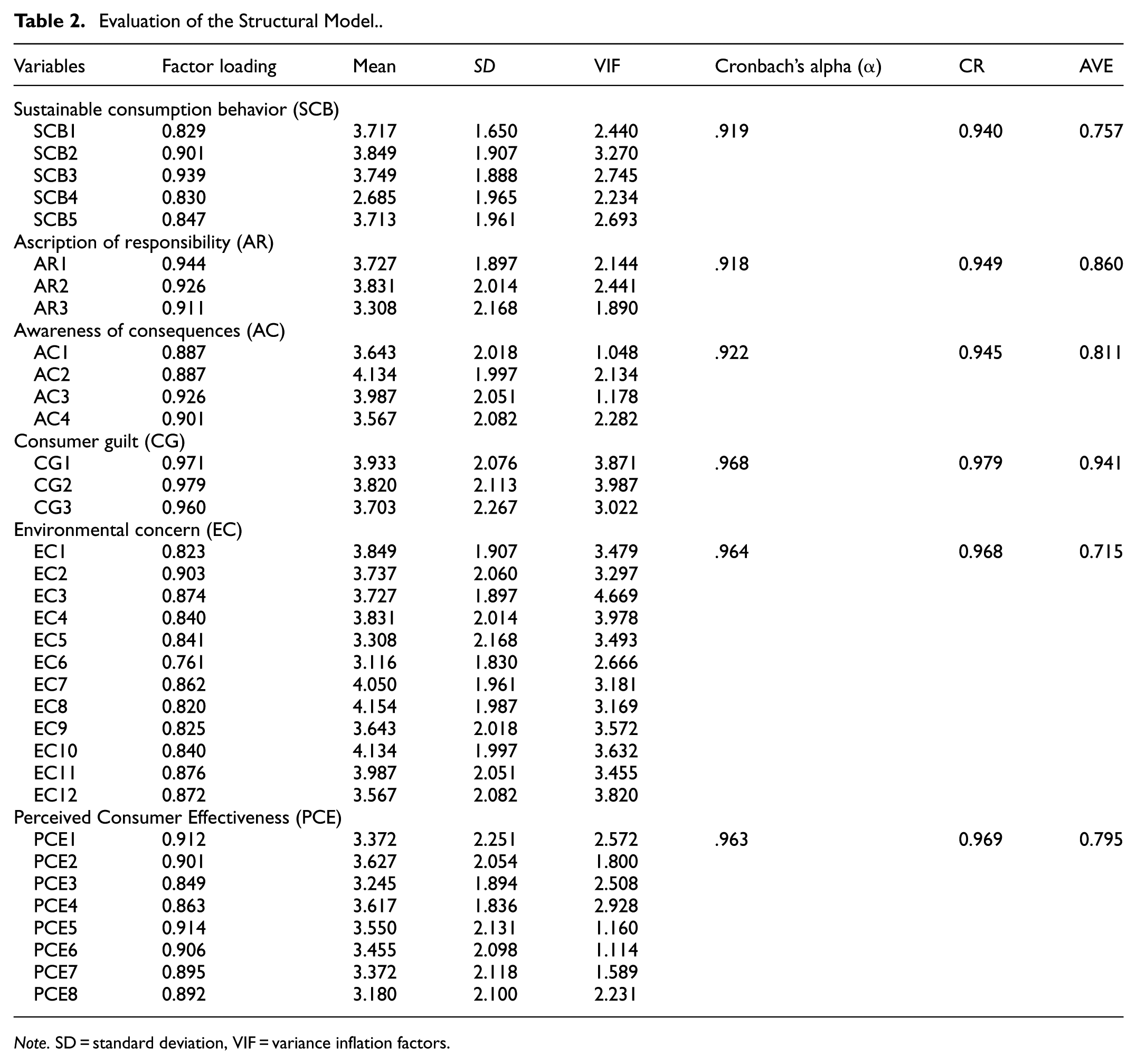
Note. SD = standard deviation, VIF = variance inflation factors.
To further test for CMV, the marker variable technique was applied (Lindell & Whitney, 2001). Low zero-order correlations (all r ≤ .09) with the marker variable were observed (Supplemental File Table D), and substantive correlations remained significant after adjustment for the smallest positive marker correlation (rmin = .03), indicating CMV is unlikely to bias the results (Supplemental File Table E). Item-deletion analysis showed that removing any item produced only negligible or negative changes in Cronbach’s α and CR, confirming that scale reliability is attributable to theoretical coherence rather than redundancy (see Supplemental File Table F).
To address theoretical overlap between PCE and AR, a separate CFA was conducted. The two-factor model, specifying PCE and AR as distinct constructs, showed a much better fit (χ2(19) = 43.12, CFI = 0.985, RMSEA = 0.052) than the one-factor solution (χ2(20) = 167.04, CFI = 0.872, RMSEA = 0.138), with a highly significant difference (Δχ2(1) = 123.92, p < .001; Supplemental File Table B). All standardized factor loadings were strong (>0.70), further supporting construct integrity (Supplemental File Table C).
Multicollinearity was minimal, with all VIFs below 5 (Hair et al., 2019; Vaithilingam et al., 2024; see Table 2), ensuring stable estimates. Discriminant validity was supported by the Fornell-Larcker criterion (Fornell & Larcker, 1981): for each construct, the square root of AVE (e.g., 0.900 for AC) exceeded its highest correlation with any other construct (e.g., 0.848 with EC), confirming clear distinction among constructs (see Table 3). The diagonal elements (previously shown in bold and italics) represent AVE for each construct, while the off-diagonal elements indicate inter-construct correlations. Discriminant validity was supported by HTMT values, all well below 0.85, with confidence intervals not exceeding 0.90. These results confirm clear distinction between constructs (see Table 4).
Fornell-Larcker Criterion.

HTMT Criterion.

Predictor-level VIF values (Table 2) were all below 5, indicating no multicollinearity. To address potential common method variance (CMV) from single-session self-report data, two tests were applied. Harman’s single-factor test showed a single factor accounted for only 33.7% of variance, well below the 50% threshold. Additionally, full collinearity VIFs for all latent variables (range: 1.72–2.94) were below 3.3 (Williams et al., 2015).
Qualitative Research Methodology
The study incorporated a qualitative phase based on in-depth interviews to complement the preceding PLS-SEM analysis and unpack the psychological nuances behind the statistical paths. This phase was designed to probe how participants experience and articulate constructs such as EC, CG, PCE, AR, and AC in their everyday consumption decisions.
Sampling and Data-collection
A qualitative phase with in-depth, semi-structured interviews complemented the quantitative findings by deepening insight into consumer perceptions and motivations underlying SCB. Twelve purposively selected participants with diverse backgrounds took part in 45 to 60 min interviews. The interview protocol is presented in Supplemental File Table G, and participant characteristics are shown in Table 5.
Participant Profile.

: Turkish lira.
The total transcript corpus amounted to approximately 35,000 to 40,000 words. Data analysis employed Braun and Clarke’s (2006) six-phase thematic analysis method, supported by MAXQDA 2022 software. Reflexive notes and an audit trail enhanced methodological trustworthiness. 50 finalized codes were identified, condensed from an initial set of over 120, and systematically categorized under 15 sub-themes. These sub-themes were further synthesized into five overarching analytical themes.
Analytic Procedure
The qualitative procedures adhered to the Consolidated Criteria for Reporting Qualitative Research (COREQ) guidelines (Tong et al., 2007). Data saturation was monitored iteratively: after 10 interviews, no new first-order codes emerged; two additional interviews were nevertheless conducted to confirm redundancy, at which point the codebook remained stable at [50] unique codes. Inter-coder reliability was established by having a second researcher independently recode 20% of the transcripts; Cohen’s kappa reached κ = [0.84], indicating almost perfect agreement (Landis & Koch, 1977).
Discrepancies were resolved via joint discussion, and the final consensual codebook was applied to the entire corpus. An audit trail, reflexive memos, and a code–recode strategy spaced 2 weeks apart further enhanced dependability and confirmability. The complete coding structure is provided in Supplemental File Table H.
Data Interpretation
Quantitative Findings
The structural model yielded strong empirical support for all proposed hypotheses. Each path coefficient demonstrated statistical significance, confirming the hypothesized relationships across the framework (see Table 6).
Hypothesis Testing Results.

Path coefficient (β), SE = standard error; BCa = bias-corrected and accelerated; CI = confidence interval; LL–UL = lower limit–upper limit.
p < .000. **p < 0.05.
As depicted in Figure 2, the visual representation of the model offers a comprehensive overview of the directional effects among the constructs.

PLS-SEM path model.
As shown in Table 6, every reported path is accompanied by its bias-corrected and accelerated 95% bootstrap confidence interval—abbreviated “95% BCa CI (LL–UL).” Because none of these lower-limit–upper-limit ranges cross zero, each coefficient can be regarded as statistically reliable (Efron & Tibshirani, 1993; Hair et al., 2022). In other words, the BCa intervals corroborate the t- and p-values already displayed in the table, offering an additional, distribution-free check on significance.
The path coefficient for H1 reveals a substantial positive influence, with a coefficient of (β = .751, t = 11.950, p < .001). EC emerges as a powerful predictor of SCB in our model (β = .751, p < .001), confirming H1. Multilevel evidence by Borges-Tiago et al. (2024) likewise identifies EC as the dominant driver of green actions across European consumers and within Portugal’s hospitality sector. Together with earlier meta-analyses (Bamberg & Möser, 2007; Maduku, 2024; Ogiemwonyi et al., 2023; Stern, 2000), these findings reaffirm EC’s pivotal role in motivating sustainable consumption. This indicates a strong positive relationship between EC and PCE. Similarly, H2 is (β = .427, t = 8.890, p < .001). This pathway is consistent with existing literature indicating that heightened EC translates into increased PEC when individuals gain concrete awareness and emotional engagement (Baek & Lee, 2025; Chen et al., 2022; Liobikienė & Juknys, 2016; Vieira et al., 2025). Both results highlight the critical role of EC in shaping consumer behavior.
The model further supports the significance of H3, where CG positively associated with PCE (β = .315, t = 4.142, p < .001). For H3, the significant positive relationship observed between CG and PCE aligns with recent findings by Ran et al. (2025), who demonstrated that anticipated guilt motivates consumers to adopt a maximizing mindset, thereby increasing their perceived effectiveness in decision-making contexts.
A similar trend is observed for H4, with a path coefficient of (β = .419, t = 4.715, p < .001), suggesting that anticipated responsibility enhances consumer effectiveness. Our findings for H4 align with prior studies (Jia et al., 2024; Onwezen et al., 2013; Peloza et al., 201375), indicating that individuals who internalize responsibility show higher PCE and greater engagement in sustainable behaviors. H5 confirms that PCE is positively associated with SCB (β = .379, t = 2.416, p < .05). This supports self-regulatory theory (Bandura, 1991): people act more sustainably when they believe their actions matter. Evidence shows PCE, with environmental concern and product quality, raises sustainable purchase intentions (Dangelico et al., 2024), while emotional appeals further boost perceived responsibility and sustainable choices (Ganassali & Ganassali, 2025). For H6, the interaction between accountability and EC is statistically significant (β = .222, t = 2.748, p = .001), although it exhibits the smallest effect size (f2 = 0.103).
Lastly, H7 demonstrates a mediating relationship, with a moderate path coefficient of (β = .146, t = 2.259, p < .05). This indirect effect was derived using bias-corrected and accelerated (BCa) bootstrapping with 5000 resamples in SmartPLS 4, and its 95% confidence interval [0.023, 0.205] excluded zero, confirming the robustness and statistical significance of the mediation.
Effect size (f2) was calculated to determine the relative contribution of each independent variable to the dependent constructs, following the guidelines proposed by Cohen (1988). In the model, H3 demonstrated the largest effect (f2 = 0.522), followed by H2 (f2 = 0.244) and Hypothesis 4 (f2 = 0.247), indicating their strong influence. The effect size for H5 (f2 = 0.183) is not negligible, but rather falls within the small-to-moderate range based on Cohen’s (1988) thresholds.
H6, which involves a moderating effect (AC × EC → PCE), yielded a smaller yet still notable effect size (f2 = 0.103), reflecting a weak but statistically significant interaction. In contrast, H7, which represents an indirect (mediated) effect, does not have a corresponding f2 value, as effect sizes are not typically computed for mediation paths in PLS-SEM (Hair et al., 2022; Sarstedt et al., 2022). Instead, its significance is assessed through the indirect path coefficient and associated statistics (Shmueli et al., 2019).
As reported in Table 7, the overall influence of EC on SCB is substantial and significant (total effect β = .897). EC also exerts a significant indirect impact on SCB through PCE (β = .146, 95% BCa CI = 0.019–0.273). Although the direct path from EC to SCB remains sizeable (β = .751, p < .001), the VAF indicates that PCE transmits only 16% of EC’s total influence. Following Hair et al. (2022), this pattern constitutes complementary partial mediation: the mediator explains a meaningful—yet clearly limited—portion of the relationship while the direct effect persists. Practically, the finding implies that raising consumers’ environmental concern will foster sustainable purchase intentions partly because it heightens their perceived effectiveness as change agents, but substantial direct motivational forces also remain at play.
Direct, Indirect, and Total Effects with Variance Accounted for (VAF).

The model demonstrated strong explanatory and predictive power. R2 values showed that PCE accounted for 66.5% of the variance and SCB for 80.8%. Predictive relevance (Q2) values were also high (0.562 for PCE, 0.641 for SCB), well above zero (Hair et al., 2017). Goodness-of-fit indices supported model adequacy: SRMR was 0.066, below the 0.08 threshold (Henseler et al., 2015), and NFI was 0.937, above the 0.90 benchmark (Bentler & Bonett, 1980).
To assess predictive validity, the model was evaluated using PLSpredict with 10-fold cross-validation. For SCB, the PLS model yielded a lower RMSE (0.732) than both linear regression (0.811) and the naïve mean-value benchmark (0.846). Similar results were found for PCE (PLS RMSE = 0.615; LM = 0.672; naïve = 0.704), with MAE indices showing the same trend. Positive Q2_predict values for both SCB (0.492) and PCE (0.413) further confirm the model’s strong out-of-sample predictive performance.
Emergent Themes
Fifty refined codes were grouped into 15 sub-themes and synthesized into five main themes, each mirroring pathways in the structural model. These interrelated themes offer qualitative depth to the model’s pathways and are further illustrated with participant quotes in the discussion and visually mapped to the quantitative model in Table 8.
Joint Display Integrating PLS-SEM Paths with Qualitative Themes.

Note. Dashes indicate limited or no direct qualitative support.
The Concern–Action Gap: Struggling to Translate Awareness into Behavior
A central theme emerging from 10 out of the 12 interviews was the difficulty participants experienced in consistently translating EC into actual behavior. While expressing strong emotional connections to sustainability issues, participants admitted significant inconsistencies in their daily choices—often citing barriers such as convenience, cost, and doubt about personal impact.
I care deeply about the environment. I read about climate change almost daily. But then I still order takeout in plastic containers. It feels like I am failing my own values. (P3) It is not that I do not want to change, it is just that sustainable choices sometimes feel too complicated or expensive. So I delay or make excuses. (P8) I get overwhelmed with all the rules—what to buy, what not to. So I end up doing nothing. (P10)
They highlight the limitations of EC when not accompanied by a strong sense of PCE, and suggest that behavioral consistency often requires more than moral intention—it demands structural and psychological support.
Empowered by Impact: The Role of Perceived Consumer Effectiveness
While concern alone was insufficient, the belief that one’s actions could make a tangible difference emerged as a key motivational driver for behavior. Eight participants described a significant turning point in their sustainable consumption behavior when they began to perceive their actions as meaningful and impactful.
When I started composting and saw how much waste we actually reduced at home, it finally felt like… like I was doing something real. That motivated me more than any campaign, really. (P1)
In many narratives, PCE seemed to function like a feedback loop—an internal reinforcement mechanism triggered not just by moral values, but by external validation or tangible proof of efficacy.
I used to think, ‘What difference can I make?’ Like, it is just me, right? But then… my friends started copying my habits. One of them told me she bought a reusable bottle because of me. I was like—wait, people notice this? (P7)
Some participants initially viewed their individual efforts as symbolic rather than outcome-driven. But over time, symbolism gave way to perceived real-world consequences.
At first, I was doing it because it felt like the right thing. You know, separating trash, using tote bags, that kind of stuff. But when I saw our garbage bin going down week by week… it was not just symbolic anymore. (P10)
Others reported moments of delayed realization, where the belief in impact only surfaced after extended effort or reflection:
Honestly, in the beginning it was like…‘I’m just doing this alone, what is the point?’ But then months later, my sister visited and said, ‘Wow, you guys really changed your habits.’ And I thought, huh… maybe this is doing something. (P5)
These accounts strongly reinforce the SEM finding that PCE is a key mediating factor between psychological variables like environmental concern and behavioral outcomes. The qualitative data reveal that PCE is not fixed—it evolves through a combination of small-scale wins, social reinforcement, and personal reflection. More importantly, it appears to be teachable and experientially constructed, not merely trait-based.
Guilt as a Moral Driver: Emotional Triggers of Change
CG emerged as a recurring emotional mechanism that prompted behavioral reflection and change. This theme appeared in nine interviews and was often described in visceral, lingering terms. Guilt was rarely immediate or fleeting—it had weight, and for many, it became a turning point.
Every time I buy a fast-fashion item, I feel this knot in my stomach. I know it is bad for the planet, but sometimes I just want something new. That guilt stays with me. (P4) I used to throw away food often. But after seeing a video on food waste, I felt ashamed. Now I meal plan and compost. Guilt can be a powerful teacher. (P9)
Some participants described guilt as creeping in during moments of contradiction—where actions clearly violated personal values but were still carried out. This tension often created cognitive dissonance that triggered future behavior change:
I would talk about sustainability with friends, but then I would walk out of a store with plastic bags and think, ‘What am I doing?’ It is like… I felt fake. That feeling stuck with me the whole day. (P6)
These narratives reinforce the quantitative finding that guilt positively associated with PCE by motivating reparative action. Rather than being paralyzing, guilt was described as a productive, morally activating emotion—one that guided individuals back toward behavioral alignment. For many, guilt did not shut down action; it created intention.
Owning the Problem: Emerging Individual Responsibility
Seven participants described a psychological shift from blaming external entities (e.g., corporations, governments) to internalizing their own role in environmental degradation. This personal AR was often a turning point in behavioral commitment.
I always thought it was up to big companies to fix things. But then I realized, I contribute too. That changed how I see my choices. (P5) Once I accepted that my daily routines—like driving short distances or wasting electricity—were part of the problem, I couldn’t ignore it anymore. (P11) At first I said ‘what can I do?’ Now I know every little thing adds up. It’s my mess too. (P3)
This shift in attribution was often described as a cognitive and moral turning point that preceded behavioral changes such as reducing waste, being more vocal in social contexts, or actively seeking sustainable options. These reflections mirror the structural finding that AR significantly enhances PCE.
Awareness as a Catalyst: How Consequence Knowledge Fuels Action
Heightened AC of unsustainable actions emerged as a cognitive trigger for behavioral transformation. Ten participants referred to “eye-opening” moments—often prompted by documentaries, articles, or social media—that connected abstract environmental issues to their personal consumption patterns.
I used to drink bottled water all the time. Then I saw a video of a sea turtle with plastic in its nose, and I stopped immediately. That image still haunts me. (P6) When I understood how palm oil affects deforestation, I started checking product labels. Awareness makes you feel responsible in a whole new way. (P2)
Some participants noted how seemingly distant issues suddenly became urgent once they saw a direct link between global consequences and personal behavior:
I always thought climate change was something distant—like, something scientists deal with. But then I read this post about how my daily meat consumption links to deforestation. It just… clicked. I couldn’t ignore it anymore. (P8)
These experiences reveal how AC moderates the relationship between concern and action by enhancing clarity and emotional salience. Awareness did not function merely as information—it created a moral lens through which prior habits were reassessed and, in many cases, replaced with new behaviors.
Discussion
This study used a mixed-methods approach—combining SEM and thematic analysis—to examine the psychological drivers and barriers of SCB. Quantitative results highlighted the strong influence of EC, CG, and AR, with PCE as a mediator and AC as a moderator. Qualitative findings identified five themes that enriched the model’s emotional and cognitive pathways. At a broader level, the climate crisis (IPCC, 2023) and collective action amplify the significance of individual efforts, informing policy and value-based marketing by underscoring the psychological importance of personal impact. Table 8 synthesizes quantitative and qualitative results, linking model paths to key themes and participant quotes, and reveals where robust statistical relationships may be limited by contextual or psychological barriers, deepening our understanding of the attitude–behavior gap.
EC was positively associated with SCB (β = .751, p < .001), supporting H1. This pronounced link in Turkish Gen Y is driven by two factors: their constant exposure to digital environmental content, which transforms concern into urgency and action (“Awareness as Catalyst”), and a collectivist culture that amplifies social accountability through peer reinforcement online. Thus, the EC → SCB path reflects both statistical strength and a social-media feedback loop that turns concern into visible, valued behavior.
Although the quantitative model shows a strong direct link from EC to SCB, qualitative findings reveal a persistent Concern–Action Gap. Many participants expressed high EC but struggled to act accordingly—for example, “I read a lot about climate change and I really care, but I still fly frequently for work. I know it’s bad, but I tell myself it is just one more trip” (P9). This suggests that EC alone may be insufficient for behavior change without additional psychological support.
The strong EC → PCE connection is driven by the growing salience of environmental threats. As described in the Awareness as Catalyst theme, moments when abstract concerns became personal increased commitment to action. This is reflected in H2 (β = .427, p < .001), where concern leads to action if paired with concrete awareness and efficacy. Qualitative accounts support this: “At first I thought bringing my own cup did not matter. But when I saw how much less trash we had after a few weeks, it made me want to keep going” (P2), showing how visible results reinforce efficacy beliefs and sustained change.
Consistent with studies in the literature, the study results confirm H3 and H4, demonstrating that CG and AR significantly and positively affect PCE. Guilt, often described in the literature as an “action-oriented” emotion (Soorani & Ahmadvand, 2019), was similarly portrayed by participants as a powerful inner force prompting behavioral reflection and correction. As one participant explained, “Every time I buy overly packaged stuff, I feel uneasy. I tell myself I will do better next time—because otherwise, it sticks with me.” (P7). This aligns with the quantitative result (β = .32) for the CG → PCE relationship, providing direct qualitative support that guilt effectively transitions into perceived consumer effectiveness. This emotional discomfort was not paralyzing but reparative, often motivating shifts toward more sustainable choices.
The “Owning the Problem” theme illustrated how AR acts as a catalyst for agency. Participants described recognizing their own role in environmental issues, shifting responsibility from institutions to themselves and increasing motivation for action (e.g., “I realized I’m part of the problem too… That changed how I act,” P4). This internalization strengthened belief in personal impact and encouraged more sustainable practices. The effects of CG and AR on PCE indicate that both normative and emotional factors are crucial for translating EC into action (Onwezen et al., 2013). External triggers—such as media coverage, corporate campaigns, or legal pressures—can further heighten guilt and responsibility, enhancing perceived effectiveness in tackling environmental challenges.
The theme Empowered by Impact captured this dynamic in qualitative responses. Participant narratives provided rich examples of this dynamic, vividly showing how feedback on personal environmental impact directly reinforced ongoing sustainable practices. Real-time eco-dashboards draw on self-efficacy theory (Bandura, 1991) by making environmental impact visible and controllable, thereby strengthening the PCE construct. As one participant shared, “At first I thought bringing my own cup did not matter. But when I saw how much less trash we had after a few weeks, it made me want to keep going” (P2). These experiences show that visible impact reinforces motivation. When individuals see their actions as part of a collective solution, not isolated efforts, they are more likely to persist. PCE buffers against helplessness and sustains consistent behavior.
The indirect effect of EC on SCB through PCE (H7; β = .146, p = .013) demonstrates partial mediation: while EC alone strongly predicts SCB, its impact is amplified when routed through PCE. Without strong efficacy beliefs, EC may remain moral concern without action—a pattern echoed in the Concern–Action Gap theme.
AC significantly moderates the EC → PCE link (H6; β = .222, t = 2.748, p = .001), showing that when individuals grasp the real harms of unsustainable behavior, concern becomes more urgent and action-oriented. This is reflected in the Awareness as Catalyst theme, where awareness triggered moral urgency. Together, these results highlight that PCE is a dynamic belief shaped by emotional, contextual, and cognitive factors (see Table 8).
In this model, PCE serves as a critical bridge linking concern to action, sustaining environmentally responsible behavior even in the face of large-scale ecological threats. PCE operationalizes the “perceived behavioral control” of TPB within the sustainability context, addressing a common gap where this construct is often under-specified (Dangelico et al., 2024). By translating abstract drivers like EC, CG, and AR into actionable efficacy beliefs, PCE provides a concrete, measurable pathway through which psychological factors shape SCB. By empirically demonstrating and qualitatively illustrating that heightened PCE closes the intention–behavior gap, our study extends TPB by showing precisely how efficacy beliefs are formed and leveraged in a sustainability setting, thereby advancing the model’s explanatory precision.
Our findings additionally reconcile mixed results in the guilt literature. Where some studies report negligible or even counter-productive effects of guilt on behavior (e.g., Smith et al., 2021), the significant CG → PCE path (β = .32) observed here suggests that guilt can be highly effective when paired with clear efficacy cues—particularly in collectivist contexts such as Turkey, where moral emotions are tightly coupled with social responsibility.
Regarding H6, this study extends NAM (Schwartz, 1977) by conceptualizing AC as a dynamic moderator in the EC → PCE relationship. AC acts as a cognitive bridge, amplifying moral urgency and responsibility, thus strengthening the link between concern and action. This refinement establishes AC as an active catalyst for moral responsibility, clarifying its moderating role within the NAM framework. This empirical extension of NAM provides a deeper, more nuanced understanding of how contextually specific knowledge and emotionally charged awareness interactively activate moral responsibility, facilitating more consistent and impactful sustainable behaviors. These advanced dynamics—moderation (H6) and mediation (H7)—reflect the layered psychological architecture of SCB, further supported by the themes Awareness as Catalyst and Concern–Action Gap.
Practical Implications
Translating empirical insights into real-world leverage points is essential if academic research is to accelerate the transition from ecological concern to measurable impact. Accordingly, we distil our seven hypotheses into a set of action-ready recommendations that speak directly to policymakers, marketers, and sustainability practitioners. Rather than offering generic advice, we pinpoint the specific psychological lever uncovered by each path in our model (e.g., guilt, efficacy, consequence awareness) and show how that lever can be operationalized through concrete interventions, ranging from carbon-footprint apps and dynamic eco-dashboards to guilt-plus-efficacy advertising copy.
The resulting framework (Table 9) serves as a “plug-and-play” menu: each row pairs a statistically significant relationship with (i) a strategic design principle and (ii) a ready-to-deploy example, enabling decision-makers to move seamlessly from theory to action and to craft messages, policies, or digital tools that are both psychologically grounded and practically feasible.
Action-oriented Practical Implications Aligned with Each Research Hypothesis.

Because PCE and AC vary across individuals, interventions should be matched to four behavioral profiles: low-PCE/high-AC (knowledgeable yet skeptical—emphasize efficacy through “your action prevents X” feedback); high-PCE/low-AC (confident yet under-informed—deploy vivid consequence cues and scenario visualizations); low-both (unaware and powerless—use gamified micro-goals plus peer comparison to build both AC and PCE); and high-both (self-motivated advocates—provide community leadership tools and public dashboards to scale their influence). The final row in Table 9 illustrates concrete tactics for each segment.
Evidence from both strands of our mixed-methods design verifies that these mechanisms are not artifacts of the model but manifest in daily life. Qualitative narratives reveal participants tracking bin weight loss, counting avoided plastic bottles, or sharing compost statistics online—behaviors that mirror the statistical strength of the PCE → SCB path. Moreover, the PLSpredict analysis shows the model outperforms linear benchmarks in out-of-sample forecasts, indicating that its pathways hold predictive power beyond the survey. These converging lines of evidence confirm that the psychological levers identified—primarily the AC–PCE synergy—operate under practical, non-laboratory conditions and thus provide a reliable platform for intervention design.
Our findings align with and extend recent research from non-Western settings. While Nguyen (2023) and Gunawan et al. (2024) emphasize the importance of social norms and collective efficacy in Asian markets, our results show that for Turkish Gen Y, moral emotions like guilt and responsibility—intensified by digital engagement—are the primary drivers of sustainable behavior. This contrast underscores the need to tailor interventions to cultural context, as moral motivation may surpass informational appeals in collectivist societies.
Limitations and Future Research
Recognizing the study’s limitations is essential for interpreting the findings and informing future research. The primary limitation is the cross-sectional design, which prevents establishing causality. Longitudinal studies are needed to track changes in EC, CG, AR, and the stability of PCE over time and in response to external events. Incorporating objective behavioral measures—such as purchase records or app-based tracking—would further validate self-reports. Table 10 ranks each limitation by severity and outlines recommendations for future research.
Ranked Overview of Study Limitations and Future Remedies.

Another important limitation concerns the sample’s relatively homogeneous demographic and cultural composition, which may limit the generalizability of the findings. Cultural norms and societal values strongly shape environmental attitudes and behaviors; thus, results derived from this urban Turkish Gen Y sample may not fully extend to broader populations. While Turkey’s Gen Y, with its digital literacy and collectivist values, offers valuable insights, strong social norms may intensify guilt and responsibility, limiting generalizability. To strengthen external validity, future research should test this model in both individualist (e.g., Germany, U.S.) and other collectivist (e.g., Indonesia, Brazil) contexts. Multi-group analysis can determine if key pathways are culturally robust or context-dependent, helping refine theory and inform tailored policy interventions.
Despite procedural safeguards, reliance on single-session self-reports introduces potential for CMV. Although Harman’s single-factor test and collinearity VIFs suggested minimal CMV, the concurrent design remains susceptible to mood and social desirability bias. Future research should consider temporal separation of measures, multi-source data, or triangulating self-reports with objective behavioral indicators such as sensor-based tracking.
The use of convenience sampling may have introduced self-selection bias, with sustainability-oriented individuals more likely to participate and potentially inflating environmental concern levels. Future studies should consider quota-based or stratified sampling and apply post-stratification weighting to correct for imbalances in environmental engagement or digital literacy. Linking survey data with objective measures, such as household energy usage, would also enhance the validity of behavioral claims.
Measurement invariance testing (MICOM) confirmed partial equivalence across gender, but subgroup analyses for other demographics (e.g., age, income, region) were limited by small sample sizes. Larger, multi-site studies are needed to assess whether structural relationships hold across diverse segments using multi-group PLS-MGA, ensuring generalizability beyond Turkish Gen Y. Although theoretical saturation was reached with 12 interviews, the qualitative sample’s educational skew may limit transferability. Future research should pursue maximum variation sampling, utilize member checking, and quantify code prevalence to strengthen the robustness of qualitative findings.
This study focused on EC, CG, AR, and AC, but did not examine other important factors such as social norms, peer influence, or anticipated emotions (e.g., pride, shame). Future work could expand the model to include these variables and explore how product category or consumption context moderates the effects of PCE or guilt, revealing domain-specific patterns in sustainable behavior.
Finally, the expanding role of digital innovations—such as carbon footprint calculators, real-time feedback apps, and gamified sustainability challenges—deserves closer examination to assess how such tools might elevate awareness, guilt, or perceived effectiveness, ultimately fostering enduring behavioral change.
Supplemental Material
sj-docx-1-sgo-10.1177_21582440251376481 – Supplemental material for Navigating Sustainability: The Role of Consumer Psychology in Shaping Sustainable Behavior
Supplemental material, sj-docx-1-sgo-10.1177_21582440251376481 for Navigating Sustainability: The Role of Consumer Psychology in Shaping Sustainable Behavior by Ebru Enginkaya and Munise Hayrun Sağlam in SAGE Open
Footnotes

Ethical Considerations
Ethical approval was obtained from the Ethics Committee of Yıldız Technical University, Social and Human Sciences Research Ethics Board (Report No: 20250304349; Verification Code: acff3; Verification Address: etik.yildiz.edu.tr/dogrula) on 3 March 2025.
Consent for Publication
Written informed consent was obtained from all participants, including consent for data use and publication.
Funding
The authors received no financial support for the research, authorship, and/or publication of this article.
Declaration of Conflicting Interests
The author declared no potential conflicts of interest with respect to the research, authorship, and/or publication of this article.
Data Availability Statement
The data that support the findings of this study are available from the corresponding author upon reasonable request. Due to ethical and privacy considerations, full access to qualitative transcripts is restricted.
Supplemental Material
Supplemental material for this article is available online.
References
Supplementary Material
Please find the following supplemental material available below.
For Open Access articles published under a Creative Commons License, all supplemental material carries the same license as the article it is associated with.
For non-Open Access articles published, all supplemental material carries a non-exclusive license, and permission requests for re-use of supplemental material or any part of supplemental material shall be sent directly to the copyright owner as specified in the copyright notice associated with the article.
