




Abstract
This study explored the antecedents of m-commerce continuance usage intention and their impact on the price sensitivity of Indonesian m-commerce customers. The study also incorporates contextual factors, such as perceived risk, trust, efficiency, and functional benefits, into the model to investigate their impact on the satisfaction of m-commerce users. Moreover, it examines how the efficient and functional benefits of m-commerce affect price sensitivity. The study employed online questionnaires to gather data from m-commerce users in Indonesia. The hypothesis was tested using a partial least squares technique with Smart-PLS. This study demonstrates that user satisfaction with mobile commerce has a significant impact on their intention to continue using it, which in turn affects their price sensitivity. The study found perceived risk, trust, efficiency, and functional benefit to be significant determinants of satisfaction in m-commerce usage. The study also found that trust, efficiency, and functional benefits influence the continuance use of m-commerce, while perceived risk is not an intervening variable for continuance intention among m-commerce users. Furthermore, the results show that perceived risk, trust, and functional benefit influence a user’s price sensitivity, whereas efficiency was not found to be a determinant in influencing price sensitivity. However, the study found that continuance usage intention and satisfaction serially mediated the link between efficiency and price sensitivity, as well as the link between functional benefit and price sensitivity. The outcome of this study would be useful for managers and practitioners who find it difficult to retain their customers’ continued intention to purchase their products and services.
Introduction
Mobile (M)-commerce is a platform where the process of selling and buying goods and services occurs through mobile devices (Chong, 2013b). Customers or m-commerce users, in this case, sellers and buyers, can carry out buying and selling activities anywhere and anytime comfortably using their personal devices as long as an Internet connection is available (Rana et al., 2019). The accessibility and flexibility features of m-commerce have additional features compared to those of e-commerce (Vărzaru & Bocean, 2021).
Nowadays, mobile devices and “smartphones” have become integral parts of our daily lives (R. J. H. Wang et al., 2015), resulting in a rapid increase in their usage. The rising trend of mobile device usage, which reached 5.32 billion at the start of 2022, has resulted in a huge growth in mobile application (app) usage (Kemp, 2020; McLean et al., 2020), has led to a significant growth in mobile application (app) usage. As a result, most e-commerce companies have adapted their pages to be easier to use with mobile devices, enhancing their friendliness to m-commerce users. With the increasing use of mobile apps, they have become a powerful catalyst for revenue growth for sellers, particularly among Millennials and Gen Zs, who have significant spending power. Additionally, tech-savvy customers have the potential to increase their volume because they are more inclined to purchase on their smartphones (Meghisan-Toma et al., 2021).
During COVID-19, m-commerce has grown in importance as a new sales channel for consumers (Vărzaru & Bocean, 2021). For example, global online sales of consumer items (groceries, fashion, electronics, and others) increased to more than half a trillion US dollars in 2021 (+18%), reaching a total of USD $3.85 trillion for the year (Datareportal.com, 2021). Surprisingly, 72.9% of all e-commerce sales occurred via m-commerce in 2021, up from 58.9% in 2017, indicating that m-commerce is replacing other online commerce channels. Indonesian are highly enthusiastic about adopting online or digital technologies. According to McKinsey&Company (2018), “Indonesians are among the world’s most enthusiastic users of digital technologies. The average Indonesian spend 4 hr a day accessing the Internet on their mobile device twice the USA average.” Indonesia is the ninth-largest e-commerce market, with a revenue of US$43 billion in 2021, placing it ahead of Canada and India. Indonesia has the fastest-growing mobile commerce market in the world (e-Commerce Market Analysis: The eCommerce market in Indonesia, 2021). The Indonesian e-commerce market has grown by 32% in 2021, contributing to a global growth rate of 29%. According to the Statista Digital Market Outlook (Statista, 2021), market expansion in Indonesia is likely to continue in the next few years. For the following 4 years, the compound annual growth rate is expected to be 10% (CAGR 2021-2025). This drop, when compared to the 32% year-over-year gain, indicates a relatively crowded market. Another sign of market saturation is Indonesia’s 44% online penetration, which means that 44% of the Indonesian population has purchased at least one product online by 2021. Furthermore, m-commerce utilization during the COVID-19 pandemic has increased and reached different levels due to social distancing and restriction policies (Dumanska et al., 2021; Vărzaru & Bocean, 2021). There are 37% of new digital consumers during this pandemic, and 93% of this group has expressed their intention to persist with this behavior afterward the pandemic period (Google Temasek Bain & Company, 2021). Therefore, it is crucial to evaluate the factors that may impact the continued intention of m-commerce users, because m-commerce users typically behave erratically and may not return to an activity or use an application after using it for the first time (M. K. Chang & Cheung, 2001; Chong, 2013b; C. S. Lin et al., 2005).
Changes in continuance consumption or usage patterns are functions of behavioral changes that occur due to innovation and technological intervention. Such changes could occur to consumers at every level, from top to bottom. Consumers with limited purchasing power exhibit a higher degree of sensitivity when it comes to shopping, as they tend to make use of mobile commerce to shop at any given time and place. This is in contrast to consumers with higher purchasing power. When low-spenders are used to shopping on mobile devices, they not only exhibit a higher frequency of shopping, but also an increase in the overall quantity of goods purchased (R. J. H. Wang et al., 2015). They also argued that repetitive shopping through m-commerce makes consumers less price-sensitive. However, in developing countries such as Indonesia, society is highly price-sensitive (Natarajan et al., 2017). According to the International Trade Administration (Administration, 2021), consumers in Indonesia exhibit a strong inclination toward price sensitivity and tend to seek out products that offer them optimal value. Such studies are critical for retailers and online stores to develop marketing and customer relationship management strategies to improve customer experience. Ultimately, this study reveals ways to attract more customers and generate high revenue. Furthermore, this study can be expanded by Wang et al. R. J. H. Wang et al. (2015) provide additional insights into m-commerce and price sensitivity. Furthermore, Natarajan et al. (2017) examined whether behavioral intentions affect price sensitivity based on the TAM (Technology Acceptance Model) of Davis et al. (1989). However, their study focused only on the initial use intentions for price sensitivity. This study considers the continuance intention of m-commerce and price sensitivity with Indonesian customers, which has not yet been empirically explored.
Studies pertaining to continuance intentions usually employ the expectation-confirmation model (ECM) developed by Oliver (1980). The model states that satisfaction is a determinant of continuance intention. Specifically, if users have a positive feeling toward m-commerce, satisfaction can lead to the intention to use or reuse (C. S. Lin et al., 2005). Interestingly, a few studies (Bhattacherjee, 2001; Natarajan et al., 2017) integrated the relationship between continuance intentions of m-commerce and price sensitivity within the ECM. However, studies linking behavioral intention and price sensitivity are rare. Natarajan et al. (2017) examined the factors influencing price sensitivity in mobile shopping applications in India, where the intention to use (pre-adoption) is the main antecedent. The study discovered that the intention to use mobile shopping applications negatively affects the price sensitivity of users, particularly innovators. This study, as illustrated beforehand, examines the construct of continuous intention (post-adoption) with price sensitivity. Since the post-adoption stage denotes the success and survival of the technology used and is considered more vital than the pre-adoption stage (Bhattacherjee, 2001), investigating the continuous intention to use and its effect on price sensitivity, as well, will be much needed. In addition, it is clear that the cost of procuring a new user is far higher than that of maintaining something at hand (Bhattacherjee, 2001). Therefore, this study aims to fill this gap. Furthermore, a significant amount of foregoing research on mobile and other tech mentioned trust as a consequential factor determining continuance/repurchase intention (Dinev & Hart, 2006; Rodríguez-Torrico et al., 2019), perceived risk determining behavioral intention (Chopdar et al., 2018; Gao et al., 2018; Gupta et al., 2010; E. S. T. Wang & Lin, 2017), efficiency in determining customer behavior (Jones & Issroff, 2007; Chahal &Kumari, 201, Hao et al., 2021; Kandula et al., 2021; Obal, 2017), and functional benefit determining sustainable use (Akel & Armağan, 2021; Mulyono & Pasaribu, 2021; Tarute et al., 2017), and is subsequently integrated into an explanatory model of m-commerce continuance intention, linked with price sensitivity. Additionally, previous studies that adopted ECM to examine the intention to use m-commerce have considered confirmation variables (Balapour et al., 2020; Duy Phuong et al., 2020; Hung et al., 2007; H. M. Lee & Chen, 2014; Shang & Wu, 2017; Wu et al., 2009), which show the stage at which the user achieves what is expected after consumption (Bhattacherjee, 2001). However, there are contextual factors such as perceived risk, trust, efficiency, and functional benefits that could affect m-consumers’ satisfaction levels and impact the continuance use of m-commerce (Hong & Hai, 2018; Rodríguez-Torrico et al., 2019; Wu et al., 2009). Hence, this study integrates perceived risk, trust, efficiency, functional benefits, satisfaction, continuance intentions, and price sensitivity within the ECM for the Indonesian consumer group. Therefore, this study is expected to contribute to the post-adoption of m-commerce and price sensitivity.
Hence, the current study has two objectives: (i) to explore the antecedents of M-commerce continuance usage intention and their effect on the price sensitivity of Indonesian m-commerce customers, and (ii) to examine the mediating role of satisfaction level and continuance usage intention toward m-commerce for price-sensitive relations with perceived risk, trust, efficiency, and functional benefit. Therefore, the current study is expected to contribute expectation confirmation model (ECM) and post-acceptance model (PAM), and consumer behavior literature. The current study will also have practical implications for managers, practitioners, policymakers, and m-commerce providers in the Indonesian context.
Literature Review
Theoretical Background
A popular model used to assess technology post-adoption behavioral intentions is the expectation confirmation model (ECM) (Oliver, 1980), which was later refined into a post-acceptance model (PAM) by Bhattacherjee (2001). In the ECM framework, consumers who reach the stage of continuing to use the system pass through several stages, starting from the initial use. Consumers have expectations from the system that should be met before they commit to initial use. After using the system for a while, a perception of its performance is formed. This perception is then compared with the expectation of determining whether the perception confirms the expectations. Confirmed expectations create satisfaction, which, in turn, leads consumers to reuse (Bhattacherjee, 2001). Meanwhile, PAM does not study the pre-consumption premise but rather incorporates perceived usefulness as a variable influenced by confirmation and affects customer satisfaction until customers intend to continue using that specific information system (Larsen et al., 2009; Lawkobkit & Speece, 2012; Lim et al., 2019). Lim et al. (2019) studied the behavior of financial technology (fintech) users by combining ECM and PAM to examine post-adoption behavior. By combining this model, the factors influencing PAM, including perceived security, were studied. Although perceived security affects service usability, it does not have a direct effect on satisfaction or intention to continue using the fintech service system (Lim et al., 2019). Perceived security is a significant sub-dimension of the perceived risk construct (Micheal et al., 2020), and it is one of the influential factors in determining the intention to use location-based service applications on an ongoing basis. Therefore, integrating the perceived risk variable into the research model is expected to capture the complex behavior, which could explain the higher variance in consumers’ or users’ behavior.
Perceived risk and trust are two motivational constructs in consumer psychology that influence consumer behavioral responses (Seo & Lee, 2021). Therefore, in the study of m-commerce, the construct of trust must be presented and integrated into the research model of intention to use m-commerce sustainably. Furthermore, the efficiency construct is considered crucial to m-commerce studies (Rodríguez-Torrico et al., 2019), as the completion of a fast (efficient) shopping process empirically affects usability, customer satisfaction, and expectation confirmation (Baker-Eveleth & Stone, 2015). The above theoretical background grounded the formulated conceptual research model (Figure 1) and proposed the research hypotheses of the present study.

Conceptual research framework.
Hypothesis Development
Satisfaction
Satisfaction is the most prominent variable that drives future consumer behavior, particularly for m-commerce applications (Natarajan et al., 2017; Rita et al., 2019). An m-commerce user’s satisfaction is a summary of the affective responses to various intensities of m-commerce activity, stimulated by several aspects of focus, such as information, system, and service quality, as defined by Y. S. Wang and Liao (2007).
According to the expectation-confirmation theory, satisfaction is a condition in which customer expectations are met. The ability to meet customer expectations depends on how consumers perceive the risks and costs of conducting online transactions (San Martín & Camarero, 2009). Other studies have shown that satisfaction worsens when consumers experience risks when using e-commerce (Tzavlopoulos et al., 2019). This is also supported by Tandon et al. (2018) and Jun et al. (2021), who argued that increased perceived risk in shopping using m-commerce caused satisfaction with m-commerce to decrease. Thus, we propose the following hypotheses:
In addition, trust is a related construct that affects customer satisfaction, which has been widely studied (Jin et al., 2016). In their study on retail service brands, K. Lee et al. (2007) found that consumer trust in a brand has a positive effect on satisfaction with the brand. In terms of technology, it was also found that consumer confidence in Malaysia regarding networks, websites, and cellular phones is positively related to satisfaction with mobile banking (Masrek et al., 2014). Moreover, Sfenrianto et al. (2018) find that trust in online shopping has a positive effect on buyer satisfaction. This is corroborated by the study conducted by Dehghanpouri et al. (2020), who found that trust has a significant relationship with m-commerce. Trust has also been found to be a significant determinant of buying decisions and satisfaction with m-commerce users (Ata et al., 2021; Ratnasari et al., 2021). Hence, we propose the following hypotheses:
M-commerce efficiency may reflect how well it works in completing tasks with minimal effort and, as a result, provides users with satisfaction (Lynn et al., 2020; Yan et al., 2019). Sun (2016) demonstrated that usability is a predictor of satisfaction through the suitability of technology instructions. Hence, we propose the following hypotheses:
Satisfaction is related to a product’s functional benefits. Research on green functional benefits and green satisfaction in the exposure of consumers to purchasing green brands in Indonesia has previously been studied by Imaningsih et al. (2019). The results indicated that green functional benefits were positively related to green satisfaction. Kotler and Keller (2018) also published this concept, where the benefits obtained from the purchase of products or services are relevant to satisfaction. Moreover, m-commerce’s functional benefits have a significant impact on user satisfaction, as many users will not use certain mobile phones to purchase or use m-commerce if they do not find it beneficial (Bilgihan et al., 2016; Yrjölä et al., 2017). Thus, we propose the following hypotheses:
Continuance Use Intention
By definition, the intention to continue use is identical to the phrase “repurchase intention” (Bhattacherjee, 2001). Therefore, it can be defined as existing users continuing to use m-commerce applications (Dehghani, 2018; Park et al., 2010). One case that impedes the appeal of reusing certain m-commerce applications in the future is the presence of privacy risks, such as personal data submitted to third parties (E. S. T. Wang & Lin, 2017). This is also found by Gupta et al., 2010) in their research in the United States and India, where perceived risk has a negative impact on behavioral intentions in the continued use of e-commerce. Furthermore, Namahoot and Laohavichien (2018) argued that perceived risk can affect the behavioral intention to use certain e-products and services that lead to the positioning of continuance use intention (Park et al., 2019). Henceforth, we propose the following hypotheses:
E. S. T. Wang and Lin (2017) said that trust causes users of location-based applications to continue to use the applications. Similar research was conducted by Chong (2013a) on m-commerce, who found that trust had the strongest impact on continuance use. Moreover, Kumar et al. (2018) found that consumers’ continuance intention to use mobile banking, that is, m-commerce, is influenced by trust. That is also in line with the study of Shao et al. (2019), as they also found trust as a significant predictor in developing continuance intention to use m-commerce. In this regard, X. Yang (2021) also presents trust as a significant determinant of the consumers’ continuance intention to use. Mostly, similar findings relating to the positive impact of trust on the continuance intention to use among m-commerce users have been observed in the research conducted (F. Meng et al., 2022). Henceforth, we propose the following proposition:
Another factor is the quality of service and perceived value expected by users, which has the potential to increase the intention of continuance use (Chahal & Kumari, 2011; Hau & Thuy, 2012). In terms of government electronic services, Li and Shang (2020) suggested that service quality refers to the efficiency of government websites, while perceived value refers to transparency, efficiency, and accountability in government services. Moreover, Qasrawi et al. (2021) also outlined that the efficiency of the m-commerce determinants, for example, websites, has an impact on user satisfaction even in the case of university students, who are ultimate customers of the universities. A similar outcome is also found in the study of Ali and Qadir (2021), as they revealed that the efficiency of e-commerce and m-commerce has a significant impact on the satisfaction of the users, who will return to buy again if they find the respective provider’s sites or software, that is, m-commerce facilities are efficient.
In addition, the functional benefits are empirically capable of increasing positive behavior related to the use of technology (smart glasses). Rauschnabel et al. (2015), in particular toward continuance use intentions, previously researched by Ravald and Grönroos (1996). Moreover, functional benefits of m-commerce have been observed in the recent hike of online customers, who are quite satisfied with many m-commerce organizations, especially during the COVID-19 pandemic when everything was online during lockdowns (Giantari et al., 2021; Smoleńska & Pilarska, 2021).
As formerly discussed, regarding ECM, in this case, as we are already familiar, satisfaction has a role in the emergence of the intention to use a system/technology in a sustainable/continuance manner as well (Bhattacherjee, 2001; X. Lin et al., 2019; Shang & Wu, 2017). Based on the empirical results regarding the effect of the above constructs on the intention to use the system in a continuation manner, the authors propose the following hypothesis:
Price Sensitivity
Price sensitivity, defined by Goldsmith and Newell (1997), is a variable that describes the differences in how individual consumers react to price levels and price changes. A consumer with high price sensitivity will demand less when prices increase (or demand more when prices fall), whereas a consumer with low price sensitivity will not react strongly to price changes. Consumers’ price sensitivity is critical in marketing theory and practice since it has an impact on profitability (Ramirez & Goldsmith, 2009). Therefore, the company needs to have a plan regarding pricing for this purpose to accommodate consumers’ sensitivity to price (Natarajan et al., 2017). The manager, who understands the antecedents of price sensitivity, will be proficient in developing concepts for attracting specific consumers without compromising on the price to make a sale (Ramirez & Goldsmith, 2009).
Customers will be in high demand for products or services of good or even premium quality, so price increases for guaranteed quality will likely leave customers unaffected. Customers will be willing to pay a premium price for products and services that are reliable and that execute orders accurately and quickly (Zeng et al., 2011). If applied to m-commerce, the efficiency of an m-commerce application in relation to the speed and convenience provided, especially when ordering products, makes consumers less sensitive to changes/increases in the price of the desired product.
Another factor affecting price sensitivity is the functional benefits of a product or service. The ultimate benefit effect of a product/service is one of the ten factors that affect price sensitivity as described by Nagle and Holden (1995) in their research. Moreover, a recent study conducted by Dumasari et al. (2021) also found that functional benefits can reduce price sensitivity. This is also argued in the study conducted by Nassar et al. (2021), where they argued that when users get the best benefits, they do not pay much attention to the price issue.
Natarajan et al. (2017) discovered one of the factors influencing the price sensitivity of mobile shopping application users, which is satisfaction, as this study supports the findings of Lao (2014). Lao (2014) categorized satisfaction into economic satisfaction and social satisfaction and proved that these two kinds of satisfaction affect price sensitivity, despite the opposite results being found for tangible and intangible products. Satisfaction with purchasing tangible products makes consumers less sensitive to price, but satisfaction with purchasing intangible goods makes consumers more sensitive to price.
Natarajan et al. (2017) uncovered the effect of the intention to use mobile shopping applications on price sensitivity, too. Consumers who had intended to use an online shopping application—after conducting research on several applications—became less sensitive about price. Meanwhile, price sensitivity has an influence on repurchase intention, which is empirically proven by Liang et al. (2018) in their research on Airbnb consumers. As previously studied by Shaik et al. (2020), price sensitivity also has a moderating effect on the switching costs of consumers’ repurchase intentions. Nevertheless, it is also necessary to recognize whether consumers’ intention to continue using m-commerce applications has a direct effect on price sensitivity where studies on the relationship between these two constructs are still limited. In accordance with the description of the factors affecting price sensitivity, the next hypotheses are:
Perceived Risk
One of the items considered as an obstacle to using applications on smartphones is the risk perceived by the users (Chopdar et al., 2018). Eliminating obstacles is the key to a lasting relationship between consumers and providers of goods and services (Gao et al., 2018). Perceived risk is uncertainty in respect of the possibility of facing negative, subjective consequences of a product or service, as conceptualized by Featherman and Fuller (2003) and Susanto et al. (2022). Researchers believe that perceived risk is a multidimensional concept. Stone and Grønhaug (1993) group perceived risk into 6 dimensions, namely: performance risk, physical risk, financial risk, psychological risk, social risk, and time risk. Meanwhile, J. Kim et al. (2009) divided perceived risk into three dimensions, specifically: product risk, financial risk, and information risk. Information risk in the research of Bhatnagar et al. (2000) was divided into security risk and privacy risk in the context of web shopping. Both of these risks are considered to influence consumer decisions to use m-commerce (To & Trinh, 2021; Wei et al., 2009). Security risk is the perception of security regarding the means of payment and the mechanism for storing and transferring information (Kolsaker & Payne, 2002). While privacy risk is the potential loss of control over someone’s personal information (Chiu et al., 2014).
Perceived risk could influence consumer behavioral intentions such as recommendations to others and the intention to revisit, which is empirically proven by Fuchs and Reichel (2011) and Rittichainuwat and Chakraborty (2009) in tourism research. The risk perceived by the customer indirectly caused the customer’s subsided intention to visit a tourist place by subsiding their satisfaction with visiting the tourist place (Habibi & Rasoolimanesh, 2021; Sohn et al., 2016). In the world of medical technology, research with this construct has also been carried out previously, where the perceived risk of using the EMR (Electronic Medical Records) system can affect decisions regarding the possibility of re-use, with doctors dissatisfied with the results obtained (Ayanso et al., 2015). Referring to these studies, the next hypothesis is:
Trust
Trust, along with commitment, communication, and satisfaction, are the basic variables underpinning the relationship marketing theory (Flavián & Guinalíu, 2006). Flavián and Guinalíu (2006) define trust as one party’s belief that their needs will be met in the future by actions taken by the other party. As with perceived risk, trust is also believed to be a multifaceted construct that, according to Marinao-Artigas and Barajas-Portas (2020), consists of honesty, virtue, and competence. Honesty is defined as the expectation that the other party keeps their promises, fulfills their obligations and promises, and is sincere (Sanzo et al., 2003). Virtue is the expectation that the other party respects the interests and welfare of the other party and tries to help and guide them (Mayer et al., 1995). Competence is defined by Sirdeshmukh et al. (2002) as an expectation that the other party has the necessary knowledge, skills, and competencies to carry out its functions.
Beforehand, it was explained that users’ trust in m-commerce led to the desire to continue using it in the future (Arumugam & Wing, 2020; Chong, 2013a; E. S. T. Wang & Lin, 2017). Similarly, Singh and Sinha (2020) also found that user trust contributes to continuing to use the technologies that can be used for m-commerce for buying products or services. In many studies, it is also detected that trust will escalate customer satisfaction so that the desire to repurchase/continue to use escalates (Chen & Chou, 2012; Fang et al., 2011; Hsu et al., 2014; Melović et al., 2021). Thus, the next hypothesis is that
Efficiency
The next construct in this research is efficiency. Efficiency itself is one of the four dimensions of mobile shopping service quality (MS-SQ) (Omar et al., 2021), which measures the speed and ease of access and use of m-commerce (Huang et al., 2015). Efficiency in m-commerce includes two aspects, such as navigation and transaction processing, where navigation efficiency is considered substantial in terms of m-commerce adoption (Khalifa & Shen, 2008). Great navigation and transaction processing at the time of m-commerce adoption will likely provide support in shaping decisions for repeated use of m-commerce. The quality of service causing customers to wish to continue using m-commerce must be excellent so as to be able to create customer satisfaction first until finally there is an increased desire to continue using m-commerce (Hao et al., 2021; Tseng, 2015). Specifically, Obal (2017) and Kandula et al. (2021) argue that customers who are aimed at using m-commerce for efficiency purposes will succeed in getting it. These customers will get satisfaction in use, with the result that they intend to continue using m-commerce. Then the next hypothesis is:
Functional Benefit
Meeting user needs through the purchase of goods and services are called “functional benefit” (FB). Lim et al. (2019) linked usability with service efficiency and effectiveness, suggesting that m-commerce meets the benefits needed by users is m-commerce with an efficient and effective system. Indicators of the functional benefits of m-commerce include perceived utility, user-friendliness, allowing devices to access m-commerce (Malaquias et al., 2018; Malik et al., 2013), ease of use, what users need, the functions that users need, designed according to what users want, and is beneficial for users, indeed (Marinao-Artigas & Barajas-Portas, 2020).
Functional benefits perceived by the user when shopping using m-commerce will affect the intention to use m-commerce continuously mediated by satisfaction. Therefore, customers who feel the functional benefits of an m-commerce application will be satisfied with their use and intend to continue shopping using m-commerce (Akel & Armağan, 2021; C. C. Chang, 2013; T. C. Lin et al., 2012). Functional benefits of a process or products and services enhance customer satisfaction and contribute to the creation of the intention of using m-commerce or others continuously (Mulyono & Pasaribu, 2021). Thus, the authors hypothesize as follows:
The Relationship of Efficiency, Functional Benefit, Satisfaction, and Price Sensitivity
We have previously discussed the antecedents of price sensitivity. However, to conduct more extensive research, it is necessary to examine the mediating role of the satisfaction variable in the relationship between efficiency and functional benefits with price sensitivity. The efficiency and functional benefits of m-commerce have previously been known to have an influence on the price sensitivity of users (M. Meng & Sego, 2020; Nassar et al., 2021). User price sensitivity will be lower when using m-commerce, which is considered highly efficient and possesses great functional benefits for users. Studying the mediating effect of m-commerce application user satisfaction in Indonesia on the relationship between efficiency/functional benefits and price sensitivity is remarkably enticing to do. Referring to the study of M. Meng and Sego (2020), their study focuses on the relationship between efficiency, satisfaction, and behavioral intention (repurchase intention, word-of-mouth, price sensitivity) in mobile retailers in China. Aligholi (2014) argued that benefits as the output of a transaction that is commensurate with the information, effort, money, and time (input) that creates satisfaction and leads to decreased price sensitivity. Therefore, we propose the following hypotheses:
Relationship Between Efficiency, Functional Benefit, Satisfaction, Intention to Continue Using, and Price Sensitivity
This study also examines the mediating effect of continuous use intention on the relationship between efficiency variables, functional benefits, and satisfaction with price sensitivity variables. The existence of a direct relationship between efficiency and price sensitivity has previously been described. Empirically, Zeng et al. (2011) found that the efficiency of m-commerce, particularly the accuracy, and speed in executing consumer orders, will affect changes in user sensitivity to prices. As for the intention to use m-commerce continuously, which has also been studied previously, it is governed by efficiency, which is part of the quality of the system. This applies equally to the variables of functional benefits and satisfaction. Functional benefits and satisfaction are antecedents of continuance use intentions and price sensitivity as described in advance (Dumasari et al., 2021; Low et al., 2013; Nagle & Holden, 1995; Natarajan et al., 2017). Will the continuance use intention caused by users’ perceived efficiency, functional benefits, and satisfaction in shopping using m-commerce change the level of customers’ price sensitivity? There are still limited findings of similar research, so the author wants to explore this further by hypothesizing:
In accordance with the hypotheses H1 to H22 above, it is assumed that there is a serial mediation between the efficiency and functional benefit variables and the price sensitivity variable, with the following hypotheses:
Conceptual Research Model
Based on the above-mentioned theoretical support and previous literature relating to price sensitivity, continuance intention, satisfaction perceived risk, trust, efficiency, and functional benefit, the following research framework has been developed:
Research Method and Results
Data Collection and Measurement Items
This study employed quantitative methods and data was obtained through distributing online questionnaires which links were sent via WhatsApp platform and e-mail. In collecting data, a non-probability approach (purposive sampling technique) is adopted, with the criteria of respondents being Indonesian residents who have undertaken shopping activities using m-commerce. A total of 401 respondents participated in the study. The number of respondents fulfills the requirements of an appropriate sample size, as J. Hair et al. (2017) suggested 5 to 20 times for total question items. From the collected questionnaire, not all met the predetermined criteria. More particularly, 26 respondents never had shopped online using m-commerce before; thus those 26 questionnaires were not included for the analysis. Therefore, only 375 questionnaires can be processed, and this figure still meets the criteria in obtaining appropriate analysis results (J. F. Hair et al., 2019). The data is then processed with the PLS-SEM approach using the Smart-PLS, as this method is considered the most suitable for testing the mediation relationship (J. F. Hair et al., 2019).
A total of 67.7% of respondents are women. The majority of respondents are in the age range of 21 to 30 (48.5%) with more than 50% of respondents being students. Several choices of m-commerce (Shopee, Tokopedia, Bukalapak, Lazada, etc.) are stated on the questionnaires, and respondents were asked to choose which m-commerce they usually visit and mention other m-commerce if the ones that are frequently used are not listed on the list. Shopee which is commonly used, followed by Tokopedia, Lazada, Bukalapak, and others. Regarding the frequency of shopping using m-commerce, 60% of respondents are people who often shop using m-commerce.
The 5-point Likert scale is used as the measurement scale, where point 1 indicates a strongly disagree on the item and point 5 indicates strongly agree. Items (as shown in Table 1 below) measuring the variable of continuance intention to use m-commerce are three reflective items adapted from Marriott & Williams (Marriott & Williams, 2018), where the research was conducted on shopping using mobile devices. Satisfaction variable was measured using reflective measurement items from Marinao-Artigas and Barajas-Portas (2020). They applied five items on m-commerce in developing countries (Chile and Mexico). Other measurement items in the study of Marinao-Artigas and Barajas-Portas (2020) which is also adopted in this study is the functional benefit variable measurement item, with a total of five items and trust variable with 3 dimensions and 2 formative measurement items for each dimension. The price sensitivity of m-commerce users was assessed using questions adapted from Natarajan et al. (2017), with a total of five reflective assessment items. Perceived risk in this study was measured using the dimensions of security risk and privacy risk as studied by Chopdar et al. (2018) on a mobile shopping app, with each dimension measured by three reflective items. Efficiency variables are measured using measurement items adopted from the research of Omar et al. (2021) on m-commerce, with five formative measurement items. The pilot study was not carried out as the measurement items had previously been investigated on subjection matter of m-commerce and mobile shopping applications. Accordingly, these measurement items or instruments were presumed to be effective in communicating the researcher’s intentions to the respondents.
Measurement Model Results.
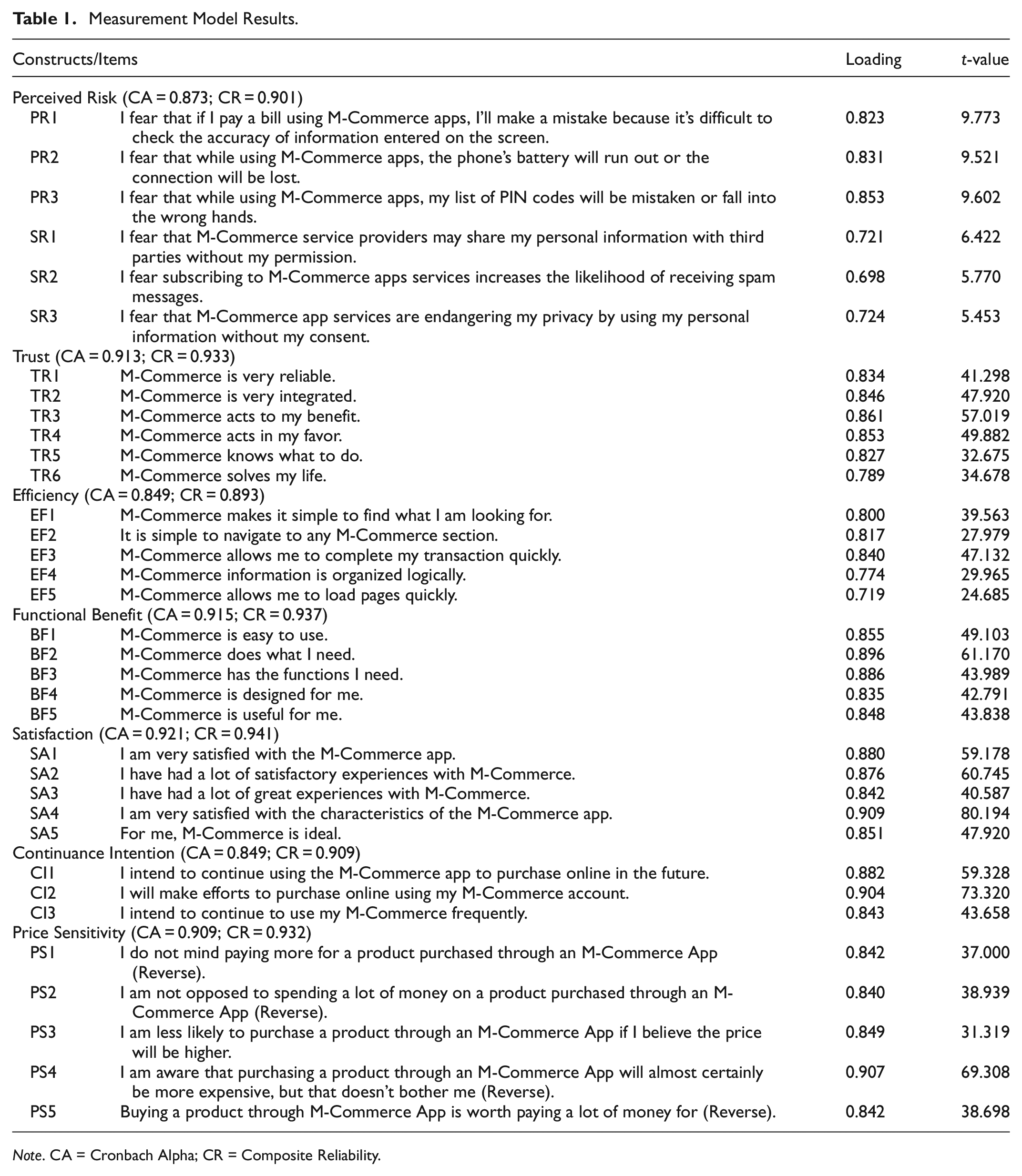
Note. CA = Cronbach Alpha; CR = Composite Reliability.
Empirical Estimation and Results
As mentioned previously, the current study adopted a PLS-SEM approach, using the Smart-PLS for testing the relationship. J. F. Hair et al. (2019) and Henseler et al. (2017) proposed two-step estimations, which we used in this study. In the first step, we proceeded to run a reflective measurement model (Table 1). This step is carried out to assess the validity and reliability of the measurement instrument. The smallest loading factor value for all items is 0.7. Hence, the results of the convergent validity of all the question items on this research questionnaire are valid. In connection with the consistency of measurement or reliability, what needs to be considered is the value of Cronbach’s alpha and composite reliability. In Table 1 below, it can be identified that Cronbach’s alpha and composite reliability of each measuring item exceed .7, hence all items are considered consistent and reliable. Furthermore, the value of convergent validity can also be observed from the AVE value. An AVE value of 0.5 indicates that the question items in this study meet the requirements of convergent validity. As for the discriminant validity, it is identified through the cube root of AVE. Items with feasible discriminant validity when the square root value of AVE is higher than the correlation value with other constructs, and the results show that the item in this study meets the standard. Moreover, discriminant validity can be detected in the heterotrait-monotrait ratio or HTMT value, which in this study did not exceed 0.9. More details can be seen in the following Table 2.
Discriminant Validity Based on Fornell-Larckers Criterion and Heterotrait-Monotrait (HTMT) Ratio.

Note. AVE = Average variance extracted. Diagonal entries (bold) are AVE square roots of constructs. The off-diagonal entries show the correlations between constructs.
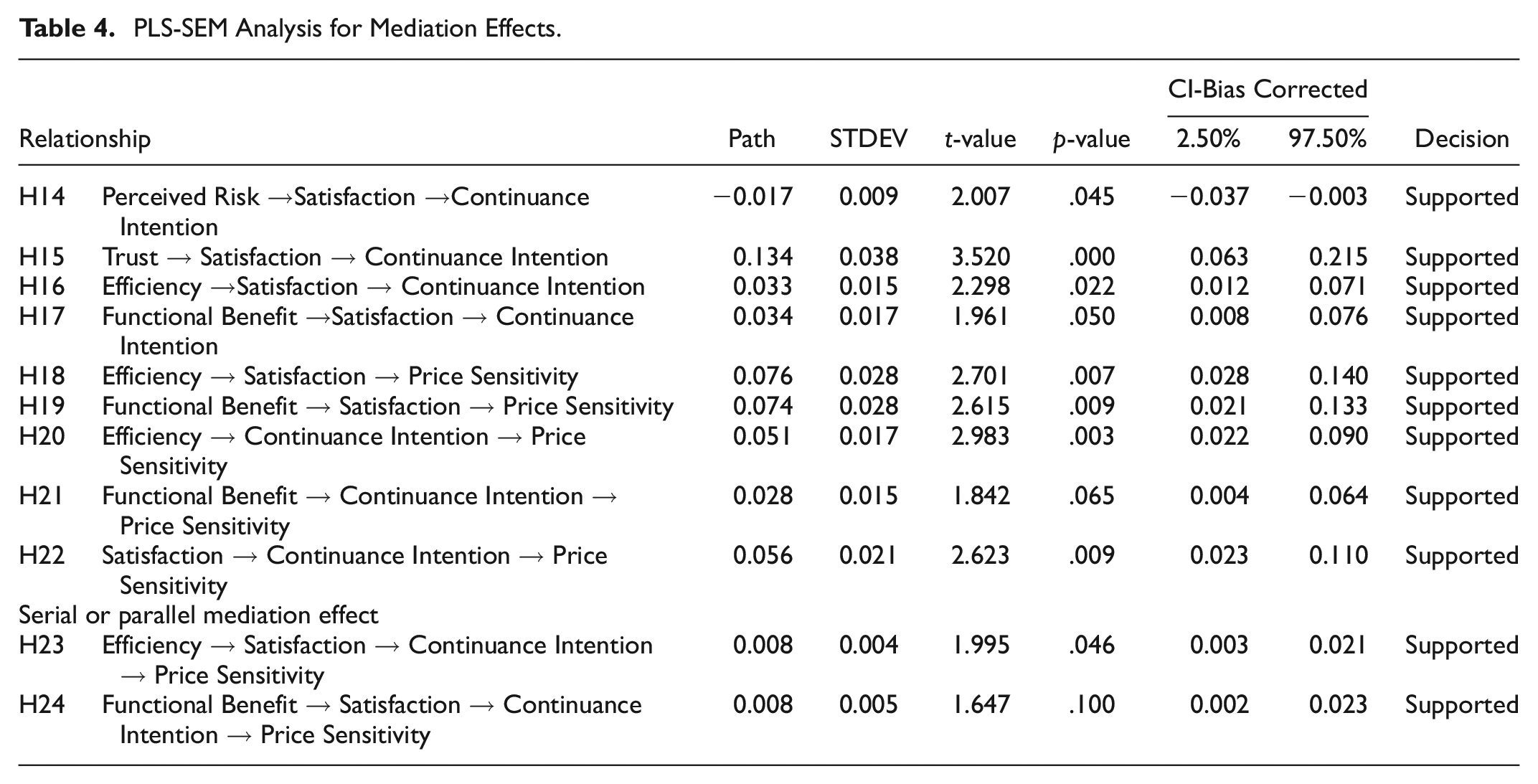
In the second step, after running the measurement model, the principal point is to evaluate the structural model, where what needs to be considered is the path coefficient, r-square (R2), collinearity, and also predictive relevance (Q2) (J. F. Hair et al., 2019). Bootstrapping was run to generate path coefficients with a significance level of 5%. Meanwhile, to determine the accuracy of the prediction of the independent variable on the dependent variable, it is necessary to pay attention to the value of R2. The satisfaction variable has an R 2 of 0.685. Additionally, the R2 of the continuous use intention and price sensitivity variables is 0.587 and 0.265, respectively. Shmueli and Koppius (2011) mentioned that the higher the value of R2, the greater the influence of the independent variable on the dependent variable, which shows the explanatory power of a model. In this case the independent variable that affects the satisfaction variable has a higher level of predictive accuracy than the variables of continuous use intention and price sensitivity. It turns out that the independent variable in this study only affects the price sensitivity of 26.5% (R2 = 0.265). To see predictive relevance, blindfold was run to obtain Q2. Satisfaction (Q2 = 0.515), continuous use intention (Q2 = 0.442) and Price Sensitivity (Q2 = 0.184) all of them have values of Q2 above 0, which indicates that exogenous variables (perceived risk, trust, efficiency, and functional benefits) have predictive relevance for endogenous variables. Furthermore, we presented path coefficients in Tables 3 and 4. Around 90% of hypothesis supported by the empirical results as their corresponding the p-value is lower than 0.05 and t-value is greater than 1.96.
PLS-SEM Analysis for Direct Effects.

Note. Satisfaction (R2 = 0.685; Q2 = 0.515), Continuance Intention (R2 = 0.587; Q2 = 0.442); Price Sensitivity (R2 = 0.265; Q2 = 0.184).
PLS-SEM Analysis for Mediation Effects.
Empirical Discussion
Antecedent of Satisfaction
Referring to H1, perceived risk has a coefficient value of −0.077, indicating it negative effects on satisfaction. The findings implies that the increased risk identified by m-commerce users during purchasing will have a negative impact on m-commerce customers’ satisfaction. This is in line with the study of San Martín and Camarero (2009), where the security and privacy policies of an online shopping site affect customer satisfaction. Therefore, m-commerce business needs to understand the factors determining quality in m-commerce to be able to achieve customer satisfaction, including security and privacy risks (Tzavlopoulos et al., 2019; S. Wang et al., 2004). The concerns of potential security and privacy risks are likely to arise during use of m-commerce, as problems related to malware, mobile network constraints, and content issues exists (Chopdar et al., 2018). Consequently, by paying attention to and overcoming problems related to security and privacy, there will be more opportunities to realize satisfaction for m-commerce users.
The influence of trust (β = .593, p-value = .00) of m-commerce on satisfaction seems to be positive and significant. Therefore, these empirical findings strongly support H2. Marinao-Artigas and Barajas-Portas (2020) demonstrated that when m-commerce is considered to show honesty, decency, benevolence, and competence, the satisfaction of m-commerce users will be positively affected. These findings are also reinforced by many other similar studies, such as B. Jin et al. (2008) and J. Kim et al. (2009), where trust is the best way to strengthen m-commerce user satisfaction.
The impact of m-commerce efficiency (β = .147 p-value = .002) on satisfaction appears to be favorable and significant. As a result, the empirical evidence substantially supports H3. The efficiency of m-commerce has also been empirically proven to bring satisfaction to users. A nifty m-commerce design that helps users navigate quickly and easily to find the product they want to purchase will make customers satisfied using m-commerce services (Omar et al., 2021). This could be applied since efficiency leads to improvements in m-commerce design, as strategic positioning and market segmentation become more precise, resulting in upgraded economic value offered to customers (Sánchez-Fernández & Iniesta-Bonillo, 2009), and the formation of satisfaction is only a matter of time.
The impact of m-commerce functional benefits (β =.145 p-value = .006) on satisfaction Therefore, these empirical findings strongly support H4. These findings are supported by Kotler and Keller (2018), who stated that functional benefits affect the satisfaction of m-commerce users. Omar et al. (2021) found that the functional benefits of m-commerce are also the ones that bring user satisfaction, but they are indirect. Functional benefits will provide users with a positive affective evaluation of themselves in the form of pleasure, joy, and happiness (emotional state), which will undoubtedly improve their shopping experience, resulting in customers who are extremely satisfied with m-commerce shopping.
Antecedent of Continuance Use Intention
As for the security and privacy risks that negatively affect satisfaction, it doesn’t necessarily imply that customers have no intention of continuing to use M-commerce. In this study, the effect of perceived risk on the intention to reuse has a coefficient value of −0.030 with a p-value of .498. H5 is rejected because the p-value is greater than .05. On the effects of perceived risk, the studies of Gupta et al. (2010) and E. S. T. Wang and Lin (2017) found that perceived risk negatively influences the intention to use m-commerce sustainably and continuously. However, the current study reveals that there is no effect of perceived risk on behavioral intentions to use m-commerce continuously. Our finding is in line with the study by Gao et al. (2018), where they discovered that the perceived risk does not have a significant effect on the intention to use the QR code mobile payment application on an ongoing basis. They argued that this is due to the possibility that the relevant laws and regulations in China in the area of QR code payments are gradually being improved. The implication is that in Indonesia, government regulations can also be an indication of why privacy and security risks have not made consumers hesitate to use m-commerce applications further in the future. In Indonesia, Law No. 19 of 2016 amends Law No. 11 of 2008 concerning Information and Electronic Transactions (UU ITE), which regulates the implementation of online buying and selling. Siregar (2019) commented that the ITE Law must be complied with by m-commerce, including that the m-commerce party is obliged not to disclose the identity and personal data of buyers. Referring to what was conveyed by Gao et al. (2018), the knowledge of the Indonesian people about the existence of the ITE Law is part of the factors causing the perceived risk to people aiming to stop using m-commerce for shopping. Yaru (2020) stated something similar. Although the perceived risk has an influence, the effect is the smallest among the effects given by other constructs, and this is due to the standardization and legalization of online shopping platforms and third-party payment guarantees, which make consumers more familiar with the m-commerce platforms and their tolerance for risk higher.
Trust (β = .308, p-value = .000) is a significant determinant of continuance intention to use m-commerce, along with satisfaction (β = .227, p-value = .000). The influences are positive for trust and satisfaction. These findings support the hypotheses H6 and H9. These findings are in line with those of X. Yang (2021) and F. Meng et al. (2022), showing the effects of trust. Additionally, satisfaction is a motivational factor that promotes the intention to use a system/technology in a continuance manner (Bhattacherjee, 2001; Lim et al., 2019; Shang & Wu, 2017). However, if consumers find m-commerce is not trustworthy, they are more likely to discontinue using m-commerce future, regardless of their level of satisfaction (Chong, 2013b).
We discovered that efficiency has a positive impact on the continuance intention to use m-commerce (β = .209, p-value = .000). Therefore, the finding lends support to hypothesis H7. To some extent, it is related to the research of Chahal and Kumari (2011) in the health sector, where the efficiency value, which is a dimension of perceived value, affects the use of providers for the same or different services (loyalty dimension). It is also relevant to the study of Jones and Issroff (2007), who stated that saving time in obtaining product information and the cost of trips to the store (efficiency) were significant motivators for m-commerce customer behavior.
Functional benefit was also found to have a positive effect on the continuance intention to use m-commerce (β = .112, p-value = .027. Hence, our hypothesis H8 is supported. The findings imply that, with functionality (utilitarian aspect), consumers will be motivated to further engage (engage) in the use of technology, and this will help create customer satisfaction and ultimately encourage sustainable use (Tarute et al., 2017). In this case, mobile applications have the same basic functions of a technology, including location tracking and system performance, that could promote satisfaction and ultimately encourage sustainable use. The past studies also argued that the functional benefits of m-commerce were seen with the recent increase in online customers, who are quite satisfied with many m-commerce services, particularly during the COVID-19 pandemic when everything was online during lockdowns (Giantari et al., 2021; Smoleńska & Pilarska, 2021).
Antecedent of Price Sensitivity
We discovered that perceived efficiency has no significant effect on price sensitivity (β = −.031, p-value = .666), hence hypothesis H10 is rejected. In a sense, when the use of m-commerce is considered easy and can complete transactions quickly, this does not make users less sensitive to the price of the product they desire to possess. This result is contrary to what was conveyed by Zeng et al. (2011), where consumers become less sensitive to changes/increases in the price of the desired product when m-commerce provides speed and convenience, especially when ordering products. In this study, the denominator of efficiency is time, when users perceive that using m-commerce makes transactions easier and faster. Consumers, especially in Indonesia in general, prioritize time and convenience (Anderson & Shugan, 1991), however, monetary costs remain an important concern. As stated by Y. Kim (2002), when consumers want to acquire maximum comfort, they as well want to reduce the expenditure of resources at the same time, in this case, time, effort, and also money. Thus, efficiency in the context of time does not reduce the user’s tolerance or sensitivity to price.
Other hypotheses with regard to the direct effect on price sensitivity are H11 (β = −.339, p-value = .000), H12 (β = .513, p-value = .000), H13 (β = −.247, p-value = .000), were entirely accepted. Functional benefits, satisfaction and intention to continuing to use m-commerce then have a significant effect on customer price sensitivity. The functional benefits sensed when shopping through m-commerce can actually reduce the price sensitivity of users. As Nagle and Holden (1995) propose 10 factors reducing consumer price sensitivity, including the final benefits felt by consumers. In the case of shopping through m-commerce, the final benefit is obtaining the product you demand/want easily. Hitherto, there has been little discussion about functional benefits in relation to price sensitivity, especially in m-commerce. Accordingly, this research can provide benefits for m-commerce businesses to find strategies to increase the functional benefits that m-commerce can provide such as time, location, adaptability, personalization, and also the effectiveness of the purchase (K. Yang, 2010) until consumers arrive at the stage of price-insensitive behavior.
As for the effect of satisfaction on price sensitivity, notwithstanding its significant effect, it has a positive effect. That way the results are the opposite of the results acquired by Low et al. (2013) and Natarajan et al. (2017). M-commerce users in Indonesia who are satisfied with transactions made using m-commerce actually lead them to become more sensitive to price changes. Meanwhile, the effect of continuance use intention on price sensitivity also resulted in the same finding, where the higher intention of continued use led to increased user price sensitivity. This finding is quite a novelty that is contributed by this study as parties related to the m-commerce business comprehend the culture of m-commerce users in their country, in this case, Indonesia (Low et al., 2013). The finding of a relationship between continuance uses intentions that positively and significantly affect price sensitivity requires m-commerce businesses to be careful in deciding to create a price change, since the increasing desire to use m-commerce further in the future, in fact, makes users of m-commerce in Indonesia is becoming more sensitive to price changes that occur.
Mediating Role of Satisfaction
In regard to mediating role satisfaction, we found that perceived risk H14: β = −.017, p-value = .045), trust (H15: β = .134, p-value = .000), efficiency H16: β = .033, p-value = .022) and functional benefits (H17: β = .034, p-value = .050) indirectly affect behavioral intentions to continue using m-commerce through satisfaction. The current adds new insights that post-adoption behavioral theory and supports the hypothesis H15, H16, H17, and H18. In regard to perceived risk indirect effects, the empirical findings of Udo et al. (Udo et al., 2010) are different from the current study as their study concluded that perceived risk does not affect customer satisfaction and behavioral intentions. The result of this study implies that when m-commerce users in Indonesia perceived the risk in using m-commerce, then this will not directly affect the desire to no longer use m-commerce in the future unless the perceived risk in such a way affects satisfaction, then the intention to reuse will be affected. With respect to the variables of trust, efficiency, and functional benefits, these variables directly or indirectly affect the intention to use m-commerce in a continuous manner through satisfaction. These factors are seen as the promoters of the satisfaction of customers, when these factors escalate customer satisfaction that led to an increase to repurchase/continuing to use any service. The past studies on trust-satisfaction- repurchase intention (Chen & Chou, 2012; Fang et al., 2011; Hsu et al., 2014; Melović et al., 2021), efficiency-satisfaction-repurchase intention (Hao et al., 2021; Kandula et al., 2021; Obal, 2017; Tseng, 2015), and functional benefits -satisfaction- repurchase intention (Mulyono & Pasaribu, 2021). Therefore, the current findings suggest that m-commerce service providers have to increase the level of trust, efficiency, and functional benefits in order to increase satisfaction that is ultimately increases the level of re-purchase or re-use intention.
Satisfaction tends to play a mediator role between functional benefits and price sensitivity and between efficiency and price sensitivity. In this regard, we found that satisfaction empirically proves that it mediates the relation between functional benefits and price sensitivity H18: β= =0.076, p-value = .007) and between efficiency and price sensitivity. Therefore, these findings are in line with our hypotheses H17 and H18. However, the findings are opposed to those findings of Aligholi (2014) and F. Meng et al. (2022), when perceived efficiency and functional benefits create satisfaction, it makes users in Indonesia more sensitive to price changes. Efficiency and functional benefits indirectly affect customer tolerance to price changes by first affecting customer satisfaction.
Mediating Role of Continuous Use Intention
Continuous use intention then empirically mediates the effect of efficiency, functional benefits, and satisfaction on price sensitivity, with the acceptance of H20 (β = .051, p-value = .003), H21 (β = .028, p-value = .065) and H22 (β = .056, p-value = .009), also with a positive relationship (increased sensitivity to price). These findings show that an increase in re-usage intention of m-commerce links the relationship between efficiency, functional benefits, and customer-perceived satisfaction with customer price sensitivity. It is noted that Indonesian customers are more price-sensitive because the switching costs are low or negligible. The customers explore different m-commerce platforms without visiting any physical stores. When they find the best deal, they buy from that m-commerce site. Hence, our study adds a novel finding that mediating the effect of behavioral intentions, specifically the intentional use of m-commerce on price sensitivity of m-commerce users.
Serial Mediation via Satisfaction and Continuance Use Intention
Regarding the serial mediating role of satisfaction and continuance use intention for the links between functional benefits and price sensitivity and between efficiency and price sensitivity, the current study demonstrated that these links have been parallelly meditated through satisfaction and continuance use intention. The findings confirmed theH23 (β = .008, p-value = .046) and H24 (β = .008, p-value = .009). These findings contribute to the cultural sphere, where satisfaction and continuous shopping intention through m-commerce correlate efficiency and functional benefits with user price sensitivity positively. M-commerce users in Indonesia, especially those who value time and convenience, will feel satisfied when shopping with m-commerce which helps carry out transactions easily and quickly. This satisfaction will encourage users to wish to continue shopping through m-commerce, even for products that are usually found in offline stores. Nevertheless, m-commerce users in Indonesia are becoming progressively sensitive to price changes, although satisfaction and desire to continue using m-commerce are intensifying. It takes place since there is a practice in the field of commerce in Indonesia, especially in retail trade and traditional markets, where producers change/increase prices when consumers are attached (because they are satisfied) with their products. This creates a stigma and creates a kind of awareness in the community that satisfaction and attachment will make producers power over consumers. As stated by Hofstede (1980) regarding the four dimensions of culture, Indonesia is included as a country with a high-power distance dimension. Although power in this case is intended for government, this condition can also be applied to organizations, including between producers and consumers. Noticing the findings of this study, it can be assumed that the stigma attached to the minds of consumers builds a similar perception to m-commerce, where when consumers have reached the stage of satisfaction and intend to always use m-commerce, the m-commerce party can make policies related to price changes, specifically by reducing discounts, eliminating the free shipping policy, reducing earning points, increasing administrative costs, and so forth.
Summary, Implications, Limitations, and Future Directions
Given the rise of m-commerce, our results have important implications for practitioners, existing literature, and theories. This study focuses on consumer behavioral intentions subsequent to the use of m-commerce, exploring the intention to use m-commerce continuously affecting customer price sensitivity. Satisfaction mediates the perceived risk, trust, efficiency, and functional benefits variables that affect the intention to use continuously and price sensitivity. The findings of this study are: (i) the perceived risk in using m-commerce directly affects customer satisfaction and indirectly affects the intention to use m-commerce in a continuous manner; (ii) Trust in m-commerce affects satisfaction and directly or indirectly affects the intention to use m-commerce continuously; (iii) Efficiency and functional benefits of m-commerce create user satisfaction and continued use intentions directly, functional benefits increase customer price sensitivity directly and indirectly, while efficiency increases customer price sensitivity indirectly; (iv) The perceived satisfaction with shopping through m-commerce greatly affects the intention to reuse, also affecting the increased price sensitivity of users; (v) There is no significant influence of perceived risk toward intention to continue using m-commerce. The variable of efficiency also does not have a significant influence on price sensitivity; (vi) There are serial mediations of satisfaction and continuance use intention of efficiency and functional benefits on price sensitivity.
Theoretical Contribution
Our findings are useful for theoretical model development in m-commerce consumer expectation literature especially in relation to emerging economies like Indonesia. We began by adding the existing literature in the m-commerce business on two theories such as theory of confirmation expectations (ECM) and post-adoption theory (PAM). Our model empirically affirms that perceived risk, trust, efficiency, functional benefit, satisfaction, continuance intention, and price sensitivity are well grounded in mobile commerce. We extended the variable of PAM with perceived risk, trust, and efficiency. The integration of multiple variables in this comprehensive model enhances the empirical intricacy of the theory of continuance intention. There exists a multitude of factors that could potentially contribute to the intention to continue using a particular mobile commerce platform. Moreover, the unique contribution of this research lies in its examination of the effect of continuance intention on price sensitivity, which has resulted in the development of a novel empirical framework within the domain of mobile commerce. This is notable as numerous prior investigations have focused on the opposite relationship, namely the impact of price sensitivity on continuance intention. The variables of this model encompass both the shopping behavior of consumers and their retention intentions in the context of mobile commerce.
Additionally, this research endeavor serves to formulate the degree of consumer price sensitivity and establish its connection with the theory of confirmation expectations (ECM) and post-adoption theory (PAM) (Bhattacherjee, 2001), where culture is a salient factor that influences the variations in the outcomes. Furthermore, this study reveals that satisfaction and intention to continue use/repurchase intention significantly and positively are related to price sensitivity. In the case of m-commerce, price changes that occur are not only related to changes in the prices of products offered, but also to reduced discounts and promos, loss of free shipping policies, reduced number of points earned, additional administrative costs, and so on. Our study also makes a contribution to the understanding of serial mediation in m-commerce context by elucidating the association between efficiency and price sensitivity through the mediating factors of satisfaction and continued use intention. The present study utilizes satisfaction and continued use of intention as serial mediators to elucidate the association between functional benefit and price sensitivity.
Practical Implications
In the context of mobile commerce business, the outcome of this study yields a comprehension of the management and marketing strategies in relation to consumers’ perceived risk, trust, efficiency, functional benefit, satisfaction, continuance intention, and price sensitivity. It is imperative for the manager to prioritize the establishment of consumer trust, as well as the efficacy and utilitarian value of their mobile commerce platform. This can be achieved through the development of a dependable and integrated system that prioritizes consumer benefit and convenience, offers clear and concise instructions, promptly resolves consumer issues, and is designed with responsiveness and consumer demand in mind. In essence, mobile commerce is poised to introduce cutting-edge technology that boasts comprehensive functionality, user-friendly interfaces, a vast array of products and services, and highly responsive customer support, among other features. Furthermore, m-commerce must secure customers’ personal information and privacy, therefore m-commerce should assign a comprehensive security application or the users.
Furthermore, to avoid any decrease in the customer numbers, successful m-commerce management requires the maintenance of the aforementioned supporting variables, such as discounts, shipping costs, and administrative charges. This is due to the fact that consumers who were initially satisfied with the service and intended to continue using m-commerce are now exhibiting greater sensitivity and are less tolerant of any modifications to pricing and expenditure-related services.
Moreover, the retention of customers is a critical factor for the prosperity of any mobile commerce platform. According to Sirdeshmukh et al. (2018), customers who have achieved a high level of satisfaction and intend to continue using m-commerce apps tend to be loyal. Losing these customers to competitors can pose a significant risk of loss for any m-commerce business. M-commerce must ensure that price-related amenities are upheld. Enhancing customer experience by offering exclusive discounts, rebates, and other appealing programs has the potential to both expand your user base and foster customer loyalty.
Limitations and Future Directions
The study has advanced the existing theories such as the expectation confirmation model (ECM) and post-acceptance model (PAM) and literature relating to the price sensitivity, intention to continue, satisfaction, perceived risk, trust, efficiency, and functional benefit. While the study offers significant contributions to the marketing literature, it is not exempt from its inherent limitations. In this regard, the scope of our research prevented us from delving further into the impact of trust and risk perception on price sensitivity. Henceforth, it is recommended that forthcoming inquiries attentively examine the relationship between the perception of risk and trust with price sensitivity. It is certainly advisable to explore other factors that may influence continued use intentions and price sensitivity. It is recommended that future research endeavors integrate control variables, such as age, gender, and occupation, as moderating factors that exert an influence on the relationship between satisfaction and price sensitivity. The incorporation of this approach will serve to augment the exploratory and comprehensive character of the study.
Footnotes
Acknowledgements
We would like to express our gratitude to Universitas Negeri Padang.
Declaration of Conflicting Interests
The author(s) declared no potential conflicts of interest with respect to the research, authorship, and/or publication of this article.
Funding
The author(s) disclosed receipt of the following financial support for the research, authorship, and/or publication of this article: This research was supported by Universitas Negeri Padang for Article Processing Charges (APC).
