




Abstract
This article tests the links between attributes of stakeholder engagement (information sharing [quantity and quality of information sharing], procedural fairness [respectful treatment and providing voice], and empathy) and local communities’ acceptance of corporate social responsibility (CSR) initiatives with the mediating roles of trust and perceived environmental protection. Using Ghana as a case, survey data were collected from 604 local inhabitants in mining communities for the study. In analyzing data with a structural equation modeling technique via IBM SPSS AMOS Version 22.0, the quality of information shared, respectful treatment, giving voice to and showing empathy to local inhabitants positively related with trust. Trust and perceived environmental protection partially mediated the relationships between attributes of stakeholder engagement and acceptance of CSR. The findings show different dimensions with different extent to which trust between mining firms and local communities can resolve conflicts on CSR initiatives as well as provide guidelines for healthy communication between stakeholders.
Keywords
Introduction
The study of Boadi, He, Darko, and Abrokwah (2018) posited that corporate social responsibility (CSR) initiatives by mining firms in Ghana can improve company–community relationship. It is not surprising that substantial number of studies has shown that mining firms in Ghana seems to be providing CSR initiatives for the local communities (Essah & Nathan, 2016; Hilson & Banchirigah, 2009; Lawson & Bentil, 2014). However, there are ongoing open resistance in the form of protests and demonstrations on these CSR initiatives from local inhabitants in Ghana (Brew, Junwu, & Addae-Boateng, 2015). This can be attributed to the perception of local communities and mining firms about CSR.
Most local inhabitants perceive CSR initiatives as cover-ups and green-washing strategy by mining firms. This is seen in the findings of Okoh (2014) where local inhabitants in Obuasi (a mining town in Ghana) were unhappy with the biophysical and sociocultural implications of mining operations on the local communities’ livelihood. These sentiments can be traced to the 1990s where about 14 communities were displaced for mining exploration in the southwest of Ghana. The youth considered that the compensation paid for the displacement was insufficient and demanded for sustainable initiatives from mining firms (The Human Rights Clinic, 2010 as cited in Moomen, 2017). Furthermore, the protests on CSR initiatives can be, as a result of, a different understanding of CSR by mining firms and local communities. Oftentimes, the motive for CSR by mining firms is to acquire social license to operate (Moffat & Zhang, 2014). The concept of social license indicates that mining firms cannot operate sustainably without the acceptance of their operations by local communities and other stakeholders (Prno & Slocombe, 2012; Thomson & Boutilier, 2011). This social license is beyond the legal requirement of operating a business. It is what makes local communities accept the presence of mining activities in their communities. The report by International Council on Mining and Metals (ICMM) illustrated that mining firm “social license” depends on establishing trust with local communities (ICMM, 2012). For this reason, a strategy of mining firms to acquire the support of local communities and hopefully establish trust with local communities has been embarking on CSR initiatives (Harvey, 2014; Slack, 2012) But the studies of Nyuur, Ofori, and Debrah (2014) and Visser (2008) concluded that in the African context, CSR initiatives are seen by local communities as philanthropy and does not require a reciprocal commitment to the provider. This understanding of CSR resonate strongly with the assertion by Zandvliet and Anderson (2009) that despite US$ 7 million per year as money spent on social development projects by his firm, the firm is frequently confronted with challenges from this same local communities who receive the social support.
The discussions so far reveal the limits of CSR to strengthen the relationship between mining firms and local community. The reason for the limits of CSR seems to be mistrust between mining firms and local communities. Although this mistrust leading to rejection of CSR initiatives by local communities are at the local community level, it is important that they are resolved. The persistence of this mistrust can metamorphose into a national threat. Indeed, the national conflict in Liberia was credited to mineral resources (Twerefou, 2009). It is in this regard that Thomson and Boutilier (2011), proposed a pyramid model with three stages for mining firms to acquire the trust of local communities. The first stage is that mining firms acquire legitimacy with the fulfillment of legal requirements for operations as specified by law per country. The second stage is to establish credibility with local inhabitants. At this stage, mining firms fulfill the consensus with local communities before and during opening of the mine. This is to reassure the local inhabitants of mining firm’s commitment to agreements before, through, and closure of mining activities. As this credibility improves, it develops into the third stage, which is local inhabitants’ trust in mining firms. Thomson and Bourtelier empirically tested their pyramid model at a mine in Bolivia but were unsuccessful to authenticate the model (Boutilier & Thomson, 2011). This was because their findings suggested modifications to the model.
Obviously, there are multiple underlying factors that can improve the relationship between mining firms and local communities. Hilson and Clifford (2010) and Jenkins (2004) suggested that social development conflicts in mining regions are complex and cannot be resolved with a single method in all regions. Hence, Cernea (2003) and Thomson and Joyce (1997) recommended that mining firms should aim at establishing good social relations with local communities at the early stages of exploration. Patel, Rogan, Cuba, and Bebbington (2016) have suggested to mining firms to use mediations and capacity building of the youth as strategies to establish healthy company–community relationship in developing countries including Ghana. However, very little is known about established strategies for mining firms that prioritize actions aimed at behavioral (and consequently, attitudinal) change across the whole of their organization to secure trust and acceptance of CSR initiatives by local communities (Harvey, 2014). As such, there is little understanding of the links between the processes of stakeholder engagement between mining firms and local communities and its effects on trust as well as CSR initiatives. Therefore, the general aim of this article is to investigate strategies for the processes of stakeholder engagement that are specifically relevant to establishing trust between local communities and mining firms and in turn acceptance of CSR initiatives in Ghana. Specifically, the study will seek to determine the influence of the intermediating roles of trust and local communities’ perception of mining firms as agents committed to reducing the negative environmental effects of their activities (perceived environmental protection) in the relationship between the attributes in the process of stakeholder engagement (information sharing, procedural fairness, empathy) and acceptance of CSR initiatives. To achieve these objectives, the article refers to stakeholder engagement as the actions of mining firms to involve local community stakeholders in its activities whereas CSR is defined as the concern of mining firms to act in the interests of local communities. In relation to how conflict around CSR can be resolved, Moomen (2017) identified interpretative and prescriptive methods for resource-related conflicts. Bell and Raiffa (1988) indicated that interpretative technique resolves conflicts by identifying the stakeholders involved and the depth of conflict, while prescriptive method seeks preventive measures to resolve conflict. This article uses both interpretive and prescriptive approaches and adapts the procedural justice theory as the main theoretical concept.
Significantly, the findings of this article would show how conflicts on CSR initiatives between industrial gold mining firms and local communities can be managed not only in Ghana, but also in other emerging sovereign regions of mineral resource-endowed sub-Saharan Africa. Albeit, the results of the study can enhance the levels of communication between local communities and mining firms as well as influence policy making by governments. This study is novel because few studies in the extant literature considered strategies that are attitudinal and behavioral in nature for improving company–community relationship before, during, and closure of mining exploration.
The study is organized as follows: theoretical background and hypotheses settings, methodology, results, discussion, conclusions and recommendations.
Theory and Hypothesis
Procedural Justice Theory
The core idea behind procedural justice theory is the idea of fair opportunities for people to meaningfully participate in the processes and allocate resources in decision making (see Thibaut & Walker, 1975; Tyler, 2000; Tyler & Blader, 2000). Although the concept of procedural justice is mostly seen in legal context, it can be applicable to nonlegal contexts. Thus, some processes in procedural justice can be used to resolve conflicts in other contexts. This is seen in the study of Knudsen et al. (2015) where information sharing and procedural fairness were used as subdomains of procedural justice. In Knudsen et al., these two subdomains positively influence company–community relationship during electricity grid location in Norway and the United Kingdom. Another case is in the United States, where Besley (2010) uses survey data collected during a public engagement process connected to nuclear energy to validate perceptions about the fairness of outcomes, decision procedures, and interpersonal treatment on both perceived favorability and acceptance of decision. The study findings show that all forms of fairness before, during, and after decision making relate positively with peoples’ acceptance. Accordingly, the studies of Litmanen, Jartti, and Rantala (2016) in two Finnish regions where mining firms operate and Bianchi, Brockner, and Bos (2015) indicated that people respond adversely when they get biased or disapproving results along with unfair processes. However, the willingness of people to approve results increases if they observe the processes of decision making are fair.
The current article draws lessons from the above studies and adapts the procedural justice theory in the context of mining exploration. In line with the objectives of this article, procedural justice is defined as local inhabitant’s meaningful participation in the processes of decision making with mining firms. Following the definitions of participation by Arnstein (1969) and White (1996), this article refers to meaningful participation as transformative participation where local inhabitants are empowered by mining firms to contribute in the stages of decision making. Thus, meaningful participation is about the local inhabitants having more power to directly negotiate for their preferred CSR initiatives or indirectly through their representatives for their voice to be heard and be responded to. The article adapts two sub domains of procedural justice, namely, information sharing and procedural fairness as used by Knudsen et al. (2015), Gross (2007), Besley (2010), and Hollander-Blumoff and Tyler (2008). However, the studies of Singer et al. (2006) and Eisenberg and Miller (1987) indicated that in intergroup settings trust can be acquired by stakeholders who display empathy. The role of empathy is rarely highlighted by studies that used the procedural fairness subdomain of procedural justice theory. In this research, empathy is treated as a distinct subdomain of procedural justice theory. Specifically, three subdomains comprising information sharing, procedural fairness, and empathy are regularly mentioned. These subdomains are used as attributes in the processes of stakeholder engagement between mining firms and local inhabitants to test the extent to which they affect trust and acceptance of CSR initiatives.
Trust
Poppo and Schepker (2010) refer to trust as the belief in the ability of individuals in a group to do good or bad. In addition, Curşeu and Schruijer (2010) indicated that to trust is the extent to which stakeholders can tolerate to be vulnerable to the actions of each other. This trust can be directed toward a group or decision (Wilburn & Wilburn, 2011).
Trust is conceptualized in this paper as a psychological state in which both mining firms and local communities have confidence and positive expectations for each other. That is, the article discusses two groups of trust, namely, affective and cognitive trust. McAllister (1995) define affective trust as the passionate links between stakeholders that are seen in the expressions of sincere care for the other party. This care can be demonstrated in the processes of stakeholder engagement between mining firms and local community. Contrary, cognitive trust denotes a trust that is established on merit such as know-how, responsibility, consistency, and loyalty (Barczak, Lassk, & Mulki, 2010; McAllister, 1995). This suggest that the skill and experience of mining firms to manage the fears and uncertainties of local inhabitants on effects of mining activities can help establish consensus for mining operations. Although mining firms are environmental degradation agents, the ability to protect the aforesaid two groups of trust can influence local inhabitants’ perception of mining firms as environmental protection agents who are willing to reduce reduce the negative effects of their mining activities. This perception of local inhabitants about mining firms can have positive relational outcome and acceptance of CSR initiatives that are link to the environment and beyond. Therefore, trust is expected to play a central role in improving company–community relationship.
Hypotheses Setting
Attributes of stakeholder engagement (information sharing, procedural fairness, and empathy) and trust:
Information Sharing and Trust
The effects of information sharing between stakeholders on trust have been researched for a long time (Pettigrew & Tropp, 2006). Knudsen et al. (2015) and Gross (2007) indicated that timely sharing of information between stakeholders’ influences individual’s judgment about the effectiveness of interactions in decision making. The studies of Turner, West, and Christie (2013) and Hewstone and Swart (2011) on resolving conflicts between stakeholders conducted in different settings concluded that information sharing provides stakeholder’s rights to meaningful participation and representation in the processes of decision making.
Information sharing in this paper focuses on the extent to which mining firms provide information to local inhabitants and the willingness of the local inhabitants to share their fears and expectations with mining firms. Thus, the quality of information (relevance of information) and the quantity of information (frequency of information) shared can have effect on both stakeholders. In the perspective of local inhabitant’s, information sharing with mining firms can identify their needs deserving priorities. This will enable local communities to develop in ways that relate with their own vision, which can translate into affection toward mining firms. While from the dimension of mining firms, they can balance business and social responsibility by using resources judiciously at where they are most needed. The aforementioned perspectives are crucial because the studies of both Okoh (2014) and Hilson and Yakovleva (2007) in Ghana as well as Yakovleva, Brust, and Mutti (2010) in Argentina indicated that mining activities have neither better socioeconomic welfare nor has it reduced the vulnerability of local communities. This account for increasing local inhabitants’ pressure on mining firms before, during, and after mines to construct roads to connect villages to towns and cities; to expand existing health facilities; to precisely communicate on employment issues to include local inhabitants (see Measham & Fleming, 2013). Violating information shared between mining firms and local communities on the above socioeconomic interventions (i.e., CSR initiatives) can have negative effects on their consensus and impair trust.
Hence, some scholars have linked information sharing between groups and individuals to establishing trust. Gillespie, Bond, Downs, and Staggs (2016) and Huijts, Molin, and Steg (2012) examined how information sharing between stakeholders affected trust in the sighting of coal seam gas and acceptance of sustainable energy technology, respectively. Their findings suggest that the quantity of information shared strengthened trust between the company and the local community and consequently a more positive behavior toward each other. Applying these findings in the context of mining exploration, the extent to which information is shared between mining firms and local communities could have effects on establishing trust and the acceptance of CSR initiatives. Therefore;
Procedural Fairness and Trust
Gross (2007) studied the social acceptance of wind energy in Australia with the application of justice and indicated that procedural fairness is about the desire to be treated with reverence, dignity, and have reasonable voice all through interactions with others. In this vein, the local communities want to be treated courteously in meetings with mining personnel. Local communities do not want to be embarrassed, bullied, and disgraced for reasons such as lack of know-how in technical projects during engagement with mining firms. Previous research shows that the quality of how a person is treated shows the extent of value and respect from decision makers. Rosenbaum et al. (2017) investigated how to measure police performance through public trust and acceptance with survey data gathered from 53 cities in the United States. Their results show a strong association between respectful treatment of the public and trust.
However, the link between respect, trust, and acceptance of decisions is having no relationship with the decision itself. Thus, the acceptance of decision can be explicitly centered on whether respect was incorporated in the processes of decision making. This is exposed in the study of Besley (2010), where local communities concerns on a new nuclear power plant were unfavorably related with their approval. Nonetheless, when nuclear concerns and respectful treatment of the local members were considered concurrently, the influence of concerns about nuclear power on acceptance was reduced. In a different way, people are encouraged by trust to collaborate with decision makers if they perceived that their concerns have been respected in the procedures of decision making.
Even though trust is necessary, people do not demand it. But then again, the desire for fairness is an essential human desire (Tyler, 1994). This insinuates that local inhabitants desire opportunities to express their opinions and mining authorities could respond negatively to efforts by seeking to ignore this desire. Using students as participants in three experiments, Terwel, Harinck, Ellemers, and Daamen (2010) investigated how public acceptance influence implementing a policy of carbon dioxide capture and storage technology. Their findings show that people care about voice in decision making even when they are not directly involved in the process. The extant literature discusses providing interest groups and individual voice in decision making. As reported by Behrent and Strelein (2001), indigenous groups were given voice at Jabiluka in Australia for mining operations. But these same groups renege from their earlier consensus with mining firms. This shows that sometimes majority group members overshadow the wisdom of the minority, especially, women groups in developing countries such as Ghana. Indeed findings of other studies exposed that providing voice to individuals or the minority to talk about preferences in decision making establishes trust and acceptance of outcomes (see De Cremer, Cornelis, & Van Hiel, 2008; Peterson, 1999). Also Schroeder and Fulton (2017) use results from a mail survey of Minnesota individual resident anglers to investigate the processes to gain residents’ perceived fairness and trust in decisions of fisheries managers. They concluded that residents’ voice in decision making was more strongly related to trust. Based on the above studies,
Empathy and Trust
Inevitably, the processes of acquiring trust are multilayered than people exchanging dialogue. As noted by Singer et al. (2006), institutions that show empathy earn the trust and respect of its stakeholders. Similarly, Trout (2010) indicated that there is a likelihood that people will respond positively when others understand their opinions, feelings, and situations. Along these lines, it seems that the influence of empathy is not satisfactorily considered by the voice domain in procedural justice research.
Eisenberg and Miller (1987) examined the literature with all relevant research including published studies, unpublished manuscripts, and dissertations to test the effects of empathy on behavior. The results exposed that empathy influences positive social behavior. On this note, the local communities desire to be listened to, accepted, and feel needed when they engage with the mining firms. This desire of local communities is reasonable because mining activities have negative effects on livelihood such as high prices of goods and services as results of the presence of mines in the communities as well as the lack of good drinking water due to pollution of water bodies with mine chemicals (Begani & Begani, 2017). The local communities may expect reassurance for their well-being from mining firms that is usually not forthcoming. This illustrates that if mining firms are enthusiastically listening and responding to what they receive, it could show care and affection for the local inhabitants. The display of such empathy can sway cooperative attitudes and behavior for healthier company–community relationship. In support of this, Hintjens (2000) suggested that to resolve conflicts at Jubiluka in Australia, mining firms may employ anthropologists during the process of stakeholder engagement, which include empathy to unravel local communities needs pattern. But as to whether or not voice and empathy should be distinct subdomains of procedural justice requires validation and that will be tested in this article.
Trust, Perceived Environmental Protection (i.e., Water, Air, Land) and Acceptance of CSR Initiatives
Historically, extractive industries are known for environmental degradation on account of their operations. Mining firms use land from exploration, construction, operation, closure, and postclosure. As a result, plants are cleared for building roads, and underpasses are excavated to access the mineral. These activities of mining firms are likely to cause habitat loss, deforestation, and loss of farm lands (Rajaram & Parameswaran, 2005; Vrablikova, Wildova, & Vrablik, 2016). This can lead to disaffection from local communities who depend on these lands for livelihood. In this studies context, Amponsah-Tawiah (2011) indicated that mining activities is a major cause of contamination of water bodies and pollution of air due to the noise as well as the dust from the blasting of dynamite. The pollution of land, water bodies, and air has been attributed to mining-related illness including mental disorders, diarrhea, malaria, upper respiratory infections, and skin diseases in local communities that host mining activities in Ghana (Ag-besinyale, 2003; Arthur, 2012; Essah & Nathan, 2016). All these effects of mining activities show the background of local communities’ misgivings and doubts that mining firms can minimize the negative effects of mining activities on the environment (water, air, and land). Hence, to establish trust between mining firms and local communities, mining firms could display a sense of care and responsibility for the negative consequences of their operations on local communities. This can influence the formation of habit and character of local communities that in spite of the negative environmental effects of mining activities, land can be reused for farming after closure of mines; health facilities and medical support have been provided by mining firms to alleviate illness; bole holes are drilled to provide good drinking water; and the youth has been reskilled to do other jobs (Lyytimäki & Peltonen, 2016; Owen & Kemp, 2014). The existence and ongoing CSR initiatives of the above nature safeguard the consensus between mining firms and local communities and in turn enhance company–community trust. Based on the above,
Despite the indirect relationship of trust between local communities’ perception of mining firm’s ability to reduce negative effects on the environment and acceptance of CSR initiatives, this same trust can result in direct acceptance of CSR decision. Wilburn and Wilburn (2011) posit that trust can be directed toward individuals, groups, or a decision. And trust in decision makers has been positively related to people’s approval of decisions (Terwel et al., 2010; Tyler, 1994). Similarly, Hamm et al. (2013) concluded that trust between company and community positively influences organizational functioning. But distrust can result in rejection and protesting against authorities by the public to protect their welfare (Smith, Leahy, Anderson, & Davenport, 2013). Base on the finding of the above studies, the final hypothesis is drawn that,
The framework below explains the relationships between constructs as hypothesized in this article (Figure 1).

Research framework.
Method
Research Context
Local communities where industrial gold mining firms with grade “A” membership under the Ghana Chamber of Mines (an association of all corporate miners in Ghana) were drawn for the study. These gold mining firms are based in four out of the 10 regions of Ghana. However, local communities from three regions, namely, Western, Ashanti, and Eastern were carefully chosen in which same gold mining firm function in two of the four regions. Significantly, the selected regions have seen lots of local communities clamor and resist against mining operations (Brew et al., 2015). There are reported cases of local inhabitants vandalizing mining firms’ properties and sometimes threatening the lives in the selected regions (Myjoyonlinenews, 2017). Besides the selection of these regions, the setting of this article is in Ghana (a sub-Saharan African country); and this addresses a specific context where in Africa CSR is seen as a philanthropy and does not require reciprocal commitment to the provider (Nyuur et al., 2014; Visser, 2008).
Data Collection
Survey data were collected with random sample technique to select local inhabitants to respond to questionnaire designed for the study. Purposefully, respondents were selected from different households and to the best of researcher’s knowledge, no more than four respondents were allowed from same household. This face approach was used to minimize bias in the responses to questionnaire. Before respondents are given questionnaire, researchers described the objectives of the study (the extent to which the processes of engagement between mining firms and local inhabitants can establish trust and acceptance of CSR) and then assured them of the confidentiality giving to the whole process and the information provided. Once the local inhabitants show willingness to partake, they were requested to answer a questionnaire intended to validate the hypotheses in this study. In sum, 625 questionnaires were administered to local inhabitants but 604 valid responses were received and used for the analysis. The data collection was between July 2017 and February 2018. Out of the 604 valid responses, in terms of gender, males = 56%, females = 44%; by occupation, farming = 40%, services = 14%, trading = 24%, manufacturing = 6%, mining = 16%; per number of years stayed in the community, 0 to 4 years = 14%, 5 years to 9 years = 10%, 10 years to 14 years = 42%, 15 years to 19 years = 19%, above 20 years = 15%. Thus, above average number of the respondents had resided in the community for a long time. They have experience how to live in the community in relation to mining operations. They were in a better position to respond to questionnaires for the objectives of this study.
Measurement of Variables
The questionnaire included measurement items/questions of all constructs, which has been tested and used in the stakeholder engagement literature. However, minor modifications were made to the wording of some questions to aid the understanding of local inhabitants before the questionnaire was finalized and distributed. The questionnaire was in five parts comprising attributes of stakeholder engagement, trust, perceived environmental protection, acceptance of CSR, and basic demographic information about respondents. All measurement items excluding demography of respondents were measured with a 7-point scale, which ranged from 1 = strongly disagree to 7 = strongly agree. The following illustrates the details and items for all constructs.
Independent variables
Quality of information shared (QUAI): Three items were adapted from Knudsen et al. (2015). They were during meetings with mining personnel they explain what would happen next in the process; during meetings with mining personnel they provide clear reasons their firms’ actions; during meetings with mining personnel they answer my questions well.
Quantity of information shared (QTYI): Following the study of Pettigrew and Tropp (2006), three items were used to for this construct. These items were we share information with mining personnel during informal meetings; we share information with mining personnel during community meetings; we frequently interact with mining firms.
Respectful treatment (RES): Items were modified from Rosenbaum et al. (2017) and they were mining firms can change decisions based on feedback from local inhabitants; personnel from mining firms are polite with local inhabitants; during meetings, the mining personnel talked down to me (reverse coded).
Voice (VOI): Three items were adapted from Schroeder and Fulton (2017) comprising during meetings the mining personnel listens to what I had to say; during meetings the mining personnel interrupted me; during meetings the mining personnel responds to my concerns.
Empathy (EMP): We adapted from Trout (2010) and measured empathy with “during meetings, the mining personnel comfort and reassure me,” “during meetings, the mining personnel seemed to believe what I was saying,” and “during meetings, the mining personnel seemed concerned about my feelings.”
Mediating variables
Trust (TRUS): Three items modified from McAllister (1995) and Terwel et al. (2010) for this construct. Thus, during meetings with the mining personnel, they seem to know what she or he was doing; I trust mining personnel to make decisions that are good for everyone in my village; I have confidence that mining personnel can do their job well.
Perceived Environmental Protection of Water (PEPW): We measured with mining firms know how to reduce water pollution that comes with mining activities; I trust mining firms can improve water quality in my village; I have the confidence that mining firms can provide alternate sources of water in my community.
Perceived Environmental Protection of Air (PEPA): We measured with mining firms know how to reduce air pollution that comes with mining activities; I trust mining firms can minimize noise pollution that comes with mining activities; I am confident that mining firms will improve the quality of air regardless of the dust associated with their operations.
Perceived Environmental Protection of Land (PEPL): It was measured with mining firms know how to reduce land degradation; I am confident that mining firms will transplant rare plants found on mine site; I trust mining site can be used after closure of mining operations.
Dependent variable
Acceptance of CSR (ACSR): It was measured with to what extent are you willing to accept the CSR of mining firms; to what extent will you be satisfied with CSR of mining firms; to what extent will you approve the CSR of mining firms.
Reliability and Validity Test
Using IBM SPSS AMOS Version 22.0, Cronbach’s alpha, composite reliability, and confirmatory factor analysis were carried out, and the results were within acceptable ranges as suggested by Hair, Anderson, Tatham, and Black (1995) and are reported in Table 1. As recommended by Chen, Curran, Bollen, Kirby, and Paxton (2008), the measurement model with the results, root mean square error of approximation (RMSEA) = 0.027; goodness of fit index (GFI) = 0.961; standardized root mean square residual (SRMR) = 0.032; comparative fit index (CFI) = 0.965; Tucker–Lewis index (TLI): = 0 .937; chi-square and df = 1,267 and 746; chi-square/df = 1.69, fit the proposed framework than other paths that were examined.
Results of Internal Reliability, Convergent, and Discriminant Validity Tests.

Note. MSV = maximum shared variance; ASV = average share variance; QUAI = quality of information shared; QTYI = quantity of information shared; RES = respectful treatment; VOI = voice; EMP = empathy; TRUS = trust; PEPW = perceived environmental protection of water; PEPA = perceived environmental protection of air; PEPL = perceived environmental protection of land; ACSR = acceptance of CSR; CSR = corporate social responsibility.
Discriminant validity was confirmed by comparing the measurement items of construct correlation with other construct items. The results (Table 2) show items loaded well to its assign construct than on other constructs, which is a good signal for discriminant validity (see Fornell & Larcker, 1981). We additionally compared the maximum shared variance (MSV) and average share variance (ASV) of each construct with its average variance extracted (AVE). The values for MSV and ASV were below that of AVE, which also proves that there are no validity concerns. Moreover, Table 3 shows a Pearson correlation on all the constructs. The results in Table 3 indicate a poor relationship with all the independent variables on each other and highly positive link between the independent variables and the dependent variable. Furthermore, to ensure that common method variance (CMV) did not affect the data set, the common latent factor (CLF) was used with delta lower than 0.20 as a base (Podsakoff, MacKenzie, & Lee, 2003). The standardized regression weights before and after the use of CLF were then compared. The findings suggest that regression weights for the measurement items were not affected by the CLF because the deltas for most of the measurement items and the CLF were lower than 0.20.
Item-to-Construct Correlation Matrix.

Note. ACSR = acceptance of CSR; PEPW = perceived environmental protection of water; PEPA = perceived environmental protection of air; PEPL = perceived environmental protection of land; TRUS = trust; VOI = voice; RES = respectful treatment; QUAI = quality of information shared; QTYI = quantity of information shared; EMP = empathy; CSR = corporate social responsibility.
Descriptive Statistics and Correlation of Constructs.

Note. Two-tailed correlation computed. ACSR = acceptance of CSR; PEPW = perceived environmental protection of water; PEPA = perceived environmental protection of air; PEPL = perceived environmental protection of land; TRUS = trust; VOI = voice; RES = respectful treatment; QUAI = quality of information shared; EMP = empathy; QTYI = quantity of information shared; CSR = corporate social responsibility.
Structural Model and Hypotheses Testing
We estimated the research framework using the traditional covariance-based structural equation modeling technique via IBM SPSS AMOS Version 22.0. The structural model fit indices fell within acceptable ranges with the following results: RMSEA = 0.034, GFI = 0.952, SRMR = 0.072, CFI = 0.951, TLI = 0.945, chi-square and df = 1,748.205 and 972, chi-square/df = 1.79.
Figure 2 indicates the outcomes of the structural path analysis. As shown in Figure 2, subattributes of information sharing, and procedural fairness as well as empathy describe significant total of 77.1% of variant in trust, while the entire model explicates 49% variant in acceptance of CSR. Specifically, H1a is accepted as the quality of information shared related positively with trust (β = .32, p < .001).

Results of structural model.
Contrary, H1b is unaccepted as the results show respondents believe the frequency of information shared is not link with establishing trust (β = −.06, p < .05). The results of H2a, H2b, and H3 were accepted as respectful treatment, providing voice and empathy were positively related with trust, (β = .40, p < .001), (β = .25, p < .001), and (β = .08, p < .01), respectively. As estimated, H4a, H4b, and H4 trust is positively connected with perceived reduction in the negative effect of mining on water (β = .61, p < .001), air (β = .83, p < .001), and land (β = .63, p < .001). Similarly, H5a, H5b and H5c recorded positive effects of perceived reduction in the negative effects of mining on water (β = .06, p < .03), air (β = .27, p < .001), and land (β = .16, p < .001) on acceptance of CSR. And then, H6 had β = .30, p < .01, which is a positive result that the acceptance of CSR is directly influenced by trust.
Mediation Tests
Table 4 below illustrates the results of Sobel test for mediation effects of perceived environment protection (water, air, and land) between trust and acceptance of CSR. From the table, the results demonstrate a mediation effect with the coefficient of air recording the highest effect, whereas that of water is relatively small.
Mediation Analysis.
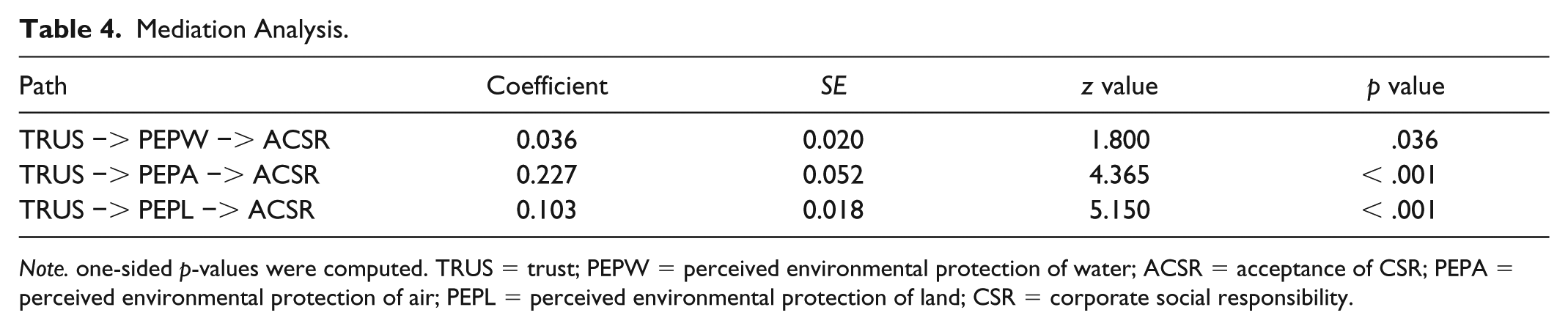
Note. one-sided p-values were computed. TRUS = trust; PEPW = perceived environmental protection of water; ACSR = acceptance of CSR; PEPA = perceived environmental protection of air; PEPL = perceived environmental protection of land; CSR = corporate social responsibility.
Discussion
This article investigates the effects of attributes of stakeholder engagement on trust, perceived environmental protection, and acceptance of CSR initiatives in mining fields. The following are worthwhile in the findings of this study.
First, the findings show that information sharing involving quality of information shared; procedural fairness (respectful treatment and access to voice) and empathy are substantial cues establishing trust. Specifically, respectful treatment of local inhabitants by mining firms had the highest influence on trust (1% increase in respectful treatment result in 38.9% increase in trust). Similarly, the quality of information shared between mining firms and the local inhabitants recorded the second highest influence on trust (1% increase in the quality of information shared will boost trust by 31.5%). Generally, the results suggest that procedural fairness subattributes bring to bear a fairly resilient influence on trust. This illustrates that different attributes of stakeholder engagement offer different influence on establishing trust between mining firms and local communities.
Surprisingly, the information sharing subattribute of quantity of information shared was adversely related with trust. This result differs from the findings of Gillespie et al. (2016) and Huijts et al. (2012), where frequency of information sharing predicted positive relationship between stakeholders. The results in this article can be explained that the respondents may not be interested in the number of meetings or interactions with mining firms. This finding is in line with the recommendation by Hilson and Banchirigah (2009) that mining firms in Ghana should rethink the schedule of meetings at venues that require local communities to pay for the cost of travel and transport across villages.
Third, the findings suggest that trust is a key precursor that can directly influence local communities’ acceptance of CSR initiatives. This shows that relationships that are built on trust can influence individual judgment toward each other. Thus, establishing trust between mining firms and local communities can predict favorable response to CSR initiatives. However, the partial mediation outcome of perceived environmental protection between trust and acceptance of CSR initiatives was greater than the direct influence of trust. This indicates that trust offers a considerable extent of descriptive control on perceived environmental protection, which in turn influence acceptance of CSR initiatives.
Altogether, the findings of this article make available that individuals depend on perceptive shortcuts to make conclusions about acceptance of authority decisions. These perceptive shortcuts were best explained by the subdomains of procedural justice theory used as attributes of stakeholder engagement.
Theoretical Implications
The results of this article add new layers to extant literature as the findings show how CSR decision making can be made to earn support from local communities in the mining industry and beyond. Although, prior research suggested stages to establish trust between mining firms and local communities (Boutilier & Thomson, 2011), the approach used by this article is different. By using the attributes of stakeholder engagement to establish trust, the article provides different dimensions with different extent to which trust can be established rather than stages between mining firms and local communities. The method is useful in settling conflicts on CSR initiatives before the start of mines, during mining operations, and after mining activities. The findings advance knowledge as it classifies and compares the influence of the attributes of stakeholder engagement to establish trust and acceptance of CSR. The finding suggests the attributes in the process of stakeholder engagement are unevenly beneficial in establishing trust, which affects the CSR initiatives.
This study is among the earliest to use empathy as a distinct subdomain of procedural justice theory. The inclusion of empathy in the attributes of stakeholder engagement with its resultant influence on establishing trust highlights the significance of empathy. This is a contribution to the procedural justice theory as the result has shown that empathy in the process of decision making have effects on decision outcomes.
Practical Implications
On information sharing, mining firms can use less technical language during information sharing with local communities. This involves capacity building of mining personnel to have a thorough understanding of local norms and develop the ability to tolerate patterns of local communities’ behavior as well as attitude. These efforts by mining firms will ensure quality information sharing with local communities that embrace precise information distribution and receiving channels (through village leaders such as chiefs, queen mothers, youth groups, and local radio stations). This will enable mining personnel to gather data on specific CSR initiatives in context of each village/communities that reflect local communities’ expectations as well as the resource capacity of mining firms. Implementing these CSR initiatives can influence local communities’ genuine perception of care by mining firms.
In terms of procedural fairness, mining firms can gain self-awareness by encouraging mining personnel to assess the effect that their individual behavior may have on local inhabitants and attempt to understand opposing viewpoints. Such assessments within the organization could enhance outward interactions with stakeholders. Most especially mining personnel will have an in-depth understanding about the sentiments of local inhabitants who will lose and have lost farmlands and properties because of mining activities. This could necessitate a creation and empowering of community development department by mining firms for personnel to receive grievances from local inhabitants and for onward forwarding to management for redress. This can help mining firms to allocate time and resources to hear and listen to the concerns of affected local inhabitants and fine-tune CSR initiatives accordingly.
Regarding empathy, mining firms and policy makers can have bystander intervention programs such as cultural diversity policies/occasions to help moderate norms and attitudes of both mining personnel and local communities that hinder healthier relationship between company and communities. These interventions provide opportunities that improve a sense of responsibility among mining staff, which result in understanding others (local inhabitants) by means of verbal or nonverbal empathy.
On how to minimize the effects of mining activities on the environment, it is recommended that mining firms rethink the routine of leftover as raw material and curtail the extent of excess generated via method reengineering. A policy on preserving biodiversity by resettling any unusual plants seen on mining site and possibly developing mines close to current infrastructure will be most desirable. These actions can leave mine locations in an acceptable state for reuse by the local inhabitants.
Finally, it is important that when local communities are engaged by mining firms, they select CSR initiatives that satisfy priori local concerns. This is to help mining firms to calculate and address specific local concerns that can augment peaceful coexistence of company and communities.
Limitations and Way Forward
This article uses the mediating role of local inhabitant’s environmental perceptions on mining activities between trust and acceptance of CSR initiatives. Indeed, CSR initiatives include environment, social, economic, and political dimensions, yet, only the local inhabitant’s perception of mining firm’s ability to reduce negative environmental effects were considered to mediate trust and all CSR decisions. Future research could consider social factors such as the standard of living, the cost of housing, and impact on infrastructure.
Conclusion
Regardless of the above limitations, this research outlined key attributes during stakeholder engagement between mining firms and local communities. These attributes were empirically tested on their relationship with establishing trust between mining firms and local communities before, during, and after mining operations. The extent to which trust between mining firms and local communities improves the acceptance of CSR initiatives was also validated. The findings of this article show that trust can be established from different dimensions with the attributes of stakeholder engagement. The approach is an ongoing process that requires both stakeholders evaluation. The method applicable is resolving conflicts at the start, during, and after mining operations. Particularly, conflicts revolving on local communities’ rejection of CSR initiatives by mining firms are most likely to be resolved with this approach. Indeed, the results of this article provide guidelines to promote healthy communication between mining firms and local communities. Furthermore, the findings broaden our understanding of organizational behavior settings for improved stakeholder relationship.
Footnotes
Declaration of Conflicting Interests
The author(s) declared no potential conflicts of interest with respect to the research, authorship, and/or publication of this article.
Funding
The author(s) disclosed receipt of the following financial support for the research, authorship, and/or publication of this article: This study was supported by the Social Science Planning Fund of the Ministry of Education, China (No. 18YJA630035).