



Abstract
Tourists’ environmentally responsible behaviour (TERB) is important for the sustainable development of tourist destinations. Based on social information processing theory, the article explores the mechanism of anthropomorphic/non-anthropomorphic guiding phrases on tourists’ environmentally responsible behaviours, and tests the mediating role of perceived loveliness and the moderating role of social trust. The study designed three experiments to conduct questionnaire surveys on tourists, empirically analysed 463 valid questionnaires collected, and constructed a theoretical model of the influence mechanism of guiding phrases on environmentally responsible behaviours. The conclusions of the study are as follows: (1) Compared with non-anthropomorphic guiding phrases, anthropomorphic guiding phrases are more capable of generating tourists’ environmentally responsible behaviours. (2) Perceptions of likability mediate the influence of guiding phrases on tourists’ environmentally responsible behaviour. (3) Social trust positively moderates the relationship between perceived cuteness and tourists‘ environmentally responsible behaviour. The higher the social trust, the stronger the relationship between tourists’ perceived cuteness and environmentally responsible behaviour. (4) Social trust positively moderates the mediating strength of perceived cuteness; the higher the social trust, the stronger the effect of anthropomorphism on environmentally responsible behaviour through the mediating path. The findings of this study have a positive significance and effect on enhancing the theoretical exploration and use of guiding phrases in tourist destinations and environmental enterprises.
Plain Language Summary
The study aims to understand how using personified language in tourist guides can promote environmentally responsible behaviour among visitors. It suggests that such language can make a difference, with personified phrases being more effective than non-personified ones. The study also finds that tourists’ perception of cuteness from the guide phrases plays a role in this process. Furthermore, social trust enhances the link between perceived cuteness and responsible behavior, as well as the overall impact of personification on such behavior. These findings are valuable for developing strategies to encourage eco-friendly actions in tourism and environmental management.
Keywords
Introduction
The rapid development of the current tourism industry not only brings more diversified travelling choices to tourists, but also puts forward higher requirements, and the key role of the public as the main body in environmental governance is becoming more and more prominent, however, a positive attitude towards the environment cannot be converted into corresponding environmental protection actions, and the lack of environmental education and guidance is an important reason. Introductory phrases through anthropomorphic forms are an important medium to achieve environmentally responsible behaviour (Ke & Liu, 2019). For example, ‘The grass is smiling at you, please go around the road’, ‘I am Snow White, please don’t turn me into Cinderella’, ‘Garbage cans are always open with a smile’, etc. Without exception, these reminders adopt the anthropomorphic strategy, thus gaining higher exposure and recognition. The anthropomorphic strategy makes them more humane, thus gaining higher exposure and recognition. It can not only improve the ecological knowledge and environmental protection awareness of the whole population, but also effectively guide the environmental protection behaviour of tourists. However, due to the reasonable and effective environmental education guidance has not yet been formed, many tourist attractions in China to guide the environmental protection language has not been effectively played, the phenomenon of natural landscape quality decline and environmental damage (Xu & Zhang, 2008).
The real test of an effective guidance phrase lies in its ability to promote behavioural change (Hansmann et al., 2009). On the one hand, guide phrases guide tourists’ behaviour to promote the protection and rational use of the scenic environment through the realization of the educational function to achieve the purpose of indirect management, which is easier to change tourists’ behavioural awareness than formal education (Apps et al., 2016). On the other hand, guiding phrases establish emotional and intellectual connections between tourists and the ecological environment, transforming the static perception of the environment into a dynamic interactive process. A few scholars have paid attention to this research topic, for example, Kronrod et al. (2012) studied the relationship between guiding phrases and the importance of environmental issues, and the relationship between guiding phrases and the importance of environmental issues. Based on cross-national research data and mainstream theoretical frameworks, Tam et al.(2018) further argue that trust has a moderating effect on the degree to which environmental awareness is translated into environmental behaviour. As research has progressed, scholars have recognised that irrationality is a factor that cannot be ignored when explaining individual behaviour, and anthropomorphism is one of them (Wang et al., 2023).
Based on the above background, this paper poses the following research questions: do anthropomorphic guide phrases have an impact on the good effects of tourists’ environmentally responsible behaviour? What are the effects of anthropomorphic features in the relationship between guide phrases and tourists’ environmentally responsible behaviour? This paper adopts a situational This paper adopts the situational experimental method to design experiments around the anthropomorphism of guiding phrases and tourists’ environmentally responsible behaviours, to advance the empirical research on guiding phrases in tourism contexts, and to provide new ideas for improving the effectiveness of tourists’ behavioural management, so as to formulate a scientific behavioural guiding policy.
Literature Overview
Introductory Terms and Anthropomorphisation
In many environments, the use of lead-in phrases has proven to be effective in capturing the interest of the public (Li et al., 2023; Malabar, 2020; Romano & Porto, 2018). Guiding language is an important symbolic expression that effectively conveys tourism image to tourists and can cause psychological resonance of tourists so as to produce responsible behaviours. As can be seen from the definition, ‘guiding language’ can be understood as the presentation of textual information to convey certain specific content to the recipient of the information, thereby creating a specific psychological or behavioural impact on the recipient of the information, an ideology that emphasizes the protection of nature and ecosystems, and the reduction of negative impacts on the environment (Afifah et al., 2024). Established studies have shown that guiding phrases can have some kind of stimulation and effect on the established environmental attitudes already held by consumers, strengthening or weakening the relationship between consumers’ environmental attitudes and behavioural intentions, and ultimately having an impact on green consumption behaviour (Wang et al., 2023).
Anthropomorphism refers to the process of endowing inanimate objects or abstract concepts with life attributes and external things with human nature or personality (Tong et al., 2020), such as endowing human characteristics, motives, intentions, behaviours, or emotions to real or imagined non-human things, so as to achieve a way of communication and interaction with humans (Choi et al., 2019). With the application of technology, scholars at home and abroad have now begun to pay attention to the anthropomorphism of robots on the study of the factors affecting the cognition and attitude of service providers and customers (Zhao et al., 2021; Zhu et al., 2024), as well as to explore the mechanism of the anthropomorphism of the interpretation mode on the effect of environmental education for tourists. Adam et al. (2021) tested that the anthropomorphism of AI in the linguistic dimension increases the user’s acceptance of service likelihood. Zhou et al. (2022) argued that advertisements using extrinsic anthropomorphism are more likely to convince consumers of the advertisements they are watching and have a higher willingness to buy the products advertised. Choi et al. (2019) found that anthropomorphism is not a panacea, and when the AI has a high level of emotional intelligence performance, many evidences show that customers will develop an averse attitude towards the AI.
Tourists’ reception of the anthropomorphic message of the guidance phrase mainly comes from the presentation of text and appearance images, etc. The manipulation methods to achieve anthropomorphism include textual manipulation and appearance manipulation. Textual manipulation refers to the use of guidance phrases to guide consumers to describe and evaluate non-human entities from an anthropomorphic perspective. Appearance manipulation, on the other hand, involves intuitively designing the appearance of non-human entities by giving them human-like features or bodies. Currently anthropomorphism involves different aspects in terms of content, scholars have started to discuss anthropomorphism of mascots (Su et al., 2023), anthropomorphism of machines (Liu et al., 2021)and anthropomorphism of brands and products (Jing & Liang, 2023)and it can be seen that Anthropomorphic persuasion of individual behaviours is widely used in research areas in high-touch and high-heterogeneity service industries such as hospitality, tourism destinations and marketing.
Environmentally Responsible Behaviour
Tourists’ environmentally responsible behaviour (TERB), which refers to individual behaviours undertaken by tourists in the tourism environment that contribute to environmental sustainability and minimise negative environmental impacts (Qiu et al., 2018). Individual fit with the environment will positively influence human behaviour, that is, the greater the fit between the tourist and the environment, the greater the congruence between the tourist and the environment and the tourist will tend to reduce environmentally damaging behaviour (Cai & Zhu, 2021). In the conceptual definition of TERB, most of the literature does not specify the implementation environment of TERB, ignoring the contextual presetting role of the implementation environment on the conceptual definition of TERB (Qiu et al., 2018). As a matter of fact, TERB is the specific behaviours implemented by tourists as individuals in tourism situations that reduce the negative environmental impacts of tourist attractions or benefit the environmental protection of tourist attractions. At this stage, in the exploration of the mechanism of influence of TERBs, more attention has been paid to the study of a single or a certain two variables such as place identity, loyalty, behavioural intention, satisfaction, etc (Liu et al., 2022), and there have been studies that discuss the influence of anthropomorphic persuasion of individual behaviours around anthropomorphic persuasion in the field of consumer behaviour research, and the discussion of whether anthropomorphic persuasion is effective for conservation behaviours has never ceased. Therefore, exploring the potential impact of guided term anthropomorphism on tourists’ environmental behaviour from a theoretical perspective offers new perspectives in the fields of environmental psychology and behavioural economics, and provides new ideas for understanding and enhancing the sustainability of tourist destinations.
Anthropomorphism of Guiding Terms and Tourists Environmental Responsibility Behaviour
The theory of social information processing (theory of social information processing) believes that the behaviour of social individuals not only depends on their needs or goals, but also affected by the surrounding environment, individuals obtain relevant information from the external environment, and process the information through the processing judgement in order to understand and guide their own behaviour (Salancik et al.,1978). The likelihood of applying human knowledge to non-human entities also increases when one observes distinct human-like features on the non-human entity, and these human-like features induce people to develop appropriate awareness and perception of the entity (Puzakova et al., 2013). Thus guiding individuals to behave accordingly. Tam argues that people who view nature in an anthropomorphic manner are more likely to feel guilty about environmental degradation and tend to take environmental actions (Tam, 2019). Epley et al. (2007) point out that when humans perceive non-human individual moral subjects as worthy of care and respect, they further believe that humans share the same identity objects as these non-humans and recognise their rights, which triggers environmental protection behaviours and enhances their environmentally responsible behaviours. Therefore, this paper argues that a sign with anthropomorphic cues is an unfamiliar non-human entity to tourists compared to traditional environmental cues in scenic areas. Guidance phrases with anthropomorphism, as a human-like social information cue, can influence tourists’ behavioural responses, and people will make anthropomorphic reasoning about the guidance phrases because of the observed human-like characteristics, which will stimulate their environmental behaviour. Based on this, this study proposes:
Mediating Role of Cuteness Perception
Perceived cuteness is a positive emotional expression that can make people feel fondness or pity (Xie et al., 2018). Existing studies mainly discuss the positive influence of perceived cuteness from two levels:consumer behaviour and cognition. At the behavioural level, the trait of cuteness can help brands and products obtain positive behavioural responses from consumers and enhance the likelihood that consumers will perform altruistic behaviours (e.g., buying green products) (Hellén & Sääksjärvi, 2013). Sherman et al. (2009) confirmed that cuteness enhances the level of care that people take in dealing with things, and that when consumers use cute products they are more careful and cherished. According to Xu et al. (2022), cuteness is considered an important factor in attracting public attention. On a cognitive level, people are more likely to perceive the satisfaction of caring for others in their interactions with cute individuals, thus increasing self-efficacy (Sherman,& Haidt 2011). Nenkov and Scott (2014)state that cuteness elicits similar consumer responses to humour, such as feeling relaxed, happy or close. Cute can help consumers construct a positive self-concept and enhance their social image while satisfying individual needs (Huddy & Gunnthorsdottir, 2000). In summary, lead term anthropomorphism triggers an increase in individuals’ perceived cuteness, which further affects individuals’ TERB. It can be argued that perceived cuteness may be a key factor in conveying the effect of lead term anthropomorphism on
Products with high levels of perceived cuteness are more likely to have customers show higher levels of cooperation and engagement (Qiu et al., 2018). According to social information processing theory, as an important external environmental message, cue cards such as anthropomorphic cuteness elements can signal to tourists which behaviours are acceptable, and thus have an impact on their environmental attitudes and behaviours. People use cuteness attributes to help accomplish self-identity reinforcement (Huddy & Gunnthorsdottir, 2000). Cuteness elements can enhance the likelihood that consumers will engage in altruistic behaviours (Lv et al., 2021). Therefore, this paper hypothesises that anthropomorphism increases people’s perceived cuteness ratings of cute elements. In tourism contexts, once tourists develop feelings of pity and responsibility towards cute elements such as environmental signage, their willingness to engage and interact with them will increase accordingly.
The Moderating Role of Social Trust
Social information processing theory suggests that there may be individual difference effects in behavioural responses during cognitive processing (Low, & Mohr 2001). From this theoretical perspective, collective action in the field of ecological environmental protection usually presents a social dilemma in which individual interests conflict with collective interests (Cui & Cao, 2021). If the public is concerned about ecological and environmental issues, it must make a trade-off between defending individual and collective interests. Often, the public will make a choice based on the degree of cooperation expected from others (Aitken et al., 2011). It has been found that the higher the individual’s expectation of others’ participation in implementing environmentally responsible behaviours (high social trust), the higher the likelihood that the individual will implement environmentally responsible behaviours (Vedlitz & Collective Action, 2006). Specifically, in a high social trust situation, when the public’s trust in others will be correspondingly higher, the likelihood and expected benefits of environmental protection co-operation between the public will increase, thus enhancing the public’s willingness to protect the environment (Zhang & Zhao, 2019). This is due to the fact that individuals will be aware that environmentally responsible behaviour during the tour is encouraged and supported by everyone, and then under the influence of social trust, the guiding term anthropomorphism can stimulate individuals to generate more environmental responsibility; in contrast, in a low social trust situation, that is, the public holds a lower level of social trust, individuals will be aware that other tourists do not agree on their actions, that is, environmental protection is not a consensus, and they are not willing to cooperate in environmental protection (Balliet & Vanlange, 2013). In contrast, in a low social trust situation, where the public holds a low level of social trust, individuals will be aware that other tourists are not acting in concert with each other, that is, protecting the environment has not become a common understanding, and they will be reluctant to engage in environmentally responsible behaviours because they do not believe that other people will adopt the same behaviours, and they are prone to ‘free-riding’. They may even doubt the effectiveness and feasibility of anthropomorphisation, thus weakening the positive impact of their own sense of environmental responsibility. Destinations with cute mascots can generate a healing feeling, which develops a sense of intimacy between tourists and the destination and further increases the willingness to travel (Su et al., 2023). Therefore, it can be argued that as an important contextual factor, social trust may play a moderating role between anthropomorphism and environmental behaviour. Accordingly, this study proposes:
Based on the above literature review and logical deduction, the theoretical model constructed in this paper based on guiding term anthropomorphism, perceived cuteness, environmentally responsible behaviour and social trust is shown in Figure 1.

Diagram of the study model
Materials and Methods
As the field of organisational behaviour has become more rigorous in its demands for causality research, scenario experiments have become a cutting-edge research methodology for revealing causality in the field of organisational behaviour internationally. Compared with laboratory and field experiments, situational experiments draw on the advantages of experimental methods and survey research in that they can manipulate both psychological variables of the subjects, as well as environmental, behavioural and relational variables, thus making situational experiments more widely applicable (Ejelöv & Luke 2020). Currently, studies have focused on the overall implementation process of scenario-based experiments, with little discussion of the design details of the experimental materials (Aguinis & Bradley, 2014). Based on previous research, Hongjun Li et al. (2018) concluded that the delineation of
Experimental Design

Experiment 1: Main Effects of Anthropomorphism and Environmentally Responsible Behaviour
Drawing on practices in the existing literature and considering realistic feasibility, the study adopted the picture + text method of initiating contextual experiments (Van et al., 2012). The advantage of the picture-contextual simulation method is that subjects are able to integrate into the experimental situation more quickly and visualise it more intuitively (Cao et al., 2020). A one-way two-level (anthropomorphic vs. non-anthropomorphic) between-groups experimental design was used in Experiment 1, which was designed to test the effect of guiding term anthropomorphism on TERB (i.e., Test H1). In order to test the validity of the manipulation of the experimental material, a pre-experiment was conducted before the formal experiment. And in order to reduce the adverse effects of some interfering factors in the online experimental process, except for the different levels of textual anthropomorphism of the guiding phrases, the colours, backgrounds, and clarity of the pictures were all identical to ensure the consistency and rigour of the experimental materials to the greatest extent possible.
Experimental Pre-test
During the pre-experiment, the experimental materials were designed using the scene of an environmental guidance phrase board in a domestic tourist attraction as a blueprint for designing the experimental scenario. In order to avoid the interference of subjects’ demographic variables and irrelevant factors, the word count of the picture materials in the two groups was roughly the same. First of all, the subjects were asked to look at the pictures and read the corresponding textual information materials, when you go to a tourist destination, in the process of playing, you encountered the following scenic area sign (anthropomorphic experimental group picture + text description):a cute cartoon image of a sign that reads, ‘Grass smiles, please take care of it’. (non-anthropomorphic experimental group text description): an environmental protection sign saying ‘Please do not trample the lawn’. Subjects in the two different experimental groups were presented with the corresponding pictorial intervention stimuli and answered the corresponding questions after reading the experimental material.
The dependent variable was measured with reference to Qiu and Zhou (2017). Environmental Responsible Behaviour Scale for Tourists, with a total of four questions, measuring items such as ‘I will classify rubbish’, ‘I will persuade my friends and relatives not to destroy the environment of scenic spots’, ‘I will care for the flora and fauna in the scenic spots’, ‘I will take the initiative to pick up garbage left behind during the trip’. ‘I will take care of the flora and fauna in the scenic spots’ and ‘I will take the initiative to pick up rubbish left behind during the trip’. The independent variables were measured by Kim’s anthropomorphisation scale (Kim & McGill, 2018), with items such as ‘I think this image looks like a human being’, ‘I think this image has human-like features’, ‘I think this image is similar to a human being ‘, ‘I think this image has its own will’, and four other items. In addition, in this study, we will gradually put in the control variables of gender, age, education, occupation, and income, and set the question of ‘detecting whether or not to answer seriously’ in the online questionnaire in order to delete invalid questionnaires and exclude invalid experimental data. Likert 7-point measures (1 for strongly disagree, 7 for strongly agree) were used for all of the above measurements.
In this pre-experiment, 40 valid subjects were randomly divided into two groups and asked to rate the level of anthropomorphisation of the lead-in phrases in the experimental materials. An independent samples t-test found that the mean value of the experimentalgroup with anthropomorphism was significantly higher than that of the experimental group without anthropomorphism (Manthropomorphism = 5.33, Mnon-anthropomorphism = 2.98, t = 5.282, p < .05), which suggests that the experimental materials selected for this study were successful and effective in manipulating the independent variables and can be used as the basis for conducting formal experimental research.
Experimental Manoeuvres and Procedures
The manipulation procedure of Experiment 1 was kept consistent with the pre-experiment. 102 participants were recruited through Credamo, an online professional questionnaire platform, to participate in the experiment, and those who participated in the experiment were randomly assigned to two experimental groups. Through data screening, 12 invalid questionnaires were excluded due to the termination of questionnaire completion and failure to enter the experimental context due to the setting of skip items. The effective sample size of the experiment was 90, with a validity rate of 88.2%, 19 males and 71 females, and the educational level was mainly distributed in the two levels of undergraduate (37%)and postgraduate education and above (60.4%). The level of anthropomorphisation was significantly different between the two experimental groups (Manthropomorphic = 6.075, Mnon-anthropomorphic = 2.750, t = 11.997, p < .001) indicating that the variable manipulation was successful.
Analysis and Discussion of Results
The study used one-way variance (ANOVA) to test the difference between anthropomorphism levels on environmentally responsible behaviour. The results of data analysis showed that anthropomorphism (α = .785) had a significant difference on environmental responsibility behaviour (α = .875) (Manthropomorphism = 6.32, Mnon-anthropomorphism = 6.11, F (1,88) = 6.880, p < .05), which indicates that the anthropomorphic experimental group had a higher level of environmental responsibility behaviour as compared to the non-anthropomorphic experimental group, that is, anthropomorphism effectively promoted the tourists’ environmentally responsible behaviour, H1 is supported by the validation. Experiment 1 tested the main effect of anthropomorphism and environmentally responsible behaviour, and furthermore, in order to explore the possible mediating mechanisms involved, Experiment 2 was conducted on this basis.
Experiment 2: Mediating Effects of Perceived Cuteness
Experiment II will explore the mediating mechanisms of the main effects described above. The materials and procedures for Experiment 2 remained the same as Experiment 1, with the addition of a measure of perceived likability, and the purpose of the experiment was to test the mediating role of perceived likability between the main effects (i.e., to test H2a∼H2c). The entries for the measure of perceived cuteness were mainly taken from the study by Nenkov and Scott (2014).
Experimental Manipulation and Procedures
Experiment 2 recruited subjects and collected subject data via a data mart on the online questionnaire platform Credamo, a total of 120 subjects were recruited for the experiment, and after excluding 17 invalid data, an effective sample size of 103 was obtained for the experiment, with a validity rate of 85.8%;the anthropomorphic evaluation scores differed significantly between the two experimental groups (Manthropomorphic = 5.92, Mnon-anthropomorphic = 2.76, and t = 14.014, p < .001), indicating that the experimental manipulation was successful.
Analysis and Discussion of Results
The results showed that there was good internal consistency for anthropomorphism (α = .934), perceived cuteness (α = .941), and environmentally responsible behaviour (α = .714). The results of the independent samples t-test showed that subjects in the anthropomorphic group showed stronger environmentally responsible behaviour than subjects in the non-anthropomorphic group (Manthropomorphic = 6.28 vs. Mnon-anthropomorphic = 4.03; t = 11.126, p < .001), suggesting that the manipulation of environmentally responsible behaviour was effective.
According to the results of one-way ANOVA test, perceived loveliness was significantly different in the two experimental groups (Manthropomorphism = 6.28, Mnon-anthropomorphism = 4.03, F (1,101) = 127.77, p < .01), that is, anthropomorphism initiated the tourists’ perceptual evaluations of perceived loveliness, and H2a was verified. Consistent with the results of Experiment 1, environmentally responsible behaviour was significantly different in the two experimental groups (Manthropomorphic = 6.26, Mnon-anthropomorphic = 5.76, F (1,101) = 5.095, p < .05).To further clarify the relationship between the variables, Experiment 2 established a general linear regression equation with environmental responsibility behaviour as the dependent variable and perceived cuteness as the independent variable, and after controlling for demographic variables (gender, age, and education), it was found that the coefficients of the effect of perceived cuteness (β = .139, p < .05) on environmental responsibility behaviour all reached the level of significance, and therefore, H2b was verified.
Next, the study further tested the mediating effect of perceived cuteness. Coding non-anthropomorphism as 0 and having anthropomorphism as 1, the PROCESS program of SPSS was used, model 4(mediated model test)was selected, and the number of Bootstrapping was set to 5,000. The results showed (Table 2) that the direct effect of anthropomorphism to environmentally responsible behaviour reached a significant level (β direct effect = 0.21, LLCI = 0.106, ULCI = 0.314, interval without zero). The confidence interval results for the mediating path of perceived cuteness (β indirect effect = −0.14, LLCI = −0.009, ULCI = −0.189)were all at the level of significance with no zeros in the interval (Table 3). Anthropomorphism can in turn influence environmentally responsible behaviour through the mediating effect of perceived likability (Figure 2), supported by H2c.
Regression Analyses of Relationships of Variables in the Mediation Model (N = 103)

β = beta, standardised regression.
p < .05, **p < .01, and ***p < .001.
Comparative Analysis of Direct and Indirect Effects

SE=standard error for the sample

Path diagram of the mediating role of perceived loveliness between anthropomorphism and environmentally responsible behaviour
The above two experiments verified the relationship and potential mediating mechanisms between lead term anthropomorphism and environmentally responsible behaviour, and in order to enhance the external validity of the conclusions, Experiment 3 replaced the research context, experimental materials, and experimental samples. Specifically, for the experimental materials, the pictures in Experiment 3 were distinguished from Experiments 1 and 2 by another set of pictures reflecting different levels of lead term anthropomorphisation. The boundary conditions of tourists' environmentally responsible behaviour are explored while ensuring the diversity of samples and contexts.
Experiment 3: Moderating Effects of Social Trust
Experiment 3 will further test the moderating role of social trust, a 2(anthropomorphic vs. non-anthropomorphic) × 2(high social trust vs. low social trust) between-groups within-groups mixed design was used, and the purpose of the experiment was to test the moderating effect of interpersonal social trust (i.e., testH3a-H3b). An electronic version of the contextual experimental questionnaire was distributed to the subjects through online channels, which was consistent with the first two experiments in terms of the manipulation process. The sample for Experiment 3 was a combination of a non-student sample and a student sample and was predominantly non-student.
Pre-experiment
The pre-experiment is a picture + text scenario experiment with the following experimental material design: ‘Please imagine the following service scenario, if you are travelling in City C and are going to stay in a hotel-H Hotel. When you need to take a shower, see the following guiding phrases’. (Picture+text description for anthropomorphic experimental group):a cartoon image of a crying Earth water droplet, with text that reads, ‘Don't let the faucet secretly shed tears’. (Non-anthropomorphic experimental group text description):a sign of a tap with the text ‘Please save water’. Subjects were randomly assigned to two contexts (anthropomorphisation level:presence vs. absence). In addition, gender, age, education, occupation, income, were used as control variables. Then, the subjects were subsequently asked to answer relevant questions, and the question set remained consistent with Experiment 2, with reference to the scale designed by Cui and Cao (2021), to include the measurement of the social trust variable, and the measurement entries included ‘Generally speaking, do you think that most people can be trusted or do you need to be as careful as possible when interacting with people’‘In general, do you think most people will try to take advantage of you whenever they have the chance, or do they usually treat you fairly and reasonably’ and ‘In general, can we trust the public sector to do the right thing’. Seventy subjects were randomly assigned to two experimental groups to participate in this experimental pre-test, and the results of the independent samples t-test showed that anthropomorphic evaluations were significantly different between the two experimental groups (Manthropomorphic = 6.03, Mnon-anthropomorphic = 2.72, t = 10.554, p < .001), and that the experimental material was able to effectively activate anthropomorphic evaluations in the subjects, and that the manipulation was successful and effective.
Experimental Manipulations and Procedures
In order to ensure a balanced sample, as well as to avoid the overlap of the Experiment 3 sample with Experiment 1 and Experiment 2, Experiment 3 recruited subjects in two rounds. The date of the first round was from 25 October to 27 November 2023,115 subjects were recruited, with an effective sample size of 112;the date of the second round was from 6 November to 11 November 2023, 53 subjects were recruited, with an effective sample size of 48;168 subjects were recruited for the two rounds, and after excluding the invalid samples, the effective sample size was 160, with an effectiveness rate of 95.23%. The recruitment of subjects in the first round of Experiment 3 includes two forms, one is to recruit domestic enterprise staff to participate in the online experiment, and all subjects are non-student samples; the other is to recruit student subjects in Hangzhou C colleges and universities. The second round of subjects were recruited online for a fee through the platform Credamo. In order to further ensure the validity of the 160 samples, firstly, a skip question item was set, which would terminate the questionnaire completion if the subjects chose to have ever answered the questionnaire. Second, all questionnaires in two rounds of Experiment 3 were manually verified to ensure that there were no cases of the same sample being filled out multiple times at the same time. Finally, offline experiments were conducted to ensure that subjects were in the same environment.
The160 subjects who participated in the experiment were randomly assigned to two experimental groups, of which,51 were male and 109 were female, with three levels of education:college (8.1%), undergraduate (50%), and postgraduate education and above (41.8%). Anthropomorphism ratings were significantly different between the two experimental groups (Manthropomorphism = 5.84, Manthropomorphism = 2.76, t = 15.838, p < .001), and the independent variable manipulation was successful. The four variables of anthropomorphism (α = .930), environmentally responsible behaviour (α = .732), perceived loveliness (α = .914) and social trust (α = .725)had good reliability.
Analysis and Discussion of Results
The results of one-way ANOVA showed that anthropomorphism levels differed on environmentally responsible behaviour (Manthropomorphism = 6.53, Mnon-anthropomorphism=5.40, F (1,158) = 10.135, p < ..001), a result consistent with the previous two studies. To further test H3a and H3b, the study further examined the moderating role of social trust between anthropomorphism→environmentally responsible behaviour and the moderating role of the mediating pathway through hierarchical regression. After controlling for demographic variables, the independent variable (anthropomorphism), moderating variable (social trust), and the interaction term between the two (level of anthropomorphism × social trust) were put into the model, and the results of the data analysis showed (Model 3 in Table 4) that the relationship of the effect of level of anthropomorphism × social trust (β = .035, p < .05) on environmentally responsible behaviours was significant. Secondly, the results of the moderated effects analysis table show that based on the interaction term anthropomorphic level *social trust, with a significance p-value of .002***, the interaction term of Model 3 presents significance, implying that the moderating variable, social trust, significantly interferes with the effect of anthropomorphic level on environmentally responsible behaviour.
Results of Stratified Regression Analyses.

Note.***, **, * represent 1% 5% 10% significance levels, respectively.
To further explore the specific role of moderating variables, simple effect analysis (simple slope analysis) was used, this study plotted the interaction effect at one standard deviation above and one standard deviation below the mean, respectively, to observe the differences in the influence effects at different levels. Anthropomorphic level has a stronger effect on environmentally responsible behaviour when social trust is high (β = .219, t = 6.725, p < .001), while this influential relationship fails to reach a significant level when social trust is low (β = .169, t = 2.288, p < .05), and H3a is supported. Tourists’ environmental responsibility behaviour was higher in high social trust situations when the guiding phrases presented anthropomorphic levels compared to when they were at non-anthropomorphic levels. On the contrary, when subjects were in a low social trust situation, anthropomorphism level had less effect on tourists’ environmental responsibility behaviour. Thus, it can be further confirmed that anthropomorphism level influences individual environmental responsibility behaviour moderated by social trust (Figure 3).

Analysis of the moderating role of social trust
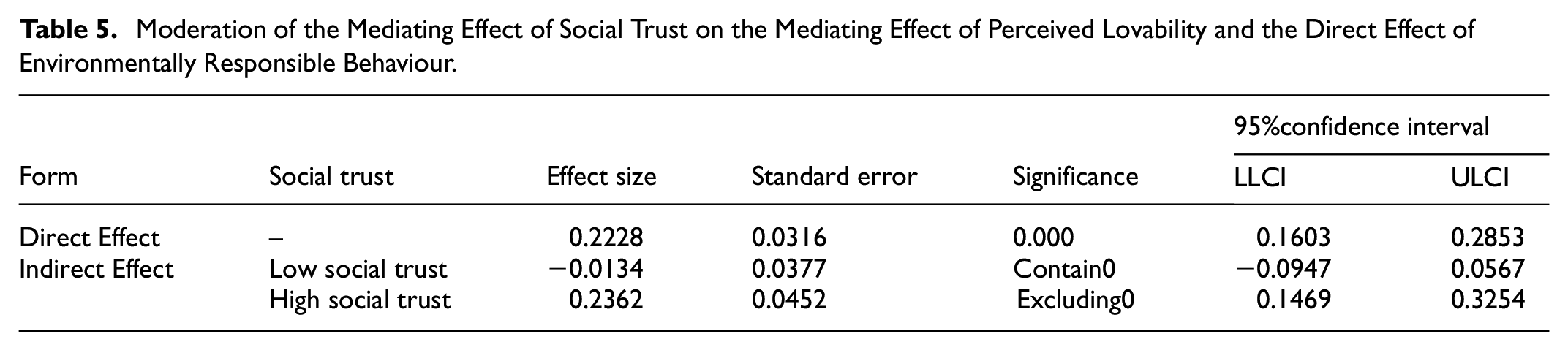
Second, test the moderated effect of social trust on the mediating role of perceived loveliness. Referring to the Bootstrap test of Hayes et al. (2017), in the PROCESS program, the test of moderated mediation effect should choose model 8, and 5,000 random samples were taken at 95% confidence interval. The results showed that the confidence interval was [0.1469, 0.3254] at the high social trust situation, and the confidence interval didn’t contain 0, and the mediation effect of perceived cuteness existed; the confidence interval was [−0.0947, 0.0567] at the low social trust situation, and the confidence interval was [−0.0947, 0.0567] at the low social trust situation. The confidence interval is [−0.0947, 0.0567], the confidence interval contains 0, and the mediation effect of perceived cuteness fails to reach the significant level. Hypothesis H3b is valid, that is, the strength of the mediation effect of perceived cuteness is moderated by social trust. For individuals in high social trust situations, anthropomorphism has no significant effect on perceived lovability, which in turn generates environmentally responsible behaviours; for individuals in low social trust situations, anthropomorphism has no significant effect on perceived lovability, as shown in Table 5.
Moderation of the Mediating Effect of Social Trust on the Mediating Effect of Perceived Lovability and the Direct Effect of Environmentally Responsible Behaviour.
In order to enhance the external validity of the findings, Experiment 3 replaced the research situation and the experimental sample and produced results consistent with the first two experiments. According to the regression results of Experiment 3 (Tables 4 and 5), it is once again confirmed that the results of the first two experiments are stable and the perceived cuteness mediation effect exists. Throughout the findings of the three studies mentioned above, all of the research hypotheses presented in the previous section were supported.
Conclusion and Discussion
Research Conclusions
The focus of this study is: does anthropomorphic guide phrases have an impact on the good effects of tourists’ environmentally responsible behaviour? What is the effect of anthropomorphic features in the relationship between guide phrases and tourists’ environmentally responsible behaviour? Three experiments were designed for these two questions and examined the mediating role of stem-cute perception and the moderating role of social trust. The results of the experiments showed that, firstly, the anthropomorphism of the guidance message positively influenced tourists’ environmental responsibility behaviour. Second, the anthropomorphic level of the guiding message mediates the effect of perceived cuteness on environmentally responsible behaviour. Third, social trust moderates the effect of anthropomorphism on environmentally responsible behaviour. The higher the level of social trust, the higher the relationship between the effects of anthropomorphism of guidance terms on environmentally responsible behaviour. Fourth, the strength of the mediating effect of perceived cuteness was positively moderated by social trust, and the influence effect of the mediating pathway increased as social trust increased.
Theoretical Contributions
At present, the use of guidance terms is very extensive both at home and abroad, especially in areas related to environmental protection and social welfare (Chen et al., 2016). However, the potential influence of anthropomorphism is often not adequately considered in current academic discussions of environmental behaviour. However, anthropomorphic strategies are highly likely to be a key antecedent variable in predicting and facilitating tourists’ display of environmental behaviours. Therefore, this study empirically demonstrates that anthropomorphic lead-in phrases can positively influence tourists’ environmentally responsible behaviours, rather than remaining solely on the basis of qualitative research, which not only enriches the existing theoretical framework of anthropomorphism, but also provides an important influence variable. Secondly, in the process of exploring its mechanism of action, this study combines the information processing model and the theory of personal-environmental matching, and establishes a logical relationship between anthropomorphism and environmentally responsible behaviour. On this basis, this study applies social information processing theory to the field of anthropomorphic guidance phrases. In the past, researchers have mainly applied it to the fields of social relations, social behaviour, and psychology to study the behavioural responses of individuals in specific social situations. This broadens the scope of application of social information processing theory to a certain extent, and provides a new research perspective for the subsequent study of tourists' environmental behaviour. Finally, this paper verifies the applicability of social information processing theory in the research context of tourists' responsible behaviour. Based on the theoretical framework of the information processing model, this paper clarifies the boundary conditions of tourists‘ responsible behaviours in the interaction scenario between tourists and guiding phrases by answering the ‘what’, ‘why’ and ‘how’ of the anthropomorphism of guiding phrases affecting tourists’ environmentally responsible behaviours (Zhang & Zhao, 2019).
Practical Implications
At present, more and more tourism service scenes (e.g., hotels, airports, restaurants, as well as holiday resorts)are beginning to use anthropomorphic guidance phrases. Based on the findings of this paper, it is suggested that anthropomorphic guiding phrases can be appropriately selected in tourism scenarios. Especially in some key service touchpoints, tourism enterprises should focus on enhancing travellers' perception of the destination through anthropomorphic design. Specifically, enterprises can add anthropomorphic elements to the appearance of the guide phrases, such as eyes, mouths, smiley faces and other elements with human-like characteristics. In the language expression of the guide language, the use of the first person or the second person, such as ‘we welcome you to this wonderful scenic spot’ or ‘you will feel a unique experience here’, so that tourists feel called by the cordiality, so that customers feel similar to the real service This will make the tourists feel being kindly called, and make the customers feel the kindness and warmth similar to the real service personnel, and then improve the environmental responsibility behaviour of the tourists. Design some interactive experience programmes in scenic spots, combined with anthropomorphic guiding language. For example, set up anthropomorphic characters for interaction, such as tour guide Xiaoming, flower fairy, etc., and guide through these characters to provide tourists with a more intimate experience. Finally, collect feedback from tourists on anthropomorphic guiding language to understand which expressions are more popular, and optimise and adjust the use of anthropomorphic language according to the feedback.
In the guiding language anthropomorphic expression, tourist attractions should give priority to the use of humorous, witty and humorous language tone, so that the guiding language is more lovely, avoiding too formal and hard expression, so that tourists feel relaxed and happy. Add some playful and childish words in the guiding language to make the language more energetic and lovely sense, for example, you can use some vivid vocabulary and make lovely icons and illustrations for supporting the guiding language. Add some lovely elements on the guide map of the scenic spot, such as cartoon patterns, smiley face signs, etc., to make the guide map more affinity and interesting. The graphic design should be simple and cute, which can attract the tourists’ attention and make the guide phrases more vivid and interesting.
Social trust is an important factor in stimulating public participation in environmental protection. The Government should actively build a harmonious and mutually trusting relationship in this regard, and continuously improve the level of social trust through measures to promote social equity, such as strengthening the provision of public services and optimising the income redistribution system. At the same time, it is recommended to establish a set of compatible mechanisms of incentives and penalties for environmental behaviour, focusing on cultivating social trust in the environmental field. In this process, the government can encourage environmental protectors by setting up incentives, setting up advanced examples of environmental protection, and transmitting positive environmental protection values to the society. At the same time, the government should also take punitive measures against those who damage the environment in order to increase the deterrent effect of environmental compliance. Such a comprehensive incentive and punishment mechanism will help build a consensus in society on environmental protection and promote greater participation in environmental protection.
This paper empirically investigates the important role of interpersonal trust in motivating tourists to implement environmentally responsible behaviours. Therefore, in addition to implementing environmental education for tourists, scenic area management and scenic area staff can improve the level of interpersonal trust of tourists through ‘cooperative atmosphere creation’ and other ways, which can encourage scenic area tourists to experience the work of environmental protection volunteers, and carry out tourists’ tree planting experience and other activities to create a good atmosphere for joint maintenance of the ecological environment; Regularly taking a specific type of environmental problem as a topic, soliciting tourists’ solutions to environmental problems and daily response methods, so that the public is aware of its important role in natural environmental protection, through this strategy, tourists can improve the level of interpersonal trust, so as to take more initiative to implement environmentally responsible behaviours, and strive to solve the ‘collective action dilemma’.
Research Limitations and Shortcomings
There are several shortcomings in this paper, which need to be improved in subsequent studies: firstly, this study used a fictional scenario design, that is, ‘picture + text’ initiation to improve internal validity, and there may be some potential risks of bias (Weiner, 2000), and future studies may consider conducting field studies to improve external validity. Secondly, this study is set in the context of the Chinese environment, and the conclusions drawn are of some relevance to the promotion of environmental protection behaviours in China. However, since individuals in Western cultures typically have an independent self-construction and pursue uniqueness and differentiation (Wang et al., 2023). Individuals in Eastern cultures have a more typical independent self-construal and value human relationships. Follow-up studies can explore whether there are significant differences in the effects of changes in guiding phrases on tourism behaviour in different cultural contexts. Comparative studies can provide a deeper understanding of how cultural factors moderate the relationship between policy changes and tourism behaviour. Thirdly, this study explored the effectiveness of cute elements in influencing individual behaviours in the context of tourism destinations. The study found that the introduction of cute design elements can significantly promote positive environmental behaviours. Based on this, the study further hypothesised that individuals who enjoy higher levels of social trust may be more inclined to prefer products that incorporate cute elements in different environments. However, this inference is yet to be empirically tested in future studies, and it provides a promising new direction for academic exploration in related fields. Finally, plans to use structural equation modeling (SEM) to further validate experimental results are considered in future studies, and where possible, methods of combining SEM with experimental studies are explored to enhance the persuasiveness of the study, which are worthy of further discussion.
Footnotes

Ethics Declarations
This article does not address ethical issues. Written informed consent has been obtained from the authors and their anonymised information will be published in this paper.
Funding
This research was Supported by the National Social Science Foundation of China: ‘The Influence Mechanism of Collective Memory of Cultural Heritage Tourism Destination on Tourists' Place Attachment’ (23BGL322) Social Science Foundation of Fujian Province: ‘Study on the Impact of Digitisation of Tourism Industry on the Ecologisation of Tourism Industry and Countermeasures’ (FJ2024C088).
Declaration of Conflicting Interests
The author (s) declared the following potential conflicts of interest with respect to the research, authorship, and/or publication of this article:
Data Availability Statement
The datasets used and/or analysed during the current study available from the corresponding author on reasonable request.
Competing Interests
We confirm that neither the manuscript nor any parts of its content are currentty under consideration or published in another joumal.