




Abstract
This study is to identify and evaluate the key factors influencing sustainable performance in Vietnamese manufacturing enterprises. It focuses on analyzing how operational and technological methods affect environmental, social, and economic outcomes both directly and indirectly. Data were gathered from 189 manufacturing professionals across Vietnam using a structured questionnaire. This study employed Partial Least Squares Structural Equation Modeling (PLS-SEM) to test a multi-path conceptual model comprising lean manufacturing (LM), Industry 4.0 technologies adoption (ID4.0), green logistics management (GLM), green supply chain management practices (GSCMP), circular economy practices (CEP), and sustainable performance (SP). The results reveal that LM and ID4.0 positively influence the performance of sustainability both directly and indirectly through GSCMP and CEP. Although CEP is a major mediating factor, GSCMP is the most powerful driver. In contrast, GLM had a favorable indirect impact through CEP but there was no direct impact on SP. These findings provide actionable insights for managers and policymakers by highlighting the need for integrated strategies that align lean and digital capabilities with green and circular practices. Through the empirical validation of the RBV-TBL integration and identification of the mediating processes of CEP and GSCMP in the context of a growing economy, this work adds to the framework of knowledge on sustainability.
Keywords
Introduction
In a competitive landscape, emerging market businesses have continuously sought ways to enhance supply chain sustainability. Manufacturing companies are under pressure to be flexible and utilize resources efficiently to satisfy customer demands and stay competitive (Buer et al., 2021), and sustainability has been broadly acknowledged as a fundamental aspect of successful business operations (Zhou et al., 2023). To address these challenges, manufacturing companies must seek new approaches to enhance their operational performance, particularly sustainability. Many organizations enhance their sustainability by implementing strategies such as LM (Buer et al., 2021), GLM (Zhou et al., 2023), and the adoption of Industry 4.0 (Karmaker et al., 2023). Businesses must demonstrate their dedication to environmental protection by implementing practices that support greener environments (Van Vo & Nguyen, 2023). In Buer et al. (2021), the authors demonstrated how the operational effectiveness of manufacturing companies is affected when LM and digitalization are combined. Additionally, LM activities affect companies’ sustainable development performance differently, specifically through the mediating role of GSCM (Awan et al., 2022). Furthermore, Zhou et al. (2023) it was demonstrated that companies must invest in GLM to enhance SP, produce cleaner products, and lead a more efficient production process (Agyabeng-Mensah et al., 2020).
From the reviewed literature, it was found that few studies have concluded the relationship between LM, ID4.0, and GLM in improving the SP of companies. This study investigates the factors that effect on the SP of manufacturing enterprises in Vietnam. First, the primary research gap lies in understanding the impact of adopting Industry 4.0, LM, and GLM on SP. Second, this study contributes to the literature by examining the possible relationships between the mediating CEP and GSCMP. Third, it broadens awareness by examining the impact of the variables on economic, social, and environmental aspects through the resource-based view, the triple bottom line theory. The data used in this analysis were gathered from 189 manufacturing enterprises in Vietnam. The insights from these results offer valuable implications for industrial managers seeking to enhance their organizations’ sustainable performance by strategically adopting modern technologies and environmentally conscious practices.
Theory and Hypothesis
Theory
Resource-Based View theory (RBV): This was firstly described by Wernerfelt (1984) and was considered a framework for investigating the fundamentals of a business’s SP because resource deployment allows a business to establish a long-term competitive edge (J. B. Barney, 2001; Epelbaum & Martinez, 2014). B. J. Barney (2001) suggest that the RBV assumes that resources and capabilities vary across firms. There are many different types of resources, including human, physical, and organizational capital (J. Barney, 1991). It provides an analytical lens to explain how internal capabilities, such as lean manufacturing practices and digital technologies (e.g., Industry 4.0), can generate competitive advantages that lead to enhanced sustainable performance. Specifically, resources such as operational excellence (via lean manufacturing) and technological infrastructure (via ID4.0; Barratt & Oke, 2007) are uncommon, priceless, and difficult to imitate, thus driving long-term outcomes aligned with the economic and environmental aspects.
The triple bottom line—underpins the outcome variable—(TBL) refers to analyzing and measuring the determination of an organization and performance regarding three dependent elements: social, environmental and economic (Khan et al., 2023). The TBL’s environmental component model measures a company’s impact on natural resources through performance indicators, such as input and output efficiency, achieved by actions such as reducing waste, pollution, and harmful resource use, recycling, researching clean technologies, and enforcing protection policies (Walker & Brammer, 2009). From an economic point of view, it emphasizes economic growth, profitability, and financial performance by linking to the organization’s effect on local, national, and international economic systems as well as the financial circumstances of its stakeholders (Chiarini et al., 2017; Sahoo & Upadhyay, 2025). From a societal perspective, this includes how an organization affects its employees, customers, suppliers, and local communities (Sahoo & Upadhyay, 2025). This includes a range of factors, such as employee welfare, community involvement, diversity and inclusion, ethical commercial strategies, and customer satisfaction (Asokan et al., 2022).
Sustainable performance: In accordance with TBL theory, this study investigates a variety of firm performances, such as financial, social, and environmental performance, which demonstrate sustainable development. It is a business and investment strategy that aims to maximize operations to meet and balance the conflicting needs of various stakeholders (Norman & MacDonald, 2004). The sustainability of a business is grounded in the principle that organizations must balance short-term gains with the mitigation of negative environmental and social impacts in the competitive advantage context (Frempong et al., 2021). It involves strategies that organizations employ to mitigate negative impacts and enhance positive results, thereby improving overall the performance of sustainability (Matarneh et al., 2024).
Hypothesis
ID4.0, LM, GSCMP, and SP
LM is conceptualized by Shah and Ward (2007) as follows: “The primary objective of an integrated socio-technical system is to eliminate waste by simultaneously minimizing or reducing variation from suppliers, customers, and internal processes.” It can also be described as a set of guidelines and customs to eliminate all forms of waste within an organization, such as cutting back on non-value-added activity and waste. Since it has become so popular, there has been a “boom” in studies that attempt to quantify the influence of lean methods on operational performance in a sustainable way. As discussed in previous research, maintenance and sustainability are parameters that link lean production and financial performance (Awan et al., 2022). Given the widespread adoption of LM as a mainstream management philosophy, a substantial amount of research has emerged that empirically examines the effect of lean initiatives on SP (Ciano et al., 2019). According to Buer et al. (2021), LM and operational performance are positively correlated, and the same results were found in Buer et al. (2021).
The multidisciplinary idea of green supply chain management (GSCM) is mainly concerned with creating ecologically friendly SCM techniques (Eltayeb et al., 2011) that describe a collection of managerial strategies meant to lessen the supply chain’s environmental impact, including eco-design (ED), internal environmental management systems (IEMS), green distribution (GD), and green purchasing (GP). According to Awan et al. (2022), implementing LM principles and process optimization has significantly reduced the emissions generated from production activities. Over-processing, overproduction, motion, waiting, inventory, and transportation are examples of waste categories. Organizations across industries have used lean approaches to enhance competitiveness and efficiency (Viles et al., 2021). The benefits of lean can be further realized by disseminating lean practices throughout the organization (Awan et al., 2022). The goal of sustainability, the next phase of lean management, is to enhance global socioeconomic conditions and reduce waste (Ikumapayi et al., 2020). Lean practices can be applied across industries and supply chains to ensure an efficient delivery and distribution (Tiwari et al., 2020).
Applying GSCM techniques helps businesses achieve TBL performance by minimizing the negative effects of unsustainable industrial operations (Karmaker et al., 2023). Previous studies on supply chains and operations management have extensively examined and experimentally supported the role of GSCM methods in improving the operational performance of supply networks (Habib et al., 2020). Some authors agree that GSCMP effectively affect SP (Amjad et al., 2022; Awan et al., 2022; Behl et al., 2024; Karmaker et al., 2023; Tao & Chao, 2024).
ID4.0 facilitates real-time process and system control and supervision through a network of connected digital objects and devices that can gather and exchange data (Luu et al., 2023). Supply chain integration of IoT, big data, cyber-physical systems, and blockchain are examples of innovations that are part of Industry 4.0 and are actively and cooperatively applied to industry to attain efficacy and efficiency (Luu et al., 2023). GSCMP are a relatively new concept in modern supply chain management. It is popular worldwide and encourages eco-friendly ventures to integrate sustainable practices with traditional activities (Amjad et al., 2022). Employing cutting-edge technology in SCs enhances financial management, product design, manufacturing, transportation, logistics, and the coordination of all operations, all of which eventually enable a variety of GSCM strategies (Esmaeilian et al., 2020). Recently, Karmaker et al. (2023) and Tao and Chao (2024) have investigated how ID4.0 technology affects the use of GSCM techniques.
Through sustainability in the economy, society, and environment, ID4.0 promotes better process integration and improves organizational performance (Mayr et al., 2018). According to the RBV, technology may be a vital tool that helps businesses outperform their competitors (Iyengar et al., 2015). Enterprises may achieve long-term performance in the industrial and service sectors by utilizing the innovative and creative technology by ID4.0 offers (Fatorachian & Kazemi, 2021). According to certain scholars, implementing ID4.0 has a significant impact on long-term performance Maware and Parsley (2023) and Karmaker et al. (2023).
Hence, these hypotheses were proposed:
Futhermore, GSCMP serves as a mediator.
ID4.0, GLM, CEP, and SP
GLM refers to logistics strategies and tactics that lessen the energy and environmental impacts of efficient delivery, with a main focus on material handling, transportation, and packaging (Seroka-Stolka, 2014). Activities within the GL are interconnected, and endeavors to improve an area frequently affects another’s sustainability, thus creating a dilemma for logistics managers in their decision-making process (Rehman et al., 2021). Bozhanova et al. (2022) focused on developing a green enterprise logistics management system within a circular economy framework, emphasizing the importance of improving management systems for environmental projects. The circular economy (CE) refers to a new economic model that helps businesses conserve resources, reduce waste (Bai et al., 2020) and highlight creating value through efficient resource consumption while reducing negative environmental consequences throughout the product’s lifecycle, allowing for material reuse (Kirchherr et al., 2017). CEP have been shown to increase company performance through increasing closed-loop operations and product reuse while lowering costs, emissions, pollutants, and energy losses.
CE and industrial ecosystems require the efficient flow and recycling of resources among businesses. Regarding the technical cycle, GL and CE are closely related and concerned with sustainability (Homrich et al., 2018). Katz-Gerro et al., (2019) discovered that the majority of CE-related categories held the opinion that implementing CE techniques would enhance sustainable performance. The impact of green logistics management on SMEs’ enhanced sustainable performance was investigated Zhou et al. (2023). CEP encourages sustainable innovation to enhance Mexican SMEs’ sustainable performance (Edwin Cheng et al., 2022). These studies highlight strategies for improving sustainability by combining circular economy principles with green logistics management.
Because technical breakthroughs and human growth are inextricably linked, Industry 4.0, has completely changed modern civilization. One of Industry 4.0’s primary contributions is the use of cutting-edge digital technology in CE activities (Shayganmehr et al., 2021). Businesses could gain significantly from Industry 4.0, which improves their performance in the circular economy and is a great strategic instrument for putting CE into practice to maximize resource utilization (Rosa et al., 2020). The relationship between ID4.0 technology and CE practices has been highlighted in earlier literary works (Karmaker et al., 2023; Luu et al., 2023; Matarneh et al., 2024; Riggs et al., 2024; Rosa et al., 2020).
Hence, these hypotheses were proposed:
Futhermore, CEP serves as a mediator.
Considering all hypotheses, the proposed model is presented in Figure 1:

The proposed model.
Method
Measurement of the Dimensions
The research variables were transformed into indicators to sharpen the examination’s emphasis. Furthermore, questionnaires were created as research tools to collect primary data on each component. This study followed a quantitative research paradigm that used approaches to investigate the correlations between key variables. The questionnaire results were examined and structured using statistical methods and primary data from dispersed surveys. A 5-point Likert scale was utilized to gather the observed factors: LM (Shah & Ward, 2007), ID4.0 (Pinheiro et al., 2022), GLM (Centobelli et al., 2018), GSCMP (Zhu et al., 2008), CE practices (Zhu et al., 2011), and SP (Kamble et al., 2020).
Sampling and Data Collection
A survey via the Internet was carried out to gather information from different Vietnamese manufacturing companies. It was delivered to experts from industrial organizations using Google Forms. The experts included engineers, general managers, and senior managers from companies that had adopted certain sustainable practices in operations, quality, manufacturing, logistics, supply chain management, and other areas. This study collected 197 questionnaires from specialists and experts, with a 98% response rate (189 responses were accepted). The study utilized a non-probability purposive sampling method, which is common in management and operations research, and the selection of respondents with at least 3 years of professional having a wealth knowledge in manufacturing was intended to enhance data quality and relevance. The responses were checked for duplicates and consistency to reduce bias.
Analytical Approach
The PLS-SEM model using SmartPLS software suited for exploratory research, small to medium sample sizes, and models with complex relationships or formative constructs (Hair et al., 2019), outer loading testing, Cronbach’s alpha reliability test, and descriptive statistics, were analyzed. In social and business sciences, PLS modeling is a well-known variance-based SEM approach (Baah & Jin, 2019).
Results
Demographic Characteristics
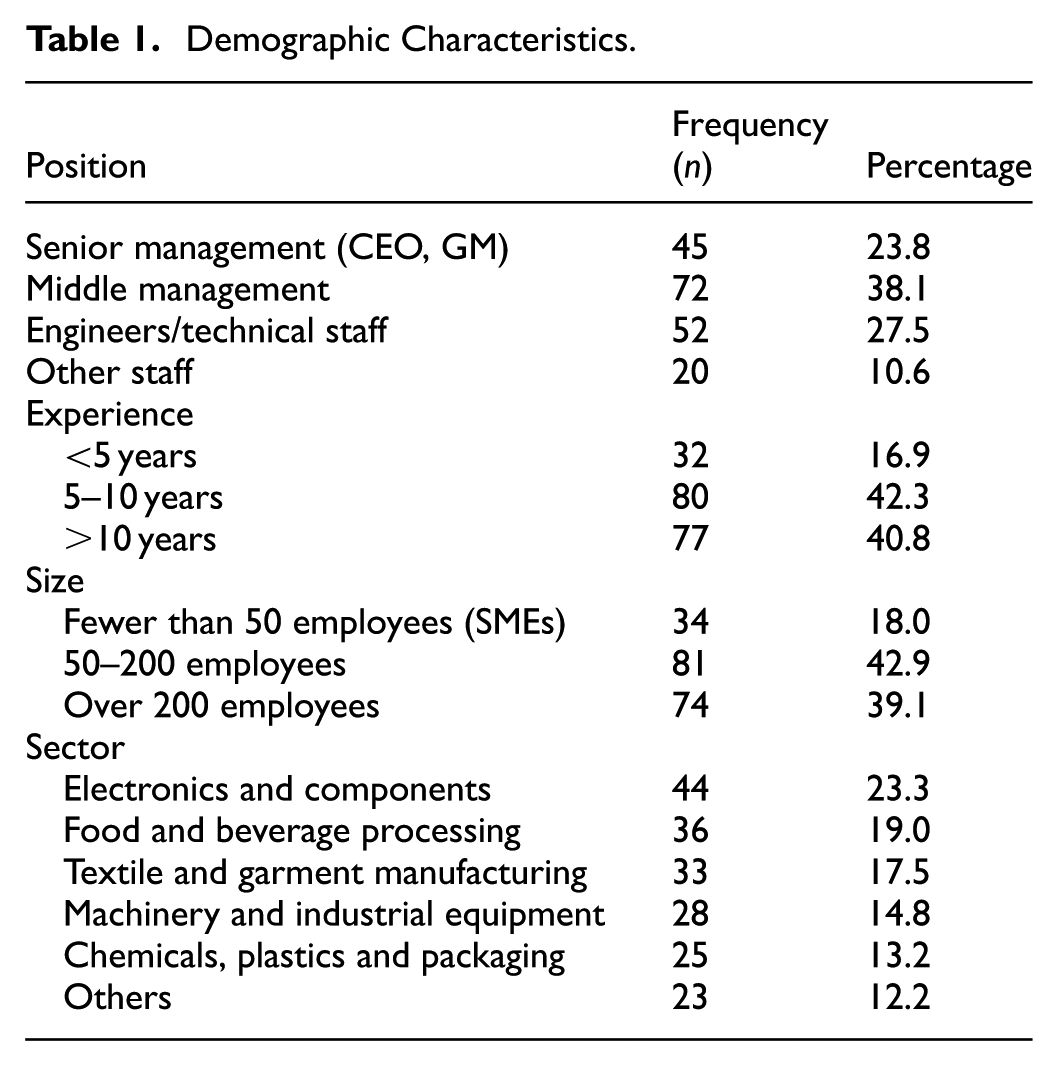
The study gathered genuine responses from 189 experts employed in different manufacturing companies in Vietnam to guarantee the quality and relevance of the data. The demographic details of the respondents and the companies they were associated with are showed in Table 1.
Demographic Characteristics.
Assessment of Reliability and Construct Validity
About Cronbach’s alpha, all of the constructions showed strong internal consistency, above the suggested cutoff of 0.70 (Hair et al., 2019). The range of values is from 0.908 (CEP) to 0.931 (GSCMP), confirming reliable measurements. The Composite reliability of each construct’s Composite Reliability is well above .70, as suggested by Bagozzi and Yi (1988), further supporting the reliability of the scales. The CR values ranged from .936 (CEP) to .948 (GSCMP). All average variance extracted (AVE) values surpass the 0.50, ensuring sufficient convergent validity (Fornell & Larcker, 1981). ID4.0 exhibits the highest AVE (0.816), indicating that the constructs explain significant variance in their respective indicators (Table 2).
Construct Reliability.

Source. Data analyzed by SmartPLS.
Assessment of Outer Loadings
All factor loadings remained over the 0.70 threshold, as Hair et al. (2019) recommended. This confirmed that the remaining observed variables strongly correlated with their corresponding latent constructs.
Assessment of Discriminant Validity
All HTMT values between pairs of constructs were below 0.85, thus meeting the criteria for discriminant validity. The values are listed in Table 3. These results indicate that all the constructs exhibit good discriminant validity, affirming the quality of the measurement model (Table 3).
HTMT Criterion Assessment.

Source. Data analyzed by SmartPLS.
Assessment of Multicollinearity
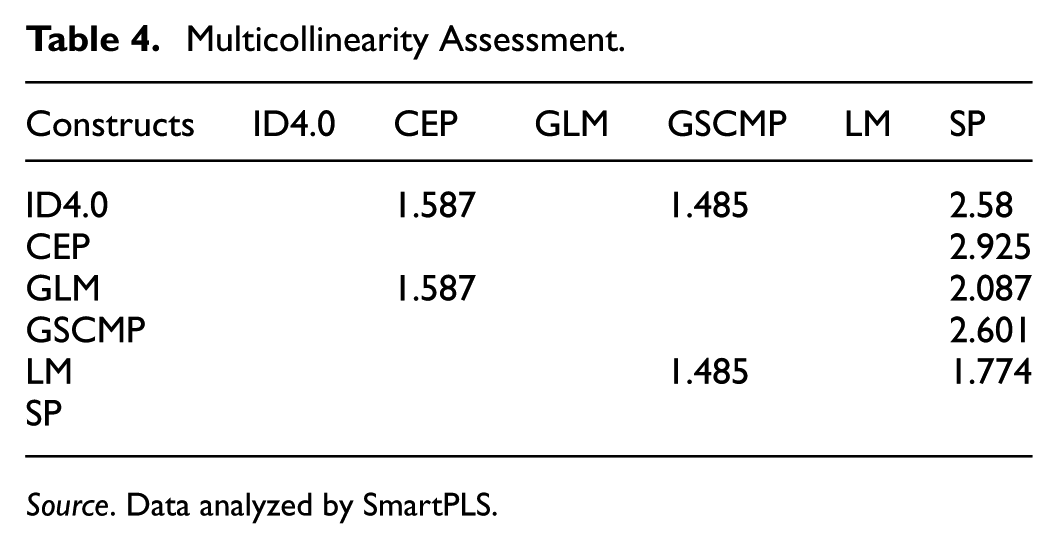
Based on the Inner VIF results, there was no evidence of multicollinearity among the variables in the research model, as all VIF values were below 5.0, ensuring the independence of the variables. These values were lower than 5.0, indicating no excessively high linear correlations between variables. This result supports the stability and accuracy of the analytical model (Table 4).
Multicollinearity Assessment.
Source. Data analyzed by SmartPLS.
R Square and R Square Adjusted Testing Results
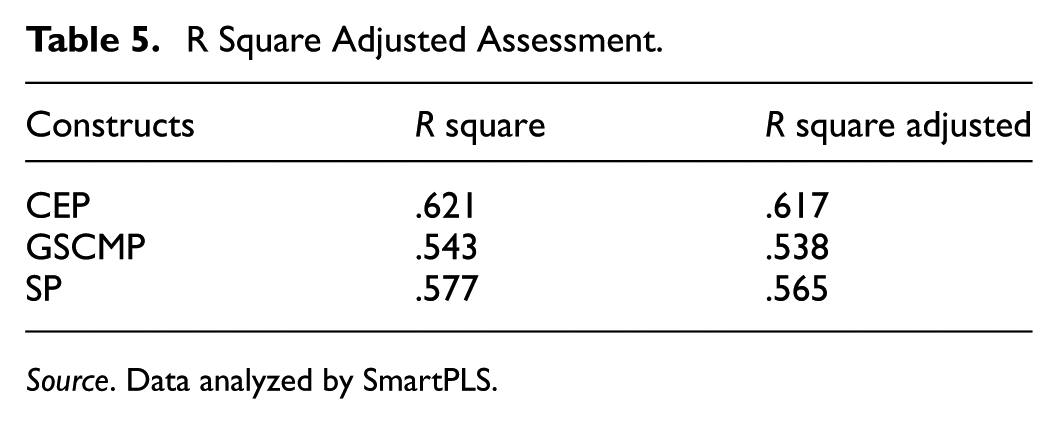
For SP, the adjusted R-squared value is .565. It means the independent variables in the model explain 56.5% of the variance. For GSCMP, the adjusted R-squared value is .538, demonstrating that 53.8% of the variation is explained by the model. For CEP, the adjusted R-squared is lower at .617, indicating that 61.7% of the variation in CEP can be explained by the model (Table 5).
R Square Adjusted Assessment.
Source. Data analyzed by SmartPLS.
F Square Testing Results
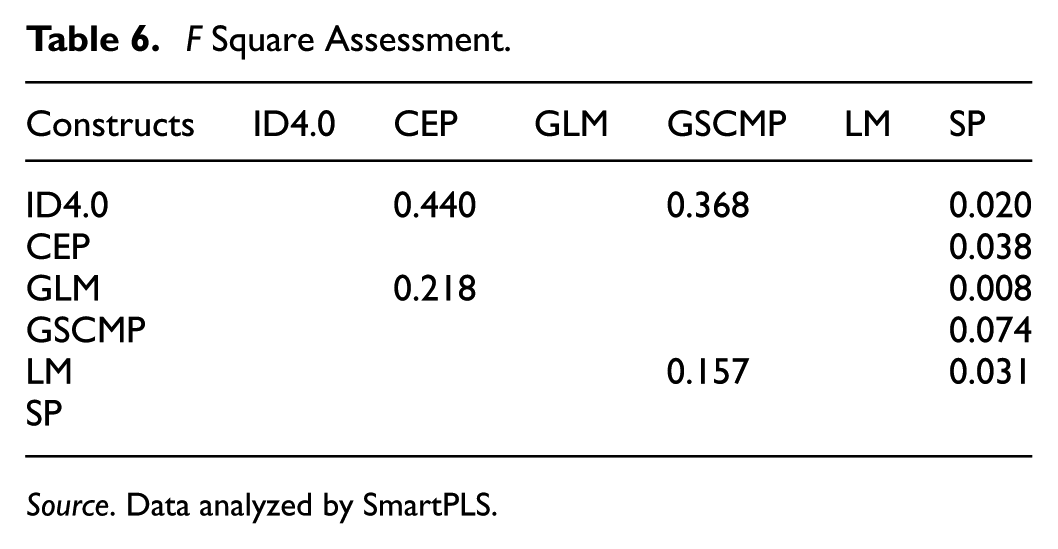
The f-squared coefficients in Table 6 reveal the effect size of each independent variable on the dependent variables in the model, primarily ranging from small to medium. The results reveal that Industry 4.0 (I4.0) exerts the strongest influence in the model, showing a large effect on both CEP (f2 = 0.440) and GSCMP (f2 = 0.368). However, its direct effect on SP remains small (f2 = 0.020). GLM demonstrates a medium effect on CEP (f2 = 0.218). LM shows a medium effect on GSCMP (f2 = 0.157). The direct effects of CEP (f2 = 0.038), GSCMP (f2 = 0.074), and LM (f2 = 0.031) on SP are all classified as small, reinforcing the conclusion that SP in this model is primarily driven by indirect pathways.
F Square Assessment.
Source. Data analyzed by SmartPLS.
Hypothesis Testing Results by Bootstrapping
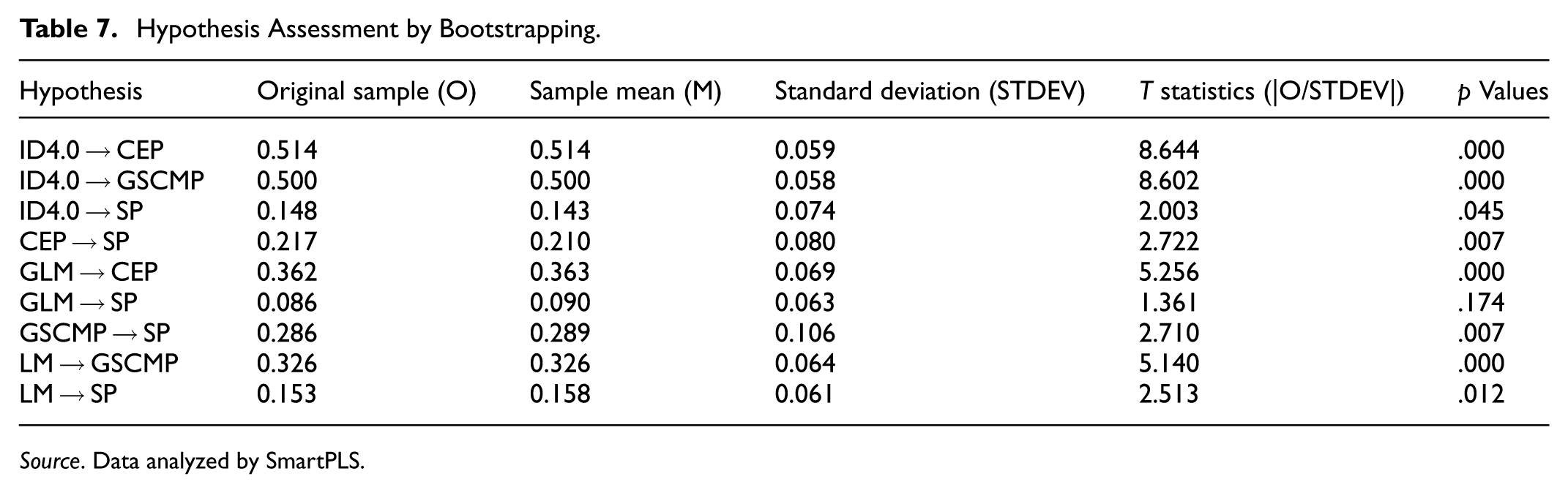
The table presents the path coefficients represented the strength of the relationships in a structural equation model. Significant relationships were identified by T-statistics greater than 1.96 and p-values below .05. Key findings include strong connections between ID4.0 and CEP (T = 8.564, p = .000) and between GSCMP and SP (T = 2.726, p = .006). Meanwhile, the GLM had an insignificant effect on SP (T = 1.369, p = .171), suggesting that its influence may rely on indirect pathways or mediating factors. Overall, constructs such as CEP, GSCMP, and LM significantly contributed to enhancing SP, with GSCMP showing the highest positive impact. These outcomes underscore the crucial role of green and sustainable practices supported by ID4.0 in achieving sustainability goals (Table 7).
Hypothesis Assessment by Bootstrapping.
Source. Data analyzed by SmartPLS.
Indirect Effects Hypothesise Testing Results
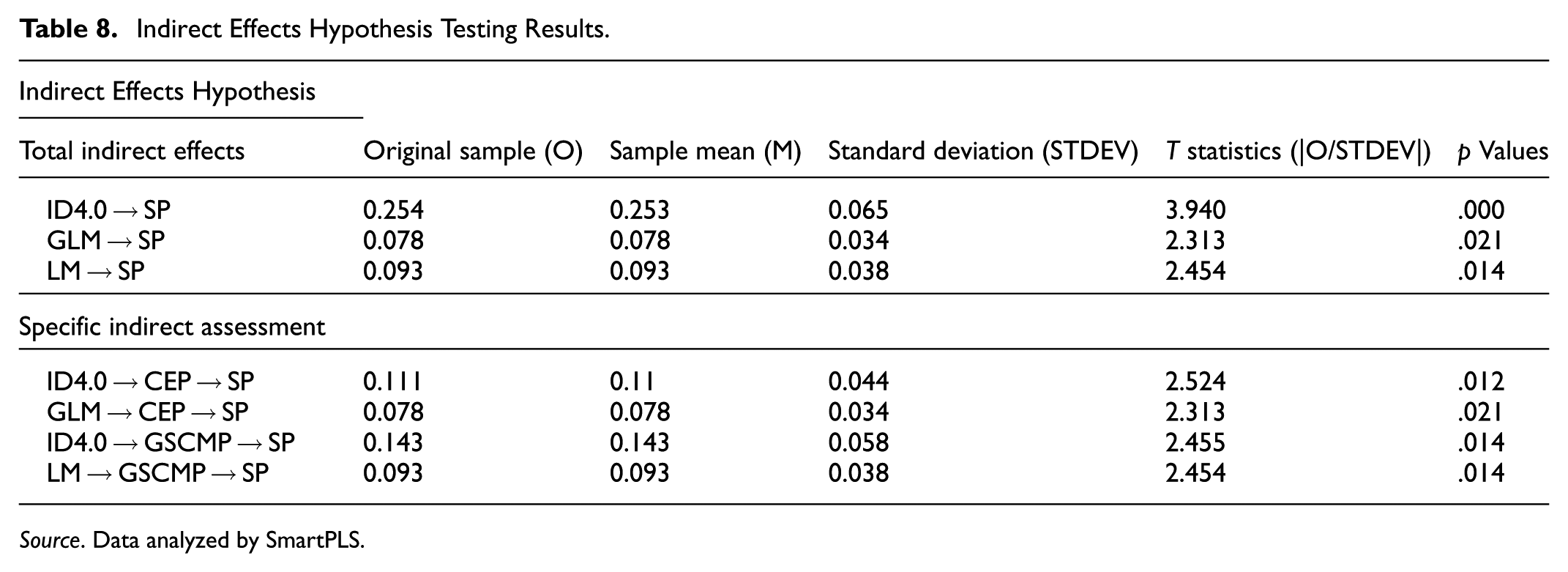
Regarding the total indirect effects, ID4.0 shows the highest overall impact on SP (indirect effect = 0.254, t = 3.940, p = .000). This underscores its importance in promoting sustainability when mediated by the circular economy and green supply chain practices. CEP also is a important mediator (indirect effect = 0.254, t = 3.940, p = .000). While GLM and LM had more minor total indirect effects (0.078 and 0.093, respectively), they remained significant in the broader sustainability context.
The results of the specific indirect effect analysis further confirm the mediating roles of CEP and GSCMP in the proposed model. Among the four indirect paths tested, ID4.0 showed two statistically significant effects on SP. Specifically, the indirect path from ID4.0 to CEP to SP was significant, with a coefficient of 0.111 (t = 2.524, p = .012). Similarly, the path from ID4.0 to GSCMP to SP also yielded a significant effect of 0.143 (t = 2.455, p = .014).
Furthermore, GLM demonstrated an indirect effect on SP through CEP, with a coefficient of β = .078 (t = 2.313, p = .021). Although the direct effect of GLM on SP was not significant, LM had an indirect influence on SP via GSCMP, showing a coefficient of 0.093 (t = 2.454, p = .014). This suggests that lean initiatives are more effective in achieving sustainability outcomes (Table 8).
Indirect Effects Hypothesis Testing Results.
Source. Data analyzed by SmartPLS.
Discussion and Implications
Discussion
This study investigated the sustainable performance of Vietnamese manufacturing companies using PLS-SEM to investigate the effects of LM, ID4.0, GSCMP, GLM, and CEP. The results mostly corroborate other studies while revealing fresh perspectives on the indirect processes influencing sustainability results.
First, LM demonstrated a significant direct effect on SP (β = .153), consistent with studies by Buer et al. (2021) and Awan et al. (2022), where lean initiatives promote resource efficiency, cost savings, and continuous improvement. Furthermore, GSCMP was significantly improved by LM (β = .326) and an indirect effect on SP through GSCMP (β = .093), confirming that lean strategies integrated into green supply chain frameworks have wider sustainability effects.
Thus, ID4.0 demonstrated both direct (β = .148) and significant indirect benefits on SP through GSCMP (β = .143) and CEP (β = .111), underscoring its critical function in improving resource circularity, organizational responsiveness, and digital traceability. These findings echo the work of Karmaker et al. (2023) and Tao and Chao (2024), underscoring that digital transformation through IoT, big data, and automation functions as a foundational enabler of sustainable systems (Amjad et al., 2022; Behl et al., 2024). CE also positively influenced SP (β = .217). Furthermore, the results revealed that the GSCMP and CEP were significant mediators in the model. The GSCMP had the highest total effect on SP (β = .286), confirming the TBL value of green procurement, eco-design, and reverse logistics Yaroson et al. (2024), indicating that waste reduction and closed-loop resource flows are essential for long-term success.
Interestingly, there was no statistically significant direct impact of the GLM on SP (β = .086, p = .174). However, it had a noteworthy indirect effect through CE (β = .078). This implies that unless logistical activities are coordinated with more comprehensive CE systems, including reverse logistics, shared transportation, and packaging reuse, they may not immediately enhance the sustainability results, followed by Bozhanova et al. (2022) and Homrich et al. (2018).
Both the RBV and TBL hypotheses were supported by these findings. According to RBV, intrinsic capabilities (such as LM and ID4.0) only gain value when used in tandem with complimentary algorithms such as GSCMP and CEP. The way that SP is motivated by the joint pursuit of economic, environmental, and social value, all of which are improved by green, digital, and circular practices, reflects TBL theory.
From a practical standpoint, these findings have sector-specific implications. The integration of ID4.0 with CEP has a particularly significant impact on electronics production, allowing for closed-loop material recovery and real-time emission tracking. Owing to the high perishability and waste intensity of food processing, CEP-like composting and by-product valorization have a considerable impact on sustainability. Through eco-labeling, water-efficient processing, and green sourcing, the GSCMP provides a more powerful lever for sustainable results in the textile and apparel sectors.
Overall, the study offers empirical evidence that integrated pathways, whereby cutting-edge technologies and operational excellence are converted into environmental and social value through green and circular mechanisms, significantly shape SP in manufacturing rather than being the product of isolated practices.
Implications
Theoretical Implications
This research provides some theoretical insights by deepening our understanding of how internal capabilities and environmental practices collectively drive sustainable performance in manufacturing enterprises. By integrating the RBV and TBL frameworks into a predictive analytical model using PLS-SEM, this study extends current sustainability theory in three key ways.
First, the findings provide empirical support for the RBV framework by showing that internal strategic resources, including LM and ID4.0, only improve sustainable performance when mediated by certain organizational procedures such as GSCMP and CEP. This finding supports the view that core resources must be combined with complementary capabilities to generate a firm-level advantage (J. B. Barney, 2001). Specifically, the RBV in sustainability literature is enhanced by the notable indirect impacts of LM and ID4.0 on SP through GSCMP and CEP.
Second, by demonstrating that attaining environmental, social, and economic success depends on both system-wide ecological alignment and internal operational excellence, this study extends TBL theory. The most important aspect is GSCMP, which reaffirms its function as an operational instrument for businesses to match supply chain choices with sustainability objectives in all three TBL dimensions. Similarly, CEP made a significant contribution to performance, demonstrating that closed-loop systems are essential for attaining both economic and environmental synergy, and are not just tactical, as posited by TBL scholars (Khan et al., 2023).
Third, the results provide modest insights into GLM’s limited role of the GLM. There was no statistically significant direct effect of the GLM on performance, even if it was conceptually consistent with sustainability. This puts into doubt long-held beliefs in the literature and raises the possibility that GLM alone would not have any strategic value unless it was included within a larger framework for the circular economy. By presenting GLM as a supporting rather than a central strategic resource in the RBV dimensions, this divergence improves theoretical clarity.
Furthermore, by highlighting the intermediary roles of GSCMP and CEP, this study contributes to process-based sustainability theory. This demonstrates that green and circular practices function as transmission mechanisms, thus translating technological and operational initiatives into sustainable outcomes. This theoretical insight responds to the recent calls in the literature for more dynamic and integrated sustainability models, followed by Fatorachian and Kazemi (2021) and Karmaker et al. (2023).
In summary, this study contributes to a more holistic understanding of sustainable performance by synthesizing RBV and TBL within an integrative empirical model. It shifts from static factor-based explanations to a networked approach in which the dimensions of outcomes, enabling behaviors, and internal resources are causally related. This foundation may be expanded in future theoretical work by adding institutional, regulatory, or competitive pressures as contingent variables affecting these linkages across geographies and sectors.
Practical Implications
Implementing lean practices, such as minimizing waste and optimizing resource use, helps businesses improve their efficiency while reducing environmental impact. Tools—just-in-time production and continuous improvement frameworks—can drive cost savings and innovation. Advanced technologies, such as AI, automation, enable real-time observation improved operational efficiency. By integrating smart systems, firms can reduce energy consumption, enhance transparency, and achieve sustainability goals, while preparing their workforce for digital transformation. Sustainable logistics practices, including route optimization, eco-friendly packaging, and low-emission transportation, can reduce the carbon footprint and improve efficiency. Practically, firms should not expect green logistics to yield direct sustainability benefits unless they are strategically linked to circular economy initiatives. This includes the adoption of reverse logistics, closed-loop systems, and waste recovery frameworks that go beyond traditional green practices. Collaboration with green logistics partners further enhances environmental performance. Sustainable sourcing, waste reduction, and reverse logistics are vital to reducing ecological harm. Engaging suppliers and adopting certifications strengthens green partnerships and credibility. Shifting to circular models, such as recycling and reusing materials, can promote long-term sustainability. Strategies such as designing durable, modular products, and adopting “product-as-a-service” models create economic and environmental value.
Limitations and Further Research
Even though this paper provides insightful information on the factors that influence sustainable performance in Vietnamese manufacturing companies. Recognizing these limitations offers new methods for future studies and provides a context for interpreting the findings.
First, the sample was limited to 189 manufacturing enterprises in Vietnam, representing a single country and sectoral context. Although the sample was purposive and targeted experienced respondents, the outcomes may not be fully generalizable across industries or cultural settings. Future research could extend the model to multi-industry and cross-country contexts (e.g., emerging vs. developed economies) to examine how institutional environments and regulatory pressures moderate sustainability pathways.
Second, the study focused on both direct and indirect effects of the first-order constructs. However, sustainability is inherently multi-dimensional and hierarchical. Future research could explore second-order constructs (e.g., bundling lean and green practices into a unified “eco-operational capability”) or use two-stage PLS approaches to assess the reflective–formative structure of latent variables such as sustainable performance.
Third, the current model did not test moderating variables that could influence the strength or direction of relationships. Variables such as ownership type, firm size, export orientation, and regulatory pressure could meaningfully shape how capabilities (e.g., ID4.0) translate into sustainable outcomes. Incorporating such moderators enhances the model’s explanatory power and policy relevance.
Finally, while this study emphasized environmental and operational factors, behavioral and cultural enablers, such as top management commitment, employee engagement, and organizational learning, were not considered. Future studies could integrate the dynamic capabilities theory or organizational behavior constructs to better capture the human dimensions of sustainability transformation.
Footnotes

Ethical Considerations
All methods used in studies involving human subjects complied with the 1964 Helsinki Declaration and its subsequent amendments, as well as the ethical standards set by the institutional and/or national research committees or similar ethical guidelines.
Funding
The authors received no financial support for the research, authorship, and/or publication of this article.
Declaration of Conflicting Interests
The authors declared no potential conflicts of interest with respect to the research, authorship, and/or publication of this article.
Data Availability Statement
The corresponding author is available to provide data supporting the study’s conclusions upon reasonable request.