




Abstract
Extreme and fundamental changes in the economy and social life in the 2000s, fueled by technological development, pushed people toward new ways of consumption known as “Sharing Economy” (SE). Consumers’ motivations to participate in SE are still not completely clear because of SE’s relatively short history and hazy boundaries. This study aimed to contribute to closing that gap. This research also looks at how consumers’ motives for SE differ across countries. Data from 678 people (440 in Istanbul, Türkiye, and 238 in Toronto, Canada) were collected and analyzed using partial least squares structural equation modeling (PLS-SEM). The results indicate that economic benefits, modern lifestyle, enjoyment, and ecological sustainability concerns substantially impact consumers’ participation in SE in both Türkiye and Canada. However, consumers in both countries are unaffected by product diversity, ubiquitous availability, sense of belonging, or convenience. In addition, altruism influences Turkish consumers but not Canadians; this could be explained by Türkiye’s being a Middle Eastern country with a feminine cultural structure. Even though Türkiye and Canada are very different in economic, social, cultural, and historical terms, their outcomes are remarkably similar. These identical findings indicate that consumers’ stimulations are similar in participating SE regardless of their country of origin. This paper is unique as it is the first research comparing Turkish and Canadian consumers’ motivations. This study is significant for both literature and practitioners in that it contributes to better understanding consumer incentives in SE.
Introduction
Although sharing is not a new phenomenon, and people have been sharing their goods with their family, friends, and neighbors since they started to live in communities, the concept of “Sharing Economy (SE)” is relatively new (Belk, 2014a; Hawlitschek et al., 2016). In the 2000s, SE emerged as a proposition for a different economic model, focusing on changing production and consumption cultures and interactions between producers and consumers (J. Schor, 2016). In popular meanings and the academic literature, SE is often used as an umbrella term for a wide range of services, activities, and businesses (Akbar & Hoffmann, 2018; Hamari et al., 2016; Hawlitschek et al., 2016).
Fundamental shifts in economic, social, and technological systems, especially in the 1990s and the 2000s, have driven people toward new forms of consumption that provide shared benefits (Calle Vaquero & Calle Calle, 2013). On the economic side, globalization, the catalyst effect of the 2007 to 2010 global financial crisis; on the social side, changes in consumer attitudes with urbanization, more attention to sustainability in consumption; on the technology side, the transition from the transmission to the communication in internet portals with Web 2.0, the increase in usage of internet applications and smartphones, all together, paved the way for SE to thrive as a new trade and consumption model (Kumar et al., 2018; Ranjbari et al., 2018; Rauch & Schleicher, 2015). The changing needs of young and tech-savvy generation Y, a large and influential community that values mobility and does not care much about ownership, have also been adequate in the emergence of SE (Kumar et al., 2018).
SE began as a new way of consumption; however, it quickly expanded its boundaries to include production. SE activities are divided into four broad categories: recirculation of goods, increased utilization of durable assets, exchange of services, and sharing of productive assets (J. Schor, 2016). While the first two categories primarily involve consumption transactions, the latter two usually entail production exchanges. eBay, Amazon, Uber, and Airbnb are the most well-known platforms for recirculating goods and increasing assets utilization on the consumption side. Platforms such as Timebanks, Zaarly, Task Rabbit, and Skillshare are on the other side of the medallion, representing the production side of SE applications.
SE may appear with many names (Acquier et al., 2017), including the on-demand economy (Cockayne, 2016), gig economy (Friedman, 2014), collaborative consumption (Botsman & Rogers, 2010), mesh economy (Gansky, 2010), peer-to-peer economy (Bauwens et al., 2019), and access economy (Bardhi & Eckhardt, 2012).
Motivations and barriers are the factors that affect the intention to participate in SE (Hawlitschek et al., 2018). Motivations express elements such as economic benefits, ecological sustainability concerns, altruism, convenience, enjoyment, and sense of belonging that impact the participation positively (Acquier et al., 2017; Benoit et al., 2017; Demary, 2014; J. B. Schor & Fitzmaurice, 2015; Tussyadiah, 2016; Wilhelms et al., 2017). Barriers negatively affect joining in SE, such as effort expectancy, security risk concerns, and product scarcity risk (Ciasullo et al., 2018; Hawlitschek et al., 2018; Lamberton & Rose, 2012).
A substantial amount of research has been conducted on motivations that affect participation in SE. However, because the scope and boundaries of SE are extensive, the factors that motivate or inhibit consumer engagement are still not entirely clear (Hawlitschek et al., 2018). Besides, comparative empirical studies, including countries with different cultures and economic structures, are scarce. Thus, in this study, the motivations of Turkish and Canadian consumers for participating in SE were examined and compared. As the first empirical cross-country research between Türkiye and Canada, this study is unique and provides critical indications to variation of consumers’ motivations across countries in SE.
The remainder of this paper is organized as follows. The following section contains a literature review, including the background of SE and consumers’ motivations for SE. The development of the research model and hypotheses are presented in the third section. While the fourth section covers the research methodology and the analysis results, the fifth section includes a discussion about the analysis results. The conclusion is the final section of the article outlining our research contributions and suggesting directions for future research.
Literature Review
Sharing Economy
The reasons mentioned earlier have led to the emergence of SE, a new trade and consumption model. This new economic model, SE, is based on sharing, swapping, trading, or renting products and services, enabling access over ownership (Martin et al., 2015). The transaction subjects in this new economy can be tangible goods such as cars, houses, rooms, books, machinery, office spaces, clothes, or intangible assets such as time, knowledge, and talent; some well-known SE applications include Uber, Airbnb, Zipcar, eBay, Amazon, Craigslist, Freecycle, Wikipedia, Timebanks, Netflix, and Couchsurfing (Ritter & Schanz, 2019).
The proliferation of consumer-to-consumer (C2C), also called peers-to-peers, sharing transactions has resulted in this new business model (Puschmann & Alt, 2016). C2C business models, which can be traced back to 1995 when recirculation goods websites Craigslist and eBay emerged (J. Schor, 2016), spread rapidly in the market, especially after Web 2.0. C2C business models have attracted attention because of the extraordinary success of Airbnb (founded in 2008) and Uber (founded in 2009), as they have become the most prevalent examples of SE (Ganapati & Reddick, 2018). In 2011, Time International selected “Collaborative Consumption” among 10 ideas that will change the world, stating that the real benefit of this new consumption style based on renting, borrowing, or sharing instead of buying was not economic but social (Walsh, 2011).
One of the few points scholars agree on about SE is how hard it is to draw clear conceptual and empirical boundaries (Acquier et al., 2017). Unfortunately, researchers cannot agree on the scope, boundaries, and limits of SE (Acquier et al., 2017; Görög, 2018; Schlagwein et al., 2020). As there is no consensual definition in the literature (Botsman, 2013; Codagnone & Martens, 2016), Schlagwein et al. (2020) identified 36 SE definitions.
One reason for this uncertainty is that SE, which is a relatively new concept (Hamari et al., 2016), has an interdisciplinary nature and is somehow related to many disciplines such as marketing, consumer behavior, sociology, geography, anthropology, management, and law (Acquier et al., 2017). Another reason is that although SE is a phenomenon, its intelligibility among academics and practitioners is not as precise (Görög, 2018). Therefore, academics define SE and draw its boundaries according to their academic focus and perspective (B. Cohen & Muñoz, 2016; Görög, 2018).
SE provides significant social benefits as it covers and supports the shared consumption of goods and services through its platforms (Akbar & Hoffmann, 2018; Hamari et al., 2016; Walsh, 2011). However, because transactions are mainly for economic reasons (Eckhardt & Bardhi, 2016), an object is shared not necessarily for social reciprocity but for economic benefits within SE (Akbar, 2019; Hamari et al., 2016). In true sharing, people give away something without expecting anything in return. Therefore, most transactions in SE are not sharing but pseudo-sharing, which describes business relationships wrapped in the word “sharing” (Belk, 2014a). It is why, as an umbrella term, SE’s boundaries are much broader than its verbal meaning. For example, while there is true sharing in Couchsurfing, transactions in Airbnb involve pseudo-sharing because of fees (Belk, 2014b). However, Airbnb remains strongly associated with SE among practitioners and academics.
SE’s tripartite structure is one of the fundamental distinguishing features of SE, as it differs from the dyadic constructs of traditional economies (Benoit et al., 2017): SE has three main stakeholders identified as (1) suppliers (e.g., driver, host, and valet), (2) consumers (e.g., passenger, guest, and user), and (3) platform providers (e.g., Uber, Airbnb, and Luxe) creating a platform-based relationship (Kumar et al., 2018). Ideally, as P2P models, SE business models should contain unlimited suppliers, just like consumers. However, in some B2C SE platforms, the supplier and platform owner can be the same company. For example, Daimler AG and BMW operate the ShareNow application as platform owners, and they use their cars as suppliers (ShareNow, 2022). SE applications are usually for-profit businesses. Thus, depending on sectors and platform types, besides those three parties, there are different stakeholders in the SE ecosystem, such as competitors, regulators, and side suppliers (Parente et al., 2018; Wirtz et al., 2019), society, and other actors (Wirtz et al., 2019). The existence of stakeholders other than suppliers, consumers, and platforms is not necessary for an application to be considered an SE. However, a business model must have at least those three critical stakeholders with a platform-based triadic relationship to be considered a SE platform.
Motivations Affecting Consumer Participation in Sharing Economy
The success of the SE platforms depends on building a delicate cluster of suppliers and consumers and a critical balance between them. Since neither side of the platform will participate without the existence of the other (Kumar et al., 2018), motivation is a vital issue in the success of SE initiatives (Hossain, 2020). Without understanding stakeholders’ motives, it would not be easy to keep up the balance between suppliers and consumers. As many SE initiatives failed, the biggest problem for this failure was the defect to match supply with demand leading to either oversupply or undersupply (Kessler, 2015). Understanding the underlying motivation will help to stimulate people better to join SE platforms and ultimately maximize the benefits promised by the SE (Oliveira et al., 2022). Thus, platform owners should be aware of consumers’ and suppliers’ motivations to join SE. The stakeholders’ motivations for participating in SE may differ (Bellotti et al., 2015; Benoit et al., 2017; Böcker & Meelen, 2017). For example, while economic and social motivations are significant for suppliers, innovation and the establishment of beneficial relationships are more critical for platform owners (Benoit et al., 2017).
Even though there is a considerable amount of research on consumers’ partaking motives in SE, absolute clarity is still not established in this regard (Hawlitschek et al., 2018). For example, some motivations, such as economic benefits and environmental sustainability, are considered the most critical drivers in literature, yet there is no consensus on their degree of importance (Julião et al., 2022).
Academics have investigated SE incentives in different ways in their research. Some studies examined the motivations as economic, social-hedonic, and environmental motives in general (Benoit et al., 2017; Böcker & Meelen, 2017; Lang et al., 2022; J. B. Schor & Fitzmaurice, 2015; Zhang et al., 2019). As motivations are based on the diverse reasons or goals that lead to action, they can be segregated as intrinsic and extrinsic motivations (Ryan & Deci, 2000). Because this distinction is too general, most researchers preferred to examine reasons in detail to be more specific. For example, Guttentag et al. (2018) detailed consumers’ motivations as interaction, home benefits, novelty, sharing economy ethos, and local authenticity.
Andreotti et al. (2017) suggested that, among the variety of motives driving consumers to participate in SE, instrumental, social-hedonic, and normative motives are the most dominant. We see a very similar distinction in the Goal-Framing Theory (GFT) (Lindenberg & Steg, 2013) as they distinguished motives as hedonic, gain, and normative. Following Andreotti et al. (2017), and based on GFT, we categorized incentives as instrumental, social-hedonic, and normative motivations. Instrumental motivations have a future-oriented characteristic, representing motives related to conserving or building up one’s resources to improve one’s long-term status. While social reasons refer to one’s need to interact with others and be accepted, hedonic motives refer to stimulus to maintain or improve the way one feels with a present-oriented characteristic. Normative motivations generalize other views and indicate reasons for behaving appropriately and obeying social norms and rules.
There are also other consumer motivations examined in the literature such as benevolence (Hellwig et al., 2015), new materialism (Martin et al., 2015), social experience (Bellotti et al., 2015), flexibility (Tussyadiah, 2016), reputation (Hamari et al., 2016), familiarity (Wu et al., 2017), meeting new people (Liang et al., 2017), interaction (Guttentag et al., 2018), knowledge (Gazzola et al., 2019). To avoid prolonging the questionnaire, we limited our model to the nine most commonly studied motivations in SE literature. We selected four instrumental, three social-hedonic, and two normative incentives: economic benefits, product variety, convenience, and ubiquitous availability as instrumental motives; sense of belonging, modern lifestyle, and enjoyment as social-hedonic motives; ecological sustainability concerns and altruism as normative motives.
Although there are a lot of empirical studies examining the motivations for participation in SE, there are only a few studies comparing countries in this regard. Iran et al. (2019) examined Tehran and Berlin consumers’ collaborative fashion consumption in a cross-cultural context. M. Gupta et al. (2019) conducted an empirical study in 10 countries, including Türkiye, to reveal how Hofstede’s cultural dimensions affect participation in SE. Davidson et al. (2018) examined American and Indian consumers in terms of materialism and SE, while Ianole-Călin et al. (2020) analyzed the participation of Romanian and Italian consumers in SE from a cultural perspective (individualism and collectivism). Another study examines providers’ motives in the accommodation sector comparing Türkiye and Lithuania (Urbonavicius & Sezer, 2019). The current study examines consumers’ motivations for participating in SE on a cross-country basis. To our knowledge, this is the first study to directly compare consumers of two different countries (Türkiye and Canada). This study provides important indications of how consumer motivations vary across countries in terms of participation in SE.
Theoretical Framework and Hypotheses Development
Model Development
The research model is structured based on the Theory of Planned Behavior (TPB) (Ajzen, 1991). TPB is an advanced version of the theory of reasoned action (Ajzen & Fishbein, 1980). TPB assumes that subjects’ behaviors result from a clear behavioral intention based on attitudes, subjective norms, and perceived behavioral control regarding activities or behaviors (Hawlitschek et al., 2018). The findings show that attitude plays a central role in predicting behavioral intention to participate in SE, compared to the impact of subjective norms and perceived behavioral control (Ianole-Călin et al., 2020). For this reason, and to simplify our model, we used Core-TPB (Bucher et al., 2016), a reduced version of TPB, excluding subjective norms and perceived behavioral control from the model (see Figure 1).

The research model; Core-TPB (Ajzen, 1991; Bucher et al., 2016).
Based on the uses and gratifications theory (Blumler, 1979) and social cognitive theory (Bandura, 1986), it is assumed that motivations positively affect attitude and provide reasons for developing positive attitudes (Bucher et al., 2016). In addition, the more prominent the motives of users, the more positive and robust their sharing attitudes are (Bucher et al., 2016). From this perspective, we propose that motivations positively affect attitude toward participation. As stated in the previous section, we selected the following motives for this study: economic benefits, product variety, convenience, ubiquitous availability, sense of belonging, modern lifestyle, enjoyment, ecological sustainability concerns, and altruism. As attitude is the primary determinant of behavioral intent in TPB (Ajzen, 1991; Hawlitschek et al., 2018), we suggest that attitude toward participation positively affects consumers’ intentions to participate in SE.
Hypotheses Development
One reason for the emergence of SE was the significant decrease in people’s purchasing power, especially during the 2007 to 2010 global crisis (Botsman & Rogers, 2010). SE gives consumers access to cheaper goods or services that they cannot afford (Kovacks, 2017). A study conducted by PwC in the US argues that 81% of Americans familiar with SE thought that the products on these platforms were economic (Hawlitschek et al., 2018; PwC, 2015). Considering these, we can say that one of the reasons that direct consumers to participate in SE is economic benefits. In addition, many researchers have found positive effects of monetary gains on consumers’ participation in SE (Bucher et al., 2016; Hamari et al., 2016; Mahadevan, 2018; Möhlmann, 2015; Özdoğan & Özkul, 2021; Tussyadiah & Pesonen, 2018). Therefore, we propose the following hypothesis:
Hypothesis 1: Economic benefits have a positive effect on attitude toward participation.
In addition to providing economic benefits, SE offers a wide range of products and varieties (Hawlitschek et al., 2018). For example, Wikipedia, a well-known SE platform founded in 2001, has become the most read encyclopedia worldwide, with services in more than 300 languages and content of more than 55 million pages by the end of 2021 (Wikipedia, 2022). While SE offers a wide variety of accommodation alternatives to consumers in tourism, it also allows people to engage in more activities with the money they would spend, reducing their costs (Tussyadiah & Pesonen, 2018). Amaro et al. (2019), Sung et al. (2018), Oyedele and Simpson (2018), and Hawlitschek et al. (2018) stated in their studies that product diversity positively impacts participation in SE (Hawlitschek et al., 2018). Thus, we propose:
Hypothesis 2: Product variety has a positive effect on attitude toward participation.
In SE business models, consumers compare goods and services options and pay through mobile applications. Compared to traditional offline services, with these no interaction choices, consumers expect faster matching and more convenient ways to obtain what they want (N. Kim et al., 2019). Some studies suggest that convenience is a crucial motive for consumers in SE (Bellotti et al., 2015; Smith, 2016). Considering that it is easier for consumers to access goods and services with the support of technological infrastructure in SE business models, we suggest the following:
Hypothesis 3: Convenience has a positive effect on attitude toward participation.
SE platforms operate across countries and the world, regardless of geographical boundaries, over the internet (Hawlitschek et al., 2018). Using these sharing platform features, a consumer in Canada can interact and even negotiate with a supplier on the other side of the world, as if they were together in a local market (Kovacks, 2017). Regardless of their location, consumers can easily access any product they want through the internet via SE applications. Therefore;
Hypothesis 4: Ubiquitous availability has a positive effect on attitude toward participation.
Eighty percent of American consumers believe that the desire to build a sturdier society powers participation in SE (PwC, 2015). In addition, findings suggest that sense of belonging affects participation positively in car-sharing (Möhlmann, 2015), house sharing (Tussyadiah & Pesonen, 2016), and P2P sharing (Hawlitschek et al., 2018). Furthermore, Albinsson and Yasanthi Perera (2012) argue that sense of belonging is a significant motive of participation in shared activities in a community. Hence:
Hypothesis 5: Sense of belonging has a positive effect on attitude toward participation.
Consumers who want to follow the trends use innovative and trending products and services. Consumption is linked to a user’s social identity and evokes positive emotions (Moeller & Wittkowski, 2010). SE consumers are generally young, well-educated, tech-savvy, and live in urban areas rather than rural areas (PwC, 2015). The preferences of the innovative Y generation for this new consumption model have a significant impact on the prevalence of SE (Kumar et al., 2018; Walsh, 2011). Collaborative and minimalist lifestyles have gained popularity among these users and represent a new form of conspicuous consumption and a display of independence (Hawlitschek et al., 2018). As fashion-conscious consumers are more likely to prefer sharing over owning (Möhlmann, 2015), we suggest:
Hypothesis 6: The modern lifestyle has a positive effect on attitude toward participation.
Enjoyment is an intrinsic motivation that affects participation in SE (Kumar et al., 2018). According to the findings of Bellotti et al. (2015), although the effect of pleasure in participating SE is very low for suppliers, it is highly effective for consumers (Bellotti et al., 2015). Hedonic motivations impact attitude toward sharing and may be related to experiencing fun and excitement (Bucher et al., 2016). Thus, we propose;
Hypothesis 7: Enjoyment has a positive effect on attitude toward participation.
Increasing concerns about climate change and the longing for social resilience through shared consumption have made SE an attractive alternative for consumers (Hamari et al., 2016). Turkish consumers think SE prevents waste and efficiently uses resources (Özdoğan & Özkul, 2021). The consumers’ preference of access over ownership makes important promises in environmental sustainability (Acquier et al., 2017). Research findings suggest that ecological awareness affects participation in SE (Hamari et al., 2016; Hawlitschek et al., 2018). Thus, people with higher environmental awareness are more likely to prefer SE (Wang et al., 2020). Therefore;
Hypothesis 8: Environmental sustainability consciousness has a positive effect on attitude toward participation.
Findings indicate that pure altruism is the primary motivation driving people to the circular economy, which is closely related to SE (de Morais et al., 2021). According to Bucher et al. (2016), similar to sharing among friends and family, the basis of sharing related to moral motives is self-sacrifice, generosity, and the desire to help others. Indeed, the act of sharing has a powerful altruistic aspect because it derives, at least in part, from the desire to help and care for others (Belk, 2010). As suppliers’ motivations for joining SE range from purely materialistic to purely philanthropic (Bucher et al., 2016), we assume the same is valid for consumers. In addition, sharing has a robust altruistic component (Bucher et al., 2016). Thus, the following hypothesis is established:
Hypothesis 9: Altruism has a positive effect on attitude toward participation.
Attitude is one’s positive or negative evaluation of performing a specific behavior (Fishbein, 1980), strongly affecting the intent to participate in SE (Y. G. Kim et al., 2018). Also, attitude is the main determining factor of behavioral intention in TPB (Ajzen, 1991). Thus, we suggest:
Hypothesis 10: Attitude positively affects participating intention in SE.
Data and Methodology
Survey Design and Data Collection
We chose Türkiye and Canada for this study because they differ in many aspects, including economic, social, and cultural. For example, although both countries are in the G20, Canada’s GDP per capita is five times Türkiye’s. Canada’s population density is 4.2 km2, whereas Türkiye’s is 110 km2 (World Bank Data, 2022a, 2022b). Furthermore, there are significant differences between cultures (Hofstede-insights, 2021a). For instance, Canadians are more individualistic and less prone to uncertainty avoidance than are Turkish people (see Figure 2).

Hofstede cultural dimensions’ scores (Hofstede-insights, 2021a).
We developed a questionnaire to evaluate the hypotheses. The questionnaire consisted of three parts. We provided a concise description of SE and listed 30 well-known SE applications at the beginning of the survey as the first part. The second part consisted of 40 measurement items representing 11 constructs (see Appendix). The last section included six demographic questions. All constructs in the questionnaire were selected from those previously tested for validity and reliability. The measurement items were adapted with minor adjustments from related studies. The items were measured on a 5-point Likert scale (1=strongly disagree; 5 = strongly agree). We placed two reversed items to check the respondents’ sincerity. The original survey was prepared in English for Canadians and translated into Turkish for the Turkish participants. The survey ethics committee decision was taken from the Gebze Technical University, Human Research Ethics Committee (2022/01-04).
To test the comprehensibility of the questionnaire and factorial structure of the variables, we conducted pilot studies with 60 people in Türkiye and 45 people in Canada. Only a few minor corrections were needed.
The surveys were applied separately in Istanbul and Toronto, the most famous cities in Türkiye and Canada. Although they are not the capital cities, they are the most important cities, accounting for one-fifth of their country’s whole population (Statistics Canada, 2021; Tuik, 2021). Both towns are economic locomotives in their respective countries.
We contacted both Turkish and Canadian participants via WhatsApp and email and asked them to complete surveys online. The questionnaire targeted independent individuals who had used at least one SE application at least once. We asked participants to read the summary and mark the applications they were familiar with at the beginning of the survey before answering measurement questions. A total of 700 responses were collected in Istanbul, Türkiye, and 300 in Toronto, Canada.
Measurement and Structural Model Evaluation
Model tests were analyzed using SmartPLS 3.0 partial least squares structural equation modeling (PLS-SEM). PLS-SEM applies a series of ordinary least squares regressions that estimate the model parameters that maximize the explained variance of the endogenous constructs (Sarstedt et al., 2021). PLS-SEM comprises two models: the measurement model shows how the measured variables represent the structures, and the structural model shows how these structures relate to each other (Hair et al., 2019).
We used PLS-SEM for the analysis for the following reasons: First of all, our model is exploratory and consists of both reflective and formative scales (see Figure 1). PLS-SEM is useful and advantageous for us to identify the key drivers of an outcome variable and to model the antecedent factors as reflective-formative latent variables (Hair et al., 2017). Secondly, because PLS-SEM is not influenced by sample size, it is recommended by researchers for large and complex models (Hair et al., 2017). Furthermore, it is suitable for exploratory researches and a very helpful tool for confirmatory model testing (Hair et al., 2017). SEM also allows researchers to test multiple hypotheses simultaneously, and to determine the strength of the relationships among the variables in the model. It takes into account measurement error, which can improve the accuracy of the analysis (Hair et al., 2017).
To evaluate the structural model, we followed (1) examining collinearity, (2) assessing the extent and significance of structural pathway relationships, (3) evaluating the coefficient of determination (R2), (4) checking the effect sizes of f2, and (5) using Q2 to assess predictive relevance (Hair et al., 2019).
Results
Demographic Characteristics of Respondents
Responses with more than five unanswered questions and problematic answers to reverse questions (Con1 and Mod1) were removed. Turkish participants who were not Turkish citizens and Canadian participants who had lived in Canada for less than 15 years were also excluded from analysis. After elimination, 440 valid responses remained from Türkiye and 238 from Canada.
Descriptive demographic data were analyzed using SPSS Statistics 23 (see Table 1). Although we had income questions in the surveys, we excluded them from the analysis. Arguably, the adoption of SE services might vary according to income levels, and the lack of income distribution in the analysis may cause some distortions. However, in this case, not including income distribution in the analysis is remissible. Because Türkiye’s inflation rates were unusually volatile during the administration of the surveys and analysis. For example, the Turkish Lira depreciated extraordinarily at the time of the survey: while one Canadian dollar was worth seven TL in December 2021, it skyrocketed to 11.5 TL in mid-March 2022 in less than 4 months.
Demographic Characteristics of the Samples.

The average age of participants was 29 for both countries, which indicates that most participants were Millennials. Demographic data suggest that for both Turkish and Canadian participants, 62% were never married, and 71% of respondents’ education level was above high school, well-educated and independent people. Because the samples’ demographic statistics are similar (see Table 1), it can be said that the samples have representative adequacy.
As mentioned above, we listed 30 SE applications at the beginning of the surveys and asked the respondents to mark the ones that they were familiar with. All the participants marked at least five applications for both countries. While the Canadian participants, who marked the most applications, marked 28 out of 30, Turkish participants marked 29. The average familiarity rate of those 30 applications on the lists for Canadians was 46.50% with 13.95 applications, and for Turkish participants was 50.06% with 15.02 applications.
Furthermore, familiarity and user rates are even greater in the case of the top 10 SE applications (see Table 2). While these data show that the participants are familiar with the SE practices, they also indicate that respondents have enough knowledge about SE.
Participants’ Statistics for The Top 10 Marked Applications.

Measurement Model Evaluation
We checked the reliability and validity of the scales to assess the measurement model. Following Hair et al. (2019), we examined the reliability of the measures using factor loadings (FL), Cronbach’s alpha (CA), and component reliability (CR) values. Regarding validity, we examined the average variance extracted (AVE) values for convergent validity (CV) and Fornell-Larcker and HTMT values for discriminant validity (DV).
We conducted the first analysis with 11 variables gathered from 40 items. Items with loading values of less than 0.5 were excluded from the analysis (Hair et al., 2019). After removing measures with insufficient FL, we proceeded to the reliability and validity analysis with 10 variables gathered from 32 items on the Canadian side and 11 variables gathered from 35 items on the Turkish side.
All the CA values of the Turkish side exceeded the desired threshold of α = .70 (Nunnally, 1978), except for two variables (see Table 3). Although the CA values for the “Convenience” and “Modern Lifestyle” were lower than 0.70, we did not remove them from the analysis; since the AVE and the CR values of these variables were higher than the recommended values of 0.50 and 0.70, respectively (Hair et al., 2019; Sarstedt et al., 2021). All the CA values surpassed the desired α = .70 (Nunnally, 1978) on the Canadian side. Additionally, the results of the CR test for all constructs in both countries remained between 0.70 and 0.95. According to these values, the scales were reliable for the Canadian and Turkish models (Chin, 1998) (see Table 3).
Reliability and Convergent Validity Analysis.
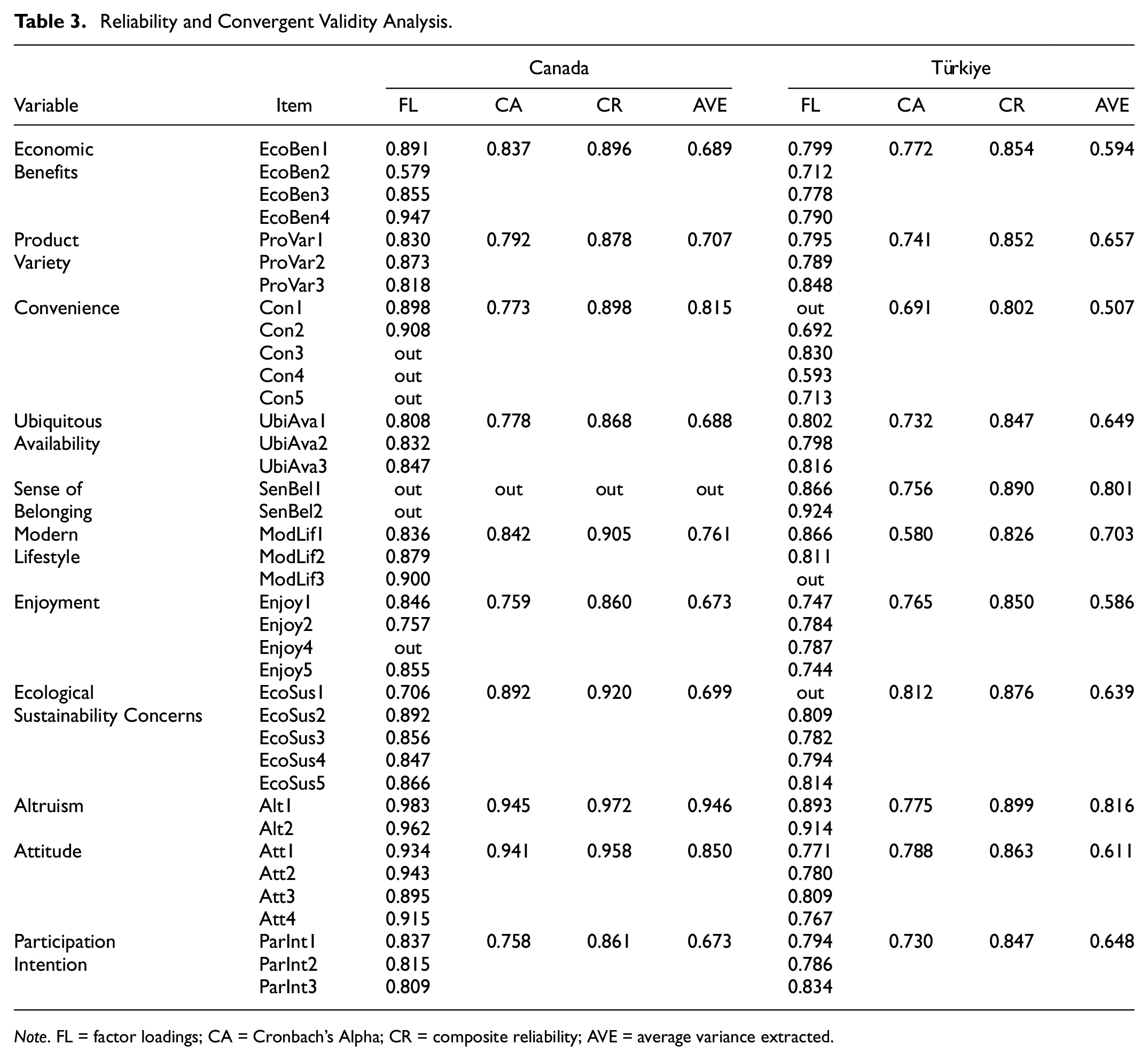
Note. FL = factor loadings; CA = Cronbach’s Alpha; CR = composite reliability; AVE = average variance extracted.
The AVE values of all constructs were higher than the minimum value of 0.50, indicating that they explained at least half of the variances in the structures (Hair et al., 2017; Sarstedt et al., 2021). Therefore, there is no convergent validity problem in the Canadian or Turkish model (Table 3).
To examine the DV of the constructs, we used the Fornell–Larcker criterion, which compares the AVE and square correlation coefficients of the structures (Fornell & Larcker, 1981). As shown in Tables 4 and 5, the DV levels were appropriate because all relevant squares correlation coefficients were smaller than the square root of the AVE values (Hair et al., 2017) (see Tables 4 and 5).
Fornell-Larcker Criterion Canada.

Fornell-Larcker Criterion Türkiye.

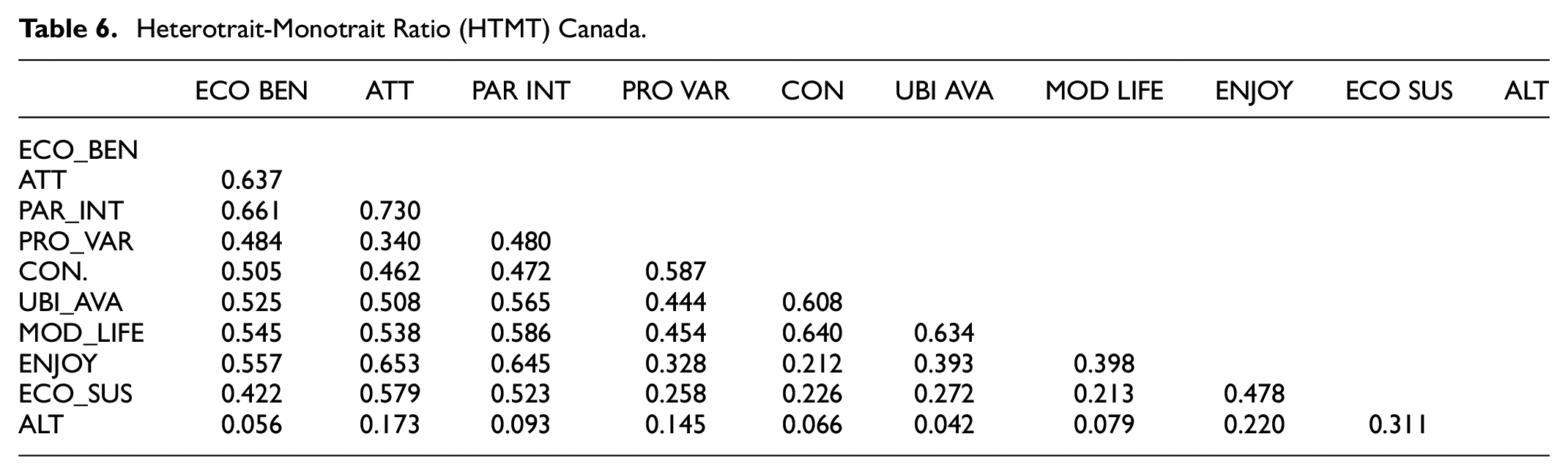
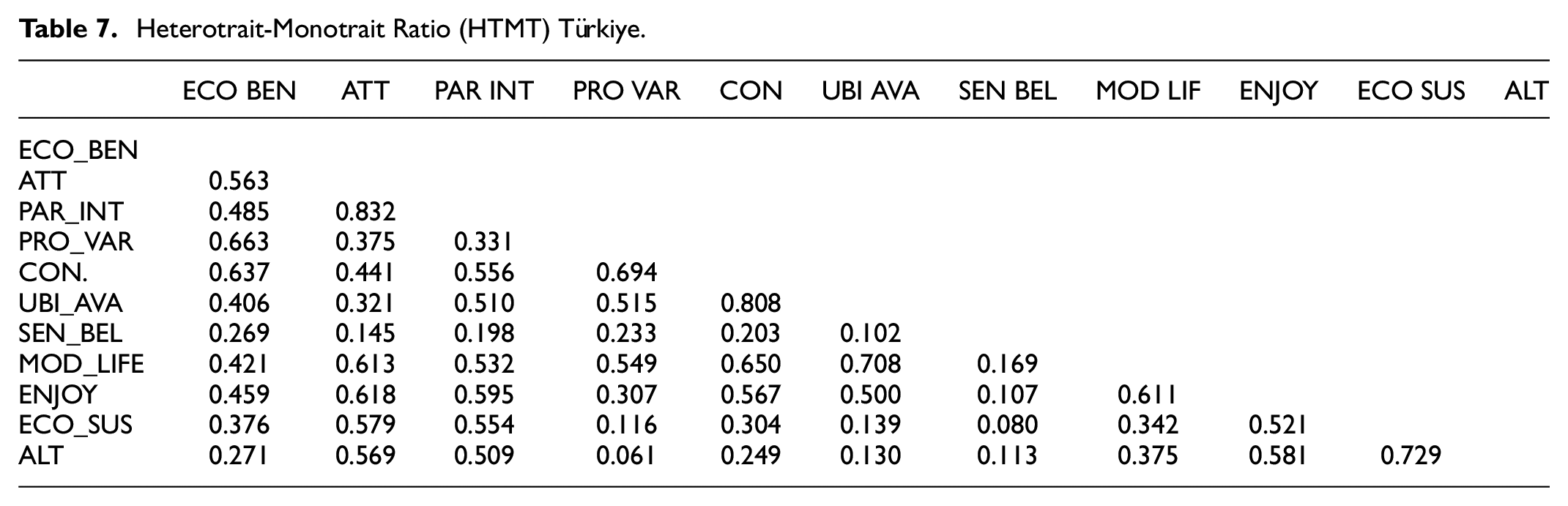
The HTMT criterion defines discriminant validity better than the Fornell-Larcker criterion (Henseler et al., 2015). Thus, the HTMT criterion was used to further verify the DVs of the structures. Since all HTMT ratios were lower than the reference point of 0.85 (Henseler et al., 2015), neither model had discriminant validity issues (Hair et al., 2017; Henseler et al., 2015) (see Tables 6 and 7).
Heterotrait-Monotrait Ratio (HTMT) Canada.
Heterotrait-Monotrait Ratio (HTMT) Türkiye.
Structural Model Evaluation
All VIF values were lower than the recommended threshold of 5 (Hair et al., 2019), with the highest VIF values of 1.734 for Canada and 2.029 for Türkiye (see Table 8). Therefore, collinearity is not an issue for the Canadian or Turkish model.
VIF and Predictive Relevance Values.

We ran the bootstrap option using 5,000 subsamples to obtain the significance levels and sizes of the structural path coefficients. Table 9 shows the coefficients values (β), t-values, significance levels (p-values), and 95% confidence intervals. 5 out of 10 road coefficients in the Canadian model and 6 out of 11 road coefficients in the Turkish model are statistically significant (see Table 9).
Structural Model Path Coefficients and Significance Analysis.

Analyzing the structural model’s predictive ability begins by examining the R2 values (Hair et al., 2019). The explained variance was 56% for attitude toward participation (ATT) and 38% for intention to participate (PAR_INT) in the Canadian model and 42% for ATT, and 41% for PAR_INT in the Turkish model (Sarstedt et al., 2021) (see Table 8).
Effect size (f2) represents the change in the R2 value when a specified exogenous construct is removed from the model. The predictive effect of a given latent variable, f2 values of 0.02, 0.15, and 0.35, show small, medium, and strong impact of an exogenous structure, respectively (J. Cohen, 2013). Effect size values less than 0.02 indicate no effect whatsoever (Sarstedt et al., 2021).
While five constructs had less than the desired f2 value, the other five had a value higher than the threshold f2 value of 0.02 in the Canadian model. In the Turkish model, four variables had f2 values below the threshold of 0.02, whereas the other six had f2 values above the threshold level (see Table 8). Therefore, road models have in-sample prediction abilities based on the R2, path coefficients, and f2 effect sizes (Hair et al., 2017).
Stone-Geisser Q2 blindfolding, another indicator of path model estimation, was used as the last step in the structural model assessment (Hair et al., 2019). The cross-validation redundancy method was applied to obtain the Q2 blindfolding results. All Q2 values were higher than zero for both models, indicating predictive relevance for endogenous structures (Chin, 1998; Hair et al., 2017) (see Table 8).
The results of hypothesis testing, along with PLS-SEM path analysis and significance verifications for the Canadian and Turkish models, are (see Table 9):
H1 is supported for both countries in terms of economic benefits (ECO_BEN) having a positive and statistically significant effect on attitude toward participation (ATT) in both Canadian and Turkish models (βCanada = 0.211, pCanada < 0.001; βTürkiye = 0.189, pTürkiye < 0.001).
Second, as product variety (PRO_VAR) did not have a statistically significant effect on ATT in either Canadian or Turkish models, H2 is not supported for either country (βCanada = −0.073, pCanada > 0.05).; βTürkiye = 0.069, pTürkiye > 0.05).
Likewise, convenience (CON) had no statistically significant effect on ATT in either Canadian or Turkish models; H3 was rejected for both countries (βCanada = 0.113, pCanada > 0.05; βTürkiye = 0.038)., pTürkiye > 0.05).
Since ubiquitous availability (UBI_AVA) did not have a statistically significant effect on ATT in either model, H4 was not supported for either country (βCanada = 0.088, pCanada > 0.05; βTürkiye = 0.-043, pTürkiye > 0.05).
Only Turkish model analysis included sense of belonging. However, it did not have a statistically significant effect on ATT (βTürkiye = 0.-039, pTürkiye > 0.05); thus, H5 was not supported for either country.
H6 is supported for both countries in terms of the fact that modern lifestyle (MOD_LIF) had a positive and statistically significant effect on ATT in both Canadian and Turkish models (βCanada = 0.162, pCanada < 0.01; βTürkiye = 0.178, pTürkiye < 0.01).
Similarly, H7 is supported for both countries, since enjoyment (ENJOY) had a positive and statistically significant effect on ATT in both Canadian and Turkish models (βCanada = 0.256, pCanada < 0.001; βTürkiye = 0.176, pTürkiye < 0.01).
Also, the impact of environmental sustainability (ECO_SUS) on ATT was positive and statistically significant in both Canadian and Turkish models; therefore, H8 is supported for both countries (βCanada = 0.297, pCanada < 0.001; βTürkiye = 0.178, pTürkiye < 0.001).
In the case of altruism (ALT) effect on ATT, while there was no significant effect for the Canadian model, there was a statistically significant positive effect in the Turkish model (βCanada = 0.046, pCanada < 0.05); thus, H9 was rejected for Canada but accepted for Türkiye (βTürkiye = 0.180, pTürkiye < 0.001).
Finally, H10 is supported for both countries, since ATT had a positive and statistically significant effect on participating intention (PAR_INT) in both Canadian and Turkish models (βCanada = 0.621, pCanada < 0.001; βTürkiye = 0.639, pTürkiye < 0.001).
In summary, while H1, H6, H7, H8, H9, and H10 were supported for Türkiye, H1, H6, H7, H8, and H10 were supported for Canada. Furthermore, H2, H3, H4, and H5 were rejected for Türkiye, whereas we rejected H2, H3, H4, H5, and H9 for Canada. The findings show that both countries’ models have moderate explanatory power: 40% for the Turkish model and 38% for the Canadian model (Henseler et al., 2015) (see R2 values in Table 8).
We can classify the findings into three groups (see Table 9). First, altruism positively affects Turkish consumers’ intent to participate in SE but not Canadians’, as H9 was supported for Türkiye but not for Canada. Second, economic benefits, modern lifestyle, enjoyment, and ecological sustainability concerns positively affect the participation intention of both Turkish and Canadian consumers, since H1, H6, H7, and H8 were supported for both countries. Finally, as product variety, convenience, ubiquitous availability, and sense of belonging do not affect Canadian or Turkish consumers, we rejected H2, H3, H4, and H5 for both countries.
Discussion
Because Türkiye and Canada are quite different in many aspects, we expected the analysis results to be considerably different. Contrary to our expectations, the results were quite similar. As said above, the findings are gathered in three groups:
First, while altruism affects Turkish consumers’ intent to participate in SE, it does not affect Canadians; it may be because Türkiye is a feminine Middle Eastern country, whereas Canada is a masculine Western country (see Figure 1). Femininity stands for the softer aspects of culture; for example leveling with others, consensus, and sympathy for the underdog is valued and encouraged (Hofstede-insights, 2021b). In addition, because acts of sharing have a powerful altruistic aspect (Belk, 2010), it is not surprising that altruism impacts people with feminine cultural structure, in our case, the Turkish people. Nonetheless, at the same time, we should not forget that pure altruism would mean the desire to give some of one’s utility to improve someone else’s utility. In contrast, impure altruism will contain an incentive for users, be it either a warm glowing feeling or a reward of some sort (Gimon, 2021). Therefore, Turkish people’s altruistic incentive levels should also be studied in future research.
Second, economic benefits, modern lifestyle, enjoyment, and ecological sustainability concerns have statistically significant and favorable effects on consumers participating in SE for both Türkiye and Canada. Environmental sustainability concerns on the Canadian side and economic benefits on the Turkish side are the most compelling motivations. D. P. Gupta and Chauhan (2021), analyzing the most cited five articles, suggested that ecological sustainability concerns and economic benefits are the primary motivating factors of SE participation. Our results are consistent with their outcomes and those of previous studies. Hamari et al. (2016), Tussyadiah and Pesonen (2016) found a positive effect of economic benefits on consumer participation in different SE sectors. Moeller and Wittkowski (2010) suggested that consumers who want to use fashionable products are more likely to prefer renting over ownership. According to Kumar et al. (2018) and Bucher et al. (2016), enjoyment positively impacts attitude in SE. Özdoğan and Özkul (2021) cite that Turkish consumers believe that SE prevents waste and promotes the efficient use of resources. Wang et al. (2020) argued that people with higher environmental awareness are more likely to prefer SE. Again, previous findings show that environmental awareness positively affects consumers’ intent to choose SE (Hamari et al., 2016; Hawlitschek et al., 2018).
Third, product variety, convenience, ubiquitous availability, and sense of belonging do not affect Turkish and Canadian consumers’ partaking in SE. Some researchers have found evidence that these motivations affect participation in SE (Bellotti et al., 2015; Hawlitschek et al., 2018; N. Kim et al., 2019; Möhlmann, 2015; Smith, 2016; Tussyadiah & Pesonen, 2016); however, the present study does not back up their outcomes.
In the case of instrumental motivations, only economic benefits impact consumers’ intent to participate in SE. In the case of social-hedonic motives, modern lifestyle and enjoyment effectively affect consumers, whereas sense of belonging is not. When it comes to normative stimulus, ecological sustainability concerns impact all consumers, but altruism affects only Turkish consumers. The most effective motivations on the Canadian side are normative motives, whereas instrumental ones are on the Turkish side. The cultural and paradigm differences between the countries just mentioned are coming into play at this stage.
Finally, the results suggest that attitude toward participation has statistically significant and positive effects on consumer intentions to participate in SE. This outcome is consistent with the findings of Hawlitschek et al. (2018), Bucher et al. (2016), and Ianole-Călin et al. (2020), which all used TPB. Alongside these studies, the present paper also confirms TPB (Ajzen, 1991). This result represents the most critical finding of empirical research.
The other intriguing result of this research is that, apart from altruism, all motivations are the same for Turkish and Canadian consumers, whether supported or unsupported in the analysis. As suggested above, these findings are surprising, contrary to our expectations. These economically, historically, culturally different nations seem to have the same affecting and unaffecting motivations in participating in SE. Is it because the world has become a “global village,” as McLuhan suggested long before (McLuhan, 1964)? Future research should investigate the similarity of these findings in detail.
In a longitudinal study conducted in the Netherlands, the findings suggest that young and educated generations tend to have a global orientation and adopt the international lifestyles imposed by intercontinental mass media and multinational marketing activities (Sobol et al., 2018). Since SE users are typically young and well-educated (Hawlitschek et al., 2018; PwC, 2015), it is not abnormal for Canadians and Turkish consumers to be influenced by the same motivations. Globalization portrays an increasingly economically, socially, and culturally interdependent world (Sobol et al., 2018). As a result of this interdependency, the dissimilarity of the nations is diminishing. All over the world, despite being on different continents, well-educated, tech-savvy young SE users are constantly getting closer to each other in terms of thinking and lifestyles. Therefore, the reason for the similar findings of this study can be explained by globalization and global consumer culture.
Conclusion
SE flourished as a new economic system based on producer and consumer interactions changed production and consumption cultures, and became widespread in a relatively short time in the 2010s (J. Schor, 2016). Many studies have examined motivations for participating in SE. However, because of SE’s relatively short history and blurry boundaries (Hamari et al., 2016), it is still unclear what factors motivate consumers to participate in SE to some extent (Hawlitschek et al., 2018). Furthermore, comparative empirical studies on this subject across countries are scarce. Since this deficiency is felt in empirical studies on SE applications, we preferred a comparative method in this study. It is important that the results must be synthesized and evaluated with the country’s cultures.
This paper is the first empirical study to compare Canadians and Turks in SE literature. As Canada and Türkiye are distinct in many aspects, we expected that Canadian and Turkish consumers’ motivations to participate in SE would also be dissimilar. However, as Turkish people and Canadians have similar stimulation in participating in SE, contrary to our expectations, the findings indicate that dissimilarities between countries are not consequential.
This paper contributes to the existing literature on consumer motivations for SE, especially Turkish literature. To the best of our knowledge, no study has directly compared the consumers of the two countries, and this study contributes to minimizing this gap in SE literature. It also confirms the validity of Core-TPB in the context of consumer participation in SE, supporting previous studies (Bucher et al., 2016).
This study is noteworthy to practitioners. The findings facilitate Turkish and Canadian SE entrepreneurs’ understanding of their consumers’ motivations. Since it suggests that consumers’ motivations for SE do not change significantly across countries, this study provides critical insights to SE businesses that want to expand their practices overseas.
The present study has some limitations. The findings of this study provide generalization, as it analyzes motivations in general in SE as an umbrella concept and does not target a specific SE platform or service. It may result in biased responses if participants inadvertently refer to a particular platform or service in the questionnaires (Hawlitschek et al., 2018). Future studies may focus on specific SE platforms or services.
This study examines only a limited number of consumer incentives and does not consider the motives of other stakeholders. Future research should include suppliers and platform owners and more types of motivations.
This research included participants only from Canada and Türkiye. Further studies should be conducted in other countries to determine whether consumers’ motivations are similar to those of Türkiye and Canada. In future studies, it should be a priority to take countries similar in economic structure and size as a basis.
Finally, to develop the existing literature, especially international studies should be supported within this framework. However, a guide will need to address the country’s comparison criteria, such as market size, trade volume, and distribution channels. It is strongly recommended that academics create a guide containing this information.
Footnotes
Appendix
Constructs and Measurement Items of the Study.

| Variable | Items | Sources | |
|---|---|---|---|
| Economic Benefits | Hamari et al. (2016) | ||
| EcoBen1 | I can save money if I participate in sharing economy. | ||
| EcoBen2 | My participation in sharing economy saves me time. | ||
| EcoBen3 | Sharing economy goods and services are cheaper than traditional alternatives. | ||
| EcoBen4 | My participation in sharing economy benefits me financially. | ||
| Product Variety | Hawlitschek et al. (2016) | ||
| ProVar1 | Sharing economy offers me a great diversity of products and services. | ||
| ProVar2 | Sharing economy offers me a wide variety for a particular product or service. | ||
| ProVar3 | Sharing economy allows me to access a diverse range of offers for products and services. | ||
| Convenience | Shankar and Rishi (2020) | ||
| Con1 | Using sharing economy applications is not easy for me. | (We developed the items based on five types of | |
| Con2 | I can reach sharing economy products and services comfortably through applications. | convenience in their framework) | |
| Con3 | I think sharing economy applications provide sufficient and useful information about their products and services. | ||
| Con4 | I think sharing economy goods and services are delivered in a timely manner. | ||
| Con5 | I think post-consumption services (e.g., solving problems) of sharing economy applications are sufficient. | ||
| Ubiquitous Availability | Hawlitschek et al. (2016) | ||
| UbiAva1 | Sharing economy allows me to access products and services in many places. | ||
| UbiAva2 | Sharing economy applications allow me to access products and services wherever I am. | ||
| UbiAva3 | Sharing economy allows me to access products and services regardless of my location. | ||
| Sense of Belonging | Hamari et al. (2016), Tussyadiah (2016) | ||
| SenBel1 | I feel connected with others while participating in sharing economy. | ||
| SenBel2 | Participating in sharing economy makes me feel like I am part of a big community. | ||
| Modern Lifestyle | Hamari et al. (2016) | ||
| ModLif1 | Sharing economy does not represent an up-to-date lifestyle. | ||
| ModLif2 | I think sharing economy meets today’s trends. | ||
| ModLif3 | I think sharing economy is in tune with the times. | ||
| Enjoyment | |||
| Enjoy1 | Participating sharing economy is enjoyable. | ||
| Enjoy2 | Participating sharing economy is exciting. | ||
| Enjoy3 | Participating sharing economy is interesting. | ||
| Enjoy4 | Participating sharing economy is fun. | ||
| Enjoy5 | Participating sharing economy is a pleasant experience. | ||
| Ecological Sustainability | Bucher et al. (2016) | ||
| Concerns | EcoSus1 | Sharing economy is a sustainable model of consumption. | |
| EcoSus2 | Sharing economy is more environmentally friendly than conventional consumption alternatives. | ||
| EcoSus3 | Sharing economy helps to reduce energy consumption. | ||
| EcoSus4 | Sharing economy helps to protect natural resources. | ||
| EcoSus5 | Sharing economy is ecologically meaningful. | ||
| Altruism | Bucher et al. (2016) | ||
| Alt1 | I think participating sharing economy allows me to do something meaningful for others as well. | ||
| Alt2 | I think I am also helping others by participating in sharing economy. | ||
| Alt3 | To help others makes me feel good. | ||
| Attitude | Zhang et al. (2019), Bucher et al. (2016) | ||
| Att1 | All things considered, I think sharing economy is a positive thing. | ||
| Att2 | All things considered, I like the idea of participating in sharing economy. | ||
| Att3 | All things considered, I think using sharing economy is beneficial. | ||
| Att4 | All things considered, I find participating in sharing economy to be a wise move. | ||
| Participating Intention | Hamari et al. (2016) | ||
| ParInt1 | I am likely to choose sharing economy next time. | ||
| ParInt3 | In the future, I will prefer sharing economy goods and services to other alternatives. | ||
| ParInt3 | It is likely that I will choose sharing economy more often in the future. | ||
Declaration of Conflicting Interests
The author(s) declared no potential conflicts of interest with respect to the research, authorship, and/or publication of this article.
Funding
The author(s) received no financial support for the research, authorship, and/or publication of this article.
