




Abstract
The study sought to assess the extent to which independent variable, green supply chain management practices (GSCMPs), to predict perceived environmental performance (PEP) in manufacturing firms in Bangladesh, with perceived green innovation (PGI) as the mediating variable. The study intended to investigate the moderating context of perceived institutional pressure (PInsPr) to both GSCMPs to PEP and PGI to PEP. This study used a deductive approach and cross-sectional survey design. Primary data was collected from upper and middle level managers using a structured survey questionnaire. Partial least squares-based structural equation modeling (PLS-SEM) with SmartPLS 4.0 was used to test the expected relationships based on the response of 603 usable samples. The results suggested that GSCMPs has a positive predicted relationship with PEP; GSCMPs and PGI also had a strong positive relationship; PGI and GSCMPs also had a strong positive relationship; PGI partially mediated the relationship between GSCMPs and PEP; and a strong PInsPr has a positive relationship with the relationship between GSCMPs and PEP while having a negative relationship with PGI to PEP. The purpose of this research was to investigate the relationship between GSCMPs and PEP in the context of the Bangladeshi manufacturing industry. The hope is that this empirical research inspires additional theoretical research and empirical research to develop green supply chain learning amongst scholars. The results of the study may guide the behaviors of policymakers or managers pertaining to the development and implementation of green supply chain management strategies and policies.
Keywords
Introduction
Supply chain management refers to the management of logistical events that occur outside the walls of the firm, for example, procuring raw materials, the manufacturing of finished goods (or other related events), and delivering finished goods to supply chain dealers, retailers, and end customers (Holzner & Wagner, 2022; Huang & Huang, 2022). On the other hand, green supply chain management entails the idea of considering the environment when making operational decisions. All activities performed within SCM, such as raw material extraction, production, transporting, storage, and packaging are performed with the aim of reducing environmental pollution such as carbon emission or maximizing energy and resources use (Rupa & Saif, 2022; Seman et al., 2012). Green supply chain management has emerged as a new structural thinking that encourages administrations to take up environmental strategy with the aim of attaining economic goals while curtailing operational actions environmental impact and advance environmental effectiveness through their supply chains (Ahmed et al., 2019; Holzner & Wagner, 2022; Huang & Huang, 2022; Mustafi et al., 2024). By greening their supply chain activities, the firm will have the possibility of lower and/or joint advantage which translates reliability, attractiveness, and financial performance (Ahmed et al., 2019; Choi & Hwang, 2015; Holzner & Wagner, 2022; Hosain & Mustafi, 2025; Huang & Huang, 2022; Mustafi et al., 2024; Wen et al., 2023). Most importantly, there is research conducted on GSCM to date, especially from the Bangladeshi perspective.
This study is constructed from previous studies (especially [Dubey et al., 2015; Hosain & Mustafi, 2025]) that investigated the relationship between GSCM practices (GSCMPs) and drivers influences on performance measures in manufacturing firms in Bangladesh, herein PInsPr was examined as the moderating association between GSCM practices and perceived environmental performance (PEP). Hosain and Mustafi (2025) research on Bangladeshi manufacturing firms clarified GSCM drivers and in relation, pointed to significant perceived regulatory pressures that drive firms GSCMPs. Similar results were made noted from Dubey et al. (2015) study, based on their study of institutional pressures have the moderating tool in research related to environmental performance in the Indian rubber industry. In Sahoo and Vijayvargy (2021) at least one performance dimension had a relation to some extent to a GSCM dimension either directly or indirectly. Their data pointed out investment recovery, in relationship to environmental performance could be looked for in GSCMPs (although GSCMPs as noted as an overall predictor of environmental performance) and eco-design as a predictor of operational performance. However, the GSCM dimensions were not directly related to economic performance, although indirect influences could be made as economic performance could be influenced indirectly.
In a recent comprehensive empirical study, Wen et al. (2023) identified four important findings, as follows: first, that institutional pressure is positively related to firms’ GSCMP adoption; second, GSCMPs and green innovation both relate positively to firms’ performance, meaning that firms can increase performance by adopting green GSCMPs; third, green innovation is a mediator of the GSCMP to firm performance relationship, meaning that it is important for the overall performance from GSCMPs; and lastly, managers willingness for support for GSCMP initiatives positively moderates the relationship between GSCMPs and firm performance. However, another study by Park et al. (2023) in South Korea relates that the positive relationship between GSCMPs and environmental performance goes down with stronger levels of institutional pressure, that is, for the green design factor, the more institutional pressure, the less the positive relationship of green design to environmental performance. Therefore, it can be stated that mixed evidence has resulted in institutional pressure and GSCMPs relationship and environmental performance. Nevertheless, it is proposed in this empirical paper that perceived green innovation (PGI) mediates the positive relationship between GSCMPs and perceived environmental performance (PEP). And, perceived institutional pressure moderates (strongest) the positive relationship between GSCMPs and PEP, while weakening the PGI to PEP positive relationship, with the moderator effect. Further, given this and in literature quite broadly, PInsPr likely has functions as a moderator in the context of GSCM. Accordingly, this study is concerned with examining how GSCMPs positively impact PEP, while discussing PGI’s mediated effect and PInsPr’s moderated effect in the direct effect. Like Wen et al. (2023), the focus of this study is to the interactions of how GSCM practices, green innovation, and institutional pressures can affect the environmental performance in BGF manufacturing firms. In conclusion, this paper is studying how GSCM practices positively impact PEP, while addressing the mediating effect of PGI and the moderating effects of PInsPr. This study has multiple objectives. The first objective of the study is to investigate the relationships between GSCMPs and PEP in Bangladeshi manufacturing firms. The second objective is to investigate PGI as a mediator in the association between PEP and GSCMPs. The final objective is to investigate PInsPr as a moderator in both the GSCMPs to PEP relationship and the PGI to PEP relationships. Therefore, the prior cited scholars take perspectives on GSCM initiatives in existing SCM/GSCM literature and implement changes that would lead to improved environmental performance. With that being stated, research questions found from this practical study are:
Theoretical Concept and Literature Review
Theoretical Concept
By integrating the Natural Resource-Based View (NRBV) with Institutional Theory, you will provide a strong theoretical underpinning to understand how firms’ environmental performance is affected by their internal capabilities and external pressures in combination. The NRBV is an aspect of the resource-based view (RBV) that holds firms may obtain competitive disadvantages if they can build strategic capabilities which are aligned with environmental sustainability (specifically, Green Supply Chain Management Practices [GSCMPs] and Perceived Green Innovation [PGI]; Hart, 1995; Russo & Fouts, 1997). GSCMPs and PGI are classified as valuable, rare, inimitable, and non-substitutable (collectively, VRIN) and firms may improve their environmental performance because of these (Barney, 1991; Hart & Dowell, 2011). Institution Theory, on the other hand, provides explanation as to how organizations are constructed by market and sector institutional environments (as operationalized through stakeholders), regulatory demands, and institutional norms. The Perceived Institutional Pressure (PInsPr; either coercive, normative, or mimetic) also drives firms’ strategic actions toward the environmental domain (DiMaggio & Powell, 1983; Scott, 2008). Therefore, in this model, we will utilize institutional theory to examine the moderating effects of the PInsPr between firms’ internal green capabilities and firm environmental performance; for instance, institutional effects may reinforce or constrain the impact of GSCMPs and green innovation initiatives. The combination of these two approaches captures a multi-layered mechanism; NRBV will clarify the internal value creation process that connects GSCMPs and PGI (a voluntary green behavior outcome) to Perceived Environmental Performance (PEP), while institutional theory will situate the external process in which institutional pressures aid in shaping the strength and direction of the internal linkages. Together these variables, correspond to recently introduced enhancements to sustainability literature regarding multi-theoretical perspectives that seek to explain the complexity in organizational environmental behavior (Bansal & Roth, 2000; Delmas & Toffel, 2008).
SCM
Over the past two decades, numerous corporations have employed global supply chain management (SCM) practices to remain competitive in the universal marketplace (Dubey et al., 2017). Firms are directing their attentions toward environmental objectives and participating in Green SCM (GSCM) practices—sustainable sourcing, green eco-design, recycling, and re-manufacturing (Al-Sheyadi et al., 2019; Mustafi et al., 2024). In North America, Europe, and Australia, among other developed countries, legislation was passed and enforced legal obligations to recover, reuse, and arrange for used products and packaging. Practices such as “closed-loop supply chains,”“reverse logistics,” and “green supply chains” began to gain attention because of the legislation (Mitra & Datta, 2014). There is an ever-increasing level of awareness in the industries, among consumers, and in governments about the need to reduce, and not only pollution prevention, but the importance of keeping the environment in a sustainable condition (Huang & Huang, 2022; Mustafi et al., 2024; Sahoo & Vijayvargy, 2021; Soda et al., 2015; Zhu et al., 2017). However, developing countries such as Bangladesh, China, Brazil, and India are less concerned with environmental protection because of poverty, not enough investment in sufficient technology, in absence of legislation and rapid industrialization (Hosain, 2021; Mustafi et al., 2024; Sahoo & Vijayvargy, 2021; Scur & Barbosa, 2017). Nonetheless, GSCM practices can provide benefits for manufacturing firms, especially in developing countries where pollution is detrimental to human health (Hosain, 2021; Huang & Huang, 2022; Namagembe et al., 2019), even with the objective need to progress their GSCM act. Though, there exists a gap in the literature in terms of understanding GSCM practices impact and implementation (Hosain & Mustafi, 2025; Mustafi et al., 2024; Raut et al., 2019; Sahoo & Vijayvargy, 2021; Wen et al., 2023). Also, there is ambiguity in terms of the role GSCM practices in the literature toward environmental performance or potentially pollution reduction, especially in developing economies such as Bangladesh (Choudhary & Sangwan, 2019; Rupa & Saif, 2022). Therefore, it is essential to establish the extent in which GSCM practices improve financial, operations, and environmental performance is something worth exploring, and how these three practices interact with each other (Choudhary & Sangwan, 2019; Holzner & Wagner, 2022; Hosain & Mustafi, 2025; Mustafi et al., 2024). For skeptical Bangladeshi managers and policymakers about GSCM practices, the uncertain nature of business environment created barriers (Soda et al., 2015). This empirical investigation addressed if the Green Supply Chain Management practices (GSCMP) would provide improvement toward environmental performance improvement (perceived by the managers) of Bangladeshi manufacturing firms, by achieving other benefits through efficiencies. The study also investigates the mediation effect of perceived Green Integration (PGI) on the relationship of GSCMP and perceived environmental performance (PEP) and moderation of a perceived Internal support and practice implementation (PInsPr) between GSCMP & PEP and PGI & PEP.
PEP
The supply chain management (SCM) operations contribute greatly to have sustainability-based business strategies and reported positive impacts on environmental performance and firm performance (Fahimnia et al., 2015). Previous studies have suggested that GSCMPs are associated with improved firm-level environmental, operational, and financial performance (Choi & Hwang, 2015; Mustafi et al., 2024; Wen et al., 2023). For example, Zhu and Sarkis (2007) researched in China how institution pressures impact GSCMPs of manufacturers. Within their study, Zhu and Sarkis (2007) reported that regulatory and market pressures yielded enhanced environmental performance; whereas they reported that competitive pressures yielded improved economic benefits without compromising environmental performance. This research represents a valuable contribution for operational strategists and organizational planners for sustainability.
GSCMPs are shown to support the environmental performance of firms and facilitate green innovation with green innovation acting as a mediator between GSCMPs and environmental performance (Seman et al., 2019). Seman et al. (2019) suggested that future studies should facilitate more empirical tests of the conceptual model regarding PGI and GSCM. Pagell and Gobeli (2009) produced case studies from 10 companies and developed a model of implementing a sustainable supply chain which addressed both environmental and social constructs and a matrix of innovative and traditional SCM performances.
GSCMPs
Al-Sheyadi et al. (2019) examined the influence of both internal and external Green Supply Chain Management Practices (GSCMPs) on environmental performance, regarding environmental impact and cost savings, drawing on survey reports and data from 138 manufacturing firms in Oman, using structural equation modeling (SEM), which provided strong empirical evidence of the complementary nature of GSCMPs. The findings of the study demonstrated a positive relationship between the degree of integrated GSCM capabilities and the environmental capabilities they produced. GSCMPs have gained considerably in relevance in recent years, due to increasing pressures from various external stakeholder groups including governments, customers, environmental agencies, pressure groups, and the public to adopt greener and more environmentally orientated practices. As Sarkis (2012) aptly noted, GSCM is essentially about the integration of environmental concerns to core supply chain function of procurement, transportation, and distribution. There is significant literature that highlights that there may be potential for a positive relationship between GSCMPs and environmental performance. For example, Govindan et al. (2013) suggested that practices like green purchasing, green logistics, and reverse logistics might all have an impact on the environmental impacts of firms, while also improving the financial performance of the firms as well. Similarly, Zhu and Geng (2013) explained that GSCMPs would be implicated in a reduction in both carbon emissions and energy consumption because of adopting such practices. Furthermore, more recently there has been greater attention paid to the relationship between GSCMPs and Perceived Green Innovation (PGI). Zhu et al. (2013) proposed that integrated GSCMP firms would also integrate GSCMPs into process innovative activities or seek green innovation. GSCMPs have a positive relationship with green innovation performance, especially when combined with good knowledge management and organizational integration. Similarly, GSCMPs promote resource efficiency, wasting reduction not only in line with principles of the circular economy; both are useful sources of green innovation (Liu et al., 2025). The relationship established between PGI and Perceived Environmental Performance (PEP) is well established, for example Rahmani et al. (2024) reported that both product and process-based green innovations improve environmental performance, although more so with process-based green innovations; this activities contributed positively to environmental performance outcomes in organizational settings where workers were in a strong engaged position, and the environmental result was also done with the support of an environmental goal. Based on an extensive review of the literature, it can be argued that GSCMPs positively impact PEP as the independent variable.
Mediating Role of PGI
Green innovation is a critical determinant of market share growth and an organization’s reputation for aligning with their strategic initiatives (Wen et al., 2023). Firms implementing green innovation can survive in an extremely competitive environment and create opportunities and evolve to a position in the international context (Hosain, 2021; Xu et al., 2023). Even though several studies have assessed the impact of GSCMPs on the firm’s overall performance, it is not common to consider green innovation as a mediating role in the context of scholarly research (Wen et al., 2023). As we indicated to explore a pathway, it was posited that we need to add a mediating variable to the understanding of GSCMPs and performance, and here is where green innovation could be that mediating variable (Holzner & Wagner, 2022). Green innovation is posited to further leverage a firm’s environmental performance with organizational GSCMPs because we posit that green innovation mediates the GSCMPs and PEP relationship completely. Green innovation provides convincing evidence that a firm can compete effectively, drive economic growth, improve product networks, and achieve socio-technical performance (Hazarika & Zhang, 2019; Holzner & Wagner, 2022; Mustafi et al., 2024). In this sense, through green innovation organizations can address the external voices of concern about their environmental impact and demonstrate significantly better firm environmental performance (Seman et al., 2019). As per the justification and literature that we previously discussed, this study will directly use perceived (the viewpoint of the employee) green innovation (PGI) as the sole mediator with the following research hypothesis to be tested:
PInsPr as the Moderator
The current research investigates the efficacy of GSCMPs as an environmental practice for improving environmental reputation of Bangladeshi manufacturing firms and their performance in international business. Green Supply Chain Management Practices (GSCMPs) combine environmental regulations as part of supply chain operations and design, emphasizing the significance of environmental principles in contributing to the firm’s image as an eco-efficient and green organization (Choi & Hwang, 2015). The relationship between GSCMPs and environmental performance is identified as an important consideration in successfully implementing GSCM (Choi & Hwang, 2015; Shah & Soomro, 2020). Environmental pressures, regulatory pressures, and market pressures are all-important drivers of firms engaging in green purchasing and eco-design. Regulatory pressures had a direct impact on the adoption of green purchasing policies, with competing pressures increasing the degree of financial value generated by engaging in GSCMPs (Hosain & Mustafi, 2025). Author note that coercive, normative, and mimetic pressures to embed GSCM into their business are sufficient antecedents for institutional green innovation (Xu et al., 2023). Normative pressure and mimetic pressure establish positive influences on cross-functional competition, while cross-functional competition mediates both the positive relationships between normative pressure and mimetic pressure to green innovation itself, and is also necessary for that positive relationship to be evident. While the present literature is limited on institutional pressure (InsPr) as a moderator, our stance is that under high levels of InsPr will enhance the positive relationship of GSCMPs to PEP and weaken the positive relationship of PGI to PEP of Bangladeshi manufacturing firms.
This paper re-examines the moderating influence of institutional theory on the relationship between GSCMPs and PEP. Institutional pressure plays a crucial role in motivating firms to adopt environmental management practices (Shah & Soomro, 2020). Previous studies have demonstrated the moderating impact of institutional pressure in various contexts, such as total quality management (TQM) adoption, internet-based supply chains, and supplier development programs. It is expected that perceived institutional pressure (PInsPr), as experienced or reported by employees, will moderate the positive relationships between GSCMPs and PEP, as well as between PGI and PEP in Bangladeshi manufacturing firms. Specifically, it is anticipated that high levels of PInsPr will strengthen the positive relationship between GSCMPs and PEP. Conversely, for the relationship between PGI and PEP, it is predicted that high PInsPr will weaken the PGI to PEP relationship. Therefore, the following hypotheses will be tested:
Conceptual Framework
The foundation of the conceptual model is based on the Natural Resource-Based View (NRBV), which states that internal green capabilities within the organization, as shown through Green Supply Chain Management Practices (GSCMP) and Perceived Green Innovation (PGI), lead to Perceived Environmental Performance (PEP; Barney, 1991; Hart, 1995). To add depth to the NRBV model, Institutional Theory shows what Perceived Institutional Pressure (PInsPr) reflects external pressures, that moderate these relationships (DiMaggio & Powell, 1983). The NRBV framework captures about 60% to 70% of the model since NRBV highlights the internal capability-building path, while Institutional Theory explains the contextual environmental influences, which captures approximately the remaining 30% to 40%. As presented in Figure 1, GSCMP is the independent variable, PGI is a mediator, PInsPr is the moderator, and PEP is the dependent outcome.
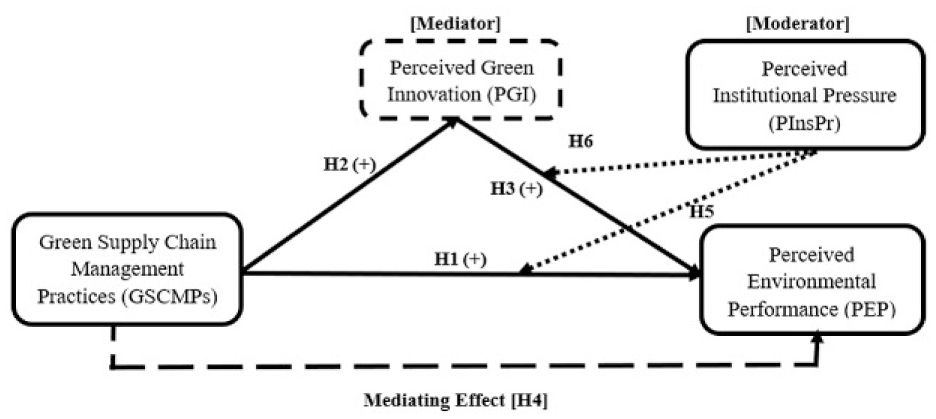
Conceptual framework.
Research Methodology
Research Method, Data Characteristics, and Sampling Method
This research was conducted using a systematic, multi-phase quantitative methodology. The first phase focused on defining the critical dimensions of the variables related to this research: namely, the independent variable: Green Supply Chain Management Practices (GSCMPs), the dependent variable: Practice of Environmentally Sustainable Products (PEP), and the moderator(s): the innovation process and perception of consumers (PInsPr) and the innovativeness of companies (PGI). A quantitative method was employed, alongside a purposive sample, to maintain objectivity and to ensure that respondents have the required knowledge and expertise within the relevant domains. According to the guidelines for selecting knowledgeable participants, CEOs, Directors, and Supply Chain Managers from 60 Bangladesh manufacturing firms were targeted as potential respondents for the structured survey instrument, which was administered between May 2023 and July 2023. A total of 603 valid responses were obtained from this survey. The respondents’ professional backgrounds supported their ability to provide sound insights regarding GSCMPs, PEP, PGI, and PInsPr; thus, the validity and quality of the dataset was enhanced.
The study conformed to a considerable degree to ethical guidelines governing human subjects in research. All of the items in the survey were not of a sensitive nature, and all of the respondents were free to decline his or her participation at any time during the study without facing any negative consequences. There were no physical, mental, social, financial, or other forms of risk that could negatively affect the respondents because of participating in this study. All instructors who participated in the research were assured of the confidentiality and anonymity of their data. The possible advantages of this study, such as an increase in overall academics, as well as the potential for advancement through the application of professional knowledge, outweigh the minimal risks of being a respondent to this study. Before any data were collected, instructors who volunteered to participate received information about the purpose of the study, what to expect throughout the study (procedures), how their data would be confidential, and the right to withdraw from the study at any point prior to data collection. Informed consent was obtained in an electronic format prior to respondents completing the actual survey. The respondents gain indirect benefits, such as increased awareness of sustainable practices and potential improvement in their environmental strategies.
For statistical analysis, IBM SPSS 29 was used to calculate descriptive statistics, while SmartPLS 4.1.0.3 was used for hypothesis testing. To assess the reliability and validity of the measurement model, Cronbach’s alpha, composite reliability (CR), average variance extracted (AVE), and Fornell-Larcker criteria (Fornell & Larcker, 1981), as well as HTMT ratios, were employed. Exploratory Factor Analysis (EFA) and Confirmatory Factor Analysis (CFA) were conducted using SPSS and SmartPLS to confirm the structure of the measurement model. Partial Least Squares-Structural Equation Modeling (PLS-SEM) was subsequently conducted using SmartPLS 4.1.0.3 to investigate the structural model and hypothesis.
Measurement Tool
In this research, a reflective first-order model was used to assess constructs, including Green Supply Chain Management Practices (GSCMPs), Perceived Green Innovation (PGI), Perceived Institutional Pressure (InsPr), and Perceived Environmental Performance (PEP). This model was developed based on the frameworks established in a number of studies (Al-Sheyadi et al., 2019; Chen, 2008; DiMaggio & Powell, 1983; Eltayeb & Zailani, 2014; Lin et al., 2014; Xue et al., 2019; Zaid et al., 2018; Zhu, Sarkis, Cordeiro, & Lai, 2008). Specifically, 22 items were used to measure each of the constructs in this study. GSCMPS acted as an independent variable and was measured using six items adapted from Eltayeb and Zailani (2014) and Zhu, Sarkis, Cordeiro, and Lai (2008). All items were modified to reflect the Bangladeshi context. PGI acted as the mediator construct and was measured using six items adapted from Chen (2008), Lin et al. (2014), Weng et al. (2015), and Xue et al. (2019) while also reflecting the Bangladeshi context. PEP acted as the dependent variable and was measured using six items from Al-Sheyadi et al. (2019) and Zaid et al. (2018). Lastly, InsPr acting as the moderator construct, was measured using five items adapted from DiMaggio and Powell (1983). Besides tailoring the items for a Bangladeshi context, the respondents were asked to rate agreement to each item using a 5-point Likert scale from 1 (strongly disagree) to 5 (strongly agree). This approach assured measurement to each construct that was logical, applicable to the context, and robust (Table 1).
Survey Items With References.

Source. Literature Review.
Sample Size and Its Determination
The appropriate sample size for this study was determined using G’Power 4.0 software (Soper, 2021), based on Cohen’s (2013) guidelines as well as Westland’s (2010) recommendations. An effect size (f2) of 0.3, an alpha level of .05, and four predictors with 22 observed variables, combined, suggested that 138 subjects would be the minimum sample size needed for the study to achieve an acceptable statistical power threshold of 80% (Gefen et al., 2011). To attempt to exceed the minimum sample size, 750 potential respondents were identified through direct contacts that allowed more focused outreach in line with the study’s objectives. The study was also specifically interested in targeting CEO’s, Directors, and Supply Chain Managers from 211 different manufacturing firms in Bangladesh, all of whom could respond to the core research question. The survey was deployed via Google Forms and received 84% of responses, totaling 633 completed surveys back. The responses were screened to ensure data completeness and consistency, and unsatisfactory submissions were discarded, leaving 603 suitable samples (n) for analysis. This methodology guaranteed a major advancement past the required minimum sample size for the study while also capitalizing on sample size that would improve reliability, validity, and generalizability (Table 2).
Distribution of Respondents by Firm.

Source. Literature Review.
Analysis and Interpretation
Demographic Information
The demographic data collected from the survey respondents including their gender, education level, job titles and years of working experience in the industry were shown in Table 3. Results indicated that most of the respondents (99.17%) were male, and most of the sample (99.50%) of the respondents had a Master’s degree. Most of the respondents (57.21%) held supply chain managerial jobs, and out of these positions, the directors made up 31.34% of the total sample size. Finally, the results showed that 41.96% had experience in the job of 9 years or more with 41.13% having experience of 5 to 8 years.
Demographic Information.

Source. Survey instrument.
Univariate Normality
In the current study, the skewness indicators for the latent factors showed nearly a normal distribution (Table 4). The kurtosis coefficients ranged from −1.168 to 1.044 and included both negative and positive values (Table 4). Though these coefficients are not completely within the narrowest parameters of normality, they are acceptable based on Sposito et al.’s (1983) more flexible normality parameters, which suggest an upper limit for normal data of 3.3. Thus, following Sposito et al. (1983) judgments and recommendations, it was determined that the data was normally distributed.
Normality of the Data.

Source. SPSS 29.
Multivariate Normality
To identify possible influential outliers in our dataset, Cook’s distance analysis was conducted, shown in Figure 2. Cook’s distance can be employed to identify influential data points that may have a large influence on the analysis, or pinpoint areas that may be beneficial to collect additional data (Cook, 1977). There were no cases identified with Cook’s distance greater than 1 in our analysis. Most cases were lower than 0.03276, suggesting that all items in our dataset have a normal distribution. The absence of outliers, and by extension normal distribution of the data, suggested the dataset was robust and reliable for our analyses and supported the validity of our findings.

Cook’s distance analysis.
Discriminant Analysis
To determine discriminant validity, we used Fornell and Larcker’s (1981) approach; this method consisted of comparing the average variance extracted (AVE) with the correlation values associated with other variables. A visual representation of the factors’ discriminant validity has been provided in Table 5. As noted in Table 5, the square root of (AVE) values were in bold off diagonals which were larger than the correlation values indicating acceptable discriminant validity was achieved in the data analysis.
Model Validity Measures.
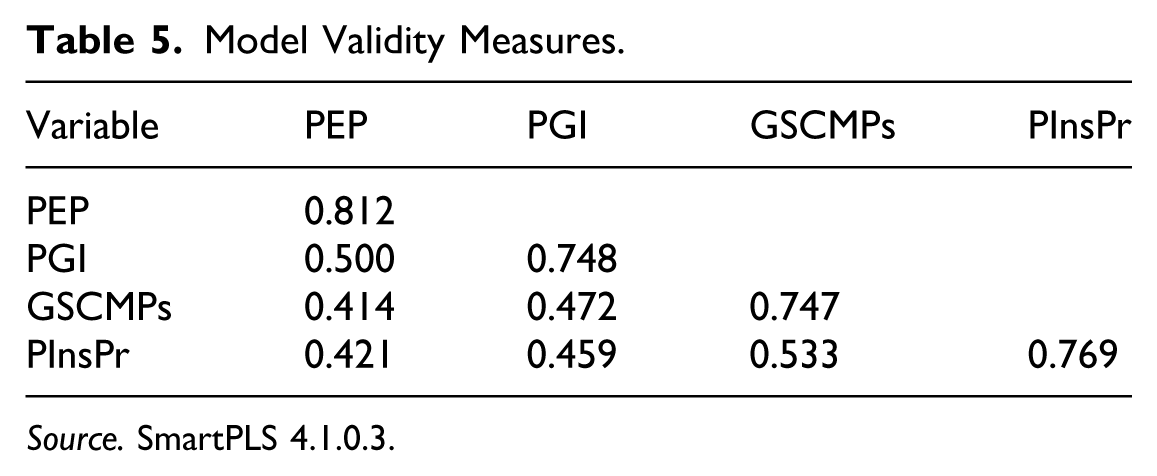
Source. SmartPLS 4.1.0.3.
Heterotrait-Monotrait Ratio (HTMT)
The HTMT value must be assessed against a reference value (typically set at 0.85 or 0.90) to determine the extent of convergent validity for the variables/constructs. Lower HTMT references indicate acceptable levels of convergent validity (the variables/constructs are established to be connected appropriately), while higher HTMT references indicate convergent validity problems, which can indicate multicollinearity or overlap in the variables/constructs (Table 6). In this study, there was no multicollinearity for the variables because all HTMT values were well below 0.85.
Heterotrait-Monotrait Ratio Analysis.

Source. SmartPLS 4.1.0.3.
Collinearity Assessment
To examine multicollinearity of variables in this study, a variance inflation factor (VIFs) analysis was performed. The VIFs varied from 1 (meaning no correlation) to 10, or more, and describes the amount of variance inflation for each coefficient. A general rule of thumb when interpreting VIF values is the following: VIF values of 5 or higher signify a high correlation, VIF values between 1 and 5 indicate moderate correlation, and VIF values of 1 represent no correlation (Hair et al., 1998). The VIF calculations, shown in Table 7, demonstrate the maximum VIF value in this analysis was 1.595, which is well below the acceptable threshold assumed by Hair et al. (1998). Thus, this analysis results did not indicate any evidence of a multicollinearity issue with factors in this study. Furthermore, the analysis points out that a VIF value above 3.3 tends to indicate pathological collinearity and potential CMB in a model. However, in this study, as shown in Table 7, the VIF values remained all below the 3.3 value indicating there was no evidence of CMB (Kock, 2015). Thus, the VIF analyses demonstrate that the factors in this study were not subject to multicollinearity issues, nor were the results skewed or influenced by CMB, thus indicating reliability in the study’s outcomes.
Variance Inflation Factor and Tolerance in Multicollinearity.

Source. SmartPLS 4.1.0.3.
Common Method Bias (CMB) Test
The single factor test advocated by Harman can be utilized to determine if one single factor accounts for most (more than 50%) of the variance. Conversely, if the single factor does not, CMB is less likely (Podsakoff et al., 2003). In this study, the test (Table 8) showed that the single factor only explained 33.099% of the variance, indicating that CMB did not occur.
Common Method Bias (CMB) Test.

Source. SPSS 29.0.
Model Evaluation
The Measurement Model
In the present study, several methods to measure reliability were utilized including composite reliability (CR), construct reliability, and average variance extracted (AVE), which capture the range of specified indicators for the various dimensions in the study estimated. CR was used to assess the consistency of two or more indicators that symbolized the variables, or constructs, since they show how close the indicators correlate (or relate) to each other, and to the same construct. AVE values were evaluated as a secondary measure, with higher values indicating that the indicators were capturing the specified constructs.
The results displayed in Table 9 show evidence for strong CA, CR, and AVE values across all dimensions, as well as statistical significance. For GSCMPs, the values were CA = 0.83, CR = 0.89, and AVE = 0.66; for PEP, CA = 0.84, CR = 0.88, AVE = 0.56; for PGI, CA = 0.80, CR = 0.86, and AVE = 0.56; and for PInsPr, CA = 0.83, CR = 0.88, and AVE = 0.59. All CA values exceeded the minimum value of 0.60 from Nunnally and Bernstein (1994). In addition, all constructs met the criteria for CR (≥0.70) from Hair et al. (1998), and met the AVE threshold of 0.50 (Fornell & Larcker, 1981; Henseler et al., 2009). The IR for all items had nontrivial values above the minimum IR in Hulland (1999), of 0.40, indicating the overall importance of the indicator in the study’s model. However, two items, GSCMPs4 and PGI6, were not retained into the EFA due to factor loadings below the suggested factor loading minimum of 0.633.
Factor Analysis.

Source. SmartPLS 4.1.0.3.
Note. IR = Indicator Reliability; VIF = Multicollinearity Statistic (AVE >0.50 [Fornell & Larcker, 1981; Henseler et al., 2009], Composite Reliability >=0.70 [Hair et al., 1998], CA >=0.60 [Nunnally & Bernstein, 1994], IR >=0.4 [Hulland, 1999]).
According to the analysis in Table 9, the outer model loadings demonstrated strong significance. All t-statistic values were greater than 2.33 at the 1% level of significance, thereby providing strong evidence for the acceptance of the Structural Equation Model (SEM). A global measure is used to evaluate overall goodness-of-fit (GoF) in path modeling, which is defined as the geometric mean of the average commonality and average R2, particularly for endogenous variables. In this study, the GoF value is calculated to be 0.48 (R2 = .383, average AVE = 0.59). The GoF value exceeds the highest cutoff of 0.36. This indicates the proposed model of this paper has a much better overall explanatory ability than the recommended GoF value, with small = 0.1, medium = 0.25, and large level = 0.36 (Akter et al., 2011).
Structural Model Assessment
Variance-based structural equation modeling (SEM) was used in this study to determine the significant relationships between four constructs: (i) Green Supply Chain Management Practices (GSCMPs), (ii) Perceived Green Innovation (PGI), (iii) Perceived Institutional Pressure (InsPr), and (iv) Perceived Environmental Performance (PEP; Table 10 and Figure 3). For Hypothesis 1 (H1), the hypothesized relationship of GSCMPs and PEP was tested. The results showed significant positive relationships of GSCMPs and PEP (β = .333, SD = 0.041, t = 8.029, p < 0.01; 95% CI [0.249, 0.413]), and thus H1 was supported. For Hypothesis 2 (H2), the hypothesized relationship of GSCMPs and PGI was tested. The results showed a significant positive relationship of GSCMPs and PGI (β = .414, SD = 0.032, t = 13.082, p < .01; 95% CI [0.349, 0.472]), and thus H2 was supported. For Hypothesis 3 (H3), the hypothesized relationship of PGI and PEP was tested. The results showed a significant positive relationship of PGI and PEP (β = .196, SD = 0.049, t = 4.017, p < .01; 95% CI [0.100, 0.290]), and thus H3 was supported.
Regression Weight.
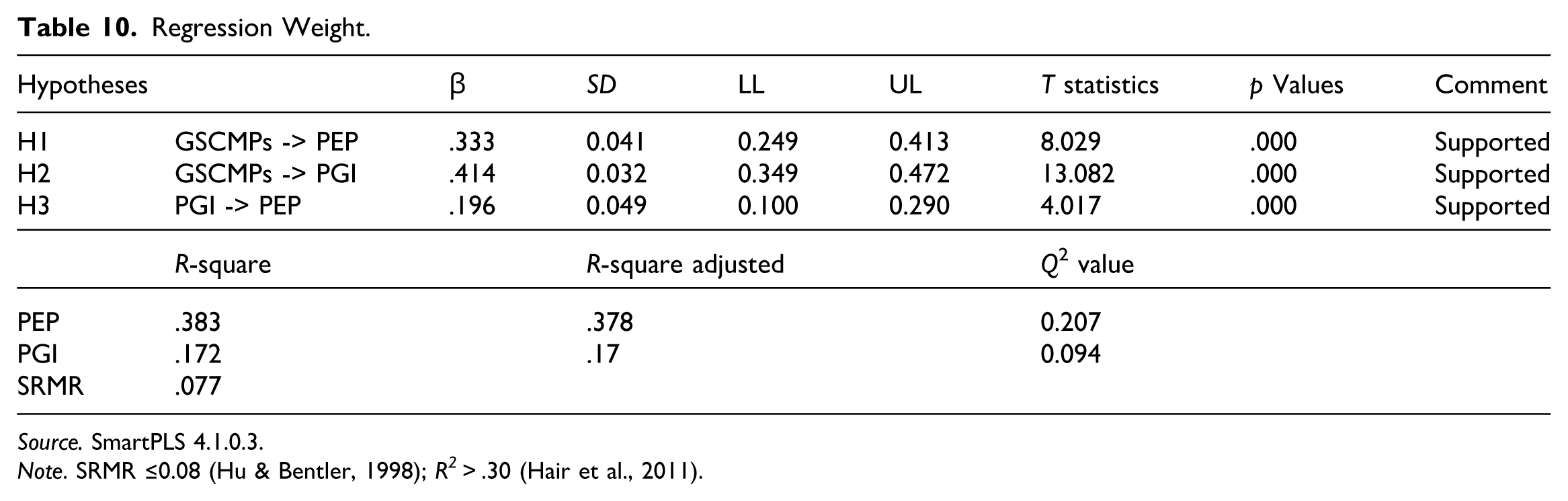
Source. SmartPLS 4.1.0.3.
Note. SRMR ≤0.08 (Hu & Bentler, 1998); R2 > .30 (Hair et al., 2011).

Path model.
Corresponding to the values established by Hair et al. (2011) for R2 values, the study reported an R2 value of .383 for the dependent variable, PEP. This indicates that the combination of the independent variables, and one mediating variable, accounted for 38.3% of the explained variance in PEP for manufacturing firms in Bangladesh, which has a value that falls into Hair et al.’s (2011) values. The model fit assessment also showed that the Standardized Root Mean Squared Residual (SRMR) was 0.077, which is below the threshold of 0.08 for a good fit, as per Hu and Bentler’s (1998) recommendations. Thus, the fit indices show that the model fits the data well, as shown in Table 10. When PLS-SEM demonstrates predictive relevance, it indicates the model’s ability to predict the data points of indicators. A Q2 value greater than zero (Q2 ≥ 0) for an endogenous latent variable suggests that the PLS path model has predictive relevance for the constructs (Hair Jr et al., 2021). As shown in Table 10, the three independent constructs, along with the single mediator and moderator, were found to be relevant to the dependent construct (PEP), as the Q2 value (Q2 = 0.207) was greater than zero in this case.
Mediation Analysis
The investigation underscores the function of the mediating variable, PGI (Perceived Green Innovation), in affecting the connections between independent and dependent variables, indicated in Table 11. The findings disclosed that PGI partially mediates the relationship between GSCMPs (Green Supply Chain Management Practices) and PEP (Perceived Environmental Performance). Specifically, the indirect effect of GSCMPs on PEP through PGI was statistically significant (β = .081, SD = 0.022, t = 3.766, p < .01; 95% CI [0.041, 0.125]). In addition, both the direct and indirect effects were significantly related to PEP. The direct effect of GSCMPs on PEP was found to be significant (β = .333, SD = 0.041, t = 8.029, p < .01; 95% CI [0.249, 0.413]), and the indirect effect was significant for two paths: the effect of GSCMPs on PGI (β = .414, SD = 0.032, t = 13.082, p < .01; 95% CI [0.349, 0.472]), and the effect of PGI on PEP (β = .196, SD = 0.049, t = 4.017, p < .01; 95% CI [0.100, 0.290]). Therefore, H4 was supported.
Mediating Effect.

Source. SmartPLS 4.1.0.3.
Mediated Moderation Model
The hypotheses of the study were empirically evaluated using SmartPLS software. As a reminder, perceived institutional pressure (PInsPr) moderates the relationship between GSCMPs and PEP, therefore 5,000 bootstrap resamples were applied, which was deemed adequate for the status of this study. The model specified GSCMPs as the independent variable, PEP as the dependent variable, PGI as the mediator, and PInsPr a moderator. The moderating effects of PInsPr were captured in the relationship between GSCMPs and PEP, which is represented in Table 12 and Figure 4. The analyses showed a significant positive (strengthening) effect of PInsPr on the relationship between GSCMPs and PEP (β = .089, SD = 0.039, t = 2.318, p < .05; 95% CI [0.018, 0.062], thus H5 was supported. The index of mediated moderation was significant (95% CI [0.018, 0.062]), which indicates that the 95% CI does not contain zero. In contrast, a significant negative (weakening) effect of PInsPr on the relationship between PGI and PEP was also identified (β = −.121, SD = 0.030, t = 4.026, p < .01; 95% CI [0.016, 0.169]), thus H6 was supported. The index of mediated moderation was statistically significant (95% CI [0.016, 0.169]), which indicates the 95% CI does not contain zero.
Moderating Effects.

Source. SmartPLS 4.1.0.3.

Moderating effect.
Discussion
The amalgamation of the Natural Resource-Based View (NRBV) and Institutional Theory furnishes a cogent framework for explicating how both internal capabilities and external pressures shape firms’ environmental performance. As an extension of the RBV, the NRBV argues that firms can develop sustainable competitive advantages by developing strategic environmental capabilities that are valuable, rare, inimitable, and non-substitutable (Barney, 1991; Hart, 1995; Hart & Dowell, 2011; Russo & Fouts, 1997). Such internal green capabilities underpin proactive sustainability practices to enhance a firm’s environmental performance.
This study demonstrates that GSCMPs are positively and significantly related to Perceived Environmental Performance (PEP). Survey data from manufacturing firms and structural equation modeling (SEM) analysis demonstrated that this relationship exists because the internal green capabilities of GSCMPs such as green eco-design, internal green orientation, and green supply chain partnerships enhance customer engagement and operational sustainability. These findings are consistent with previous literature (Al-Sheyadi et al., 2019; Govindan et al., 2013; Mustafi et al., 2024; Sahoo & Vijayvargy, 2021; Sarkis, 2012; Zhu & Geng, 2013; Zhu et al., 2013) and support NRBV’s proposition, that firms with environmentally focused internal capabilities can translate these capabilities into positive performance.
In addition, the study also identifies PGI as an essential mediating mechanism of GSCMPs on PEP. As per NRBV, green innovation in and of itself is a dynamic capability that ultimately leads to more creative organizations, resource efficiency, and sustainability for the organization in the long run. The results show that PGI does mediate the relationship between GSCMPs and PEP and is supported by Hazarika and Zhang (2019), Lin et al. (2014), Seman et al. (2019), Weng et al. (2015), and Xue et al. (2019). PGI, as a form of organizational innovation, also contributes to achieving environmental goals, along with providing some competitive differentiation and reputational advantage. In the current business context, organizations that act in an environmentally conscious manner and innovate are more likely to be recognized, foster customer loyalty, and establish a position in the market. PGI thus provides a means through which GSCMPs contribute to improved environmental performance by demonstrating NRBV’s value-creating logic.
Institutional Theory utilizes both an internal capability perspective and recognizes the impacts of external pressures Perceived Institutional Pressures (PInsPr) on firm behavior. Institutional Theory explains that coercive (regulatory), normative (societal), and mimetic (competitive) forces shape an organization’s engagement with and response to environmental challenges (DiMaggio & Powell, 1983; Scott, 2008). The findings in the study suggest that PInsPr positively moderates the relationship between GSCMPs and PEP. This means that for firms that engage in GSCMPs and operate under strong institutional pressure, there is an amplified effect of GSCMPs on environmental performance. This moderate effect is held with previous research (Dubey et al., 2017; Holzner & Wagner, 2022; Huang & Huang, 2022; Zhu, Sarkis, Cordeiro, & Lai, 2008; Zhu et al., 2012). This implies that firms subject to greater institutional pressures are more willing or motivated to have greater engagement in GSCMPs that yield stronger outcomes for environmental performance.
Nevertheless, the role of PInsPr in moderating the relationship between PGI and PEP introduces a more intricate relationship. The moderating effect is negative, which infers that excessive or strict institutional pressures may serve to constrain green innovation pursuits and diminish the effect that PGI has on environmental performance. Previous literature supports this negative moderation (Rogers et al., 2007; Tsoulfas & Pappis, 2006; Wong et al., 2012; Wu et al., 2012; Zhu, Sarkis, & Lai, 2008; Zhu et al., 2012), which relates to Institutional Theory stating that institutionalized environments may lead to substantive transformation or merely symbolic compliance. The moderate institutional pressures may promote the green behavior of employees and support efforts to innovate, but excessive pressures may lead to bureaucratic inertia or diversion of resources away from innovative approaches for sustainability. To summarize, this study provides an integrated theoretical and empirical model revealing the two-layered mechanism by which GSCMPs promote environmental performance. The NRBV illustrates the internal value-creation pathway of GSCMPs influencing PGI, which contributes to PEP while the Institutional Theory provides an external context for how institutions may shape or constrain these relationships. The dual role of PInsPr positively moderating the relationships between GSCMPs and PEP pathways, while negatively moderating the PGI–PEP pathway demonstrates the complex and potentially contradictory nature of the external institutional forces in shaping organizational sustainability behavior. This multi-theoretical integration highlights how to leverage both internal competencies and external institutional contexts in understanding how firms achieve environmental performance.
Implication of the Study
Consistent with the prior literature, the results of this study demonstrate the ability of Green Supply Chain Management Practices (GSCMPs) to improve environmental performance. The study has meaningful significance for managing various manufacturing industries. Theoretically, this manuscript makes contributions to literature in a few ways. First, this study is one of the very few empirical studies in the GSCMPs and Perceived Environmental Performance (PEP) research area to use the moderator of Perceived Institutional Pressure (PInsPr). Second, this study draws empirical data from Bangladesh, a developing country, and limited studies on this topic from this viewpoint exist. We hope this research will serve as a practical direction for future empirical studies exploring the GSCMPs and PEP relationship through a mediated moderation approach.
From a practical standpoint, the findings of this study provide substantive assistance to professionals involved in green supply chain management by allowing them to better comprehend the impacts of GSCMPs on Perceived environmental performance. Thus, these results and findings can provide managers, decision-makers, regulators, suppliers, and customers in various industries with a clearer understanding and better alignment of practices with environmental objectives. As sustainability becomes a more important area of focus in supply chain management, GSCMPs can offer a more strategic area for manufacturing firms to gain competitive advantages in the future.
Limitation and Further Scope
There are a few notable limitations to this study that should be highlighted. First, the study occurred within a singular national context of Bangladesh which may have implications for the generalization of the study results. Future studies can instead help build a broader understanding through cross-country comparisons in multiple nations to assess generalizability across different institutional and economic settings. In addition, although this study considered a small number of GSCMPs, GSCM practices occurring in the real world are heterogeneous, affected by very different types of issues, all of which would have influenced environmental performance. Future studies should explore additional moderating variables beyond institutional pressure such as sectoral issues, organizational size, or any issues concerning supply chain partners.
Additionally, it would be worthwhile examining the role of alternative mediating and moderating variables such as government support, regulatory enforcement, or technological readiness to shed further light on how GSCMPs contribute to improved environmental performance in a range of organizational contexts. Another consideration revolves around the considerable gender imbalance within the sample, with 99.17% of respondents identifying as male. This imbalance was indicative of the structural gender disparity that exists within the nation’s manufacturing sector, which is particularly acute in managerial/supply chain professions. While it is noted that women continue to play a critical role in operational roles, particularly in the ready-made garments (RMG) sector, their representation in executive and senior decision-making roles may be limited. Earlier studies as well as recent reports from the International Labour Organization and Asian Development Bank found socio-cultural norms, limited access to professional training, and institutionalized constraints to be major impediments for women in advancement. As a result, the study findings are largely characterized through a male lens. Future research should consider sampling strategies that are more gender inclusive and/or qualitative approaches to better capture the views of women who are currently working in the sector of manufacturing.
Conclusion
This article investigates the environmental performance of the Bangladeshi manufacturing industry, and the association with GSCMPs. The findings demonstrate that GSCMPs can enhance the EP of manufacturing firms in Bangladesh. The implementation of GSCMPs positively impacts environmentally sustainable manufacturing, and adopting environmentally sustainable practices within the supply chain can significantly reduce waste, energy expenditure, and emissions, leading to improved environmental performance. In summary, this research establishes the importance of GSCMPs to achieve sustainability in the Bangladeshi manufacturing industry and to encourage environmentally sustainable practices in organizations within the Bangladeshi manufacturing industry. The uptake of GSCMPs is a clear indication of an emerging interest and commitment to practice environmental stewardship by Bangladeshi manufacturers. This study places particular emphasis on the importance of institutional pressure as a moderating factor in the relationship between GSCMPs and environmental performance and facilitate firms to meet their sustainability goals. The study finds that regulation, stakeholder expectations, and societal norms all influence how much GSCMPs are incorporated and how effective they are in driving environmentally sustainable practices. Taking into consideration the moderating factor will support managers and decision-makers, which are becoming more urgent, to shape their operations and business model to reflect the expectations of institutions and the industry faster as demand increases to adopt more sustainable practices. However, based on the scope of research into the Bangladeshi manufacturing industry there are challenges and additional future research. Due to focus exclusively on the Bangladeshi manufacturing industry, caution should be taken when generalizing findings to other regions or industries. Alternatively, a more extensive comparative analysis in multiple geographic sectors and countries could inform about the relationship between GSCMPs and environmental performance with South Asian context. Moreover, although this study only examined a limited number of GSCMPs, GSCM practices are heterogeneous and are influenced by a variety of factors that influence or affect environmental performance. The implementation of GSCMPs not only promotes a culture of environmental sustainability but will also improve a firm’s competitive advantage, reputation, and stakeholder trust. The study calls for industry representatives, government organizations, and other partners to engage collaboratively to achieve the greatest benefit from GSCMPs and improved environmental performance. Finally, there remains the expectation that the Bangladeshi manufacturing industry businesses will embrace the findings from this study and move beyond passive or reactive approaches to sustainable supply chain practices which are ultimately essential. By bringing the environmental aspect of business into practice in their core strategy, manufacturing organizations can help create a greener future, while benefiting from better environmental performance and ultimately long-term success as this study indicates.
Footnotes

Ethical Considerations
The ethical approval was received from the institutional review board (IBR) of third, fourth, and fifth researcher’s institute.
Consent to Participate
The researchers obtained written “Consent to participate” from all respondents.
Funding
The authors received no financial support for the research, authorship, and/or publication of this article.
Declaration of Conflicting Interests
The authors declared no potential conflicts of interest with respect to the research, authorship, and/or publication of this article.
Data Availability Statement
This research used primary data. However, data will be available on demand.