




Abstract
The primary purpose of this research is to test a research model that examines the perceptions of Cihan Group managers regarding the impact of effective leadership in improving organizational performance: Green supply chain management practices as a mediating mechanism. As a data collection method, a survey instrument was considered that included three dimensions of effective leadership, Green supply chain management (GSCM), and organizational performance. The data were analyzed by using partial least squares–structural equation modeling (PLS-SEM). The research found positive and significant causal relationships among the leading organization, leading people, and leading self with GSCM practices. In addition, GSCM practices positively correlated with organizational performance. The findings confirmed that GSCM practices fully mediate the relationship among the leading organization, leading people, and organizational performance, as the leading organization and leading people constructs indirectly correlated with organizational performance. The findings also showed that GSCM practices partially mediated the relationship between the leading self and organizational performance, as leading self, directly and indirectly, correlated to organizational performance. The research contributes to the literature by indicating that effective leadership via its dimensions—leading organization, people, and self— indirectly improves organizational performance by the mediating role of GSCM practices. Meanwhile, GSCM practices improve social and environmental performance.
Introduction
Currently, business organizations, including manufacturing companies, are moving toward the concepts of green, sustainability, and environmental concerns. Therefore, most organizations and their leaders focus on increasing resources’ efficiency while reducing the negative impacts on social, human health, productivity, and the environment (Mallikarathna & Silva, 2019). As environmental pollution, waste from resources, and environmental imbalance increasingly become globally focused, Green supply chain management has arisen as an essential strategic selection to decrease the environmental effect and improve organizational performance on the way to achieving sustainable development. But this requires leaders who can appropriately and effectively develop plans and strategies to meet these challenges and achieve survival and growth (Ibrahim & Daniel, 2019; Zhu & Sarkis, 2004). Hence, the success of any industrial company or organization mainly depends on leadership. As the ability or skill to lead a group of employees in an organization, effective leadership expresses present-day reality and future aspirations that aim to shed light on growth and development areas. Leaders can achieve their organizational goals with less time, effort, and cost in an open system that supports constructive participation, which in turn yields elements of efficiency, effectiveness through good rationalization, and use of organizational resources (Koohang et al., 2017), not to mention promoting continuous development and organizational support learning for individuals and groups. The most important tasks that leaders can perform influence individuals’ behavior to ensure the implementation of strategies. Organizations’ goals to achieve by using appropriate methods and means must differ according to economic and social values; this requires implementing methods to influence leadership (Bryman, 2007; Hofmeyer et al., 2015).
Because of its impact on a company’s various functions, from sourcing primary materials to the end consumer, Green supply chain management (GSCM) is one topic that has gained prominence in the literature. GSCM is a cycle that begins and ends with the customer (Paliszkiewicz et al., 2015). All materials, finished products, information, and deals flow through this cycle, requiring reduction of delivery deadlines and costs and improvement of services (Zhu et al., 2005). GSCM is also a mixture of science and art to improve organizational performance and business competitiveness, and it consists of methods of obtaining the raw materials needed to produce the product or provide the service and deliver or ship it to customers (Çankaya & Sezen, 2019). The supply chain is a term used to describe all the interrelated elements and processes necessary to ensure delivery of the right amount of product in the right place at the right time and at the lowest possible cost (Younis et al., 2019). Attention to human resources is at the core of the tasks and practices that leadership must tackle; invest in human capital and refine their capabilities, potentials, develop skills, and provide the suitable regulatory environment that encourages this resource to be creative and innovative, which reflects positively on the level of overall organizational performance (Asamoah, 2017; Paliszkiewicz et al., 2015).
Furthermore, our main research question is to what extent do GSCM practices mediate the impact of leadership on organizational performance, which emerged from evaluating local and wide-ranging studies that have not yet addressed the link between and among these variables. Therefore, this research is vital to this field. While few previous studies examined the impact of GSCM on organizational performance, the current study is unique in using GSCM as a mediating variable. The research has practical implications, as leaders in manufacturing industries can effectively improve their performance through putting various GSCM principles into practice. Hence, Green supply chain managers need to focus first on the social, environmental, and economic dimensions of their organizational performance that they are required to develop. They can then choose the suitable GSCM combination that triggers a higher organizational performance level. The remainder of this article is structured as follows: In the next section, related research and theories on research variables are reviewed, and following that, the research model and hypotheses development are presented. Then follows the research methodology, while after that, results are shown. Discussions on empirical findings follow, which also address practical and theoretical implications. Finally, the conclusion includes research limitations and suggestions for further study.
Literature Review
Effective leadership is a widely explored management subject due to its role in the success of organizational goals. Therefore, various theories have been put forward to attempt to explain how leadership facilitates management processes. Based on this, some of the leadership theories are as follows. Fiedler (1974) made an effort to associate leadership and the situation of the organization. The contingency theory idea is that when leaders match, the most favorable condition to their success can be evaluated. During the past 30 years, investigators attempted to establish a link between these two concepts. Scholars have used different conceptualizations of the independent variable, such as transactional, transformational, and laissez-faire leadership, and included several related concepts such as trust in leadership, leader-member exchange, and leadership structure (Knies et al., 2016).
Regarding leadership theory, Hambrick (2007) argued that the role played by top management in an organization’s leadership could be described through reviewing the upper echelon theory. Strategic management researchers recently highlighted executive leadership’s role in shaping strategy and organizational performance (Finkelstein & Hambrick, 1990). Dubey et al. (2018) stated that the upper echelon theory has two basic assumptions in the same context. First, manager performance is based on their understanding of strategic positions, and second, manager or executive behaviors are underscored by their values, experiences, and characters. The theory is based on the premise of limited rationality. These factors can support addressing the problems arising from the poor alignment between companies and suppliers. If opportunism and self-interest determine suppliers’ actions, it may be difficult or costly for the organization (or the main agent) to verify what the agent is doing, leading to risks to the focal company (Hartmann & Moeller, 2014). An investigation into upper echelon theory may provide three main benefits. First, it may provide much greater predictability of organizational outcomes than the current theories bear. A second benefit may come for those responsible for selecting and developing top-level managers. For instance, trends in organizations led by senior executives, organizations with formal management education, or those whose dominant focus has been in a specific functional area can be highlighted. A third benefit may be due to a strategist who expects a competitor’s moves and countermoves. For instance, a competitor headed by a team of managers who grew up through the ranks of operations will be slow to respond to a new product initiative. Alternatively, a CEO brought in from outside the industry will tend to steer the company toward new business, making the core business relatively weak in the short term (Hambrick & Mason, 1984). According to Morgeson and Ilies (2007), situational leadership theory is usually measured as a theory of behavior. The approach sheds a vast deal of sunshine on the characteristics of staff in determining appropriate leadership behavior. In their effort, Campbell et al. (2003) attempted to hunt down a link between leadership and performance. Thus, they established that leadership could also be a management influence process and not just excellent or valuable to others. A successful leader can neither be primarily characterized as a strong leader or as a permissive one. They concluded that organizational performance could be a function of the competence of employees and motivation.
In their research, Sarkis et al. (2011) provided some organizational theories that suggested applications in emerging GSCM literature. They also focused on GSCM studies that used an organizational theory lens to support their work. The literature provided has been thoroughly tested and expanded in previous organizational theories or used for descriptive purposes. Researchers have defined organizational theory as the management view that can explain or describe organizational behaviors, such as designs or structures. The organizational theory’s primary focus is at the inter-organizational level as it considers the company’s supply chain relationships. They further stated that the impact of organizational theory and its relationship with GSCM had only been realized, with no firm review of its potential to advance the emerging GSCM research field. Organizational theory in management and business research has been affected by various fields and disciplines, most notably sociology, psychology, political science, economics, and engineering (Hatch, 2006). Park-Poaps and Rees (2010), in line with the stakeholder theory and the GSCM theory, argued that the company’s activities affect internal and external parties. Corporate social responsibility (CSR) can be considered the company’s responsibility to meet several stakeholders’ prospects in this context. Thus, companies can confirm their long-term survival and maintain their authorization to operate by taking into account the performers’ vast network in their strategy. Institutional theory investigates how companies can deal with their green manufacturing practices thanks to external pressures associated with environmental sustainability. This theory developed as a vital research path to explain practices concerning the environment (Hirsch & Lounsbury, 1997). The green buying function is the first practice of implementing GSCM. As Kilbourne et al. (2002) mentioned, coercive pressures are significant in advancing environmental management. The empirical findings demonstrated that governments are vital to encouraging environmental management’s intentional practices (Rivera, 2004). Burgess et al. (2006) argued that GSCM had initiated the importance of both green procurement and chain activities to succeed in long-term corporate performance and brought sustainability issues within business capabilities to the forefront. In this regard, Choi and Krause (2006) argued for considering how systems complexity, transaction costs, sourcing risks, supplier response, and supplier innovation within the supply base might best be managed. Therefore, Shi et al. (2010) showed that this concept has also been related to social network theory and its implications for GSCM practices. However, complex adaptation systems have also been applied to clarify the progress and management of ecological complexes. Then, obtaining beneficial capabilities through GSCM further supports the worth, scarcity, and inability to traverse aspects of resource-based view theory (RBVT). Hence, researchers have argued for enhancing the company image and reputation, which is an overall great resource, evidenced in GSCM practices’ value (Sarkis et al., 2011). According to Helfat and Peteraf (2003), it included self-motivated sharing competencies and usual resources. Resource and capacity development are often materialized through improvements in various performance measures of the organization. For example, green enterprise partnerships with customers were positively related to quality, resilience, and environmental performance, while partnerships with suppliers were related to better delivery performance (Vachon & Klassen, 2006a). In GSCM research, some researchers also used social networking theory (SNT) to link sustainability developments. Therefore, GSCM studies have linked it to supplier-client relationships to improve performance, which can be described or built using an SNT lens. For instance, at least three dimensions explain the links between the client and the supplier. One is that the environmental necessities, such as procurement, personnel training, and certification, in industrial relations between customer and supplier supported International Organization for Standardization (ISO) 14000 series requirements (Green et al., 1998; Sarkis et al., 2011).
The combination of social and environmental concerns on one hand and organizational and economic performance on the other has drawn considerable attention in recent decades (Younis et al., 2019). Literature on effective leadership, performance, and GSCM has increased in the last few years as organizations and researchers came to understand that environmental programs and operation management do not end at the boundaries of the organization; thus, effective leadership has been among the top research topics and scientific arguments for several years (Hofmeyer et al., 2015; Koohang et al., 2017).
Effective Leadership
The concept of leadership was established at the beginning of the last century. Many researchers have studied this concept and weighed in on each leadership style from a different perspective. Leadership refers to directing individuals or groups of individuals on reaching a detailed set of goals. Adair (2002) defines leadership as the skill and ability to convince others to pursue specific goals willingly. In a changing and unstable business environment, leaders cannot live in the present only (Ibrahim & Daniel, 2019). Leadership is one of the first organizational functions to be taken care of in organizations. Without leadership, organizations cannot maintain and achieve their goals. Leadership has a social role to play when interacting with other members of the group. This role is characterized by the establishment of the leader position, the leader’s ability to influence others and direct their behavior toward a set of goals. The results of that interaction determine the importance of leadership and its ability to achieve success and excellence. However, the concept of leadership has captured many writers’ and researchers’ attention in administrative thought, an interest that is, therefore, bestowed upon the position and, therefore, also onto politicians and military leaders (Baghdadi, 2019). Gill et al. (2006) believed that leadership is the essence of the administrative process and skills such as encouraging, motivating, and acknowledging people, which enable positive outcomes. Leadership is in the number of activities, especially communication between individuals, because it is through that the leader influences followers or employees to achieve the organization’s goal. Leadership is also an individual’s ability to guide and stimulate people within organizations (Dorfman & House, 2004; Javidan & Carl, 2005).
As many researchers conclude, therefore, leadership is vital to organizational success. Leaders determine the direction of a working group of people who commit to and then become motivated to follow that trend (Asamoah, 2017). Leadership behaviors and types play an important role: if the leader is well behaved, organizational objectives can be achieved. There are many leadership types, such as democratic leadership, dictatorial leadership, transformative leadership, advisory leadership, and participatory leadership (Chua et al., 2018). The leader’s vision and goal are achieved by guiding and motivating the team to achieve the specific set of goals envisioned by the leader—achieving the leader’s vision and goal while they guide the team and motivate it to achieve the set of goals. A transparent leadership affects individuals within a group and that, in turn, affects them as individuals and achieves the organizational goals.
GSCM Practices
GSCM has received considerable attention from researchers to reduce environmental risks and generate positive impacts on sustainability. Therefore, it has been defined as integrating environmental thinking into managing the availability chain in terms of product design, material sources, testing, manufacturing, the customer’s final product, and its management after its life span (Chygryn et al., 2020). The GSCM concept is new and appears in current literature. However, it is essential in business and has recently been presented in the literature of environmental supply chains, which is still limited (Pomegbe et al., 2019). GSCM is also defined as the foremost important strategy that the corporation should pursue to reinforce its market share and achieve other goals without harming the environment, which is reflected in raising its environmental performance (Zhu et al., 2008). GSCM was developed from supply chain management, including inventory management, customer-supplier communication, product delivery, and activity associated with the flow of products from raw materials to end users (Mentzer, 2001). The supply chain management (SCM) concept began and was promoted in the 1950s when manufacturing companies reduced excess production costs (Huque & Islam, 2007).
However, with the strengthening of competition between firms, especially in the 1990s, green practices improved, pushing companies to act with ethical and social responsibility in their supply chains (Diabat & Govindan, 2011). As a result of increased environmental awareness, GSCM was introduced and represented a revolution during this present era (Schaper, 2002). Vachon and Klassen (2006a) argued that SCM ’s green practice lacked a comprehensive context even as a framework for intervention in international management literature, which proposed a theoretical basis for classifying the availability chain environment’s management. The context will not determine the development of suppliers and CSR activities that show that companies can carry out activities through external markets or integrate them into the hierarchy. Hence, Sahoo et al. (2019) determined that GSCM’s corporate practices involve internal adjustment by integrating their environmental management activities with other companies within the supply chain or externalizing environmental management within the supply chain using market-based mechanisms. This is called environmental cooperation, while the second type of environmental cooperation is monitored. Azevedo et al. (2011) claimed that GSCM practices are often disclosed at the strategic, tactical, or operational level. They can also identify the source, the top product itself, and the delivery process. Green purchases have the most critical impact on protecting the environment and human existence. Some researchers believe that purchasing policy is the key to environmental protection measures; thus, GSCM is significant for manufacturing companies (Seuring, 2001). Yang et al. (2010) mentioned that any company that adopts environmental management practices, which inspire green procurement, strongly influences SCM and continuous improvement, thus reducing the company’s operational cost and delivery performance. This means that the purchasing department’s ability to practice green procurement strongly influences materials procurement, cost, quality, and delivery. In green procurement practices, equipment selection is significant to the procurement employee because of affecting energy use, emissions, and other production and delivery aspects. However, green manufacturing is one of the essential steps in the practice of GSCM, because implementation and preparation activities that used the minimum amount of energy and resources in the industrial system resulted in the least possible quantity of environmental pollution (Gao et al., 2009). According to Bhattacharya et al. (2014), green manufacturing is generally revealed to define green industrial practices that do not damage the natural environment during any part of industrial activities. They also mentioned that green manufacturing is a proven concept to reduce industrial waste and emissions. Economic benefits and competitive results can be achieved by preventing waste and implementing green manufacturing on competent practice of resources and improving environmental performance. Implementing green manufacturing can develop the quality of environmental performance.
Green distribution comprises green packaging and logistics. Packaging characteristics, such as shape, size, and materials, affect distribution thanks to their effect on product transport characteristics (Toke et al., 2013). Green distribution refers to any means of transport that impacts the environment and positively contributes to the environmental, economic, and social sustainability of the communities it serves (Chygryn et al., 2020). It is one of the activities required for logistics operations, which is primarily aimed at increasing the number of products transported with the least harm to the environment by facilitating the reduction of CO2, which can be reflected by reducing gas emission caused in transport, as well as reducing pollution. This aims to change the concentration of one or more natural components of the gaseous air, whether it is increasing or decreasing, and causing fumes or gases (Chen et al., 2012). In this context, Ginsberg and Bloom (2004) stressed that managers use green marketing strategies to interact increasingly with internal and external customers and ensure their company’s services and products fall within the green parameters. Thus, a successful green marketing and reform approach requires departments to use Information and Communications Technology (ICT) tools, disclose environmental information on services/products, and apply extended product duty (Ibrahim et al., 2018; Simpon & Samson, 2008).
Benefits of Implementing GSCM
Nowadays, companies consider GSCM practices a strategic move based on customer demands for environmentally sustainable products produced by processes designed and operated to enhance environmental sustainability. In this context, Zhu and Sarkis (2004) found a positive relationship between adopting GSCM practices and improvements in environmental and economic performance. They also define the possibility of a green multiplier influence resulting from extending green procurement practices from direct suppliers to other providers. Therefore, green supply policies are expected to improve economic, environmental, and social performance, and practices such as green procurement, customer collaboration, environmental design, and investment recovery positively affect environmental performance and improve competitive business positions (Diabat & Govindan, 2011). GSCM leads to an increase in the companies’ profits due to producing environmentally friendly products. GSCM also leads to spreading awareness within the organization and surrounding environment of the importance of preserving the environment and taking into account workers’ suggestions regarding the development of the supply chain’s performance, which reflects on the environment (Ottman et al., 2006). Accordingly, it reduces the cost of packaging by achieving optimum utilization of all packages and wrappings, reducing the volume of waste generated (Zhu et al., 2008). GSCM practices emphasize waste disposal, which is linked to environmental sustainability. Reducing waste can lead to lower costs, improving economic performance. Rao and Holt (2005) established a link between green supply chains and economic performance and noted that GSCM practices are geared toward business competitiveness and improving economic performance. Klassen and McLaughlin (1996) note that GSCM improves environmental, operational, and economic performance, saves costs, and showcases its ability to meet customer demands for products and services associated with environmental sustainability. Prices and marketing consequences of environmental, economic, and operational performance should improve overall financial and marketing performance. The buyer’s interest in manufacturing companies improves marketing and financial performance (Dieste et al., 2019). As customers demand environmentally friendly products and services, manufacturers must create environmental education linked to changing customer demands (K. W. Green et al., 2012).
Organizational Performance
Organizational performance is an essential concept for organizations in general, the vital management task of organizations being to achieve the goals and objectives for which the organization was established in the first place. To achieve this, organizations must use management, planning, and evaluation of performance. However, what is important is that the organizations address the gap between them through performance management based on measurement and planning (Zhang et al., 2020). Organizational performance is defined as the result of a complex set of interactions among individuals, methods, materials, and equipment that they use and among these individuals, the culture, and the environment in which they work (Barakat, 2005). In general, performance can be well described as how a person, group of people, or object performs work or activity. In organizational research, performance can be visualized at different levels of analysis. Here, we distinguish between organizational, team, and individual levels (Knies et al., 2016). Organizational performance is also the relationship between the minimum and reasonable cost or economy, high cost and appreciated output, or efficiency among output and achieved effectiveness (Chen & Barnes, 2006). Lee et al. (2018) argued that organizational performance is the effort and activity of individuals to implement and improve a particular work in different ways; it implements the work plans without infringing on the necessary standards. As Chuang and Huang (2018) mentioned, environmental performance is implemented to measure environmental protection and business environmental management. Hence, in the ISO 14001:2004 standard for the management of environmental systems, ISO developed a definition of environmental performance. By controlling environmental factors through environmental policies, objectives, and indicators, businesses can achieve measurable results in managing the environmental system. In this context, Jain and Sharma (2014) maintained that global warming, greenhouse gas emissions, energy, and resource costs are increased because of climate change. Besides, growth, international expansion, and market competition confirm that more companies choose to be environmentally friendly. The company’s environmental performance focuses on reducing air emissions, decreasing wastewater, reducing solid waste, dropping material consumption, decreasing the frequency of environmental accidents, and improving environmental status as a whole (Alvarez Gil et al., 2001). Vachon and Klassen (2006b) argued that checking and monitoring suppliers or dealing with those that meet regulations related to the environment and ideals may not be sufficient to improve companies’ environmental performance. However, improved environmental performance can be achieved by cooperating with suppliers to design green products, hold consciousness seminars, and help suppliers create their environmental programs.
Research Model and Hypotheses Development
In this section, the research model and hypotheses are developed based on the research literature, mainly the concepts of leadership theory and organizational theories, in particular, and those that are related to GSCM and performance. A similar model was first developed by Paliszkiewicz et al. (2015), which included effective leadership and organizational performance; the results found that effective leadership significantly impacts organizational performance. In his research model, Hambrick (2007) established that the top management role as an organization’s leadership could be described by reviewing the upper echelon theory. Thus, leadership’s role shapes strategy and organizational performance. In their model, Zhu et al. (2005) examined GSCM in China and found that implementing GSCM practices improved organizational performance. Çankaya and Sezen (2019) build a research model, which included GSCM practices on sustainability performance, and found a positive and significant relationship between GSCM practices and performance. Chuang and Huang (2018) examined the effect of environmental corporate social responsibility (ECSR) on performance and business competitiveness, where the mediation effect of green information technology capital was evident. However, Gosling et al. (2016) proposed a conceptual framework to understand how companies assume a leadership role in sustainable practices in their supply chain management. Singha et al. (2020) built a green innovation model, environmental performance, leadership, and green human resources management (HRM).
The current research model examines Cihan Group managers’ perceptions regarding leadership’s effect in improving organizational performance with the mediating role of GSCM practices. It is believed that leading green activities best suits diverse conditions, which may be useful for the Cihan Group in its leadership endeavors in applying GSCM as a source of competitive advantage and, at the same time, reducing environmental impact and improving organizational performance. Figure 1 illustrates the model, which is comprised of five latent variables or constructs: LO = leading organization, LP = leading people, LS = leading self, GSCM = green supply chain management, and OP = organizational performance.
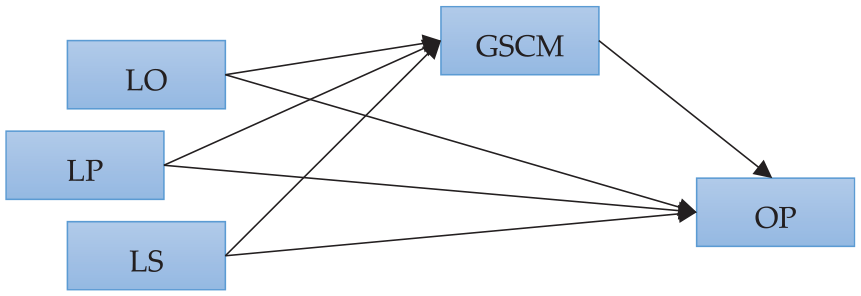
Research conceptual model.
Effective Leadership and GSCM Practices
Leadership is the process or procedure that allows an employee and a group of employees to achieve a common goal, such as green activities (Northouse, 2013). The vital role of leadership in GSCM was established by Bessant et al. (2003), who found that effective leadership improves the practices of GSCM, and even if the leaders do not contribute to detailed discussions, their presence has an encouraging and positive effort on members, in the context of cooperation between companies and suppliers within GSCM. Therefore, the leader’s role weighs more positively if they can participate with other members of the GSCM. The leadership role may also change over time at the stage of continuous learning in the supply chain, and members may need to share the leadership role, for instance, as being responsible for their course and position. Gosling et al. (2016) built a research model and examined leadership theory on organizational leadership within SCM frameworks in sustainable practice learning.
Meanwhile, leadership is considered dependable when engaging in self-awareness, personal transparency, handling balanced information, and exhibiting an internal ethical perspective (Gardner et al., 2005; Walumbwa et al., 2008). However, leaders’ confidence also helps them to be honest in relationships and to achieve transparency, and they are unlikely to search for self-supporting information. Hence, the information is handled in a synchronized and balanced manner (Paliszkiewicz et al., 2015). In the context of GSCM practices, the support of company leadership is usually treated as a crucial driver for GSCM (Min & Galle, 2001). Sharif and Irani (2012) investigated how leadership (LO, LP, LS) possibly supports the organization to achieve environmental performance in the GSCM successfully. They also stated that effective leadership is about emerging objectives and environmental performance policies to offer resources, training, and stimulate development. As a result, their research confirmed that leadership is the primary driver of GSCM practice. Dubey et al. (2014) examined the link between leadership, operational practices, institutional pressures, and the company’s environmental performance as a basis for GSCM. The results showed positive correlations between these variables; mainly, a significant positive relationship between leadership and GSCM was established. Based on the studies mentioned above, the following hypotheses are provided:
GSCM Practices and Organizational Performance
As indicated by Seman et al. (2012), over the past decade, most research has been conducted to analyze the impact of motivations toward the implementation of GSCM practices as industries practice GSCM or begin implementation, shifting the research focus to the impact of GSCM practices on organization performance. In the same context, Liang and Chang (2008) examined the potential effects of GSCM on small- and medium-sized enterprises’ (SMEs) organizational performance. To analyze the empirical data, the researchers used structural equation modeling (SEM) and found that SMEs’ performance is positively related to GSCM practices implementation. Kenneth et al. (2012) conducted research to examine the impact of GSCM practices on performance. The empirical data were collected from 159 manufacturing managers using SEM. However, the managers who provided the data mirrored the degree to which their organizations work with suppliers and customers to improve the supply chain’s environmental sustainability. As a result, the research found that the organizations that adopted GSCM improved environmental and economic performances, which, in turn, positively influenced operational performance. To examine how operational performance enhances organizational performance, Diab et al. (2015) examined GSCM practices’ influence on Jordan’s food industries’ organizational performance. They also used a survey instrument to collect empirical data from six companies specialized in the food sector and companies that applied the concept of green manufacturing. The results of the research showed the effect of GSCM practices on organizational performance. Chu et al. (2017) explored top management roles and social capital regarding the influence of institutional pressures on GSCM and firm performance. The results found a significant positive relation between GSCM and firm performance. Khan and Qianli (2017) studied the effect of GSCM practices on organizational performance in Pakistan. The outcomes presented that, except for the green purchase, the independent variables were correlated with organizational performance. However, green practices’ ecological design as green information systems has revealed a strong effect on the organization’s performance. Based on the discussions provided above, the following hypothesis was developed:
Effective Leadership and Organizational Performance
The leadership correlation with organizational performance has been the focus of various empirical studies. In particular, researchers tried to find a connection between these two concepts (Knies et al., 2016). Through their followers, effective leaders influence organizational performance (Ng’ethe et al., 2012). As mentioned by Kumar (2014), leaders exercise restraint or lead over adopted standards. However, leaders who are assumed to be authentic tend to show improved job satisfaction, organizational commitment, and high organizational performance. In contrast, self-consciousness on the part of leaders may require a course of understanding personality, inspiration, emotional reactions, behaviors, and how they can affect others. Effective leaders are conscious of their weaknesses and strengths (Walumbwa et al., 2008).
Fayhan and Jallab (2006) examined leadership and organizational performance. As a result, the research found that leadership has a significant and positive influence on customer service and effective organizational performance. In the same context, Kuria et al. (2016) researched Kenya’s health sector to analyze the leadership effect on organizational performance. The results found that effective leadership enhanced organizational commitment, employee satisfaction with their jobs, and improved individual productivity, leading to organizational performance. Weak leadership was also recognized as a vital factor in preserving strikes and the lack of health workers’ commitment. Asamoah (2017) observed the influence of effective leadership on organizational performance. The results showed that the recent success story related to the National Investment Bank’s financial performance is due to the new management team’s leadership.
Kumari (2018) attempted to test the leadership effect on organizational performance. Their results showed that leadership has a significant relational effect on organizational performance. Furthermore, the researcher mentioned that leadership should be wisely and effectively used to guide and encourage employees. Based on the above empirical findings, the third hypothesis is formulated:
Mediating Role of GSCM
GSCM is a vital part of the organization’s leadership and strategy, particularly for companies that want to reach their environmental and social performance goals, two critical components of organizational performance, as well as to meet customer demand and fit government legal requirements (Jain & Sharma, 2014). Based on a collaborative approach, organization leaders can develop GSCM practices initiatives, which require buyers to participate directly in improving suppliers’ environmental performance. Mainly focusing on long-term goals, such as leading people to build the abilities and potential of suppliers, GSCM practices may mediate the role between leadership and organizational performance, principally environmental performance (Vachon & Klassen, 2006a). This approach of collaboration between leadership and their partners within GSCM practices comprises a wide range of activities that provide educational programs, training, and sessions to communicate with information and experience in addition to technical and financial support to implement many different green management policies and obtain relevant environmental certificates (Vachon & Klassen, 2006a; Wu et al., 2012; Zhu & Sarkis, 2004). Singha et al. (2020) built a green innovation model, environmental performance, leadership, and green HRM. Chuang and Huang (2018) examined the effect of ECSR on performance and business competitiveness: the mediating role of green information technology capital. Zhu and Sarkis (2004) examined the company’s operating performance among the initial adopters of GSCM practices in industrial companies; the researchers pointed out that China, as a developed country, must stabilize economic and environmental performance. Hence, practices of GSCM appear to be a fundamental way for Chinese companies to improve performance, perhaps in these two dimensions. The research found a causal relationship between GSCM practices and performance. In the same regard, the researchers mentioned that cooperation between green transportation as a component of the GSCM system and cold storage plays a significant role in GSCM, removing the manufacturing process’s negative environmental impact. The use of environmentally friendly transportation allows manufacturing companies to achieve environmental performance and economic performance (Rao & Holt, 2005). Based on the studies mentioned above, the following hypotheses are developed:
Research Method
The research problem addressed examines the perceptions of Cihan Group managers regarding the impact of effective leadership in improving organizational performance using a data set from Iraq. The reviewed studies on leadership, GSCM, and organizational performance employed the quantitative research method and survey questionnaires as the primary data collection tool (Saunders et al., 2012). That research approach and design also allowed researchers to collect empirical data for research variables, namely, independent, dependent, and the mediation variable (which in this case is the mediating role of GSCM practices). The research design helped explain perceptions through empirical data collected from particular samples of the research population (Bryman & Bell, 2015).
Survey Instrument
Regarding the assessment of the projected hypotheses, we defined all five research constructs and measurement of their indicators. Thus, the researchers reviewed the leadership, GSCM, and organizational performance literature, which provided the definitions of the constructs and the list of measurement indicators, all verified by previous studies. These were then adapted to the context of the operating field. The instrument first included research variables; for leadership constructs, 15 indicators were used, adapted from Koohang et al. (2017), who in their research defined effective leadership through three different constructs, namely, LO, LP, and LS. The LO construct includes the indicators that an effective leader preserves to pledge the company development. These indicators are leading change, leading innovation, effect, and diversity/presence. However, the second construct, the LP, comprises the indicators that a leader establishes to expand working or employee productivity. LP include motivating staff, listening to staff, employee empowerment, effective interpersonal communication within the company, building relations, and resolving conflict. Furthermore, the construct of LS contains the indicators that develop a leader’s awareness, self-improvement, and self-development to make sound decisions. The GSCM construct was measured by collective environmental manufacturing in the supply chain, green purchasing (GP), green manufacturing (GM), green distribution and packaging (GDP), internal environmental management (IEM), green marketing (GM), environmental education (EE), and investment recovery (IR), which was adapted from Çankaya & Sezen (2019) and Zhang et al. (2020). Finally, for measuring the OP construct’s organizational performance, 18 indicators were used, adapted from Chuang and Huang (2018; see Table 1). Second, the survey instrument contained Cihan Group managers’ profiles such as gender, age, level of education, current administrative position, and overall experience. The survey used the following measuring scale: 7 = completely agree, 6 = mostly agree, 5 = somewhat agree, 4 = neither agree nor disagree, 3 = somewhat disagree, 2 = mostly disagree, and 1 = completely disagree.
Definitions of the Main Constructs.

Manager’s Profile
The data collection was launched by sending out an invitation letter to 518 prospective respondents working within Cihan Group companies via email. The questionnaires were administered electronically through a professional internet survey to all management levels, particularly general manager, CEO, company manager, and administrative staff in Cihan Group companies in most regions of Iraq. However, at the end of the data collection, 281 completed surveys were submitted. Seven of the 281 surveys were removed due to missing data, thus, yielding a final sample of 274 responses; hence, the response rate was 52.89%. The managers or participants at Cihan Group who willingly participated in the survey were male (56.6%, n = 155) and female (43.4%, n = 119). Regarding participants’ age group, 40.9% (n = 112) were in the age group of 41 to 50 years, which is the peak amount. While 23.7 percent (n = 65) of the overall sample were in the category of 51 to 60 years, 21.5% (n = 59) were 31 to 40. In addition, 8.6% (10.6%, n = 29) of the survey sample were 21 to 30 years. Finally, 3.3% (n = 10) were in the last group (61 years and above). The Cihan Group managers’ highest degree obtained was PhD (34.3%, n = 94), followed by master’s degree holders (33.9%, n = 93) and bachelor’s degrees (20.8%, n = 57); however, diplomas came in at last place (10.9%, n = 30) of the overall sample. However, the current administrative position of most of the sample attained 64.6% (n = 177) of the overall sample in job functions at lower level management or administrative staff. Company manager portion was 27% (n = 74), while 6.6% (n = 18) held the company CEO position. Finally, general managers formed the top-level management position at 1.8%, n = 5. Regarding participants’ overall experience, the results showed that 27% (n = 74) of the total survey sample had experience of between 16 and 20 years, 24.8% (n = 68) had an overall experience of 21 years and more, and 15.7 percent (n = 48) had experience of 6 to 10 years. While 17.5% (n = 43) of the total respondents had a job experience of 11 to 15 years, 17% (n = 41) had experience of less than 5 years (see Table 2).
Respondent’s Profile.

Data Analysis
To analyze the empirical research data and to test the hypotheses, partial least squares–structural equation modeling (PLS-SEM) was employed. One of PLS-SEM’s critical features is evaluating a model based on many constructs/latent variables and their indicators, but with a small survey sample size (Chin et al., 2008). However, the PLS path is a typical investigative method for determining path models, particularly with latent variables and their relationships (Hair et al., 2012; Henseler and Sarstedt 2013). As indicated by Sarstedt et al. (2017), PLS has three important exams before hypotheses testing. So, these are convergent validity, discriminant validity, and examining the structural model. To establish reliability and validity, each indicator of the latent variables’ external loadings must be >.5; reliability refers to a latent variable, or set of variables, depending on what it is planned to measure. However, for convergent validity, the values of the average variance extracted (AVE) should be higher than >.50 (Hair et al., 2012). Also, composite reliability (CR) values for each of the latent variables should be >.80. According to Henseler and Sarstedt (2013), CR is the same as any measure test of reliability, and values from .6 to .7 are a good indicator of each latent variables’ reliability. For establishing the constructs’ internal reliability, the Cronbach’s α should be equal to .7 or higher (Ringle et al., 2012). Regarding the differentiation validity, AVE’s square roots’ value should be higher than the correlation among latent variables (Hair et al., 2012; Ringle et al., 2012; see Table 3).
Reliability Indexes and Criteria.

Note. AVE = average variance extracted; CR = composite reliability; α = Cronbach’s alpha; ILV = Indicator Loading Value.
Results
Establishing Validity and Reliability
Table 3 shows the results of the AVE, CR, and Cronbach’s α for establishing the convergent validity of the research model. The AVE values for all latent variables or model constructs are higher than .05. These values are (.658, .665, .618, .802, and .767), respectively, for LO, LP, LS, GSCM, and OP, as the AVE values for all constructs are greater than .80, which is acceptable. The CR values for all model constructs (.885, .886, .891, .951, and .937), respectively, have values greater than >.80. Because the CR value is greater than or equal to .80, it is acceptable. However, we tested the internal reliability of the model constructs through Cronbach’s α. The results of Cronbach’s α are shown in Table 4, and all are acceptable as they are higher than .70. These results show a high correlation among the model constructs’ indicators (see Table 4).
Construct Reliability and Validity.
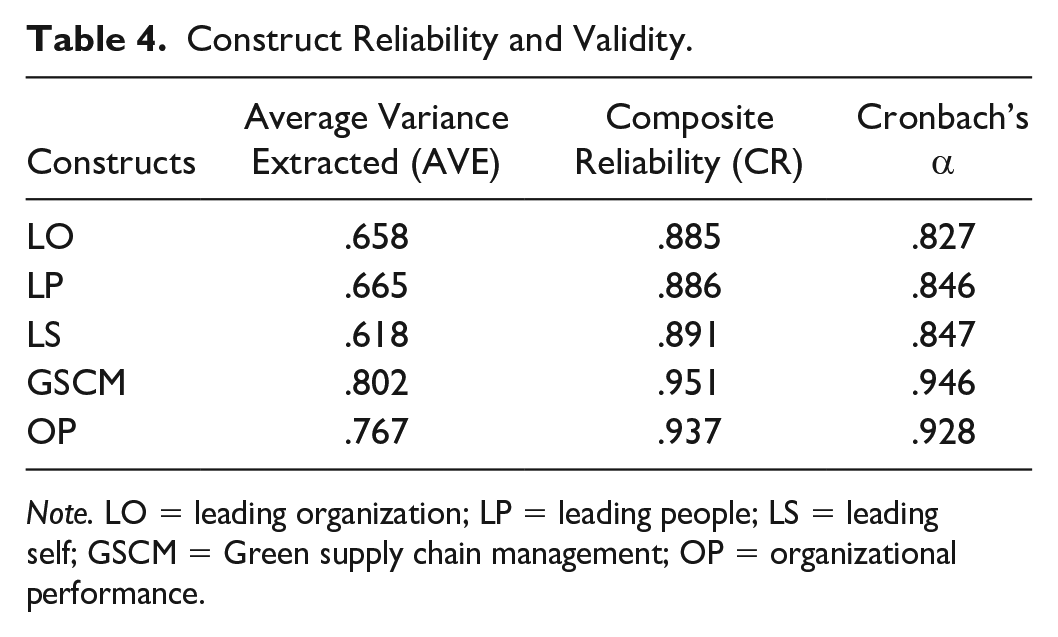
Note. LO = leading organization; LP = leading people; LS = leading self; GSCM = Green supply chain management; OP = organizational performance.
Furthermore, as Table 5 demonstrates, the convergence validity of all the model’s constructs is also determined by looking at loading value; according to Sarstedt et al. (2017), the constructs’ loading values for each indicator of the latent variable should be higher than >.70 (Fornell & Larcker, 1981). Three items were eliminated, as the values of these indicators were less than .70. Thus, after eliminating the mentioned indicators, the loading values ranged from .701 to .885, which were higher or equal to .70. Hence, these outcomes confirm the research model’s convergence validity, which means a high level of correlation between all construct indicators (see Table 5).
Measurement Model.

Discriminant Validity
For determining the discriminant validity of the model’s constructs based on the Fornell–Larker criterion, the researchers compared the values of the square root of AVE of each latent variable, which must be higher than its correlations with all other latent variables. AVE coefficients’ square roots should be confirmed in the correlation matrix and the diagonal (Hair et al., 2012). As revealed in Table 6, the discriminant validity established that AVE root square values are higher than correlations with any other constructs or latent variables of the model (see Table 6).
Discriminant Validity.

Note. LO = leading organization; LP = leading people; LS = leading self; GSCM = Green supply chain management; OP = organizational performance.
Establishing the Model Fit
As recommended by researchers (Henseler et al., 2009; McNeish, 2017; Tharenou et al., 2007), it is necessary to confirm the research model’s fitness before testing hypotheses, and model fit indices should be higher or at recommended standards. In this context, we checked all the values recommended for the estimated model fit. The value of standardized root-mean-square residual (SRMR) in the research measurement model was (.0720 < .08), which is within the recommended parameters. The value of χ2 or Chi square was (1.786 ≤ 3.0), less than three; thus, it is a good index and fit. The value of the normed fit index (NFI) is within the recommended parameters; as it is higher than .90 and closer to 1, it can be considered a good value. Furthermore, the variance inflation factor (VIF) for each construct indicator in the research model also ranged from 1.000 to 1.828; all were less than <5; therefore, the research model was considered a good fit (see Table 7).
Model Fit Test.

Note. SRMR = standardized root-mean-square residual; NFI = Normed Fit Index; VIF = variance inflation factor.
Hypotheses Testing
The results in Table 8 and Figure 2 show the PLS path analysis used to test the research hypotheses. The values of R2 for GSCM and organizational performance (OP) are .458 and .634, respectively; based on the result, the model’s R2 values have established a significant explanation of the empirical research data. Results showed that leading organizations positively and significantly impact GSCM, with a coefficient of impact up to (.176) and (p = .014), which is less than .05; hence, the correlation was significant. Results also showed a causal relationship between LP and GSCM, with a strong coefficient of impact up to (.422) and (p = .000), which is less than .05. Furthermore, LS positively and significantly correlated to GSCM, with a coefficient of impact up to .145, and (p = .023), which is less than .05; the correlation was significant. Results also confirmed that GSCM is significantly related to OP at a strong coefficient of impact .429 (p = .000), which means that GSCM practices verify the mediating role regarding the effect of leadership (LO, LP, LS) on OP.
Path Analysis Coefficient, t Value, and p Value for the SEM.

Note. SEM = structural equation modeling; LO = leading organization; GSCM = Green supply chain management; LP = leading people; LS = leading self; OP = organizational performance.
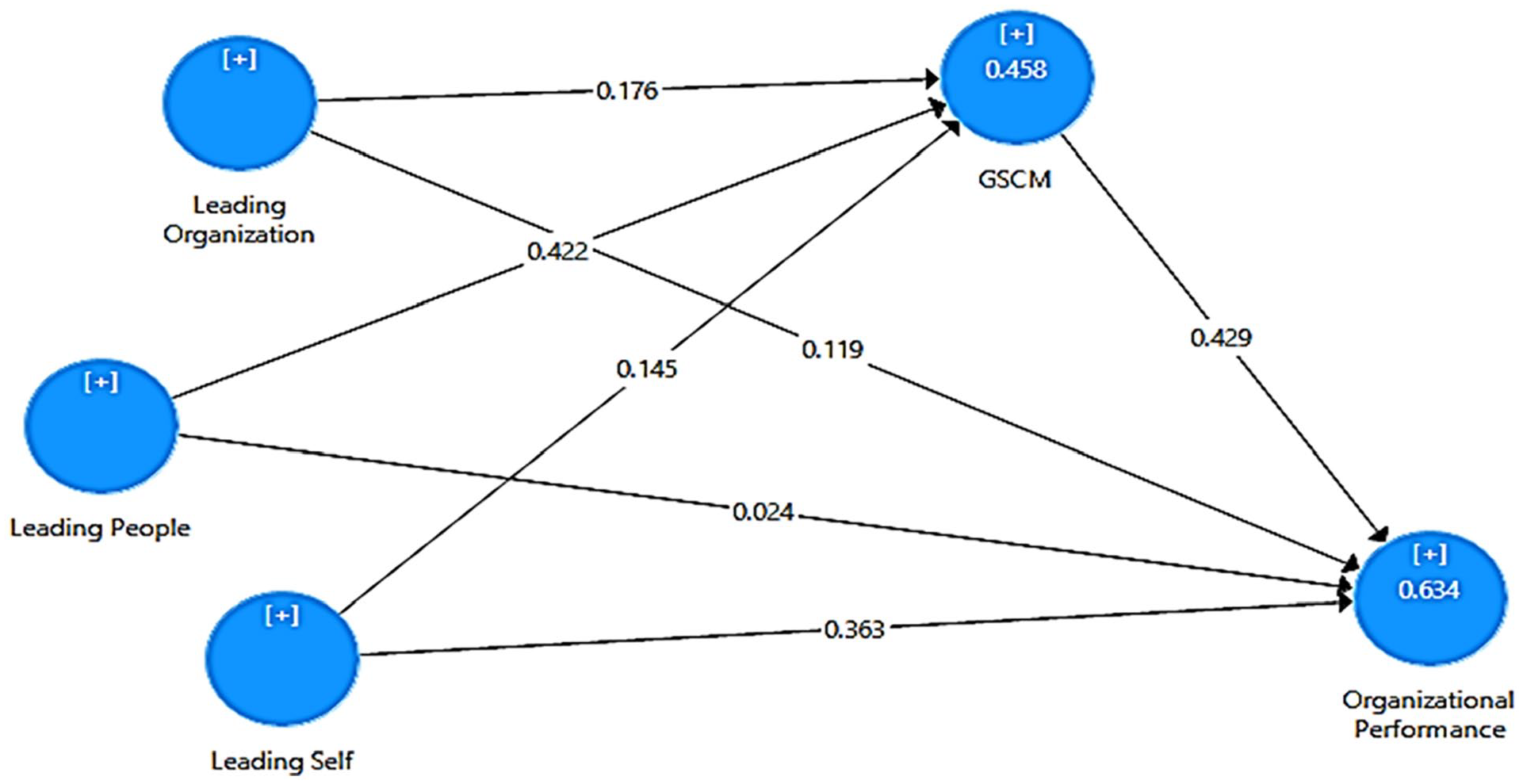
Results of structural equation modeling.
Results shown in Table 8 and Figure 2 confirm that leading organization influenced organizational performance, but with a lower coefficient of impact up to .119, and p = .055, which is higher than .05; hence, it was insignificant. Results also show that leading people positively related to organizational performance, but also with a lower coefficient of impact up to .024 and p = .745, which is higher than .05; hence, it was insignificant. In addition, leading self positively and significantly related to organizational performance, with a strong coefficient of impact up to .363, and p = .000, which is less than .05; hence, the relationship was significant. However, because the direct relationships between leadership (LO and LP) with organizational performance are insignificant, the indirect relationships are significantly positive; GSCM fully mediates the impact of leadership (leading organization and leading people) on organizational performance. While partially mediating the impact of leadership (LS) on organizational performance, the direct and indirect relationships between leading self and organizational performance were significant (see Table 8).
Regarding the mediating role of GSCM in the relationship between effective leadership (leading organization) and organizational performance of Cihan Group in Iraq, the indirect impact was measured in the existence of a mediator, and a coefficient of impact is .075, with the level of significance at p = .020. Results also confirmed the mediating impact of GSCM in the relationship between effective leadership (leading people) and organizational performance, the indirect impact was also measured in the presence of a mediator variable, and a coefficient of impact is .181 and p = .000, which is significant. Moreover, the variable of GSCM practices has a mediating role in the relationship between effective leadership (leading self) and organizational performance, so the indirect impact was measured in the presence of a mediator of GSCM, and a coefficient of impact up to .062, and p = .038. Therefore, it is clear from the path analysis results that the indirect impact of effective leadership (leading organization, leading people, leading self) on organizational performance OP was significant.
Accepting/Rejecting the Hypotheses
The path analysis coefficients, t values and p values for determining the research hypotheses’ acceptance or rejection, are shown in Table 8, so, based on these results, the research hypotheses are accepted or rejected. H1a regarding the relations between the leading organization and GSCM practices is accepted (β = .176, t = 2.267, p = .014), with a p value less than .05. H1b regarding the relations between leading people and GSCM practices was accepted (β =.422, t = 5.056, p = .000). H1c advanced the relationship between the leading self and GSCM practices, which was accepted (β =.145, t = 2.141, p = .023). H2 posited the links between GSCM and organizational performance and was accepted (β =.429, t = 7.802, p = .000). H3a advanced that leading organization is significantly linked to organizational performance, which is rejected (β =.119, t = 1.919, p = .055), as the p value is greater than .05. H3b advanced that leading people is significantly linked to organizational performance, which is rejected (β =.024, t = .325, p = .745), as the p value is greater than .05. H3c posited that leading self is significantly related to organizational performance and is accepted (β =.363, t = 6.084, p = .000). H4a posited that GSCM mediates the relationship between the leading organization and organizational performance, which is accepted (β = .075, t = 2.325, p = .020). H4b advanced that GSCM mediates the relationship between leading staff and organizational performance, and it was accepted (β = .181, t = 3.952, p = .000). H4c stated that GSCM mediates the relationship between leading self and organizational performance and is accepted (β = .062, t = 2.081, p = .038), because the p value is less than .05.
Discussions and Conclusion
This research model was tested to establish convergence validity and confirm the significance of all indicators belonging to all research variables and their constructs. Some indicators were removed as they did not yield significant loading. Thus, after the elimination of the mentioned indicators, all values were higher or equal to .70. The results, therefore, entirely confirmed the convergence validity of the research model, which means that there is a high level of correlation between all construct indicators. The empirical results of this research supported most of the hypotheses. Specifically, the results revealed that most participants agreed that leaders could positively lead to organizational change, and an organization’s invention is a leading organization. However, they can also positively improve employees’ performance by setting a vision, translating it into accurate business strategies, and expecting results. Then, they respect diversity and inclusion, bringing about innovation; this is in line with Koohang et al. (2017). In leading people, respondents agreed that leaders should encourage, attend, permit, and bring people’s efforts together. They should demonstrate good interpersonal communication skills to build and sustain relationships; this result is in line with Javidan and Carl’s (2005) findings, who said that through effective communications, the leader can influence employees to achieve the goal of the organization. They are conscious of their weaknesses and strengths. Besides, leaders ask for feedback and use the feedback for self-improvement.
Furthermore, effective leaders continuously pursue the prospect of learning. The research found that effective leadership (leading organization, leading people, and leading self) is positively and significantly related to GSCM practices; these results are in line with previous researchers (Bessant et al., 2003; Gosling et al., 2016), whose findings confirmed the effect of leadership in implementing GSCM practices. The findings show that GSCM practices are positively and significantly related to organizational performance, similar to other researchers’ findings (Kenneth et al., 2012; Khan & Qianli, 2017), who found the causal relationship between GSCM practices and organizational performance. In particular, Kenneth et al. (2012) found that the organizations that adopted GSCM experienced improved environmental and economic performances, which, in turn, positively influenced operational performance. The findings established that GSCM practices partially mediated the relationship between effective leadership (leading self) and organizational performance as the components of leading self, directly and indirectly, were linked with organizational performance. The findings also showed that GSCM practices fully mediated the relationship between effective leadership (leading organization, leading people) with organizational performance, as leadership (leading organization and leading people) was indirectly linked to organizational performance, although there were no direct relationships.
Theoretical Implications
This study lays the basis for effective leadership, GSCM, and organizational performance, although up to now, there has been a lack of published research in this area, which a large number of researchers mentioned. Few previous studies (Bu et al., 2020; Keszey, 2020) had examined the impact of GSCM on organizational performance; this study shows that GSCM plays a mediating role regarding the impact of effective leadership in organizational performance. In this regard, Aslam et al. (2019) emphasized that future studies should test a more wide-ranging model of the significances of GSCM in developing countries through containing organizational performance to provide a complete validation for resource-based logic with a sustainable perspective regarding GSCM. We, therefore, included GSCM practices to afford a better basis for their influence on organizational performance. As recommended by Ahmed et al. (2018), this research empirically examined mediating role of GSCM to increase perceptive outcomes that contribute more widely to GSCM literature and provide in-depth information to leadership, and their GSCM practices and performance. Singha et al. (2020) recently investigated leadership and green HRM’s role in green innovation environmental performance and recommended future studies to test more GSCM practices. Therefore, this research contributes to the literature by indicating that effective leadership (leading organization, people, and leading self) indirectly improves organizational performance through the mediating role of GSCM. Meanwhile, GSCM practices improve social and environmental performances; thus, the organization’s economic performance will be improved.
Practical Implications
This study has implications for leaders and managers in the manufacturing setting and, in particular, for the Cihan Group in Iraq. This research showed that effective leadership practices are significant, as having good leadership reduces employee stress and tension. Besides, leaders who listen to their employees and understand their complaints and circumstances efficiently overcome problems and keep employees indefinitely. Thus, effectively leading workforces and organizations is an essential skill that inspires employees to achieve their best results. Most of survey participants agreed on the significance of carefully implementing the practices of GSCM. Manufacturing companies that improve environmental performance reduce their costs by avoiding losses and waste, increasing compliance with environmental regulations, and reducing civil and criminal legal risks by preventing pollution. Hence, the implementation of GSCM integrates environmental awareness with the entire process of SCM. Managers can become aware that the environmental impact of total material usage at its lowest possible level is an effective way to achieve sustainable development. In this context, Shuwang et al. (2005) mentioned that the practices of GSCM highlight the supply chain’s environmental characteristics. This reduces all negative environmental impacts by dropping resource utilizations as well as energy production and the supply chain system’s leading role. The results reveal that leadership through the mediating role of GSCM improves organizational performance. An essential recommendation for practice is that leadership development and training regarding the GSCM should be a top strategic priority for all Cihan Group companies to effectively implement GSCM practices, which have a significant relationship with organizational performance. Effective leadership is required at all organizational levels.
However, this research also has broader managerial implications. As established in the literature, researchers (Bryman, 2007; Paliszkiewicz et al., 2015; Peterson et al., 2009) agreed that leadership is one essential element that determines an organization’s success. In this regard, Kuria et al. (2016) mentioned that leadership comprises building a relationship between the leader and the follower to achieve the desired results. However, leaders in the manufacturing industries can effectively improve their organizational performance by implementing GSCM practices in various ways (Gosling et al., 2016), particularly via their communications. The leader influences employees to work to achieve the goals of the organization. Leadership is also the ability to influence and motivate people within organizations (Dorfman & House, 2004; Javidan & Carl, 2005). Besides, organizations and managers within the GSCM practices must choose the right direction and recognize effective policies, planning practices, and approaches to achieve profitable and low-cost GSCM (Jain & Sharma, 2014). GSCM is an active, eco-friendly approach for companies to obtain a competitive advantage and improve performance (Bu et al., 2020; Chan, 2010). Leaders should be aware that the implementation of the GSCM practices is not a simple matter; as an outcome of GSCM practices, some costs rise (such as costs of investment, green operating costs, as well as costs of staff training and purchase cost); nonetheless, other items, or materials costs may decline (Geyer & Jackson, 2004). Therefore, both leaders and managers need to analyze costs and benefits properly. However, companies that implement GSCM practices benefit from saving costs (materials preservation, energy, and water usage are reduced), higher CSR, public image, and reduced environmental liability (Melnyk et al., 2003; Sarkis, 2001). Whereas, unfortunate environmental practices can pose significant environmental risks and consequences in commercial losses for companies, as well as lower stock prices (Wisner et al., 2012).
Limitations and Suggestions for Further Research
First, the common method bias (CMB) and endogeneity may affect our statistical investigation. Thus, we have tried to reduce CMB and endogeneity issues by following the best possible methods as they are pressing issues related to survey-based data. These methods are recommended by Guide and Ketokivi (2015) and Dubey et al. (2019). Hence, in the future, hypotheses should be tested using longitudinal data. The empirical data were collected from managers at the Cihan Group in Iraq. Future research using multiple methods, including empirical data from employees, may provide better solutions to reduce CMB. Accordingly, if future research increases the survey samples and collects data from different Iraqi manufacturers or broader regions, the findings may be valid to a broader context and provide generalizability.
Second, we grounded our theoretical framework in contingency theory, situational theory, and the upper echelon theory as these theories are related to leadership. These theories engage in leadership research. We also used organizational theory and GSCM, such as institutional theory, stakeholder theory, complexity theory, RBVT, resource dependence theory (RDT), SNT, and information theory. Organizational theories have suggested applications and have been investigated in emerging GSCM literature. The focus in some of these GSCM studies used an organizational theory lens to support their findings. The literature provided has been thoroughly tested and expanded in previous organizational theories or used for descriptive purposes (Sarkis et al., 2011). However, interesting insights into management procedures and their approach to suppliers can be derived using appreciative survey methods (AIM) called sub-ethnographic studies (Dubey et al., 2019). Finally, the mediation role of GSCM practices, which was found in the relationship of leadership with organizational performance, is indirectly linked to organizational performance, as emphasized by Ahmed et al., 2018; Aslam et al., 2019; Keszey, 2020; Singha et al., 2020. We recommend that future studies test more GSCM practices, as a mediator. Furthermore, in-depth studies should focus on a different and larger population sample, too.
Footnotes
Declaration of Conflicting Interests
The author(s) declared no potential conflicts of interest with respect to the research, authorship, and/or publication of this article.
Funding
The author(s) received no financial support for the research and/or authorship of this article.
