




Abstract
Loneliness is a common issue among university students, particularly in demanding academic environments such as nursing education. Although previous studies have examined the impact of loneliness on student well-being, limited research has explored the underlying psychological mechanisms that buffer this relationship. To address this gap, this study investigated the mediating role of positive psychological capital (PsyCap) in the relationship between loneliness and college adjustment among nursing students in South Korea. A cross-sectional survey was conducted with 188 undergraduate nursing students from two universities. Data were analyzed using Pearson’s correlation, multiple regression, and Hayes’ PROCESS macro (Model 4) with 10,000 bootstrapped samples. Results indicated that loneliness was significantly and negatively associated with both PsyCap and college adjustment. Mediation analysis confirmed that PsyCap partially mediated the relationship between loneliness and college adjustment (indirect effect β = −.35, 95% CI [−.52, −.21]). This study highlights the importance of fostering internal psychological strengths alongside social support systems in nursing education. Enhancing PsyCap through interventions such as resilience training or peer mentoring may help mitigate these effects. Future research should employ longitudinal or experimental designs to better establish causal relationships.
Plain Language Summary
Many college students feel lonely, and this can make it harder for them to adjust to university life. This study looked at nursing students and found that those who felt lonelier had more difficulty adjusting. However, students who had more positive psychological strengths—like confidence, hope, and resilience—were better at handling stress and adapting to college. These inner strengths are called “positive psychological capital.” The study found that loneliness not only directly made adjustment harder, but also lowered these inner strengths, making things worse. Helping students build their inner strengths through activities like peer mentoring or resilience training could help reduce the negative effects of loneliness.
Introduction
Loneliness has emerged as a significant global public health concern, particularly affecting young adults as they navigate the transition to adulthood. Despite unprecedented levels of digital connectivity, many individuals report experiencing deep emotional isolation. Recent data from the American College Health Association (2023) show that approximately 58% of college students in the United States reported feeling “overwhelming loneliness” within the past year. Similar trends have been observed globally, with studies across Europe and Asia reporting that between 17.5% and 60% of university students experience moderate to severe levels of loneliness (Diehl et al., 2018; Lee et al., 2023). Loneliness is not only associated with depression and anxiety but also represents a significant risk factor for suicidal ideation and self-harm among young people (Loades et al., 2020; Stickley & Koyanagi, 2016). These findings highlight the urgent need for empirical research into the psychological consequences of loneliness within higher education settings.
The effect of loneliness is not uniformly distributed across student populations. Nursing students, in particular, represent a disproportionately vulnerable group. The combination of an intensive academic workload, emotionally challenging clinical experiences, and consistently high-performance expectations often restricts opportunities for meaningful social engagement and support, thereby increasing their susceptibility to emotional isolation (Labrague, 2021; Reeve et al., 2013). Gen Z nursing students are often described as digitally fluent, driven by a desire for quick social approval, and more vulnerable to loneliness and emotional isolation, as noted in previous studies (American College Health Association, 2019; Chicca & Shellenbarger, 2018). These generational attributes may intensify sensitivity to social comparison and perceived exclusion, thereby exacerbating the risk of loneliness and its negative effects on academic and clinical performance.
Within this context, it is particularly important to examine how loneliness influences students’ adjustment to university life. College adjustment, understood as the ability to successfully navigate academic, social, and emotional challenges, represents a crucial developmental milestone. Positive college adjustment is associated with academic achievements, psychological resilience, and smoother transitions into professional roles (Baker & Siryk, 1984; Silva et al., 2021). Conversely, loneliness is shown to hinder this adjustment process by undermining motivation, lowering self-efficacy, and reducing social engagement (Bernardon et al., 2011; Bozoglan et al., 2013). Within nursing education, impaired adjustment can compromise not only academic outcomes but also the development of relational and emotional competencies essential for delivering patient-centered care.
Given these risks, research has increasingly focused on identifying internal psychological resources that may buffer the adverse effects of loneliness. One promising construct is positive psychological capital (PsyCap), which comprises hope, self-efficacy, resilience, and optimism (Luthans et al., 2006). PsyCap has been associated with greater academic engagement, more effective stress coping, and sustained motivation despite adversity (Avey et al., 2011). In nursing education, PsyCap may serve as a mediating mechanism that enables students to reinterpret loneliness more constructively, maintaining adaptive academic and emotional functioning. Despite this potential, the mediating role of PsyCap in the relationship between loneliness and college adjustment has received limited empirical attention.
Literature Review and Hypotheses
Loneliness and College Adjustment
Loneliness is increasingly recognized as a multidimensional psychological experience grounded in subjective perceptions rather than objective isolation. According to the Cognitive Discrepancy Theory (Perlman & Peplau, 1981), loneliness occurs when there is a mismatch between the desired and actual levels of social connectedness. This perceived gap often triggers emotional distress, feelings of emptiness, and reduced self-worth. Importantly, loneliness is not merely the absence of social contact but rather a perception of inadequate or unsatisfactory relationships, meaning that individuals can experience loneliness even when surrounded by others. Within the university context, loneliness has become an especially salient concern. The transition to higher education disrupts existing social networks—such as family, long-term friendships, and community ties—while simultaneously demanding adaptation to new academic and social environments. From an ecological systems perspective (Bronfenbrenner, 1979), these simultaneous changes in students’ microsystems and mesosystems increase their vulnerability to emotional isolation. This state can interfere with multiple dimensions of college adjustment, defined as a student’s ability to meet the academic, emotional, and social demands of university life (Baker & Siryk, 1984). Successful adjustment encompasses subdomains such as academic achievement, institutional commitment, emotional stability, and social integration—all essential predictors of student persistence and mental health (Friedlander et al., 2007; Katz & Somers, 2017).
Empirical evidence consistently supports the negative association between loneliness and adjustment among college students. For instance, Bernardon et al. (2011) found that students with higher levels of loneliness perceived less social support and reported more difficulty in regulating their emotions. Similarly, Bozoglan et al. (2013) observed that loneliness was strongly associated with lower self-esteem and life satisfaction, both of which are critical for sustaining academic engagement. Furthermore, Gerdes and Mallinckrodt (1994) demonstrated that emotional and social disconnection predicted lower academic persistence, highlighting that loneliness is not only an emotional experience but also a risk factor for dropout and underachievement. Cognitive and motivational processes are also affected. Research suggests that loneliness can impair concentration, attention, and motivation—skills necessary for academic success (Diehl et al., 2018; Russell, 1996). Rokach (2004, 2012) further emphasized that loneliness in university settings can stem from the loss of belonging and perceived disconnection from peers, which in turn reduces self-efficacy and academic satisfaction. Students struggling with loneliness may engage less in campus activities, exhibit greater psychological distress, and experience difficulties in establishing new support systems (Labrague et al., 2018; Reeve et al., 2013).
Importantly, nursing students may be particularly susceptible to loneliness due to the demanding nature of their curriculum, high expectations for empathy and relational competence, and exposure to clinical stressors early in training (Pitt et al., 2012; Reeve et al., 2013). Unlike students in other majors, they are required to participate in emotionally intensive care environments, often under hierarchical supervision, which may amplify feelings of isolation. Despite this vulnerability, limited research has explored how loneliness affects their academic adjustment or how internal psychological resources may buffer this risk. This study seeks to address this gap by focusing on a theoretically grounded and context-specific model of how loneliness influences the college adjustment of nursing students. Based on the theoretical and empirical literature, the following hypothesis is proposed:
The Mediating Role of Positive Psychological Capital
While loneliness can directly undermine college adjustment, it may also have an indirect effect by depleting students’ internal psychological resources. One of the most salient of these is Positive Psychological Capital (PsyCap), a state-like, developable psychological capacity comprising four components: self-efficacy, optimism, hope, and resilience (Luthans, Youssef, & Avolio, 2006; Luthans, Youssef-Morgan, & Avolio, 2015). Unlike stable personality traits, PsyCap is malleable and can be strengthened through structured interventions, experiential learning, and supportive environments (Avey et al., 2011). Each element contributes uniquely to academic persistence and emotional well-being—self-efficacy enhances the confidence to approach academic demands; hope facilitates planning and sustained pursuit of goals; resilience enables students to bounce back from setbacks; and optimism supports positive reinterpretation of stressors and future expectations. Together, these dimensions form a synergistic psychological asset that promotes adaptive functioning across academic and social contexts.
The Conservation of Resources (COR) Theory (Hobfoll, 1989) provides a compelling framework through which to view PsyCap as a mediating buffer. According to COR theory, individuals are motivated to acquire, maintain, and protect valued resources, including psychological strengths. When students face chronic stressors such as loneliness, these resources are vulnerable to erosion. In this context, emotional isolation may disrupt the self-sustaining mechanisms of psychological growth, diminishing beliefs in personal efficacy, depleting emotional energy, and weakening positive expectations about the future. Such loss of internal resources not only intensifies psychological vulnerability but also reduces one’s capacity to respond adaptively to academic and social demands (Labrague, 2021). In parallel, Social Cognitive Theory (Bandura, 1997) emphasizes the role of social interaction, modeling, and reinforcement in the development of core psychological constructs, including self-efficacy and emotional regulation. Students who experience loneliness may lack access to affirming social feedback and peer modeling opportunities, both of which are crucial for internalizing adaptive coping strategies and maintaining positive beliefs about one’s academic potential. Without these inputs, students may struggle to develop or sustain the psychological capacities necessary for effective adjustment.
Empirical evidence supports PsyCap’s buffering effect in higher education. Luthans et al. (2015) demonstrated that PsyCap is a robust predictor of academic performance and psychological well-being, even after accounting for cognitive ability. Within health-professions education, where students often encounter emotionally demanding environments and high-performance expectations, PsyCap has been associated with reduced academic burnout, increased coping efficacy, and enhanced engagement (Woo & Park, 2017; Pitt et al., 2012). Furthermore, Vanno et al. (2014) highlighted the role of PsyCap in promoting collective learning and resilience in team-based academic settings. Although PsyCap has been shown to support students’ well-being and performance in general, few studies have explicitly examined its mediating role in the link between loneliness and college adjustment, particularly among nursing students. Given their unique academic stressors and interpersonal demands, understanding this mechanism may offer valuable insights for designing targeted interventions.
Importantly, the mediating role of PsyCap becomes particularly salient in transitional periods, such as the adjustment to college life. During such times, internal psychological assets serve as critical enablers of resilience, guiding students toward productive engagement with new environments and expectations (Friedlander et al., 2007; Reeve et al., 2013). When loneliness is experienced without compensatory psychological resources, its impact on adjustment is likely to be more pronounced and enduring. Together, these theoretical and empirical findings suggest that loneliness can erode students’ positive psychological capital, which in turn compromises their ability to adjust successfully to university life. PsyCap functions as a critical internal buffer against the negative effects of emotional and social stressors. Based on this reasoning, the following hypothesis is proposed:
Methods
Participants and Data Collection Procedures
This descriptive cross-sectional study was conducted among undergraduate nursing students enrolled in two accredited nursing programs located in Gwangju, South Korea. Eligible participants were full-time students actively taking coursework during the spring semester of 2025. Students who were on academic leave, participating in exchange programs, or who had completed all clinical practicum hours were excluded from the study.
To ensure adequate statistical power, an a priori power analysis was performed using G*Power 3.1.9. The analysis indicated that a minimum of 172 participants would be required to detect a medium effect size (f2 = .15) with an alpha level of .05 and a statistical power of .95, assuming 10 predictor variables. To accommodate possible non-response and incomplete data, 200 questionnaires were distributed. After data screening, 188 valid responses were retained, yielding a 94% response rate, which was deemed acceptable for educational survey research.
Participants were recruited through convenience sampling, with surveys distributed in person by the researcher before or after scheduled lectures between April 1 and April 30, 2025. Faculty members were not present during survey administration to avoid potential coercion. Prior to data collection, students were informed of the study’s objectives, procedures, and ethical considerations through a written explanation and verbal briefing. Written informed consent was obtained from all participants.
This study received ethical approval from the Institutional Review Board of Chonnam National University (IRB No. 1040198-250122-HR-017-03) and adhered to the ethical principles outlined in the Declaration of Helsinki (2013 revision). No personally identifiable information was collected. All responses were anonymous and securely stored on a password-protected university server. As a token of appreciation, all students who received the survey were offered a gift card (approximately USD 3.50), regardless of participation status.
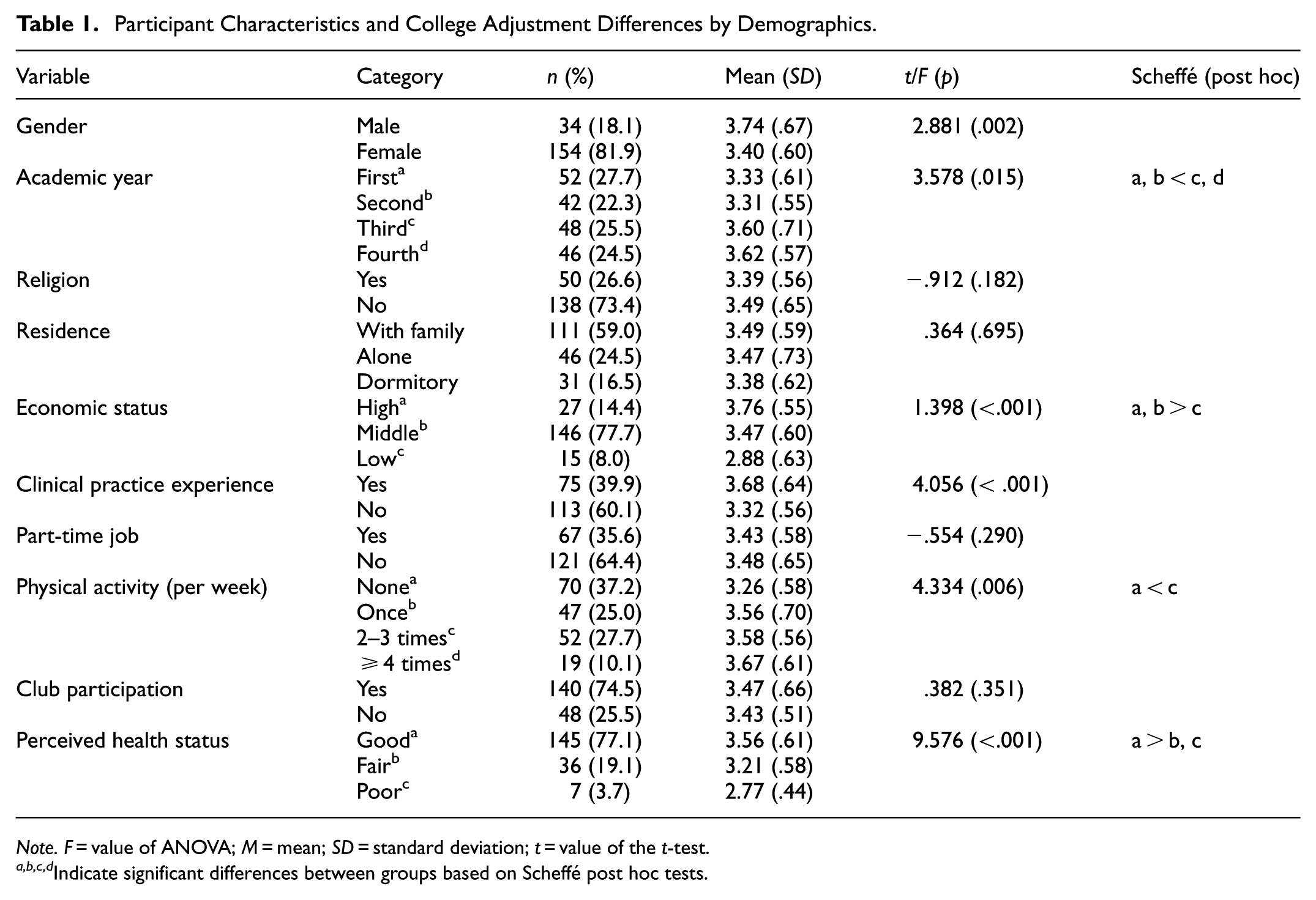
Demographic characteristics of the sample are summarized in Table 1. The majority of respondents were female (81.9%), and students were relatively evenly distributed across all four academic years. Most students reported having no religious affiliation (73.4%), lived with their families (59.0%), and perceived their health status as good (77.1%). A substantial portion reported no clinical practice experience (60.1%), and 74.5% reported participating in club activities. Economic status, physical activity level, and part-time job experience varied across the sample, providing a diverse representation of nursing student experiences.
Participant Characteristics and College Adjustment Differences by Demographics.
Note. F = value of ANOVA; M = mean; SD = standard deviation; t = value of the t-test.
Indicate significant differences between groups based on Scheffé post hoc tests.
Instrumentation
Loneliness was assessed using the Korean version of the UCLA Loneliness Scale Version 3 (Russell, 1996), which was validated for Korean populations by Jin and Hwang (2019). This 20-item instrument evaluates individuals’ subjective experiences of social isolation on a 4-point Likert scale (1 = never to 4 = always), with higher scores indicating greater perceived loneliness. In the present study, Cronbach’s α was .93.
PsyCap was measured using the Korean version of the Psychological Capital Questionnaire (PCQ) developed by Luthans et al. (2006) and validated for Korean college students by Kim (2013). The instrument consists of 24 items assessing 4 dimensions: hope, self-efficacy, resilience, and optimism. Each item is rated on a 5-point Likert scale (1 = strongly disagree to 5 = strongly agree), with higher scores reflecting greater levels of PsyCap. Cronbach’s α in this study was .92.
College adjustment was assessed using the Korean version of the College Adjustment Scale developed by Jeong and Park (2009). This 19-item measure captures students’ adaptation to academic, emotional, and social demands, with items rated on a 5-point Likert scale (1 = strongly disagree to 5 = strongly agree). Higher scores represent greater levels of adjustment. Cronbach’s α in this study was .92.
Data Analysis
Data were analyzed using IBM SPSS Statistics version 29.0 (IBM Corp, 2022). Descriptive statistics—including frequencies, percentages, means, and standard deviations—were used to summarize participants’ general characteristics and the levels of loneliness, positive psychological capital (PsyCap), and college adjustment.
Group differences in the main variables across demographic characteristics were examined using independent t-tests and one-way ANOVA. When appropriate, Scheffé’s post-hoc test was employed to identify significant between-group differences. Pearson’s correlation coefficients were calculated to explore the associations among loneliness, PsyCap, and college adjustment.
To test the hypothesized mediation model, multiple regression analyses were conducted using Hayes’ (2018) PROCESS macro for SPSS (Model 4). A bootstrapping technique with 10,000 resamples was applied to estimate bias-corrected 95% confidence intervals (CIs) for the indirect effects. Demographic variables were included as covariates to control for potential confounding influences.
Prior to the main analyses, the assumptions of normality and multicollinearity were assessed. Skewness (−.10 to 1.02) and kurtosis (−.05 to 1.38) values met the criteria for approximate normal distribution (see Table 2). No multicollinearity concerns were found, as VIF values ranged from 1.16 to 1.88 and tolerance values from .53 to .86.
Correlations and Descriptive Statistics of Key Variables.

p < .001.
Results
Differences in College Adjustment According to Demographic Variables
Significant differences in college adjustment were observed according to several demographic characteristics (see Table 1). Male students reported significantly higher levels of college adjustment compared to female students (t = 2.881, p = .002). College adjustment also differed significantly by academic year (F = 3.578, p = .015), with variation observed across the four cohorts. Students with higher perceived economic status reported better adjustment than those with lower economic status (F = 10.398, p < .001). In addition, students who had clinical practice experience showed significantly greater adjustment than those without such experience (t = 4.056, p < .001). Differences in adjustment were also found by exercise frequency (F = 4.334, p = .006), with more frequent exercise associated with higher adjustment. Finally, self-rated health status was significantly related to college adjustment, with those reporting good health showing better adjustment than those with fair or poor health (F = 9.576, p < .001).
Relationship Between Loneliness and College Adjustment
To test H1, a Pearson correlation analysis was conducted to examine the association between loneliness and college adjustment (see Table 2). The loneliness was significantly and negatively correlated with college adjustment (r = −.57, p < .001), indicating that students who reported higher levels of loneliness tended to show lower levels of adjustment to college life. This finding supports H1, confirming a significant inverse relationship between the two variables.
Mediating Effect of Psychological Capital Between Loneliness and College Adjustment
To test H2, a three-step mediation analysis was conducted to examine whether positive psychological capital (PsyCap) mediated the relationship between loneliness and college adjustment (see Table 3). In Step 1, loneliness was found to have a significant negative effect on PsyCap (β = −.52, p < .001), indicating that students with higher levels of loneliness reported lower levels of PsyCap. In Step 2, loneliness also had a significant negative effect on college adjustment (β = −.45, p < .001), supporting the direct impact of loneliness on students’ adjustment to university life. In Step 3, when both loneliness and PsyCap were included as predictors of college adjustment, the effect of loneliness decreased but remained significant (β = −.15, p < .05), while PsyCap showed a strong positive effect on college adjustment (β = .56, p < .001). The indirect effect of loneliness on college adjustment through PsyCap was also statistically significant (β = −.35, 95% CI [−.52, −.21]), confirming a partial mediating effect.
Mediation Analysis of the Effect of Loneliness on College Adjustment Via PsyCap.

Note.β = standardized regression coefficient; SE = standard error; CI = confidence interval; F = F-statistic; R2 = explained variance; Cohen’s f2 = effect size. Gender, academic year, economic status, clinical practice experience, physical activity, and perceived health status were controlled as covariates.
p < .05. ***p < .001.
These findings support H2, indicating that while loneliness directly impairs students’ adjustment, it also exerts an indirect influence by reducing their psychological resources. PsyCap functions as a psychological buffer, partially mediating the negative relationship between loneliness and adjustment to college life (Figure 1).
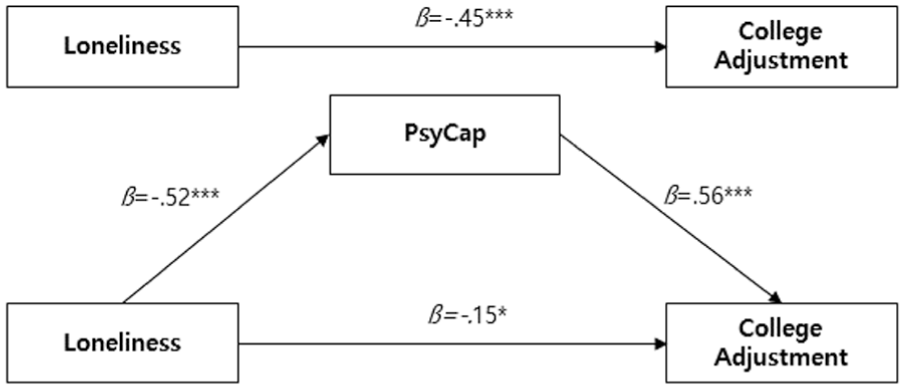
Mediating effect of PsyCap on the relationship between loneliness and college adjustment.
Discussion
This study provides meaningful insights into the psychosocial factors influencing nursing students’ adjustment to college life. The findings suggest that both external circumstances (e.g., demographics) and internal psychological resources (e.g., PsyCap) interact to shape students’ capacity to adapt to academic and social demands. Three key implications emerge from these findings.
First, the observed differences in college adjustment across demographic groups underscore the importance of tailoring educational support to students’ individual characteristics. Notably, sex, academic year, clinical practice experience, economic status, exercise frequency, and perceived health all revealed meaningful associations with college adjustment. These findings suggest that students do not adapt to college in uniform ways, but rather in response to multiple intersecting factors. For instance, the relatively higher adjustment observed in upper-year students may reflect their greater familiarity with institutional demands and more established social networks—both of which support academic resilience and self-efficacy (Berthelon et al., 2019; Brouwer et al., 2022; Zhao et al., 2022). Similarly, students with greater economic resources may experience fewer financial barriers, allowing for stronger engagement in academic and extracurricular life (Reynolds & Cruise, 2020; Titus, 2006). Physical health and regular exercise also appear to support adaptive functioning, consistent with prior research linking physical activity to emotional regulation and cognitive stamina (Keating et al., 2005; Kim & Song, 2021).
These findings emphasize the need for differentiated support services within nursing programs. Academic advisors and student counselors should consider socioeconomic status, health, and extracurricular involvement when designing student development initiatives. Wellness programs that promote regular physical activity, financial literacy, and health maintenance could enhance students’ adjustment, particularly among at-risk groups. Moreover, curricular innovations such as peer mentoring between upper- and lower-year students could leverage existing adjustment experience to support early-stage adaptation. Taken together, these demographic differences signal the importance of a context-sensitive and student-centered approach to educational design.
Second, the results affirm the significant inverse relationship between loneliness and college adjustment, supporting the first hypothesis (H1). Students who reported greater loneliness also reported more difficulty in adjusting to college life—particularly in forming peer relationships, managing academic pressures, and achieving emotional balance. This finding is consistent with prior studies highlighting loneliness as a major impediment to college integration (Bernardon et al., 2011; Gerdes & Mallinckrodt, 1994; Russell, 1996). Loneliness reduces motivation, impairs concentration, and weakens students’ confidence in their social competence (Diehl et al., 2018; Rokach, 2004).
In the context of nursing education—where collaboration, empathy, and interpersonal engagement are essential—persistent loneliness can severely limit both academic growth and professional identity formation (Jordan & Foster, 2016; Núñez et al., 2022). Moreover, loneliness may increase psychological vulnerability, making students more susceptible to stress, anxiety, and even attrition. These findings highlight the importance of proactively addressing emotional isolation within nursing education. Faculty and administrators should consider implementing regular emotional wellness screenings, peer support initiatives, and safe spaces for social interaction. Structured programs such as support groups, counseling services, and social-emotional learning modules can foster a greater sense of belonging, thereby mitigating the harmful effects of loneliness.
Third, the study demonstrates that PsyCap partially mediates the relationship between loneliness and college adjustment, thereby supporting the second hypothesis (H2). Students who reported higher levels of loneliness also tended to exhibit lower levels of PsyCap, which in turn was associated with poorer adjustment outcomes. This partial mediation suggests that while loneliness directly disrupts adjustment, it also undermines the internal psychological resources needed for coping and engagement. This is consistent with COR theory, which posits that stressors like loneliness deplete valuable psychological resources, including hope, self-efficacy, and resilience (Hobfoll, 1989). Likewise, Social Cognitive Theory (Bandura, 1997) highlights the role of social interaction in developing self-regulatory capacities—capacities that may be stunted when loneliness disrupts interpersonal learning.
This mediating role of PsyCap reinforces its value as an intervention target. PsyCap is a state-like capacity, meaning it can be developed through intentional educational experiences. Prior research suggests that interventions such as resilience training, guided self-reflection, and strengths-based coaching can meaningfully enhance PsyCap (Avey et al., 2011; Luthans et al., 2015). In particular, Luthans et al. (2010) demonstrated that structured PsyCap development programs in educational and organizational settings not only enhance psychological resources but also improve performance-related outcomes. This underscores the feasibility and effectiveness of integrating such programs into nursing curricula.
In nursing education, embedding these approaches into curricula could provide students with the psychological tools necessary to buffer stress and sustain motivation. For example, incorporating structured peer mentoring, mindfulness-based stress reduction programs, or scenario-based simulations could build resilience and optimism while fostering deeper emotional engagement. Moreover, studies among Asian college students highlight that interventions focusing on gratitude and social-emotional learning can significantly enhance self-efficacy and adaptive functioning (Datu, 2018). These culturally aligned strategies could further complement PsyCap-building efforts in Korean nursing education. Notably, PsyCap development need not replace loneliness prevention but should complement it. A dual strategy—reducing isolation while simultaneously cultivating inner strengths—may yield the most robust outcomes.
In sum, these findings underscore the dual importance of reducing emotional vulnerability and building psychological capacity to promote healthy college adaptation in nursing students. Future research using longitudinal or experimental designs can further clarify the mechanisms underlying these relationships and guide the development of effective educational interventions.
Conclusions and Limitations
This study demonstrated that loneliness significantly undermines college adjustment among nursing students and that PsyCap serves as a partial mediator in this relationship. These findings suggest that both emotional vulnerability and psychological strengths play critical roles in shaping students’ ability to adapt to academic and social demands. In particular, PsyCap appears to function as an internal buffer that helps students cope with the negative effects of loneliness, reinforcing its value as a target for educational intervention. Given the complex interplay between psychosocial factors and student adaptation, nursing education should adopt integrated strategies that address both individual and environmental dimensions. Programs that enhance PsyCap—such as resilience training, guided self-reflection, and structured peer mentoring—may help mitigate the impact of loneliness and promote academic engagement. Additionally, creating supportive and socially connected learning environments may further foster emotional well-being and professional development.
However, several limitations must be acknowledged. First, the use of convenience sampling from two universities in a single region of South Korea limits the generalizability of the findings. Although students across all academic years were included, the relatively small and uneven subgroup sizes may have constrained the analysis of year-specific trends. Future studies should employ stratified or randomized sampling across diverse educational contexts to enhance external validity. Second, the cross-sectional design precludes causal inference. While the mediating role of PsyCap was identified, longitudinal or experimental designs are needed to clarify the directionality of the observed relationships and explore long-term effects. Despite these limitations, this study offers valuable insights for strengthening student adaptation and psychological well-being in nursing education. A dual approach that reduces emotional isolation while building internal resources may serve as a foundation for preparing resilient, well-adjusted future nurses.
Footnotes
Acknowledgements
We sincerely thank all the students who participated in this study. We also appreciate the editing services provided by Essay Review Company.

Ethical Considerations
This research received ethical approval from the Institutional Review Board of Chonnam National University (IRB No. 1040198-250122-HR-017-03) and was conducted in accordance with the ethical principles of the Declaration of Helsinki.
Consent to Participate
Written informed consent was obtained from all participants prior to participation in the study.
Author Contributions
Sehoon Kim: Conceptualization, Methodology, Formal analysis, Investigation, Data curation, Visualization, Resources, and Writing – original draft preparation. Young-Ran Kweon: Conceptualization, Methodology, Data curation, Resources, Supervision, Visualization, Writing – review and editing, and Project administration. All authors gave final approval and agreed to be accountable for all aspects of the work, ensuring integrity and accuracy.
Funding
The authors received no financial support for the research, authorship, and/or publication of this article.
Declaration of Conflicting Interests
The authors declared no potential conflicts of interest with respect to the research, authorship, and/or publication of this article.
Data Availability Statement
The datasets utilized in this study can be made available upon reasonable request from the corresponding author.