




Abstract
In this study, we examine (1) the effect of leader consideration and information sharing on follower proactive behavior, and (2) the sequential mediating role of positive psychological capital (PsyCap) and job satisfaction. Data were collected from a pair of 369 leader-followers, with followers responding to their PsyCap, job satisfaction, and leadership style of the immediate leader while matching leaders responded to follower proactive behavior. Structural equation modeling was performed to test hypotheses. The study found that PsyCap and job satisfaction had a sequential mediating effect on the relationship between leader consideration and follower proactive behavior. In addition, leader consideration directly affects follower PsyCap, job satisfaction, and proactive behavior. This study demonstrates how leadership style ultimately influences follower behavior through followers’ positive PsyCap and attitudes. By adopting the ability-motivation-opportunity (AMO) model, we extended the theoretical understanding of the leadership influence process.
Keywords
Introduction
Consideration refers to a leadership style that provides trust, respect, support, and regard for followers’ feelings (Robbins & Judge, 2019). The Ohio State Leadership Study, representative research on leadership behavior theory, identified consideration as one of the two important leadership style dimensions. Many follow-up studies have been conducted to reveal the impact of consideration until new leadership research trends focus on variables such as contingency, trust, and charisma. Since late 1960s and 1970s, leadership research interest had been shifted to contingency theory, situational theory, transactional- and transformational theory (Bass, 1985; Fiedler, 1967; Hersey & Blanchard, 1969), and the attention to consideration seemed to be “forgotten (Judge et al., 2004).”
However, DeRue et al. (2011) conducted a meta-analysis on leadership behavior theory and showed that the impact of consideration on leadership effectiveness, follower satisfaction with the leader, and group performance is still significant. Recent studies have proven the effectiveness of leaders’ considerations. Kehr et al. (2023) found that leader considerations comprise the follower affiliation motive. Martínez-Córcoles et al. (2020) proved that leaders exhibiting consideration behavior increase follower role clarity and develop a trusting relationship. Zhou et al. (2023) showed that leader considerations are positively related to employee learning. These results show that consideration is still an important leadership criterion and should be investigated further.
The prevailing view of leadership behavior theory has distinguished leadership styles according to the leader’s focus, whether on people or tasks. The Ohio model presents the initiating structure as another dimension of the two leadership styles. Initiating structure refers to the behaviors in which leaders focus on goals and organize tasks and roles to achieve those goals (Robbins & Judge, 2019). The Michigan model and managerial grid differentiated leadership style (dimension) into employee-/job-centered and concerns for people/production, respectively (Blake & Mouton, 1985; Kahn & Katz, 1960).
In this study, however, we explore leader information sharing as a new aspect of the leadership style. In a rapidly changing world, organizational effectiveness depends on the capacity of organizational members, and leaders today need efforts to elicit followers’ future potential by enhancing their knowledge and creativity, rather than simply developing current task manuals or giving directions. Leaders who share important information with their followers provide critical work-related knowledge, suggestions, ideas, and experiences (Thuan & Thanh, 2020), which are positively related to follower attitudes and creativity (Koseoglu et al., 2017; Thuan, 2020). We assume that while consideration provides affective support for followers, information sharing provides cognitive support.
The results of the two leadership styles examined in this study are follower positive psychological capital (PsyCaps), job satisfaction, and proactive behavior. We adopted the perceived ability-motivation-opportunity (AMO) framework, where ability corresponds to PsyCaps, motivation to job satisfaction, and opportunity creation to proactive behavior. Although AMO research has been primarily conducted in the field of human resources management (Malik & Lenka, 2019), we try to expand the AMO factors into leadership studies by linking them with some important leadership effectiveness, such as follower perception, attitudes, and behaviors.
This study has several implications. First, most previous studies on leadership behavioral theory have been conducted by classified leadership styles as relationship- and task-oriented. However, in today’s business environment, tasks are constantly changing owing to technological progress. The style in which leaders define the work standard in advance and instruct followers does not reflect the demand for new leadership capacity. This study proposed leader information sharing as an alternative leadership style.
Second, we empirically show which leadership dimension is more effective by verifying the affective (consideration) and cognitive (information sharing) dimensions of leadership style. Third, by adopting the AMO framework, we expect to determine the leadership influence process in more detail. Fourth, we expect to confirm the important role of PsyCap and job satisfaction by empirically testing the sequential mediating effect of the two variables on the relationship between leader consideration/information sharing and follower proactive behavior.
Literature Review
PsyCap, Job Satisfaction, Proactive Behavior, and the AMO Framework
Blumberg and Pringle (1982) pointed out that previous studies that considered only limited antecedents of work performance, such as job satisfaction, job attitude, personality, and motivation, failed to provide strong predictors of job performance. In particular, they emphasized that the traditional perspectives of ability × motivation models have serious shortcomings without an explanation of environmental factors and that the missing dimension, opportunity, must be added to the investigation of work performance antecedents. The three anticipated dimensions of work performance are capacity to perform, willingness to perform, and opportunity to perform. Similarly, Bailey (1993) suggested that employees must have the necessary skills, adequate motivation, and opportunities to participate in discretionary efforts. Later, Appelbaum et al. (2000) developed this idea into an AMO framework (Marin-Garcia & Martinez Tomas, 2016).
Most of the AMO framework research focused on HR practice design from the high-performance work system (HPWS) perspective (Edgar et al., 2021), and investigated the effect of HR practices such as training (ability), performance management and reward system (motivation), and management participation (opportunities) on innovation, constructive behavior, and employee engagement (Malik & Lenka, 2019; Schuster et al., 2019). However, Kellner et al. (2019) showed that work performance is determined by HR practices promoting AMO and the individual’s response to these practices. Ehrnrooth et al. (2021) found that HPWS and transformational leadership had a moderating effect on follower self-efficacy and organizational identification. In other words, leadership style can have an effect on followers’ response to the AMO-enhancing HPWS. To further understand the AMO framework, it is necessary to consider it in connection with leadership influence.
Therefore, we designed a research model by applying AMO elements to individual attributes such as PsyCap, job satisfaction, and proactive behavior. This is because what affects followers is not the organizational practice itself, but what they perceive, feel, and do. Even a company that provides sufficient training programs cannot exercise employees’ capabilities if they do not believe in their abilities.
In this study, PsyCap corresponds to followers’ perceived abilities. Luthans (2002a) established the basic concept of positive organizational behavior (POB) based on the positive psychology movement. He differentiated POB from existing OB concepts and presented self-efficacy, hope, optimism, subjective well-being(happiness), and emotional intelligence as basic constructs. Not only did Luthans (2002b) later added resilience as a new element, but Luthans and his colleagues redefined PsyCap as a four-dimensional concept of self-efficacy, hope, optimism, and resilience (Luthans & Youssef, 2004; Luthans et al., 2006, 2007).
In many follow-up studies, Luthans and his colleagues emphasized Bandura's (1997) self-efficacy as a major component of PsyCap. Self-efficacy refers to “how well one can execute courses of action required to deal with prospective situations (Bandura, 1982, p. 122),” and it is redefined in POB study as “an individual’s conviction (or confidence) about his or her abilities to mobilize the motivation, cognitive resources, and courses of action needed to successfully execute a specific task within a given context (Stajkovic & Luthans, 1998, p. 66).” It also seems that employees with hope, optimism, resilience, and self-efficacy can better handle difficult situations (Luthans et al., 2007). Edgar et al. (2021) also used self-efficacy as a proxy for ability. In this regard, we applied PsyCap to the perceived ability of the AMO framework.
Second, job satisfaction was found to fit perceived motivation. Job satisfaction is a person’s attitude toward the job and is alleged to be affected by pay, promotion opportunity, coworkers, supervision, and mostly, the job itself (Locke, 1976; Robbins & Judge, 2019). Job satisfaction and PsyCap are independent of each other, despite their strong positive relationships (Luthans et al., 2007). Many studies have found a positive relationship between job satisfaction and job performance. Satisfied workers tend to spend more time at work and achieve better quality (Bhatti et al., 2019; Yuen et al., 2018). A recent meta-analysis also revealed a significant positive relationship between job satisfaction and performance (Katebi et al., 2022).
Hertzberg’s two-factor theory distinguishes between satisfaction and dissatisfaction factors in the workplace; the latter is related to the avoidance of pain, while the former, the motivator, is related to the desire for growth (Quick & Nelson, 2013). Motivators include satisfying job content that enables achievement, recognition, responsibility, and growth (Herzberg et al., 1959). The fact, that the satisfaction factor is the motivator, supports our attempt to link job satisfaction with perceived motivation.
Third, proactive behavior corresponds to opportunity creation. Proactive behavior refers to employees’ conscious behavior that changes and improves their workplace environment (Su et al., 2022). It has been noted (Grant & Ashford, 2008, p. 4) that proactive behavior is an “anticipatory action that employees take to impact themselves and/or their environments,” and presented the five dimensions of proactive behavior—form, the intended target of impact, frequency, timing, and tactics. Following the remarkable growth of proactive behavior research, many previous studies have investigated various behavioral patterns as proactive concepts. Examples include problem prevention (Parker et al., 2006), taking charge (Fu et al., 2022; LePine & Van Dyne, 1998), voice and personal initiative (Anwar Ul Haq et al., 2019; Liu et al., 2018; Mostafa & El-Motalib, 2019), constructive suggestions (G. Zhang & Inness, 2019), and information and feedback seeking (Bauer et al., 2019), and so on. Parker and Collins (2010) recognized that there were distinct differences but also close relationships among various types of proactive behaviors and integrated them into three higher-order categories: proactive work behavior, proactive person-environment fit behavior, and proactive strategic behavior.
Proactive behavior is an active behavior of individuals that affects the environment taken together with previous studies. Based on Blumberg and Pringle's (1982) argument that work performance studies must include opportunities to reflect environmental factors, in addition to abilities and motivations, we believe it is reasonable to assume that proactive behavior, an active behavior that changes the environment, is parallel to opportunity creation. This is consistent with Edgar et al.'s (2021) point that opportunity improvement systems provide autonomy and participation for employees.
Leadership and PsyCap
Leader consideration refers to follower-oriented behaviors, providing support, showing warmth, and paying attention to well-being (Choi et al., 2019; Martínez-Córcoles et al., 2020). Considerate-style leaders are concerned about followers’ individual needs (Jong & Ford, 2021), recognize each follower’s weaknesses and strengths, and provide necessary support based on their needs and expectations (Ding & Lin, 2021). In this process, leaders can positively influence follower resilience by lowering anxiety and promoting follower self-efficacy (Bak et al., 2022). Rebelo et al. (2018) found that transformational leaders facilitate PsyCap development in followers. Transformational leadership includes individual consideration as one of four subdimensions, and Antonakis and House (2014) pointed out that “consideration” of the Ohio model and “individual consideration” of the full-range model are almost identical concepts.
Leaders are more likely than subordinates to access important information, such as company policies, visions, and goal directions related to work within the organization. The leader’s various experiences also reinforce them to gain more valuable ideas related to work and provide more accurate insights into the overall flow. As a result, leader information sharing can provide subordinates with continuous help in work promotion and learning. Although a few prior studies have verified the direct relationship between leader information sharing and PsyCap, the relationship between the two can be inferred from previous studies in related fields. Lei et al. (2020) showed that leaders who clearly present an appealing vision and promote problem-solving positively affect follower self-efficacy and optimism. Marashdah and Albdareen (2020) found that leaders who generate new knowledge and ideas positively affect follower PsyCap. Şeşen et al. (2019) also showed that transformational leaders positively affect followers’ PsyCap in the hospitality industry. Transformational leaders create knowledge, uncover knowledge gaps among followers, and develop new perspectives (Schermuly et al., 2022). Based on this, the following hypothesis is proposed:
H1a. Leader consideration is positively related to follower PsyCap.
H1b. Leader information sharing is positively related to follower PsyCap.
Leadership and Job Satisfaction
As supervision, along with pay, promotion opportunities, coworkers, and the job itself, is a major factor affecting job satisfaction (Robbins & Judge, 2019), many studies have been conducted to verify the relationship between leadership and job satisfaction. For example, leaders who are empathetic, supportive, and considerate positively influence job satisfaction (Chordiya et al., 2019). Numerous studies have found a positive relationship between individualized consideration and job satisfaction (Chen et al., 2021; Ilyas et al., 2021; Labrague et al., 2020; Siswanto & Yuliana, 2022). Yukl et al. (2019) meta-categorized leadership style into task-, relations-, and change-oriented behaviors and proved that relations-oriented behaviors, which used to be broadly defined as consideration, are positively related to job satisfaction.
Additionally, Rafique and Mahmood (2018) conducted a systematic review of prior studies investigating the relationship between knowledge sharing and job satisfaction and found that knowledge sharing had a positive impact on job satisfaction in five of the 28 studies. Knowledge sharing behavior allows the development of employees, reduces stress, and thus improves job satisfaction (Khalil et al., 2021). Leaders who support learning create a positive HRD culture and ultimately improve employee job satisfaction (Akdere & Egan, 2020). In contrast, when a leader plays dumb or evasively hides knowledge, follower job satisfaction decreases (Offergelt et al., 2019). Thus, we hypothesize the following:
H2a. Leader consideration is positively related to follower job satisfaction.
H2b. Leader information sharing is positively follower job satisfaction.
Leadership and Proactive Behavior
Leaders who provide support, close relationships, and a psychologically safe work environment enable followers to demonstrate proactive behaviors, such as voice, innovation, and taking charge (Chang et al., 2022). Leaders who treat followers respectfully, with honesty and politeness, and recognize their core needs positively affect follower proactivity (Vogt et al., 2021). Parker et al. (2019) reviewed 95 papers that studied proactive behavior and organized the factors influencing individual proactivity into three categories. Relational factors, such as having an open leader, are among the most important factors along with strategic and self-regulatory factors. They insist that employees are comfortable taking the initiative when their supervisors trust and respect them, interact closely, and are open to suggestions.
Followers who receive appropriate information from a leader perceive themselves as belonging to the organization and feel attached to the organization (Baumeister & Leary, 1995). Leaders’ information sharing behavior shows that leaders have a close relationship with their followers, which motivates them to engage in more proactive behavior within the organization. Nifadkar et al. (2019) found that supervisors’ work- or non-work-related information sharing positively impacted subordinates’ voice behavior by strengthening trust in their supervisors. Leaders who share a clear vision, foster new ways to discover novel ideas, and focus on transforming and leveraging knowledge influence proactivity by creating a positive climate for absorptive capacity (Shafique & Kalyar, 2018). Anwar Ul Haq et al. (2019) also showed that follower proactive behavior increases when leaders empower them by providing the requisite information and resources. Based on these discussions, the following hypothesis is proposed:
H3a. Leader consideration is positively related to follower proactive behavior.
H3b. Leader information sharing is positively follower proactive behavior.
The Sequential Mediating Role of PsyCap and Job Satisfaction
We discussed earlier how leader consideration and information sharing positively affect follower PsyCap, job satisfaction, and proactive behavior. Next, Parker et al.’s (2010) model of proactive motivation explains the mediating role of PsyCap and job satisfaction. To further elaborate the investigation into proactive behavior’s antecedents, they identified three key motivational states: “can do,”“reason to,” and “energized to.” First, can do motivation include the question, “Can I do it?” Self-efficacy—the belief that one can be successful in a particular task—is one of the most important aspects of proactive goal generation. Second, the reason to motivation asks, “Do I want it?” or “Is it worth it?” Parker and her colleagues adopted the self-determination theory (Deci & Ryan, 1985), and explained that reason can also be derived from extrinsic motivation when internalized or integrated. Even when a job is not enjoyable, people act autonomously if they consider the value or importance of the job (Gagné & Deci, 2005). Third, energize to is a state of motivation related to affect. Positive affect makes individuals more active (Do Nascimento et al., 2018; Kwon et al., 2019) and affects the setting and striving for proactive goals (Parker et al., 2010).
As already discussed, self-efficacy is an essential factor in PsyCap. Furthermore, hope, optimism, and resilience are all based on positive psychological capacities (Luthans, 2002b). Hopeful people believe they can set goals and find ways to achieve them (Snyder, 1994). Optimism is a cognitive characteristic that makes one expect a positive outcome (Luthans, 2002a). Resilience refers to “the positive psychological capacity to bounce back” not only from a negative and devastating experience but also from positive changes, such as increased responsibility (Luthans, 2002b, p. 702). In addition, by adopting the AMO model, we linked PsyCap to the ability factor. Thus, we assumed that PsyCap (perceived ability) reflects can do and energize to motivation.
Noting that job satisfaction is associated with a variety of elements such as pay, promotion, recognition, coaching, and the job itself (Robbins & Judge, 2019), we assume that if a person is satisfied with their job, it might be that the job is enjoyed (intrinsic motivation) or the person is extrinsically but autonomously motivated. In addition, job satisfaction corresponds to the motivation of the AMO model; here, we argue that job satisfaction fulfills the reason to (do I want it?) motivation.
For all these reasons, we propose that PsyCap and job satisfaction, as key states of proactive motivation, mediate the relationship between the two leadership styles and proactive behavior. There is a lot of empirical evidence to support our arguments, too. Lei et al. (2020) showed that PsyCap mediates the relationship between transformational leadership and followers’ innovation capabilities. PsyCap increases the perceived value of feedback-seeking behavior and encourages people to seek information actively for personal development (Wang et al., 2017). Self-efficacy evokes voice behavior without fear of breaking the status quo (Eibl et al., 2020), helps people face potential risks such as taking action or raising self-expectations, and makes them more willing to take charge of behaviors (Rouzi & Wang, 2021).
Job satisfaction has also been found to be positively related to proactive behavior in many previous studies. Satisfied employees are more willing to contribute suggestions and ideas to enhance organizational effectiveness and engage in voice behavior (Ilkhanizadeh & Karatepe, 2017; LePine & Van Dyne, 1998; X. Zhang et al., 2014). Ilyas et al. (2021) showed that job satisfaction mediates the relationship between transformational leadership and voice behavior, a proactive behavior. In a meta-analysis of change-oriented organizational citizenship behavior (OCB), Chiaburu et al. (2022) found that positive affect and job satisfaction largely explain change-oriented OCB. Change-oriented OCB includes positive proactive behavior, voice, personal initiative, and taking charge.
Neither the AMO model (Blumberg & Pringle, 1982) nor the model of proactive motivation (Parker et al., 2010) draws a specific relationship among the variables proposed in their model. Rather, they appear independent and interactive. However, this study suggests that PsyCap will only indirectly affect proactive behavior via job satisfaction. Wu and Nguyen (2019) conducted a meta-analysis of PsyCap’s antecedents and consequences and found that work attitudes, such as job satisfaction and organizational commitment, were the main outcomes of PsyCap. As previous studies suggest a causal relationship between PsyCap and job satisfaction, we conducted a sequential mediation test.
H4a. Follower PsyCap and job satisfaction serially mediate the relationship between leader consideration and follower proactive behavior.
H4b. Follower PsyCap and job satisfaction serially mediate the relationship between leader information sharing and follower proactive behavior.
Method
Participants and Procedure
A survey was conducted on white-collar employees and their direct supervisors in publicly listed companies in South Korea to verify the research model. Korean companies have led economic growth through technological innovation and business process improvements in the face of a lack of natural resources. In an environment where continuous innovation is required, we selected white-collar employees in charge of organizing, planning, and conducting research as the subject of the study. In addition, since this study deals with the effect of leadership on follower behavior, middle managers and subordinates who constantly interacted with each other were targeted, and only pairs that had worked together for 6 months or more were included. During the survey, we announced that this study would be used only for research purposes and that confidentiality would be guaranteed. The questionnaire consisted of two parts. Part A is for subordinates to answer their PsyCap, job satisfaction, and the immediate leader’s leadership styles, while Part B is for matched leaders who respond to their subordinates’ proactive behavior. We collected data from multiple sources to avoid common method biases; in particular, the immediate supervisor, who directly observed their day-to-day work behavior, assessed follower proactive behavior (Cruz, 2022).
We first contacted intermediaries (e.g., HR managers) of target companies, explained the purpose of the study, and distributed questionnaires along with return envelopes. The intermediary formed a subordinate-supervisor pair and gave Parts A and B questions, respectively. Each respondent completed the questionnaire anonymously, sealed it in an envelope, and submitted it to the intermediary, who then kept the paired responses in a return envelope. After receiving a notification that the survey was complete, we visited each company to collect the questionnaire. In this process, subordinates and supervisors were strictly isolated, so that they could not see each other’s answers. The survey was conducted over 2 months, and a set of 369 (92.3%) out of 400 was used after removing insincere or missing values.
Among the respondents, 226 (61.2%) were male, and 143 (38.8%) were female. The average age of the respondents was 36.1 years. A total of 47 employees (12.7%) had a high school diploma, 77 (20.9%) had a college degree, 210 (56.9%) had a university degree, and 35 (9.5%) had a graduate degree. The average number of years of service at the current company was 7.3 years and the average working period with the current leader was 3.2 years. The average number of team members was 13.3.
Measures
Employees completed the questionnaire using leader consideration, leader information sharing, PsyCap, and job satisfaction scales. Their immediate supervisors rated their subordinates’ proactive behavior. For all measures except for demographic characteristics, we used a five-point Likert-type scale ranging from 1 (strongly disagree) to 5 (strongly agree).
Leader Consideration
Four items suggested by Bass (1985) were used to measure leader consideration. Sample items are, “My leader treats and respects followers equally regardless of their characteristics or background” and “My leader spends a lot of time coaching followers.”
Leader Information Sharing
Four items adopted by Arnold et al. (2000) were used to measure leader information sharing. Sample items are, “My leader communicates important company decisions to me” and “My leader explains to me the goals pursued by the company.”
PsyCap
Eight items developed by Luthans et al. (2006) were used to measure PsyCap. Sample items are, “When meeting with a leader, I can confidently explain what I am doing,”“I expect the best even when the situation is uncertain,”“I am always optimistic about what will happen at work,” and “I can overcome difficult times at work.”
Job Satisfaction
Six items by Bacharach et al. (1991) and Curry et al. (1986) were used to measure job satisfaction. Sample items are “I am satisfied with my current job” and “I am satisfied with the opportunities my job offers me.”
Proactive Behavior
Seven items were used to measure proactive behavior adapted from Frese et al. (1997). Sample items include “My subordinate … actively tries to solve problems” and “My subordinate … takes the initiative to do things that others do not.”
Findings
Confirmatory Factor Analysis
Table 1 presents the results of the confirmatory factor analysis. The hypothesized model of this study is a five-factor model consisting of consideration, information sharing, PsyCap, job satisfaction, and proactive behavior. As shown in Table 1, the hypothesized model was acceptable (χ2 = 816.30, df = 367, CFI = 0.93, TLI = 0.93, RMSEA = 0.06). All factor loadings were above the standard of 0.50, and the average variance-extracted(AVE) estimate values also exceeded 0.50, indicating the high validity of the construct variables. The reliability of all five factors was above 0.70, confirming the reliability of the survey is validated (Hair et al., 2006).
Results of the Confirmatory Factor Analysis.
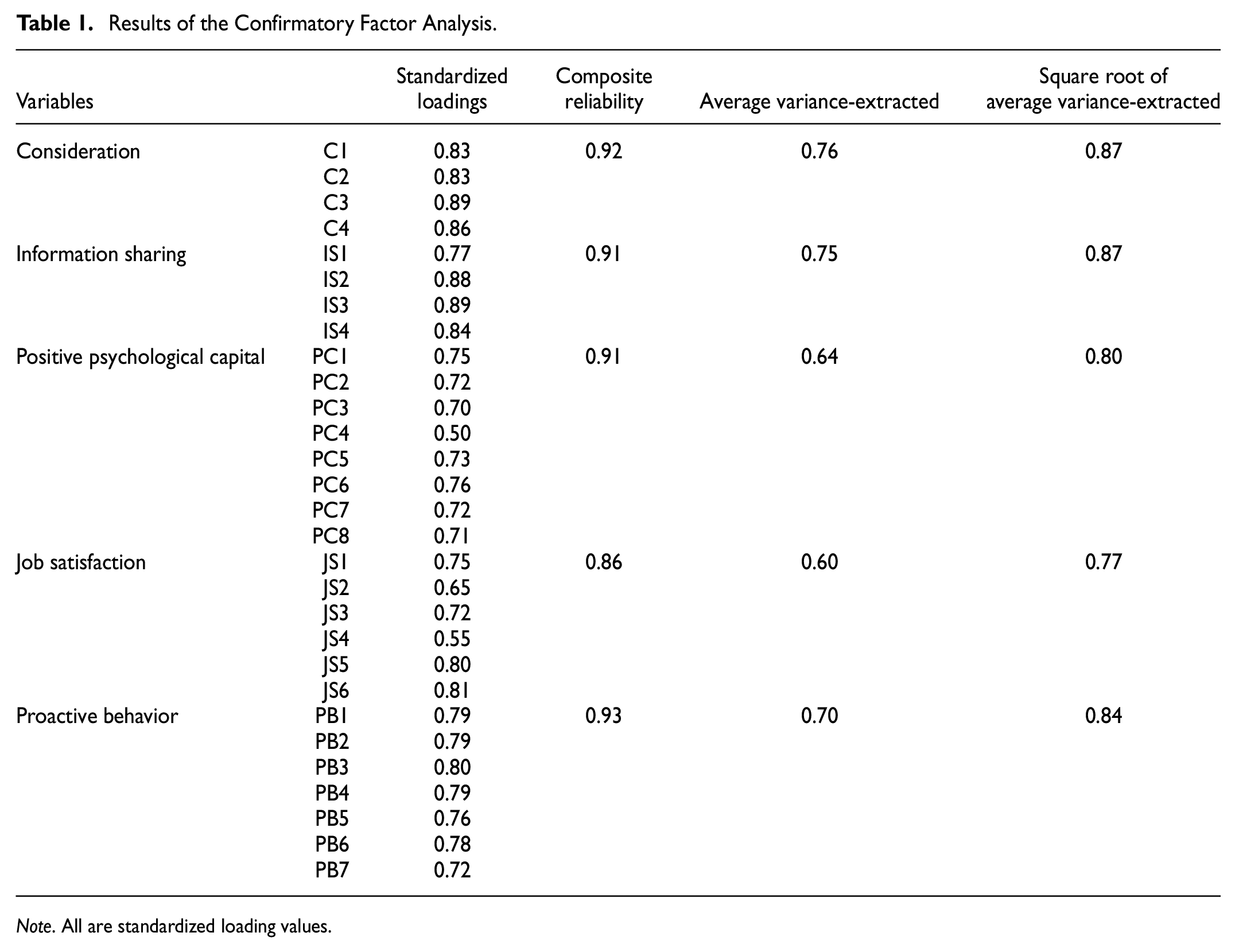
Note. All are standardized loading values.
A comparison between the square root of the AVE and the correlation coefficient was performed according to Fornell and Larcker (1981) to examine discriminant validity. The results showed that the square roots of AVE were higher than the correlation coefficient values (see Table 2), confirming that discriminant validity was secured between the factors.
Means, Standard Deviations, and Correlations.
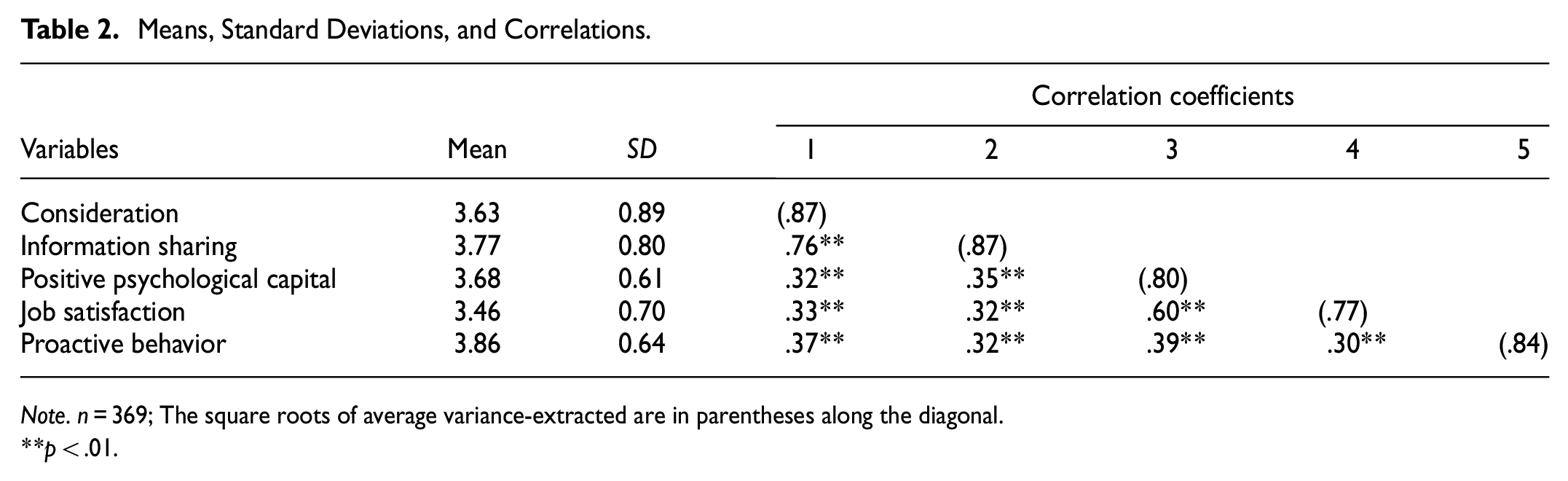
Note. n = 369; The square roots of average variance-extracted are in parentheses along the diagonal.
p < .01.
As shown in Table 2, there were significant positive correlations among the variables used in this study, such as consideration, information sharing, PsyCap, job satisfaction, and proactive behavior.
Hypothesis Tests
Structural equation modeling was performed using AMOS to verify the hypotheses presented in this study. The fit of the hypothesized model was acceptable (χ2 = 834.24, df = 368, CFI = 0.93, TLI = 0.93, RMSEA = 0.06). Specifically, CFI and TLI, which are major fitness indices, were presented as 0.90 or higher, and RMSEA was presented as 0.06, which satisfied the standard below 0.10. A comparison with competitive models is presented in Table 3.
Comparison of Structural Equation Models.

Note. The Δχ2 is the value obtained by subtracting the chi-square of the hypothesized model from the chi-square of the competitive model.
Competitive model 1 is a model in which both the path from consideration to job satisfaction and proactive behavior and the path from information sharing to job satisfaction and proactive behavior are removed from the hypothesized model.
Competitive model 2 is a model in which the pathways from information sharing to job satisfaction and proactive behavior are removed from the hypothesized model.
Competitive model 3 is a model in which the pathways from consideration to job satisfaction and proactive behavior are removed from the hypothesized model.
p < .05. **p < .01.
Competitive Models 1 and 3 had better chi-square values than the hypothesized models within the significance level, whereas competitive Model 2 had significantly worse chi-square values than the hypothesized models. However, CFI, TLI, and RMSEA were similar, with no significant difference. Therefore, in this study, it was considered preferable to adopt a full hypothesized model that included all hypotheses derived from the theoretical discussion and adopted as the final analysis model.
Figure 1 shows the path analysis results. The hypotheses were tested using a p-value of .05. Hypothesis 1a examined the relationship between leader consideration and follower PsyCap. As leader consideration was shown to have a positive relationship with PsyCap (β = .18, p < .05), Hypothesis 1a is accepted. Hypothesis 1b concerns the relationship between leader information sharing and follower PsyCap. Since information sharing has a positive relationship with PsyCap (β = .24, p < .01), Hypothesis 1b is also accepted. Hypothesis 2a relates to the relationship between leader consideration and job satisfaction. Leader consideration was found to have a significant relationship with job satisfaction (β = .17, p < .05); thus, Hypothesis 2a was accepted. Hypothesis 2b tested the relationship between leader information sharing and job satisfaction, but it was rejected as the result was not significant (β = .01, p > .05). Hypothesis 3a, which assumes a positive relationship between leader consideration and proactive behavior, was accepted as a significant relationship (β = .25, p < .01). Hypothesis 3b predicted a positive relationship between leader information sharing and follower proactive behavior, but no significant relationship was found (β = .05, p > .05); thus, it was rejected.

The result of SEM.
Hypothesis 4a relates to the sequential mediating role of PsyCap and job satisfaction in the relationship between leader consideration and follower proactive behavior. Bootstrapping was used to verify the indirect effect. We calculated the bias-corrected confidence intervals of 95% and applied the maximum likelihood estimator. The direct path from leader consideration to proactive behavior was significant and positive (β = .25, p < .01). In addition, the indirect path from leader consideration to proactive behavior through PsyCap and job satisfaction was significant (β = .07, p < .05). As both direct and indirect effects were found to be significant, PsyCap and job satisfaction sequentially played a significant mediating role between leader consideration and follower proactive behavior. Therefore, Hypothesis 4a was accepted. However, there was no significant direct or indirect relationship between leader information sharing and proactive behavior (β = .05, p > .05; β = .04, p > .05). Therefore, Hypothesis 4b was rejected. The hypothesis test results are presented in Table 4.
Hypothesis Test Results.

and b are standardized indirect effects.
p < .05. **p < .01.
Discussion
Summaries
This study empirically analyzed the effects of leader consideration and information sharing on follower PsyCap, job satisfaction, and proactive behavior. In particular, this study focuses on the sequential mediating role of PsyCap and job satisfaction. In addition, models and hypotheses are proposed based on theoretical discussions and verified through empirical studies. The results are as follows:
First, both leader consideration and information sharing showed positive relationships with follower PsyCap. These results are consistent with empirical studies on transformational leadership that emphasize intellectual stimulation and consideration (Lei et al., 2020; Li, 2019; Rebelo et al., 2018; Wang et al., 2018). Comparing the relative impacts of the two leadership styles on follower PsyCap, information sharing had a stronger effect than leader consideration. This might be because, in South Korea, the relationship between leaders and subordinates within an organization is a formal relationship established through work and regulations. Usually, power distance is high in South Korea, and most relationships are greatly affected by age and/or hierarchy gaps. In such cases, information sharing seems to have a stronger effect on a follower’s psychological state. Leader consideration also positively affects PsyCap, but information sharing is more influential. Adopting the AMO model, we assumed that PsyCap reflects followers’ perceived ability and that information sharing has greater effects on improving followers’ efficacy.
Second, leader consideration significantly and positively affected job satisfaction, but information sharing had no significant effect. Supervision is one of the five major factors associated with job satisfaction. Previous studies have shown that certain types of leadership can improve employee job satisfaction (e.g., Ilyas et al., 2021; Judge et al., 2004; Robbins & Judge, 2019), while knowledge sharing is presented with mixed results (Rafique & Mahmood, 2018). Korean employees seem to form their satisfaction through supervisors’ affective influences (consideration) rather than cognitive support (information sharing). In a culture with high power distance, a psychological state can be formed positively through valid information, but positive attitudes toward jobs require more intimate relationships, such as being individually cared for by leaders. Considering these results comprehensively, it can be concluded that, among the many ways a leader can influence follower job satisfaction, a relational approach such as consideration is more effective than a work-oriented approach such as information sharing. Job satisfaction corresponds to the perceived motivation of the AMO model. Although information sharing improves the perceived ability of followers, it takes leader consideration to motivate and lead followers to like their job.
Third, leader consideration was confirmed to have a positive relationship with follower proactive behavior, consistent with previous results (e.g., Chang et al., 2022; Vogt et al., 2021). However, information sharing had no direct effect. Proactive behavior includes actions such as prevention, taking charge, voice, personal initiative, suggestions, and information seeking (Anwar Ul Haq et al., 2019; Bauer et al., 2019; Fu et al., 2022; LePine & Van Dyne, 1998; Liu et al., 2018; Mostafa & El-Motalib, 2019; Parker et al., 2006; G. Zhang & Inness, 2019). Proactive followers voluntarily stand up to present their opinions and talk freely about problems in an organization. In South Korea, where the power distance is high, followers likely feel uncomfortable presenting their opinions to supervisors unless they have considerable courage or the belief that supervisors will not judge them. According to the study results, belief seems to be formed through consideration, not information sharing. Proactive behavior corresponds to the opportunity creation of the AMO model. The results show that leader consideration is important in building close relationships with followers, motivating and encouraging people to voluntarily develop beneficial ideas, and creating new opportunities throughout the organization.
Fourth, PsyCap and job satisfaction played significant sequential mediating roles in how leader consideration affects follower proactive behavior. It was confirmed that leader consideration was not only directly related to follower proactive behavior but also indirectly related to via PsyCap and job satisfaction. These results specifically explain how leader consideration can enhance proactive behavior. In particular, leader consideration enhances followers’ PsyCap, and PsyCap motivates members to engage in proactive behavior by inducing job satisfaction. Although Blumberg and Pringle (1982) explained that the relationships among the three elements of the AMO framework were interactive, this result shows a possible causal relationship among them. Positive perceived ability improves employee motivation and eventually allows employees to take opportunities to create new opportunities.
Implications for Theory and Practice
In this study, the following theoretical and practical implications can be presented.
First, we empirically examine the distinctive effects of a leader’s affective and cognitive influences. Specifically, we included consideration as an affective dimension and information sharing as a cognitive dimension. It was identified that leaders could positively impact followers through consideration, the affective dimension. Information sharing had a limited effect by showing a positive relationship with PsyCap only, whereas consideration was related to all three variables.
Second, it was empirically verified that PsyCap and job satisfaction play a sequential mediating role in how leader consideration affects follower proactive behavior. Although PsyCap is an important topic in positive organizational behavior and positive psychology, no previous research has investigated PsyCaps’ mediating role between leadership style and follower proactive behaviors. This study contributes to the research on positive organizational behavior by empirically showing that leaders can improve followers’ PsyCap, eventually increasing their job satisfaction and proactive behavior. We emphasize that future research should focus on the important role of PsyCap. As PsyCap positively affects the attitudes and behavior of followers, leaders must make concrete efforts to keep them positive.
Third, the mechanism by which leaders influence their follower behavior is explored. By applying the AMO model, we examined whether the leader sequentially affects followers’ perceived ability, motivation, and opportunity creation. It was found that leader consideration induces the improvement of followers’ perceived ability, motivates them, and finally allows them to take opportunities to create new opportunities. Therefore, future studies should focus on identifying the mutual impact relationships among the AMO factors. In addition, previous studies have mainly defined AMO factors through HR practices such as training and compensation, but here we applied them to employees’ psychological states, attitudes, and behaviors to be the outcome of leadership effectiveness. This is an important step in future leadership studies to expand the research perspective.
Leader consideration was one of the important factors among the various methods for improving ability, motivating, and creating opportunities for organizational members. Based on these results, we have practical implications for leadership development and HR practices. First, leaders can train themselves to improve their leadership competencies in daily work processes. To effectively exercise leader consideration, leaders must understand their followers’ characteristics, capabilities, and motivational status. Leaders can build close relationships with followers and learn about their needs through ongoing conversations, regular meetings, and one-on-one consultations. Organizations can design and implement leadership development programs that focus on improving interpersonal skills, emotional intelligence, and diverse perspectives on understanding others. Lastly, organizations should include items that evaluate leader consideration, such as “taking care of subordinates,” in middle management assessments. A multi-rater feedback assessment can be performed to reflect subordinates’ opinions.
Limitations
Although this study drew significant empirical results and presented various implications, it has some limitations.
First, there is a limit that the pollution effect according to the situational characteristics cannot be sufficiently excluded because the data of this study has a cross-sectional characteristic made at a specific point in time. In particular, since this study deals with the role of a leader, future studies need to conduct a longitudinal study at a different point in time.
Second, this study considered the affective and cognitive aspects of the leader simultaneously, but only consideration and information sharing were included. Other factors such as empathy and emotion sharing may exist in the affective aspect. In the cognitive aspect, various factors include coaching, intellectual stimulation, and inspiration.
Third, this study examined only follower proactive behavior as an outcome variable. In future research, we believe that richer implications can be presented if outcome variables can enhance organizational values, such as work performance, organizational citizenship behavior, creative behavior, and innovative behavior.
Finally, we interpreted the limited impact of information sharing based on South Korea’s culture with a high-power distance. Future studies must include samples from various countries where the degree of power distance is significantly different to test this assumption.
Conclusion
In this study, we empirically identified the mechanism by which leaders’ affective (consideration) and cognitive (information sharing) support improves followers’ proactive behavior. The results showed that affective support had a greater impact. We also examined the sequential mediating effect of follower PsyCap and job satisfaction on proactive behavior. By adopting the AMO model, we discovered the potential for a mutually influential relationship between ability (PsyCap), motivation (job satisfaction), and opportunity creation (proactive behavior). This study expands the perspective of leadership research and elucidates the detailed mechanism of leadership influence. The results also have practical implications for leadership development and evaluation.
Footnotes
Declaration of Conflicting Interests
The author(s) declared no potential conflicts of interest with respect to the research, authorship, and/or publication of this article.
Funding
The author(s) received no financial support for the research, authorship, and/or publication of this article.
Ethics Statement
Hereby, we (Kim, Jeong Sik & Choi, Se Kyung) consciously assure that for the manuscript “Exploring mechanisms from leader consideration and information sharing to follower behavior,” the following is fulfilled:
Our work is original and written by ourselves. Our work has not been previously published in English or any other language(s), and not under consideration for publication elsewhere. Our work does not infringe on any rights of others, including privacy rights and intellectual property rights. All sources used are properly disclosed with correct citation, and copying of text was all indicated using quotation marks and giving proper reference. The data is our own, true and not manipulated. We adhere to all research ethics guidelines of our discipline. We will contact the Editor to identify and correct any material errors upon discovery, whether prior or subsequent to publication of our work. Our work reflects the authors’ own research and analysis in a truthful and complete manner. All individuals credited as authors participated in the actual authorship of the work, have approved the paper for release and are in agreement with its content. Finally, we declare that this submission follows the policies of Committee on Publication Ethics (COPE) as outlined in the Manuscript Submission Guidelines.
The study was conducted according to the guidelines of the Declaration of Helsinki, and approved by the research ethics committee of SungKyunKwan University, South Korea (Reference Number: SKKU 2022-02-009). A survey was conducted on employees and managers of companies operating in South Korea, and only those who agreed to the survey responded (All respondents were informed with the following statement before participating: If you don’t want to participate in this study, you don’t have to agree, and no matter what choice you make, there will be no disadvantage for you).
