




Abstract
To date, numerous empirical studies have been conducted to investigate the link between organizational trust and organizational citizenship behaviors (OCBs). However, it is surprising that the moderating role of positive psychological capital (PsyCap) on the relationship between organizational trust and OCBs has not been directly tested. Thus, this relationship is currently under-researched. Addressing this gap in the organization literature, the purpose of this study is to examine the potential moderating role of positive PsyCap on the relationship between organizational trust and OCBs. Given this context and purpose of the study, the data collected from a sample of 1,100 health care employees from seven hospitals in Istanbul provided good support for the hypothesis. The findings indicate that positive PsyCap moderates the relationship between organizational trust and OCBs in such a manner that the relationship is stronger when positive PsyCap is high. The research findings are discussed with a view to implications and suggestions for future research.
Keywords
Introduction
More than ever before, organizations are turning to competitiveness, performance, and other positive organizational outcomes (Avey, Wernsing, & Luthans, 2008; Bakker & Schaufeli, 2008). If so, what can they do to get these positive outcomes? At this point, studies conducted in recent years offer a variety of ways for organizations on how to benefit from positive psychology (PP) to achieve these organizational outcomes (S. Lewis, 2011; Uslu, Cetin, Cubuk, & Isbilen, 2014). PP, as a result of the influence of organizational psychology, began to understand the importance of positive capital within the organization. Psychological capital (PsyCap) has emerged as a significant construct in the literature concerning positive organizational behavior (POB) (Luthans, Youssef, & Avolio, 2007). The concept of positive PsyCap emphasizes “the positive aspects of it on employees rather than the personality traits, and with regard to developing these aspects, it is assumed that it will provide a competitive advantage over its rivals” (Luthans, Youssef, & Avolio, 2007). This assumption demonstrates that PsyCap is one of the main antecedents of employee attitudes, and so it has a significant impact on organizational outcomes (S. Lewis, 2011; Youssef & Luthans, 2010). For this reason, understanding the relationships between PsyCap, organizational trust (OT), and organizational citizenship behavior (OCB) stands as an important research topic.
Despite the fact that there exists a broad range of literature regarding the influence of OT on OCBs (e.g., Konovsky & Pugh, 1994; McAllister, 1995; Podsakoff, MacKenzie, & Bommer, 1996; Wech, 2002), and there is a limited number of studies in the literature regarding the interactive effects of positive PsyCap (Cheung, Tang, & Tang, 2011; Görgens-Ekermans & Herbert, 2013; Norman, Avey, Nimnicht, & Pigeon, 2010; Roberts et al., 2011), the moderating effects of employees’ PsyCap on the relationship between OT and OCB have not been directly tested. Thus, the research problem raised here represents an under-researched and neglected issue. In addition, the current state of the extant literature in particular the western countries across different cultures and sectors remains another untapped research issue. Accordingly, this study is based on an investigation of (a) the moderating role of employees’ positive PsyCap in the relationship between OT and OCB and (b) the validity of the relationships in a culturally different context and in the health sector mentioned in the foregoing studies. Therefore, this study is set to close these gaps in the literature. The study will contribute to the relevant literature by helping define and develop employees’ positive psychological resources and by revealing that employees’ OCBs could be raised by way of high levels of PsyCap. Besides, the present study extends the scope of studies on POB (specifically PsyCap) through an empirical investigation of health care employees and the interactive effects of positive PsyCap on the relationship between OT and OCB. Thus, insights could be gained into practical directions for human resource selection, development, and performance management practices (Peterson, Luthans, Avolio, Walumbwa, & Zhang, 2011).
Theoretical Background
Positive PsyCap
Positive PsyCap was first used as POB capacity in the Journal of Organizational Behavior (Harms & Luthans, 2012; Luthans, 2002b; Wright, 2003), but then Luthans and Youssef (2004) used the concept as positive PsyCap (simply PsyCap). This concept is based on PP, that is, positive organizational psychology (POP; Seligman & Csikszentmihalyi, 2000). POP, which emphasizes the life-enhancing effects of positive emotions such as psychological well-being (Fredrickson, 2003), has aroused two interrelated movements that introduced positivity and strength-based management to the workplace (Luthans & Youssef, 2004). POB, which applies positively oriented psychological capacities that can be measured, enhanced, and managed, has been generally related to individual positive psychological aspects and their effect on performance and positive organizational outcomes (Luthans, 2002a; Luthans, Vogelgesang, & Lester, 2006; Luthans & Youssef, 2004), but positive organizational scholarship (POS), which presents an inimitable conceptual basis for understanding how and why organizational strategies have their influences on human behavior in the workplace, is mainly related to organizational positive aspects (Cameron, 2005; Cameron, Dutton, & Quinn, 2003; Donaldson & Ko, 2010). Thus, POP can be considered as an umbrella term that includes both POB and POS in terms of context (Donaldson & Ko, 2010). On the contrary, above-mentioned POB capacities contain self-efficacy, hope, optimism, and resilience, and they constitute positive PsyCap as a whole (Luthans, Avey, Clapp-Smith, & Li, 2008; Luthans, Youssef, & Avolio, 2007). PsyCap as a second-order core construct (sometimes referred to as higher-order factor) has also been empirically supported in some studies (Avey, Luthans, & Jensen, 2009; Avey, Luthans, & Youssef, 2010; Avey et al., 2008; Gooty, Gavin, Johnson, Frazier, & Snow, 2009; Görgens-Ekermans & Herbert, 2013; Luthans, 2010; Luthans, Avolio, Avey, & Norman, 2007; Luthans, Avey, Avolio, & Peterson, 2010; Luthans, Avolio, Walumbwa, & Li, 2005; Norman et al., 2010, p. 382; Peterson et al., 2011).
Self-efficacy is based on Bandura’s (1982, 1997) social cognitive theory. It is defined as “the belief one has in his or her abilities to mobilize the motivation, cognitive resources, and courses of action necessary to successfully execute a specific task within a given context” (Luthans, 2010, p. 234). It is a state, not a personality trait (Avey et al., 2009; Luthans, 2010; Luthans & Youssef, 2004). According to Harms and Luthans (2012, p. 590), efficacy is “the confidence in one’s own abilities to successfully execute and accomplish tasks.” Employees higher in self-efficacy believe they create their own success (Avey, Reichard, Luthans, & Mhatre, 2011).
Hope is based on the study of positive psychologist C. Rick Snyder as “being a motivational state that is related to the interaction between three determinants, namely, goals, agency, and pathways” (Luthans & Youssef, 2004). It is defined as “persevering toward goals and, when necessary, redirecting paths to goals (hope) in order to succeed” (Avey et al., 2009, p. 678). According to Snyder et al. (1996), hope is the belief in one’s capacity to start and maintain actions and create routes to reach goals. Employees higher in hope have a belief in their personal capacity to create their own success as well (Avey et al., 2011, p. 132).
Optimism is based on attribution theory and is closely related to the bulk of research conducted by Seligman (2006) and researchers in “positive psychology movement” (Norman et al., 2010). It is defined as “a positive explanatory style that attributes positive events to internal, permanent, and pervasive causes, and negative events to external, temporary, and situation-specific ones” (Avey et al., 2009; Luthans & Youssef, 2004). According to Harms and Luthans (2012, p. 590), optimism refers to “making positive attributions and having positive expectations for future events.” Optimist employees expect to have positive experiences (Carver & Scheier, 2002). Thus, adverse conditions are not necessarily evaluated as failures, but as opportunities that can be developed for success (Luthans et al., 2005).
Resilience can be attributed to the studies conducted by Ann Masten and others (Masten, 2001; Masten & Reed, 2002). It is defined as “developable capacity to rebound or bounce back from adversity, conflict, failure, or even positive events, progress, and increased responsibility” (Avey et al., 2009, p. 678; Harms & Luthans, 2012, p. 590; Luthans, 2002a, p. 702; Norman et al., 2010, p. 382). According to Masten (2001), resilience means “a class of phenomena characterized by good outcomes in spite of serious threats to adaptation or development.” It is prone to be more reactive than proactive (Luthans, 2010, p. 235). Resilience is one’s good adaptation against stringent conditions from a developmental perspective; hence, it is related to process, not result (Masten & Reed, 2002).
OCB
Although Barnard (1938) noted that extra-role behaviors are a need for organizations (Kidder & Parks, 2001), Katz (1964) notified that these behaviors support organizational effectiveness. However, they have gained importance since the study of Organ (1988). According to Organ (1988), OCB is “individual behavior that is discretionary, not directly or explicitly recognized by the formal reward system, and that in the aggregate promotes the effective functioning of the organization.” Organ’s (1997) later research defined it as “the maintenance and enhancement of the social and psychological context that supports task performance” and considered this term synonymous with conceptual performance (p. 95). Thus, these concepts are synonymous because they are directed toward the advantage of the organization (Norman et al., 2010).
OCB has been classified in various ways. Smith, Organ, and Near (1983, p. 657) classified OCB as altruism and generalized compliance. Altruism includes individual behaviors such as closing their deficiencies with or assisting coworkers, whereas generalized compliance contains schemas like helping make the organization better through ideas, thoughts, and suggestions. Williams et al. (1986) elaborated on Smith et al.’s (1983) classification (Puffer, 1987). They categorized OCB into three dimensions, namely, altruism, impersonal conscientiousness, and attendance. Then, Organ (1988) reconstructed Smith and others’ (1983) classification and formed a five-factor construct. The construct consists of “courtesy, altruism, civic virtue, conscientiousness, and sportsmanship” behaviors. Conscientiousness is related to the employee’s discipline perception (Barksdale & Werner, 2001) regarding the job (e.g., not leaving to finish a job that cannot be completed, responding immediately to urgent calls coming from the business while at home; MacKenzie, Podsakoff, & Fetter, 1993). Altruism is voluntary behaviors that involve intentionally helping employees who have a work-related problem such as helping discretionary to the orientation of a new employee who is hired to the organization (Avey et al., 2011; MacKenzie et al., 1993; Organ, 1988; Podsakoff & MacKenzie, 1994). Conscientiousness and altruism are similar. However, conscientiousness includes organization-oriented helping behaviors, whereas altruism is related to colleagues-oriented helping behaviors. In other words, altruism directly refers to behaviors intended to help a specific person, but conscientiousness is of help to the organization in an indirect manner (Becker & Vance, 1993). Courtesy is initiatives which are done without work-related problems such as negotiating with the unit of production before making a large-scale production decision (MacKenzie et al., 1993; Organ, 1988; Organ & Ryan, 1995). Courtesy and altruism behaviors are similar. However, courtesy behaviors are proactive, whereas altruism behaviors are reactive. Thus, courtesy behaviors are exhibited before problems occur (Yoon & Suh, 2003). Sportsmanship is not complaining of the difficult situations and keeping on exhibiting others positive attitude as a sportsman or a sportswoman shows a positive approach toward the negative behaviors (Organ, 1988; Podsakoff, MacKenzie, Paine, & Bachrach, 2000). Civic virtue refers to macro-level citizenship and it is generally a commitment to the organization as a whole (Organ, 1988; Podsakoff et al., 2000) such as attending meetings that may be useful to the organization though not compelled to do so or checking whether office doors are closed or not.
However, in some studies, OCB is divided into two broad categories according to the direction of benefits to the organization (K. Lee & Allen, 2002; McNeely & Meglino, 1994; Williams & Anderson, 1991). Altruism and courtesy have been classified into individual-directed behavior (OCB-I), whereas conscientiousness, civic virtue, and sportsmanship are organization-directed behavior (OCB-O) (Williams & Anderson, 1991). OCB-O is about more extensive behaviors that are of direct benefit to the organization and that is related to qualifications for the job such as giving advance notice when unable to come to work. On the contrary, OCB-I is more individualistic behaviors that indirectly contribute to the organization and that establish a balance between the organization and its employees as in the case of helping recently absent coworkers (Williams & Anderson, 1991).
In this study, to assess OCB, Organ’s (1988) five-factor model was used. The model has been proven empirically as the one that has the most effective and distinct factors. In addition, OCB as a second-order core construct has been empirically supported in some studies (Avey et al., 2008).
OT
The concept of trust that emphasizes the importance of interpersonal relationships increasingly gained importance in the latter half of the 1980s (Creed & Miles, 1996; Lewicki & Bunker, 1996; Tschannen-Moran & Hoy, 1998; Yildiz, Yildiz, & Iyigun, 2015). Trust is the The emotional trust is related foundation of good relations with employers, employees, and organizations (Zemke, 2000). The types of trust are sub-constructs – emotional and cognitive trust (J. D. Lewis & Weigert, 1985). The emotional trust is related to primary group relations, whereas cognitive trust is more extensive and related to secondary group relations. Scott (1980) characterized trust as “a positive force from which cooperation is derived” (p. 158). According to Nyhan and Marlowe (1997), trust is defined as “the level of confidence that one individual has in another to act in a fair, ethical, predictable manner” (p. 615).
On the contrary, OT is expanded to the organizational level of trust at the individual and team level (Creed & Miles, 1996). According to Gilbert and Tang (1998), OT is “a feeling of confidence and support in an employer; it is the belief that an employer will be straightforward and follow through on commitment” (p. 322). Nyhan and Marlowe (1997) stated that an employee’s trust in his or her supervisor is different from his or her trust to the organization as a whole. This perspective is based on Luhmann’s (1979) framework. Luhmann (1979) claimed that “trust occurs within a framework of interaction which is influenced by both personality and social system, and cannot be exclusively associated with either.” Therefore, trust for the actions of the executive group differs from the trust for the organization as a whole (Nyhan, 2000; Nyhan & Marlowe, 1997).
Trust has strong motivational effects that create and release positive energy which provides a collectivity (Dyne, Graham, & Dienesch, 1994). However, trust can be lost quickly by a particular and single behavior instantly although it is built in small steps over time (Gilbert & Tang, 1998). Thus, it is quite important to determine the antecedents of trust and engage in confidence-building practices. There are many individual and organizational factors affecting the formation of trust. For example, factors such as positive PsyCap, personality traits, organizational justice, organizational support, positive organizational climate, transformational leadership style, supportive leadership, and effective human resource management practices positively affect OT (Arnold, Barling, & Kelloway, 2001; Brockner, Siegel, Daly, Tyler, & Martin, 1997; Flaherty & Pappas, 2000; Hoy & Tarter, 2004; Hoy, Tarter, & Witkoskie, 1992; Hubbell & Chory-Assad, 2005; Konovsky & Pugh, 1994; Petersen, 2008; Tschannen-Moran, 2001; Tschannen-Moran & Hoy, 1998; Zeffane & Connell, 2003). Thus, a high level of trust leads to positive outcomes such as perceived effectiveness, open communication, collaborative decision-making processes, organizational commitment, team efficacy, job engagement, job satisfaction, achievement, and innovative behaviors (Arnold et al., 2001; Brockner et al., 1997; Flaherty & Pappas, 2000; Goddart, Tschannen-Moran, & Hoy, 2001; Hassan & Ahmed, 2011; Hoy et al., 1992; S. H. Lee, 2004; Petersen, 2008; Shockley-Zabalak, Kathleen, & Winograd, 2000; Six, 2003; Wech, 2002).
Research Model
OT and OCB
Trust is rooted in the affective ties linking individuals and conditions (McAllister, 1995). Although the level of trust in organization and leader decreases due to negative conditions (e.g., injustice, mobbing) (Dyne et al., 1994; Moorman, Niehoff, & Organ, 1993), it raises positive conditions (e.g., transformational leadership style, positive culture). So, increasing trust attitude moves individuals toward better outcomes (Chen, Hwang, & Liu, 2012; Podsakoff et al., 2000; Turner & Valentine, 2001). At the same time, theory and research clearly support the notion that OT may help to obtain desired organizational outcomes such as OCB (Dirks & Ferrin, 2001). As a result of the social exchange between employers and employees (Blau, 1964), as OT increases, employees are more likely to be grateful to the organization and then raise their motivation (Dyne et al., 1994; Morrison, 1994) and thus exhibit extra-role behaviors. The literature includes a large number of studies supporting the relationship between OT and OCB (Podsakoff et al., 1996; Podsakoff et al., 2000; Van Dyne, Cummings, & Parks, 1995; Yoon & Suh, 2003). A number of studies have found a significantly positive relationship between OT and OCB. For example, Konovsky and Pugh (1994) found that employees’ trust in supervisor mediates the relationship between procedural fairness and OCB. Deluga (1994) found that perceived fairness is related to trust in the supervisor, most closely associated with OCB. Robinson (1996) found that trust mediates the relationship between psychological contract breach and civic virtue behaviors. The findings of MacKenzie, Podsakoff, and Rich (2001) revealed that trust in manager mediates the relationship between transformational leadership style and OCB (civic virtue, helping [consisting of altruism and courtesy], and sportsmanship behaviors). Wech (2002) found that trust in a supervisor consisting of the influence of leader-member exchange significantly predicted individual and organizational level OCB.
OT in the above-mentioned studies has been shown to positively affect extra-role/discretionary behaviors such as OCB. In this context, the following hypothesis was formulated to test:
The Moderating Role of Positive PsyCap
Positive PsyCap can be “measured, developed through training intervention, and effectively managed for performance improvement” (Luthans, 2002a, 2002b; Luthans, Avey, Avolio, Norman, & Combs, 2006; Luthans et al., 2010). Thus, it is likely that positive PsyCap has a positive impact on performance outcomes. Most qualitative studies provided convincing evidence for the relationship that positive PsyCap exhibits a strong significance related to positive behaviors such as OCB (Görgens-Ekermans & Herbert, 2013) and job performance (Luthans & Youssef, 2007).
In addition, Fredrickson’s (1998, 2001, 2003) the broaden-and-build theory emphasizes the role of emotions in PP and emphasizes the role that positive emotions play in broadening individuals’ temporal thought-action repertoires. The theory explains the relationship between positive PsyCap and OCB. According to the theory, positive emotions and orientations expand an individual’s attention and focus on their patterns of thinking, tendencies regarding the positivity and their behaviors such as OCB (Norman et al., 2010). Thus, the potential for proactive extra-role behaviors such as sharing innovative thoughts or submitting suggestions for improvement increases in line with Fredrickson’s model (Avey et al., 2011).
On the contrary, there are some empirical studies related to the relationship in terms of performance in the relevant literature. For instance, the study of Luthans et al. (2005) on Chinese workers in three manufacturing factories revealed that workers’ positive PsyCap states affect role-based performance and merit-based salary performance. According to the study carried out by Youssef and Luthans (2007) on employees working in various sectors, positive PsyCap was shown to be positively related to job performance in the workplace. According to the study conducted by Sweetman, Luthans, Avey, and Luthans (2011) on employees working in various sectors, positive PsyCap was found to be related to creative performance. According to the study conducted by Luthans et al. (2010) on managers working in various sectors, PsyCap can lead to an improvement on the job performance. According to a longitudinal study carried out by Peterson et al. (2011) on 179 employees working in the service (financial) sector, a change comes out in the levels of PsyCap over time, and this change has a significant impact on subjective and objective performance. Another study conducted by Zamahani, Ghorbani, and Rezaei (2011) on telecommunication employees found that leaders’ positive PsyCap (not self-reported) positively affects role-based performance. The study of Walumbwa, Luthans, Avey, and Oke (2011) on police leaders and their followers found that a leader’s positive PsyCap positively affects group OCB.
In some studies, the effect of PsyCap on OCB was investigated. For example, the study of Gooty et al. (2009) on band members of a major university revealed that positive PsyCap has a significant positive effect on in-role performance and OCB. According to another research conducted by Avey et al. (2008) on employees working in various sectors, PsyCap was found to be associated with positive emotions that were linked with their attitudes (engagement and cynicism), and OCB and deviance behaviors. Also, positive emotions were generally determined as the mediating role in the relationship between PsyCap and OCB. According to the research conducted by Avey et al. (2010) on employees working in various sectors, PsyCap is positively linked with desired extra-role OCB, whereas it is negatively linked with “undesired organizational cynicism, intentions to quit and counterproductive workplace behaviors.” According to the research conducted by Norman et al. (2010) on employees working in various sectors, the employees highest in positive PsyCap and most highly identified with the organization were most probably to engage in OCB. According to the meta-analysis study carried out by Avey et al. (2011) on employees working in various sectors, significant positive relations were found between positive PsyCap and OCB of desirable employee behaviors.
Consistent with the studies in question so far, PsyCap states are likely to go beyond enhanced in-role/work performance, which lead to positive attitudes, intentions (e.g., intention to remain), and “contextual” behaviors (discretionary behaviors) such as OCB and cause desirable outcomes such as ethical performance (Avey et al., 2010; Gooty et al., 2009; Luthans & Youssef, 2004; Motowidlo & Van Scotter, 1994). This being the case, positive PsyCap is believed to affect the level to which an individual will exhibit OCBs.
In addition, studies conducted by Bitmis and Ergeneli (2013), Walumbwa et al. (2011), and Clapp-Smith, Vogelgesang, and Avey (2009) revealed that positive PsyCap and trust in management and group trust were positively correlated. In general, these studies did not investigate the moderating role of followers’ positive PsyCap in the relationship between OT and their OCBs. In the light of the studies, it is believed that positive PsyCap will influence an employee’s displayed level of OCBs. However, it is particularly interesting to investigate whether positive PsyCap will moderate the relationship between OT and an employee’s exhibited OCBs. In other words, individuals who are high in both OT and positive PsyCap will be more disposed to exhibit OCB than those who are low in one of these variables. In the light of previous literature supporting each relationship, it is possible that there is an interactive effect between these constructs that will differentially influence the relationship hypothesized above. Furthermore, this interaction was not examined in a culturally different context, a developing nation, Turkey, and comprehensively in terms of the health care sector in those studies. In keeping with this literature, we expect the following hypothesis:
In this context, Figure 1 illustrates our research model.

Research model.
Methodological Framework
Sample and Procedure
The research model was tested using employees from seven hospitals at Fatih Association of Public Hospitals in Istanbul, Turkey. The association is composed of eight hospitals which employ 3,721 full-time medical staff. First, the research ethics approval was obtained from Balıkesir University Faculty of Medicine Ethics Committee in Balıkesir, Turkey (the received decision no: 2014/50), and afterward, the permission for the survey was obtained from this association. Then, 1,500 standardized questionnaires were distributed to the seven organizations agreeing to participate, and completed questionnaires were collected within 4 months. However, some of them were discarded because of the excessive missing data. The final usable sample size comprised 1,100 participants including physicians and dentists (20.9%), nurses/midwives (50.5%), technicians (18.6%), and other health care professionals (9.9%), thereby representing a response rate of 73%. 71.7% of the participants were female and 28.3% of them were male. 54.2% of the respondents were in the 18- to 31-year-old group, 38.1% of them were in the 32- to 45-year-old group, and 7.7% of them were aged 46 and older. The sample was composed of master/doctorate (26%), undergraduate (36.1%), college (25.8%), and high school (12.1%) graduates. Participant tenure with the organizations ranged from 1 to 29 years.
Measures
A scale consisting of the studies of Luthans, Youssef, and Avolio (2007) for PsyCap, Nyhan and Marlowe (1997) for OT, and Podsakoff, MacKenzie, Moorman, and Fetter (1990) for OCB was used. These scales were measured on a 5-point Likert-type response format, ranging from (1) “strongly disagree” to (5) “strongly agree.” Mean scale scores were used for these scales.
Positive PsyCap
PsyCap was measured with the 24-item “Psychological Capital Questionnaire” (PCQ; Luthans, Youssef, & Avolio, 2007). The questionnaire consists of four dimensions including six-item each of “hope, optimism, self-efficacy, and resilience”. Sample items for the subscales included, per construct: “I feel confident analyzing a long-term problem to find a solution” (self-efficacy); “There are lots of ways around any problem” (hope); “I’m optimistic about what will happen to me in the future as it pertains to work” (optimism); and “I can get through difficult times at work because I’ve experienced difficulty before” (resilience). “There are lots of ways around any problem.” The instrument was adapted by Cetin and Basim (2012) and Erkus and Afacan-Findikli (2013). In the previous validation studies (Cetin & Basim, 2012; Erkus & Findikli, 2013), one reverse item for resilience and two reverse items for optimism that increased the reliability coefficients (α) for these two dimensions were excluded from the instrument. The adapted instrument consists of 21 items. The reliability coefficient for self-efficacy was .79, but for hope was .66, for optimism .65 and for resilience, it was .66. However, the Cronbach’s alpha reliability coefficient for overall 24-item composite PCQ was .87, suggesting that the core measure was of good reliability (Gooty et al., 2009; Luthans, Avolio, Avey, & Norman, 2007; Luthans et al., 2005).
OT
OT was measured with a 12-item Organizational Trust Inventory (OTI; Nyhan & Marlowe, 1997). The questionnaire consists of two dimensions including eight-item for trust in the supervisor and four-item for trust in the organization. The instrument was adapted and revised by Demircan (2003). Sample items for the subscales included, per construct: “My level of confidence that my supervisor will make well thought out decisions about his or her job is high” (trust in the supervisor); “The level of trust between supervisors and workers in this organization is high” (trust in the organization). The reliability coefficient for trust in the supervisor .97 and for trust in the organization was .87. Also, the Cronbach’s alpha reliability coefficient for overall 12-item composite OTI was .94, suggesting that the core measure was of excellent reliability (Erat, Erdil, Kitapci, & Comlek, 2012; Nyhan, 2000; Nyhan & Marlowe, 1997).
OCB
OCB was the measured with the 24-item Organizational Citizenship Behavior Scale (OCBS; Podsakoff et al., 1990). The scale developed by Podsakoff et al. (1990) was formed on the basis of five subdimensions of OCB proposed by Organ (1988). These dimensions were “conscientiousness, sportsmanship, civic virtue, courtesy, and altruism.” Sample items for the subscales included, per construct: “Attendance at work is above the norm” (conscientiousness); “Always finds fault with what the organization is doing” (R) (sportsmanship); “Attends meetings that are not mandatory, but are considered important” (civic virtue); “Considers the impact of his or her actions on coworkers” (courtesy); “Helps others who have heavy workloads” (altruism). The instrument was adapted by Polat (2007) and Basim and Sesen (2006) and revised by the recent study. Based on the previous validation studies, the two reverse-scored items for sportsmanship increased the Cronbach’s alphas for these two dimensions were excluded from the instrument. The adapted instrument consists of 22 items. The reliability coefficient for conscientiousness was .73, for sportsmanship was .70, for courtesy was .80, for altruism was .80, and for civic virtue, it was .66. However, the Cronbach’s alpha reliability coefficient for overall 22-item composite OCB was .84, suggesting that the core measure was of good reliability (Nunnally & Benstein, 1994; Polat, 2007).
Research Results
Before analyzing the hypotheses, an array of confirmatory factor analytic (CFA) models was administered through IBM AMOS 20.0 to evaluate the structure of the followers’ PCQ, OTI, and OCB. An array of models pursuing the general analytical procedure suggested by Gooty et al. (2009), Luthans, Avolio, et al. (2007), and Luthans et al. (2008) were used. To this end, three different CFAs were used including second-order, four-factor, and one-factor on the positive PsyCap, OTI, and OCB scales to assess their validity. The first model for PCQ described “four correlated first-order factors with the 21 items” (Model 1), whereas the second defined “a one-factor model, with all 21 items loading onto a single factor” (Model 2). The third model characterized “the four first-order factors of hope, self-efficacy, resilience, and optimism as loading onto a higher-order” positive PsyCap construct (Model 3). Of these models, the one-factor PsyCap (Model 2) was a good fit for the representation of PsyCap. Therefore, the one-factor model was used for hypothesis testing. Using one-factor of PysCap has precedence in the Bitmis and Ergeneli’s (2013) study. The fit indices for positive PCQ were chi-square (χ2) = 314.10; degrees of freedom (df) = 74, χ2/df = 4.25; goodness of fit index (GFI) = .96; comparative fit index (CFI) = .95; and root mean square error approximation (RMSEA) = .05. Results for PCQ are regarded as acceptable (Byrne, 2001; Hair, Black, Babin, & Anderson, 2010; Ho, 2014; Hu & Bentler, 1999; Sumer, 2000). Also, Hu and Bentler (1999) put forward a combinatorial rule for an acceptable fit. The rule clarifies that two of three indices should fit the suggestion of “root mean square residual (RMR)/standardized root mean square residual (SRMR) ≤.08, RMSEA ≤.06, and CFI ≤.95.” The same general analytical strategy was followed for OTI and OCB in this study. The higher order model for both (Model 3) was a good fit for the representation of OTI and OCB. Therefore, the high-order factor model was used for hypothesis testing relevant to these variables. The fit indices for OTI were χ2 = 175.68; df = 47, χ2/df = 3.74; GFI = .97; CFI = .99; RMSEA = .05; and RMR = .03. Results for OTI are regarded acceptable (Byrne, 2001; Hair et al., 2010; Ho, 2014; Hu & Bentler, 1999; Sumer, 2000). The fit indices for OCB were χ2 = 717.07; df = 200, χ2/df = 3.59; GFI = .95; CFI = .93; RMSEA = .05; and RMR = .04. Results for OCB are regarded acceptable (Byrne, 2001; Hair et al., 2010; Ho, 2014; Hu & Bentler, 1999; Sumer, 2000). In general, all these models provide evidence for moderate fit.
Besides, Anderson and Gerbing’s (1988) two-step approach was followed. According to this notion, they suggest that before the test of the structural model (structural equation modeling [SEM]), first the overall construct validity of the model should be tested. Thus, at the beginning of the SEM, the model with the overall approach of CFA was tested. The fit indices for the overall CFA were χ2 = 2,792.89; df = 1,057, χ2/df = 2.64; GFI = .91; CFI = .94; RMSEA = .04; and RMR = .04. Results for the overall CFA are regarded as acceptable for suggesting moderate fit (Byrne, 2001; Hair et al., 2010; Ho, 2014; Hu & Bentler, 1999; Sumer, 2000).
When the correlation matrix is examined, it is seen that the relationships between the independent variables are not at a level that can cause a multicollinearity problem (r < .80). In addition, the variance inflation factor (VIF) values for regression models are also within acceptable limits (<10). According to the assumptions of analyses performed before the models are tested, the suitability of the variables to the normal distribution was evaluated by examining the skewness and kurtosis values. Since the skewness and kurtosis values were within ±2 limits, the distribution can be accepted as normal (Hair et al., 2010).
Table 1 shows means, standard deviations, correlations, and scale reliabilities of measured factors. As shown, the mean for positive PsyCap was 3.99 (SD = .51), OT was 3.32 (SD = .87), and OCB was 4.05 (SD = .42) on a 5-point scale for all. The mean scores suggested good levels of these variables. The correlations reveal that positive PsyCap was positively related to OT (r = .19, p < .01) and OCB (r = .51, p < .01). Also, OT was positively correlated with OCB (r = .32, p < .01). These findings support the main effect hypothesized in this research model.
Mean Values, Standard Deviations, Correlations, and Scale Reliabilities of Measured Factors (N = 1,100).

Note. Cronbach’s alphas shown in the diagonal. PsyCap = psychological capital; OT = organizational trust; OCB = organizational citizenship behavior.
Significant at .01 level (one-tailed).
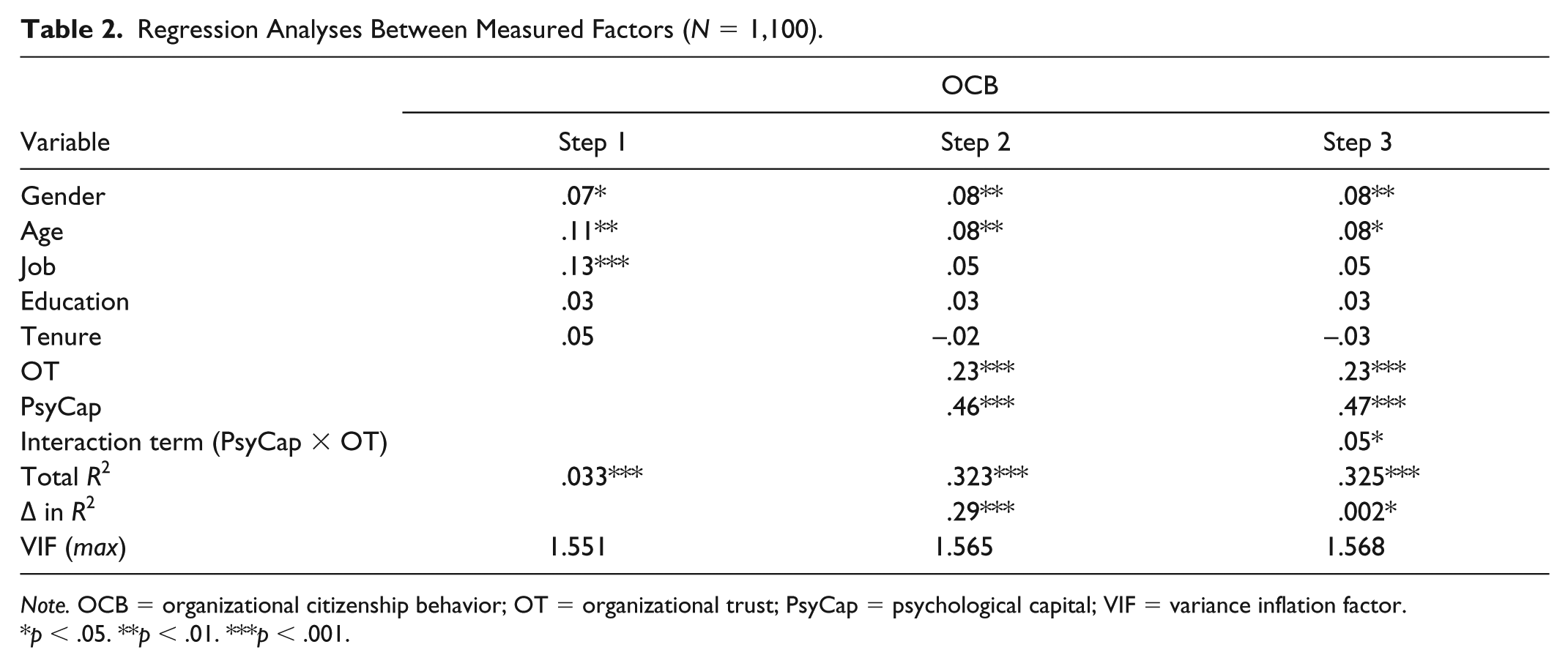
However, we need to provide more support than simple bivariate correlations for the hypotheses in this study. Therefore, hierarchical regression analyses were used to analyze both direct and interactive effects of positive PsyCap and OT on OCB. More particularly, the regression analysis with three steps was run. First of all, covariates of gender, age, tenure, job, and education were added to Step 1 to better separate the variance from independent variables in the dependent variables. In Step 2, both positive PsyCap and OT were entered into the regression models as independent variables. Finally, in the third and last step, the interaction term (PsyCap × OT) was entered into the regression model. This moderation variable was a standardized variable between positive PsyCap and OT. Findings of the regression analysis in Step 2 are shown in Table 2. H1a estimated that OT would be positively associated with OCB. As shown in Table 2, OT was a significant predictor of OCB after controlling for demographic characteristics (β = .23, p < .001), hence supporting H1a.
Regression Analyses Between Measured Factors (N = 1,100).
Note. OCB = organizational citizenship behavior; OT = organizational trust; PsyCap = psychological capital; VIF = variance inflation factor.
p < .05. **p < .01. ***p < .001.
Moreover, H1b, which estimated that positive PsyCap moderated the relationship between OT and OCB such that the relationship was stronger if PsyCap was high, was also supported. In other words, those who are high in OT and who have positive PsyCap would engage in the highest levels of OCBs. Particularly, the interactive effect of OT and positive PsyCap estimated small but significant variance beyond the direct effect of OT and positive PsyCap (ΔR2 = .002, β = .05, p < .05).
In exploring the nature of the interactive effect, simple slope tests using procedures recommended by Aiken and West (1991) were administered. Figure 2 was formed plotting the graph of the dimensions. Figure 2 shows that when PsyCap was high (b = .13, p < .000), increases in OT predicted increases in OCB, similarly, low levels of PsyCap was significant (b = .09, p < .000). However, when PsyCap was high, the interactive effect was higher than low levels of PsyCap. Thus, PsyCap may enhance the effect of OT on OCB because employees high in PsyCap can use their resources of self-efficacy, optimism, hope, and resilience (Roberts et al., 2011). Thus, overall, full support was found for both H1a and H1b.

Total effect moderation of positive PsyCap on the relationship between OT and OCB.
In the present study, the interaction effect is statistically significant; however, the change in R2 was small. A plausible explanation for this outcome might be the high mean value for PsyCap and low standard deviation. This implies that permutations of low and high levels of the moderator (i.e., PsyCap) may not have caused a high change in OCBs. Prior empirical evidence (i.e., Abubakar & Arasli, 2016; McClean, Burris, & Detert, 2013) reported similar patterns of interactions with high mean values and low standard deviations couple with a small change in R2. Furthermore, our observation denotes that the effect of OT on OCBs is mediocre, suggesting that an increase in both OT and PsyCap are likely to boost OCBs. To this end, this study highlights the importance of the interaction effects of OT and PsyCap in explaining greater levels of OCBs among health care employees.
Robustness check
In the interactive model, a very small change in R2 was observed. Therefore, to test the moderator effect, we also used a structural model using covariance-based SEM which is more robust and stringent than ordinary least squares (OLS). First, the variables to be included in the analysis were standardized. Then, the interaction term consisting of the product of the independent and moderator variable was obtained. Finally, all variables were included in SEM. As a result of the analysis, it was found that there was a significant interaction of OT and positive PsyCap on OCBs of health care employees. These results are also consistent with the results of the hierarchical regression analysis. Furthermore, all control variables were removed separately from the model and the model was re-tested. Although all five models run in this manner had minor changes, the interaction term still remained significant and the pattern of results stayed the same (p < .05). Although these findings alone cannot completely eliminate the possibility of suppression, they support confidence in the robustness of our results (McClean et al., 2013).
Conclusion
The current claims to make two significant contributions to the literature. First, it reveals the relationship between OT and extra-role behaviors (OCB) in terms of health sector employees. Indeed, the relationship between OT and OCB has been studied extensively in the past two decades. Therefore, the relationship has gained importance. It raises positive conditions while the level of trust in the organization and leader decreases due to negative conditions. There are many theoretical and empirical studies that supported the relationship between OT and OCB in the organizational literature (Deluga, 1994; Konovsky & Pugh, 1994; MacKenzie et al., 2001; Podsakoff et al., 1996; Podsakoff et al., 2000; Robinson, 1996; Van Dyne et al., 1995; Wech, 2002; Yoon & Suh, 2003). In these studies, OT was found to play an important role in the understanding of OCB. In line with this, it was found in the present study that OT is positively related to OCB in terms of health sector employees. Hence, the result parallels with above-mentioned studies. So, increasing trust attitude moves individuals toward better outcomes. As a result of the social exchange between employers and employees (Blau, 1964), as OT increases, employees are more likely to be grateful to the organization and then raise their motivation (Dyne et al., 1994; Morrison, 1994) and thus exhibit extra-role behaviors.
Last but more importantly, it empirically contributes to the theory that clarifies the extent to which followers’ positive PsyCap has a place in respecting how their trust in supervisor and organization comes out in the workplace. In brief, results suggest that followers’ positive PsyCap does matter to some extent with respect to OCBs. Yet, the importance is significant though small. Particularly, those high in PsyCap engage in more OCBs. Moreover, employees both high in positive PsyCap and high in OT would engage in the highest frequency of OCBs compared to those who are low in OT. Indeed, the link between these two variables proposed by Youssef and Luthans (2010) and S. Lewis (2011) is among the key propositions of the study. When these studies are considered, individual and organizational antecedents such as personality traits, organizational climate, culture, and leadership style can help affect followers’ positive PsyCap and OT (Gooty et al., 2009). Therefore, employees tend to rely on management and supervisor, and they constitute the positive emotions and form attitudes in a positive direction. Accordingly, these employees engage in more OCBs. Hence, those with higher levels of PsyCap and OT are more likely to gain positive outcomes, and consequently exhibit OCBs (Bitmis & Ergeneli, 2013; Clapp-Smith et al., 2009). Considering the direct effect of PsyCap on OCB, the fact that health care employees have a meaningful impact on the lives of others in terms of the task significance, in general, makes them more motivated against their work and thus leads to higher levels of OCB (Hackman & Oldman, 1976). Meanwhile, working under intense and deteriorating conditions provides that health care employees have higher levels of PsyCap (self-efficacy, hope, optimism, and resilience) in the process of time. Therefore, these employees are likely to reciprocate with higher levels of discretionary behaviors toward their work.
In this respect, positive PsyCap alters the strength of the causal relationship between OT and OCB. In addition, there is evidence for conceptual studies implying that high PsyCap is related to job performance (Fredrickson, 1998, 2001, 2003; Görgens-Ekermans & Herbert, 2013; Luthans, 2002a, 2002b; Luthans, Avey, et al., 2006; Luthans et al., 2010). On the contrary, there are also empirically proven studies (Luthans et al., 2010; Luthans et al., 2005; Peterson et al., 2011; Sweetman et al., 2011; Youssef & Luthans, 2007). High positive PsyCap was positively related to OCB in the present study. Also, in some studies, the effect of PsyCap on OCBs was investigated (Avey et al., 2010; Avey et al., 2011; Avey et al., 2008; Gooty et al., 2009; Norman et al., 2010). Hence, the result parallels with above-mentioned studies. As employees’ PsyCap is fostered, they are more likely to exhibit OCB. Positive PsyCap refers to the fact that the positive psychological developmental status of an individual activates positive emotions and orientations and directs the individual’s attention and focus on their patterns of thinking, tendencies, and behaviors. High levels of PsyCap refer to an employee’s positive job-related cognitions (Gooty et al., 2009). Thus, positive PsyCap states are likely to go beyond enhanced in-role performance and lead to “contextual” behaviors (discretionary behaviors) such as OCB. For instance, an employee who positively assesses his or her job works beyond the standard working hours or attends meetings not mandatory, but are considered important as he or she considers the likelihood to be useful to the organization of the behavior. From this practical point of view, this result emphasizes the importance of positive psychological resources and OT in activating the workforce toward OCBs. Positive PsyCap has a construct that is not constant under all circumstances and conditions. The construct can be measured, developed, and effectively managed for performance improvement (Luthans, Youssef, & Avolio, 2007). Therefore, the increase of positive PsyCap through various developing or training interventions allows for a higher level of extra-role behaviors (Luthans, Avey, & Patera, 2008). At this point, it is recommended that human resources departments focus on the development of this capacity and support it through various training interventions.
In conclusion, propositions in the studies of Youssef and Luthans (2010) and S. Lewis (2011) were supported in this study. In earlier research, the direct effects of positive PsyCap on OCB were considered; however, in the current study, the moderating effect on the relationship was better understood. From this standpoint, this study makes a contribution to POB literature. Likewise, the results of this study will provide guidance to supervisors, particularly to managers of the hospital who would like to determine the antecedents of health employees’ OCB. Besides, examining the relationships in the context of hospitals represents a new organizational setting. Public hospitals are health care institutions providing solutions to human health and which are open 24/7 and therefore they work under intensive workloads. Employees’ job-based cognitions and thereby attitudes can be affected negatively due to this intensity and some unfavorable organizational factors (e.g., negative organizational climate). As such, attitudes toward supervisors and organizations of employees may result in distrust due to this reason. As a result, distrust may lessen OCBs within the organization. To solve this problem in the organizational milieu, the positivity of employees should be supported and supervisors should exhibit behaviors supporting the positivity of employees. In addition, organizations should implement proactive human resource development strategies focused on improving employees’ overall positive PsyCap because these strategies may raise their attitudes of OT and OCB. Especially, positive PsyCap that provides organizations sustainable and competitive advantage should be developed through training intervention programs such as web-based training interventions, seminars. On the contrary, recruiting employees with high positive PsyCap is another option. Since the departments such as customer relationships or information office communicate directly with patients, these departments provide information to patients about the corporate culture, structure of the organization, and general business conduct. If organizations hire the right person (high positive PsyCap) for the right job, they will be perceived as positive by those who provide services. In this context, the measurement of PsyCap should be integrated into the recruitment process to gain a competitive advantage. In a nutshell, in future studies, this study should be tested in different sectors and repeated over time and extended by adding potential moderation or meditation variables.
Considering the control variables used in the study, it is noteworthy that gender, age, and job variables have effects on OCBs at various levels. In terms of gender, it was determined that female employees exhibited higher levels of OCB than men (Chou & Pearson, 2011; Farrell & Finkelstein, 2007). In terms of job, it was found that especially nurses and other health care workers have higher levels of OCB than physicians and dentists. Given the peculiarities of the professions of female and nurses (Zaghini, Biagioli, Prandi, Fida, & Sili, 2015), the fact that nurses are more concerned with the patients than physicians and that they meet many different needs and have a close relationship with them increases their motivation by causing them to realize the importance of their profession. Moreover, providing their jobs direct and explicit information from patients (i.e., their jobs has high feedback) motivates them to exhibit higher levels of discretionary behaviors (Hackman & Oldman, 1976; Mahnaz, Mehdi, Jafar, & Abbolghasem, 2013; Robbins & Judge, 2013). In addition, as the age increases, the level of expertise of employees and their commitment to their jobs increase incrementally and thus lead to exhibit higher levels of OCB (Chou & Pearson, 2011; Mahnaz et al., 2013).
Naturally, this study has some limitations. The first limitation is that the same source was used to collect data on both the predictor and criterion variables by respondents (common rater effect) at the same point in time (same measurement time effect). Our findings are potentially subject to common rater bias because all the data were the same measurement context (see Podsakoff, Mackenzie, Podsakoff, & Lee, 2003). As a result, this common source bias may cause inflated relationships. Therefore, as suggested by Elci and Alpkan (2009), we took a few procedural precautions such as using established scales and protecting anonymity to minimize common rater effect. Also, the observed correlations among positive PsyCap, OT, and OCB vary ranging from .19 to .51; therefore, common rater effect may be low. Frankly, this procedure can only help decrease but does not remove this limitation. In addition, Harman’s one-factor test was used to test the common method bias (CMB) problem (Podsakoff et al., 2003). The test result showed that although all items in the scale were included in the exploratory factor analysis, they were divided into more than one factors and at the same time a single factor did not cover the majority of covariance between measurements. On the contrary, when the items in the scale are loaded on a single factor, the total variance explained is 22.02% (test result <.50). These results indicate that the CMB is not a significant distortion of the research results (Harman, 1979). For this reason, we suggest future study designs that use longitudinal study designs and obtain measures of the study variables from different sources (e.g., colleagues and subordinates). Thus, how variations of psychological states may affect the trust is better understood.
The second limitation is our study design related to its scope (only on employees in the health sector) and content (only positive PsyCap, OT, and OCB). To overcome this limitation, the sample may be enlarged to different sectors (e.g., telecommunication, tourism, military). Future directions beyond this study may include testing additional outcome variables such as ethical behaviors, absenteeism, or counterproductive behaviors and control, moderating or mediating variables such as personality, culture, engagement, turnover intentions, or organizational silence.
Footnotes
Declaration of Conflicting Interests
The author(s) declared no potential conflicts of interest with respect to the research, authorship, and/or publication of this article.
Funding
The author(s) received no financial support for the research, authorship, and/or publication of this article.
