




Abstract
Demand for online education has increased in recent decades. Uptake of postgraduate nursing education in this mode is on the rise, yet many students do not achieve completion. Student engagement is vital to success in online postgraduate nursing programs. Technology enables a more efficient means of monitoring engagement, yet limited literature is available on how the design of online postgraduate nursing programs impacts student engagement. This integrative review aims to identify barriers and facilitators to engaging in online postgraduate nursing programs. Four databases, including Cumulative Index to Nursing and Allied Health Literature, Education Resources Information Center, Scopus, and Medline, were systematically searched to identify relevant literature published over the period 1990 to 2022. Fifteen papers met the inclusion criteria. Thematic analysis generated three themes: design and delivery, support and connectivity, and student factors and success. The findings of this review uncover the range of indiscriminate variables and experiences that students have with online learning, making engaging instructional design a complex process. Nursing faculty require time and resources to develop skills specific to delivering “distance” education without being distant to the students. This review concludes that online postgraduate nursing programs are not a panacea, with ethical issues identified for higher education providers.
Keywords
Introduction
Demand for online flexible learning is increasing, and online postgraduate nursing programs are no exception. This demand is increasing at a much faster rate than the demand for face-to-face modes of education in both Australia and the United States of America (USA) (Seaman et al., 2018; Stone, 2019). While nursing programs delivered online have allowed for greater access to undergraduate and postgraduate degrees, many students do not achieve completion. Student engagement is vital to their success in online nursing programs (Rioch & Tharp, 2022). Both undergraduate and postgraduate nursing students who are engaged in their learning have a higher chance of completing their degree (Hensley et al., 2021). Technology has been a significant driver for online education, allowing it to be delivered in efficient and accessible ways to a wide range of individuals (Tertiary Education Quality Standards Agency [TEQSA], 2020). Furthermore, technology allows online instructors to efficiently monitor student progress to minimize student disengagement (Roddy et al., 2017). Nevertheless, there is limited existing literature examining online postgraduate nursing programs and the ways that the design of such offerings can facilitate or hinder student engagement.
Mandatory physical distancing measures during COVID-19 necessitated universities to close campuses (Adnan & Anwar, 2020; TEQSA, 2020). Higher education providers and students capitalized on the accessible, convenient, flexible nature of online education during this period as they transitioned away from face-to-face delivery modes to the online space. Although many university campuses are now open, online modes of education delivery continue to be popular. In Australia, postgraduate part-time students are driving the popularity of online education (Latchem, 2018). Postgraduate students tend to be older, employed in a competitive labor market and increasingly seeking opportunities to upgrade their qualifications (Latchem, 2018). Additionally, some higher education providers are targeting external students, including postgraduate students, to maintain their total enrollments (Latchem, 2018).
A landmark report into the future of Australian nursing education identified that almost all nursing education programs include online instruction in their curriculum (Schwarz, 2019). The report also reinforced the benefits of online nursing education, including accessibility, convenience, and flexibility, which are particularly important for geographically isolated students (Schwarz, 2019). Accessibility for undergraduate and postgraduate nursing students is paramount in Australia as it is the sixth largest country in the world yet has the sixth lowest population density (World Population Review, 2023). A significant proportion of Australians (28%), live rurally and remotely (Australian Bureau of Statistics [ABS], 2022). Registered nurses (RNs) are working professionals most likely to hold at least a bachelors level or higher degree qualification (ABS, 2017). In addition, they make up more than 50% of the total healthcare workforce (Department of Health and Aged Care, 2021). Having accessible, flexible options for nursing students is crucial for growing and maintaining Australia’s largest healthcare workforce.
In postgraduate nursing, there are calls for more postgraduate level prepared RNs to meet the complex needs of contemporary patients in Australia and the USA (American Association of Colleges of Nursing, 2023; Darcy Associates Consulting Services, 2015). In a global literature review specific to Masters qualified nurses in Australia, New Zealand, and the USA, RNs were found to graduate with more confidence, greater clinical expertise, and enhanced employment opportunities (Cotterill-Walker, 2012). Access to postgraduate nursing education is known to increase job satisfaction (Bush & Lowery, 2016; Hallinan & Hegarty, 2016). Earlier studies suggest that employers are reluctant to release their employees and employees are reluctant to leave clinical settings to undertake postgraduate nursing education via face-to-face delivery (Black & Bonner, 2011; Coventry et al., 2015). Thus, online modes of delivery of postgraduate nursing are increasingly sought by RNs. Universities have stepped up to meet this demand, with a significant surge in the availability of online programs in recent years.
One complication when considering factors impacting online postgraduate nursing education globally stems from how online education is defined (Singh & Thurman, 2019). Singh and Thurman (2019) conducted a systematic review on the different ways non-traditional learning is defined in education literature over the past 30 years. Their findings revealed there are 46 definitions, many of which are used interchangeably and often incorrectly. While online education was one of the most common definitions, others include eLearning, blended learning, web-based and distance learning (Singh & Thurman, 2019). A series of reports that followed the trajectory of online education in the USA (Allen & Seaman, 2013; Seaman et al., 2018), illustrated the evolution of online education definitions. In 2013, online education was defined as a program course with up to 80% of the content delivered online with “typically no face-to-face meeting” (Allen & Seaman, 2013, p. 7). In 2018, this definition shifted to “Instructional content that is delivered exclusively via distance education. Requirements for coming to campus for orientation, testing or academic support services do not exclude a course from being classified as distance education” (Seaman et al., 2018, p. 5). In online postgraduate nursing, the variation in definitions has led to differing ways in how programs are described and delivered with the majority continuing to have a face-to-face or on campus component (Knestrick et al., 2016; Tiedt et al., 2021).
There is limited research that focusses on understanding student engagement for fully online nursing education programs—those that are delivered entirely online without any face-to-face component, and the factors that inform their delivery and/or student engagement in these programs. If the program includes a face-to-face component, then convenience and flexibility remains limited for students with competing professional and personal priorities. Likewise, accessibility becomes problematic for those individuals wanting to engage in education yet are constrained by geographical location. Accessibility also becomes problematic when RNs are not confident with technologies, or specific learning management systems and/or have limited access to internet, or software/hardware (Carpenter, 2016). Accessibility becomes particularly problematic for those RNs who cannot afford to interrupt work to pursue post graduate education (Bromley, 2010). These barriers to accessing online education raise questions about whether online education programs are in fact more accessible, convenient, or flexible for RNs.
For nurses and healthcare organizations, post graduate nursing programs provide an avenue for Continuing Professional Development (CPD) and formal education that supports the development of the capabilities needed to meet the complex, changing needs of the healthcare environment. As a key source of postgraduate programs, it essential that higher education providers deliver online post graduate nurse education that is in line with regulatory and accreditation bodies overseeing nursing education, which include TEQSA (2023) and the Australian Nursing and Midwifery Accreditation Council (ANMAC, 2022). Simultaneously, online postgraduate education needs to be accessible and of a quality that enhances students’ ability to engage in education and learn. The aim of this integrative review is to identify the barriers and facilitators to engaging in online postgraduate nursing programs. A deeper understanding of the barriers and enablers students experience when engaging in online postgraduate nursing programs could assist higher education providers to enhance pedagogical approaches to online education, and support students access to and engagement in these programs. The research question addressed in this review was: What do bachelors qualified nurses identify as barriers and facilitators to engaging in online postgraduate nursing programs?
Method
A systematic approach was employed in the identification, evaluation, analysis, and synthesis of the literature based on the integrative review process by Whittemore and Knafl (2005). The search protocol aligned with the Preferred Reporting Items for Systematic Reviews and Metanalyses (PRISMA) guideline (Page et al., 2021). EndNote version X9, and Covidence (an online platform for streamlining literature reviews) were used to manage the search results.
Search Strategy
The search strategy targeted four databases: Cumulative Index to Nursing and Allied Health Literature (CINAHL), Education Resources Information Centre (ERIC), Scopus, and Medline. The comprehensive list of search terms and resulting hits is reported in Supplemental File 1. The key search terms combinations included, “Students, nursing, graduate,”“Post graduate nurs*,”“Master prepared nurses,”“Distance education,”“Online education,”“Student engagement.” Search terms were adjusted to suit specific nuanced terms for each database. The search strategy was pilot tested in February 2021 in CINAHL and ERIC. The full search was performed in February 2021, then repeated in March 2022.
Inclusion and Exclusion Criteria
Table 1 outlines the inclusion and exclusion criteria. A date range filter from January 1990 to February 2021 was applied in each database for the first search, and from January 2021 to March 2022 in the second search. An English language filter was also applied to each database. January 1990 was selected due to the technical revolution commencing in this era that contributed to the rapid growth in online education (Kentor, 2015).
Inclusion and Exclusion Criteria.
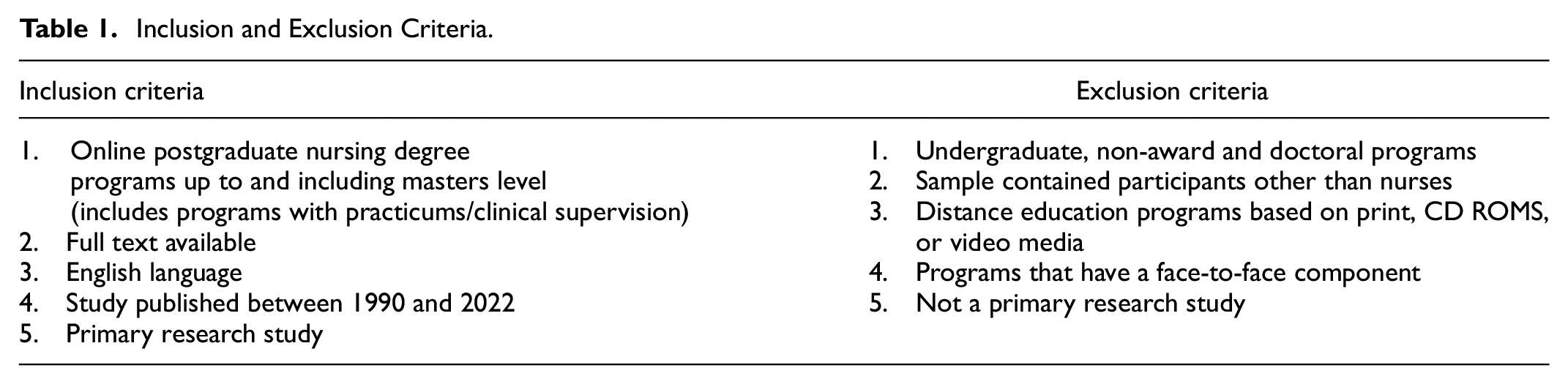
Studies were included if they investigated an online postgraduate nursing degree program up to and including Masters level, were primary research, available in full text, and published in English. Studies were excluded if they investigated doctoral programs, had a face-to-face component, or relied on print or video media.
Identification, Screening, and Evaluation
The searches yielded 855 results. All citations were imported into EndNote version X9 then into Covidence for identification of 76 duplicated articles, leaving 779 articles for screening based on the inclusion and exclusion criteria. Following the PRISMA guideline (Page et al., 2021) presented as Figure 1, the articles in Covidence were firstly screened via abstract/title then full text before selection of final papers for data extraction. The 779 articles were screened and 639 were excluded based on title and abstract. The remaining 141 articles were reviewed in full text. A final 15 articles were determined eligible for data extraction. The reference lists of the final 15 articles were checked for any eligible studies. To verify rigor, all studies were firstly reviewed by the lead author, then independently reviewed by a co-author. For articles where there were differing views, a third reviewer assessed the article before a consensus decision was reached. The authors met regularly to discuss the search strategy, search terms and inclusion and exclusion criteria, as well as checking for consistency in the review process. Each article was analyzed and critiqued according to the Mixed Methods Appraisal Tool (MMAT) (Hong et al., 2018). The critical appraisal was initially completed by the lead author. The co-authors independently confirmed the appraisal. The authors communicated regularly to verify the critical appraisal and discuss and resolve any discrepancies. The comprehensive completed critical appraisal is available at Supplemental File 2.

PRISMA flowchart of search and review process.
Analysis
Braun and Clarke’s (2022) approach to thematic analysis was used in this integrative review, allowing an inductive, data-driven, flexible, and exploratory approach to coding and theme generation. The lead author generated the initial codes that were then reviewed by all co-authors. Using a recursive, iterative process over several months tentative codes, sub-themes and themes were generated from the raw data. These codes, sub-themes, and themes underwent a cycle of rigorous review and refinement by the research team as the analytical process unfolded. The cycle finished when there was consensus that the final themes generated accurately reflected the complexity of the data and achieved the aims of this review.
Findings
Study Characteristics
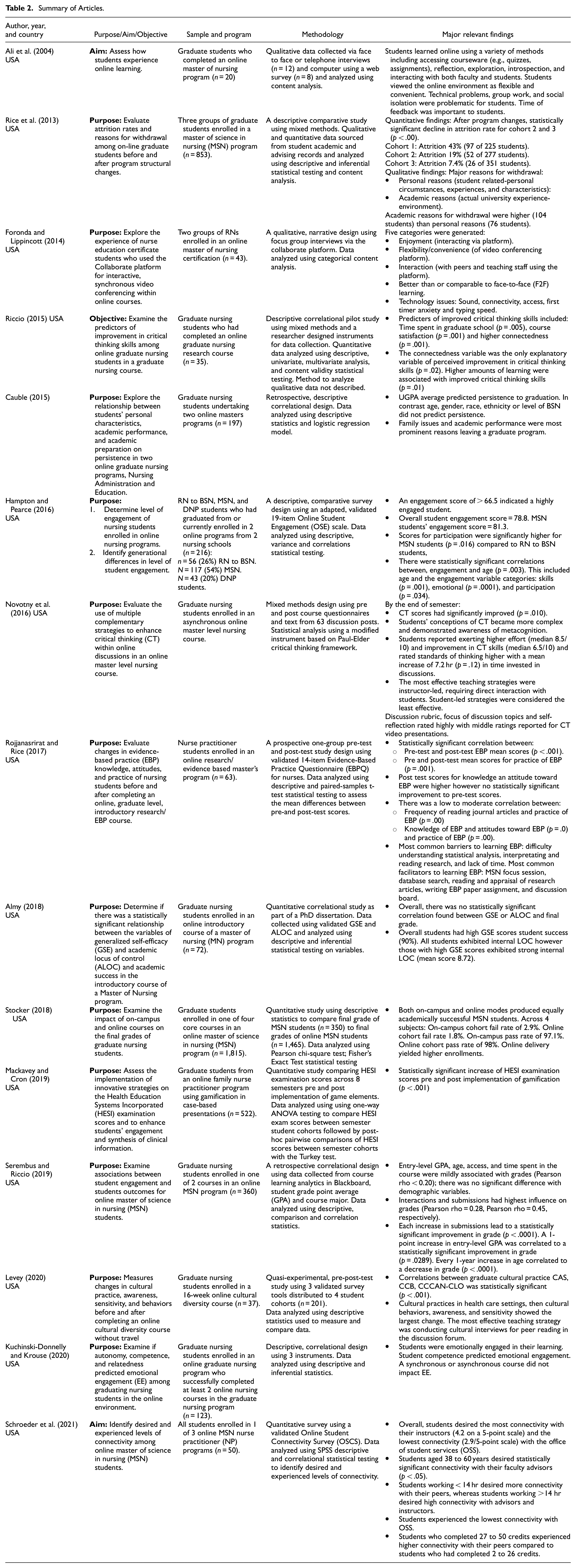
A chronological summary of the 15 studies included in this review is presented as Table 2. All studies were conducted in the USA. Eleven studies used a quantitative design (Almy, 2018; Cauble, 2015; Hampton & Pearce, 2016; Kuchinski-Donnelly & Krouse, 2020; Levey, 2020; Mackavey & Cron, 2019; Riccio, 2015; Rojjanasrirat & Rice, 2017; Schroeder et al., 2021; Serembus & Riccio, 2019; Stocker, 2018), two studies used a qualitative design (Ali et al., 2004; Foronda & Lippincott, 2014); and there were two mixed methods studies (Novotny et al., 2016; Rice et al., 2013). Students across the studies were postgraduate RNs enrolled in Master of Nursing program or subject/s within a Master of Nursing program. Programs of study ranged from family, primary care, psychiatric or mental health nurse practitioner (NP) programs, to adult gerontology, nursing administration and nursing education programs (Cauble, 2015; Foronda & Lippincott, 2014; Mackavey & Cron, 2019; Schroeder et al., 2021; Stocker, 2018). Seven studies did not indicate the program or subject type (Ali et al., 2004; Almy, 2018; Hampton & Pearce, 2016; Kuchinski-Donnelly & Krouse, 2020; Novotny et al., 2016; Riccio, 2015; Rice et al., 2013). All studies were single center studies, except for Hampton and Pearce (2016), which was a multicenter study. Although Hampton and Pearce (2016) included three cohorts of students: Master of Science in Nursing (MSN), RNs to Bachelor of Science in Nursing students (BSN) and Doctor of Nursing Practice (DNP) students, the authors reported on student engagement scores for each cohort separately. Therefore, the masters arm of this study met the inclusion criteria. The tools used to measure outcomes varied according to what was being investigated. These included: the Paul-Elder framework, Online student connectivity survey, Evidence based practice questionnaire (EBPQ), Classroom community scale, to Online student engagement scale (OSE), Basic needs satisfaction in general scale (BNSG), Online learning engagement (OLE) scale, Generalized self-efficacy (GSE), Academic locus of control (ALOC), Cultural competency assessment, Culturally congruent care for advanced nursing course objectives (CCCAN-CLO) and Health education systems incorporated (HESI) examination (Almy, 2018; Hampton & Pearce, 2016; Kuchinski-Donnelly & Krouse, 2020; Levey, 2020; Mackavey & Cron, 2019; Novotny et al., 2016; Riccio, 2015; Rojjanasrirat & Rice, 2017; Schroeder et al., 2021). Five studies relied on interviews or existing data sets (Ali et al., 2004; Cauble, 2015; Foronda & Lippincott, 2014; Rice et al., 2013; Serembus & Riccio, 2019; Stocker, 2018).
Summary of Articles.
Quality Appraisal
Overall, the studies varied significantly in respect of methodological quality. While all studies had at least one research aim, purpose, objective, or question, several studies provided incomplete descriptions of the study design, setting, participants and/or methods (Ali et al., 2004; Hampton & Pearce, 2016; Riccio, 2015; Rice et al., 2013). Rice et al. (2013) described a qualitative approach however did not specify the study design. Sample sizes varied across all the studies. While Cauble (2015), Hampton and Pearce (2016), Serembus and Riccio (2019), and Stocker (2018) had adequate sample sizes, several quantitative studies identified their sample size as a limitation to generalizability of findings (Kuchinski-Donnelly & Krouse, 2020; Levey, 2020; Rojjanasrirat & Rice, 2017; Schroeder et al., 2021). Some studies had limited evidence of addressing non-response bias (Almy, 2018; Hampton & Pearce, 2016; Novotny et al., 2016; Riccio, 2015; Rojjanasrirat & Rice, 2017; Schroeder et al., 2021).
Themes
Three major themes were derived from the analysis: design and delivery; support and connectivity; and student factors and success.
Theme 1—Design and Delivery
The first theme evident in the reviewed literature relates to the benefits to students of designing and delivering a program flexibly and conveniently (Ali et al., 2004; Foronda & Lippincott, 2014; Kuchinski-Donnelly & Krouse, 2020; Levey, 2020; Novotny et al., 2016). Students valued the ability to make choices about how and when to engage in their studies. Having the option to watch recorded sessions or revisit learning materials at their convenience in the comfort of their own home, combined with not having to drive or deal with parking, was highly valued (Foronda & Lippincott, 2014). When participating in synchronous teaching sessions, students described the ability to ask real-time questions as efficient, effective, interactive, and more learner-centered than anticipated (Foronda & Lippincott, 2014). Kuchinski-Donnelly and Krouse (2020) found that when students had the opportunity to engage with the program material asynchronously or synchronously, they experienced a high level of autonomy and perceived competence.
Effective design of discussion forums was identified as an engaging, accessible teaching strategy (Ali et al., 2004; Levey, 2020; Novotny et al., 2016). Students in the study by Ali et al. (2004) appreciated the easily accessible and competitive nature of asynchronous discussion chats because they had ample time to reflect, prepare, and respond. Shy students found it easier to participate in such cases. In addition, some students were motivated to outperform their peers when they could readily see each other’s work, reinforcing the competitiveness within discussion forums. Novotny et al. (2016) capitalized on the accessible nature of discussion forums, to create targeted teaching strategies that developed students’ critical thinking skills. Even though students reported a higher than expected effort rate to consistently engage in the discussion forums, there was a statistically significant minor (p = .010) improvement with their critical thinking skills between the beginning and end of the semester. Students also indicated that instructor-led direct interactions were the most effective teaching strategy. Levey (2020) also found that student-facilitated forums without instructor contribution were a less effective teaching strategy. Teaching strategies requiring minimal interaction from students such as video-based presentations, YouTube, and PowerPoint presentations, were similarly found to be less effective (Levey, 2020; Novotny et al., 2016).
Designing and delivering engaging program material was also important for improving the program quality or appeal (Mackavey & Cron, 2019; Rice et al., 2013; Stocker, 2018). Mackavey and Cron (2019) found that a gamification-based teaching strategy was broadly associated with enhancing the quality of the Master of Nursing program. The program was benchmarked against the Health Education Systems Incorporated (HESI) exam before and after the implementation of gamification (Mackavey & Cron, 2019). The HESI exam has been shown to effectively prepare nursing students to succeed in their certification exams (Elsevier Education, 2023). Findings indicated there was a statistically significant (p < .001) increase in the program quality with pre and post gamification implementation. Rice et al. (2013) reported on the effects of introducing two strategies to increase the appeal of an online Master of Nursing program; a 3-day program orientation, and extending the 8-week programs to 16 weeks. The authors found that attrition rates fell from 43% to 7.4%. Offering programs online can also positively impact enrollments. Stocker (2018) found that after several online campus programs were transitioned to fully online, enrollments increased more than 400% from 350 to 1,465.
Despite the positive impact a well-designed and delivered program can have on student engagement, several studies reported common barriers that impact students’ ability to engage with or learn in the online environment. The most reported barrier was technical problems (Ali et al., 2004; Foronda & Lippincott, 2014; Rice et al., 2013). Students experienced audio and connectivity issues with the learning management system, as well anxiety with using new technology (Foronda & Lippincott, 2014). When a technical issue did arise, students wanted a prompt resolution (Ali et al., 2004). In some instances, students found technical issues significant enough to withdraw from a program (Rice et al., 2013). Some students cited being a slow typist as a disadvantage to online learning (Foronda & Lippincott, 2014). The results of these studies suggest that designing strategies to overcome potential barriers to the delivery of online programs such as technical issues, could minimize the impact on student engagement in online education programs.
Theme 2—Support and Connectivity
Theme two, support and connectivity, emphasizes the importance of interactions in online postgraduate nursing programs. Teachers played a significant role in facilitating support and connectivity (Riccio, 2015; Schroeder et al., 2021). Schroeder et al. (2021) conceptualized connectivity as the intersection between social presence and sense of community. They investigated students desired and experienced level of connectivity and found that overall, students desired and experienced higher connectivity with their teachers throughout their program. This was particularly so for students who worked more than 14 hours a week or had completed more program credits. Closely related to connectivity, a sense of connectedness was associated with improved critical thinking skills in an online research program (Riccio, 2015). The students described connectedness as provision of ample opportunities to learn, engaging in course materials that promote a desire to learn, receiving timely feedback, and feeling that their educational needs were met. The sense of connectedness was optimal when it was driven by teachers who they deemed trustworthy (Riccio, 2015). Ali et al. (2004) supported the notion of timely feedback as an indicator to feeling supported by faculty. In addition, faculty who were approachable, nonjudgmental, supportive, and professional were highly regarded by students, a finding reiterated by Foronda and Lippincott (2014). Two successful mediums where faculty could demonstrate support and connectivity to students were via discussion forums (Ali et al., 2004; Riccio, 2015) and the online conferencing platform (Foronda & Lippincott, 2014). Having said this, some students still failed to feel a sense of connection with their instructors due to the element of anonymity and absence of body language in the online environment (Ali et al., 2004).
While teacher support was highly valued by students, to a lesser degree connecting with peers was also beneficial. Ali et al. (2004) found that undertaking group work allowed students to connect with peers in different geographical areas to learn about various clinical areas. Schroeder et al. (2021) found that students who worked 14 hours or less per week, or had less online learning experience, wanted more connectivity with their peers. The students in Kuchinski-Donnelly and Krouse (2020) study were more emotionally engaged and when they were able to relate well to their peers.
Theme 3—Student Factors and Success
This theme highlights factors that can impact students’ ability to have success in online learning and are difficult to regulate and modify. These factors are outside the scope of design, delivery, support, and connectivity. Studies indicated that students who enroll in online postgraduate nursing programs come with a range of indiscriminate variables, including age, generation, ethnicity, sense of self, and personal circumstances that may potentially be a facilitator, barrier, or make no difference to engagement and learning (Almy, 2018; Hampton & Pearce, 2016; Rice et al., 2013; Serembus & Riccio, 2019).
Hampton and Pearce (2016) found that baby boomers (those born between 1955 and 1964) were more engaged in their learning compared to millennials (born between 1981 and 1996) who were the least engaged of all students. Although Serembus and Riccio (2019) did not find any association between major, race, gender, or geography and overall grade, they found that students with a higher level entry grade point average (GPA) had a higher overall grade on completion of the program. They also found that older students had lower overall grades on completion of the program. Cauble (2015) also found that undergraduate GPA was a predictor of persistence to program completion.
Two studies found that personal factors, rather than characteristics of the program, were cited by students as reasons for withdrawing from study (Cauble, 2015; Rice et al., 2013). These factors included time, motivation, commitments, family issues (health, divorce, death), financial problems, and career choice. Finally, Almy (2018) found that both generalized self-efficacy (GSE), the level of student’s belief that they have the capacity to undertake study, and academic locus of control (ALOC), a student’s level of motivation and environmental influences on behavior, made no difference to the student’s final grade. Faculty have little or no control over these factors; however study findings suggest that because of their impact on learning, they need to be considered when designing and delivering online programs, and assessing student outcomes.
Discussion
The results of this integrative review contribute to the wide body of literature that identifies flexibility and convenience as hallmarks of online postgraduate education. Many online postgraduate nursing students are mature age and have competing professional and personal priorities. They also have a range of experiences with distance learning (Cipher et al., 2019). Both these factors necessitate educators to design and deliver distance postgraduate nursing programs in increasingly flexible and convenient ways. Programs need to combine asynchronous and synchronous learning that provide more choices for students in respect of the time and location of their study. However, there is a paradox associated with offering increasing choices (Schwartz, 2016); convenience and flexibility does not come without a cost to students.
Students are finding it increasingly difficult to incorporate online education into their complex lives. Often it can be challenging to find a dedicated space and uninterrupted time to study. COVID-19 exacerbated these issues, where students were impacted by a blurring of work, study, and schooling contexts (O’Keefe & Auffermann, 2022). Students found themselves studying and working from home along with other family members. Study time was reduced due to a need to accommodate school age children studying at home, limited availability of quiet spaces, and a requirement to share space and computer hardware and software with others (O’Keefe & Auffermann, 2022). Students who are less effective in prioritizing studying with home responsibilities may have decreased capacity to engage in their learning in a meaningful way. The result is an increased risk of not meeting program requirements, leading to underperforming, failing or withdrawing. It is important for students to be fully aware that studying online may not always the convenient and flexible option they are seeking for meeting their education needs. The paradox in online learning is that it has the potential to become an inflexible and inconvenient option that can impact students’ ability to successfully engage in online learning and have personal, financial and professional consequences.
From a higher education provider perspective, online postgraduate nursing attrition rates are concerning (Knestrick et al., 2016). Higher attrition rates may negatively impact a university’s reputation as an attractive place to study. Ultimately, when designing online programs, educators need to be aware that students have a wide variety of experiences with online learning. Furthermore, online learning may not be the student’s most important priority, and although students may enroll with full intent to meaningfully engage in their learning, the reality is some of them will be limited by time and commitment restraints leading to disengagement.
Given the link between student engagement and success, and the increasing popularity of learning online, the design of activities that promote student engagement when using online technologies require particular consideration. The term student engagement has evolved from the widely recognized theory in education, student involvement theory (Astin, 1999). Astin (1999) posited that college students who dedicate more physical and psychological time and effort to studying, being on campus, participating in university organizations, and interacting with faculty and other students, were more likely to have better educational and college experiences. While contemporary definitions of student engagement are vast, the major components of student engagement include behavioral and psychological, as well as emotional and cognitive factors (Bernard, 2015). Faculty developing online nursing programs can build opportunities for student engagement through creating interactive subject content and opportunities for peer to peer, as well as peer-to-teacher interaction. Rapid responses to communication and timely feedback on formative and summative assessment are also crucial strategies for maintaining student engagement.
Designing and delivering programs that meet postgraduate nursing students’ needs is however a complex process. Faculty need to be technically competent and skilled in instructional design. Use of educational design models and instructional designers can assist educators (Castro & Tumibay, 2021) however, nursing faculty can also benefit from workload relief to update skills and undertake program development to ensure quality in online nursing postgraduate programs. Workload relief encompasses reduced clinical load, minimal requirement to attend meetings, and decreased teaching load (Howe et al., 2018). Adequate workload release tends to promote greater job satisfaction (Howe et al., 2018). In nursing, online faculty who believe that they have institutional support are also more likely to be satisfied and more productive in their jobs (Wang & Liesveld, 2015). Higher education providers of online postgraduate nursing programs need to consider ways to engender more productive and satisfied nursing faculty through adequate skills development and resourcing.
Higher education institutions who offer online postgraduate programs have vastly increased accessibility for geographically distant students. However, “distance” education does not mean faculty can distance themselves from the student in an educational sense. This integrative review indicates that teacher presence is the most important source of support for postgraduate nursing students studying online. To facilitate meaningful learning and engagement, educators need to be present, and students need to feel supported by their educators. The Community of Inquiry (CoI) framework explains how cognitive, social, and teaching presence collectively facilitate a successful educational experience delivered via technology (Garrison, 2017; Garrison et al., 1999). Cognitive presence relates to the degree to which participants (teachers and learners) construct meaning from their learning. Social presence postulates the need for participants to present “as real people” (Garrison et al., 1999, p. 89). Teaching presence is driven by the instructor who can facilitate an optimum educational experience through the design, selection, and presentation of learning activities. This integrative review identified several teacher behaviors that added value to the educational experience of students, including timely feedback, and being approachable, non-judgmental, and supportive. Adding to the findings of this integrative review, Jones et al. (2022) indicated that faculty can demonstrate the social and teaching presence aspects of the CoI by being patient and respectful, presenting interesting and engaging lectures, and providing constructive feedback without shaming. Clearly, to facilitate learning and engagement, online postgraduate nurse educators need to be skilled in delivering “distance” education without being distant. Rather, they need to be present, authentic, and real.
Although once an optional mode of delivery, flexible modes of education have become widely accepted as an alternative to face-to-face learning in recent years, particularly following the COVID-19 pandemic. With the increase in prevalence of online programs, faculty and students have faced numerous challenges (O’Keefe & Auffermann, 2022). While many of these are practical in nature, ethical issues have also been raised. Shearer et al. (2020) suggest that online higher education should not be motivated primarily by the desire to increase enrollments, gratuitously use technology, or generate revenue for higher education providers. The same is true for the corporate world where many influential technology companies such as Google, Microsoft, Amazon, and Zoom, have expanded their educational services to capitalize on opportunistic profits now available in online learning following the impact of COVID-19 (Williamson et al., 2020). As seen in this integrative review, transitioning from on-campus to online learning can significantly increase student enrollments, however, there are still many uncertainties and limitations around this mode of educational delivery.
Greater accessibility to online postgraduate nursing education results in increasing enrollments, which has implications for faculty resourcing and workloads. Increasing enrollments of students with diverse ages, personal circumstances, and educational experiences is requiring more educators to transition to online teaching, often without sufficient capacity or capability to do so. Limited literature exists in respect of identifying which students and educators are best suited for the online postgraduate nursing environment. It should not be assumed that online education, with its unique pedagogy, can simply be transplanted online. Against this backgroup, educators need to be creative and innovative if they are to foster academic success. Educational programs, and those who deliver them, must account for the complex interplay of students factors, and accommodate the diversity that will determine the quality of their educational experience. The onus is on higher education providers to consider how best to balance the push for increasing enrollments and revenue, while still meeting the needs of educators and students.
Recommendations
To address the issues raised in this integrative review, three recommendations are offered. Firstly, higher education providers need to provide nursing faculty with time and resources to undertake professional development that ensures their readiness to teach in online modes. In addition to being skilled in program development and instructional design, these educators need time allocated to engage authentically and meaningfully with students. Secondly, as part of program orientation, students need to be aware that distance education is not a panacea for postgraduate nursing education and that they themselves may not all be suitable for learning via online modes. Online nursing faculty need to have robust measures in place to identify at risk students and provide early intervention without judgment to promote student success. Thirdly, technically competent faculty and students are essential to online education. Timely technical support must be available throughout the entire program, including weekends, particularly for intensive offerings where the duration is 8 weeks or less.
The wide variety of definitions of distance and flexible education, and the ways fully online postgraduate nursing programs are described in the literature, is a limitation of this integrative review. Furthermore, all studies incorporated into this review were conducted in the USA. Therefore the recommendations may have limited applicability to higher education providers who have hybrid educational modalities, and those who operate in other parts of the world. Future research should be undertaken that secures greater clarity surrounding definitions of distance and flexible education. Additionally, studies undertaken in other parts of the world may increase transferability of these results. Finally, this review revealed a paucity of the existing literature on online postgraduate nursing programs without face-to-face components indicating a pressing need for future research in this area.
Conclusion
The results of this integrative literature review raise several significant issues. It is clear that designing and delivering engaging program content is a complex process, and one that cannot simply be done as an extension of traditional educational product development. There is a very real risk that educators who lack the necessary skills to develop and deliver education in online modes can increase, rather than reduce, the conceptual distance between themselves and their students. As has been discussed in this paper, the potentional for student attrition is increased where the quality in design and delivery of online programs is lacking. Finally, it must be recognized that online postgraduate nursing programs are not a panacea. A number of limitations exist in the delivery of online nursing education, and these must be addressed if universities are to make an ethical contribution in advancing the education of nurses within the profession.
Supplemental Material
sj-docx-1-sgo-10.1177_21582440241240817 – Supplemental material for Engagement in Online Postgraduate Nursing Programs: An Integrative Review
Supplemental material, sj-docx-1-sgo-10.1177_21582440241240817 for Engagement in Online Postgraduate Nursing Programs: An Integrative Review by Anita Dunn, Helena Harrison, Holly L. Northam and Melanie Birks in SAGE Open
Supplemental Material
sj-docx-2-sgo-10.1177_21582440241240817 – Supplemental material for Engagement in Online Postgraduate Nursing Programs: An Integrative Review
Supplemental material, sj-docx-2-sgo-10.1177_21582440241240817 for Engagement in Online Postgraduate Nursing Programs: An Integrative Review by Anita Dunn, Helena Harrison, Holly L. Northam and Melanie Birks in SAGE Open
Footnotes
Acknowledgements
Nil.
Declaration of Conflicting Interests
The author(s) declared no potential conflicts of interest with respect to the research, authorship, and/or publication of this article.
Funding
The author(s) received no financial support for the research, authorship, and/or publication of this article.
Ethics Statement
N/A

Supplemental Material
Supplemental material for this article is available online.
Data Availability Statement
Data sharing not applicable to this article as no datasets were generated or analyzed during the current study.
References
Supplementary Material
Please find the following supplemental material available below.
For Open Access articles published under a Creative Commons License, all supplemental material carries the same license as the article it is associated with.
For non-Open Access articles published, all supplemental material carries a non-exclusive license, and permission requests for re-use of supplemental material or any part of supplemental material shall be sent directly to the copyright owner as specified in the copyright notice associated with the article.
