



Abstract
Amid accelerating global digitalization and technological transformation, the digital economy has emerged as a key driver of structural economic change. However, it also raises critical concerns related to the digital divide, information exclusion, and labor market restructuring, which may, in turn, affect social stability—most directly reflected in urban crime rates. This study systematically investigates the impact and mechanisms of the digital economy on urban crime rates in China’s Yangtze River Economic Belt. Through theoretical analysis and empirical testing using a fixed-effects panel regression model, we find that digital economy development exerts a significant long-term suppressive effect on urban crime rates. Mechanism tests confirm that digital infrastructure plays a crucial mediating role in this relationship. Moderation effect analysis reveals that the urban employed population strengthens the crime-suppressing effect, while the urban-rural income gap weakens it. Heterogeneity analysis further shows that the governance effect is more pronounced in cities with high carbon emissions and substantial digital divides. These findings highlight the importance of considering local socioeconomic conditions in digital governance and provide a nuanced understanding of the digital economy’s role in urban public safety.
Introduction
Against the backdrop of accelerating global informationization and technological evolution, the digital economy has emerged as a pivotal force driving economic growth and societal transformation (Al-Kasasbeh, 2024). Its core features include leveraging technologies such as the internet, big data, and artificial intelligence to reshape traditional industries and social governance systems, making it widely regarded as the engine of a new wave of industrial revolution (Özdemir & Hekim, 2018). In recent years, more countries have elevated the digital economy to a strategic national priority. In China, with the implementation of the “Internet Plus” strategy and “New Infrastructure” policies, the digital economy has rapidly permeated various sectors of production and public governance, becoming a key driver of high-quality development (Pan et al., 2022).
However, the digital economy is not merely a new engine of economic growth; it also profoundly reshapes social structures and governance systems (Niu, 2022). The expansion of digital infrastructure and the rise of platform-based economies are redefining urban social ecologies, contributing to enhanced information transparency and improved governance efficiency. At the same time, they have triggered a range of potential risks, such as widening digital divides (Molala & Makhubele, 2021), information exclusion (Watling, 2010), and shifts in employment structure (Zhang et al., 2022). These dual effects demand more nuanced research and policy approaches regarding the role of the digital economy in social governance.
Urban crime serves as a crucial indicator of social stability and governance effectiveness, and its formation mechanism is highly complex, shaped by the interplay of various factors such as economic development (Gümüş, 2004), demographic structure (Laub, 1983), and public service provision (Piggott, 2015). Traditional research has largely focused on micro-level digital tools—such as smart surveillance systems and public information platforms—for their potential to prevent or deter criminal behavior (Niu, 2022). However, comprehensive, macro-level analyses on how broader digital economic development impacts urban crime remain scarce—particularly concerning pathways through which variables like unemployment (Alves et al., 2018), income inequality (Piggott, 2015), and education levels influence crime.
The relationship between the digital economy and urban crime presents a fundamental paradox that demands careful theoretical and empirical scrutiny. While digital technologies may enhance precision management and suppress certain types of crime (Lavorgna & Ugwudike, 2021), they simultaneously enable new forms of criminal activity in cyberspace (Zhou et al.,2024). The emergence of cybercrime, including online fraud, identity theft, cryptocurrency-related offenses, and dark web transactions, represents a significant expansion of the criminal landscape. This “double-edged sword” effect raises critical questions about the net impact of digitalization on overall urban security.
From a theoretical perspective, two competing mechanisms coexist in the digital economy-crime nexus. The crime-suppressing mechanism operates through multiple channels: First, following Becker’s (1968) rational choice framework, digital employment opportunities raise the opportunity cost of criminal behavior by providing legitimate income sources and career prospects. Second, enhanced digital surveillance and data-driven policing increase the probability of detection and apprehension, thereby strengthening deterrence effects (Cohen & Felson, 1979). Third, improved information transparency and reduced information asymmetry in digital platforms may reduce opportunities for certain traditional crimes (Grabosky, 2017). Conversely, the crime-enabling mechanism manifests through the creation of new criminal opportunities with potentially lower detection risks, the technological empowerment of criminal networks through encrypted communications and anonymous transactions, and the exacerbation of social inequalities through digital divides that may intensify relative deprivation and criminal motivations (Holt & Bossler, 2014; Lusthaus, 2018).
Despite growing recognition of these dual effects, systematic empirical evidence on the net impact of digital economy development on aggregate urban crime remains surprisingly scarce. Existing literature has predominantly adopted a bifurcated approach—either focusing on digital tools for crime prevention (Kumar et al., 2023; Duxbury & Andrabi, 2024) or examining the rise of cybercrime as an isolated phenomenon (Lagazio et al., 2014)—but rarely examining the overall balance between crime reduction and crime displacement or creation. This empirical gap is particularly problematic for policymakers investing billions in smart city initiatives and digital infrastructure without clear evidence of their net effect on urban security. Furthermore, the conditions under which the crime-suppressing effects might dominate the crime-enabling effects—such as employment levels, income distribution, or regional development characteristics—remain theoretically ambiguous and empirically untested.
Against this backdrop, the Yangtze River Economic Belt (YREB) stands out as one of the most dynamic and policy-focused regions in China’s economic landscape, making it an ideal empirical setting for this study. Spanning 11 provinces and municipalities across eastern, central, and western China, the region exhibits significant gradients in economic development. It encompasses both digitally advanced metropolitan clusters and relatively underdeveloped prefecture-level cities. These interregional disparities are not only evident in the development of digital infrastructure, but also reflected in structural differences such as carbon emission intensity and the rural-urban digital divide. Taking the YREB as a case study, this research seeks to explore the following three core questions:
First, what is the net effect of digital economy development on overall urban crime rates when both traditional crime reduction and potential crime displacement are considered?
Second, under what socioeconomic conditions—particularly employment capacity and income distribution—does the crime-suppressing effect of digitalization dominate?
Third, how do regional structural factors, such as carbon emission intensity and the urban-rural digital divide, shape the effectiveness of digital economy in crime governance?
To address these questions, this study applies Principal Component Analysis (PCA) to integrate multi-type crime data and construct a composite crime index along with category-specific indicators. It then employs a fixed-effects panel regression model to estimate the direct impact of digital economy development on urban crime rates. Urban employment and urban-rural income ratio are introduced as moderating variables to identify potential moderation mechanisms. Furthermore, carbon emission intensity and the urban-rural digital divide are used as grouping criteria to conduct heterogeneity analyses. From a systems perspective on social governance, this study aims to uncover the complex relationships between the digital economy and urban crime, offering theoretical insights and policy implications for advancing digital governance modernization and promoting urban safety.
Theoretical Framework and Hypotheses Development
An Integrated Theoretical Framework
To systematically explain the mechanism through which the development of the digital economy affects urban crime rates, this study proposes the Digital Transformation and Crime Control Framework. The core logic of this framework lies in distinguishing between the driving factor and the channel of effect: the level of digital economy development, as a macro-level driver, exerts its influence primarily by shaping the digital infrastructure as the core mediating mechanism. Digital infrastructure, in turn, reconstructs urban opportunity structures, modes of social control, and degrees of social integration, ultimately affecting crime rates. This process is significantly moderated by specific urban socioeconomic contexts.
Specifically, within this framework, the level of digital economy development refers to the comprehensive scale and maturity of a city’s economic and social activities driven by digital technology; it is the source independent variable explaining changes in crime rates. Digital infrastructure (including broadband networks, mobile payment systems, digital identity platforms, etc.), on the other hand, is the material carrier and technological manifestation of the former, acting as the core mediating variable through which the effect is realized. In other words, digital economy development represents the “strategy” and “input,” while digital infrastructure represents the “tactics” and “channel.”
Theoretical Foundations
Opportunity structure theory: The opportunity structure dimension draws from Cloward and Ohlin’s (2013) differential opportunity theory, which posits that crime results not merely from blocked legitimate opportunities but from the interaction between legitimate and illegitimate opportunity structures. In their seminal work, they argued that delinquent behavior emerges when individuals have access to illegitimate means while lacking access to legitimate ones. Merton’s (1938) strain theory provides the foundational understanding that crime represents an adaptation when legitimate means to achieve culturally valued goals are unavailable. The digital economy fundamentally restructures both sides of this equation. As Acs (2023) demonstrates, digital platforms create new legitimate opportunities through reduced barriers to entry in e-commerce, gig economy participation, and digital entrepreneurship. Simultaneously, digital traceability and blockchain technologies increase the costs and risks of illegitimate activities (Wall, 2024). This dual transformation—expanding legitimate opportunities while constraining illegitimate ones—represents a qualitative shift from traditional economic development that primarily affects crime through income and employment channels alone.
Social control theory: The social control dimension synthesizes insights from both formal and informal control theories. Hirschi’s (1969) social bond theory establishes that crime is prevented through attachments to conventional society, commitment to conformity, involvement in legitimate activities, and belief in moral validity of rules. Laub and Sampson (1993) extended this framework through their age-graded theory of informal social control, demonstrating how social bonds evolve across the life course. In the digital context, these control mechanisms are fundamentally transformed. Formal control is enhanced through what Kumar et al. (2023) term “algorithmic guardianship”—AI-powered surveillance, predictive policing algorithms, and real-time crime mapping that increase both actual and perceived risks of detection. Informal control operates through new digital mechanisms: community WhatsApp groups for neighborhood watch, social media platforms that enable rapid information sharing about suspicious activities, and digital reputation systems that create stakes in conformity (Palma-Borda et al., 2025). Sampson et al. (1997) concept of collective efficacy—communities’ capacity for social control—is both challenged and potentially enhanced by digital connectivity, depending on whether digital tools strengthen, or fragment community bonds.
Social integration theory: The integration dimension builds upon Gibson et al.’s (2002) classical insight that crime reflects the degree of social integration and regulation within society. His anomie theory suggests that rapid social transformation can disrupt normative structures, leading to increased deviance. The digital transformation represents precisely such a disruption, but with complex implications for integration. Room’s (1995) social exclusion theory provides a modern framework for understanding how multiple, interconnected disadvantages create criminogenic conditions. Silver (1994) further elaborates how exclusion from economic, social, and political systems compounds disadvantage. In the digital era, Helsper’s (2012) corresponding fields model demonstrates how digital and social exclusion reinforce each other—those lacking digital access are excluded from increasingly digitized social and economic opportunities, deepening their marginalization. Conversely, digital inclusion can promote integration through access to online education, digital financial services, e-governance platforms, and virtual social networks. Whether digital economy promotes integration or exclusion depends critically on the inclusiveness of digital infrastructure and services (Reddick et al., 2024).
Establishment of Research Hypotheses
The Overall Impact of the Digital Economy on Urban Crime
The digital economy fundamentally alters the urban crime environment through simultaneous transformation of opportunity, control, and integration structures. Unlike traditional economic development that primarily affects crime through income and employment, digital transformation represents a qualitative shift in how society organizes economic activity, governance, and social relations.
First, digital platforms restructure opportunities by creating new legitimate pathways (e-commerce, gig work, digital entrepreneurship) while constraining illegitimate ones through digital traceability and algorithmic detection. Second, digital technologies enhance both formal control (smart surveillance, predictive policing) and informal control (community apps, social media monitoring). Third, digital connectivity can either promote integration through inclusive services or deepen exclusion through digital divides. The net effect on crime depends on how these three transformations interact within specific urban contexts.
Mechanism Factors: How Digital Economy Influences Urban Crime
Building on the framework, we argue that digital infrastructure serves as the central mediating mechanism linking digital economy development to urban crime outcomes. Specifically, digital infrastructure operates through three interconnected theoretical pathways identified in our framework:
First, regarding opportunity structures: Digital infrastructure (broadband networks, mobile payment systems) lowers entry barriers to legitimate economic participation through e-commerce platforms and gig economy access, while simultaneously enhancing the traceability of illegitimate transactions through blockchain records and digital payment monitoring. This dual transformation restructures both sides of the opportunity equation posited by differential opportunity theory.
Second, regarding social control mechanisms: Digital infrastructure provides the technical foundation for both formal control (AI-powered surveillance, predictive policing algorithms, real-time crime mapping) and informal control (community-based digital platforms, online reputation systems). This aligns with Hirschi’s (1969) social bond theory and Sampson et al.’s (1997) concept of collective efficacy, now extended into digital space through what Kumar et al. (2023) term “algorithmic guardianship.”
Third, regarding social integration: Access to digital infrastructure determines whether populations are included in or excluded from emerging socioeconomic opportunities. Inclusive infrastructure fosters integration by connecting marginalized groups to education, financial services, and e-governance platforms, consistent with Room’s (1995) social exclusion framework. Conversely, uneven infrastructure access creates digital divides that reinforce social exclusion and anomie (Helsper, 2012; Reddick et al., 2024).
Thus, digital infrastructure functions as the pivotal channel through which digital economy development simultaneously restructures opportunities, enables new forms of control, and mediates social integration—ultimately affecting urban crime rates.
Contingency Factors: Why Employment and Inequality Matter
The framework recognizes that digital transformation’s crime effects are not uniform but contingent on pre-existing socioeconomic conditions that shape how the three mechanisms operate.
The digital economy, through the expansion of service sectors, platform-based work, and remote employment, has shown the potential to absorb labor, especially among marginalized groups and in smaller cities (Acs, 2023). Lu et al. (2023) find that the digital economy enhances labor market flexibility, with pronounced effects for youth and women.
Employment levels indicate a city’s capacity to translate digital opportunities into real economic inclusion. Job creation is widely recognized as a key mechanism for social integration and crime prevention. According to opportunity cost theory, stable employment increases the expected benefits of legal activities, reducing the incentive for criminal behavior (Gümüş, 2004). In high-employment cities, robust labor markets and institutional support systems ensure that digital platforms create genuine legitimate opportunities rather than precarious pseudo-employment. For social control, employed populations have greater stakes in conformity, making them more responsive to enhanced digital controls. In low-employment contexts, digital transformation may create visible opportunities that remain practically inaccessible, potentially increasing frustration and crime.
Therefore, urban employment capacity may moderate the relationship between digital development and crime. In cities with high employment levels, the crime-reducing effects of digital expansion are likely to be stronger; in cities with persistent unemployment, these effects may be weakened or even reversed.
From a social stratification perspective, the impact of the digital economy on income distribution is highly heterogeneous. On one hand, it may enhance fairness by improving information efficiency and expanding inclusive services (Au, 2024); on the other, it may widen income gaps between high- and low-skilled labor, particularly across urban and rural regions (Peng & Dan, 2023).
Inequality as a Contingency Factor: Income inequality affects how digital control mechanism’s function and whether digital services promote integration or exclusion. Regarding social control, income inequality can weaken social trust, and increase frustration among disadvantaged groups, indirectly raising the risk of crime (Maddah, 2013). In equal societies, digital surveillance is perceived as collective security; in unequal ones, it’s seen as elite domination, reducing legitimacy, and compliance. For integration, digital services in equal contexts promote universal integration, while in unequal contexts they may create “digital privilege” that deepens social divisions. High inequality thus undermines both the control and integration mechanisms of digital transformation.
Hence, the level of urban-rural income inequality may condition the effectiveness of digital development. In cities with narrower income gaps, the digital economy may function more effectively as a tool for social stabilization; in more unequal cities, its positive effects may be diluted.
Structural Heterogeneity: Why Context Shapes Digital Transformation
The framework further recognizes that structural characteristics of cities create fundamentally different contexts for digital transformation’s operation.
Carbon emission intensity is often used as a proxy for regional industrial structure and ecological governance capacity. High-carbon cities are typically dependent on traditional heavy industries, have older infrastructure, and often face higher environmental and governance burdens (Shangguan, 2024a). These structural limitations may restrict the digital economy’s capacity to scale and integrate into public management (Shangguan, 2024b). Digital transformation in these contexts faces three challenges: (1) opportunity structures remain tied to physical production rather than digital platforms, (2) industrial spatial patterns limit digital surveillance effectiveness, and (3) industrial working-class culture may resist digital integration. Low-carbon, service-oriented cities have pre-adapted structures that amplify digital transformation’s crime-reducing potential. Therefore, we expect that the crime-reducing impact of the digital economy will be less pronounced in regions with higher carbon emission intensity.
The urban-rural digital divide determines what proportion of the population can access digital transformation’s benefits. Where divides are narrow, digital economy operates as a universal force affecting entire urban populations. Where divides are wide, digital transformation creates a “dual city”—one digitally integrated with expanding opportunities and effective controls, another digitally excluded and potentially criminogenic. Wide divides thus create conditions where digital economy may paradoxically increase aggregate crime by deepening social fractures.
The digital divide across regions reflects structural inequalities in infrastructure, access, and digital literacy. According to Reddick et al. (2024) access to digital services is significantly constrained by education, income, geography, and language barriers. When large portions of the population remain digitally disconnected, the reach, and effectiveness of digital governance tools are significantly diminished. Thus, in cities with a wider urban-rural digital divide, the capacity of the digital economy to reduce crime is likely to be weakened.
Methods and Data
Methods
Principal Component Analysis
Urban crime rates are influenced by a multitude of factors, and the number of indicators derived from case data is substantial. To ensure representativeness and reduce dimensionality, we selected eight major types of criminal offenses that rank highest in frequency and jointly account for over 90% of total urban crime cases. These include: Property Theft (PT), Financial Fraud (FF), Illegal Gambling (IG), Drug Trafficking (DT), Public Provocation (PP), Vehicular Offense (VO), Reckless Driving (RD), and Intentional Assault (IA). Each category reflects different dimensions of urban criminal activity. However, correlations exist among these indicators, potentially leading to multicollinearity and redundancy in the statistical analysis. To address this issue, Principal Component Analysis (PCA) was employed to extract common components and reduce data dimensionality. This method yields two key synthetic indicators: the Crime Rate Factors (CRF) and the Overall Criminal Crime (OCC), which collectively capture the primary variance across multiple crime categories. All criminal case statistics are sourced from China Judgements Online, the China Urban Statistical Yearbook and the CNRDS database (https://www.cnrds.com).
Kernel Density Estimation of Crime Rate Trends
This study employs Kernel Density Estimation (KDE) to examine the temporal trend of crime rates. KDE is a non-parametric estimation technique characterized by its low dependence on predefined model structures and strong robustness, making it particularly suitable for analyzing distributions with irregular or unbalanced features. By generating a smooth, continuous density curve, KDE effectively illustrates the underlying distributional shape of random variables and provides an intuitive estimate of their probability density. Let


In Equation 1,

In Equation 3,
Empirical Models
Baseline Model Specification
This study utilizes city-level panel data from China spanning 2014 to 2021 to empirically examine the impact of digital economy on urban population crime rates. The baseline econometric model is specified as follows:

In the model, subscript i denotes the city and t denotes the year. The dependent variable
Variable Description.

Mediation and Moderation Model
To empirically examine the theoretical mechanisms and boundary conditions outlined in our framework, we implement the following econometric strategies. We adopt a causal-steps approach (Baron & Kenny, 1986) to investigate whether digital infrastructure serves as a mediating channel between the digital economy and urban crime. This method involves estimating a series of regression models:


A significant mediation effect is supported if
To assess how socioeconomic contexts reshape the digital economy-crime relationship, we introduce interaction terms into our fixed-effects models. The model specification is as follows:

Here, the coefficient
Data
Digital Economy
In this article, we adopt the “Peking University Digital Financial Inclusion Index” (PKU-DFIIC) compiled by Guo et al. (2020) as a proxy indicator for the level of digital economic development in China. This index was jointly developed by the Peking University Digital Finance Research Center and Ant Group Research Institute, based on massive micro-level transaction data provided by Ant Group (Appendix). It covers 31 provinces (municipalities directly under the central government and autonomous regions), 337 prefecture-level cities and above, and approximately 2,800 counties in mainland China, spanning the period from 2011 to 2023 (with county-level data available from 2014 to 2023).
The index is built around three dimensions: coverage breadth, usage depth, and digitization level, with a total of 33 indicators. Weights are assigned using the analytic hierarchy process (AHP) and coefficient of variation method, and a logarithmic efficacy function is applied for normalization to ensure cross-sectional and temporal comparability.
As a key manifestation of the digital economy in finance, digital financial inclusion effectively captures the penetration and application depth of digital technologies. Thus, the index is widely adopted in academic research as a reliable measure of subnational digital economic development (Zhang et al., 2019), particularly for finer-grained urban-level analysis.
We employ the city-level version of this index as our main explanatory variable. Sourced from publicly available reports of the Peking University Digital Finance Research Center, it offers an accurate and detailed basis for examining the relationship between digital economy development and other urban economic phenomena in China.
Research Geographic Scope
The geographic scope of the study can be seen in Figure 1. The research focuses on the Yangtze River Economic Belt in China, which is highlighted in the national context map on the left panel. The Yangtze River Economic Belt encompasses key provinces characterized by significant economic activities, diverse demographic profiles, and varying levels of digital infrastructure, providing an appropriate empirical context for examining the relationship between the digital economy and crime trends.

Geographic scope of the study.
Results and Discussion
Principal Component Analysis Results
To eliminate the effects of differing scales and units across indicators in the sample, all data were first standardized and normalized. After preprocessing, a factor model suitability test was conducted on the relevant indicators. According to the results of the Kaiser–Meyer–Olkin (KMO) measure and Bartlett’s Test of Sphericity, the KMO value exceeded .7 and the significance level was below .05, indicating that the data are appropriate for principal component analysis (PCA). The detailed results of the PCA are presented in Table 2.
Results of Principal Component Analysis.

Based on the Kaiser criterion (eigenvalues greater than 1), two principal components were successfully extracted from the initial set of eight crime-related indicators. Specifically, Component 1 has an eigenvalue of 4.278, explaining 53.48% of the total variance, while Component 2 has an eigenvalue of 1.045, accounting for an additional 13.06% of the variance. The cumulative variance contribution of these two components reaches 66.54%, indicating that they capture the majority of information contained in the original variables. This suggests that the factor extraction results are statistically reliable. Furthermore, to enhance interpretability, a rotation of the factor loading matrix was performed, and the resulting rotated component matrix is presented in Table 3.
Rotated Component Matrix.

Note. Bold values indicate strong factor loadings, demonstrating which variables contribute most significantly to each principal component. Variables with higher loadings are more strongly associated with their respective component, facilitating interpretation of the underlying factor structure.
Based on the rotated component matrix, the first principal component is primarily associated with PT, FF, IG, PP, and RD. These variables reflect multiple dimensions of urban economic crimes, and thus, this component is labeled as the Economic Crime Factor (ECF). The second principal component captures information from DT, VO, and IA, which more accurately represent non-economic or violent criminal behaviors. Hence, it is defined as the Non-Economic Crime Factor (NECF). The factor score formulas for ECF and NECF are given as follows:


Based on the eigenvalues and variance contribution rates reported in Table 3, a weighted aggregation of the two principal components is performed to construct a comprehensive index of urban criminal activity. Specifically, the OCC is calculated as a weighted sum of ECF and NECF, with weights corresponding to each component’s share of the total variance explained. The calculation formula for OCC is as follows:

Kernel Density Estimation Results
The results of the unconditional Kernel Density Estimation are illustrated in Figure 2a (Kernel density plot) and Figure 2b (density contour map). In both graphs, the X-axis represents the OCC value in year t, while the Y-axis represents the OCC value in year t + 3. From the density contour map, it is evident that the density center lies below the 45-degree diagonal, indicating an overall downward trend in urban crime rate over time. In areas with low levels of criminal activity, the probability density is symmetrically distributed around the diagonal, suggesting relative stability in crime rates for these cities. In contrast, for areas with higher levels of criminal activity, the probability mass shifts significantly away from the diagonal, which reflects a more unstable and divergent dynamic. This distributional pattern implies that cities with lower crime rates tend to maintain stable crime levels, whereas cities with higher crime rates are more likely to experience polarization, with some continuing to deteriorate while others improve.

Results of Kernel density estimation. (a) Kernel density plot, (b) density contour map.
The reliability of these findings is strengthened by their alignment with prior research using Kernel Density Estimation (KDE) to evaluate regional disparity and dynamic convergence patterns in China. Studies such as Deng et al. (2017) and Guo (2009) demonstrate that KDE effectively captures both convergence and divergence dynamics in nonparametric distribution analyses, particularly under conditions of heterogeneity across cities or provinces. Furthermore, similar polarization effects and “club convergence” dynamics—where low-crime cities converge toward stability while high-crime cities diverge—have been documented in the evolution of digital economy and green innovation patterns across Chinese prefectures (Xue et al., 2023; Zhang et al., 2024).
Baseline Regression Results
To address potential multicollinearity among the explanatory variables, a Variance Inflation Factor (VIF) test was conducted. The results show that all VIF values are well below the commonly accepted threshold of 10, indicating no serious multicollinearity. In addition, unit root tests confirm that there are no unit root problems in the panel data. Model selection procedures were conducted using the F-test, Lagrange Multiplier (LM) test, and the Hausman test, all of which support the use of a two-way fixed effects model. Accordingly, the baseline estimation is performed using city and time fixed effects. To verify the robustness of the results, we conducted a robustness check by excluding municipalities directly under the central government and provincial capital cities (e.g., Shang Hai, Nan Jing, Nan Chang, He Fei, Cheng Du, Kun Ming, Hang Zhou, Wu Han, Gui Yang, Chong Qin, Chang sha.). The results show that after excluding these cities, the impact of DE on NECF becomes statistically insignificant. However, the effects of DE on both the ECF and OCC remain significantly negative. These findings indicate that the baseline regression results are relatively robust. The baseline regression and robustness test results are reported in Table 4.
Results of Baseline Regression and Robustness Test.

Note. t-statistics in parentheses.
p < .01. **p < .05. *p < .1.
As shown in Table 4, the coefficients of the DE are consistently negative and statistically significant across all three baseline models (1) to (3): −.0071 (p < .05) in Model 1, −.0089 (p < .1) in Model 2, and −.0074 (p < .01) in Model 3. These results confirm Hypothesis H1 and further demonstrate that in the current context of China’s digital economy, it has a stable and significant suppressive effect on both economic and non-economic crime types. This finding is consistent with the conclusions of Li and Li (2025). Potential mechanisms include improved information transparency, optimized employment structure, and enhanced social governance capacity (Li & Li, 2025); as well as increased opportunity cost and reduced expected gains from committing crimes due to digital economic advancement. In fact, China’s ongoing initiatives such as “Digital China” and “Smart Cities” have significantly advanced the digitalization of public governance. Digital technologies are now deeply integrated into public security, grassroots management, and social assistance systems (Palma-Borda et al., 2025). Moreover, they have reshaped urban governance structures and enhanced capabilities in managing social risks (Zhang et al., 2024). Thus, the crime-reducing effect of the digital economy—driven by both technological tools and structural transformations—is both theoretically plausible and empirically verifiable.
This study examines the impact of the digital economy on criminal crime, and logically, reverse causality is not an evident concern since individual criminal activities do not influence the overall development of a city’s digital economy. Nevertheless, two potential endogeneity challenges remain in the empirical analysis. First, both the digital economy and criminal crime may be simultaneously affected by unobservable city-specific factors, which introduces an omitted variable problem. For instance, factors such as regulatory intensity and law enforcement standards—difficult to measure—might promote digital economic development while concurrently reducing crime rates. Omitting these factors could lead to an underestimation of the coefficient
Drawing on the research by Li and Wu (2023) on the digital economy, to mitigate these endogeneity issues, this study employs two instrumental variables. Specifically, IV1 is defined as the product of the per-100 persons fixed telephone count in 1984 and the previous year’s national information technology services revenue; IV2 is defined as the density of long-distance optical cables. The instrumental variable regressions, shown in Table 5, reveal that after instrumenting, the coefficient on the digital economy remains significantly negative at the 1% to 5% level, suggesting that the baseline regression is not substantially compromised by endogeneity. The Kleibergen–Paap LM statistic (idstat) for the under-identification test in all models significantly exceeds conventional critical values, and the corresponding p-values (idp) are all .000, which is well below the .1 significance level. This indicates that the null hypothesis of under-identification is strongly rejected at the 1% significance level, confirming a significant correlation between the instrumental variables and the endogenous variables, thus satisfying the identification condition. Additionally, the F-statistics (widstat) for the weak instrument test in all models are substantially greater than 10 (approximately 65.93 for IV1 and 376.35 for IV2), far exceeding the Stock-Yogo critical value at the 10% maximal bias level (typically around 16.38). This demonstrates that the selected instrumental variables do not suffer from weak instrument problems and exhibit strong explanatory power, effectively addressing endogeneity concerns.
Endogeneity Test Results.

Note. t-statistics in parentheses.
p < .01. **p < .05.
Mediation and Moderation Analysis Results
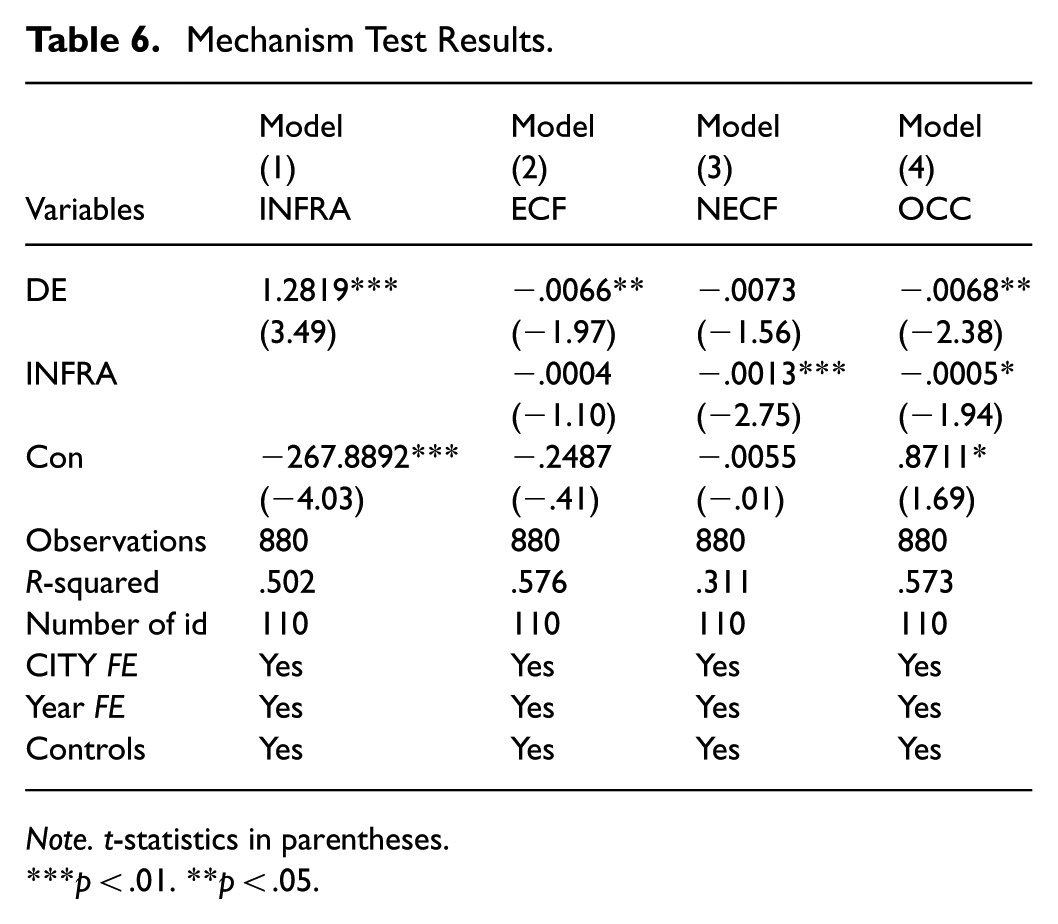
The study employs the number of international internet users as a proxy for digital infrastructure (INFRA) to test its mediating role and empirically validate Hypothesis 2 (Table 6).
Mechanism Test Results.
Note. t-statistics in parentheses.
p < .01. **p < .05.
In summary, the instrumental variables pass both the under-identification test and the weak instrument test, indicating that the model specification is appropriate, the instrumental variables are valid, and the estimation results are reliable. It is worth noting that although the dependent variables differ (ECF, NECF, OCC), the test results for the same instrumental variable across different models are highly consistent, further supporting the robustness of the instrumental variable selection.
Model (1) examines the impact of the DE on the mediating variable—INFRA. The results show that the coefficient of DE is significantly positive at the 1% statistical level. This indicates that regions with higher levels of digital development also have significantly higher levels of digital infrastructure construction, satisfying the first prerequisite for the mediation effect test.
Models (2) to (4) incorporate the mediating variable (INFRA) while controlling for the digital economy (DE) to observe its impact on three types of crime rates. The results reveal significant heterogeneity across crime types. Specifically, an improvement in INFRA has the strongest suppressive effect on the NECF, with a coefficient that is significantly negative at the 1% level. Simultaneously, it also shows a significantly negative impact on the OCC. However, for the ECF, the coefficient of INFRA, although negative, is not statistically significant.
In summary, the mediation effect test results partially support research Hypothesis 2. The development of the digital economy does significantly promote the construction of digital infrastructure, and the improvement of this infrastructure, in turn, significantly reduces both non-economic and overall crime rates. This suggests that the construction of digital infrastructure is an effective mediating pathway through which the digital economy influences crime rates, particularly non-economic crime. However, this mechanism’s impact on economic crime is not fully supported by the statistical tests, implying that economic crime may be driven by other, more direct or complex mechanisms.
The study uses the logarithm of urban employment population (UEP) and the urban-rural income ratio (URIR) as moderating variables to empirically test Hypotheses H3 and H4, with the estimation results reported in Table 7.
Moderation Effects of UEP and URIR.

Note. t-statistics in parentheses.
p < .01. **p < .05. *p < .1.
Models (1) to (3) incorporate the interaction term DE * UEP into the baseline model. The results show that the coefficient of the interaction term DE * UEP is consistently negative and statistically significant at the 1% level, while the main effect of DE is statistically insignificant. Because of the consistent trend across these three models, only the moderating effect of Model (3) is visualized in Figure 3a. As seen in Figure 3a, UEP significantly moderates the impact of DE on OCC, with the digital economy exerting a stronger crime-reducing effect in cities with higher employment levels. These findings validate Hypothesis H3.

Moderating effects of UEP and URIR. (a) UEP, (b) URIR.
This result is not only statistically robust, but also theoretically consistent with existing empirical research and China’s labor market structure. Studies have demonstrated that employment opportunities serve as a key deterrent to crime by increasing the opportunity cost of criminal behavior (Cheong & Wu, 2015). In the Chinese context, digital economy development has been closely linked to the expansion of service sector jobs, platform-based employment, and remote work, particularly in second- and third-tier cities. These employment forms have absorbed labor surplus and reduced the vulnerability of youth and migrant populations—two demographics highly correlated with urban crime risk (Wang et al., 2020). The finding that higher UEP levels enhance the crime-suppressing effect of digitalization therefore reflects both the employment multiplier effects of digital transformation and its crime-prevention benefits under inclusive labor dynamics.
Models (4) to (6) include the interaction term DE * URIR. The results show that the DE * URIR coefficient is generally positive and statistically significant at the 5% level, though it is insignificant in Model (5). Meanwhile, the main effect of DE remains negative and significant at the 10% level across all three models. Since the trend is basically consistent, only the moderating effect of Model (6) is visualized in Figure 3b. As shown in Figure 3b, URIR increases over all OCC, indicating that higher urban-rural income inequality weakens the crime-mitigating effects of digital development. Therefore, Hypothesis H4 is also supported.
This finding aligns with well-documented theoretical expectations and empirical evidence on inequality and social disorder in transitional economies. In China, urban-rural inequality has long been recognized as a structural challenge—especially in central and western regions where income disparities persist despite macroeconomic growth (Song et al., 2020). Research shows that rising income inequality, particularly when it limits access to public services or digital infrastructure, exacerbates feelings of relative deprivation and social exclusion, which are key predictors of crime in urban contexts (Xie & Deng, 2018). Therefore, the positive moderating effect of URIR reflects a policy-relevant insight: without equitable digital and economic access, the benefits of technological progress in reducing crime may be attenuated or even reversed in inequality-prone environments.
Heterogeneity Analysis Results
Heterogeneity by Carbon Emission Intensity
To empirically test Hypothesis H5, we conducted a heterogeneity analysis by classifying Chinese prefecture-level cities into two subgroups based on their carbon emission intensity: High Carbon Emissions (HCE) and Low Carbon Emissions (LCE). Specifically, we calculated the annual average carbon dioxide emissions for each city and defined HCE cities as those above the sample median, while cities at or below the median were categorized as LCE. Separate baseline regressions were then performed for each subgroup. As shown in Table 8, Models (1) to (3) report the results for LCE cities, where the estimated coefficients of the DE are consistently statistically insignificant. In contrast, Models (4) to (6), which correspond to HCE cities, reveal significantly negative coefficients for DE at the 5% significance level. These results suggest that the crime-reducing effect of the digital economy is more pronounced in cities with higher carbon emission intensity. However, the lack of significance in LCE cities indicates that Hypothesis H5 is only partially supported.
Heterogeneity Analysis: HCE Versus LCE Cities.

Note. t-statistics in parentheses.
p < .01. **p < .05. *p < .1.
The significant effect of the digital economy in high-carbon cities may be attributed to more develop digital infrastructure and stronger regulatory systems in these regions (Meng et al., 2023). In areas with greater environmental pressure and more advanced green policy frameworks, digital governance tends to be more effective. There is growing evidence that digital public safety systems and environmental monitoring technologies operate in synergy, enhancing overall governance outcomes (Huang & Wu, 2024). This pattern aligns with China’s recent policy orientation that prioritizes “smart city” development and “dual carbon” strategies in regions with higher environmental risks. Conversely, many LCE cities are characterized by a concentration in light industry or service sectors, and are often located in the underdeveloped central or western regions. These cities frequently suffer from limited digital infrastructure, insufficient fiscal capacity, and weak administrative effectiveness. As a result, the digital economy may not yet have matured to a point where it can exert a measurable impact on crime governance (Zhu et al., 2022).
Heterogeneity by Urban–Rural Digital Divide
To test Hypothesis H6, we divided the full sample into two subsamples based on the degree of the urban–rural digital divide: High Urban–Rural Digital Divide (HUD) and Low Urban–Rural Digital Divide (LUD). Specifically, we calculated the annual average urban–rural digital gap for each city, and defined HUD cities as those with values above the sample median, while cities at or below the median were classified as LUD. We then conducted separate baseline regressions for each group. As shown in Table 9, Models (1) to (3) present the results for LUD cities, where the coefficients for the DE variable are consistently statistically insignificant. In contrast, Models (4) to (6), corresponding to HUD cities, display significantly negative coefficients for DE at the 5% significance level. These findings suggest that the digital economy has a more pronounced crime-reducing effect in cities with a greater urban–rural digital divide. However, due to the lack of statistical significance in LUD cities, Hypothesis H6 is only partially supported.
Heterogeneity Analysis: HUD Versus LUD Cities.

Note. t-statistics in parentheses.
p < .01. **p < .05. *p < .1.
The observed heterogeneity can be interpreted in light of China’s regional disparities in digital infrastructure, access, and capability. In HUD areas—where disparities in broadband penetration, digital literacy, and access to smart services are more pronounced—residents often lack the means to benefit from digital crime-prevention tools, thereby weakening the crime-reduction impact of digitalization (Chen et al., 2010). In such regions, the digital economy’s public safety benefits may be offset by informational exclusion and administrative blind spots. By contrast, LUD regions—typically located in economically advanced eastern provinces—have achieved more equal digital access across urban and rural populations, allowing the digital economy to play a more effective governance role. The effectiveness of crime reduction in LUD cities may stem from a more inclusive digital public service system, higher ICT literacy among residents, and more integrated surveillance and e-governance platforms (Liu et al., 2019).
Conclusion
Main Findings
This study systematically investigates the impact of the digital economy on urban crime rates and its underlying mechanisms through theoretical analysis and empirical testing. The main conclusions are as follows: First, baseline regression results indicate that the development of the digital economy exerts a significant long-term suppressive effect on urban crime rates. Second, mechanism tests confirm that digital infrastructure plays a crucial mediating role in this relationship. Specifically, digital economy development significantly promotes the advancement of digital infrastructure, which in turn effectively reduces crime rates. This finding is empirically supported by mediation effect tests. Third, moderation effect analysis shows that the urban employed population strengthens the crime-suppressing effect of the digital economy, while the urban-rural income gap weakens this effect. Fourth, heterogeneity analysis reveals that the governance effect of the digital economy is more pronounced in cities with high carbon emissions and a substantial digital divide.
Policy Implications
Based on these findings, several policy recommendations can be proposed to enhance the crime-reducing potential of the digital economy under differentiated urban conditions in China.
Promote inclusive digital infrastructure development with a focus on narrowing the urban-rural digital divide. As this study shows, digital governance is more effective in regions with mature access systems and higher digital literacy. National and local governments should prioritize investments in broadband coverage, digital platforms, and public service access in underserved areas—particularly in low-emission and low-income regions—to ensure that the benefits of digitalization are equitably distributed.
Enhance urban employment absorption capacity as a core strategy for integrating digital development with crime prevention. Targeted support for digital industries, platform employment, and flexible labor policies in cities with large labor inflows—especially for migrant workers and youth—can strengthen the positive moderating effect of employment and reduce social marginalization.
Mitigate the weakening effect of income inequality on digital governance by more closely integrating fiscal and redistributive policies with digital transition plans. Expanding digital financial inclusion, increasing public investment in education and upskilling, and supporting low-income groups through e-government channels can amplify the stabilizing role of the digital economy.
Adopt differentiated digital governance models according to regional carbon intensity and development stage. In high-emission, industrialized cities, digital strategies should be coordinated with ecological governance and social risk prevention frameworks to achieve co-benefits. In contrast, in low-emission, service-oriented cities, digital investment should focus more on social integration and public safety co-management.
Limitations and Future Research
This study has several limitations that point to directions for future research.
First, although we have verified the mediating role of digital infrastructure, the digital economy may influence crime rates through other channels (e.g., social capital, psychological perceptions). Future research could explore more complex multiple mediation models.
Second, while the measurement of the digital economy is based on an authoritative index, future studies could develop a more comprehensive evaluation system by integrating multi-source data, including real-time transaction data, platform usage statistics, and micro-level behavioral indicators, to better capture the multidimensional nature of digital transformation.
Third, due to data availability, the examination of new forms of crime, such as cybercrime is insufficient. As these crimes become increasingly prevalent in the digital age, subsequent research should strengthen analysis in this area and investigate how the digital economy’s relationship with traditional crime differs from its relationship with cyber-enabled offenses.
Footnotes
Appendix: Construction of the Digital Inclusive Finance Index
In this study, the digital economy is proxied by the Digital Inclusive Finance Index developed by the Institute of Digital Finance at Peking University and Ant Financial Research Institute (Guo et al., 2020). The index is widely used in empirical research and provides provincial-, prefectural-, and county-level panel data. The construction follows a transparent and replicable process, which we summarize below.

Ethical Considerations
Not applicable.
Funding
The authors disclosed receipt of the following financial support for the research, authorship, and/or publication of this article: This work was supported by Hubei Provincial Federation of Social Sciences Post-Funded Project (HBSKJJ20243266) and Open Fund Project of Key Research Base of Humanities and Social Sciences in Hubei Province Universities, Research Center for Reservoir Resettlement (2022KFJJ04).
Declaration of Conflicting Interests
The authors declared no potential conflicts of interest with respect to the research, authorship, and/or publication of this article.
Data Availability Statement
The datasets used in this study are available from the corresponding author upon reasonable request.