




Abstract
Chinese government has been advocating a reduction in energy intensity in its efforts to meet peak carbon targets, particularly in the context of emerging economic growth and frequent technological breakthroughs. This study assesses China’s digital economy based on regional data experience and constructs a non-linear dynamic threshold model that incorporates heterogeneity thresholds for low-carbon technology innovation into the impact mechanism to explore whether the digital economy can effectively reduce regional energy intensity. It is found that China’s digital economy currently shows an overall upward trend with fluctuations in parts and a wide gap between the rich and the poor. Further, a significant heterogeneous threshold effect of low-carbon technology innovation exists in the effect of digital economy development on energy intensity: a lower level of low-carbon technology innovation is not advantageous to the decrease of energy intensity by digital economy development, while as the level of low-carbon technology innovation increases and exceeds the “threshold value,” the effect of digital economy development is effectively enhanced to a certain extent, thus promoting the reduction of energy intensity. As the level of low-carbon technology innovation raises and surpasses the “critical value,” the impact effect of digital economy development is heightened to a certain extent, thus promoting the decrease of energy intensity. The study replies the question of how to effectively use low-carbon technology innovation to accomplish digital economy development and help reduce regional energy intensity, which provides a reference for achieving the goal of carbon peak and accelerating green and high-quality economic development.
Plain language summary
This paper takes into account the "threshold effect" to understand the relationship between digital economy development, low-carbon technology innovation and energy intensity better.
Keywords
Introduction
Being the main input factor of economic growth, energy plays an essential role in the fast development of the global economy. However, for most developing countries, for example, China, the economic growth is relatively sloppy and inefficient energy use still exists in different regions, resulting in increasing energy consumption. China is in the stage of industrial development of intensive exploitation of resources and rapid consumption, and energy consumption dominated by fossil fuels is still the most extensive energy consumption mode. Energy intensity, defined as the ratio of energy inputs to economic output (Hou et al., 2018), reflects the financial efficiency of energy use and the contribution and cost of resources and environment per unit of economic growth. At this stage, the proportion of coal consumption in general is descending by years, but fossil energy is still a vital part of the energy consumption structure. Rough use of fossil energy is the “chief culprit” of carbon emissions. Therefore, accelerating energy saving, improving energy use and reducing energy intensity are of great relevance for the green and high-quality development in the global economy at this stage.
With the in-depth application of digital technologies like the Internet and big data, together with the pressing demand of society from all walks of life for Internet and digitalization, the digital revolution continues to affect various countries and industry sectors. The report of the 20th National Congress of the Communist Party of China (CPC) pointed out that it is necessary to accelerate the construction of a digital China and a strong network country; it is necessary to accelerate the development of the digital economy, and to create an internationally competitive digital industry cluster. The Chinese government proposes to build the Digital China, containing the building of a digital economy, digital community and digital government, to drive the change of production, lifestyle and governance with the development of the digital economy as a whole, and to increase the part of the increased value of the digital economy core industries from 7.4% to 10% of the target request in 2025. The digital economy is the result of the tide of the digital revolution, and the proportion of the digital economy is inventoried as one of the main targets of economic and social development (Hong & Murmann, 2022). In addition, the Green New Deal for Europe and Japan's Green Development Strategy both put forward that the development of the digital economy will accelerate social and economic green and low-carbon development. Research shows that digital technologies can reduce carbon emissions by more than 20% (Abdul et al., 2019). It can be seen that the digital economy has become a key power in energy saving and emission reduction, and also provides strong support to achieve the goal of “carbon peaking.” However, few studies have identified the development of the digital economy as one of the drivers influencing changes in energy intensity.
Enhancing resource utilization efficiency and promoting green technological progress are inevitable requirements for the economy to achieve sustainable development. The biggest difference between low-carbon technology innovation and traditional innovation is that it does not focus on economic growth as the only goal, but also on the improvement of ecological benefits and environmental quality (Tang et al., 2020). Therefore, focusing on the effect of low-carbon technology innovation is irreplaceable in stimulating the digital economy to reduce energy intensity. Most scholars believe that low-carbon technology innovation contributes to reducing energy intensity by enhancing the efficiency of energy use and realizing substitution between energy and other factors (Tan & Lin, 2018; Ahmer et al., 2021; Xu et al., 2022). However, Khazzoom (1980) considers that technological advances lead to more efficient energy use, and the increase in efficiency also implies a reduction in the cost of energy use and economic growth, possibly increasing the consumption of energy. Meanwhile, Y. Chen et al. (2016) found a passive effect of low-carbon technology innovation on energy intensity. In addition, Victor & Reiner (2020) found that there is a non-linear effect of low-carbon technology innovation on energy intensity, and a non-linear effect of different technological innovation sources and structural changes on industrial energy intensity. It is worth noting that there is a wide variability among regions with different resource structures, levels of competitiveness and even the external environment, which leads to various complex factors influencing energy intensity, and the mechanism and scope of influence of different factors on energy intensity may vary from place to place. Existing studies have neglected the nonlinear threshold points at different levels of low-carbon technological innovation, which to some extent has led to biased results. This raises some interesting and thought-provoking questions: Under the different levels of low-carbon technology innovation in China, what are the mechanisms and endogenous differences in the development of regional digital economies on energy intensity? Is any regional digital economy development effective in reducing energy intensity? How to coordinate the contradiction between the energy environment and the economic growth through the digital economy development?
Based on these issues, this paper takes into account the “threshold effect” to understand the relationship between digital economy development, low-carbon technology innovation and energy intensity better. Firstly, this paper builds a comprehensive digital economy development assessment index system to measure the heterogeneity structure of China. Second, this paper includes digital economy and low-carbon technology innovation into the theoretical mechanism framework of regional energy intensity, and answers the question of how to effectively use low-carbon technology innovation to digitize and promote regional energy intensity reduction in the digital economy era, and explores the non-linear “threshold” characteristics and heterogeneity factors of the relationship between the development of digital economy and energy intensity caused by regional differences in low-carbon technology innovation, and whether the threshold or turning point exists in this relationship. The research results provide a reference on the effective use of low-carbon technology innovation to accomplish digital economy development, promote the reduction of regional energy intensity, and accelerate green and high-quality economic development.
Literature Review
Energy is an important foundation of economic development. The energy not only directly affects energy supply and demand, but also affects energy utilization efficiency. In the process of China’s rapid development, the energy intensity is declining, which is conducive to reducing energy consumption and reducing environmental pollution. Therefore, exploring energy intensity has important theoretical and practical significance. Related studies on energy intensity, Koilakou et al. (2022) found that income level, the population size affects energy intensity in Germany and the United States to varying degrees. At the same time, Hena and Bansal (2022) explored the impact of PAT on the energy intensity of energy-intensive industries in India. Wu, Fareed, Wolanin, et al. (2022) considered that green finance and eco-innovation have a significant positive impact on energy intensity in all economies, variables such as economic growth and trade openness also have an impact on energy intensity. Rahman et al. (2023) found that industrialization has a positive impact on energy intensity in both the long and short term; In the long run, trade openness will hurt energy intensity, but it is not significant in the short term. Oteng-Abayie et al. (2023) found that Ghana’s energy intensity presents an oscillating pattern, and renewable energy, rural electrification and digitalization have direct and indirect long-term asymmetric effects on the total energy intensity. It is concluded that the development of a digital economy can reduce energy consumption and intensity, which provides empirical evidence for using low-carbon technology to reduce energy consumption and improve energy utilization efficiency to reduce energy intensity. Specifically at the regional level, L. Zhang et al. (2022) a non-linear "inverted U-shaped" relationship in environmental regulation and energy intensity in east and central China, and a non-linear “U-shaped” relationship in western China.; and economic variety and energy intensity have a significant negative effect under the environmental barriers in the eastern region. Similarly, J. X. Wu et al. (2018) Wu et al. considered that the energy intensity of cities in various levels of China is influenced by the income level of the population. From these studies, we know that there is a nonlinear relationship between environmental regulation and energy intensity, which provides a research idea for us to study the relationship between low-carbon technological innovation and energy intensity. Focusing on the industrial level, Hou et al. (2023) found that the green transformation of Chinese industry has a significant negative effect on carbon intensity, but it is still limited by the critical threshold of environmental regulation. Further, based on different economic development level perspectives, Xue et al. (2022) found that there is an inverted U-shaped heterogeneous effect of renewable energy development on energy intensity. After the above-mentioned scholars’ research, it is found that the existing related research on energy intensity is more about the influence of energy price, environmental regulation, industrial structure or trade openness on energy intensity, and less about the development of the digital economy as one of the driving forces that affect the change of energy intensity.
The digital economy promotes the transformation of energy productivity in the economy and society through technological innovation, and gradually becomes a new driving force and engine to improve the high-quality development of the industry. The digital economy is an important component of the modern economic system and an important driving force to promote high-quality economic development. Grasping the key points of digital economy development is the key to maintaining high-speed economic growth, achieving high-quality development and building a modern and powerful country. Studies related to the development of the digital economy in different theoretical perspectives have increased significantly. At the social level, Jane (2011) considered that the development of the digital economy can improve people's living quality and contribute to the structural change of society through digital technology. Pouri and Hilty (2021) showed that the digital economy builds a platform for sharing practice through digital technology, making it an example of social digital transformation, allowing a large number of peers to share what others have provided and enjoy the shared economic and social benefits. Particularly in the medical field, Kwon et al. (2021) described the transformation of medical care from the traditional face-to-face form to online care through digital tools during the fight against the COVID-19 epidemic. In recent years, data-driven digital transformation in the healthcare environment used data analysis and digital technology to improve business processes and decision-making (Yaspal et al., 2023). In the field of banking and finance, Liu et al. (2022) studied the impact of Chinese digital technologies on its labor, product, and loan market equilibrium outcomes. Kasri et al. (2022) found that there is a balanced and long-term relationship between digital payment transactions and the stability of Indonesia’s banking industry, and further concluded that there is a one-way causal relationship between digital payment and bank stability, and there is a positive short-term relationship between variables. In terms of agricultural development, Jiang et al. (2022) found that the digital economy can improve the green development of Chinese agriculture significantly, and a regional heterogeneity exists in the degree of impact, Mikhaylova et al. (2021) studied the impact of digitization on the efficiency of the digital economy supply chain management in each country. The impact of the digital economy on the employment structure and workplace conditions of the workforce (Muntaner, 2018), on energy and green economy efficiency (L. Zhang et al., 2022; Ciocoiu, 2011), and the development of the digital economy and the high-quality development of China’s economy (Mei & Chen, 2016; Ren & He, 2022). Based on the cybersecurity perspective, Ukwuoma et al. (2022) reviewed the cybersecurity measures in developed countries to maintain the stable development of the digital economy and sought the methodological path for the digital economy to contribute to economic development.
The digital economy promotes the transformation of economic and social energy production efficiency through low-carbon technological innovation and gradually becomes a new driving force and engine to promote the green, low-carbon and high-quality development of the industry. Research on digital economy development and energy intensity is mainly concentrated on energy-using efficiency and carbon emission mechanisms. First, X. Chen et al. (2021) proposed that as an important subject of the carbon neutrality targets, China’s energy industry can use digital technology advances and applications like big data, artificial intelligence, and blockchain to make changes. Mohammad et al. (2023) showed that China is the largest emerging economy in the world, and reliable green energy such as biomass, geothermal energy and hydropower plays an important role in promoting decarburization in China. It is determined that hydropower consumption is the primary driving factor of carbon neutrality, and its influence is more significant than any other decisive factor, which helps to greatly reduce carbon emissions and improve environmental quality, emphasizing the need to give priority to hydropower consumption to achieve carbon neutrality. Second, Yi et al. (2022) took different regions as the research object and found that digital economy development significantly reduced regional carbon emission intensity and there was regional heterogeneity, which was more obvious in the eastern region. In addition, Wang et al. (2022) showed a positive impact of the digital economy on the high-quality development of energy in China. However, L. Zhang et al. (2022) showed that the growth of the digital economy is not beneficial to improve energy efficiency, thus indirectly increasing carbon emissions. Further, Lange et al. (2020) argue that digitization has both positive and negative effects on energy consumption, and the level of digitization increases energy consumption when the inhibitory effect is greater than the growth effect. In particular, as scholars further investigate the development of the digital economy and energy intensity, the relationship between the two is difficult to define clearly and in some cases may also exhibit a non-linear relationship. Deichmann et al. (2019) studied the relationship between digital economy and energy intensity in South Asian cities utilizing a stationarity test and vector error correction model. The results showed that with the economic growth, energy intensity would initially increase and then decrease, showing a nonlinear relationship. Nham (2022) made a quantitative analysis by using the Bayesian vector autoregressive model, and the research results showed that there was a nonlinear relationship between the development of the digital economy and energy intensity, which indicated that the digital economy could positively affect energy intensity after reaching a certain level. Han et al. (2016) found a non-linear relationship between ICT development and energy consumption in China, where the relationship between the two took a turn in 2014. Under the threshold of innovation and environmental regulation, Wu, Wu, and Cheong (2022) found that there is a non-linear characteristic of the impact of digital economy development on carbon emissions, with a significant inverted U-shaped relationship between the two, and digital economy is hard to fully exploit its emission reduction advantages for regions with low technology level.
In summary, existing research still needs breakthroughs and improvements:
(1) First, there are cases where the evaluation of the development of the digital economy is measured using only single or one-sided indicators.
(2) Second, most of the relevant existing studies on energy intensity examine the influence of energy prices, environmental regulations, and industrial construction on energy intensity, and rarely include the development of the digital economy as one of the power sources affecting the change of energy intensity.
(3) Third, most studies describe the link between digital economic development and energy intensity based on traditional econometric models of economic principles, which, however, often does not reflect the endogenous relationship between variables well, and ignore the non-linear threshold at different levels of low-carbon technology innovation will lead to biased results to some extent.
In summary, this paper scientifically assesses Chinese digital economy development from the perspective of “threshold differences” and clarifies how low-carbon technological innovation at different levels affects the relationship between regional digital economy development and energy intensity, providing a new perspective for developing countries to re-examine sustainable development.
Theoretical Assumptions
Digital Economy and Energy Intensity
The level of the digital economy needs some control, and too high or too low may offset its beneficial effects. Accordingly, this study puts forward the hypothesis:
Hypothesis
Digital Economy, Low-carbon Technological Innovation and Energy Intensity
Under different levels of low-carbon technological innovation, the impact of the digital economy on energy intensity may be different (Huang et al., 2023). Based on heterogeneity, the following assumptions are put forward:
Hypothesis
Based on above assumptions, we construct a schematic diagram of the influence mechanism of the digital economy on energy intensity (Figure 1):
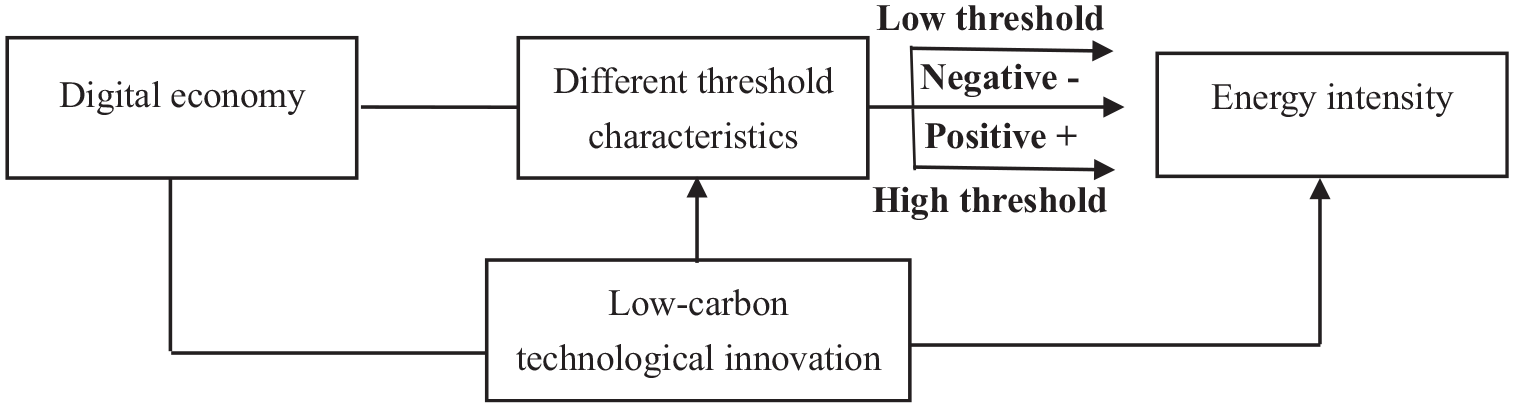
Schematic diagram of impact mechanism.
Measuring the Development of the Digital Economy
Indicator Construction
The digital economy is a new economic form that uses digital knowledge and information as key factors of production, digital technology as the central driving force, modern information networks as an important carrier, and accelerates the reconstruction of the economic development and governance model through the deep integration of digital technology and the real economy (Hong & Murmann, 2022). According to existing research, the current methods for evaluating the level of digital economy are mainly single indicator method and comprehensive indicator method. This paper argues that it would be more accurate to reflect the development level of the digital economy using the composite indicator method. Based on its research purpose, scholars measure it by constructing an index system. Some scholars construct an index system from two dimensions: digital finance and Internet development (Cheng et al., 2022; Liang & Li, 2023; Luo et al., 2022; Zou & Deng, 2022). However, with the continuous enrichment and development of the connotation of the digital economy, the dimensions of the digital economy are more extensive. Ren et al. (2021) found that from the development foundation of the digital industry, digital innovation ability and digital application degree, the digital economy index system is constructed. Some scholars are based on four dimensions: digital economy development carrier, digital industry scale, digital technology application and digital innovation ability (Chen, 2022) Some scholars are based on the four dimensions of digital economy development carrier, digital industry scale, digital technology application and digital innovation ability (Liu et al., 2022; Lyu et al., 2023; Ma & Zhu, 2022). It can be seen that the current studies have not yet agreed on the indexes for measuring the level of digital economy development. Therefore, on the basis of the principles of accessibility, reliability, and science, this paper combines the basic features of the theory of digital economy, regional realistic development characteristics and existing research bases to construct a three-in-one digital economy index system of “digital infrastructure construction—digital industrialization level - industrial digitalization level.” The indicators of e-commerce transactions (Wu et al., 2022) are added to the level of digital industrialization, and the indicators of digital financial inclusion (Yi et al., 2022), the number of enterprise domain names, enterprise websites, and enterprise web pages (Mei & Chen, 2016) are added to the level of industrial digitization in order to reflect the level of digital economy development more comprehensively. Specifically: (a) Digital infrastructure development. Digital infrastructure is the foundation and prerequisite for the development of digital economy, which includes hardware and software facilities. Specifically, the level of hardware facilities construction is measured by three indicators: fiber optic cable density, cell phone exchange density and mobile base station density, and the level of software facilities construction is measured by Internet broadband access density. (b) Digital industrialization development. Digital industrialization means integrating the four technologies of artificial intelligence, blockchain, cloud computing and data science to develop the software and hardware information industry, gradually extricate digital products and digital services from traditional products and traditional services, and then expand the scale of the digital economy. The level of digital industrialization development includes five dimensions: employment, telecom industry, software industry, e-commerce and communication industry, and is reflected by the employment of relevant personnel, per capita telecom business volume, per capita software business revenue, e-commerce transaction volume and fixed asset investment in communication industry. (c) Digital development of industry. Industry digitalization is the core component of the digital economy, accounting for about 80.9%. The level of industrial digital development is examined in terms of both financial digitalization and enterprise digitalization. Specifically, the level of financial digitalization is revealed by digital inclusive finance, and the digitalization level of enterprises is characterized by the number of enterprise e-commerce transaction activities, enterprise domain names, websites and web pages. Based on the above literature, we have constructed the evaluation index system of the digital economy in China. As shown in Table 1 below.
Evaluation Index System of Digital Economy in China.

In this paper, we use objective assignment through the entropy method, which eliminates the human factor and subjective evaluative nature to a certain extent, and enables the adoption of normalization methods for dimensionless processing of data, etc. (Hou, 2018; Yi et al., 2022). In contrast, the principal component analysis method is based on the information structure of the original data, and the weights are established by finding the cumulative contribution of variance of the indicators, eliminating the influence of variable correlation on the combined results, eliminating the impact of variable correlation on the combined results (Ahmer et al., 2021). Thus, to avoid the bias caused by subjective factors, this paper adopts the entropy method to make the measurement of digital economy development more reasonable.
Analysis of the Digital Economy
It can be seen from the results of Table 2 and Figure 2 measurements the current overall level of Chinese digital economy development is low, to a certain extent still relying on the traditional development model and development thinking, there is still more room for future development. Reasons for this are mainly the following. In terms of digital input, the traditional elements of production and the level of investment in the development of the digital economy are low, the building of relevant digital infrastructure is still in its infancy, as well as the inadequate use of digital technology, which does not play a strong role in sustaining the development of the digital economy. In terms of industrial technology, there is a need to further improve China's innovation capacity, and the level of major original achievements is low, and key core technologies such as high-end chips and industrial software are still subject to constraints. At the same time, basic research in China is relatively weak, with the proportion of basic research to R&D investment in 2020 being only 6%. In terms of enterprise digital economy development, it is difficult for SMEs to introduce and use standardized technologies and software because of the distinctive individual characteristics among individual enterprises.
Digital Economy in China (2013–2020).


Digital economy in China (2013–2020).
Regions with high levels of digital economy development are Guangdong Province, Beijing Municipality, Shanghai Municipality, Jiangsu Province, and Zhejiang Province. On the whole, these regions are mostly the eastern regions with good economic foundation, better industrial structure and superior geographic location, with innate technological advantages and strong green innovation atmosphere, and more mature in terms of digital infrastructure, technology level and scale of benefits. From a specific regional perspective, in 2020, the level of digital economy in Guangdong Province is almost 10 times higher in Guangxi Province, with obvious differences between regions. Central and western regions like Qinghai, Ningxia, Xinjiang and Gansu provinces have a low digital economy, indicating that their digital economy is lagging behind, making it difficult to exploit the positive externalities of digitization. Due to problems like the lack of underlying technology, backward digital infrastructure and weak regional attractiveness, the overall level of digital economy in the Midwest is low.
Material and Methods
Specifications of the Dynamic Threshold Model
Considering the heterogeneous impact of digital economy development on energy intensity, the influence of the low-carbon technology innovation level in different regions of China should be emphasized, otherwise, the evaluation of low-carbon technology innovation in each area of China will be biased (Tan & Lin, 2021). The nonlinear “structural change” problem is the source of this bias, whose critical value is called the threshold. Scholars can find the critical values of the sample data on the basis of the static panel threshold regression model by Hansen (1999; 2000). However, this model not only ignores the treatment of endogenous variables but also applies only to static panel models and is unable to study the dynamic characteristics of the sample data. To improve these deficiencies, this paper adopts an improved dynamic panel threshold regression method by incorporating a lagged term of the dependent variable, while to control the possible continuity and inertia of energy intensity itself and the endogeneity of the model, the first-order difference GMM and its instrumental variables are further incorporated into the model. Based on Hansen’s model, this paper estimates the threshold value and divides different intervals according to the threshold value, and further uses the first-order difference GMM estimation method proposed by Arellano and Bond (1991) to dynamically estimate the subinterval parameters.
This paper takes energy intensity (EI) as the explanatory variable, digital economy development (DE) as the core explanatory variable, low-carbon technology innovation (LT) as the threshold variable, and adds control factors such as lagged term (L1/L2), industrial structure (IS), urbanization level (UL), openness to the outside world (OD), and energy consumption structure (ES) to examine the effect of digital economy development on energy intensity in each region under different threshold levels of low-carbon technology innovation. Based on this, setting the panel threshold model (with a single threshold):

Where
Variables and Data
Explained variable: energy intensity (EI). In this paper, the natural logarithm of energy expenditure per unit of production value in each region is used to express the energy intensity (Hou et al., 2018) in tons of standard coal per 10,000 Yuan. This indicator shows how efficiently a region uses energy for its economic activities. The lower the energy intensity, the higher the energy use effectiveness of the region; the higher the energy intensity, the lower the energy use effectiveness of the area.
Digital economy development (DE) is the core explanatory variable. That is the results measured above.
Threshold variable: low-carbon technology innovation (LT). Based on the technology innovation positive externality (Gai & Li, 2018; Xie, 2021), low-carbon technology innovation can contribute to the reduction of energy intensity by increasing the efficient use of energy and achieving a substitution relationship between energy and other factors (Tan & Lin, 2021). There are various methods of measurement that have been studied, the first one is directly measured using green patent count, using green invention patents granted to measure low-carbon technology innovation. Second, using the ratio of revenue from sales of green innovation products and energy consumption to express low-carbon technology innovation (Tan & Lin, 2021). It is more valid to use green patent count to measure low-carbon technology innovation. Based on the above views, this paper measures low-carbon technology innovation by the natural logarithm of the number of green inventions and green utility models obtained by each region in that year.
Referring to existing studies (Ajayi & Reiner, 2020; Xia & Wang, 2018), a series of control variables were set for the mechanism of energy intensity to further alleviate the endogenous problems of digital economy development. In each region, the value added of the tertiary sector as a percentage of regional GDP is used to measure the industrial structure. When the industry adjusts its industrial structure, the economies of scale it produces will reduce the product cost, improve the utilization efficiency of energy resources and reduce the energy intensity (Razzaq et al., 2021). The proportion of urban population at the end of the year in each region indicates the urbanization level. Urbanization level is one of the most influential human activities, which may have different effects on energy intensity with time (Liobikiene & Butkus, 2019). The openness to the outside world is expressed as a percentage of the total investment registered at year-end by foreign-invested enterprises in each region to the regional GDP. Generally speaking, if a region has a high level of opening up to the outside world, then the information acquisition speed in the region is also relatively fast, and advanced technologies and management methods can be absorbed and digested in time, to improve the resource utilization efficiency from quantitative to qualitative, and then play a restraining role in energy intensity (Qamruzzaman & Jian, 2020). The energy consumption composition is expressed as a percentage of each region’s coal consumption compared to its total energy consumption. Promoting the green optimization and adjustment of energy consumption structure has become a key way to directly determine whether energy intensity and economic development can achieve a “win-win.”
Data from 30 provinces in China from 2013 to 2020 are selected as the scope of sample examination in this paper. (Due to the lack of data, it does not include four provincial administrative regions: Hong Kong, Macau, Taiwan Province and Tibet.), Among them, some missing data in 30 provinces are estimated to be supplemented by the annual increase percentage. Raw data comes from the National Bureau of Statistics and the National Energy Administration of China, the Intergovernmental Panel on Climate Change (IPCC)–“IPCC Guidelines for National Greenhouse Gas Inventories,” the Chinese Research Data Services Platform (CNRDS), etc. The data used in this paper mainly come from various public reports, such as the Digital Inclusive Finance Index compiled by the Digital Finance Research Center of Peking University, Ant Group and National Energy Administration, the National Taian Database, the China Statistical Yearbook, the China Statistical Yearbook, the statistical yearbooks of various provinces and regions, IPCC, etc. The number of green inventions and green utility models obtained in each region in that year came from the China National Intellectual Property Administration patent database of China Research Data Service Platform (CNRDS). At the same time, the energy intensity and low-carbon technological innovation are logarithmically processed. Table 3 shows the sample descriptive statistics for all variables.
Descriptive Statistics of Variables.

Results and Discussion
Estimation Results of the Dynamic Threshold Model
We start from the regional heterogeneity threshold of low-carbon technology innovation and use the dynamic panel threshold model to study the impact relationship between the development of the digital economy and high or low energy intensity. Table 4 displays the outcomes of the threshold effect test. The relationship between digital economy development and energy intensity shows a double threshold effect in terms of low-carbon technology innovation, according to Hansen’s threshold model.
Threshold Significance Test.

Note: “*” means significant at the level of 10%, “**” means significant at the level of 5%, and “***”means significant at the level of 1%, the same below.
The results are shown in Table 5. Once the significant thresholds were found, we divided the low-carbon technology innovation into different degrees: low level of innovation (LT ≤ 6.006), medium innovation level (6.006 < LTI ≤ 7.722) and high level of innovation (LT > 7.722).
Results of Threshold Estimators and Confidence Intervals.

Moreover, the plot of the “likelihood ratio” series function of the threshold variable shows the structure of the estimates (Figure 3).
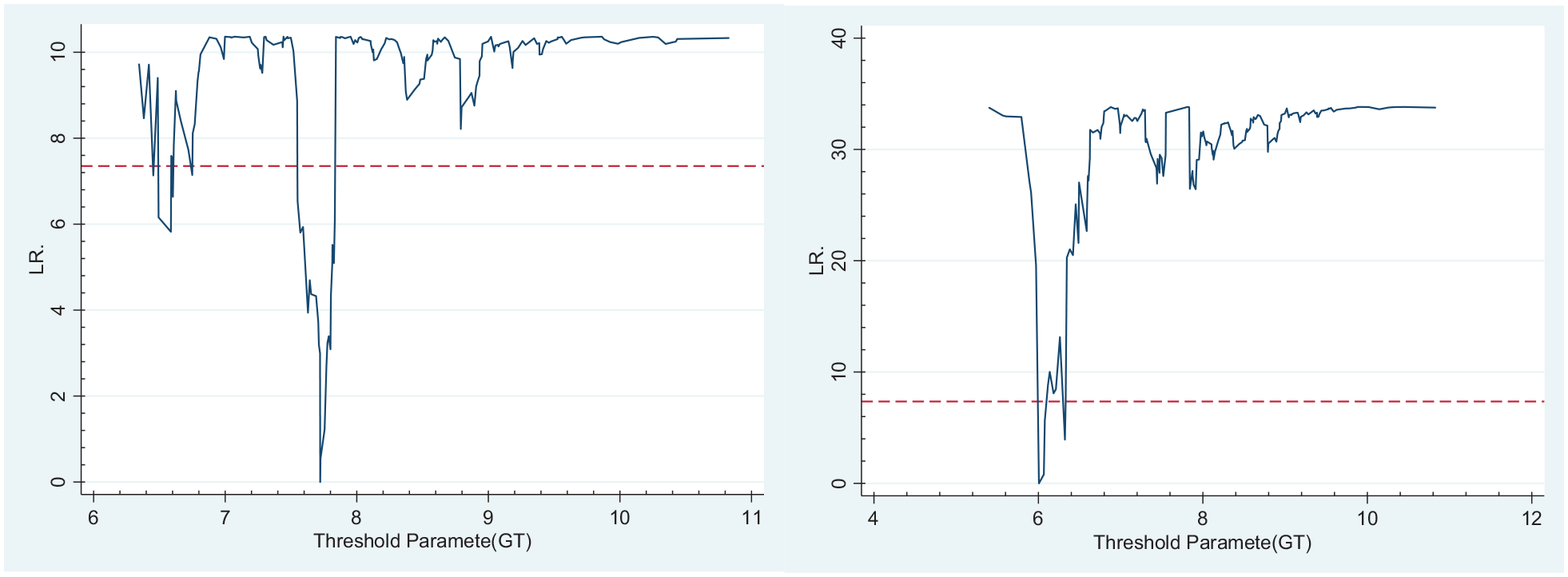
Likelihood ratio function for the threshold model.
We divide low-carbon technology innovation into different intervals according to the threshold value and consider the “structural change” threshold effect of digital economy development on energy intensity of each region under different levels of low-carbon technology innovation. The estimated results are presented in Table 6.
Results of Dynamic Threshold Regression.

Note: “*” means significant at the level of 10%, “**” means significant at the level of 5%, and “***”means significant at the level of 1%, the same below.
Table 6 shows that the digital economy development shows an inverted U-shaped relationship on energy intensity under the perspective of low-carbon technology innovation. With increased low-carbon technology innovation, there are differences in regional energy intensity driving mechanisms: when low-carbon technology innovation is low (LT ≤ 6.006) and medium (6.006 < LT ≤ 7.722), there is a non-significant positive effect of digital economy development on energy intensity. When low-carbon technology innovation is high (LT > 7.722), there is a significant negative inhibitory effect of digital economy development on energy intensity. Thus, the digital economy shows a significant low-carbon technology innovation threshold effect on energy intensity.
For other drivers of energy intensity reduction, the industrial structure and energy consumption structure of China at this stage inhibit the reduction of energy intensity to a certain extent. From the threshold regression estimation results in Table 6, it can be seen that the regression coefficient of energy intensity in the lagging period is positive, indicating that the digital economy will promote energy intensity in the short term; The regression coefficient of energy intensity in the second phase is negative, indicating that the digital economy has promoted the reduction of energy intensity through certain policies and low-carbon technologies for a long time. In a word, the digital economy is a long-term nonlinear process from its emergence to its development and expansion, and it can only play a role in the energy industry after accumulating certain influence, optimize the energy structure, empower the traditional energy industry, and achieve the effect of reducing energy intensity (Lu & Zhu, 2022). It is found that the development of secondary industries in China is mainly dependent on energy consumption and that the newly industrialized regions of the country have started to transition to technology-intensive industries (Oak & Bansal, 2022). In the western region, its industrial development is still dominated by traditional industries, and emerging industries are in the budding stage of development, thus there is a gap between the existing resource allocation and the consensual resource allocation. In addition, China’s current energy situation is in the stage of “more coal and less gas,” and compared with coal and other non-clean energy, clean energy production represented by natural gas is lower and the price is higher, which also indirectly indicates that the use of coal and other energy in China is less efficient, and the use of non-clean energy technology needs further breakthroughs (Ajayi & Reiner, 2020). Relatively speaking, the level of urbanization also positively contributes to energy intensity. On the one hand, as the number of people entering the city to live and produce increases, there is a shortage of infrastructure construction, and more efforts are needed to build infrastructure to protect the daily lives of residents, while pursuing a better quality of life and increasing the demand for transportation, thus increasing the demand for energy. On the other hand, the scale effect brought by urbanization can improve the efficient use of energy to a certain extent, therefore prompting a reduction in energy intensity. We can see that the effect of the scale effect of urbanization is not yet evident at this stage (Xue et al., 2022). It should be noted that foreign openness has a negative effect on energy intensity, but the coefficient of foreign openness correlation is not significant, in other words, there is not sufficient evidence that foreign openness plays a role in the reduction of energy intensity, but to some extent, advanced management experience, technological equipment and knowledge inventions of developed countries and regions can further reduce energy dependence by prompting foreign investment to introduce new knowledge and technology to the land (Eleni et al., 2022). Therefore, all regions should adjust the industrial structure, optimize the energy consumption structure, and further play the urbanization process of the scale effect and energy saving effect, the reasonable introduction of foreign investment and adhere to build a new pattern of opening up to the outside world to promote the reduction of energy intensity.
Finally, with respect to the robustness of the model results, the lagged terms of the explanatory variables are significant at the 1% level of significance, indicating that controlling for the dynamic change in the impact of digital economy development on energy intensity is necessary when low-carbon technology innovation is the threshold variable. From the Hansen over-identification test, it is known that the p-value = .259, and the original hypothesis that the model instrumental variable setting is reasonable cannot be rejected at the 10% level. the results of the AR (1) and AR (2) tests are shown in Table 7, and it is more reasonable to use the first-order difference GMM.
AR (1) and AR (2) tests.

Discussion
The results of this paper show a non-linear relationship between digital economy development and energy intensity as the level of low-carbon technology innovation increases. Specifically, when low-carbon technology innovation is at a low level, it is not beneficial for the development of the digital economy to reduce energy intensity. Nonetheless, if the level of low-carbon technology innovation continues to rise and crosses the threshold, indicating that the digital economy has a significant dampening effect on energy intensity. Academic circles generally believe that technological innovation has dual attributes, that is, private product attributes, technology is protected by law and economy, and has private product attributes; The attribute of public goods has a strong positive externality for technologies shared all over the world (Gai & Li, 2018; X. Zhang & He, 2008). Due to the “scarcity” and “externality” properties of technology elements, changes in the level of low-carbon technology innovation significantly affect the relationship between the development of China’s digital economy and energy intensity. We consider that the relationship between the “positive knowledge externality” and the “energy rebound effect” generated by different levels of low-carbon technology innovation is determined by the predominance of the two (Ajayi & Reiner, 2020). In the case of China’s relatively sloppy economic growth and low energy use efficiency, there is an urgent need to promote low-carbon technology innovation and enhance resource use efficiency in various industry sectors. In particular, on the basis of a substantial increase in the low-carbon technology innovation capacity, the positive knowledge externalities of low-carbon technology innovation are conducive to stimulating the development of the digital economy for energy intensity reduction.
When low-carbon technology innovation is at a low level, it is difficult to exploit the positive knowledge externalities of low-carbon technology innovation to stimulate the digital economy development to improve energy use efficiencies. First, the investment in digital industry infrastructure like base stations, network equipment, and data centers will raise total energy consumption, making it hard to achieve a win-win situation between maintaining the development of the digital economy and reducing energy intensity (Ahmer et al., 2021). Second, due to the uncertainty of technology R&D activities and the slow process of breaking through the boundaries of innovation possibilities at this stage, the conversion rate of R&D results of low-carbon technology innovation at this time is low and R&D costs are high, and enterprises still prefer traditional energy consumption patterns in the process of digital economy development, which instead leads to further intensification of energy consumption pressure (Wu et al., 2022). With the improvement of energy efficiency, energy consumption is still growing rapidly, which further leads to energy rebound. “Energy rebound effect” refers to the economic phenomenon that energy efficiency improvement has not achieved the expected energy-saving effect, which hurts the coordination and sustainable development of energy, economy and environment systems (Zha et al., 2021), it is a problem that must be considered in the process of saving energy consumption by improving energy efficiency (Lorenzo et al., 2023). In addition, progress in green technology and digital technology can improve energy efficiency and produce energy savings (Tang et al., 2020; Wu et al., 2022). But digital economic development may lead to a “rebound effect” on energy. In other words, increased energy efficiency will reduce the cost of energy use per unit of output as well as promote economic growth, resulting in increased energy demand, somewhat offsetting reductions in energy consumption caused by efficiency gains (Y. Chen et al., 2016). Finally, there is a need for higher energy consumption for improvements in digital technology performance and device appearance (Mei & Chen, 2016).
With the further improvement of low-carbon technology innovation, the sustainable development ideas of green, low-carbon, innovation and recycling have been deeply rooted in people's hearts, and the development of China’s digital economy focuses more and more on the improvement of ecological benefits and green low-carbon development while pursuing economic growth. Advantages of positive knowledge externalities of low-carbon technology innovation gradually emerge, and energy-saving technology advances flourish, and there is a positive and positive effect of green technological advances on total factor green energy efficiency (Tan & Lin, 2021), thus consuming less energy for a given output. With increased R&D capacity in low-carbon technology innovation, the competitiveness of green technologies is becoming increasingly prominent, gradually replacing the importance of energy elements to productive life (Tang et al., 2020). Accordingly, the technology innovation not only provides technical support for the development of the digital economy and promotes the update and iteration of digital technology, but also facilitates the integration of digital technology and energy technology, and promotes green and low-carbon development of resource-based enterprises in the process of development of digital economy. During this period, although the rebound effect of energy due to the development of the digital economy is still present, the overall trend is decreasing, mainly because the rebound effect will be reduced as green technology continues to advance and energy use efficiency is improved while production and management processes are optimized (Hou et al., 2018; Tan & Lin, 2018), which can realize the reduction of energy intensity achieved by the development of the digital economy driven by green technology advancement. In addition, using digital technologies such as big data and cloud computing to collect operational data in real time to realize accurate forecasting, remote monitoring of equipment and energy consumption management can also reduce resource waste effectively.
In summary, raising the low-carbon technology innovation level to within the affordability of companies in various industries at this stage is beneficial to the role of the digital economy development for energy intensity reduction. Fundamentally reduce the demand for fossil energy in economic and social life, increase clean and low-carbon energy use, reduce the emission of pollutants at source due to the use of more low-carbon technological innovations, and pursue a low-carbon and environmentally friendly production and lifestyle.
Regional Heterogeneity
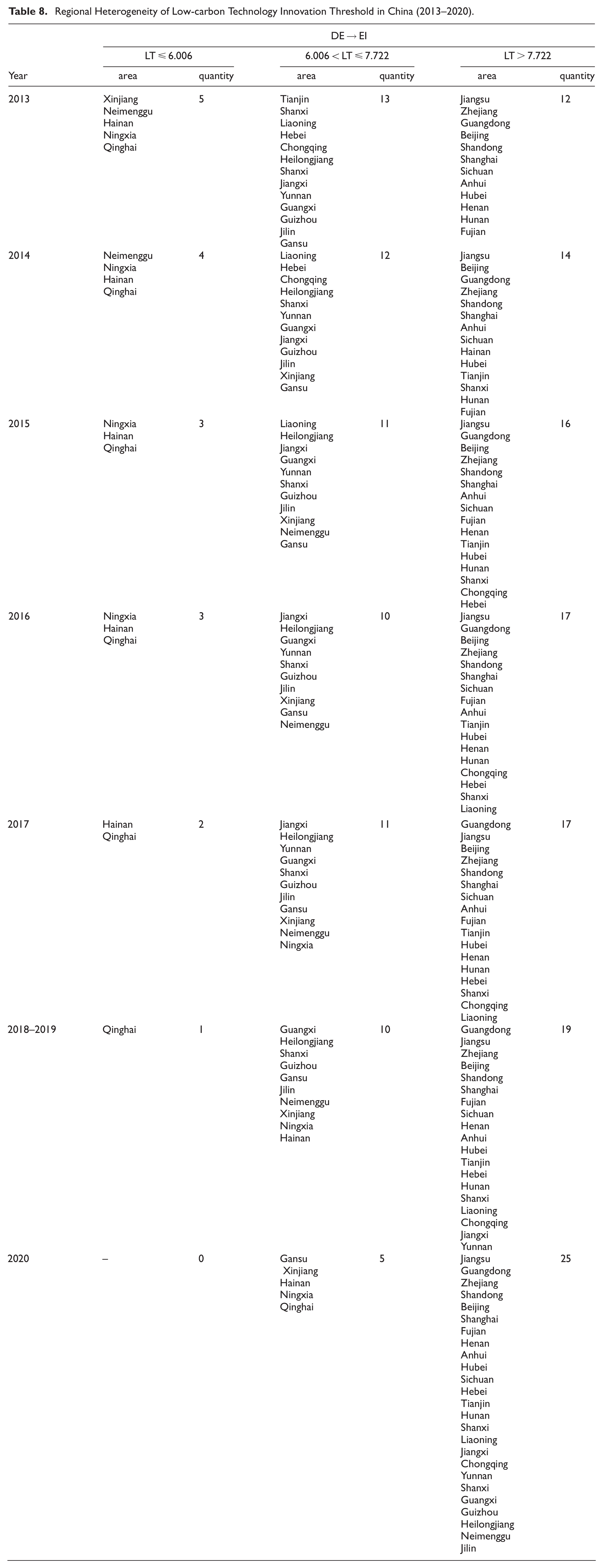
Table 8 shows the threshold level distribution of low-carbon technology innovation between regions. In 2013, 18 regions nationwide had a low level of low-carbon technology innovation (LT ≤ 7.722), with only 12 regions crossing the threshold value. Due to their not yet formed a perfect and mature market mechanism, as well as lower R&D funding investment, technical resources talent cultivation and environmental regulation, it is difficult for the northwest, northeast and southwest regions to develop a higher level of low-carbon technology innovation. Especially in the western regions such as Xinjiang, Ningxia and Qinghai, the geographical environment and shortage of talents have led to a low level of technological innovation for a long time. At the same time, the southeast coastal region has the advantages of low-carbon technology innovation in terms of economic development level, openness to the outside world, investment in technology resources and government support, etc. Improving production and management processes through digital means while vigorously promoting the use of clean energy will greatly reduce energy intensity. During 2014 to 2020, high-level low-carbon technology innovation regions continued to increase to 25, and only a few regions have not reached the threshold value, indicating that most regions in the country have now crossed the threshold value and reached high innovation level, and with digital economy development stimulated by low-carbon technology innovation can contribute to the reduction of energy intensity. This is mainly due to the fact that with the concept of green, environmental protection and ecology gradually gaining popularity, all industries are oriented toward environmentally friendly and green development, and are increasing investment in low-carbon technology innovation. At the same time, the proposed Bohai Economic Circle, Yangtze River Delta Economic Circle, Pan-Pearl River Delta Economic Circle and Sichuan-Chongqing Economic Circle are conducive to the leading provinces in low-carbon technology innovation to drive the overall level of the region through the external spillover effect of technology and resources.
Regional Heterogeneity of Low-carbon Technology Innovation Threshold in China (2013–2020).
Conclusions and Implications
Conclusions
The following main findings were made:
(1) In general, China’s overall level of regional digital economy development is relatively low, and still relies on traditional development models and development ideas to a certain extent, there is still much space for future development. Especially in areas such as Qinghai, Ningxia, and Hainan, due to the lack of underlying technology, backward digital infrastructure and weak regional attractiveness, the level of digital economy development is low. It is worth pointing out that between 2013 and 2020, the majority of provinces and regions in China showed a fluctuating rising trend in digital economy and faster development of the digital economy.
(2) Regional heterogeneity in the development of the digital economy in various regions is significant, and problems of unbalanced and insufficient development still exist, which is not conducive to bringing into play the synergy of digital economy development to reduce China’s energy intensity. The degree of digital economy development is higher in the eastern region, which has a good economic foundation, a more complete industrial structure and a superior geographical location. Influenced by its innate technological advantages and strong green innovation atmosphere, the degree of digital economy development is better than that of the central and western regions in terms of infrastructure, technology level and benefit scale.
(3) The role of digital economy development on energy intensity shows a non-linear inverted “U” shape with regional differences in the level of low-carbon technology innovation. When low-carbon technology innovation is at a low level, digital economy development is not conducive to energy intensity reduction. With the enhancement of low-carbon technology innovation level, once the threshold value is broken, it is possible for high-level low-carbon technology innovation to effectively stimulate the driving effect of digital economy development, that is, high-level low-carbon technology innovation level can weaken the energy rebound effect, and the positive externality of innovation knowledge as well as energy-saving effect outweighs the energy rebound effect caused by digital economy development, which in turn is conducive to the reduction of energy intensity.
(4) For other drivers of energy intensity reduction, openness to the outside world has contributed to the reduction of energy intensity. To some extent, industrial structure, energy consumption structure and urbanization level at this stage are not conducive to the reduction of energy intensity, and a significant positive effect exists, with the inhibitory effect of industrial structure being the most significant.
Research Contributions
Leading the digital economy development and innovating low-carbon technology to reduce energy intensity are important ways to achieve the win-win goal of a low-carbon society and sustainable development. This paper’s theoretical contributions are as follows:
(1) At the theoretical level, the existing literature mostly focuses on the impact of energy prices, environmental regulations, and industrial structure on energy intensity, and less often includes the digital economy development as one of the power sources affecting the change of energy intensity. In this paper, based on the construction of an evaluation system to measure the digital economy development level in Chinese regions, this paper incorporates the digital economy, low-carbon technology innovation, and energy intensity into the research framework, and empirically examines the non-linear dynamic role of low-carbon technology innovation in the process of energy intensity reduction driven by the digital economy. This research perspective helps to grasp the important role of the digital economy in promoting regional energy intensity reduction and enriches the research related to the digital economy and energy intensity.
(2) At the research system, the existing studies have not yet established a unified framework to measure the digital economy development level, making it difficult to measure each region of China's digital economy development level in a comprehensive and scientific way. Therefore, this paper analyzes the connotation of digital economy development and builds a digital economy development indicator system from the three aspects of “digital infrastructure construction—digital industrialization level—industrial digitization level,” which makes up for the shortage of digital economy indicators in China. It measures the status quo of digital economy development in different regions of China and provides new research ideas for measuring the digital economy development level in the future.
(3) At the content level, when exploring the driving effect of energy intensity, previous studies have seldom considered the level of regional low-carbon technological innovation, and there is still room for further improvement in analyzing the mechanism of the enabling effect of the digital economy. Under China’s “peak carbon” goal, this paper starts from the perspective of low-carbon technological innovation, focuses on its threshold characteristics in the mechanism between digital economy and energy intensity, and clarifies the complex dynamic impacts of different levels of low-carbon technological innovation on digital economy and energy intensity. It is conducive to clarifying the development trend and the specific internal mechanism, which is of great theoretical and practical significance for the effective use of low-carbon technological innovation to realize the digital economy development, promote the reduction of regional energy intensity, and accelerate the green and high-quality development of the economy.
Policy Recommendations
We focus on the impact of digital economy development on energy intensity. By presenting the findings of this paper, we understand the development of the digital economy from the perspective of achieving the goal of “carbon peaking” and provide a diversified pathway system for the role of digital economy development in promoting the reduction of energy intensity by combining the heterogeneous threshold mechanism of low-carbon technology innovation. Based on these conclusions, we suggest the following policy path.
First, with the announcement of China's carbon peak and carbon neutral targets, promoting the development of the digital economy and improving energy use efficiency is an important path for China to achieve sustainable economic development and build a green China. Firstly, digital infrastructure and underlying technological innovation are the keys to the development of the digital economy. We should speed up the construction of new infrastructure such as 5G network base stations, big data centers, cloud computing and artificial intelligence, lay a solid foundation for key underlying core technologies, and accelerate the transformation of scientific and technological achievements into real productivity. In the central and western regions with weak digital infrastructure, such as Qinghai, Ningxia, Hainan and other regions, we will further promote the broadband China strategy and reduce the “digital divide” between urban and rural areas. For example, Qinghai Province is helping many towns and administrative villages to build digital village platforms based on scientific and technological innovations such as all-optical networks, helping national strategies and creating unique values for digital information infrastructure. It is worth noting that large-scale construction of digital infrastructure will be accompanied by more energy consumption needs and carbon emissions, low-carbon technology innovation should be used to achieve energy saving, emission reduction and green development of the digital industry itself. Secondly, we should promote the low-carbon development of the digital economy, use digital technology to promote the deeper digitalization of traditional industries such as agriculture and industry, improve energy efficiency by accurately monitoring carbon emissions and accurately controlling energy, and guide clean energy consumption to achieve a win-win situation between production efficiency and energy efficiency of various industries and industries. At the same time, the central and western governments should optimize policies and formulate green channels and special policies. Economic prosperity is the main driving force to attract talent. All regions should focus on promoting economic development, increasing employment opportunities and economic activities, and attracting talent to live and work in the region. For example, Hainan Province has promulgated a series of implementation policies to attract talent, such as “Decision on Implementing the Strategy of Strengthening the Province with Talents” and “Implementation Opinions on Implementing the Decision of the Central Committee of the Communist Party of China and the State Council on Further Strengthening Talent Work,” to improve the overall quality of the talent team and promote the harmonious development of the economy and society. Meanwhile, digital technology innovation can also change people’s life patterns, such as telecommuting, online public services, and electrification of transportation, which is conducive to optimal resource allocation.
Second, to achieve energy intensity reduction, it is necessary to consider the threshold impact effect of low-carbon technology innovation level in each region and set reasonable countermeasures according to the specific conditions of different regions. For regions where the low-carbon technology innovation level is low, the government shall strengthen support, build a good environment for low-carbon technology innovation, and promote the factor investment and R&D efforts in low-carbon technology innovation in various industrial sectors through financial subsidies, green investment and appropriate tax policies. In particular, in the central region, which is rich in natural resources and has been relying on resources for crude development for a long time, it is actively engaged in low-carbon technology innovation while gradually achieving clean energy to replace fossil energy consumption and paying attention to energy conservation and emission reduction at source. For those regions with high levels of low-carbon technology innovation, further play its industrial agglomeration, resource integration and radiation-driven role, and export green technology from the eastern, northern and southern coastal areas to the central, northeastern and western parts of the country, and gradually promote the synergistic low-carbon technology innovation development in all regions. Meanwhile, promote the deep integration of green technology and digital technology, reduce the energy rebound effect in the development process of the digital economy through green technology progress, and achieve the low-carbon development of the digital economy. As an important industrial cluster in China, the Bohai Rim region has strong scientific research strength and a relatively developed marine industry. Developing a marine low-carbon economy is the only way to enhance the core competitiveness of the Bohai Rim economic circle. Therefore, we should coordinate the introduction of low-carbon technology and independent technology development, accurately grasp the strategic direction of low-carbon technology development, and launch a targeted low-carbon technology research and development strategy. As an important industrial base in China, the Yangtze River Delta needs to give full play to the basic advantages of science and technology, industry, etc., take the innovation consortium as the starting point, carry out joint research on green and low-carbon key technology innovation, promote the independent control of key core technologies in key industrial chains, and provide strong scientific and technological support for promoting the comprehensive green transformation of digital economic and social development. The Pan-Pearl River Delta region, as an economically developed region of China and a window of reform and opening up, is a dense zone of high-tech enterprises and high-tech product production enterprises, with high foreign investment, which also provides financial support for its development of scientific and technological progress. Then the region should make good use of this advantage, attract, train and manage more outstanding talents, adopt and formulate tax incentives conducive to the development of low-carbon technological innovation, increase financial investment in scientific research, and guide enterprises to engage in low-carbon technological innovation. Sichuan-Chongqing Economic Circle is located at the intersection of “the Belt and Road Initiative” and the Yangtze River Economic Belt. It is the region with the densest population, the strongest industrial base and the strongest innovation ability in western China. We should guide the whole society to adopt advanced and applicable green and low-carbon new technologies, new equipment and new processes, promote resource conservation and intensive utilization, and inject strong momentum into the green and low-carbon development of the Sichuan-Chongqing Economic Circle.
Finally, it is essential to coordinate the efforts of all parties to better reduce energy intensity levels. First, industrial structure optimization policies driven by technology can significantly improve energy efficiency, and all levels of government should focus on increasing investment in technology when formulating policies to actively develop energy-saving and environmental protection industries and strategic emerging industries. Furthermore, we should adjust the energy consumption structure that relies too much on fossil resources, not only need to use green and clean production technology to improve the efficiency of energy use but also make sure that the ratio of clean energy such as natural gas is growing steadily. Since it is hard to change the energy consumption structure on short notice, the government should set it from the perspective of long-term planning. Meanwhile, during the urbanization development process, focus should be placed on improving the urbanization quality, using the scale effect of urbanization to make intensive use of land, energy and other elements, enhancing the efficient use of energy in urban public infrastructure construction, and at the same time raising residents’ awareness of energy conservation and emission reduction. In addition, we should insist on expanding the opening to the outside world, introducing foreign investment and advanced technology, bringing into play the technology spillover effect to promote the low-energy development of our products and industries, and insisting on the strategy of “introducing and going out” to promote multilateral cooperation with neighboring countries and regions.
Research Limitations and Prospects
There are some research limitations in this paper: due to the limitation of the availability and applicability of the existing energy intensity statistics, this paper selects the sample data to focus on the macro-level of the industry during the sample period. With the continuous updating of the data, the subsequent research can consider expanding the sample range appropriately. Secondly, in addition to the perspective of low-carbon technological innovation that this paper focuses on, energy intensity may also be affected by other heterogeneous threshold factors, such as environmental regulation, industrial structure, human capital of scientific and technological innovation, etc., which will be the focus of further research in the future.
Footnotes
Declaration of Conflicting Interests
The author(s) declared no potential conflicts of interest with respect to the research, authorship, and/or publication of this article.
Funding
The author(s) disclosed receipt of the following financial support for the research, authorship, and/or publication of this article:This work was financially supported by the Graduate Education Reform Project of Henan Province (Grant number 2023SJGLX205Y), Henan Province Higher Education Philosophy and Social Science Innovation Talent Support Program (2025-CXRC-08), Major Project of Philosophy and Social Sciences Basic Research in Henan Province(2025-JCZD-03), Philosophy and Social Sciences Research Innovation Fund of Henan Agricultural University (SKJJ2024A04) and Humanities and Social Sciences Research Project for Universities in Henan Province (2025-ZZJH-170).

Data Availability Statement
Data sharing is not applicable to this article as no datasets were generated or analysed during the current study.