




Abstract
While existing literature has extensively examined the bilateral relationships between digital inclusive finance (DIF), the real economy (TRE), and common prosperity (CP) in isolation, the synergistic effect of DIF-TRE coordination remains a critical gap. Based on panel data from 278 Chinese cities (2011–2023), this study develops an integrated analytical framework by constructing a novel coupling coordination degree index to measure DIF-TRE coordination and empirically investigates its impact on CP. Results reveal that this coordination significantly promotes CP, a finding robust to endogeneity concerns and robustness tests. Crucially, we unpack the underlying mechanisms through technological innovation, industrial structure upgrading, and regional entrepreneurial activity. Furthermore, we uncover significant regional heterogeneity, with effects more pronounced in eastern and large cities, and provide novel evidence of significant positive spatial spillover effects, demonstrating that a city’s DIF-TRE coordination level positively impacts CP in neighboring regions. These findings move beyond the prevailing bilateral paradigm, offering a more systemic explanation and targeted policy insights for achieving CP through DIF-TRE coordination.
Plain Language Summary
This study looks at data from Chinese cities (prefecture-level and larger) between 2011 and 2023. Its main goal is to understand two things: first, how well digital inclusive finance (a type of finance that uses digital tools to serve more people, like online loans for small businesses) and the real economy (actual businesses and industries, such as manufacturing, agriculture, and retail) work together; second, how this cooperation affects common prosperity (the goal of making sure economic benefits are shared more evenly across society). Here’s what we found: Over the years, digital inclusive finance and the real economy in China have been working better together, but this progress isn’t the same everywhere—some places are improving faster than others. When these two areas coordinate well, it clearly helps push common prosperity forward. This happens in three main ways: it encourages new technology (like better digital tools for businesses), improves the mix of industries (e.g., shifting from low-tech to high-value industries), and boosts more people to start their own businesses in a region. We also saw differences based on where the cities are and how big they are. For example, eastern Chinese cities (like those near the coast) and large cities get a bigger boost to common prosperity from this coordination than central/western cities or smaller cities. Plus, when one city’s digital inclusive finance and real economy work well together, it even helps nearby cities move toward common prosperity too. These findings can help policymakers. They can use this information to make better plans: for instance, figuring out how to improve the coordination between digital inclusive finance and the real economy in different types of cities (big vs. small, eastern vs. central/western). In turn, this can help cities develop in a better way that supports the goal of common prosperity for everyone.
Introduction
Common Prosperity (CP), a defining socioeconomic objective and core characteristic of Chinese Modernization, extends beyond mere income growth to encompass broader ideals of shared development and equitable opportunities for all citizens. Formally enshrined in China’s long-term development blueprint, most notably the 14th Five-Year Plan (2021–2025) and the vision for the 15th Five-Year Plan period (2026–2030), it signals a strategic shift toward high-quality growth that is both efficient and inclusive. This endeavor aims to build a robust, olive-shaped income distribution by expanding the middle-income group, which underpins long-term social stability and sustainable economic development. Nevertheless, the realization of CP is fraught with multifaceted challenges. Key challenges include persistent urban-rural and regional development gaps, financing constraints faced by Small and Medium-sized Enterprises (SMEs), and the complex task of balancing economic efficiency with distributional equity amid a rapidly evolving digital economy.
In this context, Digital Inclusive Finance (DIF) has emerged as a potent tool with the potential to address these structural imbalances. By leveraging big data, cloud computing, and other digital technologies, DIF can dramatically lower transaction costs and extend financial services to previously excluded populations and enterprises, thereby ostensibly promoting financial inclusion. Concurrently, a robust Real Economy (TRE) is universally recognized as the fundamental bedrock of sustainable wealth creation, job generation, and technological progress. The conventional policy and academic discourse, however, often treat the development of DIF and the strengthening of TRE as parallel yet separate tracks.
This segmented perspective overlooks a critical and under-examined question: is the independent advancement of DIF and TRE sufficient, or even optimal, for achieving CP? A growing body of literature suggests potential pitfalls. The decoupling of finance from the real sector is a well-documented phenomenon that can lead to asset bubbles and exacerbate inequality (Cecchetti & Kharroubi, 2015; Menkhoff & Tolksdorf, 2000). DIF, if developed in isolation, risks becoming a conduit for speculative capital; conversely, it may lack commercial sustainability if not effectively embedded in value-creating economic activities. Therefore, drawing on Schumpeterian growth theory (Schumpeter, 1934), which posits that innovation and creative destruction are the primary drivers of economic development, we posit that the coordinated development of DIF and TRE is not merely an option but a prerequisite. This coordination ensures that the allocative efficiency of DIF is channeled toward productive, innovation-driven endeavors within TRE, while the evolving demands of TRE, in turn, spur the iterative upgrading and risk calibration of DIF offerings. We hypothesize that this synergistic relationship constitutes a fundamental mechanism for a sustainable pathway toward CP.
Yet, the existing academic literature leaves a significant gap in our understanding of this tripartite relationship. While substantial research has examined the bilateral links between DIF and economic growth (Zhang et al., 2024), DIF and poverty reduction (Yue et al., 2024), or economic growth and inequality (Barro, 2000), few studies have systematically investigated the synergistic effect of DIF-TRE coordination. The mechanisms through which this coordination might transmit its influence to CP, whether through catalyzing technological innovation, driving industrial upgrading, or stimulating regional entrepreneurship, remain largely theoretical and lack robust empirical validation. Moreover, the potential for such coordination to generate spatial spillover effects, thereby influencing CP in neighboring regions, is a dimension almost absent from current discourse.
To bridge these gaps, this study constructs a novel coupling coordination degree index to quantify the coordination between DIF and TRE across 278 Chinese cities from 2011 to 2023. We then empirically investigate the impact of this coordination on CP and unpack the underlying transmission mechanisms. Several key questions drive our research: Does the coordinated development of DIF and TRE significantly promote CP? What roles do technological innovation, industrial upgrading, and entrepreneurial activity play in this process? Does the effect exhibit spatial spillovers and regional heterogeneity?
The contributions of this paper are threefold. First, it moves beyond the siloed analysis of DIF or TRE by pioneering an integrated framework that positions their coordination as the core explanatory variable for CP. Second, it empirically tests and validates a chain of mediating mechanisms, thereby illuminating the “black box” of how coordination translates into prosperous and shared outcomes. Third, it incorporates a spatial dimension into the analysis, revealing the presence of spillover effects and regional disparities, which provides a nuanced, evidence-based foundation for crafting targeted and regionally differentiated policies.
Literature Review
A substantial body of literature has explored the relationships between DIF, TRE, and CP. However, existing research often examines these elements in isolation or through bilateral lenses, failing to capture the synergistic potential of their trilateral interaction. This review critically synthesizes the extant literature along three key bilateral relationships, identifies theoretical and empirical gaps, and culminates in the justification for the present study’s integrated framework.
DIF and TRE: From Macro Empowerment to Micro Foundations
The literature on DIF’s impact on the TRE has evolved from highlighting its macroeconomic benefits to a more nuanced understanding of its micro-level foundations and conditional effects.
At the macro level, scholars have established that DIF contributes to sustainable economic growth (Cheng et al., 2021), inclusive growth (Corrado & Corrado, 2017), and regional high-quality development (Li et al., 2022). The dominant narrative is that by extending financial services to vulnerable groups, DIF promotes broader participation in the economy, thus “expanding the pie” of aggregate wealth.
At the micro level, research has drilled down into its effects on households and firms. Studies show that DIF influences household asset allocation (He & Liu, 2024) and boosts residents’ consumption (Liu et al., 2021), thereby stimulating domestic demand. More critically for the TRE, a growing strand of literature demonstrates that DIF alleviates financing constraints for firms, thereby promoting enterprise innovation (Xiong et al., 2023), improving ESG performance (Li & Pang, 2023), and facilitating digital transformation (Hao et al., 2023). These micro-foundations are essential for understanding how DIF translates into tangible TRE development.
However, a critical limitation persists. The vast majority of these studies position DIF as an external shock or an independent driving force upon a passive TRE, reflecting a simplistic, unidirectional view of finance that overlooks the reciprocal relationships emphasized in theories of financial symbiosis and endogenous growth. They largely overlook the reverse driving effect of TRE’s developmental demands and digital transformation on the evolution of DIF itself. This one-way perspective fails to capture the dynamic, interactive nature of their relationship. In response to this gap, and to capture the multi-dimensional nature of DIF (a prerequisite for analyzing their bidirectional interaction), this study employs the comprehensive Peking University Digital Financial Inclusion Index, which measures coverage breadth, usage depth, and digitalization level (Guo et al., 2020).
DIF and CP: Exploring the Efficiency-Equity Nexus
The direct link between DIF and CP has garnered significant attention, with research primarily focusing on distributional outcomes. A consensus suggests that DIF can promote CP by narrowing the urban-rural income gap (Zhao et al., 2022), alleviating relative poverty (Pei et al., 2024), and fostering a more creative economy by boosting citizens’ disposable income and improving education access (Wang et al., 2023). The mechanisms often cited include promoting entrepreneurship, stimulating employment, and leveraging the power of internet finance (Hao et al., 2023).
Despite these valuable insights, the literature exhibits two key shortcomings. First, the concept of CP is often narrowly operationalized, over-relying on income gap metrics while underemphasizing other critical dimensions such as opportunity equality and access to public services. Second, and more fundamentally, the literature often treats DIF as a standalone distribution tool, implicitly assuming that its inclusiveness inherently leads to equitable outcomes. This view overlooks the crucial question of what kind of DIF is truly conducive to CP. It fails to sufficiently interrogate whether DIF, if decoupled from the productive, value-generating sectors of TRE, might simply become a conduit for consumer credit or even speculative capital, thereby having limited or even negative long-term impacts on sustainable prosperity.
To address the first shortcoming, this article constructs a multi-dimensional CP index that encompasses both “affluence” (e.g., per capita income and consumption) and “commonality” (e.g., urban-rural gap, public service provision), providing a more holistic measure of the outcome variable that aligns with the comprehensive definition outlined in our introduction.
TRE and CP: The Missing Link
TRE is universally recognized as the bedrock of wealth creation, employment, and industrial upgrading. Yet, surprisingly, few studies explicitly link the TRE to the theoretical framework of CP. Scholars have instead focused more broadly on the complex, non-linear relationship between economic growth and inequality, a debate famously initiated by Kuznets (1955) and continued by others like Barro (2000). This research shows that growth can either increase or decrease inequality, depending on factors like the direction of technological progress and the institutional environment.
This body of work, while foundational, presents a critical gap: it remains highly abstract. It treats “economic growth” as an aggregate outcome and pays scant attention to the internal structure and quality of the TRE, such as its industrial composition, technological intensity, and capacity for job creation, which are the key micro-determinants of how economic growth is generated and distributed. The question of how TRE’s development model interacts with the financial system to shape distributional outcomes remains a black box.
Consequently, moving beyond a simplistic aggregate measure, this study evaluates the TRE system through a composite index reflecting its development level, investment capacity, consumption vitality, and structural composition. This allows us to capture the quality and structure of TRE development, which are crucial for its impact on CP.
Synthesizing the Gap: From Bilateral Links to Trilateral Coordination
In summary, the existing literature provides a solid but segmented foundation. It has capably explored the bilateral relationships of DIF-TRE, DIF-CP, and (to a lesser extent) TRE-CP.
The fundamental research gap is the neglect of the synergistic, systemic effect of DIF-TRE coordination and its causal pathways toward CP. The prevailing paradigm treats DIF and TRE as independent inputs into the CP function, ignoring their interdependence. The crucial question of how the dynamic coupling and coordination between the financial system (DIF) and the economic base (TRE) jointly determine the trajectory towards common prosperity remains largely unaddressed. The mechanisms (technological innovation, industrial upgrading, entrepreneurship) have been studied in isolation but have not been integrated into a coherent mediating chain within this trilateral framework. Furthermore, the spatial spillover effects of this coordination remain virtually unexplored.
This study aims to fill these gaps. We posit that the coordinated development of DIF and TRE is not merely the sum of their individual effects but a distinct systemic variable that is central to achieving CP. By measuring this coordination, testing its direct and indirect effects, and examining its spatial spillovers, this article moves beyond the existing bilateral paradigm to provide a more integrated and systemic explanation.
Theoretical Analysis and Research Hypotheses
This study is grounded in Schumpeterian growth theory, which posits that economic development is driven by endogenous innovation and the process of “creative destruction” that reshapes industrial structures. We extend this framework into the digital era by arguing that the coordinated development of DIF and TRE acts as a fundamental catalyst for this innovation-driven process, thereby creating a sustainable pathway toward CP. The following sections delineate the bilateral coordination between DIF and TRE, its direct impact on CP, the mediating mechanisms, and the spatial effects, leading to our formal research hypotheses. The overall theoretical framework is illustrated in Figure 1.

Theoretical framework.
Coordinated Development of DIF and TRE
The imperative for finance to support the real economy (TRE) is a well-established tenet in economics. However, the digital era has fundamentally reshaped the dynamics and scale potential of this relationship, calling for a framework that captures their bidirectional coordination. We posit that DIF and TRE engage in a dynamic, bidirectional synergy, forming a virtuous cycle of mutual empowerment that is the essence of their coordinated development.
From DIF to TRE: DIF, leveraging its technological edge and data infrastructure, empowers the real economy by alleviating financing constraints, enhancing transactional efficiency, and optimizing resource allocation. This moves beyond the physical and cost limitations of traditional finance, enabling broader inclusion and operational efficiency within TRE.
From TRE to DIF: Conversely, the digital transformation and evolving demands of TRE create a reverse driving force on DIF. New economic formats and differentiated needs push DIF to advance in technology, product innovation, and risk management. Furthermore, the vast data generated by TRE’s digitalization enriches DIF’s risk assessment models, fostering systemic financial stability.
This interactive loop, in which finance supports real economic activities that in turn stimulate financial innovation, establishes the foundation for a sustainable coordination mechanism. The following sections delve into how this specific coordination directly and indirectly fosters CP.
The Direct Impact of Coordination on Common Prosperity
Building upon the dynamic synergy between DIF and TRE established above, we now examine its direct implications for CP. The direct impact of DIF-TRE coordination on CP can be understood through the lens of institutional economics and the concept of opportunity equality. We argue that this coordination constitutes a “meta-institution” that reconstructs the value creation and distribution paradigm of the economic system, effectively transcending the traditional trade-off between efficiency and fairness.
Specifically, the coordination between the two is first reflected in the inclusive empowerment of market entities: After digital financial tools are deeply integrated with TRE scenarios, financial services can reach the long-tail groups that traditional financial institutions find difficult to cover, such as farmers and small and micro merchants, and directly broaden the channels for wealth accumulation by eliminating “financial exclusion”; secondly, the coordinated development reshapes the primary distribution structure. Relying on the full-process traceability of digital payment systems, the coordinated development constructs a mechanism for precisely matching contributions with benefits (Huang, 2022). Take the live-streaming e-commerce ecosystem as an example. The digital footprints of participants in each link of the supply chain are recorded in real time and converted into revenue distribution weights in smart contracts, enabling producers in remote areas to obtain distribution shares for the first time that match the value of their labor, and increasing the proportion of property income of rural families. More importantly, this coordination mechanism, through the public goods attributes of digital infrastructure, ensures that residents have more equitable opportunities in work, education, healthcare, etc. (Song et al., 2024), and eliminates the inequality of opportunities caused by differences in economic status, geographical location or social capital (Zhou & Wang, 2021). When digital payment, cloud computing, and other tools become the underlying operational infrastructure of TRE, yak farmers in Naqu, Tibet, and financial institutions in Lujiazui, Shanghai essentially share the same level of market access capabilities. This digital equality effect has reduced the gap in per capita disposable income between regions, and has directly promoted the leap of CP from outcome fairness to opportunity fairness (Chen & Shi, 2022).
Therefore, we propose:
The Indirect Impact Mechanisms
The bidirectional synergy between DIF and TRE not only exerts a direct influence but also propels CP through several synergistic transmission channels. Within the overarching Schumpeterian framework, we posit three synergistic mediating channels through which DIF-TRE coordination fosters CP: technological innovation (TECH), industrial structure upgrading (UPGR), and regional entrepreneurial activity (REA). Conceptually, these mechanisms can form a dynamic, self-reinforcing chain: TECH acts as the initial driver of “creative destruction,” which in turn drives UPGR by restructuring the economic structure; this evolved industrial structure then creates new market niches and opportunities, stimulating REA. This sequential logic suggests a potential cascade effect, where coordination first sparks innovation, which then enables upgrading, finally broadening entrepreneurial opportunities.
It is important to note that while this sequential logic is theoretically appealing, each mechanism also possesses its own independent explanatory power and may be directly driven by DIF-TRE coordination. Furthermore, we acknowledge potential boundary conditions, such as the level of human capital or regional institutional quality, which may moderate the strength of these pathways. Therefore, our empirical strategy first rigorously tests the significance of each individual channel, laying the foundational groundwork for substantiating the more complex cascading relationship in future research.
Technological Innovation Channel
Schumpeterian theory posits innovation as the engine of growth but highlights the critical constraint of financing. DIF-TRE coordination directly addresses this by mitigating three fundamental market failures in innovation finance: the first is information asymmetry. The integration of DIF’s transaction and credit data with TRE’s production data enables the precise identification of innovation needs and risks, effectively reducing information costs and shortening the R&D cycle. The second is collateral shortage. By leveraging big data and alternative metrics for risk assessment, DIF unlocks vital funding for intangible asset-intensive SMEs, thereby broadening the base of potential innovators who are often excluded by traditional finance. The third is high-risk externality. Given the high uncertainty of technological innovation, DIF provides a safety net for the innovation activities of TRE entities by developing integrated tools combining credit, insurance, and futures, encouraging more entities to invest in long-cycle, high-risk core technology research. This empowered technological advancement promotes CP through two primary avenues: it disseminates cost-reducing, welfare-enhancing technologies that directly benefit low-income groups, and it creates a demand for skilled jobs, with inclusive finance mechanisms supporting the necessary vocational training for upward mobility.
Thus, we hypothesize:
Industrial Structure Upgrading Channel
Building directly on the innovation channel and grounded in Kuznets’ (1973) theory of structural change, industrial upgrading represents the materialization of technological progress into a more advanced economic fabric. In terms of financing and guiding upgrading, DIF, underpinned by big data and blockchain, moves beyond the collateral-based constraints of traditional finance. It provides targeted, low-cost credit to SMEs within the TRE, which are often the most dynamic actors in the adoption of new technologies and business models. Concurrently, the evolving demands of a digitally transforming TRE for intelligent equipment and customized solutions create a pull effect, guiding DIF capital toward strategic emerging and high-value-added sectors (Zhou et al., 2024). This synergy ensures that financial resources are not merely inclusive but are also productively allocated, directly fueling the shift toward a more advanced industrial structure. In resource allocation, the deep integration of digital technologies with TRE (e.g., digital supply chain finance platforms) shortens financing cycles and improves capital flow efficiency. Aligned with TRE’s industrial layout, this optimized allocation facilitates a regional shift from inefficient traditional sectors to intelligent manufacturing and modern services, supporting balanced regional development and rural industrial revitalization. In emerging industry cultivation, DIF-TRE coordination directs resources to priority areas (e.g., rural primary-secondary-tertiary industry integration, strategic emerging industries) via scenario-based services, fostering new productive forces. This upgrading process promotes CP by expanding the fiscal base for public redistribution, creating higher-quality employment opportunities, and enabling workers to participate more equitably in value distribution through skill-income matching.
Therefore, we propose:
Regional Entrepreneurial Activity Channel
The theories of entrepreneurial ecosystem (Audretsch, 2015) and endogenous growth (Aghion & Howitt, 1992) emphasize the role of new firm creation in driving economic vitality and employment, a market-level response to opportunities generated by technological innovation and industrial upgrading. In terms of optimizing the entrepreneurial environment, DIF-TRE coordination enhances the entrepreneurial ecosystem and expands resource access via technological innovation. TRE furnishes entrepreneurs with industrial foundations and market scenarios, while DIF lowers operating costs and enhances capital turnover efficiency through services including supply chain finance, payment settlement, and digital lending; their synergistic interaction elevates entrepreneurs’ resource allocation efficiency. Meanwhile, the extensive adoption of platform-based financial services and digital tools has refined the entrepreneurial ecosystem and fortified entrepreneurs’ risk resilience. By integrating localized digital platforms and supply chain finance, entrepreneurs can more efficiently connect with local demand, raise entrepreneurial success rates, and foster a virtuous cycle of entrepreneurial clustering. Vigorous entrepreneurial activities, in turn, bolster employment and income distribution equity. During their growth, start-ups absorb a large workforce, particularly from low- and middle-income groups, directly boosting their earnings. Meanwhile, start-up growth also drives the development of upstream and downstream industries, forming an industrial cluster effect (Zhu et al., 2019), promoting regional economic coordination, narrowing urban-rural, and inter-regional gaps (Suhaimee et al., 2020), and ultimately advancing CP.
Hence, we hypothesize:
Spatial Spillover Effects
Our analysis extends beyond local effects to incorporate a spatial dimension, guided by theories of new economic geography and spatial econometrics (Anselin, 1988; Krugman, 1992). From the perspective of spatial action, production factors can flow across regions, and the closer the geographical distance, the higher the efficiency of the flow. The neighboring regions are closely connected in terms of economic development and social production, and their financial development levels are also more aligned with their own regional economic conditions. In the initial stage of development, geographical conditions are a key factor for the agglomeration of economic and financial resources. Regions with location advantages will attract financial resources from the surrounding areas. This unbalanced state widens the spatial gap of financial resources, and the “siphon effect” is particularly pronounced. Specifically, according to the theory of new economic geography, the core-periphery model indicates that the core area, with its advantages in infrastructure, public services, and industrial agglomeration, attracts resources from surrounding areas to concentrate there, thus forming a “siphon effect.” Although this effect can promote local economic development and stimulate consumption, it is detrimental to the development of other regions. In the later stage of development, the growth of finance and economy enters a diffusion phase: financial resources in developed regions become saturated. According to the law of diminishing marginal returns, resources will shift to less developed regions with more opportunities and higher returns (X. Zhao et al., 2023). This diffusion process leverages the spillover effects of technology and knowledge to boost the financial and economic development of backward regions (Audretsch & Feldman, 1996), drive consumption, and promote CP. Critically, DIF-TRE coordination, relying on digital information technology, effectively breaks through the temporal and spatial limitations of the flow of resources and elements and reduces transaction costs, thereby accelerating both the aggregation and, more importantly, the diffusion of financial resources and significantly enhancing the spatial linkage effect among regions. This digital leverage is expected to amplify positive spillovers while potentially mitigating negative siphon effects over time.
Based on this, we propose:
Study Design
Construction of the Index System
Indicator Systems for the Coupling Coordination Model
Digital Inclusive Finance (DIF) System: The level of DIF is measured by the widely recognized and extensively used Peking University Digital Financial Inclusion Index of China (2011–2023). This index is rooted in the conceptual framework of financial inclusion, which emphasizes access, usage, and quality of financial services. It comprehensively captures three theoretically based dimensions: coverage breadth (measuring the accessibility of financial services), usage depth (reflecting the intensity and diversity of financial activities), and degree of digitization (reflecting the efficiency and cost-effectiveness of service provision). The adoption of this index ensures comparability with a vast body of prior literature. Therefore, the original data were normalized to eliminate dimensional differences.
The Real Economy (TRE) System: Currently, there is no unified standard for measuring the level of TRE. Following conventional practice in the literature, we define the TRE as gross domestic product (GDP) minus the output of the financial and real estate sectors. To go beyond this single aggregate indicator and capture the multi-faceted nature of real economic development, we construct a composite index from a systems theory perspective, evaluating TRE across four interdependent dimensions:
Level of economic development: Representing the overall output and scale of TRE.
Investment capacity: Reflecting the potential for future productive capacity expansion.
Consumption level: Indicating the vitality of the domestic market and residents’ purchasing power.
Structure of the real economy: Capturing the industrial composition and optimization, which is crucial for sustainable growth.
The selection of these specific dimensions is informed by existing research (Pang et al., 2025) and theoretically aligns with the core drivers of sustainable economic development emphasized in growth theory.
The specific indicator system construction is shown in Table 1.
Digital Inclusive Finance System and Real Economy System Evaluation Index System.

Common Prosperity Indicator System
Drawing on the research of Zhao and Jiao (2024), this article constructs a comprehensive evaluation index system for CP at the city level from the two dimensions: “Affluence” and “Commonality” (see Table 2). The “Affluence” dimension focuses on measuring the outcomes of economic development and residents’ standard of living, incorporating indicators such as per capita GDP, per capita disposable income, and urban and rural residents’ per capita consumption expenditure. The “Commonality” dimension emphasizes the sharing of development outcomes and the degree of equity, covering indicators such as the provision of public services, urban-rural disparities, and regional income gaps.
Common Prosperity Indicator System.

Coupling Coordination Models Setting
To examine the degree of mutual influence and interdependence between DIF and TRE, the coupling coordination model is used to calculate the coordination degree between the two. For details, see Formulas 1 to 3:



Among them,
Entropy Method
To measure CP and TRE indicators, the entropy method was employed to determine the weights of indicators at each level. As an objective weighting approach, it assigns weights based on the information content embodied in the variation of indicator values, effectively avoiding interference from subjective human judgment. This method is particularly well-suited for our study, as it ensures the final indices are data-driven rather than reliant on a priori assumptions about the relative importance of different aspects of CP and TRE, thereby yielding more neutral and robust measures. The specific calculation steps are as follows:
First, standardize the raw data to eliminate the influence of dimensional differences.

Second, calculate the entropy value of each indicator.

Third, compute the utility value and weight of each indicator based on the entropy values.

The comprehensive score of CP for each city is derived through weighted calculation.

The higher the CP score, the higher the level of common prosperity development of the city.
Kernel Density Estimation
Kernel density estimation is a method used in probability theory to estimate the unknown density function, which belongs to the category of non-parametric test methods. See Formulas 8 and 9 for details:


Among them, x is the random variable, N is the number of observations, h is the bandwidth, K (·) is the kernel density,
Dagum Gini Coefficient and Its Decomposition
The Dagum Gini coefficient is an improvement on the traditional Gini coefficient, and its core methodological advantage lies in its decomposability. This coefficient decomposes overall inequality into three parts: intra-group disparity, inter-group disparity, and hypervariable density. See Equation 10 for details.

Where, G is the overall Gini coefficient, and the overall Gini coefficient G is the sum of the contributions of intra-regional disparities
Measurement Modeling
Firstly, this article constructs the following regression model (11) to test the direct effects.

Where
Secondly, this article constructs the following interaction term model (12) for mechanism testing.

Drawing on the work of Elhorst (2014), this study constructs the following Spatial Durbin Model (Equation 13) to test Hypothesis 5 and examine spatial effects. The SDM can simultaneously capture the spatial dependence of the dependent variable (the ρ term) and the spatial dependence of the explanatory variables (the WX term). Its specification is more general, which effectively avoids specification bias caused by omitting the spatial lag term of variables.

This study adopts the economic geographical distance matrix as the spatial weight matrix
Variable Description and Data Sources
Variable Description
Explained Variable (CP)
As previously defined, CP is a comprehensive index measured by the entropy method, encompassing both “Affluence” and “Commonality” dimensions.
Core Explanatory Variables (JS)
This variable measures the coupling coordination degree between DIF and TRE.
Control Variables
Referring to the existing research (Chen & Zhang, 2023), this paper selects the level of human capital (HC), population density (PD), financial development level (FIN), the government’s self-sufficiency (GOV), industrialization level (IND), and digital infrastructure (DI) as control variables. Specifically, human capital is measured by the ratio of higher education enrolments to the registered population of each city. Population density is calculated by dividing the total population by the city’s area. The financial development level is indicated by the ratio of the balance of deposits and loans at financial institutions to annual GDP. Government’s self-sufficiency is represented by the ratio of fiscal revenue to expenditure. The industrialization level is measured by the natural logarithm of the number of industrial enterprises. Finally, the digital infrastructure level is quantified by the natural logarithm of the number of mobile phone subscribers in each city at the end of the year.
Mechanism Variables
The first is technological innovation (TECH), quantified by the number of invention patent applications and authorizations in each city. The second is industrial structure upgrading (UPGR), measured by the ratio of output from the tertiary to the secondary industry. The third is regional entrepreneurial activity (REA), which is represented by the number of private and self-employed workers in cities and towns.
Based on theoretical reasoning and prior literature, we posit the expected effects of key variables as follows. The core explanatory variable (JS) is hypothesized to exert a direct positive effect on CP (supporting H1), while the mechanism variables (TECH, UPGR, REA) are expected to play positive mediating roles between JS and CP (aligning with H2–H4). For control variables, we anticipate positive contributions from factors enhancing economic vitality and development capacity (PD, FIN, GOV, HC, IND, DI).
Data Source and Descriptive Statistics
The sample of this study covers 278 prefecture-level and above cities in China, with a time span from 2011 to 2023. The sample selection is based on the following criteria: (1) administrative level of prefecture-level or above to ensure data comparability and completeness; (2) continuous availability of key economic and financial statistical indicators of the cities in authoritative databases such as the China City Statistical Yearbook during the research period. The starting year of the data is determined by the release year (2011) of the core explanatory variable—the Peking University Digital Financial Inclusion Index. For a small number of missing values, we use the linear interpolation method for imputation to maintain the balance of the panel data. Ultimately, we obtain an unbalanced panel dataset consisting of 3,614 city-year observations. The descriptive statistical analysis is shown in Table 3.
Statistical Description of the Variables.

Analysis of Regional Differences and Evolutionary Dynamics
Coupling Coordination Measurement Results
Based on the two subsystem index systems mentioned earlier, the comprehensive scores of DIF and TRE of each city can be obtained. Then, according to the coupling and collaboration model, their coupling and collaboration levels can be derived. Results are in Table 4. From an overall trend perspective, during the sample period, the scores of almost all cities improved, indicating that the coordinated development of DIF and TRE has been strengthened in these cities. Although the rankings of some cities have fluctuated, on the whole, the top-ranked cities such as Shanghai, Beijing and Shenzhen have maintained a relatively high level of stability, indicating that these cities have strong competitiveness in coordinated development. From the perspective of regional differences, the scores of cities along the eastern coast are generally higher, while those of cities in the central and western regions are lower, showing a clear regional disparity.
Coordination Scores of the Selected Cities.

Regional Differences and Source Analysis
To reveal the regional differences and their sources among the eastern, central, and western regions, this article calculates the overall Gini coefficient and the regional situation of the level of DIF-TRE coordination from 2011 to 2023 based on the Dagum Gini coefficient and its decomposition method. Results are in Table 5.
Gini Coefficient and Decomposition Results.

Overall Differences
The overall Gini coefficient of the coordinated development level shows a trend of first decreasing and then fluctuating, indicating that during this period, the gap in coordinated development levels between regions was gradually narrowing, and the balance of regional development had improved. Since 2016, the Gini coefficient has begun to fluctuate, which suggests that the trend of narrowing development gaps between regions has stagnated, and even showed signs of widening in some years, putting the balance of regional development under challenge.
Intra-Regional Differences
The intra-regional differences in the eastern region are relatively high and fluctuate across years. This may be attributed to the uneven economic development levels and financial innovation capabilities among cities in the eastern region: some developed cities take the lead in coordinated development, while some relatively underdeveloped cities lag behind, resulting in significant internal disparities. The intra-regional differences in the central region are relatively small and stable, indicating that cities in the central region have relatively similar development levels in this regard. The intra-regional differences in the western region showed a downward trend from 2011 to 2017, followed by slight fluctuations. This reflects that the development balance among cities in the western region is gradually improving, though certain disparities still exist.
Regional Differences
The Gini coefficient for East-Central differences shows an overall downward trend, indicating that the gap in the level of coordinated development between the eastern and central regions is gradually narrowing. The Gini coefficient for East-West differences has a marked downward trend, suggesting that the development gap between the eastern and western regions is continuously decreasing. The Gini coefficient for Central-West differences remains relatively stable with slight fluctuations, which means that the gap in coordinated development between cities in the central and western regions has not changed significantly.
Sources of Differences and Contribution Rates
The contribution rate of intra-regional differences shows a slow upward trend, indicating that the impact of unbalanced development among cities within a region on the overall differences is gradually increasing. In contrast, the contribution rate of inter-regional differences presents a downward trend, which suggests that although disparities between regions still exist, their impact on the overall differences is gradually weakening. The contribution rate of the super-variable density rises year by year, reflecting the growing influence of overlapping factors between regions. Beyond intra-regional and inter-regional differences, the impact of difficult-to-clearly-categorize factors, such as the randomness of policy implementation and the impact of unexpected events, on the overall differences is constantly increasing. In the future, intra-regional differences and the overlapping issues between different regions will become the main sources of overall differences.
Analysis of Evolutionary Dynamics
As shown in Figure 2, the horizontal kernel density curve of coordinated development shows a “single-peak” shape, reflecting a concentrated trend. In the early stage (2011–2015), the curve peaked high and narrowly in 2011, with coordinated development concentrated in the low-value range. Later, the peak shifted right, flattened, and the curve widened, as coordinated development moved toward higher levels and disparities became more apparent. In the medium term (2016–2020), the curve continued to shift to the right, the peak decreased, the width expanded, the concentration interval shifted upward and the distribution became more scattered. More regions entered a stage of higher coordination, and the differences expanded. Recently (2021–2023), the curve has flattened, the peak has further decreased, the density in the high-value range has increased, the concentration trend has weakened, the overall level has improved, and the differences have gradually stabilized. Meanwhile, the density of the right tail has increased, with more high-coordination entities, while the density of the left tail has decreased, and the proportion of low-coordination entities has reduced. Overall, it shows a trend of “from low-level concentration to high-level diffusion, differentiation, and then stabilization and improvement.”
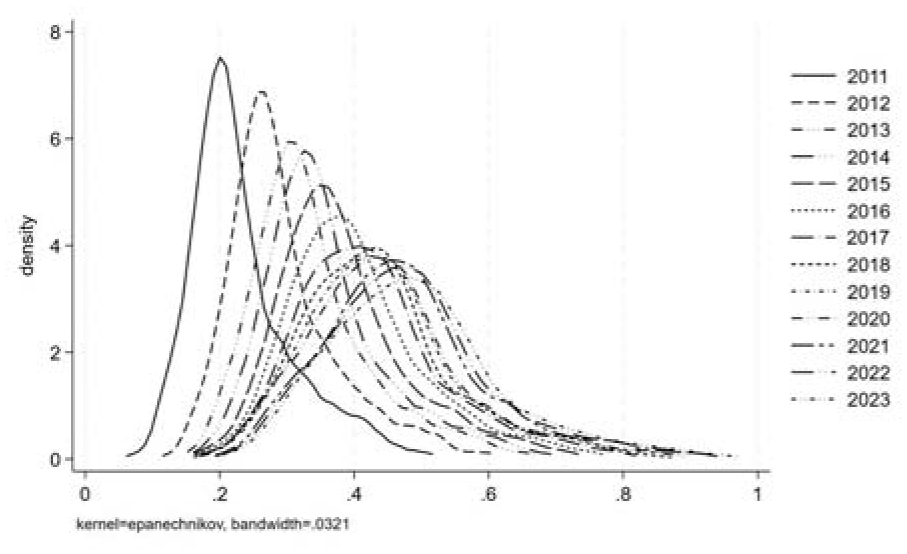
Trend of coupling coordination kernel density.
Empirical Results and Analysis
Benchmark Regression Analysis
To address the primary research objective of assessing the direct impact of DIF-TRE coordination on CP, we estimated Equation 11. Results are in Table 6, with the following treatments applied: (1) The stepwise regression method was adopted to effectively mitigate multi-collinearity; (2) To address omitted variable bias, a two-way fixed effects model was introduced for estimation, with robust standard errors clustered at the city level, corresponding to columns (3) and (4) of the table. Meanwhile, columns (1) and (2) reported the results of pooled OLS regression (excluding fixed effects).
Benchmark Regression Results.

Note. t-values in parentheses.
, *** denotes significance at the 5% and 1% levels, respectively.
The coefficient for JS is .386 and statistically significant at the 1% level in our preferred two-way fixed effects model (Column 4). This finding directly supports Hypothesis 1. Economically, this implies that a one-standard-deviation rise in DIF-TRE coordination (.131) is associated with a .051 increase in the CP index (.386 × .131), which accounts for approximately 24.5% of the sample mean of CP (.208). This is an economically meaningful effect, confirming that DIF-TRE coordinated development is a potent driver of CP.
Robustness Tests
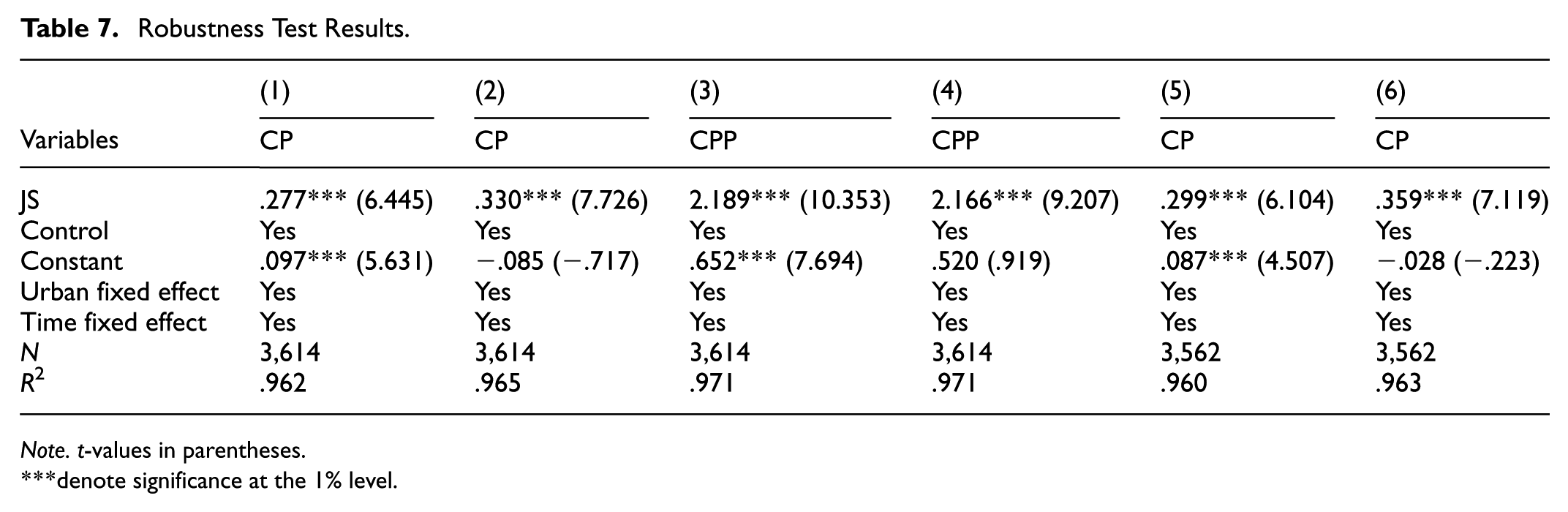
The robustness test was conducted through the following methods: First, the core variables were winsorized at the 1% level for both tails prior to regression, as shown in columns (1) and (2) of Table 7; Second, to avoid result deviations caused by different weighting methods, principal component analysis (PCA) was re-employed to reconstruct the CP index, so as to enhance the reliability of the index measurement, with regression results reported in columns (3) and (4) of Table 7; Third, considering the disparities in development level and government support policies between Chinese municipalities directly under the Central Government and other prefecture-level cities, the four municipalities were excluded from the sample. The remaining city-level observations were re-regressed to verify the result robustness, with outcomes listed in columns (5) and (6) of Table 7.
Robustness Test Results.
Note. t-values in parentheses.
denote significance at the 1% level.
The coefficient of JS remains positive and significant at the 1% level across all alternative specifications: after 1% tail-winsorization (Coef. = .330), using a PCA-constructed CP index (Coef. = 2.166), and excluding municipalities (Coef. = .359). This robustness directly strengthens the credibility of our conclusion supporting Hypothesis 1.
Endogeneity Test
Although this study controlled for a series of variables and employed a two-way fixed effects model, the model may still face endogeneity concerns due to omitted variable bias and reverse causality. To mitigate such endogeneity bias, this paper drew on the research by Du et al. (2023) and selected two instrumental variables (IVs) for two-stage least squares (2SLS) estimation.
The first IV is the spherical distance between each city and Hangzhou. As Hangzhou is a major center for digital financial innovation in China, the spillover effects of its digital finance development diminish with increasing distance. Consequently, this distance is statistically correlated with the local coordination level between DIF and TRE (JS). Furthermore, this spherical distance is an exogenously determined historical variable that is unlikely, to the best of our knowledge, to directly influence the local common prosperity process through channels other than the diffusion of digital finance, thereby satisfying the exclusion restriction.
The second IV is the first lag of the core explanatory variable (JS). The prior period’s coordination level exerts a persistent influence on the current period’s JS but is orthogonal to the current period’s stochastic error term. Given that the first lag of JS is predetermined relative to the current period’s error term, it satisfies the exogeneity requirement. This helps mitigate part of the endogeneity stemming from expectations and dynamic effects.
As shown in Table 8, both IVs pass the weak instrument test and the underidentification test, confirming the validity of the IVs. The 2SLS regression results remain statistically significant and positive, reinforcing the reliability of the baseline findings. We acknowledge that potential omitted variable bias remains a limitation, which we discuss further in the discussion section.
The Endogeneity Test.

Note. Square brackets = p-values; curly brackets = 10% weak identification test critical values. t-values in parentheses.
denote significance at the 1% level.
Mechanism Analysis
We next turn to the second research objective: identifying the transmission channels. The results in Table 9 empirically confirm that the DIF-TRE coordination exerts its influence through the three hypothesized mechanisms proposed in this study.
Results of the Mechanism Analysis.

Note. t-values in parentheses.
, *** denotes significance at the 5% and 1% levels, respectively.
Technological Innovation (H2)
As shown in column (1) of Table 9, a unit increase in JS led to a 1.717 unit rise in invention patent applications and authorizations (TECH), confirming that coordination significantly fostered urban innovation. The positive and significant interaction term JS × TECH (.275, p < .01) in column (2) indicated that the effect of coordination on CP was significantly stronger in more innovative cities. This channel contributes significantly to the total effect of DIF-TRE coordination on CP, validating the Schumpeterian link between financial-technology coordination, innovation, and common prosperity.
Upgrading of Industrial Structure (H3)
According to the results in column (3) of Table 9, DIF-TRE coordination (JS) significantly promoted industrial structure upgrading, with a statistically significant coefficient of .394 for the UPGR indicator. The interaction term JS × UPGR (coefficient = .743, p < .01) in column (4) exhibits substantial economic significance, indicating that the positive effects of JS on CP were amplified as the economy transitioned to higher-value-added sectors. This structural shift created higher-quality employment opportunities and expanded the tax base to support redistribution efforts.
Regional Entrepreneurial Activity (H4)
According to the results in column (5) of Table 9, the coefficient of JS on REA was .767, indicating a strong simulative effect on regional entrepreneurial activity. The significant interaction JS × REA (.483, p < .01) in column (6) showed that entrepreneurial vitality was a critical pathway for ensuring the benefits of growth were widely shared through job creation and income generation for low- and middle-income groups.
Heterogeneity Analysis
Our third research objective was to examine heterogeneity in the impact of DIF-TRE coordination on CP. Referring to the regional classification of Cui et al. (2024), subsample regressions and inter-group coefficient difference tests were performed for the sample cities based on geographical location and city size. Table 10 reports the test results.
Results of the Heterogeneity Test.

Note. t-values in parentheses.
, *** denote significance at the 10% and 1% levels, respectively.
The impact is significantly stronger in eastern cities (Coef. = .571) compared to the central and western regions (Coef. = .176), with a p-value for the coefficient difference of .000. Similarly, the effect in large cities (Coef. = .519) is about three times that in medium and small-sized cities (Coef. = .168). This disparity underscores a “synergy divide,” primarily driven by gaps in initial economic development, digital infrastructure quality, and policy implementation effectiveness. The weaker effect in less developed regions suggests that simply promoting DIF and TRE independently is insufficient; targeted interventions are needed to build the foundational capacities required for synergistic development to flourish. This finding critically informs the fourth research objective by highlighting that the path to CP is not uniform and requires regionally differentiated policies.
Tests for Spatial Effects
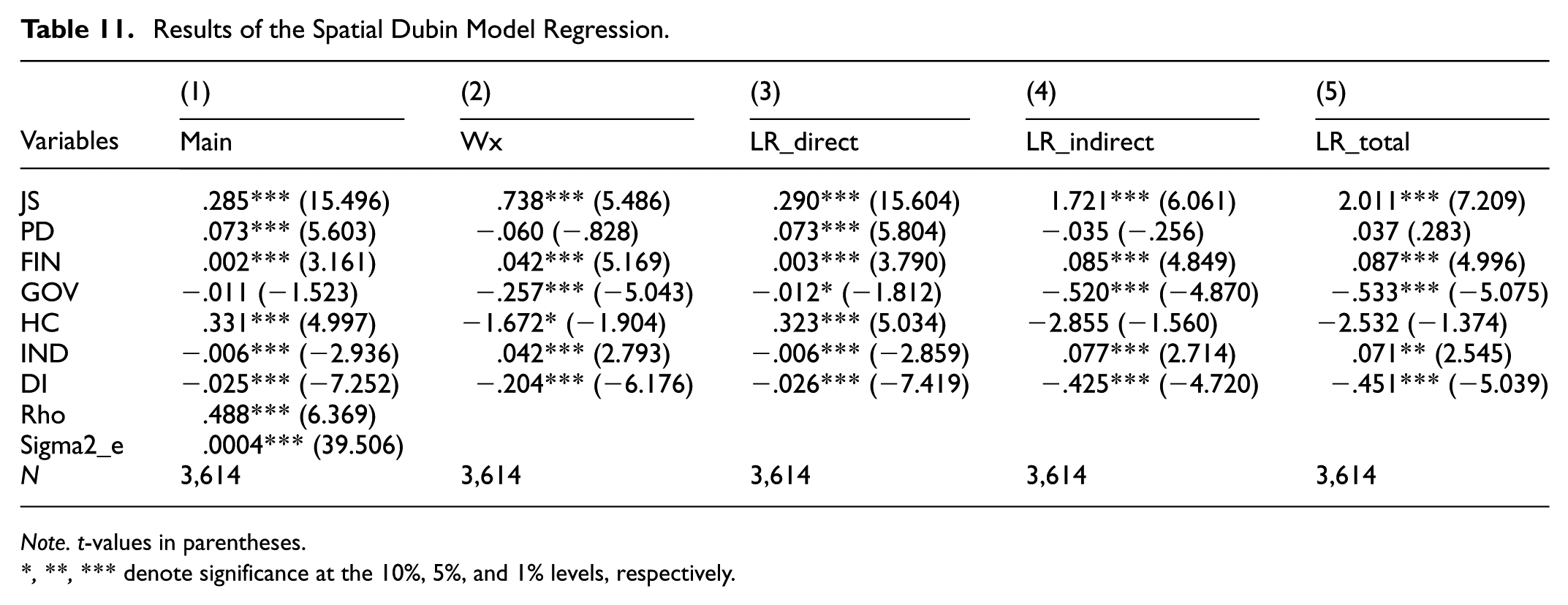
Finally, we tackle the fifth research objective focused on spatial spillover effects. Table 11 presents the results of the SDM regression, which estimates the impact of DIF-TRE coordination on CP using the economic geographical distance matrix.
Results of the Spatial Dubin Model Regression.
Note. t-values in parentheses.
, **, *** denote significance at the 10%, 5%, and 1% levels, respectively.
As shown in Column (1) of Table 11, local DIF-TRE coordination (JS) exerted a statistically significant positive impact on local common prosperity (CP), indicating that JS could significantly promote CP. Additionally, the coefficient of the spatial lag term of JS (Wx) is significantly positive (.738, p < .01), suggesting that the coordinated development level of neighboring regions exerted a positive spatial spillover effect on the local CP. The decomposition of effects in columns (3) to (5) is particularly revealing. The significant positive indirect (spillover) effect (1.721) is notably larger than the direct effect (.290), implying that the regional impact of DIF-TRE coordination is driven more by its cross-regional spillovers than by its within-region effect. The total effect is substantial at 2.011. These results provide strong empirical support for Hypothesis 5.
This finding can be explained by the nature of digital networks and integrated supply chains. DIF leverages digital infrastructure to generate positive externalities, such as knowledge diffusion, cross-regional capital flows, and integrated supply chain finance, thereby facilitating a market-driven process where development in advanced areas radiates to and elevates neighboring regions.
Discussion
Major Findings
Our study provides robust empirical evidence that the coordinated development of DIF and TRE serves as a pivotal mechanism for advancing CP in urban China. The core finding is that enhanced DIF-TRE coordination exerts a statistically significant and economically meaningful positive impact on CP, a result that withstands a battery of robustness checks and endogeneity tests. Crucially, we unpack the “black box” of this relationship by identifying and validating three synergistic transmission channels: technological innovation, industrial structure upgrading, and regional entrepreneurial activity. This mechanism chain elucidates how coordination translates into broader and more equitable development outcomes.
Beyond the average effect, our analysis reveals two critical contextual dimensions that shape the pathway to prosperity. First, we document significant regional heterogeneity: the promoting effect is substantially stronger in eastern and large cities, highlighting a “synergy divide” linked to disparities in initial endowments and digital infrastructure. Second, and importantly, we provide novel evidence of positive spatial spillover effects. The benefits of DIF-TRE coordination are not confined by administrative boundaries; progress in one city elevates the CP levels of neighboring regions, underscoring its role in fostering regionally balanced development. Together, these findings depict a dynamic where DIF-TRE coordination acts as a powerful yet unevenly distributed engine for CP, whose effectiveness is amplified through cross-regional spillovers.
Theoretical and Practical Contributions
This study makes distinct contributions to both theory and policy.
Theoretically, it moves decisively beyond the prevailing bilateral paradigm in the literature by pioneering an integrated, trilateral analytical framework. Grounding our analysis in Schumpeterian growth theory, we conceptualize DIF-TRE coordination not merely as a policy alignment but as a digital-era catalyst for the core Schumpeterian process of “creative destruction.” This constitutes a meaningful extension of the classical theory to the context of finance-real economy interaction in the digital age. Furthermore, by specifying and empirically validating a coherent chain of mediating mechanisms and incorporating spatial spillover effects, we provide the first systematic account of the pathways and geography through which this synergistic coordination advances CP. This offers a more dynamic and systemic theoretical explanation for achieving equitable development.
Practically, our findings deliver actionable, evidence-based guidance for policymakers. The documented heterogeneity in effects provides a clear mandate for regionally differentiated policies, cautioning against one-size-fits-all approaches. Conversely, the significant positive spatial spillovers offer a compelling rationale for inter-regional coordination and investment in connective digital infrastructure, as gains in one area can positively ripple through others. Thus, the study provides a nuanced empirical foundation for designing targeted, coordinated policies that leverage digital-financial synergy to promote high-quality and inclusive growth.
Policy Recommendations
Derived directly from our empirical findings, we propose the following targeted policy recommendations:
Construct a Long-Term Coordination Mechanism to Balance Inclusiveness and Sustainability
Establish government-bank-enterprise data-sharing platforms that integrate production data from TRE with credit data from DIF. Leverage big data risk management to accurately match financing supply with real economic demands, curbing both reckless lending and the misuse of “inclusive finance” for high-interest arbitrage. Encourage financial institutions to launch tailored financial products for rural industrial integration and SME digital transformation. Implement differentiated performance evaluation systems for financial institutions, prioritizing service quality to TRE over mere quantitative loan growth.
Strengthen the Transmission Pathways to Common Prosperity Via Industrial Upgrading, Innovation, and Entrepreneurship
For industrial upgrading: Utilize DIF to channel capital toward high-value-added and green industries. Establish targeted special funds for industrial upgrading and offer tax incentives to enterprises that significantly increase labor remuneration following technological transformation. For Technological Innovation: Develop “innovation white lists” for SMEs, providing low-interest loans based on assessments of their digital R&D intensity. Design and promote “R&D interruption insurance” products to mitigate innovation risks. For Entrepreneurship: Promote “credit + skills training” models, offering start-up capital coupled with digital platform training for low-income groups and returning migrants, thereby unlocking grassroots entrepreneurial vitality.
Promote Coordinated Regional Development to Unleash Positive Spatial Spillovers
Accelerate the deployment of 5G, cloud computing, and other digital infrastructure in central, western, and rural areas to narrow the foundational digital divide. Establish east-central-west financial linkage mechanisms to facilitate cross-regional technology and capital transfers, and support inter-regional supply chain cooperation. Launch rural digital finance pilot projects, develop credit products tailored to rural economic scenarios, and use tax exemptions to guide capital toward rural revitalization. Build regional coordinated regulatory systems, adopting negative lists to restrict capital flows into high-risk speculative sectors and ensuring financial resources serve the weak links of TRE.
Research Limitations
While this study provides comprehensive insights, it is subject to several limitations that point to fruitful avenues for future research.
Distributional Consequences and Boundary Conditions: This study focuses on average effects, leaving the distributional consequences of DIF-TRE coordination across different social groups (e.g., by skill level, age, or hukou status) underexplored. It is crucial to investigate whether the gains from coordination are widely and fairly shared, or if they risk exacerbating existing inequalities. Furthermore, our research highlights the positive outcomes of coordination but does not extensively explore its potential boundary conditions or negative externalities, such as the risk of over-indebtedness or the displacement of traditional sectors. Investigating these contingencies is a vital next step.
Causal identification and endogeneity: Although we have made concerted efforts to address endogeneity concerns primarily by using instrumental variables (IVs) and two-way fixed effects models, we acknowledge that challenges in establishing definitive causality remain. Our IV strategy was primarily designed to mitigate and has effectively addressed the reverse causality and omitted variable bias associated with the core explanatory variable (JS). However, some of the control variables (e.g., financial development level, FIN; industrialization level, IND) may themselves be endogenous to the common prosperity process. For instance, a higher level of common prosperity could, in turn, foster deeper financial development or industrial upgrading. While their inclusion is necessary to mitigate omitted variable bias, their potential endogeneity means our model estimates should be interpreted as capturing robust and economically significant conditional correlations that are highly suggestive of causality rather than providing incontrovertible proof for it. Future research could employ more dynamic panel data models to better account for the potential endogeneity of a broader set of regressors.
Mechanism interdependencies and dynamics: This study establishes the critical roles of TECH, UPGR, and REA as mediators between DIF-TRE coordination and CP. However, it primarily treats them as parallel pathways. An exciting avenue for future research lies in empirically modelling and testing the temporal sequence and potential interdependencies among these mechanisms. Employing methodologies such as structural equation modelling or sequential mediation analysis could help unravel the precise nature of this dynamic “innovation-upgrading-entrepreneurship” chain, moving from establishing its existence to elucidating its intricate structure.
Footnotes

Ethical Considerations
The study presented in this manuscript does not involve human participants, human data, or human tissue. Therefore, ethical approval from an Ethics Committee or Institutional Review Board was not required for this research.
Consent to Participate
Given that the study does not involve human participants, the requirement for informed consent to participate is not applicable.
Consent for Publication
This article does not contain any individual person’s data. Thus, the requirement for informed consent for publication is not applicable.
Author Contributions
Qiuping Yi: Conceptualized the research framework and research questions, designed the empirical methodology, and took the lead in drafting the manuscript’s introduction, literature review, and methodology sections. Yubo Zhang: Collected and processed the core economic data, conducted the empirical analysis using statistical software, and drafted the results section. Verified the robustness of the empirical findings and participated in revising the discussion section. Also responsible for the initial revision of the full manuscript based on peer review comments. Yumin Luo: Contributed to refining the research design and interpreting the empirical results, drafted the discussion and conclusion sections, and ensured the consistency of the manuscript’s logic and academic rigor.
Funding
The authors disclosed receipt of the following financial support for the research, authorship, and/or publication of this article: This work was supported by the (National Social Science Fund of China) under Grant (number 25BJY018).
Declaration of Conflicting Interests
The authors declared no potential conflicts of interest with respect to the research, authorship, and/or publication of this article.