




Abstract
This paper examines the impact of import competition on firm innovation in the Chinese manufacturing sector. We find that import competition stimulates innovation, consistent with the “escape-competition effect” from the existing literature. Firms also adopt more skill-biased technologies in response to increased competition, with this effect observed in both low- and high-tech industries. Moreover, as import competition intensifies, firms expand their range of imported product lines, with this impact being more pronounced for tariff cuts on imports from high-income countries compared to those from non-high-income countries. The importance of product differentiation strategies grows as import competition increases, further driving innovation. We also discover rich heterogeneous effects across firm ownership, firm size, and trade modes. These findings provide important insights for policymakers and scholars on the pro-innovation effects of import competition in developing economies.
Introduction
As one of the fastest-growing developing economies, China’s economic rise during the post-WTO period has attracted worldwide attention. Along with its rapid economic development, China’s economy has presented a noteworthy feature: the reduction of import tariffs and the steady growth in innovation activities. After China’s accession to the World Trade Organization (WTO) in December 2001, China’s import tariff rate has dramatically dropped by 40.75% points from 18.38% points in 2001 to 10.89% points in 2006. China’s import value, which has quadrupled from 225.1 billion US dollars in 2001 to 956.1 billion US dollars in 2007, has been the second-largest globally for over 6 years. Meanwhile, the creative powers of China have continued to improve. For example, total patent applications increased from fewer than 97,000 pieces in 1998 to more than 717,000 in 2008. In 2013, China ranked first in the number of patent applications worldwide. It surpassed the United States to become the country with the largest number of international patent applications under the World Intellectual Property Organization (WIPO) Patent Cooperation Treaty (PCT) framework in 2019.
About the relationship between import competition and firm innovation, a comprehensive review of recent studies by Shu and Steinwender (2019) indicates that while some evidence supports the pro-innovation effects of import competition, the results vary significantly by region. In the case of developing economies, evidence tends to be more positive, suggesting that increased competition from imports can spur technological advancements and innovation. For instance, Bombardini et al. (2017) and Medina (2024) have shown that competition can drive innovation and quality upgrading through the “escape-competition effect” for firms in China and Mexico, while this impact is mixed for firms in North America. Competition increases incentives for firms to innovate by reducing the pre-innovation rents, that is, the rents a firm can capture without innovating (Arrow, 1962). This effect is identified as the “escape-competition effect,” which indicates that import competition positively stimulates firm’s innovative activities (Shu & Steinwender, 2019).
Notably, these studies lack detailed analysis of the underlying mechanisms, leaving a significant gap in the literature. The purpose of this paper is to examine the impact of import competition on firm innovation and how import competition affects firm innovation. By identifying the mechanisms involved, the research contributes to understanding how external trade shock shape innovative activities for firms in emerging economies.
This paper closely relates to two studies: Bombardini et al. (2017) and Q. Liu et al. (2021), which explore how tariff reductions affect firm innovation in China. Unlike Bombardini et al. (2017), who focus on the heterogeneity of effects across firms with varying productivity levels, we estimate the overall impact of import competition on firm innovation while identifying specific mechanisms through which these effects occur. Similarly, while Q. Liu et al. (2021) provide valuable insights into tariff-driven changes in innovation, our study incorporates export demand shocks into the baseline model to account for unobservable shocks from other trading partners. This inclusion enhances the robustness and precision of our findings.
Our contributions to the literature are twofold. First, we provide empirical evidence demonstrating that import competition significantly fosters innovation in the Chinese manufacturing sector. This finding is particularly important for developing economies, as it highlights how increased exposure to global competition can serve as a catalyst for innovation and technological advancement in domestic market. Second, we expand the existing literature by showing that the positive effect of tariff reductions on firms’ patenting activities operates through specific channels: the adoption of skill-biased technology, the expansion of import product lines, and the implementation of product differentiation strategies. While recent studies have explored the relationship between tariff cuts and the introduction of new products (Goldberg et al., 2010) or industry-level skill intensity (Fieler & Harrison, 2023), our analysis goes further by connecting trade shocks to firms’ strategic responses and their innovation outcomes. Our results show that firms adopting these strategies-skill-biased technology, import diversification, and product differentiation-are better equipped to innovate and more resilient to external trade pressures. This study sheds new light on the complex dynamics of trade and innovation, providing empirical support for theoretical models in the existing literature.
Our primary finding indicates that import competition exerts a positive impact on innovation after controlling the effects of changes in input tariff reductions and export demand. Specifically, holding other factors constant, a 1% point reduction in import tariffs correlates with a 0.11% point increase in patent application activities among manufacturing firms. This positive relationship aligns with the “escape-competition effect,” suggesting that heightened import competition spurs firms to intensify their innovation efforts. Furthermore, we explore the mechanisms through which import competition influences innovation. Our analysis finds that firms in skill-intensive industries have experienced a notable rise in rankings following China’s accession to the WTO, revealing that these firms are increasingly adopting skill-biased technologies in response to higher import competition. Firms exhibiting industry-switching behavior in response to import competition benefit more significantly in terms of innovation. Building on prior literature that highlights the role of expansion of imported products under freer trade conditions (Amiti & Konings, 2007), our findings suggest that increased import competition incentivizes firms to diversify their import product lines as a strategy to drive innovation. Additionally, our results underscore the growing importance of product differentiation strategies in response to heightened import competition, which further stimulates firms’ innovation activities.
The remainder of the paper is organized as follows. The next section outlines literature review, theoretical analysis, and hypothesis development. Section 3 presents an overview of the data sources and outlines the econometric model employed for the estimation. Section 4 includes the main empirical results. Section 5 explores the potential channels through which import competition influences innovation. Section 6 offers a further discussion of our findings. Finally, Section 7 concludes with a summary of the key insights and implications of the study.
Literature Review and Hypothesis Development
International trade and its impact on domestic innovation have been a central focus of academic research since the early 1980s, with particular attention given to the consequences of globalization and trade liberalization policies such as tariff reductions and free trade agreements. The literature on the trade-innovation nexus broadly encompasses three streams: technology diffusion, trade-induced structural change, and firm-level responses to import competition. This study focuses on the third stream, specifically examining how firms respond to import competition and how this response affects their innovation behavior.
Import Competition and Firm Innovation
A key theoretical foundation underpinning this relationship is Arrow’s (1962) insight that intensified market competition reduces pre-innovation rents more than post-innovation rents, thus increasing the incentive for technological advancement. Recent extensions of this logic (Bloom et al., 2021; Medina, 2024) suggest that import competition—particularly following large tariff reductions—forces firms to reallocate trapped resources toward innovation and product upgrading. This aligns with the broader “escape competition effect” (Aghion et al., 2017), in which firms facing competitive pressure are incentivized to innovate as a strategy for survival and differentiation.
Empirical research has provided mixed but generally supportive evidence for the positive effect of import competition on innovation. For example, Bloom et al. (2016, 2021) find that import competition from China significantly enhanced firm innovation in Europe, while Hombert and Matray (2018) document similar findings for the United States. Ahn et al. (2018) extend this evidence to South Korea. However, contrasting results by c suggest a decline in R&D expenditures among some U.S. firms, highlighting heterogeneity in firm responses. Woo et al. (2022) find a positive link between foreign competition and corporate social responsibility, while Akcigit and Melitz (2022) offer a theoretical model indicating that the impact of trade on innovation is ambiguous—potentially positive or negative depending on firm characteristics and industry structure.
Building on this literature, this paper proposes the following:
Mechanisms Linking Import Competition to Innovation
In addition to examining the overall effect, we also explore the mechanisms through which import competition influences innovation. The literature suggests multiple channels.
The Trade-Induced Skill-Biased Technical Change Hypothesis posits that international trade alters the relative demand for high-skilled versus low-skilled labor, thereby affecting the direction of technological change (Aboushady & Zaki, 2021; Silva, 2009). Empirical studies have shown that increased market penetration by imports and heightened import competition, resulting from international trade participation, incentivize firms to adopt skill-biased technologies, which in turn impact firm productivity and technological innovation output. For example, increases in import scale and import competition have been found to significantly boost productivity and patent activity among firms in the United States and Europe (Bloom et al., 2016). Also, high-skilled workers can transfer technical knowledge and skills to lower-skilled workers (Mazzolari & Ragusa, 2013). This knowledge spillover enhances the overall skill level of the firm, reduces innovation risks, and strengthens the firm’s technological innovation capacity and competitive advantage.
In response to intensifying competition, firms can pursue product diversification to maximize profits and secure funding for technological innovation by reallocating resources across industries. Since opportunity costs vary between sectors (Levinthal & Wu, 2010; Sakhartov & Folta, 2014), diversification allows firms to shift resources away from industries affected by import competition toward those with stronger competitive advantages or higher growth potential. This strategic reallocation not only mitigates risks in vulnerable sectors but also reduces opportunity costs and enhances overall profitability. Empirical studies have shown that trade liberalization results in increased product variety, especially through access to higher-quality intermediate inputs (Fieler & Harrison, 2023). Meanwhile, the Nelson Hypothesis (Nelson, 1959) posits that product diversification is beneficial for technological innovation. Firms with multiple product lines can more effectively integrate and optimize resources, such as technology and capital, thereby internalizing returns, reducing the per-unit cost of products or services, and fostering technological innovation.
Firms also respond to import competition by engaging in product differentiation activities to avoid direct price competition and appeal to niche markets. Theoretical and empirical analysis (Atkeson & Burstein, 2008; Bertschek, 1995; Bloom et al., 2016) shows that intensified import competition increases a firm’s investment in product innovation, enhancing product diversity and differentiation, thus fostering innovation. Specifically, the reduction of import tariffs primarily encourages firms to increase product differentiation by lowering trade costs and enhancing the profitability of differentiated products, thereby driving innovation within the firm.
Accordingly, this paper proposes the following:
Data and Methodology
Data Sources
Our analysis draws on five main datasets containing industry-level, firm-level, and transaction-level information. The industry-level tariff data comes from the Tariff Download Facility (TDF) maintained by the World Trade Organization (WTO). The firm-level patent data comes from the Chinese Patent Data Project (CPDP) provided by He et al. (2018). Other firm-level data comes from China’s Annual Survey of Industrial Firms (ASIF) collected by China’s National Bureau of Statistics. The transaction-level data comes from China’s Customs Trade Database (CTD) and International Trade Database at the Product Level (BACI). The former is conducted by China’s General Administration of Customs (GAC), and the latter is maintained by the Leading French Center for Research and Expertise on the World Economy (CEPII). Our sample period is between 2000 and 2006. Since import tariffs declined most significantly between 2000 and 2006 in China, many studies set this period as the tariff shock, including Cai and Liu (2009), Brandt et al. (2012, 2017), Chen et al. (2017), Bombardini et al. (2017), and Q. Liu et al. (2021).
Industry-Level Data
The Tariff Download Facility reports detailed information on Most-Favored-Nation (MFN) applied and bound import tariffs at the disaggregated level of the standard codes of the Harmonized System (HS), including the tariff lines and all types of ad valorem duty. It provides China’s tariff data at HS six-digit level. Considering that we are interested in testing the average effect of industry-level import competition on firm innovation, we use the average of ad valorem duty at HS six-digit level to construct the industry-level variable to measure import competition, see Yu (2015) and Fan et al. (2018) for a similar approach.
Firm-Level Data
The CPDP presents the detailed information on patent applications of Chinese above-scale industrial firms, such as the assignee (name and address), the inventor, the dates (application, grant, and expiry), the patent descriptions, the patent type (design, utility model, and invention), and so forth. It is arranged by He et al. (2018) by matching China’s State Intellectual Property Office (SIPO) patents to firms covered in ASIF. We obtain firm patent application data from the CPDP database.
The ASIF database contains production and key accounting information, including balance sheets, profit and loss accounts, and cash flow statements, for all state-owned firms and non-state-owned firms with annual sales exceeding 5 million CNY from 2000 to 2006. The database reports over a hundred production and financial variables, covering basic firm details, production data, and financial information. Following Cai and Liu (2009), we clean the sample to address noisy and misleading data. We exclude observations missing core information, such as firm name, identification number, gross industrial output, value added, intermediate input, and total and fixed assets. We also drop firms with annual sales below 5 million CNY or profit margins of 100% or more, and we remove firms that do not conform to Generally Accepted Accounting Principles (GAAP).
Each firm in our sample is classified according to the four-digit Chinese Industry Code (CIC) system, similar to the old U.S. Standard Industrial Classification (SIC) system. In 2003, the CIC was updated, making some industries more detailed and merging others. To ensure consistency, we converted the 2000 to 2002 data from the 2002 CIC to the 2003 version using the concordance table provided by Brandt et al. (2012). Our analysis focuses solely on firms in the manufacturing sector.
Transaction-Level Data
The CTD database records detailed import information monthly of all imported goods transactions through Chinese customs at eight-digit level from 2000 and 2006, including firm basic information (firm name, phone number, zip code, type of ownership), product code, import value, quantity, unit price, source country, means of transportation, trade regimes (ordinary, processing and assembling, and others), export destinations, and so forth. Service trade is excluded in our analysis with its irrelevance. We further aggregate the eight-digit import data to six-digit level to correspond with the tariff data.
The BACI database provides detailed bilateral trade data at the six-digit level for over 5,000 manufacturing products, including trading countries, product codes, total trade volume, and quantity. For the total volume of trade, we use the average annual exchange rate of the RMB against the US dollar from 2000 to 2006.
Similar to the tariff data, the CTD and BACI databases also encountered HS code adjustments in 2002. We standardized the transaction data by matching the 1996 HS version to the 2002 version for 2000 and 2001 in both datasets using the UN’s standard HS concordance table.
Merging the Five Datasets
To obtain the data for regression, we merge the five datasets in three steps, following the methods of Brandt et al. (2012) and Yu (2015). First, we match the ASIF and CPDP databases using firm identification numbers and names. Next, we merge this data with the CTD database using combinations of firm name and year, postal code and phone number, and legal representative and phone number. Finally, we link the resulting data with the Tariff Download Facility and BACI databases using country name, year, and six-digit HS product code.
Estimation Specification
To test the impact of import competition on firm innovation, we employ a linear Ordinary Least Square specification with fixed effects as our benchmark regression equation:

where i, j, and t refer to a firm, a four-digit industry and a year, respectively. More specifically,
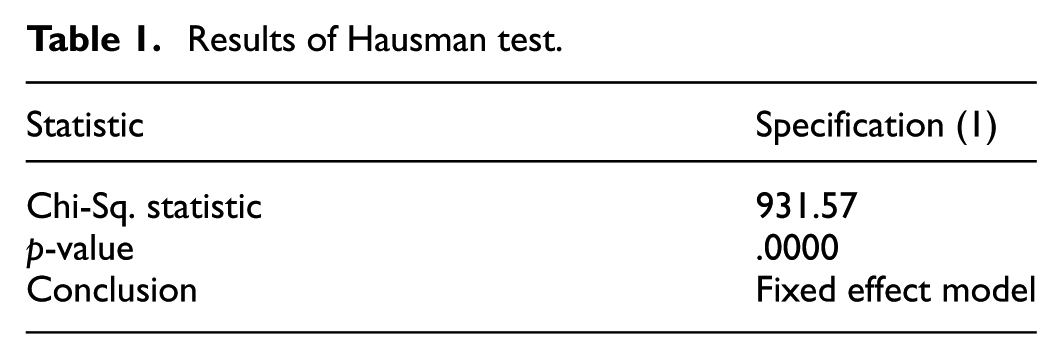
As noted by a reviewer, diagnostic tests including Hausman test is important for choosing the regression model. Hausman test is employed to determine the type of model (a fixed effect model or a random effect model). As shown in Table 1, specification (1) significantly rejected the null hypothesis at the critical level of 1%, and fixed-effect model is more suitable for this sample.
Results of Hausman test.
With the existence of heteroscedasticity and autocorrelation of unknown form in the panel data, it is challenging to consistently estimate asymptotic variance. Table 2 displays the test results of heteroscedasticity and autocorrelation for the regression model. The results indicate the existence of heteroscedasticity and autocorrelation. In order to mitigate the effects of heteroskedasticity and autocorrelation problems on the estimation results, a fixed-effects model based on heteroscedasticity-robust standard errors clustered at the four-digit industry level was chosen as the estimation model in this paper.
Results of Heteroscedasticity and Autocorrelation Tests.

We measure innovative activity by the logarithm of annual invention patent applications. China’s patent system categorizes patents into invention, utility model, and design. Invention patents undergo rigorous examination for novelty and non-obviousness, while utility model and design patents are granted automatically after 1 year. Additionally, Invention patents offer 20 years of protection, compared to 10 years for the other categories. Due to their higher R&D demands, stringent standards, and greater value, invention patents are the most challenging and indicative of firm innovation (Pru’homme, 2017). Therefore, we use the logarithm of invention patent applications as our proxy for firm innovation. Though invention patents could better reflect innovation, we also attempt to use utility model and design patents application counts to capture innovation in robustness checks, results are still robust to the changes (for more details, see subsection 4.3).
To measure import competition, we first construct industry-level output tariff by the following equation:

where
Import tariffs are commonly used in the international trade literature to measure trade shocks or trade liberalization, particularly in developing economies (Fan et al., 2018; Goldberg et al., 2010; Goldberg & Pavcnik, 2004; Q. Liu et al., 2021; Medina, 2024). As tariffs decrease, foreign products increase competition in the domestic market. Thus, a reduction in import tariffs can serve as a proxy for heightened import competition.
Changes in industry-level output tariffs impact not only the industry itself but also related industries through input-output linkages. A reduction in input tariffs intensifies competition for domestically produced inputs, enabling downstream firms to access higher-quality inputs at lower prices, thereby reducing production costs (Amiti & Konings, 2007). Focusing solely on output tariffs could lead to omitted variable bias, resulting in an upward bias in the estimation of

where
Using the 2002 HS version of six-digit products and the 2002 CIC version at the four-digit level, along with China’s 2002 input-output table at the two-digit level, we derive two-digit industry-level input tariffs. We then map these to four-digit industry-level input tariffs in the 2003 CIC version using the CIC02-CIC03 industry concordance table. Introducing input tariffs allows us to capture the competition effects of import liberalization in input industries, known as the magnifying effect, as discussed in Fieler and Harrison (2023).
While import competition affects firm innovation activities, the market size effect caused by export liberalization is another important factor in firm innovation, as studied in Lim et al. (2018) and Aghion et al. (2024). To identify the impact of import competition more accurately on firm innovation, we control the market size effect by introducing exogenous export demand shock from other countries. The definition of export demand shock is shown in the following equation:

where
Although the increase in import demand or technological changes in other countries may lead to a rise in export demand for China,
Results
Descriptive Analysis
Table 3 presents the descriptive statistics of our sample. The minimum, maximum, and mean values of Invention_patent indicate that there is large variation on firm’s patenting activities. The mean value of industrial output tariff is approximately 1.7 times its standard deviation, whereas the mean value of industrial input tariff is about 4.8 times its standard deviation. This suggests that input tariffs are less dispersed and more tightly concentrated around their mean compared to output tariffs. The maximum value of export demand shock is approximately twice the mean, indicating a right-skewed distribution.
Descriptive Statistics.

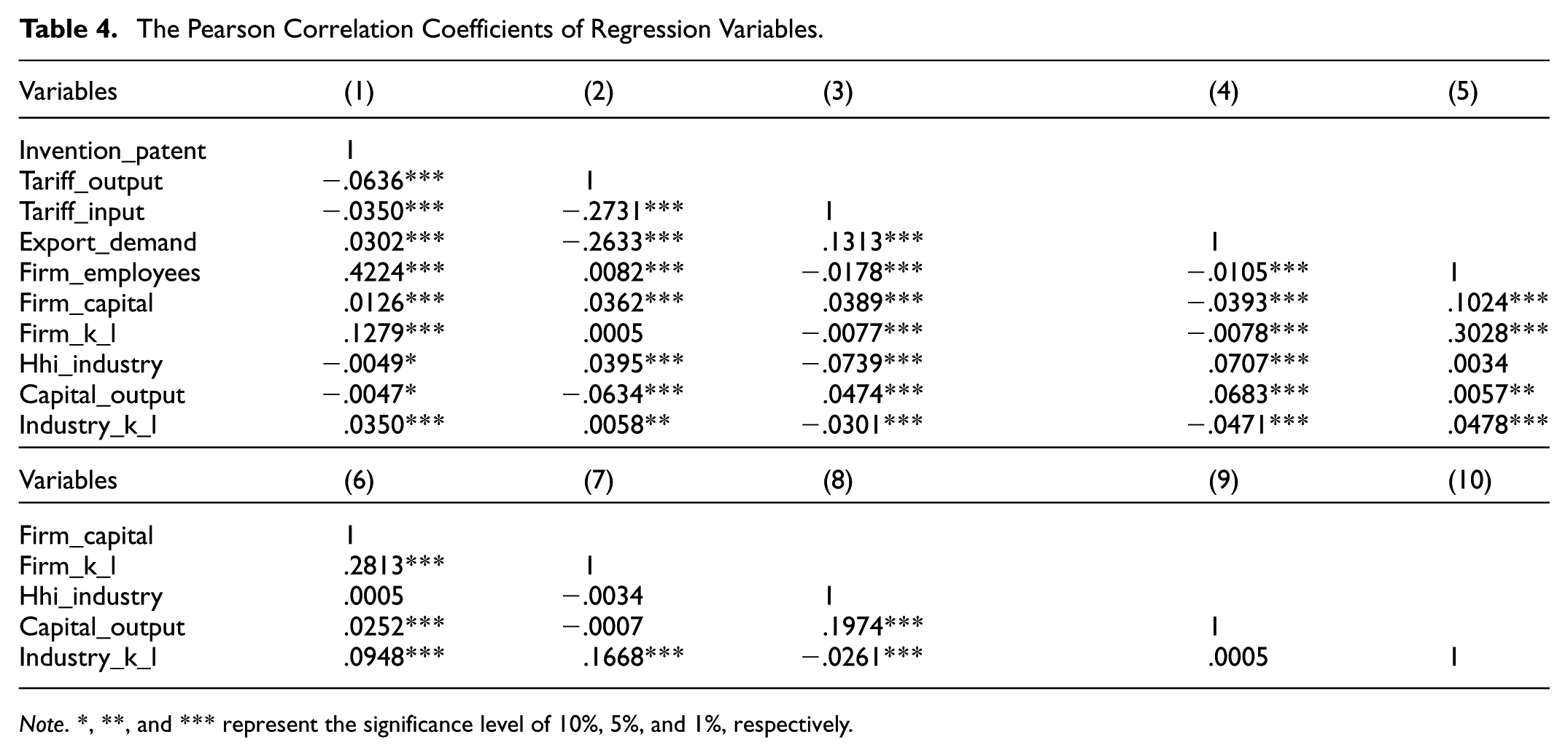
Table 4 presents the pairwise correlations among firm innovation, industrial tariffs, and control variables. As expected, we find that Tariff_output and Tariff_input are negatively and significantly related to firm innovation measure Invention_patent, providing an early sign of potential link between import competition and firm innovation. In addition, Invention_patent is significantly associated with Firm_employees, Firm_capital, Firm_k_l, Capital_output, Industry_k_l, indicating that it is appropriate to control these variables in our empirical specification.
The Pearson Correlation Coefficients of Regression Variables.
Note. *, **, and *** represent the significance level of 10%, 5%, and 1%, respectively.
Benchmark Results
Table 5 presents the benchmark regression results for the impact of import competition on firm innovation, with standard errors clustered at the industry level. Column (1) includes only industry output tariffs, where the key regressor, Tariff_output, is negative and statistically significant, indicating a positive relationship between import competition and innovation. With decreasing import tariffs, more competitive foreign goods (final or intermediate) will flood into the domestic market. Therefore, a decrease in import tariffs leads to an increase in the total imports within the industry, resulting in higher import competition. In column (2), firm-specific and industry-specific time-variant controls are added (e.g., firm employees, capital, capital-labor ratio, industry competition), and the results remain robust. Columns (3) and (4) introduce input tariffs and export demand shocks, with Tariff_output consistently negative and significant at the 1% level. Hypothesis 1 is confirmed.
Baseline Results.

Note. All columns include a constant term and control for ownership dummies. All standard errors are clustered at the industry level and standard deviations are shown in parenthesis.
, **, and *** represent the significance level of 10%, 5%, and 1%, respectively.
Taking column (4) as our benchmark result, a one-percentage-point reduction in industry output tariffs leads to a 0.11% point increase in patent applications by industrial firms, holding other factors constant. A one-standard deviation decrease in industry output tariffs promotes firm innovation by 0.38%. Firms in industries experiencing larger tariff cuts tend to show higher patent activity, consistent with the “escape competition effect” of import competition on innovation (Ahn et al., 2018; Bombardini et al., 2017; Brandt et al., 2017).
As noted by a reviewer, there is the time lag between firm’s innovation efforts and patent output. These two are not instantaneous. Considering this, we include the 1- and 2-year lagged independent variables into the regression model and return the results, respectively. Results of column (5) in Table 5 show that after including 1-year lagged effect, tariff at output level remains significantly negative. Tariff at input level and export demand shock are also appeal significantly negative. Results of column (6) in Table 5 display a similar pattern as column (5) do. Our core independent variables remain significantly negative after considering 2-year lagged effect. This is also in accordance with the long-term effect of import competition has been discovered in related literature (Q. Liu et al., 2021), highlight that import competition could affect firm activities in a long run.
Robustness of Benchmark Results
Alternative Independent and Dependent Variable
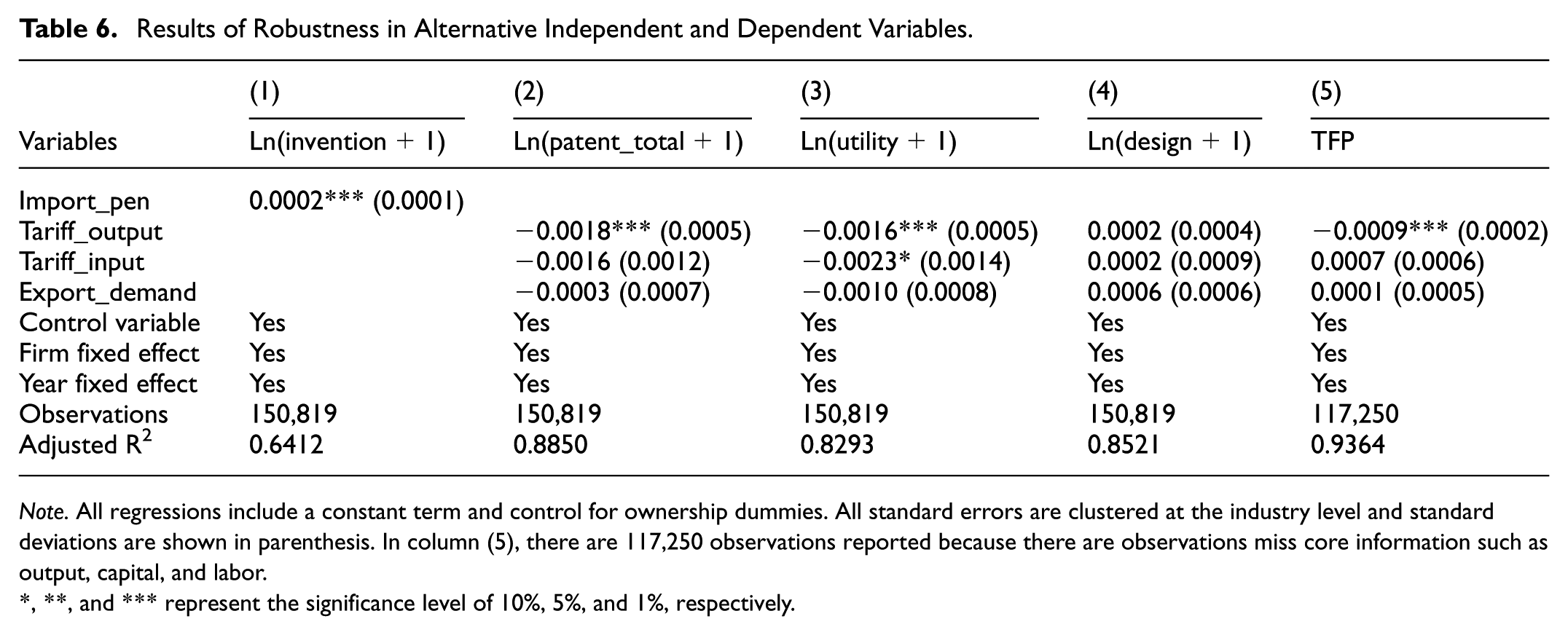
While using import penetration as a proxy for import competition has the potential drawback of endogeneity with firm characteristics, it offers the advantage of capturing non-tariff barriers. For robustness, we calculate four-digit industry import penetration as the ratio of annual industry import volume to total output value. Higher import penetration indicates stronger competition. The industry-level import data is sourced from the CEPII-BACI database, and output values are from the ASIF database. We adjust import volumes using the average RMB-USD exchange rate (2000–2006) and output values with the annual output price index. Results, presented in Table 6, Column (1), show a positive and significant coefficient for import penetration, suggesting that increased import penetration stimulates firm patenting.
Results of Robustness in Alternative Independent and Dependent Variables.
Note. All regressions include a constant term and control for ownership dummies. All standard errors are clustered at the industry level and standard deviations are shown in parenthesis. In column (5), there are 117,250 observations reported because there are observations miss core information such as output, capital, and labor.
, **, and *** represent the significance level of 10%, 5%, and 1%, respectively.
In our initial analysis, we used invention patent applications to measure firm innovation. As a robustness check, we also consider the logarithm of total patent applications, utility model patents, and design patents as alternative proxies for innovation. Table 6 presents these results. Columns (2) to (4) indicate that a 1% point decrease in import tariffs increases total patent applications and utility model patent applications by 0.18% and 0.16% points, respectively, holding other factors constant. However, utility model patent applications are statistically insignificant, which is consistent with Q. Liu et al. (2021). This suggests that the positive effect of import competition on innovation is driven primarily by invention patents, justifying their use as the core dependent variable.
As noted by a reviewer, innovation is patented, yet many firms lack patents. In our analysis, there are about 58% of our sample (88,356 firms) report zero patents, which potentially neglecting the innovative activities that cannot be reflected in the patent level. Total factor productivity of firms captures both technological progress and efficiency gains while being widely available and comparable across firms (Cheng et al., 2023). Thus, we use firm TFP, calculated using the Olley and Pakes (1996) method, as a proxy for innovation. Results of column (5) in Table 6 show that stronger import competition still stimulates firm innovation in the productivity perspective.
Exclusion of Processing Trade
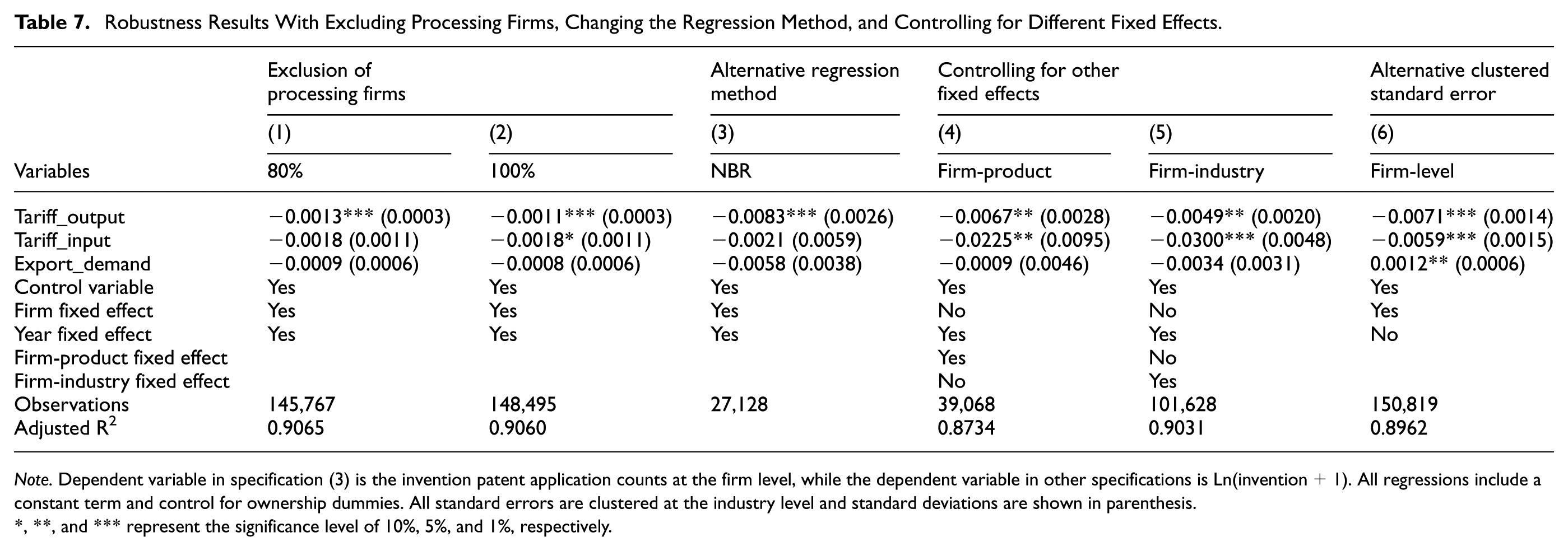
Processing trade is a key feature of China’s foreign trade, where firms enjoy duty-free imports, either exempt from import taxes or refunded. Since processing firms are minimally affected by import tariff changes and rarely innovate (Chen et al., 2017), we exclude them from our analysis to check the robustness. Specifically, we exclude firms with processing trade shares of 80% and 100% of their total trade volume. We then re-estimate Equation (1) for each subsample. The results in columns (1) and (2) of Table 7 demonstrate the robustness of our baseline results, after the exclusion of the specified firms.
Robustness Results With Excluding Processing Firms, Changing the Regression Method, and Controlling for Different Fixed Effects.
Note. Dependent variable in specification (3) is the invention patent application counts at the firm level, while the dependent variable in other specifications is Ln(invention+1). All regressions include a constant term and control for ownership dummies. All standard errors are clustered at the industry level and standard deviations are shown in parenthesis.
, **, and *** represent the significance level of 10%, 5%, and 1%, respectively.
Negative Binomial Regression
The patent applications are a typical count variable and it is over-dispersed with the sample standard deviation being more than eight times as large as the sample mean. Given this characteristic, we employ a Negative Binomial Regression to test the robustness of our findings. The results presented in Table 7, column (3), indicate that the estimated coefficient for import tariffs remains statistically significant and negative, corroborating earlier results.
Controlling for Firm-Product and Firm-Industry Fixed Effects
In the previous analysis, we included firm and year-fixed effects in our estimation to control for time-invariant heterogeneity of firm characteristics and all unobserved yearly shocks. However, one may still worry about whether other unobserved firm-level factors affect our empirical estimation. Given this concern, we introduce firm-product and firm-industry fixed effects in our specification separately to further control for potential factors varied by products and industries. Columns (4) and (5) of Table 7 indicate that, after accounting for fixed effects, the results remain robust.
Clustering Standard Error at Firm Level
We calculated the standard errors by clustering at the four-digit industry level in our precious regressions. To avoid the potential bias of the serial correlation of the independent variable on the regression results (Brandt et al., 2017), and to check the robustness if we cluster our standard errors at other levels, we cluster the standard error at the firm level in our regression. Our findings remain robust following this check, as shown in column (6) of Table 7.
Endogeneity
In this subsection, we address the potential endogeneity of tariff changes in our analysis. The concern arises from a possible reverse causality between industry-level output tariffs and firm innovation. While lower import tariffs could indeed spur innovation, policymakers might selectively reduce tariffs in industries better equipped to compete with cheaper foreign goods, such as those with rapidly growing productivity (Brandt et al., 2017). Additionally, firms may influence tariffs through lobbying to serve their interests. Consequently, industries with higher innovation might experience larger tariff cuts, leading to reverse causality between the dependent and independent variables.
To address this concern, we use the corresponding tariff aggregated at the four-digit industry level in 2000 interacted with a post-WTO accession dummy, as an instrument for industry-level output tariffs, following Goldberg et al. (2009). Brandt et al. (2017) provide strong evidence that tariff cuts are negatively correlated with initial tariff protection, and that initial tariffs predict protection well. They also show that tariff changes are uncorrelated with initial industry characteristics, making our instrument reasonable. We use this interaction term instead of the initial tariff alone due to the inclusion of industry fixed effects in our model. Columns (1) and (2) of Table 8 present the results with and without control variables. The coefficients on industry-level tariffs are statistically significant and negative, with larger absolute values than in the baseline OLS regressions. This may reflect stronger firm responses to the larger tariff cuts associated with WTO entry compared to smaller changes in other years. Using the IV specification, a one standard deviation decrease in output tariffs (approximately 4.39) increases firm patenting by about 6.37%.
Results of Endogeneity Treatment.

Note. All specifications employ a Two Stage Least Square (2SLS) regression method. All regressions include a constant term and control for ownership dummies. All standard errors are clustered at the industry level and standard deviations are shown in parenthesis.
, **, and *** represent the significance level of 10%, 5%, and 1%, respectively.
Second, following Yu (2015), we use one period lagged industry-level import tariffs as an additional instrument for current tariffs, employing a Two-Stage Least Squares (2SLS) method for Equation (1). The idea is that past tariffs are highly correlated with current tariff changes but uncorrelated with the error term or other determinants of the dependent variable (Fan et al., 2018). The results, shown in Table 8, indicate that lagged tariffs remain statistically significant and negative at the one% level. Specifically, a one standard deviation decrease in output tariffs is associated with a 6.41% increase in firm patenting. Tests for weak identification and weak instruments confirm the validity of this approach. The coefficient estimates for industry output tariffs in columns (2) and (4) are similar, with the second approach yielding a slightly larger estimate. These results support the conclusion that increased import competition correlates with higher within-firm patenting activity.
Evidence about Mechanism and Heterogeneity
We have established that greater import competition significantly increases firms’ patenting activities. When domestic markets are flooded with foreign products, firms may respond by adopting more skill-biased technologies, expanding import product lines, or implementing product differentiation strategies. Understanding these mechanisms is crucial for revisiting or implementing relevant policies. In this section, based on the detailed information from our datasets, we explore the channels driving the positive link between import competition and firm patenting.
Use of Skill-Biased Technology
Existing literature supports the trade-induced technical change hypothesis, which suggests that engaging in foreign trade encourages firms to adopt more skill-biased technologies, boosting productivity and patenting activities, as seen in European countries (Bloom et al., 2016). Although our dataset lacks direct measures of high-skilled versus low-skilled technology use, we introduce a ranking variable based on industry skill intensity. This helps determine whether firms shift toward more skill-intensive industries, providing evidence for this mechanism. The premise of this test is that if skill-biased technology plays a role in our context, we should observe a larger improvement in skill-intensive rankings, indicating a shift toward more skill-intensive industries after China’s entry into the WTO.
The 2004 ASIF census data provides information on the educational background of the workforce, including levels below senior high, senior high degrees, and 3- or 4-year college degrees. We define skilled workers who obtain a senior-high degree, or a 3- or 4-year college degree, and then rank four-digit industries according to the share of skilled workers out of total workers in the industry’s labor force with ascending order. As the value of
Table 9 demonstrates the effects of tariff reductions on the skill-intensive industry ranking of firms. Columns (1) and (2) report estimates for all firms and industry-switching firms, respectively. The reduction in output tariffs, ranging from −5.52 to −5.72, is associated with a statistically significant improvement in rank. Hypothesis 2A is confirmed. Trade openness allows firms to access new materials and managerial practices through the import market, thereby facilitating the adoption of skill-biased technologies. However, this process also necessitates firms’ capacity to learn and absorb these technologies.
Results of the Usage in Skill-Biased Technology.

Note. All regressions include a constant term and control for ownership dummies. All standard errors are clustered at the industry level and standard deviations are shown in parenthesis.
, **, and *** represent the significance level of 10%, 5%, and 1%, respectively.
To investigate this further, we divide the sample into low-tech and high-tech groups based on the two-digit industry classification from the China Statistical Yearbook on High Technology Industry (2003–2006). Columns (3) and (4) present the results, revealing that the predicted tariff cuts have a larger effect on low-tech firms (−2.84) compared to high-tech firms (−2.15). While this outcome may initially appear counterintuitive, it aligns with the structure of China’s economy. Given the country’s abundant low-wage labor, China has positioned itself as “The World’s Factory,” specializing in low-end manufacturing within the global value chain (Aguiar de Medeiros & Trebat, 2017). Consequently, low-cost manufacturing has been a key driver of China’s economic growth.
Moreover, trade openness tends to yield higher profit markups for low-tech firms relative to their high-tech counterparts (Chen et al., 2017). The trade and growth literature similarly posits that when trade barriers are reduced between developed and developing countries, low-tech industries in the latter grow at a relatively faster pace than high-tech industries (Krugman, 1994). In our context, both low- and high-tech firms exhibit increased use of skill-biased technologies, which contributes to technological upgrades and heightened innovation activity.
Expansion of Import Product Lines
Previous literature has established the significant impact of expanding imported products, particularly imported inputs, on firm productivity and performance-a phenomenon known as the “earning by importing” effect (Amiti & Konings, 2007; Paul & Yasar, 2009). Based on this, we could conjecture that increased import competition encourages firms to import more, thereby positively influencing productivity and innovation activities. Specifically, Goldberg et al. (2010) highlight that improved access to imported intermediates substantially contributes to the creation of new domestic products and enhances total factor productivity at the firm level. Moreover, firms with a more diverse product mix and higher productivity levels are better equipped to engage in innovation, allowing them to remain competitive in response to increasing import competition in the domestic market. Although direct evidence linking imports of final goods to firm-level productivity growth is lacking, Van den Berg and Van Marrewijk (2017) find that productivity gains occur in imports of both technology-intensive and unskilled-labor-intensive products, with a smaller positive effect observed for the latter.
To investigate this mechanism, we analyze the number of imported products within four-digit industries operated by firms as the primary outcome variable, which serves as an indicator of firms’ expansion of import product lines. Similarly, R. Liu and Rosell (2013) employ the number of four-digit SIC industries to identify the product scope each firm operates and to examine the relationship between import competition and the basic nature of firm innovation with the Compustat database of North America. We use the information at the product level to capture the importing behavior as detailed as possible.
The results, presented in Table 10, indicate that tariff reductions significantly increase the number of imported products at the four-digit industry level managed by firms, suggesting that the expansion of import product lines is a key mechanism in response to greater import competition. Hypothesis 2B is confirmed. Specifically, a one standard deviation decrease in output tariffs corresponds to a 27.04% increase in firms’ import product lines. This finding aligns with the existing literature that underscores the importance of import diversity driven by international trade (Grossman & Maggi, 2000).
Results of Expansion of Import Product Lines.

Note. All regressions include a constant term and control for ownership dummies. All standard errors are clustered at the industry level and standard deviations are shown in parenthesis.
, **, and *** represent the significance level of 10%, 5%, and 1%, respectively.
While import diversity influences firms’ production behavior, recent research highlights that the origin of imports also plays a crucial role. Given the varying levels of knowledge stock across countries, the information and technology embedded in imported products differ, leading to distinct impacts on firms’ technology adoption and production activities depending on the source country (Rodrigues, 2010). Since each import source country possesses unique technological advancements and knowledge, we then expect that tariff reductions from high-income countries will have a more significant positive effect on the patenting activities of manufacturing firms. Following Chen et al. (2017), we classify import source countries using two methods: (1) considering all OECD countries as high-income, with the rest classified as non-high-income, and (2) including non-OECD countries that are classified as high-income by the World Bank, with the remainder defined as non-high-income. We apply the identification strategy used in the previous analysis and present the results in Table 10. Columns (2) and (3) show the results using classification method (1), while columns (4) and (5) display the results using method (2). The findings in columns (2) and (3) indicate that the positive effect of import competition on expanding import product lines is primarily driven by tariff reductions on imports from high-income countries. Similarly, columns (4) and (5) reveal that while tariff reductions from both high-income and non-high-income countries lead to an expansion of import product lines, the effect is more pronounced for high-income countries.
Adoption of Product-Differentiation Strategy
Related literature has established the growing importance of differentiation as import competition intensifies. Hombert and Matray (2018) provides evidence that increased import competition heightens the sensitivity of firm performance to differentiation, with the marginal benefit of differentiation rising alongside greater import competition. Consequently, firms are motivated to pursue differentiation strategies under heightened import competition. Fieler and Harrison (2023) theoretically demonstrates that product differentiation strategies not only enhance social welfare in the context of increased import competition but also improve the performance of import-competing firms, for example, by increasing their total factor productivity. Based on these findings, we conjecture that product differentiation becomes increasingly critical for firms as import competition intensifies, thereby positively influencing firms’ innovation activities.
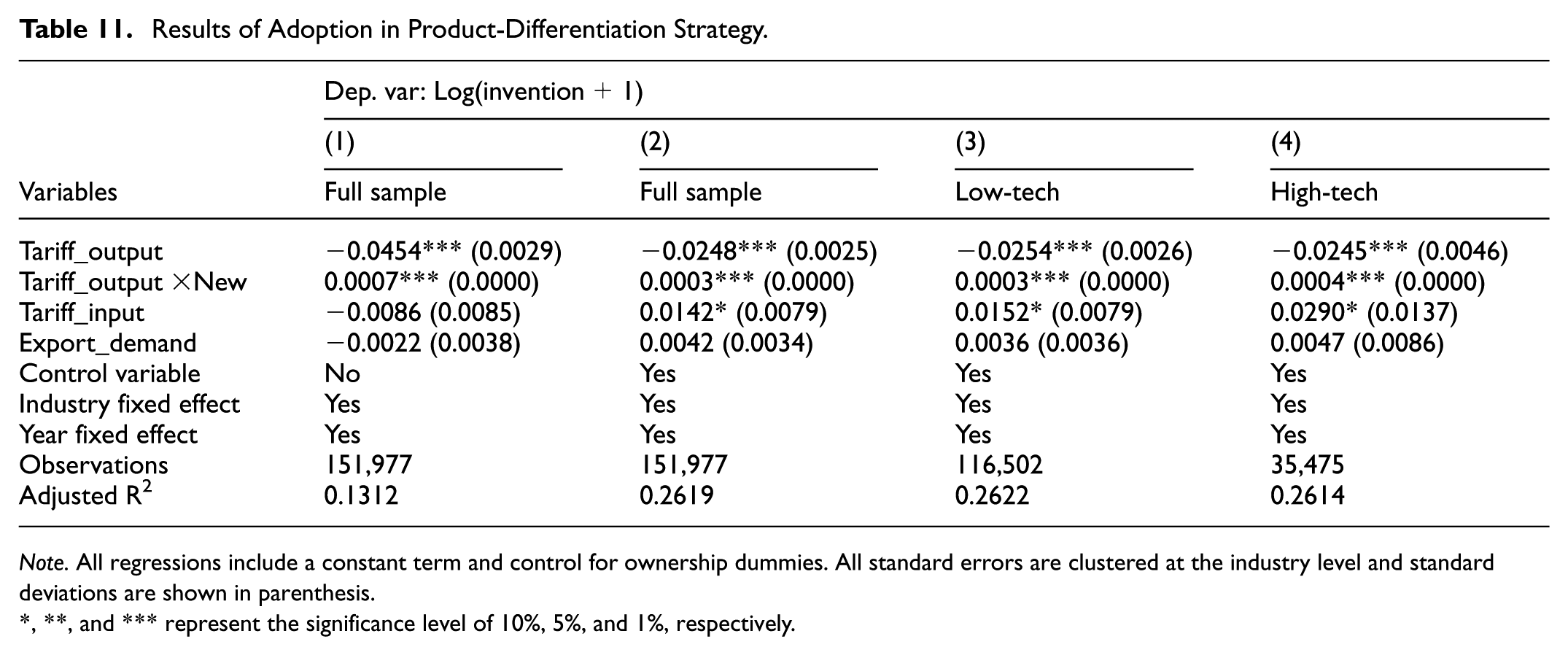
Given the challenge of directly measuring product differentiation strategies, we utilize the new product information reported in the ASIF dataset to test this channel. Specifically, we introduce a dummy variable,
The results, presented in Table 11, indicate that the interaction term is significantly positive in columns (1) and (2), suggesting that while tariff cuts generally enhance within-firm invention patenting activities, firms engaged in new product production benefit more than their counterparts. Hypothesis 2C is confirmed. To account for firm heterogeneity in learning and technology absorption, we further conduct a grouping analysis between low- and high-tech firms, using the classification method mentioned in subsection 5.1. The results in columns (3) and (4) show that under increased import competition, both low- and high-tech firms with positive output values in new products exhibit greater innovation activities compared to firms with zero output in new products. Moreover, high-tech firms adopting product differentiation strategies display a more substantial increase in patenting activities in response to import trade shocks than low-tech firms.
Results of Adoption in Product-Differentiation Strategy.
Note. All regressions include a constant term and control for ownership dummies. All standard errors are clustered at the industry level and standard deviations are shown in parenthesis.
, **, and *** represent the significance level of 10%, 5%, and 1%, respectively.
Heterogeneity Analysis
As suggested by a reviewer, firm’s innovative activities not only be impacted by exogeneous trade shock, but also influenced by firm’s distinctive characteristics. Inspired by this, we furtherly discover firm’s heterogeneous responses in patent activities across firm ownership structure, firm size, and trade modes.
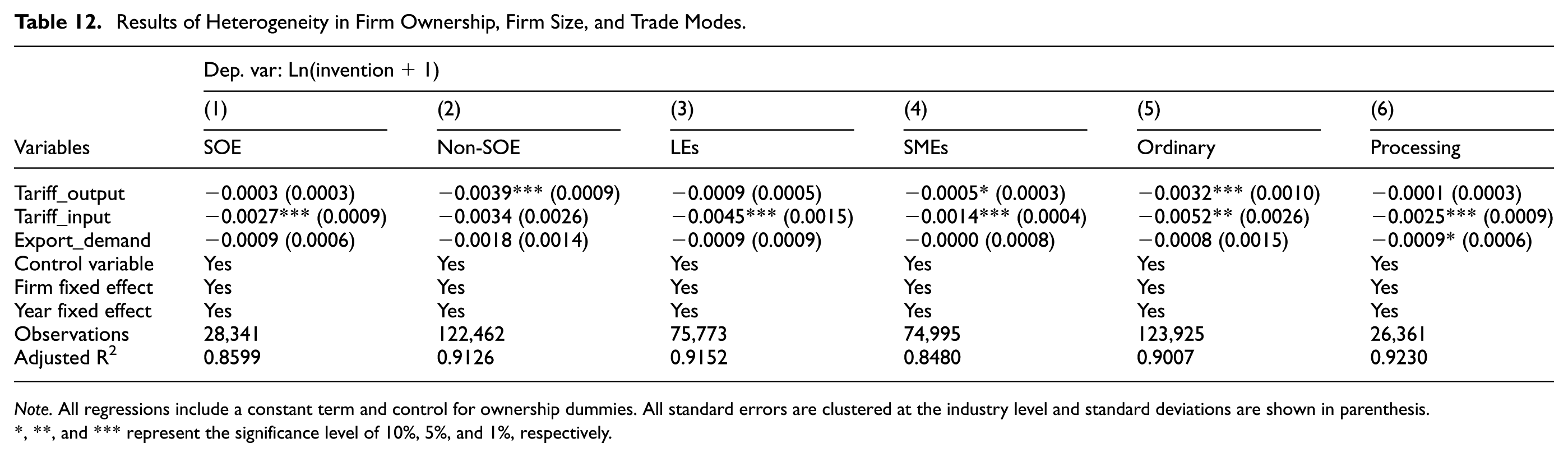
Given the differences in ownership concentration, corporate governance, portfolio strategy, and knowledge management among firms with varying ownership structure (i.e., state-owned enterprises and non-state-owned enterprises), how they may respond to import competition by adjusting their patent activities is worthy of investigation. In view of the significant differences between China’s state-owned enterprises (SOEs) and non-state-owned enterprises (non-SOEs) in resources, commercial objectives, and incentive system (Choi et al., 2011), we run the regressions for each subsample. Results in columns (1) and (2) of Table 12 show that import competition significantly increases patent activities of non-SOEs, while have no impact on SOEs.
Results of Heterogeneity in Firm Ownership, Firm Size, and Trade Modes.
Note. All regressions include a constant term and control for ownership dummies. All standard errors are clustered at the industry level and standard deviations are shown in parenthesis.
, **, and *** represent the significance level of 10%, 5%, and 1%, respectively.
SOEs in China often face soft budget constraints and political interference, reducing their innovation incentives (J. Y. Lin, 2021). In contrast, non-SOEs in China tend to be more innovative due to stronger market competition and more efficient resource allocation. As a result, non-SOEs exhibit stronger patent performance compared to SOEs.
Firms with varying sizes differ in equipped resources and technologies, R&D budget constraints, which will affect the innovation input and innovation output of firms (Serry, 1998). Following C. Lin and Su (2008), we divide the whole sample into two sub-samples—large enterprises (LEs) and small and medium-sized enterprises (SMEs)—according to the industrial annual median values of total assets. Results in columns (3) and (4) of Table 12 show that import competition significantly increases patent activities of SMEs, compared to the insignificant impact on LEs. SMEs face intense pressure to differentiate, driving higher R&D intensity and patenting activity (Audretsch & Belitski, 2021).
As discussed in previous analysis, processing trade is a key feature of China’s foreign trade, where firms enjoy duty-free imports, either exempt from import taxes or refunded. Therefore, one may consider that the innovative activities of processing firms may differ from firms engage in ordinary trade. We then run regressions on processing firms and ordinary (non-processing) firms. Results in columns (5) and (6) of Table 12 show that import competition significantly increases patent activities of ordinary firms, while have no impact on processing firms. Processing firms mainly process and assemble all or part of the raw materials and parts provided by foreign investors and export (Manova & Yu, 2016), thus reducing production costs is more conducive to its profit margin and market value than innovation. Ordinary firms involve more diverse forms of trade and have more incentives to improve product competitiveness through innovative activities.
Discussion
In this section, we provide further discussion of the results, including a interpretation of the mechanisms and a comparison with related literature on the pro-innovation effects of import competition.
Further Interpretation
Our findings demonstrate that reductions in import tariffs serve as a significant driver for firms to adopt skill-biased technologies, thereby enhancing their innovation capabilities. This mechanism is particularly important as it suggests that firms facing increased competition from imports are incentivized to upgrade their technological processes by investing in more skill-intensive production techniques. Such a shift can increase the demand for skilled labor, which is necessary to operate and refine these advanced technologies. This finding resonates with the theoretical work of Ekholm and Midelfart (2005), who argue that trade openness increases the profitability of skill-intensive technologies. It also complements Caselli’s (2014) empirical findings from Mexico, where trade liberalization raised the skill premium, resulting in higher wages for skilled workers. Since Li et al. (2022) provide city-level evidence on the positive impact of capital goods import and rising demand for skill in China. Our work provides important firm-level evidence between import trade shock and firm’s skill-intensive production reflected as the rising demand for skilled labor. Our contribution to this literature emphasizes that in the context of Chinese manufacturing, exposure to international trade not only incentivizes firms to innovate but also alters the composition of their workforce, pushing them toward a more skill-intensive, technology-driven growth model. This shift toward skill-biased technological change is pivotal for innovative activities, as it enhances firms’ ability to compete globally by aligning technological advancement with an increasingly skilled workforce.
The expansion of import product lines presents another key mechanism through which import competition stimulates innovation. Our results indicate that by reducing tariffs, firms gain access to a wider range of high-quality imported products at lower costs. This access enables firms to learn from advanced technologies embedded within these imports, reducing the need for extensive in-house R&D and allowing them to focus on product development and innovation. Moreover, the fact that the expansion of import product lines is more pronounced when firms import from high-income countries suggests that the source of imports matters significantly. High-income countries tend to export more sophisticated products, thereby providing firms in developing countries with better opportunities to assimilate cutting-edge technologies. This aligns with findings from Feng et al. (2016), who show that trade liberalization, by diversifying input imports, helps firms upgrade product quality. Similarly, H. Y. Lin and Yang (2017) find that trading with developed countries provides greater productivity benefits than trading with developing countries. In a recent analysis, Şeker et al. (2024) find that the major contribution of freer trade to product innovation is mainly through new imported varieties. Our study adds to this body of work by highlighting that the expansion of import product lines is important to a firm’s ability to innovate, as they help reduce costs and improve the firm’s technological capabilities, thus fostering sustained innovation under external competitive pressures.
Finally, we find that the positive effect of tariff reductions on firms’ patenting activities is amplified by the adoption of product differentiation strategies. This mechanism underscores that not all firms respond to import competition in the same way-firms that pursue product differentiation, especially in high-tech sectors, are better equipped to leverage the benefits of tariff reductions. Product differentiation allows firms to distinguish their products in increasingly competitive markets, giving them an edge in capturing niche markets or charging premium prices. This in turn creates stronger incentives for innovation, as firms seek to maintain their differentiated position in the market. Hombert and Matray (2018) suggests that the potential for larger marginal benefits makes firms more responsive to differentiation strategies under intense competition, and our findings provide micro-level evidence supporting this idea. Furthermore, Bastos and Straume (2012) argue that international trade can reinforce product differentiation at the macro level, which in turn encourages firm-level innovation. Our analysis reveals that this effect is particularly strong in high-tech industries, where the stakes for innovation are higher and the benefits of differentiation more substantial. By adopting these strategies, firms not only enhance their competitiveness but also contribute to overall industry-level technological advancement. This nuanced understanding of how firms utilize product differentiation strategies in response to trade shocks deepens our insight into the complex dynamics between import competition and domestic innovation. In a more recent paper, Chakravorty et al. (2024) find that increased import competition stimulates the innovative activities of American firms in less-differentiated industries, while have no impact for firms in highly differentiated sector. However, in our paper, we find that Chinese firms as a whole are stimulated by import competition in patenting activities. This also shows the difference in innovation patterns between firms in developing and developed countries in the face of import competition.
Altogether, our results show that import competition positively stimulates firm innovation, with the incorporation of export demand shocks into our empirical specification. We also find that reductions in import tariffs serve as a significant driver for firms to adopt skill-biased technologies, the expansion of import product lines, and the adoption of product differentiation strategies, thereby enhancing their innovation capabilities.
Comparison With Related Literature
Our findings on the pro-innovation effects of import competition in China align with evidence from other developing economies, though some differences emerge. Studies on India (Topalova & Khandelwal, 2011) and Peru (Medina, 2024) similarly suggest that trade liberalization fosters firm innovation, supporting the escape-competition effect. Reductions in tariffs lead to increased productivity and technical efficiency of Indian firms. Likewise, in Peru, intensified foreign competition in low-quality segments incentivize firms to upgrade product quality and invest in R&D. Related literature indicates that rising competitive pressure can drive innovation across different institutional and economic settings.
However, differences in industry structure shape the magnitude and channels of these effects. Unlike China, where firms respond to competition by expanding imported product lines and adopting skill-biased technologies, firms in some other developing countries exhibit weaker adjustments in input sourcing and technological upgrading. For instance, import competition is linked to productivity gains but not necessarily to greater innovation, as firms often rely on foreign technology rather than investing in domestic R&D (Iacovone et al., 2011).
Altogether, our results show that rising import competition stimulates firm innovation. Our analysis of the underlying mechanisms reveals that the positive effect of tariff reductions on firms’ patenting activities hinges on their use of skill-biased technology, expansion of import product lines, and adoption of product differentiation strategies.
Concluding Remarks
The impact of trade liberalization on innovation has been a central topic in the literature. Our analysis examines how import competition—defined as increased competition in the domestic market at the output level due to trade liberalization—affects firm innovation and the mechanisms through which this competition influences innovation. Utilizing a unique combined dataset of Chinese manufacturing firms and controlling for input tariffs and export demand shocks in our empirical estimation, we provide robust empirical evidence that import competition significantly enhances firm innovation in China.
Our analysis of the underlying mechanisms reveals that the positive effect of tariff reductions on firms’ patenting activities hinges on their use of skill-biased technology, expansion of import product lines, and adoption of product differentiation strategies. We find that import tariff cuts prompt firms to employ more skill-biased technology, thereby enhancing innovation activities. This increase in the use of skill-biased technology is observed in both low- and high-tech firms. We also demonstrate that import tariff reductions encourage firms to expand their import product lines, fostering innovation. Notably, the positive impact of tariff cuts on the expansion of import product lines is more significant when imports originate from high-income countries compared to non-high-income countries. In addition, we show that the effect of tariff reductions on firms’ patenting activities also depends on their product differentiation strategies. These findings shed light on the mechanisms through which import competition influences firm innovation and offer important implications for enhancing the innovation capacities of firms in other developing economies.
Our heterogeneity analysis highlights the differential effects of import competition on firm innovation. We find that import competition significantly increases patent activity among non-SOEs, while it has no impact on SOEs. Similarly, the effect is strong for SMEs but insignificant for large enterprises, consistent with evidence that SMEs face greater competitive pressure and respond by increasing R&D intensity and patenting (Audretsch & Belitski, 2021). Moreover, import competition significantly boosts patenting in ordinary firms but has no effect on processing firms. Given that processing firms primarily engage in assembling and exporting foreign-supplied inputs (Manova & Yu, 2016), cost reduction is more critical to their profitability than innovation. In contrast, ordinary firms, which operate across diverse trade forms, have stronger incentives to enhance product competitiveness through innovation.
This study has several limitations. Due to data constraints, patent filings are used as a proxy for innovation; however, not all filings translate into meaningful innovation outcomes. Future research could address this limitation by incorporating firm-level data on patent citations, which may provide a more nuanced measure of innovative activity. Additionally, our findings suggest that future studies on the impact of trade liberalization on firm innovation should pay closer attention to output market dynamics, particularly from the perspective of import competition and the importing side of trade flows.
Footnotes
Acknowledgements
The author thanks the editors and anonymous referees for their insightful comments and suggestions, which greatly improved the paper. All remaining errors are the author’s own.

Ethical Considerations
This study did not require ethical approval as it did not involve human or animal participants, and no sensitive or personally identifiable information was used.
Consent to Participate
Informed consent was not required for this study as it did not involve direct interaction with human participants or collection of personal data.
Author Contributions
YT: Conceptualization, Written the original draft, Data Collection, Data analysis and Design the methodology, WB: Supervision, Conceptualization, Editing.
Funding
The authors disclosed receipt of the following financial support for the research, authorship, and/or publication of this article: This work was supported by the National Social Science Fund Project [NO.24CJY130], Jiangxi Provincial Social Science Foundation Annual Project [NO.25YJ32], Jiangxi Provincial Social Science Foundation Annual Project [NO.24GL44], Nanchang Humanities and Social Sciences Research Base Project [NO.JD202503].
Declaration of Conflicting Interests
The authors declared no potential conflicts of interest with respect to the research, authorship, and/or publication of this article.
Data Availability Statement
Part of the datasets used and/or analyzed during the current study have been taken from the databases (Tariff Download Facility, CPDP, and CEPII). Other datasets such as ASIF and CTD are made available from the corresponding author on reasonable request.