




Abstract
As the number of FTAs signed by Korea increases, the issue of enhancing utilization in export, which can be called as the fruits of FTAs in terms of trade policies, is attracting a lot of attention. Concerning FTA utilization in export, the government has been making various efforts to increase credibility to origin-related documents including certificate of origin, to increase the approved exporters, and has been spending a lot of financial and human resources on publicity so that more businesses can access the information on origin. These policies taken by the government were confirmed to be mostly useful in enhancing FTA utilization in export by theoretical models and statistical analysis. Even in the case of some policies not confirmed yet, their effects will be proven in the near future through empirical data after the history of FTAs becomes longer. However, there are also some points to be improved to constantly promote FTA utilization. That is, policymakers need to make FTA contracting parties honor the other party’s approved exporter, reduce burdens of FTA utilization caused by post verification, and strengthen cooperation and collaboration with related agencies.
Keywords
Introduction
A Free Trade Agreement (FTA) refer to an agreement, which grant a preferential tariff treatment by eliminating trade barriers and tariff to goods and service transacted among contracting countries. For the purpose of phasing out tariff on goods completely, Special Act and Agreement have been applied on clearance procedures and origin-related areas under FTAs, which is in its initial stage for regional economic integration. Korea’s trade volume with FTA contracting countries accounts for 36% of its total trade as FTAs have been concluded with 49 countries including EU and the U.S. over the last decade since Korea first enforced the Korea-Chile FTA in 2004, demonstrating that economic environment under FTA has been stabilizing. In particular, trade volume with FTA partners is expected to account for more than 60% as Korea-China FTA becomes effective, contributing to generalization of FTA preferential clearance (Table 1).
Difference of Certification of Origin by FTA.

Source. FTA portal of Korea Customs Service.
The essential part of FTA implementation is to confirm whether importers and exporters are qualified to enjoy preferential tariff treatment in a perspective of customs administration before conducting post verification because the existing tariff rate is maintained to be applicable to non-FTA partners whereas tariff barriers on FTA partners are lowered. In a perspective of trade policy, endeavors shall be made to help Korean exporters to be given low tariff rate as much as possible in FTA contracting countries as a core policy.
Korea Customs has been consistently dealing with the former one mentioned for a major FTA task, and, as for the latter one mentioned for a major FTA policy, Ministry of Trade, Industry & Energy and Small & Medium Business Administration have given considerable assistance to raise the degree of FTA utilization. However, it is true that effects of budget spending for exporters, efforts made so far in terms of policy, and problems businesses are currently facing are not fully analyzed and discussed. These issues shall be continuously discussed while the schemes for promoting FTA utilization are implemented, and therefore, the policy suggested in this paper is just one of several hundreds of opinions.
This paper gives a brief review of efforts on policies, which have been made to enhance FTA utilization, and then measures for improvement will be drawn based on an empirical analysis on effects of existing policies to enhance FTA utilization. Up to now, papers on FTA utilization mostly discussed policies in the normative perspective. There are not many study cases with an analysis on effectiveness of empirical policies using actual utilization rates. This paper bases on field experiences in executing policies to enhance the FTA utilization rate and it is meaningful in the sense that the data for actual policies are used to verify the effectiveness.
The analysis in this paper builds on KCS’s (Korea Customs Service) policies to remain focused on the point of the discussion even though comprehensive analysis on policies from various departments is more likely to draw accurate effects of policies. The policy analysis is based on internal reports in KCS, interviews with employees in the customs authority who have implemented policies by contacting Korean exporters directly, and statistics analysis of KCS for analyzing effectiveness of policies. As of May 10, 2015, Korea has signed and effectuated 11 FTAs with 49 countries. As mentioned in Introduction, the core part of FTAs in exportation is to confirm whether exporters are qualified to receive preferential tariff treatment, conduct post verification, make Korean exporters enjoy lower preferential tariff, and also to prevent being selected for post verification in the contracting partners. Thus, this paper will present overall review of FTA-related tasks based on these export issues.
First of all, in order to get preferential tariff treatment under FTA, conditions for importers, exporters and traded goods should be included in requirements such as parties subject to transaction, goods for concession, originating goods, direct transit, and certification of origin under FTA. As for the requirements for “parties” subject to transaction, transactions should be made within the countries concerned, and relevant importers and exporters should be entitled to request and issue certificate of origin and obligated to conduct verification. As for the criterion for “goods subject to concession,” goods subject to receive preferential tariff treatment should be classified as the matching HS Code in the Agreement. “Originating goods” should be confirmed as originating goods from contracting countries based on origin requirements set out in the Agreement. As for “direct transit,” goods subject to claim for preferential tariff treatment should be transported directly within Parties concerned. In order to satisfy “certification of origin’ standard, goods subject to claim for preferential tariff treatment should be proved that goods are originating.
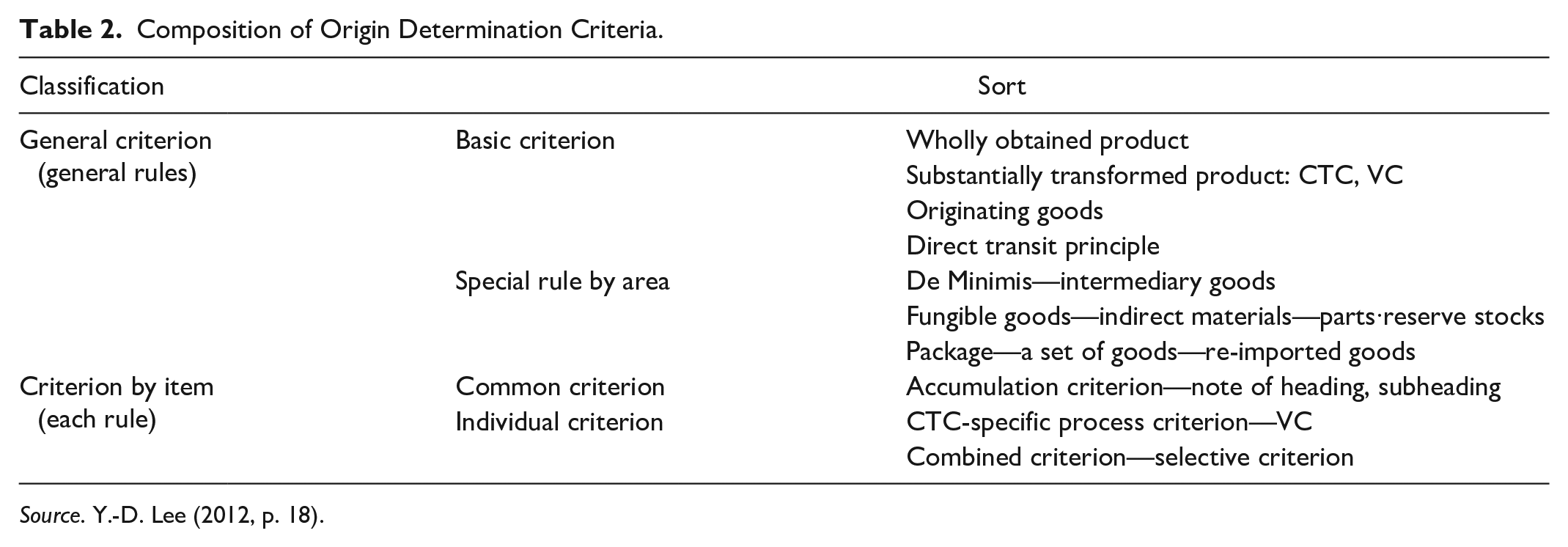
The method for issuance of C/O is two-fold: to be issued by institution and by exporters. Customs authorities in originating countries or other qualified institutions verify origin and issue C/O under the system of issuance by institution in accordance with procedures and methods set out in the Agreement. Under the system of issuance by exporters, exporters confirm the origin, fill in, and sign C/O in accordance with procedures and methods set out in the Agreement. Korea also has approved exporters system regarding the issuance of certificate, which grants benefits to exporters approved by the customs authority such as simplified issuance procedures and additional document. Under Korea-EU FTA, exporters who export goods exceeding €6,000 should be designated as approved exporters in order to issue C/O (Table 2).
Composition of Origin Determination Criteria.
Source. Y.-D. Lee (2012, p. 18).
Origin determination criteria is criteria for determining whether a certain good satisfies requirements set out in FTA, being divided into two: wholly obtained criterion and substantially transformation criterion. Based on whether fundamental characteristic of goods is changed or not, substantially transformation criterion is divided into change in tariff classification (CTC) criterion and specific process criterion. Value contents (VC) criterion is based on whether economic value of materials composing goods exceeds a certain proportion. There is also a criterion combining CTC and VC, or a criterion applying CTC or VC selectively.
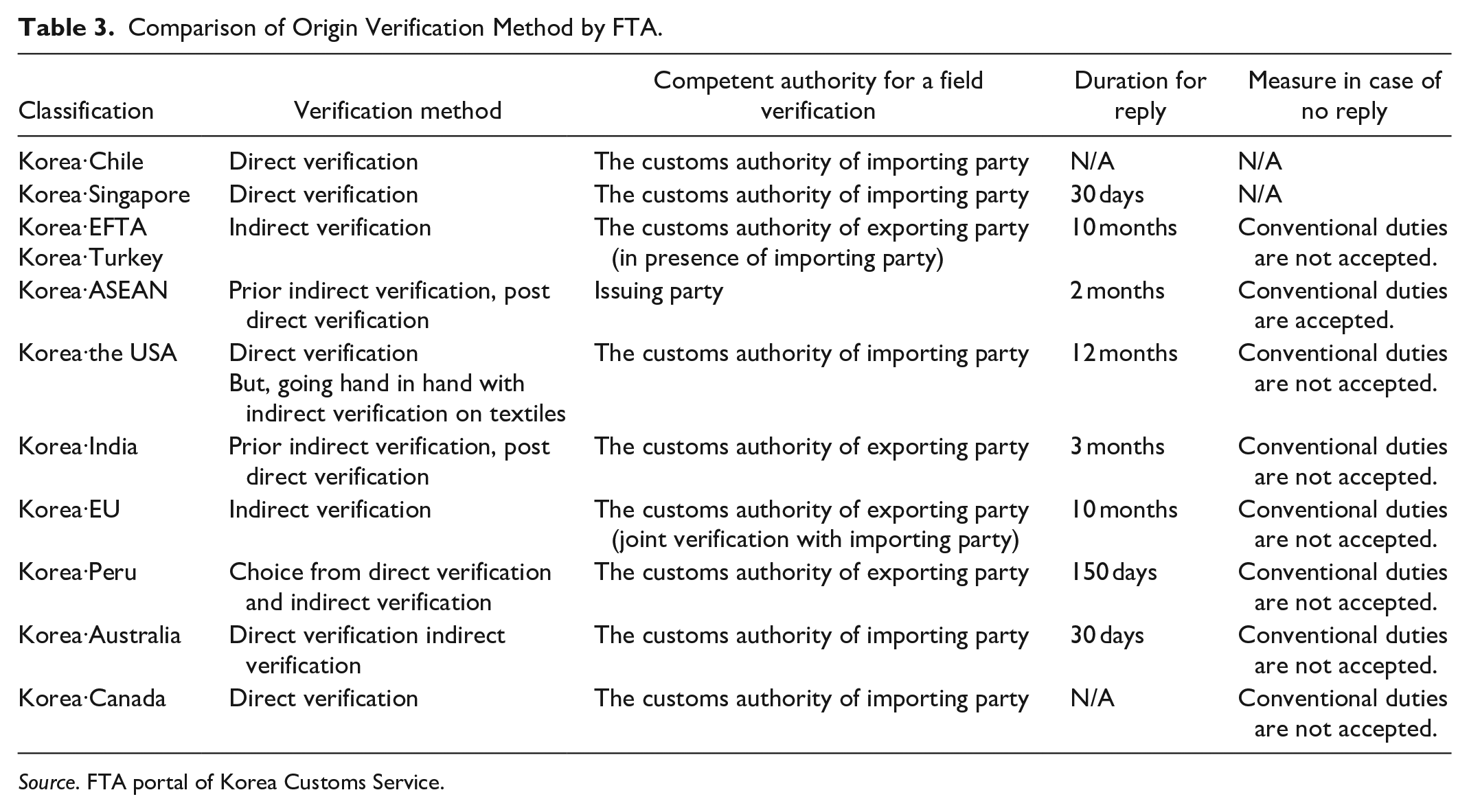
In Korea, importers who plan to claim preferential tariff treatment should submit the import declaration form and request form for tariff treatment application before the import declaration is accepted, but it is possible to claim preferential tariff treatment exceptionally within 1 year after import declaration is accepted. In principle, the customs examines whether preferential tariff treatment is accorded or not after the acceptance of import declaration, but examines before accepting import declaration exceptionally. Even though the importer claims preferential tariff treatment, there are some cases where the application is limited or delayed. When importers do not submit evidential document required by the customs or when it is difficult to accept originating status of goods with the only evidential document submitted, the application of preferential tariff is limited. When exporters in the contracting countries write false or wrong evidential document more than twice over the recent 5 years, the application of preferential tariff is delayed. The countries concerned can conduct verification on authenticity and accuracy of evidential document upon request of origin verification from the other party or if necessary, preferential tariff is applied. The method of origin verification falls into two categories: import verification and export verification based on items subject to verification. Based on the competent part of verification, there are direct verification (the customs authority of importing party) and indirect verification (the customs authority of exporting party). Origin verification can be divided into written verification (request for document) and on-site verification (Table 3).
Comparison of Origin Verification Method by FTA.
Source. FTA portal of Korea Customs Service.
When receiving FTA preferential tariff rate through all procedures stated earlier, the FTA utilization rate for import and export of the year is calculated by using following calculation.

① Utilization rate of exports: ratio of items whose C/Os are issued among all items subject to FTA tariff rate.
② Utilization rate of imports: ratio of items which actually claim preferential tariff treatment among all items subject to FTA tariff rate.
Even if C/Os are issued in Korea, the true utilization rate can be calculated only when the preferential tariff rates are actually applied in the importing country. However, since it is difficult to obtain statistics from the importing country there are limits to substituting it with C/O issuance cases.
The KCS calculates utilization rate of FTA based on the amount of money rather than ratio of items, being calculated as proportion of actual record of C/O issuance among import and export performance under FTA. The calculation is as follows (Table 4).
Utilization Rate of Export by FTA (Unit: %).

Source. FTA portal of Korea Customs Service.
Literature Review
Exports are one of the factors that greatly influence a country’s economic growth. Bottega and Romero (2021) argues that innovation is very important to promote exports. J. Lee et al. (2020) emphasizes extend geographic market diversity as a major way to improve export performance. This is because export performance is one measure of national competitiveness (Ruzekova et al., 2021). The importance of FTAs in this respect cannot be overemphasized.
Domestic and overseas literatures regarding FTA utilization can be largely categorized into determinants for export performance or utilization rate; current FTA utilization rate in import and export; and economic effects from utilization of FTAs.
Firstly, with regard to determinants for export performance, Shim et al. (2012) suggested a direction of policies for how to utilize the Korea-ASEAN FTA in order to enhance export performance of SMEs, that is to say how to push up the export performance of companies through a higher FTA utilization rate of SMEs, emerging from the conventional trend of focusing on the direct relation between internal resources of companies and the export performance with regard to export performance of SMEs which most of previous studies did. This study recommends a single point of integrated FTA support portal at the government level for better understanding of regulations on origin especially for FTAs and for dissemination of the expertise; establishment of a system for electronic C/Os for less clearance time and logistics cost; and establishment of an integrated electronic information system in the FTA contracting country. Gulczyński and Nilsson (2019) found that EU imports from Korea make good use of trade preferences with an overall preference utilization rate of close to 90% in 2016. They suggested policymakers should provide training on FTAs to exporters with a promotion of FTA utilization. In addition, Yoon and Na (2013) endeavored to identify determinants for export performance of SMEs in the settings of FTAs. They reported that the findings of their empirical analysis of what new capabilities and resources contribute to export performance on the resource basis indicate that FTA marketing capability and CEO’s focused exportation to FTA regions are the main contributing factors. Additionally, it was indicated that the capability of the government in utilization of FTA origin affects not the export performance but only the daily processes of companies. Thus, they argued that the government’s support policies should be modified in their objectives and direction with the focus on enhanced capability for utilization of FTA origin, and marketing capability toward FTA regions should be strengthened.
On the other hand, Park and Choi (2013) considered origin management capability and distribution level of origin information of companies as major determinants of the FTA utilization rate, and conducted an empirical analysis of SMEs exporting to the EU and the U.S. From the analysis, they argued that origin management capability and distribution level of relevant information are greatly affected by understanding level of FTAs, cooperation level between companies, and degree of support from the government and entities in the private sector. For this reason, professional personnel should be fostered, an origin management system should be disseminated and expanded, and the government support programs should be enhanced, together with promoting a consulting market in the private sector. One of overseas studies is done by Sung and Lee (2014) which explored determinants of Korea-ASEAN FTA utilization. In the study, margin effects, ROO effects, and scale effects were major determinants and especially the scale effects were most influential. Consequently, they emphasized that the government’s support for reduced expenses for SMEs and expanded trade as well as efforts made by policy-making authorities to alleviate tariffs are crucial.
Next is a study in relation to FTA utilization in import and export. Cheong and Cho (2009) researched the status of FTA utilization by Korean companies and the companies’ stances on FTAs. The findings of the research indicate that about half of the surveyed companies assessed FTAs as beneficial to their business but only about 20% of the companies are utilizing FTAs. For this reason, they argued that the government should push forward a wide range of measures for higher utilization rates of FTAs by companies other than making efforts to emphasize the value and advantages of FTAs. Chung and Jeong (2013) also suggested that a survey on the current status of the FTA utilization rate should be carried out to identify difficulties faced by traders with an aim of higher FTA utilization rates, and as solutions they suggested education about FTA utilization and improvements to be made in consulting. On the other hand, Hayakawa (2013b) focused on intermediary goods that take up many parts in Korea’s total import and export and researched whether benefits of trade liberalization exist in importing intermediary goods. The findings are that in the cases of Korea’s FTAs with EFTA, ASEAN, and India, the utilization rate in import is lower than 50% except for the Korea-Chile FTA. It was emphasized that further efforts and interest are required to improve the FTA utilization rate in importing intermediary goods.
Lastly, Cho (2014) analyzed economic effects of FTAs. In the study, they analyzed economic effects from utilization of the Korea-India CEPA. The findings of the analysis indicate that the higher utilization rate of the FTA between the two countries and where it leads to an increase in industrial productivity, the greater the actual GDP of Korea to grow rather than India’s. Consequently, they reported that active market opening and support policies for improved utilization rates are needed in the future.
Additionally, Hayakawa (2013a) looked at the relation between the share of domestic input and number of FTA utilization cases at the business perspective, focusing on Japan and its contracting parties from ASEAN as trade partners. The study was not indicative of any significant relation between the two factors, but it proved that many countries utilizing FTAs have a spaghetti bowl phenomenon due to a very high share of domestic input. Hayakawa et al. (2014) also researched about Thai exports to Japan to determine whether there is a diagonal cumulation effect in utilization FTAs under the two FTAs. The findings show that there is approximately a 4% trade increase effect from diagonal cumulation. On the other hand, Hamanaka (2013) brought up the issue with data and indicated that there is confusion on the use of FTAs, resulted from absence of consensus on the definitions of utilization rate and usage rate. That is to say, the findings from the research on existing literatures show that the confusion about the definitions of the two terms caused deviation of the data on FTA utilization.
To piece together the abovementioned ideas, a lot of studies have been conducted on Korea’s export performance and its determinants while there are significantly insufficient studies on the use of FTAs or FTA utilization rates. Previous studies have been limited to SMEs or took a fragmentary and limited approach only on the specific contracting parties such as the U.S. and EU. Therefore, it is necessary to take comprehensive reviews on government policies designed for higher FTA utilization rates and all types of companies should be included in the macroscopic perspective. Plus, the direction of studies needs to be focused on exportation which takes up a large part of the national economy, rather than focusing on the FTA utilization rate in importation as previous studies did. In that respect, this study aims to provide implications of policies for more effective implementation of FTAs in the future by measuring a number of policies that have been carried out by the government to date in order to find out how much they actually contributed to the promotion of FTA utilization by companies.
Theoretical Model
To choose variables which influence the utilization rate of FTAs by Korean exporters, we can take a look at a simple corporate profit function. The profit of importers in the FTA contracting country will be as follows:

where π : profit, TR: total revenue, TC: total cost, Q: quantity, P0: original market price.
Q : quantity of import, Px: current market price.
R0: risk level of the importer, B0: original barrier.
In this function, P0 is the original market price at which certain imported goods from a Korean exporter are sold in the importer’ domestic market without considering tariff, Px is the export price from Korea which is also the prime cost for the importer, Q is the quantity of import, and t0 is the tariff rate imposed before application of an FTA. R is a risk level of being imposed with additional ex post facto tariffs due to exclusion from application of the FTA tariff rate where the origin was denied through origin verification after goods subject to application of the FTA tariff rate were imported from the Korean exporter. When importing the goods that are not subject to application of the FTA tariff rate, the level of risk is zero. B (Barrier) is a risk level of unduly not being applied with the FTA tariff rate due to non-tariff barriers of the importing country, though the goods are subject to application of the FTA tariff rate. The total cost should include additional costs such as the transportation cost and insurance premium, but for the convenience of analysis it is assumed that all other cost variables are constant. In addition, suppose the tariff is entirely shifted to the consumers.
Premised on this model, the condition for maximized profit of the importer is to maximize the TR (Total Revenue) where the TC (Total Cost) is constant, or to minimize the TC where the TR is constant. On the other hand, assuming that the FTA tariff rate was applied and the tariff rate was reduced to t1 from t0, then the tariff rate shifted to consumers is lower. This will make the market demand increase and also the import increase. Therefore, the total revenue (after tax) of the importer will increase and consequently so will the total profit (after tax). Generally, tariffs are ad valorem taxes based on the value of imports, but for the convenience of analysis it is assumed that they are per unit taxes. In other words, it is ∂π/∂t < 0.This increase of the total profit will raise the demand for Korean exports by the importer in the FTA contracting county and it can be inferred that the higher the concessional tariff rate of the FTA is, the higher the utilization rate of Korean exporters will be.
The next interesting aspect is the risk level of being imposed with tariffs after importation due to exclusion from application of the FTA tariff. This will be mostly related to the risk of the Korean exporter, where the Korean exporter intentionally or mistakenly obtained an improper C/O (certificate of origin) and sent it to the importer. In this case, the importer is exposed to a risk of being imposed with additional charges when conducting ex post facto validation of origin. In the case of being imposed with additional charges, the importer could file a law suit against the exporter or take out an insurance policy for the possible imposition of additional taxes but it would be inevitable to face increased costs to some extent such as expenses for law suits or insurance premiums. In other words, it can be said that it is ∂TC/∂R > 0 and therefore ∂π/∂R < 0. This will result in the decreased demand for the Korean exports by the importer. In this sense, with the decreased risk level of Korean exporters it can be inferred that the FTA utilization rate of Korean exporters will improve. Relevant schemes are the “origin confirmation certificate verified by the customs” or “advance ruling for origin,” and it is expected that C/Os issued by certification bodies will lower the risk in comparison with self-issued C/Os. Additionally, providing information which can enhance expertise of Korean exporters may lower the risk. This indicates that the higher the utilization of the FTA software “FTA-PASS” and the more experts such as consultants and origin managers are provided, the higher the FTA utilization rate will be.
Thirdly, we can take a look at the risk level of B (Barrier) where the FTA tariff rate is unduly not applied on the goods subject to application of the TFA tariff due to non-tariff barriers of the importing country. Non-tariff barriers are referred to as non-institutional barriers including delays in the processes or irregularities in clearance such as demands for bribes. If B becomes greater, the expenses of the importer will increase and naturally the profit will decrease. This will lead to the decreased demand for Korean exports by the importer. In other words, it is ∂TC/∂B > 0 and therefore ∂π/∂B < 0. It is empirically known that this is a risk which developing countries are more likely to have rather than developed countries. In order to resolve these non-tariff barrier issues, overseas customs attaches are actively harnessed in addressing clearance difficulties in the importing country. It can also be inferred that the FTA utilization rate by the exporters will improve if overseas customs attaches are in place and the Korean government endeavors to address clearance issues.
The following is a profit function of the Korean exporter:

Variable A has not been explained in the function of the exporter’s profit. Variable A is a cost entailed by obtaining a certificate of origin. Where the cost required for certification of origin is high, the total cost will increase, and the total profit will decrease. It can be indicated as ∂TC/∂A > 0 and therefore∂π/∂A < 0. Thus, it can be inferred that if we can lower the cost for certification of origin, the FTA utilization rate of Korean exporters will improve. A relevant policy is the certification of origin scheme and it can be expected to increase the FTA utilization rate if C/Os for individual export items are not required through the scheme. Moreover, when considering only the cost for issuance, it can be inferred that self-issued certificates will push up the FTA utilization rate in comparison with obtaining C/Os issued by certification bodies.
Variable R in the function can be understood in the same context as the risk level of the importer. It means that R of the exporter indicates a risk of purposely or mistakenly obtaining an improper C/O and sending it to the importer. Consequently, there is a risk to the importer of being imposed with additional taxes at the time of ex post facto origin validation and of having to make a claim for compensation to the exporter. Variable R also includes a risk of undergoing origin validation at a direct or indirect request by an authority of the importing country, and a risk that the result of the validation is unsatisfactory due to not meeting origin requirements and consequently being excluded from application of the FTA tariff rate for a set period of time.
The Analysis of Existing Policies in Relation to Enhancement of FTA Utilization Rate in Exportation
For systematic analysis on policies to enhance the FTA utilization rate in exportation, the existing policies need to be classified into three categories of cost reduction, provision of information, and reduction of risks. Specifically, they are policies to reduce costs in FTA utilization by exporters for enhanced utilization rate in exportation, policies to provide information to exporters on the FTA utilization in exportation, and policies to reduce risks such as recompense claimed to exporters from verification by the contracting country after exportation using the FTA.
Policies to Reduce Costs for FTA Utilization in Exportation
Companies that meet certain criteria are certified as approved exporters for preferential origin purposes, aiming at enhancing capacity of companies in origin management and alleviating the burden for proof of origin. Approved exporters are granted with preferential tariffs on the exports exceeding €6,000 in accordance with the Korea-EU FTA. In addition, approved exporters benefit from simplified documentation when applying for C/Os and automatic issuance of C/Os. Approved exporters are categorized by company and by item as shown in the following Table 5. The former category is to allow self-issued C/Os or simplify the issuance procedures for companies that are assessed to have origin management capability on all the items subject to trade agreements Korea concluded. The benefits given to the latter are similar but the scope of benefits is limited. In other words, self-issued C/Os and procedural benefits are granted only to trade agreements and items (6-digitHS codes) applied for certification of approved exporters. These approved exporters programs are designed to alleviate inconvenience of having to obtain C/Os for each export declaration by exporters and as a result it shifted the audit of origin requirements from audit of items to companies.
Types of Approved Exporters and Valid Period.

Source. Korea Customs Service.
Moreover, certification is processed in cooperation with a specialized entity in the private sector (Korea Institute of Origin Information) and the cost and audit time entailed by the certification process for companies are reduced. Also, there is a program which an approved company can self-inspect prior to the expiration date of certification. An approved exporter self-inspects the certification requirements and then submits the result to the Customs. In the case where there are no problems, the certification is renewed without audit.
The approved exporters program was launched in 2007 and went through two amendments, aiming at alleviating certification requirements for higher FTA utilization rates.
Policies to Provide Information
For seamless operation of origin system, roles of government agencies such as customs are important. However, voluntary capacity building of private sector is essential for utilization of FTAs. In this regard, Korea Customs Service has been operating coordinator of origin system, a private qualification, since March 2010 to assist training of private sector’s experts in FTA including origin part. Korea Institute of Origin Information is in charge of conducting the exam and the coordinators are produced continuously, as 2,170 candidates had passed the exam throughout 13 examinations so far. Moreover, the qualification has gained more credibility by acquiring government certification on 27th of December, 2012.
FTA-PASS, a system which provides such services as determination on country of origin, issuance (application) of certificates, storage and circulation of documents to SMEs, was developed by KCS and started to be distributed from September 2010 free of charge. Major functions of FTA-PASS are automatic determination on the fulfillment of origin criterion based on analysis about origin criteria stipulated in the texts of FTAs, issuance of supporting documents such as declaration of origin and certificate of origin, automatic delivery of application form for the issuance of certificate of origin to electronic customs clearance website, storage and circulation of origin supporting documents including declaration of origin.
Policies to Reduce Risks
Upon a request from exporter or producer, producer, or supplier of materials used for the production of exported goods or finished goods can confirm the country of origin of the materials concerned or finished goods and issue a document (declaration of origin) to provide it to producer or exporter. Also, producer or exporter who received declaration of origin from the producer of materials or finished goods can request the issuance of certificate of origin based on the declaration of origin, or issue certificate of origin itself. The purpose of this system is to reduce exporter’s burden to substantiate country of origin and achieve immediacy of procedures for proving country of origin by having the country of origin of exported goods or raw materials which are domestically supplied be confirmed based on the confirmation of producer who knows better than anyone else about the goods in question. To collect origin supporting documents for finished goods and raw materials for exported goods which are domestically supplied, exporter has to receive parts list, cost statement of raw material, manufacturing process introduction, etc from supplier. However, as those documents contain confidential information, companies do not want to provide them. Prior confirmation of declaration of origin by customs was introduced to tackle this problem. It aims to remove problems such as concerns over leakage of confidential information and lack of trust between companies in declaration of origin through examination and certification on the accuracy of declaration of origin by customs with public confidence. Prior confirmation of declaration of origin by customs was introduced on February 1st, 2014 and small and medium sized manufacturing companies (small companies have priority) have been utilizing it.
Procedures for certification through “prior confirmation of declaration of origin by customs” are as follows: Customs receives relative documents from “subcontractor” to examine the country of origin of goods, and “contractor” receives certified declaration of origin from relative authority and subcontractor to determine the country of origin of goods. Then, subcontractors do not have to worry about the leakage of confidential information as they are not required to submit it, and contractors can enhance the credibility of country of origin as customs examine and guarantee the accuracy of declaration of origin. In addition, they will not encounter serious difficulties in the future even in the cases of origin verification. However, since this scheme has been fully implemented since 2014 the data was not available to use in the statistical analysis.
One of FTA utilization-related difficulties occurs in overseas importing countries. When Korea-originating goods are imported into a foreign country, FTA tariff rate may not be applied due to conflicts with customs authority of the importing country. KCS created FTA utilization difficulty team to tackle this problem. To overcome FTA utilization-related difficulties, KCS has informed customs authority of a FTA contracting party and Korean companies in foreign country of how to interpret the text of FTA and provided support to origin-related conflicts. It has also held briefing sessions with a purpose to prevent conflicts from occurring in advance. In addition, KCS has received cases of clearance difficulties through customs attaché dispatched at embassy in an overseas contracting party and its website (overseas customs clearance difficulties center). Countries to which customs attaché s have been dispatched are Hong Kong, Japan, China, Thailand, EU, Vietnam, and Indonesia.
The biggest problem concerning overseas customs clearance difficulties is that there are many FTA contracting parties to which Korea has not dispatched customs attaché yet. In that case, commercial agents do the role of customs attaché. However, it is impossible for commercial agents to act as customs attaché as origin criteria requires high level of expertise. In addition, as for ASEAN and India, non-tariff barriers exist and, because of that, many Korean exporting companies fail to utilize FTA. Therefore, the role of customs attaché dispatched to foreign countries will gather importance day-by-day.
In accordance with the article 14 of the Act on Special Cases of the Customs Act for the Implementation of Free Trade Agreement, an exporter or a producer in any other signatory nation or an agent of either of them who has doubt whether the criteria for determining origin are satisfied, may file an application for ruling on such doubt such as criteria for determining origin before filing an import declaration for relevant goods. To apply for the ruling on whether the criteria for determining origin were met, applicants shall file evidentiary documents regarding manufacturing and accounting matters of manufacturers. And for Korean exporting companies, consulting is available by making inquiries on behalf of their counterparts in the importing country. However, it was not used in the statistical analysis due to insufficient data on the advance origin ruling system.
Findings of Statistical Analysis
Panel data possess several major advantages over time-series, cross-sectional or pooled data. According to Hsiao (2014), regression analysis using panel data has the following merits: dynamic relationships can be estimated since individuals are observed repetitively; unobserved heterogeneity of individuals can be considered in the model; and researchers can get more efficient estimator since there are more data provided. However, approaches on panel data can be diverse as to whether a constant term in regression model is identical by cross-section or time-series; what types of hypotheses a research uses on the structure of error term. In the case of unbalanced panel data where time series data are short and the number of cross-section units is few, as in this study, different models could result in disparate estimation results. These limitations are not possible to be addressed as of now. Therefore, this paper tried panel data analysis with given samples, hoping that this paper could be useful for future policy decisions. A fixed-effect model is appropriate in estimating effects in the samples with panel data whereas a random-effect model is suitable for estimating features of a large population with random sampling. However, considering that this is not an absolute standard and the population of the study is not large, this paper did not apply this standard and tried to select a model based on the result of statistical analysis on model appropriateness.
The purpose of this study is to test effectiveness of the government policy to enhance utilization of FTA in exports. Yearly utilization of FTA in export was used as the dependent variable of the panel regression model and various government policies conducted to promote FTA utilization were taken as independent variables. The formula is as follows:

The terms in this function are as follows:
Exutilrateit (Yit) :FTA utilization rate in exportation by FTAs.
Approvfirmit (X1it): Results of designating approved exporters for origin (number of cases).
Origin_mgrit (X2it): Number of origin managers fostered.
FTA_Passit (X3it): Number of businesses with origin management systems.
Gigwanit(X4it): Methods for verifying C/Os(issuance by authorities = 1 and self-issuance = 0).
Tsolveit (X5it): Results of resolving difficulties in clearance (number of cases).
Gdpgrowthit (X6it): GDP growth rate of the FTA contracting country.
Approvfirm2it(X7it): Approvfirmit × Indit.
Indit :Methods for verifying C/Os (issuance by authorities, the Korea-EU, Korea-EFTA, Korea-PERU = 1 and others = 0).
ui: Effects for contracting countries by FTAs.
eit: Error term.
The explanation on the major policy variables in the above regression model is as follows:
First, the Approvfirm variable indicates approved exporters per year, specifically the number of exporters who enjoy benefits of self-issuance or procedural simplification regardless of the agreements. Approved exporters by company and by item overlap, thus only approved exporters by company were calculated and used in the regression analysis. It is notable that the variable indicative of the number of approved exporters was used only for agreements requiring issuance by authorities, the Korea-EU, Korea-EFTA, and Korea-Peru. Further elaboration on this would be as follows:
In order for approved exporters to enjoy more benefits from FTAs, origin approved exporters need to be implemented with an aim to reduce time and cost in obtaining origin certificates per FTA. In other words, the approved exporters scheme has no use in the FTAs which grant no preferential benefits to approved exporters. Benefits for approved exporters in the cases of issuance by authorities, the Korea-EU, Korea-EFTA, Korea-PERU are as indicated in Table 6. Also, depending on whether or not it is issuance by authorities, the Korea-EU, Korea-EFTA, and Korea-PERU, the effect of Approvfirm variable can differ. To identify this, the variable Approvfirm2 is added. The Approvfirm2 variable is an interaction term with dummy variable on whether or not it is issuance by authorities, Korea-EU, Korea EFTA, and Korea-Peru FTA. In these four cases, there are benefits like self-issuance or procedural simplification regardless of the agreements for the approved exporters as can be seen in Table 6. By creating a new variable “Approvfirm2,” we can refine the effect of being an approved exporter because all the FTAs which allow no benefits to the approved exporters are eliminated by setting Ind = 0.
Benefits of Approved Exporter.

Source. Materials posted on the website of KCS.
Second, Origin-mgr and FTA-PASS variable are selected in the theory that fundamentally as the number of origin managers and the number of businesses using FTA-PASS increase they will have more information on origin utilization, consequently the utilization rate in exportation will increase. However, the FTA-PASS variable only calculated the businesses which used FTA-PASS program for the origin management provided by the KCS and businesses which used other programs are not taken into consideration. These two variables also apply to all agreements and items.
Third, Gigwan variable is a dummy variable on whether it is issuance by authorities. The variable on the issuance by authorities needs to be identified in two perspectives of reduction of cost and risk level. Issuance by authorities is a more costly scheme than self-issuance, though it is a very secure scheme compared to self-issuance, regarding the risk on origin verification by the FTA contracting partner after exportation is complete. Therefore, in the aspect of cost this variable is not helpful for enhancing the FTA utilization rate in exportation by comparison with self-issuance, though positive effects are expected for enhancing the FTA utilization rate in exportation relating to the risk of post verification. Specially, in the case of Korea-Peru FTA the dummy value is set as 0.5, considering the fact that exporters can choose from issuance by authorities or self-issuance.
Fourth, if exports of Korean businesses encounter difficulties in clearance due to non-application of FTA tariff rates which result from frictions or conflicts with the Customs in the importing country, customs or commercial attachés make efforts to resolve these issues. If these efforts result in resolution of the issues, it is very likely to positively affect the utilization rate in exportation. In this regard, variable Tsolve which indicates results of resolving difficulties in clearance, is included as an explanatory variable.
Lastly, it is also notable that among variables discussed in this theoretical model available for tax rates is not included as an independent variable. It is only natural that the utilization rate is high in exportation to the contracting country with high bound tariff rates and this can be deemed as a type of an environment variable which cannot be adjusted by policies. Moreover, we would like to mention that since this environment variable has considerable influence statistically, the role of the policy variable was not measurable. In this regard, as an environment variable, Gdpgrowth variable is included since the economic growth rates of contracting countries can affect exportation to them (Table 7).
Comparison of Appropriateness Between Fixed-Effect and Random-Effect Models.

Next, this study carried out the Hausman testing to find out which one between the fixed-effect model and the random-effect model is more appropriate. To compare the appropriateness between the two models, the Hausman testing should be conducted by setting up the null hypothesis (H0: E(ui/Xit) = 0) that there is no correlation between the “FTA contracting party”-specific variable(ui) and the independent variable(Xit). If the null hypothesis that E(ui/Xit) = 0 is rejected, the GLS estimator would be inconsistent, thus, estimation by fixed-effect model would be desirable. On the contrary, the null hypothesis is accepted, the GLS estimator by random-effect model would be consistent and efficient, and therefore, it is desirable to estimate the study with the random-effect model. In this study, the p-value as the result of Hausman testing was so large that the null hypothesis could not be rejected, thus, the random-effect model was selected as an appropriate method.
Table 8 shows descriptive statistics on model variables. The reason why the number of observation value by variables is different is the difference in the length of time-series data as the years of eight FTAs included in the study are different. First, utilization in export which is the dependent variable shows that the difference between the maximum and minimum values is very large. This is due to the fact that the utilization of the Korea-ASEAN FTA which was concluded in 2007 was only 1.3% whereas the utilization of the Korea-Chile FTA reached its peak at 99.2% in 2006.
Descriptive Statistics.

Note. Exutilrate = FTA utilization rate in exportation by FTAs; Approvfirm = results of designating approved exporters for origin (number of cases); Origin_mgr = number of origin managers fostered; FTA_Pass = number of businesses with origin management systems; Gigwan = methods for verifying C/Os (issuance by authorities = 1 and self-issuance = 0); Tsolve = results of resolving difficulties in clearance (number of cases); Gdpgrowth = GDP growth rate of the FTA contracting country.
The panel regression analysis on utilization in export conducted with seven variables including interaction term above showed that some variables were significant as shown in Model 1 of Table 9. It was found that the number of origin manager, businesses with the origin management system in place, the dummy variable “Gigwan” and ‘Tsolve,” the results of resolving difficulties in clearance among explanatory variables were significant at the 5% level except for the growth rate of GDP included as the control variable to the model to find out pure effects from the policy regardless of economic growth impacts. On the other hand, designation of Approved Exporter by the agreement was not statistically significant. However, in the limited cases of FTAs which require origin issuance by authorities, Korea-EU, Korea-EFTA, and Korea-Peru FTA, we can say the effects of being approved exporters are significant with the Approvfirm2i,t variable at the 10% level (more accurately, p-value 6.7%).
The Result of Panel Regression.

Note. Exutilrate = FTA utilization rate in exportation by FTAs; Approvfirm = results of designating approved exporters for origin (number of cases); Origin_mgr = number of origin managers fostered; FTA_Pass = number of businesses with origin management systems; Gigwan = methods for verifying C/Os (issuance by authorities = 1 and self-issuance = 0); Tsolve = results of resolving difficulties in clearance (number of cases); Gdpgrowth = GDP growth rate of the FTA contracting country; Approvfirm2it(X7it) = Approvfirmit × Indit; Indit = methods for verifying C/Os (issuance by authorities, the Korea-EU, Korea-EFTA, Korea-PERU = 1, and others = 0).
10% level of significance. **5% level of significance. ***1% level of significance.
This study also reanalyzed with the rest variables with Model 2 but the result was not that different. The result also showed that the regression coefficient was stable without severe variations. Therefore, it is possible to interpret the effects of policies based on these variables.
In other words, as predicted in the theoretical model, the approved exporter system which reduces exporters’ costs is significant as p-value (6.7%) exceeds just over 5% of general level of significance. It was indicated that this considerably and significantly contributed to the utilization rate in exportation. Moreover, it was analyzed that rather than the system of issuance by authorities, the self-issuance system further enhances the utilization rate in exportation regarding the cost reduction in the utilization by exporters. Considering the risk of post verification after exportation using FTAs, it is presumed that rather than the self-issuance system the system of issuance by authorities will be helpful for enhancement of the utilization rate. However, it seems that the effects of reducing the risk level are not represented in figures due to offsetting by the cost reduction effects. The figures in this part are deemed to be changed when the counterparts in FTA exportation begin to fully implement verification in the future and should be covered in the future research. For reference, the Korea-Peru FTA which gives options to choose between issuance by authorities and self-issuance carries some implications. In the Korea-Peru FTA, from January to November 2015,in the statistics 16.8% was applied with the FTA tariff rates through issuance by authorizes and 83.2% through self-issuance. Further, the variables for origin managers and FTA-PASS which are indicated to provide information to exporters, contribute to the enhancement of the utilization rate. Particularly, it was analyzed that the effect of increasing one origin manger is more significant than any other policies. For this reason, it should be considered in the future policies to enhance the utilization rate in exportation. Particularly, the data analysis was conducted with the figures of resolving difficulties in clearance by FTAs in order to explore whether or not the policy to resolve difficulties in clearance contributed to the enhancement of the utilization rate in exportation. The result came out to be significantly negative. This may be strange at a glance but if FTA contracting countries have a number of non-tariff barriers, more difficulties in clearance will occur and consequently, it can be interpreted that the figures of resolving difficulties in clearance will be high. Counterpart countries with lots of difficulties in clearance have high figures for resolving them but it also means there are negative effects to the utilization rate in exportation due to the difficulties in exportation.
Discussion
This study has described the outline of existing policies, theoretical model establishment, and has tested the effectiveness of those policies through regression analysis. These can be summarized as following:
To enhance FTA utilization in export for Korea’s businesses, it is critical to reduce trade risks such as additional duty collection of exporters due to application of FTA conventional tariff, to lower the cost caused by preparation for the proof of origin by exporters, and to provide more information to the exporters for easy access to the utilization. To this end, the government has been making various efforts to increase credibility to origin-related documents including certificate of origin, to increase the approved exporters, and has been spending a lot of financial and human resources into publicity so that more businesses can access the information on origin. This governmental endeavor was found to be statistically significant in increasing FTA utilization in export. Although it is true that some of the policy effects which were predictable in theoretical model were difficult to be proved statistically, this only means that there have been not enough observed data due to the short history of FTAs in Korea and that it is too early to conclude that there has been no policy effects. Therefore, the existing policies taken by the government to enhance FTA utilization should be constantly promoted although there are some matters to be improved. In this sense, some points for the improvement of current policies need to be mentioned.
Approved exporter system can be improved by reducing approved exporter’s burden caused by origin verification. Origin verification on exporter is conducted when the other FTA contracting party requests confirmation of country of origin. Even though approved exporter status is granted to an exporter with recognition of the ability to manage country of origin, origin verification on the exporter is conducted in accordance with Act on Special Cases of the Customs Act for the Implementation of Free Trade Agreement whenever verification request is made, countering the benefits of approved exporter system. In particular, some countries make excessive amount of verification requests following their domestic origin verification principles, and because of that, the burden of an exporter which issued origin declaration sharply increase from time to time.
To tackle this problem, a new way for the management of approved exporter system needs to be adopted. First of all, we need to make FTA contracting parties honor the other party’s approved exporter. AEO program, which has already been adopted around the world, could be a great reference for us. Authorized Economic Operator (AEO) program offers various benefits in the process of import and export to trading companies recognized by KCS such as prompt clearance and exemption of customs inspection. Through an agreement between countries, a company with AEO authorization of one country is also recognized in the other country and granted with various customs benefits.
Key point would be, through a mutual agreement between FTA contracting parties, to conduct indirect and direct verification on the recognized approved exporter at the minimum level. By utilizing certification grading system (e.g., AAA, AA, and A) of AEO program which is currently being operated, classifying exporters according to their propriety of the management of country of origin and applying differentiated verification procedures for each exporter, we need to minimize the burden of the companies and enhance the efficiency of the management of country of origin. Second, through the improvement of product-specific approved exporter’s ability to manage country of origin, we need to have those product-specific approved exporters obtain company-specific approved exporter status. Considering the fact that fulfillment of requirements only for representative items, not all goods produced by an exporter, is being currently examined before granting product-specific approved exporter status, the line between product-specific approved exporter and company-specific approved exporter is blurred. As for companies producing and exporting several goods, it is realistically impossible to go through examination for certification every time they export new “like goods.” Therefore, in many cases, product-specific approved exporters select representative items and apply for certification.
With a precondition of relaxing certification criterion of approved exporter, by combining two systems into one and enhancing consulting or education for approved exporter certification, we need to improve companies’ ability to manage country of origin and respond to origin verification in the future. Third, local exporters should also be allowed to be approved exporters. That is to say, the companies to which approved exporter status is granted should be not only “exporters” but also “producer of raw material for exported good (local exporter).” If company-specific approved exporter status is granted to local exporters to improve the ability to manage country of origin, the credibility of declaration of origin discussed later on will be able to be boosted. Fourth, programs for mutual cooperation between large companies and small and medium sized companies have to be activated. Considering the reality that the accuracy of large companies’ management of country of origin inevitably relies on the accuracy of SME’s management of country of origin, activation of the programs is also significantly imperative to large companies. For example, if large companies provide education programs related with management of country of origin and ways to utilize FTA to their subcontractors and utilize regional customs relative education contents and expert instructors as needed, we will be able to expect a synergy effect.
It is true that the distribution of FTA-PASS made FTA-related tasks of exporting companies much simpler and easier. However, there are some improvements that need to be made regarding system and personnel management. First of all, to make sure that FTA-PASS is well utilized, convenience that companies can enjoy should be enhanced. For instance, connection between FTA-PASS and companies’ internal system such as Enterprise Resource Planning (ERP) has to be strengthened and customizing function making it possible for invoice and certificate of origin to be issued through connection between the systems needs to be reinforced. When it comes to personnel management, many SMEs suffer in cases where staff in charge of the management of country of origin change his/her job or retires or their subcontractor is driven out of business because in those cases management of country of origin is suspended for a while. To tackle this issue, origin supporting document clouding service needs to be introduced. If it is introduced, even in the cases of closure of subcontractor, origin supporting documents are available if a company applied for the clouding service. Also, if a FTA contracting party requests origin verification, origin-related information stored in clouding server makes prompt origin verification and reply to be possible.
Prior confirmation of declaration of origin by the Customs still has a room for improvement. Though it is currently being utilized to grant public confidence to declarations of origin issued by SMEs, all the manufacturing companies issuing declarations of origin should be able to utilize it. Also, in order to promote interest of manufacturers issuing declarations of origin in the management of country of origin or ease burden of regional customs caused by origin verification, we need to devise a system helping companies to be capable of issuing valid declarations of origin through consulting and education related with the fulfillment of origin criterion. It is known that, despite positive purposes of prior confirmation of declaration of origin by the Customs, companies find it a strain to submit relative documents and prefer to contact private sector agencies rather than regional customs. Private companies hire customs brokers for support. Reflecting the current situation, we need to consider allowing private sector agencies to apply on behalf of the companies in order to improve the system.
Even though more countries concluded FTAs, small and medium sized companies are still experiencing difficulties in benefiting from FTAs due to complex origin criteria and lack of experts. This leads to so-called FTA gap or FTA divide since it is easier for large companies than SMEs to obtain expertise on FTA-related systems and sharpen their competitiveness in exports as a result. According to research on export difficulties by Korea-Federation of SMEs in 2014, FTA utilization-related difficulties ranked the top among difficulties occurred in the process of export by SMEs.
To address this problem, relative agencies including Korea Customs Service are providing FTA consulting services. The services aim to eventually strengthen competitiveness in exports by improving SMEs’ capability to manage country of origin and FTA utilization rate. FTA consulting service is to provide government budget so that SMEs can consult experts of private sector such as customs broker for FTA utilization. For the service, training program had already been provided to customs brokers to foster them as professional consultants and the consulting service started to be offered from the year of 2013. According to K-BIZ (2014), SMEs and enterprises of middle standing can receive a maximum of 4 million Korean won of government budget, and from the beginning of service in 2011 to 2014 as much as 3.9 billion Korean won of budget was offered to support 2.287 SMEs and enterprises of middle standing. In 2014, consulting for responding to subsequent origin verification and consulting for prior confirmation of declaration of origin were available in addition to FTA total consulting reflecting demands of SMEs.
Korea’s trade environment faces newly emerging circumstances such as Korea-China FTA and Trans-Pacific Partnership (TPP) demanding proactive responses to these changes. Without proper countermeasures, there is a risk of losing the existing FTA benefits. In particular, it is concerned that so called spaghetti bowl effect will intensify further as bilateral and multilateral FTAs of the same country are being signed simultaneously. In the process of supporting businesses to utilize FTAs, therefore, it is required to classify tasks clearly and strengthen collaboration among the government agencies. Accordingly, it is essential to enhance cooperation among the government agencies in the process of FTA conclusion and implementation and the efforts of academia to support the policies and processes theoretically should continue as they are getting more important.
Footnotes
Declaration of Conflicting Interests
The author(s) declared no potential conflicts of interest with respect to the research, authorship, and/or publication of this article.
Funding
The author(s) disclosed receipt of the following financial support for the research, authorship, and/or publication of this article: This work was supported by Hankuk University of Foreign Studies Research Fund.
