



Abstract
This research examines the nexus between Abusive Supervision and Cyber-loafing behavior in banking sector employees. The banking sector is suitable for examination due to the prevalence of hierarchical structure and stress, creating a greater likelihood of abusive treatment. Through convenience sampling, we targeted 201 upper-level employees of various commercial banks in Pakistan and employed partial least squares structural equation modeling using SmartPLS. We found that (1) abusive treatment (β = 0.44) triggers cyber-loafing in employees. (2) Further, employee motivation (β = −.37) significantly mediates this relationship. (3) In addition to this, moral disengagement (β = .39) adds fuel to the fire. (4) However, organizational commitment (β = −.47) moderates the effect of abusive treatment on cyber-loafing behavior. The findings are valuable for authorities and policymakers to raise accountability, foster a supportive culture, initiate training programs and put efforts to ensure employee commitment. Further, the study uncovers the abuse-led behavior by adding mediation of motivation, spark of moral disengagement and moderation of organizational commitment. It documents the phenomena under the mixed guidelines of social exchange theory, social cognitive theory and conservation of resources theory.
Plain Language Summary
This research was motivated to uncover the nexus between abusive treatment and cyber-loafing behaviour in the banking sector in Pakistan. We targeted banks because of their complex hierarchal structure and the likelihood of the prevalence of abusive treatment. We found that abusive treatment triggers cyber-loafing in employees. Further, employee motivation significantly intermediates this relationship. In addition to this, moral disengagement adds fuel to the fire. However, organisational commitment impedes the effect of abusive treatment on cyber-loafing behaviour. These findings are valuable for authorities and policymakers to raise accountability, foster a supportive culture, initiate training programs and put efforts to ensure employee commitment. This study offers valuable insights by drawing a different perspective to describe the consequences of abuses on behaviour. The work of Koay et al. (2022) is near our investigation, but it is limited to employee beliefs. We added the perspective of commitment level and motivation to explain this phenomenon. Additionally, the investigation context is unique due to the extensive hierarchal structure in the baking sector, which causes more stressful working conditions stimulating abusive behaviours. Further, it uncovers the psychological mechanism of abuse-driven cyber-loafing in the banking sector, an under-explored management research area.
Introduction
Contemporary research in leadership has shown a notable shift toward exploring the negative side of leadership (Caniëls & Hatak, 2022; Mackey et al., 2021; Wiguna et al., 2023). The phrase dark side of leadership has multifaceted perspectives and is interchangeable with different terms such as abusive supervision (Bhattacharjee & Sarkar, 2024), despotic leadership (Nauman et al., 2018) and mentors undermining (Liu et al., 2025). The concept of bad leaders is increasingly concerning to the business world, and it is deemed crucial as it has a deep-rooted impact. Cognizant of this situation, this research established a theoretical model for the dark side of leadership.
Abusive supervision (hereafter named as ABS) is one of the dimensions of destructive leadership stated as subordinates’ perceptions of the extent to which their supervisors consistently display hostile verbal and nonverbal behaviors, excluding physical contact (Ahmed et al., 2024). The scope of ABS covers adverse treatment, threats of firing, withholding basic information, aggressive cues, explosive outbursts (i.e., screaming), and the use of insulting language (Liang & Brown, 2023). Workplace abuse may have unwanted consequences for leaders and subordinates (Day et al., 2021).
Considering the consequences, victims of ABS may experience adverse cognitive outcomes such as anger, hostility, anxiety, depression, and psychological distress (Fischer et al., 2021). Employees experiencing ABS may lose interest in work and spend time on unproductive tasks during duty time, leading to underutilization of resources. The frequent use of technology for non-work purposes, known as cyberloafing (CBL), may harm organizational performance. Prior research suggests that abused workers are more sensitive to CBL. Additionally, it is believed that employees may use moral disengagement (MOD) as a tool to deal with ABS, leading to greater involvement in CBL. In a nutshell, the influence of ABS on CBL may get to the extreme when subordinates are morally disengaged.
Based on social exchange theory (SET), employees with lesser commitment may be more likely to engage with CBL if abused. Similarly, they may not show cooperation and not sustain a constructive relationship with an abusive leader (Drory et al., 2022). According to Cai et al. (2024), subordinates attempt to improve the relationship only for the consideration of cooperation and support from the supervisor. Conversely, according to SET, if the leader is non-supportive, employees would get demotivated and shift their attention toward unproductive tasks such as CBL (Lim & Teo, 2024; Prasetya et al., 2023). Consequently, in terms of organizational behavior, motivation (MOT) enables workers to value their assignments and enhance productivity (Nguyen et al., 2021).
Researchers have documented that leaders may have favorable and adverse effects on subordinates’ MOT through their behavior (Bottomley et al., 2016; Cansoy, 2019; Graves & Sarkis, 2018; Szczepańska-Woszczyna, 2015). Cognizant of it, the present study expects MOT to mediate the link between ABS and CBL. Further, this study has contributed in three ways. Firstly, it focuses on ABS by providing new insight into how ABS is linked to CBL. Secondly, this study introduces the mediating role of MOT. Finally, it examines how organizational commitment (ORC) and MOD influence the relationship between ABS and CBL.
The phenomena addressed in this study are well-suited to the banking sector due to a hierarchical and pressure-intensive atmosphere. The rigid structure in banks with added formalities deters employees from raising their voices against any mistreatment. In addition, the ineffective redressal channel, particularly embedded in such a bureaucratic and culturally discouraged system, makes them helpless. Thus, they tend to rely on alternative informal remedies such as cyber-loafing. Additionally, the constant client dealing and higher performance targets affect mental state by increasing stress and reducing their bandwidth in the workplace. Thus, their working condition and mental stress put them in a vulnerable stage, especially during mistreatment, causing them to engage in cyber-loafing behavior.
Problem Statement
Reflecting on a few years back, there has been a significant change in the way leadership is studied (Zhao et al., 2023). The traditional research is tilted towards an optimistic view of leadership, such as increased productivity and employee satisfaction (D’Innocenzo et al., 2016; Dionne et al., 2004; McColl-Kennedy & Anderson, 2002). In contrast, the contrary research has been moved towards a pessimistic view of leadership, such as high employee turnover and reduced job satisfaction (Kaluza et al., 2020; Thoroughgood et al., 2018; Yang & Fry, 2018).
This alternate perspective has given a new direction to leadership research. This ideology of the dark side of leadership is becoming the point of debate and taking a pessimistic view of contemporary leadership. Hence, there is a dire need to investigate its consequences on performance, survival and business success (Neves & Schyns, 2018). The first footprint of destructive leadership is put on employees, then on business performance. With this mindset, we focused on establishing a comprehensive model to determine the factors and then enhance or reduce the drastic impacts of abuses on employees’ counter responses. This phenomenon is better suited to stressful workplaces, wherein the abuses originate with more frequency compared to peaceful environments. This condition is best matched with banks wherein performance pressure and work stress result in greater mistreatment and violations.
We, based on this clear objective, aim to test the effect of abusive treatment on employee behaviors in the light of contingent factors. Therefore, the following objectives are formulated;
This study seeks to unveil the connection between abusive supervision and cyber-loafing.
Further, we aim to examine the mediation of motivation on the association of abusive supervision and cyber-loafing.
Likewise, our premise is to test the moderation of organizational commitment and moral disengagement associated with ABS and CBL.
Following these objectives, we raised different questions to keep the focus aligned. These four questions are: “To what extent ABS derive CBL?”“Does MOT mediate the association of ABS and CBL?” and “Does ORC moderate the association of ABS and CBL?” and “Does MOD moderate the relationship between ABS and CBL?”
This study is worthwhile for multiple reasons. First, it explains how ABS leads to CBL through MOT, expanding on previous research. Second, it examines how ORC and MOD affect the relationship between ABS and CBL. Lastly, it provides practical suggestions for authorities to control CBL behavior in the workplace.
Theoretical Framework
Social Exchange theory (SET) views relationships as transactions wherein the premise remains around cost and benefit. It is deeply rooted in psychology literature and assumes that relations are built on trust and mutual contact (Zhang et al., 2025). Further, it clarifies that the motivation of human ties is perceived as a benefit exceeding its underlying cost. In organizational studies, particularly those related to leadership, researchers have widely used SET to understand the formation of relationships between supervisors and members. Leaders contribute to forming this relationship in the shape of resource provision, while members provide loyalty in exchange. Resources may include support, mentorship, and equal treatment, whereas loyalty may be based on superior performance and job commitment. In a nutshell, trust and respect are the fundamental ingredients of a leader-member relationship.
Reciprocity is the crux of SET, which means that both sides need to ensure a balance to sustain this relationship (McLeod et al., 2021). Both supervisors and members may cause damage to this relationship with their acts, intentionally or unintentionally. For instance, supervisors may mistreat employees, causing damage, or employees may show nonproductive behavior. Therefore, the equilibrium state is organizational citizenship behavior, while the disturbance in equilibrium leads to counterproductive behavior. In the banking sector, there is a dire need to explain the abusive behavior of managers and their consequences. In parallel with this, a framework is needed to explain and investigate bank cyber-loafing practices. This nexus between supervisors’ abusive treatment and employee engagement in cyber-loafing practices must be demonstrated with moderation and mediation-based frameworks. This study attempts to explain this nexus in light of SET, social cognitive theory (SCT), and conservation of resources (COR) theory.
These theories demonstrate the transition of abusive treatment to engagement in cyber-loafing. According to SET, ABS causes damage to trust while CBL affects mutual expectations. Similarly, COR theory deepens the understanding by justifying emotional damage. SCT justifies that when employees experience unfair treatment, they perceive themselves as psychologically betrayed and disengage from their assigned tasks. In a nutshell, SCT explains how employees justify their CBL through MOD. In comparison, SET and COR demonstrate why employees are involved in CBL through demotivation or depletion. This integration of theories indeed strengthens the theoretical ground and offers deeper insights.
Taking a collective perspective, each theory complements the others instead of justifying isolation. Amongst this integration of theories, SET dominates on contextual grounds. The phenomenon under discussion relates to the reciprocity of the relationship, wherein tension starts with negative treatment and ends in unwanted behavior. Based on this foundation, SCT extends the understanding through cognitive mechanisms. According to this, employees justify their counterproductive behaviors with moral disengagement driven by negative treatment by their supervisors. Further, COR explains the factors that buffer or exacerbate the magnitude of impact. Hence, our framework is anchored by SET, which explicitly addresses why this transition occurs. Furthermore, SCT, based on cognitive mechanisms, elaborates on how it works, whereas COR reflects the contingent factors that may reduce or enhance this impact. This multifaceted theoretical approach ensures robustness and deepens understanding.
This multifaceted theoretical lens remains underexplored, which distinguishes this research from existing research. For instance, Koay et al. (2022) explained that abuse triggered unproductive behaviors with a mediator, that is, reciprocity beliefs and a moderator, that is, moral disengagement. However, this research takes an added perspective by employing employees’ commitment to their organization (contingency) and their level of energy toward duties (mediator). These additional insights contribute to the theory in addition to the context. Several features of banks, such as stressful job roles, digitalization and performance pressure, offer a relevant context to check the robustness of the mainstream topic under study. Lastly, this research broadens the understanding of how, why and when unfair treatment leads to employees’ unproductivity, particularly in technology-intensive and performance-driven workplaces.
The Effect of Abusive Supervision on Cyber-Loafing
Abusive behavior includes adverse treatment with verbal and nonverbal channels, excluding any physical contact (Tepper et al., 2017). It is prevalent in organizational settings where employers may abuse their subordinates with humiliation, criticisms, silent treatment and initiating lies (Zhang & Liu, 2018). The conceptualization of ABS can be categorized into two subjective and objective approaches. For instance, it can be predicted from both the perceptions (subjective) and behaviors (objective). We follow Tepper’s stance and deem ABS as the perception-based construct. Although perception may differ from behaviors, it still remains critical for employees’ behaviors. We incorporated self-reported data following the conceptual definition of ABS. Additionally, we took necessary steps such as adding controls and robustness checks to deal with potential perceptual bias.
It is destructive and can only be identified by employee reporting. In fact, it is an exchange process where abusive actions are countered by reactions in terms of unwanted behaviors. This phenomenon is well explained within the scope of SET, which demonstrates that abusive behavior is deemed unwelcome by receivers and leads to poor relations. The exchange process in an organization is well documented by Dhali et al. (2023), who provided that if the employees perceive they are deriving benefits, they reciprocate it by doing more and vice versa. Hence, the leader-member relationship is crucial for organizations as it is linked with productivity. Abusive supervision can stimulate anger, displeasure, and several negative emotions. This study seeks to examine another important nonproductive behavior called CBL. Aligned with the above discussion, the following hypothesis is proposed.
Moral Disengagement Triggers the Effect
Moral disengagement is a multidisciplinary construct frequently used in psychology. However, it has been widely applied to organizational settings (Schuh et al., 2021). In an organizational context, it is called engagement in unethical practices, including unauthorized data access by hacking, corporate corruption and fraud (Ogunfowora et al., 2022). Although there are several studies available regarding wrongdoings in the corporate sector, such as CBL (Koay & Soh, 2018), sexual harassment (Samnani, 2021), stealing, theft, undue influence, and fraud (Nguyen & Truong, 2021), this study is motivated to test the ABS-CBL connection with the presence of MOD. The underlying conceptualization is facilitated by SCT, wherein it is hypothesized that the presence of MOD may trigger the effect of ABS on CBL (Koay et al., 2022). Hence, the following hypothesis is proposed.
Organizational Commitment Moderates the Effect
Organizational commitment is a sense of belonging, loyalty and dedication towards the workplace (Herrera & De Las Heras-Rosas, 2021). Employees are the assets, and their commitment is fundamental to organizational performance (Zhenjing et al., 2022). Commitment is about the willingness to act under set criteria. Those who are more committed tend to bind them with organizational goals and avoid any act that may be useless. In other words, this commitment serves as an enabler of psychological resilience. Therefore, committed employees are more capable of dealing with negativity (Liu et al., 2021), and COR has explained this phenomenon well. This study seeks to understand the role of ORC in adverse treatment and its unproductive outcome. It is hypothesized that more committed employees have a better capacity to absorb abusive behavior and are less likely to be involved in CBL. The following hypothesis is developed to test the moderating role of ORC.
Motivation Mediates the Effect
Motivation is an energy that directs personal efforts towards a defined goal (Wijayanto & Riani, 2021). Although the construct, that is, employee motivation, has been well studied (Engidaw, 2021; Sarwar et al., 2025a), this research seeks to understand its role in the dark side of the leadership context. Looking into the root, MOT is about the willingness to do usually productive tasks, and when it prevails, employees are least likely to engage in nonproductive tasks such as CBL. However, leadership support is deemed the source of MOT. Conversely, abusive leadership behavior may reduce MOT, which subsequently may affect CBL. According to SET, the leader-member interaction may have two main consequences: Positive and negative behavior. As the scope of this research is dark, negative behavior implies adverse treatment by a supervisor, reducing the motivation of members and leading to negative behavior, that is, CBL. In light of the above theoretical discussion, the following hypothesis is proposed to test empirically.
As shown in Figure 1, the direct path represents the first hypothesis (H1) linking ABS and CBL. It describes that Employees deliberately start nonproductive activities if treated abusively by the supervisor. Based on prior knowledge and guidance of SET, employees act as they perceive. When they get appreciation and support from the leader, their actions become work-centric and vice versa. Similarly, two constructs at the bottom of the framework represent moderation paths (H2 and H3). As demonstrated in the prior discussion, MOD is assumed to trigger the direct path, so this study refers to it as a spark. Conversely, ORC reduces the impact of ABS on CBL and is referred to as a contingent factor. Additionally, the upper portion of the framework (Figure 1) shows an indirect path, indicating that the relationship between ABS and CBL also passes through MOT (H4). Because MOT plays the bridging role, it is taken as a mediator. Lastly, the framework is guided by three theories: SCT, SET and COR.
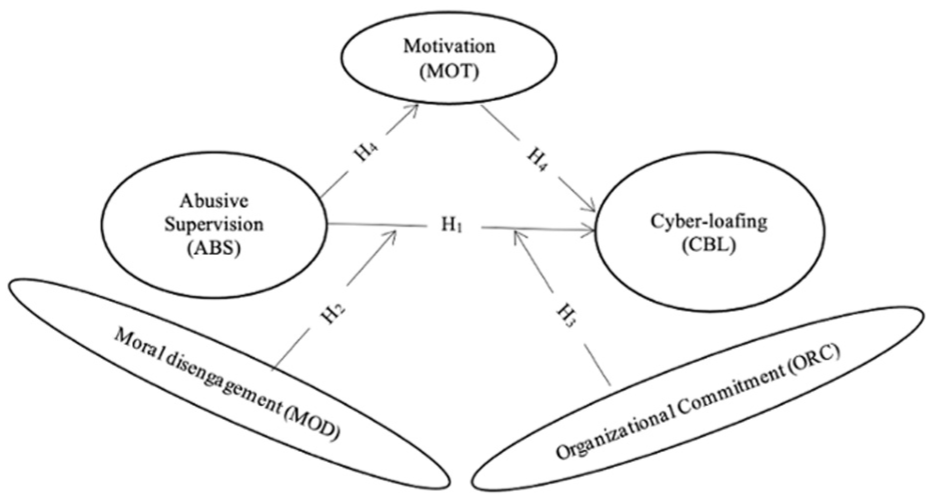
Research framework.
The proposed theoretical framework is built on the interconnection of three theories, adding value to the theoretical base. Each path represents a specific theory; for instance, the first proposed hypothesis (H1) refers to the direct relation between adverse supervision and its consequences on employee nonproductive behavior. This relationship stands on SET, which proposes that the negative treatment causes damage to employee trust and sense of belongingness, which leads to counterproductive behaviors such as CBL. The moderating path represents the second hypothesis (H2) supported by SCT, which posits that the counterproductive behavior of mistreated employees is contingent on their cognition. Moral self-sanctions bind workers to engage in ethical behaviors. This binding weakens when they face unfair treatment. In response, they engage in counterproductive work, that is, CBL. Hence, the transition from mistreatment to counterproductive response is dependent on cognition, and the level of moral engagement decides its intensity. The third hypothesis (H3) uncovers the role of commitment in abuse-led counterproductive behavior under the jurisdiction of COR theory. Committed employees are more psychologically resilient as they possess more capacity to absorb mistreatments. This psychological resource normalizes the adverse effect of ABS on CBL. The last hypothesis (H4) is grounded on SET, which emphasizes the role of motivation in explaining the translation of unfair treatment into counterproductive behaviors. Motivation is an energy that urges employees to accomplish the assigned tasks. When employees face mistreatment, their motivation is undermined, causing an imbalance in social exchange. Consequently, the direction of this energy is diverted from productive tasks to nonproductive ones, particularly CBL.
Methodology
Population and Sample Size
We selected upper-level employees of the banking section in Pakistan as the target population who hold the key managerial or supervisory positions. Such employees remain engaged with operational decisions, target-based assignments, supervision of lower staff, and frequent client dealing. This inherent nature of their job distinguishes them from lower-level employees, as they are more likely to experience an abusive supervisor and exhibit counterproductive behavior in response. Moreover, upper-level employees are better equipped with digital tools and autonomy, which may stimulate involvement in nonproductive tasks more frequently than lower-level employees. Hence, cognizant of contextual relevance, we particularly targeted upper-level employees.
The banking sector is crucial due to its hierarchical structure and greater pressure, indicating a prevalence of abusive supervision (Wu et al., 2021). We followed the rule of thumb approach to formulate a sample size wherein items are multiplied by 10. Hence, we found the figure 200 (i.e., 20 × 10 = 200), and this approach is consistent with prior practices (Gulzar et al., 2024; Shaukat et al., 2024). To filter non-serious responses based on our prior experience, we increased this number to approach 260 employees (Sarwar & Khan, 2022). Later, we picked 201 healthy responses for data analysis after excluding non-serious responses. Finally, we included 201 banking employees in our survey based on convenience sampling.
Although the adoption of convenience sampling challenges the generalizability, this technique facilitated us in collecting the required data from the desired audience. The entire banking staff may differ significantly in forming their perception of the supervisor. Therefore, the external validity issue cannot be overlooked. We propose the adoption of greater care while interpreting the results and particularly generalizing to other banking institutions or other sectors of a similar nature.
Additionally, we took great care to minimize the potential bias and established protocols for safety measures. We sought permission from the potential respondents to confirm that they are willing to participate in the survey at their own will. Further, we discussed the purpose of their research and assured them that they would keep their responses confidential. It was necessary to take them into confidence due to the involvement of socially sensitive matter, that is, abusive treatment, in addition to meeting the ethical standards (Sarwar et al., 2025b). The questionnaire was split into distinct sections, particularly separating predictor and outcome constructs to ensure psychological differences. This technique minimizes the respondent’s mental cause-and-effect connection, leading to responses beyond reality. Since the protocols were designed before data collection, they helped in gathering a reliable dataset for further analysis.
Research Design
We use a deductive approach to investigation based on positivist philosophy. For this, we framed four hypotheses guided by three theories discussed earlier. The data was gathered through a questionnaire distributed among upper-level banking employees. We ensured compliance with ethical considerations at all phases of the study. Participants were informed about the purpose of the study and data secrecy. The study adapted the scales from the literature and conducted a pilot test for reliability and validity before the central survey (Sarwar et al., 2024). The scale distinguished the banking employees into five categories (five-point Likert scale) based on their responses. These categories range from strongly disagree to strongly agree. Additionally, the model contains five reflective constructs wherein items are interchangeable.
Diagnostic Test
The prevalence of common method bias (CMB) stems from the primary data, which needs to be addressed. According to Hidayat-ur-Rehman and Alsolamy (2023), when data is collected from a single source, there is a greater likelihood of the existence of CMB. Similarly, the work of Mohd Thas Thaker et al. (2020) suggested diagnosing the bias when a self-administered questionnaire is employed.
The consequences of CMB may lead to Type-1 and Type-2 errors because the same respondents provide the data of dependent and independent variables (Fuller et al., 2016). Cognizant of these concerns, we tested the CMB in our data using SPSS software. We utilized Harman’s single-factor test, which states that a single factor should explain less than 50% of the total variance. Our results reported the highest variance, that is, 29.71% which falls below the threshold. Hence, we found the absence of CMB in our survey data.
Predictive Ability Test
PLS-based structural modeling offers prediction and explanation for theory development and validation. The quality of prediction or predictive power has two perspectives: first, in-sample and out-of-sample predictive power (Sharma et al., 2022). Although various tests exist to check the in-sample predictive capacity, such as goodness of fit and explained variance (i.e., R2), PLS lacks in providing out-of-sample predictive power of a model in statistical terms. Predictive relevance is fundamental for theory development, validation, and model selection, providing the base for real-time managerial decisions (Table 1).
Sources of Constructs.

Notes. ABS = abusive supervision; CBL = cyberloafing; MOD = moral disengagement; ORC = organizational commitment; MOT = motivation.
We utilized a cross-validated predictive ability test (CVPAT) wherein two models with homogeneity in construct and heterogeneity in paths (both supported by theory) are compared to select one having greater predictive power (Chin et al., 2020). We divided this analysis into four steps following Liengaard et al. (2021). In the first phase, we developed two models supported by SET, SCT, and COR and labeled them with the established model (EM) and alteration model (AM). Both models differ in the arrangement of a construct (i.e., ORC) taken as a moderator in EM, while a mediator in AM (see Figure 2). In the second phase, we check the measurement model assessment of both with identical treatment, for instance, selection of the same indicators, and similar Pls-algorithm setting. Subsequently, we performed a CPVAT assessment in the third phase based on 10-fold and 5,000 sub-samples using bootstrapping. According to results reported in Table 2, we found the negative value of differential average losses (EM-AM = −.13, p = .042), which infers that average losses in EM are lesser than AM, and this value is found significant at 5%. Hence, we may confidently assert the absence of CMB in our data based on CVPAT (Table 3).

Established and alternate models for CVPAT based comparison.
Cross-Validated Predictive Ability Assessment.

Note. Mode 1 is the fundamental model, and Model 2 is the altered model for CPVAT assessment. The description of this test includes 5,000 bootstraps, 10 folds and a 95% confidence interval.
Hypothesized Statements.

Sources. Author compilation.
In addition to Harman’s test, we incorporated the collinearity test in our analysis to capture the likelihood of the threat of CMB (Table 11). We found no evidence of the prevalence of such bias. Further, we took serious efforts to deal with the socially sensitive nature of CBL. We followed high standards to ensure the anonymity and confidentiality of the data. These measures helped to minimize the potential social desirability bias.
Data Analysis
We used SmartPLS software, wherein the Partial Least Square Structural Equation Modeling (PLS-SEM) Technique helped analyze the primary data. For this purpose, we preferred PLS-SEM over Covariance-based SEM due to its capability in handling small data without considering data distribution conditions. Further, we followed Hair et al. (2019) throughout its implementation. We initiated a pilot survey to confirm the reliability and validity of the instrument. For this purpose, we relied on various reliability and validity tests, focusing, for instance, on Cronbach Alpha values, Average Variance Extracted and Cross-loading of indicators. Our initial results supported the quality of the instrument in terms of reliability and validity. However, some items were removed based on poor factor loadings.
Descriptive Analysis
In this section, the study describes the profile of the sample banking employees. We analyze various demographic factors such as gender, age, current experience, education level and marital status. As per statistics in Table 4, our sample is male-dominant (Around 82%). Although women are increasingly participating in the labor market in Pakistan, it is still dominated by males (Athar et al., 2023). Around fifty percent of targeted employees belong to the young age bracket (18–35 years), and others are from the middle and older age brackets. It leverages the opportunity to capture the behavior of employees from different age groups. The sample contains a mix of employees with greater and fewer experiences. Most of the sample employees possess 16 years or equivalent education. Around 70% of employees are married. Married employees have different stress-coping attributes as compared to unmarried ones, particularly in response to abusive treatment.
Description of Sample Banking Employees.
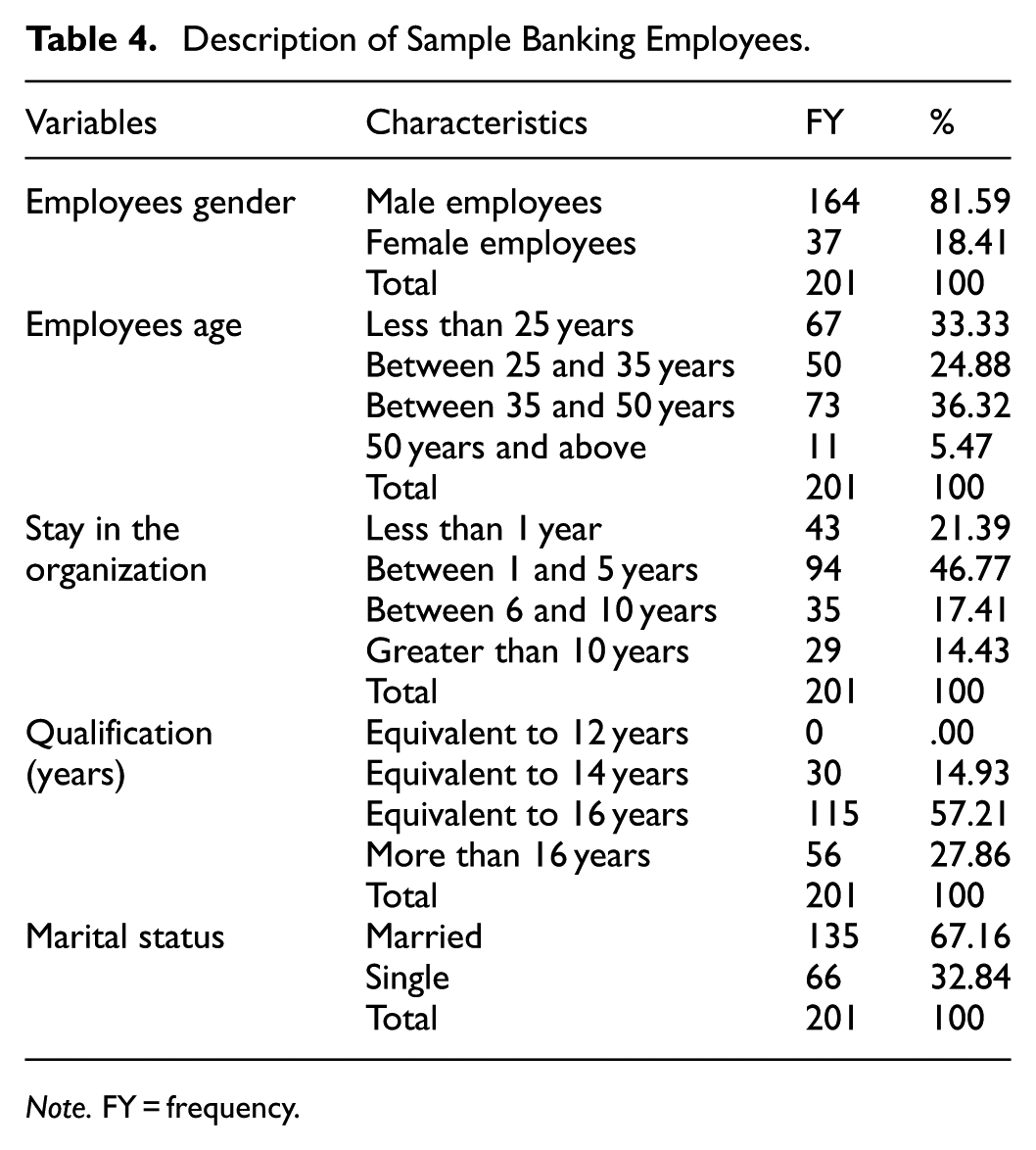
Note. FY = frequency.
Unlike other professions, banking employees spend more time at the workplace (often after working hours) to perform their duties, such as closing the daily balances (Goyal & Babel, 2015). In addition to this, they usually need to deal with clients throughout working hours. This situation has made it more challenging to gather data from them. This study, however, distributed 260 questionnaires and found 201 final numbers for data analysis, claiming a good response rate (i.e., Around 77%). The details of the 29 removed questionnaires are presented in Table 5.
Response Rate Calculation.

Note. N = number of questionnaires.Response Rate is derived by dividing final number of questionnaires received on total number of questionnaires delivered (i.e., 201/260*100 = 77.30%).
To ensure a better response, we targeted different banks, for instance, Allied Bank, Askari Bank, Bank Al Habib, Bank Alfalah, Bank of Punjab, Faysal Bank, Habib Bank Limited, Meezan Bank, and United Bank Limited. Table 6 displays the descriptive statistics of the latent construct used in the study, wherein each construct has its corresponding central tendency value.
Descriptive Statistics.

Notes. S = sample size; Min-V = minimum value; Max-V = maximum value; Mean-V = mean value; Std-V = standard deviation value; ABS = abusive supervision; CBL = cyberloafing; MOD = moral disengagement; ORC = organizational commitment; MOT = motivation.
Measurement Model Analysis
The Measurement Model Analysis in SmartPLS encompasses various tests to determine the reliability and validity (Ringle et al., 2015). For validity assessment, this study employed a cross-loading technique wherein items were loaded to all the constructs and validated, and the results were found better in their respective constructs. For instance, the ABS items (i.e., ABS_1, ABS_2, ABS_3) in Table 7 are better loaded to their construct (see bold entries) than others. Hence, validity is established for ABS and similarly for all the constructs in the table.
Results of Cross-Loading.

Note. ABS = abusive supervision; CBL = cyberloafing; MOD = moral disengagement; ORC = organizational commitment; MOT = motivation.
Parallel to cross-loading, the measure model analysis in this section provided Factor loadings, Cronbach’s alpha, composite reliability, and average variance extracted (AVE) values (see Table 8). For instance, the threshold value for AVE is .5, and all the resultant values fall above the threshold, confirming convergent validity. Besides, Cronbach’s alpha values are greater than .7, which means reliability is established. Similarly, factor loadings are also greater than the threshold of .70. Hence, the statistics in the table support the reliability and validity of the instrument.
Convergent Validity.

Note. FL = factor loadings; α = Cronbach’s alpha; CR = composite reliability; AVE = average variance extracted; ABS = abusive supervision; CBL = cyberloafing; MOD = moral disengagement; ORC = organizational commitment; MOT = motivation.
Another, Table 9 presents the outcomes of the Fornell–Larcker Criterion assessment. According to this, the diagonal values (bold) must be greater than those in rows and columns (Ramayah et al., 2018). For instance, a central value, that is, .851, in the diagonal is greater than values in its respective row (i.e., .764 and .672) and values in the column (.742 and .693). Hence, discriminant validity is confirmed.
Fornell–Larcker’s Discriminant Validity.

Note. ABS = abusive supervision; CBL = cyberloafing; MOD = moral disengagement; ORC = organizational commitment; MOT = motivation. Bold Values must be greater than values in their respective rows and columns to establish discriminant validity.
To confirm the robustness, this study applied another technique to check the discriminant validity, referred to as the Heterotrait–Monotrait Ratio (HTMT). Discriminant validity posits that if two constructs are conceptually different, these must also be statistically different, and there should be no strong correlation between them (Ramayah et al., 2018). The threshold value is set to .9, and the result must fall under the threshold. According to Table 10, all values are lower than .90. Hence, the instrument has discriminant validity.
Heterotrait–Monotrait Ratio Assessment.
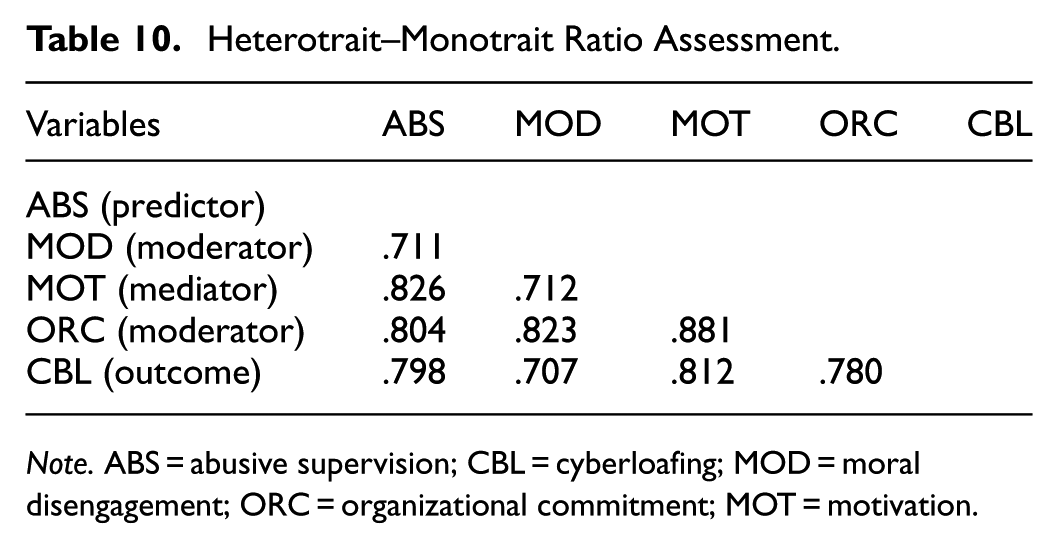
Note. ABS = abusive supervision; CBL = cyberloafing; MOD = moral disengagement; ORC = organizational commitment; MOT = motivation.
Multicollinearity is a disease that may be prevalent in statistical data. It is an unwanted association between two independent variables, which can produce biased estimates. Consequently, biased estimates may lead to wrong conclusions. So, the multicollinearity test is fundamental to statistical analysis. In SmartPLS, it is examined by a variance inflation factor (i.e., VIF) and the threshold value is set at 5.0, and any higher value indicates its existence (Ringle et al., 2015). According to Table 11, all VIF values are less than 5.0. Hence, there is no problem with multicollinearity.
Multicollinearity Test.

Note. ABS = abusive supervision; CBL = cyberloafing; MOD = moral disengagement; ORC = organizational commitment; MOT = motivation; VIF = variance inflation factor.
Structural Model Analysis
We examined some commonly used model fitness indices to meet the quality standards. The first test assessed the variation in observed and predicted correlation statistics and reports the Standardized Root Mean Square Residual (SRMR). According to Table 12, the calculated value is lower than the threshold of .08, which justifies the fitness. Further, we relied on the Normed Fit Index (NFI) test, wherein the model is evaluated through comparison with a benchmark model, wherein the outcome must be exceeded by .90 to prove fitness. As per the results, our findings proved the fitness of the proposed model. We also verified fitness with Root Mean Square Theta (RMS_theta), and the results remained supportive (see Table 12).
Model Fitness Test.

Note. SMRS = standardized root mean square residual; NFI = normed fit index; RMS = root mean square. All values fall within an acceptable range of model fitness.
We employed robust measures to cross-validate the self-reporting biases. We incorporated some control variables such as age, gender and work experience in the path analysis. We found the insignificant effect of these controls. Moreover, the baseline relationship remained stable even in the presence of controls. This stability of results ensures the absence of self-reported bias in measuring a socially sensitive construct.
Path Analysis
The premise of using Path analysis (or inner model analysis) is to test the hypotheses. It uses the bootstrapping technique and concludes causal relationships. Table 13 reports the findings wherein a decision is made on the t-statistic threshold of 1.96. All four t-stat values are more significant than the threshold, meaning that each path in the proposed model is significant. The direction of the relationship in H1 and H2 is positive, while it is negative in H3 and H4.
Hypotheses Test.
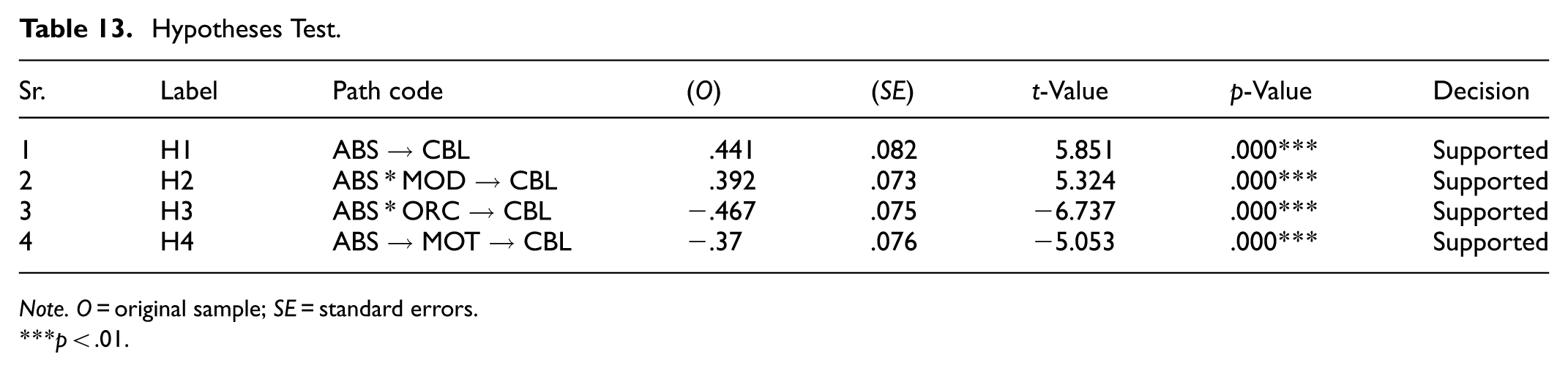
Note. O = original sample; SE = standard errors.
p < .01.
The first direct path (ABS → CBL) investigates the direct connection between ABS and CBL. According to Table 10, this relationship is statistically significant. (H1: O = .441, t = 5.851). These findings are consistent with the literature discussed in an earlier section. Hence, we empirically document that Abusive treatment provokes nonproductive behavior in the banking sector, such as CBL. Its consequences may be far-reaching, affecting customer service, reputational damage, lack of legal compliance and unintentional leakage of sensitive data (Fahad & Kistyanto, 2021). Therefore, we recommend that authorities remain vigilant for such destructive practices and deal with bad leaders accordingly.
Similarly, the second path (ABS * MOD → CBL) proposed that MOD can influence ABS and CBL. According to results (H2: O = .392, t = 5.324), Employees with high moral disengagement are sensitive to the dark side of leadership. These findings are interesting as the employees with MOD will exhibit greater CBL behavior, which can understate their performance (Chiu et al., 2024). Therefore, policymakers must take corrective actions, such as promoting ethics, raising accountability, and initiating training programs. Banks may offer incentives for ethical conduct and develop a support system for reporting unethical practices.
Further, the third direct path (ABS * ORC → CBL) examines the moderation of ORC between ABS and CBL. The impact of ORC as a moderator has been found to be significant and negative (H3: O = −.467, t = −6.737). It is inferred that committed employees are least likely to engage in CL in response to AS (Usman et al., 2021). In fact, ORC serves as a cognitive resource, and it can absorb abusive treatment to an extent. Based on these findings, we propose that authorities raise employee commitment through a supportive culture, achievement recognition, building trust, ensuring job security, promoting open communication, and attractive compensation plans.
Lastly, the fourth path (ABS → MOT → CBL) describes the bridging role of MOT between AS and CL. The mediation is found to be significant and negative (H4: O = −.370, t = −5.053). It infers that the dark side of leadership affects employees’ motivation, leading to nonproductive behavior such as CL (Koay et al., 2022). Especially in a sophisticated baking context, supervisors’ abusive treatment, in fact, causes damage to employees’ energy, leading to involvement in non-work-related activities. Here, we suggest policymakers raise efforts to sustain the high energy level of employees for better performance.
Conclusion and Limitation
This research was motivated to uncover the nexus between abusive treatment and cyber-loafing behavior in the banking sector in Pakistan. We targeted banks because of their complex hierarchical structure and the likelihood of the prevalence of abusive treatment. We found that abusive treatment triggers cyber-loafing in employees. Further, employee motivation significantly mediates this relationship. In addition to this, moral disengagement adds fuel to the fire. However, organizational commitment moderates the effect of abusive treatment on cyber-loafing behavior. These findings are valuable for authorities and policymakers to raise accountability, foster a supportive culture, initiate training programs and put efforts to ensure employee commitment.
This study offers valuable insights by drawing on a different perspective to describe the consequences of abuses on behavior. The work of Koay et al. (2022) remained near our investigation, but it is limited to employee beliefs. We added the perspective of commitment level and motivation to explain this phenomenon. Additionally, the investigation context is unique due to the extensive hierarchical structure in the baking sector, which causes more stressful working conditions, stimulating abusive behaviors. Further, it uncovers the psychological mechanism of abuse-driven cyber-loafing in the banking sector, an under-explored management research area.
Concerning limitations, this study is limited in offering generalizability due to sample size and technique. In the future, the sample size may be increased, or a probability sampling technique may be employed to raise generalizability. Additionally, it targets the Banks in Pakistan only; however, future efforts may be expanded to other developing nations for a better understanding. This study views abusive behavior as a unified construct, whereas it could be studied into different dimensions such as emotional abuse, physical abuse, economic abuse or moral abuse. Lastly, we acknowledge the social sensitivity of cyber-loafing and the possibility of the prevalence of bias due to self-reported measures. This limitation may be addressed in future studies through compensating measures such as indirect questioning and obtaining behavioral data. Indeed, such efforts would deepen understanding and foster practices in organizational settings.
The study acknowledges the aforementioned limitations, particularly the compromised generalizability, and urges consideration of them in future studies. It suggests conducting an investigation in the future to check whether ABS-driven CBL is consistent across sectors or environments. It is also necessitated because banks have a different structure, leadership and level of digital dependence from other sectors such as healthcare, education or manufacturing. Furthermore, cross-analysis would also strengthen the theoretical proposition. It is a common understanding that countries differ in cultural aspects. For instance, Pakistani organizations contain a power-difference culture unlike that in Western countries. Therefore, it is possible that the generation of abuses and consequent response may differ across countries. Hence, there is a dire need to extend this phenomenon across sectors and cultures to confirm external validity.
Theoretical Implications
This study has several theoretical contributions. Firstly, it synthesizes the ideas from three interlinked theories (i.e., SET, SCT, and COR) to understand the dark side of leadership. Combining theories provides a holistic view of a problem. Abuse-led behaviors are becoming a burning issue due to increasing stress on banking sector employees. Supervisors’ adverse treatment of subordinates may either generate confrontation or cyber-loafing, both of which are destructive to banks’ performance. We found a significantly positive connection that supports the existing theories under consideration and is consistent with prior studies. Secondly, this research draws attention to a comprehensive framework integrating MOT, MOD, and ORC to understand abuse-driven behavior deeply. For instance, our findings proved that MOT serves as a mediator, MOD serves as an intensifier and ORS as a mitigator. Indeed, these novel findings enhance understanding and provide a novel perspective on the phenomena. Lastly, the context of this research is unique and has been overlooked by management researchers. We propose that this research fits best in the banking sector due to structural hierarchies and increasingly stressful working conditions. These circumstances enhance the likelihood of a supervisor’s abuses and employee unproductive behaviors. Hence, the findings are prudent due to contextual relevance.
Our findings are based on the triangulation of three theories, providing a deep theoretical insight, making this study distinct from prior research. The prior research has addressed this phenomenon with a limited theoretical base. We introduced a psychological mechanism within abuse-driven unproductive behavior, wherein SCT and COR theories provide how employees justify this deviant behavior. We introduced commitment as the contingent factor in cyber-loafing literature, which remained underexplored in prior related studies. We extended SET by introducing motivation as the central construct to explain how abuses affect work disengagement. We combined multifaceted aspects such as human relations, emotions and cognition to understand the consequences of adverse treatment on unproductive behavior, particularly in a high-pressure environment. This approach of triangulation of theories and the unique high-pressure environment make this study unique and distinguish it from prior work.
Practical Implications
In addition to a theoretical contribution, this research offers many practical insights. It suggests raising accountability for abusive treatment for bank managers at the branch level because, ultimately, managers become victims. Ineffective and abusive treatments trigger unproductive behaviors, which subsequently affect organizational performance in aggregate. For a decline in performance, the managers have to report in terms of abusive treatment against them by their supervisor. So, the abusive treatments generated either by them or within their team may come back to them. Hence, our findings suggest raising accountability and a supportive culture to identify the abusive treatments and unproductive behaviors to deal with accordingly. Similarly, for Policymakers at the head office level, regular training programs are required to sustain moral engagement. Further, incentivizing employees with different schemes such as promotions, competitive packages, paid leaves and recreational tours can sustain motivation and raise commitment.
Key points:
Abusive treatment is destructive for banking, as it causes unproductive behaviors.
Employees with high moral disengagement have the least tolerance against abuses.
Enhancing motivation can help control the abuse-led cyber-loafing.
Footnotes

Ethical Considerations
Ethical approval for this research was granted by the Institutional Review Board (IRB) of Hailey College of Banking and Finance, as per approval letter No. D-0003026/hcbf dated March 5, 2024. The study was conducted in accordance with established ethical guidelines for research involving human participants. All individuals involved were fully briefed on the purpose of the study, and their confidentiality and anonymity were rigorously maintained.
Consent to Participate
Informed consent was obtained from all subjects involved in the study.
Author Contributions
Anil Yasin Ar contributed in resources, supervision and project administration. Additionally, Sonia Sattar performed the following tasks such as conceptualization, methodology, software, validation, formal analysis, investigation and writing original draft preparation. Lastly, Usman Sarwar contributed in data curation, writing review, editing and visualization. All authors have read and agreed to the published version of the manuscript.
Funding
The authors disclosed receipt of the following financial support for the research, authorship, and/or publication of this article: The authors acknowledge the financial support provided by Tecnologico de Monterrey, Business School, Mexico, in the production of this work.
Declaration of Conflicting Interests
The authors declared no potential conflicts of interest with respect to the research, authorship, and/or publication of this article.
Data Availability Statement
Data will be made available on request.