




Abstract
Building on the functional approach theory, the current study empirically examined the influences of servant leadership behaviors on volunteers’ motivations and on their organizational commitment feelings. In addition, it also examined servant leadership’s indirect influences via those motivations on volunteers’ commitment feelings. To test its hypotheses, the study used the data collected from 385 volunteers. The research has found out that the degree of perceived servant leadership behaviors affected both participants’ motivation to volunteer and their affective and normative commitments feelings toward their organizations. Furthermore, as one of the six dimensions of the motivation concept suggested by the functional approach theory, only the protective motive partially mediated the influences of perceived servant leadership behaviors on the volunteers’ normative commitment attitudes. The study discussed the possible rationales under these research findings and made some future research proposals. The study hopes that its findings, through responding to expectations of their voluntary members, help voluntary organizations to be more effective and efficient in their recruiting and sustaining efforts.
Keywords
Introduction
Different from other types of helping behaviors by its key defining features as voluntary, planned, sustained, and ongoing helpfulness that mostly calls for substantial amount of personal resources (e.g., time, money, energy, and/or opportunity) (Clary et al., 1998; Piliavin & Charng, 1990), volunteerism requires people to forgo something important to themselves and to engage in those helping services in a steady manner over long periods of time. And, it is noteworthy that despite these inherent high costs and many hurdles in the process, many people across the world already have been taking part within various helping services as volunteers (Clary et al., 1998).
Before beginning any voluntary activity, that altruistic and demanding nature of volunteering makes individuals go through a decision process in which they think of and evaluate the personal reasons, needs, goals, possible costs, and results of being a volunteer (Benson et al., 1980; Clary et al., 1998). To comprehend those motivational foundations of volunteerism, the present study has adopted the functional approach which describes the individual and social functions which a person expects to obtain in return of his or her thoughts and conducts (Snyder, 1993). These functions induce individuals to begin and maintain their voluntary helping behaviors (Clary & Snyder, 1991).
The present examination is of the opinion that relative to business organizations, it may be much more difficult for voluntary organizations to externally motivate their members for initiating and sustaining their voluntary helping behaviors because these motives are mostly considered intrinsic and self-directed (Dwyer, Bono, Snyder, Nov, & Berson, 2013). So, any voluntary organization should give a special importance to leader behaviors at all levels of its hierarchy. In relation to these leader behaviors, it is sad to say that there is not a sufficient number of studies in voluntary contexts compared with business environments (Catano, Pond, & Kelloway, 2001; Clary et al., 1998; Clary, Snyder, Ridge, Miene, & Haugen, 1994; Omoto & Snyder, 1995; Penner & Finkelstein, 1998; Snyder, Omoto, & Lindsay, 2004). So, this article asserts that in a world where the need for volunteers is gradually increasing and where the voluntary activities at regional, national, and global level are becoming more large and complicated, voluntary organizations and their activities also require modern leadership approaches to survive and develop, just as business organizations do (Maier, Meyer, & Steinbereithner, 2016).
Relative to other leadership concepts (e.g., spiritual, authentic, ethical, transformational leadership, etc.), servant leadership has notable and unique characteristics which can make this leadership style exceptional and more superior (Walumbwa, Hartnell, & Oke, 2010). The primary distinct feature of servant leadership is its focus on followers’ well-being, personal growth, and enhancement (Smith, Montagno, & Kuzmenko, 2004). Consequently, the present research suggests that this altruistic and follower-centered nature of the servant leadership behaviors might make great contributions to motivation and commitment of volunteers who sacrifice their substantial personal resources for the well-being of others without any expectance in return, just as their leaders do.
Accordingly, the first objective of the research was to explore the associations between servant leadership and volunteer motivation. Some may think that volunteers do not need to be motivated by a leader because of their inherent motivations for volunteering (Podsakoff, Ahearne, & MacKenzie, 1997). However, because volunteers do not have any employment relationship with their organizations, they can easily give up their volunteering activities. That is why leadership behaviors in volunteer environments deserve to be taken into consideration as much as those in business environments. The second objective of the investigation was to examine the relations between servant leadership and organizational commitment. Organizational commitment concept, which is described as the relative intensity of an individual’s identification with and attachment to an organization (Mowday, Porter, & Steers, 1982), should have a special importance for voluntary contexts. Studies in non-voluntary settings show significant associations between organizational commitment attitudes and servant leadership behaviors (Barbuto & Wheeler, 2006; Cerit, 2010; Ehrhart, 2004; Jaramillo, Grisaffe, Chonko, & Roberts, 2009; Liden, Wayne, Zhao, & Henderson, 2008; West, Pearson, Dovidio, Shelton, & Trail, 2009). However, there is a considerable need to increase the existing scarce knowledge of how people can be motivated to be volunteers and how to build long-term ties between volunteers and their organizations. The third objective was to investigate the links between volunteers’ motivation and their commitment attitudes to their organizations. The expectation was to see direct associations between the two concepts as regards to voluntary contexts because this study believes that the concept of motivation should have a special importance for voluntary helping behaviors (Mannino, Snyder, & Omoto, 2011). Drawing on the preceding three hypotheses, as fourth and last objective, volunteer motivations’ possible mediation influences on the relationships between servant leadership and organizational commitment dimensions were questioned.
As mentioned earlier, this study discusses servant leadership behaviors, organizational commitment, and motivation of volunteers by using the functional approach theory. Therefore, the results of this empirical research may have practical implications for managers in voluntary organizations. Moreover, the results of this research are hoped to make an important contribution to the emerging literatures of servant leadership and volunteerism.
Theory and Hypotheses
Volunteering and Motivation
Although volunteers perform many roles of different kinds in thousands of different organizations, it is hard to say that there is a common exercise in volunteerism (Gaskin, 1999). Given the lack of standard definitions and practices, volunteerism is often defined as continuous and structured helping behaviors without reciprocity, coercion, and obligation (Clary & Snyder, 1991; Musick & Wilson, 1997; Smith, 1994). In another widely accepted and similar definition, volunteerism has been defined as unremunerated helping activities which are engaged in a systematic and structured way and performed for people in need to whom the volunteer has no obligation (Tilly & Tilly, 1994). Even so, it is noteworthy that as the core principal, all voluntary activities eventually aim at producing a public good (Wilson, 2000).
One important key issue implicit in those definitions is one’s free will to volunteer. Thus, the state of being obligated for a voluntary act is an obstacle to be accepted as a volunteer. Therefore, if someone volunteers due to his or her some obligations or coercions, such as community service or school credits, then he or she cannot be considered as a volunteer. Another central theme in the above definitions is about the requirement of not being paid. It entails any volunteer not to expect any material compensations in return for all those voluntary acts, particularly in the form of money such as stipends or low pay (Smith, 1994). However, individuals receiving negligible material reimbursement of a nonmonetary nature, such as bus tickets and free meals, can be thought as volunteers when their true and sincere intentions are to contribute to the public good because they reimburse relatively much more higher prices for those activities, and they devote their time to helping that could be used somewhere else for earning an income (Cnaan, Handy, & Wadsworth, 1996). Besides, an additional important characteristic of voluntary helping behaviors is that they must be performed nonspontaneously (Piliavin & Charng, 1990). In other words, spontaneous helping behaviors occurring in situations in which someone finds himself unexpectedly in an immediate decision process to act or not for helping a stranger in need are out of the scope of this study.
Based on the framework of volunteerism just drawn above, voluntary helping behaviors, therefore, are supposed to involve a thoughtful planning activity by which a volunteer looks for occasions to help others and require committed association over a substantial time (Benson et al., 1980). So, it is obvious that some forces stimulate people to volunteer despite its many inherent costs (e.g., time, energy, money, opportunity, etc.). Accordingly, it is critical to comprehend the motivational foundations of volunteering which induce individuals to help other people on a regular and ongoing basis, by sacrificing some of their personal resources of time, energy, and/or opportunity (Clary et al., 1998). In doing this, it is essential to take into account that the attitudes and decisions concerning voluntary behaviors will not depend merely on the individual himself or herself or on the circumstances, but rather the interaction of two. Thus, drawing on the conception suggesting that the decisions and behaviors are contingent on the fit between an individual’s motivations and the opportunities afforded by the volunteering setting, this study assumes volunteerism as a theory that must be examined from a motivational perspective (Clary et al., 1998; Mannino et al., 2011). Motivations are the psychological processes which describe the reasons, intentions, plans, and goals of an individual to volunteer, and they have a great role in any volunteer’s decisions, choices, and behaviors (Snyder, 1993). That is why people’s needs, desires, and goals and their perceptions regarding the opportunities provided by volunteering environment for satisfaction of their expectations can promote or impede their prospective actions regarding volunteering (Mannino et al., 2011). Consequently, it is considered that the motivation of volunteers is very important in understanding why and how they take part in voluntary helping behaviors and how they continue to be committed to these long-term actions.
Because it is the most widely used approach, and has been applied in many voluntary settings (Chacón, Gutiérrez, Sauto, Vecina, & Pérez, 2017; Gage & Thapa, 2012), the present inquiry adopts the interpretation of the functional approach to volunteer motivation, which essentially argues that individuals may perform a given voluntary activity out of different motivational grounds by which they functionally hope to satisfy their certain psychological needs, and these functions influence volunteers’ decision process on beginning and sustaining their helping behaviors (Clary et al., 1998). Functional approach necessitates a motivational standpoint that leads inquiry into the individual and social processes that launch, guide, and maintain action (Katz, 1960). A wide range of researches on the motivational analysis of mental, sentimental, behavioral, and relational processes verify basic functionalist ideas (Snyder & Cantor, 1998).
Individuals will be eager to attend to and sustain voluntary actions to the extent that they think volunteering provides themselves opportunities which help them satisfy their specific needs and/or reach some predetermined goals. Therefore, building on the functional approach, Clary et al. (1998) generated the Voluntary Functions Inventory (VFI) and defined six functions to be served by volunteerism. VFI, as an instrument, measures the degree of importance of each of key motives for a volunteer, and these functions are as follows: “Values” (volunteerism provides individuals opportunities to show their selfless and philanthropic involvement for the contentment and well-being of other people), “Understanding” (an individual can learn something new, and gather diverse knowledge, opinions, and skills in relation to living through volunteering which might eventually lead to his or her self-development), “Career” (one may wish to develop his or her skills with a specific goal for a new profession, or to use his or her volunteering activity as a step for a new career), “Protection” (volunteering offers a mechanism through which an individual can be far from his or her harmful feelings or personal remorse or troubles to preserve the self in safe), “Enhancement” (volunteering might contribute to the personal evolution, personal development, and/or sense of worth of an individual), and “Social” (forming robust and constructive relationships with people sharing common interest, or being a part of some activities seen as important by major figures in the society).
Each motivation comprises different values and meanings for each volunteer. Specifically, while some consider any function as very important, this function may not be meaningful to another (Snyder et al., 2004). Regardless of the hierarchical order of these functions among themselves, research findings reveal the validity of the theory of functional approach and suggest that every volunteer can have different motivations even for the same voluntary work in the same workgroup (Mannino et al., 2011). Furthermore, while different motivations have different meanings for different individuals, it should be noted that they do not work completely apart from each other. Rather than having only one motive at a time, volunteers may have a combination of those motives (Mannino et al., 2011).
In their systematic review of researches on volunteers using VFI, Chacón et al. (2017) put forward that VFI sufficiently measured the most common motives in nearly all kinds of volunteers. The authors proposed that the extensive use of VFI could be explained, as well as other factors, by its well-founded theoretical framework and its good psychometric features. Gillespie, Gottlieb, and Maitland (2011) also stressed VFI’s theoretical basis, the predictive characteristic, and the general-purpose applications of the inventory as key merits. Law, Shek, and Ma (2011) backed VFI as well, and acknowledged the functions as the motives behind volunteer involvement and further stated that when the basic motivations of people are known, they can be affected to be volunteer and they can continue to participate in voluntary activities.
Volunteer Motivation and Servant Leadership
Given the importance of helping services performed by volunteers, it will have some significant implications for voluntary organizations’ leaders to have a deep understanding of the basic motives of volunteering. Given the great importance of the services provided by volunteers for all communities, it is considered that the leaders’ deep understanding of the main motivations of volunteers will have a significant impact on effectiveness and efficiency of the voluntary activities. Because volunteers’ individual needs and desires are essential foundations of their motivation (Dwyer et al., 2013), these forces can provide important explanations to “why people volunteer” and “how their continuous involvement can be maintained.” Evidence suggests that in selecting and persuading new volunteer nominees and sustaining their involvement, the messages which aim at their motivations are much more efficient (Clary et al., 1994). In some other studies, findings put forth the importance of a good match between any voluntary task and an individual’s specific motivations for volunteering (Houle, Sagarin, & Kaplan, 2005; Omoto, Snyder, & Martino, 2000). Therefore, leadership behaviors which put the needs, desires, goals, and plans, shortly saying, motivations of individuals for volunteering, into the central point of their endeavor will more likely be successful in attracting and convincing new people, and in assuring their commitment to their voluntary organizations over a significant time period. Thus, this current exploration adopts that the dyadic associations between voluntary people and their leaders might significantly influence initiating and sustaining stages of volunteering (Catano et al., 2001).
Given the main characteristics of voluntary helping behaviors and the significance of the motives of people for volunteering (Ryan & Deci, 2000), servant leadership can be a very appropriate leadership model in voluntary contexts to attract, recruit, and retain individuals for voluntary services. As Greenleaf (1970, 1977) stated, the main idea of “the servant leader is servant first” is the foundation of his leadership philosophy. Serving followers is the first priority of the servant leaders, and followers’ personal growth and development are over the self-interest of themselves (Hale & Fields, 2007; Smith et al., 2004; Stone, Russell, & Patterson, 2004). The focus of the influence of servant leadership lies on the idea of “serving and developing people,” and servant leaders do not utilize their supremacy for getting things accomplished; rather, they try to persuade their followers (Van Dierendonck, 2011). In this respect, Van Dierendonck (2011) identified six main categories of behaviors exhibited by servant leaders: (a) empowering and developing (encouraging the initiative and self-confidence of followers, and enhancing their sense of personal power), (b) humility (prioritizing the followers’ own achievements and talents and keeping himself or herself behind), (c) authenticity (being honest with oneself, representing internal feelings, purposes, and engagement correctly), (d) interpersonal acceptance (being aware of and accepting the psychological states of other people and experiencing their feelings in terms of showing one’s care about them), (e) providing direction (letting people know what is expected of them), and (f) stewardship (readiness for taking responsibility for other people and prioritizing of service instead of control and self-interest).
As one of the emerging leadership theories, servant leadership is believed to have a great potential with its distinguishing characteristics which might produce substantial added value to voluntary services. The primary difference between servant leadership behaviors and the others which exhibit some resemblances with servant leadership, including transformational, ethical, authentic, and spiritual leadership approaches, is its primary focus on followers’ needs, development, and well-being. In this regard, Parolini, Patterson, and Winston (2009), in their discriminant analysis, compared the behaviors of transformational leaders and servant leaders, and found that participants perceived servant leaders as more engaged in their needs and expectations, whereas transformational leader behaviors were seen as more directed to organizational objectives. In another study on construct development, Brown, Trevino, and Harrison (2005) explored the main aspects of ethical leadership and concluded with six core behaviors which overlap with the three characteristics of servant leadership, specifically, empowering, humility, and stewardship. However, regarding its other key features, namely, authenticity, interpersonal acceptance, and providing direction, servant leadership noticeably differentiates from ethical leadership. As for authentic leadership, which emphasizes the consistency between one’s behaviors and real thoughts and feelings, the focal point is the expression of the “true self” (Walumbwa, Avolio, Gardner, Wernsing, & Peterson, 2008). When compared with servant leadership behaviors, authentic leadership, with its specific concentration on being authentic in one’s relations with other people and being sincere toward one’s internal feelings and thoughts, can be considered to be a sub-concept under servant leadership theory, which has relatively a much broader and more comprehensive framework for leader behaviors (Van Dierendonck, 2011). Another leadership model displaying similarities with servant leadership is spiritual leadership, which focuses on the meaning at work and the importance of values in an organizational setting (Pawar, 2008). In this regard, spiritual leaders influence their followers through establishing a cultural atmosphere, which eventually supports followers’ sense of meaning and being a part of a certain group or organization (Fry & Slocum, 2008). Van Dierendonck (2011) suggested that the existing literature on spiritual leadership has failed to clearly identify the actual leader behaviors. This deficiency of clarity on spiritual leadership behaviors makes servant leadership a more reasonable theory to explain leader–follower interactions. In conclusion, notwithstanding some matches with other leadership concepts, the core behaviors of servant leadership, which particularly focus on followers’ needs, individual growth, and development without any covert agenda regarding organizational objectives and/or leader’s own expectations, are considered as relatively much more right and proper leadership concept for voluntary settings.
When leaders treat their followers selflessly, and care for the well-being of them, then those followers will have more strong positive feelings and feel a desire to work with their leaders (De Cremer, 2006). Because servant leaders are highly engaged with the concerns of their followers, and empathize with and nurture them, these people will have relatively higher motivation to engage in prosocial activities (De Cremer, Mayer, Schouten, & Bardes, 2009). Owens and Hekman (2012) empirically showed that unpretentious leaders who always feel concern for their followers establish intense relationships with their followers and encourage them to entirely be engaged in their work. The rationale for this causal relationship can be that people perceive that their important needs are being fulfilled, which is the vital ingredient of motivation. Schaubroeck, Lam, and Peng (2011) argued that servant leaders’ modest, moral, and empathetic behaviors help them create trustworthy relationships with their followers, thereby making it easy for leaders to inspire their followers to engage in helping behaviors (Colquitt, Scott, & LePine, 2007). Besides, people often perceive their leaders as role models (Yukl, 2010). Through their exemplary behaviors, servant leaders can encourage their followers to be involved in voluntary helping behaviors (Van Dierendonck, 2011). Researchers suggest that when followers perceive their leaders as having and exhibiting attractive characteristics, they are more likely to behave in their leaders’ manner (Hannah, Walumbwa, & Fry, 2011; Mayer, Aquino, Greenbaum, & Kuenzi, 2012). And, we know from Hale and Fields (2007) that followers find servant leaders fascinating.
In summary, this study suggests that servant leaders’ humble, ethical, supporting, empowering, healing, caring, and understanding behaviors (Spears, 2010) will evoke and promote all kinds of motivations of people to volunteer (Clary et al., 1998). That is why, given the significant features in common between voluntary helping services and servant leadership behaviors, and taking the research findings on servant leaders’ motivational influences into consideration, it is very possible that servant leaders will be quite influential in motivating individuals to volunteer.
Servant Leadership and Organizational Commitment
Another key concern of voluntary organizations is ensuring the continuance of these helping behaviors of volunteers over long periods of time. As voluntary behaviors are willingly conducted, there isn’t any obstacle for volunteers to stop their services and quit their organizations. That is why volunteers’ organizational commitment is a key attitude that needs to be fostered and maintained by the leaders. Organizational commitment means one’s tendency to stay to in an organization (Ambali, Eissa, Bakar, Hashim, & Tariq, 2011; Price, 1997). Kanter (1968) defined it as acknowledgment of, empathy for, and alignment with the values, and desire to be connected to the organization. Porter, Steers, Mowday, and Boulian (1974) described organizational commitment as believing in, and adoption of the organization’s objectives and values, aspiration for much more contributions behind formal job requirements, and desire to stay a member of the organization.
According to Meyer and Allen (1991), three types of organizational commitment are there: affective, continuance, and normative commitment. Affective commitment refers to emotional attachment to and equating one’s self with his or her organization’s cultural values; continuance commitment refers to the anticipated losses of leaving the organization; and normative commitment means social, official, moral, and/or ethical responsibility to the organization (Meyer & Allen, 1997). This study argues that as a result of the differences in the underlying motives, each of these three types of commitment will have its own consequences (Somers, 1995). In this context, affective organizational commitment, which indicates the degree of loyalty an individual has for an organization, and emphasizes an individual’s identification with and commitment to an organization (Porter et al., 1974), is claimed to lead to strong emotional commitment ensuring that they remain in the organization (Meyer, Allen, & Smith, 1993). Accordingly, affective component can have relatively higher influence on commitment feelings of people (Meyer & Allen, 1997).
In achieving the organizational goals, commitment of the organizational members plays a significant role (Swanepoel, Erasmus, van Wyk, & Schenk, 2003). Moreover, lack of commitment brings about some kinds of negative job attitudes like turnover intension, absenteeism, and so on (Bennett & Durkin, 2000) because lack of commitment will lead to weakening or devastation of bonds between volunteers and their organizations. Thus, organizations should create appropriate conditions for boosting the feelings of their members’ commitment. Leaders, as the primary founders of those conditions in organizations, are assumed to have crucial responsibilities for building and sustaining of these sentimental connections. For example, evidence suggested that employees’ organizational commitment was in positive correlation with the sense of support they received from their leaders (Danish, Ramzan, & Ahmad, 2013; Eisenberger, Hutington, Hutchison, & Sowa, 1986). Study by Stone et al. (2004) also showed that leaders contributed to the commitment of their followers by supporting their personal growth.
The current inquiry proposes that servant leaders will considerably foster the commitment feelings of the followers toward their organizations. More specifically, servant leaders’ humble, altruistic, caring, emotional healing, supportive, and empathetic behaviors (Spears, 2010) have a substantial potential to cause volunteers to form emotional connections with their organizations. Because servant leadership behaviors will nurture volunteers’ psychological needs and expectations, it is very likely to develop affective commitment attitudes in volunteers. Similarly, just as implied by the social exchange theory (Blau, 1964), volunteers can also feel some moral responsibilities toward their organization in response to what they get from their leaders in the form of support, understanding, help, care, and concern. Consequently, they will feel a lack of balance of exchange, and they will need to respond to these virtuous behaviors exhibited by their leaders. Subsequently, they will feel moral obligations to stay and continue their services even if they want to leave from their organizations.
Research introduced that the caring behavior exhibited by servant leaders was significantly correlated with followers’ commitment as those behaviors gave rise to developing trust and positive feelings in followers, and they accepted their leaders as role models (Agarwal, DeCarlo, & Vyas, 1999). Moghaddam and Ansari (2013) also indicated that servant leadership behaviors generated commitment attitudes in followers because it created a pleasing and positive atmosphere to work. Studies of Ambali et al. (2011) and Mazarei, Hoshyar, and Nourbakhsh (2013) also proved this positive association between servant leadership and affective and normative commitment attitudes. Accordingly, the second hypothesis of the study suggests that servant leaders will be quite effective in creating affectively and normatively committed followers.
Motivation, Commitment, and Servant Leadership
As noted, volunteering includes continuous and organized helping behaviors, and it requires commitment throughout a substantial period (Benson et al., 1980). Thus, commitment is a necessary attitude for sustaining of voluntary helping behaviors. To make volunteers committed, voluntary organizations should generate necessary conditions to motivate volunteers. The rationale under that argument lies on the functionalist approach to motivation, which states that motivation of volunteers depends on the opportunities through which volunteers expect to satisfy some specific needs, and nurturing these needs of volunteers can contribute to their commitment toward their organizations (Clary et al., 1998; Snyder, 1993). As long as their motivation levels are high enough, volunteers can continue their membership and provide their services. Motivation will give them necessary energy to be involved in the activities and help them overcome many hurdles which they may encounter within the process. That is why it is considered that the commitment feelings are important outcomes of some motivational processes.
As stated before, this study accepts the main idea that volunteerism is a function of some organizational and individual factors, including motivation. As Mannino et al. (2011) put forth, people’s motivations affect their decisions to participate into voluntary activities, and the quality of their future experiences. Furthermore, volunteerism is an emotional and moral phenomenon which denies coercion and material expectation. Motives which include humanistic concerns, desire for understanding, needs for protection, enhancement, and social affiliations (Clary et al., 1998) can make considerable contributions to organizational (affective and normative) commitment of volunteers for the reason that the feelings and thoughts that will take their roots from these motives will help volunteers develop emotional and moral connections with their organization. If those roots are strong, then their commitment feelings will be high. Indeed, as the research by Angle and Perry (1983) confirmed, volunteers motivated by intrinsic and extrinsic features of their work context are more likely to develop and exhibit commitment behaviors. Pierce, Rubenfeld, and Morgan (1991) also supported these arguments and suggested that motivating volunteers can enhance their affective organizational commitment. Then, the third hypothesis is suggested as follows:
Drawing on the previous hypotheses, this study proposes that some of the impact of servant leadership behaviors upon volunteers’ commitment may actualize over volunteer motivation. Given the anticipated relations between servant leadership and volunteers’ motivation, and the associations between motivation and commitment, the influence of servant leadership behaviors on volunteers’ commitment might be, at least to some extent, via its hypothesized potential influence on motivation of individuals to volunteer. Because leaders will not exert its influence fully just via motivation, that mediation effect should be expected as partial. Although there are not enough studies which examine such mechanisms between servant leadership and organizational commitment, the current investigation believes that there are other possible individual and organizational-level factors (e.g., self-efficacy, optimism, hope, trust, psychological capital, organizational culture, climate, policies, etc.) which are likely to mediate this expected association between servant leadership and organizational commitment. So, the last hypothesis is identified as follows:
In light of what has been put forward in the theoretical framework so far, the research model is summarized in Figure 1 presented below.
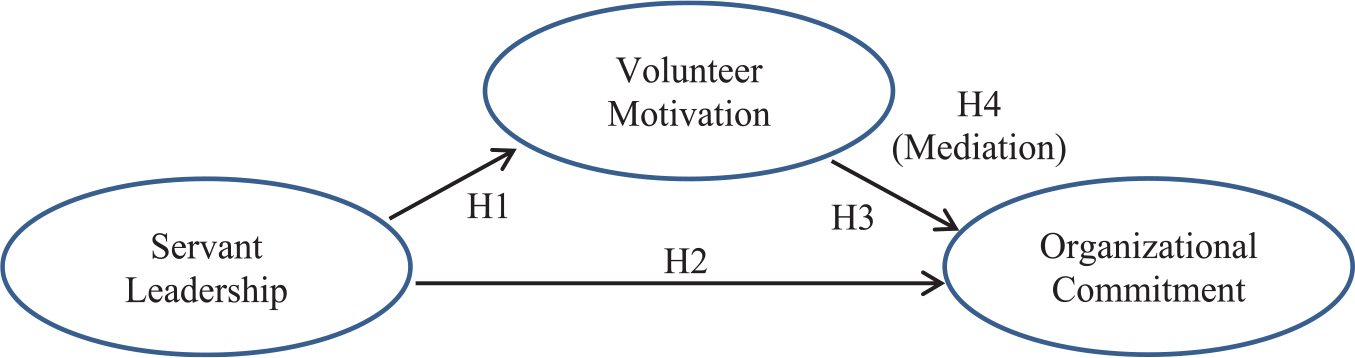
Hypothesized theoretical model.
Method
Sample and Procedure
The participants of the study were volunteers from nine various branches of six voluntary organizations situated in Istanbul (Turkey) which are dealing with fighting all kinds of addiction, supporting education of children and young people, taking care of the older, and protection of nature and environment. In all, 450 people were randomly selected from totally 1,228 registered volunteers across all these nine branches and they were asked to participate in this study. One week after when the invitation was accepted by all 450 people, the questionnaire was conducted by e-mail (264), in person (163), and by telephone (23). To increase the number of replies, e-mail respondents who did not respond within 2 weeks were reminded once more. Together with the 199 returned e-mail surveys, a total of 385 volunteers answered the questionnaires (response rate = 31%). According to the formula proposed by Naing, Winn, and Rusli (2006), this study considers that this sample size is enough. Besides, although not all the voluntary organizations in the city were included in the research population, it was observed that the participants’ responses regarding the study variables displayed a normal distribution.
The sample of the study consisted of 62% male and 38% female participants, which was very similar to the overall gender structure in the population of 1,228 volunteers (61% male and 39% female). The average age of the sample was rather young, so that 60% of the participants were lesser than 40 and 80% were lesser than 50. In all, 52% of the participants had a bachelor’s degree representing a fair education level throughout the sample. The deviations from the ratios of population for age and education level were within the margins of ±3%. Participants generally had quite a long experience, with 89% working at their current voluntary organizations for at least a year and more. This value was very close to the population rate of 85%.
Measures
Servant leadership
Each volunteer in the sample was acting within a workgroup which was set up from six to 10 people and supervised by an assigned leader who was also a volunteer like his or her followers. Leaders were experienced personnel who had been working in their organizations for 4 to 13 years and were participating in nearly all activities together with their own workgroup. In this regard, there is a significant opportunity for close interactions between the leader and followers.
It is important to stress that this study is at the individual level and examines the subjective perceptions of each volunteer regarding the behaviors exhibited by their workgroup leader. For measuring the perceived leader behaviors of servant type, the present study employed the scale of Dennis and Bocarnea (2006) which was adapted by Aslan and Özata (2011) into its Turkish form. The original instrument of Dennis and Bocarnea (2006) comprised of six dimensions with overall 29 questions. The instrument (Aslan and Özata, 2011) consists of 14 questions in five dimensions and measures the degree to which the leaders display the core virtues of servant leaders: agapao love, altruism, empowerment, trust, and vision. Several items of the measure were “my leader has made personal sacrifice(s) for me” and “my leader has shown his or her care for me by encouraging me.” Participants evaluated their leaders’ behaviors upon a 5-point scale (from 1 = strongly disagree to 5 = strongly agree). For each volunteer, an average point of servant leadership was computed based on the all items of the scale.
Volunteer motivation
Drawing on the functional approach theory, the VFI (Clary et al., 1998) was used to determine the functional motives which individuals have for volunteering. VFI has 30 items and each item falls under one of the six subscales, each of which defines one different personal or social function obtained through volunteering: Protective, Values, Career, Social, Understanding, and Enhancement Motives. Sample statements from the scale were “volunteering can help me to get my foot in the door at a place where I would like to work” and “doing volunteer work relieves me of some of the guilt over being more fortunate than others.” Participants evaluated each of the 30 possible reasons to volunteer on a 7-point scale (from 1 = not at all important/accurate to 7 = extremely important/accurate). For each five items, subcategory of motives, an average score was computed.
Organizational commitment
For measuring organizational commitment, the current research made use of the scale of Meyer and Allen (1997). The three-dimensional measure involves 18 questions, and every six items of each of three subscales were averaged to determine the level of strength for each dimension: Affective, Normative, and Continuance Commitment. Some items from the scale were “I would be very happy to spend the rest of my career with this organization”; “it would be very hard for me to leave my organization right now, even if I wanted to”; and “I feel guilty if I leave my organization.” The participants were asked to evaluate the items on a 5-point scale (from 1 = strongly disagree to 5 = strongly agree).
Results
Analytic Strategy
As the data analyzed were obtained from volunteers who were enrolled in nine different branches of six different organizations in the city, the ANOVAs were used to determine whether there were any significant differences between six organizations or between nine branches as regards the evaluations of the participants on the study’s main variables. The results revealed that there were no significant differences between the answers of the participants because of the fact that the organizations or branches they belonged to were different.
Because the focus of the investigation is on how the leader behaviors are perceived by each volunteer, each volunteer’s individual motivations that lead them to volunteer, and the level of commitment they feel toward their organizations, the current research examined all the main variables in question at the individual level. Consequently, at this point, it should be reemphasized that this research sought to examine how each volunteer individually perceived the behaviors exhibited by his or her leader, rather than to objectively measure that leader’s behaviors.
For identifying the psychometric qualities of the scales used in the study, the confirmatory factor analysis (CFA) compared the study’s hypothesized 10-factor model (one factor for servant leadership, three factors for organizational commitment, and six factors for volunteer motivation) against a single-factor model.
In tune with the hypothesized model, the study analyzed the direct influences of perceived leader behaviors on each motivation dimension and commitment attitudes, together with the mediation effects of volunteer motivation in next step. First, hierarchical regression analyses were conducted for direct and indirect impacts, whereby the personal traits like gender, age, and education level were included as control variables because earlier research found out that such demographic variables were found to be associated with motivations to volunteer (Clary, Snyder, & Stukas, 1996; Omoto et al., 2000). Next, drawing on the results of hierarchical regression analyses, the study developed a structural equation model (SEM) to see if the results of regression analyses would be proved. Besides, as a complementary test, the analysis process included Sobel tests (Sobel, 1982) to further confirm the existence of the indirect effects.
The outcomes of the tests were given below. The descriptive statistics, along with the Cronbach’s alpha coefficients, are presented in Table 1.
Descriptive Statistics.
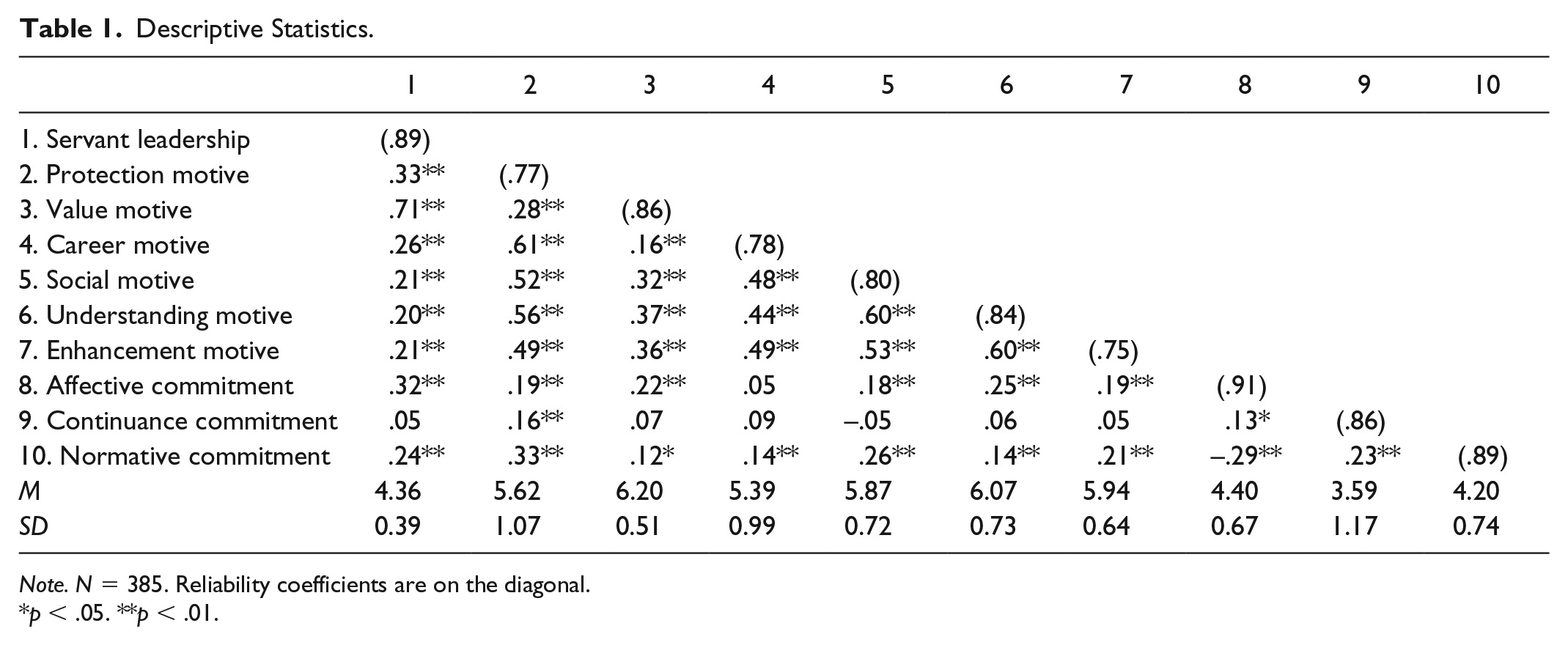
Note. N = 385. Reliability coefficients are on the diagonal.
p < .05. **p < .01.
CFAs
Results of CFAs, performed to find out whether the hypothesized measurement model embodied independent concepts, exhibited that the hypothesized 10-factor model (including servant leadership, the three organizational commitment attitudes, and the six volunteer motives) provided a satisfactory fit to the data (Kaplan, 2000; Schermelleh-Engel & Moosbrugger, 2003), with χ2(1784, N = 385) = 5.095,104, p < .01; comparative fit index (CFI) = 0.91, root mean square error approximation (RMSEA) = 0.04, standardized root mean square residual (SRMR) = 0.06. All the observed items had significant loadings on their corresponding latent factors. As an alternative model to compare with the hypothesized model, the analysis of a single-factor model, in which all the items of the three measures (servant leadership, organizational commitment, and VFI) were loaded on a single factor, presented a significantly worse fit, with χ2(1829, N = 385) = 13.495,104, p < .01; CFI = 0.82, RMSEA = 0.09, SRMR = 0.11. Those results revealed that the scales utilized in the current examination were identified as different concepts just as anticipated.
Tests of Hypotheses
It was observed that out of the demographic variables that were put into all regression tests of the hypotheses as the control variables, the “education level” influenced volunteer motivation (protective, career, and social) and normative commitment significantly and negatively and effected affective commitment positively. Similarly, the gender factor had a significant and negative effect only on the affective commitment. However, drawing on the results of those tests, it was concluded that these control variables did not notably change the effects of the main independent variables on the dependent variables. The test values taken by these variables are also indicated in the notes just below the relevant tables.
To test the first hypothesis which predicted the direct influences of servant leadership on the volunteer motivation, each motive was regressed on servant leadership behaviors perceived by followers (Table 2). The results of the regression analyses showed that perceived servant leadership behaviors significantly predicted all the volunteer motives (β = 0.17 to 0.32, p < .01). In other saying, perceived servant leadership behaviors had positive relationships with each of the motives to volunteer. Looking at the effect sizes (β) and the rates of explained variance (R2), it can be asserted that the effects of servant leadership behaviors on protection and career motives are prominent. More specifically, the more servant leadership behaviors a leader displays, the more volunteers are motivated by their protection (β = 0.32, R2 = .13, p < .01) and career needs (β = 0.22, R2 = .09, p < .01). On the contrary, the effects on the value, social, understanding, and enhancement motives (βs = 0.18, 0.17, 0.17, 0.18, respectively) were also significant and positive, and but remained relatively low, as much as close to the half of the protection motive. In sum, these results supported the Hypothesis 1.
Regression Analysis Results of Hypothesis 1.

Note. N = 385. Age, gender, and education level were included into the analysis as control variables. Out of them, only education level for protection (β = −0.12, p = .02*), for creer (β = −0.12, p = .02*), and for social (β = −0.20, p = .00**) was significant.
p < .05. **p < .01.
Hypothesis 2 was also tested in the similar way (Table 3). The results represented a significant and positive effect of servant leadership behaviors on volunteers’ affective and normative commitment attitudes. In other words, perceived servant leadership behaviors displayed by leaders significantly and positively influenced the affective (β = 0.35, p < .01) and normative commitment (β = 0.20, p < .01) of volunteers toward their organizations. As a result, Hypothesis 2 was also supported.
Regression Analysis Results of Hypothesis 2.

Note. N = 385. Age, gender, and education level were included into the analysis as control variables. Out of them, education level (β = 0.13, p = .01**) and gender (β = −0.11, p = .03*) for affective commitment, and education level (β = −0.24, p = .00**) for normative commitment were significant.
p < .05. **p < .01.
The next hypothesis suggested the direct influences of volunteer motivation on volunteers’ commitment attitudes. The results also supported Hypothesis 3, indicating a meaningful and positive influence of volunteer motivation upon commitment feelings of volunteers toward their organizations (Table 4). Particularly, volunteers with higher value and understanding motives are more emotionally committed to their organizations (β = 0.13 and 0.14, p < .05, respectively). Besides, career motive was found to be in negative association (β = −0.15, p < .05) with affective commitment, suggesting that the more volunteers are career oriented in their voluntary acts, the less they feel sentimentally connected toward their institutions. Furthermore, protective motive’s influence on normative commitment was notably high (β = 0.35, p < .01). This means that people with higher protection needs are more likely to feel obligated to remain in their organizations. Likewise, career (β = 0.16, p < .01) and social motives (β = 0.15, p < .05) were also significant and positive predictors of normative commitment whereby it suggests that volunteers’ career goals and needs for social affairs also positively affect their normative attachment feelings. Besides, contrary to career and social motivations, the degree of understanding needs of people has a lowering effect on their normative commitment attitudes (β = −0.16, p < .05).
Regression Analysis Results of Hypothesis 3.
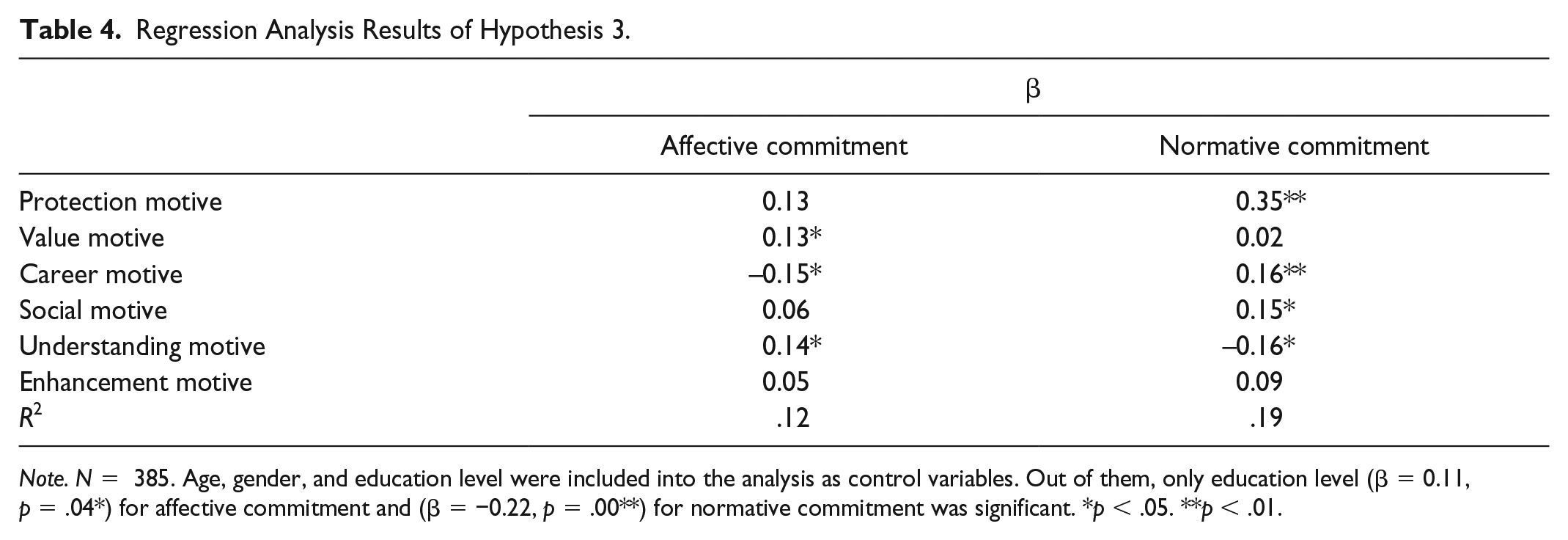
Note. N = 385. Age, gender, and education level were included into the analysis as control variables. Out of them, only education level (β = 0.11, p = .04*) for affective commitment and (β = −0.22, p = .00**) for normative commitment was significant.
p < .05. **p < .01.
Hypothesis 4 suggested that the motives which induce people to volunteer would partially mediate the relationships between perceived servant leadership behaviors and affective (Hypothesis 4a), and normative organizational commitment (Hypothesis 4b). For testing this mediation hypothesis, the method suggested by Baron and Kenny (1986) was used. For Hypothesis 4a, in the first stage, the existence of meaningful association between servant leadership (predictor) and affective commitment (dependent variable) was explored (Table 3). In the second stage, associations between servant leadership and volunteer motives (mediators) were formed (Table 2). Next, the relationship between volunteer motives and affective commitment (Table 4) was analyzed. And finally, a hierarchical regression analysis was carried out in two steps (Table 5). To talk about any mediation effect of volunteer motives, the significance of the association between servant leadership and affective commitment, which is discovered in Step 1, should no longer exist in Step 2 (full mediation), or only the magnitude of that significant relationship has to be decreased in Step 2 (partial mediation). As can be seen in Table 5, there is no important change neither in the significance nor in the magnitude of the relationship between servant leadership and affective commitment (Δβ = 0.04, p < .01). Accordingly, it is not possible to talk about any mediating effect of motivation between servant leadership behaviors and affective commitment. In conclusion, Hypothesis 4a was not supported.
Mediation Analysis Results for Hypothesis 4a.

Note. N = 385. Age, gender, and education level were included into the analysis as control variables. Out of them, education level (β = 0.15, p = .00**) and gender (β = −0.11, p = .02) were significant.
p < .05. **p < .01.
Hypothesis 4b, regarding the mediation effect of volunteer motives on the relationship between servant leadership and normative commitment, was tested through the same method just as carried out for affective commitment. Hierarchical regression analysis (stepwise) with regard to the third and fourth stages of the process of Baron and Kenny (1986) suggested that volunteer motives significantly and partially mediated that relationship (Table 6). Although there was no change in the significance level of the relationship, the size of the impact of perceived servant leadership behaviors noticeably decreased (β = 0.20 to 0.11). Specifically, the results revealed a significant partial mediation role of the protective motive because of the aforementioned decrease in the effect size of servant leadership behaviors (Δβ = 0.09), which occurred at the second step when the protective motive entered into the analysis, without leading to any change in significance. To check that result, as a supplementary analysis, Sobel test was conducted (Table 7). This test also confirmed that hypothesized partial mediation effect (z = 2.17, p < .05). In addition, 45% of the total effect of servant leadership on normative commitment realized via protective motive. Thus, Hypothesis 4b was supported.
Mediation Analysis Results for Hypothesis 4b.
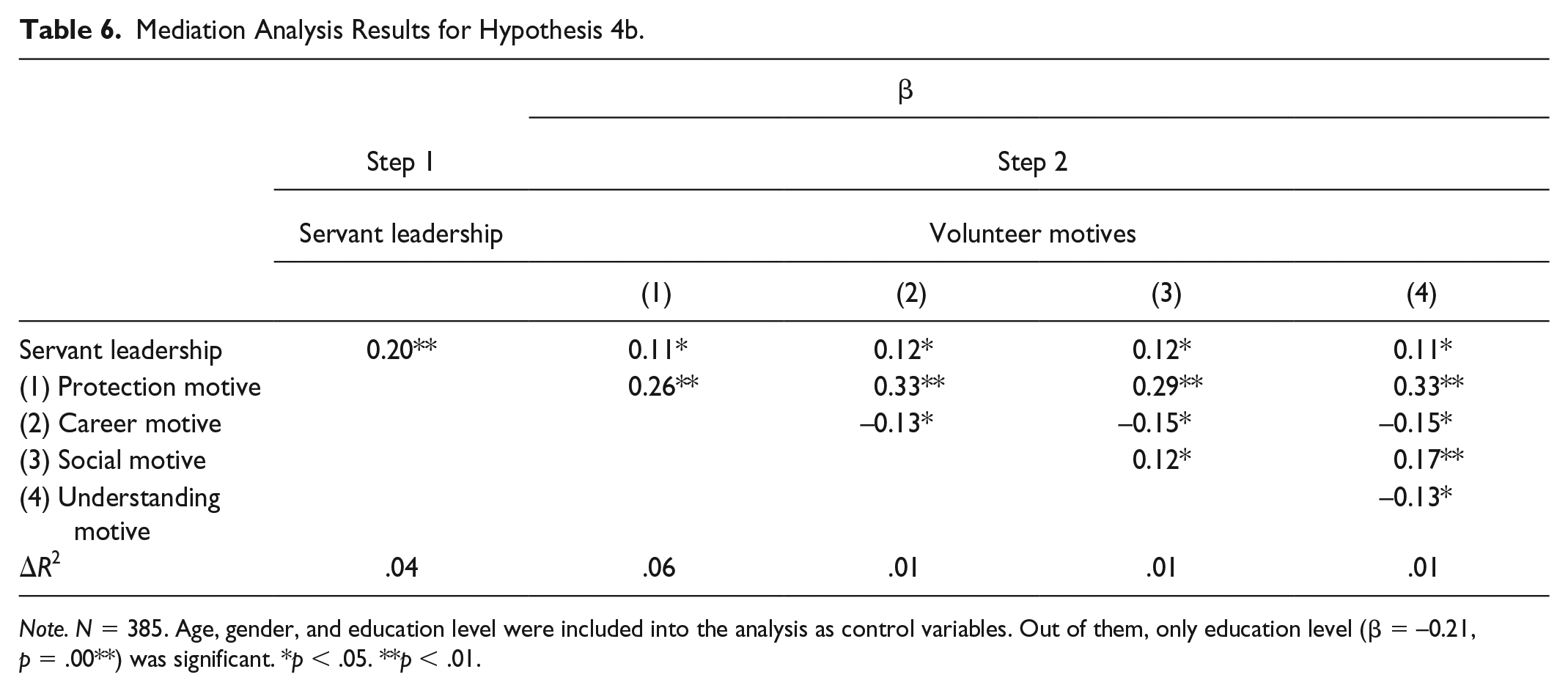
Note. N = 385. Age, gender, and education level were included into the analysis as control variables. Out of them, only education level (β = −0.21, p = .00**) was significant.
p < .05. **p < .01.
Sobel Test of Mediation for Hypothesis 4b.
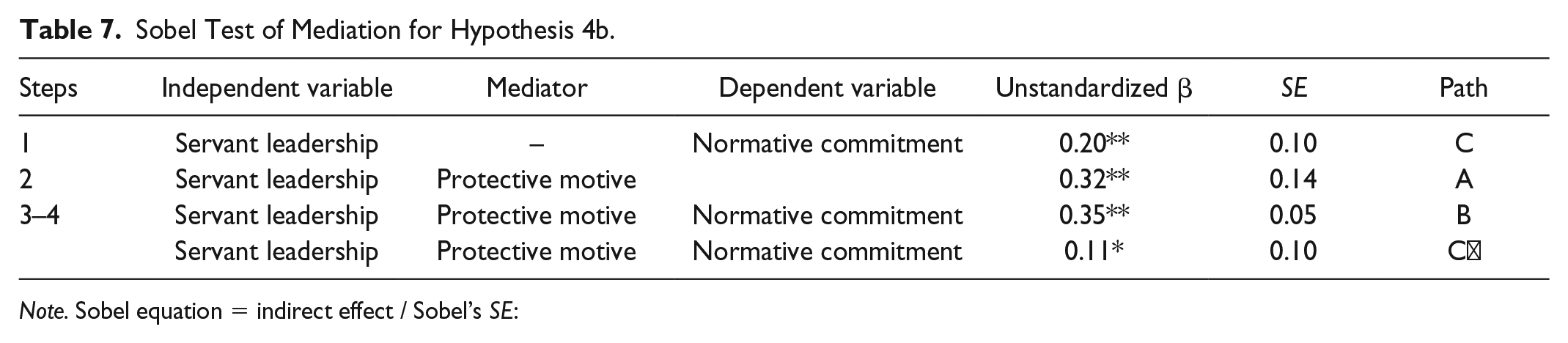
Note. Sobel equation = indirect effect / Sobel’s SE:
Z = 0.112 (indirect effect) / 0.051 (Sobel’s SE)
Z = 2.17 (p value = .03 < .05).
Portion of (Community Culture – Affective Commitment) due to Servant Leadership: (C − C′) / C = 45%.
p < .05. **p < .01.
To check the accuracy of the outcomes of the hierarchical regression tests, structural equation modeling was utilized. Employing AMOS application, SEM analysis explored if the model, established in accordance with the products of hierarchical regression analyses, would fit the data collected from the sample. This hypothesized model (Figures 2 and 3) predicted (a) the direct influences of volunteer motives upon affective and normative commitment, (b) the direct effect of the servant leadership behaviors on affective commitment, and (c) the indirect effect of the servant leadership on normative commitment, through the mediating variable of the protective motive. Results of SEM analysis, χ2/df = 2.848, RMSEA = 0.069, SRMR = 0.052, normed fit index (NFI) = 0.91, CFI = 0.93, and Tucker–Lewis index = 0.91, indicated an acceptable fit to the data observed (Kaplan, 2000; Schermelleh-Engel & Moosbrugger, 2003), confirming the outputs taken from the hierarchical regression analyses.

Standardized beta weights from structural equation model predicting affective commitment.

Standardized beta weights from structural equation model predicting normative commitment.
Discussion
Building on the functional approach theory (Snyder, 1993), the current study empirically investigated the impacts of perceived servant leadership behaviors on volunteers’ motivations, and on their affective and normative commitment attitudes. In addition to its direct effects, servant leadership’s indirect influences via those motivations on volunteers’ commitment feelings were also examined. Just as hypothesized, servant leadership behaviors had positive associations with all the types of motives to volunteer, and affective and normative commitment attitudes. Furthermore, volunteer motivation also significantly and positively influenced volunteers’ affective and normative commitment feelings. However, only the protective motive significantly and partially mediated the positive relationship between servant leadership behaviors and normative commitment attitudes of volunteers.
Although the findings revealed the positive influences of perceived servant leadership behaviors on all types of volunteer motivations, the underlying causes of these relations have not been reiterated in this section because relevant explanations have already been given place in the theoretical framework of the study. However, as an interesting point, the results showed that the volunteers with high degree of protective motive perceived some characteristics of servant leadership as supportive and impressive. The rationale behind this relationship more likely lies on the healing attributes of servant leadership as servant leaders provide their followers with emotional healing by showing that they are, by their side, always ready to help and support them (Spears, 2010). Servant leaders, through their actions and words, clearly show their concerns for their followers, empathize with them, and demonstrate that they are really aware of what followers feel and think. So, they recognize followers’ problems and are willing to help them overcome those personal problems. Therefore, this study considers that emotional healing behaviors of servant leaders support followers’ protective motives by which they can hold the belief that their leaders will always be with and help them solve their problems.
One noteworthy finding is related with the Hypothesis 2, suggesting the relationships between servant leadership and affective and normative commitment attitudes of volunteers. Given the characteristics of servant leader behaviors and the nature of affective commitment, which were argued in the “Theory and Hypotheses” section, that result was also an expectable case. In other words, the altruistic, selfless, supportive, and empowering behaviors of servant leadership might touch on feelings of followers and help them form sentimental connections with their organizations. As can be seen in Table 1, the mean values and their standard deviations suggest that participants volunteer generally because of their humanistic and understanding concerns, which essentially have emotional foundations. That is why servant leadership behaviors are more likely to cause significant positive changes in those feelings, subsequently to lead to increased affective organizational commitment of followers. In practical terms, that result might be a very useful instrument for voluntary organizations to establish a long-term membership relationship with their volunteers.
Another significant finding is about the relationship between servant leadership and normative commitment. That is, in response to altruistic, selfless, others-centered servant leadership behaviors, followers also feel a moral requirement to remain with the organization and decide to continue their helping behaviors until they perceive a balance of exchange exists, just as the social exchange theory suggests (Blau, 1964). When leaders dedicate themselves to serve and help their followers and other stakeholders, followers develop moral connections toward their leaders and organization as a specific form of exchange. Although it is not as desirable as emotional attachment, normative commitment is ultimately thought to help voluntary organizations continue their voluntary activities for a significant period of time.
Regarding the results of the mediation analyses, the relatively strong relationships of protective motive with servant leadership and normative commitment also partially explain how servant leadership behaviors evoke normative commitment feelings in followers. More specifically, it might be servant leaders’ empathetic, altruistic, supportive, and emotional healing behaviors which contribute to safety of followers’ ego and personal integrity, help them overcome their personal problems, and subsequently make them feel morally compelled to stay and continue their services. By considering the other five important motives to volunteer, and that the mediator role was determined only for the relationship between normative commitment (moral obligation) and protection motive, this study evaluates that volunteer motivation does not serve as an important mediator between servant leadership and organizational commitment.
Additional noteworthy finding is about the results of Hypothesis 3, which proposed the relationships between volunteer motives and organizational commitment. In particular, the more volunteers are concerned with career-related benefits and making use of volunteering as an instrument for a new career or for keeping or developing some career-related skills, the less they will be affectively and normatively committed because this utilitarian perspective may prevent volunteers to make emotional and moral connections with their organizations. In other saying, career benefits are rather like material expectations, and can have negative influences on affective and moral bonding of volunteers with their organization. So, to establish sustainable associations with their voluntary members, leaders at all levels of voluntary organizations should control for the negative effects of career motives of individuals.
Besides career and protective motives, the current empirical investigation also wants to shed light on the associations between understanding motive and affective and normative commitment attitudes. The positive effect of understanding motive on affective commitment demonstrates that the attempts to gain insights into other people’s lives in need and so to learn something from volunteering experiences will lead to emerging of emotional connections between volunteers and their organizations. The logic under that explanation can be that while trying to learn and grasp the main feelings and thoughts of people in need of help, volunteers are expected to empathize with them. In seeking to truly and sincerely understand what is going on in their inner worlds, volunteers may have to establish a bridge in between, on which feelings and thoughts can be smoothly exchanged. It can be this exchange process which is more likely to contribute to development of affective commitment in volunteers. Different from career motive involving some career-related benefits, in the case of understanding motive, the endeavor that leads to those empathetic feelings in a volunteer could conduce him or her to be emotionally connected to his or her organization.
When it comes to normative commitment, the impact of the understanding motive on that motive turns to be negative (Table 6). Based on the social exchange theory (Blau, 1964), this can be explained in a way that any volunteer will not feel any moral responsibility to stay and continue his or her activities in the organization as he or she will not feel any requirement to reciprocate. In other words, this process does not contain anything being exchanged which will require a volunteer to feel any liability, at least not in emotional meaning. Moreover, it is expected that the understanding motive’s positive influences on affective commitment will also reduce a volunteer’s perceptions of moral obligation to her or his organization. The negative relationship found out between normative and affective commitment feelings (Table 1; r = −.29, p < .01) supports this argument. Thus, as a significant outcome, this study puts forward and verifies that volunteers with higher understanding motivation will most likely be affectively committed to their organizations, together with decreasing moral obligations to stay.
Regarding the social motive and normative commitment, the findings show that when some social concerns guide a volunteer, such as establishing and/or sustaining of friendships through volunteering, or possibilities for being rewarded or punished by friends or society, then he or she might feel moral obligations to stay at his or her organization and continue his or her helping services. Another explanation might be that, as suggested by the social exchange theory (Blau, 1964), because a volunteer will perceive a lack of balance of exchange which is stemming from her or his relationships with other volunteers and/or the organization itself, then he or she will more likely hold moral responsibilities to stay with that organization. In the end, he or she will most likely feel the need to give something back in return of what he or she gets from his or her relationships with others.
Overall, the outputs of the current empirical study are believed to make significant contributions to the understanding of the associations among servant leadership behaviors, motivation, and organizational commitment in voluntary settings, and to give important insights into how volunteers’ organizational commitment attitudes can be developed and sustained over a substantial period. In particular, the conclusions regarding the servant leadership behaviors, which are seen by the current investigation as a relatively less studied subject in voluntary contexts, might offer several useful practical implications: First, because servant leadership behaviors have been found to be influential in establishing emotional and moral connections between a voluntary organization and its members, the leader training programs can specifically focus on the behaviors unique to that type of leadership. Second, people in leadership positions in voluntary organizations are well advised to take the volunteers’ motivations into consideration if they want to have more committed voluntary members because different motives play different roles in different commitment attitudes, namely, affective and normative commitment. Finally, as another important finding, people in leadership roles can create very strong moral connections with their followers who have higher levels of protective motive. If leaders can nurture the needs which are stemming from the protective motive, then it is more likely to make volunteers normatively committed to their organizations.
Although this examination puts forward important evidences concerning the influences of servant leadership behaviors and volunteers’ motivations on organizational commitment feelings, it also has some limitations with regard to potential common-method biases. The study used follower self-reported evaluations of servant leadership and organizational commitment. Servant leadership behaviors were only measured based on the subjective perceptions of the participants. However, to obtain more accurate estimations of servant leadership, for example, future studies should not only take the individual scores supplied by volunteers into consideration but also include group-level evaluations of the servant leadership. Moreover, to measure servant leadership behaviors more objectively, the gathered quantitative data could also be supported with qualitative data by observing and recording the behaviors of workgroup leaders at work in the field from the servant leadership concept’s point of view. This type of data can also be collected through one-to-one interview with leaders and followers or conducting focus groups. Besides, workgroup leaders’ own motivations toward voluntary activities should be taken into consideration, which is also an important limitation of the study. Because leaders’ motivations may have important influences on the strength of the perceptions of leader behaviors by followers, they might subsequently influence all the associations between the current study’s main variables.
In addition, for a more correct measurement of volunteers’ organizational commitment attitudes, future research should also get data from respective supervisors of each volunteer. In addition, to mitigate this possible common-method bias (Podsakoff, MacKenzie, Lee, & Podsakoff, 2003), future studies can employ longitudinal research strategies in which researchers will collect necessary data at different times, for example, Time 1 and Time 2. For the current study, it might be the motivations of volunteers at Time 1, servant leadership behaviors at Time 2, and organizational commitment at Time 3.
Another limitation of the study is its research design strategy wherein all the variables are at the individual level. To draw a well-defined picture of servant leadership in voluntary environment, future research should consider other group and individual-level factors (e.g., organizational culture, climate, policies, strategies, trust, psychological capital, self-efficacy, etc.), and investigate cross-level mediation and/or moderator effects of servant leadership behaviors on important organizational and individual-level outcomes (e.g., performance, creativity, turnover, organizational citizenship behaviors, etc.). Besides, future research which will comparatively investigate servant leadership with other leadership approaches (e.g., authentic leadership, ethical leadership, transformational leadership, etc.) can reveal servant leadership’s relative contributions to specific outcomes, and may help development of more refined understanding of servant leadership theory in voluntary settings, whereby organizations can form more efficient leader training programs.
In summary, organizational commitment attitudes have vital implications for voluntary organizations and the society in which those organizations carry out their activities. Therefore, the results of the present empirical investigation might contribute to the understanding of why voluntary organizations should benefit from the merits of servant leadership approach, and why comprehension of the needs and goals of their voluntary members can be critical to attracting and sustaining of volunteers. The answers to the questions could make considerable contributions to practical world of volunteerism, and the relevant literatures of servant leadership, organizational behavior, and volunteerism. When supported by future empirical studies which will take into consideration the limitations suggested by this study, the current findings can enhance the understanding of how and under which circumstances servant leadership concept may affect important organizational outcomes in voluntary settings.
Footnotes
Declaration of Conflicting Interests
The author(s) declared no potential conflicts of interest with respect to the research, authorship, and/or publication of this article.

Funding
The author(s) received no financial support for the research, authorship, and/or publication of this article.