



Abstract
Drawing on conservation of resources (COR) theory, this study examines the relationship between abusive supervision and employee knowledge sharing and investigates the mechanism underlying their relationship through perceived motivational climate and psychological safety. The data were collected from 337 supervisor-employee dyads from knowledge-based companies in China. Hierarchical regression and path analysis were used for data analysis. The results showed that abusive supervision played a detrimental role in affecting employees’ willingness to share knowledge and that a perceived motivational climate moderated the effect of abusive supervision on employee knowledge sharing through psychological safety. Based on the findings, we provide the theoretical and practical implications.
Keywords
Introduction
Knowledge is a strategic resource for organizations. Previous studies have pointed out that employees’ engagement in knowledge sharing and organizational support in knowledge management can foster business success and build competitive advantages for companies’ short term and long-term development (Argote & Ingram, 2000). Therefore, the research on identifying the factors that influence employees’ willingness to engage in knowledge sharing and the relevant mechanism has generated a substantial attention. Among the potential antecedents of knowledge sharing, leaders’ behaviors have attracted considerable attention, which are found to have a great influence on employees’ behaviors. For instance, transformational leadership (Le & Lei, 2018; Son et al., 2020), empowering leadership (A. Lee et al., 2018; Srivastava et al., 2006; Xue et al., 2011), and ethical leadership (Bavik et al., 2018) have been found to positively promote employees’ knowledge sharing at work. These studies provide us with a clear picture on the positive effects of leadership on employees’ knowledge sharing. Nevertheless, not all the leadership can engage employees in knowledge sharing. We argue that certain leaders’ behaviors can have negative impacts on employees’ willingness to share knowledge. However, few studies have precisely examined the dark sides of leadership that may hinder employee knowledge sharing in an objective manner. The present study addresses the identified gap by employing the Conservation of Resources (COR) theory (Hobfoll, 1989) to investigate how abusive supervision, a common stressor in the workplace, depletes employees’ resources and then hinders employees’ knowledge sharing behaviors. We aim to enhance the understanding of the psychological mechanisms underlying the process by which negative leadership behaviors influence employees’ knowledge sharing.
According to Ipe (2003) knowledge sharing is “the art of making knowledge available to others within the organization.” At the individual-, team-, and organizational levels, knowledge sharing can provide employees with opportunities to pursue better performance (Wang & Noe, 2010). However, when employees possess the knowledge that gives themselves a competitive edge over other colleagues, and when knowledge is difficult to achieve, knowledge sharing will make employees feel risk-taking (S. Lee et al., 2018) and which is often considered as an extra-role behavior (Matzler et al., 2011). Moreover, during the knowledge sharing, knowledge holders may be poorly perceived and resisted by knowledge recipients, or even called “pretentious”(Wang & Noe, 2010). Therefore, only when employees feel safe enough and they are provided with sufficient resources (e.g., incentives, corporate policy), they are more likely to engage in knowledge sharing (Hu et al., 2018). Thus, this study proposes that psychological safety, which enables individuals fully display themselves without concerns regarding negative impacts on their self-image, status or occupation (Kahn, 1990), might play an important mediating role in the relationship between abusive supervision and knowledge sharing. Consistent with COR theory, we propose that abusive supervision depletes employees’ psychological safety and thus affects their knowledge sharing.
Knowledge sharing among individuals is affected not only by a supervisor’s leadership style, but also by the workplace environment. To better examine the impact of abusive supervision on knowledge sharing, we examine the motivational climate, which is a group-level variable that has potential moderating effect. The motivational climate refers to group members’ shared perception of success and failure standards regarding their work. Two types of motivational climates exist, which are mastery climates and performance climates (Nerstad et al., 2013). Mastery climates focus on individual/team learning, development, and hard work, while performance climates define success based on normative abilities and social comparisons (Ames, 1992). According to Hobfoll et al. (2018), the organizational environment is a double-edged sword, which can nurture employees’ resources and restrain them as well. Therefore, this study aims to explore the negative moderating role of the motivational climate in the relationship between abusive supervision and employees’ knowledge sharing.
Our study contributes to the current literature in the following aspects: First, this study enriches the abusive supervision literature and knowledge sharing literature by investigating the influence of abusive supervision on knowledge sharing, thereby contributing to the insufficient exploration of the negative factors that hinder employees’ knowledge sharing. Second, the context in which individuals are embedded has always been regarded as an important factor affecting individual knowledge sharing. Through examining how the mastery climate and performance climate influence the negative relationship between abusive management and knowledge sharing across different levels, our research verifies both the nourishing and restraint effects of context on personal resources. Third, by investigating the mediating role of employees’ psychological safety in the relationship between abusive supervision and knowledge sharing, we identify the internal mechanism by which abusive supervision influences employees’ knowledge sharing. Furthermore, our study reveals the important role of psychological safety in employees’ knowledge sharing. The theoretical model of this study is shown in Figure 1.

Proposed model.
Theories and Hypotheses
Abusive Supervision and Knowledge Sharing
Abusive supervision refers to subordinates’ perceptions of the extent to which supervisors engage in the sustained display of hostile verbal and nonverbal behaviors, excluding physical contact (Tepper, 2000). The typical examples of abusive supervision include, but not limit to, publicly criticism, ridicule, and the silent treatment. In the United States, 13% of employees report that they were victims of abusive supervision (Tepper, 2000). According to a survey which has more than 10,000 Chinese professionals’ participation, more than 70% of employees reported that they had been abused by their supervisors, much more frequently than by colleagues (Shen et al., 2020). Other previous studies have shown that abusive supervision, as a stress source in the workplace, has significant negative effects on employees’ work performance, such as increasing the level of psychological tension and stress, decreasing the satisfaction at work and in daily life, causing the intention to quit, inducing the levels of deviant workplace behaviors, and lowering the levels of performance (Tepper, 2000; Tepper et al., 2017; Tepper, 2007). In line with the lack of resources, we predict that employees who are under the abusive leadership may reduce their willingness to engage and efforts in knowledge sharing, representing an expansion of the scope of the study of abusive supervision.
Knowledge sharing is a process in which individuals offer task-related information and experience to help others, solve problems, develop new ideas, and implement new processes through cooperation with others (Cummings, 2004) and, thus, is essentially a process in which employees exchange knowledge with each other and jointly create new knowledge (Wang & Noe, 2010). For employees, knowledge sharing is a typical self-determination behavior that requires each individual to invest extra time and energy to engage. When sharing knowledge with others, individuals might risk being subjected to the recipient’s maladaptive reactions (Wang & Noe, 2010). Therefore, an employee’s discretionary knowledge sharing is promoted only when the individuals realize that the organization will compensate them for the risk of the knowledge lost by providing sufficient resources (e.g., support from a supervisor) (Park & Kim, 2018; Wang & Noe, 2010).
According to COR theory, individuals tend to acquire, maintain, and preserve resources such as experience, practice, energy, social support, expertise, and discretionary decision-making (Hobfoll et al., 2018). When encountering a risk of resource loss, having an actual loss or the failing to obtain corresponding benefits after investing resources, individuals experience strong psychological pressure. A supervisor’s abusive behavior, such as hostility and ridicule, might cause employees to experience the actual loss of important resources or perceive a risk of resource loss (A. Lee et al., 2018). In turn, employees might focus on conserving and protecting their existing resources to avoid further resource losses. For employees, special knowledge, expertise, skills, and information are very important resources. When employees suffer from abusive supervision, they might use the discretion to keep their knowledge to themselves. In addition to the perceived loss of leadership support, which is a vital resource, abusive supervision might further consume the resources that employees set aside to cope with a supervisor’s mistreatment, leading employees to reduce efforts at work and to reduce the good behaviors such as knowledge sharing. Overall, drawing upon COR theory, we propose that employees who have suffered abusive supervision are unlikely to share knowledge, thus leading to the following hypothesis:
H1: Abusive supervision is negatively correlated with employee knowledge sharing.
Moderating Effect of the Group Motivational Climate
The achievement context in which employees perform daily tasks plays a very important role in their decision to share knowledge (Connelly et al., 2019). The motivational climate defined by traditional achievement goal theory represents a situation in which employees perceive the standards of success and failure as the policies, practices, and procedures implemented in the work environment. Practices and procedures are usually communicated through what leaders support and reward (Černe et al., 2014). Therefore, the mastery climate and performance climate, representing different value orientations, can enable employees to understand which behaviors are promoted and can be rewarded in the organization. Different climates encourage employees to adopt different methods when addressing diverse information, which inevitably influences the interaction among group members (Nerstad et al., 2018). Therefore, we propose that the performance climate and mastery climate play different roles in weakening or enhancing the relationship between abusive supervision and employees’ knowledge sharing.
The performance climate emphasizes intragroup competition, norms, and social comparisons (Nerstad et al., 2018). Embedded in this climate, employees pay more attention to demonstrating their abilities and the distribution of the group members’ abilities. In this compulsive social comparison situation, group members often exhibit anxiety, such as worrying about personal performance, and are often overwhelmed by comparing themselves to other group members and attempting to outperform others, which becomes the goal of employees (Gerber et al., 2018). However, only the most accomplished employees are recognized as the most successful. When employees suffering from abusive supervision perceive their group climate as a performance climate, their knowledge sharing behaviors are further hindered. Under the performance climate, only high performance is recognized. Therefore, to meet the needs of self-achievement and the pursuit of surpassing others in the performance climate, employees may actively pay attention to information or resources that can enable them to “surpass” their colleagues. Generally, the line leader is one of the most important sources of feedback for employees in the organization. Consequently, leadership behaviors toward employees becomes an important criterion for employees to use to evaluate whether their personal goals (surpassing others) have been achieved (Ashford et al., 2016). Therefore, in a performance climate, employees who suffer from abusive supervision not only experience resource depletion but also immerse themselves in a sense of failing to “surpass” others. In turn, such depletion and sense of failure may hinder employees’ willingness to share their “cherished” knowledge with other group members. Therefore, we propose the following:
H2a: A performance climate moderates the relationship between abusive supervision and knowledge sharing. Specifically, the higher the performance motivational climate level is, the stronger the negative correlation between abusive supervision and employee knowledge sharing.
In contrast to a performance climate, a mastery climate does not overemphasize the social comparison process and norms within a group but, rather, emphasizes the development of learning, mastery and technology (Nerstad et al., 2018). In a mastery climate, employees actively pay attention to self-development and improve their capabilities, and an individual’s sense of accomplishment is mainly derived from self-comparison, that is, the current performance level exceeds prior performance levels (Černe et al., 2017). A mastery climate is based on cooperation, information exchange, and trust, and important criteria for employees’ success include positively helping others and improving oneself while developing skills and contributing to knowledge enhancement at work (Men et al., 2020). Thus, under a mastery climate, group members appreciate personal effort, and they are keen to share knowledge and engage in cooperation with others. Furthermore, group members tend to learn and cooperate with each other for self-growth. On the one hand, group members accept help from others; on the other hand, group members are happily help others. Thus, a mastery climate builds community support relations with individuals who provide positive external resources, such as social support from other members of the group, which provides opportunities for employees to cope with increased job demands or pressure (Hobfoll et al., 2018). Although abusive supervision can cause subordinates to perceive a loss of internal resources, the resources obtained from the external environment (e.g., through colleagues) characterized by a mastery climate might alleviate the feeling of the lack of resources caused by abusive supervision. Therefore, in a mastery climate, even though abusive supervision exists, employees are encouraged to engage in knowledge and information sharing with each other to achieve self-improvement. Therefore, we propose the following hypothesis:
H2b: A mastery climate regulates the relationship between abusive supervision and knowledge sharing. Specifically, the higher the mastery motivational climate level is, the weaker the negative correlation between abusive supervision and employee knowledge sharing.
Mediating Role of Psychological Safety
Psychological safety is essentially a mental state of an individual, that is, the individual believes that there is no threat in the surrounding interpersonal situation and thus no embarrassment or punishment for self-expression (Kahn, 1990). For employees, psychological safety is an important factor that drives their knowledge-sharing behavior within an organization (Wu & Lee, 2016). Sharing knowledge with others is a risky behavior (Argote & Ingram, 2000). On the one hand, knowledge is an important resource for individuals to use to maintain a competitive advantage within an organization, whereas sharing knowledge with others might diminish the respective competitive advantage (Park & Kim, 2018). On the other hand, knowledge sharing is a self-expression behavior that might also expose individuals’ insufficiency and cause discomfort in the recipients of such knowledge (Wu & Lee, 2016). Individuals exhibit knowledge-sharing behavior only when they perceive a high level of psychological safety and believe that sharing knowledge with others will not have deleterious results (Park & Kim, 2018).
Within an organization, the leader is the agent of the organization that controls the various resources required by subordinates to complete their work. Leaders’ interaction with subordinates could affect employees’ psychological safety perception (Walumbwa & Schaubroeck, 2009). Previous studies have revealed that positive leadership behaviors, such as transformational leadership (Carmeli et al., 2014), authentic leadership (S.-M. Liu et al., 2015), ethical leadership (Men et al., 2020; Walumbwa & Schaubroeck, 2009) and shared leadership (S. Liu et al., 2014) that display inclusiveness, understanding, and supportiveness, can effectively improve employees’ psychological safety. In contrast, abusive supervision, including the frequent ridiculing and taunting of subordinates, might have a negative effect on the psychological safety of subordinates (A. J. Xu et al., 2015; Yang et al., 2020). Similarly, the organizational environment may affect the relationship between abusive supervision and employee psychological safety (Edmondson & Lei, 2014). For example, under a performance climate, fierce competition exists among group members and employees aim to outperform each other, leadings individuals to experience difficulties in obtaining additional supportive resources from colleagues and they perceive knowledge sharing as the loss of important resources (Černe et al., 2014). Therefore, under performance climate, employees who have experienced abusive supervision might feel obvious helplessness, a sense of a lack of resources and thus psychological insecurity at higher levels, causing them to be more reluctant to share knowledge with others. Under a mastery climate, cooperation among group members and positive interdependence provides individuals with additional resources that can effectively compensate for employees’ resource losses caused by abusive supervision, making their psychological security perception less affected by abusive supervision, which in turn encourages individuals to maintain a high level of knowledge sharing. Based on this analysis, we propose the following hypothesis:
H3A: Employees’ psychological safety plays a mediating role in the relationship between a performance climate and abusive supervision in knowledge sharing interactions. Specifically, the higher the group’s performance climate level is, the lower the level of psychological safety experienced by employees with a high level of perceived abusive supervision, and thus, the lower their level of knowledge sharing behavior.
H3b: Employee psychological safety plays a mediating role in the relationship between a mastery climate and abusive supervision in knowledge sharing interactions. Specifically, the higher the group’s mastery climate level is, the higher the level of psychological safety experienced by employees with a high level of perceived abusive supervision, and thus, the higher the level of knowledge sharing behavior.
Methodology
Samples and Procedures
To test the hypotheses, the data from employees and their supervisors were collected from eight high-tech companies in the provinces of Fujian, Guangdong, and Jiangsu in China. To ensure the quality of the questionnaire survey and the effectiveness of the pairing, we first obtained the active support of the human resources department of each company prior to the survey, and together with the HR department personnel, we selected leaders of 83 groups and 398 employees as the subjects of this study, who were then coded accordingly. The questionnaires were addressed to each group-based unit, where employees completed the survey, and we collected the date on site. The survey is composed of items concerning leadership behavior (abusive supervision), motivational climate (performance climate and mastery climate) and psychological safety, and the group leaders were surveyed using a questionnaire with items concerning group members’ knowledge sharing behavior. Generally, the team supervisor has several subordinates. To ensure the accuracy of their evaluation of their subordinates’ knowledge sharing, we invited the supervisors that have worked with their subordinates on a daily basis and have frequent interactions with them to join our survey. In addition, the supervisors supposedly have a good understanding of their subordinates’ daily behaviors. Because the content in the questionnaire was rather sensitive, the questionnaire was issued in an envelope with a double-sided adhesive seal, with instructions emphasizing that the questionnaire was conducted anonymously and reminding the participants to seal the completed questionnaire in the accompanying envelope and return it to the survey team. In addition, all supervisors and subordinates voluntarily participated in the survey, and their anonymity was ensured. These specific data collection design can support participants to give honest answers.
In this study, 435 questionnaires were sent to supervisors and their respective subordinates of 86 groups in the companies; 417 questionnaires were returned from the supervisors, and 398 questionnaires were returned from the subordinates, yielding recovery rates of 95.8% and 91.5%, respectively. After excluding the invalid copies, data from 337 supervisor-employee paired questionnaires were obtained, male respondents accounted for 55.5% of the surveyed population, and 59.3% of the employees were younger than 25 years.
Measures
Abusive supervision: The 10-item one-dimensional structured scale developed by Aryee et al. (2007) was adopted. The scale was generated by selecting 10 items from the original scale developed by Tepper (2000) according to the Chinese cultural context. Sample items include, “My supervisor makes negative comments about me to others” and “My supervisor tells me my thoughts or feelings are stupid”; the items are scored using a 5-point Likert scale (1 = I don’t remember that he/she has ever acted like that to me; 5 = He/she acts like that frequently). The consistency of the scale used in this study was 0.92.
Psychological safety: The four-item one-dimensional structured scale developed by Nembhard and Edmondson (2006) was adopted. Sample items include, “People in this group are comfortable checking with each other if they have questions about the right way to do something” and “No one on this time would deliberately act in a way that undermines my efforts”; the items are scored using a 7-point Likert scale (1 = Strongly disagree; 7 = Strongly agree). The internal consistency coefficient of the scale in this study was 0.89.
Motivational climate: The 14-item motivational climate scale developed by Nerstad et al. (2013), containing two dimensions, namely, performance climate (8 items) (e.g., In my department/work group, it is important to achieve better than others)and mastery climate (6 items) (e.g., In my department/work group, one is encouraged to cooperate and exchange thoughts and ideas mutually), was adopted; the items are scored using a 7-point Likert scale (1 = Strongly disagree; 7 = Strongly agree). The internal consistency coefficients of performance climate and mastery climate in this study were 0.90 and 0.84, respectively. The confirmatory factor analysis showed that the two-dimensional structure of motivational climate fit well (χ2/df = 1.61, GFI = 0.97, CFI = 0.99, IFI = 0.99, and RMSEA = 0.019).
To test the feasibility of the integration of the performance climate and mastery climate within the group, we calculated the Rwg values of performance climate and mastery climate and the intragroup correlation coefficients, that is, ICC (1) and ICC (2). Regarding the performance climate, the Rwg ranged from 0.56 to 0.98, with an average of 0.94, and the ICC (1) and ICC (2) values were 0.38 and 0.73, respectively. Regarding the mastery climate, the Rwg ranged from 0.66 to 0.98, with an average of 0.91, and the ICC (1) and ICC (2) values were 0.35 and 0.71, respectively. According to James (1982), the Rwg should be greater than 0.70, and the ICC (1) and ICC (2) values should be greater than 0.05 and 0.5, respectively. These results indicate that the Rwg values of the performance climate and mastery climate were greater than the threshold standard of 0.70 and that the ICC (1) and ICC (2) values were also greater than the threshold standards of 0.05 and 0.5, respectively. Therefore, we concluded that performance climate and mastery climate have good consistency within the group, and hence, the measurement values of individuals can be integrated and added at the group level.
Knowledge sharing: The 7-item one-dimensional structured knowledge sharing behavior scale developed by Srivastava et al. (2006) was adopted. Sample items include “The subordinate shares his/her special knowledge and expertise with others” and “the subordinate shares lot of information with others.” The scale is scored using a 7-point Likert scale (1 = Strongly disagree; 7 = Strongly agree). The internal consistency coefficient of the scale was 0.89.
Control variables: The employee’s gender, age, work experience, and education as well as the supervisor’s gender and work experience were used as control variables in this study.
Data Analysis
Confirmatory Factor Analysis
To determine the discrimination ability of the data, we used Amos 24.0 software to conduct a confirmatory factor analysis. We tested whether the five-factor model fits the data better and found that relative to other available models, the five-factor model showed the best fit and supported the hypothesis model, as shown in Table 1.
Confirmatory Factor Analysis Results for Hypothesized Variable (N = 337).
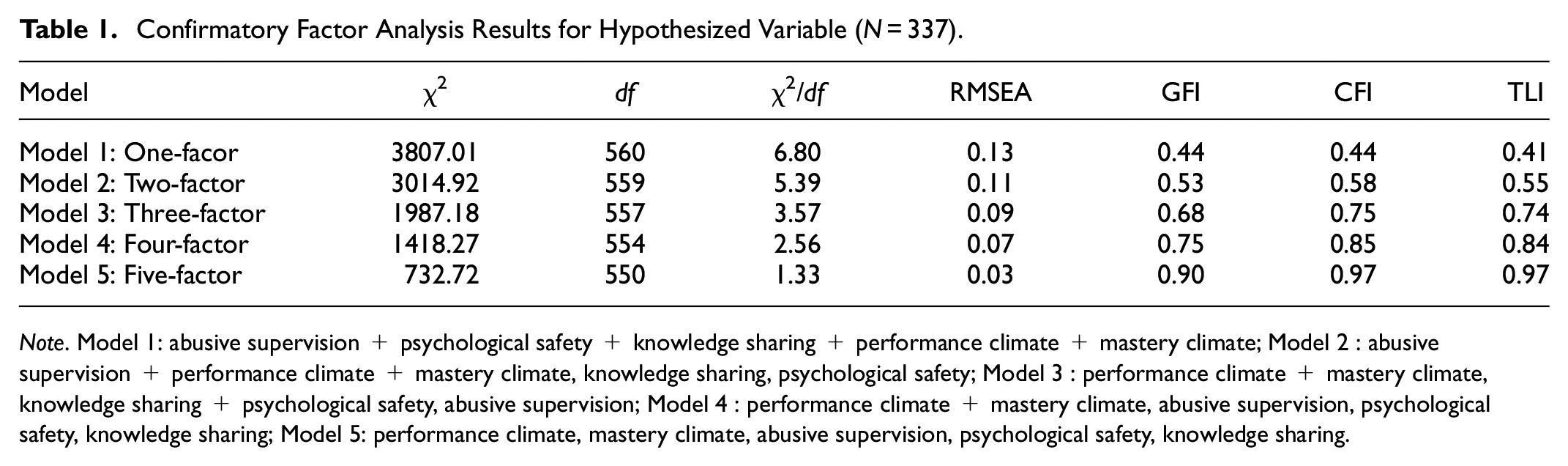
Note. Model 1: abusive supervision + psychological safety + knowledge sharing + performance climate + mastery climate; Model 2 : abusive supervision + performance climate + mastery climate, knowledge sharing, psychological safety; Model 3 : performance climate + mastery climate, knowledge sharing + psychological safety, abusive supervision; Model 4 : performance climate + mastery climate, abusive supervision, psychological safety, knowledge sharing; Model 5: performance climate, mastery climate, abusive supervision, psychological safety, knowledge sharing.
Descriptive Statistical Analysis
Table 2 shows the descriptive statistics of all variables used in this study. The results showed that abusive supervision was significantly negatively correlated with employee knowledge sharing, which is consistent with our predicted result. In addition, there was a negative correlation between abusive supervision and employee psychological safety and a significant positive correlation between employee psychological safety and knowledge sharing, indicating that the key variables of this study are suitable for further analyses.
Descriptive Statistics and Correlations.

p < .05, **p < .01.Note. N = 77(supervisors); N = 337(employees). Gender was coded “1” for men and “2” for women. Age was coded “1” for 18 to 25, “2” for 26 to 35, “3” for 36 to 45, “4” for over 46. Education was coded “1” for specialty, “2” bachelor’s degree, “3” for master’s degree, “4” for doctor.
Hypotheses Testing
HLM6. 08 software was used to test the hypotheses. The control variables, including the supervisors’ gender and the employees’ gender, age, work experience, education, years working under the direction of the supervisor, and working hours, were integrated into the HLM analysis. The results are shown in Table 3. Hypothesis 1 proposes that abusive supervision negatively affects employee knowledge sharing. The M1 model in Table 3 indicates that abusive supervision is able to significantly negatively predict employee knowledge sharing. Therefore, H1 is validated.
Hierarchical Linear Modeling Regression Results.

p < .05, **p < .01.
We propose that the motivational climate regulates the relationship between abusive supervision and employee knowledge sharing, such that, a performance climate strengthens the negative relationship between abusive supervision and employee knowledge sharing, and a mastery climate weakens the negative relationship between abusive supervision and employee knowledge sharing. Moreover, the interaction item between abusive supervision and motivational climate (performance climate and mastery climate) could affect employee knowledge sharing by affecting employee psychological safety. To validate these hypotheses, based on an analysis of the mediating effect, as recommended by Preacher et al. (2007), we treated the interaction term between motivational climate and abusive supervision at the individual level as an antecedent variable and adopted the cross-level mediating effect test procedure recommended by Mathieu and Taylor (2007) to further examine the mediating effect of the mediating variables on the interaction term and the outcome variable.
The validation of the cross-level mediating effects is based on the following four criteria:
The independent variables (interaction items between performance climate and abusive supervision and between mastery climate and abusive supervision) are significantly predictive of the outcome variable (knowledge sharing).
The independent variables (interaction items between performance climate and abusive supervision and between mastery climate and abusive supervision) are significantly predictive of the mediating variable (psychological safety).
The mediating variable is significantly predictive of the dependent variable (knowledge sharing).
When the independent variables (interaction terms between performance climate and abusive supervision and between mastery climate and abusive supervision) and the mediating variable (psychological safety) are simultaneously incorporated into the regression equation, if the effect of the independent variables is no longer significant, the mediating variable plays a full mediating role; if the effects of both the mediating variable and independent variables are significant, the mediating variable plays a partial mediating role. The results are shown in Table 3.
The M2 model shown in Table 3 indicates that the interaction item between motivational climate and abusive supervision is significantly predictive of employee knowledge sharing. Specifically, the interaction between performance climate and abusive supervision can significantly negatively predict employee knowledge sharing, indicating that in an organization with a high-performance climate, abusive supervision and employee knowledge sharing are strongly negatively correlated. Therefore, H2a is supported. However, the interaction between mastery climate and abusive supervision can significantly positively predict employee knowledge sharing, indicating that with a high-performance climate level, abusive supervision and employee knowledge sharing are strongly positively correlated. Therefore, H2b is validated. The interactive effect between performance climate and abusive supervision on employee knowledge sharing is shown in Figure 2. The results reveal that in an organization with a higher performance climate level, abusive supervision and employee knowledge sharing exhibit a stronger negative correlation. Under a high -performance climate, abusive supervision predicts an even lower level of knowledge sharing, whereas under a low performance climate, the predictive effect of abusive supervision on knowledge sharing is not significant.

Interactive effect of performance climate and abusive supervision on knowledge sharing.
The interaction effect between mastery climate and abusive supervision on employee knowledge sharing is shown in Figure 3. The results reveal that in an organization with a lower mastery climate, abusive supervision and employee knowledge sharing exhibit a stronger negative correlation. When an organization has a low mastery climate, abusive supervision predicts an even lower level of knowledge sharing, whereas in an organization with a high-performance climate, the predictive effect of abusive supervision on knowledge sharing is still not significant. These results support H2a and H2b.

Interactive effect of mastery climate and abusive supervision on knowledge sharing.
According to the M3 model, only a performance climate moderates the relationship between abusive supervision and psychological safety; thus, in a group with a high performance climate, employees who have suffered abusive supervision experience a lower sense of psychological safety, whereas the moderating effect of a mastery climate on the relationship between abusive supervision and psychological safety is not significant, indicating that regardless of the mastery climate level in an organization, the relationship between abusive supervision and employee psychological safety does not change much. Based on M2, employee psychological safety is incorporated into the equation to form the M4 model, and the results show that after such incorporation, employee psychological safety, can significantly positively predict employee knowledge sharing. However, the predictive effect of the interaction between abusive supervision and a performance climate on knowledge sharing is nonsignificant, whereas that of the interaction between a mastery climate and abusive supervision on knowledge sharing is still significant, indicating that employee psychological safety plays a complete mediating role in the mechanism underlying the interaction effect between the performance climate and abusive supervision on knowledge sharing, whereas the effect of the interaction between the mastery climate and abusive supervision on knowledge-sharing is not achieved through employee psychological safety. Therefore, H3a is supported, but H3b is not supported.
Conclusion and Discussion
In a volatile, uncertain, complex, and ambiguous (VUCA) business world, employee knowledge sharing is critical for the effectiveness of an organization and the maintenance of its competitive advantage. As the agent of an organization, leaders play an important role in increasing or decreasing individuals’ resources and predicting employees’ engagement in knowledge sharing. Based on COR theory, we examined the effect of abusive supervision on employee knowledge sharing, the moderating effect of a motivational climate in the organization on these relations, and the mediating effect of the interaction between a motivational climate and abusive supervision on employee psychological safety. We found that although abusive supervision weakens employee knowledge sharing behaviors, its negative effects vary among different motivational climate types within a group. Specifically, the higher the performance climate level in a group, the lower the level of psychological safety among employees who have suffered abusive supervision, and the lower their level of knowledge sharing behavior. Next, we discuss the theoretical and practical implications of these findings.
Theoretical Implications
With the increasing importance of knowledge sharing by individuals in the knowledge economy, it is crucial to identify the factors that might hinder employees’ knowledge sharing intention and behavior. The results of this study expand previous studies in the following aspects. First, based on COR theory, we found that employees who had been abused by their supervisors experience a loss of resources, potentially causing them to reduce their level of knowledge sharing to protect their existing resources. This finding provides a new line of evidence concerning the role of leadership behavior in influencing employee knowledge sharing. Prior studies have noted that leadership might have an important influence on individuals’ willingness to share knowledge and that transformative and empowering leadership styles might promote knowledge sharing while destructive leadership styles might hinder knowledge sharing (Wang & Noe, 2010). Since that abusive behavior of leaders affects employees’ knowledge sharing behavior has rarely been studied, in this study, from the COR perspective, we confirm that a relationship exists between abusive supervision and knowledge sharing, which effectively bridges the gap in the literature regarding knowledge sharing.
Second, by introducing the moderating effect of a motivational climate, we examined the boundary condition of the effect of abusive supervision on employee knowledge sharing. We found that the two dimensions of the motivational climate, namely, mastery climate and performance climate, bidirectionally regulate the negative effect of abusive supervision on employee knowledge sharing. Specifically, a mastery climate has a buffering effect on the negative effect of abusive supervision whereas a performance climate further aggravates the effect of abusive supervision. Although the organizational environment affects the devastating effects of abusive supervision, few studies addressed the moderating role of the organizational environment (e.g., hostile working conditions, inequity at work in relation to abusive supervision and outcome variables). By introducing the motivational climate, which is an organizational contextual factor, as a mitigator to or enhancer of the negative effect of abusive supervision, we expanded the scope of studies investigating abusive supervision. Our findings are consistent with prior studies, and we highlight that the knowledge-sharing culture within an organization is an important situational factor that can be used to predict whether employees opt to engage in knowledge-sharing behaviors. Moreover, the results of this study verified the argument by Hobfoll et al. (2018), who highlight that the external environment affects the inner mechanism of resources. Our study supports the call for further research concerning contextual factors when applying COR theory to interpret organizational phenomena.
Third, we found that employee psychological safety mediates the interaction effect between employees’ performance climate and abusive supervision on knowledge sharing behavior. Specifically, in high-performance climate groups, abusive supervision causes employees to experience low levels of psychological safety and then have low levels of knowledge sharing behavior. Previous studies demonstrated that abusive supervision is significantly correlated with employee psychological safety (W. Liu et al., 2016; A. J. Xu et al., 2015; Yang et al., 2020), and the latter is an important factor that affects the level of employee knowledge sharing. Nevertheless, in this study, we introduced psychological safety as a psychological mechanism to connect abusive supervision and knowledge sharing, providing a new perspective to reveal the “black box” in the relationship between abusive supervision and knowledge sharing. We shed light on how abusive supervision affects employee knowledge sharing behaviors while underscoring the key role of psychological safety in the knowledge-sharing process.
Moreover, we revealed that psychological safety does not play a mediating role in the interaction effect between a mastery climate and abusive supervision on employee knowledge sharing. Thus, in groups with a high mastery climate level, employees who experienced abusive supervision can still exhibit a high level of knowledge sharing behavior, but the impact of abusive supervision on employee knowledge sharing is not exerted by enhancing employee psychological safety, thus, regardless of the mastery climate level within an organization, the effect of abusive supervision on employee psychological safety does not vary greatly. Baumeister et al. (2001) noted that the effect of negative events is stronger than that of positive events; relative to the effect a performance climate and abusive supervision, the effect of a mastery climate within a group, representing a positive external environment, on employee psychological safety might be rather weak, which can be clearly observed in the results of the M3 model in Table 3. Therefore, this result provides new evidence supporting the notion that the effect of negative events is greater than that of positive events.
Practical Implications
The results of this study have several implications for management practice. First, organizations should be aware that leadership behavior might be an important factor influencing various employee behaviors, such as knowledge sharing. Our results demonstrate that the knowledge management system implemented by an organization might become ineffective when employees experience the abusive supervision. Given the negative effect of abusive supervision on knowledge sharing behavior, organizations should prompt perceived effective leadership behaviors that could lead to employees’ knowledge sharing. For businesses highly dependent on innovations, it is necessary to adopt measures to decrease the abusive supervision behaviors, such as providing leadership training programs or coaching to enhance managers’ interpersonal skills, enhancing managers’ sensitivity to abusive supervision behaviors and their personal behavior such as self-monitoring capabilities, and setting up a feedback channel which allows employees to report abusive supervision anonymously.
Second, the results of this study indicate that a performance climate, which advocates comparisons and competition among individuals, aggravates the negative impact of abusive supervision on employee knowledge sharing, whereas a mastery climate, which cherishes personal improvement and development, mitigates the negative effect of abusive supervision on employee knowledge sharing. These findings suggest that managers must be aware work climate has impacts on employee knowledge sharing. Therefore, it is necessary to create a mastery motivational climate that advocates self-development and fulfilment through management practices in organizations. For example, work can be designed into meaningful, challenging and diverse tasks or job crafting that enable employees to have more autonomy in addressing challenges such that their motivation for self-improvement can be stimulated.
Finally, we found that employees’ psychological safety plays an important role in influencing employee knowledge sharing. Our findings reveal that only when employees perceive high level of job security and the trust relationship is widely existed in the organization, employees are more likely to have psychological safety. For example, the perception of employee psychological safety can be enhanced by allowing open discussions regarding all subjects in the organization, setting collective goals by avoiding employees blaming each other, and emphasizing the importance of positive work relationships and trust toward colleagues and leaders to foster psychological safety.
Limitations and Future Research Directions
There are some limitations in this study. First, due to the cross-sectional study design, it is impossible for us to infer causality. Based on the present study, we were unable to argue whether abusive supervision is derived from the reduced level of employee knowledge sharing. In fact, it is possible that employees being unwilling to share knowledge with others causes supervisors to adopt abusive behaviors, especially when the supervisor is aware that knowledge sharing is critical for the success of the company. Therefore, in future studies, it is necessary to further investigate the causal relationship between abusive supervision and employee knowledge sharing through longitudinal designs or field experiments.
Second, abusive supervision, motivational climate and psychological safety were measured by self-reporting. However, due to the sensitivity of abusive supervision and motivational climate, employees may feel scared and refuse to report the “real situation” because of the influence of social desirability, requiring a “safer” measure to dispel participants’ feeling of “fear” when measuring sensitive variables in future research. In addition, to measure knowledge sharing, we adopted a supervisor evaluation method that has been widely used in previous studies, which avoided common method bias to a certain extent (Wang & Noe, 2010). However, the evaluation of employee knowledge sharing from different sources, such as supervisors, subordinates, and colleagues, could increase the effectiveness of this measurement.
Third, similar to previous studies, this study focused on the supervisor-subordinate pair level. However, in recent years, it has been found that the perception of a third party regarding the abusive supervision of the same supervisor also affects the behavior of the third party (E. Xu et al., 2020). Therefore, when the third party perceives that a colleague has been abused by a common supervisor, how will the knowledge-sharing behavior of the third-party change? Will the third-party share knowledge with the victim to help the victim solve work problems and jointly cope with the boss’s abusive supervision? Alternatively, will the third party choose schadenfreude and further impose resource restrictions on the victim (such as intentionally not sharing knowledge)? Therefore, in future studies, it would be interesting to include a third party in the research framework to reveal the mechanism of employee knowledge sharing behavior more comprehensively. Despite these limitations, our findings contribute to a better understanding of the knowledge-sharing mechanism by incorporating the impacts of abusive leadership behavior, motivational climate and psychological safety.
Forth, the sample in this study was collected from employees of high-tech companies in China, which might limit the generalizability to other industries in other countries. The cultural issues may influence the results. Therefore, future research could consider employees outside tech industry, such as doctors, teachers, researchers, etc., and a cross-national study to further test the effectiveness of this research model in other industries.
Footnotes
Declaration of Conflicting Interests
The author(s) declared no potential conflicts of interest with respect to the research, authorship, and/or publication of this article.
Funding
The author(s) disclosed receipt of the following financial support for the research, authorship, and/or publication of this article: This research was supported by “The National Natural Science Foundation of China” (Grant No.: 71801097, 72172048).
Ethics Statement
All procedures performed in this study involving human participants were in accordance with the ethical standards of the institutional and/or national research committee and with the 1964 Helsinki declaration and its later amendments or comparable ethical standards.
