




Abstract
In this paper, the influence of organizational factors and the role of individual factors on volunteers’ job satisfaction and affective commitment is examined, in particular, whether volunteers’ motive fulfilment mediates the influence of perceived organizational support for the two outcomes of job satisfaction and affective commitment. A crosssectional survey was used to collect data from 213 volunteers from five non-profit organizations in Queensland, Australia. Perceived organizational support is found to have a significant relationship on volunteers’ job satisfaction and affective commitment. Furthermore, motive fulfilment had a significant effect on the impact of perceived organizational support (POS) on the two outcomes. The results of the study provide new knowledge about the importance of motive fulfilment as a tool for improving volunteers’ positive organizational experiences and explain how motive fulfilment promotes increased job satisfaction and affective commitment.
Keywords
Introduction
Community non-profit organizations’ (NPOs) effectiveness depends on volunteers who render free services for the benefit of others. Volunteers are integral to the NPO workforce, and most NPOs depend on their continuous commitment to achieve their goals (Alfes et al., 2017; Einolf & Yung, 2018; Hyde et al., 2016). Previous studies have argued that volunteers’ service tenure is due to the satisfaction they derive from their volunteering activities (Boezeman & Ellemers, 2008a; Cuskelly et al., 2006; Galindo-Kuhn & Guzley, 2002) and their personal attachment and loyalty to organizational goals (Garner & Garner 2011; Nencini et al., 2016). These outcomes show that volunteers’ prosocial behaviors help their organizations to minimize costs and deliver services to the community (Cornforth & Mordaunt, 2011; Garner & Garner, 2011) and are linked to the two vital workplace outcomes of affective commitment and job satisfaction. For this reason, it is crucial to understand the antecedents of these workplace outcomes, given the importance of volunteers’ dedication, and continuity in helping NPOs achieve their goals.
Job satisfaction, defined as an attitudinal variable that describes the feeling of an individual about his/her job (Knights & Kennedy, 2005), and affective commitment, defined as the level to which a person is emotionally involved in, identified with, and believes in organizational goals (Allen & Meyer, 1990), are predicted by different organizational and individual factors. For example, empirical evidence has shown that both workplace outcomes are predicted by perceived organizational support (POS; Andriyanti & Supartha, 2021; Brunetto et al., 2018; Knapp et al., 2017). These authors (Andriyanti & Supartha, 2021; Brunetto et al., 2018; Knapp et al., 2017) remarked that employees’ feelings of support through the organization’s policies and practices increase employees’ beliefs that their organizations are concerned about their welfare and value their efforts, which in turn, leads to increased willingness to continue helping, emotional attachment, and reduced turnover behavior. Hence, in this study, the argument is that POS will predict job satisfaction and the affective commitment of volunteers in community NPOs in Australia.
Another predominant view in the literature is that the fulfilment of volunteers’ personal needs, such as values, self-esteem, affiliation, etc., increases job satisfaction and affective commitment (see Bang et al., 2013; Finkelstein, 2007; Penner & Finkelstein, 1998). This result is congruent with past research (see Nencini et al., 2016), that shows that the fulfilment of individual motives engenders positive experiences that lead to volunteers’ overall feelings of satisfaction about their daily activities and emotional attachment to the organization (Q. E. Usadolo, 2016). These characteristics inevitably determine how long an individual remains in the organization because people participate in voluntary service to satisfy personal needs. In this light, it is believed that volunteer motive fulfilment plays a significant role in the relationship between POS and the two workplace outcomes. Thus, motive fulfilment is considered as an intervening variable between POS and both workplace outcomes (job satisfaction and affective commitment) in this study.
The influence of the organizational factor, POS, on volunteers’ workplace outcomes of job satisfaction and affective commitment is examined in this research using the individual factor of motive fulfilment as a mediator, and social exchange theory (SET) is used as an analytic lens. The research questions (RQ) are as follows:
The contributions of this paper to the existing literature are twofold. First, while there are studies examining the effect of POS on paid employees, a few studies have examined how POS impacts volunteers’ job satisfaction and affective commitment; hence, this study is seeking to establish whether the impact of POS across different work sectors can be generalized and in turn, provide a deeper understanding for those who manage volunteers in community NPOs. Second, this study provides further evidence about how POS impacts workplace outcomes by examining the indirect impact of POS on volunteers’ job satisfaction and affective commitment through motive fulfilment. This type of analysis will provide further explanation about the contributions of the distinctive role of the fulfilment motives, especially as they relate to volunteers in community NPOs. Figure 1 provides a clearer understanding about the interactions between these variables.

Model showing the relationships between all variables.
Social Exchange Theory
SET is defined as “voluntary actions of individuals that are motivated by the returns they are expected to bring and typically do bring from others” (Blau, 1964, p. 91). It is a relationship that is characterized with shared understanding and the norm of reciprocity in the form of favors, assistance, access to resources, activities that enhance self-esteem, affiliation, and respect (Blau, 1964; Brunetto et al., 2013; Cropanzano & Mitchell, 2005). In an employee-organizational context, social exchange relationship is cooperative, and this could involve the exchange of services for tangible and intangible rewards (see Brief & Motowidlo, 1986; De Clercq et al., 2010; Organ & Konovsky, 1989).
SET is particularly important as an analytical lens in this study given its value proposition that “The more valuable to a person is the result of his action, the more likely he is to perform the action” (Homans, 1961, p. 55). In this regard, SET is concerned with the extent to which an individual finds a certain reward useful when compared to other available rewards (Homans, 1974). In both paid and volunteer organizations, employees and volunteers will see positive outcomes that result from their actions as rewards and negative outcomes as a sign of inequitable exchange (Q. E. Usadolo, 2016). This means that the usefulness or benefits of a reward to the recipient are important in terms of obtaining the desired action from the recipient.
Based on SET, employees are prone to reciprocate when their actions result in any form of reward (beneficial or nonbeneficial) from their organizations. However, in the case of volunteers, the obligation to reciprocate will be high if important personal motives are met (Gouldner, 1960; Homans, 1961) by their organizations because volunteers’ motives inform the actions they will perform. Thus, in the case of volunteers, if rewards are to be considered valuable resources, they should fulfil volunteers’ motives. This is evident in the results from several previous studies that show that volunteers are obliged to reciprocate to longer stays in the organization when the activities and resources provided fulfil these functional motives (Clary et al., 1998; Davis et al., 2003; Finkelstein, 2008a). In other words, volunteers’ perceptions of favorable treatment will be based on the desire to satisfy socioemotional needs that fulfil important functional motives because the motives serve as an alternative (non-financial) reward for their involvement in the organization. Therefore, to increase volunteers’ obligations to reciprocate, an organization must continuously create an environment that supports and serves important motives. Hence, POS is expected to be a predictor of motive fulfilment.
Perceived Organizational Support in the Context of Volunteers in Non-profit Organizations
POS is a SET construct that is used to describe employee-organization relationship. The degree to which organization values its employees positively is used to assess its fulfilment of its obligations to its employees (Eisenberger et al., 1990). Hence, the positive support of employees by an organization may lead to a feeling that “would create a felt obligation to care about the organization’s welfare and help the organization to reach its objectives” (Rhoades et al., 2001, p. 825).
From the literature of paid employees, POS theorists (Rhoades & Eisenberger, 2002) posit that employees’ emotional support, affiliation, and acceptance are best met through the support provided by the organization. This means that POS is based on a relational contract (Farmer & Fedor, 1999; Knapp et al., 2017) that serves as a means by which organizations provide resources that meet employees’ needs that are not met by financial rewards. Thus, it is expected that the perception of POS will serve as a relational currency in return for volunteers’ contributions, which will motivate volunteers to reciprocate the fair treatment they receive from the organization.
The fact that POS is based on relational rewards makes it an important factor for NPOs that are already experiencing financial difficulties because of the perception that organizational support such as recognition, respect, fair treatment, and job enrichment does not cost money to implement. Such discretionary aids are perceived as an expression of organizations’ positive appreciation of individuals’ contributions (Eisenberger et al., 1990) and result in increasing volunteers’ feelings of being valued and cared for (Farmer & Fedor, 1999). Therefore, POS will increase if employees perceive rewards (extrinsic and intrinsic) and favorable work activities are given by their employer voluntarily (Rhoades & Eisenberger, 2002).
Research has shown the importance of high-quality POS on paid employees’ job satisfaction (Andriyanti & Supartha, 2021), wellbeing (Brunetto et al., 2012), propensity to leave, affective commitment (Park et al., 2021) and stress (Rodwell & Demir, 2012), and supervisor-subordinate relationships (Wayne et al., 1997). The premise for the analysis of these studies is based on the fundamental principle of the norm of reciprocity, which posits that paid employees who feel they are being appreciated or supported may reciprocate with high performance and affective commitment while those who feel they are not being supported may reciprocate with poor commitment and performance. However, despite the documented findings of POS on paid employees’ attitudes and behaviors, comparable research on the influence of POS on volunteer worker outcomes is limited. This is the reason this study is necessary: it may help to elucidate the effect of POS on volunteers’ workplace outcomes, namely, affective commitment and job satisfaction.
Job Satisfaction
Employees’ job satisfaction is a concern among organizational psychologists because it is an attitudinal variable that describes the feeling of an individual about his/her job (Chiboiwa et al., 2011; Knights & Kennedy, 2005) and is associated positively with productivity and negatively with absenteeism in the workplace (Lo Presti, 2013). Job satisfaction in the context of NPOs is important because volunteers who are happy with their work activities are likely to keep on volunteering (S. E. Usadolo & Usadolo, 2018; Won et al., 2021).
The two components of job satisfaction, namely, communication satisfaction (in terms of organizational support, integration, and information) and satisfaction with the organizational context (with respect to the nature of the work assignment, participation, efficacy, and sense of empowerment), are linked to organizational factors (Gidron, 1983; Herzberg, 1966). Hence, most studies have found that the occurrence of expected POS in terms of harmonious relationships between the organization and paid employees engenders job satisfaction. For example, Paillé et al.’s (2015) study of public service employees found a positive relationship between POS and job satisfaction. A meta-analysis of paid employees by Rhoades and Eisenberger (2002) found a strong relationship between POS and job satisfaction. Based on this, it is expected that volunteers’ perceptions of support from the organization would influence volunteers’ job satisfaction in community NPOs in Australia. Thus, Hypothesis 1 (H1) is formulated as follows: Volunteers’ perceived organizational support is positively related to their job satisfaction.
Affective Commitment
Affective commitment is a desirable attitude that every organization seeks to encourage because individuals with emotional attachment to their organizations usually have a strong affiliation with and are loyal to their organization (Rhoades et al., 2001). This means that volunteers in community NPOs in Australia who are emotionally attached to their organizations will be more engaged in organizational activities. For example, in Penner and Finkelstein (1998) and Grube and Piliavin (2000) a positive association between organizational commitment and the number of hours per week volunteers reported working in volunteer organizations was found. Non-commitment has been associated with stress, and withdrawal behaviors (Cooper-Hakim & Viswesvaran, 2005; DeCotiis & Summers, 1987; Farrell & Stamm, 1988). In addition, Mowday et al. (1982) argued that a noncommitted individuals may not present a good image of the organization to the community. This will have more of an effect on community NPOs who recruit mainly from the community through word of mouth.
Affective commitment has been found to be one of the reciprocal commodities used by individuals as repayment to an organization when they believe that their organization is providing them with the necessary support. Using the notion of the norm of reciprocity, when an organization relates to its employees positively by given them access to the required resources and autonomy, the employee will feel obligated to repay the organization by putting in more effort to increase their organization productivity (Brunetto et al., 2013). Over time, employees’ emotional ties and a sense of unity in the organization increases (Addae et al., 2006). An obligation to improve organization’s wellbeing and achieve its objectives were found in a study of Dutch volunteers who believed they were receiving the necessary support from the organization (Boezeman & Ellemers, 2007). Therefore, Hypothesis 2 (H2) is formulated to investigate the relationship between POS and volunteers’ affective commitment to community NPOs in Australia, and the hypothesis is as follows: Volunteers’ perceived organizational support will be positively related to their affective commitment.
Motive Fulfilment
Motive fulfilment as the term is used in this study is built around the view that when reason (motives) for volunteering are met, the result will be one or more favorable workplace outcomes such as job satisfaction and affective commitment (see Q. E. Usadolo, 2016). Motive fulfilment is different from having a motive. Motive, in terms of the functional approach used by Clary et al. (1998), explains the function or reason a volunteer has decided to give his/her time for unpaid activities in an organization. Hence, it is only when the reason (motive) is achieved that the volunteer would deem it appropriate to reciprocate. In other words, motive fulfilment, specifically in the context of volunteerism, refers to a state where the volunteer feels his/her reason for volunteering has been met (see Q. E. Usadolo, 2016). Such reasons could be, according to Clary et al. (1998), to express important values (altruism or values), to obtain better understanding (understanding), to enhance self-esteem (self-esteem), to increase social networks (social), to improve career prospects and opportunities (career), and to reduce self-guilt (protection). Motive fulfilment consists of the elements stated above in two categories, which are value (altruism) and egoistic (understanding, enhancement, social, career, and protective) motives. Hence, the drive to volunteer is usually identified as one or a combination of several motives (Finkelstein, 2008b; Haski-Leventhal & Bargal, 2008), and it is assumed that volunteers are motivated to perform activities that fulfil these personal motives. The present study uses motive fulfilment as a mediator of the influence of POS on job satisfaction and affective commitment.
The impact of POS on job satisfaction and affective commitment has mainly been based on paid employees’ general beliefs about organizations’ valuing and caring for their wellbeing. The preconditional aspect of POS regarding its fulfilment of the individual’s important socioemotional needs before influencing these outcomes has received less focus (Lee & Peccei, 2007) for both the paid and volunteer workforce. Hence, the intention of this study is to address an aspect of this gap by examining the role of motive fulfilment that has been identified as a need that is important to volunteers, and which, if met, is likely to result in volunteers’ job satisfaction and affective commitment.
Volunteer experiences have been suggested to be an important factor that could be influenced by motive fulfilment. According to Penner (2002), volunteers’ perceptions about how they are cared for, treated, and supported in their organizations and the organizations’ management practices impact on their volunteering experience and behavior. Thus, organizations’ policies and the nature of relationships in organizations are all factors that may determine whether volunteers’ experiences are positive or not. In this light, Brudney (1999) and Wilson (2000) stated that volunteering occurs not only on account of motivation but also because of organizational support. Hence, Dwiggins-Beeler et al. (2011) and Penner (2002) argued that organizational variables (such as POS) or dispositional variables (such as motive fulfilment) alone may not fully explain volunteers’ workplace outcomes. Consequently, Penner (2002) suggested that dispositional variables can be mediators in the relationship between organizational variables and workplace outcomes.
The importance of the role of motive fulfilment as an intervening variable was addressed in a longitudinal study of 238 community volunteers in the USA by Davis et al. (2003). Davis et al. employed a more elaborated model that included motive fulfilment as one of the mediating variables. They showed that motive fulfilment mediated the relationship between the antecedents (dispositional empathy and motivation) and the outcomes. The inclusion of other variables to determine how antecedent variables linked to the outcomes deepened the understanding of the exchange process (Davis et al., 2003).
Although the study of Davis et al. (2003) confirmed the possible mediating role of motive fulfilment between independent variables and workplace outcomes, the study did not provide a detailed analysis of the predictive validity of each motive fulfilment, and this limits the understanding of the core characteristics of the different motives. Moreover, the variables investigated were different from the ones in the present study. Therefore, to provide a deeper understanding in the present study, the effect of the fulfilment of six volunteer motives as mediators between POS and job satisfaction in community NPOs in Australia was tested with the Hypothesis 3 (H3): Volunteers’ motive fulfilment will mediate the relationship between POS and job satisfaction.
According to Gupta et al. (2016) and Rhoades and Eisenberger (2002), continuous exchanges of rewards that fulfil the important socio-emotional needs of individuals will result in the development of real emotional links with the organization to increased feelings of psychological fulfilment. In this way, the positive impact of POS on affective commitment depends on the extent to which important socio-emotional needs are met. With regard to volunteers, their commitment has been associated with the fulfilment of their motives (Finkelstein, 2008b). Moreover, studies that have focused on the role of need fulfilment have found that it partially mediates the association between POS and affective commitment. However, these findings were based on certain kinds of needs. For example, Lee and Peccei (2007) found organization-based self-esteem (OBSE) partially mediated the relationship between POS and affective commitment among paid employees. Based on this, it is expected that the impact of POS on affective commitment will be mediated by the fulfilment of socio-emotional needs that, in this case, are volunteer motives. To test this in community NPOs in Australia, the following Hypothesis 4 (H4) is formulated: Volunteers’ motive fulfilment will mediate the relationship between POS and affective commitment. Together, the hypotheses provide a way forward for informing the research design, as illustrated in Figure 1.
Method
Procedures
This study employed a self-administered survey (using a cross-sectional research design) technique to collect data from participants in five community NPOs in Queensland, Australia.
Prominent among the community services these NPOs render are settling refugees, advocating for refugees, developing, and engaging within and between communities, reskilling and employing refugees, and sourcing and delivering clothes to the needy. Two of the NPOs are involved in community respite for people with a disability and advocacy and transport services for people with a disability. The community NPOs provide services to the vulnerable and less privileged in their communities.
Before the distribution of the questionnaires, meetings were held with different volunteer coordinators in the NPOs to explain the research project and then permission was sought for data collection. About 680 questionnaires were distributed after explaining to the volunteers the objectives of the research project during these meetings. Both volunteer coordinators and volunteers were given assurance that the information collected from them would be kept confidential, and the findings would be reported anonymously. Finally, a total of 213 were returned.
Most questionnaires were handed out and collected by the researcher after these meetings. Those who were not able to complete their questionnaires at the meetings were given the option to either bring them to the next meeting or send them by post using the stamped, self-addressed envelopes provided. Postage-paid envelopes were used to make it easy for the participants to return the survey and still retain their anonymity. In addition, some questionnaires were left to volunteer coordinators to distribute to those volunteers who were absent.
After data collection, the data collected were analyzed with SPSS Package 23. Descriptive statistics such as means, frequency distributions, and percentages were used to analyze the demographic data.
Measures
Perceived organizational support was measured with the shorter version of the questionnaire developed by Eisenberger et al. (1990). An example of the question is, “The organization cares about my general satisfaction at work.” The shorter version is a unidimensional scale comprising eight questions. All questions are measured using a 6-point Likert-type scale in which responses range from Strongly Disagree (1) to Strongly Agree (6). This instrument was used because several studies have empirically shown that it has high internal reliability (see Bang, 2007; Eisenberger et al., 2002). A Cronbach’s alpha of .85 was obtained.
Volunteer Functions Inventory (VFI) developed by Clary et al.’s (1998) for determining volunteer’s motive fulfilment was used in this study. A total of 18 items were used, and all questions were measured on a 6-point Likert-type scale ranging from Strongly Disagree (1) to Strongly Agree (6). An example of the self-value fulfilment measure is, “By volunteering at this organization, I am doing something for a cause I believe in.” The Cronbach’s alpha was .84.
Affective commitment was assessed with Allen and Meyer’s (1990) measure of employees’ emotional attachment to the organization. All questions were measured on a 6-item scale with responses ranging from Strongly Disagree (1) to Strongly Agree (6). One of the questions was “I enjoy discussing my organization with outside people,” with a Cronbach’s alpha of .93.
Hackman (1980) four items scale instrument were used to measure job satisfaction. Respondents indicated their level of agreement or disagreement with a scale ranging from Strongly Disagree (1) to Strongly Agree (6). For example, one of the questions was “I frequently think of quitting this job.” It was modified to read, “I am generally satisfied with my volunteering activities.” The questions were modified to capture volunteers’ overall job satisfaction, and it had a Cronbach’s alpha of .89.
Demographic variables such as gender, age, number of hours, and years of volunteering were measured with single-item questions.
Demographic Analysis
The percentage of the total data collected from the five community NPOs compared to the the number of questionnaires given out was 32.7%. The number of respondents from the organizations were as follows: Organization A, 51 (24%); B, 34 (16%); C, 46 (21.6%); D, 43 (20.2%); and E, 39 (18.3%). Similar to the report of National Survey of Volunteering Issue (2011), the majority of the volunteers who participated in this study were females (N = 140 or 65.7%). The age distribution of the participants was consistent with findings from the Australian Council of Social Service (2009), which suggested that older people (aged 43 and above) participate more in voluntary service than do younger people. Most of the respondents, volunteer for 3 to 4 hours per week and have been with the organization for 3 to 5 years.
Data Analysis
In Table 1 the means, standard deviations, as well as the correlation coefficients of each variable are shown.
Mean, Standard Deviations, and Correlations.
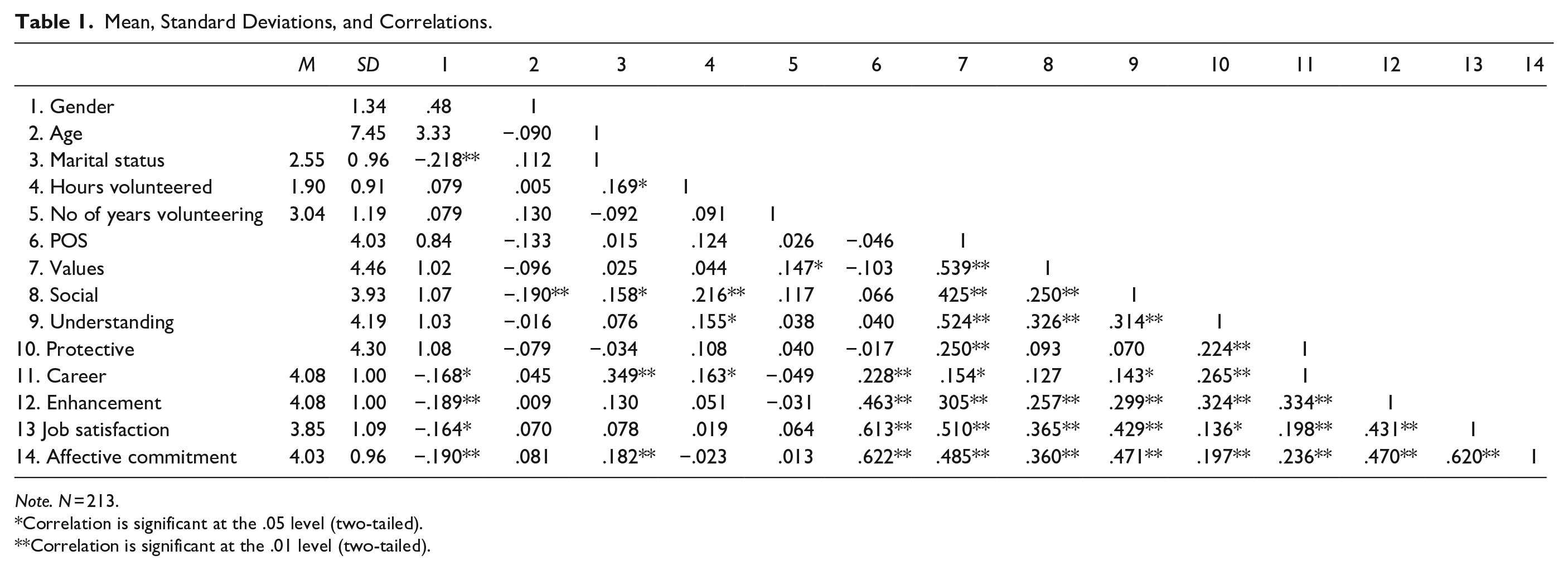
Note. N = 213.
Correlation is significant at the .05 level (two-tailed).
Correlation is significant at the .01 level (two-tailed).
Prior to hypothesis testing, it was important to confirm that all items used for data collection are true measure of the intended constructs (Schumacker & Lomax, 2004). The measures were evaluated with a factor analysis set at 0.45 factor loading cut-off point. The 66 questions in the questionnaire revealed nine latent variables with eigenvalues greater than one. These factors explained a total of 78% variance of the constructs. The first factor only accounted for 10.07% of the total variance. Both tests for Bartlett’s sphericity and Kaiser–Meyer–Olkin measure of sampling adequacy were significant (with a chi-square value of 95, 36.640, p = .001 and .790, respectively). The value was above the minimum 0.6 requirement as recommended by Hair et al. (2010) and Kline (2011). There were no multicollinearity and common method bias because all the correlations were below .90 (Pavlou et al., 2006). In addition, Harmon’s single factor test shows that the degree of variance accounted for by one factor is 17.8%, which is lower than 60% to 70% point of concern (Fuller et al., 2016). As the unrotated exploratory factor analysis did not show that a single factor accounts for most of the variance, the common method bias was not considered a problem.
The hypotheses were tested with SPSS PROCESS Macro Model 4 developed by Hayes and Preacher (2014). PROCESS Macro integrates the bootstrapping effect and provides the findings of both direct and indirect effects. The results of hypothesis testing are explained below.
Results
H1 and H2 were supported, as the findings show that POS significantly impacts volunteers’ job satisfaction (β = .426, t = 4.592, p < .0001) and affective commitment (β = .389, t = 4.882, p < .0001). Thus, confirming the acceptance of H1 and H2. The findings are shown in Table 2.
Results of Simple Regression for POS, Job Satisfaction, and Affective Commitment.

Correlation is significant < .001 level.
H3 was partially supported as the values show that when the mediators were included in the model, the effect of POS on job satisfaction was reduced from (β = 426. to β = .330) but still significant (p < 000), which clearly indicates partial mediation. Table 3 shows the indirect effect values of the lower (LLCI) and upper (ULCI) limits of each of the mediators and only three variables of motive fulfilment (value, understanding, and enhancement) LLCI and ULCI values did not contain zero. The results are shown in Table 3.
Mediation Analysis of the Indirect Effect of POS on Job Satisfaction.
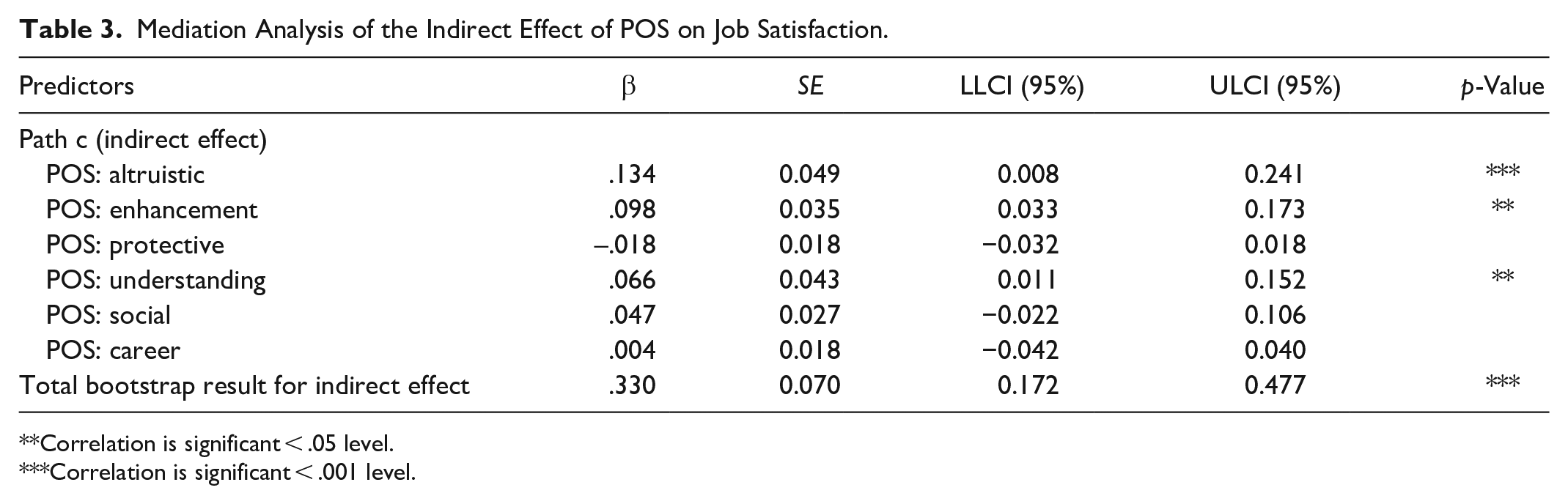
Correlation is significant < .05 level.
Correlation is significant < .001 level.
H4 was also partially supported as the beta (
Mediation Analysis of the Indirect Effect of POS on Affective Commitment.

Correlation is significant < .05 level.
Correlation is significant < .001 level.
Discussion
This study aimed to provide a deeper understanding of how POS influences employees’ workplace outcomes (job satisfaction and affective commitment) by exploring how both organizational and individual factors influence volunteers’ attitudes and behaviors using a SET theory. The SET lens provides a scenario of what should happen in ideal circumstances; assuming that effective workplace relationships have developed over time between volunteers and their organizations, mutual reciprocity would have developed, in turn, enhancing the benefits for both the volunteers and their organizations. Based on SET, the expectation was that motive fulfilment would increase because of effective workplace relationships. As such, the role of motive fulfilment in the association between POS, job satisfaction, and affective commitment was examined.
Consistent with past research (Addae et al., 2006; Farmer & Fedor, 1999; Maertz et al., 2007), the findings support the hypotheses H1 and H2 that POS has a direct and significant effect on volunteers’ job satisfaction (β = .604) and affective commitment (β = .599). The findings directly support previous studies that a supportive work environment is a determinant of predictor of job satisfaction and individuals’ emotional ties with their organizations.
Furthermore, the mediating effect of motive fulfilment was tested to provide a clearer picture of the processes underlying the effect of POS on job satisfaction and affective commitment. Unlike previous studies (such as that of Davis et al., 2003), which examined the combined effects of the fulfilment of altruistic and egoistic motives, the effects of the fulfilment of each of the six motives (values, enhancement, social, career, understanding, and protective) were examined separately in this study to determine each factor’s unique contribution. Some motives were statistically significant, and some were not significant.
This study found partial support for H3 and H4 (fulfilment of three motives are significant). Put differently, the effect of POS on job satisfaction is partially influenced by the fulfilment of the value motive (β = .134), understanding motive (β = .066), and enhancement motive (β = .098). Likewise, the effect of POS on affective commitment was partially mediated by the fulfilment of value motive (β = .093), enhancement motive (β
The indirect effect of POS on outcomes through value motive fulfilment indicates that job satisfaction and affective commitment would increase when the organization provides a supportive work environment where policies and procedures enable volunteers to reach out to people in need. For an altruistically motivated individual, such an environment that leads to the fulfilment of altruistic values will enhance the perception of organizational support, resulting in job satisfaction and affective commitment because these factors serve as valuable rewards.
The results show that supporting the personal growth of volunteers in areas such as knowledge and skill improvement increases volunteers’ perceptions of organizational support. Volunteers who find that their volunteering activities do not only enable them to use their skills but also provide opportunities to acquire new knowledge and skills that increase their self-esteem will consider their jobs rewarding because they are receiving important personal benefits from the organization. These supports from the organization are important rewards because they fulfil volunteers’ functional motives for better understanding and self-enhancement. This, in turn, causes them to feel obligated to reciprocate with positive workplace outcomes (job satisfaction and affective commitment).
In addition, understanding and enhancement motives are closely related to what Deci and Ryan (2000) refer to as autonomy and competence needs. These have been identified as individuals’ most important needs regardless of their demographic differences. The findings support the argument that any social environment (for instance, the social environment in an organization) that facilitates the satisfaction of these needs will increase the likelihood of positive workplace outcomes. In this regard, a volunteer with a sense of autonomy over the activities in a community NPO is likely to have increased self-esteem because some measure of independence is attached to what he/she does as a volunteer. Competence relates to understanding motive as the acquisition of more skills and knowledge improves a person’s aptitude. Hence, for volunteers who desire such psychological support, the fulfilment of these motives (understanding and enhancement) as a set is important in the relationship between POS and workplace outcomes because these motives are rewards that the volunteers of community NPOs regard as beneficial.
Furthermore, a volunteer whose volunteering experience satisfies his/her understanding motive has not only been empowered but has also been enriched in terms of his/her personal growth and self-esteem. Another possible reason fulfilment of understanding and enhancement motives is significant in the relationship between POS and affective commitment is that affective commitment to the organization increases when socio-emotional needs are met (Maertz et al., 2007; Rhoades et al., 2001). The socioemotional needs referred to by these authors are very similar to the elements constituting both understanding and enhancement motive fulfilment.
The analysis of the intervening variables revealed that the fulfilment of career protective and social motives were not significant mediating variables on the effect of POS on job satisfaction and affective commitment. One possible factor that could have contributed to the nonsignificant effect of the fulfilment of social and career motives might have been the demographic characteristics of this study’s participants. Most of the volunteers who took part in this study had paid jobs and were aged 45 years and above. Consistent with Phillips and Phillips’ (2011) finding that most volunteers are paid employees in either the private or public sector, volunteers may volunteer to fulfil only those motives that are not being met in their paid work. This may be the reason for the insignificant findings with respect to career, protective, and social motive fulfilment as mediators of POS with job satisfaction and affective commitment. In addition, Okun and Schultz (2003) found that as age increases, volunteers’ motivations regarding career benefits decrease. Thus, it is not surprising that the fulfilment of career motives did not have a significant impact on the association between POS and the two workplace outcomes of job satisfaction and affective commitment, as career benefits may not be important for most of the older volunteers. However, in contrast to Okun and Schultz’s (2003) findings, the desire for social interaction did not seem to have much effect on the effect of POS on job satisfaction and affective commitment. This might be due to demographic characteristics specific to the organizations examined. Therefore, this is something that future studies would need to explore further.
Contributions to the Literature
The impact of POS on the two identified volunteer workplace outcomes through motive fulfilment has rarely been explored in past volunteering research. By focusing on these individual factors, this research provides a clearer picture of the ways volunteers can be motivated to remain in their organizations.
This study has also helped to fill some gaps researchers have identified in the literature. Many scholars such as Clarke (2010) and Van Quaquebeke and Eckloff (2010) have suggested that further studies should examine leadership and management roles in NPOs and volunteerism. Some scholars have argued that not much is known about the interactive mechanisms that would help to explain the link between organizational factors and positive work outcomes for volunteers (Jenkinson et al., 2013). Several studies (see Bang, 2011; Boezeman & Ellemers, 2008b; S. E. Usadolo & Usadolo, 2018) have advanced knowledge about some of the organizational and individual factors affecting volunteers, and these studies have made a fundamental difference to the understanding of volunteers across all categories of NPOs. The present study extends the earlier research by suggesting and testing a model that investigates the influence POS has on volunteer job satisfaction and affective commitment in community NPOS in Australia.
POS serves not only as a means by which organizations reward volunteers’ contributions but is also an indicator of organizations’ willingness to provide aid and resources that enhance a positive volunteering experience. The use of volunteers as participants in this study contributes to the existing literature because it extends the understanding of positive work environments in a volunteer context. Thus, the findings of this study have shown that the provision of a positive work environment with sound policies and procedures affects volunteers’ job satisfaction in NPOs, specifically community NPOs in Australia.
The findings in this study are consistent with other studies (Bang, 2007; Davis et al., 2003) that have shown positive volunteering experiences that fulfil volunteers’ motives, to predict high levels of job satisfaction, and increase emotional ties with the organization. This study contributes to the literature by examining reciprocal pathways or processes between POS, job satisfaction, and affective commitment. The study conducted provides new knowledge on how to improve volunteers’ work experiences that have been emphasized as an important determinant of volunteers’ attitudes and behaviors. This is a gap that the present study addressed, as not much is known about the association between POS and volunteerism. This empirical study has provided a clearer insight of the impacts of management and their support on volunteers’ workplace outcomes.
In organizations with paid workforces, salaries, and benefits are two of the primary rewards for employees. Volunteers in NPOs do not engage in volunteering activities for monetary rewards; volunteers in NPOs seek rewards of another kind. It has not been made clear in the literature what the focus should be when examining the reciprocal exchanges between organizations and volunteers. This study has been able to highlight a possible focus by considering several types of motives. In line with Homans (1961), the findings in this study shows that the fulfilment of a set of motives that mediate the relationship between management and their supports, and the two work outcomes can be used to encourage volunteers to feel committed to their organizations. This contribution is important because the findings have shown that volunteers will continue to reciprocate for as long as the organization keeps on providing resources that help them satisfy the motives that are important to them.
Practical Implications of the Study
The findings of this study are important for management interested in enhancing their volunteers’ job satisfaction and emotional attachment to their organizations. The findings of provide useful information that can be used to develop and improve policies and strategies that strengthen the two positive workplace outcomes examined in this study.
Practicably, the results of this study have confirmed that a supportive work environment fosters volunteers’ positive workplace experiences. Also, the mediation framework contributes insight that will help community NPOs to develop policies that will nurture the fulfilment of the three motives. It, therefore, means the provision of structures (such as task independency, open communication, and participative decision making) to aid managers of volunteers to provide a relational, involving, and autonomous supportive workplace to stimulate volunteers’ perceptions of organizational support. The fulfilment of these salient motives (value-oriented, enhancement, and understanding) will improve volunteers’ work experiences which will in turn increase their job satisfaction and loyalty to the organization. This would not only help organizations to save cost on training but also on the recruitment of new volunteers, as volunteers who have positive experiences have been found to be more likely to encourage friends and family members to volunteer (Boezeman & Ellemers, 2008b).
What is clear from this study is that there are no fixed guidelines for managing volunteers in community NPOs. Rather, volunteer managers need to adopt a supportive management style that will enable them to understand volunteers’ interests, values, and preferences. Management will be able to deal with the challenges of volunteers’ behavior better if they take volunteers’ motives into consideration when designing their models of volunteer management.
As indicated by the findings of the study, NPOs must provide supportive work environments that have been identified as antecedents of two workplace outcomes, namely, job satisfaction and affective commitment. This requires good organizational policies that provide managers with the latitude to manage the resources at their disposal. These findings will sensitize NPOs toward the role of volunteer motive fulfilment and the concerns of the volunteers they seek to employ.
While focusing on these three motives’ fulfilment may sound appealing to organizations wanting to boost their volunteers’ job satisfaction and affective commitment, the results suggest that community NPOs should not undermine the importance of other motives. In a nutshell, given what this study has revealed, management should emphasize value-oriented enhancement, and understanding motives’ strategies while finding a way to emphasize other benefits such as the fulfilment of protective, social, and career motives because the latter have direct effects on the outcomes despite not being effective as mediators.
Limitations of the Study
Limitations of this study were the analysis of the data with multiple regression tools. Although multiple regression analysis is suitable for determining links between variables, a structural equation model is often recommended as being more appropriate for testing a complex model with a number of interactive relationships simultaneously (Byrne, 2010; Kline, 2011). However, the use of multiple regression analysis did not pose any problems in this study because the conditions for avoiding common method bias and all conditions for undertaking a multiple regression were met.
The respondents of this study were volunteers from one sector of volunteer organization, specifically, community NPOs. Although the participants were from different backgrounds. Hence, there is a need to exercise caution when extrapolating the findings to other types of NPOs as requirements for voluntary services are not the same in them. It is likely that the requirements for work activities in these different types NPOs may be different from those of community NPOs. These differences may affect the extrapolation of the findings to other types of NPOs such as recreational and sport services NPOs.
This study contributes to the existing literature because the questionnaire used to collect data was proven to be reliable tools used in previous studies. In addition, the data analysis adhered to the recommended process of factor analysis, reliability, and validity test. The results of these tests showed that the items were suitable—based on the factor loadings and Cronbach’s alpha. Moreover, the findings are not only consistent with findings in the literature, but also provide deeper understanding of the process through which the variables tested are linked to each other.
Footnotes
Declaration of Conflicting Interests
The author(s) declared no potential conflicts of interest with respect to the research, authorship, and/or publication of this article.
Funding
The author(s) received no financial support for the research, authorship, and/or publication of this article.
