




Abstract
This study aims to explicitly examine the relationship between leadership styles and nurse organizational commitment, providing specific correlations and regression results to enhance readers’ understanding of the findings. Nurses’ well-being is significantly influenced by the leadership styles they observe, and effective healthcare leadership is crucial for improving healthcare systems’ efficacy. The study population consists of private hospital nurses from Vellore City, Tamil Nadu, India. Questionnaires were disseminated using Google Forms, resulting in 308 responses, of which 283 (N = 283) were deemed usable. Nurses self-rated their perceptions of their various managers’ leadership styles using the Multifactor Leadership Questionnaire 5x-short, along with the Three-Component Model (TCM) Employee Commitment Survey and a demographic questionnaire. Descriptive statistics, correlation, and regression were examined using SPSS 26.0. The study’s regression analysis found significant links between leadership styles and various types of commitment among nurses. Specifically, the results show that transformational (TRF) and laissez-faire (LF) leadership styles positively impacted affective commitment. TRF had a stronger influence (TRF: β = .938, p < .001; LF: β = .580, p < .001). The findings also indicate that TRF and LF styles positively influenced normative commitment (TRF: β = .803, p < .001; LF: β = .392, p < .001), while transactional (TRA) leadership had a negative effect on normative commitment (TRA: β = −.308, p = .007). These results provide valuable insights for healthcare organizations looking to increase commitment among their nursing staff by fostering specific leadership styles. This study contributes to nursing and organizational behavior by filling a gap in the current knowledge on the relationship between leadership styles and organizational commitment among nurses. Given the specific obstacles and stresses nurses face in their jobs, understanding how different leadership styles affect their commitment can assist healthcare organizations in better supporting their nursing staff. Healthcare organizations can apply these results by implementing targeted leadership development programs to identify and cultivate leaders with transformational and laissez-faire traits. Additionally, organizations can create a work environment that values autonomy and decision-making, fostering commitment among nurses. Future research could explore the long-term effects of implementing leadership development programs based on the identified effective leadership styles. Additionally, examining the broader implications of these findings for the field of nursing and healthcare management would be valuable for advancing the understanding of organizational commitment among nurses.
Plain Language Summary
This article explores how different leadership styles affect the commitment of nurses to their organizations. The study was conducted among nurses in Vellore City, Tamil Nadu, India. It found that transformational and laissez-faire leadership styles positively influenced nurses’ commitment, while transactional leadership had less impact. The findings suggest that fostering transformational and laissez-faire leadership could improve nurse commitment and overall performance. This has important implications for healthcare organizations aiming to enhance nurse engagement and dedication.
Introduction
Nursing stands as the cornerstone of the global healthcare sector, with nurses’ commitment to their hospitals playing a pivotal role in maintaining high-quality safety and healthcare environments (Meredith & Smith, 2018). The term “organizational commitment” denotes the attachment between an employee and the organization (Meyer & Allen, 1991). Committed employees are known to exert more effort toward achieving organizational goals and objectives (Wiener, 1982), and organizational commitment has been linked to various employee attitudes and behaviors, including job performance, job satisfaction, and job turnover (Meyer et al., 2002).
In the 21st century, healthcare organizations face multifaceted challenges, underscoring the critical need for strategic and effective leadership techniques (Cummings et al., 2016). Effective leadership is essential for creating tactics and structures that engage and support experienced personnel, sustain their commitments, and reduce their intent to leave the organization (Avolio et al., 2004). Leadership, as a complex process involving goal setting, persuasion, and motivation, is intricately linked to the achievement of organizational objectives (Northouse, 2021).
The leadership style adopted by a leader plays a crucial role in directing, motivating, and implementing plans within an organization (Bass, 1985). Research has identified three primary leadership styles: transformational, transactional, and laissez-faire (Avolio & Bass, 1995a; Bass, 1985). These leadership styles have a significant impact on organizational commitment, which is vital for individual performance and organizational effectiveness (Meyer et al., 2002).
Organizational commitment is closely associated with desirable work outcomes and individual performance, making it a focal point for organizational success (Anvari & Janjaria, 2023). Moreover, strong organizational commitment has been consistently linked to lower turnover rates, while less committed employees are more likely to leave the organization (Meyer et al., 2002).
The lack of comprehensive understanding regarding the relationship between leadership styles and organizational commitment in the nursing profession underscores the need for this research. Employee engagement, job satisfaction, and overall organizational success are profoundly influenced by organizational commitment, making it imperative to identify the most effective leadership styles to foster commitment among nurses. While leadership behavior and organizational commitment have been extensively studied independently, their interaction, especially concerning the various leadership behaviors and multifaceted approaches to organizational commitment, has received less attention.
This study aims to address this gap by focusing on the nursing profession and offering specific insights into the relationships between organizational commitment and leadership in healthcare. By concentrating on nurses, who play a pivotal role in healthcare delivery, this research provides valuable insights into leadership styles that are particularly effective in this specific setting. The paper titled “The Role of Leadership Styles in Fostering Organizational Commitment among Nurses” contributes to the existing body of knowledge by providing empirical support, practical implications, and specific attention to the nursing field, thereby deepening our understanding of how leadership philosophies can impact nurses’ organizational commitment.
Objectives of the study:
To examine the level of Organizational Commitment among nurses in the healthcare sector.
To investigate the relationship between leadership styles and Organizational commitment among nurses in healthcare sectors.
Hypotheses of the study:
H1: There is a significant level of Organizational Commitment among nurses.
H2: The leadership styles positively influence affective, continuance, and normative commitment.
Literature Review
Leadership Styles
The shortage of nurses worldwide (Chan et al., 2013; Wakefield, 2014; WHO, 2021) is a significant challenge for nursing leadership. Various reviews (Skakon et al., 2010; Weberg, 2010), originating from different disciplines, suggest that managers who employ certain leadership styles can strengthen relationships with their employees, improve performance, productivity, the work environment, and work-related well-being. Conversely, ineffective leadership leads to increased costs, employee turnover, and absenteeism while decreasing performance. Bass (1985) researched the ideas of transformational, transactional, and laissez-faire leadership in various organizational contexts.
Transformational Leadership
Numerous studies have extensively examined the impact of transformational leadership on the well-being of employees across various professional fields, and they have produced similar results (Gilbert et al., 2017; Jacobs et al., 2016; Kara et al., 2013; Sudha et al., 2016). For instance, in the hospitality industry, it has been reported that transformative leadership has a more potent positive influence on work-related well-being than transactional leadership (Kara et al., 2013). Furthermore, Kelloway et al. (2012) discovered that non-transformational leadership styles were negatively linked to trust, which mediated the effects on employees’ commitment.
According to the recent finding from Sabbah et al. (2020), the results reveal that the transformational style of leadership contributed to an increase in the quality of life and the outcome variables (extra effort, perceived leader effectiveness, and satisfaction) among nurses directly more than the other two leadership styles.
However, transformational leadership has the power to change the organizational culture. Transformational leadership must be conceptualized to change nurses’ working conditions.
Transactional Leadership
The term “traditional” leadership refers to this style of management. It was coined on the theory that there are some underlying transactions or bargains between managers and employees where followers are informed of the expectations placed on them to be eligible for compensation or rewards for complying with the suggested requirements (Bass, 1990). In nursing and healthcare, there is a leadership model called transactional leadership that is not as popular as it used to be. However, it can still be useful for achieving short-term goals when implemented with clear direction and intrinsic motivation. This model is based on the work of Burns (1978) as cited by Richards (2021). In nursing and healthcare, some people criticize the transactional approach because it may lead to a non-holistic approach to patient care. This happens because the approach focuses on task completion rather than the patient (Giltinane, 2013).
In nursing, transactional leadership, which emphasizes the relationship between followers and their leaders, is required to influence subordinates’ behavior. A transactional leader will reward or punish subordinates based on whether their performance satisfies expectations (Ghorbanian et al., 2012).
Laissez-Faire Leadership
According to a study conducted by Aly et al. (2022), there is a concerning relationship between the Laissez-faire leadership style and the productivity level perceived by nurses. The study found that the Laissez-Faire leadership style has a positive relationship with staff nurses’ productivity, as long as they acknowledge the invaluable role of transformational and transactional leadership. This finding is supported by Specchia et al. (2021), who claim that the nature of Laissez-faire leadership promotes centralized decision-making, allowing staff nurses to select the best possible solution to different work conflicts.
This subset of the transactional method is distinguished by the desire to avoid accountability and engagement. It is called “the absence of leadership” and is deemed ineffectual since it decreases people’s faith in managers and institutions (Tosunoglu, 2016). It is a leadership style in which followers have entire power over decisions that must be made without the leader. As a result, it is regarded as the least active type of leadership accessible (Northouse, 2021).
Organizational Commitment
Mowday et al. (2013) defined organizational commitment as “the relative strength of an individual’s identification with and involvement in a particular organization.” Employees’ sense of belonging and continued desire for employment in an organization is strengthened by organizational commitment, consisting of affective, normative, and continuance commitment (Allen & Meyer, 1990; Chen et al., 2015). Affective commitment refers to the emotional bond that employees feel toward their organization. It is the passionate connection of workers to their association, their desire to see the organization excel in its objectives, and the pride they take in being a part of that association. Normative commitment, on the other hand, involves employees’ ethical commitments toward the association since participation is seen as “the correct thing to do.”Continuance commitment, on the other hand, involves a person’s apparent need to stay with an association because leaving the association would be expensive (Allen & Meyer, 1990).
Organizational commitment in the nursing sector has been studied globally since its inception in the 1970s. The nursing profession is a vital pillar of society, and healthcare delivery and health standards rely heavily on nursing staff (Salem et al., 2016). Healthcare organizations are in dire need of a culture in which the nursing employees are dedicated, motivated, and strongly associated with their sacred profession (Dinc et al., 2018). Nurses’ perceptions of the general approach to organizational commitment are an important factor in understanding organizational behavior and a good predictor of employee retention, job satisfaction, and job performance. Increasing organizational commitment and job satisfaction are imperative to maintain nursing staff (Al-Hakami et al., 2020).
Nurses make up 50% of the healthcare workforce but provide the majority of healthcare services (Majeed, 2014). This can have both positive and negative effects on the healthcare sector. Nurses are critical to the healthcare system and should be provided with the best possible conditions to enable them to perform their duties to the best of their abilities. Optimal nursing performance depends on the knowledge, competencies, job satisfaction, and organizational commitment of individual nurses (Dinc et al., 2018).
Relationship Between Leadership Styles and Organizational Commitment
Numerous empirical studies have established the impact of unique leadership principles on developing various organizational commitment dimensions. Although the results are not always constant, the overall trend indicates that some links exist between leadership styles and organizational commitment.
Significant relationships between consideration leadership style and commitment were found by Lok and Crawford (1999), but not between commitment and starting structure leadership style. Even though a more recent study (Yiing & Ahmad, 2009) discovered a substantial association between consideration leadership style and commitment, beginning structure leadership style was not shown to have a statistically significant correlation with commitment. A study by Cummings et al. (2010) looked into the relationships between emotional commitment and several leadership styles, including participative, directive, and supporting. Employee emotional commitment was strongly and favorably correlated with all three leadership traits.
Many studies have been conducted to evaluate the relationship between transformational/transactional or laissez-faire leadership styles and organizational commitment (Dunn et al., 2012). Emery and Barker (2007) found a moderately positive relationship between affective commitment and all facets of the transactional leadership style, contingent reward, and the second facet of transactional leadership, management-by-exception, which is still not distinguished into active and passive. Only the transformational leadership style substantially correlated with affective commitment, according to the research (Bacha & Kosa, 2022). Avolio and Bass (1995b) and Avolio et al. (2004) discovered a positive relationship between transformative leadership and emotional and normative Commitment, but no link between transformational leadership and continued commitment. Avolio et al. (2004) revealed an essential correlation between organizational commitment and transformative leadership. In addition, they discovered that structural remoteness and psychological empowerment could be moderators in this relationship.
Although both transformational and transactional leadership impact organizational commitment, Yiing and Ahmad (2009) discovered that transformational leadership had a greater impact. Lok and Crawford (2004) discovered a strong relationship between organizational commitment and transformative leadership. They also discovered that collective efficacy acts as a moderator in this relationship. Walumbwa et al. (2004) discovered almost identical positive correlations between transformational and transactional leadership styles in a Lithuanian context. They also discovered a link between laxness and affective commitment. A recent study by Hakim and Wirajaya (2021) found that laissez-faire leadership style has a linear influence on nurses’ commitment.
There is a significant gap in the literature regarding organizational commitment and the nursing sector in this region. The commitment of nurses is crucial to the success of healthcare organizations. It helps achieve organizational goals, improves efficiency and effectiveness, and enhances the quality of healthcare services. It is hoped that this study will contribute to the knowledge base on the issue, and aid policymakers in developing long-term strategies to retain and improve the performance of nurses, while also implementing organizational policies that increase nurses’ commitment.
Methodology
Research Design
This study’s research design was non-experimental, lacking random assignment, manipulation, and an experimental and control group. The study looked at the relationship between leadership style and organizational commitment at the follower level. The TCM Organizational Commitment Survey assessed nurses’ organizational commitment, whereas the MLQ 5x-short assessed nurses’ perceived leadership styles. Descriptive statistics were utilized for all independent, dependent, and control variables. The hypothesized correlations between independent and dependent variables were demonstrated using linear regression analysis (see Figure 1). ANOVA was used to show differences between three or more categorical groups.

Model framework.
Sampling Plan
A convenience sample of private hospital nurses from Vellore City, Tamil Nadu, India, was invited to participate in the study. A total of 308 nurses were invited to complete the questionnaires using Google Forms. However, only 283 (N = 283) of the recorded responses were deemed usable for the study.
Instruments
Demographic Questionnaire
Participants were requested to fill out a demographic questionnaire prepared by the researchers, which asked four questions about their age, gender, education, marital status, shift, number of working hours per week, additional perks, designation, department, and monthly compensation. The data gathered was utilized to investigate the effects of the study’s control variables.
Multifactor Leadership Questionnaire (MLQ) 5x-Short
To evaluate three leadership dimensions within the Full Range Model of Leadership, Avolio and Bass (1995a) created the Multifactor Leadership Questionnaire (MLQ) 5x-Short. The 32 items that make up the MLQ 5x-Short are intended to evaluate the subscales of three leadership behaviors:
Transformational leadership was scored using 20 items.
Transactional leadership was scored using eight items.
Laissez-faire leadership was scored using four items.
All items are scored on a 5-point Likert scale, with one being “never” and five being “frequently, if not always.”
TCM Organizational Commitment Survey
Allen and Meyer (1990) created the Three-Component Model (TCM) Organisational Commitment Survey to examine three types of organizational commitment: affective, normative, and continuity commitment. The TCM Organisational Commitment Survey contains 18 items that are used to assess the subscales of the three commitment behaviors:
Six items are used to assess affective commitment.
Six items are used to assess normative commitment.
Six things are used to assess continuing commitment.
All items were assessed on a 5-point Likert scale, with 1 being strongly disagree and 5 being strongly agree.
Results
Data Collected
Participants
This survey collected responses from private-sector nurses in Vellore, Tamil Nadu, India. A total of 308 private-sector nurses were invited to participate in the study. The researchers gained access to the nurses by sharing the survey questionnaires using Google Forms. However, only 283 responses (N = 283) were deemed suitable for analysis. The 25 surveys that were not used were excluded because the participants either did not provide informed consent, did not complete the MLQ 5x-short, did not complete the TCM Employee Commitment Survey, or did a combination of the three. All usable data, including responses from the 283 nurses, were entered into the Statistical Package for Social Sciences (SPSS) to test the three hypotheses. The descriptive statistics derived from the usable data are shown in Table 1.
Demographic Characteristics of Nurses.

Demographic Characteristics of Nurses
The study participants were predominantly female (95.8%) with a small male representation (4.2%). Most participants were under 25 years old (35.3%) and single (59.7%). In terms of education, 43.1% held bachelor’s degrees, and 22.3% held master’s degrees. The majority worked the morning shift (49.8%) and had 41 to 50 hr workweeks (52.3%). Flexible work schedules were the most mentioned extra benefit (55.1%).
Descriptive Statistics of Main Variables
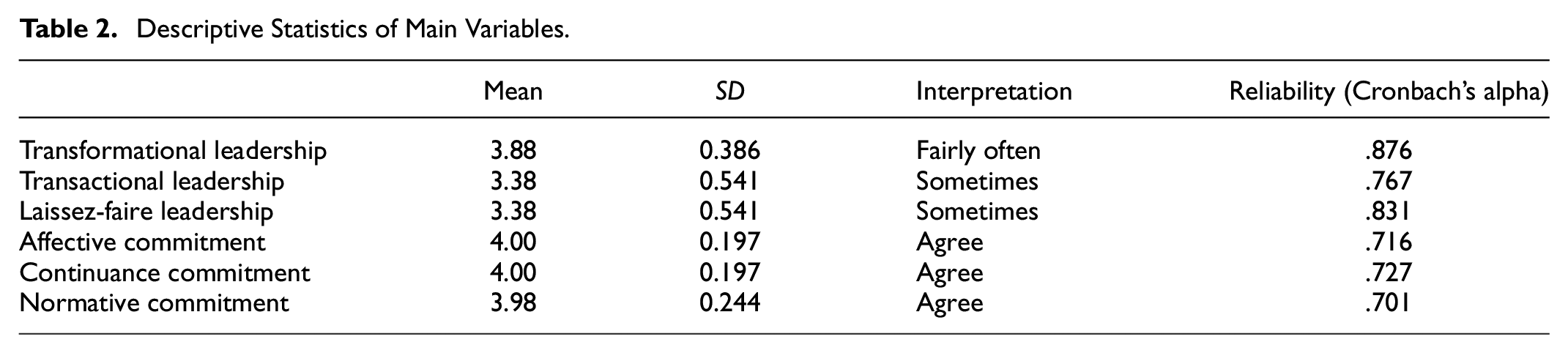
The study found that Transformational leadership was the most frequently encountered leadership style, with a mean score of 3.88 and a standard deviation of 0.386. The Cronbach’s alpha coefficient of .876 indicates high internal consistency for these items. For Transactional and Laissez-faire leadership, the mean scores were 3.38 with standard deviations of 0.541, indicating moderate to high consistency. The scores for Affective and Continuance commitment were 4.00 with a standard deviation of 0.197, indicating strong agreement, while Normative commitment had a mean score of 3.98 with a standard deviation of 0.244, indicating reasonable consistency.
Based on the findings, it appears that participants generally encountered transformational leadership more frequently than transactional or laissez-faire leadership. The mean scores and standard deviations indicate that emotional and ongoing commitment to the organization were both perceived as strong by the participants. Normative commitment showed a reasonable level of agreement among the participants. The descriptive statistics suggest that transformational leadership is prevalent and that the participants are highly committed to the organization (Table 2).
Descriptive Statistics of Main Variables.
Correlation
Table 3 illustrates the Pearson correlation intercorrelations between the subscales to examine whether the subscales were separate measures of the same idea. The subscales in this study are significantly related to each other. The LMX’s two dimensions and the transactional and transformational leadership subscales have notably high correlations, indicating a strong association between these constructs. Moreover, the components of commitment also exhibit meaningful relationships. A correlation of .39 or .79 suggests a moderate to strong relationship between the variables, which means that they are not entirely independent but rather influence each other to a certain extent. These correlations provide insights into the interconnectedness of the variables and their practical significance in understanding the relationships between different aspects of leadership and commitment. In Table 3, The ** superscripts are commonly used in statistical table to indicate the significance of coefficients or statistics, with different letters denoting different levels of significance.
Intercorrelations of the Main Variables.

Note. TRF = transformational leadership; TRA = transactional leadership; LF = Laissez-Faire leadership; AC = affective commitment; CC = continuance commitment; NC = normative commitment.
Regression Results Between Leadership Styles and Affective Commitment
According to the regression analysis, there is a significant and positive correlation between different leadership styles and Affective Commitment (AC). Model 3, which includes all three leadership styles (TRF, LF, and TRA) as predictors, explains the highest variance in AC, that is, 43.6%. All three models are statistically significant, indicating that the predictor variables have a significant relationship with AC. The standardized coefficients (beta) demonstrate that TRF has the most significant and positive connection with AC, followed by LF, whereas TRA has a negative association with AC. These findings suggest that leaders who exhibit transformational and laissez-faire leadership styles have higher levels of AC, while those who display transactional leadership have lower levels. These results align with previous research showing a positive correlation between TRF and AC, and a negative relationship between TRA and AC (Tables 4 and 5). In Table 4, The superscripts are commonly used in statistical table to indicate the significance of coefficients or statistics, with different letters denoting different levels of significance. Typically, lowercase letters (a,b,c,d) indicate siginificance at the 0.05 level.
Model Summary and ANOVA.

Coefficients.

Regression Results Between Leadership Styles and Continuance Commitment
According to the regression analysis, there is a strong relationship between leadership styles (TRF, TRA, and LF) and Continuance Commitment (CC). The models with different combinations of predictors explain between 25.5% and 33.2% of the variation in CC, indicating that leadership styles significantly contribute to CC. Specifically, TRF and LF have a positive impact on CC, while TRA has a negative association with CC. These findings suggest that TRF and LF styles are crucial in developing and maintaining CC in organizations. This aligns with previous studies that demonstrate the impact of specific leadership styles on team cohesion and effective teamwork (Tables 6 and 7). In Table 6, The superscripts are commonly used in statistical table to indicate the significance of coefficients or statistics, with different letter denoting different levels of significance. Typically, lowercase letters (a,b,c,d) indicate siginificance at the 0.05 level.
Model Summary and ANOVA.

Coefficients.

Regression Results Between Leadership Styles and Normative Commitment
The regression analysis indicates a significant relationship between leadership styles (TRF, TRA, and LF) and Normative Commitment (NC) scores. The models show that these leadership styles have a moderate to strong connection with NC scores, explaining between 37.2% and 43.1% of the variability. The ANOVA results support the significance of the models, demonstrating that the regression coefficients are not random.
Specifically, TRF has a positive relationship with NC scores in all models, while LF also displays a positive relationship in models 2 and 3. In contrast, TRA negatively correlates with NC scores in Model 3. These findings suggest that different leadership styles have varying effects on NC scores, with TRF and LF styles positively influencing NC ratings, while TRA style may have a negative impact. These results align with previous studies that have shown a connection between transformational and transactional leadership styles and employee job satisfaction and organizational commitment (Tables 8 and 9).
Model Summary and ANOVA.

Coefficients.

The regression coefficients show how strong and in which direction the relationships are between leadership styles and organizational commitment. These findings have significant practical implications. For example, the positive correlation between transformational leadership (TRF) and organizational commitment suggests that organizations could benefit from fostering a leadership culture that emphasizes inspirational motivation, intellectual stimulation, and individualized consideration. This approach could lead to higher levels of employee commitment, resulting in increased job satisfaction, lower turnover intentions, and greater organizational citizenship behaviors. On the other hand, the negative correlation between transactional leadership (TRA) and organizational commitment suggests that a more contingent reward or management-by-exception approach may be associated with lower levels of commitment. Therefore, it is important to promote transformational and supportive leadership behaviors within the organization.
Discussion and Practical Implications
The findings of a study suggest that transformational and laissez-faire leadership styles have a significant impact on affective, normative, and continuance commitment among nurses, while transactional leadership has comparatively less influence on these types of commitment. These results are in line with previous research on leadership styles and organizational commitment (Bacha & Kosa, 2022; Cummings et al., 2010).
Previous studies have shown that transformational leaders inspire and motivate followers to foster a sense of shared vision and purpose, which is positively linked with affective, normative, and continuous commitment. This study’s findings reinforce this association. On the other hand, the study’s positive relationship between laissez-faire leadership and commitment may seem unexpected, but it could be explained by the idea that followers become more invested in the organization and its goals when given more autonomy and freedom to make decisions (Tosunoglu, 2016).
According to a recent study, healthcare organizations can take specific steps to enhance organizational commitment among nurses by fostering transformational and laissez-faire leadership. To promote transformational leadership, organizations could emphasize developing leadership training programs that focus on inspiring and motivating teams effectively. This can be achieved through inspirational motivation, individualized consideration, and intellectual stimulation. Moreover, creating a supportive organizational culture that encourages autonomy and innovation can help foster laissez-faire leadership, which can help nurses feel more invested in the organization and its goals. However, it’s important to address potential challenges associated with these leadership styles, such as ensuring that laissez-faire leadership does not result in a lack of direction and guidance and that transformational leadership is not perceived as overly controlling. By implementing these strategies, healthcare organizations can work toward improving overall leadership effectiveness and promoting higher levels of organizational commitment among nurses.
Conclusion
In conclusion, the study underscores the critical role of leadership styles in shaping organizational commitment among nurses, with transformational and laissez-faire leadership styles emerging as significant influencers. Healthcare organizations can enhance organizational commitment and overall performance by prioritizing the development of these leadership styles among nurse leaders. This has broader implications for nursing and healthcare management, particularly in addressing challenges such as nurse retention and overall organizational success. By fostering transformational and laissez-faire leadership, healthcare organizations can potentially improve nurse engagement and dedication, leading to a more committed and motivated nursing workforce. Furthermore, the study’s contribution to existing knowledge and its potential impact on international nursing education warrant further exploration, as these findings could have far-reaching implications for nursing practices and education on a global scale.
Footnotes
Acknowledgements
I am thankful to my guide Dr. R. Subashini of VIT Business School for her support in my study.
Author Note
The submitted article is my own work and it is not under any review by other journals.
Author Contributions
All authors have participated in (a) conception and design, or analysis and interpretation of the data; (b) drafting the article or revising it critically for important intellectual content, and (c) approval of the final version.
Declaration of Conflicting Interests
The author(s) declared no potential conflicts of interest with respect to the research, authorship, and/or publication of this article.
Funding
The author(s) received no financial support for the research, authorship, and/or publication of this article.

Data Availability Statement
Data sharing not applicable to this article as no datasets were generated or analyzed during the current study.