




Abstract
This study analyzes 6,245 news articles from 437 media outlets (2013–2024) to assess global sentiment toward the Belt and Road Initiative (BRI) amid Sino-U.S. relations. Based on a cluster analysis of UN voting records, countries are grouped into four political stances: pro-China, pro-U.S., neutral-U.S., and neutral-China. Correlation analysis show pro-U.S. countries show more negative sentiment toward the BRI, while pro-China countries show more positive sentiment. Notably, this study introduces two moderating variables to the alignment with U.S./China and BRI sentiment relationship—value conflict and reciprocal benefit. The results show value conflict strengthens the negative association between alignment with U.S. and the BRI sentiment in neutral-China countries, while reciprocal benefit strengthens the positive association between alignment with China and the BRI sentiment in pro-China and neutral-U.S. countries. Findings indicate strengthening the BRI’s global support requires engaging neutral countries and emphasizing the reciprocal benefits of participation.
Plain Language Summary
This study looks at how the world views China’s Belt and Road Initiative (BRI) by analyzing 6,245 news articles published between 2013 and 2024 by 437 media outlets worldwide. It examines how attitudes toward the BRI are related to countries’ political positions in the context of China–U.S. relations. Using voting data from the United Nations, countries were grouped into four categories: those that tend to side with China, those that side with the United States, and two neutral groups leaning slightly toward either China or the U.S. The analysis shows that countries aligned with the U.S. generally express more negative opinions about the BRI, while those aligned with China show more positive ones. The study also looks at two factors that can influence this relationship: value conflict (differences in political or social values) and reciprocal benefit (mutual economic or strategic gains). It finds that value conflict makes U.S.-aligned countries in the neutral-China group view the BRI more negatively, while reciprocal benefit makes both pro-China and neutral-U.S. countries view it more positively. Overall, the findings suggest that to gain broader global support, the BRI should focus on building partnerships with neutral countries and highlighting the mutual benefits of participation rather than emphasizing political alignment.
Keywords
Introduction
Launched by China in 2013, the Belt and Road Initiative (BRI) constitutes an international cooperation framework that has fundamentally reshaped global economic connectivity and regional development paradigms (Khan et al., 2018). As a comprehensive strategy integrating geopolitical, economic, and diplomatic dimensions, the BRI has achieved remarkable progress: China’s foreign contracted projects now span over 184 countries and regions, while trade volume with the BRI partner countries has surged from 1.9 trillion to 2.8 trillion (J. Wang, 2024). The initiative has emerged as a crucial platform for fostering infrastructure development, enhancing regional connectivity, and promoting inclusive growth across Eurasia and beyond. However, its implementation faces intricate geopolitical challenges, especially from rival powers, with the U.S. posing the strongest opposition through its competing development initiatives (Ruan, 2019).
Scholars have noted the divergent emphasis frames utilized by China and the U.S. in their discourse on the Belt and Road Initiative (Teo & Xu, 2023; Yang & Van Gorp, 2023). Specifically, the U.S. often frames the BRI within the context of its strategic competition with China, portraying it as a key arena of geopolitical rivalry (C. Zhu & Ni, 2024). This perspective frequently emphasizes concerns related to “value conflict,”“predatory lending,” and the “debt trap,” consequently depicting the initiative as problematic (Lai et al., 2020). By contrast, Chinese official discourse tends to emphasize frames of “Reciprocal Benefit,” underscoring economic opportunities and development cooperation as a means to encourage wider international engagement (Adeli & Ammann, 2024).
At the same time, as the power gap between China and the U.S. narrows and strategic competition escalates, other countries are increasingly pressured to make decisions about aligning with one of the two major powers (Hill et al., 2020). U.S. allies frequently adopt and reinforce negative discourses surrounding the BRI, reflecting and reproducing the strategic orientations of the U.S. (Huang, 2018) Meanwhile, the initiative has facilitated the deepening of collaborative frameworks between China and its partner countries (Huang, 2016). As a result, with the intensification of multidimensional competition between the U.S. and China, global political frames and discourse on the BRI is becoming more polarized (Franceschini & Loubere, 2022).
Extant research has examined how Sino-US relations affect global perceptions of the BRI. For example, Chen (2022) analyzed how the Italian newspaper Corriere della Sera’s stance on the BRI shifted within the context of Italy’s alliance with the U.S., while Mao (2019) studied the impact of American nationalist ideologies on India’s coverage of the initiative. However, these studies typically focus on individual countries or regions, specific media sources, or analyze the influence of either the U.S. or China in isolation.
Moreover, there is a lack of studies exploring how the U.S.-promoted “Value Conflict Theory” and China’s “Reciprocal Benefit Theory” influence the relationship between political stance and sentiment toward the BRI.
As one of the world’s most significant bilateral relationships, Sino-US relations profoundly shape global perceptions of the BRI. In this context, the current study uses cluster analysis, sentiment analysis, and statistical analysis to examine 6,245 news articles on the BRI published by global news outlets between September 2013 and October 2023. Specifically, this study examines how Sino-US relations influence global sentiment toward the BRI and explores the roles of value conflict and reciprocal benefit in shaping this relationship. Importantly, the findings and conclusions of this study are derived from rigorous statistical analyses of reliable and credible data sources. We adhere strictly to scholarly neutrality and scientific ethics, ensuring that our results are driven solely by the data.
Literature Review
Sino-US Relations and Political Stance
Shifts in the balance of power within international relations, especially the distribution of power among key nations, fundamentally shape the global environment (Jones et al., 2017). After the dissolution of the Soviet Union, the bipolar world order characterized by U.S.-Soviet rivalry came to an end, temporarily leading to a structure of “one superpower, multiple great powers” (Wu, 2025). China’s rapid development has progressively strengthened its central role in international relations, reducing the power gap with the U.S. and escalating strategic competition between the two countries. The U.S.–China relationship has increasingly evolved into a strategic rivalry encompassing military, economic, and geopolitical dimensions (Ahmed, 2025). In its diplomatic engagements, the U.S. consistently emphasizes the concept of a “rules-based international order” (Nye, 2008), utilizing its soft power—ranging from cultural influence to discursive authority—to maintain its global standing. The U.S. has frequently characterized China’s actions as a “challenge” and “threat” to this order, thereby portraying China as a “major disruptor” (Gewirtz, 2024). By contrast, China primarily aims to enhance its international influence through initiatives like the Belt and Road Initiative (BRI), infrastructure investment, and development aid, while simultaneously condemning U.S. power politics (Ezeanyika et al., 2024). At the socioeconomic level, China and the U.S. remain each other’s important trading partners and investment destinations (Congressional Research Service, 2024). However, their relationship is simultaneously marked by recurring frictions over technological restrictions, supply chain security, and financial competition (Li et al., 2020). Sino-US relations not only influence bilateral interactions but also have a profound impact on reshaping the international order across multiple dimensions (Li, 2011).
Regarding the BRI, the U.S. has promoted critical narratives about China and engaged in “threat construction,” (Blanchard, 2021) encouraging its allies and countries within its sphere of influence to align either with China or the U.S. Meanwhile, China’s economic relationships with BRI partner countries have played a key role in reshaping their perceptions of China, helping to create a positive circumstance. Constructivist theory posits that economic interdependence mutually shapes identities, cultivating an “ingroup-outgroup” mentality and a collective identity, which in turn helps distinguish one group from external entities (Wendt, 2008). As a result, strong trade and investment ties with China are likely to significantly strengthen a country’s alignment with China and foster a more positive perception of the country, contributing to the creation of a “pro-China stance” bloc in the global order, in contrast to the U.S. and its allied network (Chi, 2015).
Prior studies have analyzed how Sino-US relations impact China’s national image building (Guo, 2017), network power competition (Miao & Xing, 2024), and global security and governance (Tehseen, 2017), etc. These studies often use the indicator of voting alignment in the United Nations General Assembly to assess the level of political, economic, and security-related closeness between a country and either China or the U. S. Research findings often lead to similar conclusions: Either “alignment with China significantly enhances a country’s positive perception of China,” or “alignment with the U.S. significantly diminishes a country’s positive perception of China” (J. Wang, 2023). While these studies offer valuable insights into the U.S.-China competitive relationship, they often demonstrate a tendency for “binary thinking,” oversimplifying complex international relations into opposing camps. This reductionist approach overlooks the complexities and diversity of geopolitical interactions, potentially resulting in oversimplified understandings and incomplete solutions.
This study argues that while the intensifying U.S.-China strategic competition pressures countries to take sides, there are far more possibilities beyond the binary categories of “pro-China” and “pro-U.S.” For instance, are there countries that align closely with both China and the U.S.? Do such countries display varying perceptions and sentiments toward the BRI? Addressing these questions helps counteract binary thinking, providing new theoretical and practical frameworks for developing region-specific and country-specific BRI strategies.
Based on the literature review above, this study proposes the following research question:
Sino-US Relations and Global Sentiment Toward the BRI
News media serve as direct channels for conveying national perceptions of China and attitudes toward the BRI. In many ways, the BRI initiative depends on media outlets for constructing its image and disseminating information, thereby shaping global public perception and sentiment (Zaw & Yu, 2024). News coverage can never achieve complete objectivity; although objectivity has traditionally been regarded as a core principle of journalism, numerous instances show how personal values influence news narratives, leading them to diverge from this ideal (Allern, 2002). Both theoretically and empirically, scholars are increasingly acknowledging that news reporting inherently involves “emotionality.” Some even contend that emotions offer a stronger foundation for journalism, signifying an “emotional turn” in the field (Peng, 2019). Existing research on news emotionality has largely concentrated on sentiment analysis as an end, remaining confined to the descriptive examination of affective expressions in journalistic texts. For instance, through a quantitative analysis of 100,000 news articles, Berger and Milkman (2012) demonstrated that news content often contains high levels of emotional arousal. Xuan and Wu (2024) identified the use of distinct emotional frames in mainstream international media, whereas O’Neill and Nicholson-Cole (2009), in an empirical study of climate change communication, demonstrated that emotionalized reporting functions as a crucial mechanism for affective mobilization. Nevertheless, limited empirical research has examined the determinants of news emotionality, particularly those extending beyond journalists’ or editors’ subjective orientations. Addressing this research gap, the present study introduces political stance as a key explanatory dimension, using the BRI as a case to systematically examine how political alignment shapes the emotional intensity of news coverage and the mechanisms through which this occurs. In doing so, the study extends existing scholarship by offering a more comprehensive understanding of how political contexts condition emotional expressions in global news discourse.
A country’s media coverage directly reflects its mainstream political ideologies, influencing, shaping, and altering public perceptions, attitudes, and behaviors toward the BRI (Ryffel et al., 2014). It is therefore logical to infer that a nation’s reporting on the BRI is shaped by its political stance within international relations networks, which ultimately reflects in the emotional tone of its news coverage.
Specifically, U.S. allies and other countries within its sphere tend to internalize the U.S.-led international order, norms, and ideologies. In the case of the BRI, this is reflected in the widespread adoption of U.S. narratives and agenda-setting frameworks in media coverage. The U.S. has negatively portrayed the BRI as a “debt trap,”“new colonialism,” and a “China’s competition for global dominance” (G. Zhu & Huang, 2016). Countries including the United Kingdom, Italy, and India, have adopted similar narrative frameworks (Y. Liu, 2024). Furthermore, to preserve its influence over traditional spheres of power, the U.S. has consistently sought to undermine the authority, legitimacy, and credibility of both the BRI and the Asian Infrastructure Investment Bank (AIIB) within key international organizations and agendas (Qian et al., 2023). Most countries within the U.S.-led system have largely embraced these positions and adjusted their actions accordingly.
At the same time, China has consistently countered hostile narratives, such as the “threat theory,” by promoting alternative discourses like “a community with a shared future for mankind,” with the goal of fostering positive sentiments toward the BRI in other countries. As a result, countries with a positive relationship with China tend to view the BRI favorably. For instance, Indonesia has typically reported on the BRI in a positive manner (He & Luo, 2023). Similarly, the Association of Southeast Asian Nations (ASEAN) and Central Asian countries have generally maintained a more positive attitude in their coverage of the BRI (Yu, 2024).
Therefore, this study proposes the following research questions:
“Value Conflict Theory” and “Reciprocal Benefit Theory”
The U.S. has consistently employed a diplomatic strategy of fostering shared-value communities to strengthen its alliances. A historical analysis reveals distinct patterns in this approach across different periods. During the Revolutionary Era (18th century), the U.S. contrasted itself with British monarchism, positioning itself as an experiment in representative democracy. This narrative strategy is evident in The Federalist Papers, which critiqued Europe’s ancien régime (Zhao, 2009). In the Cold War Era (1947–1991), the U.S. constructed a strategic rivalry framework based on ideological disparities, framing its institutional differences with the Soviet Union as a paradigm clash between the “free world” and “authoritarian systems,” a discourse systematically articulated in the National Security Council Report 68 (NSC-68; Gong, 2022). Following the Cold War, the post-2001 period saw the emergence of the “axis of evil” concept within the counterterrorism context, shaping security policy discourse as documented in the U.S. National Security Strategy (Popović & Puljić, 2024). In the contemporary strategic reorientation (2017–present), China has been officially characterized as a “strategic competitor” in the U.S. National Security Strategy, with an emphasis on divergent development models and governance systems. This cognitive framework aligns with the longstanding U.S. diplomatic tradition of “constructing self-identity through defining the Other” (Huntington, 2013).
Regarding the BRI, the value conflict paradigm has consistently operated as a conceptual underpinning structuring U.S. evaluative discourse. This theoretical lens positions geopolitical and ideological divergences as constitutive elements shaping Washington’s systematic critique of Beijing’s transcontinental connectivity strategy. U.S. strategic discourse portrays the BRI as a geoeconomic tool that institutionalizes China’s state-led development model through asymmetric financing. It is framed as serving two goals: legitimizing Beijing’s governance through conditional infrastructure funding and creating structural alternatives to the liberal international order via norm diffusion (Li, 2020). Overall, in mobilizing allies against the BRI, the U.S. has strategically constructed China as the “Other,” positioning its own “democratic” and “liberal” values as universal benchmarks (Yan, 2020), leveraging a “democracy versus authoritarianism” narrative to reinforce ideological divisions and uphold its traditional spheres of influence. This framing intensifies identity conflicts between China and the U.S. across political systems, economic models, and cultural traditions, further deepening emotional divides between its allies and China.
Since its inception in 2013, the BRI has been institutionally anchored in a normative framework of “collaborative reciprocity,” emphasizing equitable partnerships, polycentric governance, and collective gains within the global political economy. Chinese policymakers have consistently framed the BRI as a transnational mechanism for redistributive development, rooted in principles of non-exclusionary participation and systemic interdependence. Structurally, the initiative is positioned as a global public goods platform, where infrastructural connectivity serves as both a material and symbolic conduit for reconfiguring North-South developmental asymmetries (Acharya, 2016). Empirically, the BRI’s operational logic unfolds through three intersecting dimensions: material interdependence, reflected in large-scale infrastructure projects such as port modernization and rail corridors that integrate global value chains (Global Value Chain Development Report, World Bank, 2019); financial architecture, demonstrated by multilateral funding mechanisms like the Asian Infrastructure Investment Bank and the Silk Road Fund, which facilitate transnational capital flows while challenging the hegemony of Bretton Woods institutions (Hameiri & Jones, 2016); and normative entrepreneurship, which promotes South-South cooperation as an alternative epistemic paradigm to Western-dominated neoliberal globalization (Mawdsley, 2018). Chinese state discourse highlights the BRI’s dual role as both a corrective mechanism for global infrastructure deficits—estimated at 94 trillion dollars by 2040, according to G20 assessments—and an institutional laboratory for post-Washington Consensus multilateralism, as evidenced by the project financing patterns of the BRICS New Development Bank (Griffith-Jones, 2014). This framing positions China not merely as a bilateral actor but as a systemic stakeholder in global public goods provision, deliberately contrasting its “developmental peace” model (Gozali & Al-Fadhat, 2024) with Western conditionality-based aid frameworks.
The 2023 White Paper issued by China’s State Council Information Office serves as a strategic narrative instrument, systematically documenting the BRI’s geoeconomic impact through emblematic infrastructure projects. Key examples include the China-Europe Railway Express, the China-Laos Railway, the Jakarta-Bandung High-Speed Railway, and 79 overseas economic cooperation zones fostering institutionalized production networks (State Council Information Office of China [SCIO], 2023). The White Paper frames these achievements as manifestations of “developmental multilateralism” (Trade and Development Report, UN Trade and Development, 2022), asserting direct causal linkages between BRI participation and infrastructure expansion, economic growth, and labor market transformation. Chinese state media employs a tripartite strategy to reinforce these narratives. Overseas Chinese-language media further amplify this messaging through spatialized lexicons, emphasizing “construction” to highlight physical transformation, “strategy” to frame the BRI as deliberate statecraft, and “corridor” to visualize economic integration through “transport geography” (Huang, 2017).
Overall, the discourse surrounding the BRI reflects a competition between two contrasting narratives: “value conflict” versus “reciprocal benefit.” Specifically, the notion of value conflict refers to a perspective—primarily associated with the U.S.—that interprets international frictions as stemming from fundamental differences in values, political systems, or ideologies, and regards such conflicts as central to countries’ pursuit of their interests. By contrast, the notion of reciprocal benefit, largely advanced by China, emphasizes the potential for countries to realize mutual gains through cooperation, thereby reducing conflict, fostering trust, and promoting stable multilateral relations.
Based on the above literature review, this study proposes the following research questions:
In summary, the overall research framework is illustrated respectively in Figures 1 and 2.

Research framework—Moderator 1.

Research framework—Moderator 2.
Methods
Sample
UN General Assembly Voting Data
This study operationalizes alignment through a UN General Assembly (UNGA) voting convergence analysis, employing a dyadic spatial voting model to quantify ideological proximity between countries. The methodology builds on Bailey et al.’s (2017) ideal point estimation framework, adapted to measure asymmetric alignment with China and the U.S. during the BRI formative decade (2013–2023). Roll-call voting records for 967 substantive resolutions were retrieved from the Voeten (2023) UN Voting Dataset (Georgetown Dataverse). The temporal scope spans full UNGA sessions (78th–77th), corresponding to China’s BRI implementation phase. Votes were coded as follows: 1 = Yes (affirmative alignment), 0 = Abstain (neutral/ambiguous), −1 = No (negative alignment). The bilateral agreement score S(i,j) for country i with reference country j (China or the U.S.) is calculated as:

Where: V i,k , V j,k represent the vote positions of country i and reference country j on resolution k ; A = 0.5 if V i,k = 0 (adjustment for abstentions), otherwise A = 0; N = 967 (total substantive resolutions). This produces two continuous indices: S i, China (alignment with China) and S i, US (alignment with U.S.). Construct validity is assessed by correlating the alignment scores with established measures, such as UNGA ideal points from Strezhnev and Voeten (2013), ensuring methodological rigor.
Global Media Coverage on the Belt and Road Initiative (BRI)
This study employs a transnational media coverage analysis to interrogate global sentiment toward the BRI, operationalized through a corpus of 6,245 English-language news articles from 437 media outlets across 50 countries. The data collection protocol for this study involved selecting sources from the ProQuest Global Newsstream database. ProQuest, the most widely utilized authoritative database in academic research, provides the world’s most comprehensive press repository with over 3,000 digitized publications from globally recognized sources (ProQuest, 2025). Achieving 95% historical completeness, ProQuest is frequently employed for content and framing analysis in communication studies (M’Bareck, 2019). The search parameters were set as follows: the keywords “One Belt, One Road,”“Belt and Road Initiative,” and “OBOR” were used, with a date range from 1 September 2013 (when the BRI was first proposed) to 31 October 2024 (at the time of writing), and the language of the sources was limited to English. Search parameters, including keywords, date range, and language restrictions, were applied consistently across all countries. Since this study focuses on how U.S.-China strategic competition influences the global sentiment toward the BRI, to align with the study’s focus on third-party perspectives, exclusion criteria were applied to eliminate Chinese media outlets such as Xinhua and Global Times, as well as U.S. media outlets. The final dataset includes 6,245 BRI-related English news articles from 437 mainstream news outlets across 50 countries. For non-English-speaking countries, an additional verification process was conducted to ensure the representativeness and credibility of the selected sources, including cross-referencing with local media rankings and readership statistics.
First, in countries where English is not the native language but is an official language (e.g., India, Pakistan, Bangladesh), the chosen English-language newspapers are considered authoritative. Second, for countries where English is not the native language but is widely spoken (e.g., Thailand, Israel, several Arab nations), the selected English newspapers are among the most respected and influential within the country. Third, in developed countries where English is not the primary language but authoritative English newspapers exist (e.g., Les Échos in France), these sources are included. Therefore, we ensure all selected news outlets are reputable and reflect mainstream political views within their respective countries. These procedures collectively enhance the methodological rigor of the dataset, making the sample transparent, replicable, and providing a basis for verification in future research.
Methods
Cluster Analysis
This study employs K-Means clustering, an unsupervised machine learning algorithm, to categorize countries’ political stances based on their calculated divergence (D i ) in alignment with U.S. and China. K-Means clustering was selected for its scalability, as it efficiently handles large datasets. Additionally, it offers interpretability through its clear centroid-based representation of stance archetypes, which aids in understanding the distinct groupings within the data. Moreover, K-Means aligns with the theoretical consistency of spatial voting theory, which assumes that preferences are normally distributed, making it a suitable method for analyzing the voting patterns of UN member countries (Savvas et al., 2017). Based on the perplexity model proposed by Blei et al., the “elbow method” is used to determine the optimal number of clusters.
Sentiment Analysis
Sentiment analysis involves analyzing, processing, summarizing, and reasoning about emotionally charged text. By conducting sentiment analysis, it becomes possible to extract opinions, recognize emotions, and assess attitudes more effectively. This study employs the sentiment lexicon embedded in LIWC (Linguistic Inquiry and Word Count) for sentiment analysis. Developed by Pennebaker et al., LIWC is a language analysis tool known for its detailed statistical indicators and high analytical accuracy. Due to its strong reliability and validity, LIWC has been widely used in sentiment analysis of news coverage and other related fields (Smirnova et al., 2017).
Measures
Dependent Variable
Global sentiment toward the BRI: The sentiment value in this study is calculated based on the positive and negative word counts generated by LIWC, as well as the total word count. The calculation formula is: (Positive Word Count − Negative Word Count)/(Positive Word Count + Negative Word Count). As seen from the formula, the larger the value, the more positive the sentiment of the text; conversely, the smaller the value, the more negative the sentiment.
Independent Variable
Political stance: The types of political stance in this study is derived from cluster analysis based on the alignment score generated from the United Nations General Assembly voting records, using Python 3.6.0 and the K-means clustering algorithm. The clustering is based on two continuous indices: S i, China (alignment with China) and S i, US (alignment with U.S.). The algorithm is run with different k values, and the sum of squared errors is observed as it changes with k. The optimal k value is found to be 4.
Moderating Variables
Value Conflict
This study operationalizes value conflict through a tripartite construct of cultural, political, and economic distance between nation-countries and the U.S.
(1) Cultural distance: The Hofstede cultural dimension data is used to measure cultural distance. This includes six cultural dimensions: power distance, individualism/collectivism, masculinity/femininity, uncertainty avoidance, long-term/short-term orientation, and indulgence/restraint. The cultural distance is calculated using the measurement method developed by Kogut and Singh (1988), with the formula as follows:

Where: CDj is the cultural distance between the U.S. and country j; Iij is the score of country j on the i-th cultural dimension; IiN is the score of the U.S. on the i-th cultural dimension; and Vi is the variance of scores on the i-th cultural dimension. Data for each country on these six dimensions comes from the publicly available Hofstede index.
(2) Political distance: The political distance is measured using the Worldwide Governance Indicators (WGI), which includes six dimensions: voice and accountability, political stability and absence of violence, government effectiveness, regulatory quality, rule of law, and control of corruption. Following the approach of Y. Wang et al. (2015), the average of the six indicators for each country is calculated, and the absolute difference between each country’s average and the U.S. average is taken as the political distance.
(3) Economic distance: The economic distance is measured based on the economic freedom index published by the Heritage Foundation. This index evaluates the economic system of each country through 12 economic freedom indicators, such as government integrity, judicial efficiency, and financial freedom, with each indicator scored on a 0 to 100 scale. The absolute difference between a country’s economic freedom score and the U.S. score is taken as the economic distance, following the methodology of Z. Liu and Huang (2019).
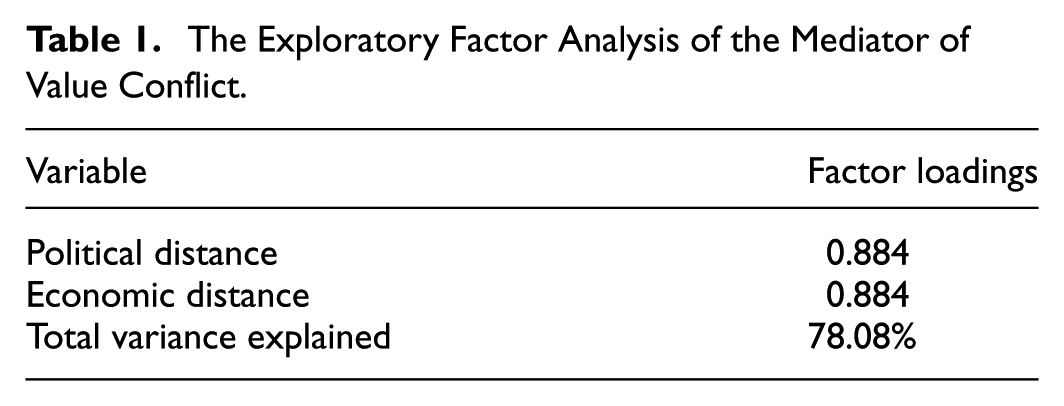
Subsequently, this study conducted exploratory factor analysis (EFA) on the three variables using SPSS 22.0. A single common factor was extracted; however, the factor loading for cultural distance was −0.425. This indicates that cultural distance contributes minimally to the latent construct. Given this finding, cultural distance was excluded, and a secondary EFA was performed exclusively on political and economic distances. The factor component matrix is presented in Table 1. The KMO measure was 0.602, and Bartlett’s test was significant (p < .001). Cronbach’s alpha was .85, indicating strong internal consistency. These results confirm the suitability of the factor analysis with adequate reliability and validity. Based on results, the composite measure of value conflict was ultimately derived from the equally weighted average of political distance and economic distance from the U.S.
The Exploratory Factor Analysis of the Mediator of Value Conflict.
Reciprocal Benefit
The strategic objectives underpinning China’s BRI—including enhanced infrastructure connectivity, trade liberalization, and financial market integration—are widely acknowledged in extant scholarship (Ahsan et al., 2023). Therefore, this study operationalizes reciprocal benefit through three proxy variables: revenue generated from overseas contracted projects (infrastructure connectivity), bilateral trade dependence (trade facilitation), and foreign direct investment interdependence (financial integration). These metrics collectively assess the hypothesized mutual benefits framework intrinsic to BRI’s transnational cooperation paradigm.
(1) Infrastructure connectivity: This is derived from data on China’s foreign contracting project revenue, sourced from the Statistical Bulletin on China’s Foreign Contracting Projects, published by the Ministry of Commerce of China. The dataset spans 2008 to 2023 and is categorized by country and region.
(2) Trade dependence: Trade dependence is the proportion of a country’s bilateral trade with China relative to its GDP. Data of the bilateral trade dependence is sourced from the UN Comtrade (2024).
(3) Direct investment dependence: This is the proportion of a country’s stock of foreign direct investment from China relative to its total foreign direct investment stock. Data is sourced from the “Statistical Bulletin on China’s Foreign Direct Investment” published by the Ministry of Commerce of China (2023).
This study then conducted exploratory factor analysis (EFA) on the three variables using SPSS 22.0. Prior to this, the values of infrastructure connectivity were log-transformed. A single common factor was extracted; however, the factor loading for direct investment dependence was 0.427. This indicates that direct investment dependence contributes minimally to the latent construct. Given this finding, direct investment dependence was excluded, and a secondary EFA was performed exclusively on infrastructure connectivity and trade dependence. The factor component matrix is presented in Table 2. The KMO measure was 0.572, and Bartlett’s test was significant (p < .001). Cronbach’s alpha was .83, indicating strong internal consistency. These results confirm the suitability of the factor analysis with adequate reliability and validity. Based on the results, the composite measure of reciprocal benefit was ultimately derived from the equally weighted average of infrastructure connectivity and trade dependence.
The Exploratory Factor Analysis of the Mediator of Reciprocal Benefit.

Result
Cluster Analysis
We perform cluster analysis within a two-dimensional framework, comparing alignment with China versus alignment with the U.S. This approach is applied to a sample of 50 BRI-reporting nations, with their spatial distribution visualized using multidimensional scaling, implemented through Python’s Matplotlib library (Figure 3). Specifically, the primary purpose of cluster analysis is to categorize observations (in this case, countries), into groups such that entities within the same group exhibit greater similarity in feature space, whereas those in different groups display greater dissimilarity (Kaufman & Rousseeuw, 2009). In this study, similarity is operationalized through countries’ alignment scores with China and the U.S., forming a two-dimensional feature space. By establishing a cross-axis at the mean value of 0.5 on each dimension, a straightforward and interpretable partitioning is achieved, capturing natural separations in the data. This quadrant-based classification adheres to the methodological principles of cluster analysis: countries within the same quadrant demonstrate comparable political alignment, while inter-quadrant comparisons reveal distinct differences. The resulting clusters are further substantiated and visually represented through bubble chart visualization, highlighting their clear differentiation. The analysis reveals three key findings. First, the bipolar competition structure exhibits mutually exclusive alignment patterns, with no nations demonstrating high alignment with both powers or exhibiting equidistant neutrality. Second, a longitudinal analysis of UN General Assembly voting records (2013–2024) reveals significant continuity in stances over time. Third, while limited realignment patterns emerge, such as Turkey’s shift from a neutral stance with a slight tilt toward China in 2013 to a pro-China position in 2023, no substantial counter-alignment reversals are observed between the Pro-U.S. and pro-China blocs.

K-Means cluster analysis of alignment with China and alignment with U.S.
Specifically, within the Sino-U.S. competitive framework, the political stances of countries can be classified into four distinct types:
(1) Pro-China: This category includes 12 countries, such as Pakistan, Egypt, and Vietnam. These nations show strong alignment with China in their voting records. They typically maintain close economic and political ties with China.
(2) Neutral but leaning toward the U.S. (hereafter “neutral-U.S.”): After quantification, the alignment score is close to the mean value of 0.5, but it shows higher alignment with the U.S. and lower alignment with China. This group includes eight countries, such as Ireland, New Zealand, and Australia. These countries generally maintain a neutral stance in international affairs but exhibit a measurable tendency to align with the U.S. in their UN voting patterns. While occasional overlaps with China occur, their overall voting behavior shows a consistent preference for U.S. positions on key issues.
(3) Neutral but leaning toward China (hereafter “neutral-China”): After quantification, the alignment score is close to the mean value of 0.5, but it shows higher alignment with China and lower alignment with the U.S. This category consists of 20 countries, including Malaysia, Turkey, and Oman. These nations also uphold a broadly neutral stance in global affairs but display a clear inclination to align with China in their voting records. Although they sometimes vote in line with the U.S., their patterns indicate a stronger overall affinity toward China on significant matters.
(4) Pro-U.S.: This group includes 10 countries, such as the UK, Canada, and Israel. These nations show strong alignment with the U.S. in their voting records. They generally maintain close diplomatic relations and share strategic interests with the U.S.
Thus, under the Sino-U.S. strategic competition framework, alongside the broadly defined pro-China and pro-U.S. stances, there exists a substantial “neutral camp,” which can be further subdivided into neutral but lean toward the U.S. and neutral but lean toward China. These findings address RQ1.
Correlation Analysis
The correlation analysis of key variables (see Table 3) reveals a significant negative correlation between alignment with U.S. and sentiment toward the BRI. This indicates that countries more closely aligned with the U.S. tend to express more negative sentiment toward the BRI. In contrast, a significant positive correlation exists between alignment with China and sentiment toward the BRI, suggesting that the stronger a country aligns with China, the more favorable its sentiment toward the BRI. These findings fully address RQ2.
Descriptive Statistics and Pearson Correlation Analysis Results of Main Variables (N = 6,245).

p < .01.
Examining the Moderating Role of the Value Conflict in the Relationship Between Alignment With U.S. and Global Sentiment Toward the BRI
Prior to conducting the moderation analyses using PROCESS 4.2, this study standardized the key variables: alignment with the U.S., global sentiment toward the BRI, and value conflict. The analysis was conducted separately for four country categories: pro-China, pro-U.S., neutral-U.S., and neutral-China. As shown in Table 4, the interaction term (alignment with the U.S. × value conflict) was not statistically significant for pro-China (β = .267, p > .05), neutral-U.S. (β = −.339, p > .05), or pro-U.S. countries (β = .174, p > .05). However, the interaction was significant for neutral-China countries (β = .406, p < .05). These findings indicate that value conflict moderates the relationship between alignment with the U.S. and sentiment toward the BRI only among neutral-China countries. Specifically, in this group, higher levels of value conflict—reflecting greater political and economic distance from the U.S.—strengthen the positive association between U.S. alignment and support for the BRI. To illustrate this interaction, Figure 4 presents predicted sentiment toward the BRI at two levels of value conflict (high = +1, low = −1) among neutral-China countries.
Examining the Moderating Effect of Value Conflict in the Relationship Between Alignment With U.S. and Sentiment Toward the BRI.

Note.*p < 0.05. **p < 0.01. ***p < 0.001.

Moderation effect of value conflict on alignment with U.S. → Global sentiment toward the BRI for neutral-China nations.
The Moderating Role of the Reciprocal Benefit in the Relationship Between Alignment With China and Global Sentiment Toward the BRI
In a similar vein, this study standardized the variables—alignment with China, global sentiment toward the BRI, and reciprocal benefit—prior to conducting moderation analyses using PROCESS 4.2. The analyses were carried out separately for countries classified as pro-China, pro-U.S., neutral-U.S., and neutral-China. As presented in Table 5, the interaction term (alignment with China × reciprocal benefit) was statistically significant for pro-China countries (β = .593, p < .01) and neutral-U.S. countries (β = 1.148, p < .001), but not for neutral-China (β = .314, p > .05) or pro-U.S. countries (β = −.215, p > .05). These results suggest that reciprocal benefit moderates the relationship between alignment with China and sentiment toward the BRI only for pro-China and neutral-U.S. countries. Specifically, in both groups, greater reciprocal benefit—indicative of deeper economic interdependence with China—amplifies the positive effect of alignment with China on support for the BRI. To illustrate these interactions, Figures 5 and 6 display the predicted sentiment toward the BRI at two levels of reciprocal benefit (high = +1, low = −1) for pro-China and neutral-U.S. countries, respectively.
Examining the Moderating Effect of Reciprocal Benefit in the Relationship Between Alignment With U.S. and Sentiment Toward the BRI.

Note.*p < 0.05. **p < 0.01. ***p < 0.001.
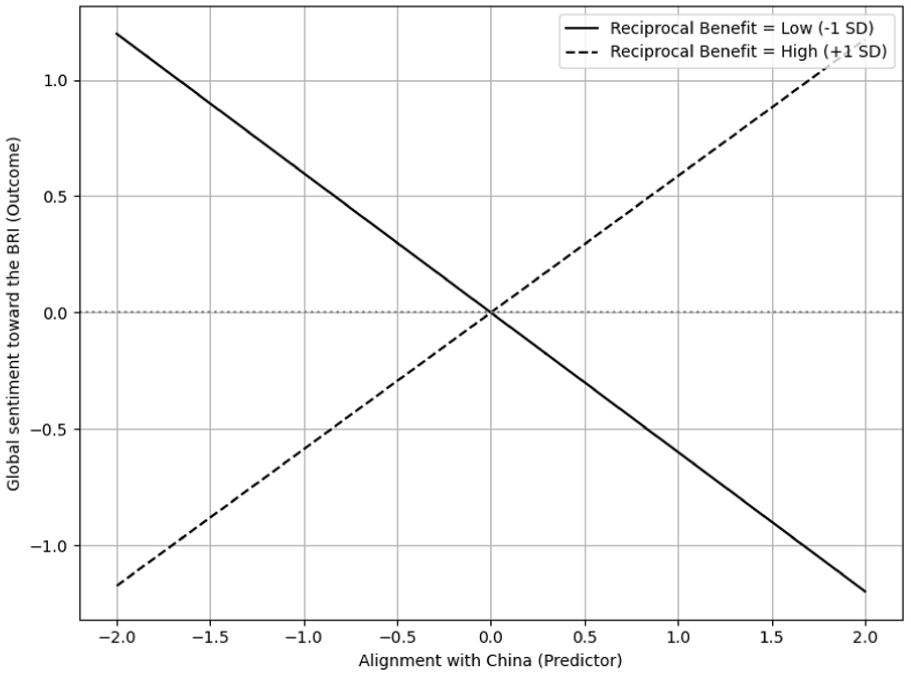
Moderation effect of reciprocal benefit on alignment with China → Global sentiment toward the BRI for pro-China nations.

Moderation effect of reciprocal benefit on alignment with China → Global sentiment toward the BRI for neutral-U.S. nations.
Conclusion
This study empirically examines 6,245 Belt and Road Initiative (BRI)-related news articles from global media through cluster analysis, sentiment analysis, and statistical methods. It investigates how Sino-U.S. relations shape international sentiment toward the BRI, with particular focus on the moderating effects of value conflict and reciprocal benefit.
In addressing RQ1, this study quantifies national alignment indices with China and the U.S. based on United Nations General Assembly voting records using the K-means clustering algorithm. The findings reveal four distinct categories of political stances within the Sino-U.S. context, moving beyond the conventional binary classification of “pro-China” and “pro-U.S.” The identification of two additional categories—neutral-U.S. and neutral-China, demonstrating a more nuanced understanding of political stances. Previous research has largely assumed that national positions can be categorized into two opposing stances—pro-China/anti-U.S. or pro-U.S./anti-China—reflecting the prevalence of a “binary framework” as either an analytical assumption or a structural pressure (Figiaconi, 2025). Building on this dichotomous baseline, our study identifies more nuanced variations by distinguishing four distinct categories—pro-China, neutral-China, neutral-U.S., and pro-U.S.—thereby highlighting the strategic diversity and hybrid positioning adopted by many countries amid major-power rivalry. Many countries pursue more flexible and pragmatic foreign policy strategies. Rather than aligning strictly with one great power, these nations often adopt hedging strategies (Kuik, 2016), balancing economic and political interests to maintain strategic autonomy in an increasingly multipolar world (Kuik, 2021). In addition, in the fields of international communication and public diplomacy, prior studies have primarily focused on addressing external value bias and negative portrayals—for instance, China’s long-standing efforts to rectify the negative “propaganda” label in shaping its international image (Zhang, 2014). Some scholars have further noted that public diplomacy theories tend to emphasize national interests and image defense, while paying limited attention to the passive or active roles of neutral countries or groups in international discourse (Zaharna & Huang, 2022). Although certain studies have examined the interaction between communication initiatives and recipient countries, they often treat neutral countries as background or objects rather than as key actors in communication strategies (Tan & Hughes, 2025). This study’s identification of a neutral stance underscores the importance of focusing on neutral countries.
In addressing RQ2, the correlation analysis finds political alignment significantly influences global sentiment toward the BRI. As expected, a strong negative correlation between alignment with U.S. and BRI sentiment suggests that closer alignment with U.S. positions is associated with more critical attitudes toward the initiative. Conversely, a strong positive correlation between alignment with China and BRI sentiment suggests that countries more closely tied to China perceive the initiative in a favorable light. These patterns reflect the broader geopolitical narratives that influence national media and policy-making perspectives (Vujaković, 2013).
In addressing RQ3 and RQ4, this study incorporates two moderating variables—value conflict and reciprocal benefit—and demonstrates their differing significance across the four political stances. Value conflict, operationalized as the political and economic distance from the U.S., and reciprocal benefit, measured via infrastructure connectivity and trade dependence with China, offer a nuanced perspective on how underlying structural dynamics shape the relationship between a country’s political stance and its sentiment toward the BRI. The analysis further underscores substantial differences across stance categories in their responsiveness to competing ideological and economic influences.
The moderating effect of value conflict is particularly salient among neutral-China countries. These nations often maintain substantial economic engagement with China while simultaneously remaining ideologically or politically proximate to the U.S. This dual positioning creates internal tensions, resulting in ambivalent or conditional attitudes toward the BRI. Moreover, as value conflicts intensify, such countries tend to exhibit greater volatility, with their policy orientations becoming more susceptible to external ideological pressures. In contrast, for pro-U.S. countries, strong ideological alignment with the U.S. appears to dominate their foreign policy orientation, thereby neutralizing any potential moderating effects of value conflict. Their skepticism toward the BRI remains largely unmitigated, irrespective of their economic considerations. In comparison, the moderating role of reciprocal benefit is most evident among neutral-U.S. and pro-China countries. In the case of pro-China countries, the presence of extensive economic interdependence with China—demonstrated through robust trade relationships and infrastructure connectivity—amplifies their favorable sentiment toward the BRI. This indicates that reciprocal benefit functions as a “positive amplifier” within this group, reinforcing and stabilizing their stance. For neutral-U.S. countries, even moderate levels of economic benefit derived from participation in BRI projects appear to temper their otherwise critical perspectives. Unlike value conflict, reciprocal benefit in this category promotes pragmatic flexibility, suggesting that their political stance exhibits greater malleability and responsiveness to material considerations. This indicates that pragmatic economic interests can, to some extent, offset ideological affinities with the U.S., reinforcing the importance of material incentives in shaping international attitudes toward China’s global initiatives.
Discussion
By distinguishing four political stances—pro-China, neutral-China, neutral-U.S., and pro-U.S.—this study highlights the strategic diversity and hybrid positioning that many countries adopt in the context of great power competition. The analysis demonstrates that a country’s political stance systematically shapes how the BRI is framed and perceived, revealing that the interplay between value conflict and reciprocal benefit operates differently across economic and political dimensions for each stance category. This nuanced heterogeneity is evident in the emphasis placed by pro-China and neutral-China countries on the initiative’s economic opportunities, contrasted with the focus of pro-U.S. and neutral-U.S. countries on geopolitical concerns and financial risks. Furthermore, the relationship between alignment and sentiment is contingent upon underlying ideological tensions and concrete economic interests, particularly among countries occupying the neutral middle ground. These findings suggest that neutral countries should not be treated merely as “intermediary actors” but as active participants with the capacity to shape agendas and influence international perceptions of the BRI.
From a practical policy perspective, these findings underscore the strategic importance of tailoring engagement approaches to neutral countries, whose positions are comparatively fluid and sensitive to perceived value alignment or reciprocal benefits (Ma et al., 2025). Specifically, engagement with pro-China audiences should emphasize reciprocity and developmental gains, whereas interactions with pro-U.S. audiences should aim to address concerns and reduce uncertainty. Policy strategies must account for the differential interplay between economic incentives and underlying ideological tensions across stance categories, particularly among neutral-China and neutral-U.S. countries. Notably, economic incentives—especially in infrastructure development and trade—can exert a significant influence on sentiment, even in countries exhibiting partial alignment with rival powers, highlighting the nuanced leverage of material and normative factors in shaping international perceptions of the BRI.
Theoretically, this study extends existing research on news emotionality in several important ways. Whereas prior studies have primarily focused on describing the emotional characteristics of news content itself (Xuan & Wu, 2024), few empirical investigations have systematically examined the factors that shape the intensity and polarity of news emotions. By introducing “political stance” as a central analytical lens, this study demonstrates how a country’s alignment—whether pro-China, pro-U.S., or neutral—significantly influences the emotional tone of BRI-related coverage. Moreover, it uncovers the mechanisms through which political stance interacts with structural and ideological factors, including value conflict and reciprocal benefit, to modulate news emotionality. In doing so, the findings not only advance theoretical understanding of news affect but also bridge the gap between content-focused emotional analysis and broader political and international dynamics, providing a more comprehensive framework for interpreting how global political contexts shape media affect.
In sum, this study offers a more nuanced and systematic understanding of political stances within the contemporary global order and elucidates how international infrastructure initiatives, such as the BRI, are differentially perceived across diverse alignment spectra. These insights are critical for anticipating patterns of global engagement with China and for comprehending how great power competition is mediated through the intersection of national interests, ideological orientations, and media discourse.
Limitations and Future Directions
This study provides valuable insights into how political stance, value conflict, and reciprocal benefit shape global sentiment toward the BRI, yet several limitations warrant consideration. First, the reliance on media sources for sentiment analysis may not fully capture the views of governments or the public. Media framing can reflect editorial bias or geopolitical agendas, potentially skewing results. Future research should incorporate additional sources—such as official statements, policy documents, or public opinion surveys—to enhance validity. Second, while the study spans 2013 to 2024, sentiment may be influenced by external events (e.g., COVID-19, the Ukraine conflict) that shift media narratives. Moreover, the exclusive focus on English-language media may underrepresent perspectives from the Global South. Expanding temporal and linguistic coverage would yield a more comprehensive view. Lastly, although the two moderating variables were informed by prior research and validated for reliability, their operational indicators may have more suitable alternatives. For instance, while infrastructure connectivity was measured using China’s overseas contracting revenue, investment stocks in host countries’ transport and energy sectors might provide a more accurate representation of long-term connectivity. Future research could explore and test these alternative measures to further refine the analysis. Addressing these limitations will deepen understanding of global responses to the BRI and enhance future research on international alignment in an era of strategic competition.
Footnotes

Funding
The authors disclosed receipt of the following financial support for the research, authorship, and/or publication of this article: This work was supported by the National Social Science Fund under Grant 23BXW050.
Declaration of Conflicting Interests
The authors declared no potential conflicts of interest with respect to the research, authorship, and/or publication of this article.
Data Availability Statement
The datasets supporting this study are publicly available. UN General Assembly roll-call voting data and ideal point estimates can be accessed via Harvard Dataverse. The BRI global media coverage dataset was collected from ProQuest Global Newsstream. Additional processed data are available from the corresponding author upon reasonable request.
Generative Artificial Intelligence (AI)
I confirm that I used ChatGPT (March 2025 version) to check grammar and improve sentence structure during the preparation of this manuscript. This use has been transparently disclosed in the manuscript.