




Abstract
Taking A-share listed companies in Shanghai and Shenzhen Stock Exchange as samples, this paper empirically examines the impact of enterprises’ participation in alien merchant chambers on enterprise R&D investment. The results show that enterprise which join in the alien merchant chambers has lower financial constraints and risk expectations, so that has more R&D investment. Besides, when alien merchant chambers are more, or when macroeconomic policy uncertainty is higher, the promotion effect of alien merchant chambers on R&D investment is greater. Further, it’s also found that the promotion effect is more significant for non-state enterprises and enterprises located in high level marketization regions, and the promotion effect is significant for both high-tech and non-high-tech enterprises.
Plain Language Summary
This study explores whether joining alien merchant chambers affects its investment in research and development (R&D). Understanding this relationship is important because R&D investment drives innovation and long-term business growth. The researchers analyzed data from companies listed on the Shanghai and Shenzhen Stock Exchanges in China. They compared companies that joined alien merchant chambers with those that did not, examining their R&D investment levels. The study found that companies participating in alien merchant chambers face fewer financial constraints and lower risk expectations, leading to increased R&D investment. The positive impact is even stronger when there are more alien merchant chambers in the region or when economic policy uncertainty is high. Additionally, the effect is more pronounced for privately-owned companies and those in regions with a higher level of marketization. Both high-tech and non-high-tech firms benefit from joining these chambers. The findings suggest that alien merchant chambers play a crucial role in supporting businesses by easing financial pressures and reducing uncertainties, which encourages innovation. Policymakers and business leaders should recognize the value of these organizations in fostering economic growth and technological advancement.
Introduction
Enterprise innovation is risky, although successful innovation can bring great benefits to the enterprise, the enterprise may also suffer losses due to innovation failure, so the enterprise innovation decision is a typical risk-based decision, innovation investment decisions must consider the influence of various factors. It’s found that R&D investment often demand substantial financial backing (Alvarez & Crespi, 2015; Ayalew & Zhang, 2020), financial constraints and financial distress are the main factors affecting R&D investment (Cui et al., 2021; Mohnen et al., 2008). Besides, decision makers’ risk perception can also influence their investment choices (Adner & Feiler, 2019). Therefore, alleviating the financing constraints of enterprises and reducing their operating risk expectations are critical to fostering enterprise R&D investment.
Alien merchant chambers are formal organizations granted the status of social group legal entities (Zhou & Zhao, 2024), play a pivotal role in resource allocation, credit guarantee, and information provision for their member enterprises (Hamilton, 1979; K. C. Liu, 1988). Existing studies suggest that alien merchant chambers contribute to commercial growth and trade expansion (Dasgupta & Serageldin, 2000; Grief et al., 1994), enhance risk-taking capacity, and facilitate mutual financing and cross-business cooperation among member firms (Cai & Szeidl, 2018). These findings imply that alien merchant chambers have the potential to mitigate financial constraints and reduce risk perceptions for member enterprises, thereby fostering R&D investment. Despite these insights, the existing literature on alien merchant chambers remains sparse, and their role in influencing enterprise R&D investment is underexplored. While previous studies have emphasized the chambers’ impact on trade and general business cooperation, there is a noticeable lack of research focusing on how these organizations influence R&D investment, particularly within the Chinese context. This research gap is critical, as understanding this relationship is essential for addressing real-world governance and corporate strategy issues. Specifically, it remains unclear whether and how alien merchant chambers facilitate enterprise R&D investment by alleviating financing constraints and reducing operating risk expectations.
To address this gap, this study examines the relationship between alien merchant chambers and enterprise R&D investment using a comprehensive dataset of A-share listed companies on the Shanghai and Shenzhen stock exchanges from 2010 to 2020. The unique longitudinal dataset, based on registered data, provides a robust empirical foundation for the analysis. This study seeks to answer the following research questions: 1) Does joining an alien merchant chamber significantly promote enterprise R&D investment? 2) What mechanisms (e.g., alleviating financial constraints and reducing risk perception) underlie the relationship between alien merchant chambers and R&D investment? 3) How do contextual factors, such as the number of alien merchant chambers in the firm’s location, macroeconomic uncertainty, property rights, degrees of marketization, and firm types, moderate this relationship?
By systematically examining these questions, the most important theoretical contributions of this paper as follows: Redefining the Functions of Alien Chambers of Commerce. Through a dual theoretical framework, this study expands the role of alien chambers from a “resource intermediary” to a “financial - psychological dual enabler.” This expansion provides theoretically micro-founded evidence for understanding how business associations in emerging economies promote innovation, offering a more granular explanatory framework for their functional roles.
Theoretical Analysis and Research Hypotheses
Institutional Background of the Alien Merchant Chamber in China
Merchant Chambers, also referred to as chambers of commerce, are semi-formal, regional commercial organizations. The culture of merchant chambers can be traced back to the Song Dynasty, with their influence peaking during the Ming and Qing Dynasties. Over time, these chambers evolved into the Ten Major Traditional Chinese Merchant Chambers, including: Jin Merchants (Shanxi Province), Hui Merchants (Anhui Province), Yue Merchants (Guangdong Province), Min Merchants (Fujian Province), Yong and Longyou Merchants (Zhejiang Province), Dongting Merchants (Jiangsu Province), Lu Merchants (Shandong Province), Jiangyou Merchants (Jiangxi Province), Qin Merchants (Shaanxi Province) (Du et al., 2017).
With the Reform and Opening-Up (1978), massive flows of people and capital across regions began to occur. Many entrepreneurs and business people left their hometowns to start businesses or invest in other regions. To maintain hometown connections, access business information, and consolidate resources, they started forming merchant chambers based on their place of origin, laying the foundation for alien merchant chambers.
As the market economy system became more established and regional economic cooperation strengthened, alien merchant chambers evolved from loose hometown organizations into formal social groups with defined functions and governance structures. Recognizing the role of chambers of commerce in attracting investment and promoting regional economic cooperation, local governments began to support their establishment and operations.
In 2001, the National Civil Organization Management Conference proposed that certain provinces and cities could pilot the registration of alien merchant chambers. In 2003, the Ministry of Civil Affairs issued the “Opinions on the Registration of Alien Merchant Chambers” to standardize the management and development of these organizations. The document stipulated that alien merchant chambers must be registered with the civil affairs departments at their operational locations. This legal provision officially recognized the legitimacy of alien merchant chambers, granting them the status of formal social organizations with legal status.
Since the release of these guidelines in 2003, alien merchant chambers have seen significant growth (see Figure 1). According to the China Research Data Service Platform (CNRDS), as to 2020, there are 462 provincial-level alien merchant chambers in China.

Number of newly estabilished ailen merchant chambers in 1905 to 2020.
Alien Merchant Chambers and Enterprise R&D Investment
Alien merchant chambers are voluntary associations formed by businessmen from the same province who operate in different regions, with advocacy from core enterprises in various provinces and government support (Zhou & Zhao, 2024). Their membership includes entrepreneurs from various industries, and unity, mutual assistance, and resource sharing are important characteristics of alien merchant chambers (Dessí & Piccolo, 2016). Therefore, alien merchant chambers serve as relational network platforms that bring together a wealth of market resources, integrating the political and economic resources of member enterprises themselves and their political affiliations with governments. Through the platform and bridge provided by alien merchant chambers, companies can build rich internal and external social networks, offering numerous benefits to member enterprises’ innovation activities.
On one hand, based on the Pecking Order Theory, innovation, as a resource-intensive activity, particularly relies on financial resources. Innovative activities often require substantial financial support, which internal funds of enterprises typically cannot fully provide, making it one of the significant reasons inhibiting enterprise R&D investment (García-Quevedo et al., 2018). Existing research has found that alleviating financing constraints can promote enterprise R&D investment (Ayalew & Zhang, 2020; Mohnen et al., 2008). Alien merchant chambers can assist companies in obtaining more bank loans with longer terms, thus alleviating their financing constraints. Firstly, alien merchant chambers can enhance communication among companies, fostering cooperation and trust (Bennett, 1995; Noel and Luckett, 2014), which can lead to mutual financing through cross-business activities (Popescu, 2016; Deng et al., 2017), thereby reducing financing constraints. Secondly, alien merchant chambers can provide companies with more opportunities to establish private connections with financial institutions, directly facilitating access to credit support. Therefore, joining alien merchant chambers can promote enterprise R&D investment by alleviating financing constraints.
On the other hand, drawing on Prospect Theory, behavioral finance research suggests that managers’ risk perceptions and preferences, influenced by psychological traits such as risk aversion, can affect their decision-making behavior due to information asymmetry and environmental uncertainty (Hirshleifer, 1993; Sunder et al., 2017). R&D activities are high-risk endeavors, with a significant possibility of failure and corresponding losses (Brav et al., 2018; Holmstrom, 1989). Therefore, enterprise R&D investment is heavily influenced by a company’s willingness to invest. When companies anticipate significant operational risks in the future, they tend to adopt more conservative investment strategies, reducing their funding for projects involving substantial investment, such as new products or projects (Cui et al., 2021). Risk perception is related to the resources and information available to the company (Antonides & Van Der Sar, 1990; Nguyen et al., 2019), and alien merchant chambers, as relational network platforms with abundant resources, can provide member companies with more resources and information, thereby reducing their risk perception. Firstly, as bridges between the place of origin, the location of the business, and the local government, alien merchant chambers can obtain support from relevant government departments and institutions (Ogilvie, 2014; Wang, 2017), thus reducing member companies’ political risk perception. Secondly, alien merchant chambers enable member companies to possess a dual identity of “implicit political affiliation and explicit social network”, which can increase trust levels between member companies and customers and suppliers (Kong et al., 2020), thereby reducing reputation risk perception in business collaborations. Lastly, alien merchant chambers provide member companies with a sense of material and psychological security through unity, mutual assistance, and resource sharing, enhancing their subjective risk preference (Xu et al., 2021), which, in turn, reduces operational risk perception. Therefore, alien merchant chambers can promote enterprise R&D investment by reducing member companies’ risk perception.
Based on the Pecking Order Theory, chambers alleviate liquidity constraints by expanding financing channels for member enterprises, enabling firms to bear the upfront costs of R&D. Meanwhile, drawing on Prospect Theory, chambers reduce firms’ perception of technological innovation uncertainties through industry risk assessment mechanisms, making them more inclined to long-term R&D investment (Figure 2). When firms’ funding availability improves and risk aversion weakens, they are more likely to allocate resources to R&D activities with high return potential. Accordingly, Hypothesis 1 is proposed:

The logical chain of alien merchant chambers and R&D investment.
Moderating Effect of the Number of Alien Merchant Chambers
Economic exchanges within alien merchant chambers are not limited to interactions between member companies and between members and governments; they actively establish lateral connections with other alien merchant chambers to expand their network of relationships (Zhou & Zhao, 2024). However, the number of local alien merchant chambers varies by location. Individual alien merchant chamber have limited resources to mobilize, but when chambers link with one another through different relationships, they can form a chamber ecosystem that harnesses network effects (Dessí & Piccolo, 2016). Existing research confirms that more alien merchant chambers can strongly promote the establishment of city chamber networks, further fostering interpersonal relationships and social capital connections between cities (Wang, 2017). Therefore, the number of alien merchant chambers in a company’s location may affect the promoting effect of joining alien merchant chambers on enterprise R&D investment. Specifically, when there are more alien merchant chambers in the location of a company, companies joining alien merchant chambers will come into contact with a greater number of different alien merchant chamber members. With more social connections developed by a company, its ability to acquire resources also strengthens (Lin, 1999). Consequently, its impact on alleviating financing constraints and reducing risk perception becomes more significant, ultimately leading to a greater promotion of enterprise R&D investment. Based on this, the following hypothesis is proposed:
Moderating Effect of Macroeconomic Policy Uncertainty
Macroeconomic policy uncertainty can affect corporate financing constraints (D’Mello & Toscano, 2020). For instance, bank credit may tighten to mitigate default risk, resulting in a decrease in the size of corporate credit (Hu & Gong, 2019); Difficulties in external financing due to uncertainty and increased internal liquidity demand may reduce the scale of commercial credit financing and have adverse effects on enterprise R&D investment (P. Liu & Dong, 2020). However, when macroeconomic policy uncertainty is high, joining alien merchant chambers not only opens up channels for internal and external financing, but also provides a platform for member companies to communicate. This further reduces information asymmetry and financial friction between transacting parties, thus decreasing the likelihood of financial institutions reducing credit and business partners reducing commercial credit financing due to risk avoidance. As a result, joining alien merchant chambers can alleviate high financing constraints resulting from macroeconomic policy uncertainty and promote enterprise R&D investment. Additionally, joining alien merchant chambers provides member companies with a platform for communication, increasing channels for accessing information (Zhou & Zhao, 2024). This, in turn, reduces the high risk perception caused by macroeconomic policy uncertainty and ultimately promotes enterprise R&D investment. Therefore, when macroeconomic policy uncertainty is high, the promoting effect of joining alien merchant chambers on enterprise R&D investment is greater. Based on this, the following hypothesis is proposed:
Research Design
Sample Selection and Data Sources
We use data from A-share listed companies on the Shanghai and Shenzhen stock exchanges in China from 2010 to 2020 as our research sample. The initial sample selection process is conducted as follows: ①Exclude financial and insurance companies listed on the stock exchanges due to their special accounting policies; ② Exclude listed companies subjected to ST and *ST treatment; ③ Remove samples with missing observations; ④ Eliminate outliers, such as samples with an asset-liability ratio greater than or equal to 1 or with a board size of 0. After these steps, the study obtains a final sample of 3,080 listed companies, totaling 21,072 firm-year observations.
The data on alien merchant chambers used in this study come from the China National Research Data Service (CNRDS), while other data, including financial and corporate governance data at the firm level, are sourced from the China Stock Market & Accounting Research (CSMAR) database and CNRDS. Furthermore, to mitigate the influence of extreme values on the research results, this study applies winsorization to all continuous variables involved in the analysis, trimming them at the 1st and 99th percentiles.
Variable Definitions and Measurement
Dependent Variable
Enterprise R&D investment (RD). There are two main measures of enterprise R&D investment: the ratio of research and development (R&D) expenditure to operating income and the ratio of R&D expenditure to total assets (Kor, 2006; Tang et al., 2015). This study adopts the ratio of R&D expenditure to operating income as the proxy variable for RD. R&D expenditure includes both capitalized and expensed amounts. To ensure the robustness of the results, this study also measures enterprise R&D investment using the ratio of R&D expenditure to total assets in robustness tests.
Independent Variable
Membership in alien merchant chambers (Chamber). Based on information from the CNRDS database, which discloses data on 462 provincial-level alien merchant chambers, this study determines whether a listed company has joined an alien merchant chamber by cross-referencing the member company list disclosed by the chambers. Considering that member companies are generally invited to join chambers at the time of their establishment, this study takes the year of the alien merchant chamber’s establishment as the company’s joining year. If a company joins an alien merchant chamber in the same year or subsequent years, the Chamber variable takes a value of 1; otherwise, it takes a value of 0.
Moderating Variables
Number of alien merchant chamber in the company’s location (Cha_num). This study uses the natural logarithm of the number of alien merchant chambers in the company’s location plus one as the proxy variable for Cha_num. When the number of alien merchant chambers in the company’s location is greater than the median number of alien merchant chambers in all provinces in that year, the Cha_num variable takes a value of 1; otherwise, it takes a value of 0.
Macroeconomic policy uncertainty (EPU). This study uses the China Economic Policy Uncertainty Index, measured by Huang and Luk (2020), which is based on news reports from China’s top ten newspapers, including China Youth Daily and People’s Daily Overseas Edition. The index covers uncertainty in fiscal policy, monetary policy, trade policy, exchange rates, and capital account policy, among other aspects. Since the index is monthly data, this study uses the value in January of each year as the annual economic policy uncertainty index.
Control Variables
Following the practices of Rashad Abdel-Khalik (2014), Barker and Mueller (2002) and Xu et al. (2021), and others, this study controls for the influence of the following variables: ①Company-level factors: company size (Asset), larger firms are better able to innovate and have greater commitment to R&D; leverage (Lev), creditors can demand more information, while the uncertainty inherent in R&D projects increases the degree of information asymmetry, so the higher leverage may led to lower R&D; return on assets (Roa), more profitable firms increase their investment in R&D; board size (Board), proportion of independent directors (Indb), more board members and more independent directors are better able to monitor CEO and positively influence R&D; ownership nature (Soe), state-owned enterprises in China are monopolistic to some extent, and therefore lack incentives to R&D; proportion of the largest shareholder’s holdings (Top1), the controlling shareholder undermine the company’s interests, which adversely affects R&D investment; management’s shareholding ratio (Mshare), management with smaller stockholdings will spend less R&D which is risky; and company list age (Listage), younger firms spend higher proportions of their sales on R&D; ② CEO-level factors: CEO age (CEOage), CEO gender (CEOgender), older or female CEOs tend to be more conservative; and dual roles (Isdual), CEO who is also in the position of Chairman has more power on the decision of R&D project; ③ Regional factors: marketization index of each province (Index), legal environment, government–market relations, development of market intermediary organizations varies from region to region in China, and these factors will influence the enterprises R&D investment; and the company’s location (Area), distinguish Chinese provinces into central, eastern and western regions and set them as 3 dummy variables. The eastern region includes Beijing, Tianjin, Hebei, Liaoning, Shanghai, Jiangsu, Zhejiang, Fujian, Shandong, Guangdong, and Hainan; the central region includes Shanxi, Jilin, Heilongjiang, Anhui, Jiangxi, Henan, Hubei, and Hunan; and the western region includes Chongqing, Sichuan, Guizhou, Yunnan, Tibet, Shaanxi, Gansu, Qinghai, Ningxia, Xinjiang, Inner Mongolia, and Guangxi. Additionally, this study controls for industry and year fixed effects. Specifically, 29 industry dummy variables are included based on the 2012 industry classification standard of the China Securities Regulatory Commission (except for the manufacturing sector, which is classified according to the second-level standard), and 11 year dummy variables are incorporated based on the sample selection period (Table 1).
Variable Definitions.

Model Design
To test Hypothesis 1, which posits that joining alien merchant chambers can promote enterprise R&D investment, this study establishes the following model (1) and employs cluster-robust standard errors in the model regression process.

Where Chamber i,t represents whether the firm i has joined alien merchant chamber in period t, RD i,t denotes the innovation investment of firm i in period t, specifically the ratio of R&D expenditure to operating income, Controls i,t encompasses a series of control variables of firm i in period t, including industry and year controls, and ε t represents the error term. When the coefficient of Chamber i,t is significantly positive, it provides support for Hypothesis 1.
To test Hypotheses 2 and 3, which suggest that a greater number of alien merchant chambers in a firm’s location or higher macroeconomic policy uncertainty amplify the positive effect of joining an alien merchant chamber on R&D investment, this study conducts subgroup analyses based on the moderating variables. The constructed Model (1) is tested with respect to these variables, and cluster-robust standard errors are employed in the model regression process.
Empirical Results and Analysis
Descriptive Statistics
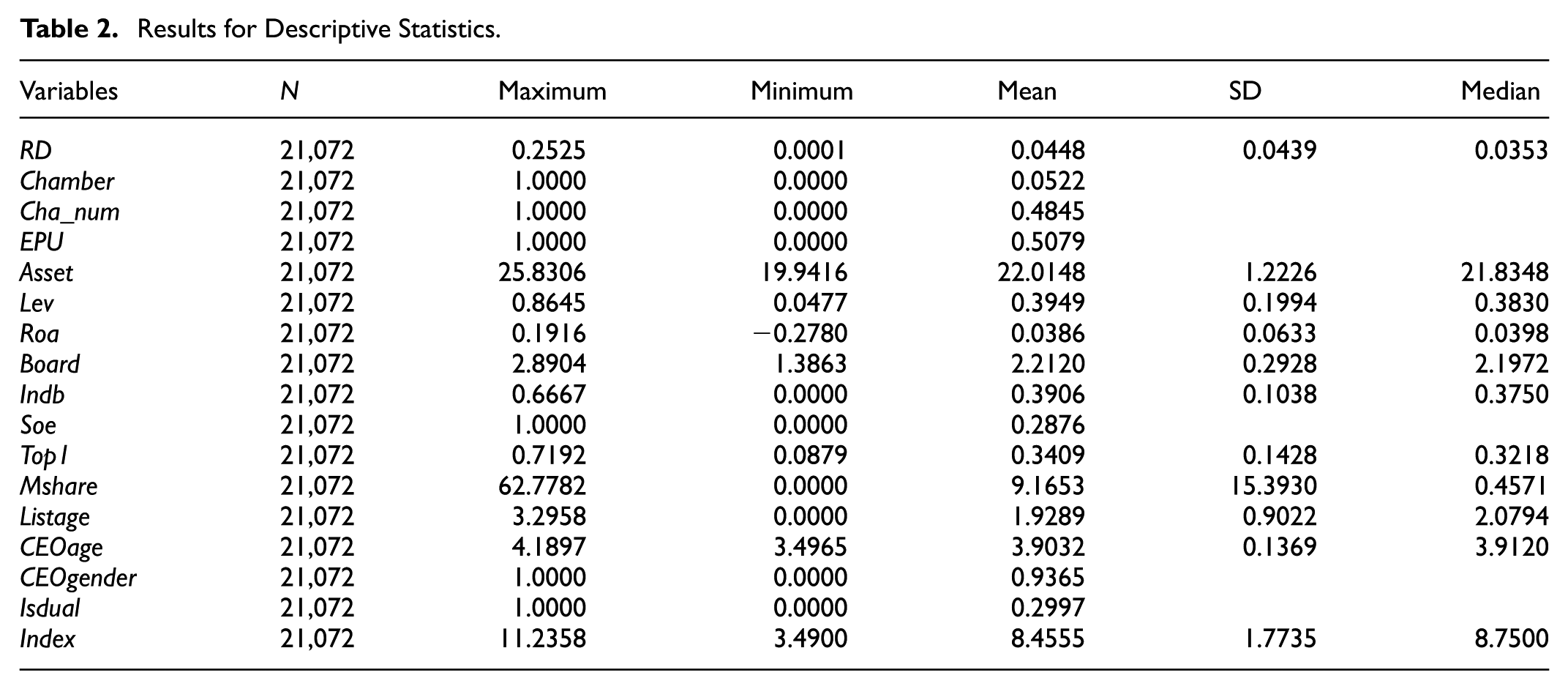
Table 2 presents descriptive statistics for the main variables. The maximum value of RD is 0.2525, the minimum is 0.0001, indicating significant variation in R&D investment levels among the sample companies, and the mean is 0.0448, this means that the R&D intensity is on average 4.5%. The mean value for Chamber is 0.0522, indicating that 5.22% of the firms in the sample have joined alien merchant chambers, which is consistent with the data proportion in the study by Zhou and Zhao et al. (2024).
Results for Descriptive Statistics.
Correlation Analysis
Table 3 displays the Pearson correlation coefficients between variables. In the univariate analysis, the correlation coefficient between Chamber and RD is not statistically significant. Further analysis with control variables will be conducted to verify this relationship.
Pearson Correlation Coefficients of the Main Variables.

p < .1; **p < .05; ***p < .01.
Control variables are generally significantly correlated with the dependent variable RD. This suggests that the selection of control variables is appropriate. The correlation coefficients among control variables are within a reasonable range. The highest correlation coefficient is 0.5417, which is between Asset and Lev, but its absolute value is far below the critical threshold of 0.8. Furthermore, this study conducts a variance inflation factor (VIF) test, and the maximum VIF value for each variable is 2.92, with an average VIF value of 1.54. These values are well below the classical threshold of 10, indicating that multicollinearity is not a serious issue in the model.
Regression Results
This study performs regressions on the previously constructed Model (1), and the regression results are presented in Table 4. In Model 1, which does not include control variables, the regression coefficient for Chamber and RD is 0.0019, significant at the 10% level. In Model 2, which includes control variables, the regression coefficient for Chamber and RD is 0.0045, significant at the 1% level. This indicates that joining alien merchant chambers significantly increase enterprise R&D investment 0.45%, that is, the ratio of R&D expenditure to operating income will promote 0.45%, for example, if the enterprise achieved ¥100 million in sales, the R&D will increase ¥450,000. This indicates that joining alien merchant chambers significantly promotes enterprise R&D investment. Thus, Hypothesis 1 is supported, confirming that alien merchant chambers can act as an effective external governance mechanism.
Regression Results for Alien Merchant Chambers and R&D Investment.

Note. t-statistics in parentheses, 95% confidence intervals in square brackets.
p < .1; **p < .05; ***p < .01.
We conducts subgroup regressions on the previously constructed Model (1), and the results are presented in Table 5. Models 1 and 2 display the moderation effects test results for the number of alien merchant chambers in a firm’s location. In model 1, the group with more alien merchant chambers, the regression coefficient for Chamber and RD is 0.0082, significant at the 1% level. In model 2, the group with less alien merchant chambers, the regression coefficient for Chamber and RD is 0.0018, which is not significant. The comparison of the two group results suggests that when there are more alien merchant chambers in the firm’s location, the positive effect of joining alien merchant chambers on R&D investment becomes more significant. Further conducting an inter-group coefficient difference test, the p-value is 0.000, indicating a significant difference in the regression coefficients between the two groups, that is, when there are more alien merchant chambers in the firm’s location, joining alien merchant chambers more significantly enhances R&D investment.
Regression Results of the Number of Alien Merchant Chambers and Macroeconomic Policy Uncertainty Moderating Effect Test.

Note. t-statistics in parentheses, 95% confidence intervals in square brackets.
p < .1; **p < .05; ***p < .01.
In Models 3 and 4 of Table 5, the moderation effects test results for macroeconomic policy uncertainty are presented. In model 3, the group with higher macroeconomic policy uncertainty, the regression coefficient for Chamber and RD is 0.0061, significant at the 1% level. In Model 4, the group with lower macroeconomic policy uncertainty, the regression coefficient for Chamber and RD is 0.0027, significant at the 10% level. The comparison of the two group results suggests that regardless of external macroeconomic policy uncertainty, joining alien merchant chambers can promote firm R&D investment. Further conducting an inter-group coefficient difference test, the p-value is .053, indicating a significant difference in the regression coefficients between the two groups, that is, when macroeconomic policy uncertainty is higher, joining alien merchant chambers has a greater positive effect on R&D investment.
Figure 3a illustrates the moderation effect of Cha_num. From the figure, it can be observed that when there is a higher number of alien merchant chambers, the slope is steeper, indicating that joining alien merchant chambers has a more significant positive effect on R&D investment in locations with a higher number of alien merchant chambers.

Moderating effect: (a) Moderating effect of Cha_num; (b) moderating effect of EPU.
Figure 3b displays the moderation effect of EPU. From the figure, it is evident that when macroeconomic policy uncertainty is higher, the slope is steeper, signifying that joining alien merchant chambers has a more substantial positive impact on R&D investment during periods of higher macroeconomic policy uncertainty.
The above results indicate that when there are more alien merchant chambers in the firm’s location, joining alien merchant chambers has a more substantial positive effect on R&D investment. This supports Hypothesis 2, suggesting that a greater number of alien merchant chambers can form a network, and further enhancing synergy effects. Additionally, when macroeconomic policy uncertainty is higher, joining alien merchant chambers has a more substantial positive effect on R&D investment. This confirms Hypothesis 3, indicating that alien merchant chambers can assist member enterprises in mitigating systemic risks to some extent.
Robustness Tests
Propensity Score Matching Test
Considering that the proportion of firms joining alien merchant chambers is relatively low, there might be other reasons leading to higher R&D investment in these firms, potentially causing sample selection bias. Propensity Score Matching (PSM) method can check if the firms self-select to implement R&D, as well as check if the alien merchant chambers are the valid measures for enterprise R&D (Gordon et al., 2009). So we employed the PSM method to match the sample before conducting regressions. In the first stage, a Probit model was used, with the dependent variable Chamber. The “nearest neighbor matching” method was used to match the sample, and all control variables from the regression model (1) previously constructed were included as covariates for matching. The matching ratio was set at 1:1, resulting in a final dataset of 2,096 firm-year observations that satisfied the common support condition and the balancing assumption. Additionally, clustering of standard errors was applied in the regression.
Table 6 Model 1 presents the regression results after PSM matching. The regression coefficient of Chamber and RD is significantly positive at the 1% level of significance. This result indicates that after controlling for the sample selection issue, the positive correlation between alien merchant chambers and R&D investment remains significant. Thus, the previous empirical results are robust.
Regression Results of Robustness Tests.

Note. Z-values in parentheses of Model 3 and Model 8, t-statistics in parentheses of other models, 95% confidence intervals in square brackets.
p < .1; **p < .05; ***p < .01.
Omitted Variable Test
Considering that other individual characteristics of managers and other factors in the location of the enterprise may also influence a firm’s R&D investment, there might be possible problem of omitter variables. Instrumental variable (IV) eatimation is the standard textbook solution to mitigating endogeneity problems (Larcker & Rusticusb, 2010), this study addresses the potential issue of omitted variables using instrumental variable (IV) estimation. Both Hillman et al. (2002) and Srinidhi et al. (2011) believe that the percentage of women employed in an industry influences the likelihood of female participation in the boards of firms belonging to that industry. Besides, Ma et al. (2020) use the proportion of executives with academic experience in other companies in the same industry as the instrumental variable in the first-stage model when they study the relationship between top management teams’ academic experience and firms’ corporate social responsibility voluntary disclosure. Based on these studies, this study employs the proportion of firms in the province where a firm is located that joined a alien merchant chamber as an IV. If a higher proportion of firms in the same province join alien merchant chambers, the probability of the focal firm joining such a chamber is also higher. However, the proportion of firms in the same province joining alien merchant chambers is not expected to have a direct impact on the R&D investment of the focal firm. Model 2 in Table 6 presents the first-stage regression results, where the regression coefficient of Chamber on the selected IV is significantly positive at the 1% significance level. This indicates that a higher proportion of firms in the same province joining alien merchant chambers is associated with a higher likelihood of the focal firm also joining such chambers. Thus, the basic requirement of a correlation between the instrumental variable and the explanatory variable is met. The weak instrumental variable test statistic, with an F-value of 230.79, significantly exceeds the empirical threshold of 10, suggesting the absence of weak instruments. Therefore, the choice of the instrumental variable in this study is appropriate.
Model 3 in Table 6 shows the second-stage regression results, where the regression coefficient of Chamber and RD is significantly positive at the 1% significance level. This result indicates that, even after accounting for the potential omitted variables issue using instrumental variable estimation, the positive effect of alien merchant chambers on R&D investment remains robust, confirming the earlier empirical findings.
Other Robustness Tests
To assess the sensitivity of the results, several robustness tests are conducted: ①As an alternative measure of R&D investment, the ratio of R&D expenditure to total assets (RD2) is used. ② Given that the dependent variable, R&D investment, is a proportion variable with values between 0 and 1, a Tobit model with upper and lower limits is employed for regression. ③ To account for potential lagged effects in R&D investment decisions, the dependent variable is regressed with a one-period lag. ④ To control for regional variations in economics, education, and marketization, province fixed effects are included. ⑤ Considering there are only a fraction of firms engaged in R&D activities, excluding firms with zero R&D expenditures leads to a selection bias, we use the fixed-effects Poisson model to further test.
Table 6 presents the results of these robustness tests in Models 4 to 8. In all these models, the regression coefficients of Chamber and RD are significantly positive at the 1% significance level. These results demonstrate that, even after conducting a series of robustness tests, the positive effect of alien merchant chambers on R&D investment remains robust, confirming the earlier empirical findings.
Mediation Mechanism Test
Alleviating Financing Constraints Mechanism
Following the approach of Hadlock and Pierce (2010), the study uses the SA index to measure firms’ financing constraints. Specifically, the SA index is calculated as follows:

where ln(Asset) represents the natural logarithm of total assets (in hundred million yuan), and Listage represents the number of years a firm has been listed. Since the SA values are all negative, a larger absolute value of the SA index indicates more severe financing constraints faced by the firm. Therefore, the absolute value of the SA index is used as a proxy for firms’ financing constraints.
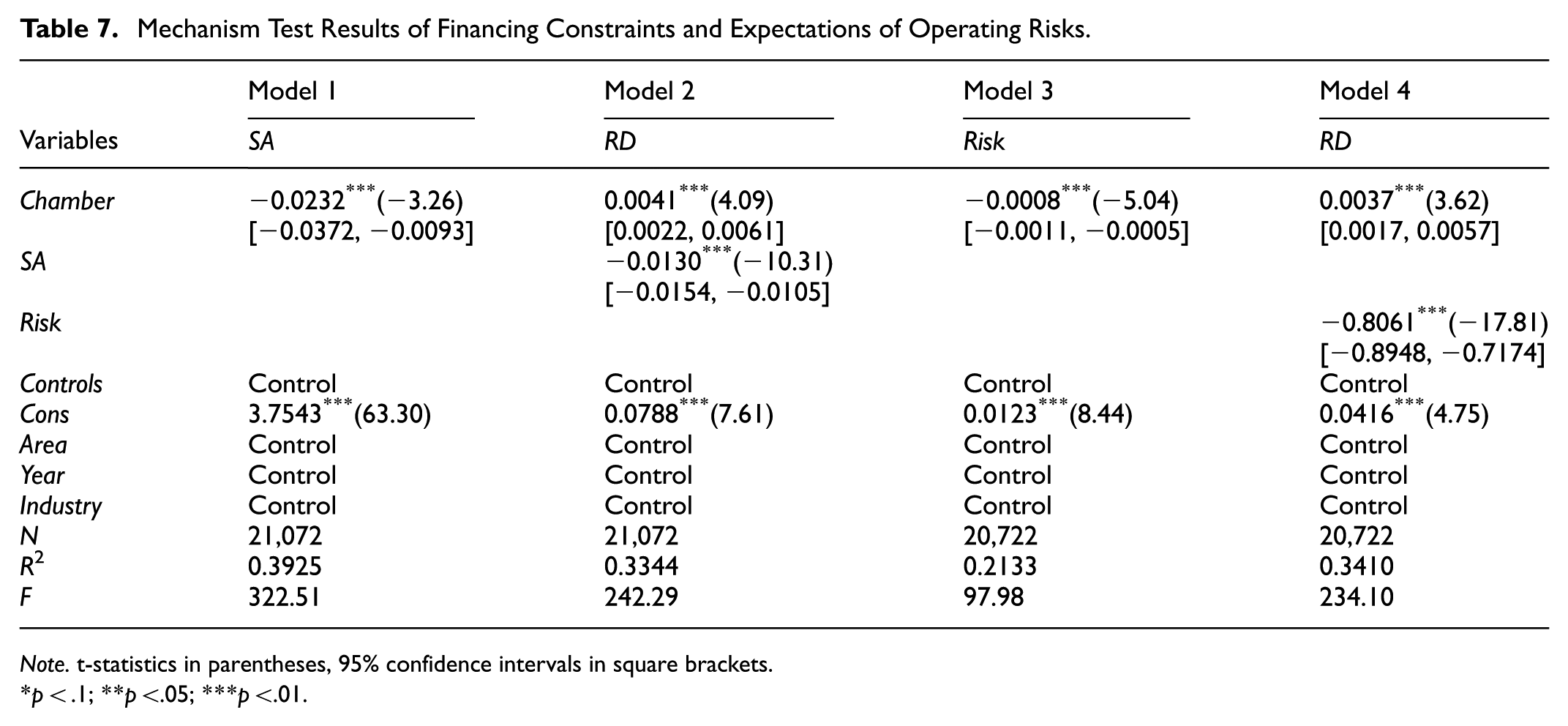
Models 1 and 2 in Table 7 present the results of the mediation test for financing constraints. In Model 1, the regression coefficient of Chamber and SA is significantly negative at the 1% significance level, indicating that joining alien merchant chambers can alleviate firms’ financing constraints. In Model 2, the regression coefficient of Chamber and RD is significantly positive at the 1% significance level, and the regression coefficient of SA and RD is also significantly positive at the 1% significance level. These regression results suggest that financing constraints partially mediate the relationship between alien merchant chambers and R&D investment. In other words, joining alien merchant chambers can alleviate firms’ financing constraints, subsequently promoting R&D investment. Further Sobel tests reveal a Z-value of 3.51, indicating significant mediation effects, with mediation explaining 6.77% of the total effect.
Mechanism Test Results of Financing Constraints and Expectations of Operating Risks.
Note. t-statistics in parentheses, 95% confidence intervals in square brackets.
p < .1; **p <.05; ***p <.01.
Reducing Expectations of Operating Risks Mechanism
When firms anticipate higher operational risks, they tend to reduce their R&D investments. Risk perception can be reflected through the disclosure of risk-related keywords in the “Management Discussion and Analysis” section of annual reports. This study uses the sum of precise word frequencies corresponding to risk-related keywords in the financial text data disclosed by the WinGo financial text data platform, divided by the total word count of the report, to measure firms’ expectations of operating risks (Risk). A higher value of this measure indicates higher anticipated operating risks.
Models 3 and 4 in Table 7 present the results of the mediation test for expectations of operating risks. In Model 3, the regression coefficient of Chamber and Risk is significantly negative at the 1% significance level, indicating that firms joining alien merchant chambers have lower expectations of operating risks. In Model 4, the regression coefficient of Chamber on RD is significantly positive at the 1% significance level, and the regression coefficient of Risk on RD is also significantly positive at the 1% significance level. These regression results suggest that expectations of operating risks partially mediate the relationship between joining alien merchant chambers and R&D investment. In other words, joining alien merchant chambers can reduce firms’ expectations of operating risks, subsequently promoting R&D investment. Further Sobel tests reveal a Z-value of 4.54, indicating significant mediation effects, with mediation explaining 14.60% of the total effect.
Heterogeneity Analysis
Property Rights Heterogeneity
Christodoulou et al. (2018) found that state-owned enterprises, relative to private enterprises, enjoy a certain degree of monopoly, making it easier for them to obtain special funds, preferential policies, and protective financing means, resulting in lower financing constraints. While difficulty in obtaining financing is an important factor hindering the economic development of private enterprises. Therefore, compared to state-owned enterprises, non-state-owned enterprises benefit more from joining alien merchant chambers, which has a more significant impact on promoting R&D investment. To test this, the study further divided companies based on Soe into state-owned enterprises and non-state-owned enterprises.
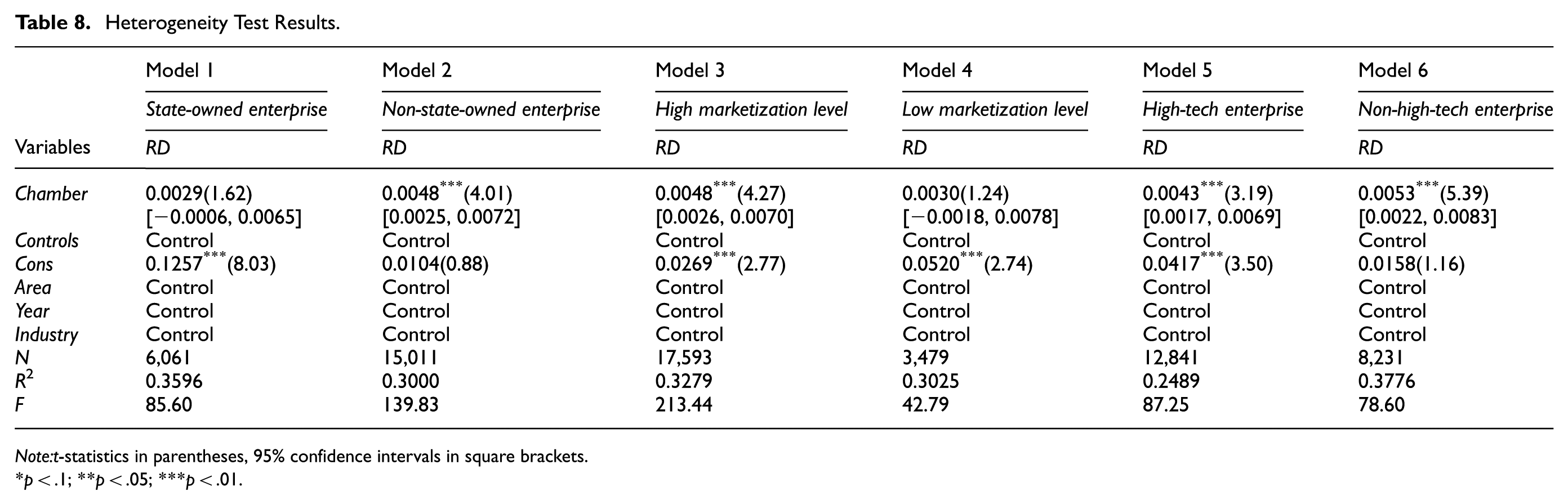
Table 8 Model 1 displays the regression results for state-owned enterprises. The regression coefficient between Chamber and RD is 0.0029, which is not significant. In Model 2, the regression results for non-state-owned enterprises show that the coefficient between Chamber and RD is 0.0048, significant at the 1% level. The comparison of results between the two groups indicates that, relative to state-owned enterprises, the promotion effect of joining alien merchant chambers on R&D investment is more significant for non-state-owned enterprises, suggesting that non-state-owned enterprises benefit more from joining alien merchant chambers.
Heterogeneity Test Results.
Note:t-statistics in parentheses, 95% confidence intervals in square brackets.
p < .1; **p < .05; ***p < .01.
Marketization Level Heterogeneity
In general, a higher level of marketization implies a better relationship between government and the market, better development of market intermediary organizations, and a more favorable legal environment (Sun et al., 2022; Wang et al., 2019). This suggests that regions with higher marketization levels will have better-developed alien merchant chambers, making it easier for companies to join such chambers. In these areas, intellectual property is better protected, motivating companies to innovate and increase their R&D investments. Therefore, marketization level has a positive impact on the relationship between alien merchant chambers and R&D investment. The study grouped companies based on the Index variable, considering whether the marketization index of the province where the company is located is greater than the median marketization index of all provinces in that year.
Table 8 Model 3 presents the regression results for companies with a higher marketization level. The regression coefficient between Chamber and RD is 0.0048, significant at the 1% level. Model 4 shows the regression results for companies with a lower marketization level, where the coefficient between Chamber and RD is 0.0030, which is not significant. These results suggest that, compared to companies located in areas with lower marketization levels, companies located in areas with higher marketization levels experience a more significant positive impact on R&D investment from joining alien merchant chambers.
Enterprise Type Heterogeneity
Compared to non-high-tech enterprises, high-tech enterprises are eligible for more tax incentives, which result in higher levels of innovation investment (Yang et al., 2023). Therefore, the study further examined the impact of joining alien merchant chambers on R&D investment for different types of companies. Based on qualification data disclosed by the CSMAR database, companies that have received provincial or higher-level high-tech enterprise qualification certification are classified as high-tech enterprises, while others are classified as non-high-tech enterprises.
Table 8 Model 5 presents the regression results for high-tech enterprises. The regression coefficient between Chamber and RD is 0.0043, significant at the 1% level. Model 6 displays the regression results for non-high-tech enterprises, where the coefficient between Chamber and RD is 0.0053, also significant at the 1% level. The results indicate that both high-tech and non-high-tech enterprises benefit from joining alien merchant chambers in promoting R&D investment. Further inter-group coefficient difference tests reveal a p-value of .326, indicating no significant difference in the regression coefficients between the two groups.
Discussion
Conclusion
We empirically examine the impact of joining alien merchant chambers on the R&D investment of A-share listed companies on the Shanghai and Shenzhen stock exchanges between 2010 and 2020. The findings show that joining these chambers significantly boosts R&D investment. Companies that participate in alien merchant chambers benefit from enhanced financial resources and reduced risks. This positive effect is stronger when there are more alien merchant chambers in the company’s location or when macroeconomic uncertainty is high. Additionally, the effect is more pronounced for non-state-owned enterprises and those located in regions with higher levels of marketization, and it holds true for both high-tech and non-high-tech companies.
Theoretical Implications
Our study contributes to the existing literature in several significant ways:
First, different theoretical framework integration: from “Resource Dependence” to a “Capability-Willingness” two-dimensional model. Existing studies focus on the “resource supply” and “resource support” functions of alien merchant chambers. This study, on the one hand, emphasizes how alien merchant chambers improve the smoothness of corporate financing channels, explaining the “capability foundation” of R&D investment from the dimension of “funding availability”. On the other hand, it introduces a cognitive psychology perspective to interpret the “willingness-driven” R&D investment from the dimension of “risk perception bias”.
Second, different mediating mechanisms expansion. Existing research primarily explores the mediating mechanisms of alien merchant chambers through the single variable of social capital, treating social capital as the sole driving factor without considering micro-decision foundations such as corporate financing constraints and risk perception. This study demonstrates the mechanisms from both financing constraints and risk expectations, further revealing other possible pathways through which alien merchant chambers exert governance effects.
Third, different research findings: focus on the input side rather than the output side. Existing studies have confirmed the direct impact of alien merchant chambers on corporate innovation output, mainly reflected in the increase in the number of invention/non-invention patents. This study focuses on the mechanism analysis of alien merchant chambers on firms’ input capability and willingness before innovation decisions, mainly reflected in the scale of R&D expenditure, thus further enriching the understanding of the positive effects of firms joining alien chambers of commerce.
Practical Implications
Beyond its theoretical implications, our study holds significant practical relevance.
First, leveraging chamber platforms to address financing difficulties. Companies should actively participate in alien merchant chambers to leverage their network effects and resource integration capabilities, overcoming the limitations of single financing channels and improving financing efficiency. Governments and financial institutions can utilize chamber platforms to better match corporate needs, optimize regional financial support policies, and help businesses achieve innovative growth.
Second, reducing risk expectations to boost innovation confidence. The study provides practical guidance for firms on resource allocation adjustments in uncertain environments, particularly by building robust external cooperation networks to address external risks. Companies can build trust networks through chamber participation, utilizing peer experience and feedback mechanisms to lower subjective risk expectations associated with innovation and thereby invest more confidently in R&D projects. Merchant chambers should enhance their functions in information consulting and risk prevention training to provide members with risk assessment and management support.
Third, policy directions for policymakers. Governments can incentivize alien merchant chambers to establish financial services and innovation collaboration platforms to further leverage their intermediary role in alleviating financing constraints and reducing risk expectations, particularly under high economic uncertainty. Policymakers can utilize alien merchant chambers as platforms for policy dissemination and innovation support, strengthening their role as bridges between policy and market. This would enable companies to utilize resources more effectively.
Limitations and Future Directions
However, our study does have certain limitations that need to be acknowledged. For example, the sample of this study only includes provincial-level alien merchant chambers, while city-level or county-level alien merchant chambers are not included, so we can try to collect more comprehensive sample data for empirical testing in the future. Besides, while this research has successfully demonstrated the positive influence of enterprises joining alien merchant chambers on their R&D investment, it remains to be determined whether this participation also exerts an external governance role on other agency problems such as earnings management, investment efficiency, and so on. Similar networks in other countries, such as diaspora business networks in the U.S. or ethnic business groups in Southeast Asia, may operate with more diverse membership criteria, with a stronger emphasis on industry-specific affiliations or multinational corporate connections rather than regional or kin-based ties, and a comparative study of the effect and mechanism of the alien merchant chamber in China versus similar foreign business communities in other countries is also important. Further investigation can be done from these perspective in future studies.
Footnotes

Ethical Considerations
Ethical approval was not required for this research.
Author Contributions
All authors contributed to the study conception and design. Material preparation, data collection and analysis were performed by Ran Zhou. The first draft of the manuscript was written by Ran Zhou, Jingjing Li and Hanying Wang. All authors read and approved the final manuscript.
Funding
The authors disclosed receipt of the following financial support for the research, authorship, and/or publication of this article: This research is supported by the Youth Research Project of Philosophy and Social Sciences of the Education Department of Hubei Province, titled “Research on the impact of alien merchant chambers on enhancing enterprise innovation capability: From the perspectives of innovation input, innovation output, and innovation efficiency” (24Q120) and the key research project of the Ministry of Education’s Chinese Excellent Traditional Culture Special Program (23JDTCA053).
Declaration of Conflicting Interests
The authors declared no potential conflicts of interest with respect to the research, authorship, and/or publication of this article.
Data Availability Statement
The datasets used and/or analyzed during the current study are available from the corresponding author on reasonable request.