




Abstract
The formation of technical standards is a complex process that involves the integration of various technical resources and organizational resources. It is influenced by multiple factors. This paper focuses on four independent variables, namely market size, economic environment, infrastructure construction, and government support, which are regarded as different dimensions of the socio-technical landscape. Additionally, R&D investment is introduced as a mediator variable to construct a model that examines the role of the socio-technical landscape in the formation of technical standards. Empirical tests are conducted using relevant data from the 4G technology in China’s mobile communication industry. The study reveals that there is a positive causal relationship between market size, economic environment, infrastructure development, government support, and technology standards. Furthermore, it finds that R&D investment plays a significant mediating role between the economic environment and technology standards, infrastructure development and technology standards, and government support and technology standards. These findings provide valuable insights for enterprises and governments in promoting the formation of technical standards.
Plain Language Summary
The formation of technical standards is a complex process that involves the integration of various technical resources and organizational resources. It is influenced by multiple factors. This paper focuses on four independent variables, namely market size, economic environment, infrastructure construction, and government support, which are regarded as different dimensions of the socio-technical landscape. Additionally, R&D investment is introduced as a mediator variable to construct a model that examines the role of the socio-technical landscape in the formation of technical standards. Empirical tests are conducted using relevant data from the 4G technology in China's mobile communication industry. The study reveals that there is a positive causal relationship between market size, economic environment, infrastructure development, government financial support, and technology standards. Furthermore, it finds that R&D investment plays a significant mediating role between the economic environment and technology standards, infrastructure development and technology standards, and government financial support and technology standards. These findings provide valuable insights for enterprises and governments in promoting the formation of technical standards.
Introduction
Recently, with the rise of knowledge-based economy and network economy led by technological innovation, profound changes have taken place in the global market environment and industrial development model. In the fierce international competition, “industrial unrest, but standards first” has become the trend of industrial development, and technical standards have become the focus of strategic competition among enterprises, industries, and even countries (Viardot et al., 2016; Wang & Dong, 2016). Nowadays, whoever takes the lead in setting technical standards will be able to command heights of the market and gain competitive advantage initiatively. Technical standards refer to documents that are approved by recognized products or related processes and production methods, regulations, rules, guidelines, or specific institutions for common and repeated use, and are not mandatory requirements (Jain, 2012; Tassey, 2000; Y. Zhao & Du, 2021). Therefore, technical standards are not only the technical guidelines formulated for things that need to be harmonized and coordinated in technical activities, but also the solutions to repetitive and universal technical problems. Meanwhile, technical standards are the key factors that determine competition rules and affect the competitiveness of enterprises, industries and even countries as well (H. Lee & Oh, 2006).
Technical standards are essentially a co-evolutionary process with systematic characteristics, the formation of technical standards is influenced by many factors (Z. Wu et al., 2021). Over the years, scholars have conducted extensive research on the factors that influence the formation of technical standards. Part of the research focused on the determination of the influencing factors of the formation of technical standards. Jorgensen and Sorensen (1999) constructed a hierarchical evolution model consisting of factors such as government, market, and technical characteristics of standards, then concluded that the above factors have important influence on the formation of technical standards; on this basis, some scholars have further clarified the promoting role of more relevant factors such as economy, infrastructure, R&D investment, and enterprise capabilities in the formation of technical standards. Other researches focus on the motivations and mechanisms of technical standards formation. P. Gao (2015) validated the relationship between government support, R&D investment and the formation of technical standards taking advantage of the TD-SCDMA standard’s practical experience. Other scholars are based on the basic theory of technical standards, focus on the aspects including enterprises capabilities, the economic, market, and government respectively to summarize these different factors that affect the formation of technical standards (J. Gao, 2012; P. Gao, 2015; Marshall, 2007). In summary, there are some studies which discussed the important influence of macro-environmental factors on the technical standards formation but have little mention of macro-environmental factors mechanisms of action, or more focusing on studying the factors’ direct or independent effects on the formation of technical standards, neglecting to discuss the synthetic effect of all factors from a holistic perspective. In addition, the existing literatures mainly concentrate on qualitative analysis and case studies, lacking empirical research based on quantitative data support.
So far, the multi-level perspective (MLP) approach has traditionally been applied to the study of technological innovation, socio-technical transition, and stability. The MLP provides a comprehensive macro-oriented development that demonstrates that technological, social, legal and institutional factors play a central role in technology-related research (Lenfle & Söderlund, 2022). That is, MLP integrates complex and dynamic innovation processes enabled by the interaction of social factors and technological innovation (Carroli, 2018; Geels, 2002, 2010). By doing so, it provides a possibility to explain the dynamic process of the formation of technical standards from the technical landscape at the macro level.
In view of this, the purpose of this study is to enhance our understanding of the formation of technological standards in the technological landscape at the macro level. More specifically, starting from the socio-technical landscape level of MLP analysis framework, this paper analyzes and determines the main factors affecting the formation of technical standards, introduces R & D investment as an intermediary variable, constructs the action relationship model of socio-technical landscape on the formation of technical standards, and selects 4G (LTE advanced) technology in China’s mobile communication industry as the research object to empirically test the effectiveness of the theoretical model, aiming to find out the key factors to guide the formation of technical standards for the government, so as to provide useful reference for the formation of technical standards.
The rest of this article is organized as follows. Section 2 provides a review of the literature. Section 3 presents the research hypotheses. Section 4 describes the study design, data sources, and methods. The fifth part carries on the analysis and discussion of the results. Section 6 summarizes and makes policy recommendations.
Literature Review and Theoretical Basis
The Formation of Technical Standards
A significant body of literature offers important insights on what factors influence the formation of technical standards. Table 1 provides a systematic summary of relevant studies.
Summarized Review of the Related Work.

As can be seen from Table 1, most scholars have studied the factors influencing the formation of technical standards based on a macro perspective (X. Gao, 2014; J. Gao et al., 2019; Jho, 2007; Leiponen, 2008; Uotila et al., 2017; Wiegmann et al., 2017; R. Zhang & Sun, 2023). In fact, the formation of technical standards needs to go through a complex process, and there are multi-level factors that affect the formation of technical standards. However, existing studies by scholars on the influencing factors of technical standard formation under the macro perspective are more based on the single dimension of the government subject for analysis (X. Gao, 2014; J. Gao et al., 2019; Jho, 2007), neglecting to discuss the comprehensive influence of multidimensional factors in the macro influencing factors from a holistic perspective. Therefore, based on the MLP hierarchy theory, this paper studies the comprehensive influence of multi-dimensional factors at the social landscape level on the formation of technical standards.
The Multi-Level Perspective (MLP) and Socio-Technical Landscape
The MLP analytical framework is derived from the semi-evolutionary theory of the Netherlands’ Tunter Institute (Li, 2009), is a research methodology that combines evolutionary economics with the sociology of technology. Rotmans (2001) present a multi-level approach to the analysis of change in socio-technical systems, which identifies different levels of aggregation—(macro-level) socio-technical landscape (meso-level) regimes and (micro-level) niches (Rotmans et al., 2001). Geels (2002) identifies the MLP as a macro-theoretical framework for analyzing socio-technical system transitions and for describing how transitions from one system to another are made. The MLP states that the socio-technical system consists of three levels: technological niches in micro-level, socio-technical regime in meso-level, socio-technical landscape in macro-level (Geels, 2004, 2012). In recent years, the MLP research framework has been widely used in technology transformation research (Keller et al., 2022; C.-K. Lee & Yu, 2022; Z. Wu et al., 2021).
The socio-technical landscape has long been widely studied as an important factor in the MLP analytical framework. The concept of landscape can be traced back to the theory of landscape ecology. Urban et al. (1987) used the landscape research method of hierarchical mode and behavioral paradigm to simplify the dynamic landscape, and defined the landscape as the natural ground landscape in the whole landscape for the first time. Kauffman et al. (1998) pioneered the introduction of the term “technical landscape” in the study, linking the concept of landscape with the technological change of the enterprise, and proposing that the technological landscape is the external environment faced by enterprises in technological innovation planning, with combining technology needs and dynamic environment, can further clarify the focus of future technological improvements and make the best decisions for technological change. The Socio-technical Landscape refers to the external environment that affects technological change. “It consists of many external factors, including oil prices, economic growth, war, immigration, political alliances, cultural values, environmental issues, etc.” (Geels, 2002). Subsequently, based on the MLP multi-layer analysis method, Geels (2010) carried out a series of studies, constructed an evolutionary model of technological transformation and socio-technical landscape including market, policy and infrastructure construction, with discussing the synergy of each element to technological change, has reached the conclusion that the socio-technical landscape plays a key role in the process of technological transformation.
Research Hypothesis
Dimensions of Socio-Technical Landscape That Affect the Formation of Technical Standards
With regard to the dimensions of the socio-technical landscape, scholars usually divide it into dimensions such as market, macro-economic environment, infrastructure, political factors, knowledge and deep cultural patterns (Geels, 2004). Based on the viewpoint of the Social Shaping of Technology Theory, any technological innovation is the process of interaction between innovation subjects under external environmental factors, the formation of technical standards is inseparable from the shaping of social technology landscape elements such as market, economic environment, politics and infrastructure construction (Markard & Truffer, 2008). Existing research shows that the economic path is the driving force for the formation of technical standards (J. G. Gao & Shan, 2012), Market mechanism and government-led mechanism are the two main mechanisms for the formation of technical standards (Narayanan & Chen, 2012); meanwhile, in the process of industrialization of technical standards, infrastructure construction is the basic premise for the creation and acquisition of industrial value (Yoo et al., 2005). In view of this, this paper believes that the impact of socio-technical landscape on the formation of technical standards can be considered from the four dimensions of market size, economic environment, infrastructure construction and government support.
The Relationship Between Socio-Technical Landscape and Technical Standards Formation
Market size refers to market capacity, which is represented by the number of existing users in the market (L. Gao, 2018; Saloner, 1988). A number of studies have shown that market size plays a decisive role in the formation of technical standards (Jorgensen & Sorensen, 1999; H. Lee & Oh, 2006; Wiegmann et al., 2017). The reason is that the path dependence makes it easier for users to accept new technologies derived from the original technology. The larger market size (i.e., the larger number of existing users) can reduce the resistance of high-tech industries to the implementation of technical standards based on the original technology, improving the acceptance of technical standards by most users in the market, and thus to enhance the success possibility of technical standards; at the same time, the existing market size means the user base. From the characteristics of network effects, the better the user base, the more the network scale Large, the higher the network value that the industry can implement after adopting the technical standards and users accepting the technical standards. Thus, the strong willingness of the industry to create technical standards and the users to adopt the technical standards contributes to the formation of technical standards (Kauffman et al., 2000). Based on this, the paper proposes the following assumption:
Hypothesis 1: Market size is positively correlated with the formation of technical standards.
The economic environment refers to the macroeconomic conditions that affect the innovation activities related to technical standards, including economic structure, economic development trends, national income levels and so on (S. Zhao et al., 2012). The formation of technical standards is influenced by the economic environment. J. G. Gao and Shan (2012) proposed that although the formation of technical standards is mainly based on technology, it needs economic promotion as well. A good economic environment is conducive to raising the national income level, improving people’s spending power, inducing new market demand, thereby promoting the improvement of technology and speeding up the conversion of new technologies into technical standards. S. Zhao et al. (2012) verified the conclusions of J. G. Gao and Shan (2012) through the VAR model of technical standards, technological innovation and economic growth, then further believed that economic growth provides a material basis for the formation of technical standards and haves a long-term and stable positive effect on technical standards. The specific performance is that the rapid economic growth provides technology, talent reserve and financial support for technological innovation, and continues to promote the industrialization of technological achievements, promote the standardization of technical knowledge, and further promote the establishment of technical standards system. Therefore, this paper proposes the following assumption:
Hypothesis 2: The economic environment is positively correlated with the formation of technical standards.
Infrastructure construction refers to material engineering facilities that provide public services for social production and residents’ lives in the fields of transportation, environmental protection, water conservancy, energy and power, construction, communications, etc., for example, the communication infrastructure usually consists of a communication cable, a computer room, a base station, an iron tower, a pipeline, and the like (Ministry of Housing and Urban-Rural Development of the People's Republic of China, 2018). Different types of enterprises in the industrial chain establish links based on infrastructure construction, form technical innovation systems with technical standards as the core, and provide cooperation mechanisms and scale conditions for the research and development of technical standards (Yoo et al., 2005). Specifically, on the one hand, better infrastructure construction level has increased the frequent links between enterprises, and more enterprises involved in the development of technical standards are integrated into the technology innovation system, which is conducive to realizing the resource integration of different technology modules, accelerating the development of key technologies in the standard system and reducing the R&D investment of technical standards (J. G. Gao & Shan, 2012); on the other hand, the perfect infrastructure construction provides sufficient conditions for the industrialization of technical standards, promotes the deep cooperation between enterprises, increases the expected benefits of future operation of technical standards, further improves the evaluation value of technical standards, attracting more supporting companies to participate in the creation of standards, thus accelerating the formation of technical standards (Y. Chen et al., 2015). Therefore, this paper proposes the following assumption:
Hypothesis 3: Infrastructure construction is positively correlated with the formation of technical standards.
Government support refers to a series of incentives taken by the government to promote the formation of technical standards, including giving financial support, introducing support policies and related regulations, leading research and development cooperation (Narayanan & Chen, 2012). The government plays an important role in the context of China, and government-supported policies and measures are the premise and main force for promoting technological innovation (Z. Wu et al., 2021). Studies have shown that the government’s policies and financial support have guaranteed the success rate of technological innovation to a certain extent, enterprises that carry out technological research and development around technical standards have benefited, and the transformation from new technologies to technical standards has been intensified under the influence of interests. P. Gao (2015) found through empirical research that the intermittent fluctuations and vague attitudes supported by the government have increased the uncertainty of the development of TD-SCDMA standards, causing most companies to adopt a wait-and-see attitude and adopt prudent investment strategies. It hindered the development of technical standards and eventually delayed the formation of TD-SCDMA standards. This study validates Sun et al. (2020) conclusion that government support can positively influence the formation of technical standards. Therefore, this paper proposes the following assumption:
Hypothesis 4: Government support is positively correlated with the formation of technical standards.
Mediating Role of R&D Investment
In the “2016 National Statistical Survey on Science and Technology Funds” jointly issued by Chinese National Bureau of Statistics, the Ministry of Science and Technology and the Ministry of Finance, R&D expenditure refers to the expenditures of the whole society actually used for basic research, applied research and experimental development during the statistical year, including labor costs, raw material fees, fixed assets purchase, construction fees, management for actual research expenses and so on. Comprehensive scholars’ understanding of R&D investment, this paper defines R&D investment as the expenditure and personnel input for basic research, applied research and experimental development activities for the purpose of increasing the total amount of knowledge, using new knowledge and discovering new uses. Relevant research shows that R&D investment as a necessary condition for technological innovation has a significant role in promoting technological innovation (Hu, 2021; J. Zhang & Rogers, 2009); similarly, the establishment of technical standards cannot bypass technological innovation, and new technologies and technical standards are bundled and developed, making technological innovation a support for the introduction of technical standards (Datla et al., 2015; Tassey, 2000). It can be seen that there is an interaction between R&D investment and technical standards. This view can be further confirmed in the study of regional technical standards innovation by Blind et al. (2011). The study pointed out that the expenditures and personnel input of R&D activities are positively related to the formation of technical standards (Blind et al., 2011). Therefore, this paper proposes the following assumption:
Hypothesis 5: R&D investment is positively correlated with the formation of technical standards.
Based on Schumpeter’s innovative theory, scholars have conducted a lot of research on the factors affecting R&D investment from the aspects of economic environment, infrastructure construction and government support. Park and Shin (2018) argues that R&D investment decisions are affected by the economic environment (Park & Shin, 2018; Teitel, 1994); Cheng et al. (2022) emphasizes that government support plays an important role in promoting the intensity of R&D investment (Cheng et al., 2022; Z. Chen & Yu, 2007); Varsakelis (2006) pointed out that the growth of infrastructure construction and R&D investment is positively related (Z. Chen & Yu, 2007). The above scholars’ viewpoints and empirical research results show that there is a corresponding logical relationship between socio-technical landscape, R&D investment and technical standards, namely: economic environment, infrastructure construction, and government support as the influencing factors of R&D investment, promote R&D investment and thus contribute to the formation of technical standards. In view of this, this paper believes that the socio-technical landscape reflects the macro environment formed by technical standards, which will not only directly affect the creation process of technical standards, but also influence the establishment of technical standards through R&D investment.
As the international competition situation becomes increasingly fierce, changes in the economic environment directly affect the use of funds required for R&D activities and the invocation of human resources, thus having an external impact on the formation of technical standards. On the one hand, changes in the economic environment will first have a guiding effect on R&D investment and affect the investment direction of R&D funds; secondly, a good economic environment is conducive to increasing the amount of R&D investment funds to meet needs of technological innovation and standards creation, thus promoting the formation of technical standards (Z. Chen & Yu, 2007). On the other hand, a good economic environment helps to promote the popularization of higher education and high-level skills training, increases the number of researchers available for R&D activities, and enhances the initial knowledge accumulation of personnel investment and technological innovation in R&D activities, thus promotes the construction of technical standards systems (Grabowski & Vernon, 2000). It can be said that the better the economic environment, the greater the incentive effect on R&D investment, and the higher the efficiency of technical standards formation. Therefore, this paper proposes the following assumptions:
Hypothesis 6: The economic environment is positively correlated with R&D investment.
Hypothesis 6a: R&D investment plays a mediating role between the economic environment and the formation of technical standards.
Y. Chen et al. (2015) believe that infrastructure construction not only affects the expected benefits of R&D investment, but also becomes a prerequisite for the creation and acquisition of technical standards value (Y. Chen et al., 2015). Based on Vroom’s expectation theory, Grabowski and Vernon (2000) propose that expected returns are an important determinant of R&D investment (Grabowski & Vernon, 2000); and with establishing a quantitative model of R&D investment, Klette and Griliches (2000) further validate expected returns have positive effect on R&D investment (Klette & Griliches, 2000). In view of this, this paper believes that there is a chain reaction between infrastructure construction, expected revenue, R&D investment and the formation of technical standards, and through the promotion of each other, constitutes a corresponding correlation. The specific performance is that the more complete the infrastructure construction, the higher the expected return on R&D activities (Y. Chen et al., 2015); g good expected returns enhance the motivation of enterprises’ R&D activities and increase R&D investment (Z. Chen & Yu, 2007). Correspondingly, the greater the R&D investment, the easier the value creation and acquisition of core technology R&D, and the faster the technical standards are formed. Therefore, this paper proposes the following assumptions:
Hypothesis 7: Infrastructure construction is positively correlated with R&D investment.
Hypothesis 7a: R&D investment plays a mediating role between infrastructure construction and the formation of technical standards.
Government support has a positive effect on the increase in R&D investment (T. Wu et al., 2020). On the other hand, the government’s science and technology incentives show the government’s attitude for R&D investment, provide policy guarantees for R&D activities, induce incentives for enterprises’ R&D activities, and thus promote R&D investment (Deng et al., 2019); On the other hand, government funding support has a guiding role in R&D investment, expanding the funding sources for R&D activities, increasing enterprises’ confidence in R&D investment, and thus increasing the intensity of R&D investment (Shen & Lin, 2020). Relevant research shows that the government’s financial support and policy guidance are significantly positively related to R&D investment. The more stable the government support, the greater the R&D investment. Correspondingly, the more obvious the role of R&D investment in promoting technological innovation, the higher the frequency of technological innovation activities, and the more critical technologies required to form a standard system are generated, thus accelerating the formation of technical standards (Tassey, 2000). Therefore, this paper proposes the following assumptions:
Hypothesis 8: Government support is positively correlated with R&D investment.
Hypothesis 8a: R&D investment plays a mediating role between government support and the formation of technical standards.
In summary, this paper draws on the relevant research results at home and abroad, and on this basis, adhering to the aforementioned research logic and research hypothesis, constructs a role model of socio-technical landscape and technical standards based on R&D investment as a mediator (As shown in Figure 1), and subsequent hypothesis testing will be performed based on this model.
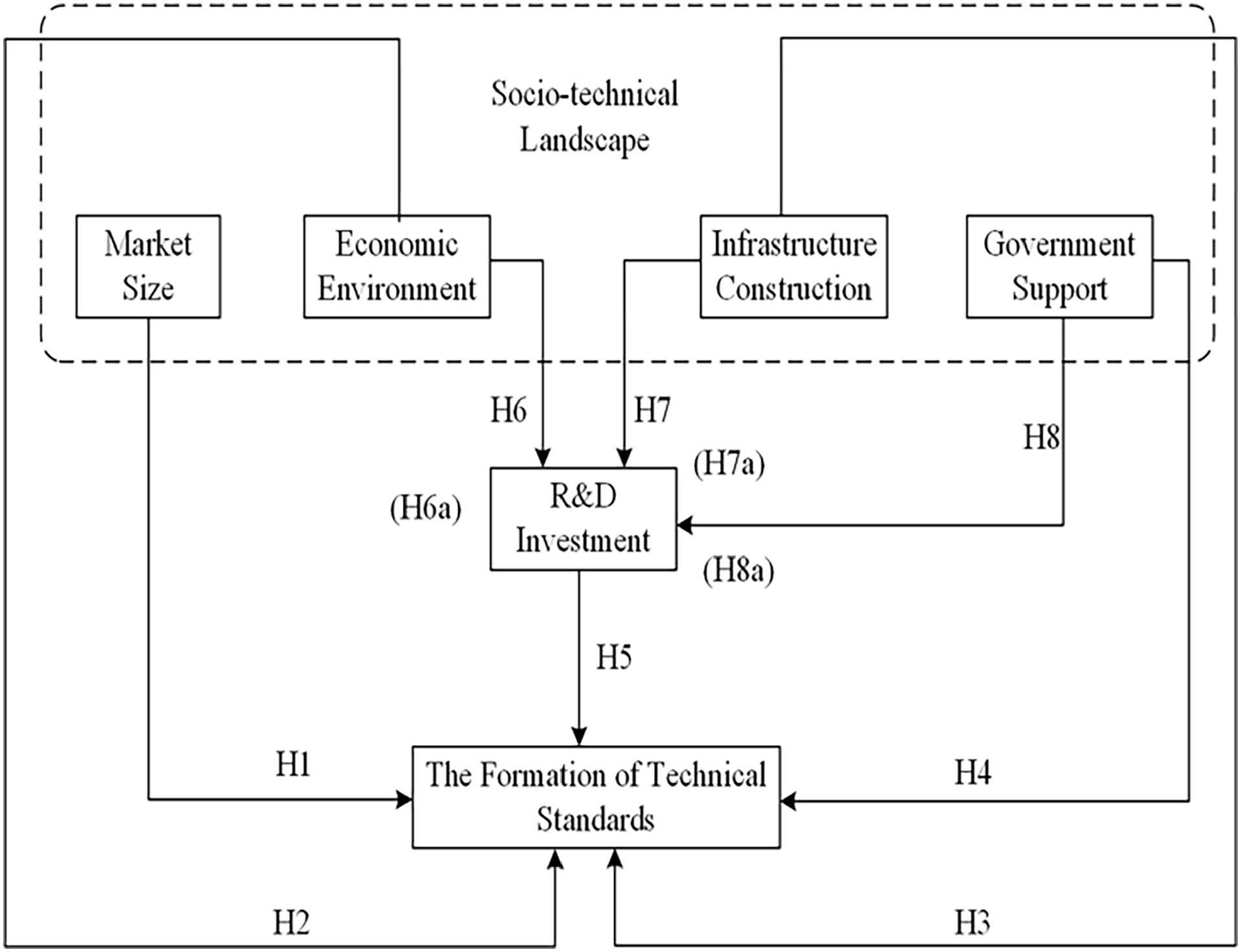
The model of the role of socio-technical landscape on the formation of technical standards.
Research Design
Research Object Selection
Based on the comprehensive consideration of the representativeness of technology, the integrity of the standard and the availability of data, this paper selects the 4G technology standard of China mobile communication industry as the research object. From 2005 to 2012, the 4G standard experienced the technological development process from the establishment of technology routes, innovation and evolution to standard creation, and formed a complete 4G technical standard system by mastering key core technologies (Xia, 2012). It can be said that the formation of the 4G standard has both the impact of market size and infrastructure construction, as well as the promotion of economic environment and government support. At the same time, it is inseparable from the intermediary role of R&D investment, and better presents the relationship of socio-technical landscape, R&D investment and technical standards, which is consistent with the sample characteristics involved in this study.
Variable Measurement
This paper mainly refers to the research of H. Lee and Oh (2006), Saloner (1988), J. Gao (2012), and selects the measurement indicators of socio- technical landscape from the four dimensions of market size, economic environment, infrastructure construction and government support. Specifically, this study selects the number of mobile phone users to measure the market size; measures the economic environment by using the per capita disposable income of urban residents; uses the fixed assets investment in the mobile communication industry as the measurement index of the infrastructure construction dimension. Meanwhile, this article draws upon the common practice of existing literature (Liu & Zhang, 2021; Qi et al., 2021), selection of national fiscal expenditure on science and technology in the mobile communications industry as a measure of government support. Considering that R&D investment is the total resource input of technological innovation activities, it consists of expenditures and personnel input (Yu et al., 2020), based on the research results of Z. Chen and Yu (2007), and with reference to the practice of existing studies that generally use R&D expenditure to measure R&D investment (Alam et al., 2020), the R&D expenditure of R&D organizations in the communications industry is used to measure R&D investment in the mobile communications industry.
At the same time, Teitel (1994), M. Zhang et al. (2020) and other scholars clearly pointed out that because some core technologies are necessary for the formation of technical standards, the process of forming a technical standards system can be seen as a collection of core technologies for innovative outputs (Foucart & Li, 2021; Teitel, 1994; M. Zhang et al., 2020). According to the judgment of the International Telecommunication Union (ITU), China communications industry 4G standard is a complete system which mainly contains eight key core technologies, such as Frequency Division Duplexing, Time Division Duplexing, Orthogonal Frequency Division Multiplexing (OFDM), Orthogonal Frequency Division Multiple Advanced (OFDMA), Multiple-input Multiple-output (MIMO), Smart Antenna, Software Radio and Modulation Coding technologies. Therefore, this paper selects the number of standard-essential patents for the above-mentioned eight key core technologies as a measure of the formation of technical standards.
Data Collection
The specific data in this paper on the measurement indicators of market size, economic environment, infrastructure construction, government support, R&D investment and other variables are all from the Wind database. The Wind database is a relatively complete and accurate financial database in China, whose data categories are comprehensive and sources are authentic. The patent application data of eight key core technologies used to measure the 4G technical standards formation is from the European Telecommunications Standards Institute (ETSI)database. The field of standardization of the ETSI database is mainly in the telecommunications industry and in the field of information and broadcasting technology in cooperation with other organizations. As the largest official standardization organization in the EU, ETSI is the most frequently cited and authoritative database in the field of technical standards research. The recommended standards published by the ETSI database are more internationally recognized. The above data acquisition method makes the original data of the measurement index in this study have higher credibility, which ensures the accuracy of the research. In addition, considering the rapid development of 4G technology, in order to reflect the timeliness of data changes, this paper obtains relevant data on a quarterly basis, further ensuring the effectiveness of the research.
The data collection and processing work of this paper is mainly carried out in two steps: the first step is to take 31 provinces and municipalities in China as the research object, and select 2005 to 2012 as the time span when the standard-essential patents involved in the formation of 4G technical standards have been accumulating continuously, and collect the relevant data according to the unit of quarterly; the second step is to carry out the data processing, which is to clean and exclude patent duplicates of the eight standard-essential patents obtained from the search separately, and finally obtaining a total of 992 pieces of data for 32 quarters in 31 provinces and municipalities. The Central Limit Theorem is often considered to be fulfilled in statistics when the sample size is ≥30, that is, the sample is normally distributed (Ross, 2017). Normally distributed data is a prerequisite for many experimental statistical methods, so with a sample size ≥30, the study is statistically significant and the regression results are reliable. In addition, a sample size of ≥30 helps to prevent type II error and increases the probability of significance arising (Columb & Atkinson, 2016). The sample size of this study met the relevant statistical requirements.
In order to carry out sample analysis more effectively, this study also collects industry factor data such as the number of participating enterprises and industrial sales profits in the process of technical standards formation. Considering these factors have a certain impact on the relationship between socio-technical landscape, R&D investment and the formation of technical standards, they are treated as control variables in data analysis.
Research Methodology
Multiple Regression Models (OLS)
Based on the preceding analysis, this paper incorporates multiple explanatory variables. Accordingly, the research methodology of existing literature is consulted, and the OLS multiple regression model is employed to examine the relationship between two or more independent variables and the dependent variable (Islam et al., 2020), This model was chosen to elucidate the framework of factors that influence the formation of technological standards in this study. The model is presented as follows:

In this model, Yi represents the ith observation of the dependent variable (technical standard formation), while Xik represents the independent variable at the ith observation. In this study, k is set to 4, corresponding to market size, economic environment, infrastructure development, and government support. β0 is the constant term, β1 to βk are the estimated parameters, and
Mediation Effects Model
In this paper, we refer to the three-step method proposed by R. M. Baron and Kenny (1986) to test for mediation effects (R. M. Baron & Kenny, 1986). This method involves constructing three regression equations with different dependent effects to evaluate the mediation effect. Firstly, the independent variable is regressed on the dependent variable; secondly, the independent variable is regressed on the mediator variable; and thirdly, regressing the dependent variable by adding both the independent variable and the mediator variable. Three conditions must be met to establish the mediation effect: first, a significant relationship must exist between the independent variable and the dependent variable; second, a significant relationship must exist between the independent variable and the mediator variable; and third, the mediator variable must significantly affect the dependent variable when the independent and mediator variables are added simultaneously.
Research Results
Descriptive Statistics and Correlation Analysis of Variables
The analysis results of the mean, standard deviation and correlation coefficient of the variables involved in this study are shown in Table 2. Table 2 shows that there are significant positive correlations between market size (r = .589, p < .01), economic environment (r = .450, p < .01), infrastructure construction, government support (r = .477, p < .01) and the formation of technical standards. The above results provide a basis for further research on the hypothetical model of socio-technical landscape and the formation of technical standards.
Variable Descriptive Statistics and Correlation Coefficients.

indicates p < 0.05, ** indicates p < 0.01, and *** indicates p < 0.001
Meanwhile, in order to avoid false regression due to the existence of multi-collinearity between the variables, the multi-collinearity problem was tested before regression analysis. The results show that the variance inflation coefficient VIF of all the variables meets the requirements, that is, the values are lower than the critical value of 10 (Kleinbaum et al., 1998). Therefore, the variables studied in this paper are not affected by multi-collinearity, and multiple-regression methods can be used for subsequent analysis.
Regression Analysis of Main Effects
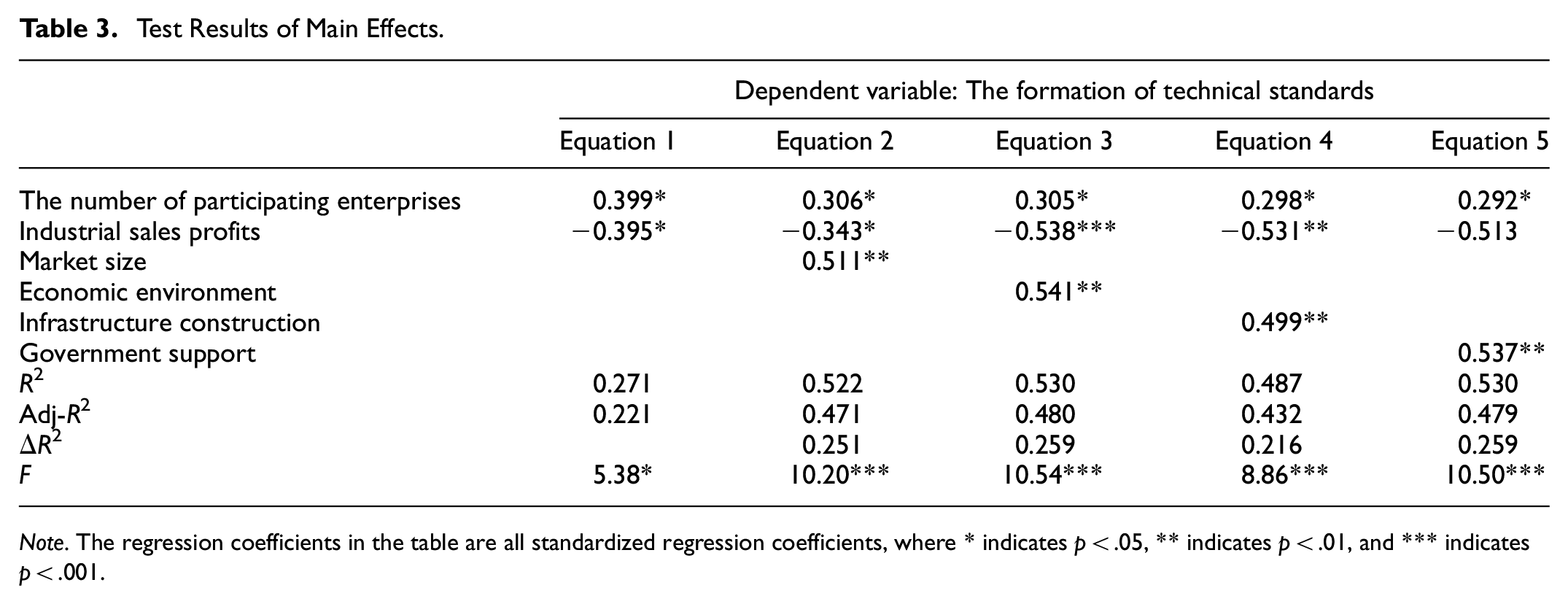
This paper uses Stata11.0 to test the relevant hypotheses. Due to the large variation of values among different variables in the study, the original data of all variables were standardized in the paper, and the effects of each variable on the formation of technical standards were analyzed by multiple regression methods, in addition, robust regression is chosen to avoid heteroscedasticity. According to the research paradigm of the existing literature, the hypothesis test method of this paper is as follows: Firstly, without considering the influence of socio-technical landscape, the control variable is used as the independent variable and the formation of technical standards is used as the dependent variable to obtain the Equation 1; then, on the basis of Equation 1, considering the role of socio-technical landscape, and join the independent variables such as market size, economic environment, infrastructure construction and government support respectively to obtain the Equations 2–5. The results are shown in Table 3.
Test Results of Main Effects.
Note. The regression coefficients in the table are all standardized regression coefficients, where * indicates p < .05, ** indicates p < .01, and *** indicates p < .001.
The results of Equations 1 and 2 show that after adding the independent variable market size based on the control variables, the positive correlation between market size and the formation of technical standards is tested by 1% significance, and the regression coefficient is .511 (p < .01), the hypothesis 1 is verified; the results of Equations 1 and 3 show that after introducing the independent variable economic environment based on the control variables, the positive correlation between economic environment and the formation of technical standards is tested by 1% significance, and the regression coefficient is .541 (p < .01), the hypothesis 2 is verified; the results of Equations 1 and 4 show that after adding the independent variable infrastructure construction based on the control variables, the positive correlation between infrastructure construction and the formation of technical standards is tested by 1% significance, and the regression coefficient is .499 (p < .01), hypothesis 3 is also verified; finally, from the results of Equations 1 and 5, it can be seen that after adding the independent government support on the basis of the control variables, the positive correlation between government support and the formation of technical standards is tested by 1% significance, and the regression coefficient is .537 (p < .01), hypothesis 4 is verified as well.
It can be drawn that market size, economic environment, infrastructure construction, government support and the formation of technical standards are significantly positively correlated, that is, socio-technical landscape has positive effect on the formation of technical standards. This result means that the larger the market size, the better the economic environment, the more complete the infrastructure construction, and the stronger the government support, the stronger the role of the socio-technical landscape they represent in forming technical standards, and the better the environmental and resource conditions of standards establishment, thus the smoother the formation of technical standards.
The results of the hypothesis test confirm the conclusion of T. Wu et al. (2020), Jorgensen and Sorensen (1999) about market size and government support as the driving force for high-tech transformation into technical standards. At the same time, it also verifies the economic path model of J. G. Gao and Shan (2012) on the formation of technical standards, and provides empirical support for the value model of the technical standards evaluation of Y. Chen et al. (2015).
Regression Analysis of Mediating Effects
According to the “mediator” test model proposed by R. M. Baron and Kenny (1986), this paper argues that if the correlations between socio-technical landscape, R&D investment and the formation of technical standards can meet the following conditions, then R&D investment as mediator exists: (1) The independent variable is significantly correlated with the dependent variable; (2) the mediator variable is significantly correlated with the dependent variable; (3) the independent variable is significantly correlated with the mediator variable; (4) the independent variable and the intermediate variable enter the regression equation at the same time to explain the dependent variable, if both the mediator variable and the independent variable have significant effects and when the effect of the independent variable is weakened than before, the mediator variable appears as a partial mediating effect; but if the effect of the mediator variable is significant while the effect of the independent variable is not significant, then the mediator variable appears to be a fully mediating effect. Thus, the regression Equations 6–12 in Table 4 are established, where Equations 6, 7, 8 are regression equations for economic environment, infrastructure construction, government support, and control variables for R&D investment respectively; while Equations 9, 10, 11 are regression equations for economic environment, infrastructure construction, government support and control variables, R&D investment to the formation of technical standards respectively; and Equation 12 is the regression equation for R&D investment to technical standards. Since the verification results of the hypotheses 2 to 4 in the foregoing have shown that the judgment condition (1) of the mediator is satisfied, the other judgment conditions will be mainly examined below.
Test Results of Mediation.

Note. The regression coefficients in the table are all standardized regression coefficients, where * indicates p < .05, ** indicates p < .01, and *** indicates p < .001.
The empirical result of Equation 12 shows that the R&D investment is significantly positively correlated with the formation of technical standards, and the regression coefficient is 0.602 (p < .001), This result indicates that when there is a 1 unit change in R&D investment, technology standard formation also changes by 0.602 units in the same direction. Hypothesis 5 is verified and the mediator’s judgment condition (2) is satisfied.
The test results of Equations 6, 7, 8 show that the economic environment, infrastructure construction, and government support have a positive impact on R&D investment, their regression coefficients are 0.689 (p < .001), 0.695 (p < .001), and 0.577 (p < .01) respectively, all of which satisfy the judgment condition (3) of mediator, and further verify the hypotheses 6, 7, 8. Based on the regression coefficients, it can be observed that a 1 unit change in the economic environment, infrastructure development, and government support leads to respective changes of 0.689 units, 0.695 units, and 0.577 units in the same direction in the formation of technical standards. The results are consistent with the views of Z. Chen and Yu (2007) that economic environment, infrastructure construction, and government support are the influencing factors of R&D investment, which have a significant role in promoting R&D investment.
The results of Equations 9, 10, 11 further show that when the economic environment, infrastructure construction, government support, and R&D investment enter the regression equation at the same time to interpret the formation of technical standards, the role of R&D investment is significant (β9 = .447, p < .05; β10 = .450, p < .05; β11 = .481, p < .01), while the economic environment, infrastructure construction, and government support are not significant. This result indicates that the mediating effect of the economic environment accounts for 56.9% of the total effect, the mediating effect of infrastructure development accounts for 62.7% of the total effect, and the mediating effect of government support accounts for 51.7% of the total effect. The results satisfy the judgment condition (4) of mediator, indicating that R&D investment has a significant mediating role in the positive regression relationship between economic environment, infrastructure development, government support and technological standard formation, thus verifying hypothesis 6a, hypothesis 7a, and hypothesis 8a.
The test results of the path coefficient of the role model of socio-technical landscape on the formation of technical standards are shown in Figure 2. As can be seen from Figure 2, R&D investment plays a mediator role in the relationship between socio-technical landscape and the formation of technical standards. Since the impacts of economic environment, infrastructure construction, and government support on R&D investment are supported by many practical cases, the conclusion obtained in this paper that R&D investment plays a full mediator role between economic environment, infrastructure construction, government support and the formation of technical standards is easy to understand. Specifically, good economic environment affects the decisions of R&D investment, provides sufficient capital and human resources for R&D activities, improves the efficiency of successful research and development of key technologies, and creates conditions for the formation of technical standards; the infrastructure construction increases the expected income of R&D activities, induces the motivation of enterprises to carry out technological innovation, accelerates the rate of core technology in R&D activities, and directly promotes the formation of technical standards; government support for R&D investment reduces the uncertainty risk and cost of R&D activities, promotes the promotion of key technologies, and increases the recognition of core technologies, which in turn promotes the formation of technical standards.

The test result of the path coefficient of the model.
Discussion and Conclusion
Based on the four dimensions of market size, economic environment, infrastructure construction and government support, this paper analyzes the impact of socio-technical landscape on the formation of technical standards. At the same time, it introduces R&D investment as an intermediary variable to further construct theoretical model of socio-technical landscape and the formation of technical standards. The empirical research of 4G technical standards verified the hypothesis of this paper. The research results indicate that: (1) there is a significant positive correlation between the socio-technical landscape and the formation of technical standards. (2) the socio-technical landscape not only directly affects the establishment of technical standards from the dimension of market size, but also from the three dimensions of economic environment, infrastructure construction and government support indirectly influence the formation of technical standards through the intermediary variable of R&D investment; this means that the technical standards can be formed smoothly, not only driven by the market size, but also driven by indirect promotion of R&D investment caused by the economic environment, infrastructure construction and government support. (3) In the socio-technical landscape, the government support has the highest regression coefficient for R&D investment, that is, its promotion effect is the most obvious, indicating that government support is critical to the formation of technical standards.
As evident from the previous section, the majority of existing studies have primarily focused on technological factors (J. Baron et al., 2016; L. Chen et al., 2019; X. Gao, 2014; Jho, 2007; Jiang et al., 2018), alliance factors (Jho, 2007; Kim et al., 2018; Uotila et al., 2017), and government factors (J. Gao et al., 2019; Jho, 2007; Wiegmann et al., 2017; R. Zhang & Sun, 2023) in their investigation of technological standard formation. These studies mostly indicate the influence of individual factors on the formation of technological standards, while lacking specific research on the underlying mechanisms and limited exploration of mediating effects. Therefore, in contrast to previous studies, this paper incorporates multiple macro factors in its findings, with a particular inclusion of R&D investment within the research framework, thereby expanding the boundaries of research on the influencing factors of technical standard formation.
Theoretical Contribution
The theoretical contribution of this paper is mainly reflected in three aspects. Firstly, This paper represents a breakthrough from the limitations of prior research, which predominantly examined the factors impacting the formation of technical standards solely from a macro-environmental perspective with a single-level government focus (X. Gao, 2014; J. Gao et al., 2019; Jho, 2007). Although existing research has emphasized the importance of the external environment for the creation of technical standards, scholars have not given specific explanations as to which factors affect the formation of technical standards and how they play their role. Based on the macro level, this paper integrates the key elements of the external environment that affect the formation of technical standards, and initially opens up the black box of “socio-technical landscape and technical standards.” The market size, economic environment, infrastructure construction, and government support are included in the research scope of socio-technical landscape that affects the formation of technical standards, and the role of socio-technical landscape in the formation of technical standards is analyzed and considered comprehensively.
Secondly, most of the previous studies focused on the direct or independent role of socio-technical landscape or R&D investment in the formation of technical standards (Blind et al., 2011). This paper puts socio-technical landscape, R&D investment and technical standards into the same research framework, fully explores the interaction between the above three, and discusses the mechanism of socio-technical landscape and R&D investment on the formation of technical standards. At the same time, the research results of this paper broaden the perspective of the research on the influencing factors of the formation of technical standards, eliminate the cognitive unilateral that may be caused by a single perspective, and further improve the research system of technical standards formation.
Thirdly, the typical example of the formation of 4G technical standards creates the possibility of studying the influencing factors of technical standards based on statistical data. Hence, it diverges from existing findings that primarily rely on qualitative methods, such as case studies, to investigate the factors influencing the formation of technical standards (J. Gao et al., 2019; Narayanan & Chen, 2012; Wiegmann et al., 2017). This paper presents a quantitative study of the mechanisms influencing the formation of technical standards with the help of statistical data. The theoretical and empirical research on the relationship between socio-technical landscape, R&D investment and the formation of technical standards in this paper not only verifies the previous theoretical views of scholars, but also further integrates the existing research conclusions, thus breaking through the limitations of qualitative analysis and case study, and deepening the research on the influence mechanism of the formation of technical standards. At the same time, the empirical research on 4G technical standards not only highlights the important value of socio-technical landscape and R&D investment on the formation of technical standards, but also expands the reasonable application space of statistical data to a certain extent, ensuring the reliability and standardization of the research and providing new ideas for the research of technical standards.
Practical Implication
The above research conclusions provide the following inspiration for advancing the practice of technical standards formation:
Firstly, for enterprise, relevant enterprises should continue to expand the user base on the basis of maintaining superior technology, and strengthen the market size to directly promote the formation of technical standards. On the one hand, enterprises should strive to strengthen the trust of existing users, maintain good customer relationships, maintain the current market size, and make full use of customers’ technical habits and path dependence to lay a solid user foundation for the formation of technical standards. On the other hand, we will strive to increase users’ recognition of new technologies through network effects, expand the market impact of new technologies through network externalities, and stimulate the willingness of potential users in the market to become real users, thereby expanding market size and promotion scope and promoting the smooth formation of technical standards.
Secondly, relevant industries and enterprises should optimize the allocation of R&D investment with the help of economic environment, infrastructure construction and government support, and effectively play the intermediary role of R&D investment in the formation of technical standards. R&D investment is the premise of technological innovation, which is the basis for the establishment of technical standards. Relevant industries and enterprises should pay full attention to the impact of economic environment, infrastructure construction, and government support on R&D investment, and use it as a medium to promote the formation of technical standards from various dimensions of socio-technical landscape: using all kinds of resources provided by a good economic environment rationally, investing in research and development activities of technological innovation, and accelerating the acquisition rate of core technologies in the technical standard system; strengthening the R&D cooperation with other enterprises through perfect infrastructure construction, increasing R&D investment to enrich innovative communication channels and shortening the formation cycle of technical standards; utilizing the guiding role of government support, increasing R&D investment directionally and consciously, accelerating the research and development of key technologies, and finally realizing the establishment of technical standards.
Finally, considering that government support has the most significant impact on corporate R&D investment, the government can actively adopt a variety of initiatives to enhance its positive role in the formation of technical standards. In order to reduce the risk of technological innovation, make up for the lack of investment in R&D activities, and increase the rate at which technical standards are formed, the government can provide support from three aspects: firstly, providing financial support, government subsidies, government procurement and other financial support, enhancing the power of enterprise technological innovation and R&D investment, easing the cost pressure of enterprises to establish standards alone, and promoting the formation of technical standards; secondly, enacting policies and laws such as tax incentives and patent protection regulations, creating a good atmosphere for key technological innovation and standards creation, promoting relevant enterprises in the standard system to actively carry out research and development and innovation under the policy guidance, thereby promoting the formation of technical standards; thirdly, by leading the establishment of industry-university-research cooperation platform and industrial technology standard alliance, etc., optimizing the relevant resource allocation needed to create technical standards, reducing the difficulty and risk of technical standards formation, saving the investment and cost of standard development, and accelerating the formation speed of technical standards. With adjusting and combining the above-mentioned various forms of support, the government can better guide the input-output ratio of the technical standards creation process and give play to the important role of government support in the formation of technical standards.
Limitation and Prospect
Subject to the quantifiability of indicators and the availability of data, this paper mainly explores the impact of socio-technical landscape on the formation of technical standards from quantitative factors including market size, economic environment, infrastructure construction, and government support, without considering qualitative description factors such as culture and system. Future research will continue to explore the effective measurement basis of the above qualitative factors, incorporate it into the field of empirical research, and further expand the research object to the technical standards of other industries, strive to enrich the theoretical framework and empirical data of the model, enhance the universality of research conclusions, thereby present the relationship between socio-technical landscape and the formation of technical standards more effectively.
Footnotes
Author Contributions
Conceptualization: Bing Sun; Methodology: Hongying Mao; Formal analysis and investigation: Yujiao Tan; Writing—original draft preparation: Tian Liang; Writing—review and editing: Hongying Mao; Resources: Tian Liang; Supervision: Tian Liang.
Declaration of Conflicting Interests
The author(s) declared no potential conflicts of interest with respect to the research, authorship, and/or publication of this article.
Funding
The author(s) disclosed receipt of the following financial support for the research, authorship, and/or publication of this article: This work was supported by the National Natural Science Foundation of China (Grant 72274044, 71774035) and Natural Science Foundation of Heilongjiang Province (Grant LH2020G005).
