




Abstract
Rapid migration-driven urbanization in developing nations poses significant challenges to environmental sustainability and policy effectiveness. This study investigates the interplay between migration, urban growth, and environmental policy in Karachi and Quetta, Pakistan—two cities with distinct urbanization trajectories. Integrating an adapted Pressure-State-Response (PSR) framework with a mixed-methods approach, the research combines survey data from 400 residents, geospatial analysis of land-use change (1992–2022), and secondary data, analyzed using Partial Least Squares Structural Equation Modeling (PLS-SEM). The findings reveal that urban growth (State) significantly mediates the relationship between migration (Pressure) and perceived environmental policy effectiveness (Response). Crucially, the City Type (Karachi vs. Quetta) significantly moderates the strength of the Pressure→ State→ Response pathway, revealing that the fragmentation of governance in Karachi and the resource scarcity in Quetta lead to distinct outcomes. The analysis also reveals that fragmented governance impedes effective policy responses, challenging the applicability of universal models like the Environmental Kuznets Curve (EKC) in such contexts. These findings underscore the necessity for context-specific, integrated urban planning that actively incorporates migration dynamics, strengthens governance, and promotes social equity to achieve sustainable development.
Keywords
Introduction
Urbanization in the developing world represents a profound and swift transformation, fueled by substantial rural-urban migration driven by socio-economic disparities and climate displacement (Jedwab et al., 2017; Sohail & Chen, 2022)., urbanization challenges in developing nations are frequently intensified by substantial rural–urban migration flows, setting them apart from the experiences of many developed countries (Carter, 1997; Cui, 2020; Nolan & White, 1984; Yang et al., 2023). This demographic shift acts as a significant Pressure on urban systems, generating critical environmental pressures, including heightened pollution, accelerated resource depletion, and habitat degradation (Gedikli et al., 2022; Shi et al., 2022; Zipperer et al., 2020). These challenges are particularly acute in the Global South, where the rapid pace of urban expansion frequently outstrips the capacity for effective planning and governance, leading to unsustainable resource consumption and policy failure (Cui, 2020; Sohail & Chen, 2022; Yang et al., 2023).
Pakistan exemplifies this trajectory, with projections suggesting nearly 60% of its population will reside in urban areas by 2050 (United Nations, 2019). Major cities like Karachi and Quetta vividly demonstrate the impact domestic migration, which fuels rapid urban expansion, exerting considerable pressure on housing availability, infrastructural capacity, and the provision of essential services (Lehri et al., 2021; Mahar et al., 2022). These two contrasting cities are strategically chosen to provide a valuable comparative basis for assessing governance effectiveness. Karachi functions as the fragmented economic megacity model, defined by immense population pressure and infrastructural deficits. Quetta represents the resource-constrained secondary city model, acutely vulnerable to climate pressure and water scarcity. Examining these two divergent yet representative models is central to our comparative design, enabling the robust assessment of generalizability required for context-specific urban governance (Nazeer et al., 2021; Yousafzai et al., 2022).
Despite existing research exploring aspects of migration and urban development in Pakistan, a significant gap persists in the literature. Specifically, there is a lack of investigation into the mediating role that urban growth (State) between migration dynamics (Pressure) and the implementation or effectiveness of environmental policies (Response). Previous studies (Abdul & Yu, 2020; Afzal et al., 2018; Jabeen et al., 2017) have predominantly focused on the demographic and economic dimensions of urbanization, often overlooking how policy interventions (or their absence) shape urban resilience and environmental sustainability.
Crucially, the pure Pressure-State-Response (PSR) model is insufficient to capture the socio-political and governance failures that hinder the Response phase. Therefore, our study augments the (PSR) framework (Rapport, 1979) with principles from resilience frameworks and planetary urbanization theory to provide a robust theoretical lens for evaluating contextual governance capacity. The study employs a mixed-methods approach to investigate these dynamics. which provides a robust structure for our conceptual model, as illustrated in Figure 1. To contribute to the sustainable urban development literature, present study investigates the complex relationships between migration, urbanization, and environmental policy in Karachi and Quetta. This research fulfills a critical gap by demonstrating the mediating role of urban growth and, critically, the moderating role of city type, thereby providing context-specific insights required for resilient urban governance in the global south. The study aligns with SDG 11 (Sustainable Cities and Communities) and supports SDGs 10 and 13 by examining migration-driven urbanization and its environmental governance implications.

Conceptual model.
Specifically, we pursue the following research objectives:
To compare the effects of migration on the urban development trajectories of Karachi and Quetta.
To evaluate the environmental impacts resulting from migration-driven urbanization in these two cities.
To assess the effectiveness of current environmental policies in managing urban growth and mitigating its associated environmental impacts.
To develop evidence-based policy recommendations that promote sustainable urban development while addressing the needs and impacts related to migrant populations.
Ultimately, by achieving these objectives—enhancing understanding of the dynamic interplay between migration, urban growth, and environmental policy effectiveness, this research can inform the design of more targeted and integrated interventions that promote genuinely sustainable urban development pathways.
Literature Review and Conceptual Framework
Theoretical Background and Conceptual Lens
A widely used framework for analyzing environmental issues is the Pressure-State-Response (PSR) model (Cheng & Li, 2024; Hu et al., 2024; Lai et al., 2022). Within this model,
Urbanization, particularly migration-driven urbanization, is one of the most significant global drivers of environmental and socio-economic changes. In rapidly growing megacities like Lagos and Jakarta, unplanned urban expansion often puts immense pressure on infrastructure and the environment, resulting in severe environmental degradation (Nilay & Onur, 2024; Satterthwaite et al., 2021). In contrast, cities like Singapore have demonstrated how integrated governance can mitigate the environmental impacts of rapid urbanization (Gürçam, 2024). Pakistan’s urbanization trajectory shares similarities with these global trends, yet it exhibits distinct characteristics. Cities like Karachi and Quetta, experience rapid migration-driven growth that frequently overwhelms institutional capacities, creating unique challenges in both urban governance and environmental management (Aslam et al., 2023; Qasim, 2014).The urban transition in Pakistan is marked by one of the highest urbanization rates in South Asia (Khan et al., 2023), characterized by high level of domestic migration, significant interprovincial displacement, and increasingly, climate-induced population movements (Azizi et al., 2022; Tanveer et al., 2022).
While the PSR model provides a strong foundation, it is necessary to integrate it with broader theories to fully capture the complexity of migration-driven urbanization. Insights from Planetary Urbanization emphasize urbanization as a global process extending beyond administrative boundaries (Brenner, 2013; Brenner & Schmid, 2017), while Migration Systems Theory helps contextualize the economic and socio-political factors driving population flows to Karachi and Quetta (Massey, 1990). To address the socio-political barriers to policy effectiveness—the inherent governance failures, we integrate Lefebvre’s Urban Theory. This focus on the production of space through unequal socio-political power (Lefebvre, 2003), is vital for understanding how migration and urban growth exacerbate spatial inequalities in Karachi and Quetta, which, in turn, structurally hinder the effective and equitable implementation of the policy Response (R). Finally, Resilience Frameworks highlight the need for adaptive governance to address environmental stressors such as water scarcity and pollution, ensuring equitable urban development and resource distribution (Walker & Salt, 2012).
The literature on urbanization, migration, and governance in Pakistan is growing; however, there remains a significant gap in understanding the precise interactions between these factors. The interplay of migration-induced pressures, urban growth, and environmental governance in cities like Karachi and Quetta remains underexplored, especially concerning policy effectiveness in mitigating these pressures. As existing research tends to focus on broader, global frameworks or policy advocacy, a critical gap exists in the literature regarding how urban growth mediates the relationship between migration and environmental outcomes in Pakistan. This study aims to address this gap by exploring the mechanisms that link migration pressures to the effectiveness of environmental policies in Karachi and Quetta.
Migration as Environmental Pressure
Migration, particularly the combined influx of economic migration in Karachi and climate-induced migration in Quetta, represents a significant Pressure (Azizi et al., 2022; Tanveer et al., 2022). These distinct migration patterns create varying environmental pressures on each city’s infrastructure and natural resources. In both cities, rapid population growth places immense strain on infrastructure, leading to deficits and resource depletion (Lehri et al., 2021). The sheer speed and volume of this demographic shift overwhelm existing governance structures, leading to a direct strain on the capacity for policy development and implementation (Aslam et al., 2023; Qasim, 2014). This literature proposes a direct relationship between migration (Pressure, P) and the development and effectiveness of environmental policies (Response, R), particularly in the context of rapidly expanding cities driven by migration.
Urban Growth as the Mediating Mechanism (State)
The rapid urban growth driven by migration, serves as a key mediating mechanism between migration pressures and the effectiveness of environmental policies. In Karachi, unregulated urban expansion, fueled by industrial growth and high levels of migration, places significant strain on infrastructure, leading to challenges such as pollution, traffic congestion, and waste management (Lehri et al., 2021). In contrast, Quetta’s urbanization, largely driven by domestic migration and climate-induced displacement, primarily stresses water resources and contributes to aquifer depletion (Khan et al., 2023; Mahar et al., 2022).
This distinction highlights the different environmental pressures each city faces due to urban growth. The environmental degradation resulting from this growth, including unchecked sprawl, pollution, water scarcity, and aquifer stress, illustrates the State (S) component of the PSR framework. As the literature suggests, urban growth plays an essential role in mediating how migration-induced pressures shape environmental outcomes, which in turn influence the need for policy interventions (Harsono et al., 2024; Nazeer et al., 2021). These environmental challenges confirm that degradation of the environment (S) often triggers a policy response (R), in line with the core principles of the PSR. This proposes that urban growth mediates the relationship between migration pressures and environmental policy effectiveness.
Environmental Policy (Response) and Contextual Moderation
Environmental policies are often shaped by the unique contextual factors present in each city, and their effectiveness varies widely (Handoyo, 2024; Nguyen et al., 2023). Theories like the Environmental Kuznets Curve (EKC) often fail to apply in contexts like Karachi because weak governance prevents the necessary policy responses from decoupling economic growth from rising emissions (Yousafzai et al., 2022). This highlights how governance moderates the relationship between the State (S) and Response (R) in the PSR framework.
The governance-related factors in moderate the strength of the structural pathways (Acheampong & Opoku, 2023; Crane et al., 2021), as seen in Karachi’s fragmented governance or Quetta’s lack of resources. In Karachi, fragmented governance and the lack of coordination between various authorities have resulted in unregulated industrial growth, contributing to air pollution and inadequate waste management (Hussain & Nadeem, 2021; Iqbal et al., 2024). Similarly, in Quetta, resource scarcity and the overexploitation of aquifers limit the city’s capacity to develop comprehensive water management strategies (Azizi et al., 2022; Khan et al., 2023). These challenges exemplify how contextual factors, such as city-specific governance, influence the P-S-R pathways. Karachi’s rapid urbanization worsens environmental issues due to fragmented governance, while Quetta’s resource limitations shape responses to water scarcity. This highlights the moderating effect of city-specific factors on policy effectiveness within the PSR framework.
Hypothesis Development
Guided by the theoretical framework and the insights derived from the literature, the following hypotheses are formally proposed for investigation:
Materials and Methods
Study Area
This research focuses on Karachi and Quetta which serve as the administrative capitals of Sindh and Balochistan provinces in Pakistan. Karachi located at 24.8600° N, 67.0100° E, is Pakistan’s most populous city and primary economic hub. It covers 3,530 km2 and serves as a major destination for internal migrants seeking employment and urban amenities (International Organization for Migration, 2023). Quetta, situated at 30.1796° N, 66.9750° E, and covering 2,653 km2, functions as a key administrative and economic hub for Balochistan, experiencing significant migration due to better services and living standards compared to surrounding rural areas (Pakistan Bureau of Statistics, 2017).
These two cities have been purposefully chosen for analysis due to distinct socio-environmental pressures and their comparative significance as migration destinations. Karachi, as Pakistan’s economic powerhouse, primarily attracts economic migrants seeking opportunities in trade, industry, and services. This contrasts with Quetta, which faces climate-induced displacement due to increasing environmental stressors, such as droughts and water scarcity, particularly in the surrounding rural areas. Karachi represents a classic case of economic migration, while Quetta serves as a hub for climate migration, providing a critical comparison for understanding how different forms of migration influence urban growth and environmental policy (Asian Development Bank, 2023). The mapped locations are illustrated in Figure 2.

Location of study area.
Research Design, Sampling, and Data Collection
This study employed a quantitative explanatory research design, grounded in a positivist approach, to evaluate the causal relationships within the adapted Pressure-State-Response (PSR) model. This design was necessary because it allows for statistical analysis and generalizable conclusions regarding how latent constructs—migration and urban growth—affect policy outcomes. The use of Partial Least Squares Structural Equation Modeling (PLS-SEM) was particularly suited for this complex, variance-based PSR framework and its conceptualized latent variables.
A stratified random sampling technique was used to ensure the data collected were representative of key urban stakeholders (residents, urban planners, and policymakers) in both Karachi and Quetta. The sample size of 400 respondents (Karachi: 230, Quetta: 170) was determined using (Krejcie & Morgan, 1970) guidelines to ensure adequate statistical power. Data were collected via in-person surveys conducted from March to May 2024, yielding an 80% response rate, which enhanced the representativeness of the sample.
The study was conducted in accordance with the Declaration of Helsinki ethical protocols, and all necessary ethical considerations were strictly observed. Written informed consent was obtained from all survey participants, who were provided full disclosure about the study’s purpose and procedures. Participation was voluntary, and respondents were assured of anonymity and the confidentiality of their responses. Data storage and handling adhered to privacy protection principles, ensuring secure and ethical data management practices.
Measures, Operationalization, and Instrument Validation
This section details the structured, closed-ended survey instrument used to operationalize the PSR constructs. The instrument was developed by adapting items from established literature (Ahmed, 2021; Iqbal et al., 2024; Qasim, 2014) to ensure contextual relevance to the comparative study of Karachi and Quetta.
Environmental Policies (EP): six items assessed the Response construct by targeting perceived implementation effectiveness and enforcement, reflecting the governance issues central to the study adopted from (Khan et al., 2023) and (Ahmed, 2021). Such as, “To what extent do you agree that the current environmental policies in the city are effectively reducing air pollution?” The instrument initial consisted of 17 items. Face and content validity were confirmed by experts in urban planning. Following a pilot study (n = 30), three items were removed after initial factor analysis due to low factor loadings, a standard procedure taken to enhance scale reliability and convergent validity. The reliability of the final 14-item instrument was subsequently confirmed using Composite Reliability (CR), which is the appropriate metric for PLS-SEM. The specific measurement properties, including item counts, conceptual dimensions, and full source references for all final items, are comprehensively presented in Section (“Confirmatory Factor Analysis and Composite Reliability”) Table 1.
Confirmatory Factor Analysis (CFA) and Composite Reliability.

Secondary Data Acquisition and Processing
In addition to primary data, secondary data were integrated to enhance the study’s credibility through a sequential explanatory mixed-methods approach. This allowed for triangulation and deeper contextualization of survey findings with objective spatial and documentary evidence.
Secondary data sources included geospatial data (GIS) and content analysis of government reports, municipal records, and environmental databases. Geospatial data included satellite imagery from Landsat Thematic Mapper and Enhanced Thematic Mapper Plus (1992, 2002, 2013, 2022), obtained from the USGS Earth Explorer portal, and topographic maps from the Survey of Pakistan. This data was used to quantify urban growth and land cover changes. The imagery was corrected using atmospheric and digital enhancement techniques to improve analysis accuracy.
Content analysis of secondary textual data from government and environmental reports was performed to establish the socio-political and governance context necessary for interpreting the multi-group analysis findings. Policy documents, municipal records, and environmental reports were systematically analyzed using NVivo software. Thematic coding was applied to identify recurring themes related to governance fragmentation, resource allocation challenges, and specific environmental enforcement mechanisms in Karachi and Quetta. This process moved beyond descriptive summaries to create a comparative baseline of institutional capacity, directly informing the nuanced interpretation of differences in perceived policy effectiveness (EP) between the two cities.
Data Analysis
Data analysis was conducted in two primary stages: initial quantitative analysis of survey data using Partial Least Squares Structural Equation Modeling (PLS-SEM) and geospatial analysis of land-use change. This approach ensured that the theoretical relationships outlined in the PSR framework were statistically tested while the contextual data (urban growth) provided objective validation.
Statistical Data Analysis (PLS-SEM)
Primary data were analyzed using PLS-SEM in SmartPLS 4, a suitable tool for complex predictive models in social and environmental research. The analysis proceeded in two sequential steps. First, the measurement model was assessed to confirm reliability and validity. This involved evaluating internal consistency through Composite Reliability (CR) and the constructs’ convergent validity using Average Variance Extracted (AVE). Discriminant validity was assessed using the Fornell-Larcker criterion and the HTMT ratio. Construct validity (convergent and discriminant) and reliability were evaluated using factor loadings (threshold >0.7), Composite Reliability (CR; threshold >0.7), and Average Variance Extracted (AVE; threshold >0.5). Items with loadings below 0.7 were removed to ensure model validity.
In the second stage, the structural model was assessed by testing the hypothesized pathways using 5,000 bootstrap samples to determine the significance of path coefficients (β), and associated t-values Model quality was confirmed by assessing the coefficient of determination (R2), predictive relevance (Q2), and the effect size (f2). The relationships defined by H2 (Mediation/Foundational links) were assessed by examining the significance of the direct and indirect effects. Finally, Hypothesis H3 (Moderation) was tested using Multi-Group Analysis (MGA) to formally compare the structural path coefficients (β) between the Karachi and Quetta subsamples.
Spatial Data Analysis
Geospatial analysis focused on examining changes in urban expansion and land cover patterns between 1992 and 2022, using ArcMap 10.8. Corrected satellite imagery was analyzed and categorized into four major land cover types: settlements, barren areas, vegetation, and water bodies, through supervised classification methods. GIS-based change detection, overlay, and buffer analyses were employed to map urban growth trends and identify significant land cover transformations. The methodological process is summarized in Figure 3. To ensure scientific rigor, a mandatory Accuracy Assessment was conducted, which involved cross-referencing random validation points against high-resolution reference data to construct a Classification Error Matrix. The classifications consistently achieved a final overall accuracy of 88.5% and a Kappa Coefficient of .82, unequivocally confirming the robustness of the geospatial data. These spatial findings were then used to support the validation of survey outcomes related to infrastructure growth and the expansion of residential zones, offering a comprehensive understanding of urbanization dynamics in Karachi and Quetta.
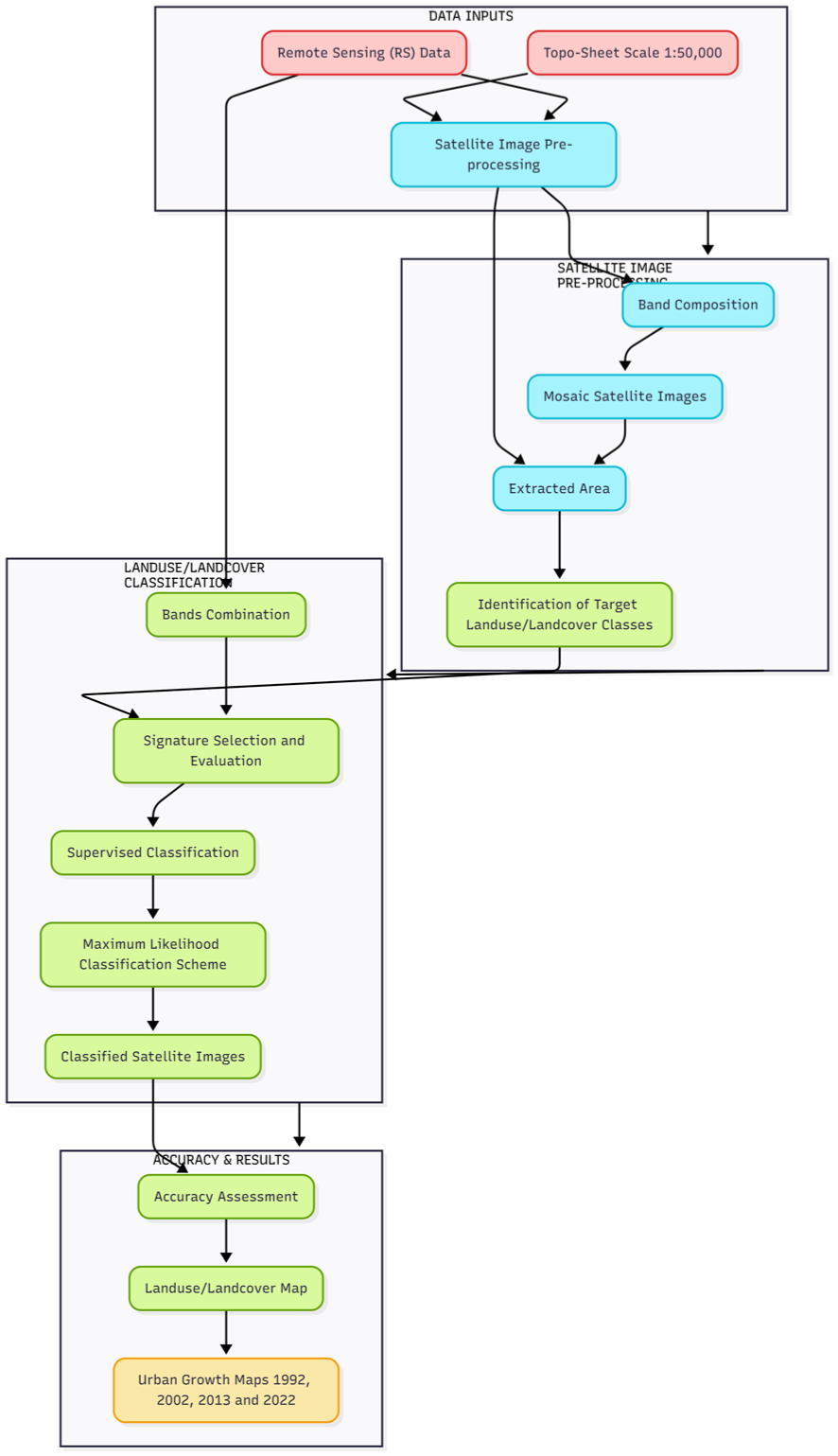
Flowchart of urban growth methods.
Data Analysis and Results
Confirmatory Factor Analysis and Composite Reliability
Prior to hypothesis testing, the measurement model was assessed using Confirmatory Factor Analysis (CFA) within the PLS-SEM framework to ensure the reliability and validity of the constructs: Migration (
Indicator reliability was evaluated based on outer loadings. Following standard guidelines set by (Hair et al., 2021), items with loadings below the threshold of 0.7 were removed to enhance construct validity. Initially comprising 17 items, the final measurement model retained 14 items (Table 1) after removing three items (one from UG, two from EP) due to insufficient loadings. The retained items demonstrated strong loadings on their respective latent variables: MIG items ranged from 0.767 to 0.796, UG items from 0.718 to 0.771, and EP items from 0.732 to 0.791, indicating that the indicators reliably represented their intended constructs (Hair et al., 2021; Shrestha, 2021).
Internal consistency reliability was further assessed using Composite Reliability (CR). As reported in Table 1, the CR values for Migration (CR = 0.801), Urban Growth (CR = 0.752), and Environmental Policies (CR = 0.795) all exceeded the recommended benchmark of 0.70 (Cheung et al., 2024), unequivocally confirming the internal consistency of the measurement scales.
Convergent and Discriminant Validity
Further validation of the measurement model focused on assessing convergent and discriminant validity. According to Gong et al. (2024), an Average Variance Extracted (AVE) value greater than 0.5 indicates convergent validity, meaning the construct explains a significant variation of the indicators used. Therefore, convergent validity was established, as the AVE for each latent construct exceeded the minimum threshold of 0.50 (Migration AVE = 0.621; Urban Growth AVE = 0.603; Environmental Policies AVE = 0.613), indicating that the constructs captured sufficient variance from their respective indicators (Table 2).
Average Variance Extracted (AVE) and Discriminant Validity (DV).
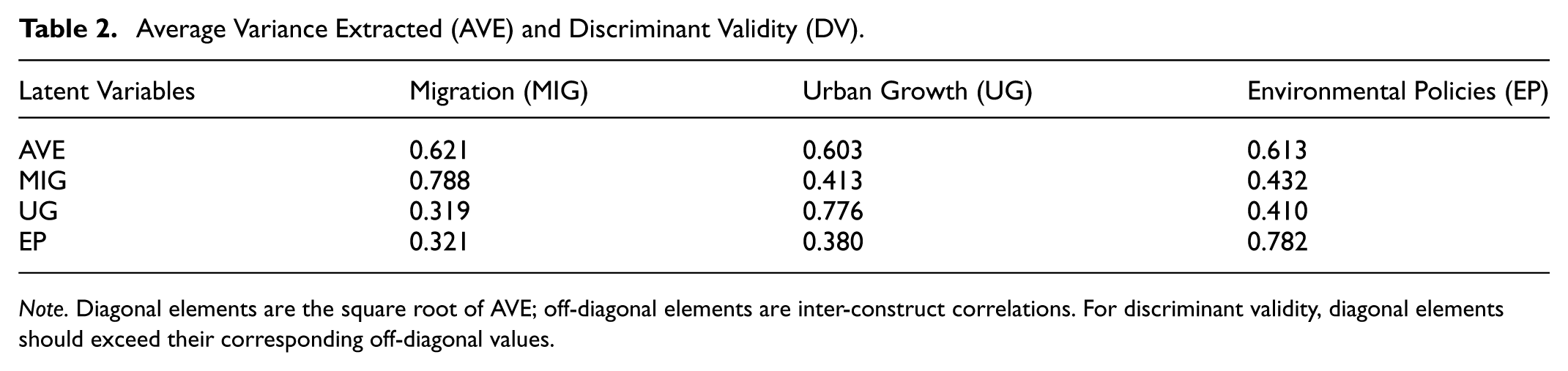
Note. Diagonal elements are the square root of AVE; off-diagonal elements are inter-construct correlations. For discriminant validity, diagonal elements should exceed their corresponding off-diagonal values.
Discriminant validity was assessed using the (Fornell & Larcker, 1981). As detailed in Table 2, the square root of the AVE for each construct (diagonal values) was greater than the correlations between that construct and all other constructs in the model (off-diagonal values). This confirms that discriminant validity was achieved, providing clear evidence that the measures for Migration (Pressure), Urban Growth (mediating State), and Environmental Policies (Response) represent distinct concepts within the study’s PSR-informed framework.
Structural Model Assessment: Explanatory Power and Effect Sizes
The explanatory power and predictive relevance of the PSR-informed structural model were evaluated using the coefficient of determination (R2) and effect size (f2), respectively. R2 values indicate the proportion of variance in endogenous constructs explained by their predictors, with values above 0.26 considered substantial (Chin, 1998; Cohen et al., 1988).
As detailed in Table 3, the model explained a substantial portion of the variance in the mediating State variable, Urban Growth (UG R2 = 0.613). Similarly, a substantial amount of variance in the Response variable, Environmental Policies (EP R2 = 0.689), was collectively explained by Migration and Urban Growth.
Effect sizes (f2), and Explanatory Power (R2).

Note. R2 indicates variance explained (substantial >0.26). F2 indicates effect size (large ≥0.35). “—“ indicates not applicable.
The effect size (f2) quantifies the contribution of each predictor to the R2 of its target construct, with f2 values ≥0.35 indicating a large effect (Hair et al., 2021). The analysis revealed a large effect size for the influence of Migration (Pressure) on Urban Growth (State) (f2 = 0.532). Furthermore, Urban Growth (State) exhibited a large effect size on Environmental Policies (Response) (f2 = 0.429). These results (summarized in Table 3 and visualized in Figure 4) underscore the substantive impact of the Pressure and mediating State variables within the proposed structural model.

Structural Equation Model of the Study.
Hypothesis Testing (Path Analysis)
The study used coefficient analysis to establish the association between the predictor and dependent variables (Hair et al., 2021). This approach measures the qualities and strengths of these relationships and determines the variation in the dependent variable explained by each predictor (Bagozzi & Yi, 1988). It identifies the predictors with stronger relationships or regression weights with the dependent variable.
Applying this analysis within the PLS-SEM framework, the study tested the hypothesized relationships derived from the conceptual model (Figure 4). Statistical significance (T > 1.96, p < .05) was assessed via bootstrapping (5,000 resamples), with results detailed in Table 4.
Path Coefficient Analysis (Hypotheses testing).

Note.β = standardized path coefficient. T > 1.96 and p < .05 indicate statistical significance.
Multi-Group Analysis: Karachi Versus Quetta
To address H3 (which posited that the structural paths would be moderated by city context), a Multi-Group Analysis (MGA) was performed comparing the structural path coefficients between the Karachi and Quetta subsamples (Table 5 and Figure 5).
Comparison of Path Coefficients among Karachi and Quetta.

Note. Coefficients represent standardized path coefficients (β) for Karachi and Quetta. “Difference” indicates the numerical difference between these coefficients. The “p-value” assesses the statistical significance of this difference; p < .05 indicates a significant difference in path strength between the two cities.
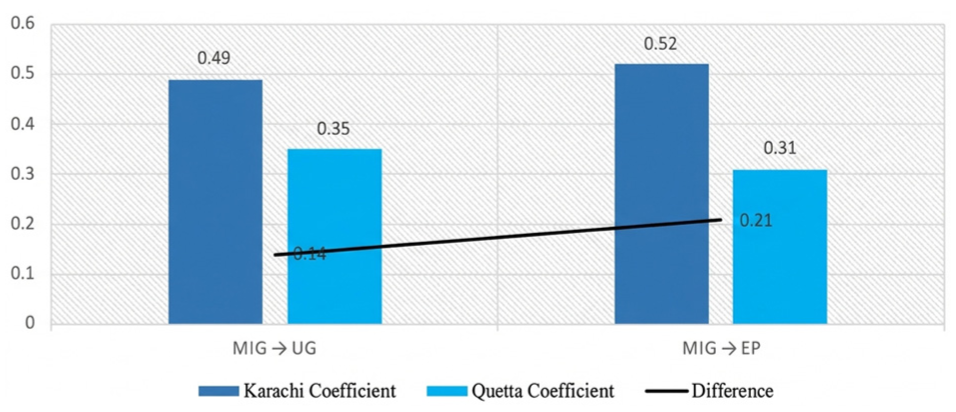
Comparison of path coefficients between Karachi and Quetta.
The MGA revealed statistically significant differences for two key relationships, thereby supporting H3:
The effect of Migration (Pressure) on Urban Growth (State mediator) was significantly stronger in Karachi (β = .49) than in Quetta (β = .35) (Difference = 0.14, p = .030).
Similarly, the direct effect of Migration (Pressure) on Environmental Policies (Response) was also significantly stronger in Karachi (β = .52) compared to Quetta (β = .31) (Difference = .21, p = .024).
These findings confirm that the structural pathways relating migration and urban growth to environmental policy effectiveness are significantly moderated by the specific urban context. The results suggest a substantially stronger influence of migration pressures on both urban state and policy response in Karachi compared to Quetta. This quantitative difference is further explored in the discussion, where it is linked to the socio-political and resource constraints identified through content analysis.
Urban Growth and Land Cover Change (GIS Analysis)
Geospatial analysis of Landsat imagery (1992–2022) provided objective measures of changes in the urban State over time. The results show that there has been a significant increase in urban growth. Both Karachi and Quetta exhibited significant spatio-temporal patterns of urban expansion, representing State changes driven by Pressures such as population growth and migration (Figure 5 and 6). Over time, both cities experienced a marked increase in built-up areas accompanied by a reduction in barren land. In Karachi, urban expansion was primarily directed toward the northwest, whereas in Quetta, growth extended toward both the northwest and the south.

Land-use change in Karachi: (a) 1992, (b) 2002, (c) 2013, and (d) 2022.
Figure 8 illustrates the extent of built-up area expansion and offers a quantitative comparison of land cover in Karachi and Quetta. The analysis indicates that in 2022, Quetta experienced an increase in barren land, while its built-up area saw a notable decline, as depicted in Figure 7. A brief rise in vegetation, particularly grass cover, is observed in Figure 7d, which is attributed to increased rainfall and flooding during that year. This vegetation growth represents a short-term fluctuation rather than a sustained environmental shift, coinciding with the 2022 floods in Balochistan—a major climatic event that temporarily altered the landscape (NDMA, 2022). Widespread damage to infrastructure and housing likely altered the landscape detected by satellite sensors and potentially influenced subsequent societal Responses. Similar flood impacts in Sindh likely exacerbated Pressure (migration) towards Karachi (NDMA, 2022).
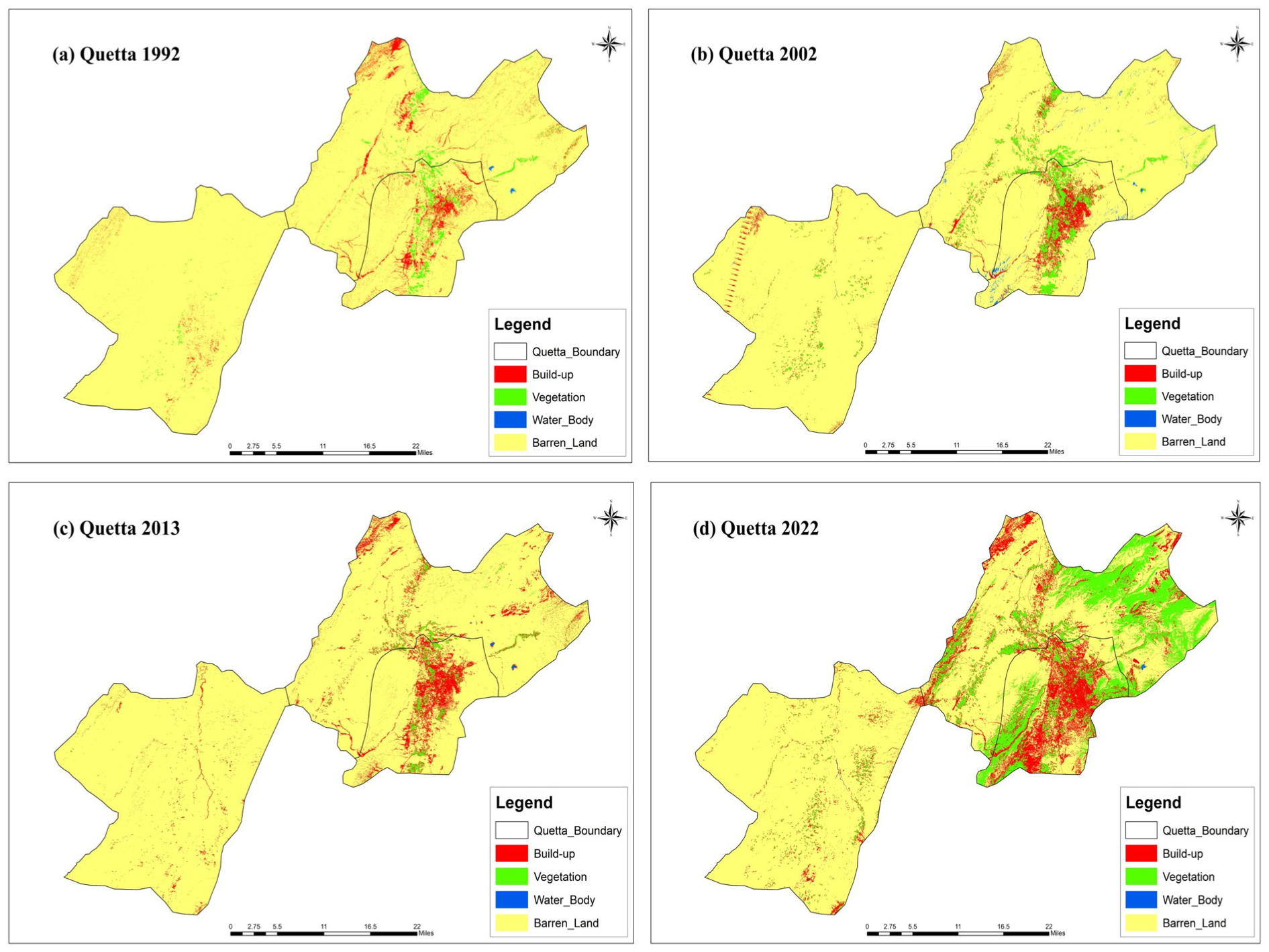
Land-use change in Quetta: (a) 1992, (b) 2002, (c) 2013, and (d) 2022.

Area in sq. km of landcover of Karachi and Quetta city.
Content Analysis
Content analysis of secondary data (including municipal records, environmental databases, and government reports) was conducted to provide objective, comparative indicators related to the study’s adapted Pressure-State-Response (PSR) framework for Karachi and Quetta. This analysis established the baseline contextual differences necessary for interpreting the Multi-Group Analysis (H3) results.
Pressure and State Indicators
Table 6 presents comparative indicators reflecting key Pressure elements (Migration) and resulting urban State characteristics (Growth, Strain, Disparities) for Karachi and Quetta. Karachi registered a significant differential in migratory pressure, recording an annual migration rate of 5.2%, which is substantially higher than Quetta's 2.1%. This disparity in migration directly corresponds with a more severe urban State in Karachi, as evidenced by multiple metrics: Karachi exhibits higher urban population growth (6.8% vs. 3.4%), greater annual urban expansion (12.5 sq. km vs. 4.8 sq. km), and a critical Infrastructure Strain Index (85% vs. 60%), indicating the megacity operates closer to its functional capacity limits. Furthermore, indicators of socio-economic vulnerability highlight the differential strain on the urban system, with Karachi recording more acute conditions including higher unemployment (12% vs. 8%) and a greater proportion of households below the poverty line (22% vs. 18%).
Impact of Migration on Urban Growth and Socio-Economic Disparities.

Note. Infrastructure Strain Index: A composite metric (0%–100%) reflecting pressure on housing, transportation, and utilities.
Environmental State Indicators
Key environmental State indicators for Karachi and Quetta detailed in Table 7 further highlight the differential severity of urban environmental challenges. Karachi’s severity is highlighted by ambient PM2.5 concentrations (88 µg/m3) which are nearly double those recorded in Quetta (45 µg/m3) suggesting a far greater challenge related to industrial emissions and vehicular traffic. Furthermore, Karachi experienced a significantly higher rate of agricultural land loss around the metropolitan fringe (25% vs. 12%), directly reflecting the intensity of its urban expansion. Regarding resource management, a larger percentage of Karachi's population (30%) was reported to be affected by water scarcity relative to Quetta (18%). In terms of waste management, proper disposal rates were reported as 72% for Karachi and 65% for Quetta, indicating systemic waste management challenges persisting in both urban systems.
Environmental Challenges Associated with Urban Growth.

Policy Response Indicators (Effectiveness)
Table 8 details selected indicators of the Response dimension, providing empirical documentation of the operational environment for policies in both cities. The data confirms that policy effectiveness is highly varied and subject to critical, context-specific implementation gaps. Implementation percentages for key policies range from a low of 60% (Water Conservation Policies) to a high of 90% (Air Quality Monitoring Systems), illustrating uneven progress across sectors. The Challenges Identified through the content analysis (e.g., land acquisition, low public participation, funding, and water distribution issues) provide the qualitative basis for interpreting the weakness of the policy response observed in the main statistical model.
Effectiveness of Environmental Policies.

Discussion
This study explored the complex interplay between migration, urban growth, and environmental policy effectiveness in Karachi and Quetta using the adapted Pressure-State-Response (PSR) framework. The findings reveal how urban growth (State) acts as a crucial intervening variable that fully mediates the relationship between migration-induced pressures (Pressure) and policy responses (Response), strongly supporting H2. The strength of this mediation is shaped by the socio-economic and environmental conditions of each city, as contextualized by H3.
The analysis confirmed that migration (Pressure) directly influences environmental policies (Response) (H1), though the P → R pathway varies between Karachi and Quetta, influenced by governance fragmentation in Karachi and resource constraints in Quetta (H3). In Karachi, the country’s primary growth pole, intense migration exerts strong pressure, prompting more frequent and reactive policy responses such as slum regularization and air quality monitoring. However, content analysis (Section “Content Analysis”) confirms that this strong quantitative Pressure → Response relationship is largely undermined by governance fragmentation, with multiple agencies holding conflicting mandates over environmental enforcement, thereby inhibiting actual effectiveness. These policies are often reactive, driven by high levels of in-migration and industrial activity, similar to challenges in other megacities like Mumbai (Satterthwaite et al., 2021).
In contrast, Quetta’s responses are shaped by a different kind of pressure climate-induced displacement which has intensified due to events like the 2022 floods. The MGA result showing a weaker pathway in Quetta is analytically linked to provincial resource constraints and low fiscal capacity for major infrastructure investment. These environmental shocks heightened existing vulnerabilities in Quetta’s urban state (Figure 7), influencing the urgency and focus of policy actions. This divergence shows that the nature of response depends not only on migration volume but also on its root causes economic vs. environmental as well as the specific institutional capacity and resources available to execute policy (Qasim et al., 2023). This supports H3.
Urban growth plays a central and statistically significant mediating role in the migration-policy nexus, strongly supporting H2. The significant direct pathway from Urban Growth (State) to Environmental Policies (Response) H3 confirms the foundational premise of the PSR framework that observable environmental degradation is the primary trigger for societal policy reactions. In non-technical terms, analysis demonstrates that migration pressure does not significantly impact policy response unless it first translates into observable urban growth (e.g., sprawl, infrastructure strain), which then compels a policy action. The P → S → R pathway was clearly evident, with migration significantly shaping urban growth (State), which in turn influenced environmental responses. In Karachi, rapid sprawl contributes to environmental degradation through rising pollution and infrastructure strain (Figure 6 and Section “Pressure and State Indicators”), similar to conditions in Dhaka. In Quetta, expansion into peri-urban and agricultural areas (Section “Urban Growth and Land Cover Change (GIS Analysis)”) reflects a different form of degradation under pressure, echoing green space loss seen in Jakarta (Nagle Alverio et al., 2025).
These findings also raise questions about the applicability of generalized models like the Environmental Kuznets Curve (EKC). In Karachi, industrial and economic growth has coincided with increasing pollution (Yousafzai et al., 2022), rather than the expected decline in environmental degradation as income rises, as seen in Seoul. This suggests that under-regulated urban growth and the documented governance fragmentation can undermine typical EKC patterns. Crucially, the failure of the P→R pathway (as demonstrated by the MGA and content analysis) acts as the specific governance mechanism that prevents the environmental 'decoupling' necessary for a city to move past the turning point of the EKC. Governance capacity is thus a key component of the urban state, influencing how cities respond to pressure.
The study’s mixed-methods approach combining SEM, GIS-based land use and land cover (LULC) analysis, and content analysis was crucial in capturing the complex, layered nature of PSR dynamics. GIS findings grounded SEM results by visualizing spatial transformations in the urban state, while MGA statistically confirmed the distinct PSR pathways in Karachi and Quetta. These results contribute to planetary urbanization theory by emphasizing governance as an active moderator not just a contextual backdrop in shaping the environmental outcomes of migration-driven urban transitions. The study affirms the central role of urban growth in mediating environmental impacts of migration and aligns with literature highlighting regional variation in urban expansion (Nazeer et al., 2021).
Ultimately, the findings underscore the need for adaptive, inclusive environmental policies that integrate migration considerations into urban planning. Rather than treating migration as a standalone challenge, planning frameworks must embed it within sustainable development strategies to foster more equitable and resilient urban transformations.
Recommendations
This study identifies leverage points for fostering more sustainable urban development in Karachi and Quetta, confirming that these interventions must be context-specific due to the moderating effect of City Type (H3) on the P→S→R pathways. Based on the empirical findings, the following recommendations are proposed.
Enhancing Integrated Governance and Participatory Policy Implementation and Resilience
The governance solutions must focus on overcoming the fragmented and siloed governance structures in Karachi, and addressing resource constraints in Quetta, by establishing coordinated urban planning agencies. These bodies would be tasked with improving coordination among relevant urban and environmental agencies, streamlining decision-making and facilitating better resource allocation. In Karachi, a dedicated Metropolitan Planning Authority (MPA) with executive authority should be set up to manage urban growth, enforce environmental regulations, and lead comprehensive urban planning. This will help reduce the current fragmentation where multiple agencies with conflicting mandates often hinder effective policy implementation.
For Quetta, where climate-induced migration has exacerbated resource limitations, a similar coordinating body should be established with a focus on climate adaptation and resource management. Additionally, both cities must adopt shock-responsive protocols to quickly address sudden migration surges and environmental challenges. These protocols should include rapid urban expansion measures, land-use adjustments, and disaster mitigation strategies, informed by Resilience Frameworks to enhance the cities' ability to respond to unforeseen pressures such as climate migration or natural disasters. These governance solutions address how migration-induced urban pressures (P) and urban growth (S) can be better managed through integrated systems tailored to each city's unique characteristics.
Integrating Migration Dynamics into Proactive Urban and Environmental Planning
Migration significantly shapes urban growth and demands policy response. Proactive planning, especially in Karachi, must include robust migration data and projections. This involves predictive modeling using GIS and updated census data to anticipate future demands for housing, services, and infrastructure. Priority should be given to implementing anti-sprawl measures in line with Planetary Urbanization theory by establishing regional, multi-scalar planning. This involves utilizing Land Value Capture (LVC) mechanisms in peri-urban areas to fund necessary infrastructure. Affordable and climate-resilient housing, ideally located near major employment zones and connected to planned mass transit corridors, to mitigate informal settlement growth and address socio-economic disparities. These policies provide the specific transport and housing Response (R) required to mitigate Urban Growth (S).
Strengthening Environmental Protection and Resource Management
In response to critical environmental conditions, policy Responses (R) must be differentiated based on the specific State (S) of the city. For Quetta, this means implementing mandatory metering and a highly regulated permitting system for all private and industrial boreholes, overseen by a dedicated Aquifer Governance Board. Nature-based solutions (e.g., restoring check dams and flood plains) must be prioritized to explicitly enhance aquifer recharge and adaptive capacity against climate Pressure (P). In Karachi, legislation protecting agricultural land and mandating greenbelts must be strengthened and enforced. Expanding real-time air quality monitoring and enforcing emission standards are also necessary to address the previously identified air pollution problem. Crucially, this monitoring must be coupled with the legal authority to enforce industrial emission controls with clear penalties for non-compliance, directly addressing the S→R gap.
Promoting Social Equity and Inclusive Urban Development
To address vulnerable population needs, the structural socio-political factors hindering effective environmental Response (R) must be addressed. These may include vocational training, improved access to public housing, and urban services. Public transport accessibility and affordability can be improved by connecting informal settlements to major economic zones, helping ease infrastructure strain and improve livelihood access, particularly in high-pressure contexts like Karachi. Effective policy Response (R) must guarantee equitable access to basic services (water, sanitation) for all settlements to formalize the urban State (S) and reduce socio-economic drivers of environmental vulnerability.
These recommendations underscore the need for data-informed, inclusive planning. By addressing the interplay between migration, urban growth, and environmental management, Karachi and Quetta can move toward more sustainable, resilient urban futures. Effective implementation requires collaboration among communities, civil society, the private sector, and government institutions.
Conclusion
This study investigated the intricate relationships between migration, urban growth, and environmental policy effectiveness in Karachi and Quetta, Pakistan, each presenting distinct challenges in managing these dynamics in rapidly urbanizing contexts. The study employed an adapted Pressure-State-Response (PSR) framework, augmented by principles from Resilience Frameworks and Planetary Urbanization theory, to analyze these dynamics in two distinct urban contexts of the Global South. The findings revealed that urban growth plays a significant mediating role in the impact of migration-induced Pressures on environmental states and subsequent policy responses, with the nature and intensity of these interactions between Karachi’s industrial expansion and Quetta’s climate-induced vulnerabilities.
The principal findings confirmed the study’s hypotheses: migration (Pressure) directly influences environmental policies (Response, H1), while urban growth (a key aspect of the urban State) also mediates the pathway from migration to policy outcomes (H2). The Multi-Group Analysis confirmed the central contribution of this study by establishing the moderating role of City Type (H3), further emphasized that PSR dynamics are highly context-specific, varying with each city's socio-economic drivers and environmental challenges. Geospatial analysis visualized tangible State changes via land cover transformations, while content analysis provided quantitative indicators of Pressure, State, and Response, corroborating the SEM results and enriching interpretation.
Theoretically, this research demonstrates the utility of adapting the PSR framework to dissect the complex, mediated pathways linking human mobility to environmental governance in rapidly urbanizing South Asian cities. By showing how Karachi’s economic growth coincides with escalating pollution despite policy interventions, the study challenges the universal applicability of the Environmental Kuznets Curve (EKC) in contexts of fragmented governance and unregulated development. This finding underscores that governance failure is the critical variable that allows environmental degradation to escalate alongside or even ahead of economic growth, necessitating context-sensitive models that specifically account for local socio-political and institutional realities shaping the policy (Response).
The policy implications emphasize the urgency for integrated, adaptive, and spatially responsive planning. Key recommendations include shifting to multi-scalar adaptive governance (Section “Enhancing Integrated Governance and Participatory Policy Implementation and Resilience”), tailoring environmental strategies to local vulnerabilities (e.g., implementing an Aquifer Governance Board in Quetta, mandating enforceable industrial emission controls in Karachi), and promoting social equity. The finding of City Type moderation (H3) implies that policy success is contingent upon addressing specific governance deficits: fragmentation in Karachi versus resource constraint in Quetta. These findings directly contribute to the objectives of Sustainable Development Goal 11 (Sustainable Cities and Communities), and align with SDGs 10 (Reduced Inequalities) and 13 (Climate Action) through their emphasis on inclusive, resilient, and environmentally responsive urban governance. Collectively, these call for a shift toward participatory, evidence-based policymaking.
Limitations and Future Research Direction
This study is limited by its cross-sectional design, which constrains causal inference, and its focus on two cities, limiting generalizability. Future research should adopt longitudinal approaches to capture long-term feedback loops between migration, urban change, policy, and environmental outcomes. Expanding comparative analysis to secondary cities with diverse growth patterns could also offer deeper insights. Furthermore, developing the adapted PSR indicators for routine sustainability audits could enhance policy responsiveness.
By elucidating the mediating role of urban growth within the migration-environment nexus in Karachi and Quetta, this study underscores the importance of strategic planning and robust governance in managing development alongside environmental sustainability. The findings offer a nuanced understanding to inform more effective and equitable pathways toward resilient urban futures in an era of accelerating human mobility and environmental change.
Footnotes

Ethical Considerations
The study was conducted in accordance with the Declaration of Helsinki ethical protocols were strictly observed throughout the research process. Written informed consent was obtained from all survey participants after providing them with full disclosure regarding the study’s purpose and procedures.
Consent to Participate
Participation was voluntary, and respondents were assured of anonymity and the confidentiality of their responses. Data storage and handling complied with privacy protection principles.
Author Contributions
Conceptualization: Naveed Ahmed Malik, Lou Wenlong; Methodology: Naveed Ahmed Malik, Syed Jameel Ahmed; Software: Syed Jameel Ahmed, Naveed Ahmed Malik; Validation: Naveed Ahmed Malik, Syed Jameel Ahmed, Lou Wenlong; Formal Analysis: Naveed Ahmed Malik, Ali Akbar; Investigation: Naveed Ahmed Malik, Lou Wenlong; Data curation: Naveed Ahmed Malik, Syed Jameel Ahmed, Ali Akbar; Writing—original Draft Preparation: Naveed Ahmed Malik, Lou Wenlong; Writing, Review and Editing: Lou Wenlong, Naveed Ahmed Malik, Ali Akbar; Supervision: Lou Wenlong.
Funding
The authors received no financial support for the research, authorship, and/or publication of this article.
Declaration of Conflicting Interests
The authors declared no potential conflicts of interest with respect to the research, authorship, and/or publication of this article.