




Abstract
This study aimed at examining the synergy among economic growth, carbon dioxide (CO2) emissions, urbanization, and energy consumption in MINT (Mexico, Indonesia, Nigeria, and Turkey) countries. Yearly data from 1993 to 2017, which were sourced from World Bank Development Indicators, were employed, and the analysis was performed by employing the ARDL Bounds test approach. The findings from the study reveal that the energy–growth hypothesis that assumed unidirectional causality from energy consumption was true for Nigeria and Indonesia, whereas Mexico and Turkey followed the feedback hypothesis, which indicates a bidirectional relationship. Meanwhile, all the MINT countries show a long-run relationship from economic growth, energy consumption, and CO2 emissions to urbanization. The study suggests that the policymakers in MINT countries should develop an energy conservation policy that will enhance the potential growth of their economy. More so, there is a need to promote green industries. Finally, to ensure sustainable urbanization in MINT countries, concerted efforts need to be made to ensure the reduction in the urbanization level, so as to ensure the sustainability of the urbanization, but without compromising the economic growth, through the formulation of policies that will ensure the decrease in CO2 emissions to achieve quality environment.
Introduction
Dated back to 2013, the “MINT” countries (Mexico, Indonesia, Nigeria, and Turkey) was coined as the new emerging economies that will become a center of attraction for an economic group that would serve a significant role in the international economic relations (Durotoye, 2014). The MINT countries possess similar characteristics, such as a relatively large youthful and growing population; another factor is the advantage in the geographical location of those countries that placed them close to the developed economies. For instance, Indonesia and China are closely located, Turkey is at the border of the European Union, Mexico is the next neighbor to America, and Nigeria is to serve as the economic rally point for Africa (Asongu et al., 2018). Moreover, of the four countries that constitute the MINT countries, only Nigeria is not yet a member of the G20 group that comprises both developed and developing countries. However, the abundant natural resources that Nigeria is endowed with, most especially the crude oil, placed it at an advantage position.
According to Kokotović and Kurečić (2016), as at the time, Goldman Sachs coined the MINT countries in 2012—Mexico, Indonesia, Nigeria, and Turkey were placed at 14th, 16th, 39th, and 17th world economy, respectively. However, by the World Bank economy ranking 2018, Mexico dropped to 15th, Indonesia maintained its 16th position, Nigeria moved up the rank to 31st, and Turkey stood at 18th position (World Bank, 2018a). Meanwhile, the same document projected that by the year 2023, all the four MINT countries will be among the first 20 world economy, with Mexico at 15th, Indonesia at 16th, Nigeria at 20th, and Turkey at 17th positions. Although the MINT countries abound with opportunities, there are certain challenges that will accompany the economic growth of the four countries, for instance, the increase in urbanization, level of energy consumption, and environmental pollution.
Thus, it becomes necessary to evaluate the relationship among the economic growth, the level of energy consumption, rate of urbanization, and environmental pollution. Over the years, the global population movement from rural to the urban center has continued to rise from 39.1% in 1980 to 52.2% in 2011 (Wang et al., 2018). Therefore, urbanization turns the area to an industrialized, specialized, and accelerated economic development center. Also, high rates of economic development and growth are induced by industrialization that leads to increasing greenhouse gas (GHG) emissions. Jedwab and Vollrath (2015) opined that urbanization stands out as a significant determinant and hallmark for the economic development of any nation, and when the level of per capita income is high, it is complemented with a higher level of urbanization in most developed countries. Besides, urbanization heightens both industrial and residential energy consumption in the process of shifting the production architects from agricultural to industrial sectors that will increase technological-oriented production structure. In this view, economic growth and development with the urbanization effects has increased energy consumption that has generated an increased amount of carbon dioxide (CO2) emission, which is noted to be the dominant contributor to global warming and the GHG effect (Bakirtas & Akpolat, 2018; Heidari et al., 2015; Wang et al., 2018).
The interaction between economic growth, energy consumptions, and CO2 emissions has been an active research area for a while (Apergis & Payne, 2010; Arouri et al., 2012; Bartleet & Gounder, 2010; Niu et al., 2011). However, Ozturk (2010) emphasized that most of the literature on energy–growth nexus has been tilted toward the role of the energy in either stimulating the economic growth or examining the direction of causality between the two variables. Although the study observed further that energy has been found in most studies to have a positive influence on growth, however, the results have been mixed with conflicting results on the relationship which has resulted in nonagreement on neither the existence nor on the direction of causality between energy consumption and economic growth. In the light of the above, one of the critical issues in energy economics literature has mainly focused on determining the relationship between economic growth and environmental pollution. It is in view of these that Ozturk (2010) suggested that the conflicting and unreliable results can be avoided if the authors can utilize ARDL Bound test among others, and include variables like CO2, population, real gross fixed capital formation.
Meanwhile, the MINT countries are not left out in the rapid urbanization that is going on around the world in the last three decades. Records from World Bank (2018a) reveal that the percentage number of people living in urban centers between 1995 and 2016 increase to 47.1%, 98.4%, 160.3%, and 62.2% for Mexico, Indonesia, Nigeria, and Turkey, respectively. This trend in the population of urban residents is forecasted to remain unabated for the next two decades. However, from the literature reviewed, it is evident that there are a number of flaws: first, it is clear there is an absence of studies that examined the relationship among economic growth, energy consumption, CO2 emission, and urbanization in MINT countries, despite their potential position in the world economy, coupled with the challenges facing the countries as developing countries; second, the inclusion of urbanization in the energy–growth relationship has not been exhaustively investigated, most especially in the MINT countries as an emerging economic block.
Thus, the main contribution of this study to the literature is using the ARDL Bound test and the inclusion of CO2 and urbanization as suggested by Ozturk (2010) to investigate the energy–growth relationship in the MINT countries. Basically, MINT countries as an emerging economic block have not been sufficiently researched to have a better understanding of the similarities and differences of the four countries in terms of the energy–growth relationship. The remainder of the article is structured as follows: The empirical literature is reviewed in the “Literature review” section, where the relationships between the variables employed in this study were discussed; data sources, discussion of variables employed, and method of analysis utilized in the study were discussed in “Data and Method” section; and results and discussion of results occupied “Results and Discussions” section. The article is rounded up with the conclusion and policy implications of the findings that are presented in “Conclusion and Policy Implications” section.
Literature Review
Relationship Between Economic Growth and Energy Consumptions
In recent times, the causal influence of macroeconomic variables on the energy consumption abounds in the literature. Energy is considered to be an important factor in the economic growth of a nation, and it is considered to be a significant tool for holistic development and a necessity commodity (Ito, 2017). The study on the nexus between energy consumption and economic growth has been of interest to the researchers. Shahbaz and Lean (2012) in their study found a long-run relationship between energy consumption and economic growth. However, a nonlinear relationship was found between economic growth and energy consumption in a study carried out on five ASEAN countries (Heidari et al., 2015). This study was a deviation from other studies that have been focusing on the influence of economic growth on energy consumption and vice versa. For instance, the study of Saidi and Hammami (2015) determined the influence of economic growth on energy consumptions. The study found a positive and statistically significant influence of economic growth on energy consumptions.
The study of Al-Mulali and Sab (2012) was in agreement with Shahbaz and Lean (2012). Al-Mulali found that the relationship between economic growth and energy consumption is bidirectional. The study also found primary energy consumption to have a bidirectional relationship with economic growth in the short run. Menegaki and Tugcu’s (2016) study was slightly tilted away from other studies on energy consumptions and economic growth in the sense that the study utilized sustainable economic welfare growth (ISEW) index as a proxy for gross domestic product (GDP) and found that energy consumption Granger causes ISEW and vice versa. In another study, an inverted U-shaped relationship was found between economic growth and energy consumption (Sbia et al., 2017). The study by Nyiwul (2017) was tilted toward renewable energy consumption in Sub-Saharan African (SSA) region, which found economic growth to have a positive influence on renewable energy but found nonsignificance of renewable energy consumption influence on economic growth. The study then posited that the experienced economic growth in recent times in the SSA region does not commensurate with the increase in development and energy consumption, which is not in agreement with the empirical evidence in the literature from other developing economies.
Relationship Between Economic Growth and CO2 Emissions
Several studies have shown significant results of a unidirectional relationship between economic growth and CO2 emissions (Govindaraju & Tang, 2013). However, the study of Ghosh (2010) presents a bidirectional relationship between the economic growth of India and CO2 emissions in the short term. In a recent study by Yang and Zhao (2014), the finding of Govindaraju and Tang (2013) was corroborated. The study stated further that while a unidirectional relationship was found between CO2 and energy consumption, a bidirectional relationship was found between CO2 and economic growth. Furthermore, Chang (2010) conducted a study on China as an emerging economy and found that the high level of CO2 emissions in the country was as a result of its economic growth. Menyah and Wolde-Rufael (2010a) corroborated the study where the unidirectional relationship was found between CO2 emissions and economic growth. In a similar study by Farhani et al. (2014) that was centered on 11 Middle East and North Africa (MENA) countries with the inclusion of urbanization in their model, the study found that the result was improved and the CO2 was positively affected. Niu et al.’s (2011) study on eight Asia-Pacific countries demonstrated that energy consumption, economic growth, and CO2 have a stable long-run relationship.
Chang (2010), Heidari et al. (2015), Magazzino (2016), and Cai et al. (2018) established in their studies the existence of a relationship among energy consumption, CO2 emissions, and economic growth. Their studies were in agreement with Halicioglu (2009) that found income to significantly influence CO2 emissions than the energy consumption in Turkey. A similar result to Halicioglu (2009) study was found by Pao and Tsai (2011) on Brazil’s economy. Meanwhile, in another study by Lean and Smyth (2010) in the ASEAN countries, CO2 emissions and electricity consumption were found to significantly influence the country’s economic growth. The study by Ozturk and Acaravci (2010) was in agreement with previous studies by revealing a short- and long-run influence of CO2 on the economic growth of Turkey (Gozgor et al., 2018), whereas the same directional relationship was found between energy consumption and CO2 emissions in the work of Jafari et al. (2015). In a study conducted on South Africa by Menyah and Wolde-Rufael (2010b), the study established that a long-run and unidirectional causal relationship exists between energy consumption, CO2 emissions, and economic growth. This finding agreed with Pao and Tsai (2011). It was opined in the study of Menyah and Wolde-Rufael (2010a) that CO2 emissions can be minimized by nuclear consumptions. Khoshnevis Yazdi and Shakouri (2018) corroborate Menyah and Wolde-Rufael (2010a) and concluded in their study that economic development remains the main impact factor on the increase of CO2 emissions.
The Nexus Between Urbanization and Economic Growth
It has been argued in the literature that there is a positive relationship between economic growth and urbanization. Most of the scholars argued that there is an increase in economic growth at every stage of urbanization. Guan et al. (2015) and Sbia et al. (2017) established a positive relationship between urbanization and economic growth on a country-level basis. Some other authors found that economic growth has a stronger effect on the urbanization compared with the effect of urbanization on economic growth. Liddle and Messinis (2015) found in their study the positive influence of economic growth on urbanization in SSA countries, while urbanization was found to have a negative influence on economic growth. Fox (2012), Poelhekke (2011), and Issaoui et al. (2015) established in their studies that as the level of urbanization increases at the initial stage, economic growth will be negatively affected. Liddle (2013) found that a significant relationship exists between urbanization and economic growth, and the study concluded that the influence of urbanization on economic growth will transit from negative to positive as the country grows.
In as much study abounds on the urbanization and economic growth relationship, the literature on the empirical evidence of the direction of the relationship is scant. However, the studies of Bloom et al. (2008) analyzed urbanization and GDP per capita growth of 163 countries and found that urbanization does not Granger-cause GDP per capita. Meanwhile, the shortcoming of the work is in the short time span of their observations, and the heterogeneity of the time series was not considered. Among the few available literatures on the relationship between urbanization and economic growth are the works of Solarin and Shahbaz (2013) and Mishra et al. (2009), who conducted studies on a small panel and employed time-series method. The study by Liddle (2013) was not a causality analysis but added energy consumption to the model developed by McCoskey and Kao to examine the existence of cross-dependency in the panel. Liddle (2013) concluded that the influence of urbanization on economic growth for upper- and middle-income countries is positive, whereas low-middle and low-income countries were found to be close to zero or negative. The study found that urbanization influence is in steps, which means that every stage of urbanization has a different influence on economic growth. Recent study by Wang et al. (2018) where a balanced panel data set of 170 countries was utilized found that there is variation in the causal relationship between urbanization and economic growth across the subpanels based on income.
Moreover, the study of Al-Mulali and Ozturk (2015) attempted the examination of the causal events for environmental degradation in the MENA region; the study found that the environmental damages of the region are increasing by energy consumption, urbanization, trade openness, and industrial development, whereas political stability was found to lessen the damages in the long run. The study thus suggested that member countries of the MENA region should reduce the energy consumption through the deployment of a number of policies, by way of enhancing their investment in energy saving, and energy-efficient projects. It is also suggested that the policymakers in urban planning in those countries should reduce the urbanization level, which will help in no small measure to ameliorate the environmental damages caused by urbanization.
Meanwhile, in reference to Ozturk’s (2010) and Shahbaz and Sinha’s (2019) arguments on the inconclusive results on the Environmental Kuznets Curve (EKC) hypothesis, some researchers examined the nexus among CO2 emission, economic growth, and energy consumption (Al Mamun et al. 2014; Asif et al., 2015; Dar and Asif, 2018; Nguyen & Wongsurawat, 2017; Phuong & Tuyen, 2018), and virtually all of them established a significant positive influence of economic growth and energy consumption on CO2 emission. Similarly, some recent studies such as Phong et al. (2018) found a positive influence of GDP and energy consumption on CO2 in the long run, whereas urbanization was found to negatively influence CO2 in the short run. He et al. (2019) investigated the relationship between environmental degradation and economic indicators (such as GDP, financial liberalization, energy consumption, urbanization, and trade openness) in Malaysia. The result shows that there is a positive relationship between GDP, trade openness, energy consumption, and environmental degradation (ecological footprint). The study suggested that Malaysia should practice effective planning of land usage to encourage green and intelligent urbanization so as to reduce the influence on environmental degradation.
A recent study by Ayinde et al. (2019) on Nigeria investigating the influence of economic growth, industrialization, and urbanization on energy consumption in Nigeria reveals a significant relationship between economic growth and energy consumption at the long run, while nonsignificance of the short-run causal relationship was observed. Also, Sinha and Sengupta (2019) established a positive influence of energy consumption on environmental quality in their study.
From the literature reviewed, it is evident that the relationship between economic growth, CO2 emission, and energy consumption has been thoroughly researched. However, controlling for urbanization in the model has not been sufficiently researched, most especially in the newly coined emerging economic block (MINT) which shares some similar characteristics. Thus, there is a need to fill the observed gaps in the literature so as to contribute to the literature on the MINT countries in respect of their similarities and differences in terms of the energy–growth relationship.
Data and Method
Data
This study employed secondary data that were sourced from World Bank (2018b) Development Indicators. The data sourced were urban population as a proxy for urbanization, GDP per capita (constant 2010 US$) as a proxy for economic growth, CO2 emissions (kg per 2010 US$ of GDP) as a proxy for carbon emissions (in line with Sinha & Sengupta, 2019), and energy use (kg of oil equivalent per capita) as a proxy for energy consumption. The data extracted for GDP and urbanization cover the period from 1993 to 2017 for the four countries (see Figures 1 and 2) but CO2 data were available for the four countries between the period 1993 and 2014 (see Figure 3), energy consumption data were available for the same period (1993–2014) for Indonesia and Nigeria, and energy consumption data were available for Mexico and Turkey between the period 1993 and 2015 (see Figure 4). This is the reason for the unbalance of the number of observations for the variables (see Table 1). As shown in Table 1, all the data except CO2 emission were transformed into natural logarithms before the empirical analysis.

Economic growth of MINT countries.

Urban population of MINT countries.

CO2 emissions of MINT countries.

Energy consumption of MINT countries.
Descriptive Statistics.
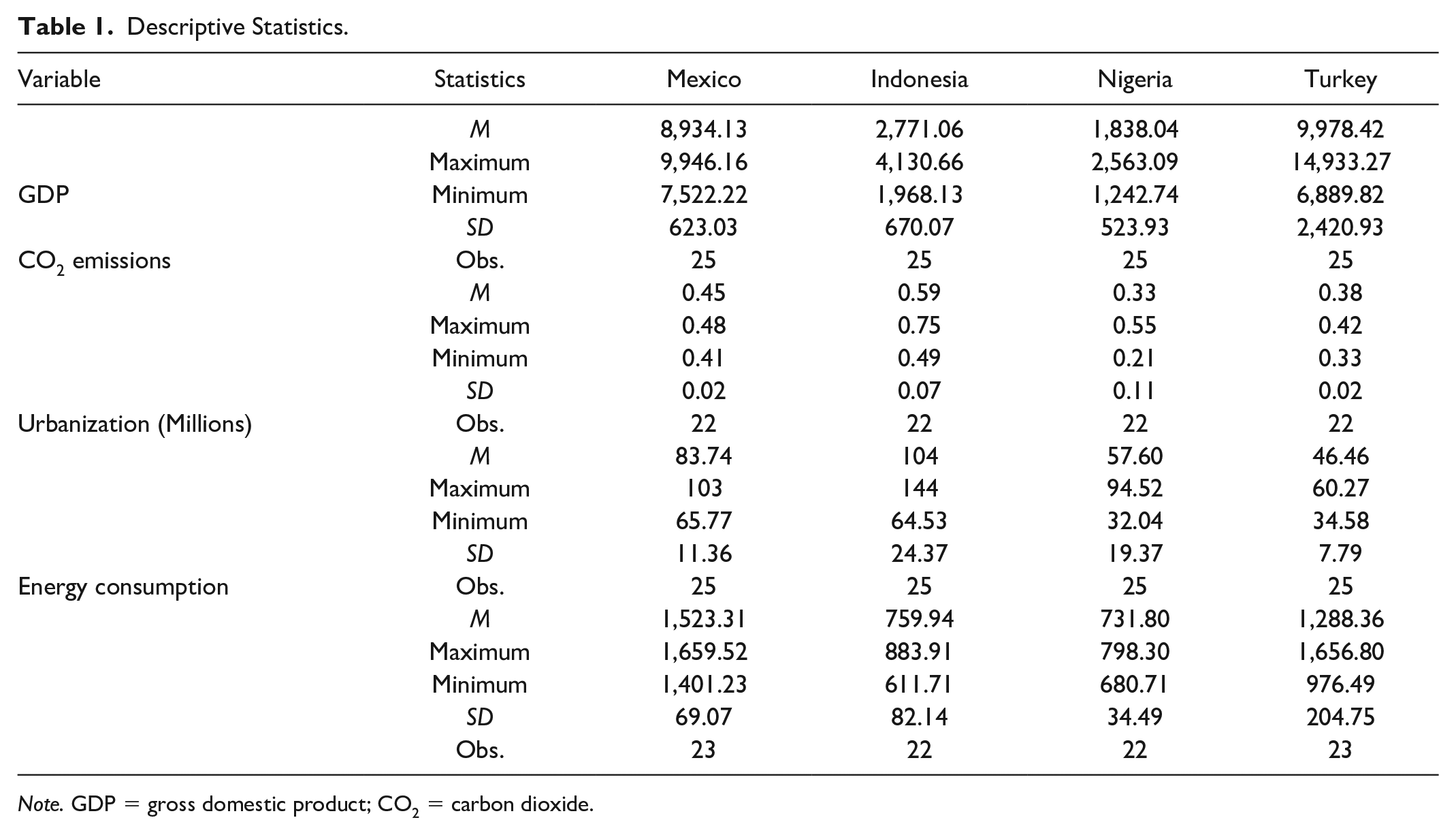
Note. GDP = gross domestic product; CO2 = carbon dioxide.
Figures 1, 2, 3, and 4 depict economic growth, energy consumption, urbanization, and CO2 emissions for MINT countries in the period under observation. Apparently, among the countries, Turkey exhibits an upward trend in its GDP, whereas other countries maintained a relatively flat growth. For CO2 emissions, Indonesia shows the highest CO2 emissions which experienced a sharp upward movement around 2011 but declined in the following year. In respect of urbanization, Indonesia maintained the highest urbanization among the four countries; however, the four countries maintained almost the same pattern in their energy consumption. Further descriptive data are shown in Table 1. For GDP, the maximum mean value is observed in Turkey, whereas Nigeria exhibits the least GDP. While Nigeria still maintained the minimum CO2 emissions, Indonesia shows the highest CO2 emissions. For urbanization, the minimum urban population was found in Turkey, whereas Indonesia maintained the highest urbanization among the MINT countries.
However, the pattern of the energy consumption changed with Mexico having the highest energy consumption, whereas the minimum was still found in Nigeria, which could be attributed to its low level of industrialization.
Method
This study first proposed a single equation with four time series Yt, Xt, Kt, Zt as follows:

In line with ARDL bounds test as proposed by Pesaran et al. (2001), we first ensured that none of the series employed in this study is I(2). Therefore, the stationarity test was done using the Augmented Dickey–Fuller (ADF) test and Phillips–Perron (PP) test. The ARDL model with Bound Test method was predicated on ordinary least squares (OLS) estimation which used a conditional unrestricted error correction model for determining cointegration among the variables employed. This is to ensure whether there is a long-run relationship between the variables. According to Pesaran et al. (2001) cited in Cai et al. (2018), ARDL for this study could be written as follows:

where Yt is a vector and the variables in (Xt) are allowed to be purely I(0) or I(1) or cointegrated; β and δ are coefficients; γ is the constant; I = 1, . . ., k; p and q are optimal lag orders; εit is a vector of the error terms.
However, where there is cointegration according to Pesaran et al. (2001), the model could be written as follows:

The lag order is necessary to avoid overparameterization of the model. In line with Goh et al. (2017), Breusch–Godfrey Serial Correlation LM (Lagrange multiplier) test was employed to test for serial correlation in each equation, whereas Breusch–Pagan–Godfrey heteroskedasticity was also used to determine that the model is free from the heteroskedasticity problem. Jarque–Bera test was however employed for normality tests. As for the stability of the model, this study followed the work of Thao and Hua (2016) which cited the work of Narayan and Smyth (2005), that the cumulative sum of recursive residuals (CUSUM) should be applied in determining the stability of ARDL model.
The choice of ARDL Bound test approach for this study was based on the argument of Pesaran and Pesaran (1997) cited in Thao and Hua (2016) that the method performs significantly in case of small size. It also contradicts the conventional way of determining long-run relationship, which failed to estimate the ARDL method system of equation, rather only estimate a single equation, and has the ability to accommodating different variables in a model with different optimal lag. Finally, Pesaran et al. (2001) argued that in a situation where the nature of the stationarity of the data is confusing, the application of the ARDL bounds test is useful.
Results and Discussions
Result for Unit Root Test
In order not to get an unpredictable outcome in our time-series analysis, it is then necessary to employ the unit root test to determine the stationarity of our data set. The ADF test and PP test, which was built on Dickey–Fuller test, were also employed to ensure that none of the variables employed in the analysis is integrated at I(2) so as not to violate the assumptions of ARDL (Pesaran et al., 2001). Table 2 shows that across the MINT countries, the LGDP, CO2, LURB, and LEC are integrated at I(1). Therefore, as the assumption of ARDL is not violated, it is safe to proceed with further empirical analysis.
Unit Root Test.
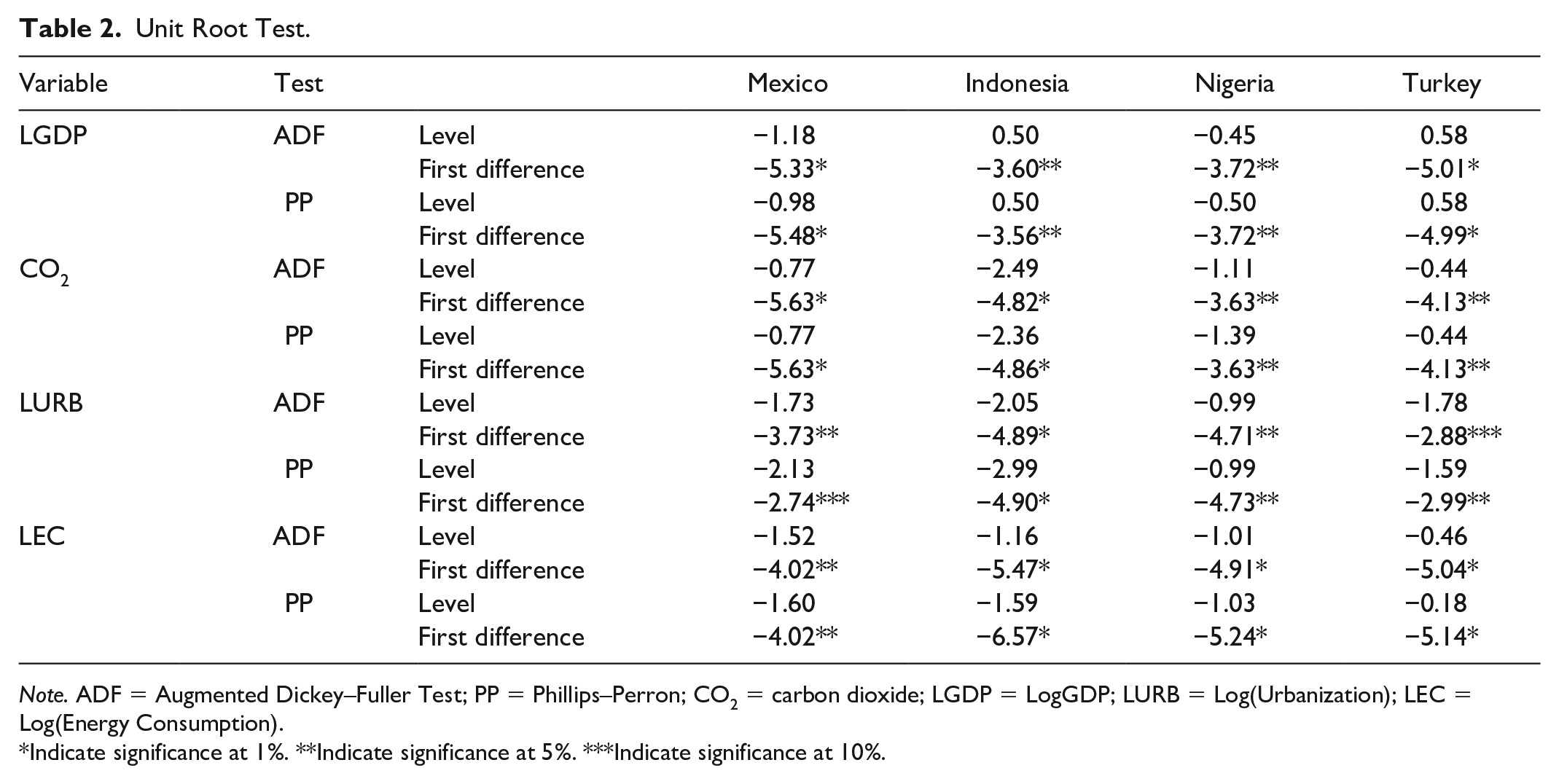
Note. ADF = Augmented Dickey–Fuller Test; PP = Phillips–Perron; CO2 = carbon dioxide; LGDP = LogGDP; LURB = Log(Urbanization); LEC = Log(Energy Consumption).
Indicate significance at 1%. **Indicate significance at 5%. ***Indicate significance at 10%.
Result for ARDL Bounds Testing for Cointegration
As shown in Table 3, the result for Mexico when GDP is the dependent variable reveals that there is cointegration among GDP, CO2, urbanization, and energy consumption. This is an indication that there are possibilities of long-run relationship among the variables, and as such, there is a need to estimate the error correction model to determine the speed of adjustment in case there is a shock. Meanwhile, only ARDL (short-run model) was estimated when CO2 is the dependent variable because the result from the ARDL bounds test for cointegration indicates that there is no cointegration. Similarly, there is no cointegration when urbanization is also a dependent variable, which means that only short-run model was performed. However, Table 3 reveals a cointegration when energy consumption is the dependent variable; therefore, the error correction model was estimated.
The ARDL Bound Testing for Co-Integration.

Note. ARDL = Autoregressive-Distributed Lag; CO2 = carbon dioxide; LGDP = LogGDP; LURB = Log(Urbanization); LEC = Log(Energy Consumption).
As for Indonesia, the result from bounds test reveals a cointegration only when urbanization and energy consumption are dependent variables, whereas the other two variables (GDP and CO2) show no cointegration from the bounds test. In the case of Nigeria, three of the variables show cointegration when they are substituted as the dependent variable, these are CO2, urbanization, and energy consumption. In that case, the error correction model was performed for these three models to determine whether the long-run relationship is significant and to ascertain the speed of adjustment. Finally, Turkey is the only country among the four MINT countries that shows cointegration for the four models. It is assumed that a bidirectional long-run relationship exists among economic growth, CO2, urbanization, and energy consumption.
Estimates of Causal Relationship
In respect of the fact that there exists a long-run relationship among economic growth, CO2, urbanization, and energy consumptions in Mexico and Turkey, the error correction model was estimated to determine the long-run relationship and the speed of adjustment. Table 4 shows that CO2, urbanization, and energy consumption have a stable long-run causal relationship with economic growth in two countries (Mexico and Turkey). The Error Correction Term (ECT) coefficient for both countries is −1.37 and −1.04, respectively, which are both found to be statistically significant. The result implies that in the presence of shock, it will take both countries a long time to return back to equilibrium as a result of the high speed of adjustment. This result is in agreement with the studies of Acheampong (2018), Bakirtas and Akpolat (2018), Wang et al. (2018), who found similar result of a long relationship among GDP, CO2, urbanization, and energy consumption.
The Results of Granger Causality Test.
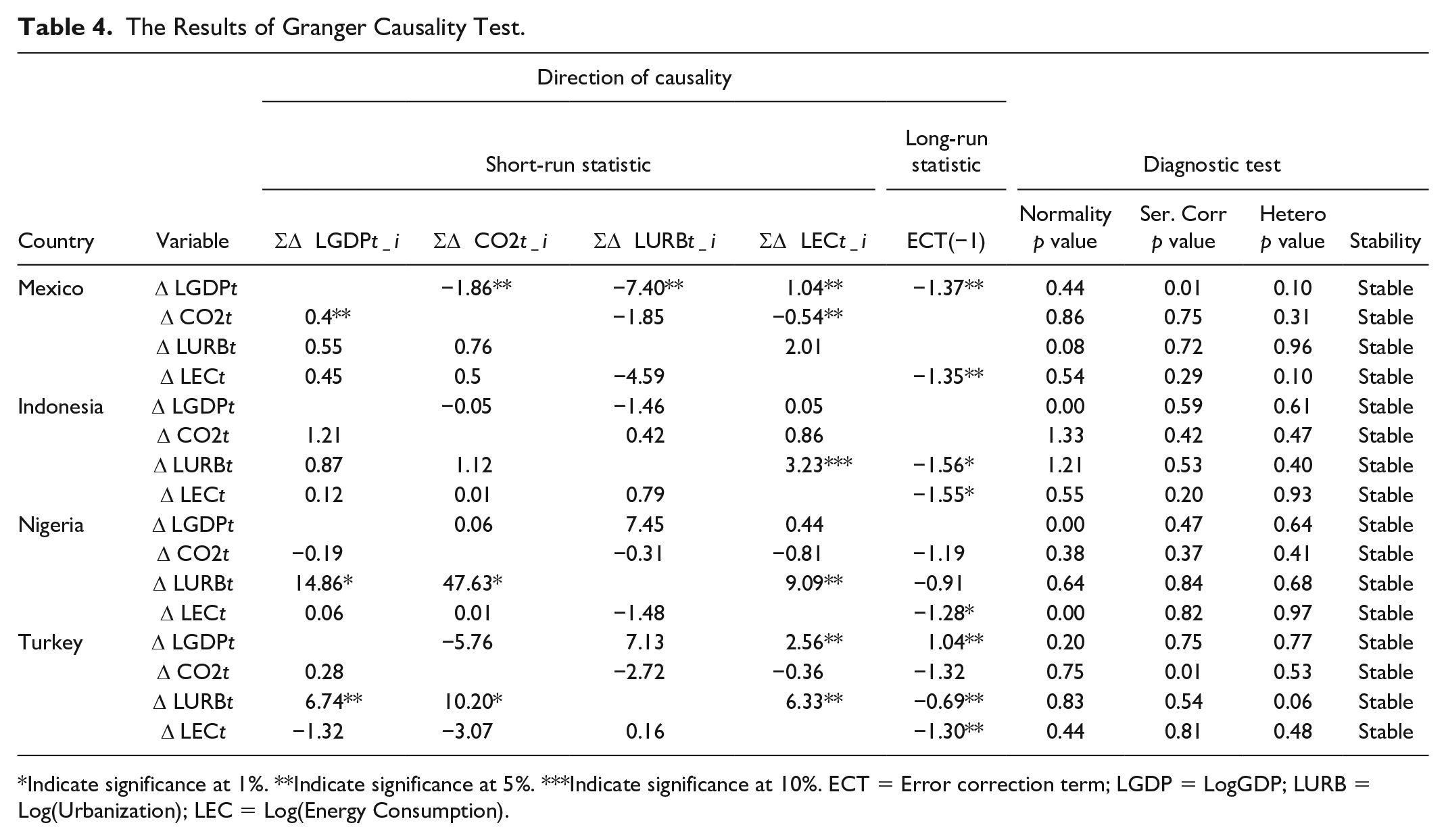
Indicate significance at 1%. **Indicate significance at 5%. ***Indicate significance at 10%. ECT = Error correction term; LGDP = LogGDP; LURB = Log(Urbanization); LEC = Log(Energy Consumption).
Moreover, the results shown in Table 4 and Figure A1 reveal that there is also short-run causality running from energy consumption to economic growth in both Mexico and Turkey, whereas urbanization has short-run causality to economic growth only in Mexico. The result is in agreement with the study of Araç and Hasanov (2014) and Bakirtas and Akpolat (2018) who found similar results in both Turkey and Mexico. The implication of these findings from Mexico and Turkey is that the two countries should formulate a policy that will transform their industries to a green economy which is the best way to guide against the environmental challenges that will emanate from economic growth.
On the variables that contribute to the CO2 emissions in the MINT countries, the result depicted in Table 4 and Figure A1 reveals that although Turkey has economic growth, urbanization, and energy consumption to have a long-run relationship with CO2, the significance of the causality could not be established. This result is in contrast to the studies of Acheampong (2018) and Wang et al. (2018) who found a long-run impact of economic growth on CO2 emissions at the global level, and Esso and Keho (2016) who found a long-run relationship in Nigeria, because their findings could not be substantiated among the MINT countries. However, only Mexico shows a negative causal impact of energy consumption on CO2 emissions among the MINT countries. This finding corroborates the studies of Akin (2014) and Wang et al. (2018) who earlier established the impact of energy consumption on CO2 emissions. Meanwhile, there is short-run causality running from economic growth to CO2 emissions in Turkey (Figure A1). The result is in agreement with Shahbaz et al. (2018) who had earlier established similar results.
The result of Granger causality shown in Table 4 reveals that among the four MINT countries, Indonesia, Nigeria, and Turkey were found to have a long-run causal relationship among urbanization, CO2 emissions, economic growth, and energy consumption. The long-run relationship was found to be statistically significant in Indonesia and Turkey, but could not establish the long-run relationship in Nigeria. However, in Nigeria, the Granger causality test shows that there is positive short-run causality running from economic growth to urbanization (Figure A1). This result is consistent with the works of Bakirtas and Akpolat (2018) and Wang et al. (2018) who had previously established similar results. The result from Table 4 further shows CO2 Granger-cause urbanization in Nigeria and energy consumption Granger-cause urbanization. The implication of these results in Nigeria is that there is a need for policy in Nigeria to stem the rate of urbanization to reduce the environmental problem that will arise from the challenges of urbanization.
The cointegration result as shown in Table 3 reveals that there exists long-run relationship among energy consumption, economic growth, CO2 emissions, and urbanization in Mexico, Indonesia, Nigeria, and Turkey. The long-run relationship was estimated for the four MINT countries, and in all the four countries, the results found a statistically significant long-run relationship among energy consumption, economic growth, urbanization, and CO2 emissions. The ECT coefficients of stable long-run relationship for Indonesia, Nigeria, and Turkey are above 100% speed of adjustment, which are −1.55, −1.28, and −1.33, respectively; the coefficients were nevertheless found to be statistically significant, and it is consistent with previous studies (Acheampong, 2018; Araç & Hasanov, 2014; Esso & Keho, 2016; Saidi & Hammami, 2015; Shahbaza et al., 2016). The results imply that it will take a long period for the system to adjust back to equilibrium in the presence of shock. The implication of this is that the new emerging economic block called MINT should develop an energy–growth policy that will put into consideration the rate of urbanization and CO2 emissions.
The results from the above analysis were subjected to diagnostic tests. The result as shown in Table 4 reveals that all the models found to be statistically significant passed the normality, serial correlation, and heteroskedasticity tests. Also, the stability of the models as depicted in Figure A2 shows that they all fall within 5% significance level boundary. This implies that the models are stable and safe to use for policy making.
Conclusion and Policy Implications
The study has examined the synergy among economic growth, CO2 emissions, urbanization, and energy consumption for a sample of MINT countries. The findings are mixed across the MINT countries. The empirical result for the long run indicates that in Mexico, there is a bidirectional long- and short-run relationship between economic growth and energy consumption. Energy growth in Mexico was also found to be associated with CO2 emissions and urbanization in the long run. Further analysis shows that long-run causal relationship exists between urbanization and energy consumption, and CO2 emissions and energy consumption. In the short run, bidirectional causality was found between economic growth and CO2 emissions, whereas unidirectional causality was found running from energy consumption to CO2 emissions. The result from the analysis suggests that energy and CO2 emissions preventable policies should be put in place without being detrimental to economic growth and urbanization.
To ensure a sustainable urbanization and energy consumption in Indonesia, there is a need to put in place an urban development policy that will accommodate the rate of urbanization, and energy policy that will ensure the sustainability of the energy consumption in the long run. The long-run causal relationship estimation from Indonesia shows that there is a bidirectional long-run causal relationship between urbanization and energy consumption; the unidirectional long-run causal relationship was found running from economic growth to urbanization, CO2 running to urbanization, and economic growth running to energy consumption. Meanwhile, short-run unidirectional causality was found running from energy consumption to urbanization.
In the case of Nigeria, a unidirectional long-run relationship was found to be running from economic growth to energy consumption, CO2 emissions running to energy consumption, and urbanization running to energy consumption. However, a unidirectional short-run causality was found to be running from economic growth to urbanization, and also a unidirectional short-run causality was found running from energy consumption to urbanization. As for Turkey, a bidirectional long-run relationship was found between economic growth and energy consumption, economic growth and urbanization, and urbanization and energy consumption. Moreover, unidirectional long-run association was found running from CO2 emissions to economic growth, from CO2 to energy consumption, from CO2 to urbanization. Meanwhile, unidirectional short-run causality was found running from energy consumption to economic growth.
The implication of results found in this study on MINT countries suggests that the growth hypothesis that assumes unidirectional causality from energy consumption is true for Nigeria and Indonesia, whereas Mexico and Turkey followed the feedback hypothesis, which shows there is a bidirectional relationship. It is therefore pertinent for the MINT countries to develop energy conservation policies that will increase their economic growth. This policy should be geared toward ameliorating CO2 emissions. However, in this regard, structural policies are required, so that the environmental quality will improve, so also the economic growth. There is a need for the countries in the block to enhance their energy efficiency by implementing green technologies as well as encouraging the use of renewable energy. In addition, the heavy dependence on fossil fuel should be substituted with renewable energy, as fossil fuel is the main contributor to GHGs.
Furthermore, there is a need for the MINT countries to transform their industries to a green economy, which is the best way to guide against the environmental challenges emanating from economic growth. The countries in the MINT block should enforce their rules and regulations regarding the conservation of the environment so that environmental health is more emphasized.
Finally, to achieve urbanization sustainability in MINT countries, effective energy, economic, and environmental policies are required to guide the rate of urbanization development in those countries without compromising the economic growth and to ensure decrease in CO2 emissions to achieve quality environment. The policymakers in urban planning in the MINT countries should aim toward the reduction of the urbanization level by practicing an effective land use to encourage green and intelligent urbanization, which will to some extent ameliorate the influence of urbanization on the environmental degradation.
Footnotes
Appendix
Declaration of Conflicting Interests
The author(s) declared no potential conflicts of interest with respect to the research, authorship, and/or publication of this article.
Funding
The author(s) received no financial support for the research, authorship, and/or publication of this article.
